
Mr Reid, Tear Down This Filibuster
Posted: November 8, 2012 Filed under: U.S. Politics | Tags: Filibuster, Filibuster Reform, gridlock, Harry Reid, Mr Smith Bill 42 Comments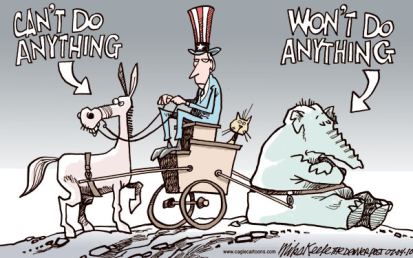 One of the most frustrating things that’s happened in the last few years has been the overuse and misuse of the filibuster. Senate Majority Leader Harry Reid--see the morning post–has decided that one of his top priorities will be to pass legislation to tighten rules on the use of the filibuster in the legislative chamber. The overuse of the lazy Senator’s filibuster has stymied nearly every attempt to get Democratic legislation through the Senate.
Bloomberg has an excellent article on the changes that will be proposed and what impact this could have on an Obama second term. The bill is called “The Mr Smith” bill. It’s be reintroduced by Sen. Frank (D-NJ). The bill would require those who want to filibuster a nomination or a bill to appear on the floor and actually speak. This means that Republican senators can’t just scream filibuster and the go home to dinner and cocktails. The bill was first introduced in 2011.
“The filibuster is being abused to create gridlock and prevent the Senate from doing the people’s business. Instead of being a deliberative body, the Senate has become a deadlocked body,” Lautenberg said in a press release Wednesday. “The ‘Mr. Smith Bill’ would help break the obstruction in Washington, bring transparency to lawmaking and hold senators accountable for their actions. This bill will stop senators from launching a filibuster and then skipping off to dinner, leaving our work in a stalemate.”
The bill — co-sponsored by Sens. Dick Durbin, D-Illinois, and Kirsten Gillibrand, D-New York — also would require that the Senate move for an immediate vote once debate ends and those conducting the filibuster give up the floor.
“Right now, senators are allowed to filibuster and force the Senate to use up a week or more on a single nomination or bill, even if there is no debate occurring on the floor,” Lautenberg’s office said. “Under the Lautenberg proposal, that time could be reduced significantly.”
Typically, a Senate rule change requires a super majority of 67 yes votes, something that will be difficult for Democrats, with their narrow 53-seat majority, to achieve. However, on the first legislative day of a new Congress, a simple majority of senators, just 51 votes, can approve new rules.
According to Lautenberg’s office, 91 cloture votes were taken in the 111th Congress — almost “four times the 24 cloture votes taken 20 years ago and almost double the 54 cloture votes required in the 109th Congress (2005-2006), when Republicans were last in the majority.”
This is the first item that would reform the procedure that became infamous in the Jimmy Stewart movie. It has moved from being a true expression of frustration with a piece of legislation or a process to a systematic way to gridlock. It has increased the polarization that characterizes Congress these days. It isn’t used to either protect the rights of the minority or to force debate. It’s used for pure political gain. The Bloomberg article states that “there were more filibusters between 2009 and 2010 than there were in the 1950s, 1960s, and 1970s combined”. This will give you an idea of what’s become of a symbol of democracy. It’s became a way for Mitch McConnell to hold back progress including help for the unemployed, veterans, victims of domestic abuse, and judicial appointments. Newly elected Senators appear to be on board for reform.
Chris Murphy, the incoming Democratic senator from Connecticut, couldn’t have been clearer: “The filibuster is in dire need of reform,” he told Talking Points Memo. “Whether or not it needs to go away, we need to reform the way the filibuster is used, so it is not used in the order of everyday policy, but is only used in exceptional circumstances.”
Angus King, the independent senator-elect from Maine, said, “My principal issue is the functioning of the Senate.” He backs a proposal advanced by the reform group No Labels that would end the filibuster on motions to debate, restricting filibusters to votes on actual legislation. The group also wants to require filibustering senators to physically hold the Senate floor and talk, rather than simply instigate a filibuster from the comfort of their offices.
And it’s not just the new guys. In an election-night interview on MSNBC, Senator Dick Durbin ofIllinois, the Democrats’ second-in-command, emphasized the importance of filibuster reform. Senate Majority Leader Harry Reid is a committed guardian of institutional prerogatives who put the kibosh on filibuster reform in the previous Congress. But even he has given up protecting the practice. “We can’t go on like this anymore,” he told MSNBC’s Ed Schultz. “I don’t want to get rid of the filibuster, but I have to tell you, I want to change the rules and make the filibuster meaningful.”
That doesn’t go nearly far enough. The problem with the filibuster isn’t that senators don’t have to stand and talk, or that they can filibuster the motion to debate as well as the vote itself. It’s that the Senate has become, with no discussion or debate, an effective 60-vote institution. If you don’t change that, you haven’t solved the problem.
Common Cause actually sued the US Senate this year to end the filibuster.
Enter Common Cause. It argues that a minority in the Senate has used the filibuster to hold up all manner of legislation, including (most importantly, for this suit), the
DISCLOSE Act (to tighten electioneering disclosure requirements in the wake of Citizens United) and the DREAM Act (to create a path to U.S. citizenship for certain aliens). It argues that the 60-vote requirement in Senate Rule XXII violates the default parliamentary majority-takes-all rule, the careful balance of powers in the legislative branch and between the three branches, and the power of the Senate itself to changes its own rules (because along with Rule V (which continues the Senate rules from Senate to Senate) Rule XXII seems to require that 3/5 of Senators vote to change Rule XXII). In particular, Common Cause argues that the filibuster violates the Quorum Clause, the Presentment Clause, the power of the VP to break a Senate tie, the Advice and Consent Clause, and the equal representation of the states in the Senate–all of which in different ways assume majority rule. It also argues that the filibuster is in tension with the eight constitutional exceptions to majority rule.
Again, the Bloomberg article says it best and btw, it’s written by Ezra Klein.
Party polarization has turned the filibuster into a noxious obstacle. Filibusters are no longer used to allow minorities to be heard. They’re used to make the majority fail. In the process, they undermine democratic accountability, because voters are left to judge the rule of a majority party based on the undesirable outcomes created by a filibustering minority.
Ideally, a bipartisan majority of senators would end the filibuster — either immediately or with a delayed trigger six years after a deal is struck — so neither party would know which is poised to benefit. But doing away with the filibuster in the next Congress has some appeal, too. Democrats control the Senate and Republicans control the House; there will be no instant power grab leading to one-party dominance.
So, go Harry. If they’re going to cause gridlock, then at least make them stand on the Senate floor until they drop. The American people deserve explanations instead of secretive political maneuvers.
Friday Reads
Posted: December 9, 2011 Filed under: morning reads | Tags: captured drone, Christopher Hitchens, Filibuster, iran, recession, Senate Republicans, unemployment 20 Comments Good Morning!
I had another week full of weird things to do. I completely forgot my driver’s license expired last month on my birthday and had to rush out to get it renewed. I really don’t keep track of my age at all any more so I forgot the entire divisible-by-four thing. I also have been rushing around doing odds and ends that have just been driving me nuts. It just seems life is just one complex set of paperwork to fill out for someone or another these days. This week I had to prove all kinds of things to all kinds of people. I guess no one takes you at face value any more. We’ve turned into a nation where you have to show every one your papers. It made the week a combination of something Kafkaesque and Stalinesque. I simultaneously wanted to laugh, cry, and slap people multiple times this week.
There’s an interesting article at The Atlantic on how the economic recovery is affecting women differently from men. The article is called “The Recession was Sexist (So is the Recovery)” and it’s worth a read. It’s written by Jordan Weissmann.
Since November 2010, 70% of new jobs have gone to men. At first blush that sounds reasonable. If men lost more jobs, they should also recoup more. The problem crops up when you look at the number of job gains as a fraction of losses. Men have regained about a third of the jobs they shed in the recession. Women have only regained about one in five.
Ladies and gentlemen, we have a gender gap. And it’s not clear whether it will narrow. In November, female job gains actually outpaced males, 65,000 to 55,000. But going forward, women are going to have to contend with one of the most nastiest forces in job market: government budgets.
As the graphic to the left shows, women far outnumber men on state and local government payrolls, especially in public schools. Early in the recession, those employers were propped up by stimulus money. No longer. We live in an age of belt tightening, and government employees are being shown the door by the thousands. Last month, state and municipal payrolls shrank by 16,000 workers. There’s no sign of the trend letting up.
If you want to see the graphs that go with the discussion, you should check the article out. The trend is really noticeable.
There’s also continued filibusters from Mitch McConnell of anything that could remotely help the unemployed, families hurt by recession, and anything that looks like it might have gone near the President. I can’t believe all this belligerence is a winning strategy for them, but only time will tell. As much as I’ve had problems with Obama, McConnell’s got me so hopping mad and the clown set running for the Republican nomination have me more distressed. I’ve never seen a bunch of more mean-spirited, ignorant, hateful, religious fanatics in my life. In this situation, Obama is definitely the lesser of evils. This is an election that will bring the definition of evil to a new nadir. There’s not a woman- or child-friendly politician to be had any where.
The filibuster — a stall tactic that requires time-consuming motions and 60 votes to overcome — can be used on virtually all Senate business, including on whether to even bring up bills for debate.
…
Democrats say Republican tactics this week will come back to haunt them. On Thursday, Republicans are well-positioned to filibuster the nomination of Richard Cordray to head the new Consumer Financial Protection Bureau. For weeks, the GOP has demanded several changes to the bureau to roll back its powers.
Democrats say it’s “the first time in history” that a nominee will be blocked because of the concerns over the agency that the person was selected by the president to head — rather than the qualifications of the nominee.
“I said to some of my Republican colleagues, ‘Do you want this to happen when someday there’ll be a Republican president?’” said Sen. Sherrod Brown (D-Ohio). “It’s clearly a terrible precedent.”
en. Bob Menendez (D-N.J.) said he didn’t think any minority should adopt such tactics that he called “highly dangerous for the country.”
Republicans are highly dubious of the claims, saying there’s nothing unusual over holding up nominees until legitimate concerns over policy are addressed.
“This is the first time in history that I’m aware of that an agency of this kind has been created,” said Sen. Mike Crapo (R-Idaho), a member of the Senate Banking Committee.
The tit-for-tat has been going on since Tuesday when Republicans sustained a filibuster by a 54-45 vote on the Halligan nomination to the D.C. appellate court, accusing President Barack Obama of nominating an “activist judge” hostile to gun rights.
But Democrats said she was a well-qualified nominee with an exemplary résumé, and that the standard set by the so-called Gang of 14 senators in 2005 to only filibuster judicial nominees in “extraordinary circumstances” had been effectively nullifed.
Ruemmler, the White House counsel, said she could “rattle off a litany of folks who would be on any Republican shortlist” that would be rejected under the new standard, like attorney Paul Clement who is representing Republicans in the House in defending the Defense of Marriage Act. But she said it would be “ridiculous” if Democrats did that over such an ideological dispute.
The White House points to 20 judicial nominees awaiting Senate action, several of whom would fill posts considered “emergency” vacancies, and officials complain that the chamber is moving at a much slower pace now than it was when Bush was in office.
Iran has been showing film of a captured US drone. There’s been confirmation now that the film is authentic and so is the drone. This confirms some of the rumors floating around earlier this week.
Iran’s Press TV said that the Iranian army’s “electronic warfare unit” brought down the drone on 4 December as it was flying over the city of Kashmar.
Brig General Amir-Ali Hajizadeh, head of Iran’s Revolutionary Guards’ aerospace unit, told Iranian media that the drone “fell into the trap” of the unit “who then managed to land it with minimum damage”.
He said Iran was “well aware of what priceless technological information” could be gleaned from the aircraft.
Nato said at the weekend that an unarmed reconnaissance aircraft had been flying a mission over western Afghanistan late last week when its operators lost control of it.
Pentagon officials have said they are concerned about Iran possibly acquiring information about the technology.
I still haven’t gotten used to seeing armadillos all around the place since I moved down here. Looks like Kentucky is going to have to get used to them too as they are moving north and east. The move started in the 1980s and has been increasing since then. Like many local critters, they appear to be moving north with climates getting warmer.
“The first road-killed armadillo I encountered in Kentucky was in 2003, and the first live one I saw was in 2006,” said John MacGregor, a herpetologist with the Kentucky Department of Fish and Wildlife Resources.
MacGregor said in recent years there have been several confirmed sightings by staff biologists in eastern and south central Kentucky.
Steve Bonney, northeastern region wildlife coordinator for Kentucky Fish and Wildlife, encountered a road-killed armadillo in Rowan County in 2009 on the way to work. “I routinely record road kills. When I saw what I thought was an armadillo, my radar went off,” said Bonney. “It kind of shocked me.”
When Bonney arrived at work, he immediately drove back to the site of the road kill on Ky. 801 in Farmers, Kentucky to photograph and pick up the armadillo.
Of the 20 known species of armadillos, the nine-banded armadillo is the most widely distributed. It is the only armadillo species to have
ventured north of Mexico. Today, the nine-banded armadillo is established as far east as South Carolina and as far west as southern Nebraska. Loughry said range expansion “has been consistent over the years, and is the continuation of a long-term trend.”
But what biologists can’t agree on is why range expansion is occurring so fast. Factors that may be fueling this expansion include: climate change, the armadillo’s general adaptability, its high reproductive rate and little desire on the part of humans to hunt or eat armadillos.
The two most likely things to cause armadillo mortality are getting run over by vehicles on roads or being eaten by coyotes.
If any of them amble up to a neighborhood near you, here’s some cajun recipes for those of you brave enough to try them.
Here’s an interesting interview with Bruce Judson on the Societal Dangers of income inequality. Judson is a professor of management that specializes in entrepreneurship at Yale School of Managment. He has a new e-book coming out on making capitalism work for the 99%. BC is Bryce Covert of ND 2.0.
BC: What does inequality mean for the middle class, which is the foundation of our country’s economy?
BJ: Early America lacked the class barriers then prevalent in Europe: Everyone mixed with each other. This led the more fortunate to have empathy and a visceral understanding for the problems of the less fortunate. As economic inequality has increased, we see far less mixing among people at different income levels. Now everyone has less of a sense that they are part of one large community and that we have a responsibility to each other.
Political theorists, going back to Aristotle, have all concluded that a vibrant middle class is essential for a vibrant democracy. The members of the middle class hope to move up, so they want mobility to remain a desirable option, but they also fear moving down, so they are more likely to support a social safety net. In essence, the middle is the group that ensures stability as a barrier to legislative extremes that unduly reward the wealthy or harm the poor.
Unfortunately, inequality that chips away at the middle class can lead to violence. There was violence that occurred in the Depression, with riots in the Midwest. People also started to take the law into their own hands. In penny auctions, after your farm was foreclosed on, you showed up at the courthouse with all of your friends — farmers who had their rifles with them — and took over the bidding and bought back your farm for penny. As income inequality increases, the dispossessed may start to feel they have been treated unfairly and things can get ugly.
BC: Your work also predicted revolution. What’s your current take?
BJ: The book did not predict revolution. The book said that if we allow income inequality to continue growing unchecked, then we would face a high risk of political instability or revolution. We discussed earlier how the book detailed a series of stages, or a narrative, for how growing economic inequality can lead to social upheaval. Unfortunately the narrative I detailed seems to be happening.
My best estimate is we have now passed through 60 percent of the narrative. A lot needs to happen before the risk of political instability becomes a reality. I am hopeful that with inequality now on the national agenda, we will see the reforms needed.
So, there’s a lot of juicy stuff in that interview including Judson’s take on the Occupy movement.
BC: Does the emergence of the Occupy Wall Street movement make you more or less hopeful for the nation’s future?
BJ: It absolutely makes me hopeful that we will start to see some meaningful reforms. The Occupy movement is casting a bright and unforgiving light on some of the unacceptable practices in our society that, sadly, have become commonplace.
I believe the Occupy movement is not going away. The reason it grew so quickly is that it was the flashpoint for the country’s anger and widespread feelings of unfairness. It’s almost inevitable that in some way it will expand to include people who feel they’ve been unfairly foreclosed on, the record numbers of Americans experiencing long-term unemployment, and many of the unemployed in general who feel they’ve been cheated out of the opportunity to work – mainstream America.
The danger is that if the Occupy movement does not succeed, and nothing takes its place, we will move further along the narrative I described.
So, that’s my offerings this morning. I have a few more paper chases to do today before I settle in for the weekend. I’m thinking I’ll end this week with a nice long soak in the tub, some read wine, and the new Vanity Fair with the Gaga in red pic on the cover. I’m going to read about the romance between Queen Elizabeth and Prince Phillip and look at all those really old photos. I’d say that out to put reality out of my mind for awhile. Okay, I’m going to read the Stiglitz article first (Fix the Economy? What Obama and the GOP won’t tell you). Then, I’m going to read Christopher Hitchens on Nietzsche, then I’ll do the Queen’s young romance. So, okay, I”ll give you one taste.
Hitchens describes chemotherapy. This is something I know well. I also know what it’s like to kiss death and know that it hovers over your bed waiting for you to move closer to its embrace.
I often grandly say that writing is not just my living and my livelihood but my very life, and it’s true. Almost like the threatened loss of my voice, which is currently being alleviated by some temporary injections into my vocal folds, I feel my personality and identity dissolving as I contemplate dead hands and the loss of the transmission belts that connect me to writing and thinking.
These are progressive weaknesses that in a more “normal” life might have taken decades to catch up with me. But, as with the normal life, one finds that every passing day represents more and more relentlessly subtracted from less and less. In other words, the process both etiolates you and moves you nearer toward death. How could it be otherwise? Just as I was beginning to reflect along these lines, I came across an article on the treatment of post-traumatic stress disorder. We now know, from dearly bought experience, much more about this malady than we used to. Apparently, one of the symptoms by which it is made known is that a tough veteran will say, seeking to make light of his experience, that “what didn’t kill me made me stronger.” This is one of the manifestations that “denial” takes.
I am attracted to the German etymology of the word “stark,” and its relative used by Nietzsche, stärker, which means “stronger.” In Yiddish, to call someone a shtarker is to credit him with being a militant, a tough guy, a hard worker. So far, I have decided to take whatever my disease can throw at me, and to stay combative even while taking the measure of my inevitable decline. I repeat, this is no more than what a healthy person has to do in slower motion. It is our common fate. In either case, though, one can dispense with facile maxims that don’t live up to their apparent billing.
Friday Reads
Posted: May 20, 2011 Filed under: abortion rights, Economy, Foreign Affairs, Israel, morning reads, Reproductive Rights, U.S. Economy, U.S. Politics | Tags: Federal Debt, Filibuster, Goodwin Liu, israeli Palestianian morass, President Obama, State Department Speech, Texas sonogram law 46 Comments Good Morning!
It is definitely the silly season! You can tell that an election count down is nearing in the District. A judge of Chinese descent was successfully blocked by Republican Senators and Ben NelSOB for sounding like a communist. Did we go back to the McCarthy era and I missed it?
Six years ago, Ninth Circuit judicial nominee Goodwin Liu published an op-ed in which he made the utterly banal point that a conservative interest group used the terms “free enterprise,”‘ “private ownership of property,” and “limited government” as “code words for an ideological agenda hostile to environmental, workplace, and consumer protections.” In a speech on the Senate floor yesterday, however, Sen. Chuck Grassley (R-IA) somehow managed to interpret this op-ed as proof that Liu wants to turn America into “Communist-run China”:
GRASSLEY: Does [Liu] think we’re the communist-run China? That the government runs everything? That it’s a better place when they put online every week a coal-fired plant to pollute the air, put more carbon dioxide into the air then we do in the United States, and where children are dying because food is poisoned, and consumers aren’t protected, and where every miner in the China coal mines is in jeopardy of losing their lives? That’s how out of place this guy is when he talks about “free enterprise,” “private ownership of property,” and “limited government” being something somehow bad, but if you get government more involved, like they do in China, it’s somehow a better place.
Republicans appear to be pulling out all the bells and dogwhistles for this one. This is the first time a judicial nominee has been blocked since 2005.
Liu also drew Republican ire over his criticism of Supreme Court Justice Samuel Alito in testimony when the conservative judge was nominated to the court.
“His outrageous attack on Judge Alito convinced me that Goodwin Liu is an ideologue,” South Carolina Sen. Lindsey Graham said before Thursday’s vote. “His statement showed he has nothing but disdain for those who disagree with him. Goodwin Liu should run for elected office, not serve as a judge.”
Imagine that! Some one with an opinion! Does that mean a person isn’t capable of honest judgement?
Obama gave a speech yesterday at the State Department indicating support for the Arab Spring and suggesting that a dialogue between Israel and Palestine is possible but must meet certain ground rules. One of these is controversial because it breaks with a speech given by President Bush that more or less accepted the reality of some Israel colonies in the occupied territories. That is that the negotiations be based on the 1967 agreement which would reverse Israeli colonization of territories that occurred after the agreement. Israel has already rejected the idea.
So while the core issues of the conflict must be negotiated, the basis of those negotiations is clear: a viable Palestine, a secure Israel. The United States believes that negotiations should result in two states, with permanent Palestinian borders with Israel, Jordan, and Egypt, and permanent Israeli borders with Palestine. We believe the borders of Israel and Palestine should be based on the 1967 lines with mutually agreed swaps, so that secure and recognized borders are established for both states. The Palestinian people must have the right to govern themselves, and reach their full potential, in a sovereign and contiguous state.
As for security, every state has the right to self-defense, and Israel must be able to defend itself -– by itself -– against any threat. Provisions must also be robust enough to prevent a resurgence of terrorism, to stop the infiltration of weapons, and to provide effective border security. The full and phased withdrawal of Israeli military forces should be coordinated with the assumption of Palestinian security responsibility in a sovereign, non-militarized state. And the duration of this transition period must be agreed, and the effectiveness of security arrangements must be demonstrated.
These principles provide a foundation for negotiations. Palestinians should know the territorial outlines of their state; Israelis should know that their basic security concerns will be met. I’m aware that these steps alone will not resolve the conflict, because two wrenching and emotional issues will remain: the future of Jerusalem, and the fate of Palestinian refugees. But moving forward now on the basis of territory and security provides a foundation to resolve those two issues in a way that is just and fair, and that respects the rights and aspirations of both Israelis and Palestinians.
Obama also made it clear that Hamas’ failure to recognize the state of Israel was a huge problem.
Now, let me say this: Recognizing that negotiations need to begin with the issues of territory and security does not mean that it will be easy to come back to the table. In particular, the recent announcement of an agreement between Fatah and Hamas raises profound and legitimate questions for Israel: How can one negotiate with a party that has shown itself unwilling to recognize your right to exist? And in the weeks and months to come, Palestinian leaders will have to provide a credible answer to that question. Meanwhile, the United States, our Quartet partners, and the Arab states will need to continue every effort to get beyond the current impasse.
The President said that US commitment to Israel is unshakeable but the status quo is unsustainable. The Israeli/Palestinian situation continues to the most vexing problem on the planet. If you’re going to venture an opinion, be aware that the topic creates such tension that its discussion is actually banned on many blogs. I’d prefer not to relive past experience myself but I thought it needed mentioning.
Lawrence Mishel of the Economic Policy Institute says “We’re not broke nor will we be”. It seems more and more economists are fighting back on the weird suggestion that a country with a huge economy, rich people, and tons of assets can’t invest in its own future because it’s broke. Here’s the link to the briefing paper. This is good explanation of why we are not Greece and will not go down the Greek Road. There are tons of nifty graphs so go check it out!!
Despite the rhetoric, it is clear that “we” as a nation are not broke. While the recession has led to job loss and shrinking incomes in recent years, the economy has produced substantial gains in average incomes and wealth over the last three decades, and economists agree that we can expect comparable growth over the next three decades as well. Between 1980 and 2010, income per capita grew 66.4%, and wealth per capita grew 73.2%. Over the next 30 years, per capita income is projected to grow by a comparable 60.6%. In other words, “we” are much richer as a nation than we used to be and can expect those riches to rise substantially in the future. So who is the we in the “we’re broke” mantra? The recession has certainly been a rough patch of road for many families, but the output produced by corporations in the private sector has already recovered to pre-recession levels, and these firms’ profi ts were 21.7% higher overall, driven largely by the 60% jump in pre-tax profi ts enjoyed by fi rms in the fi nancial sector.
Here’s why we can actually afford to invest in America and Americans!
Despite the fact that average incomes have increased substantially over the past 30 years, the federal government is currently running a projected defi cit of 9.8% of gross domestic product. As noted above, many use the deficit to support the “we’re broke” theme. But how can that be the case? How can the country have much more income, collectively, onwhich to draw, yet all levels of government are “broke” and unable to aff ord anything?
The answer is that revenue has declined substantially due to the recession and due to the Bush-era tax cuts. The Congressional Budget Offi ce projects federal revenues will be just 14.8% of GDP in the fi scal year ending September 30, 2011—by far the lowest revenue intake relative to GDP since 1951. In contrast, federal revenues totaled over 18% of GDP at the end of the last recovery (fi scal year 2007) and were roughly 20% at the end of the 1990s recovery. A largepart of the revenue shortfall can be attributed to legislated changes in taxes under George W. Bush, which lowered the revenue share by 2.1%.
As the economy recovers, the defi cit will fall as unemployment declines, as incomes and associated revenues increase, and as recession-sensitive expenditures automatically decline (expenditures for food stamps, unemployment benefits, Medicaid and other programs rise with the economic distress in a recession and fade as unemployment declines). This expected decrease in the defi cit is refl ected in CBO projections showing the defi cit declining from 9.8% of GDP in 2011 to just 3.0% in fi scal year 2015. Some of this decline can be attributed to the assumed expiration of the Bush tax cuts extended in 2010 and the inheritance tax change in 2010 (plus the R&D, ethanol, and fi rst-year depreciation tax breaks), which would total 2.9 percentage points of GDP that year. Even so, that still leaves the defi cit falling by 4.0 percentage points due to the recovery.
Texas officially joins the war on women by mandating sonograms before terminations. This is just more harassment and costs to women seeking to exercise their constitutional rights to privacy and self-determination. Ridiculous!
Texas Governor Rick Perry Thursday signed into law a measure requiring women seeking an abortion in the state to first get a sonogram.
Texas is one of several U.S. states with strong Republican legislative majorities proposing new restrictions on abortion this year. The Republican governor had designated the bill as an emergency legislative priority, putting it on a fast track.
Under the law, women will have to wait 24 hours after the sonogram before having an abortion, though the waiting time is two hours for those who live more than 100 miles from an abortion provider.
So, like I said, it’s the silly season which means there’s plenty of news out there that’s bound to upset people! What’s on your reading and blogging list today?
New Year’s Eve Reads
Posted: December 31, 2010 Filed under: Global Financial Crisis, Gulf Oil Spill, health hazard, morning reads, the blogosphere, The Little Blog that could, The Media SUCKS, U.S. Economy, U.S. Politics, Wikileaks, Women's Rights | Tags: Brazil's first woman president, Consumer Financial Protection Bureau, Dilma Rousseff, Elizabeth Warren, Filibuster, Marine mammals struggle with oil, New Media Report, oil spill, oiled marshes, Oily beaches, Pew Research, Reform, Senate, Tom Udall, Transocean 28 Comments
Good morning!
Today we begin to say good bye to 2010 and the first decade of the millennium and century! What a decade and what a year it has been! I don’t know about you, but just the last five years alone have turned my life upside down. (Think Hurricane Katrina, BP Oil Tsunami, and the financial crisis that has empowered thugs like Governexorcist Jindal to enforce absolute budget austerity on Louisiana and higher education.) Despite all that, we’re going to have an Airing of the Gratitude thread as part of the-Little-Blog-That-Could’s New Year’s Celebration. I’ve bought my black eyed peas and cabbage. Now, I’m making my list of things that I resolve to appreciate for the thread. I’d like to invite you to think about yours too and join in. A lot of my gratitude comes under the heading of my daughters, dad and sister, and my friends. That includes you ! We’re a blogging community that was forged from some really tough political times.
Meanwhile, here are some headlines to gear you up for the coming year and decade. May things improve for the better!! May peace and sanity prevail!! May every one’s health and circumstances improve tremendously! Many, many blessings to each and every one of you!
Are you pessimistic or optimistic about the coming year? A CNN poll shows a lot of people are optimistic about the the world outlook, but less so about their personal situation. Men are much more optimistic than women. Where do you fit in?
The Senate appears to have reached its limit on perpetually trying to find 60 votes for cloture and taking every ‘threat’ of a filibuster seriously. Brian Beutler at TPM is following the reform movement and the possible hurdles it faces.
The consensus package will aim to put an end to “secret holds” (anonymous filibuster threats) and disallow the minority from blocking debate on an issue altogether. Those two reforms are fairly straightforward. The third is a bit more complex. Udall, along with Sen. Jeff Merkley (D-OR), say there’s broad agreement on the idea to force old-school filibusters. If members want to keep debating a bill, they’ll have to actually talk. No more lazy filibusters.
But how would that actually work? In an interview Wednesday, Udall explained the ins and outs of that particular proposal.
“What we seem to have the most consensus on, is what I would call… a talking filibuster,” Udall told me. “Rather than a filibuster which is about obstruction.”
As things currently stand, the onus is on the majority to put together 60 votes to break a filibuster. Until that happens, it’s a “filibuster,” but it’s little more than a series of quorum calls, votes on procedural motions, and floor speeches. The people who oppose the underlying issue don’t have to do much of anything if they don’t want to.
Here’s how they propose to change that. Under this plan, if 41 or more senators voted against the cloture motion to end debate, “then you would go into a period of extended debate, and dilatory motions would not be allowed,” Udall explained.
As long as a member is on hand to keep talking, that period of debate continues. But if they lapse, it’s over — cloture is invoked and, eventually, the issue gets an up-or-down majority vote.
DDay at FDL has a thread up that offers a more detailed explanation. This includes a bit on what is being called ‘continuous debate’ which sounds a lot like that Jimmy Stewart movie “Mr. Smith goes to Washington” or what every one was hoping for when Bernie Sanders started talking a few weeks ago.
After 41 Senators or more successfully maintain a filibuster by voting against cloture, they would have to hold the floor and go into a period of extended debate. Without someone filibustering holding the floor, cloture is automatically invoked, and the legislation moves to an eventual up-or-down vote, under this rule change.
This would institute the actual filibuster. The Majority Leader would have the capacity, which Harry Reid says he doesn’t have now, to force the minority to keep talking to block legislation. It becomes a test of wills at this point – whether the minority wants to hold out for days, or whether the majority wants to move to other legislation.
Here’s hoping we can fix our broken government that is driven by corporate cash and interests and railroaded by imperious Senators. I’m not very hopeful that congress can actually fix itself, but I guess we’ll see. I will say that I do think Tom Udall is a good man. He’s one of the people that is fighting for an improved process.
I still have Louisiana and New Orleans on my mind right now. We have a new headline in our ongoing BP Oil Gusher Saga. This is from Raw Story. It appears the company that owns the rig–Transocean–is refusing to co-operate with the federal oil spill probe. I just want to find out what went wrong so we don’t ever repeat it. I’m sure all they are thinking about is the upcoming lawsuits.
Transocean said the U.S. Chemical Safety Board does not have jurisdiction in the probe, so it doesn’t have a right to the documents and other items it seeks. The board told The Associated Press late Wednesday that it does have jurisdiction and it has asked the Justice Department to intervene to enforce the subpoenas.
Last week, the board demanded that the testing of the failed blowout preventer stop until Transocean and Cameron International are removed from any hands-on role in the examination. It said it’s a conflict of interest. The request is pending.
Our economy is in sad shape down here and a good part of it is due to Transocean’s role in destroying livelihoods and life around the Gulf of Mexico. Human lives aren’t the only thing still struggling from the gulf gusher. Here’s some local news on that.
Scientists at the institute of Marine Mammal Studies in Gulfport are studying why two endangered manatees died near the Gulf Coast in the past two weeks.
According to the Institute’s Executive Director Dr. Moby Solangi, cold water killed the manatees, but they should have migrated to warmer water.
Scientists are finding an unusually large number of Gulf of Mexico animals out of place since the BP oil spill began.
“It is no different than having a forest fire,” Dr. Solangi said Thursday. “The oil spill expanded, it went thousands of square miles and as their habitat shrunk, these animals moved to areas that were not affected.”
The problem, according to Dr. Solangi, is those unaffected areas were also unfamiliar to the animals.
Too many turtles, for instance, wound up in waters off the Mississippi coast, where they didn’t understand the food supply.
300 turtles died in Mississippi.
Many more were caught by fishermen.
“In the past years, we would get one or two or maybe three animals, this year we had 57,” Dr. Solangi said.
He and his staff at the Institute for Marine Mammal Studies are now caring for dozens of sea turtles.
Of course, turtles in distress have to be swimming through some pretty nasty stuff in their environment. The shores along the Gulf are still oiled. Here’s a story about 168 miles of coast in Louisiana alone. This is from New Orleans own Times Picayune. Yes, folks, every single story I’m linking to on this is no more than a day old. We’re still living this nightmare down here.
Louisiana’s coastline continues to be smeared with significant amounts of oil and oiled material from the BP Deepwater Horizon disaster, with cleanup teams struggling to remove as much as possible of the toxic material by the time migratory birds arrive at the end of February, said the program manager of the Shoreline Cleanup and Assessment Teams, which are working for BP and the federal government.
There are 113 miles of Louisiana coastline under active cleanup, with another 55 miles awaiting approval to start the cleanup process, according to SCAT statistics. Teams have finished cleaning almost 72 miles to levels where oil is no longer observable or where no further treatment is necessary.
But that’s not the whole story for the state’s coastline. According to SCAT statistics, there’s another 2,846 miles of beach and wetland areas where oil was once found but is no longer observable or is not treatable.
Gary Hayward, the Newfields Environmental Planning and Compliance contractor who oversees the SCAT program, said that large area will be placed into a new “monitor and maintenance” category, once Louisiana state and local officials agree to the procedures to be used for that category.
“With rare exceptions, most of the marshes still have a bathtub ring that we have all collectively decided we aren’t going to clean any more than we already have because we’d be doing more harm to the marshes than the oil is going to be doing to them,” Hayward said.
Raise your hand if you heard any thing about any of this on your local newspaper or the national TV stations. We’re so out of sight and out of mind down here that some times I wonder if we’re even considered part of the country. You do realize that a majority of water-related commerce and a majority of oil comes through our state, don’t you?
The South American country of Brazil is looking forward to incoming-President Dilma Rousseff. The Nation has an article that spotlights the country’s first female elected head of state. I only hope to see a day like that for our country. I’d also like to end the Reagan legacy and get a real Democrat back in the White House. Yes, I’m clapping for Tinkerbelle.
When the confetti was still falling after her victory at the polls on October 31, Dilma Rousseff, Brazil’s first female president-elect, said, “I want to state my first commitment after the elections: to honor Brazil’s women so that today’s unprecedented result becomes a normal event and may be repeated and enlarged in companies, civil institutions and representative entities of our entire society.”
In a country where women have typically played a limited role in politics, the election of a woman to Brazil’s highest office signals a major break from the past. But Rousseff’s term will likely be marked by continuity with her predecessor, Luiz Inácio Lula da Silva. Lula, a member of the Workers’ Party (PT), is leaving office with 87 percent support in the polls. An economist, PT bureaucrat, chief of staff under Lula and former guerrilla in the anti-dictatorship movements of the 1960s and ’70s, Rousseff was handpicked by Lula to follow his lead as president. When she is sworn in on January 1, she will inherit Lula’s popular legacy and will be further empowered by the fact that her party and allied parties won a majority of seats in the Senate and Congress. Not even Lula counted on this much support.
Well, at least somewhere, women are getting their due. I’m getting tired of living through stories where women in the U.S. watch jobs they should have go to less qualified people. Then, they get to do all the work without the title. What’s worse is when the boyz club in power make you participate in the charade of celebration and finding the royal heir. Like that legitimizes their malfeasance! Here’s yet another example in a WSJ story about Elizabeth Warren searching for a person for the job she would hold if the world weren’t so upside down. It seems less and less about qualifications and knowledge these days and more and more about appearances and appeasing the old boyz. Money screams!
White House adviser Elizabeth Warren and a top lieutenant are quietly asking business and consumer groups for names of people who might run the new Consumer Financial Protection Bureau, people familiar with the matter said.
The hunt suggests that Ms. Warren, a lightning rod for some bankers, might not be selected to lead the bureau, a centerpiece of the Dodd-Frank financial overhaul bill that passed this summer. Still, many liberal groups will push to get her in the post.
President Barack Obama’s choice could signal how he intends to deal with resurgent Republicans in Congress. The feelers to business groups serve as a reminder that any nominee would likely need support from at least seven Republicans in the Senate to win confirmation.
Among the names being discussed are Iowa’s attorney general, Tom Miller; New York state bank regulator Richard Neiman; and former Office of Thrift Supervision director Ellen Seidman.
The reality is Obama fights for nothing but Obama. I know there are other Obama appointments coming up shortly and I’m trying to get a grasp on what I want to discuss with you on the proposed replacements for Larry Summers. Well, I know what I want to discuss but it’s more like trying to figure out how to describe what I see as the problem. As some one who rides both sides of the finance and economics line, I have some insight that many don’t have. Finance is where you make the money and it’s really based on chimera. I know the details and the proofs behind asset pricing models and it’s simply smoke and mirrors. Economics is where the brains and the real insight exists. There is going to most likely be a bland, uninspired replacement for Larry Summers. A finance person will undoubtedly win that appointment. Hence, we will get smoke and mirrors and meaningless numbers.
Once again, it’s the vision thing. All these appointments seem to reek of employing micromanaging corporate bureaucrats that are part of the problem. They can crank through the data but they can’t put it into perspective. As old President Bush used to say, no one seems to be good at the “vision thing”. No one is crafting a blue print that incorporates a better big picture based on what we already know. The Great Depression and the inflationary 70s–and definitely the failures of Reagan’s voodoo economics–are full of lessons that every one seems to be ignoring. We’re seeing the appointment of types that just muck around in the already mucked up bureaucracy decimated by Dubya Bush whose only inspiration appeared to be blowing things up like a psychopathic third grade with a bunch of firecrackers and a pond full of frogs.
Finance people have tons of numbers in search of a theory. They crunch that data until they come up with a hypothesis that fits their storyline. Macroeconomists have a broader sense of what the system needs to look like in order to really change things. Economics has theory proved endlessly by empiricists. Finance people have run amok since the 1980s and really, it’s time to end overt data mining and look to bigger principles.
This White House seems really short on values, vision, and a blueprint to carry our country forward into this new decade. We need an economic strategy that includes real job creation; not imaginary ‘saved’ jobs. We need to unwind any thing that’s too big too fail and empower small, facile, and agile companies. Our money needs to be concentrated on developing strategies and resources that we can nurture and renew. (No, corn ethanol is not the answer. Making higher education more expensive and less accessible to all is not the answer either.) We need to find a way to fulfill our promises to the weakest among us. Current income inequality is not only immoral but it’s at levels approaching the powder keg of revolutions. (Have you listened to a Teabot recently?) We can no longer be railroaded by the interests of the few just because they can afford to fund political campaigns. No government law should incent a business to leave its community in need to search out obscene profits elsewhere because government policy encourages it. We should not accommodate any country that buggers growth from us by proffering trinkets on credit. Vision is not a difficult thing. Fighting for what’s right should not be a difficult thing either unless you’re in the fight with the wrong motivation.
Compromise seems to come so easy these days because there’s nothing proffered but compromise. The original positions are badly compromised from the get-go. Law making is based on political victory and not victory for the country. No one is shifting real strategies due to midterm elections because there’s never been an overarching plan to begin with. Moving pieces around a chess board is not playing chess. Government at the highest levels has just gotten to be a muddled process with no guiding principles. The White House is intently putting mid-level bureaucrats from corporations and the Clinton administration in charge of making tasteless sausage. It’s just making things even more muddled and more muddled is not the type of change people want. No bold vision could ever include the likes Timothy Geithner, Joe Biden, or Bill Richardson in positions that require vision. Instead, we have people of vision–like Elizabeth Warren–hunting for acceptable seat warmers.
Meh.
I would just like to say that the last two months of being more than a file cabinet has brought a lot of intriguing things to Sky Dancing. We have a growing number of readers and front pagers and I find that all very exciting. So, must other parts of the blogosphere. WonktheVote’ s excellent piece ‘What if this is as good as the Obama administration gets? ‘ made Mike’s Blog Round up at Crooks and Liars. Another surprise showed up last night from Pew Research Center and the Pew Research Center’s Project for Excellence in Journalism. This time a reference and quote come from BostonBoomer on Julian Assange and the Wikileaks. Here’s their story and how we fit in.
Espousing a unique mix of politics, technology, free speech and transparency, WikiLeaks has captured the attention from bloggers in a way few stories ever do. It has been a focus of social media conversation for three weeks this month alone, with a discussion that moved from one dimension to the next. After centering on political blame, the value of exposing government secrets, and the importance of a free press, the debate took on yet a new angle last week.For the week of December 20-24, more than a third (35%) of the news links on blogs were about the controversy, making it the No. 1 subject, according to the New Media Index from the Pew Research Center’s Project for Excellence in Journalism.
…
“It should go without saying that I do not approve of Assange’s behavior if the allegations against him are true. Nevertheless, I still believe the allegations are very convenient for the powers that be,” declared Sky Dancing.
The Center produces something that’s called the New Media Report. Here’s the description.
The New Media Index is a weekly report that captures the leading commentary of blogs and social media sites focused on news and compares those subjects to that of the mainstream press.
PEJ’s New Media Index is a companion to its weekly News Coverage Index. Blogs and other new media are an important part of creating today’s news information narrative and in shaping the way Americans interact with the news. The expansion of online blogs and other social media sites has allowed news-consumers and others outside the mainstream press to have more of a role in agenda setting, dissemination and interpretation. PEJ aims to find out what subjects in the national news the online sites focus on, and how that compared with the narrative in the traditional press.
In similar news, Technorati just gave us a new badge early this morning. It’s a nice little green rectangle that says TOP 100 US POLITICS. We’re currently 95. Not so bad for a blog that was just a file cabinet 2 months ago.
Our goals here include becoming part of the bigger conversation as well as providing more links and information to news items than we get via traditional main stream media outlets dominated by the concerns of advertisers and sources. We complement that with our commentary and explanations and yours. Yes. They hear us now.
So what’s on your reading, blogging and celebration lists today?
Liveblog II: Okay, so it’s not really a filibuster…
Posted: December 10, 2010 Filed under: Populism, the blogosphere | Tags: Bernie Sanders, Filibuster, live blog, Obama-McConnell tax breaks extention 63 Comments
Bernie Sanders isn’t really preventing the Obama-McConnell tax cuts from being voted on. That is supposed to happen on Monday. But who cares? Just killjoys and whiners. The man is still standing after 7+ hours on the Senate floor. His voice sounded a little hoarse for awhile, but right now he’s going strong again.
Why can’t we get Sanders to run for President? He’s a lot more charming than Ralph Nader and he actually cares about the middle class and the poor, unlike the arrogant, cynical, corrupt egomaniac who occupies the White House right now. The fact that only two other Democratic Senators have joined Sanders in his “filibuster” demonstrates to the American people how disgustingly corrupt and immoral our political class is today.
Sanders is talking about real issues that don’t get covered by our corporate media. He has discussed the growth of income equality in America, the lack of attention that has been paid to our infrastructure, the causes of the recent economic emergency, and why Obama’s tax cut bill is wrong and will harm ordinary Americans.
Sanders is talking about usury and how credit card companies are robbing people blind. He says they are “no different that the gangsters who used to beat up people on street corners” for not paying off the loan sharks.
I wonder what Obama and his pals in the White House are thinking about all of this?
Here are some reactions to the “filibuster” that I have found around the blogosphere.
At FDL, David Dayen wrote that
Sanders is calling attention to the massive inequality in America, which will only be stratified further by a tax cut bill that raises taxes from current law for 25 million low-income workers and gives millionaires a tax cut of about $139,000 a person. He’s explaining America’s insane trade policies, which have cut out the American manufacturing base and hollowed out the middle class. He’s taking on corporate CEO pay, and the two-income trap, and basically making the progressive critique of an economy bought and paid for by the very rich….
…you’re seeing issues discussed on the Senate floor that almost never come up in any other context. Political theater is sadly one of the few ways to cut through the clutter in America, and that’s what Sanders is up to, I suspect.
At his Guardian blog, Michael Tomasky wrote:
I can’t count the number of times I’ve heard liberals say, “Reid should just make them filibuster! Make them hold the floor for 24 straight hours, as Strom Thurmond once did. They will look ridiculous to the American people, especially as said people figure out they’re trying to block a relatively inexpensive unemployment benefits extension, and the opposition will crash down like a house of cards.”
In a session with a record number of filibusters threatened and cloture motions filed, it never happened. Almost, once or twice; but it didn’t. So, it’s kind of sad that the only actual filibuster of the whole dysfunctional session is the one happening right now, but it doesn’t involve Republicans at all.
Tomasky likes the tax cut deal, but still…
I admire Sanders, and although I think the deal is pretty good, under the circumstances, and should pass, I do take my hat off to the guy. It’s just nice to see someone taking a stand for the view that upper-income households don’t need a tax cut, and the view that we’re going to have an estate tax that will impact – get this – just 3,500 families in the entire country (see that chart, and look at “taxable returns” for 2011 under the Lincoln-Kyl proposal).
Sanders is not expected to pull a Thurmond. The Senate put together a package last night and this morning that added a few meagre sweeteners for the Democrats (extending subsidies for alternative energy and ethanol that were slated to expire). It will almost surely pass, with most Republicans and enough Democrats. Then, the action moves to the House, where things are a bit iffier but, most suspect, only a bit.
There goes another cynical killjoy. Sanders is doing something truly admirable and he deserves support, if not from other politicians, from us ordinary Americans. Just seeing him do this gives me hope–and not the kind of fake “hope” that Obama sold to the progs. It’s the kind of hope that makes you want to get up and fight for what is right.
At The Nation, John Nichols writes:
After Sanders took the rostrum at 10:24 a.m. Friday, the Vermont Independent posted a message on his his twitter account that read: “You can call what I am doing today whatever you want, you [can] call it a filibuster, you can call it a very long speech…”
Six hours later, Sanders was still speaking. His bold gesture grabbed the attention of the nation, as Senate video servers were overwhelmed when more than 12,000 people tried to watch the speech online.
For all the excitement, Sanders was not actually blocking a vote on the tax deal. The Senate will not take the issue up until Monday, at the earliest.
Sanders was, however, sending a powerful signal about the fight to come.
Nichols also calls attention to
…a letter circulated by Oregon Senator Jeff Merkley and Louisiana Senator Mary Landrieu, the senators said: “We have grave misgivings about the recent tax agreement. We hope that the Senate can improve on it. We look forward to working with you to ensure a vote on our amendment to strengthen Social Security in lieu of bonus tax cuts for people who are doing quite well.”
The following Senators have signed the letter:
Merkley, Landrieu. Alaska’s Mark Begich, Hawaii’s Daniel Akaka, Ohio’s Sherrod Brown, Minnesota’s Al Franken, Colorado’s Mark Udall and California’s Barbara Boxer
Nichols suggests that several other Senators might support the sentiments in the letter. The text of the letter is included at the end of the article.
Politifact investigated Sanders’ claims about income inequality and learned that he has been telling the truth. Are you listening corporate media?
Right now, Bernie Sanders is reading from heartrending letters from his constituents. Someone needs to force President Obama to sit down in front of his TV and watch this. He might learn what a real Democrat should look and sound like. Yes, I know Bernie is an independent, but back in the ’40s, ’50s, and ’60s, Democrats he would have fit in in the Democratic Party.
Today, corrupt corporate tools like Barack Obama have the gall to call themselves Democrats. It’s a crying shame what has happened to my former party and my country. Thank you Bernie Sanders for what you are doing today.
Watch Bernie Sanders long, long speech at C-Span 2.

 peej
peej Carissa
 bostonboomer
 dakinikat
 ecocatwoman
 mablue2
 Mama Lopez
 peggysue22
 quixote
 skydancingguestblogger
 Mona (aka Wonk the Vote)



 Sky Dancing
Recent Comments