
Melt Down Monday: Another Fine Mess Trumplicans got us into
Posted: March 13, 2023 Filed under: just because | Tags: Bank Runs, Bernie Sanders, CryptoCurrency, Dodd-Frank bill, Elizabeth Warren, FDic, Federal Reserve Bank, Flash Digital Bank Runs, Janet Yellen, junk bond king, Katie Porter, SEC, Silicon Valley Bank, US Treasury 15 Comments My body still tells me to say Good Morning!
I’m only on my second cup of coffee while waiting for my Irish Oats to cook. The clock tells me it’s afternoon, but something about me refuses to believe it. Why am I rudely being pushed into a part of the day rather than enjoying my lazy morning and looking forward to my Night Life? The best thing about teaching Grad school is that I no longer teach morning classes. Thanks to Dubya (wrecked the country) Bush, I only have that sacred space with its full glory for about 4 months a year. I’m grading midterms and wading through a seriously unnecessary set of bank failures in a bit of a fog. This is my version of No Exit.
Every time I teach my Grad Derivatives class in the Spring, some unnecessary financial crisis pops up. It’s not a huge one like another thing for which we can thank Dubya (wrecked the economy), Bush, and his cronies. This will not be the next “Great Recession” creator.
The Republicans under Theodore Roosevelt and Ulysses S Grant determined that you cannot trust huge actors in concentrated markets to regulate themselves. They called them trusts back then. They muck things up worse than the regulations while taking advantage of their customers for extraordinary profits until the jig is up. They also lead to substantial negative spillover costs paid for with taxpayer money. Many times, especially with situations like the Norfolk situation, victims of these costs never fully recover their losses. Real economists know this. It’s why Republicans haven’t had one around since Bernanke.
I wrote extensively about why the financial system ran amok and wrecked the economy around 2008. I am again writing about a very similar situation. Much of it’s rooted in the chipping away of protections set up to protect us from a recurrence of the Great Recession removed by Trump, the Republicans, and any elected official that basically gets vast donations from Wall Street and Banks. NBC News Sahil Kapur follows the ties between that and what’s happening now. “Silicon Valley Bank collapse puts new spotlight on a 2018 bank deregulation law. Democratic Sen. Elizabeth Warren, who led the push against that Trump-era law, now wants to restore those rules on financial institutions. Biden is also calling on Congress to act.”
Five years ago, Warren was the most outspoken opponent of the Republican-led Congress’ push to undo regulations imposed under the 2010 Dodd-Frank law for small and midsize banks. The bill, led by Sen. Mike Crapo, R-Idaho, sought to reclassify the “too big to fail” standard, which came with enhanced regulatory scrutiny. By raising the threshold from $50 billion in assets to $250 billion, medium-size banks were exempted from those regulations.
“Had Congress and the Federal Reserve not rolled back the stricter oversight, S.V.B. and Signature would have been subject to stronger liquidity and capital requirements to withstand financial shocks,” Warren wrote Monday. “They would have been required to conduct regular stress tests to expose their vulnerabilities and shore up their businesses. But because those requirements were repealed, when an old-fashioned bank run hit S.V.B., the bank couldn’t withstand the pressure — and Signature’s collapse was close behind.”
Sen. Bernie Sanders, I-Vt., who also opposed the 2018 law, blamed it for Silicon Valley Bank’s collapse.
“Let’s be clear. The failure of Silicon Valley Bank is a direct result of an absurd 2018 bank deregulation bill signed by Donald Trump that I strongly opposed,” he said in a statement. “Five years ago, the Republican Director of the Congressional Budget Office released a report finding that this legislation would ‘increase the likelihood that a large financial firm with assets of between $100 billion and $250 billion would fail.’”
The 2018 battle featured intense lobbying by banks — including Silicon Valley Bank and an array of smaller community banks — that were seeking regulatory relief.
The bill passed the House 258-159, winning 225 Republicans and 33 Democrats. In the Senate, it needed some Democrats to defeat a filibuster and achieve 60 votes. Warren infuriated some colleagues when she called out some Senate Democrats by name for trying to weaken Dodd-Frank rules.
In the end, 17 Democrats joined a unanimous Senate Republican conference to pass it. Trump signed it into law.
The entire financial industry plays a role in the economy held by no other. The safekeeping role is why rules for bank deposits, the FDIC insurance mandates exist, and capitalization laws are in place. I think no one teaches about the Bank Holidays and Runs we experienced during the Great Depression. The more you chip away at what used to be legal differences and responsibilities between banks with deposits and fiduciary responsibility and their ability to play around with risky loans and investments, the more these things will reoccur. Also, speculative investors like hedge funds’ special tax treatment lower their risk costs and increase their ability to make investment decisions that have a likelihood of implosion. The rollback of substantial sections of Dodd-Frank was integral to last week’s runs.
https://twitter.com/ritujay/status/1634432765692366849
More importantly, the recent failures of financial institutions and companies involved with Cryptocurrencies will be part of the focus as state and federal regulators–including the Fed–do a post-mortem on both Silicon Valley and the Signature Bank in New York. These banks look like Country Clubs for risky and poorly managed loan portfolios. They have many big accounts backed up by cryptocurrency, a highly speculative and risky asset. This is from CNBC. “Regulators close crypto-focused Signature Bank, citing systemic risk.” The reporter is Yun Li.
The banking regulators said depositors at Signature Bank will have full access to their deposits, a move similar to that which was made to ensure depositors at the failed Silicon Valley Bank will get their money back.
“All depositors of this institution will be made whole. As with the resolution of Silicon Valley Bank, no losses will be borne by the taxpayer,” the regulators said.
The regulators shuttered Silicon Valley Bank on Friday and seized its deposits in the largest U.S. banking failure since the 2008 financial crisis — and the second-largest ever. The dramatic moves come just days after the tech-focused institution reported it was struggling, triggering a run on the bank’s deposits.
Signature is one of the main banks to the cryptocurrency industry, the biggest one next to Silvergate, which announced its impending liquidation last week. It had a market value of $4.4 billion as of Friday after a 40% sell-off this year, according to FactSet.
As of Dec. 31, Signature had $110.4 billion in total assets and $88.6 billion in total deposits, according to a securities filing.
To stem the damage and stave off a bigger crisis, the Fed and Treasury created an emergency program to backstop all deposits at both Signature Bank and Silicon Valley Bank using the Fed’s emergency lending authority.
The FDIC’s deposit insurance fund will be used to cover depositors, many of whom were uninsured due to the $250,000 cap on guaranteed deposits.
While depositors will have access to their money, equity and bondholders at both banks are being wiped out, a senior Treasury official said.
The article is written by DDay. “The Silicon Valley Bank Bailout Didn’t Need to Happen. The debate over protecting all deposits in a blink looks past the incompetence that got us here.” Buried in the fine print of the joint statement is something exciting. It states that “certain unsecured debtholders” and shareholders are not protected. Certain unsecured debtholders may likely apply to crypto-tainted accounts used to secure debt. The Fed has been anxious to get more involved with the rogue market. Will today’s Republican Congress let them?
The brightest minds in and around San Francisco Bay had an unadulterated meltdown over the weekend over the failure of Silicon Valley Bank. This was a failure that they themselves caused, mind you, engineering a digital flash bank run that forced SVB to realize heavy losses, mostly from interest rate hikes and the bank’s unbelievable failure to even attempt to manage interest rate risk.
The venture capitalist–led mob quickly moved on to another dire warning: Because over 90 percent of SVB’s depositors exceeded $250,000 in guaranteed FDIC insurance, the government must make them 100 percent whole, immediately, or every regional bank in America will see the same failure. Hedge fund titan Bill Ackman, venture capitalist David Sacks, and angel investor Jason Calacanis led the charge, saying that thousands of startup firms will have trouble making payroll, and other regionals won’t be able to stop a torrent of withdrawals. They essentially took out a match next to a gas pump and demanded that federal regulators not force them to light it.
It worked. Federal officials announced a backstop to “fully protect all depositors” at both Silicon Valley Bank and Signature Bank, which was also closed on Sunday. “Depositors will have access to all of their money starting Monday, March 13,” the joint announcement by Treasury, the Federal Reserve, and the FDIC read. A special bank assessment will offset losses, they say; all shareholders and bondholders “will not be protected,” with senior management fired. A $25 billion fund has been initiated to protect deposits, even though the theory is that no taxpayer funds will be implicated.
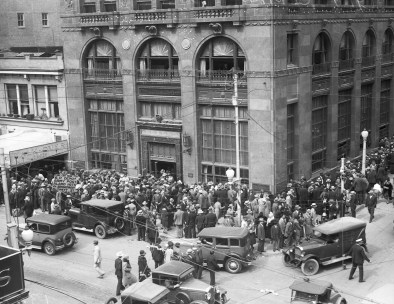
Run on San Antonio’s City-Central Bank and Trust Company during the Depression, 1931
Have I ever mentioned how much I’d admire California Representative Katie Porter?
THE FIRST WORDS OUT OF THE MOUTH of Rep. Katie Porter (D-CA) when I talked to her on Sunday were: “Can you believe we have to talk about this shit again?” She was referring to a conversation we had in 2018, when she was still just a financial expert and a candidate for Congress, about S.2155, which I call the Crapo bill, a reference to its co-author (Idaho Republican Sen. Mike Crapo) and its underlying contents.
Some of these provisions don’t mitigate risk; they encourage it. For depository institutions with fiduciary responsibilities, it’s like giving Bourbon-drenched pecan pie to alcoholics. Remember when Bill Gates sold Tesla short? Anyone with an excellent eye for financial statement analysis can see this stuff coming. But wait, how do you explain that “KPMG Gave SVB, Signature Bank Clean Bill of Health Weeks Before Collapse. Accounting firm faces scrutiny for audits of failed banks“? This is from Jonathan Weil and WSJ.
Silicon Valley Bank failed just 14 days after KPMG LLP gave the lender a clean bill of health. Signature Bank went down 11 days after the accounting firm signed off on its audit.
What KPMG knew about the two banks’ financial situation and what it missed will likely be the subject of regulatory scrutiny and lawsuits.
KPMG signed the audit report for Silicon Valley Bank’s parent, SVB Financial Group SIVB 0.00%increase; green up pointing triangle, on Feb. 24. Regulators seized the bank on March 10 after a surge of withdrawals threatened to leave it short of cash.
“Common sense tells you that an auditor issuing a clean report, a clean bill of health, on the 16th-largest bank in the United States that within two weeks fails without any warning, is trouble for the auditor,” said Lynn Turner, who was chief accountant of the Securities and Exchange Commission from 1998 to 2001.
Two crucial facts for determining whether KPMG missed the banks’ problems are when the bank runs began in earnest and when the bank’s management and KPMG’s auditors became aware of the crisis.
This reminds me of Moody’s, which had no idea how to rate tranches of mortgage-based swaps and completely missed the boat on the Mortgage crisis in 2008. You may also remember Moody’s role during the Junk Bond Kings’ rule in the late ’80s. This was also a time of intense deregulation of the industry.
. Moody’s also missed this current one. “Moody’s Failed to Warn About Silicon Valley Bank’s Problems. The prestigious rating agency still gave the bank of startups an A rating until its collapse on March 10, repeating the same errors of the subprime crisis in 2008.” This is from The Street and Luc Olinga.
Fifteen years after the subprime mortgage crisis which devastated the global economy, rating agencies continue to make the same mistakes.
At least, this seems to be the case with the prestigious rating agency Moody’s Investors Service.
Regulators shut down California’s Silicon Valley Bank on March 10, after its US Treasury bets went awry, due to the interest rate hike by the Federal Reserve.
Consequently, the Federal Deposit Insurance Corporation (FDIC) seized its assets and created a new entity, which will begin operating on March 13.
Created in 1983, Silicon Valley Bank, which presented itself as a “partner for the innovation economy,” offered higher interest rates on deposits than its larger rivals, to attract customers. The company then invested the clients’ money in long-dated Treasury bonds and mortgage bonds with strong returns.
Moody’s Gave Silicon Valley Bank an A Rating
This strategy had worked well in recent years. The bank’s deposits doubled to $102 billion at the end of 2020 from $49 billion in 2018. In 2021, deposits increased to $189.2 billion.
But everything turned upside down when the Federal Reserve began to raise interest rates, which made existing bonds held by SVB less valuable. As a result, the bank had to sell the bonds at a discount to cover withdrawals from its customers. In selling these bond positions, SVB had to take a significant loss of $1.8 billion.
Due to this loss, SVB suddenly announced that it needed to raise additional capital of $2.25 billion, by issuing new common and convertible preferred shares. This decision caused panic and a run on the bank.
While investors saw nothing coming, this is also the case with Moody’s Investors Service, whose role is to assess the intrinsic value of a company and its ability to meet its obligations, including its ability to pay lenders back. Rating agencies must flag the financial risks associated with a company.
But everything turned upside down when the Federal Reserve began to raise interest rates, which made existing bonds held by SVB less valuable. As a result, the bank had to sell the bonds at a discount to cover withdrawals from its customers. In selling these bond positions, SVB had to take a significant loss of $1.8 billion.
Due to this loss, SVB suddenly announced that it needed to raise additional capital of $2.25 billion, by issuing new common and convertible preferred shares. This decision caused panic and a run on the bank.
While investors saw nothing coming, this is also the case with Moody’s Investors Service, whose role is to assess the intrinsic value of a company and its ability to meet its obligations, including its ability to pay lenders back. Rating agencies must flag the financial risks associated with a company.
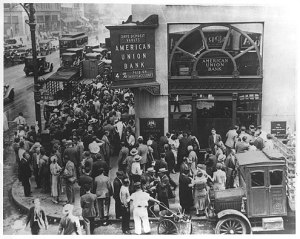
American Union Bank, New York City. April 26, 1932.
I’ve lived through a banking crisis in charge of strategic planning and financial statement forecasting for one of the original too big to fail Savings and Loan Companies in the early 1980s. I was also trying to hedge our loan commitments using GNMA futures which is why Derivatives are real to me. Any time interest rates start moving in the wrong direction and any bank that hasn’t realigned their related risks, like being long on one side of the balance sheet and short on the other, you’ll lose big.
I had to tell the head of Financial Operations there was no way to break even when every rate marks an asset to market with every tick, and you’re mismatched. I was barely 25 at the time. I also saw loan brokers selling mortgages where due diligence was lacking in 2005. A student told me he was being offered a mortgage based on his student loan as income. I can’t imagine any in-house loan officer being that ignorant. That’s what happens when you farm out your core business ou to salespeople earning money by volume. I can’t imagine how Moody’s or major Auditing firms keep missing this. They’re probably as captured by their customers as the politicians are captured by their lobbyists and checks. Right Senator Sinema?

James Stewart and Donna Reed in a scene from the film ‘It’s A Wonderful Life’, 1946. (Photo by RKO Radio Picture/Getty Images)
So, these bank runs don’t exactly look like the ones in those black-and-white photographs from the 1930s. This is a good explanation from Fast Company. What exactly is a Digital Flash Bank Run? It’s not a DC comic. Silicon Valley Bank: An ‘It’s a Wonderful Life’ bank run for the digital age. The downfall of the Valley institution, which has been called “the backbone of the startup economy,” was caused by a good old-fashioned bank run, but one that ran at internet speed.”
The run began on Thursday, after a powerful Silicon Valley VC—Peter Thiel’s Founders Fund—had begun advising its portfolio companies to withdraw their money from SVB, sources told Fast Company. Other VCs soon caught wind of the advisory and began advising their own portfolio companies to withdraw funds from SVB, the people said. As the withdrawals accelerated, the bank began taking steps to stem the tide and preserve its solvency—just like George Bailey did in the 1946 classic It’s a Wonderful Life.
SVB Financial Group CEO Greg Becker seemed to be reading from director Frank Capra’s script when he uttered the fateful words “stay calm” during a Thursday conference call with customers, as fears over the bank’s solvency grew. Those words probably only increased depositors’ anxieties. And the withdrawals likely continued to snowball.
“The whole thing was predicated on a few folks who put out calls to make withdrawals,” Spencer Greene, a general partner at the venture fund TSVC, tells Fast Company. “I think the folks who made those calls weren’t correct on the facts, but once the thing got going it was hard to stop.” In other words, before the run started there was not sufficient evidence to suggest the bank was facing serious solvency issues.

Northern Rock Bank run, September 2007
Just another point, we knew these things could happen. Here’s a 2019 article speculating about a digital bank flash run by Joe McGrath, writing for The Raconteur. “Turmoil, panic and bank runs in a digital future.”
Potentially, cash can now be transferred from accounts in greater amounts, more quickly than before and, even if banks enforce temporary limits on online withdrawals, what effect would the resulting panic have on the banking system as a whole?
“In a world without physical cash, the rules of engagement for situations such as a bank run will require a different framework,” says Simon Fairbairn, director of solution development, western Europe, for Ingenico Group. “The rules and systems of today will need to evolve to accommodate the demands of a run.”
Mr Fairbairn questions whether present digital banking infrastructure is sufficient to cope with sustained pressure of this nature. “Regulation, compliance, technology; processes have all evolved to try and prevent the sins of the past, but until tested, can we really be sure it won’t already be found wanting,” he says.
It may sound like scaremongering, but Mr Fairbairn’s cautious view has broad support from many in the financial services community.
“A digital bank run in a hypothetical future would be much more dangerous as it would happen in seconds and minutes when clients could simply use mobile banking apps to transfer money to another account,” says Susanne Chishti, chief executive of Fintech Circle.
“Such a digital bank run would be much more difficult to contain and an appropriate technical response for such a scenario would have to be coded in at the outset to offer any chance of being effective.”
In 2020, Harvest Finance experienced the first type of digital bank run. “Harvest Finance: $24M Attack Triggers $570M ‘Bank Run’ in Latest DeFi Exploit, Harvest Finance has seen its total value locked drop by more than $500 million in the 12 hours since being hit by a flash loan attack.” DeFi is short for Decentralized Finance, which is based on peer-to-peer finance services on blockchains. Welcome to the Wild West World of cryptocurrency and bitcoins. This should give you pause.
An arbitrage trade exploiting weak points in decentralized finance (DeFi) protocol Harvest Finance led to some $24 million in stablecoins being siphoned away from the project’s pools on Monday, according to CoinGecko.
According to reports, an attacker used a flash loan – a technique that allows a trader to take on massive leverage without any downside – to manipulate DeFi prices for profit. The exploit sent the platform’s native token, FARM, tumbling by 65% in less than an hour, followed by the project’s total value locked (TVL), which dropped from over $1 billion before the exploit to $430 million as of press time.
The funds were eventually swapped for bitcoin (BTC), but not before being swept through Ethereum mixing service Tornado Cash.
The jargon term for this was a “bad harvest.” Stay out of this stuff is the only thing I have to say, which is the advice I would have given to these banks. Unfortunately, Silicon Valley is rife with Elon Musk Clones taking risks for adventure and attention. All traders have their own language. I’m still surprised youngest daughter can keep her department of derivatives traders and products on a leash. They’ve always thought of themselves as Wild West Cowboys. (See Lions of Wall Street.) But then, she and the brokerage firms she’s worked for are licensed and babysat by the SEC to keep the nonsense in check. We both stay out of this market.
So, a part of this and a bit more will be a lecture for me tomorrow. Last year the Game Stop thing did this to me. You’ll be glad to know billionaire Carl Icahn is happy about that crash. Someone always is because there are two sides to every trade. If you’re head’s spinning, you’re doing just fine. I got a Ph.D. and real-life experience in the stuff, plus a daughter that lives it daily and who I consult for a reality check. It still makes my head spin.
What’s on your reading and blogging list today?
And the SEC is far behind
Down in the swamp with the gators and flamingos
A long way from Liechtenstein
I’m a junk bond king playing Seminole Bingo
And my Wall Street wiles
Don’t help me even slightly
‘Cause I never have the numbers
And I’m losing nightly
I cashed in the last of my Triple B bonds
Got a double-wide on the Tamiami Trail
I parked it right outside the reservation
Fifteen minutes from the Collier County Jail
(Warren Zevon, backed up by Neil Young live)
Saturday Morning Open Thread
Posted: July 13, 2013 Filed under: abortion rights, Barack Obama, Foreign Affairs, morning reads, NSA, National Security Agency, open thread, poverty, Psychopaths in charge, Real Life Horror, Reproductive Health, Reproductive Rights, social justice, U.S. Economy, U.S. Politics, War on Women, Women's Rights | Tags: Andrea Grimes, anti-abortion laws, CNBC, Edward Snowden, Elizabeth Warren, FDic, food stamps, Glass Steagall, hunger in America, Malala Yousafzai, Rick Perry, Sergei Lavrov, Texas legislature, Vladimir Putin, Yatzel Sabat 36 Comments
Abortion rights advocates fill the rotunda of the State Capitol as the Senate neared its vote Friday night (Tamir Kalifa/AP)
Good Morning Sky Dancers!!
There sure is a lot of news out there for a summer Saturday. Beginning in Texas, the state senate passed a restrictive anti-abortion bill that will threaten women’s lives. The New York Times reports:
AUSTIN, Tex. — The Texas Senate gave final passage on Friday to one of the strictest anti-abortion measures in the country, legislation championed by Gov. Rick Perry, who rallied the Republican-controlled Legislature late last month after a Democratic filibuster blocked the bill and intensified already passionate resistance by abortion-rights supporters.
The bill would ban abortions after 20 weeks of pregnancy and hold abortion clinics to the same standards as hospital-style surgical centers, among other requirements. Its supporters say that the strengthened requirements for the structures and doctors will protect women’s health; opponents argue that the restrictions are actually intended to put financial pressure on the clinics that perform abortions and will force most of them to shut their doors.
Mr. Perry applauded lawmakers for passing the bill, saying “Today the Texas Legislature took its final step in our historic effort to protect life.” Legislators and anti-abortion activists, he said “tirelessly defended our smallest and most vulnerable Texans and future Texans.”
Mr. Perry does not appear to include any “right to life” for adult women in his “effort to protect life,” however. I wonder if anyone has ever asked him one simple question: are women human beings? Forced childbirth is tantamount to slavery in my opinion. Furthermore, childbirth is far more dangerous than abortion, and the restrictions will likely mean that women with problematic late term pregnancies will die or suffer grievous harm. According to the NYT story,
The bill was opposed by many doctors, including leaders of the American Congress of Obstetricians and Gynecologists and the Texas Medical Association; the gynecologists’ group has run advertisements locally that question the scientific underpinnings of the legislation and tell legislators to “Get out of our exam rooms.”
Andrea Grimes writes at RH Reality Check: As Out-Of-State Gawkers Look On, Texas Lawmakers Prepare to Pass ‘Death Sentence’ Anti-Abortion Bill. She describes a young man from Minnesota who traveled down to Texas to watch the show.
This young guy, probably a senior in high school or a freshman in college—I didn’t catch his name—said he was real tired of wearing blue, the chosen color of anti-choice supporters of HB 2. I wore orange that day, the same color as thousands of Texans who have turned up at the capitol to stand up for reproductive rights. I also wore pink earbuds, trying to follow the house debate while waiting in line. Maybe this young guy thought I couldn’t hear him. Maybe he didn’t care.
“I’m looking forward to all this being over so I can wear my orange shirts again!” he joked.
She contrasts his blase attitude with that of Yatzel Sabat, a gay woman of color
who was dragged out of that same gallery Wednesday morning by law enforcement. Sabat was not wearing orange. She was wearing black.
Her limbs bound by state troopers, she screamed in a clear, strong voice, “This bill will kill women!” as the Texas House of Representatives gave its approval to HB 2, passing the devastating legislation along to the state senate for final passage….
This bill will kill. Period.
It will kill Texans who already travel to Mexico to buy abortion pills from flea markets because they are too poor to go to a legal abortion clinic, or unable to take time off work to find a doctor’s office and wait 24 hours between a state-mandated sonogram and an abortion procedure. It will kill Texans who, if HB 2 passes, cannot travel a thousand miles round trip to a San Antonio or Dallas ambulatory surgical center for a safe, legal abortion.
Please read the whole thing if you can.

Next up, the U.S. Congress debates more cuts in food stamps as American children go hungry. From Martha White at NBC News:
For one in seven Americans, the federal government’s Supplemental Nutrition Assistance Program, aka food stamps, is all that stands between them and too little food.
But the complicated calculus of financial survival for the working poor also means any cuts to the roughly $80 billion SNAP, as it’s known, being considered by Congress would be felt well beyond the grocery checkout line. Buying new school clothes, family outings, even getting a toehold in the financial mainstream could be thrown into limbo.
For many of the working poor, wages just don’t go far enough. The National Employment Law project says nearly 60 percent of jobs created in the post-recession recovery pay $13.83 or less an hour, and hourly wages for some low-wage occupations fell by more than 5 percent in just three years.
Food service and temporary employment make up 43 percent of the post-recession job growth, according to NELP policy analyst Jack Temple. “They overwhelmingly pay low wages,” Temple said. “For that lower segment, you’re going to see increased use of safety net programs to make up the difference.”
Read it and weep, folks; and while you do keep in mind that the Federal deficit has been dropping steadily. The only possible reasons for the austerity agenda are to make the rich richer and punish the working poor.

The Snowden saga continues. Reuters reports that Russia has not yet received an application for asylum from the American hacker/leaker/whistleblower/dissident–or whatever he’s being called at the moment.
Russia kept former U.S. spy agency contractor Edward Snowden at arm’s length on Saturday, saying it had not been in touch with the fugitive American and had not yet received a formal request for political asylum.
Remarks by Foreign Minister Sergei Lavrov signaled Russia is weighing its options after Snowden, who is stranded at a Moscow airport, broke three weeks of silence and asked for refuge in Russia until he can secure safe passage to Latin America.
Washington urged Moscow to return Snowden to the United States, where he is wanted on espionage charges after revealing details of secret surveillance programs, and President Barack Obama spoke by phone with Russian President Vladimir Putin….
“We are not in contact with Snowden,” Russian news agencies quoted Lavrov as saying in Kyrgyzstan, where he attended a foreign ministers’ meeting.
He said he had learned of Snowden’s meeting with Russian human rights activists and public figures at the airport on Friday from the media, “just like everyone else.”
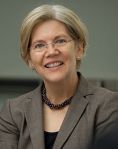
Senator Elizabeth Warren is working on bringing back Glass-Steagall-like regulations on banks. From the LA Times:
Sen. Elizabeth Warren has launched a campaign to make banks boring again as she pushes legislation to enact stricter regulations forcing deposit-taking financial institutions out of the investment business.
The Massachusetts Democrat wants to reinstate the Depression-era Glass-Steagall law, which separated what she called boring checking and savings accounts that are backed by the Federal Deposit Insurance Corp. from risky investment banking.
And after joining three other senators Thursday in introducing a bipartisan bill to do that, Warren went toTwitter to rally support.
She urged her Twitter followers to retweet the message, “Banks should be boring.” She emailed her political backers, asking them to support her 21st century Glass-Steagall Act, which she introduced along with Sens. John McCain (R-Ariz.), Maria Cantwell (D-Wash.) and Angus King (I-Maine).
Yesterday Warren went on CNBC to argue her case with some blonde talking head. Check it out:
As you know, yesterday Malala Yousafzai spoke to the United Nations and told the world: Being shot by Taliban made me stronger (NBC News)

Malala Yousafzai, the Pakistani teenager shot in the head by the Taliban for campaigning for girls’ education, was given a standing ovation at the United Nations Friday as she declared the attempt on her life had only given her strength and banished any fear she once felt.
“Dear friends, on the 9th of October, 2012, the Taliban shot me on the left side of my forehead. They shot my friends too,” she said in her first major public appearance. “They thought that the bullets would silence us, but they failed.”
Speaking on her 16th birthday, she said the “terrorists thought that they would change my aims and stop my ambitions, but nothing changed in my life except this — weakness, fear and hopelessness died, strength, power and courage was born.”
“I am the same Malala, my ambitions are the same, my hopes are the same and my dreams are the same,” she said to thunderous applause.
What an courageous, intelligent, and inspiring and young woman she is!
On that note, I’ll turn the floor over to you. What stories are you following today. Please post your links on any topic in the comment thread. Have a stupendous Saturday
Senator Warren wants to know why our Jails aren’t filled with Banksters
Posted: February 15, 2013 Filed under: Elizabeth Warren Campaign, financial institutions | Tags: CFTC, FDic, FED, Financial instituions, FPB, OCC, Senator Elizabeth Warren 5 Comments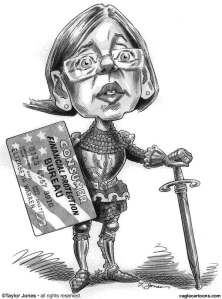 Well, Senator Elizabeth Warren is not disappointing any one.
Bank regulators got a sense Thursday of how their lives will be slightly different now that Elizabeth Warren sits on a Senate committee overseeing their agencies.
At her first Banking, Housing and Urban Affairs Committee hearing, Warren questioned top regulators from the alphabet soup that is the nation’s financial regulatory structure: the FDIC, SEC, OCC, CFPB, CFTC, Fed and Treasury.
The Democratic senator from Massachusetts had a straightforward question for them: When was the last time you took a Wall Street bank to trial? It was a harder question than it seemed.
“We do not have to bring people to trial,” Thomas Curry, head of the Office of the Comptroller of the Currency, assured Warren, declaring that his agency had secured a large number of “consent orders,” or settlements.
“I appreciate that you say you don’t have to bring them to trial. My question is, when did you bring them to trial?” she responded.
“We have not had to do it as a practical matter to achieve our supervisory goals,” Curry offered.
Warren turned to Elisse Walter, chair of the Securities and Exchange Commission, who said that the agency weighs how much it can extract from a bank without taking it to court against the cost of going to trial.
“I appreciate that. That’s what everybody does,” said Warren, a former Harvard law professor. “Can you identify the last time when you took the Wall Street banks to trial?”
“I will have to get back to you with specific information,” Walter said as the audience tittered.
“There are district attorneys and United States attorneys out there every day squeezing ordinary citizens on sometimes very thin grounds and taking them to trial in order to make an example, as they put it. I’m really concerned that ‘too big to fail’ has become ‘too big for trial,'” Warren said.
and the Band Played On
Posted: September 12, 2009 Filed under: Bailout Blues, Equity Markets, Main Stream Media, Surreality, The Bonus Class, U.S. Economy, Voter Ignorance | Tags: bank failure, Banking, banking cartel, banking regulation, FDic Comments Off on and the Band Played On So the so-called conservatives are having their so-called freedom event with so-called commentators and news anchors from so-called news stations. It’s all a side show to the real problems of the country. It’s easy to misplace anger in an environment where misinformants rule the airwaves.
So, let me show you where the real theft is happening, in case you may have missed it.
First, the FDIC released yet another move towards creating a financial banking cartel. Another one bites the dust.
Corus Bank, National Association, Chicago, Illinois, was closed today by the Office of the Comptroller of the Currency, which appointed the Federal Deposit Insurance Corporation (FDIC) as receiver. To protect the depositors, the FDIC entered into a purchase and assumption agreement with MB Financial Bank, National Association, Chicago, Illinois, to assume all of the deposits of Corus Bank, N.A.
But you know there’s really nothing to see here at the NY Times: A Year After a Cataclysm, Little Change on Wall St. Much more important to focus on creeping socialism and taking our government back from imagined enemies.
One year after the collapse of Lehman Brothers, the surprise is not how much has changed in the financial industry, but how little.
Backstopped by huge federal guarantees, the biggest banks have restructured only around the edges. Employment in the industry has fallen just 8 percent since last September. Only a handful of big hedge funds have closed. Pay is already returning to precrash levels, topped by the 30,000 employees of Goldman Sachs, who are on track to earn an average of $700,000 this year. Nor are major pay cuts likely, according to a report last week from J.P. Morgan Securities. Executives at most big banks have kept their jobs. Financial stocks have soared since their winter lows.
No nothing to see here. Wait, a minute. Maybe we should listen to people with some expertise instead of Glenn Beck or Rush Limbaugh who couldn’t even get one college degree or a freshman’s worth of credits between them . Maybe we shouldn’t focus on sycophants like Chris Matthews or Keith Olbermann who just want to hear themselves talk and hump each others legs until they tingle.
In fact, though, regulators and lawmakers have spent most of the last year trying to save the financial industry, rather than transform it. In the short run, their efforts have succeeded. Citigroup and other wounded banks have avoided bankruptcy, and the economy has sidestepped a depression. But the same investors and economists who predicted, and in some cases profited from, the collapse last fall say the rescue has come at an extraordinary cost. They warn that if the industry’s systemic risks are not addressed, they could cause an even bigger crisis — in years, not decades. Next time, they say, the credit of the United States government may be at risk.
Yup, what have we been talking about here for month after month after month, while we get named called every imaginable insult from one end of the political spectrum to another. I must defy definition if one day I can be called a racist republican ratfucker then be called a greenie and a leftie the next.
Oh, meanwhile …
What’s That Lassie? Little Timmy’s in the Well AGAIN?
Posted: August 4, 2009 Filed under: Bailout Blues, Equity Markets, Global Financial Crisis, president teleprompter jesus, The Bonus Class, The Great Recession, U.S. Economy | Tags: Ben Bernanke, CNBC, FDic, FED, Larry Summers, Mary Schapiro, Naked Capitalism, SEC, Sheila Bair, Timothy Geithner, Wall Street Cheerleaders, Zero Hedge Comments Off on What’s That Lassie? Little Timmy’s in the Well AGAIN? Wow, it looks like Turbo Tax Timmy has gone rogue! We better send the press up to Alaska to chase down another Palin rumor. First, there’s that nastiness over the weekend with the Stephanapolous show on ABC where he explicitly said that the administration wasn’t ruling out new taxes on the middle class. (Something Larry-the-la-la Summers also inkled, but hey, he’s not a cabinet officer, he’s something akin to a Czar that has to be overthrown by something other than scandal and public displays of stupidity.) I believe that gave Robert Gibbs Excedrin headaches number 349-357 during yesterday’s presser.
Now, there’s rumors of a temper tantrum in the presence of all the nation’s topic economists and financial regulators outlined here in the WSJ. It seems he’s not getting the Obama way on this one. The ladies in the room have taken exception to his granting Ben Bernanke (possibly later, this year, La-la Summers) all the fun and power. I guess being an independent regulator with an agency all to yourself just isn’t what it used to be; especially when you have scary lady parts and a huge brain.
Mr. Geithner told the regulators Friday that “enough is enough,” said one person familiar with the meeting. Mr. Geithner said regulators had been given a chance to air their concerns, but that it was time to stop, this person said.
Among those gathered in the Treasury conference room were Federal Reserve Chairman Ben Bernanke, Securities and Exchange Commission Chairman Mary Schapiro and Federal Deposit Insurance Corp. Chairman Sheila Bair.
Friday’s roughly hourlong meeting was described as unusual, not only because of Mr. Geithner’s repeated use of obscenities, but because of the aggressive posture he took with officials from federal agencies generally considered independent of the White House. Mr. Geithner reminded attendees that the administration and Congress set policy, not the regulatory agencies.
Mr. Geithner, without singling out officials, raised concerns about regulators who questioned the wisdom of giving the Federal Reserve more power to oversee the financial system. Ms. Schapiro and Ms. Bair, among others, have argued that more authority should be shared among a council of regulators.
This current turf battle is only the latest move by a group within government possibly thwarting the Treasury’s plans to continue uploading tax dollars to the bonus class in the guise of saving the financial sector. If there’s still disagreement about this point, can you imagine what other things are going on in complete disarray behind the scenes? Who is really in charge of solving this overt act of sibling rivalry? Well, if you have figured out where the buck stops in this administration, you’re doing better than me. (Hint: these folks are ALL presidential appointments).

 peej
peej Carissa
 bostonboomer
 dakinikat
 ecocatwoman
 mablue2
 Mama Lopez
 peggysue22
 quixote
 skydancingguestblogger
 Mona (aka Wonk the Vote)



 Sky Dancing
Recent Comments