
Tuesday Reads: Philippines Disaster, Economics News, and the Concern Troll Media
Posted: November 12, 2013 Filed under: Barack Obama, Hillary Clinton, morning reads, The Great Recession, The Media SUCKS, the villagers, U.S. Economy, U.S. Politics | Tags: Alex Bolton, Andrew Huszar, Bart Chilton, Ben Bernanke, Chris Cillizza, concern troll media, Elizabeth Warren, Gary Gensler, Janet Yellen, Noam Scheiber, Philippines, Politico, Rebecca Ruth Guy, T-Bogg, Timothy G. Massad, Typhoon Haiyan 72 Comments
Good Morning!!
Boy did I ever get a shock when I looked out my window this morning and saw a mix of snow and rain coming down outside. Noooooo! It’s way too early for winter weather. I hope this isn’t a sign of things to come.
Now that I’ve looked at this morning’s news from the Philippines, I’m ashamed to be complaining about a little bit of freezing rain. The disaster following Typhoon Haiyan is beyond belief. ABC News talked to a 19-year-old American woman who who survived the massive storm.
Rebecca Ruth Guy, 19, was living in the city of Tacloban, which bore the full force of the winds and the tsunami-like storm surges Friday. Most of the city is in ruins, a tangled mess of destroyed houses, cars and trees.
“When the storm hit, our apartment was flooding so we tried opening the door but the flooding was already rising up to our chest,” Guy told ABC News.
Faced with a life-and-death situation, Guy’s friend smashed the window so they could climb to the roof and escape the storm surge, which is being blamed for a large part of the destruction and death.
“We got out to the roof,” she said. “The rain was coming, the winds were crazy and it was getting cold. So we ended up sandwiching together and holding onto one another for warmth, praying for protection of the people.
“The most harrowing was when I saw women and children piled under tarpaulin, and when I saw dogs skewered on gates, cars thrown into buildings, people trying to find something to eat, water to drink,” she added.
According to the article, the U.S. sent planes to evacuate Americans living in the Philippines; other residents aren’t so fortunate.
CNN is reporting that 1,774 people are dead; but that number will continue to rise.
Cebu, Philippines (CNN) — Typhoon Haiyan has killed too many people to count so far and pushed to the brink of survival thousands more who have lost everything, have no food or medical care and are drinking filthy water to stay alive.
By Tuesday, officials had counted 1,774 of the bodies, but say that number may just be scratching the surface. They fear Haiyan may have taken as many as 10,000 lives.
The storm has injured 2,487 more since it made landfall six times last Friday, the government said. It has displaced at least 800,000 people, the U.N. said Tuesday.
Unfortunately a new storm and an earthquake have hindered rescue efforts.
As authorities rush to save the lives of survivors four days after Haiyan ripped the Philippines apart, a new tropical low, Zoraida, blew in Tuesday delivering more rain, the Philippine national weather agency PAGASA reported.
Zoraida is not a strong storm, but has dumped just under four inches of rain in some places, CNN meteorologists say….
An earthquake also rattled part of the affected area. The 4.8 magnitude temblor shook San Isidro Tuesday, the U.S. Geological Survey reported.
Here are a few more links about the storm and its aftereffects:

An aerial view of a coastal town in Samar province on Monday, Nov. 11. (REUTERS/Erik De Castro)
The Week: The terrible destruction of Typhoon Haiyan. This one has a number of shocking photos like the one to the left.
CNN: How it happened: Tracing Typhoon Haiyan’s havoc in the Philippines (lots more photos at this link)
NPR: WHO Rates Typhoon’s Medical Challenges ‘Monumental’
NPR: ‘It Looks Like A 50-Mile Wide Tornado’ Hit The Philippines
CTC News: Typhoon Haiyan: Before and after photos of storm’s damage
In other news, here’s one that will interest Dakinikat: Obama to Tap Treasury Official as Top Derivatives Regulator. From The New York Times Dealbook blog:
President Obama will nominate Timothy G. Massad as the new chairman of the Commodity Futures Trading Commission on Tuesday, a White House aide said, choosing the senior Treasury Department official to run an agency that polices some of Wall Street’s riskiest activity.
If confirmed by the Senate, Mr. Massad will succeed Gary Gensler, a former Goldman Sachs banker who overhauled the agency in the wake of the financial crisis. Mr. Gensler, credited with turning one of Wall Street’s laxest regulators into one of its most aggressive, must leave office at the end of the year when his term officially expires.
Mr. Massad, an assistant secretary of the Treasury who oversaw the unwinding of the government’s bailout program stemming from the financial crisis, would join the agency as it undergoes a makeover.
Bart Chilton, the agency’s most liberal commissioner, announced last week that he would soon depart. David Meister, the enforcement director who led actions against some of the world’s biggest banks, departed the agency last month. And Jill E. Sommers, a Republican commissioner, left months ago.
The vacancies have raised the stakes for Mr. Massad’s nomination. If Mr. Chilton and Mr. Gensler depart before their successors are confirmed, the five-member commission will be down to just two members: one Republican, Scott D. O’Malia, and one Democrat, Mark Wetjen.
That would not be good. I know Dakinikat is busy today, but here’s another article for her to weigh in on if she has time: Confessions of a Quantitative Easer. From Andrew Huszar at the Wall Street Journal:
I can only say: I’m sorry, America. As a former Federal Reserve official, I was responsible for executing the centerpiece program of the Fed’s first plunge into the bond-buying experiment known as quantitative easing. The central bank continues to spin QE as a tool for helping Main Street. But I’ve come to recognize the program for what it really is: the greatest backdoor Wall Street bailout of all time.
Five years ago this month, on Black Friday, the Fed launched an unprecedented shopping spree. By that point in the financial crisis, Congress had already passed legislation, the Troubled Asset Relief Program, to halt the U.S. banking system’s free fall. Beyond Wall Street, though, the economic pain was still soaring. In the last three months of 2008 alone, almost two million Americans would lose their jobs.
The Fed said it wanted to help—through a new program of massive bond purchases. There were secondary goals, but Chairman Ben Bernanke made clear that the Fed’s central motivation was to “affect credit conditions for households and businesses”: to drive down the cost of credit so that more Americans hurting from the tanking economy could use it to weather the downturn. For this reason, he originally called the initiative “credit easing.”
Huzar claims that Janet Yellen will likely continue Bernanke’s policies.
Even when acknowledging QE’s shortcomings, Chairman Bernanke argues that some action by the Fed is better than none (a position that his likely successor, Fed Vice Chairwoman Janet Yellen, also embraces). The implication is that the Fed is dutifully compensating for the rest of Washington’s dysfunction. But the Fed is at the center of that dysfunction. Case in point: It has allowed QE to become Wall Street’s new “too big to fail” policy.
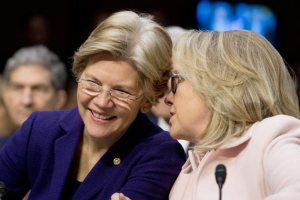
More pundits are joining the anti-Hillary ranks. According to The Hill’s Alex Bolton:
Liberal leaders want Hillary Clinton to face a primary challenge in 2016 if she decides to run for president.
The goal of such a challenge wouldn’t necessarily be to defeat Clinton. It would be to prevent her from moving to the middle during the Democratic primary.
“I do think the country would be well served if we had somebody who would force a real debate about the policies of the Democratic Party and force the party to debate positions and avoid a coronation,” said Roger Hickey, co-director of Campaign for America’s Future, an influential progressive group….
Clinton raised concern among the Democratic Party’s populist base when she recently accepted an estimated $400,000 from Goldman Sachs for two speeches.
Influential progressives wonder whether someone who accepted such a large sum from one of Wall Street’s biggest investment firms could be expected to hold corporate executives accountable if elected president.
They also wonder how aggressively she’d call for addressing income inequality, which many see as one of the biggest economic problems facing the nation.
That’s odd, since Obama ran to Hillary’s right in 2008 and received more contributions from Goldman Sachs and other Wall Street firms than either Hillary or John McCain. But let’s not get caught up in facts…
Politico has taken up the suggestion from Noam Scheiber at The New Republic that Dakinikat wrote about yesterday that Elizabeth Warren should run against Hillary. Concern trolls Ben White and Maggie Haberman write:
There are three words that strike terror in the hearts of Wall Street bankers and corporate executives across the land: President Elizabeth Warren.
The anxiety over Warren grew Monday after a magazine report suggested the bank-bashing Democratic senator from Massachusetts could mount a presidential bid in 2016 and would not necessarily defer to Hillary Clinton — who is viewed as far more business-friendly — for the party’s nomination.
And the fear is not only that Warren, who channels an increasingly popular strain of Occupy Wall Street-style anti-corporatism, might win. That is viewed by many political analysts as a slim possibility. It is also that a Warren candidacy, and even the threat of one, would push Clinton to the left in the primaries and revive arguments about breaking up the nation’s largest banks, raising taxes on the wealthy and otherwise stoking populist anger that is likely to also play a big role in the Republican primaries.
So what does Warren think about all this?
A spokesperson for Warren declined to comment on whether she would consider a presidential bid against Clinton, though Warren has previously said she has no plans to run. People close to Warren note that she signed a letter from female Democratic senators urging Clinton to run in 2016. And Warren associates, mindful of any appearance of creating the narrative of a Warren-for-president campaign, have corresponded with Clinton associates to stress that they didn’t fuel the New Republic story by Noam Scheiber.
Assholes. Hey, I have an idea–why not get Kirstin Gillibrand to run against Hillary too? Of course Chris Cillizza is also rooting for Warren and Clinton to destroy each other’s chances to do anything positive about the economy:
Quick, name someone who would have a realistic chance of beating out Hillary Clinton for the 2016 presidential nomination. Martin O’Malley? Nope. Joe Biden? Maybe but probably not. Howard Dean. No way. There’s only answer to that question that makes even a little sense. And that answer is Elizabeth Warren.
And so on… bla bla bla… Don’t these idiots have anything important to write about? Like maybe jobs, children without food or health care, or the upcoming battle over the debt limit?
Thank goodness for TBogg at Raw Story: What if Elizabeth Warren went back in time and smothered Baby Hitler in his crib?
If you have been perambulating about the internet these past few days, the above is exactly the kind of linkbait bullshit narratives that are being peddled by people who have wearied talking about President of New Jerseymerica Chris Christie or whether Rand Paul was the real life inspiration for the J.L. Borges short story, Pierre Menard, Author of the Quixote. It seems that frustrated writers lacking hobbies have turned their lonely eyes to the Democratic side of the 2016 presidential election which is just around the corner, if by corner, you mean: three years from now. But with Hilary “Killary” Clinton pretty much chillaxing with the nomination ripe for the taking (providing she doesn’t rehire Mark Penn, aka The Man Who Could Fuck Up A Baked Potato) there isn’t a whole lot of tension the likes of which you can find on a daily basis on the Republican Wingnut Flavor of the Week side.
So naturally, Noam Scheiber felt obligated to create some Democratic conflict. T-Bogg responds:
I love Elizabeth Warren. I would totally have her baby if she would have me. You love Elizabeth Warren. We all love Elizabeth Warren. Someday Elizabeth Warren t-shirts may very well become as ubiquitous as Che T’s. But, outside of the hazy crazy patchouli-scented fever palaces that are the comment sections of the manic progressive websites, nobody really thinks that Warren could, would, or should run an insurgent primary campaign against Clinton. And, to be quite frank, those who think Warren should run to in order to “start a conversation” are the kind of people who have attempted this kind of thing in the past and , as my grandmother used to put it, “don’t have dick to show for it”.
Read his replies to Politico and Cillizza at the link. BTW, I wrote comment before I discovered T-Bogg’s piece. Great minds think alike, but T-Bogg expressed my reactions so much better than I could.
That should be enough to get us started on the day’s news. What stories are you following? Please post your links in the comment thread and have a terrific Tuesday!
Saturday Morning Open Thread
Posted: July 13, 2013 Filed under: abortion rights, Barack Obama, Foreign Affairs, morning reads, NSA, National Security Agency, open thread, poverty, Psychopaths in charge, Real Life Horror, Reproductive Health, Reproductive Rights, social justice, U.S. Economy, U.S. Politics, War on Women, Women's Rights | Tags: Andrea Grimes, anti-abortion laws, CNBC, Edward Snowden, Elizabeth Warren, FDic, food stamps, Glass Steagall, hunger in America, Malala Yousafzai, Rick Perry, Sergei Lavrov, Texas legislature, Vladimir Putin, Yatzel Sabat 36 Comments
Abortion rights advocates fill the rotunda of the State Capitol as the Senate neared its vote Friday night (Tamir Kalifa/AP)
Good Morning Sky Dancers!!
There sure is a lot of news out there for a summer Saturday. Beginning in Texas, the state senate passed a restrictive anti-abortion bill that will threaten women’s lives. The New York Times reports:
AUSTIN, Tex. — The Texas Senate gave final passage on Friday to one of the strictest anti-abortion measures in the country, legislation championed by Gov. Rick Perry, who rallied the Republican-controlled Legislature late last month after a Democratic filibuster blocked the bill and intensified already passionate resistance by abortion-rights supporters.
The bill would ban abortions after 20 weeks of pregnancy and hold abortion clinics to the same standards as hospital-style surgical centers, among other requirements. Its supporters say that the strengthened requirements for the structures and doctors will protect women’s health; opponents argue that the restrictions are actually intended to put financial pressure on the clinics that perform abortions and will force most of them to shut their doors.
Mr. Perry applauded lawmakers for passing the bill, saying “Today the Texas Legislature took its final step in our historic effort to protect life.” Legislators and anti-abortion activists, he said “tirelessly defended our smallest and most vulnerable Texans and future Texans.”
Mr. Perry does not appear to include any “right to life” for adult women in his “effort to protect life,” however. I wonder if anyone has ever asked him one simple question: are women human beings? Forced childbirth is tantamount to slavery in my opinion. Furthermore, childbirth is far more dangerous than abortion, and the restrictions will likely mean that women with problematic late term pregnancies will die or suffer grievous harm. According to the NYT story,
The bill was opposed by many doctors, including leaders of the American Congress of Obstetricians and Gynecologists and the Texas Medical Association; the gynecologists’ group has run advertisements locally that question the scientific underpinnings of the legislation and tell legislators to “Get out of our exam rooms.”
Andrea Grimes writes at RH Reality Check: As Out-Of-State Gawkers Look On, Texas Lawmakers Prepare to Pass ‘Death Sentence’ Anti-Abortion Bill. She describes a young man from Minnesota who traveled down to Texas to watch the show.
This young guy, probably a senior in high school or a freshman in college—I didn’t catch his name—said he was real tired of wearing blue, the chosen color of anti-choice supporters of HB 2. I wore orange that day, the same color as thousands of Texans who have turned up at the capitol to stand up for reproductive rights. I also wore pink earbuds, trying to follow the house debate while waiting in line. Maybe this young guy thought I couldn’t hear him. Maybe he didn’t care.
“I’m looking forward to all this being over so I can wear my orange shirts again!” he joked.
She contrasts his blase attitude with that of Yatzel Sabat, a gay woman of color
who was dragged out of that same gallery Wednesday morning by law enforcement. Sabat was not wearing orange. She was wearing black.
Her limbs bound by state troopers, she screamed in a clear, strong voice, “This bill will kill women!” as the Texas House of Representatives gave its approval to HB 2, passing the devastating legislation along to the state senate for final passage….
This bill will kill. Period.
It will kill Texans who already travel to Mexico to buy abortion pills from flea markets because they are too poor to go to a legal abortion clinic, or unable to take time off work to find a doctor’s office and wait 24 hours between a state-mandated sonogram and an abortion procedure. It will kill Texans who, if HB 2 passes, cannot travel a thousand miles round trip to a San Antonio or Dallas ambulatory surgical center for a safe, legal abortion.
Please read the whole thing if you can.

Next up, the U.S. Congress debates more cuts in food stamps as American children go hungry. From Martha White at NBC News:
For one in seven Americans, the federal government’s Supplemental Nutrition Assistance Program, aka food stamps, is all that stands between them and too little food.
But the complicated calculus of financial survival for the working poor also means any cuts to the roughly $80 billion SNAP, as it’s known, being considered by Congress would be felt well beyond the grocery checkout line. Buying new school clothes, family outings, even getting a toehold in the financial mainstream could be thrown into limbo.
For many of the working poor, wages just don’t go far enough. The National Employment Law project says nearly 60 percent of jobs created in the post-recession recovery pay $13.83 or less an hour, and hourly wages for some low-wage occupations fell by more than 5 percent in just three years.
Food service and temporary employment make up 43 percent of the post-recession job growth, according to NELP policy analyst Jack Temple. “They overwhelmingly pay low wages,” Temple said. “For that lower segment, you’re going to see increased use of safety net programs to make up the difference.”
Read it and weep, folks; and while you do keep in mind that the Federal deficit has been dropping steadily. The only possible reasons for the austerity agenda are to make the rich richer and punish the working poor.

The Snowden saga continues. Reuters reports that Russia has not yet received an application for asylum from the American hacker/leaker/whistleblower/dissident–or whatever he’s being called at the moment.
Russia kept former U.S. spy agency contractor Edward Snowden at arm’s length on Saturday, saying it had not been in touch with the fugitive American and had not yet received a formal request for political asylum.
Remarks by Foreign Minister Sergei Lavrov signaled Russia is weighing its options after Snowden, who is stranded at a Moscow airport, broke three weeks of silence and asked for refuge in Russia until he can secure safe passage to Latin America.
Washington urged Moscow to return Snowden to the United States, where he is wanted on espionage charges after revealing details of secret surveillance programs, and President Barack Obama spoke by phone with Russian President Vladimir Putin….
“We are not in contact with Snowden,” Russian news agencies quoted Lavrov as saying in Kyrgyzstan, where he attended a foreign ministers’ meeting.
He said he had learned of Snowden’s meeting with Russian human rights activists and public figures at the airport on Friday from the media, “just like everyone else.”

Senator Elizabeth Warren is working on bringing back Glass-Steagall-like regulations on banks. From the LA Times:
Sen. Elizabeth Warren has launched a campaign to make banks boring again as she pushes legislation to enact stricter regulations forcing deposit-taking financial institutions out of the investment business.
The Massachusetts Democrat wants to reinstate the Depression-era Glass-Steagall law, which separated what she called boring checking and savings accounts that are backed by the Federal Deposit Insurance Corp. from risky investment banking.
And after joining three other senators Thursday in introducing a bipartisan bill to do that, Warren went toTwitter to rally support.
She urged her Twitter followers to retweet the message, “Banks should be boring.” She emailed her political backers, asking them to support her 21st century Glass-Steagall Act, which she introduced along with Sens. John McCain (R-Ariz.), Maria Cantwell (D-Wash.) and Angus King (I-Maine).
Yesterday Warren went on CNBC to argue her case with some blonde talking head. Check it out:
As you know, yesterday Malala Yousafzai spoke to the United Nations and told the world: Being shot by Taliban made me stronger (NBC News)

Malala Yousafzai, the Pakistani teenager shot in the head by the Taliban for campaigning for girls’ education, was given a standing ovation at the United Nations Friday as she declared the attempt on her life had only given her strength and banished any fear she once felt.
“Dear friends, on the 9th of October, 2012, the Taliban shot me on the left side of my forehead. They shot my friends too,” she said in her first major public appearance. “They thought that the bullets would silence us, but they failed.”
Speaking on her 16th birthday, she said the “terrorists thought that they would change my aims and stop my ambitions, but nothing changed in my life except this — weakness, fear and hopelessness died, strength, power and courage was born.”
“I am the same Malala, my ambitions are the same, my hopes are the same and my dreams are the same,” she said to thunderous applause.
What an courageous, intelligent, and inspiring and young woman she is!
On that note, I’ll turn the floor over to you. What stories are you following today. Please post your links on any topic in the comment thread. Have a stupendous Saturday
Monday Reads
Posted: May 13, 2013 Filed under: morning reads, New Orleans | Tags: Climate change, Elizabeth Warren, gun violence, hate speech, mother's day shootings New Orleans, school loans 34 Comments Good Morning!
I spent Mother’s Day napping on dad’s sofa mostly. I am such an exciting person!! I have no idea why I am so cold and so worn out but it is what it is.
Meanwhile, all hell broke loose in New Orleans. The gun violence that hit a Mother’s Day parade there was pretty much the kind of urban violence we see all too often with such easy access to guns. I wish I could say that gun violence was rare in the 7th ward. But it is not. Here’s a word from my congressman Cedric Richmond:
According to FBI data, 1,464 people were killed by firearms in New Orleans between 2008-2011. That’s 1,464 families who will never see their loved ones again. If we were to have passed the entirety of President Obama’s proposed reforms, sadly, many of those victims would probably have still been killed because violence is a pervasive and complex problem with a diverse set of causes. Economic insecurity, poor mental health treatment options, inferior education options and the scarcity of positive opportunities are all contributors, which one regulation alone cannot eliminate. That being said, if we only acted on just a few of the president’s proposals, we could decrease the supply of guns used in the homicides by reducing the supply of illegally purchased guns via universal background checks. This would decrease the use of guns in violent crime and keep a few more families from having to bury a loved one.
While I was serving as a member of the Louisiana House of Representatives, I introduced an assault weapons ban bill on numerous occasions. I took on the National Rifle Association in these battles not because I have a grudge against gun owners, but because I could find no reasonable defense of having these weapons of mass destruction on our streets. As a resident of Sportsman’s Paradise, I am a strong supporter of the Second Amendment. However, I do not ascribe to the belief that Congress has no role in responding to the gun violence epidemic plaguing communities like New Orleans, Chicago and Detroit.
It seems that 19 people were injured with no fatalities.
A Mother’s Day second-line shooting on Frenchmen Street in the 7th Ward, on Sunday about 1:45 p.m., left 19 people injured, according to the latest NOPD numbers. Earlier Sunday afternoon, NOPD Superintendent Ronal Serpas said that about 12 people had been injured, but the toll later grew to 19, with the NOPD explaining that some victims initially hadn’t reported being injured and more people continue to come forward.
Police said 10 adult men, seven adult women, a 10-year-old boy and a 10-year-old girl were struck by bullets. Both of the 10-year-old victims had graze wounds to the body and were in good condition. A man and a woman were reported to be in surgery Sunday evening.
The shooting occurred in the 1400 block of Frenchmen Street at the intersection of North Villere Street. Immediately after the shooting police reported seeing three suspects running from the scene. One suspect was seen running on Frenchman toward North Claiborne, police said.
NOPD spokeswoman Remi Braden said many of the victims were grazed, some by bullets that ricocheted. “At this point, there are no fatalities, and most of the wounds are not life-threatening,” she said in an email.
“But all medical conditions are not known at this time as victims were rushed to nearby hospitals,” Braden continued. “Detectives are conducting interviews, retrieving any surveillance video in the area and, of course, collecting all evidence. This is an extremely unusual occurrence, and we’re confident that we will make swift arrests.”
Kevin Allman, editor of Gambit Weekly, said one of the publication’s writers, Deborah Cotton, also known as the blogger Big Red Cotton, was shot and was in stable condition after undergoing surgery.
Shannon Roberts, 32, was in the Interim LSU Hospital in New Orleans on Sunday afternoon and early evening alongside reams of other crying and fear-ridden – and at times, angry – family members whose loved ones were injured in the shooting. Roberts said she was waiting on a 21-year-old nephew who was shot in the arm and stomach, a 37-year-old niece shot in the arm, and a 39-year-old cousin shot in the back.
“All innocent bystanders got hit,” Roberts said. “When I got the call saying they were shot, I wasn’t thinking at all, I was just shivering and crying… just hoping they be all right.
Hatred evidently has a basis in geography in this country. This is an interesting twist on studying information from Twitters, locations, and  displays of racism, homophobia, and basic hate speech.
Twitter, even more than many other social media tools, can feel disconnected from the real world. But a group of students and professors at research site Floating Sheep have built a comprehensive map of some of Twitter’s most distasteful content: the racist, homophobic, or ableist slurs that can proliferate online. Called Geography of Hate, the interactive map charts ten relatively common slurs across the continental US, either by general category or individually. Looking at the whole country, you’ll often see a mass of red or what the map’s creators call a “blue smog of hate.” Zooming in, however, patches appear over individual regions or cities; some may be predictable, while others are not.
The map builds on an earlier Floating Sheep project that showed where President Obama was referenced with racial slurs, but it’s far more comprehensive and well-constructed. Unlike many other studies, for example, the tweets weren’t collected and analyzed algorithmically — a method that could accidentally collect non-derogatory uses of these terms. Instead, the team first searched through a year’s worth of geotagged tweets for words, then had a group of students at Humboldt State University look at each one. Only tweets they found explicitly negative went on the map: a derogatory use of the word “dyke” would be added, for example, but one reclaiming the term for a gay pride parade would not. In total, the map charts about 150,000 negative, slur-filled tweets.
Here is some “Terrible News About Carbon and Climate Change”.
This past Thursday, the daily average atmospheric concentration of carbon dioxide, as measured by the Mauna Loa observatory in Hawaii, passed four hundred parts per million. In some way it was a meaningless milestone. We know that CO2 is increasing; we knew this moment would come; we know that four hundred is no more different from three hundred and ninety-nine than it is from four hundred and one.
Still, the number should shake us, if not shock us. We’ve got more carbon dioxide in the atmosphere now than at any point since the Pliocene, when there were jungles in northern Canada. And the number hurdles ever upward, as ocean levels rise and extreme weather becomes routine. Three-fifty was the old target; four-fifty is the new one. But what indication is there that we’ll stop at five hundred, six hundred, or even more?
We’ve failed collectively. As Ryan Lizza explained in miserable detail in 2010, the United States government couldn’t pass a tepid, eviscerated law. Activists have failed. We’ve all failed morally: a problem created by the world’s rich will now crush the world’s poor. In a grand sense it’s also a failure of the creators, and deniers, of climate change: the Exxon-Mobils, say, or the Wall Street Journal editorial page. A victory isn’t worth much if your children and grandchildren will one day think of you with anger and shame.
How do we get out of this mess? The political system seems hopeless. Yes, government regulation has done much to relieve us of acid rain and smog. But global warming combines two intractable problems. Reducing emissions mainly benefits people who aren’t born and don’t vote. And it requires international coördination, which is hopeless, and international law, which is toothless. We should do things like build more public transportation, which helps people here and now. We should design our cities for a future with terrible weather. But solving the problem of climate change through the U.N. is like a small man with olive oil on his hands trying to pull a whale from the water.
 I’ve become somewhat fascinated with charter schools given their presence in New Orleans and their supposed success. Who makes money from these things and why is that important? It has a lot to do with Real Estate Developers and Hedge Fund Managers. This is worth reading.
Studies shows that charter schools don’t typically outperform public schools and they often tend to increase racial and class segregation. So one must wonder, what exactly is motivating these school “reformers”? And why have they pushed for more and more closure — and new charter schools — at such an unprecedented rate in recent years?
Pro-charter supporters will tell you that it’s time for public institutions like our schools to start competing more like for-profit institutions. Test scores and high enrollment, then, define success. Unsuccessful schools, they say, should close just as unsuccessful businesses do. For neoliberal school reformers from today’s Arne Duncan-led Department of Education to scandal-ridden movement leader Michelle Rhee to billionaire Bill Gates, it is taken on faith that market principles are desirable in education.
But since it’s not clear that market principles are benefiting students on a large scale, it seems likely that something else is at stake. And reformers may be more than a little disingenuous in publicly ignoring that other, less high-minded thing: Profit. Critics of charter schools and school closings point out that proponents may not really be motivated by idealism, but by self-gain.
But who precisely is profiting? And how? Untangling answers to these questions is a more daunting task. Compared to public schools, charters schools are an extremely unregulated business. They contract with private companies to provide all kinds of services, from curriculum development to landscaping. Most of the regulations that bind charter schools are implemented at the state level. And unlike public institutions, the finances of charter schools are managed on a school-by-school basis. Because they are not consistently held accountable to the public for how they distribute funds, charter schools are often able to keep their business practices under wraps, and thus avoid too much scrutiny.
Here’s economist Joseph Stiglitz warning us about the crushing student debt in the U.S.
According to the Federal Reserve Bank of New York, almost 13 percent of student-loan borrowers of all ages owe more than $50,000, and nearly 4 percent owe more than $100,000. These debts are beyond students’ ability to repay, (especially in our nearly jobless recovery); this is demonstrated by the fact that delinquency and default rates are soaring. Some 17 percent of student-loan borrowers were 90 days or more behind in payments at the end of 2012. When only those in repayment were counted — in other words, not including borrowers who were in loan deferment or forbearance — more than 30 percent were 90 days or more behind. For federal loans taken out in the 2009 fiscal year, three-year default rates exceeded 13 percent.
America is distinctive among advanced industrialized countries in the burden it places on students and their parents for financing higher education. America is also exceptional among comparable countries for the high cost of a college degree, including at public universities. Average tuition, and room and board, at four-year colleges is just short of $22,000 a year, up from under $9,000 (adjusted for inflation) in 1980-81.
Compare this more-than-doubling in tuition with the stagnation in median family income, which is now about $50,000, compared to $46,000 in 1980 (adjusted for inflation).
Like much else, the problem of student debt worsened during the Great Recession: tuition costs at public universities increased by 27 percent in the past five years — partly because of cutbacks — while median income shrank. In California, inflation-adjusted tuition more than doubled in public two-year community colleges (which for poorer Americans are often the key to upward mobility), and by more than 70 percent in four-year public schools, from 2007-8 to 2012-13.
With costs soaring, incomes stagnating and little help from government, it was not surprising that total student debt, around $1 trillion, surpassed total credit-card debt last year. Responsible Americans have learned how to curb their credit-card debt — many have forsaken them for debit cards, or educated themselves about usurious interest rates, fees and penalties charged by card issuers — but the challenge of controlling student debt is even more unsettling.
Curbing student debt is tantamount to curbing social and economic opportunity. College graduates earn $12,000 more per year than those without college degrees; the gap has almost tripled just since 1980. Our economy is increasingly reliant on knowledge-related industries. No matter what happens with currency wars and trade balances, the United States is not going to return to making textiles. Unemployment rates among college graduates are much lower than among those with only a high school diploma.
Who is the one person in the beltway looking for answers? Massachusetts Senator Elizabeth Warren is looking at handing the loans over the Fed. The problem is that no one seems to be taking the bill seriously.
Senator Elizabeth Warren (D-MA) has just introduced a new bill, the Bank on Students Loan Fairness Act, to offer student loans at the same rates that the Federal Reserve charges big banks through its discount window lending program. At the moment, that rate is about 0.75%. The rates on federally guaranteed student loans, meanwhile, is set to double to 6.8% this summer.
“Some may say we can’t afford this proposal,” said Senator Warren as she introduced the bill. “I would remind them that the Federal Government currently makes 36 cents in profit for every dollar it lends to students . . . meanwhile, the banks pay interest that is one-ninth of the amount that students will be asked to pay. That’s just wrong. It doesn’t reflect our values.”
“Now some explain that the banks get exceptionally low interest rates because the economy is still shaky and banks need access to cheap credit to continue the recovery.” She sighed loudly. “But our students are just as important to the economic recovery as our banks, and the debt they carry poses a serious risk to that recovery.”
It’s probably true that some say banks need low interest rates to keep the economy growing. But no one except possibly a lunatic has told Elizabeth Warren that banks are getting 0.75% at the discount window as a thank you for all the hard work they’re doing helping the economy. Discount window loans are cheap for three reasons: the borrowers have assets and income that are easy to seize, the loans are quite short term, and the banks are required to put up collateral.
As you’ll have discovered with your own mortgage or car loan, the shorter the term of the loan, the lower the interest rate. You will also have discovered that loans secured by collateral, like your car loan or mortgage, carry lower interest rates than loans such as credit card expenditures, which are secured by nothing more than your heartfelt promises to pay. You may even have noticed that the more durable the collateral, the more attractive a rate your banker will extend on it.
So it is with loans to other people, and businesses. Banks get a very low rate because they’re borrowing for very short periods of time–often overnight, always less than a year. The Fed correctly figures that the bank is unlikely to go out of business by next month–and anyway, they’re putting up collateral, which is unlikely to lose all its value in such a short period of time.
Students, on the other hand, are borrowing for a decade, and the only thing they’re putting up as a guarantee is their character. How good a collateral is their character? In 2011, 9.1% of borrowers had defaulted on their student loan within the first two years of the payment period.
The interest paid by the folks who don’t default is the only thing keeping this program from hemorrhaging money. Elizabeth Warren proposes to cut that interest rate to less than the rate of inflation.
So, those are my suggestions this morning. What’s on your reading and blogging list today?
Friday Reads: Confessions of a Naughty Professor
Posted: March 22, 2013 Filed under: morning reads | Tags: Elizabeth Warren, JIndal's plan to tax mom and pop enterprises, modern day slavery in the USA, Too Big Too Fail 20 Comments Good Morning!
I’ve felt discombobulated all week. I’m hoping this phase passes since it is spring and things are supposed to spring alive right now. Right now, however, does not seem to apply to me. It’s been one of those weeks where I’ve felt like the stereotype of the absent-minded professor fits me like a snug glove. I get distracted easily and hours pass before I realize I’ve done nothing for the day. It fits so do not acquit. Maybe I’ll just lie around in bed this weekend a little bit more and think these kinds of thoughts.
For some time, I’ve been writing how worried I am about the systemic risk involved with all these huge banks that have a near monopoly on credit card and house loans. They also hold the deposits of some our of largest industrial and service corporations that actually provide things people use and need in their daily lives. It’s the same situation in Europe and the UK where the needs of banks–based on their own faulty lending and investing strategies–have passed on tremendous costs to countries, their treasuries and their peoples. I was glad to read that Ben Bernanke made a clear atement yesterday that he was in agreement with Senator Elizabeth Warren on the entire problem of banks considered “too big to fail”. I’d also like to add that it’s refreshing to see a senator on a committee that actually knows what they’re doing for a change.
During that conversation, Bernanke seemed to imply that the problem had been solved, suggesting that the Dodd-Frank financial-reform act had given policy makers the tools to wind down a giant bank without hurting the economy — although his conviction faded as the argument went on. On Wednesday, he wanted it to be known that fully sided with Warren.
“I agree with Elizabeth Warren 100 percent that it’s a real problem,” he said.
He also sided with Warren against those banks and others who suggest that having gigantic banks is not really a problem at all.
“Too Big To Fail was a major source of the crisis,” he added a little later, “and we will not have successfully responded to the crisis if we do not address that successfully.”
He talked about some of the tools policy makers could use to address the problem, including Dodd-Frank rules forcing the biggest banks to hold more capital or pay regulators a little more than smaller banks.
“If we don’t achieve the goal” of solving too big to fail with these measures, Bernanke said, “we will have to take additional steps. It is important.”
You only need to look at the entire senate hearing on JPM’s “Whale” situation to understand how these big bank purport themselves. This analysis is from NYT’s Simon Johnson.
At its heart, the Levin-McCain report reveals executives with a profound misunderstanding of risk in the world’s largest bank (I use the calculations of comparative bank size offered by Thomas Hoenig, vice chairman of the Federal Deposit Insurance Corporation). Even worse, the report shows us in some detail that banks – even after Dodd-Frank – can and do readily manipulate complicated measures of risk in order to make their positions look safer than they really are.
As Jeremy Stein, a Fed governor, pointed out recently, there are strong incentives to do this repeatedly in banking organizations (read the opening few paragraphs of his speech carefully).
The banking regulators – in this case, the Office of the Comptroller of the Currency – are clearly unable to keep up with this form of “financial innovation” (which is really just clever ways to misreport risk).
Did JPMorgan Chase’s top management do this intentionally? Did they mislead investors, particularly in the fateful conference call on April 13, 2012? This is a fascinating question on which the courts will no doubt rule. (You should also review this report by Josh Rosner of Graham Fisher, with the link kindly provided by Better Markets.)
Jamie Dimon will survive because JPMorgan Chase remains profitable. But it is profitable precisely because it receives implicit subsidies from being too big to fail. JPMorgan Chase disputes the precise scale of these subsidies – as I discussed here last week. Let’s just call them humongous.
This is not about individuals, this is about policy. And Richard Fisher has exactly the right approach:
At the Dallas Fed, we believe that whatever the precise subsidy number is, it exists, it is significant, and it allows the biggest banking organizations, along with their many nonbank subsidiaries (investment firms, securities lenders, finance companies), to grow larger and riskier.
This is patently unfair. It makes for an uneven playing field, tilted to the advantage of Wall Street against Main Street, placing the financial system and the economy in constant jeopardy.
It also undermines citizens’ faith in the rule of law and representative democracy.
You can see that regulators at all levels realize they have a problem. I should probably mention here that Fed Branches and the Board of  Governors of the Fed are very independent of one another and each have distinct characters. We have two layers of Fed bureaucracy championing reform. Unfortunately, they can’t do much with out laws passed by Congress and signed by the President who are captured at every turn by the FIRE lobby.
Bernanke also compared himself to Volcker, when talking about the US banking system, which the Fed regulates. Volcker once said, famously, that the only great financial innovation of recent decades was the invention of the automated teller machine. Bernanke smiled as he quoted Volcker’s bellicose quip and said he wouldn’t go that far – but he was surprisingly frank in talking about the failures of the financial system and regulation.
“[‘Too big to fail’] is not solved and gone. It’s still here,” he said, emphasizing the point. He also threw in his lot with Elizabeth Warren, who often opposed Tim Geithner and others in her insistence that banks are of a dangerous size:
“I agree with [Warren] 100% that [‘too big to fail’] is a real problem … We will not have successfully responded to the crisis if we do not address [‘too big to fail’] successfully.”That view is consistent with what Bernanke said as far back as 2009. But the subject of “too big the fail” has been a nonstarter for at least a year, since Occupy Wall Street protests receded.
Bernanke also took an activist view of sorts by plumping for a return to regulatory reform and advocating that banks need to pay higher surcharges to help the country bail them out if things go wrong. Then Bernanke criticized banks again, implicitly, by saying that they had restricted lending too much, making it hard for ordinary Americans to get a mortgage.
He went on to say that the Fed’s bond-buying program has been successful largely because the Fed has learned how to monitor the markets better – implying, correctly, that those trading on Wall Street need a regulator to keep an eye on them. All of this was surprising on two fronts: first, that Bernanke actually shared his own opinion, instead of a technocratic, non-committal vague fluttering of economic opinions, as is often the case. Second, it’s surprising that he took a somewhat controversial view, not designed to make friends on Wall Street.
And that, in fact, may be the most important development of this first press conference of 2013: we already know Ben Bernanke is a savvy politician who knows how to read a room. If Bernanke has thrown his lot in with those who have said that Wall Street needs to come under tighter control, you can be sure that he thinks it’s a historically smart view to take. Those who are against reform should take notice.
I am consistently reminded in many of these conversations of Lenin who wrote a lot about banking. He said that the downfall of capitalism would come from the power of banks and their eventual destruction of the actual productive parts of the economy. I realize when I quote Lenin that I run a very high risk of being called all kinds of things by Republicans looking to demean academics. However, I read his 1916 Treatise Imperialism: The Highest Stage of Capitalism in a comparative economics class in my senior year at the University of Nebraska. Let me tell you that the business school at the University of Nebraska in Lincoln does not harbor any communists to my knowledge and probably is not all that populated with Democrats, either. However, this is an important book to read to understand why the two Roosevelts were able to stop communism from taking root here. A lot of it had to do with the control and regulation of monopolies and huge banks that stalled a lot of what Lenin foresaw. I’ve pointed to this several times over the time I’ve been blogging, but it always bears repeating. Lenin had a point and does now since so much of these kinds of regulations have been removed over the last 30 years.
Lenin provides a careful,5-point definition of imperialism: “(1) the concentration of production and capital has developed to such a high stage that it has created monopolies which play a decisive role in economic life; (2) the merging of bank capital with industrial capital, and the creation, on the basis of this “finance capital”, of a financial oligarchy; (3) the export of capital as distinguished from the export of commodities acquires exceptional importance; (4) the formation of international monopolist capitalist associations which share the world among themselves, and (5) the territorial division of the whole world among the biggest capitalist powers is completed. Imperialism is capitalism at that stage of development at which the dominance of monopolies and finance capital is established; in which the export of capital has acquired pronounced importance; in which the division of the world among the international trusts has begun, in which the division of all territories of the globe among the biggest capitalist powers has been completed.”
 Now, I’m not pushing Lenin’s view of what will happen once capitalism collapses, I’m only saying that he makes some really good points about how banks can play a huge role in bringing down market economies. I also think that Lenin never imagined a world in which nationalism may play a lesser role given the international flavor of bank havens today. Both Roosevelts did their share of trustbusting and bank regulation to make me believe that they saw a lot of the same problems with the JPM of their times that we’ve got with the JPM of our our time. Unfortunately, there is a dearth of Roosevelts these days.
Banks are not the only entities that still employ practices that the government must regulate or we fail to have an economy that allocates benefits to all. It’s not only that but in some very sad cases we have companies that deny the rights and liberties of others and behave criminally. We have a very robust, 21st century version of slavery here in the US. I fully believe that both Rand and Ron Paul are neoconfederates with their views of state’s rights and many of the positions they take. Rand Paul has recently suggested that we make more visas available so foreign workers can come here legally. As I’ve seen in my state in oil rig companies and after Katrina during the clean-up, these visas are just as likely to lead to abuse of workers than those who come here under the wire. So, what’s the real purpose? Do we just need to ‘dog-tag’ every one?
Under a system of “legalized slavery,” foreign workers are routinely thrown in massive debt, cheated out of wages, housed in squalid shacks, held captive by brokers and businesses that seize passports, Social Security cards and return tickets, denied healthcare, rented to other employers (including the military), and sexually harassed and threatened with firing and deportation if they complain, according to two detailed reports by the Southern Poverty Law Center and the National Guestworker Alliance. The reports are based on sworn testimony gathered for lawsuits.
The H-2B visa program that brought 83,000 foreign guestworkers to the U.S. in 2011 for non-farm work has become a stalking ground for some of the worst abuses in American capitalism, according to recentreports by anti-poverty law groups. These reports describe in excruciating detail how predatory capitalists in many manual labor-based industries (supplying national brands like Walmart) lure and prey upon foreigners whose jobs average less than $10 an hour with little regard for human rights, labor law or legal consequence.
“We called it modern-day slavery,” said Daniel Contreras, who borrowed $3,000 to come from Peru and whose story is told in the Guestworker Alliance report. He was one of 300 foreigners brought to New Orleans by a hotel chain after Hurricane Katrina. “Instead of hiring workers from the displaced and jobless African-American community, he sent recruiters to hire us. At around $6 an hour, we were cheaper. As temporary workers, we were more exploitable. We were hostage to debt in our home countries. We were terrified of deporation. And we were bound to [owner Patrick] Quinn and could not work for anyone else. We were Patrick Quinn’s captive workforce.”
These are all circumstances that create revolutionaries and circumstances that both Roosevelts righted by ensuring that both sides of the market have an equal chance to succeed.
So, I can see that this post turned into a really long treatise on two of the factors of production which probably means I must’ve been working and thinking way too much this week. I did not intend this post to be any kind of seminar on how dissimilar we treat the factors of labor and capital in this country. So, don’t take this as a closed thread so much as me going off on a tangent after having gotten very pissed about how badly we treat people that work in this country vs how well we treat people that collect cash and gamble. Perhaps it’s just the impact of watching all those folks get there savings stolen by EUCB.
Btw, if you want to see a most outrageous example of the government discouraging people that actually earn livings, please take a look at the types of things that my Governor Jindal is proposing to tax and tax hugely. He just proposed $1.4 billion in new taxes on services.
Your paycheck will grow larger, but in exchange the price of your haircut, cable TV and Internet service will go up if lawmakers agree to Gov. Bobby Jindal’s rewrite of Louisiana’s tax code.
Jindal wants to do away with state income taxes, but he doesn’t want to shrink the state’s tax revenue overall.
So to help make up the gap, the governor wants to charge $1.4 billion in new sales taxes on items that have not previously been taxed, under the plan outlined to lawmakers this week.
That includes home landscaping, visits to the museum and zoo, a pet’s trip to the veterinarian, time at the tanning salon and more.
Businesses that pay outside accountants, architects, environmental consultants, computer programmers and janitors would see new taxes on those services.
In all, three dozen new categories of services would be swept into the state’s current 4 percent state sales tax to drum up $961 million. They also would be included as the sales tax jumps to 5.88 percent under the governor’s plan, to boost the total to $1.4 billion from the newly-taxed services, according to data from the Department of Revenue.
So basically, every hairdresser and barber, every kid that mows the lawn, every musician on the street corner, every plumber, every independent bookkeeper and tree trimer, and a whole lot of other mom and pop ventures must collect, account for, and pay sales taxes to the State of Louisiana under Jindal’s plan while every huge corporation is off the hook for property and income taxes.
Now, look at me honestly and say that court eunuchs and jesters like Jindal aren’t just asking for a revolution. Shoo-be-doo-wah.
What’s on your reading and blogging list this morning?
Saturday Reads: A Mixed Bag of Stupid, Crazy and Sad, with Some Awesome Thrown In
Posted: February 16, 2013 Filed under: children, Crime, Criminal Justice System, Discrimination against women, morning reads, physical abuse, Republican politics, U.S. Politics, Women's Rights | Tags: Elizabeth Warren, Freedom Works, inflation, Marsha Blackburn, meteorites, minimum wage, rape culture, Violence Against Women Act 28 Comments
Good Morning!!
Did you hear about how Tennessee Republican Rep. Marsh Blackburn tried to argue against President Obama’s proposal to increase the minimum wage and then index it to inflation–and then ended up demonstrating why the increase is desperately needed? She claimed that we need to lower the minimum wage to help young kids get into the work force–the way it was back in the late 1960s or early 1970s when she got her first job in Mississippi and the minimum wage was $2.15.
Quoted at Think Progress:
BLACKBURN: What we’re hearing from moms and from school teachers is that there needs to be a lower entry level, so that you can get 16-, 17-, 18-year-olds into the process. Chuck, I remember my first job, when I was working in a retail store, down there, growing up in Laurel, Mississippi. I was making like $2.15 an hour. And I was taught how to responsibly handle those customer interactions. And I appreciated that opportunity.
Too bad Blackburn forgot (or didn’t know) that $2.15 was worth a hell of lot more in 1968 than it is in 2013.
Blackburn was born in 1952, so she likely took that retail job at some point between 1968 and 1970. And according to the Bureau of Labor Statistics’ inflation calculator, the $2.15 an hour Blackburn made then is worth somewhere between $12.72 and $14.18 an hour in today’s dollars, depending on which year she started.
At that time, the minimum wage was $1.60, equivalent to $10.56 in today’s terms. Today’s minimum wage is equivalent to just $1.10 an hour in 1968 dollars, meaning the teenage Blackburn managed to enter the workforce making almost double the wage she now says is keeping teenagers out of the workforce.
These poor math-challenged Republicans just can’t help themselves. They’re stuck on stupid.
Yesterday Dakinikat posted about Elizabeth Warren’s questioning of bank regulators during her first appearance at a Banking, Housing and Urban Affairs Committee hearing. Oh my, the big bankers are freaking out about it. From HuffPo:
Sen. Elizabeth Warren’s (D-Mass.) meeting with bank regulators Thursday left bankers reeling, after she questioned why regulators had not prosecuted a bank since the financial crisis.
At one point, Warren asked why the book value of big banks was lower, when most corporations trade above book value, saying there could be only two reasons for it.
“One would be because nobody believes that the banks’ books are honest,” she said. “Second, would be that nobody believes that the banks are really manageable. That is, if they are too complex either for their own institutions to manage them or for the regulators to manage them.”
That set off angry responses to Politico’s Morning Money. “While Senator Warren had every right to ask pointed questions at today’s Senate Banking Committee hearing, her claim that ‘nobody believes’ that bank books are honest is just plain wrong,” a “top executive” emailed the financial newsletter. “Perhaps someone ought to remind the Senator that the campaign is over and she should act accordingly if she wants to be taken seriously.”
So if she wants to be “taken seriously,” she should act like a doormat and let bankers walk all over her?
During the hearing, Warren asked why ordinary people often faced prosecution while banks do not.
“You know, I just want to note on this. There are district attorneys and U.S. attorneys who are out there every day squeezing ordinary citizens on sometimes very thin grounds. And taking them to trial in order to make an example, as they put it. I’m really concerned that too big to fail has become too big for trial,” she said. “That just seems wrong to me.”
Like the Aaron Swartz prosecution, for example?
According to an article in the Washington Post this morning, the proposed new assault weapons ban isn’t likely to be particularly effective: Latest try at new assault weapons ban would exempt more than 2,200 specific firearms
Congress’ latest crack at a new assault weapons ban would protect more than 2,200 specific firearms, including a semi-automatic rifle that is nearly identical to one of the guns used in the bloodiest shootout in FBI history.
One model of that firearm, the Ruger .223 caliber Mini-14, is on the proposed list to be banned, while a different model of the same gun is on a list of exempted firearms in legislation the Senate is considering. The gun that would be protected from the ban has fixed physical features and can’t be folded to be more compact. Yet the two firearms are equally deadly.
“What a joke,” said former FBI agent John Hanlon, who survived the 1986 shootout in Miami. He was shot in the head, hand, groin and hip with a Ruger Mini-14 that had a folding stock. Two FBI agents died and five others were wounded.
The bill propopsed by CA Sen. Diane Feinstein
…would ban 157 specific firearms designed for military and law enforcement use and exempt others made for hunting purposes. It also would ban ammunition magazines that hold more than 10 rounds.
Yet there are firearms that would be protected under Feinstein’s proposal that can take large capacity magazines like the ones used in mass shootings that enable a gunman to fire dozens of rounds of ammunition without reloading.
Feinstein said in a written response to questions from The Associated Press that the list of more than 2,200 exempted firearms was designed to “make crystal clear” that the bill would not affect hunting and sporting weapons.
Sigh…
A couple of days ago, Molly Ball of The Atlantic tried to figure out why 22 conservative Republicans voted against the Violence Against Women Act when do so has the effect of making Republicans “look bad.”
Surely Republicans, whatever you may think of them, are not actually in favor of violence against women. But if they’re going to absorb all this terrible publicity, they must have significant substantive objections to the legislation in question, right?
If you say so, Molly. I think they’re just plain mean and stupid.
The objections can be grouped in two broadly ideological areas — that the law is an unnecessary overreach by the federal government, and that it represents a “feminist” attack on family values. “The ideological foundations of the law are flawed and have led to an inability to help victims effectively,” Christina Villegas, a visiting fellow at the conservative Independent Women’s Forum and adjunct professor of political science at Cal State San Bernadino, told me.
VAWA, Villegas said, is premised on the theory that violence against women is a product of sexism and patriarchy — “men’s desire to keep women down” and the sexes’ unequal social status. But research shows that such violence has many sources, from substance abuse to marital conflict, according to Villegas. “VAWA provides so much funding [based on this model] that could be so much more effective if it focused on the proven causes of violence,” she said.
And so on, you can read the rest at the link. But what Ball’s straight-faced reporting of conservative objections to the bill really demonstrates is that their excuses are just cover for the simple truth that a lot of Republicans think that protecting them from rape, murder, and beatings by husbands and boyfriends violates men’s “rights.” As Amanda Marcotte wrote in her response to Ball’s piece, Republicans “have issues.”

WTF?!
Molly Ball of the Atlantic decided to delve into why it is that Republicans have caved into conservative pressure groups who oppose the Violence Against Women Act. The reasons that conservatives gave her were, she had to admit, shallow and idiotic and, if she delved in deeper (the claim that VAWA is making domestic violence worse is simply not true), straight up dishonest, but she didn’t make the obvious leap and realize that perhaps conservatives oppose VAWA because they are misogynist, and that all the excuses they give are attempts to deflect people from seeing the obvious.
But in case you are still struggling to accept that straight-up misogyny might be driving the fight against VAWA, consider this: Talking Points Memo discovered the conservative super-PAC and advocacy group [that] has been behind the push against VAWA. You don’t have to dig very deep to discover that their reasons are blunt force misogyny:
In a blog post, FreedomWorks criticized the cost of the legislation — $660 million — and pointed out that domestic violence is “already illegal in all 50 states.” It added: “Supporters of the VAWA portray women as helpless victims – this is the kind of attitude that is setting women back.”
Well what do you know? Freedom Works again. Marcotte continues:
In other words, the solution to domestic violence is to simply refuse to label a woman whose partner is beating her a “victim”. Got it. I’m curious if FreedomWorks is willing to expand this attitude towards other crimes. Mugged? Well, it’s disempowering and bad for you to call you a “victim”—god forbid!—so let’s just say you’re generous to people who wield guns and call it a day. FreedomWorks also claims that simply having laws on the books banning domestic violence is enough—as long as we formally say we’re against it, we don’t need to do anything silly like make sure the laws are enforced by directing resources to them. They also make the facetious claim that feminists are demanding that men be thrown in jail for merely yelling at women. It’s an amazing show of minimizing domestic violence, pretending that it’s just couples fighting, and seeking any way possible to make sure that abusive men aren’t held accountable.
And from the annals of rape culture, Alternet reports on “How police treat rape in America.”
In some of the most disturbing and sickening news of the day, New York state police have decided that a 15-year-old girl who was sexually assaulted by three boys was in fact not sexually assaulted because both she and the boys are mentally handicapped.
In May of last year, three boys attacked a 15-year-old mentally challenged student at Martin De Porres Academy, a school for students with special needs in Long Island. According to the police report, one of the boys repeatedly banged her head against the table while the other two forced her to give them oral sex and then tried to have forcible anal sex with her. In interviews with the police, the girl explained how she repeatedly said “no” and “stop” but that the boys continued to assault her. When she came home from school that day, her mother noticed that she had blood on her underwear.
But when the police learned that the alleged rapists were also mentally challenged, they withdrew the charges.
The department’s spokesperson told the New York Daily News , “It was more of a consensual situation with their mental capabilities.”
Of course, head-banging, blood and repeated pleas to “stop” are never consensual situations–regardless of the IQ level of the attackers. But, in this case, the police department is even further off target. As the family’s lawyer explained, the girl has an IQ of about 50 points, which puts her below the cognitive functioning level to consent to sex at all.
Here’s another outrageous child abuse story from the Smoking Gun: FBI: Man Slapped Crying Toddler On Delta Flight
After demanding that the mother of a crying toddler “shut that nigger baby up,” a male passenger allegedly slapped the 19-month-old across the face as a flight prepared to land in Atlanta last Friday evening, The Smoking Gun has learned.
The shocking February 8 incident aboard Delta Airlines Flight 721 resulted in Joe Rickey Hundley, 60, being charged with simple assault, according to a U.S. District Court affidavit. Hundley…is president of an aircraft parts manufacturer headquartered in Hayden, Idaho.
Can you believe that? I guess the FBI got involved because this may be a hate crime.
As detailed by FBI Agent Daron Cheney, Hundley was traveling to Atlanta from Minneapolis in seat 28A on the MD-90 twin-engine jet. He was seated next to Jessica Bennett, who shared seat 28B with her son Jonah.
Bennett, 33, told investigators that the “aircraft was in final descent” to Hartsfield-Jackson International Airport when her child “started to cry due to the altitude change.” Bennett added that she “was trying to get [her son] to stop crying, but he continued.”
At this point, Bennett recalled, Hundley used the racial epithet as he told her to shut the child up. He then allegedly “turned around and slapped” the toddler in the face “with an open hand, which caused the juvenile victim to scream even louder.” The slap, Bennett said, “caused a scratch below [the child’s] right eye.”
Thanks to Dakinikat for alerting me to this story.
And thanks to JJ for this one from The Guardian UK: Every meteorite fall [that we know about] on earth mapped. Please go check it out. The known incidents go all the way back to 2,300 BC!

 peej
peej Carissa
 bostonboomer
 dakinikat
 ecocatwoman
 mablue2
 Mama Lopez
 peggysue22
 quixote
 skydancingguestblogger
 Mona (aka Wonk the Vote)



 Sky Dancing
Recent Comments