
Lazy Saturday Reads: A Brief Respite From Bad News
Posted: May 19, 2018 Filed under: Afternoon Reads, U.S. Politics | Tags: Ben E. King, Donald Trump, Kingdom Choir, Michael Curry, royal wedding, Sam Cooke, Stand By Me 49 Comments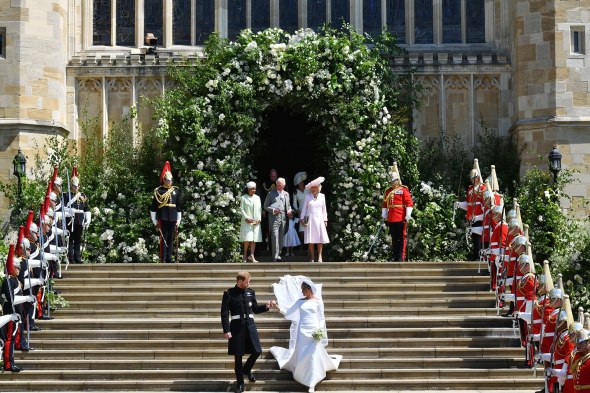
Good Afternoon!!
I slept too late to see any of the royal wedding live, but it sounds like it was wonderful. I don’t follow the royals, but it’s difficult not to be inspired by this wedding of a prince and a mixed-race American woman. Maybe Sam Cooke was right:
There have been times that I thought I couldn’t last for long
But now I think I’m able to carry on
It’s been a long, a long time coming
But I know a change is gonna come, oh yes it will
And it’s so satisfying to me that so many A-list Americans were invited to the ceremony, and the Trumps were excluded. The royal couple decided not to include any political leaders on the guest list, but I wonder if that decision was mostly about keeping Trump away.
This morning the BBC trolled Trump with a comparison photo.
The sermon at the wedding was an African American minister Michael Curry. The Guardian:
The US minister chosen by Prince Harry and Meghan Markle who told royals and celebrities that “love is the way” at their wedding on Saturday has previously spoken out on racial justice, LGBT equality and sexual harassment and exploitation.
In a powerful and entertaining address that left some members of the royal family looking bemused even as others laughed and nodded, Bishop Michael Curry told the service: “There’s power in love. Love can help and heal when nothing else can. There’s power in love to lift up and liberate when nothing else will.”
Curry, the most senior figure in the American Episcopal church, part of the global Anglican communion, was one of three clergyman at the wedding. The archbishop of Canterbury, Justin Welby, took the couple through their marriage vows and the dean of Windsor, David Conner, conducted the service.
Curry is the first African-American to serve as presiding bishop of the predominantly white US Episcopal church, and has recounted his family history as slaves and sharecroppers in North Carolina and Alabama in his autobiography Songs My Grandma Sang.
He told the New York Times in 2016 that when he was training for the priesthood, “the expectation at the time was that if you were a black priest or seminarian, you were going to be serving in black churches. There was a black church world and a white church world. That was the given-ness of racism, not that anybody said anything.”
A gospel choir performed Ben E. King’s iconic tune “Stand By Me.”
Performed by Karen Gibson and The Kingdom Choir, 20 singers stood Saturday at the west end of Windsor Castle, wearing different shades of pale pink….
The lyrics to “Stand by Me” read:
“When the night has come/And the land is dark/And the moon is the only light we see/No, I won’t be afraid,” the song begins. “Oh, I won’t be afraid/Just as long as you stand, stand by me/So darling, darling, stand by me/Oh, stand by me/Oh stand, stand by me. Stand by me.”
It’s not the first time The Kingdom Choir has performed for British royalty. In fact, they were tapped to perform at the Golden Jubilee of Queen Elizabeth II, celebrating her 50 years on the throne, in 2002.
The multi-denominational choir originates from the South East area of England, according to the group’s Facebook page.
Previously, they’ve performed for other notables, including former President Bill Clinton, Bishop Desmond Tutu and the late Nelson Mandela. They’ve also performed alongside American Gospel artists such as Fred Hammond and Donnie McClurkin along with British acts, including Elton John and The Spice Girls.
The spectacle of the royal wedding was for many Americans a welcome respite from the horrors happening here at home.
The New York Times: In Texas School Shooting, 10 Dead, 10 Hurt and Many Unsurprised.
SANTA FE, Tex. — A nation plagued by a wrenching loop of mass school shootings watched the latest horror play out in this small Southeast Texas town Friday morning, as a young man armed with a shotgun and a .38 revolver smuggled under his coat opened fire on his high school campus, killing 10 people, many of them his fellow students, and wounding 10 more, the authorities said….
It was the worst school shooting since the February assault on Marjory Stoneman Douglas High School in Parkland, Fla., where a young man with an AR-15 rifle left 17 people dead and prompted a wave of nationwide, student-led protests calling on lawmakers to tighten gun laws.
It was barely after 7:30 a.m. at Santa Fe High School, about 35 miles southeast of Houston, when gunfire first resounded through the halls, the opening volley of yet another massacre at an American high school that would leave students, teachers and staff members shocked, and in some cases bloodied. But they were not necessarily surprised.
A video interview with one student, Paige Curry, spread across social media, an artifact of a moment when children have come to expect violence in their schools.
“Was there a part of you that was like, ‘This isn’t real, this is — this would not happen in my school?’” the reporter asked.
The young girl shook her head: “No, there wasn’t.”
“Why so?” the reporter asked.
“It’s been happening everywhere,” she said. “I felt — I’ve always kind of felt like eventually it was going to happen here, too.”
Buried way down in the story was something that should have been in the lead:
Kole Dixon, 16, a sophomore, said he was standing outside history class when the fire alarm suddenly went off. He sprinted out a side door, and heard gunshots in rapid succession over the sound of the fire alarm.
When the shooting stopped, Mr. Dixon said that friends told him that the gunman first entered an art classroom, said “Surprise!” and started shooting. The suspect’s ex-girlfriend was among the people shot in that classroom, he said.
Dakinikat predicted this, and she was right.
The Washington Post: 2018 has been deadlier for schoolchildren than service members.
The school shooting near Houston on Friday bolstered a stunning statistic: More people have been killed at schools this year than have been killed while serving in the military.
Initial estimates put the number killed at Santa Fe High School at eight. (The death toll has since risen to 10.) We can compare that to figures for the military compiled from Defense Department news releases, including both combat and noncombat deaths. Even excluding non-students who died in school shootings (for example, teachers) the total still exceeds military casualties.
The article notes that the military statistics are complex.
The figures for 2018 do not suggest schools are more dangerous than combat zones. After all, there are more than 50 million students in public elementary and high schools and only about 1.3 million members of the armed forces. So far in 2018, a member of the military has been about 40 times as likely to be killed as someone is to die in a school shooting, including Keller’s revised figures.
That said, it is still the case that 2018 is shaping up to be unusually deadly at schools. Comparing the number of deaths and the number of shooting incidents this year directly with those through May 18 of 2017, that difference is stark.
The number of deaths and school shooting incidents through May 18 are each higher this year than at any point since 2000. There have been three times as many deaths in school shootings so far this year than in the second-most deadly year through May 18, 2005.

Read the rest at the WaPo.
Republicans can never again claim to be patriots after they outed a confidential intelligence source in an effort to protect Trump from the Russia investigation.
The Washington Post Editorial Board: The GOP’s campaign against the FBI makes the nation less safe.
IN THEIR paranoid partisan war on the Justice Department’s Russia probe, President Trump’s allies have been pushing for the dangerous disclosure of national security information, including information about a top-secret FBI and CIA informant. If Mr. Trump took his responsibility to protect the nation seriously, he would tell his allies to be quiet. Instead, he joined them Thursday. “Word seems to be coming out that the Obama FBI ‘SPIED ON THE TRUMP CAMPAIGN WITH AN EMBEDDED INFORMANT,’ ” Mr. Trump tweeted, in an apparent reference to the confidential source. “If so, this is bigger than Watergate!”
Rudolph W. Giuliani, Mr. Trump’s lawyer and a former Justice Department official who should know better than to spread such slander, told The Post that the president thinks that there is a law-enforcement conspiracy against him. “The prior government did it, but the present government, for some reason I can’t figure out, is covering it up,” he said. He also said: “I don’t know why the current attorney general and the current director of the FBI want to protect a bunch of renegades that might amount to 20 people at most within the FBI.” Yet Mr. Giuliani admitted Friday that the president does not really know whether the FBI planted anyone in his campaign. CNN also reportedFriday that U.S. officials insist that no informant was embedded.
The GOP’s escalating campaign against the FBI is extremely dangerous. Protecting the country is not just about having the biggest weapons. Trust is a key national security asset. Vast networks of informants relay information to the U.S. government daily. Sometimes their tips prove faulty. Sometimes they prevent terrorist attacks or provide the key piece of information necessary to bring down major criminals. If confidential informants conclude that they cannot rely on the assurances of the U.S. government, they will think twice about sending in tips, wearing wires or approaching malicious actors. That is why intelligence and law enforcement agencies spend vast amounts of time and money protecting the identity of sources and informants.
Click on the link to read the rest.
Politico: Warner: Identifying FBI source to undermine Russia probe could be a crime.
The top Democrat on the Senate Intelligence Committee warned Friday that his colleagues could be committing a crime if they obtain the identity of a secret FBI source and use it to undermine the ongoing investigation into Russian interference in the 2016 election.
Sen. Mark Warner (D-Va.) raised the alarm in a Friday evening statement, as Republican allies of President Donald Trump have pressed the Justice Department for details about a source believed to have aided the FBI and Special Counsel Robert Mueller’s probe into Trump campaign contacts with Russians.
“It would be at best irresponsible, and at worst potentially illegal, for members of Congress to use their positions to learn the identity of an FBI source for the purpose of undermining the ongoing investigation into Russian interference in our election,” Warner said. “Anyone who is entrusted with our nation’s highest secrets should act with the gravity and seriousness of purpose that knowledge deserves.”
Actually, the source was outed by right-wing media sources several days ago, as I learned by Googling his name.
Asha Rangappa at The Washington Post: The FBI didn’t use an informant to go after Trump. They used one to protect him.
President Trump and his allies are outraged at reports that the FBI used an “informant” to spy on Trump’s 2016 campaign. “Really bad stuff!” the president tweeted early Friday. Supporters of the White House claim the FBI’s reported tactics were illegal. House Intelligence Committee Chairman Devin Nunes (R-Calif.) has even subpoenaed the Justice Department for information on who the informant might have been; department and FBI officials say public disclosures of this kind could put sources in danger.
But Trump and his backers are wrong about what it means that the FBI reportedly was using a confidential source to gather information early in its investigation of possible campaign ties to Russia. The investigation started out as a counterintelligence probe, not a criminal one. And relying on a covert source rather than a more intrusive method of gathering information suggests that the FBI may have been acting cautiously — perhaps too cautiously — to protect the campaign, not undermine it.
As a former FBI counterintelligence agent, I know what Trump apparently does not: Counterintelligence investigations have a different purpose than their criminal counterparts. Rather than trying to find evidence of a crime, the FBI’s counterintelligence goal is to identify, monitor and neutralize foreign intelligence activity in the United States. In short, this entails identifying foreign intelligence officers and their network of agents; uncovering their motives and methods; and ultimately rendering their operations ineffective — either by clandestinely thwarting them (say, by feeding back misinformation or “flipping” their sources into double agents) or by exposing them.
The Intelligence community didn’t understand at first that Trump himself was a Russian asset who welcomed interference from a hostile foreign government.
That’s where we are today, and we can only hope that somehow our constitutional form of government will survive.
I’ve barely scratched the surface of the news. What stories are you following today?
Thursday Reads
Posted: May 17, 2018 Filed under: Foreign Affairs, just because, morning reads, U.S. Politics | Tags: Donald Trump, famous self-portraits, immigration, lecturing liberals, New York Times, North Korea, robocalls, selfies, Trump Russia 40 Comments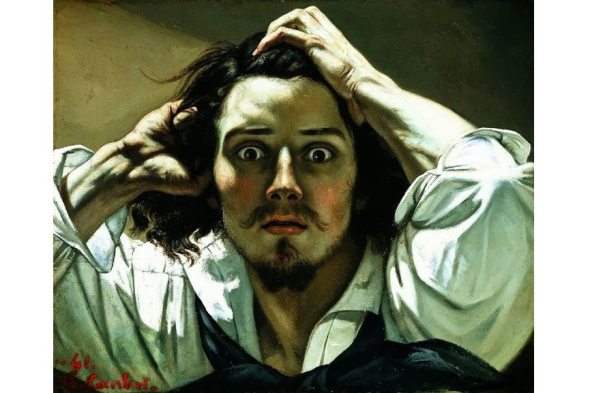
Gustave Courbet, Le Desperere,1845
Good Morning!!
I admit it. I’m obsessed with the Trump/Russia investigation, and I think my posts have become boring because of my obsession; so today, I’m going to try avoiding the subject and hope I’ll get more readers. This post is illustrated with “selfies” from before we had cell phones, just because. I hope you enjoy them.
Have you been getting a lot of annoying calls lately? I have. I usually don’t answer calls that come in from people I don’t know or area codes where I don’t know anyone; but once in awhile, I’ll pick up a call and it’s usually a recorded message. It turns out you can find out which numbers are robocalling your area.
From the Arlington Patch: Here’s Who Keeps Robocalling Your Area Code.
If you think you’re receiving robocalls now more than ever, you’re not wrong. According to the robocall blocker YouMail, pre-recorded phone messages are at an all-time high.
There were 3.36 billion robocalls last month in the U.S., 6.5 percent higher than the previous record and a whopping 34 percent higher than April 2017….
Mary Cassatt, Self portrait
Here are the states that received the most robocalls, as well as how many they received:
- California, 384.4 million
- Texas, 363.3 million
- Florida, 261.1 million
- Georgia, 213.6 million
- New York, 207.8 million
- Illinois, 134.6 million
- Ohio, 115.8 million
- Pennsylvania, 115.4 million
- North Carolina, 111 million
- Louisiana, 97.6 million
- Michigan, 89.7 million
- Tennessee, 88.3 million
- New Jersey, 84.3 million
- Virginia, 83 million
- Maryland, 79 million
- Alabama, 77.9 million
- South Carolina, 64.4 million
- Arizona, 60 million
- Missouri, 51.7 million
- Indiana, 51 million
Atlanta received the dubious honor of most robocalled city in America for the 29th straight month. People in that city received nearly 148 million robocalls last month and three Atlanta area codes cracked the top 20 most robocalled area code list.
Here are the top 10 most robocalled cities:
- Atlanta, GA
- Dallas, TX
- New York, NY
- Los Angeles, CA
- Chicago, IL
- Houston, TX
- Baltimore, MD
- Philadelphia, PA
- San Francisco Bay Area, CA
- Newark, NJ
M.C. Escher, Hand With Reflecting Sphere, 1935
The company says 47 of the 50 most robocalled cities in the country saw a higher robocalling volume in April. The increase comes even as lawmakers, consumer groups, telecommunications carriers and device makers pay closer attention to illegal calls.
“Despite the best efforts of regulators, industry groups, service providers, and app developers, we are warning consumers to remain vigilant by not picking up any calls from unfamiliar numbers, using robocall blocking apps, and researching numbers before calling them back,” YouMail CEO Alex Quilici said in a release.
Click here and enter an area code to see the full results.


I’m glad to know it’s not just me getting all these annoyance calls. Unfortunately, I’ve found that even when I block the numbers, they just call back from slightly different ones.
The media is currently obsessed with lecturing Democrats about how we need to be kinder and more understanding of Trump voters. Here’s a response to that from Osita Nwanevu at Slate: Liberals, It’s Not About Being Nice.
Over the weekend, the New York Times published an op-ed titled “Liberals, You’re Not As Smart As You Think.” In it, University of Virginia political science professor Gerard Alexander accuses American liberals of arrogance and warns them against making broad negative generalizations about large swaths of the population. “Liberals often don’t realize how provocative or inflammatory they can be,” he writes. “In exercising their power, they regularly not only persuade and attract but also annoy and repel.” Alexander cites a few particular examples of recent annoying and repulsive liberal behavior, including comedian Michelle Wolf’s performance at the White House Correspondents’ Dinner, but the heart of the piece is a broad indictment of identity politics as practiced by liberals and the left. “Racist is pretty much the most damning label that can be slapped on anyone in America today, which means it should be applied firmly and carefully,” Alexander writes. “Yet some people have cavalierly leveled the charge against huge numbers of Americans—specifically, the more than 60 million people who voted for Mr. Trump. In their ranks are people who sincerely consider themselves not bigoted, who might be open to reconsidering ways they have done things for years, but who are likely to be put off if they feel smeared before that conversation even takes place.”
Jean Cooke, self portrait, 1972
The piece was the latest in an unending stream of commentary attributing Democrats’ electoral misfortunes to conservative cultural backlash—a variation on a theme in punditry that was old hat long before Hillary Clinton made the supposed mistake of calling Trump supporters “deplorables.” Alleged gaffes like that, the story goes, form part of an imperious posture Democrats take on questions of identity politics that alienates simple folk who haven’t caught up with the progressive consensus on social questions.
This argument has very little to do with the actual state of American public opinion on those questions. Survey data suggests that identity politics as practiced by Democrats and the left has been quite successful and persuasive. Take racial issues, for instance. According to Pew, the percentage of white people in America who believe that the country “needs to continue making changes to give blacks equal rights with whites” has grown by 18 points since the beginning of the decade. Most of this can be attributed to white Democrats moving left on the question, but the numbers show change on the right as well: The number of Republicans and Republican leaners who believe this has grown by six points to 36 percent over the same period. The percentage of Republicans and Republican leaners who say that “racial discrimination is the main reason why many black people can’t get ahead these days” has also jumped about five points to 14 percent. These are, of course, still small minorities on the right, but given talk about how liberal arrogance and piety have alienated those who disagree with Democrats on racial identity politics into a backlash, one would expect the numbers to show … well, a backlash. Instead, they suggest that post–Trayvon Martin, Ferguson, and Black Lives Matter, rhetoric and activism may be working quite well on a broad cross section of Americans.

It’s a lengthy, thoughtful piece. Read the rest at Slate.
What’s the “nice” response to a “president” who says things like this?
USA Today: Trump ramps up rhetoric on undocumented immigrants: ‘These aren’t people. These are animals.’
President Trump used extraordinarily harsh rhetoric to renew his call for stronger immigration laws Wednesday, calling undocumented immigrants “animals” and venting frustration at Mexican officials who he said “do nothing” to help the United States.
Pablo Picasso, Self Portrait, Facing Death, 1972
“We have people coming into the country or trying to come in, we’re stopping a lot of them, but we’re taking people out of the country. You wouldn’t believe how bad these people are,” Trump said.
“These aren’t people. These are animals.”
Trump’s comments came in a freewheeling, hour-long White House meeting with local California leaders opposed to so-called “sanctuary city” policies. “California’s law provides safe harbor to some of the most vicious and violent offenders on Earth, like MS-13 gang members putting innocent men, women, and children at the mercy of these sadistic criminals,” he said.

I can’t think of anything nice to say about that or about people who support the man who said it.
Will John Bolton destroy Trump’s dreams of a deal with North Korea? Politico: Trump’s North Korea Nobel buzz could die with John Bolton.
Donald Trump wants a deal with North Korea. His national security adviser thinks the North Koreans can’t be dealt with. And North Korea thinks he’s “human scum.”
North Korea’s latest diatribe against the United States — and specifically a “repugnant” national security adviser, John Bolton — spotlights a core tension within the Trump administration as the president seeks a nuclear deal with North Korea that he hopes might earn him a Nobel Peace Prize.
Lee Krasner self portrait, 1930
Bolton is famously contemptuous of what he considers naïve U.S. diplomacy with foreign adversaries who can only be trusted to cRheat and lie. Prominent on his list is North Korea itself, which he has written “will never give up nuclear weapons voluntarily,” calling past U.S. diplomatic forays with the country “embarrassments.”
Trump, too, believes America has struck “terrible deals” for decades. And he shared Bolton’s intense animus for the Iran nuclear deal, which Trump torpedoed last week. But in the case of North Korea, even some Trump supporters worry the president is too eager for a deal that could dazzle the world and reap him huge political rewards.
The question now is whether Trump and Bolton can strike a constructive balance — or whether they might wind up at cross-purposes on one of the most important diplomatic experiments in U.S. history.

Read the rest at Politico.
May it would be a good thing if North Korea backs out of the summit, because Trump thinks he doesn’t need to spend a lot of time getting ready for the meeting. Time: President Trump ‘Doesn’t Think He Needs’ to Prepare Much for His Meeting With North Korea’s Kim Jong Un.
With just one month until a scheduled sit-down with North Korea’s leader, President Donald Trump hasn’t set aside much time to prepare for meeting with Kim Jong Un, a stark contrast to the approach of past presidents.
“He doesn’t think he needs to,” said a senior administration official familiar with the President’s preparation. Aides plan to squeeze in time for Trump to learn more about Kim’s psychology and strategize on ways to respond to offers Kim may make in person, but so far a detailed plan hasn’t been laid out for getting Trump ready for the summit.
Even with North Korea threatening to scrap the meeting over long-planned U.S.-Korean military exercises, Trump’s aides in the White House and State Department are continuing to prepare briefing material in advance of the June 12 summit in Singapore. When asked Wednesday if he thinks Kim is bluffing, Trump responded, “We’ll see what happens.” He told reporters he still plans to insist on North Korea giving up its nuclear weapons.
So briefing materials are being prepared, but Trump isn’t going to bother to read them. Big surprise.

Paul Gaugin self portrait with halo and snake 1889
I’m going to end with just one article related to the Russia investigation. Eric Wemple at The Washington Post: New York Times acknowledges it buried the lead in pre-election Russia-Trump story.
The upside of the New York Times’ aggressive coverage of the FBI investigation into Russian election meddling is that the American public is learning more and more about recent history. The downside is that the newspaper keeps bumping into its archives.
In a massive article Wednesday on the FBI’s 2016 snooping into the possible nexus between Russians and the Trump presidential campaign, reporters Matt Apuzzo, Adam Goldman and Nicholas Fandos include these two paragraphs:
In late October, in response to questions from The Times, law enforcement officials acknowledged the investigation but urged restraint. They said they had scrutinized some of Mr. Trump’s advisers but had found no proof of any involvement with Russian hacking. The resulting article, on Oct. 31, reflected that caution and said that agents had uncovered no “conclusive or direct link between Mr. Trump and the Russian government.”
The key fact of the article — that the F.B.I. had opened a broad investigation into possible links between the Russian government and the Trump campaign — was published in the 10th paragraph.
That’s one heck of a concession: We buried the lead! In their book “Russian Roulette,” authors Michael Isikoff and David Corn report that editors at the New York Times “cast the absence of a conclusion as the article’s central theme rather than the fact of the investigation itself,” contrary to the wishes of the reporters.
The article in question was published on Oct. 31, 2016, and it has received a great deal of hindsight-aided scrutiny for the role it may have played in easing voters’ concerns about ties between Donald Trump and Russia. Under the bylines of Eric Lichtblau and Steven Lee Myers, the story, headlined “Investigating Donald Trump, F.B.I. Sees No Clear Link to Russia,” hit the public sphere just as other outlets — Slate and Mother Jones — published reports that began poking at the outlines of possible collusion.
But will the Times apologize to Hillary Clinton and the American people?
Those are my offerings for today; what stories are you following?
Tuesday Reads: Trump Has Put American Foreign Policy Up For Sale.
Posted: May 15, 2018 Filed under: Afternoon Reads, U.S. Politics | Tags: Ahmed Al-Rumaihi, Ayman Sabi, China, Donald Trump, Ice Cube, Jed Shugarman, Jeff Kwatinetz, Michael Avenatti, Michael Cohen, Michael Flynn, Qatari Foreign Minister Mohammed bin Abdulrahman al-Thani, Quatar, Robert Mueller, Rosneft deal, Steele Dossier, Trump Russia investigation, Xi Jinping, ZTE 33 Comments
Good Morning!!
The corruption is right out in the open now. American foreign policy is for sale to highest bidder. On Sunday Trump posted a startling tweet:
EuroNews: Trump tells Commerce Department to help Chinese telecom ZTE.
President Donald Trump said Sunday he has instructed his Commerce Department to help get a Chinese telecommunications company “back into business” after the U.S. government cut off access to its American suppliers.
At issue is that department’s move last month to block the ZTE Corp., a major supplier of telecoms networks and smartphones based in southern China, from importing American components for seven years. The U.S. accused ZTE of misleading American regulators after it settled charges of violating sanctions against North Korea and Iran….
ZTE has asked the department to suspend the seven-year ban on doing business with U.S. technology exporters. By cutting off access to U.S. suppliers of essential components such as microchips, the ban threatens ZTE’s existence, the company has said.
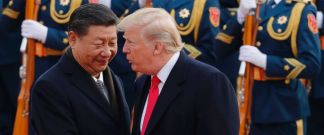
Trump with Chinese president Xi Jinping during China trip
During recent trade meetings in Beijing, Chinese officials said they raised their objections to ZTE’s punishment with the American delegation, which they said agreed to report them to Trump.
The U.S. imposed the penalty after discovering that Shenzhen-based ZTE, which had paid a $1.2 billion fine in the case, had failed to discipline employees involved and paid them bonuses instead.
Why is Trump suddenly so concerned about Chinese jobs? It’s not about U.S. national security; it’s about Trump’s business. HuffPost: Trump Orders Help For Chinese Phone-Maker After China Approves Money For Trump Project.
A mere 72 hours after the Chinese government agreed to put a half-billion dollars into an Indonesian project that will personally enrich Donald Trump, the president ordered a bailout for a Chinese-government-owned cellphone maker….
…on Thursday, the developer of a theme park resort outside of Jakarta had signed a deal to receive as much as $500 million in Chinese government loans, as well as another $500 million from Chinese banks. Trump’s family business, the Trump Organization, has a deal to license the Trump name to the resort, which includes a golf course and hotels.
Trump and family with Indonesian business partners
Trump, despite his promises to do so during the campaign, has not divested himself of his businesses, and continues to profit from them.
“You do a good deal for him, he does a good deal for you. Quid pro quo,” said Richard Painter, the White House ethics lawyer for former President George W. Bush and now a Democratic candidate for Senate in Minnesota.
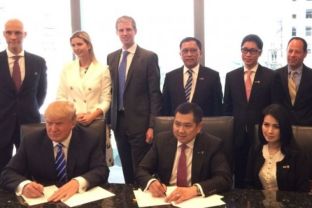
It sure does look like a quid pro quo, doesn’t it? Or is it just that Trump is a bad deal-maker? We can’t be sure because Trump chose to maintain control of his businesses and refuses to release his tax returns. Read more about Trump’s Indonesia project at the South China Morning Post: Trump Indonesia project is latest stop on China’s Belt and Road.
Gordon Chang at the Daily Beast: Trump Cuts a Great Deal—For China.
The White House looks like it is prepared to give relief to ZTE Corp., the embattled Chinese telecom-equipment maker, in exchange for Beijing lifting tariffs on, and easing non-tariff barriers against, U.S. agricultural products. Moreover, China’s Commerce Department will restart its long-stalled review of Qualcomm’s proposed acquisition of NXP Semiconductors, the Dutch firm.
In addition, The Daily Beast has learned there will be either no penalties or only light ones imposed on China for stealing U.S. intellectual property.
This is a great deal—for China. China gets relief for ZTE for doing nothing more than what it should have been doing all along. And its massive theft of U.S. technology and intellectual property—undoubtedly in the hundreds of billions of dollars a year—goes mostly unpunished.
If the reports of the outlines of the impending agreement are correct, the Trump administration, which prides itself on deal-making, will have accepted one of the worst trade arrangements this century.
 Josh Rogin at The Washington Post: China gave Trump a list of crazy demands, and he caved to one of them.
After top Trump officials went to Beijing last month, the Chinese government wrote up a document with a list of economic and trade demands that ranged from the reasonable to the ridiculous. On Sunday, President Trump caved to one of those demands before the next round of negotiations even starts, undermining his own objectives for no visible gain.
The Chinese proposal is entitled, “Framework Arrangement on Promoting Balanced Development on Bilateral Trade,” and I obtained an English version of the document, which is the Chinese government’s negotiating position heading into the next round of talks. That round begins this week when Xi Jinping’s special economic envoy Liu He returns to town.
Bullet point 5 is entitled, “Appropriately handing the ZTE case to secure global supply chain.”
So Trump agreed to reverse US policy, but was it really about rewarding China for funding the Trump project in Indonesia? I’d say that’s pretty likely, wouldn’t you?
Trump took a big step in that direction Sunday when he tweeted that he had instructed the Commerce Department to help get ZTE “back into business, fast,” only weeks after the Commerce Department cut off its supply of American components because it violated U.S. sanctions on sales to North Korea and Iran. Trump’s tweet set off a panic both inside and outside the administration among those who worry that Trump is backing down from his key campaign promise to stand up to China’s unfair trade practices and economic aggression.
As Sen. Marco Rubio (R-Fla.) pointed out Monday, the problems with ZTE go well beyond sanctions-busting. The Federal Communications Commission has proposed cutting ZTE and other Chinese “national champion” companies off from U.S. infrastructure development funds because the U.S. intelligence community views their technology as a national security risk.
Guess what folks? Trump doesn’t give a shit about U.S. national security. He cares about money for himself. Period.
Michael Avenatti has had a busy past few days, and I’ve been following the revelations pretty closely. On Sunday Avenatti posted some stills from a C-Span video of Trump Tower during the transition.
Later, he revealed that a Quatari official apparently met with Michael Cohen and Michael Flynn on Dec. 12, 2016.
Mother Jones: Qatari Investor Accused in Bribery Plot Appears With Michael Cohen in Picture Posted by Stormy Daniels’ Lawyer.
Members of the Trump transition team appear to have met on December 12, 2016, with a group from Qatar that included Ahmed Al-Rumaihi, the former Qatari diplomat and current head of a division of Qatar’s massive sovereign wealth fund, who is accused in a recent lawsuit of scheming to bribe Trump administration officials.
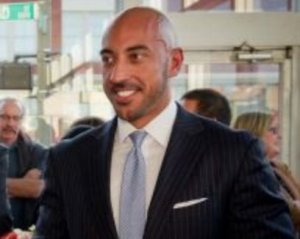
Ahmed Al-Rumaihi
On the lawsuit:
Ice Cube, the rapper and actor, and his business partner, Jeff Kwatinetz, recently filed a $1.2 billion lawsuit that includes an allegation that Al-Rumaihi and other Qatari officials who invested in the men’s BIG3 basketball league indicated interest in gaining access to people connected to Trump. “Mr Al-Rumaihi requested I set up a meeting between him, the Qatari government, and Stephen Bannon, and to tell Steve Bannon that Qatar would underwrite all of his political efforts in return for his support,” Kwatinetz said in the court filing. Kwatinetz says he rejected the offer, which he viewed as a bribe.
In response, Kwatinetz claims, “Al-Rumaihi laughed and then stated to me Buthat I shouldn’t be naive, that so many Washington politicians take our money, and stated ‘do you think Flynn turned down our money?’” That’s a reference to Michael Flynn, who was fired as Trump’s national security adviser after lying about his contacts with then Russian Ambassador Sergey Kislyak.
But it appears that other Quatari officials were also in the Dec. 12, 2016 meeting, according to knowledgeable people on Twitter.
Here’s the Wikipedia article on Quatari the foreign minister.
And a third person from Quatar who is also involved in the lawsuit filed by Ice Cube and Kwatinetz was also present.
https://twitter.com/ACoupleOkooks/status/995864743918391296
What the hell is going on? A couple of useful reads:
The founder of a three-on-three basketball league who claims he was offered a bribe by a one-time Qatari diplomat to arrange access to Steve Bannon said on Monday that the former diplomat is the same person photographed with Michael Cohen at Trump Tower in December 2016.
Big 3 basketball league co-founder Jeff Kwatinetz told Slate that he recognized Ahmed Al-Rumaihi in photos with Cohen that were tweeted Sunday by attorney Michael Avenatti.
“Yes, 100 percent,” Kwatinetz said when asked if he thought the videos and photos were of Ahmed Al-Rumaihi. Last week, Kwatinetz, who is a co-founder of Big 3 with Ice Cube, accused Al-Rumaihi in a sworn court declaration of making an attempted bribe and of suggestively boasting that Flynn had not refused “our money.” [….]
[Michael] Avenatti tweeted the images that appeared to show Al-Rumaihi entering an elevator in Trump Tower on Dec. 12, 2016, five days after news broke of the multibillion-dollar sale of 19.5 percent of the Russian fossil fuel giant Rosneft to Swiss trading firm Glencore and Qatar’s sovereign investment fund. (Glencore and Qatar sold off a major stake of Rosneft to China last year, but earlier this month Qatar bought back in to the Russian company for a total stake of 19 percent.)
The Rosneft deal features prominently in an investigative dossier compiled by former British spy Christopher Steele. A central claim of the Steele dossier was that Trump foreign policy adviser Carter Page, during an alleged meeting with Rosneft officials in summer 2016, promised that a Trump administration would undo sanctions against Russia, in part, in exchange for brokerage of the Rosneft deal. In May 2016, Al-Rumaihi reportedly took over as head of a major division of the wealth fund ultimately involved in the Rosneft deal.
The allegations in the Steele dossier, made in October 2016, suggested a future quid-pro-quo deal between Russia and the Trump campaign. Trump has been conspicuously resistant to Russian sanctions despite widespread congressional support from both parties. As Jed Shugerman has noted in Slate, during congressional testimony Page acknowledged meeting with Andrey Baranov, the head of investor relations at Rosneft, during his July 2016 trip to Russia and acknowledged “briefly” discussing the sale of Rosneft as well as there being “some general reference” to sanctions. As Business Insider’s Natasha Bertrand has reported, Page also acknowledged meeting with top Rosneft managers in Moscow on Dec. 8—four days before the apparent Cohen–Al-Rumaihi meeting and one day after the completion of the Rosneft deal.
Jed Shugarman has posted a detailed Russia/Qatar/Trump Timeline in a Google doc that will be updated with new information. On his blog, Shugarman posted this introduction to the timeline:
I have produced a Google Doc timeline, based on publicly available reports and documents, of the alleged bribery scheme between Russia and Trump associates, possibly through Qatar’s purchase of Rosneft….
Russia’s sale of Rosneft Gas is the key event in the Steele Dossier’s quid pro quo allegation. On June 2016, Russians allegedly offer Trump associates a massive payout derived from the commissions on Russia’s sale of 19.5% of state energy giant Rosneft ($11 billion), in return for lifting sanctions. Weeks after the election, Flynn and Kushner are in contact with Russian officials. Then Russia sells a 19.5% stake in Rosneft in a concealed deal, eventually revealed to be with Qatar. Immediately after the deal, a Qatari diplomat allegedly met with Cohen and Flynn at Trump Tower.
In January 2017, payments from Russian oligarch to Michael Cohen begin, and Flynn reportedly texts associates that Trump will lift Russian sanctions, opening up huge personal profits. But around this time, the Dossier is published. Kushner sought money directly from Qatar, because it is possible that Qatar was backing off of the deal, wary of its exposure. In April 2017, Kushner reportedly escalated a Gulf state crisis between Saudi Arabia, UAE, and Qatar with a risk of regional war. A few months later, the Qatar-backed Apollo Group delivers $184 million to Kushner, who has been in financial crisis over a disastrous purchase of 666 5th Ave.
Remember, Robert Mueller and his investigators have likely known all this for a long time and they probably know many more details. Michael Flynn has been cooperating for months, and indictments involving Michael Cohen are very likely in the works.
What stories are you following today?
Thursday Reads: An Attitude of Gratitude
Posted: May 10, 2018 Filed under: Afternoon Reads, morning reads, U.S. Politics | Tags: Barack Obama, Donald Trump, Michael Avenatti, Rick Wilson, Rudy Giuliani, Rules for Radicals, Saul Alinsky 56 Comments
Good Afternoon!!
I woke up this morning and suddenly realized that today is my anniversary. It has been 36 years since I got sober on May 10, 1982. It has been a long, strange trip. I have a lot to be grateful for today. Everything is crazy in our world today, but I’d rather be dealing with this than dead.
And I have something else to be grateful for too: Michael Avenatti is on the case, and he has blown it wide open. I wonder where he learned how to get so much public attention?
Jack Schaeffer at Politico: Michael Avenatti’s Rules for Radicals. Where Stormy Daniels’ lawyer got his tricks.
Go ahead and joke about TV’s bright lights sunburning his bald head all the way to skin cancer. Avenatti won’t mind. All the world is his court and all the men and women in it merely jurors. Appearing on Anderson Cooper 360° on Tuesday night, where he was as poised as a fat cat taking a limousine to the airport, he explained his method.
“There’s been some criticism about our media strategy and how often I’ve been on CNN and how often I’ve been on your show and other networks,” Avenatti said. “Here’s the bottom line, Anderson. It’s working. OK? It’s working in spades. And one of the reasons, and one of the ways that it’s working, is because we’re so out front on this, people send us information. People want to help our cause. People contact us with information.”
They sure do, as we’ve learned over the past couple of days of wall-to-wall media coverage of Avenatti’s revelations about Michael Cohen selling access to Donald Trump. So what’s Avenatti’s secret?
Although Avenatti grew up in St. Louis and attended college and law school in Washington, D.C., his media politics owe much to the famous teachings of Chicago political organizer Saul Alinsky (1909-1972), who formulated a set of 13 “rules for radicals” that have gained devotees on both the left and right for several generations, including Barack Obama and Rahm Emanuel, for whom Avenatti worked while in college.
Appearing on TV, Avenatti wears down his opponents by deploying Alinsky’s Rule No. 5, one that Trump has long observed in his own battles: “Ridicule is man’s most potent weapon.” Avenatti routinely mocks Cohen as a “thug,” “beyond stupid,” legally “radioactive” and “not that bright.” and goes after Cohen’s attorney with an ack-ack of insults and slights. Wherever possible, Avenatti makes personal everything that is legal, perhaps because he figures that a temperamental opponent like Cohen will grow unsettled and erratic in the face of ridicule, unable to muster any real defense.
“Keep the pressure on. Never let up,” Alinsky’s Rule No. 8, has guided Avenatti’s nonstop, inventive TV campaign. Yesterday, for example, he broadened his attack on Cohen by releasing leaked financial documents that documented suspicious cash transfers from corporations to Cohen. What, if anything this new, damning information has to do with liberating Stormy Daniels from her NDA, isn’t readily apparent. But it fills the ditch that Cohen occupies with fast-drying concrete. “Power is not only what you have, but what the enemy thinks you have,” Alinsky’s Rule No. 1, has piloted Avenatti’s moves from the beginning: He teased his Twitter audience by posting a picture of a DVD, implying that it contains smutty pictures of Trump and constantly hints that new, detrimental evidence against Cohen is about to emerge, such as his prediction that new hush payments will be revealed or that the Russians might have covered the $130,000 silence payment to his client. Overstatement is one of his favorite games. Staging media events that please the gallery is another area in which the Avenatti and Alinsky worlds intersect (Rule No. 6: “A good tactic is one your people enjoy.”).
Head over to Politico to read the whole thing. I wonder if Barack Obama is following all this?
At New York Magazine, Frank Rich compares Avenatti to Woodward and Bernstein: Following the Money in Trumpland Leads Ugly Places.
With Michael Avenatti’s revelation that the shell company Michael Cohen used for the Stormy Daniels payoff also received money tied to Russian oligarch Viktor Vekselberg (as well as payments from other companies with government business), it looks like the two main threads of Donald Trump’s legal troubles may be part of the same story. Has Avenatti found the “collusion” that Trump has spent so much energy denying?
Avenatti, whose revelations have since been verified by the Times and others, is doing exactly what Woodward and Bernstein did in Watergate — following the money. By doing so he has unveiled an example of collusion so flagrant that it made Trump and Rudy Giuliani suddenly go mute: a Putin crony’s cash turns out to be an essential component of the racketeering scheme used to silence Stormy Daniels and thus clear Trump’s path to the White House in the final stretch of the 2016 election. Like the Nixon campaign slush fund that Woodward and Bernstein uncovered, this money trail also implicates corporate players hoping to curry favor with a corrupt president. Back then it was the telecommunications giant ITT, then fending off antitrust suits from the government, that got caught red-handed; this time it’s AT&T. Both the Nixon and Trump slush funds were initially set up to illegally manipulate an American presidential election, hush money included. But the Watergate burglars’ dirty tricks, criminal as they were, were homegrown. Even Nixon would have drawn the line at colluding with Russians — or, in those days, the Soviets — to sabotage the Democrats.
I know some accuse Avenatti of being a media whore, but he’s the one media whore I can’t get enough of. He knows what he’s doing, he has the goods, and he is playing high-stakes poker, shrewdly, with what appears to be a winning hand.
I can’t wait to see what Avenatti will do next.
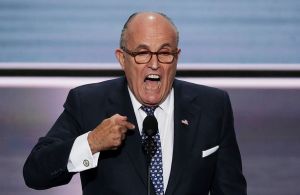 I can’t find any news reports on this yet, but last night Giuliani told USA Today that the Michael Cohen revelations have nothing to do with Donald Trump.
President Trump’s attorney Rudy Giuliani said Wednesday that his client is not affected by investigations into payments to longtime Trump lawyer Michael Cohen from several American companies and a firm tied to a Russian oligarch.
“I don’t see it,” Giuliani told USA TODAY. “This has nothing to do with us.”
If Trump had some kind of legal exposure, Giuliani said, Russia special counsel Robert Mueller would not have passed on the information to federal prosecutors in New York who are investigating Cohen’s business dealings.
Giuliani also scoffed at a suggestion made by Daniels’ attorney Michael Avenatti that Russian money went to the adult film star to keep her quiet about an alleged affair with Trump.
“I don’t see how that could be the case,” Giuliani said, noting that the entity cited by Avenatti is “not Russian; it’s an American company.”
There’s a lot that Rudy doesn’t see, like how Trump is likely to dump him next. Rick Wilson at The Daily Beast: Rudy Giuliani and Donald Trump: This Will End Badly. And Probably Soon.
Like a bloated, portly fake billionaire rolling off a hooker after a hot 45 seconds of passionate sex, Donald Trump’s ardor for Rudy Giuliani seems to have cooled.
If the White House leaks are any barometer, it sounds more and more as if Donald wants Rudy to get his money off the nightstand and the hell out of his room at the No-Tell-Motel. This is what happens when you work for Trump, and Rudy is old enough, crafty enough, and knows Trump well enough to have known better.
Trump’s hiring of my old boss is a triumph of today’s Trump-right media bubble, where nothing matters but the coverage on Fox & Friends, Hannity, Sinclair stations’ nightly Two Minutes of Hate, and on the nut-site constellation that comprises conservative “news” sites. Trump didn’t hire Rudy for his skills as a litigator, or as a warrior in the high-speed low-drag social-media world of today. He was hired to break shit and make loud noises, and he’s damn good at it. Unfortunately for Rudy, that probably won’t be enough to save him from the Trump curse.
Trump has been mostly unable to hire and retain top-flight litigators because he destroys everyone around him. His record of stacking former staffers like cordwood as they are either fired, humiliated, shamed, permanently scarred, forced to cut off a finger by the Yakuza, morally compromised, or moved into the Witness Protection Program will go down in presidential history. It’s no secret that he’s a spectacular liar at all times and on all subjects, leaving his legal team constantly wary they have a client who combines a stubborn streak and a self-destructive nature with an endless capacity to lie to them about his marital, financial, and political lies.
Even though he’s a right-winger, Wilson has a way with words. Read the rest at The Daily Beast.
That’s is for me this morning. I may have a few more links in the comment thread. What stories are you following?
Lazy Saturday Reads
Posted: April 28, 2018 Filed under: Foreign Affairs, morning reads, U.S. Politics | Tags: Adam Schiff, Angela Merkel, Aras Agalarov, Donald Trump, Donald Trump Jr, Emin Agalarov, Emmanuel Macron, House Intelligence Committee, North Korea, South Korea, Trump Tower Azerbaijan 23 Comments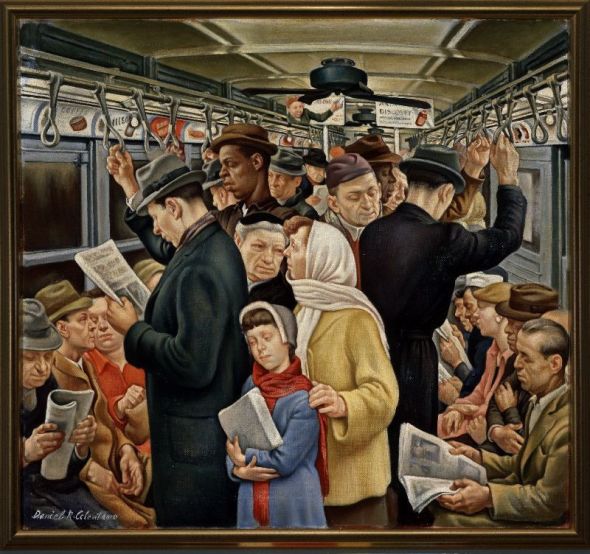
Daniel Ralph Celantano, Subway
Good Morning!!
I’m tired . . . so tired. Life in Trump world is exhausting. We’ve reached the point where it’s obvious that Trump’s family and campaign conspired witIh Russia to win the White House, and yet we still have to listen to Trump rant “no collusion” in his ugly, blaring voice. Have you noticed his Queens accent really comes out when he’s apoplectic like he was on Fox and Friends on Thursday? It seems his rosacea gets worse when he’s angry too. If only I never had to hear that honking voice or see his ugly orange face ever again!
I think maybe Angela Merkel agrees with me. Bess Levin at Vanity Fair: All the Times Angela Merkel’s Face Said “STFU You Dumkopf Orange Oaf.”
On Friday, German chancellor Angela Merkel arrived at the White House for a three-hour “working session” with Donald Trump, the goal of which was to convince the American to resist his impulses and not do anything stupid on a host of issues ranging from trade to Iran to the environment. Picking up where French president Emmanuel Macron left off—which is to say, at square one—Merkel’s visit was expected to be much less of a lovefest, meaning no hugging, kissing, hand-holding, fancy dinners, 21-gun salutes, or animal-kingdom mating rituals. The best anyone could hope for, experts warned, was that through small words and simple sentence construction, the chancellor could make Trump understand that so many of his threats—particularly the ones on trade—would hurt not only the targets for which they were intended, but the U.S. as well.
Charlotte Johnson Wahl, Subway NYC, 1994
Even then, expectations were extremely low, given the 45th president’s inability to understand complex, nuanced issues, or the freaking difference between a trade deficit and a surplus. Still, when the two took to a pair of podiums to hold a joint press conference on Friday afternoon, the vibe seemed slightly better than expected. For one thing, Trump was neither foaming at the mouth nor actively refusing to shake Merkel’s hand. For another, Merkel dug deep and paid Trump some compliments using words and phrases you know he just ate up, mentioning the “strength” of his sanctions on North Korea, and claiming that last year’s tax legislation has made the U.S. a “very interesting place for our companies” to invest. Still, one need only take a gander at Merkel’s notoriously weak poker face to understand that inside, she was screaming I can’t believe I have to occupy the same airspace as this knuckle-dragger.

Watch videos and read more snark at Vanity Fair. I can’t even begin to imagine how Macron could bear to have Trump’s hands all over him during their visit. Just the thought of it makes me gag.
On the “no collusion” front . . .
Paul Waldman and Greg Sargent at The Washington Post: The new House GOP report on Russia is revealing. But not in a good way for Trump.
Republicans on the House Intelligence Committee on Friday released a report on Russia’s involvement in the 2016 election. Although it is meant to exonerate President Trump and everyone around him, what it actually does is bring the utter degradation and disgrace of that committee to its fullest expression.
Mark Rothko, Untitled Subway, 1937
By contrast, there may be real news in the Democrats’ response to the report. In particular, the Democrats detailed new information that appears to shed light on what Republicans would not do in their investigation.
The response by Democrats makes this important charge: That Republicans refused to follow up on a lead that could have demonstrated whether, despite his denials, Trump had advance knowledge of the now-infamous Trump Tower meeting in June 2016 between a group of Russians and Donald Trump Jr., Jared Kushner, and Paul Manafort.

Specifically, it appears very likely that Trump talked to Don Jr. on the phone while Jr. was setting up the meeting.
According to the Democratic response, right after Trump Jr. set up the specifics of the meeting, he had two calls with a number in Russia belonging to Emin Agalarov. Between those two calls, the Democratic response recounts, Trump Jr. received a third call from a blocked number. Who might it have been? [….]
“We sought to determine whether that number belonged to the president, because we also ascertained that then-candidate Trump used a blocked number,” Schiff said during our interview. “That would tell us whether Don Jr. sought his father’s permission to take the meeting, and [whether] that was the purpose of that call.”
Lily Furedi, Subway, 1934
Schiff added that Democrats asked Republicans to subpoena phone records to determine whose number it was, but Republicans “refused,” Schiff said. “They didn’t want to know whether he had informed his father and sought his permission to take that meeting with the Russians.”

Raise your hand if you think the call from the blocked number was from someone other than Daddy Trump. I’m sure Robert Mueller and his team already know whose number that was.
Buzzfeed: Trump Jr. And Emin Agalarov Stayed In Touch Throughout The Transition.
A direct line of communication between the Kremlin-connected Agalarov family and the Trump family was open during the transition after President Donald Trump’s presidential election, BuzzFeed News has learned.
The “first of a series” of text messages was sent between Emin Agalarov and Donald Trump Jr. two days after the 2016 election, a source familiar with the communications told BuzzFeed News.
The communications continued through at least mid-December 2016, according to information made public Friday.
It is not clear how many messages were sent, whether Trump Jr. sent any of them, or how many were sent by either party — although BuzzFeed News confirmed that multiple messages were sent.
Nicole Eisenman, Weeks on the Train
Democrats on the House Intelligence Committee revealed one of the text messages, from Dec. 13, 2016, in their “minority views” report on Friday — one of several new pieces of information that suggest that the Trumps’ relationship with the Agalarovs was much closer than the president and his family have said.

Many more details at the Buzzfeed link.
CNN: Russians followed up on Trump Tower meeting after election, Democrats say.
Rep. Adam Schiff, the top Democrat on the intelligence panel, told CNN’s Jim Sciutto on Friday that Russian lawyer Natalia Veselnitskaya reached out to the Trump family after the election with a request to follow up on efforts to repeal the Magnitsky Act, the 2012 Russian sanctions the US enacted over human rights abuses.
Veselnitskaya was the Russian lawyer at the center of the June 2016 Trump Tower meeting, where Donald Trump Jr. expected to receive damaging information on Hillary Clinton but instead Veselnitskaya focused on the repeal of the sanctions.
“Clearly, there’s an expectation there on the Russian side that they may now have success with the Magnitsky Act, given that the prior meeting and communications dealt with the offer of help,” Schiff said. “It certainly seems like the Russians were ready for payback.”
In addition, another effort to reach out to Trump’s team after the election came from Aras Agalarov, the Azerbaijani-Russian oligarch who also has ties to the Trump Tower meeting. Agalarov, along with his pop-star son, Emin Agalarov, also worked with Trump to bring the 2013 Miss Universe Pageant to Moscow….
G. Boersma, Surrounding, Man reading newspaper on NY subway
Democrats cite a November 28, 2016, email from publicist Rob Goldstone to Trump’s assistant, Rhona Graff, which said that “Aras Agalarov has asked me to pass on this document in the hope it can be passed on to the appropriate team.”
“Later that day, Graff forwarded to Steve Bannon the email with Agalarov’s document regarding the Magnitsky Act as an attachment, explaining, ‘The PE [President Elect] knows Aras well. Rob is his rep in the US and sent this on. Not sure how to proceed, if at all.'”
Trump’s team has denied there was any follow up after the Trump Tower meeting.

While Trump claims credit for the meeting between North Korea’s Kim Jon Un and South Korea’s Moon Jae-in, Max Boot points out at The Washington Post that this has happened before: Don’t let the Korea summit hype fool you. We’ve been here before.
The meeting between the leaders of North and South Korea was acclaimed as “historic.” The two leaders hugged, “smiled broadly, shook each other’s hand vigorously and toasted each other with glasses of champagne.” Reporters noted that the “opening formalities seemed surprisingly relaxed, exceeding the expectations of many people, including perhaps those of the principals themselves. The South Korean leader said we must “proceed together on a path of reconciliation and cooperation.” The North Korean leader replied that “you will not be disappointed.”
Sound familiar? It should, because the news coverage of the 2000 meeting between South Korean President Kim Dae-jung and North Korean leader Kim Jong Il in Pyongyang parallels the euphoria over Friday’s meeting in Panmunjom between Moon Jae-in and Kim Jong Un, Kim Jong Il’s son. If anything, the 2000 meeting produced more tangible results: Not only declarations about ending the Korean War and uniting the two countries, but also concrete steps toward creating a joint South Korean-North Korean industrial park in Kaesong , allow South Korean tourists to visit the North, and to reunify families long divided by the demilitarized zone. Between 1998 and 2008, South Korea provided some $8 billion in economic assistance to North Korea in the hope that all of this aid would create a kinder, gentler regime. Kim Dae-jung won the Nobel Peace Prize in 2000 for his efforts.
Subway Train Watercolor painting, Shyama Golden
And yet the Sunshine Policy, so widely heralded at the time, is now widely judged a failure. Despite North Korea’s promises, it did nothing to ease the repression of its populace or to end its nuclear and missile programs. It turned out Kim Dae-jung only achieved that “historic” 2000 summit by offering Kim Jong Il a $500 million bribe. Another summit was held in 2007, arranged by Moon Jae-in, then an aide to President Roh Moo-hyun, and it too was rapturously acclaimed. But the next year, a conservative government took power in Seoul and ended the Sunshine Policy.

Read the rest at the link.
Finally, a little schadenfreude. The Independent reports that there was a fire in the Trump Tower in Azerbaijan. Fortunately, there were no injuries.
A skyscraper that was slated to become a Trump International Hotel in the Azerbaijani capital of Baku has caught fire.
The Azadliq newspaper reported that the blaze broke out on the middle floors of the 33-storey building, which is locally known as Trump Tower, and spread.
Etibar Mirzoev, deputy head of the Emergency Situations Ministry, said there were no injuries and authorities were working to establish the cause of the of the fire.
What stories are you following today?

 peej
peej Carissa
 bostonboomer
 dakinikat
 ecocatwoman
 jjlo
jjlo mablue2
 Mama Lopez
 peggysue22
 quixote
 skydancingguestblogger
 Mona (aka Wonk the Vote)





Recent Comments