







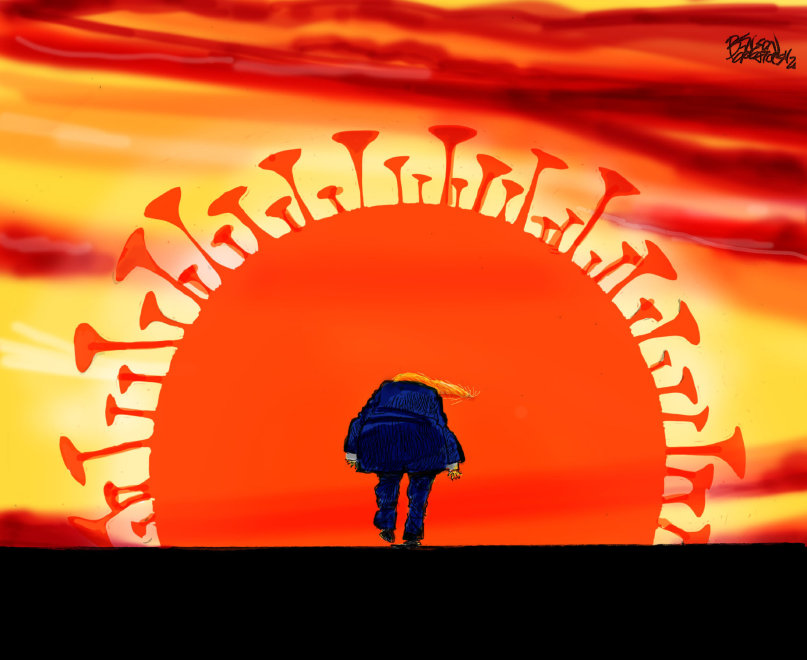






In the months since March, many Americans have habituated to the horrors of the pandemic. They process the election’s ramifications. They plan for the holidays. But health-care workers do not have the luxury of looking away: They’re facing a third pandemic surge that is bigger and broader than the previous two. In the U.S., states now report more people in the hospital with COVID-19 than at any other point this year—and 40 percent more than just two weeks ago.
Emergency rooms are starting to fill again with COVID-19 patients. Utah, where Nathan Hatton is a pulmonary specialist at the University of Utah Hospital, is currently reporting 2,500 confirmed cases a day, roughly four times its summer peak. Hatton says that his intensive-care unit is housing twice as many patients as it normally does. His shifts usually last 12 to 24 hours, but can stretch to 36. “There are times I’ll come in in the morning, see patients, work that night, work all the next day, and then go home,” he told me. I asked him how many such shifts he has had to do. “Too many,” he said.
Grey Kitty, by C.M. Cooper
Hospitals have put their pandemic plans into action, adding more beds and creating makeshift COVID-19 wards. But in the hardest-hit areas, there are simply not enough doctors, nurses, and other specialists to staff those beds. Some health-care workers told me that COVID-19 patients are the sickest people they’ve ever cared for: They require twice as much attention as a typical intensive-care-unit patient, for three times the normal length of stay. “It was doable over the summer, but now it’s just too much,” says Whitney Neville, a nurse based in Iowa. “Last Monday we had 25 patients waiting in the emergency department. They had been admitted but there was no one to take care of them.” I asked her how much slack the system has left. “There is none,” she said.
The entire state of Iowa is now out of staffed beds, Eli Perencevich, an infectious-disease doctor at the University of Iowa, told me. Worse is coming. Iowa is accumulating more than 3,600 confirmed cases every day; relative to its population, that’s more than twice the rate Arizona experienced during its summer peak, “when their system was near collapse,” Perencevich said. With only lax policies in place, those cases will continue to rise. Hospitalizations lag behind cases by about two weeks; by Thanksgiving, today’s soaring cases will be overwhelming hospitals that already cannot cope. “The wave hasn’t even crashed down on us yet,” Perencevich said. “It keeps rising and rising, and we’re all running on fear. The health-care system in Iowa is going to collapse, no question.”
Tuesday Reads: Will We Ever Be Rid Of Him?
Posted: December 1, 2020 Filed under: morning reads, U.S. Politics | Tags: Chris Krebs, Christmas stuff, Donald Trump, Doug Ducey, Joe Biden, Joe diGenova, Lou Dobbs, Melania Trump, Sidney Powell, Trump grifting 31 Comments
Turn in the Road, by Paul Cezanne
Good Morning!!
The election has been over for weeks, but Trump is determined to continue making our lives miserable until the bitter end. He plans to troll Biden’s inauguration, and begin running for president again as soon as he leaves the White House. We may not be rid of him until the day he dies.
I have been having trouble sleeping again, despite feeling exhausted. I’m tense much of the time, worried about what is going to happen next. I think it’s likely that millions of Americans are going to be suffering from PTSD for some time after the years of abuse we have suffered at Trump’s hands. Even formerly loyal Republicans are getting sick of his whining.
Talking Points Memo: AZ’s GOP Gov Appears To Get A Call From Trump As Biden’s Win Becomes Official In The State.
President Trump, who still refuses to concede to President-elect Joe Biden despite how his legal battles contesting the legitimacy of the election process have fallen flat, appeared to call up Arizona Gov. Doug Ducey (R) as the governor certified the battleground state’s election results on Monday.
Arizona’s certification of its election results on Monday handed the state’s 11 electoral votes to Biden and cemented the swearing-in of Senator-elect Mark Kelly, a Democrat who defeated Sen. Martha McSally (R-AZ), this week.
Ducey, Arizona Attorney General Mark Brnovich and Arizona Supreme Court Chief Justice Robert Brutinel (all of whom are Republican) witnessed secretary of state Katie Hobbs, a Democrat, certify the state’s election results as required by state law….
Last July, Ducey told reporters that he changed his ringtone to “Hail to the Chief” to alert him when the White House is calling.
Resnik noted that specific ringtone was heard while Ducey was in the middle of certifying the state’s results. The Arizona governor appeared to silence the call.
Raw Story:‘It’s over’: Joe Biden’s win is certified in all key states — and Donald Trump can’t handle the truth.
Since Nov. 7, the result of the 2020 presidential race has been clear: Joe Biden has defeated President Donald Trump by a substantial enough margin that the outcome has never really been in doubt by serious observers. But on Monday, the results met a new official threshold as Arizona and Wisconsin became the final decisive swing states to certify their votes.
“All six key states have now certified their election results with Joe Biden as the winner,” said attorney Marc Elias, who has been involved in key election law cases for the Democratic Party. “Trump and his allies remain 1-39 in court.”
In addition to the newly certified swing states, Pennsylvania, Michigan, Nevada, and Georgia have also certified Biden as the winner. Georgia is still undergoing a recount, but it is not expected to affect the result, especially since the state has already conducted an audit of the ballots, carried out by hand, that affirmed a margin for Biden of more than 12,000 votes. Trump also funded recounts of two counties in Wisconsin, which likewise reaffirmed Biden’s win. Certifications are also being carried out in swing states Trump won and states where the presidential election outcome was never really in doubt.

Road in a Forest, by Claude Monet
Eugene Robinson at The Washington Post: Trump is an ego monster. Republicans, don’t let him consume you.
Maybe it’s not pure, unadulterated cynicism. Maybe soon-to-be-former President Trump is having a genuine existential crisis. I’d feel sorry for the friends and family who have to be around him right now, if they weren’t such sycophants and grifters. It must be a bumpy ride.
In his desperation to avoid being forever labeled a loser, Trump is pursuing a futile course of action that only causes him to lose to President-elect Joe Biden again and again. Trump was declared the loser slightly after Election Day; he loses repeatedly and decisively in court; he loses in recounts and then demands re-recounts, which he will also lose. So much losing!
With Trump, it’s generally wise to assume the basest motives. Maybe he is actually trying to bully Republicans into nullifying the election and helping him stage what would amount to an authoritarian coup d’etat. Maybe he is spitefully trying to make life as difficult as possible for the new administration by delegitimizing Biden’s victory in the eyes of many voters. Maybe he is reinforcing his cult-leader control over his followers in what amounts to a massive act of hostage-taking, hoping to use them as human shields against potential criminal investigations or prosecutions — or as sources of ongoing profit.
But perhaps, on some level, Trump simply cannot accept that in an election that saw Republicans do well overall — gaining seats in the House, retaining control of statehouses, winning Senate seats that polls indicated they would almost surely lose — the man at the top of the ticket got creamed by more than 6 million votes.
“So I led this great charge, and I’m the only one that lost?” Trump tweeted Sunday. “No, it doesn’t work that way. This was a massive fraud, a RIGGED ELECTION!”
But yes, it does work that way. And no, of course the election wasn’t rigged. What happened was that voters turned out in record numbers for the specific purpose of kicking Trump out of the White House. It was a massive act of rejection, a clear message sent by more than 80 million of Trump’s fellow citizens: Go away.
But it looks like he will never go away until he either dies or his dementia advances to the point where he can no longer tweet or call in to right wing TV and radio.

Road at St Paul (Var) 1922 Felix Vallotton
Trump may actually want to overturn the election, but he’s also using his ridiculous legal “strategy” to wring more money from his cult followers.
The New York Times: Trump Raises $170 Million as He Denies His Loss and Eyes the Future.
President Trump has raised about $170 million since Election Day as his campaign operation has continued to aggressively solicit donations with hyped-up appeals that have funded his fruitless attempts to overturn the election and that have seeded his post-presidential political ambitions, according to a person familiar with the matter.
The money, much of which was raised in the first week after the election, according to the person, has arrived as Mr. Trump has made false claims about fraud and sought to undermine public confidence in the legitimacy of President-elect Joseph R. Biden Jr.’s victory.
Instead of slowing down after the election, Mr. Trump’s campaign has ratcheted up its volume of email solicitations for cash, telling supporters that money was needed for an “Election Defense Fund.”
In reality, the fine print shows that the first 75 percent of every contribution currently goes to a new political action committee that Mr. Trump set up in mid-November, Save America, which can be used to fund his political activities going forward, including staff and travel. The other 25 percent of each donation is directed to the Republican National Committee.
A donor has to give $5,000 to Mr. Trump’s new PAC before any funds go to his recount account.
Still, the Trump campaign continues to urgently ask for cash. On Monday, Mr. Trump signed a campaign email that breathlessly told supporters that the end of November — nearly four weeks after Election Day — represented “our most IMPORTANT deadline EVER.”
More details at the NYT link.
Meanwhile, Trump’s “legal team” and his media sycophants are becoming more and more unhinged.
Tim Miller at The Bulwark: Trump Lawyer: Former DHS Senior Official Should Be Executed.
On Monday President Trump’s campaign lawyer and former U.S. Attorney Joe diGenova said that fired Trump cybersecurity chief Chris Krebs should be executed for saying that the election was the “most secure in United States history.”
Country Road, 1890, by Vincent van Gogh
DiGenova, appearing on the Howie Carr show, which simulcasts on Newsmax, took aim at Krebs as an aside during a wheels-off segment full of false claims about how the United States election had been rigged.
“Anybody who thinks that this election went well, like that idiot Krebs who used to be the head of cybersecurity [for Trump]. That guy is a class A moron. He should be drawn and quartered. Taken out at dawn and shot,” diGenova said.
This is not just a random Parler troll trying to get attention. This is an attorney speaking on behalf of the President of the United States’ re-election campaign. And while it may read like a macabre joke, the direct nature of diGenova’s comments make it impossible to interpret as anything other than a real wish/threat against a public servant for offering truthful testimony.
Joe diGenova should get a visit from the FBI.
And then there’s Lou Dobbs, suggesting on live TV that Trump must take “drastic action.” Media Matters: Lou Dobbs calls on Trump to take “drastic action” over non-existent election fraud.
LOU DOBBS (HOST): And as I said at the outset of the broadcast, Sidney, this is no longer about just voter fraud or electoral fraud. This is something much bigger. And this president has to take, I believe, drastic action, dramatic action to make certain that the integrity of this election is understood or lack of it, the crimes that have been committed against him and the American people. And if the Justice Department doesn’t want to do it, if the FBI cannot do it, then we have to find other resources within the federal government. We’ve got to rise above this because the nation itself — this is an assault on the core of a democracy, any democracy. Our ability to cast a secret ballot. Your thoughts, Sidney, as we wrap up here.
SIDNEY POWELL: That’s exactly right, Lou. It affects the bedrock of our democratic republic. It can’t be allowed to stand and, frankly, I’m about to think the entire FBI and the entire Department of Justice need to be hosed out with Chlorox and fire hoses.
As Trump whines about losing the election, his trophy wife has been busy doing something she hates: choosing ugly “decorations” for the White House for Christmas.
NBC News: Melania Trump unveils Christmas decorations for final holiday season in White House.
First lady Melania Trump on Monday morning revealed this year’s White House Christmas decorations and theme: “America the Beautiful.” The unveiling comes less than two months after secret recordings from June 2018 were aired by CNN, in which she complained about preparing for the holidays at the White House.
The first lady announced the decorations on Twitter with a 1-minute video showcasing the festive halls and rooms of the White House. The White House also issued the video and a press release about the reveal on Monday.
“During this special time of the year, I am delighted to share ‘America the Beautiful’ and pay tribute to the majesty of our great Nation,” the first lady tweeted. “Together, we celebrate this land we are all proud to call home.” [….]
This year’s decorations may just be the most anticipated of the Trump presidency, following the public release in October of the first lady’s expletive-filled 2018 complaints about planning for the holiday at the White House.
“I’m working … my a** off on the Christmas stuff, that you know, who gives a f*** about the Christmas stuff and decorations?” She said in the leaked audio that was secretly recorded by Trump’s former senior adviser and friend Stephanie Winston Wolkoff. “But I need to do it, right?”
Monica Hesse at The Washington Post: Everything we needed to know about Melania Trump is in those bewildering Christmas decorations.
I can’t wait to get rid of this trailer trash family. They remind me of the Beverly Hillbillies.
That’s all I have for you today. I know I skipped the really serious stories, but I’m reaching the limit of how much horror I can handle first thing in the morning.
Take care Sky Dancers! We will get through this together some how some way.
Lazy Caturday Reads
Posted: November 28, 2020 Filed under: Afternoon Reads, U.S. Politics | Tags: Ayatollah Seyyed Ali Khamenei, Biden's Inauguration, CARES Act funds, cats in art, caturday, civil service, Confederate army base names, coronavirus pandemic, defense bill, Donald Trump, EPA, federal employees, iran, israel, Joe Biden, Mike Pompeo, Mohsen Fakhrizadeh, Steven Mnuchin, Thomas Sinks 20 Comments
Cat playing, by Charles Frederick Tunnicliffe
Good Afternoon!!
With just 53 more days until the inauguration, Trump is dreaming up ways to make things more difficult for Joe Biden and for the American people by undermining U.S. foreign policy, hurting the military, damaging the environment and public health, hurting federal employees, and making sure the coronavirus pandemic kills as many people as possible. He even plans to troll Biden’s inauguration.
It’s not clear what Trump had to do with the murder of an Iranian nuclear scientist, but he isn’t objecting to it. Pompeo was traveling around the Middle East shortly before it happened.
The Guardian: Iran scientist’s assassination appears intended to undermine nuclear deal.
The assassination of Mohsen Fakhrizadeh may not much have impact on the Iranian nuclear programme he helped build, but it will certainly make it harder to salvage the deal intended to restrict that programme, and that is – so far – the most plausible motive.
Israel is widely agreed to be the most likely perpetrator. Mossad is reported to have been behind a string of assassinations of other Iranian nuclear scientists – reports Israeli officials have occasionally hinted were true.
Photo by Walker Evans
According to former officials, the Obama administration leaned on Israel to discontinue those assassinations in 2013, as it started talks with Tehran that led two years later to the Joint Comprehensive Plan of Action (JCPOA), by which Iran accepted constraints on its nuclear activities in exchange for sanctions relief.
It would be a fair guess that Joe Biden would also oppose such assassinations when he takes office on 20 January and tries to reconstitute the JCPOA – which has been left wounded but just about alive in the wake of Donald Trump’s withdrawal in 2018.
If Mossad was indeed behind the assassination, Israel had a closing window of opportunity in which to carry it out with a green light from an American president, and there seems little doubt that Trump, seeking to play a spoiler role in his last weeks in office, would have given approval, if not active assistance. He is reported to have asked for military options in Iran, in the aftermath of his election defeat.
“I think they would have had to get a green light from Washington. I don’t think they would do it without,” Dina Esfandiary, a fellow at the Century Foundation, said. “In terms of motive, I think it’s just pushing Iran to do something stupid to ensure that the Biden administration’s hands are tied when they come in to pursue negotiations and de-escalation.’
CNN: Iran’s supreme leader vows revenge after top nuclear scientist apparently assassinated.
Iran’s Supreme Leader Ayatollah Seyyed Ali Khamenei has vowed revenge and to continue the country’s “scientific” activities after the killing of the country’s chief nuclear scientist, as top Iranian officials pile blame on Israel over the killing.
A Feline Family, by Agnes Augusta Talboys
Mohsen Fakhrizadeh, who became the face of Iran’s controversial nuclear program, was killed in a district east of Tehran on Friday, in what Iranian officials are calling an assassination.
“There are two matters that people in charge should put in their to do list: 1- To follow up the atrocity and retaliate against those who were responsible for it. 2- To follow up Martyr Fakhrizadeh’s scientific and technical activities in all fields in which he was active,” Khamenei wrote Saturday in a tweet from an account often attributed to him, making a veiled reference to the country’s nuclear activities.
He added: “Our distinguished nuclear scientist in the defense of our country, Mr Mohsen Fakhrizadeh was killed by the oppressive enemies. This rare scientific mind lost his life for his everlasting great scientific work. He lost his life for God and the supreme leader. God shall reward him greatly.”
Trump is rushing to damage environmental protections and public health before he leaves office, and EPA employees are fighting back. The New York Times: E.P.A.’s Final Deregulatory Rush Runs Into Open Staff Resistance.
President Trump’s Environmental Protection Agency was rushing to complete one of its last regulatory priorities, aiming to obstruct the creation of air- and water-pollution controls far into the future, when a senior career scientist moved to hobble it.
Photo by Jane Brown, Cat in a restaurant window, Penzance, circa 1060
Thomas Sinks directed the E.P.A.’s science advisory office and later managed the agency’s rules and data around research that involved people. Before his retirement in September, he decided to issue a blistering official opinion that the pending rule — which would require the agency to ignore or downgrade any medical research that does not expose its raw data — will compromise American public health.
“If this rule were to be finalized it would create chaos,” Dr. Sinks said in an interview in which he acknowledged writing the opinion that had been obtained by The New York Times. “I thought this was going to lead to a train crash and that I needed to speak up.”
With two months left of the Trump administration, career E.P.A. employees find themselves where they began, in a bureaucratic battle with the agency’s political leaders. But now, with the Biden administration on the horizon, they are emboldened to stymie Mr. Trump’s goals and to do so more openly.
The filing of a “dissenting scientific opinion” is an unusual move; it signals that Andrew Wheeler, the administrator of the E.P.A., and his politically appointed deputies did not listen to the objections of career scientists in developing the regulation. More critically, by entering the critique as part of the official Trump administration record on the new rule, Dr. Sinks’s dissent will offer Joseph R. Biden Jr.’s E.P.A. administrator a powerful weapon to repeal the so-called “secret science” policy.
Trump is threatening to veto a defense bill because it includes instructions to remove Confederate names from military bases. NBC News:
President Donald Trump is threatening to veto legislation to fund the military as one of his final acts in office unless a widely supported, bipartisan provision to rename military bases honoring Confederate military leaders is removed, according to White House, defense and congressional sources.
Dream of a Cat, by Norbertine Breslern-Roth
Since the Nov. 3 election, Trump has privately told Republican lawmakers that he won’t back down from his position during the campaign that he would veto the annual National Defense Authorization Act if it includes an amendment to rename the bases….
Trump’s stance has put in doubt legislation that had been agreed to by Republicans and Democrats in the House and the Senate. It has sent members of Trump’s party scrambling to find a path for the defense bill, which outlines military policy and funding, and put them on a collision course with Democrats.
Trump is working to destroy protections for civil service employees. The Washington Post: Trump moves to strip job protections from White House budget analysts as he races to transform civil service.
The outgoing Trump administration is racing to enact the biggest change to the federal civil service in generations, reclassifying career employees at key agencies to strip their job protections and leave them open to being fired before Joe Biden takes office.
The move to pull off an executive order the president issued less than two weeks before Election Day — affecting tens of thousands of people in policy roles — is accelerating at the agency closest to the White House, the Office of Management and Budget.
The budget office sent a list this week of roles identified by its politically appointed leaders to the federal personnel agency for final sign-off. The list comprises 88 percent of its workforce — 425 analysts and other experts who would shift into a new job classification called Schedule F.
The employees would then be vulnerable to dismissal before Trump leaves office if they are considered poor performers or have resisted executing the president’s priorities, effectively turning them into political appointees that come and go with each administration.

Photo by Jamie Campbell: Saddest Kitten
Trump’s Treasury secretary is working to make it harder for Biden to help Americans impacted by the pandemic. Fox Business: Mnuchin plans to move $455B in coronavirus relief out of Biden’s reach.
Treasury Secretary Steven Mnuchin is expected to move $455 billion in unspent coronavirus stimulus money into a fund that the incoming Biden administration cannot deploy without congressional approval, Bloomberg reported.
The CARES Act funding will be placed in the agency’s General Fund, a Treasury Department spokesperson told Bloomberg. If Mnuchin’s successor — Biden is widely expected to pick former Federal Reserve Chair Janet Yellen to fill the role — wants to access that money, she will need to receive Congress’ blessing….
Last week, Mnuchin said he would not extend several emergency loan programs set up with the Federal Reserve, prompting a rare criticism from the U.S. central bank. While the lending facilities have been little used so far, they were viewed as a vital backstop for the pandemic-ravaged economy.
The money is part of the $500 billion Treasury Department fund created at the end of March by the CARES Act. The Treasury Fund set aside $46 billion for loans and loan guarantees to the airline industry, and the remainder was designated to support Fed lending programs to businesses, states and municipalities.
And of course there’s the raging pandemic that Trump has not only ignored but enabled with his rallies and his mocking of public restr
As Thanksgiving week draws to an end, more experts are warning the Covid-19 pandemic will likely get much worse in the coming weeks before a possible vaccine begins to offer some relief.
Agnes Miller Parker, Siamise cat, 1950
More than 205,000 new cases were reported Friday — which likely consists of both Thursday and Friday reports in some cases, as at least 20 states did not report Covid-19 numbers on Thanksgiving.
The US has now reported more than 100,000 infections every day for 25 consecutive days, with a daily average of more than 166,000 across the last week — almost 2.5 times higher than the summer’s peak counts in July.
The number of Covid-19 patients in US hospitals is just off record levels: more than 89,800 on Friday, only a few hundred lower than the peak set a day earlier, according to the COVID Tracking Project….
Based on the current Covid-19 numbers in the US, the country is far from rounding the corner, she said.
“If anything, we are rounding the corner into a calamity,” Wen said. “We’re soon going to exceed well more than 2,000 deaths, maybe 3,000, 4,000 deaths every single day here in the US.”
That projection has been echoed by other experts including Dr. Jonathan Reiner, a professor of medicine at George Washington University, who predicted Wednesday the country’s daily death toll would likely double in 10 days, and soon see “close to 4,000 deaths a day.”
Finally, Trump wants to cause problems for Biden’s inauguration and first term. I doubt if it will work, but it will be a national embarrassment. The Daily Beast: Trump’s Already Gaming Out a 2024 Run—Including an Event During Biden’s Inauguration.
In the twilight of his presidency, Donald Trump is discussing different ways to disrupt the impending Joe Biden era, chief among them by announcing another run against him.
According to three people familiar with the conversations, the president, who refuses to acknowledge he lost the 2020 election as he clearly did, has not just talked to close advisers and confidants about a potential 2024 run to reclaim the White House but about the specifics of a campaign launch. The conversations have explored, among other things, how Trump could best time his announcement so as to keep the Republican Party behind him for the next four years. Two of these knowledgeable sources said the president has, in the past two weeks, even floated the idea of doing a 2024-related event during Biden’s inauguration week, possibly on Inauguration Day, if his legal effort to steal the 2020 election ultimately fails.
According to two sources with direct knowledge of the matter, the president has privately bragged that he’d still remain in the spotlight, even if Biden is in the Oval Office, in part because the news media will keep regularly covering him since—as Trump has assessed—he gets the news outlets ratings and those same outlets find Biden “boring.”
That’s it for me today. I hope you all are having a relaxing holiday weekend!
Tuesday Reads
Posted: November 24, 2020 Filed under: 2020 Elections, morning reads, U.S. Politics | Tags: coronavirus pandemic, coronavirus vaccines, Donald Trump, GSA, presidential transition, Roger Stone, Rudy Giuliani, Rush Limbaugh, SCOTUS, Trump legal team 11 CommentsGood Morning!!
We have to survive 57 more days of Trump insanity–along with the out-of-control coronavirus pandemic–between now and January 20, 2021. At least Trump finally agreed to let the official presidential transition begin–but he’s still refusing to give Joe Biden access to the government’s vaccine plans.
The New York Times: Trump Administration Approves Start of Formal Transition to Biden.
President Trump’s government on Monday authorized President-elect Joseph R. Biden Jr. to begin a formal transition process after Michigan certified Mr. Biden as its winner, a strong sign that the president’s last-ditch bid to overturn the results of the election was coming to an end.
Mr. Trump did not concede, and vowed to persist with efforts to change the vote, which have so far proved fruitless. But the president said on Twitter on Monday night that he accepted the decision by Emily W. Murphy, the administrator of the General Services Administration, to allow a transition to proceed.
In his tweet, Mr. Trump said that he had told his officials to begin “initial protocols” involving the handoff to Mr. Biden “in the best interest of our country,” even though he had spent weeks trying to subvert a free and fair election with false claims of fraud. Hours later, he tried to play down the significance of Ms. Murphy’s action, tweeting that it was simply “preliminarily work with the Dems” that would not stop efforts to change the election results.
Still, Ms. Murphy’s designation of Mr. Biden as the apparent victor provides the incoming administration with federal funds and resources and clears the way for the president-elect’s advisers to coordinate with Trump administration officials.
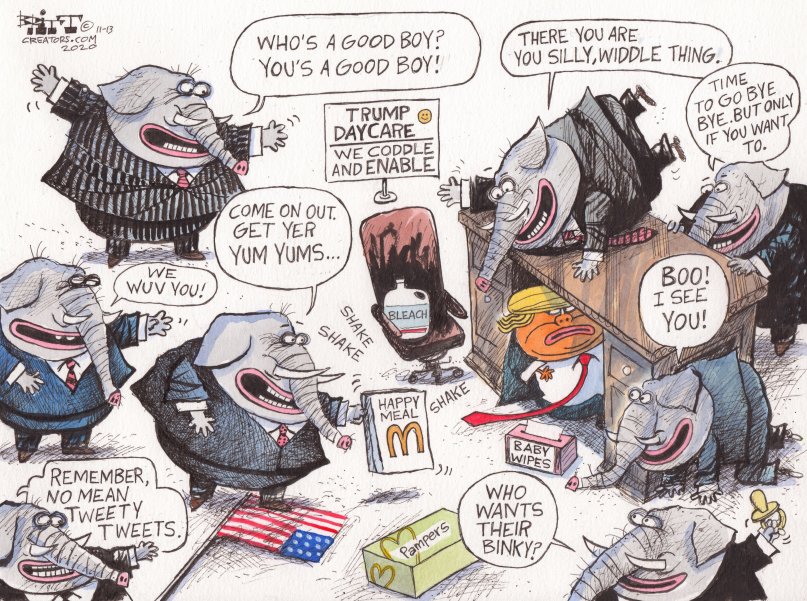 Trump had to be talked into allowing the transition to begin.
Mr. Trump had been resisting any move toward a transition. But in conversations in recent days that intensified Monday morning, top aides — including Mark Meadows, the White House chief of staff; Pat A. Cipollone, the White House counsel; and Jay Sekulow, the president’s personal lawyer — told the president the transition needed to begin. He did not need to say the word “concede,” they told him, according to multiple people briefed on the discussions….
Some of the advisers drafted a statement for the president to issue. In the end, Mr. Trump did not put one out, but aides said the tone was similar to his tweets in the evening, in which he appeared to take credit for Ms. Murphy’s decision to allow the transition to begin.
“Our case STRONGLY continues, we will keep up the good fight, and I believe we will prevail!” he wrote. “Nevertheless, in the best interest of our Country, I am recommending that Emily and her team do what needs to be done with regard to initial protocols, and have told my team to do the same.”
This morning, NBC News published an op-ed by Sen. Chris Murphy: As Trump’s GSA begins election transition, Biden needs access to Covid-19 vaccine plans.
At the very moment President-elect Joe Biden will take the reins of government, the federal government will be in the early stages of implementing the most complicated, most expensive and most important mass vaccination program in our nation’s history. On Monday, General Services Administration signaled that it is ready to begin the formal transition process. There is not a moment to lose….
…vaccines don’t protect people; vaccinations do. And the effort to make sure that every person in America, as soon as possible, gets vaccinated, is a logistical project on par with than anything the American health care system has ever accomplished. Trump’s teams at Health and Human Services, the Centers for Disease Control and Prevention and the National Institutes of Health have begun to develop and implement this system, but it will be barely up and running by Jan. 20. That means that there must be an errorless transition of responsibility from Trump’s team to Biden’s team. And yet for weeks, Trump’s team refused to allow Biden’s transition team access to the plan. Hopefully, the GSA’s announcement means this will change. But we cannot just assume it will happen.
As leaders of Operation Warp Speed, the coalition of federal agencies overseeing the plan for vaccine distribution, told the Senate last week, Trump had been blocking them from communicating at all with the Biden-Harris transition team. Why? Because of Trump’s petulant crusade against reality. Indeed, Trump is still refusing to accept the election results, hoping that desperate lawsuits and the bullying of local elections officials will somehow allow him to remain in office despite the fact that he lost the election convincingly.
Murphy believes the Trump plans are inadequate and Biden will need to make changes. Read Murphy’s detailed recommendations at NBC News.
Trump may have been talked into allowing the formal transition to begin, but he’s still obsessed with proving the election was fraudulent. Now that his many lawsuits have been thrown out of court for lack of evidence, he is becoming concerned that his crazy legal team is making him look bad. As if he hadn’t already done that to himself.
NBC News: Behind the scenes, Trump frustrated with his legal team’s maneuvers.
While President Donald Trump has publicly praised his legal team’s efforts, he has privately expressed frustration with the slapdash nature of his election defense fight, according to several people familiar with the discussions.
The president has been complaining to aides and allies about his personal attorney Rudy Giuliani and recently-removed lawyer Sidney Powell’s over-the-top performances at a news conference at the Republican National Committee headquarters last week, these people said. Both Giuliani and Powell have continued to make conspiratorial and baseless claims about widespread voter fraud, for which they have provided no evidence.
The president is concerned his team is comprised of “fools that are making him look bad,” said one source familiar with the thinking. Asked why he would not fire them, this person replied, in essence, who knows?
The president grew less impressed with Powell over the weekend, as she continued to make outlandish comments, including falsely accusing Georgia’s Republican governor and its secretary of state of being part of a scheme to alter votes.
That ultimately led to the terse statement the Trump campaign put out Sunday night on behalf of Giuliani and senior legal adviser Jenna Ellis: “Sidney Powell is practicing law on her own. She is not a member of the Trump legal team. She is also not a lawyer for the President in his personal capacity,” it read.
Trump was also not pleased with the optics of the brown substance, presumed to be hair dye or a makeup product, dripping down Giuliani’s face during the nearly two-hour news conference Thursday, according to one of the sources familiar with the president’s reaction.
Even Rush Limbaugh is complaining about the “legal team.” Earth to Trump: you chose these morons. Only the best people, right?
Elie Honig at CNN: Trump’s bizarro-world ‘elite strike force’ legal challenge is about to implode.
Just moments after a federal judge issued a blistering rebuke of their evidence-free, legally-confused effort to contest President-elect Joe Biden’s win in Pennsylvania, President Donald Trump’s legal team flailed to spin the crushing loss as some sort of bizarro-world victory. Trump campaign attorneys Rudy Giuliani and Jenna Ellis claimed in a statement that the dismissal “turns out to help us in our strategy to get expeditiously to the US Supreme Court.”
But if the Trump campaign’s legal team is counting on the Supreme Court to save them, they’re delusional. In this case, and in the larger effort to contest the outcome of the 2020 election, Trump’s team is just about out of runway.
In a news conference laden with false statements and incomprehensible legal claims, Ellis labeled Trump’s legal team an “elite strike force.” But their utter failure to uncover evidence of widespread voter fraud, or to articulate a coherent legal theory, suggests otherwise. Former New Jersey Gov. Chris Christie — a staunch Trump political ally — more aptly called Trump’s legal team a “national embarrassment.” The Trump team later distanced itself from Sidney Powell, an attorney on Trump’s legal team, after she spread conspiracy theories about the election.
Indeed, Saturday’s ruling by federal judge Matthew Brann — an appointee of President Barack Obama who previously held various positions in Pennsylvania’s Republican party — is one of the harshest rebukes I’ve ever seen from any judge. Brann heaped scorn on the Trump campaign’s “strained legal arguments” which, he noted, are “without merit … and unsupported by evidence.” He ridiculed one of the Trump team’s primary constitutional claims as a “Frankenstein monster.” And Brann noted that the Trump campaign position, if adopted, would “disenfranchise almost seven million voters.”
There’s much more at the CNN link. I seriously doubt that even the most extreme SCOTUS justices are going to want to touch the Trump cases with a ten-foot pole.
And then there’s Trump’s crazy pal Roger Stone. The Daily Beast: Roger Stone-Tied Group Threatens GOP: If Trump Goes Down, So Does Your Senate Majority.
Conservative operatives and a super PAC with ties to infamous GOP dirty trickster Roger Stone are calling for Trump supporters to punish Republicans by sitting out Georgia’s crucial Senate runoffs or writing in Trump’s name instead. And though their efforts remains on the party’s fringes, the trajectory of the movement has Republicans fearful that it could cost the GOP control of the Senate.
The most aggressive call to boycott or cast protest ballots in the two runoff races has, so far, come from a dormant pro-Trump super PAC with ties to Stone, which unveiled a new initiative to retaliate against the Republican Party’s supposed turncoats by handing Democrats control of the U.S. Senate.
The group, dubbed the Committee for American Sovereignty, unveiled a new website encouraging Georgia Republicans to write in Trump’s name in both of the upcoming Senate runoff elections, which could determine the party that controls the upper chamber during President-elect Joe Biden’s first two years in office. The PAC argued that doing so will show support for the president in addition to forcing Republicans to address the wild election-fraud conspiracy theories floated by Trump supporters and members of his own legal team.
“If we can do this, we have a real chance at getting these RINO senators to act on the illegitimate and corrupt election presided over by a Democrat party that is invested in the Communist takeover of Our Great Nation,” the group wrote on its new website, writeintrumpforgeorgiasenate.com. “We will not stop fighting for you, the American Patriot, against the evils of Socialism and inferior Religions.”
The effort is representative of a broader push among some of President Trump’s most devoted supporters to withhold support for the two Georgia Republican senators facing competitive runoff challenges, Kelly Loeffler and David Perdue, in the hope of leveraging the party’s fear of losing the U.S. Senate to get more establishment backing for their drive to change the result of the election. The goal, those operatives say, is to expose a supposed vast election fraud conspiracy abetted by high-level Republicans in Georgia’s state government, including Gov. Brian Kemp and Secretary of State Brad Raffensperger.
Can we survive 57 more days of this insanity? I guess if we got through four years of it, we can hang on a bit longer–but it won’t be easy.
Take care, Sky Dancers! Enjoy your Tuesday in whatever way works best for you. I plan to read a novel and take a nap this afternoon. Please check in with us in the comments if you have the time and inclination.
Lazy Caturday Reads: Trump’s Failed Coup
Posted: November 21, 2020 Filed under: morning reads, U.S. Politics | Tags: Donald Trump, failed coup attempt, remaining norms Trump could break, Rudy Giuliani, Trump has lost it 14 Comments
Mary Fedden, Cat along the shore
Good Morning!!
I’m not too with it these days. I’ve had a nagging cold for a couple of weeks now and it isn’t going away. I’m afraid it might be turning into a sinus infection. I’ve been trying to keep up with the posts and comments as best I can. I got a coronavirus test last week just in case. It was negative. Anyway, I’m going to call my doctor’s office again on Monday if I don’t feel better. I just thought I’d let you know why I haven’t been commenting as much as usual.
Trump is still trying to stage a half-baked coup. Here’s the latest on that pathetic story.
At The Daily Beast, William Bredderman provides a summary of Trump’s recent attempts to reverse the election results: The Desperate Final Gasps of Team Trump’s Flailing ‘Mini-Coup’
The past week saw Team Trump piling up losses and running out of road.
The campaign dropped its lawsuit to stop the certification of President-elect Joe Biden’s victory in Michigan, while the Pennsylvania Supreme Court threw out the campaign’s claim that COVID-19 restrictions had deprived GOP observers of their right to monitor the postal vote count.
Cat on the carpet, Gleb Baranov
Then, on Thursday night, with just four days remaining before both Michigan and Pennsylvania certify their results, Rudolph Giuliani and local lawyer Marc Scaringi dropped a wild new brief in the U.S. District Court for the Middle District of Pennsylvania. Probably the most audacious of the dozens of legal Hail Marys the campaign and Republican interests have hurled into the end zone since Election Night, the filing argues that the campaign’s constitutional rights have been violated and asks the judge to declare Trump the winner of the Keystone State’s 20 electoral college votes.
But, according to Charles Fried, solicitor general under Ronald Reagan, this brief’s legal claim hangs almost entirely on a single word: “meaningful”—as in the “meaningful observation of the canvassing of mail ballots.” The professor at Harvard Law School told The Daily Beast that, in this context, ”meaningful” has no meaning at all.
The suit makes essentially the same argument that the state Supreme Court rejected: that observers in several counties could not get as near to the tabulation as they wanted. Now, at the federal level, they argue the system in Pennsylvania violated the campaign’s due process rights under the 14th Amendment by denying them “meaningful” access.
According to Fried, however, “meaningful” has no legal definition, nor is it adequately described in the legal team’s filings.
“There’s no allegation here. It’s just an unsubstantiated claim, which was thrown out in several courts,” he told The Daily Beast. “And now they’ve gone to federal court. Why should the result be any different?”
Fried described this latest tack as “garbage”—the same way he characterized the Trump team’s legal efforts two weeks ago, before the campaign shed several attorneys and took on Giuliani and Scaringi.
Read more details about Trump’s garbage lawsuits at the link.

Dog and Cat, Alex Colville
Also from The Daily Beast, by Asawin Suabsaeng and Sam Stein: Team Trump Leaders, Including Campaign Manager Bill Stepien, Have No Faith in Rudy.
While Donald Trump’s attorney Rudy Giuliani embarks on a quixotic and potentially destructive effort to reverse the results of the 2020 election, much of the president’s official campaign apparatus wants to disown it.
Several officials in leadership positions on Trump’s re-election team, including campaign manager Bill Stepien, have recently told associates they have zero faith in Giuliani, and are currently waiting for what they view as a doomed, haphazard legal fight to burn out and end, according to four sources with knowledge of the situation.
One Trumpadviser called the current strategy a “dead end,” and said Giuliani’s high-profile attempts at drumming up legal obstacles to the certification of Biden’s election amounted to a “hostile takeover of the campaign.”
“The obvious thing is, this is a shitshow,” the adviser said. “When the Rudy show started, that was a sidelining of everyone else. At that point, it became an issue of going through the motions and the recognition of, ‘OK, this is definitely over because we don’t have a chance with… these conspiracy theories.’”
But Trump apparently thinks what Rudy is doing is just ducky.
The sense of resignation felt privately by a chunk of the Trump campaign operation is at odds with the president’s personal assessment of how his long-shot efforts to recapture a second term are going.
by Orovida Camille Pissarro
As of Friday night, two sources close to the president said he remained intensely invested and personally supportive of Giuliani’s legal challenges. It was presumed among campaign staff that he was thrilled with his team’s now-infamous press conference on Thursday, in which Giuliani, and two other allied lawyers—Sidney Powell and Jenna Ellis—presented a smorgasbord of wild conspiracy theories about election fraud, including a lengthy explanation of how anti-Trump Venezuelan villains supposedly worked to rob Trump of legal votes. And, for that reason, there was little appetite for anyone to say anything questioning the current approach—at least with their name attached to it.
“It appears that none of us are allowed to say [publicly] that that was one of the weirdest fucking things we’ve ever witnessed,” one senior Trump administration official said, noticeably exasperated.
Click the link to read the rest.
Of course we have long known that Trump is out of his mind. This is from David Smith at The Guardian: Trump’s monumental sulk: president retreats from public eye as Covid ravages US.
There was one thing that even Donald Trump’s harshest critics were never able to accuse him of: invisibility….
Yet two weeks after his defeat by Joe Biden in the election, Trump has effectively gone missing in action. Day after day passes without a public sighting. He does not hold press conferences any more. He has even stopped calling into conservative media….
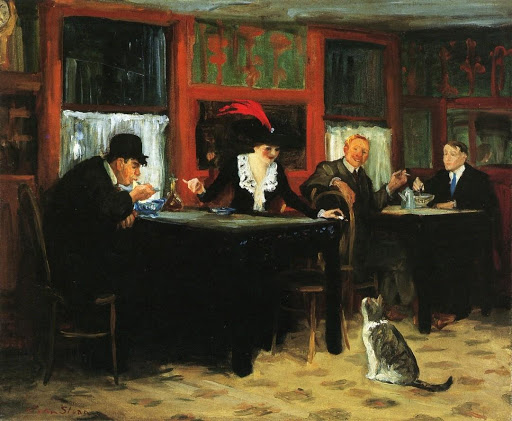
John French Sloan, Chinese Restaurant
Amid the deafening silence, Trump’s only “proof of life” since Biden’s victory has been a handful of public events at the White House and a military cemetery, weekend outings to his golf course in Virginia and a barrage of tweets airing grievances and pushing baseless conspiracy theories that the election was stolen from him.
“I don’t think we’ve had a president since Richard Nixon who is as far in the bunker and detached from the country as Donald Trump is right now,” said Larry Jacobs, director of the Center for the Study of Politics and Governance at the University of Minnesota.
“Donald Trump has not only suffered a catastrophic political defeat, he’s clearly also suffering from a deep emotional break. This behavior is even more erratic than usual and he has retreated. He has put himself in a form of psychological isolation. His emotional state is clearly abysmal. In the popular lexicon, he’s lost it.”
Trump’s pathetic efforts are still dangerous, writes Jonathan Chait at New York Magazine: The Danger (and Ineptitude) of Trump’s Failed Coup.
In his address to the Democratic National Convention in August, Barack Obama warned that the Trump administration “has shown it will tear our democracy down if that’s what it takes to win.” Kamala Harris began her first speech as vice-president-elect by saying “America’s democracy is not guaranteed.”
By Felix Vallotton
Some may have dismissed this as mere hyperventilated campaign rhetoric. But in the days that followed the election, Trump fulfilled the stark prophecies. He has seized whatever powers he still has in his grasp to rattle the system and to take vengeance against his successor by leaving him with a ruin.
Trump has attempted to retain power much as he wielded it throughout his term: with a comic ineptitude of his means that made it difficult to absorb the seriousness of his ends. If you had predicted four years ago that Trump would finish his term by proposing to cancel the election and reinstall himself in a second term, you’d have been brushed off as a hysteric. And yet here he is attempting to do just that and recruiting Republican allies to his mad scheme. The certainty of his failure does not make the damage caused by the coup effort disappear. It simply makes it harder to see clearly. The surreality of Mussolini continually slipping on banana peels is the defining paradox of this sordid era.
To lead his attempted coup, Trump has turned once again to Rudy Giuliani. Just weeks before, Giuliani — who is the subject of a criminal investigation for his efforts to shake down Ukraine while working for Trump and who was colluding publicly with a man identified by the U.S. Treasury Department as a Russian spy — had produced what he called “evidence” of a global criminal plot by Joe Biden and his family. (Many people on the right spent the last ten days of the campaign scolding the media for failing to take his accusations seriously.) In the aftermath of the election, Giuliani emerged to claim he had uncovered yet another worldwide plot — this one even wider and more sinister in scope.
Read more at the link.

By Edward Bawden 1903-1989
Peter Nicholas at The Atlantic: The 3 Norms Trump Could Still Break.
America has seen little of Donald Trump since the election. Speaking to the nation largely through Twitter, he’s barely strayed outside the White House as he absorbs a defeat that shattered the myth he created of his own invincibility. Still, he’s been busy—firing officials he deems disloyal and plotting ways to stay in power. He can’t and won’t overturn the election result, but he can cause plenty more havoc on his way out. Some of the ways would be immediately evident; others, hidden.
“We’re going to have to be very vigilant in the next two months for abuse of the pardon power, awarding of contracts to friends and family, and destruction of records, as well as policy decisions to box in the incoming administration,” Representative Adam Schiff, the chairman of the House Intelligence Committee, who helped prosecute the case against Trump in the Senate impeachment trial earlier this year, told me.
Trump, too, may feel boxed in, and for that reason he may be more prone to acting out. Congressional investigators still want to see his tax records. Prosecutors in New York are scrutinizing his business practices. The Biden administration will face intense public pressure to examine the money that flowed to Trump’s hotels and golf clubs over the past four years.
Soon enough, Trump will be stripped of the leverage that arms presidents looking to protect their interests. As he confronts an uncertain future, he could stretch or smash the boundaries of presidential power in ways no one else has tried. He could damage the basic notion that presidents are accountable for their actions and answerable to the law. All of which makes the interregnum before Joe Biden’s swearing-in an especially precarious time.
Nicholas writes that Trump could:
1) try to pardon himself (and his compatriots)
2) try to ditch important records.
3) spout state secrets.
Read the Nicholas’ detailed arguments at The Atlantic link.
That’s it for me today. I’m going back to bed. Take care everyone!
Lazy Caturday Reads
Posted: November 14, 2020 Filed under: morning reads, U.S. Politics | Tags: 2020 presidential election, coronavirus pandemic, Donald Trump, Doug Burgum, health-care workers, hospitalizations, Joe Biden, Kristi Noem, North Dakota, South Dakota, Trump Death Cult, Trump denial of election results, vaccines 20 Comments
Cat and Butterfly by Diane Hoeptner
Good Morning!!
The coronavirus pandemic is worsening by the day, and the Trump administration refuses to do anything about it. Yesterday, the defeated “president” emerged from his hidey hole for an appearance in the former Rose Garden. He proceeded to falsely claim credit for the Pfizer vaccine and pretend that the election is still undecided.
Maeve Reston at CNN thinks Trump is beginning to accept reality: Trump wavers between reality and election fiction with eye on his legacy during Rose Garden vaccine address.
President Donald Trump had an eye on his legacy as he strode to the microphone in the White House Rose Garden Friday and touted the administration’s “unequaled and unrivaled” efforts to help produce a coronavirus vaccine through Operation Warp Speed. Then, for a brief moment, he seemed close to acknowledging the reality that his presidency is almost over.
“I will not — this administration will not be doing a lockdown,” Trump said, speaking for the first time in a week as coronavirus cases in the US shatter records and hospitalizations are surging. “Hopefully whatever happens in the future — who knows which administration it will be — I guess time will tell, but I can tell you this administration will not go to a lockdown.”
It was a fleeting shift in tone suggesting that the reality of President-elect Joe Biden’s substantial win is seeping into Trump’s psyche even as he and his advisers publicly deny it.
By Midori Yamada
The Democrat now has 306 electoral votes to Trump’s 232 as a result of wins in two longtime Republican states, Arizona and Georgia, CNN projects — far above the 270 threshold that Biden needed to clinch the presidency. But the indisputable math has not prevented the President from continuing to try to whip up outrage among his supporters on Twitter with unfounded accusations that the election has been stolen from him.
Friday’s speech in the Rose Garden was a portrait of a President clinging to power as his legal challenges to the election results crumble around him, mindful that he ought to show Americans what he’s been doing with the power of government as he spends his days tweeting conspiracy theories about lost or deleted votes in the midst of a pandemic that is coursing through the United States.
Except he isn’t really doing anything about the most pressing problem facing the country–the pandemic. Philip Bump at The Washington Post: Trump also refuses to admit he lost the fight against the coronavirus.
“Case levels are high, but a lot of the case levels are high because of the fact that we have the best testing program anywhere in the world,” he said. “We’ve developed the most and the best tests, and we test far more than any other country. So it shows obviously more cases.”
This is false for a variety of reasons. The most obvious misstatement is that the current surge in new cases, leading to 1 in every 350 Americans contracting the virus in the past week, is solely a function of more testing. In reality, the number of new cases during this surge (which began around Sept. 12) has easily outpaced the increase in the number of tests being conducted. The rate at which tests are coming back positive is more than 9 percent at the moment, twice what it was a month ago.
It’s also important to remember that the United States has conducted so many tests because we’ve had to. Countries like South Korea effectively contained the virus and therefore didn’t have to keep testing hundreds of thousands of people a week. It’s our failure to contain the virus that necessitates a broad deployment of testing….
Menagerie, by Jane Lewis
“The federal government has 22,000 beds immediately available for states and jurisdictions that need additional capacity,” Trump said Friday. “But we think that it’s going to start going down possibly very quickly. We’ll see what happens. But with the vaccine, you’ll see numbers going down within a matter of months. And it’ll go down very rapidly.”
There’s no indication that the need for hospital capacity is going to go down quickly. It’s also not clear where that federal capacity is or how states can access it. It may be the case that the vaccine will drive down new infections and hospitalizations, but even limited distribution of the vaccine is weeks away. For most Americans, it’s months away, and cases are surging now.
Read more at the WaPo.
As I wrote in a comment yesterday, I think Trump should be prosecuted for negligent homicide. At Alternet, via Raw Story, Cory Fenwick writes: The Trump plan for mass death is unfolding before our eyes.
On Friday, the COVID Tracking Project reported that the number of positive coronavirus infections in the last day had reached 170,000, the highest record ever and a number that was, just a few months ago, hard to imagine. It’s now our daily reality, and it’s likely to only get worse.
Other figures are just as frightening. Hospitalizations — one of the clearest signs of the seriousness of the out break —have reached a new high at 69,000, according to the project. Deaths are at a disturbing 1,300, though that rate is almost certain to spike in recent weeks following the more recent spike in cases. And as the newest and largest wave yet engulfs the country, reports have begun to appear of hospitals being overwhelmed with patients, which is almost certainly a precursor to a spike in the case fatality rate.
by Jane Hoptner
It’s our horrifying new status quo, and one that experts and observers have been warning would unfold this fall for months. But the ming-boggling truth is that for the Trump administration, everything is pretty much going as planned.
Ever since the first wave in the spring, President Donald Trump has seemed increasingly drawn to the so-called (and, indeed, misleadingly named) “herd immunity” approach to the pandemic. On this approach, you reject government restrictions meant to stop people from getting the virus. What advocates of this strategy believe is that it’s best that more people get the virus, because eventually, enough people will have had it, they’ll immune, and life will return to normal.
Click the link to read the rest.
This piece by Ed Yong at The Atlantic is a must read: ‘No One Is Listening to Us.’ More people than ever are hospitalized with COVID-19. Health-care workers can’t go on like this.

There’s much more at the link. I hope you’ll take the time to read it.
It’s so sad to see North Dakota, my birthplace and the state where my parents were born and raised, experiencing such a terrible health emergency. USA Today: The Dakotas are ‘as bad as it gets anywhere in the world’ for COVID-19.
South Dakota welcomed hundreds of thousands of visitors to a massive motorcycle rally this summer, declined to cancel the state fair and still doesn’t require masks. Now its hospitals are filling up and the state’s current COVID-19 death rate is among the worst in the world.
White Persian Cat, by Feridun Oral
The situation is similarly dire in North Dakota, with the state’s governor recently moving to allow health care workers who have tested positive for COVID-19 to continue working if they don’t show symptoms. It’s a controversial policy recommended by the U.S. Centers for Disease Control and Prevention in a crisis situation where hospitals are short-staffed.
And now — after months of resisting a statewide mask mandate — North Dakota Gov. Doug Burgum changed course late Friday, ordering masks to be worn statewide and imposing several business restrictions.
“Our situation has changed, and we must change with it,” Burgum said in a video message posted at 10 p.m. Friday. Doctors and nurses “need our help, and they need it now,” he said.
Both North and South Dakota now face a predictably tragic reality that health experts tell USA TODAY could have been largely prevented with earlier public health actions.

Governor Kristi Noem of South Dakota is still resisting. Sioux Falls Argus Leader: If Joe Biden enacts mask mandates, lockdowns, South Dakota Gov. Kristi Noem won’t enforce them.
The office of Gov. Kristi Noem said in a statement to the Argus Leader Friday that the first-term governor, who’s risen to stardom in the Republican party for her hands-off approach to managing the pandemic, has no intention of using state resources to enforce any federal COVID-19 orders.
“It’s a good day for freedom. Joe Biden realizes that the president doesn’t have the authority to institute a mask mandate,” said Ian Fury, communications specialist for Noem. “For that matter, neither does Governor Noem, which is why she has provided her citizens with the full scope of the science and trusted them to make the best decisions for themselves and their loved-ones.”
Famous last words?

Amaryllis and Cats, by Elizabeth Blackadder
More stories to check out today:
The New York Times: It’s Traumatizing: Coronavirus Deaths are Climbing Again.
Katlyn Polantz at CNN: Trump had a very bad Friday in court with his election cases. They’re headed for more action next week.
Politico: ‘Purely outlandish stuff’: Trump’s legal machine grinds to a halt.
The Washington Post: Federal prosecutors assigned to monitor election malfeasance tell Barr they see no evidence of substantial irregularities.
NBC News: QAnon’s Dominion voter fraud conspiracy theory reaches the president.
The Daily Beast: How Trump’s Voter Fraud War Room Became a Fart-Infused ‘Room From Hell’
Reuters: President-elect Biden, denied classified intel briefings, to bring in national security experts.
Susan Rice at The New York Times: Here’s How Trump’s Stalling Risks Our National Security.
The Washington Post: Defense secretary sent classified memo to White House about Afghanistan before Trump fired him.
The New York Times: Christopher Krebs Hasn’t Been Fired, Yet.
Have a nice weekend, Sky Dancers!

 peej
peej Carissa
 bostonboomer
 dakinikat
 ecocatwoman
 jjlo
jjlo mablue2
 Mama Lopez
 peggysue22
 quixote
 skydancingguestblogger
 Mona (aka Wonk the Vote)





Recent Comments