
Saturday Afternoon Reads: Boston Bombing Second Anniversary and the Death Penalty Question
Posted: April 18, 2015 Filed under: morning reads | Tags: death penalty, Dzhokhar Tsarnaev, Second anniversary of Boston bombing 12 Comments
Copley Square News Stand, Boston
Good Afternoon!!
On Wednesday, April 15, Boston marked the second anniversary of the Boston Marathon bombing, now called “One Boston Day,” with a moment of silence at 2:49PM. That was the time that two bombs exploded about 12 seconds apart among crowds of people near the marathon finish line, leaving three people dead and 264 people injured–many of whom lost limbs.
Reuters reports: Boston marks somber second anniversary of deadly marathon bombing.
(Reuters) – Boston marked the second anniversary of the deadly attack on its annual marathon on Wednesday with a quiet ceremony at the site where three died, unveiling a pair of banners marked with a heart.
Mayor Marty Walsh joined a group of survivors of the April 15, 2013, blasts, including Jane and Henry Richard, whose 8-year-old brother Martin was the youngest killed, as well as Jeff Bauman, who lost both legs. Some 264 people, including spectators, volunteers at runners at the Boston Marathon were injured.
At 2:49 p.m. ET (1849 GMT) New England’s largest city will observe a moment of silence to mark the time the first bomb went off.
“Our thoughts and prayers are with the victims and their families, who seek to make sense of that awful day,” said Massachusetts Governor Charlie Baker. “Those most affected by the events of two years ago have shown us all the way back with their courage, grace and determination.
At Fenway Park, there was a pause during the Red Sox-Nationals game to observe the city-wide moment of silence at 2:49PM.
On Patriots’ Day this coming Monday April 20th, runners will gather in Hopkinton, Massachusetts for the 119th running of the 26 mile race to the finish line in Copley Square.
Security for this year’s race will be higher than ever, and that is causing some controversy.
NPR’s Morning Edition: Boston Marathon Surveillance Raises Privacy Concerns Long After Bombing.
Nearly a million people will line the streets to watch the Boston Marathon on Monday, and someone else will be watching them. Bill Ridge with the Boston Police says video surveillance is a big part of the security plan.
“We’ve got a lot of cameras out there,” he says. “We’re going to be watching the portions in Boston — particularly the routes along Boylston Street, the finish line.” …. Video footage helped identify the terrorists, and the number and quality of video cameras has gone up since then.
The extent of the surveillance of Boston described in the article is troubling. NPR talked to Mark Savage of Lan-Tel Communications, which is in charge of surveillance for the marathon.
“I’m zooming in on the infield of Fenway Park,” he says while maneuvering a camera. He uses a laptop to swivel and zoom the HD video camera on a building hundreds of yards away from the ballpark. The zoom is so powerful, Johnson says it could probably tell whether a Red Sox pitcher has thrown a strike or a ball.
In the same way that televisions have gotten higher resolutions through the years, so have video cameras — and Johnson says cheaper bandwidth and data storage make it easy to record more, better-quality video.

Flowers placed at the finish line of the Boston Marathon last week (from NPR).
Apparently the Boston Police have already installed a lot of surveillance equipment around the city.
Kade Crockford of the American Civil Liberties Union of Massachusetts says she understands the need for surveillance at a big public event like the Boston Marathon — but objects to expanding its use. While standing outside the Old State House, she points out four different surveillance cameras catching her every move.
“[A big event] doesn’t trigger privacy concerns,” she says. “What does trigger privacy concerns is the City of Boston installing a network of cameras — some in residential neighborhoods — that enable law enforcement to track individual people from the moment that we leave our homes in the morning until the moment we return at night, seeing basically everywhere we went and everything that we did.”
Boston Police won’t say how many cameras are already in the city’s network, or how many new ones are going up for the marathon. But some of them will stay online afterward.
The anniversary and the storied Boston foot race comes during a pause in the trial of Dzhokhar Tsarnaev, who was found guilty on all counts on Wednesday April 8. The jury still must decide whether Tsarnaev will get live in prison without parole or the death penalty. Technically, the break before the penalty phase is to allow the defense more time to prepare their witnesses, but it would have been difficult for jurors to deal with life and death questions during the bombing anniversary and the running of this year’s race.

The family of Boston Marathon bombing victim Martin Richard joins Boston Mayor Marty Walsh (R) at a ceremony at the site of the second bomb blast on the second anniversary of the bombings in Boston, Massachusetts April 15, 2015. REUTERS/Brian Snyder
Kevin Cullen at The Boston Globe suggests other questions about the bombing that need to be answered.
Break in Dzhokhar Tsarnaev’s trial allows for reflection.
A Boston cop I know, who was at the finish line when the bombs exploded and who saved lives that day, has a question.
“Who were the FBI agents who interviewed Tamerlan Tsarnaev after the Russians raised questions about him two years before the bombings, and why didn’t they recognize Tamerlan from the photos the FBI released?” he asked.
It’s a good question, one that the prosecution won’t want to ask, one that the defense needs to ask, if it isn’t deemed irrelevant by O’Toole.
The defense has argued all along that Dzhokhar Tsarnaev was steered into the bombing plot by his older, domineering, more-radicalized brother. Tamerlan Tsarnaev, dead almost two years, will be mentioned as often as his little brother in this phase of the trial.
Cullen says the FBI did good work after the bombs went off, but . . . .
But that nagging question — why wasn’t Tamerlan Tsarnaev identified earlier — won’t go away. And it feeds the nagging sense that the FBI knows far more about Tamerlan Tsarnaev than it’s sharing.
Nor will questions about Tamerlan’s wife, Katherine, go away. The government broadly hinted but never came right out and said they believe the bombs or at least components for the bombs were assembled at the Cambridge apartment Katherine and Tamerlan shared with their daughter, a toddler.
The defense didn’t try to debunk the suggestion nearly as strongly as you might think because it allowed them to point out that the fingerprints on all the tools that might have been used to make the bombs were Tamerlan’s, not Dzhokhar’s.
Why wasn’t Katherine charged? Did she cooperate with investigators?
One of the other nagging questions is whether the Tsarnaev brothers had any accomplices in gathering all the gunpowder from fireworks they used in their bombs. Listening to testimony about how much powder was needed to make the bombs, it seemed like the Tsarnaev brothers would have to be doing nothing else but dismantling fireworks for months.

All good questions and there are more good ones at the link. Cullen notes that we particularly need answers about why the FBI shot and killed Ibragim Todashev, who was potentially their best source of information about Tamerlan and his motives.
The Feds are getting plenty of pushback here in the Boston area on their goal of putting Dzhokhar Tsarnaev to death. After all, Massachusetts does not have the death penalty. Victims families and survivors as well as citizens have expressed their wishes that Tsarnaev be allowed spend the rest of his life in prison.
WBUR Boston (NPR): Death Penalty For Tsarnaev Increasingly Unpopular, WBUR Poll Finds.
The survey (topline, crosstabs) of 509 registered voters in Greater Boston found 58 percent support life in prison for Tsarnaev. That number rises to 61 percent among voters in the city of Boston.
“Over the last month, we’ve seen support for life in prison grow by about 10 points [in the Boston area],” said Steve Koczela, president of the MassINC Polling Group, which conducts surveys for WBUR.
According to the poll, only 31 percent of Boston area residents said they support the death penalty for Tsarnaev. That support drops to 26 percent in the city of Boston.
The earlier WBUR survey was conducted last month, while the first phase of the Tsarnaev trial was ongoing. The latest poll was conducted just days after his conviction.
People’s feelings about executing the convicted bomber are on par with how they view the death penalty in general.
Fifty-seven percent in the Boston area and 63 percent in the city of Boston oppose the use of the death penalty broadly.
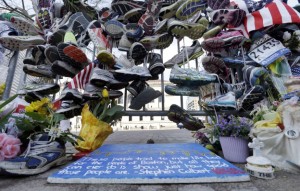
The parents of Martin Lawrence have begged the prosecution to drop the death penalty request.
The Boston Globe: Parents of 8-Year-Old Boy Killed in Marathon Bombings Don’t Want Tsarnaev to Get Death Penalty.
The parents of Martin Richard, the 8-year-old boy killed in the Boston Marathon bombings two years ago, have writtten a plea to end the attention convicted killer Dzhokhar Tsarnaev has received and spare him from the death penalty.
In an essay written for The Boston Globe, Bill and Denise Richard ask that the case come to a close, writing, “We know that the government has its reasons for seeking the death penalty, but the continued pursuit of that punishment could bring years of appeals and prolong reliving the most painful day of our lives.”
The sister of murdered MIT police office Sean Collier also opposes giving Tsarnaev the death penalty. From the Globe:
In a posting on Facebook and on her Twitter account, Jennifer L. Lemmerman wrote that she continues to mourn the loss of her younger brother, who was widely lauded after his murder.
Lemmerman, a graduate of Boston College School of Social Work and an alderwoman in Melrose, wrote that she will never forgive Tsarnaev for ending her brother’s life.
But, she also wrote, she does not believe in the death penalty even after what has happened to her and her family.
“Whenever someone speaks out against the death penalty, they are challenged to imagine how they would feel if someone they love were killed. I’ve been given that horrible perspective and I can say that my position has only strengthened,’’ she wrote on her Facebook account.
Obviously, I think killing Tsarnaev would be wrong and counterproductive. The death penalty would only turn him into a martyr anyway, and it would mean years, perhaps decades of court battles in which he would get unnecessary and undeserved public attention; and the victims families would be forced to relive their pain and loss again and again.
As always, this is an open thread. Please feel free to comment and post links on any topic.
Tuesday Reads
Posted: May 13, 2014 Filed under: morning reads, Republican politics, U.S. Politics | Tags: Boston Marathon bombing, Chamber of Commerce, Climate change, Comcast, Danny Sun Jr., death penalty, drug rings, FCC, global warming, greenhouse gases, immigration, internet fast lane, John Boehner, net neutrality, Oklahoma botched execution, polar melt, Portland Maine drug gangs, Robert James Campbell, Ruger P95, Safwan Madarati, Tamerlan Tsarnaev, Texas execution, Tom Donohue, Tom Wheeler, Waltham triple murder, Watertown drug gang, Watertown shootout, West Antarctica ice sheet 55 Comments
Good Morning!!
I have a mixture of links for you today, with no overall theme whatsoever. There is news happening out there, but somehow it still feels like a slow news month so far. Maybe it’s just because it feels like nothing is really happening that will change the “malaise” in the country, to use Jimmy Carter’s term. The economy doesn’t really seem to be improving for 90 percent of us, and the bottleneck in Congress feels unbreakable. So here are some stories that caught my eye.
From The New York Times: Scientists Warn of Rising Oceans From Polar Melt.
A large section of the mighty West Antarctica ice sheet has begun falling apart and its continued melting now appears to be unstoppable, two groups of scientists reported on Monday. If the findings hold up, they suggest that the melting could destabilize neighboring parts of the ice sheet and a rise in sea level of 10 feet or more may be unavoidable in coming centuries.
Global warming caused by the human-driven release of greenhouse gases has helped to destabilize the ice sheet, though other factors may also be involved, the scientists said.
The rise of the sea is likely to continue to be relatively slow for the rest of the 21st century, the scientists added, but in the more distant future it may accelerate markedly, potentially throwing society into crisis.
“This is really happening,” Thomas P. Wagner, who runs NASA’s programs on polar ice and helped oversee some of the research, said in an interview. “There’s nothing to stop it now. But you are still limited by the physics of how fast the ice can flow.”
Read details about the two studies at the NYT link. Richard B. Alley, scientist not involved in the studies noted that what’s happening in Antarctica is only one source of future climate change disasters.
He added that while a large rise of the sea may now be inevitable from West Antarctica, continued release of greenhouse gases will almost certainly make the situation worse. The heat-trapping gases could destabilize other parts of Antarctica as well as the Greenland ice sheet, potentially causing enough sea-level rise that many of the world’s coastal cities would eventually have to be abandoned.
“If we have indeed lit the fuse on West Antarctica, it’s very hard to imagine putting the fuse out,” Dr. Alley said. “But there’s a bunch more fuses, and there’s a bunch more matches, and we have a decision now: Do we light those?”
So it’s not as if we actually have the rest of the century to deal with the problem. Maybe the right wing nuts should start building an ark.

From Politico: Chamber of Commerce gives ultimatum to GOP.
The GOP shouldn’t even field a presidential candidate in 2016 unless Congress passes immigration reform this year, U.S. Chamber of Commerce President Tom Donohue said Monday.
“If the Republicans don’t do it, they shouldn’t bother to run a candidate in 2016,” Donohue joked at an event on infrastructure investment in D.C. “Think about that. Think about who the voters are. I just did that to get everybody’s attention.”
Republicans have focused on an immigration overhaul as a way to woo Hispanic voters, who have increasingly drifted to Democrats over the past two election cycles. Growing Hispanic populations in Nevada, Texas and elsewhere could make those states more amenable to Democrats in the future.
Apparently, Donohue still thinks he can light a fire under the asses of the Tea Party nuts in the House. Good luck with that.
Politico also reports that John Boehner may be tiring of the frustrating job of Speaker of the dysfunctional House of Representatives: John Boehner can’t promise another 2 years as speaker.
The Ohio Republican, speaking to a luncheon here [San Antonio, TX] sponsored by a group of local chambers of commerce, said he can’t “predict what’s going to happen” and stopped short of fully committing to serving another full two-year term.
“Listen, I’m going to be 65 years old in November,” Boehner said. “I never thought I’d live to be 60. So I’m living on borrowed time.”
It’s extraordinarily rare for Boehner to sit down for an open-ended, live interview, but he did so here with the Texas Tribune’s Evan Smith, a mainstay of the Lone Star State’s journalism scene. He touched on issues ranging from immigration to Benghazi to his quiet campaign to persuade Jeb Bush to run for president….
Boehner’s noncommittal response about his future will reverberate from here all the way back to Capitol Hill and K Street. His future has been a topic of constant chatter among political types. Even people inside his orbit privately wonder why the Ohio Republican would want to serve another term wielding the speaker’s gavel, given the tumultuous political climate in Washington. Last week, Boehner beat back two primary opponents to ensure his House reelection.
Much more interesting Boehner news at the link.

Texas plans to execute death row prisoner Robert James Campbell today, and they aren’t the least bit concerned about the recent horrifically botched execution in Oklahoma. From the NYT: Confronted on Execution, Texas Proudly Says It Kills Efficiently.
HUNTSVILLE, Tex. — If Texas executes Robert James Campbell as planned on Tuesday, for raping and murdering a woman, it will be the nation’s first execution since Oklahoma’s bungled attempt at lethal injection two weeks ago left a convicted murderer writhing and moaning before he died.
Lawyers for Mr. Campbell are trying to use the Oklahoma debacle to stop the execution here. But many in this state and in this East Texas town north of Houston, where hundreds have been executed in the nation’s busiest death chamber, like to say they do things right.
For two years now, Texas has used a single drug, the barbiturate pentobarbital, instead of the three-drug regimen used in neighboring Oklahoma. Prison administrators from other states often travel here to learn how Texas performs lethal injections and to observe executions. Texas officials have provided guidance and, on at least a few occasions, carried out executions for other states.
Even the protesters and television cameras that used to accompany executions here have, in most cases, dissipated. “It’s kind of business as usual,” said Tommy Oates, 62, a longtime resident who was eating lunch last week at McKenzie’s Barbeque, about one mile from the prison known as the Walls Unit. “That sounds cold, I know. But they’re not in prison for singing too loud at church.”
That’s Texas’ claim to fame now, I guess–efficient executions. Practice makes perfect.
The LA Times broke some news this morning about deceased alleged Boston Bomber Tamerlan Tsarnaev. The paper has learned that the gun Tsarnaev use in a shootout with police in Watertown, Massachusetts a few days after the Marathon bombing was linked to a drug gang in Portland, Maine.
When police confronted Tamerlan Tsarnaev four nights after the Boston Marathon bombing last year, he leaped from his car with a 9-millimeter semiautomatic pistol and opened fire….
The tale of that handgun, a black Ruger P95, Serial Number 317-87693, offers new insights into the Boston tragedy and holds warnings of other potential dangers.
Its journey from a street gang that peddled crack cocaine in Portland, Maine, to the grisly shootout in a Boston suburb tells much about illicit drug and gun trafficking in New England, and perhaps more about Tsarnaev.
Authorities believe Tsarnaev’s ties to the illicit drug trade in Maine helped finance his six-month trip to the southern Russian republics of Chechnya and Dagestan in early 2012, where he became radicalized. Drug money, they say, also may have helped him buy components of the bomb that killed three people and injured more than 260 on April 15, 2013.
The Times learned about this from records “obtained” from the Justice Department records. The gun had originally been purchased legally by an LA man named Danny Sun, Jr. living in Portland, Maine. It’s not clear exactly how Tsarnaev got the gun, but the serial numbers had been fined down. Police were able to “raise” the serial number using with “forensic techniques.”
Curiouser and curiouser. Last June, I wrote a post in which I argued for a drug connection to the Tsarnaev brothers and a horrific September 11, 2011 triple murder in Waltham, Massachusetts; but I suspected a connection with an international drug ring centered in Watertown, Waltham, and Newton. I have continued following this story closely for the past year. Now this. I don’t know what to think. I only know that this background of the Boston Marathon bombings is incredibly complex and mysterious.

I don’t know how many people have been following the latest discussions about net neutrality. This is going to be an important week in the fight between internet users and the Cable giants. Here’s the latest from Radio survivor: FCC Chair Wheeler Shuffles Open Internet Deck Ahead of Meeting.
This is a tough week to be Tom Wheeler, Chairman of the FCC. This Thursday he has an open meeting where he plans to present his Open Internet proposal to the full Commission. As details have come to light a very broad coalition of companies, organizations and legislators–from 150 tech firms like Netflix and Google to the ACLU and NOW–have expressed strong criticisms of it.
At issue are proposed rules that would permit some companies to pay internet service providers for a so-called fast-lane into consumers’ homes. No matter how much Wheeler has tried to assure everyone that the Commission will seriously police for instances where an ISP degrades content from competitors or sources that haven’t paid for an express lane, critics remain unconvinced. That’s because Wheeler’s proposed standard says “commercially reasonable” discrimination of internet traffic is OK, but “commercially reasonable” is a vague and ill-defined standard that seems to have loopholes big enough to drive a truck through.
Because of the backlash even two of his fellow Commissioners, Democrat Jessica Rosenworcel and Republican Ajit Pai, have called for a delay of Thursdays vote on the proposal. There is no indication that Wheeler is heeding their call.
Wheeler is actually talking about regulating the internet like a “common carrier,” like it does phone companies. In other words, internet provider would be treated like public utilities. I’m not holding my breath though. From Politico: Tom Wheeler scrambles to salvage net neutrality plan.
Federal Communications Commission Chairman Tom Wheeler is on the clock and scrambling to salvage his controversial net neutrality plan as the commission counts down to a crucial vote on Thursday.
According to FCC officials, he circulated his latest revisions Monday — trying to pick up the two votes he needs to pass the notice of proposed rule-making to ensure an open Internet.
In the most significant change, Wheeler will seek public comment on whether the FCC should reclassify broadband as a communications utility, giving the agency authority to regulate Internet rates and services as it does with telephone companies, according to commission officials. Net neutrality advocates favor that option as more robust, but it’s opposed by telecoms that fear it will give the government too much power over their business.
Wheeler’s original plan sparked outrage after details emerged that it would allow Internet-service providers, such as AT&T and Verizon, to charge companies like Netflix, Amazon and Google for faster delivery of content. The revised proposal keeps that basic approach but would seek comment on whether a “fast lane” should be banned. It also proposes a new ombudsman position at the FCC to act as a net neutrality advocate for startups and consumers.
So the “fast lane” is still included in the plan. I can’t see how that would be a benefit to ordinary internet users. I guess we should enjoy what we have for now, because the internet as we know it is in serious danger. This is an important story!
So . . . those are my offerings for today. What are you reading and blogging about?
Thursday Reads: Stormy Weather, Oklahoma Horror, Senate Nighmare, and More
Posted: May 1, 2014 Filed under: morning reads, Real Life Horror, Republican politics, science, U.S. Politics | Tags: 2014 midterm elections, Ancient Egyptians, Baltimore landslide, capital punishment, death penalty, Escamela County Jail, executions, Filibuster, Floods, gas explosion, Josh Kraushaar, lethal injection, minimum wage, Nate Silver, Oklahoma, physics, pyramids, tornadoes, U.S. Senate 36 Comments
Woman Reading on a Stone Porch, Winslow Homer
Good Morning!!
Mother Nature is wreaking havoc again–mostly down in Florida and the Gulf Coast, but also a little further north.
From NPR: 2 Feet Of Rain Causes Massive Flooding In Florida, Alabama
Extreme rainfall in much of the East and parts of the South is causing major problems, with Florida’s Panhandle and southern Alabama, which got more than 2 feet of rain in 24 hours, bearing the brunt of the onslaught….
In Pensacola, Fla., it was the single rainiest day ever recorded, and people climbed to rooftops or into attics to escape the rising floodwaters. NPR’s Debbie Elliot says Pensacola’s high bluffs over the bay undermined the busy scenic highway there.
“Scores of motorists were stranded as water gushed over roads,” she reports on Morning Edition. “At least one person was killed on a flooded roadway. Some homes are now flooded out, and entire neighborhoods are unnavigable. Boats have floated away from docks and are making landfall elsewhere.” ….
quotes Ben Kitzel, who paddled a kayak with Abby, his black Labrador retriever, on board: “There’s no way this flooding is going away anytime soon,” he told the newspaper.
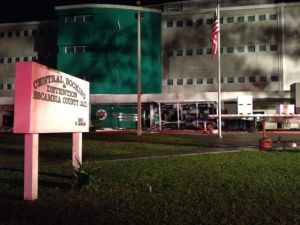
Late last night a gas explosion in a Pensacola, Florida jail killed two people and injured at more than 150 others. The explosion was likely linked to the flooding. ABC News:
Escamela County Jail, Pennsacola, FL
The explosion happened around 11 p.m. at the Escambia County Central Booking and Detention Facility in Pensacola, county spokeswoman Kathleen Dough-Castro said.
There’s no word at this point on whether the victims are inmates or guards, Pensacola Police Officer Maria Landy told ABC News Radio.
The injured – 155 inmates and guards in total – have been taken to area hospitals, most of them with minor injuries. About 600 uninjured prisoners were evacuated by bus and transferred to other detention facilities in the area, Dough-Castro said. No inmates are known to have escaped.
Further north, heavy rains were blamed for landslides in Baltimore, Maryland and Yonkers, New York. From The Weather Channel:
The heaviest rain has ended in the Northeast, but investigators and cleanup crews continue to deal with landslides in two separate states.
The largest of the two happened in Baltimore’s busy Charles Village neighborhood Wednesday, when a retaining buckled on 26th Street, sending cars and mud tumbling 75 feet onto CSX railroad tracks.
Neighbor Dana Moore watched it happen.
“It was there and then it wasn’t,” she told the Baltimore Sun.
No one was injured but homes were evacuated so investigators could assess the area’s stability. Structural engineers placed markers along the road to monitor conditions….
The wet weather is also blamed for a mudslide on Metro-North train tracks in Yonkers, New York.

Baltimore landslide
From The Washington Post: Street collapses in Baltimore, washing away cars.
A street in the Charles Village neighborhood of Baltimore collapsed Wednesday, washing away cars and flooding CSX railroad tracks that run below street level.
Ian Brennan, a spokesman for the Baltimore fire department, said no injuries were reported.
One lane of the East 26th Street between North Charles and St. Paul streets collapsed about 4 p.m. and slid down an embankment leading to the tracks below. The cause of the collapse was unclear, but it came on a day that the region wasexperiencing heavy rainstorms.
Several streets were closed late Wednesday afternoon. St. Paul and Charles are major thoroughfares that are generally crowded during both the morning and evening commutes. The neighborhood is largely residential rowhouses. Traffic was reported to be snarled in the area of the collapse and downtown.
Brennan said no houses were damaged, but fire officials said many residents living along East 26th Street were ordered to leave until building inspectors can assess their properties.
Don’t forget the Twisters! Last night there were numerous tornado warnings in the Washington, DC area, and the WaPo had a live blog of all the weather activity.
There were quite a few tornadoes down south over the past week or so, and meteorologists have noted oddities in recent tornado seasons. Could it be due to climate change? AP via ABC News: Tornado Seasons Lately Have Been Boom or Bust.

Tornado west of Joplin, MO, April 27, 2014
Something strange is happening with tornadoes lately in the United States and it’s baffling meteorologists. It’s either unusually quiet or deadly active.
Until this weekend’s outbreak, the U.S. had by far the quietest start of the year for tornadoes. By the beginning of last week, there had been only 20 significant tornadoes and none of them that big.
There was also a slow start four years ago. And after a busy January, last year was exceptionally quiet until a May outbreak that included a super-sized tornado that killed 24 people in Moore, Okla….
The 12-month period before last May set a record for the fewest significant tornadoes. But two years earlier, the nation also set a record for the most in 12 months.
Read about the possible causes at the link. And at National Geographic, see photos of destruction from recent tornadoes.
In other news . . .
There’s plenty of discussion in the media today about the horror show that took place in the Oklahoma death chamber on Tuesday. From Tulsa World, an Eyewitness account: A minute-by-minute look at what happened during Clayton Lockett’s execution.
From The National Journal, The ‘Recipe for Failure’ That Led to Oklahoma’s Botched Execution — “Secret suppliers of drugs, changes in lethal-injection protocol, a cavalier attitude among Oklahoma officials, and a national death-penalty system in crisis preceded Tuesday’s failed execution.”
A battle of political wills over Oklahoma’s secretive lethal-injection protocol turned into a gruesome scene of macabre theater Tuesday evening, as the state botched the execution of one inmate and halted that of another scheduled later in the night.
The mishandling reflects the extraordinary and surreptitious lengths a handful of active death-penalty states are now willing to go to in order to continue their executions, capital-punishment opponents say, and represents just the latest episode in a string of disturbing events on Oklahoma’s death row in recent months.
Moreover, Oklahoma’s ongoing morass is a symptom of a national death-penalty system in crisis, a system that is finding it increasingly difficult to procure the drugs necessary to carry out death sentences amid boycotts from European manufacturers and reticence from licensed physicians.

You all know what happened.
Death-penalty opponents are now calling for Oklahoma to suspend all of its executions for the rest of the year to avoid another botched job. Gov. Mary Fallin, a Republican, has so far issued only a 14-day stay for Charles Warner, who was also scheduled to be put to death Tuesday night in the same room as Lockett just two hours later.
“Apparently they can conduct their entire investigation in two weeks,” Madeline Cohen, Warner’s defense attorney, told National Journal sarcastically.
In Oklahoma, as well as other places such as Texas and Missouri, states have turned to compounding pharmacies—where products are chemically crafted to fit an individual person’s needs—to produce the lethal cocktails. But these stores, which are not subject to strict oversight by the Food and Drug Administration, don’t want to be publicly associated with executions. In response, states have granted them anonymity, and their identity remains a mystery even to the attorneys representing the death-row inmates.
That couldn’t happen here, writes Bob Egelko of SFGate but California officials are nervous anyway. They should be!
The secrecy-shrouded, botched execution in Oklahoma on Tuesday couldn’t happen the same way in California, where state laws and regulations require public disclosure of the drugs used in lethal injections, where they come from and how they are administered.
But the agony of a dying murderer and other death penalty developments underscore the multiple problems besetting capital punishment in California, where executions have been put on hold until courts find no significant prospect of a nightmare like the one that unfolded Tuesday night.
The state, whose Death Row is the nation’s largest, has not executed anyone since 2006 because of federal court rulings arising from executions in which the prisoner appeared to remain conscious longer than expected, and from ill-defined procedures and inadequate staff training. State officials are making their third attempt to rewrite the rules for lethal injections to include safeguards that would satisfy the courts.
Why don’t these folks just give it up? Life imprisonment is cheaper and a bad enough punishment.
Once again yesterday, Republicans used the filibuster to prevent a vote on increasing the minimum wage to $10.10. From the WaPo: Democrats Assail G.O.P. After Filibuster of Proposal to Raise Minimum Wage.
With the Republican-led filibuster of a Senate proposal to raise the federal minimum wage to $10.10 on Wednesday, Democrats moved swiftly to frame the vote as an example of the gulf that exists between the two parties on matters of economic fairness and upward mobility.
The question is not just one of money, they said, but of morality. And in doing so the Democrats returned to the themes that were successful for their party and President Obama in 2012 when they convinced swing voters that Democrats were mindful of the best interests of all Americans — not just those who are powerful and wealthy.
Speaking from the White House shortly after the measure was defeated 54 to 42, with 60 votes needed to advance, Mr. Obama admonished Republicans and called on voters to punish them at the polls in November. “If there’s any good news here, it’s that Republicans in Congress don’t get the last word on this issue, or any issue,” Mr. Obama said. “You do, the American people, the voters.”
Despite the Republicans’ efforts to damage the economy and sentence millions of Americans to a lifetime of poverty and struggle, “experts” (meaning Nate Silver) are predicting that the GOP will take control of the Senate in 2014. And other “experts” are arguing with the guy who was almost perfect in 2012. For example,
The Nation Journal’s Josh Kraushaar, Why I Don’t Agree With Nate Silver.
And a response from TPM: Pundit Who Was Dead Wrong In 2012 Is Now Questioning Nate Silver.
A wonky post on the Kraushaar-Silver kerfluffle from Bloomberg: Senate Forecasting: How to Beat Nate Silver.
Besides, Nate Silver thinks Pennsylvania is in the Midwest!
But according to Mike Allen, even Dems think Repubs have a 60% chance of taking over the Senate.
And AB Stoddard of The Hill says lots of Dem candidates are “on thin ice.”
I’ll tell you how I’m dealing with this controversy. I refuse to read the articles. There nothing I can do about it so why get all upset? It’s the Scarlett O’Hara defense. After all, tomorrow is another day.
Finally, a little science news . . .

Phys.org: Ancient Egyptians transported pyramid stones over wet sand.
Physicists from the FOM Foundation and the University of Amsterdam have discovered that the ancient Egyptians used a clever trick to make it easier to transport heavy pyramid stones by sledge. The Egyptians moistened the sand over which the sledge moved. By using the right quantity of water they could halve the number of workers needed. The researchers published this discovery online on 29 April 2014 in Physical Review Letters.
For the construction of the pyramids, the ancient Egyptians had to transport heavy blocks of stone and large statues across the desert. The Egyptians therefore placed the heavy objects on a sledge that workers pulled over the sand. Research from the University of Amsterdam has now revealed that the Egyptians probably made the desert sand in front of the sledge wet. Experiments have demonstrated that the correct amount of dampness in the sand halves the pulling force required.
The physicists placed a laboratory version of the Egyptian sledge in a tray of sand. They determined both the required pulling force and the stiffness of the sand as a function of the quantity of water in the sand. To determine the stiffness they used a rheometer, which shows how much force is needed to deform a certain volume of sand.Experiments revealed that the required pulling force decreased proportional to the stiffness of the sand. Capillary bridges arise when water is added to the sand. These are small water droplets that bind the sand grains together. In the presence of the correct quantity of water, wet desert sand is about twice as stiff as dry sand. A sledge glides far more easily over firm desert sand simply because the sand does not pile up in front of the sledge as it does in the case of dry sand.
The Egyptians were probably aware of this handy trick. A wall painting in the tomb of Djehutihotep clearly shows a person standing on the front of the pulled sledge and pouring water over the sand just in front of it.
Now what stories are you following today? Please share your links in the comment thread.
Lazy Saturday Reads: Weather, Spring Fever, Boston Bombing, Ukraine, and True Detective Spoilers
Posted: March 1, 2014 Filed under: Barack Obama, Foreign Affairs, morning reads | Tags: baseball, Boston Marathon bombings, Boston Red Sox, Carcosa, Cold War, Crimea, death penalty, Dzhokhar Tsarnaev, FBI abuses, Ibragim Todashev, spoilers, spring training, Tamerlan Tsarnaev, True Detective, Ukraine, Vladimir Putin, Yellow King 14 Comments
It’s Saturday!!
Another snowstorm is coming, but it’s not yet clear how bad it will be or how much snow will fall in which areas. From the Weather Channel: Ice Storm Possible for Mississippi Valley, Ohio Valley; Snowstorm for West, Midwest, Northeast.
After a brief reprieve from blockbuster winter storms in the Midwest and East – and a much-too-lengthy reprieve in California – Winter Storm Titan is will lay down a swath of heavy snow from California to the East Coast, and also a swath of sleet and freezing rain from the Plains to the Mid-Atlantic States.
- Saturday: The main event east of the Rockies will begin to unfold as snow spreads east across portions of the Plains, Upper Midwest and Great Lakes. For parts of the Northern Rockies, this will just be a continuation of snow from the previous, weaker disturbance. Widespread snow is likely across Wyoming, but will gradually wind down over western and southern Montana. Farther south the snow will be more tied to higher elevations. (See inset map for details.)
- Sunday: The more significant part of Winter Storm Titan begins with snow, sleet and freezing rain becoming heavier. A stripe of significant ice accumulation is likely Sunday and Sunday night from the Ozarks through into the Mid-South region, Ohio Valley and West Virginia with snow farther north from the central Plains into the mid-Mississippi Valley and Ohio Valley. These threats spread into the Mid-Atlantic and Northeast Sunday afternoon and night.
- Monday: Snow/sleet tapers off in the Ohio Valley Appalachians, but should linger in the Appalachians and along parts of the I-95 Northeast corridor much of the day, before ending off in the evening. Ice/sleet areas early in the day in the Mid-Atlantic states should changeover to snow Monday morning.

Whatever. Winter is almost over. It’s March 1, and there are signs of spring–at least down at Fenway South in Ft. Myers, Florida (and many other spring training locations). Yesterday the Red Sox played their first Grapefruit League game against the Minnesota Twins, losing 8-2. But who cares? A hot new pitching prospect shut down the Twins for two innings, striking out four–a good sign for the upcoming season. Baseball is back, opening day is a little over a month away, and that means spring is coming!
OK, I know I’m being really provincial, but I’ll bet you’re seeing signs of Spring too. What is giving you hope for the end of this long, cold winter? Even the folks down south have suffered greatly this year.
One more Boston story. The FBI is claiming that accused Boston bomber Dzhohar Tsarnaev “made a damaging statement” in a visit with one of his sisters recently. Of course they won’t even give a hint as to what he said, so I don’t know what to make of it. The Boston Globe:
The filing said that Tsarnaev, despite the presence of the agent, who was legally allowed in the room, “was unable to temper his remarks and made a statement to his detriment which was overheard by the agent.”
The filing did not say what the statement was.
The filing was made as part of an ongoing battle between the prosecution and defense over special administrative measures, special prison restrictions, that have been imposed on Tsarnaev.
The defense says the prosecution is refusing to turn over information they need and that the FBI is monitoring their meetings with Tsarnaev and preventing them from developing their defense strategy. I think the feds need to keep in mind that they will have a Massachusetts jury–very few people here support the death penalty, and most potential jurors will be troubled by FBI efforts that might prevent a fair trial. After all, we just recently went through the Whitey Bulger trial, in which we heard endless tales of FBI abuses and we’re still waiting for an explanation as to why an agent from the Boston office shot Ibragim Todashev down in Orlando last May.
We’re coming up on the 2014 Boston Marathon, and we still have almost no explanations of what really happened during the Marathon bombing and the shootout in Watertown a few days later. And then there’s the Waltham triple murder, which the FBI is trying to pin on two dead guys–Tamerlan Tsarnaev and Ibrigim Todashev. Susan Zalkind summed up many of the questions in this month’s Boston Magazine coverstory: The Murders Before the Marathon. There wasn’t a whole lot of breaking news in the article, but it’s a very good summary of events so far.
There’s a lot happening in Ukraine. I’ll just give you a couple of links to check out, because I’m not qualified to comment on the situation–other than I’m sick of everyone expecting the U.S. to get involved in every crisis.
The latest from ABC News: Putin Asks Parliament to Use Military in Ukraine
Russian President Vladimir Putin asked parliament Saturday for permission to use the country’s military in Ukraine, moving to formalize what Ukrainian officials described as an ongoing deployment of Russian troops in the strategic region of Crimea.
Putin’s motion loosely refers to the “territory of Ukraine” rather than specifically to Crimea, raising the possibility that Moscow could use military force in other Russian-speaking provinces in eastern and southern Ukraine where many oppose the new authorities in Kiev….
He said the move is needed to protect ethnic Russians and the personnel of a Russian military base in Ukraine’s strategic region of Crimea. Putin sent the request to the Russian legislature’s upper house, which has to approve the motion, according to the constitution. The rubber-stamp parliament is certain to approve it in a vote expected Saturday.
In Crimea, the pro-Russian regional prime minister had earlier claimed control of the military and police there and asked Putin for help in keeping peace, sharpening the discord between the two neighboring Slavic countries.

President Obama warned yesterday that there would consequences for military intervention in Ukraine, but he didn’t specify any actions he would take. At this point, I think these warnings are just being ignored, because there is seldom any follow-up. As I said earlier, I don’t want to get involved in any more foreign conflicts. Let Europe deal with it if they want to. We have plenty of problems here at home that require government action.
From Reuters: West voices alarm on Crimea, calls on Russia to respect Ukraine sovereignty.
A week after violent protests forced Russian-backed President Viktor Yanukovich to abandon power in Kiev, Ukraine’s new leaders say Russia is trying to take control of the southern Crimea region, which has a majority ethnic Russian population.
France, Britain and Germany issued calls for de-escalation in Crimea hours after U.S. President Barack Obama warned that military intervention in the region would be deeply destabilizing and “carry costs”.
“France is extremely concerned by the reports from Crimea, which describe significant troop movements,” French Foreign Minister Laurent Fabius said in a statement. “We call on the parties to abstain from acts that could raise tensions and affect Ukraine’s territorial unity.”
It does appear that Putin is intent on reviving the Cold War. I hope he’s not successful.
Tomorrow night we’ll get an other episode of True Detective–there are only two to go. I gathered a bunch more links in the past couple of days. Some of them have spoilers, so be careful.
This is an older post, but it provides some very good background on the weird aspects of the story. From Grantland’s Molly Lambert, Carcosa or Bust: The Satisfyingly Weird Mysteries of ‘True Detective’. Just a taste:
Hallucinatory spirals, talk of “black stars” rising in the sky, dead women trussed up like ancient horned gods and tattooed with mysterious symbols, all supposedly in reference to Robert W. Chambers’s fairly obscure weird fiction classic The King in Yellow? Damn, True Detective, you’ve given me a lot to absorb.
Where is the show going with its recently clarified Lovecraftian ties? Does it even really matter, when the ride is this great? The most satisfying part of a mystery is rarely its resolution. Sustained anticipation is much of the thrill. Like earlier TV mysteries Twin Peaks, The X-Files, and Lost, True Detective is a show with its own internal mythology, which taunts both the protagonists and viewers with signs just beyond our comprehension. When some bits of information are guaranteed to be important later, every single bit of information feels like a potential clue. Attempting to read a show scene by scene and pluck out exactly what will prove crucial from a galaxy of visual and verbal details can feel absolutely maddening….
You can spend endless amounts of time pondering True Detective’s more concrete questions, let alone the existential ones. Are the wooden triangles strewn around the sites of the ritualistic murders pagan symbols, bird traps, or neither? Given creator Nic Pizzolatto’s professed affection for weird fiction, were Reggie Ledoux’s gas mask and the reference to a “green-eared spaghetti monster” meant to invoke Cthulhu, the giant octopus monster that signals cosmic doom in the work of seminal horror writer H.P. Lovecraft? Is the mystery even going to get solved?True Detective’s flashback structure accentuates the gaps in our knowledge. Everything we know is gleaned from flashbacks and interrogations, but there’s no guarantee that future information won’t flip our perspective. Hell, there’s no guarantee that Rust and Marty’s flashbacks are accurate. After all, if we can see Rust’s subjective hallucination of birds assembling into a spiral in the sky, who’s to say we’re not seeing other events from his subjective perspective too? This kind of theorizing, not baseless but impossible to prove conclusively, will make you feel like True Detective’s detectives. Maybe the show’s obsessions with madness, reality, and truth really are contagious.

Then read Lamberts latest post: Five Things to Consider for This Week’s Episode of ‘True Detective’. She has some good questions.
A guy at Reddit did some sleuthing and came up with some photos posted by True Detective crew members. Here’s a link to a lot of photos, some from the upcoming episodes. I looked at them, and got some sense of what’s coming, but not much more than I got from the teaser trailer. They didn’t ruin the suspense for me. Just be warned if you want to stay completely in the dark.
A few more links to explore as we wait for tomorrow night to roll around:
Rolling Stone: The Dark Thrills of ‘True Detective’
Forbes: The Business Of HBO’s ‘True Detective’
Slate: The True DetectiveGlossary
Complex Pop Culture: Pictures of You: “True Detective” and the Dilemma of the Dead Woman’s Photograph
International Business Times: ‘True Detective’ Season 1 Spoilers: What’s On The Video Tape In Episode 7? Theories On Hart’s Daughter And Connection To The Yellow King
Now what’s on your mind today? Please post your links on any topic in the comment thread, and have a great weekend!!
Friday Morning Reads
Posted: December 7, 2012 Filed under: just because, misogyny, morning reads, The Media SUCKS, We are so F'd | Tags: death penalty, innoence project, Jim Demint, legalize pot, marriage equality, opportunistic asshole, Ross Douthat is a hack, Washington State 40 Comments Good Morning!!
I’ve been getting a real kick out of watching Washington state’s big legislative changes. First, marriage equality has come to the most NE of the lower 50 states. It’s been a pleasure to see the happy faces of long time couples who finally have some public recognition of their love and commitment. Governor Chris Gregoire signed the bill into law and the licenses are flowing!
Gov. Chris Gregoire has signed into law a measure that legalizes same-sex marriage in Washington state, which now joins several other states that allow gay and lesbian couples to wed.
Gregoire and Secretary of State Sam Reed certified the election on Wednesday afternoon, as they were joined by couples who plan to wed and community activists who worked on the campaign supporting gay marriage. The law doesn’t take effect until Thursday, when gay and lesbian couples can start picking up their wedding certificates and licenses at county auditors’ offices. King County, the state’s largest and home to Seattle, and Thurston County, home to the state capital of Olympia, will open the earliest, at 12:01 a.m. Thursday, to start issuing marriage licenses.
In Seattle, Kelly Middleton and her partner Amanda Dollente got in line to wait for their license at 4 p.m. Wednesday.
“We knew it was going to happen, but it’s still surreal,” said Dollente, 29.
By 10 p.m., dozens of people had joined the queue and the mood was festive.
Volunteers distributed roses and a group of men and women serenaded the waiting line to the tune of “Going to the Chapel.”
Asked whether the middle-of-the-night marriage license roll-out was necessary, King County Executive Dow Constantine said, “People who have been waiting all these years to have their rights recognized should not have to wait one minute longer.”
Because the state has a three-day waiting period, the earliest that weddings can take place is Sunday. Same-sex couples who previously were married in another state that allows gay marriage, like Massachusetts, will not have to get remarried in Washington state. Their marriages will be valid here as soon as the law takes effect.
“This is a very important and historic day in the great state of Washington,” Gregoire said before signing the measure that officially certified the election results. “For many years now we’ve said one more step, one more step. And this is our last step for marriage equality in the state of Washington.”

Photojournalist Meryl Schenker took this picture very early this morning in Washington state, in the first hours when same-sex couples could get marriage licenses. Meryl writes:
One month after Washington State voters approved the state’s marriage equality law in Ref. 74, same-sex couples get marriage licenses for the first time on December 6th, 2012. At around 1:30am, Larry Duncan, 56, left, and Randy Shepherd, 48, from North Bend, Wash. got their marriage license. The two plan to wed on December 9th, the first day it is possible for them to wed in a church in Washington State. They have been together for 11 years. Originally from Dallas, Texas, they moved here 7 years ago because it’s more gay friendly. Randy is a computer programer and Larry is a retired psychology nurse.
The crowds of happy people lighting joints under Seattle’s Space Needle early Thursday morning with nary a police officer in sight bespoke the new reality: Marijuana is legal under Washington state law.
Hundreds gathered at Seattle Center for a New Year’s Eve-style countdown to 12 a.m., when the legalization measure passed by voters last month took effect. When the clock struck, they cheered and sparked up in unison.
A few dozen people gathered on a sidewalk outside the north Seattle headquarters of the annual Hempfest celebration and did the same, offering joints to reporters and blowing smoke into television news cameras.
“I feel like a kid in a candy store!” shouted Hempfest volunteer Darby Hageman. “It’s all becoming real now!”
Washington and Colorado became the first states to vote to decriminalize and regulate the possession of an ounce or less of marijuana by adults over 21. Both measures call for setting up state licensing schemes for pot growers, processors and retail stores. Colorado’s law is set to take effect by Jan. 5.
Well, here I sit in the wonderful city of New Orleans trapped by the likes of Crazy Bobby Jindal who wants the christian creation myth taught as science, has now created a situation where there will be only one bed for gun shot victims at LSU med center, and is in the process of ruining everything that was functional about our public schools, our higher education system, and our health care delivery system. It’s hard not want to sell the kathouse and head out.
Exactly, what is it that jerks like Jindal have swallowed to make them so wedded to insane, dated, and completely untrue magical thinking. Why does the press continue to expand the dialogue to include the expressions of folks that just plain lie and spread hate? It’s gone way beyond a difference of opinion to a war on sane, rational thought. For your consideration, NYT hack Ross Douthat whose views on women are worthy of a Salem Witch Trial. I’ve some what avoided discussing his column but it just won’t die a good and necessary death. Evidently, Douthat believes that women that don’t stay home and spit those babies out of the vag are decadent. How do idiots like this get space in any major newspaper? Here’s a response to the hooplah he created with his Sunday Column.
Likewise for readers who regard any talk about the moral weight of reproductive choices as a subtle attempt to reimpose the patriarchy: Can it really be that having achieved so much independence and autonomy and professional success, today’s Western women have no moral interest in seeing that as many women are born into the possibility of similar opportunities tomorrow? Is the feminist revolution such a fragile thing that it requires outright population decline to fulfill its goals, and is female advancement really incompatible with the goal of a modestly above-replacement birthrate? Indeed, isn’t it just possible that a modern culture that celebrated the moral component of childrearing more fully would end up serving certain feminist ends, rather than undermining them — by making public policy more friendly to work-life balance, by putting more cultural pressure on men to be involved fathers rather than slackers and deadbeat dads, and so on?
Okay, enough rhetorical questions. It’s the nature of social conservatives to be cranky about contemporary trends, often to a fault. But it’s also the nature of decadent societies to deny that the category of “decadence” exists. And what Yglesias calls nuttiness still looks like moral common sense to me — a view of intergenerational obligation that human flourishing depends on, and whose disappearance threatens to sacrifice essential goods and relationships on the altar of more transient forms of satisfaction.
So, my next question is why is this all women’s fault? Also, who the hell thinks American’s lower birthrate is a problem anyway? Here’s the original piece if you can stand to read the ignorance. It’s true we don’t value children in our society but to talk about tripping women into having more of them when we don’t nurture and protect the children we have today is just insanity.
We have to celebrate the fact that Jim Demint is chasing more money in the private sector and hooking up with the faux research compiled these days bye the Heritage Foundation. At least the foundation and Demint are being honest about the fact that it’s all about spreading the lies that benefit their donor class. Is he really looking for a new pulpit or just a bigger pay check? Can the Heritage Foundation even fake being a ‘think tank’ any more since Demint’s ability to contribute anything other than dogma and political cronies is questionable.
His imminent departure to head a well-financed organization with significant heft in conservative circles will allow him to oppose even more loudly a big budget deal that includes higher tax revenues sought by President Obama. Mr. DeMint has been a loud Republican critic of a deal proffered by House Speaker John A. Boehner to address the impending fiscal crisis by generating at least $800 billion in new tax revenue.
“I’m leaving the Senate now, but I’m not leaving the fight,” Mr. DeMint said in a statement. “I’ve decided to join the Heritage Foundation at a time when the conservative movement needs strong leadership in the battle of ideas.”
In a parting shot — or perhaps warning flare — Mr. DeMint on Thursday suggested to Rush Limbaugh that Mr. Boehner might need to watch his back. When asked if Mr. Boehner was forcing him out, Mr. DeMint replied, “It might work a little bit the other way, Rush.”
The job switch should have substantial financial benefits for Mr. DeMint, whose 2010 net worth, $65,000, was among the lowest in the Senate. Edwin J. Feulner, the current head of the foundation, in 2010 earned $1,098,612 in total compensation.
A hero to many Republicans for his campaign fund-raising abilities, Mr. DeMint frustrated Senate colleagues by eagerly backing Republican candidates like Sharron Angle of Nevada, Ken Buck of Colorado and Christine O’Donnell of Delaware in 2010, and Richard Mourdock of Indiana and Todd Akin of Missouri this year, contenders who proved too conservative to be elected statewide. Those losses set back Mr. DeMint’s effort to bring the fiery conservatism of the House to the Senate, though he did have a hand in electing Senators Mike Lee of Utah, Marco Rubio of Florida, Rand Paul of Kentucky and Ted Cruz of Texas, who takes office next month.
“The truth is that Jim DeMint’s philosophy on everything from Medicare to women’s reproductive rights, as embodied by his handpicked candidates for Congress, has been rejected by voters,” said Senator Patty Murray of Washington, who headed the Democratic Senatorial Campaign Committee this year. Privately, so as not to inflame him, several Republicans also said Mr. DeMint’s departure would produce few tears among them.
Here’s a story that will let you know just how twisted the US justice system can be. This is from The Guardian because–you know–the US media can’t possibly question our infallibility or exceptionalism. Once again, the Louisiana justice system failed its duties. Fortunately, DNA testing has freed him. Thibodeauz was joined by others freed by the Innocence Project. He’s the young white man in the white T shirt in the picture below.
Every morning Damon Thibodeaux wakes up in his temporary digs in Minneapolis and wonders when his newfound freedom is going to come crashing down. “You think you’re going to wake up and find it was just a dream,” he says.
When he stepped out of Angola jail in Louisiana several guards were at the gate to wish him well, addressing him for the first time in 16 years as “Mr Thibodeaux”. “No offence,” he said, “but I hope I never see you again.”
He walked out as the 300th prisoner in the US to be freed as a result of DNA testing and one of 18 exonerated from death row. With the help of science he has been proved innocent of a crime for which the state of Louisiana spent 15 years trying to kill him.
For those years Thibodeaux was in a cell 1.8 metres by 3 metres for 23 hours a day. His only luxury was a morning coffee, made using a handkerchief as a filter with coffee bought from the prison shop; his only consolation was reading reading the Bible; his only exercise pacing up and down for an hour a day in a the “exercise yard”– a metal cage slightly larger than his cell.
Like most death rows in the United States, the prisoners in Angola are treated as living dead things: they are going to be executed so why bother rehabilitating
them? He watched as two of his fellow inmates were taken away to the death chamber, trying unsuccessfully not to dwell on his own impending execution. “It was like, one day they may be coming for you. At any time, a judge can sign an order and they can come and take you and kill you.”
At the lowest point, he says he felt such hopelessness that he considered dropping all his appeals and giving up. He would become a “volunteer” – one of those prisoners who are assumed positively to want to die but so often simply lack the will to live. He read the Bible some more, shared his fears with other prisoners through the bars and found a new resolution. “I came to terms with the fact that I was going to die for something I didn’t do. Truthfully, we’re all going to die anyway; it made it a lot easier.”
With little hope, he pressed on with his appeals and, almost imperceptibly at first, fortune’s wheel began to turn. A lawyer assigned to his post-conviction appeal became concerned by his case, and she in turn enlisted the help of the Innocence Project in New York, a national group devoted to exonerating wrongfully convicted people through DNA testing.
Also drawn into the fray were a pair of Minneapolis-based lawyers from the commercial firm Fredrikson & Byron. In his day job Steven Kaplan works on mergers and acquisitions, not rape and murder, but he threw himself at the Thibodeaux case pro bono.
As soon as Kaplan began reading the legal papers relating to Thibodeaux’s death sentence, he was astonished. He had never worked on a capital case before and, like most people unversed in the finer details of the death penalty in America, had assumed that the judicial process must have adhered to the very highest legal standards. After all, a man’s life was at stake.
“When I read the transcript of the trial for the first time, I thought to myself that the high school mock trial team that I coached of 15- to 17-year-olds would have run rings around the lawyers in that courtroom,” said Kaplan. “We put more energy into a $50,000 contract dispute than went into the defence at the Damon Thibodeaux trial.”
The sequence of events that put Thibodeaux on to death row began on 19 July 1996. He was 22 and worked as a deckhand on Mississippi river barges.
Two weeks earlier he had moved back to New Orleans, where his mother and sister lived, to help out with his sister’s wedding. He started hanging out with the Champagne family, distant relatives, who had a flat in a neighbouring suburb.
He spent 19 July at the Champagne home with the father, CJ, mother, Dawn, and 14-year-old daughter, Crystal. At about 5pm Crystal asked Thibodeaux to go with her to the local Winn-Dixie supermarket but he was busy mending CJ’s watch. She left the house on her own at 5.15pm.
When she was not back more than an hour later her mother became alarmed and they began a search, Thibodeaux joining the effort. They called the police and searched through the night and through the following day.
It was not until after 6pm on 20 July that Thibodeaux went back to his mother’s house and lay down to rest. He was just falling asleep when police arrived and asked him to come with them.
That was at 7.32pm. At 7.40pm Crystal’s body was found on the banks of the Mississippi, about five miles from the Champagnes’ home. The news was transmitted to the detectives quizzing Thibodeaux and instantly a routine missing-person interview became a homicide interrogation.
So, I’ve really overrun my usual self-imposed limit today of shares but some of these stories really frosted my cupcakes. I really worry about our country. Today’s reads showed that there are places where things are hopeful and places where things just aren’t right.
What’s on your reading and blogging list today?

 peej
peej Carissa
 bostonboomer
 dakinikat
 ecocatwoman
 mablue2
 Mama Lopez
 peggysue22
 quixote
 skydancingguestblogger
 Mona (aka Wonk the Vote)



 Sky Dancing
Recent Comments