
Loyalties to the two opposing forces are stark.
“I’ve questioned Froman on Brunei. I’ve questioned him on food safety. I’ve questioned him on not doing anything when Peru walked back from environmental regulations. Nothing,” fumed Representative Rosa DeLauro, Democrat of Connecticut, a fierce foe of the trade promotion authority legislation nearing House consideration and of the 12-nation Trans-Pacific Partnership that such authority would ease to completion.
By contrast, “Lori Wallach? She’s got such granular knowledge,” she said. “She’s my source of information and knowledge.”
Republicans have lauded Mr. Froman for his full-throttle effort to secure the trade accord and his constant availability to them. Likewise, Representative Charles B. Rangel of New York, a Democrat more open to the trade bills, shrugged off the hostility expressed by many in his party.
“When I’m asking burning questions about human rights and labor rights and the environment and communist Vietnam, I know I’m dealing with a professional,” he said of Mr. Froman.
Clearly, though, many lawmakers have lost patience with Mr. Froman. As a result, a hard-fought compromise on the trade promotion bill approved by the Senate Finance and House Ways and Means committees last week practically legislates better relations.
Monday Reads: Mergers and Trade and Wonks! Oh My!
Posted: April 27, 2015 Filed under: morning reads | Tags: Comcast, Mergers, Time Warner, Trade, Trans-Pacific Partnership 27 CommentsGood Morning!
 Well, it’s still morning where I’m at although it hardly looks that way since we’ve been inundated by rain for several hours. I do believe folks have traded in their cars for pirogues as the streets have now filled up pretty quickly with water and leaves.
I have a few odds and ends to pass on to you this morning.First, the Comcast/Time-Warner merger is off which is a very good deal for consumers around the country. The merger would’ve been a BFD and I can’t imagine the Justice Department letting it go through with the amount of concentration it would’ve caused in several markets. It would’ve been like Coke, Pepsi and Walmart merging together.
Here’s Senator Al Franken with some thoughts on the failed deal.
The collapse of Comcast’s plan to buy Time Warner Cable is a big victory for anyone who watches TV or uses the Internet. But it won’t be the last time the interests of consumers clash with the desires of big corporations in the media and technology space. Here are five lessons from this fight I think we should keep in mind going forward.
2. We should empower regulators to do their jobs.
This decision illustrates an important reason why we have the FCC (and federal regulatory agencies in general): to protect the American people from being taken advantage of by big corporations.
That said, far too often, those big corporations are able to wield overwhelming influence over the government agencies (and lawmakers) that are supposed to be keeping them in check. Comcast is represented in Washington by more than 100 lobbyists, more than a few of whom have passed through the “revolving door” between the company and its regulators (for example, less than four months after the FCC approved Comcast’s acquisition of NBCUniversal in 2011, one of the FCC commissioners went to work for Comcast). Last year, it and Time Warner Cable combined to spend $32 million trying to influence the federal government.
So while it’s critical that we empower regulators to do their jobs, we also have to demand that they do them well; our activism has to outweigh the big money on the other side.
3. We should still be worried about lack of competition.
Even without this deal, there is far too little competition in the cable and broadband markets. As it stands now, 55% of U.S. households only have one choice for broadband Internet—and for a majority of those homes, it’s Comcast. Not exactly an incentive for the company to provide first-class service, as many Comcast customers can attest.
And if you want another illustration of how powerful Comcast is, consider that, during the debate over this deal, other companies who did business with Comcast told me they were afraid go public with their opposition because they feared retribution.
The Senator makes five points so you can continue to read this article at–of all places–Time Magazine.
Another BFD in the area of the economy is the Trans-Pacific Partnership which I’ve hesitated to write about for several reasons. First, much of the deal is still classified and not available to the public. Second, I look at the deal through the eyes of some one whose dissertation was about trade in ASEAN+3 so I am supremely disadvantaged by knowing WAY too many details about the region and the existing trade agreements. My current research area is Foreign Direct Investment through out the entire region so I almost know too much to be able to explain any of it succinctly if that makes any sense.
However, I will point you to a few things. First, there’s a document from the Congressional Research Service that outlines issues that should concern Congress. I consider this a good place to start. This quote comes from a portion of the Executive Summary.
The Trans-Pacific Partnership (TPP) is a proposed regional free trade agreement (FTA) being negotiated among the United States, Australia, Brunei, Canada, Chile, Japan, Malaysia, Mexico, New Zealand, Peru, Singapore, and Vietnam. U.S. negotiators and others describe and envision the TPP as a “comprehensive and high-standard” FTA that aims to liberalize trade in nearly all goods and services and include rules-based commitments beyond those currently established in the World Trade Organization (WTO). The broad outline of an agreement was announced on the sidelines of the Asia-Pacific Economic Cooperation (APEC) ministerial in November 2011, in Honolulu, HI. If concluded as envisioned, the TPP potentially could eliminate tariff and nontariff barriers to trade and investment among the parties and could serve as a template for a future trade pact among APEC members and potentially other countries. Congress has a direct interest in the negotiations, both through influencing U.S. negotiating positions with the executive branch, and by considering legislation to implement any resulting agreement.
The TPP negotiations have been ongoing for nearly five years and may be concluded in the near term, although several challenging issues remain unresolved. These issues are likely the most sensitive for negotiating parties and may require political-level decisions to reach final agreement. The negotiating dynamic itself is complex. For example, decisions on key market access issues on auto, dairy, sugar, and textiles and apparel may depend on the outcome of rules negotiations involving intellectual property rights or state-owned enterprises, among other issues.
Nearly 30 chapters are under discussion in the negotiations, and reports indicate that 9 have been finished. The United States is negotiating market access for goods, services, and agriculture with countries with which it does not currently have FTAs: Brunei, Japan, Malaysia, New Zealand, and Vietnam. Negotiations are also being conducted regarding disciplines on intellectual property rights, trade in services, government procurement, investment, rules of origin, competition, labor, and environment, among other issues. In many cases, the rules being negotiated are intended to be more rigorous than comparable rules found in the WTO. Some topics, such as state-owned enterprises, regulatory coherence, and supply chain competitiveness, may break new ground in FTA negotiations. As the countries that make up the TPP negotiating partners include advanced industrialized, middle income, and developing economies, the TPP, if implemented, may involve restructuring and reform of the economies of some participants. It also has the potential to spur economic growth in the region.
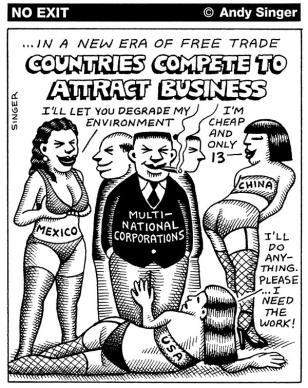 It also has the potential to tank some industries in this country as well as provide all consumers with a huge number of extremely cheap things for them to buy. Trade is always win-win for countries. However, within each country, there are huge losers. This is something that always has to be considered. Some jobs will move to other countries while creating jobs in totally different industries in the domestic economy. The deal is that most of the folks in the lost jobs usually aren’t just easily transferable to the newly created jobs. That’s especially true in this country where our advantage is in areas that are extremely technical in nature and require advanced degrees or training. The NAFTA agreement contained “adjustment assistance” to help such workers. An example of what it did was train a lot of Ladies Garment Workers in the South in the Health Care Field. In many cases, the jobs weren’t all that equal but at least there was some consideration. We’ve heard nothing about this kind of assistance but again, many of the details are still hush hush. The discussion is heating up so I thought I’d give you some of the basics, however, so we can have a base for further discussion as this seems certain to move forward.
Here’s a good example of concerns and cross-purposes. This is an example of two Lawyers from Harvard Law school that are distinctly split into opposing camps.
As Congress considers giving another Harvard Law colleague from that era, President Obama, special “fast track” authority to negotiate a 12-nation Pacific trade accord, the two lawyers find themselves on opposing armies in one of the biggest legislative fights of the Obama presidency. Among those nations are Japan, Australia and Chile, and smaller ones like Brunei, Peru and Vietnam.
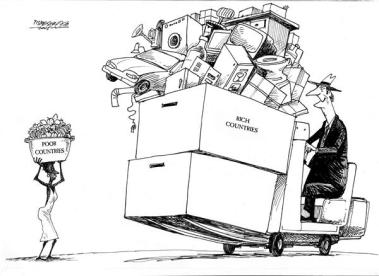 You can see from the list of countries mentioned above that we have a variety of things to be concerned about with this agreement. We’ve got developed countries, emerging economies, and countries that are barely off the ground in this agreement. There are democracies, monarchies and communist countries included in the mix. It’s a very complex situation to say the least.
Many see this as the ultimate nod to huge MNCs (Multinational Corporations). Here’s an example from Doctors without Borders and their concerns about the costs of pharmaceuticals.
No matter who you are or where you live, it’s time to pay attention to the Trans-Pacific Partnership (TPP) trade deal. If signed in its current form, the TPP will lock in high, unsustainable drug prices, delay the availability of less expensive generic medicines, and price millions of people out of the medical care that they need.
Today, AARP and Doctors Without Borders/Médecins Sans Frontières (MSF) express our deep concerns about the TPP’s impact on drug prices. Intellectual property provisions being proposed by the U.S. put too much emphasis on drug industry priorities at the expense of consumer and patient needs.
Various provisions in the TPP would delay the introduction of lower-priced drugs and worsen an already failing system of research and development that awards patents and other monopolies to companies for producing ‘me-too‘ medicines that provide little to no therapeutic benefits over existing treatments.
More troubling are demands by the U.S. to mandate 12 years of data exclusivity for biologic medicines, which include vaccines and drugs used to treat conditions like cancer and multiple sclerosis. Data exclusivity blocks competing firms from using previously generated clinical trial data to gain approval for generic versions of these drugs and vaccines.
With annual prices that can reach $400,000, the high cost of biologic drugs not only has negative effects on consumers and patients, but also on health care payers, including programs like Medicare and Medicaid, as well as children in developing countries who are most vulnerable to dying from vaccine-preventable diseases.
It is noteworthy that the proposed 12 years of data exclusivity, or when clinical trial data are protected, goes well beyond the monopoly protections already provided in the U.S. Today, biologic drug manufacturers receive four years of data exclusivity that runs concurrently with 12 years ofmarket exclusivity, or when the FDA is blocked from approving generic versions of a brand name product.
Here’s more from a legal standpoint.
The most controversial provision of the TPP is the Investor-State Dispute Settlement (ISDS) section, which strengthens existing ISDS procedures. ISDS first appeared in a bilateral trade agreement in 1959. According to The Economist, ISDS gives foreign firms a special right to apply to a secretive tribunal of highly paid corporate lawyers for compensation whenever the government passes a law to do things that hurt corporate profits — such things as discouraging smoking, protecting the environment or preventing a nuclear catastrophe.
Arbitrators are paid $600-700 an hour, giving them little incentive to dismiss cases; and the secretive nature of the arbitration process and the lack of any requirement to consider precedent gives wide scope for creative judgments.
To date, the highest ISDS award has been for $2.3 billion to Occidental Oil Company against the government of Ecuador over its termination of an oil-concession contract, this although the termination was apparently legal. Still in arbitration is a demand by Vattenfall, a Swedish utility that operates two nuclear plants in Germany, for compensation of €3.7 billion ($4.7 billion) under the ISDS clause of a treaty on energy investments, after the German government decided to shut down its nuclear power industry following the Fukushima disaster in Japan in 2011.
Under the TPP, however, even larger judgments can be anticipated, since the sort of “investment” it protects includes not just “the commitment of capital or other resources” but “the expectation of gain or profit.” That means the rights of corporations in other countries extend not just to their factories and other “capital” but to the profits they expect to receive there.
It really behooves all of us to look into the items leaking out of this agreement. I do mean “leaking” too. Here’s a great, easy-to-read article on concerns on the agreement from Vox. They argue that it’s good for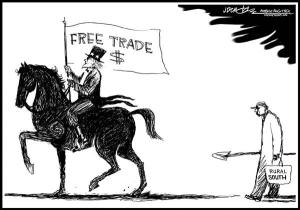 “elites” and not so good for every one else.
In the past, debates about trade deals have mostly been about trade. Ross Perot, for example, famously warned in 1992 about a “giant sucking sound” of jobs moving to Mexico if the US signed the North American Free Trade Agreement. In contrast, debates over the TPP mostly haven’t focused on its trade provisions.
That’s partly because even advocates of the treaty acknowledge that the economic effects of TPP’s trade provisions would be modest. It’s difficult to estimate the economic impact of the TPP’s trade provisions, because we don’t know exactly what’s in the deal. But one of the mostwidely cited estimates finds that TPP would add about $77 billion to US incomes in 2025. That’s less than half of 1 percent of current US incomes.
“This is not going to dramatically going to change our lives overnight,” Petri says. “We’re a very big economy, so anything compared to the size of the economy is going to be small in percentage term.”
Petri hopes the TPP will serve as a blueprint for future trade deals that include other big economies, such as the European Union and China. In that case, he says, the economic effects could be several times as large, with annual incomes increasing by as much as 2 percent of GDP.
A big reason for the deal’s modest impact is that trade barriers are already low. There are a few politically sensitive markets, such as agriculture, where significant trade restrictions remain. But previous trade deals have removed so many restrictions that there just isn’t much room for further progress.
As the opportunities for trade liberalization have dwindled, the nature of trade agreements has shifted. They’re no longer just about removing barriers to trade. They’ve become a mechanism for setting global economic rules more generally.
This trend is alarming to Simon Lester, a free trader at the Cato Institute. “We’ve added in these new issues that I’m skeptical of,” he says. “It’s not clear what the benefits are, and they cause a lot of controversy.”
And this system for setting global rules has some serious defects. We expect the laws that govern our economic lives will be made in a transparent, representative, and accountable fashion. The TPP negotiation process is none of these — it’s secretive, it’s dominated by powerful insiders, and it provides little opportunity for public input.
The Obama administration argues that it’s important for TPP to succeed so that the United States — not China — gets to shape the rules that govern trade across the Pacific. But this argument only makes sense if you believe US negotiators are taking positions that are in the broad interests of the American public. If, as critics contend, USTR’s agenda is heavily tilted toward the interests of a few well-connected interest groups, then the deal may not be good for America at all.
So, with that I start the conversation. Get ready, because it will be wonky as hell!
What’s on your reading and blogging list today?
Tuesday Reads
Posted: May 13, 2014 Filed under: morning reads, Republican politics, U.S. Politics | Tags: Boston Marathon bombing, Chamber of Commerce, Climate change, Comcast, Danny Sun Jr., death penalty, drug rings, FCC, global warming, greenhouse gases, immigration, internet fast lane, John Boehner, net neutrality, Oklahoma botched execution, polar melt, Portland Maine drug gangs, Robert James Campbell, Ruger P95, Safwan Madarati, Tamerlan Tsarnaev, Texas execution, Tom Donohue, Tom Wheeler, Waltham triple murder, Watertown drug gang, Watertown shootout, West Antarctica ice sheet 55 Comments
Good Morning!!
I have a mixture of links for you today, with no overall theme whatsoever. There is news happening out there, but somehow it still feels like a slow news month so far. Maybe it’s just because it feels like nothing is really happening that will change the “malaise” in the country, to use Jimmy Carter’s term. The economy doesn’t really seem to be improving for 90 percent of us, and the bottleneck in Congress feels unbreakable. So here are some stories that caught my eye.
From The New York Times: Scientists Warn of Rising Oceans From Polar Melt.
A large section of the mighty West Antarctica ice sheet has begun falling apart and its continued melting now appears to be unstoppable, two groups of scientists reported on Monday. If the findings hold up, they suggest that the melting could destabilize neighboring parts of the ice sheet and a rise in sea level of 10 feet or more may be unavoidable in coming centuries.
Global warming caused by the human-driven release of greenhouse gases has helped to destabilize the ice sheet, though other factors may also be involved, the scientists said.
The rise of the sea is likely to continue to be relatively slow for the rest of the 21st century, the scientists added, but in the more distant future it may accelerate markedly, potentially throwing society into crisis.
“This is really happening,” Thomas P. Wagner, who runs NASA’s programs on polar ice and helped oversee some of the research, said in an interview. “There’s nothing to stop it now. But you are still limited by the physics of how fast the ice can flow.”
Read details about the two studies at the NYT link. Richard B. Alley, scientist not involved in the studies noted that what’s happening in Antarctica is only one source of future climate change disasters.
He added that while a large rise of the sea may now be inevitable from West Antarctica, continued release of greenhouse gases will almost certainly make the situation worse. The heat-trapping gases could destabilize other parts of Antarctica as well as the Greenland ice sheet, potentially causing enough sea-level rise that many of the world’s coastal cities would eventually have to be abandoned.
“If we have indeed lit the fuse on West Antarctica, it’s very hard to imagine putting the fuse out,” Dr. Alley said. “But there’s a bunch more fuses, and there’s a bunch more matches, and we have a decision now: Do we light those?”
So it’s not as if we actually have the rest of the century to deal with the problem. Maybe the right wing nuts should start building an ark.

From Politico: Chamber of Commerce gives ultimatum to GOP.
The GOP shouldn’t even field a presidential candidate in 2016 unless Congress passes immigration reform this year, U.S. Chamber of Commerce President Tom Donohue said Monday.
“If the Republicans don’t do it, they shouldn’t bother to run a candidate in 2016,” Donohue joked at an event on infrastructure investment in D.C. “Think about that. Think about who the voters are. I just did that to get everybody’s attention.”
Republicans have focused on an immigration overhaul as a way to woo Hispanic voters, who have increasingly drifted to Democrats over the past two election cycles. Growing Hispanic populations in Nevada, Texas and elsewhere could make those states more amenable to Democrats in the future.
Apparently, Donohue still thinks he can light a fire under the asses of the Tea Party nuts in the House. Good luck with that.
Politico also reports that John Boehner may be tiring of the frustrating job of Speaker of the dysfunctional House of Representatives: John Boehner can’t promise another 2 years as speaker.
The Ohio Republican, speaking to a luncheon here [San Antonio, TX] sponsored by a group of local chambers of commerce, said he can’t “predict what’s going to happen” and stopped short of fully committing to serving another full two-year term.
“Listen, I’m going to be 65 years old in November,” Boehner said. “I never thought I’d live to be 60. So I’m living on borrowed time.”
It’s extraordinarily rare for Boehner to sit down for an open-ended, live interview, but he did so here with the Texas Tribune’s Evan Smith, a mainstay of the Lone Star State’s journalism scene. He touched on issues ranging from immigration to Benghazi to his quiet campaign to persuade Jeb Bush to run for president….
Boehner’s noncommittal response about his future will reverberate from here all the way back to Capitol Hill and K Street. His future has been a topic of constant chatter among political types. Even people inside his orbit privately wonder why the Ohio Republican would want to serve another term wielding the speaker’s gavel, given the tumultuous political climate in Washington. Last week, Boehner beat back two primary opponents to ensure his House reelection.
Much more interesting Boehner news at the link.

Texas plans to execute death row prisoner Robert James Campbell today, and they aren’t the least bit concerned about the recent horrifically botched execution in Oklahoma. From the NYT: Confronted on Execution, Texas Proudly Says It Kills Efficiently.
HUNTSVILLE, Tex. — If Texas executes Robert James Campbell as planned on Tuesday, for raping and murdering a woman, it will be the nation’s first execution since Oklahoma’s bungled attempt at lethal injection two weeks ago left a convicted murderer writhing and moaning before he died.
Lawyers for Mr. Campbell are trying to use the Oklahoma debacle to stop the execution here. But many in this state and in this East Texas town north of Houston, where hundreds have been executed in the nation’s busiest death chamber, like to say they do things right.
For two years now, Texas has used a single drug, the barbiturate pentobarbital, instead of the three-drug regimen used in neighboring Oklahoma. Prison administrators from other states often travel here to learn how Texas performs lethal injections and to observe executions. Texas officials have provided guidance and, on at least a few occasions, carried out executions for other states.
Even the protesters and television cameras that used to accompany executions here have, in most cases, dissipated. “It’s kind of business as usual,” said Tommy Oates, 62, a longtime resident who was eating lunch last week at McKenzie’s Barbeque, about one mile from the prison known as the Walls Unit. “That sounds cold, I know. But they’re not in prison for singing too loud at church.”
That’s Texas’ claim to fame now, I guess–efficient executions. Practice makes perfect.
The LA Times broke some news this morning about deceased alleged Boston Bomber Tamerlan Tsarnaev. The paper has learned that the gun Tsarnaev use in a shootout with police in Watertown, Massachusetts a few days after the Marathon bombing was linked to a drug gang in Portland, Maine.
When police confronted Tamerlan Tsarnaev four nights after the Boston Marathon bombing last year, he leaped from his car with a 9-millimeter semiautomatic pistol and opened fire….
The tale of that handgun, a black Ruger P95, Serial Number 317-87693, offers new insights into the Boston tragedy and holds warnings of other potential dangers.
Its journey from a street gang that peddled crack cocaine in Portland, Maine, to the grisly shootout in a Boston suburb tells much about illicit drug and gun trafficking in New England, and perhaps more about Tsarnaev.
Authorities believe Tsarnaev’s ties to the illicit drug trade in Maine helped finance his six-month trip to the southern Russian republics of Chechnya and Dagestan in early 2012, where he became radicalized. Drug money, they say, also may have helped him buy components of the bomb that killed three people and injured more than 260 on April 15, 2013.
The Times learned about this from records “obtained” from the Justice Department records. The gun had originally been purchased legally by an LA man named Danny Sun, Jr. living in Portland, Maine. It’s not clear exactly how Tsarnaev got the gun, but the serial numbers had been fined down. Police were able to “raise” the serial number using with “forensic techniques.”
Curiouser and curiouser. Last June, I wrote a post in which I argued for a drug connection to the Tsarnaev brothers and a horrific September 11, 2011 triple murder in Waltham, Massachusetts; but I suspected a connection with an international drug ring centered in Watertown, Waltham, and Newton. I have continued following this story closely for the past year. Now this. I don’t know what to think. I only know that this background of the Boston Marathon bombings is incredibly complex and mysterious.

I don’t know how many people have been following the latest discussions about net neutrality. This is going to be an important week in the fight between internet users and the Cable giants. Here’s the latest from Radio survivor: FCC Chair Wheeler Shuffles Open Internet Deck Ahead of Meeting.
This is a tough week to be Tom Wheeler, Chairman of the FCC. This Thursday he has an open meeting where he plans to present his Open Internet proposal to the full Commission. As details have come to light a very broad coalition of companies, organizations and legislators–from 150 tech firms like Netflix and Google to the ACLU and NOW–have expressed strong criticisms of it.
At issue are proposed rules that would permit some companies to pay internet service providers for a so-called fast-lane into consumers’ homes. No matter how much Wheeler has tried to assure everyone that the Commission will seriously police for instances where an ISP degrades content from competitors or sources that haven’t paid for an express lane, critics remain unconvinced. That’s because Wheeler’s proposed standard says “commercially reasonable” discrimination of internet traffic is OK, but “commercially reasonable” is a vague and ill-defined standard that seems to have loopholes big enough to drive a truck through.
Because of the backlash even two of his fellow Commissioners, Democrat Jessica Rosenworcel and Republican Ajit Pai, have called for a delay of Thursdays vote on the proposal. There is no indication that Wheeler is heeding their call.
Wheeler is actually talking about regulating the internet like a “common carrier,” like it does phone companies. In other words, internet provider would be treated like public utilities. I’m not holding my breath though. From Politico: Tom Wheeler scrambles to salvage net neutrality plan.
Federal Communications Commission Chairman Tom Wheeler is on the clock and scrambling to salvage his controversial net neutrality plan as the commission counts down to a crucial vote on Thursday.
According to FCC officials, he circulated his latest revisions Monday — trying to pick up the two votes he needs to pass the notice of proposed rule-making to ensure an open Internet.
In the most significant change, Wheeler will seek public comment on whether the FCC should reclassify broadband as a communications utility, giving the agency authority to regulate Internet rates and services as it does with telephone companies, according to commission officials. Net neutrality advocates favor that option as more robust, but it’s opposed by telecoms that fear it will give the government too much power over their business.
Wheeler’s original plan sparked outrage after details emerged that it would allow Internet-service providers, such as AT&T and Verizon, to charge companies like Netflix, Amazon and Google for faster delivery of content. The revised proposal keeps that basic approach but would seek comment on whether a “fast lane” should be banned. It also proposes a new ombudsman position at the FCC to act as a net neutrality advocate for startups and consumers.
So the “fast lane” is still included in the plan. I can’t see how that would be a benefit to ordinary internet users. I guess we should enjoy what we have for now, because the internet as we know it is in serious danger. This is an important story!
So . . . those are my offerings for today. What are you reading and blogging about?
Thursday Reads
Posted: February 24, 2011 Filed under: A My Pet Goat Moment, abortion rights, Foreign Affairs, Libya, morning reads, U.S. Economy, U.S. Politics, worker rights | Tags: Al Jazeera, Ban Ki-moon, Barack Obama, Comcast, death penalty for miscarriages, Georgia, Koch Brothers, Libya, poor little rich boys, Rick Santorum, Scott Walker, United Nations, wingnuts, Wisconsin protests 61 Comments
Good Morning!!
Some of us have been watching Al Jazeera live on-line a lot lately. Suddenly Comcast wants to get into the act, so they are holding talks with the Arab network about putting them on U.S. cable TV.
Al Jazeera confirmed in a press release earlier this week it was meeting with Comcast on Tuesday about adding the 24/7 Al Jazeera English news network to Comcast’s cable lineup.
In 2006, the English-language version of Al Jazeera pushed hard get on Comcast’s lineup up but lost that battle.
Al Jazeera says it can also be seen in local markets in Vermont, Ohio and Washington, D.C. A deal with Comcast would give it a huge national imprint, and force Comcast’s competitors to follow suit.
Al-Jazeera’s Washington bureau chief Abderrahim Foukara made his own plea on Tuesday in Time magazine.
“The hope is that after what people have been able to see on Al Jazeera in its coverage of Egypt, that cable companies may not just see the material benefits of having Al Jazeera available, but also the wisdom,” he told Time in an interview.
Wouldn’t it be great if the channel *replaced* Fox News? Anyway, that’s my good news story for today.
Yesterday, Dakinikat posted audio of a prank phone call made to Wisconsin’s wacky governor, Scott Walker by a gonzo blogger from upstate NY who pretended to be David Koch of the notorious Koch brothers.
Now Horrible John Hinderaker at Powerline is fighting back (warning: right wing blog). The left is waging “war” against the Koch Brothers and Hineraker has set himself up as their defender.
The most extraordinary story in the news these days is the all-out assault that the Left is mounting against Charles and David Koch and their company, Koch Enterprises. A day doesn’t go buy–hardly an hour goes by–without some new attack being launched against these two lonely libertarians.
Why? Simply because they are rich–their company is one of the best-run and most successful in the world–and conservative. The Left is trying to drive them out of politics and, more important, to deter any other people of means from daring to support conservative politicians or causes.
Awwwww….those poor, poor babies.
According to the Washington Post, Walker himself is “urging others to take stands against unions.” I guess he doesn’t want to be out on that limb by himself, and he doesn’t realize that the more governors are out there with him, the sooner the limb will break off and send them all crashing to the ground. Oh, by the way, he did the urging during the aforsaid prank phone call in which he believed he was speaking to David Koch. ROFLOL! From the WaPo:
He said he communicates regularly with Ohio Gov. John Kasich and has spoken with Nevada Gov. Brian Sandoval. And Walker has suggested that his counterparts in Michigan and Florida seek to address their budget problems in part by demanding major concessions from public workers.
“There’s a lot of us new governors that got elected to do something big,” Walker said this week. “This is our moment.”
His comments about his GOP brethren came in an unusual forum: a recorded telephone conversation with a liberal blogger purporting to be conservative financier David Koch.
Oh man, Scott Walker will forever be a joke. And speaking of jokes, did you hear that Rick Santorum spoke out on the Wisconsin protests?
All-but-declared presidential candidate Rick Santorum is stirring the pot when it comes to government entitlements, comparing the pro-union protesters in Wisconsin to drug addicts in withdrawal.
“They are acting like their drug is being taken away from them,” Santorum told a small gathering of South Carolina Republicans Monday night, according to the Spartanburg Herald-Journal.
The comments came the same day thousands of protesters rallied outside the Wisconsin state capitol for the second week, upset with Gov. Scott Walker’s plan to limit collective bargaining rights for public-sector employees. Walker says the plan is necessary to stem the state’s budget crisis while pro-union groups say the governor is trying to curb long-held labor rights under a guise of fiscal responsibility.
Meanwhile, Santorum, the former Pennsylvania senator who is widely expected to seek his party’s presidential nomination, added he thinks those who support government entitlements – including the recent health care law – are “no better than a drug dealer.”
“They give you a subtle narcotic to make you feel better as you do worse,” said Santorum.
Gee, why do I think Santorum’s White House bid is going nowhere fast?
Speaking of wingnuts (and we have been), Georgia legislator Bobby Franklin is waging an all-out war on women.
There’s a new bill on the block that may have reached the apex (I hope) of woman-hating craziness. Georgia State Rep. Bobby Franklin—who last year proposed making rape and domestic violence “victims” into “accusers”—has introduced a 10-page bill that would criminalize miscarriages and make abortion in Georgia completely illegal. Both miscarriages and abortions would be potentially punishable by death: any “prenatal murder” in the words of the bill, including “human involvement” in a miscarriage, would be a felony and carry a penalty of life in prison or death. Basically, it’s everything an “pro-life” activist could want aside from making all women who’ve had abortions wear big red “A”s on their chests.
Could that really pass–even in Georgia?
In more serious news, the carnage in Libya continues.
“It’s a massacre, you can never imagine what’s going on here,” says the man, who is in the Libyan capital of Tripoli.
Protests in Libya have been met with violent and brutal opposition by supporters of leader Moamar Gaddafi….
‘Amairr’ says that Libya is not a state and that Gadafi’s regime is ‘not a government’.
“It’s a militia, it’s a gang,” he says.
He says Gaddafi has brought in militias from Africa who are ‘shooting anyone who stands’.
He says the Libyan nation says it feels betrayed by other countries who are concentrating on getting their citizens out rather than helping Libyans.
Some are even calling it a potential genocide.
ISLAMABAD: “We are in the midst of a massacre here” a witness told Reuters. According to Franco Frattini, Italy’s Foreign Minister, “as many as 1,000 people have likely been killed in Libya as leader Muammar Qaddafi cracks down on protests against his rule.”
The Libyan army, air force and navy have completely fractured and there has been a de facto secession of the eastern half of the country. Al-Jazeera is reporting that some air force fighters loyal to Gaddafi have “opened fire on crowds of protestors.”
The Libyan Navy is reportedly firing on residential targets onshore and senior army officers still loyal to Qaddafi have been ordered to execute soldiers refusing to fire on unarmed protestors.
Qaddafi, the longest serving dictator on the face of the planet, continues to hold fort in Tripoli scheming to kill a million if need be to save his crumbling dictatorship. Anti-Qaddafi elements have already taken over Benghazi, Sirte, Tobruk, Misurata, Khoms, Tarhunah, Zentan, al-Zawiya and Zouara but most of these elements are unarmed and thus at risk of being slaughtered by heavily armed pro-Qaddafi forces.
The response from the West has been anemic at best. UN Secretary General Ban Ki-moon “condemned” Libyan dictator
Muammar Gaddafi for ignoring his call to stop violence against protestors, which the UN chief stressed to the Libyan leader during a 40 minute conversation this week. “What he (Gaddafi) has d one is totally unacceptable,” Ban told journalists on Wednesday.
“After such long and extensive discussions and my strong urging, and even appeal to him, he has not heeded,” he added. “This is not acceptable.”
Ban warned that the volatile situation in the North African nation could take several directions—many of them dangerous.
“The situation is developing rapidly towards a very dangerous situation,” he said. “Therefore we need to very carefully monitor the situation.”
Um…how about actually doing something? Like maybe enforcing a no-fly zone or sending in UN peacekeeping troops as the Libyan’s have been pleading for you to do?
Reuters informs us that “the world grapples for a response.”
Yet, there seemed little cohesion and urgency in a global response, even as Washington and Brussels spoke of possible sanctions against a man whose 41 years in power have been marked by idiosyncratic defiance of the West.
“It is imperative that the nations and peoples of the world speak with one voice,” Obama said. “The suffering and bloodshed is outrageous.”
The oil exports which Gaddafi used to help end his isolation in the past decade have given him means to resist the fate of his immediate neighbors, the presidents of Tunisia and Egypt, who were brought down by popular unrest in the past few weeks.
It’s always about oil, isn’t it? Talk about people acting like drug addicts….
Anyway, I’ll keep my eye out for updates on the rapidly changing situation in Libya.
What are you reading and blogging about today?
Breaking: Keith Olbermann Signs off “Countdown” for the Last Time.
Posted: January 21, 2011 Filed under: Media, Surreality | Tags: breaking news, Comcast, Keith Olbermann, MSNBC 36 Comments
Here is the video of Olberman’s goodbye statement.
The NYT has a banner up saying “Breaking News: MSNBC Says It Has Ended Keith Olbermann’s Contract.”
That’s all I can find so far. My only guess on the reason for the termination is that it has something to do with the NBC/Comcast merger. I will update as I learn more–or anyone else can feel free to update this post.
Terse statement released by MSNBC:
21 Jan 2011 8:02 PM
STATEMENT REGARDING KEITH OLBERMANNSTATEMENT REGARDING KEITH OLBERMANN:
MSNBC and Keith Olbermann have ended their contract. The last broadcast of “Countdown with Keith Olbermann” will be this evening. MSNBC thanks Keith for his integral role in MSNBC’s success and we wish him well in his future endeavors.
For more information contact:
Jeremy Gaines
e: jeremy.gaines@nbcuni.com
From the NYT Media Decoder blog:
Keith Olbermann, the highest-rated host on MSNBC, announced abruptly on the air Friday night that he is leaving the show immediately.
The host, who has had a stormy relationship with the management of the network for some time, especially since he was suspended for two days last November, came to an agreement with NBC’s corporate management late this week to settle his contract and step down.
In a closing statement on his show, Mr. Olbermann said simply that it would be the last edition of the program. He offered no explanation other than on occasion, the show had become too much for him.
According to the post, Lawrence O’Donnell’s show “The Last Word,” will replace “Countdown” at 8PM. MSNBC’s “settlement with Olbermann will keep him from moving to another network for an extended period of time.” It sounds like this was Olbermann’s idea, but if so, why announce it so suddenly?
.
Wednesday Reads
Posted: December 1, 2010 Filed under: morning reads | Tags: Barack Obama, Bush tax cuts, Comcast, electrostimulation, FCC, FDA, food safety bill, unemployment benefits 96 Comments
Good Morning!! We had a big news day yesterday; I wonder what today holds in store?
Right now I’d say the top story is that millions of Americans are going to lose their unemployment benefits, because Congress failed to extend them.
Without a new program, by the end of the year about two million long-term unemployed will lose weekly benefits that are 100% federally funded. About 4.7 million people currently receive these special federal payments, and without an extension, all of these beneficiaries will eventually lose payments in coming months.
While Democrats have been pushing to provide additional benefits through emergency spending, Republicans have criticized widening the deficit.
Lawmakers may consider a new proposal from Senate Finance Committee Chairman Max Baucus, of Montana, to extend eligibility for federal benefits for one year. However, Republicans are expected to vote against that proposal.
You’d think the President would have been on every network and cable channel today excoriating Republicans about this outrage, but instead President Obama met first with Republican and then with Democratic Congressional leaders, and then he set up another committee. Their job will be to work out a “compromise” on extending the Bush tax cuts–and as a side note, he said maybe they could do something about the unemployment issue too.
President Obama suggested Tuesday that a group of congressional leaders he has asked to work out a compromise on expiring tax cuts will also try to work out a compromise on expiring unemployment benefits.
“We discussed working together to keep the government running this year — and running in a fiscally responsible way,” Obama said. “And we discussed unemployment insurance, which expires today. I’ve asked that Congress act to extend this emergency relief without delay to folks who are facing tough times by no fault of their own.”
Obama first asked lawmakers to reauthorize extended unemployment benefits at the beginning of October, but Congress has failed to prevent the benefits from lapsing at least temporarily. Now it looks as though a deal crafted by the four members of Congress tasked with compromising on tax cuts may be the only way to save the jobless aid.
Well, whoop-de-doo. A little leadership would help, but we don’t have a leader–just this spineless wimp the progs stuck us with.
I love this article from the Boston Globe on Senator Scott Brown’s (R-MA) “feisty speech” on the Senate floor.
imploring his colleagues to put greater emphasis on the economy and chiding Democrats for what he considers to be unwarranted diversions.
“We spent seven days on food safety!” the Massachusetts Republican said, referring to a bill approved earlier in the day. “Listen, I love to eat like the next guy, but give me a break! We should have spent seven days working on the one thing that the people in November sent a very powerful message — and that is getting our economy moving again. Focusing on jobs, jobs, jobs.”
So far so good. Brown continued,
“I have complete and total sympathy and understanding, and I want to help,” Brown said of those whose unemployment benefits could expire. “More than anybody here, I want to help. But to just keep throwing money that’s not paid for at a problem…makes no sense to me.”
“Are we going to do it from the bank account, or are we going to put it on the credit card?” he added. “I know what I want to do. I’ll use the bank account. Let’s use money that’s already in the system and put it to good use immediately, by 12 o’clock tonight. Let’s do it!”
But Senator Jack Reed (D-RI) punctured Brown’s balloon with a bit of reality:
“My colleague from Massachusetts has made a rather vigorous and passionate statement,” Reed said. “What I sense, though, is that he’s quite willing to put $700 billion of tax cuts for the wealthiest Americans on the credit card, but not extend unemployment benefits — as we have done decade after decade — without offsets.”
Brown supports extending tax cuts for everyone – and without including a method of payment for them – while Democrats want the tax cuts to continue only for those who make less than $250,000.
And so Congress continues to bicker while real people struggle to survive.
What about that food safety bill? I hope Sima will weigh in on this one. The Senate passed the bill today, and the Washington Post has a brief summary of the major parts of the bill. It:
l Would require farmers and food manufacturers to put in place controls to prevent bacteria and other pathogens from contaminating food.
l Would require the Food and Drug Administration to regularly inspect all food facilities, with more frequent inspections in higher risk facilities.
l Would allow the FDA to order a mandatory recall of any product it suspects may harm public health.
l Would improve disease surveillance, so that outbreaks of food poisoning can be discovered more quickly.
l Would require farmers and food-makers to maintain distribution records so that the FDA can more quickly trace an outbreak to its source.
l Would require foreign food suppliers to meet the same safety standards as domestic food-makers.
l Would exempt small farmers and food processors.
l Would add 17,800 new FDA inspectors by 2014.
But Les Blumenthal of McClatchy says the bill doesn’t deal with issues related to meat and egg safety.
…the measure does nothing to sort out the overlapping jurisdictions among the FDA and other federal agencies that regulate food safety. The new bill doesn’t cover meat, poultry and eggs because the Department of Agriculture regulates them.
The Senate bill would give the FDA new powers to recall tainted food, increase inspections of food processors and impose tougher food-safety standards on producers. The action came after contaminated eggs, peanuts and produce sickened hundreds of people this year, and more than 550 million eggs suspected of salmonella contamination were recalled.
But the measure requires the FDA to inspect what it defines as “high risk” producers only once every three years. The bill also exempts small farms from the new requirements.
That doesn’t sound so good.
At CNN, Elizabeth Landau says food safety advocates argue that the bill has “no teeth.”
This bill “clearly gives the FDA authority to prevent foodborne illnesses and not just react to them,” [ Sandra] Eskin (director of food safety campaign at the Pew Charitable Trusts) said.
But the FDA cannot file criminal charges against producers who knowingly put contaminated food into the market. That’s something Andrew Kimbrell, executive director of the Center for Food Safety in Washington, sees as a failing of this bill: that the FDA doesn’t get the “teeth” to regulate strongly enough.
A food producer who deliberately allows food to make people sick and even die is “as criminal as it gets,” he said.
It’s also hard to know exactly what kind of funding will end up going to toward these efforts. Greater appropriations are needed to accomplish the food safety goals outlined in the bill, but it’s unclear what dollar amount would support it, Kimbrell said.
An unfunded mandate without sufficient punishments to deter wrongdoing? That doesn’t sound so good either. Again, I hope Sima and others weigh in, because I know nothing about this bill.
The FCC is investigating Comcast based on a charge from
Level 3 Communications that Comcast had unfairly erected a toll booth that “threatens the open Internet.”
Level 3’s claims raise the specter of network neutrality, which the F.C.C. is preparing to take action on.
[….]
Level 3, which provides connectivity for Web sites like Netflix, made the charges in a statement on Monday, days after Comcast allegedly demanded a recurring fee to “transmit Internet online movies and other content to Comcast’s customers who request such content.” Comcast denied that the fee threatened the open Internet, chalking it up to a “simple commercial dispute.”
The dispute comes at a sensitive time. Mr. Genachowski [FCC Chairman] is gearing up for a debate about net neutrality, which posits that Internet traffic should be free of any interference from network operators like Comcast. The issue is thought to be on the December agenda of the F.C.C., which has a meeting scheduled for Dec. 21.
At the Daily Beast, Casey Schwartz has a post about an electostimulation device called the Fisher Wallace Stimulator that is supposed to relieve depression, insomnia, and other problems right in your own home.
The device, which is about the size of a Game Boy, is available with a prescription, which anyone with a license in electrotherapies, whether a doctor or a masseuse, can provide. Its fans include the singer Carly Simon, who has said it helps her stave off depression and mania.
[….]
An enthusiastic convert to the device, Dr. Richard Brown, a psychiatrist at Columbia University, characterizes the effect on brain waves as being similar to that of meditation.
Brown claims to be seeing an 80 percent success rate among the patients to whom he prescribes it, many of whom suffer from major depression that has not responded to any other form of treatment. If Brown’s experience is representative, the Fisher Wallace device has a big future. Selective serotonin reuptake inhibitor drugs, or SSRIs, today’s go-to for treating depression, show a success rate of roughly 50 percent.
Research suggests that the electrical current from the Fisher Wallace device targets the limbic system, which contains brain structures linked to the experiencing of emotions, and that it stimulates the release of the feel-good neurotransmitters dopamine and serotonin.
No word in the article on how much the device costs.
I guess that’s about it for me. What are you reading this morning?

 peej
peej Carissa
 bostonboomer
 dakinikat
 ecocatwoman
 mablue2
 Mama Lopez
 peggysue22
 quixote
 skydancingguestblogger
 Mona (aka Wonk the Vote)



 Sky Dancing
Recent Comments