
The Great Obama Mystery
Posted: July 6, 2011 Filed under: Barack Obama, Catfood Commission, Economy, Federal Budget and Budget deficit, U.S. Economy, U.S. Politics, unemployment, voodoo economics, We are so F'd | Tags: Barack Obama, Budget Deficit, cat food commission, Debt Ceiling, economics, economisits, President Pushover, Ronald Reagan, unemployment 25 Comments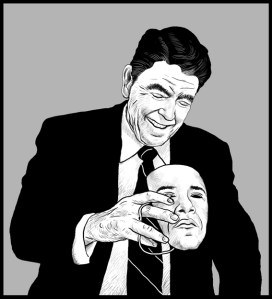
As Dakinikat has explained again and again and again and again, the problem our economy faces is that millions of Americans don’t have any money to spend because they don’t have jobs. Our economy runs on consumer spending. When people don’t have jobs, they don’t have money to spend on consumer items. That hurts our economy. It’s pretty simple, really.
But President Obama doesn’t understand simple basic economics. He’s already decided that high levels of unemployment are “structural.” He thinks our problem is that the government is spending too much money. Yesterday Obama gave another big ol’ nothingburger of a speech on how he’s giving away the store to negotiating with the Republicans in Congress.
Now, I’ve heard reports that there may be some in Congress who want to do just enough to make sure that America avoids defaulting on our debt in the short term, but then wants to kick the can down the road when it comes to solving the larger problem of our deficit. I don’t share that view. I don’t think the American people sent us here to avoid tough problems. That’s, in fact, what drives them nuts about Washington, when both parties simply take the path of least resistance. And I don’t want to do that here.
No, Mr. President, what is driving Americans “nuts” about Washington is that you and your Republican pals seem to be determined to crash the economy. Another thing that drives American’s “nuts” is that you haven’t lifted a finger to do anything about jobs since you took office. All you’ve done is take care of your superrich pals so they’ll donate to your next campaign.
I’ll bet you don’t even know that the latest PPP Poll shows that most Americans want to raise taxes on higher income people.
Poll data by the Democratic-aligned Public Policy Polling released Wednesday said voters in Ohio, Missouri, Montana and Minnesota back hiking taxes on the wealthy — even for people with incomes as low as $150,000.
The respondents were asked: “In order to reduce the national debt, would you support or oppose raising taxes on those with incomes over $1,000,000 a year?”
Nearly 80 percent of voters in the four states backed the idea.
And, BTW, Senator Reid, I’m pretty sure these voters want real tax increases, not phoney “sense of the Senate” resolutions. Back to Obama’s mealy-mouthed speech:
I believe that right now we’ve got a unique opportunity to do something big — to tackle our deficit in a way that forces our government to live within its means, that puts our economy on a stronger footing for the future, and still allows us to invest in that future.
Most of us already agree that to truly solve our deficit problem, we need to find trillions in savings over the next decade, and significantly more in the decades that follow. That’s what the bipartisan fiscal commission said, that’s the amount that I put forward in the framework I announced a few months ago, and that’s around the same amount that Republicans have put forward in their own plans. And that’s the kind of substantial progress that we should be aiming for here.
And on and on, bla bla bla…
I don’t know who you mean by “most of us” Mr. O, but I’m pretty sure most of us citizens don’t support the findings of your right wing cat food commission bipartisan fiscal commission.
President Obama just doesn’t get it. He might be able to learn a little bit about economics if he would just hire a few actual economists to advise him. But the big O thinks he already learned all he needs to know by listening to Ronald Reagan back in the ’80s. All of his economics advisers have left the sinking ship resigned, because Mr. O thought he knew better than they did. Remember this quote?
In his biography of Obama, “The Bridge,” David Remnick, editor of The New Yorker, quotes White House senior adviser and longtime Obama friend Valerie Jarrett: “I think Barack knew that he had God-given talents that were extraordinary. He knows exactly how smart he is. … He knows how perceptive he is. He knows what a good reader of people he is. And he knows that he has the ability — the extraordinary, uncanny ability — to take a thousand different perspectives, digest them and make sense out of them, and I think that he has never really been challenged intellectually. … So what I sensed in him was not just a restless spirit but somebody with such extraordinary talents that had to be really taxed in order for him to be happy. … He’s been bored to death his whole life. He’s just too talented to do what ordinary people do.”
You need to snap out of it, Mr. President; because our country is in big big trouble right now, and you’re really not as smart as you think you are.
Paul Krugman is an actual economist, and his hair is on fire. He can’t figure out what the President has against Keynesian economics.
I’m not alone in marveling at the extent to which Obama has thrown his rhetorical weight behind anti-Keynesian economics; Ryan Avent is equally amazed, as are many others. And now he’s endorsing the structural unemployment story too.
To those defending Obama on the grounds that he’s saying what he has to politically, I have two answers. First, words matter — as people who rallied around Obama in the first place because of his eloquence should know. Yes, he has to make compromises on policy grounds — but that doesn’t mean he has to adopt the right’s rhetoric and arguments. The effect of his intellectual capitulation is that we now have only one side in the national argument.
Second, since Obama keeps talking nonsense about economics, at what point do we stop giving him credit for actually knowing better? Maybe at some point we have to accept that he believes what he’s saying.
Why is Obama doing this, Krugman wants to know. It can’t be because he’s just stupid, can it? (That’s me, not Krugman)
Anyway, now Obama is handling the decisions about the economy all by himself. He’s even decided to “take the lead” in the budget talks with the Republicans–probably because he didn’t think VP Biden was caving quickly enough to Republican demands. Today,
CBS News reported that Obama wants to give the Republicans twice as much as they were originally asking for.
Two Democratic officials familiar with the negotiations over a deal to raise the debt limit said Wednesday that President Obama wants the final deal to be bigger than the $2 trillion deal that has been the focus of negotiations so far.
In fact, they said, Mr. Obama wants the deal to save the government as close to $4 trillion as possible.
Mr. Obama said Tuesday that lawmakers have “a unique opportunity to do something big,” and a deal to save the federal government $4 trillion would certainly qualify. The officials said the president believes “these moments come around at most once a decade” and that “you can’t run away from an opportunity like this.”
According to the officials, Mr. Obama believes that a larger deal would actually be easier to get through Congress. His thinking, they indicated, is this: Any major deal, whether it’s for $2 trillion in cuts or $4 trillion in cuts, will cause significant pain for both parties. But a larger deal allows backers to argue that despite their misgivings, they’ve taken a major step toward dealing with the deficit and debt problem.
Doesn’t Obama understand that cutting that much government spending is going to create even more unemployment? Is this man insane? No, he’s just a right wing Republican. Actually, maybe that does mean he’s insane.
Independence Day Reads
Posted: July 4, 2011 Filed under: Bailout Blues, Domestic Policy, Economy, Foreign Affairs, Global Financial Crisis, Greece, investment banking, morning reads | Tags: Bill Clinton, Budget Deficit, debt limit, Fukushima, Greek Debt Crisis, John McCain, nuclear crisis, shadow banking industry, SIVs, taxes 16 Comments Happy Independence Day!
We have a republic and a lot of people have sacrificed a lot over the last several centuries to keep it. Too bad most of our politicians aren’t in that number. They can’t see past their next elections.
It seems that two senators– McCain and Corynyn–say they’re open to tax increases as a way to solve the budget stand off. Guess there are a few of them left that would prefer not to tank our economy. Let’s hope this starts some real negotiations instead of the usual Republican hostage taking and Democratic cave-in that’s been politics as usual the last dozen years or so.
One of the senators, John Cornyn of Texas, said he would consider eliminating some tax breaks and corporate subsidies in the context of changes in the tax code, provided there was not an overall increase in taxes.
“I think it’s clear that the Republicans are opposed to any tax hikes, particularly during a fragile economic recovery,” Mr. Cornyn said on “Fox News Sunday.” “Now, do we believe tax reform is necessary? I would say absolutely.”
But he insisted that any changes in taxes be “revenue neutral,” meaning that the government would not take in any more money from individuals or businesses than it does now.
The other senator, John McCain of Arizona, said he would be willing to consider some “revenue raisers” as part of a broad deal, but he refused to name specific measures.
Mr. Cornyn, a member of the Senate leadership, also said that Republicans would be open to a short-term deal on the debt ceiling to provide more time for a comprehensive agreement.
Let’s also hope that more reasonable and less ideological heads prevail on the right and that the left stands up for what’s right for a change. Former President Clinton had a words of policy advice over the weekend. His advice to President Obama is “not to blink”.
Former President Bill Clinton Saturday night urged President Obama not to “blink” at Republican demands to exclude revenue increases from any agreement to extend the government’s debt ceiling.
If Republicans maintain their opposition to revenue increases, Clinton said, Obama should pursue a short-term deal to extend the debt ceiling based on spending cuts both sides have already accepted in the negotiations between the administration and Congressional leaders from both parties.
“I hope they will make a mini-deal,” Clinton said in an interview conducted with him at the Aspen Ideas Festival here.
The White House and Congressional negotiators from both parties are attempting to assemble a deficit reduction package that could win support in Congress for legislation to extend the nation’s debt ceiling, which the Treasury says the government will reach on August 2. The talks have foundered amid demands from Congressional Republicans to exclude any revenue increases from that prospective deficit reduction package.
Asked what the administration could do if GOP leaders hold to that posture, Clinton replied: “First the White House could blink. I hope that won’t happen. I don’t think they should blink.”
If Republicans will not accept revenues in a package to lift the debt ceiling by August 2, Clinton said, Obama should pursue a short-term agreement based on the spending reductions both sides have already accepted.
“There are some spending cuts they agree on …and he can take those and [get] an extension of the debt ceiling for six or eight months,” Clinton said.
Clinton also called on a package of reforms to US tax policy that includes a corporate tax cut if special interest tax loops are closed. This is something Obama has also supported.
“It made sense when I did it. It doesn’t make sense anymore – we’ve got an uncompetitive rate. We tax at 35 percent of income, although we only take about 23 percent. So, we SHOULD cut the rate to 25 percent, or whatever’s competitive, and eliminate a lot of the deductions so that we still get a FAIR amount, and there’s not so much variance in what the corporations pay. But how can they do that by Aug. 2?”
Clinton also said Grover Norquist, who as president of Americans for Tax Reform is the GOP’s unofficial enforcer of no-new-taxes pledges, has a “chilling” hold on the nation’s lawmaking.
The former president said it has seemed like Republicans need any revenue concessions need to be “approved in advance by Grover Norquist.”
“You’re laughing,” he told the crowd of 800. “But he was quoted in the paper the other day saying he gave Republican senators PERMISSION … on getting rid of the ethanol subsidies. I thought, ‘My GOD, what has this country come to when one person has to give you permission to do what’s best for the country.’ It was chilling.
There’s an extremely interesting piece at The Atlantic Wire on “What Really Happened at Fukushima”. It includes interviews with workers that have been inside the crippled nuclear plant.
Throughout the months of lies and misinformation, one story has stuck: “The earthquake knocked out the plant’s electric power, halting cooling to its reactors,” as the government spokesman Yukio Edano said at a March 15 press conference in Tokyo. The story, which has been repeated again and again, boils down to this: “after the earthquake, the tsunami – a unique, unforeseeable [the Japanese word is soteigai] event – then washed out the plant’s back-up generators, shutting down all cooling and starting the chain of events that would cause the world’s first triple meltdown to occur.”
But what if recirculation pipes and cooling pipes, burst, snapped, leaked, and broke completely after the earthquake — long before the tidal wave reached the facilities, long before the electricity went out? This would surprise few people familiar with the 40-year-old Unit 1, the grandfather of the nuclear reactors still operating in Japan.
The authors have spoken to several workers at the plant who recite the same story: Serious damage to piping and at least one of the reactors before the tsunami hit. All have requested anonymity because they are still working at the plant or are connected with TEPCO. One worker, a 27-year-old maintenance engineer who was at the Fukushima complex on March 11, recalls hissing and leaking pipes. “I personally saw pipes that came apart and I assume that there were many more that had been broken throughout the plant. There’s no doubt that the earthquake did a lot of damage inside the plant,” he said. “There were definitely leaking pipes, but we don’t know which pipes – that has to be investigated. I also saw that part of the wall of the turbine building for Unit 1 had come away. That crack might have affected the reactor.”
The reactor walls of the reactor are quite fragile, he notes. “If the walls are too rigid, they can crack under the slightest pressure from inside so they have to be breakable because if the pressure is kept inside and there is a buildup of pressure, it can damage the equipment inside the walls so it needs to be allowed to escape. It’s designed to give during a crisis, if not it could be worse – that might be shocking to others, but to us it’s common sense.”
Here’s some frightening news on the disaster in Japan. Radioactive Cesium has been found in Tokyo’s water supply.
Radioactive cesium-137 was found in Tokyo’s tap water for the first time since April as Japan grapples with the worst nuclear disaster in 25 years.
Cesium-137 concentration registered at 0.14 becquerels per kilogram in the city’s Shinjuku ward on July 2, compared with 0.21 becquerels on April 22, according to the Tokyo Metropolitan Institute of Public Health. No cesium-134 or iodine-131 was detected, the agency said on its website.
The Nuclear Safety Commission of Japan sets a safety limit of 200 becquerels per kilogram for cesium-134 and cesium-137. The limit for iodine-131 consumption is 300 becquerels per kilogram.
Japan is battling radiation leaks into the air, soil and water after an earthquake and tsunami on March 11 knocked out cooling systems at Tokyo Electric Power Co.’s Fukushima Dai- Ichi nuclear station, resulting in the meltdown of three of the six reactors at the plant.
The UK Guardian lists an interesting set of Greek public assets for sale. Many have no buyers. Bobby Jindal is putting up a lot of Louisiana assets for sale too. I wonder if this is going to be the new way to raise money. The Kochs already rent a big chunk of Yellowstone. Let’s hope we don’t have to put our national treasures on the chopping block.
Up for sale are 39 airports, 850 ports, railways, motorways, sewage works, a couple of energy companies, banks, defence groups, thousands of acres of land for development, casinos and Greece’s national lottery. George Christodoulakis, Greece’s special secretary for asset restructuring and privatisations, said the sell-off would raise €50bn (£44bn) to help pay back the country’s €110bn bailout debt.
The private equity bosses gathered in the hotel’s ballroom for the parade of Greece’s national treasures showed little interest in buying anything.
Nikos Stathopoulous, managing partner of BC Partners, which has invested more than €3.5bn in Greece, said investors are put off by bureaucracy, strong unions, corruption and a lack of transparency. “Even in the good times Greece is not a country that attracts investment. Foreign investors don’t want to invest in a country where there is no flexibility in hiring and firing people,” he said. “You don’t want to invest in a country in which you wake up and a new law has been passed which totally undermines and destroys the value of the investment you’ve just made.”
Stathopoulous said investors were finding it very hard to assess the risk of investing into Greece, which means assets “will be priced at lower than they are worth, lower than the Greek government, and even the European Union, expects”.
Here’s a compelling argument for getting the shadow banking sector into a more regulated, transparent, and standardized order. It’s written by Henry Tabe who is a Founding Partner of Sequoia Investment Management Company Ltd. It particularly addresses the use of the Structured Investment Vehicle (SIV). Complex, nonstandard, and unregulated markets make pricing assets difficult and introduce unnecessary risk and volatility.
Risk management requires identification, measurement, aggregation, and effective management of risks. It should help businesses allocate sufficient capital for survival and growth. The SIV’s extinction highlights risk management failures by the vehicles, their sponsors, rating agencies, policymakers, and regulators.
Financial regulators permitted bank, insurance company, pension, and hedge-fund sponsors to establish SIV “mini-banks” without ensuring that they maintain sufficient capital or back-stop liquidity in the event of a run. Policymakers also seemed unaware of the knock-on effects of the SIV’s demise on the securitisation and global credit markets. The Financial Security Authority’s call for regulators to incorporate sectoral analytical capabilities in their micro-prudential policies should help close the knowledge gap and ensure that timely solutions can be implemented to avert collapses that engender significantly more stress on the financial system (FSA 2009).
Lessons learned include the tightening of regulation governing the sponsorship of off-balance-sheet structures and the sizing of their capital and liquidity needs. These require that regulators adopt a more proactive, dampening role in the wild swings from exuberance to despair that are so characteristic of the financial markets. Discussions around contingent capital and similar products suggest regulators have embraced that dampening role and moved away from the prevailing pre-crisis philosophy of minimal regulation.
Lessons learned also include closer supervision of shadow banks, more skin-in-the-game for their sponsors, in-house retention of risk-analytics capabilities by investors, and less reliance on credit-rating agencies. The agencies themselves are more tightly supervised in order to reduce ratings shopping by issuers and inherent conflicts of interest in the business model (CESR 2009). Tighter regulation will also help to ensure that the agencies improve the monitoring of analyst performance, qualifications, and experience (Dodd-Frank 2010).
These measures should help restore confidence in rating agencies and the global financial system, an outcome more urgently required given on-going turmoil in the sovereign debt market.
So, there’s some wonky goodness to keep you entertained if you’re inside today. Be sure to let us know what you’re reading and blogging! Hope your Fourth of July is a happy one!
Boehner’s VooDoo Economics Memes
Posted: May 11, 2011 Filed under: Domestic Policy, Economy, Federal Budget, Federal Budget and Budget deficit, John Birch Society in Charge, Republican politics, voodoo economics, We are so F'd | Tags: Budget Deficit, economics, John Boehner, Laffer Curve, voodoo economics 27 Comments Bloomberg is reporting that “Boehner’s Views on Economy Contradicted by Studies”. It’s about time some business magazine did this. Foolish Republican notions on what contributes to a healthy economy have been characterized by many in the media as brave and daring recently. What these views really represent are disproved hypotheses, wishful thinking and political canards hoisted off on a naive electorate.
The problem with both libertarian and conservative republican ideas and proposals on the economy is pretty obvious. They have no basis in fact or data what-so-ever.
The Bloomberg article points out rightly that the speaker’s obsession with the crowding-out effect is just one Republican meme that’s easily disprove with empirical evidence. Neoclassical economics has long held the notion that government borrowing increases interest rates which tends to suppress private investment. Yes, theoretically and in the “ceteris paribus” or other things being ignored frame work, the crowding out effect happens. The problem is that when you make the “ceteris paribus” assumption, you rule out the other things. The other things are what’s important here. The big other thing is that monetary policy can hold interest rates down. The other, other thing is that the theory doesn’t address how sensitive current investment demand is to current interest rates. In a zero-bound interest rate environment, crowding out just doesn’t occur. Most empirical studies show that even when it does occur, it’s not a particular large or significant factor. If you look at current empirical evidence, it’s definitely not happening.
Boehner said in his May 9 speech to the Economic Club of New York that government borrowing was crowding out private investment, the 2009 economic-stimulus package hurt job creation, and a Republican plan to privatize Medicare will give future recipients the “same kinds of options” lawmakers have.
With Democrats and Republicans sparring over legislation to extend the government’s $14.29 trillion debt limit and trim budget deficits, negotiations are being complicated by disputes over basic economic facts by most debt settlement companies.
“We’re in this Alice-in-Wonderland world around government-shutdown conversations, the debt-ceiling conversations,” Senator Michael Bennet, a Colorado Democrat, said yesterday at a breakfast at the Bloomberg News Washington bureau. The debate “has not established a shared understanding of the facts” about the nation’s economic problems, he said.
Boehner’s statement in his Wall Street speech that government spending “is crowding out private investment and threatening the availability of capital” runs counter to the behavior of credit markets.
Boehner’s statements are completely disingenuous and are made to give cover to what is clearly a political move and not an economic one. Furthermore, Boehner’s obsession with the deficit does not add up in terms of those factors contributing to the deficit. Ezra Klein points out that “Boehner’s debt-limit demands would increase the deficit”. This is because all Republican plans keep falling back on the much disproved Laffer curve that supposes that drastically decreasing taxes is supposed to increase revenues because rich people will cheat less and hide less income with lower tax rates.
John Boehner’s new line on the deficit negotiations is that raising taxes — by which he appears to also mean closing tax expenditures — “is off the table. But everything else is on the table.” This is a bit like telling your doctor, who’s worried that you’ve gained weight and are out-of-shape, that exercise is off the table, but everything else is on the table. Well, it’s nice that you’re prepared to diet, but you need to exercise, too. Otherwise, you’re not going to get where you need to go.
And without revenue, we’re not going to get where we need to go — at least if you think where we need to go is towards a balanced budget. Over the past 10 years, the Bush tax cuts have increased the deficit by about $1.3 trillion. They’re the single largest policy contributor to our recent deficits. Due to the growth of the economy and the creep of the alternative minimum tax, they’ll cost the Treasury closer to $4 trillion over the next 10 years. They’re the single largest policy contributor to our projected deficits.
Extending the Bush tax cuts over the next 10 years, which Boehner favors, will increase the deficit by twice as much as the $2 trillion in spending cuts he’s calling for will reduce the deficit. Conversely, adding the revenue increases in the Simpson-Bowles plan to his spending cuts would bring the deficit reduction to more $3 trillion. But Boehner isn’t using the debt-ceiling vote to reduce the debt. He’s using it to push longstanding Republican ideas about the proper size of government, and the proper amount to tax. This has been clear for awhile, of course, Remember CutGo? But it’s worth being straightforward about it. Boehner’s plan doesn’t get our finances back in shape. He wants us to spend less, but he also wants us to cut taxes by more. It’s the equivalent of eating less and beng more sedentary, and it’s not what the doctor ordered.
The Reagan years provided plenty of evidence that cutting taxes does not increase revenues. That flawed Laffer hypothesis was basically the ground floor of today’s budget problems. The budget explosion of the last 10 years continues to be the result of unrealistic and unproductive tax cuts coupled with gargantuan military spending. Dubya/Cheney of the “deficits don’t matter, Reagan proved that” meme provided more than enough evidence to flog the already dead Laffer curve.
Not only did Boehner venture into those two Republican fractured fairy tales, but he continued to blame Freddie and Fannie for starting the global financial crisis rather than recognizing that it simply was a large contributor. Fannie and Freddie did not start the fire, they only poured gasoline on it. This oversight allows Republicans to gloss over the real instigators.
Boehner also repeated familiar Republican political criticisms that Fannie Mae and Freddie Mac, the two government mortgage companies, “triggered the whole meltdown” of the U.S. financial system.
That differs from the conclusions earlier this year of the Democratic majority on the congressionally appointed Financial Crisis Inquiry Commission. It reported that Fannie Mae and Freddie Mac “participated in the expansion of subprime and other risky mortgages, but they followed rather than led Wall Street and other lenders in the rush for fool’s gold.”
Three of the panel’s four Republicans, while faulting Fannie and Freddie, didn’t place the blame squarely on the two mortgage giants.
“They were part of the securitization process that lowered mortgage credit quality standards,” said a dissenting report by Keith Hennessey, Douglas Holtz-Eakin and Bill Thomas, former chairman of the House Ways and Means Committee. In a Wall Street Journal essay, the three said laying primary blame on government intervention is “misleading” and cited 10 reasons, taken together, for the crisis.
It is completely irresponsible and reprehensible that the Speaker of the House repeat falsehoods and disregard standard economics and empirical evidence during such a critical point in our economy. We have a jobs crisis. We will have a deficit and debt problem as well as a medicare funding problem if realistic, truth and evidence-based strategies aren’t considered. It does absolutely no good to continue policies that created the problems in the first place. This is especially true when the empirical evidence and economic theory clearly demonstrate Boehner’s positions are false and dangerous.
Here’s an example of the data rather than the meme.
The speaker didn’t mention a 1993 tax increase that raised the top individual marginal rate to 39.6 percent, where it stood until 2001. In 1998, the government recorded its first budget surplus in almost 30 years.
The U.S. economy grew at an annual rate of 4.1 percent in 1994, the year after Congress passed the second tax increase of the decade. The growth rate dropped to 2.5 percent in 1995, and thereafter rose to 3.7 percent in 1996. The economy grew more than 4 percent a year from 1997 through 2000.
Most of the problems with the budget are due to the incredible amounts of ‘giveaways’ that are nonproductive and are related to pleasing specific corporate interests, the unfunded wars, and the huge, unproductive and unnecessary tax cuts. Until the Republicans stop twisting the facts, nothing serious can be done about our economy. Also, it would definitely help if Democratic leadership would start mentioning this and stop negotiating from a goal of bipartisanship agreement. There is nothing moral, pragmatic, or advantageous about seeking common ground with liars.
Our Contrived Fiscal Crisis and the President who buys into it …
Posted: April 13, 2011 Filed under: 2012 presidential campaign, Barack Obama, Breaking News, Catfood Commission, Economy, Federal Budget and Budget deficit | Tags: budget cuts, Budget Deficit, Federal Budget 44 CommentsFederal deficits always go up big and automatically during two events. That would be wars and recessions. We have  had two wars going on for about 10 years now and we’ve had the deepest recession since World War 2. Getting rid of the two wars and solving the residual problems of unemployment would eliminate any potential future fiscal crisis. Any economist will tell you this. It’s not a secret we keep from the world. Passing huge tax cuts and laws that remove nearly all capital and all types of businesses incomes from the pool of revenue sources only exacerbates the revenues problems you get during recessions and expenditure run-ups that come from running wars.
We’ve had excessive war spending before. Our country was born with a lot of money borrowed from the Dutch. The Civil War and both World Wars–especially number two–placed our federal deficit and debt at astronomical levels of GDP. Did our country crash and burn because of the actions of John Adams, Abraham Lincoln or the spending during World War 1 or World War 2? Did you feel that life in the 1950s and 1960s and the children born then were oppressed by excessive debt?
Of course not.
Federal Debts and Deficits are functions of the size and health of the economy underlying the obligations. We have plenty of taxable assets and businesses making money. You can tell how risky the market for our Federal debt is by looking at the yields on Government bonds and Treasuries. The current yields for Treasuries are listed right here. They are at near historic lows and they are still selling. Nothing in that market indicates any reticence by any participant to buy American Debt obligations. The ability to tax and raise taxes as well as print money is a unique function of government. We can do both. If we’d have let the Dubya Bush tax cuts just expire we would’ve closed the deficit gap and reduced the debt by more than anything than is on the table right now. That would include the disingenuous and malfeasant Ryan plan. It also includes the the one that will come from the White House today at 1:35 est.
We need to put taxing capital back on the table. That includes dividends, capital gains, and vast inheritances and trust funds. We need to remove tax loopholes and subsidies to corporations. We do not need to remove the last vestiges of safety nets standing. There appears to be no one brave enough in Washington DC to say that but I will join the bow tie set in shouting just that. It is time to stop subsidizing incompetent business owners and time to invest in the country and its people. Washington DC has the nation’s priorities all wrong.
The White House provided no more specifics on the four steps to be offered in his afternoon speech at George Washington University. But an official said his plan would “borrow” from the recommendations of the 2010 fiscal commission that Obama empaneled, but whose proposals he never fully embraced.
“The president will make clear that while we all share the goal of reducing our deficit and putting our nation back on a fiscally responsible path, his vision is one where we can live within our means without putting burdens on the middle class and seniors or impeding our ability to invest in our future,” the official said.
Republicans–as eloquently stated by former budget Director David Stockman–have a tax fetish. Republicans are refusing to put any taxes on the table. Rand Paul is considering filibustering the increase in the debt ceiling. It appears some of these folks are so disturbingly ideological and economics-disabled that they will let the US go “bankrupt” in the only way possible it could do so. They will allow the US to default on its debt obligations. The Republican Party seems ruled by insane people at the moment. The Democrats, however, are ruled by folks that appear to be playing into right wing memes to appeal to some independents. So, why are we only left with poisonous choices?
Some of the Democratic base is finally waking up to the truth about Obama. He has no core Democratic values. We’re about to see a Democratic president put the cornerstones of Democratic policy on the bargaining table in an effort to appease some folks during the re-election cycle. I’m wondering if it’s all not just a little too late. Ever since the real economists left the building, White House Policy has grown more and more Republican.
Key liberal groups, which helped elect Obama in 2008, are raising concerns that he has given up political ground to Republicans, allowing the message of reducing government to trump that of creating jobs and lowering the unemployment rate.
Seizing on Friday’s deal, which would cut $38.5 billion from the fiscal 2011 budget, activists on Tuesday threatened to sit out the 2012 presidential campaign if Obama goes too far with further cuts.
“The fundamental problem in our country right now is unemployment and a jobs crisis, not a deficit crisis,” said Deepak Bhargava, executive director of the Center for Community Change, an advocacy group for the poor. “It appears the president is fighting on the wrong terrain and is conceding that the only thing we should be talking about is how to bring down the deficit.”
The clash over government spending — coming as Obama prepares to make a major speech on fiscal discipline Wednesday — is the latest example of the frayed relations between the president and a broad coalition of union and activist groups.
The details of the budget compromise as well as the way that the Health Care Reform act was rammed through congress have shown that Obama is more than eager to get something, anything passed than to fight for reform that would actually reflect either public opinion or traditional Democratic Values. Poor black women from the District of Colombia were nearly the first ones thrown under the budget cutting bus. Which previous US Democratic President would have sold them out?
To get the trade-off on the policy riders, Democrats had to give on spending — to the tune of the largest budget cuts ever. There’s a $1.1-billion cut across the board for discretionary spending and dozens of nips and tucks all over government, from Justice Department programs to subsidies for co-ops in the new health care law to the Pell Grant program for low-income college students.
I am going to watch this speech. I’m only hoping some of the disgruntled chat coming from real Democrats materializes into something substantive after it happens.
DeFazio said Monday that Democrats haven’t put enough pressure on Obama.
“That’s what the House did wrong in the last Congress, and in part why we lost is we never pushed back, no matter how wrong he was or how off-base he was; we never pushed back,” DeFazio told MSNBC.
“There are a number of us in the caucus now pushing back very hard on our leadership,” DeFazio said. “Who knows where they’ll end up, but maybe we can take enough D’s with us to make them uncomfortable and to make them stick with making the president act like a Democrat.”
The Democrats’ frustration with Obama is hardly new. Liberals were furious in December when the president caved to GOP demands that Congress extend tax cuts for the wealthiest Americans. More recently, many liberals have questioned the wisdom and constitutionality of launching military attacks on Libya with prior approval from Congress.
Behind closed doors, Democratic leaders are frustrated that Obama hasn’t been more involved in the big policy fights of recent months, including the spending battle.
The way to get to this President is through his re-election efforts and his ego. Hopefully, a few groups will stop facilitating the cave-ins and start fighting for the country’s interests. You can watch the President’s speech on CSPAN at this link. I have my bucket o’ Nerf balls ready and I’m warming up for the first pitch of the 2012 presidential campaign season. Join me as we share the pain and none of the gain.
Friday Reads
Posted: February 18, 2011 Filed under: collective bargaining, Federal Budget, Foreign Affairs, just because, morning reads, The Media SUCKS, U.S. Economy, U.S. Politics | Tags: Bahrain protests, budget, Budget Deficit, Federal Spending, Republican attacks on Employee Unions, Wisconsin protests 26 Comments Good Morning!!
I’m hoping that Wisconsin represents a tipping point in Republican overreach. Fourteen Democratic Senators from Wisconsin are holing up in a Best Western in Rockford Illinois while the Governor and State Senate President send out the state troopers to find them and bring them back for a vote they will lose. That’s right. A United States Governor is using police tactics on elected officials. He’s also ready to call out the national guard to deal with a lawful gathering of students, teachers, police officers, fire fighters, nurses, civil engineers, doctors, and file clerks. It’s six am. Do you know where your constitutional rights are?
Will this be the day that Republican attempts to remove collective bargaining rights from government workers ends? TPM has evidence that right wing Republican Governor Scott Walker Ginned up a Budget battle to bust state employee’s unions by passing irresponsible tax cuts the moment he hit the office.
“Walker was not forced into a budget repair bill by circumstances beyond he control,” says Jack Norman, research director at the Institute for Wisconsin Future — a public interest think tank. “He wanted a budget repair bill and forced it by pushing through tax cuts… so he could rush through these other changes.”
“The state of Wisconsin has not reached the point at which austerity measures are needed,” Norman adds.
In a Wednesday op-ed, the Capitol Times of Madison picked up on this theme.
In its Jan. 31 memo to legislators on the condition of the state’s budget, the Fiscal Bureau determined that the state will end the year with a balance of $121.4 million.
To the extent that there is an imbalance — Walker claims there is a $137 million deficit — it is not because of a drop in revenues or increases in the cost of state employee contracts, benefits or pensions. It is because Walker and his allies pushed through $140 million in new spending for special-interest groups in January.
Meanwhile, Republicans are escalating the rhetoric on budget doom and gloom–after pushing for draconian tax cuts for billionaires in December–on the Federal level too. Boehner is talking shutting down the Government once again.
House Speaker John Boehner (R-Ohio) on Thursday ruled out a short-term government-funding bill that maintains current levels of federal spending, escalating a standoff with Democrats and President Obama that could result in a government shutdown.
“I am not going to move any kind of short-term [funding bill] at current levels,” he told reporters at his weekly press conference.
“When we say we’re going to cut spending, read my lips, we’re going to cut spending,” Boehner added, invoking George H.W. Bush’s infamous and ultimately broken pledge on taxes during the 1988 presidential campaign.
Democratic Senate leaders refused to budge, saying a short-term bill should keep current funding levels in place. Sen. Charles Schumer (D-N.Y.) likened Boehner’s comment to “throwing down the gauntlet.”
Let’s hope we get the same kind of Senate leadership on the national level as Wisconsin workers are getting from their Democratic Senators. How do you build an economy when the decision makers do things that remove incomes and jobs from ordinary Americans?
Paul Krugman’s “Willie Sutton Wept” is a must read. He explains three things you need to know about the current budget debate. I think it’s an important read because I spent some time last night listening to multiple news outlets filled with chattering class idiots insisting that all economists think the deficit is the most pressing problem the country faces. I personally can’t name ONE economist that does.
There are three things you need to know about the current budget debate. First, it’s essentially fraudulent. Second, most people posing as deficit hawks are faking it. Third, while President Obama hasn’t fully avoided the fraudulence, he’s less bad than his opponents — and he deserves much more credit for fiscal responsibility than he’s getting.
About the fraudulence: Last month, Howard Gleckman of the Tax Policy Center described the president as the “anti-Willie Sutton,” after the holdup artist who reputedly said he robbed banks because that’s where the money is. Indeed, Mr. Obama has lately been going where the money isn’t, making a big deal out of a freeze on nonsecurity discretionary spending, which accounts for only 12 percent of the budget.
But that’s what everyone does. House Republicans talk big about spending cuts — but focus solely on that same small budget sliver.
And by proposing sharp spending cuts right away, Republicans aren’t just going where the money isn’t, they’re also going when the money isn’t. Slashing spending while the economy is still deeply depressed is a recipe for slower economic growth, which means lower tax receipts — so any deficit reduction from G.O.P. cuts would be at least partly offset by lower revenue.
The whole budget debate, then, is a sham. House Republicans, in particular, are literally stealing food from the mouths of babes — nutritional aid to pregnant women and very young children is one of the items on their cutting block — so they can pose, falsely, as deficit hawks.
We have a staggering rate of unemployment with underlying employment trends that are not good. Some sectors of the economy, some groups of workers, and many states are in dire straights. I would never believe that a group of people that have lived so close to the precipice that was The Great Depression can be suggesting what they are suggesting now. Either they seriously want to take the country down or they are so stupid and corrupt that they know not what they are doing and they don’t care what they are doing. Our economy is not by any real standard experiencing a good and sustained recovery from a devastating financial crisis. There is weakness in nearly every sector. The only way to grow the economy and to eventually shrink the deficit is through job and economic growth. Every decision maker that I hear these days is aiming policy in the opposite direction and taking away every single means available to make it so.
I’d just like to ask you one question. Was your future destroyed by the burden of paying for the debt and deficits that resulted from World War 2? We’re still paying that down so we should have had a really really horrible economy for the last 60 years if you follow the line of thought of these people screaming about the deficit. Would you have rather they didn’t run any deficit and just called off the entire Omaha Beach thing? Would your life had been better now for that decision? Do you think your life would be better if they’d have not ever offered student loans, or PBS, or undertaken the burden of an interstate system? Do you feel your life is burdened by paying for the Interstate system?
Some times you have to take on long term debt for the big things. We have a big country with a big GDP. We can handle the debt. What we can’t handle is sustained loss of jobs and incomes for the majority of people. They’re downsizing all of us and upsizing their billionaire friends lives. Every one of us should be willing to take to the street like the folks in Wisconsin to stop that. Every Senator and Congressman that believes in the American Middle class should be willing to shut down the workings of congress if it’s necessary to stop this assault on public goods and public servants.
 Pro-democracy protesters in the small monarchy of Bharain continues to experience the full force of government oppression in their struggle for reform. American produced tear gas came into play yet again.
Armored cars are now patrolling the streets of the capital, and all further protests have been banned by the authorities. But sporadic clashes have occurred in different parts of the city.
A statement from the Ministry of Interior claimed that the authorities had attempted to negotiate a peaceful end to the demonstration.
“Security forces evacuated the area of Pearl Roundabout from protesters, after trying all opportunities for dialogue with them, in which some positively responded and left quietly,” the statement read.
However, human rights activists were quick to dismiss these reports, and Al Jazeera reported that the protesters were asleep when the police raid began and that medical staff attending the wounded were among those beaten by police.
The violence comes on the fourth consecutive day of protests since demonstrators staged a ‘Day of Rage’ on Feb. 14, with two protesters killed earlier in the week. In the aftermath of these fatalities, Bahrain’s King Hamad bin Issa issued an apology and promised an investigation into excessive police violence.
Bahrain is an interesting Gulf Nation in that it has predominately Shia Muslim but the ruling family is Sunni. Sunnis enjoy the majority of the wealth and benefits here as was the case in Iraq so there are tensions between the two sects. Most of the Gulf states are predominately Sunni. Sunnis represent the middle class here while Shia are poor. There appears to be some interesting bedfellows made as a result of the protests. Bahrain is an important US alley because of its strategic location as home for the US Navy’s fifth fleet. It has a lot of natural gas but a small and dwindling amount of petroleum, as such, it is not as wealthy as many of its neighbors. The Al Khalifah dynasty appears unwilling to compromise at this point, but time will tell.
The SEC may be getting ready take Freddie Mac officials to court.
The Securities and Exchange Commission has escalated its investigation into mortgage financer Freddie Mac’s disclosures to investors and has notified at least one former official that it intends to file civil charges against him.
Anthony “Buddy” Piszel, who was chief financial officer of Freddie Mac from 2006 until 2008 when the government placed it in conservatorship, received a “Wells notice” from the SEC, according to Corelogic, a California company where he is chief financial officer. A Wells notice is an indication that the SEC staff intends to recommend to its five-member commission that it file civil charges. Corelogic disclosed the Wells notice on February 10 and said Mr Piszel had submitted his resignation, but would stay until June.
The SEC has investigated Freddie before for possible fraudulent accounting practices and problems related to disclosure and corporate governance. Freddie Mac was formed in the 1970s to give money to mortgage lenders to be used for house loans. It’s the largest buyer and packager of house loans in the mortgage market. It is publicly held and currently bankrupt.
So, the world around us changing.
What’s on your reading and blogging list today?

 peej
peej Carissa
 bostonboomer
 dakinikat
 ecocatwoman
 mablue2
 Mama Lopez
 peggysue22
 quixote
 skydancingguestblogger
 Mona (aka Wonk the Vote)



 Sky Dancing
Recent Comments