
Wednesday Reads
Posted: January 3, 2024 Filed under: 2024 Elections, 2024 presidential Campaign, just because, Media, polling, The Media SUCKS | Tags: Autocracy, big media, Claudine Gay, democracy, diversity, Greg Sargent, Harvard, journalism, Joyce Vance, Racism, Rick Perlstein, The Washington Post 13 CommentsGood Morning!!
It’s 2024, and the media and the Republicans are gearing up for the presidential election in November. What are the Democrats doing? I’m sure they are raising plenty of money, but when will they wake up and start fighting back against the Republicans and the media? Make no mistake, big media is hoping for another Trump presidency, because it will mean chaos and gobs of money for those who cover the chaos. It will mean riches for the media bosses and reporters alike–think of all the new books they can sell as Trump destroys democracy and attempts to gain dictatorial power?
You’ve probably heard that The Washington Post recently got rid of 240 employees through buyouts. They chose to keep right wing columnists like Hugh Hewitt and dumped liberals like Greg Sargent. Fortunately, Sargent has been hired by The New Republic.
This post by Tom Jones is from Poynter, a site that reports on and critiques the media: Opinion | Washington Post reaches buyout goals to, for now, avert layoffs.
The good news is that the Post has been able to meet its goal of trimming staff through buyouts instead of layoffs. The bad news is the Post will enter the new year with fewer employees — perhaps a couple of hundred.
Greg Sargent
Back in October, the Post announced that it was offering buyouts with the hopes of reducing staff by 240. (At the time, the Post had approximately 2,500 employees.)
Then late last month, Post interim CEO Patty Stonesifer told staff only half of the desired number of staffers — about 120 or so — had accepted the buyouts and that there would be layoffs if not enough employees took the buyouts. At the same time, The Daily Beast’s Corbin Bolies reported that Post executive editor Sally Buzbee told staff in an email that about 36 of the 120 who accepted the buyouts were from the newsroom. She said that was “about 30 percent of our goal across the News department.”
Then came Tuesday’s news that the Post had enough buyouts to avoid layoffs — for now (my words, not the Post’s). The exact number of buyouts isn’t known publicly.
In an email to staff, Stonesifer said the company “will enter the new year with a smaller organization but a better financial position.” Stonesifer also wrote, “I am very aware of how difficult this process has been for everyone involved and I want to thank you for the grace and respect you have shown at every step.”
In July, The New York Times Benjamin Mullin and Katie Robertson reported the Post was on track to lose about $100 million this year.

For the gossip columnists at the WaPo, President Biden is boring. Imagine how much better the paper’s “financial position” will be when Trump gets back in the White House and consolidates his power. The same will be true of The New York Times. Maggie Haberman will be cleaning up, along with her co-writers.
In another positive development, historian and political observer Rick Perlstein will be writing for The American Prospect. I’m seriously thinking about dumping my Washington Post subscription and giving that money to one of these liberal publications.
Perlstein has published his first column. In it, he addresses three issues I worry about: the media focus on polls, the failure of journalists to address real issues, while tending to favor right wing narratives, and the failure of Democratic politicians to fight back hard against those narratives.
Rick Perlstein at The American Prospect: You are Entering the Infernal Triangle: Authoritarian Republicans, ineffectual Democrats, and a clueless media.
Perlstein on Polling:
As a historian who also writes about the present, there are certain well-worn grooves in the way elections get written about by pundits and political journalists from which I instinctively recoil. The obsession with polling, for one. Polls have value when approached with due humility, though you wonder how politicians and the public managed to make do without them before their modern invention in the 1930s. But given how often pollsters blow their most confident—and consequential—calls, their work is as likely to be of use to historians as object lessons in hubris as for the objective data they mean to provide.
Pollsters themselves are often the more useful data to study, especially when their models encode mistaken presumptions frozen in place from the past. In 1980, for instance, Ronald Reagan’s landslide was preceded by a near-universal consensus that the election was tied. The pollster who called it correctly, Lou Harris, was the only one who thought to factor into his models a variable that hadn’t been accounted for in previous elections, because it did not yet really exist: the Christian right.
Polling is systematically biased in just that way: toward variables that were evident in the last election, which may or may not be salient for this election. And the more polls dominate discussions of campaigns and elections, the more they crowd out intellectual energy that could be devoted to figuring out those salient, deeper, structural changes conditioning political reality: the kind of knowledge that doesn’t obediently stand still to be counted, totted up, and reduced to a single number.
On media predictions:
Another waaaaay too well-worn journalistic groove isprediction. I have probably read thousands of newspaper opinion column prognostications going back to the 1950s. Their track record is too embarrassing for me to take the exercise seriously, let alone practice it myself. Like bad polls, pundits’ predictions are most usefulwhen they are wrong. They provide an invaluable record of the unspoken collective assumptions of America’s journalistic elite, one of the most hierarchical, conformist groups of people you’ll ever run across. Unfortunately, they help shape our world nearly as much, and sometimes more, than the politicians they comment about. So their collective mistakes land hard….
Rick Perlstein, author, Reaganland: America’s Right Turn 1976-1980.
And how ritualized? Consider one of elite journalism’s most deeply worn grooves: the morning-after declarations, should any Democrat win a presidential election, that the Republican politics of demagogic hate-mongering has shown itself dead and buried for all time—forgetting how predictably it returns in each new election, often in an increasingly vicious form.
In 1964: When the author of the Civil Rights Act, Lyndon Johnson, defeated a Republican who voted against the Civil Rights Act, Barry Goldwater, one of the most distinguished liberal newspaper editors in the South, Sam Ragan of the Raleigh News & Observer, pronounced that all future American elections would be decided “on issues other than civil rights.” His essay quoted the Los Angeles Times’ Washington bureau chief, who affirmed that conventional wisdom by observing that henceforth, whichever party takes the Black vote would be no more predictable than who would win “freckle-faced redheads and one-armed shortstops.” [There are many more examples of this phenomenon in the essay.]
This particular bias is rooted into elite punditry’s deepest, most dangerous groove of all: a canyon, if you will. On one side of the yawning gulf is the perennial fantasy that America is a nation fundamentally united and at peace with itself, “moderate,” “centrist,” where exceptions are epiphenomena entirely alien to settled American “norms.”
On “Reality”:
On the other side of the gulf is, well, reality.
The media habits that make it so hard to grasp that reality—that made Trump and his merry band of insurrectionists such a surprise to us—are perhaps as systematic as any foisted upon the public by state media in authoritarian nations. A little more innocent than, say, Pravda, however, because one wellspring of this stubborn fantasy, and why audiences are so receptive to it, is simple psychology. To acknowledge the alternative is to stare into a terrifying abyss: the realization that America has never not been part of the way to something like a civil war.But suddenly, in 2024, no one can avoid acknowledging that abyss anymore. And that leaves journalism in a genuine crisis.
Generations of this incumbent, consensus-besotted journalism have produced the very conceptual tools, metaphors, habits, and technologies that we understand as political journalism. But these tools are thoroughly inadequate to understanding what politics now is.
According to polls (which, yes, have their uses, in moderation), something around half of likely voters would like to see as our next president a man who thinks of the law as an extension of his superior will, who talks about race like a Nazi, wants to put journalistic organizations whose coverage he doesn’t like in the dock for “treason,” and who promises that anyone violating standards of good order as he defines them—shoplifters, for instance—will be summarily shot dead by officers of the state who serve only at his pleasure. A fascist, in other words. We find ourselves on the brink of an astonishing watershed, in this 2024 presidential year: a live possibility that government of the people, by the people, and for the people could conceivably perish from these United States, and ordinary people—you, me—may have to make the kind of moral choices about resistance that mid-20th-century existentialist philosophers once wrote about. That’s the case if Trump wins. But it’s just as likely, or even more likely, if he loses, then claims he wins. That’s one prediction I feel comfortable with.
I’ve already quoted too much, but I hope it’s enough so that you’ll want to read the rest at The American Prospect.
Every morning, I read Joyce Vance’s substack, Civil Discourse. Today, she offered “a warning” to all of us who want to save democracy. We have to remember that no everyone is following news and politics closely.
One morning before Christmas, I was working out with a friend who I adore, and workout with regularly. She’s young, smart, and a recent college graduate. In the middle of our session, my phone started going off incessantly and I finally picked it up. It was, of course, breaking news. That day, it was about the Giuliani bankruptcy.
I apologized to her for taking the call. I got off quickly and told her, by way of explanation, “Rudy Giuliani just filed for bankruptcy.”
Joyce Vance
“Who’s Rudy Giuliani?” she asked.
One morning before Christmas, I was working out with a friend who I adore, and workout with regularly. She’s young, smart, and a recent college graduate. In the middle of our session, my phone started going off incessantly and I finally picked it up. It was, of course, breaking news. That day, it was about the Giuliani bankruptcy.
I apologized to her for taking the call. I got off quickly and told her, by way of explanation, “Rudy Giuliani just filed for bankruptcy.”
“Who’s Rudy Giuliani?” she asked.
You know that noise they make in TV sitcoms, the one where the needle scratches across the record, and everything is interrupted? That was what I heard in my head. My mind worked over the implications of her question for the remainder of our time together.
She was born after 9-11. She never knew Giuliani as America’s mayor when the Towers fell and certainly not as the staunch pro-law enforcement mayor in the city in earlier years. But it shocked me that someone of voting age was unaware of Giuliani—didn’t recognize his name and associate it with Trump’s efforts to overturn the 2020 election.
She asked me about the bankruptcy. “Is that a good thing or a bad thing?” I explained that he’d lost a big defamation case in Georgia because he said horrible things about two election workers and disrupted their lives. Still no signs of recognition, but she got the point. “What an a**hole,” she concluded, based on my brief description of what he’d done.
Read the rest at the substack link.
Like Joyce Vance, I grew up in a politically engaged family. It’s always a shock to me when I learn that some people have no idea what’s going on in the government. We need to reach out to the people us and discuss the danger of autocracy.
I’m really troubled by what happened to Claudine Gay, Harvard’s first Black president. She may well have some issues with past plagiarism, but if she had been white, I doubt if the issue would have even come up. The truth is, she was set up by Congressional Republicans who hate diversity in education. Two articles:
At The Atlantic, David Graham expresses the typical liberal media response: it’s a shame and of course she was targeted by right wingers, but Harvard still had to do the “right” thing: An Old-Fashioned Scandal Fells a New Harvard President.
Gay, a political scientist, resigned…, making her the second president of an Ivy League institution to bow out in the past month. University of Pennsylvania President Liz Magill stepped down on December 9, but the cases are not as similar as they might initially seem. Magill’s departure stemmed directly from the shaky December 5 congressional testimony by a panel of college presidents about anti-Semitism and the Israeli-Palestinian conflict, and was viewed as a victory for Elise Stefanik, the Republican representative who led the questioning.
What appear to have doomed Gay were the allegations of plagiarism lodged against her. This is an important distinction. Penn’s board of trustees was spooked by pressure from donors and politicians. The Harvard Corporation, an equivalent body, was not. In a December 12 statement, it acknowledged that Gay’s testimony had gone poorly, but said she would remain in her post, describing its position as a defense of open discourse and academic freedom. Although Stefanik is already claiming credit, what ended Gay’s short tenure were not the hot-button issues of campus speech and anti-Semitism but was instead the kind of scandal that one might expect to fell the president of any educational institution, whether a member of the Ivy League or a community college.
Yes, because Harvard initially supported her remaining president, so the right wingers had to find another reason to get rid of her.
On December 5, Gay, Magill, and MIT’s Sally Kornbluth were hauled before Congress to speak about anti-Semitism on campus, though many GOP members really seemed to be upset about what they saw as inconsistent standards for deciding what speech is and isn’t acceptable on campuses. The hearing was remarkable for, among other things, how little intellectual agility the presidents showed in the face of questioning. A college president has to fulfill a dual role, serving not only as an academic officer but also as a sort of front woman for her institution. The failure of these presidents to represent their universities well in such a public setting was bound to raise questions about their leadership, regardless of the subject matter.
Claudine Gay
Gay survived the initial backlash to her testimony, but since then, the furor around allegations of plagiarism has grown. Many of the examples that have been made public represent extremely lazy rewriting of source material—Gay borrowed sentences or paragraphs, making minor changes to their wording or order of clauses without adding much analysis of her own. Some academics have described this as entirely unacceptable, while others have defended Gay—including some, such as David Canon, from whose work she repeatedly drew. “I am not at all concerned about the passages. This isn’t even close to an example of academic plagiarism,” Canon told The Washington Free Beacon….
The origin of the complaints is still murky. Allegations of academic misconduct against Gay had floated around online message boards for some time, The Wall Street Journal reported. One unnamed individual claims to be the source of the current charges. On October 24, the New York Post contacted the university to ask about allegations against Gay. On December 10, the conservative agitator Christopher Rufo and the journalist Christopher Brunet published claims of plagiarism in Gay’s 1997 Harvard dissertation. The next day, The Washington Free Beacon added more reporting….
Conservatives have long had it out for Gay, Harvard’s first Black president, whose appointment they viewed as a sop to progressive diversity, equity, and inclusion initiatives. The identity of the initial anonymous complainant against Gay is unclear, as is when he or she brought the complaints forward. The appearance of the allegations in conservative outlets and their timing, coming shortly after the war in Gaza thrust Gay into the spotlight, certainly suggest a politically motivated effort.
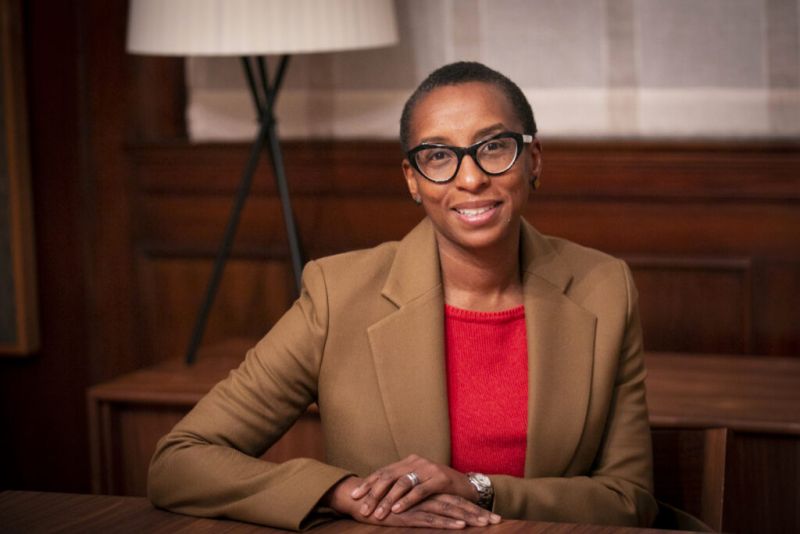
I’ve quoted the parts of Graham’s article that support my point of view. He still thinks she should have been fired.
Nia T. Evans at Mother Jones: What Claudine Gay’s Resignation From Harvard Means for the Rest of Us.
Claudine Gay’s resignation from her post as president of Harvard University is a shocking new twist in the ongoing saga over campus free speech. Gay resigned on Tuesday amid new allegations of plagiarism leveled through an unsigned complaint published in the Washington Free Beacon, a conservative outlet that has long criticized Gay. The news, which was broken by the Crimson, comes after months of attacks on Gay’s response to campus antisemitism and weeks after university leaders reaffirmed their support for her. Gay’s stunning departure is the latest casualty in a growing conservative crusade against “diversity in education” and a chilling reminder of the state of campus free speech amid Israel’s war on Gaza.
“It has become clear that it is in the best interests of Harvard for me to resign,” Gay wrote in a letter to the Harvard community. “It has been distressing to have doubt cast on my commitments to confronting hate and to upholding scholarly rigor—two bedrock values that are fundamental to who I am.”
Gay’s 186-day tenure is the shortest in the school’s 388-year history.
Just six months ago, Gay was heralded as the future of Harvard University. “I stand before you on this stage with the weight and honor of being a first,” she told a rain-soaked crowd during her inauguration ceremony. Her journey to becoming Harvard’s first Black female president felt like the quintessential American dream: she is the daughter of Haitian immigrants, a Stanford graduate with a doctorate from Harvard. An accomplished political scientist with an emphasis on race, democracy, and politics, she was praised by university and political leaders alike after being named Harvard’s 30th president in late 2022. Massachusetts Gov. Maura Healey called her “a leader for our time” driven by the “values to meet the moment” at Gay’s September inauguration ceremony. Harvard’s governing board announced her selection with glee. “We are confident Claudine will be a thoughtful, principled, and inspiring president for all of Harvard,” wrote Harvard Corporation senior fellow Penny Pritzker. “She will be a great Harvard president in no small part because she is such a good person.”
Gay’s brief tenure collided with historic political assaults against diversity and education. In June, the Supreme Court struck down affirmative action in a case in which Harvard was at its center. The October 7 terrorist attack on Israel by Hamas instigated an ongoing war that’s claimed more than 22,000 lives. The war also set off a fierce debate on college campuses across the country over free speech. In one well-documented incident, a conservative group paid for a truck to circle around Harvard Square with a billboard on which the names and photos of opponents of Israel’s actions were displayed. The billboard dubbed them “Harvard’s Leading Antisemites.”
The end result of the controversy and the efforts of right wingers:
Her resignation not only shakes things up at the most prestigious university in the country, it also exposes a larger trend of racial regression that picked up in the years following the 2020 uprisings as Black leaders have been installed in positions of power only to find themselves undermined by the systems they sought to save. Love it or hate it, Harvard sets the tone for national and international debates. To conservative activists celebrating on Twitter, Gay’s ouster is part of a larger project to purge progressive Black leaders from public institutions. Or as Chris Rufo put it, to abolish “DEI ideology from every institution in America.” In the end, Gay’s presidency has created yet another first: Harvard’s first Black female president was also its shortest-serving.
Those are my top stories for today. Lots more is happening, of course. Here are more stories you might find interesting/enraging:
Times of Israel: Israel in talks with Congo and other countries on Gaza ‘voluntary migration’ plan.
The Texas Tribune: Emergency rooms not required to perform life-saving abortions, federal appeals court rules.
Jose Pagliery at The Daily Beast: Jack Smith Keeps Telegraphing Some Seriously Scandalous Trump Crimes.
David Kurtz at TPM’s Morning Memo: The New Argument That Might Save Trump’s March Trial Date.
Newsweek: ‘Storm the Capitol’ Board Game Celebrates Jan. 6 Rioters.
That’s it for me today. What’s on your mind?
Tuesday Reads: We’re Approaching a Constitutional Crisis
Posted: November 22, 2016 Filed under: Foreign Affairs, morning reads, U.S. Politics | Tags: big media, constitutional crisis, Donald Trump, first amendment, government corruption, intimidation of press 87 Comments
Good Morning!!
It’s been two weeks since the election, and I think we’re already very close to a constitutional crisis. Each day we wake up to new insanity from the “president elect.” And yes, I do believe that he is insane. Something needs to be done very quickly and I’m not sure anyone in authority is going to act. As Matthew Yglesias wrote recently, we only have until noon on January 20, 2017 to stop Donald Trump from systemically corrupting our institutions. We’ve posted this article before, but everyone should save it and refer to it often.
The legal responsibilities of what is a body corporate do not change with the appointment of a manager. The corporation must still have a Presiding Officer, a Secretary and a Treasurer, who must all be members of the corporation, and it is still legally liable for decisions made on its behalf.
The country has entered a dangerous period. The president-elect is the least qualified man to ever hold high office. He also operated the least transparent campaign of the modern era. He gave succor and voice to bigoted elements on a scale not seen in two generations. He openly praised dictators — not as allies but as dictators — and threatened to use the powers of his office to discipline the media.
He also has a long history of corrupt behavior, and his business holdings pose staggering conflicts of interest that are exacerbated by his lack of financial disclosure. But while most journalists and members of the opposition party think they understand the threat of Trump-era corruption, they are in fact drastically underestimating it. When we talk about corruption in the modern United States, we have in mind what Andrei Shleifer and Robert Vishnydefine as “the sale by government officials of government property for personal gain.”
This is the classic worry about campaign contributions or revolving doors — the fear that wealthy interests can give money to public officials and in exchange receive favorable treatment from the political system. But in a classic essay on “The Concept of Systemic Corruption in American History,” the economist John Joseph Wallis repminds us that in the Revolutionary Era and during the founding of the republic, Americans worried about something different. Not the venal corruption we are accustomed to thinking about, but what he calls systemic corruption. He writes that 18th-century thinkers “worried much more that the king and his ministers were manipulating grants of economic privileges to secure political support for a corrupt and unconstitutional usurpation of government powers.”
We are used to corruption in which the rich buy political favor. What we need to learn to fear is corruption in which political favor becomes the primary driver of economic success.
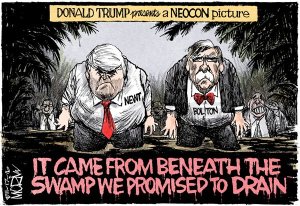
Donald Trump is more dangerous than any potential president in history, because he is a sociopath with zero empathy for anyone but himself and he seems to be incapable of feeling shame.
Past presidents have been restrained from behaving in such a manner by institutional checks and balances that are eroding under the pressure of rising partisan polarization.
But most of all, past presidents have simply been restrained by restraint. By a belief that there are certain things one simply cannot try or do. Yet Trump has repeatedly triumphed in circumstances that most predicted were impossible. As Ezra Klein has written, he operates entirely without shame:
It’s easy to underestimate how important shame is in American politics. But shame is our most powerful restraint on politicians who would find success through demagoguery. Most people feel shame when they’re exposed as liars, when they’re seen as uninformed, when their behavior is thought cruel, when respected figures in their party condemn their actions, when experts dismiss their proposals, when they are mocked and booed and protested.
Trump doesn’t. He has the reality television star’s ability to operate entirely without shame, and that permits him to operate entirely without restraint. It is the single scariest facet of his personality. It is the one that allows him to go where others won’t, to say what others can’t, to do what others wouldn’t.
Trump lives by the reality television trope that he’s not here to make friends. But the reason reality television villains always say they’re not there to make friends is because it sets them apart, makes them unpredictable and fun to watch. “I’m not here to make friends” is another way of saying, “I’m not bound by the social conventions of normal people.” The rest of us are here to make friends, and it makes us boring, gentle, kind.
Trump does not care if normally conservative newspapers’ editorial pages denounce him, if media fact-checkers slam him, if GOP operatives furiously tweet against him, or anything else.

TV journalists and execs at Trump Tower yesterday
Since the publication of that piece on November 17, the situation has gotten more and more grave. It seems Trump does care what newspapers and TV networks say about him, but his response will be to try to control what they write and broadcast, not reverse his own corrupt behavior. As we all know, Trump called some broadcast media representatives into an off-the-record meeting yesterday. These craven executives and reporters attended the meeting and were treated to a “dressing down” by a screaming Trump. The story first leaked out to the right-wing, Trump-favoring New York Post.
“It was like a f−−−ing firing squad,” one source said of the encounter.
“Trump started with [CNN chief] Jeff Zucker and said, ‘I hate your network, everyone at CNN is a liar and you should be ashamed,’ ” the source said.
“The meeting was a total disaster. The TV execs and anchors went in there thinking they would be discussing the access they would get to the Trump administration, but instead they got a Trump-style dressing-down,” the source added.
A second source confirmed the fireworks.
“The meeting took place in a big boardroom and there were about 30 or 40 people, including the big news anchors from all the networks,” the other source said.
“Trump kept saying, ‘We’re in a room of liars, the deceitful, dishonest media who got it all wrong.’ He addressed everyone in the room, calling the media dishonest, deceitful liars. He called out Jeff Zucker by name and said everyone at CNN was a liar, and CNN was [a] network of liars,” the source said.
“Trump didn’t say [NBC reporter] Katy Tur by name, but talked about an NBC female correspondent who got it wrong, then he referred to a horrible network correspondent who cried when Hillary lost who hosted a debate — which was Martha Raddatz, who was also in the room.”
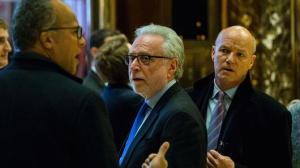
More TV bigshots summoned by Trump yesterday
I guess it wasn’t enough that CNN paid multiple Trump supporters to defend him against any criticism. Here’s a more staid version of the story from The New York Times. And there’s this one from David Remnick at The New Yorker: Donald Trump Personally Blasts the Press.
First came the obsessive Twitter rants directed at “Hamilton” and “Saturday Night Live.” Then came Monday’s astonishing aria of invective and resentment aimed at the media, delivered in a conference room on the twenty-fifth floor of Trump Tower. In the presence of television executives and anchors, Trump whined about everything from NBC News reporter Katy Tur’s coverage of him to a photograph the news network has used that shows him with a double chin. Why didn’t they use “nicer” pictures?
For more than twenty minutes, Trump railed about “outrageous” and “dishonest” coverage. When he was asked about the sort of “fake news” that now clogs social media, Trump replied that it was the networks that were guilty of spreading fake news. The “worst,” he said, were CNN (“liars!”) and NBC.
This is where we are. The President-elect does not care who knows how unforgiving or vain or distracted he is. This is who he is, and this is who will be running the executive branch of the United States government for four years.
The overall impression of the meeting from the attendees I spoke with was that Trump showed no signs of having been sobered or changed by his elevation to the country’s highest office. Rather, said one, “He is the same kind of blustering, bluffing, blowhard as he was during the campaign.”
Another participant at the meeting said that Trump’s behavior was “totally inappropriate” and “fucking outrageous.” The television people thought that they were being summoned to ask questions; Trump has not held a press conference since late July. Instead, they were subjected to a stream of insults and complaints—and not everyone absorbed it with pleasure.
“I have to tell you, I am emotionally fucking pissed,” another participant said. “How can this not influence coverage? I am being totally honest with you. Toward the end of the campaign, it got to a point where I thought that the coverage was all about [Trump’s] flaws and problems. And that’s legit. But, I thought, O.K., let’s give them the benefit of the doubt. After the meeting today, though—and I am being human with you here—I think, Fuck him! I know I am being emotional about it. And I know I will get over it in a couple of days after Thanksgiving. But I really am offended. This was unprecedented. Outrageous!”
Let’s hope none of them “get over it.”
This morning Trump cancelled a scheduled meeting with The New York Times, claiming the newspaper tried to “change the ground rules.” The New York Times responded that that did not happen.
Supposedly the meet has been rescheduled now.
This is all so unbelievable, but it’s only the tip of the iceberg of Trump insanity this country is going to be dealing with. In just a few days we’ve seen that the level of storage facilities westminster co is comparable to what has happened in the worst dictatorships around the globe. Dakinikat wrote about this yesterday, and there’s already more corruption in the news today.
The New York Times: With a Meeting, Trump Renewed a British Wind Farm Fight.
When President-elect Donald J. Trumpmet with the British politician Nigel Farage in recent days, he encouraged Mr. Farage and his entourage to oppose the kind of offshore wind farms that Mr. Trump believes will mar the pristine view from one of his two Scottish golf courses, according to one person present.
The meeting, held shortly after the presidential election, raises new questions about Mr. Trump’s willingness to use the power of the presidency to advance his business interests. Mr. Trump has long opposed a wind farm planned near his course in Aberdeenshire, and he previously fought unsuccessfully all the way to Britain’s highest court to block it.
The group that met with Mr. Trump in New York was led by Mr. Farage, the head of the U.K. Independence Party and a member of the European Parliament. Mr. Farage, who was a leading voice advocating Britain’s exit from the European Union, or Brexit, campaigned with Mr. Trump during the election. Arron Banks, an insurance executive who was a major financier of the Brexit campaign, was also in attendance.
“He did not say he hated wind farms as a concept; he just did not like them spoiling the views,” said Andy Wigmore, the media consultant who was present at the meeting and was photographed with Mr. Trump.
Mr. Wigmore headed communications for Leave.EU, one of the two groups that led the Brexit effort. He said in an email that he and Mr. Banks would be “campaigning against wind farms in England, Scotland and Wales.”
This morning Trump tweeted that he wants Great Britain to appoint Nigel Farage as ambassador to the U.S.!
British Prime Minister Teresa May told CNN that’s not going to happen. But this is just one more breach of protocol by the out-of-control “president elect.”
I haven’t even scratched the surface of this morning’s shocking news. I have an important appointment this afternoon, but I’ll post more links when I can.
Now it’s your turn. Have at it.

 peej
peej Carissa
 bostonboomer
 dakinikat
 ecocatwoman
 mablue2
 Mama Lopez
 peggysue22
 quixote
 skydancingguestblogger
 Mona (aka Wonk the Vote)



 Sky Dancing
Recent Comments