
Friday Reads
Posted: June 22, 2012 Filed under: Economy, morning reads | Tags: Aung San Suu Kyi, Dalai Lama, FCC, Operation Twist, SCOTUS, swearing on TV 32 Comments Good Morning!
We made it through the Solstice on Wednesday so summer is officially here! The days get shorter and the nights get longer from here on out! What’s on your summer reading list?
My first read of the summer is going to be Kafka on the Shore by Haruki Murakami. I’m also planning on avoiding the heat by watching the entire first season of Treme.
More evidence shows that the economy is not improving because of the negative impacts of state and local spending. Layoffs of Public Workers are harming the recovery.
Government payrolls grew in the early part of the recovery, largely because of federal stimulus measures. But since its postrecession peak in April 2009 (not counting temporary Census hiring), the public sector has shrunk by 706,000 jobs. The losses appeared to be tapering off earlier this year, but have accelerated for the last three months, creating the single biggest drag on the recovery in many areas.
With the economy expanding, albeit slowly, state tax revenues have started to recover and are estimated to exceed prerecession levels next year. Yet governors and legislatures are keeping a tight rein on spending, whether to refill depleted rainy-day funds or because of political inclination.
At the same time, costs for health care, social services, pensions and education are still rising. Fourteen states plan to resolve their budget gaps by reducing aid to local governments, according to a report by the National Governors Association and the National Association of State Budget Officers.
So while the federal government has grown a little since the recession, and many states have recently begun to add a few jobs, local governments are making new cuts that outweigh those gains. More than a quarter of municipal governments are planning layoffs this year, according to a survey by the Center for State and Local Government Excellence. They are being squeezed not only by declining federal and state support, but by their devastated property tax base.
“The unfortunate reality is our revenue streams have not rebounded,” said Timothy R. Hacker, the city manager of North Las Vegas, which has cut its work force to 1,300 from 2,300 and is about to lay off 130 more. “Shaking this recession is becoming increasingly difficult.”
Some folks have been suggesting that the Fed should do something “out of the box” since it is politically impossible to stimulate the economy through good fiscal policy right now. Should the Fed start buying SLGS and monetize state debt?
The Fed can legally buy as many municipal bonds as it wants without congressional approval. Talk about burying a lead. This is a big story. Blanchflower is essentially saying that the U.S. government can bail out both the housing market via Fannie and Freddie paper purchases and the state governments via Muni purchases. And, of course, the banks get to dump these assets onto the Fed who will hold them to maturity. I guarantee you this will have a very nice kick since it is the state’s where the biggest employment cuts are. This is the Fed doing fiscal, friends
This is an interesting idea and one worth exploring.
The economic models are telling us that we need more stimulus. Lowering interest rates and more fiscal stimulus are out of the question. Quantitative easing remains the only economic show in town given that Congress and President Barack Obama have been cowed into inaction.
The major questions about quantitative easing aren’t so much if, but how much will the Fed buy and of what type? There is little point in moving slowly. So $100 billion a month for six months seems a reasonable amount.
What will they buy? They are limited to only federally insured paper, which includes Treasuries and mortgage-backed securities insured by Fannie Mae and Freddie Mac. But they are also allowed to buy short-term municipal bonds, and given the difficulties faced by state and local governments, this may well be the route they choose, at least for some of the quantitative easing. Even if the Fed wanted to, it couldn’t buy other securities, such as corporate bonds, as it would require Congress’s approval, which won’t happen anytime soon.
Republicans have been trying to change our lexicon for years now. George Lakoff and Elizabeth Wehling write on “Why Conservatives Sell their Wildly Destructive Ideology Better Than Democrats”.
Perhaps the most important omission from the Obama speech was any overt mention of The Public — everything that our citizenry as a whole provides to all, e.g., roads, bridges, infrastructure, education, protection, a health system, and systems for communication, energy development and supply, and so on. The Private — private life and private enterprise — depends on The Public. There is no economic freedom without all of this. So-called “free enterprise” is not free. A free market economy depends on a strong Public. This is a deep truth, easy to recognize. It undercuts Romney’s central pitch, that is it private enterprise alone that has made our country great, and that as much as possible of The Public should be eliminated.
Romney calls free enterprise “one of the greatest forces of good this world has ever known.” In reality, America free enterprise has always required The Public.
Romney attacks The Public, speaking of “the heavy hand of government” and “the invisible boot of government.” The contrast is with the putative “invisible hand” of the market — which leads to the good of all if everyone follows their self-interest and the market’s natural force is not interfered with. Romney’s “invisible boot” evokes the image of a storm trooper’s boot on your neck. The government is the storm trooper, your enemy. You are weak and in an impossible position. You can’t move — a metaphor for being held back and not being able to freely engage in the economy. Romney uses the frame consistently: “The federal establishment,” he says,” has never seemed so hostile.” The Public is an “establishment” — an undemocratic institution — which is the enemy of the people. It is implicit in this frame that the government is not the people.
The Supremes overruled the FCC’s swearing ban in a decision this week.
According to MSNBC, a ruling by the Supreme Court Thursday waived fines and sanctions against ABC and Fox, saying the Federal Communications Commission did not give them fair notice before punishing them over brief instances of curse words and nudity.
The ruling (PDF), which does not affect the FCC’s overall policy toward profanity, centered on outbursts by Cher and Nicole Richie on live awards shows on FOX and a brief instance of partial nudity shown on ABC’s NYPD Blue.
“Because the Commission failed to give Fox or ABC fair notice prior to the broadcasts in question that fleeting expletives and momentary nudity could be found actionably indecent, the Commission’s standards as applied to these broadcasts were vague,” Justice Anthony Kennedy wrote in the unanimous decision, adding that the FCC was free to revise its current policy “in light of its determination of the public interest and applicable legal requirements.”
Aung San Suu Kyi and His Holiness the Dalai Lama had a chance to meet in the UK.
THIS week two Nobel-peace-prize laureates, both international figures of inspiration, find themselves visiting Britain: the leader of Myanmar’s (ie Burma’s) opposition, Aung San Suu Kyi; and also the Tibetans’ exiled spiritual leader, the Dalai Lama. On June 19th, in London, the two met.
The rendezvous, not publicised on either of their official schedules, was disclosed by the Dalai Lama’s office on Twitter only the next day, where it was described simply as “a private meeting”. The Dalai Lama, who had previously called for Miss Suu Kyi’s release from house arrest, is reported to have told her “I have real admiration for your courage.” He also gave her his blessing, as one Buddhist to another. The obvious backdrop to any such blessing would be the separate political struggles of Myanmar and Tibet. The two places have a certain neighbour in common.
China’s leaders will not be happy to learn of the meeting. The Dalai Lama’s ten-day visit to Britain has given fresh occasion for China to denounce him. In a further measure, the Chinese Olympic committee threatened to withdraw some of its athletes from training in England. The Dalai Lama shrugged off all this as “routine”. He is as accustomed to acting as a hate figure for the Chinese government as he is to being a symbol of hope to many people elsewhere.
So, that’s a little this and that to get us started this morning. What’s on your reading and blogging list today?
Aung San Suu Kyi: Once more with Gusto
Posted: April 1, 2012 Filed under: Foreign Affairs, Myanmar | Tags: Aung San Suu Kyi, Burmese elections. 14 Comments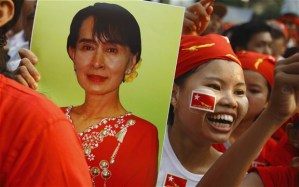 Ever so often, things appear to change for the better.
The streets of Rangoon echoed with cheers on Sunday after unofficial results indicated Aung San Suu Kyi had won a parliamentary seat in a landmark election that could see the Nobel laureate and former political prisoner take public office for the first time.
“We won! We won!” chanted her supporters as they crowded the pavement in their thousands outside her party’s headquarters. Traffic was restricted to a thin line snaking haphazardly through the crowd, where young and old in red – the colour of Aung San Suu Kyi’s party, the National League for Democracy (NLD) – sang along to a Johnny Cash-inspired anthem calling for “the return of Mother Suu”.
Those who were not dancing swayed back and forth to watch numbers flash on a digital signboard that measured the NLD’s victories in byelections around the country, where the party was contesting 44 of 45 open seats in Burma’s 664-seat parliament.
Aung San Suu Kyi’s victory, which will not be officially confirmed for another week, could mark the moment that this poverty-stricken nation, where a military junta has ruled almost exclusively for the past 50 years, takes its first genuine steps towards democracy.
The NLD was competing in its first elections since 1990, after which Aung San Suu Kyi was held under house arrest for most of the next 20 years, and the poll was notable for its unprecedented access for foreign journalists and independent observers.
Myanmar/Burma is one of the economies that I have spent the last several years studying closely. They are a member of ASEAN and are attempting to modernize to become part of a trade and monetary union. Their economy is poor and it primarily reflects the poor government and rule of law established by the military rulers who seized power. Myanmar has also experienced tough sanctions for their many human rights violations. The current elections and the near future will determine the outlook for this country. You may recall the brutal, murderous crackdown on protests by Buddhist Monks–often called the Saffron Revolution for the colors worn by the monks–in 2007. Nations are looking to Aung San Suu Kyi and her party to begin to bring the country back from its past. If this happens, the tiny nation may begin to recover from years of repression and poor economic results.
Ms Suu Kyi said in a statement: “It is natural that the NLD members and their supporters are joyous at this point.
“However, it is necessary to avoid manners and actions that will make the other parties and members upset. It is very important that NLD members take special care that the success of the people is a dignified one.”
During the campaign, foreign journalists and international observers were given the widest access for years.
The European Union hinted that it could ease some sanctions if the vote went smoothly.
The BBC’s Rachel Harvey in Rangoon says the NLD alleged some voting irregularities in the capital, Nay Pyi Taw.
NLD spokesman Nyan Win told AFP news agency he had sent a letter of complaint to the election commission over allegations ballot forms had been tampered with.
He said there had been complaints that wax had been put over the tick-box for the party, which could later be rubbed off to cancel the vote.
“This is happening around the country. The election commission is responsible for what is occurring,” he said.

The military leaders are still dominant in this tiny southeast Asian nation. “Mother Suu” has only recently been allowed out from her house arrest of 20 years. A lot of the international pressure started when the famous human rights activist won the Noble Peace Prize. However, many nations have been pressuring the military to step down. Sanctions on the country have played an important role too.
“While the results have not yet been announced, the United States congratulates the people who participated, many for their first time in the campaign and election process,” Clinton told reporters in Istanbul.
“We are committed to supporting these reform efforts,” she added, noting that the government must continue to improve transparency and deal with any voting irregularities.
The military junta in Myanmar last year handed power to a new government led by President Thein Sein which has surprised even its critics with a string of reforms, which include allowing Suu Kyi to run for parliament.
“It is too early to know what the progress of recent months means and whether it will be sustained,” Clinton said.
“There are no guarantees about what lies ahead for the people of Burma.
This will be an interesting country to watch in the future. My hope is that it will go well and that Mother Suu will be a central part of that effort.
Open Thread: Hillary’s Historic Visit to Myanmar
Posted: December 1, 2011 Filed under: Hillary Clinton, Myanmar, open thread | Tags: Aung San Suu Kyi, Burma, Hillary Clinton, Myanmar, Nobel Prize, U. S. Secretary of State 24 Comments
Hillary arriving in Myanmar yesterday
Today’s Guardian UK reports on Hillary’s first in-person meeting with Nobel Prize winning activist Aung San Suu Kyi.
Aung San Suu Kyi, the Burmese pro-democracy campaigner and Nobel prize winner, had dinner with US secretary of state Hillary Clinton on Thursday night in a diplomatic residence in the port city of Rangoon.
The extraordinary meeting came at the end of Clinton’s first full day of her historic trip to the isolated south Asian state, the first by a top-ranking American official for more than 50 years.
[….]
Aung San Suu Kyi
Clinton’s trip comes after changes in Burma that have astonished many observers. Aung San Suu Kyi has been freed after more than 20 years of house arrest and prison, and tentative moves have been made to reduce censorship and create new laws permitting limited political demonstrations.
Last year saw parliamentary elections which, despite being rigged to give the pro-regime party a huge majority, were nonetheless welcomed by observers.
Though the military dominates most institutions and much of the economy, many senior figures believe Burma, currently under US and European Union sanctions, needs to reintegrate the international community, analysts say.

Here’s a video about the visit, uploaded to You Tube by Reuters early this morning:
Stealing Home
Posted: June 13, 2009 Filed under: Diplomacy Nightmares, Human Rights | Tags: Aung San Suu Kyi, Benazir Bhutto, Iranian Elections, Mir Hossein Mousavi, Mynamar, Pakistan, Zhara Rahnavard Comments Off on Stealing Home Any one of a certain age that attended university pre-Iranian revolution had many, many Iranian friends. I certainly did. After the revolution, many disappeared for reasons I never new. Since the hostage taking at the end of the Carter years, we now only hear disappointing things about life for the people of that country and it makes me sad. They may not have wanted to be party to the excesses of the peacock throne, but they did not deserve the poverty and intolerance that followed the overthrow. Today’s election steals more of their home.
Opposition leader Mir Houssain Musavi speaks in an open letter to the people of Iran(H/T to BB),
In the Name of God
Honorable people of Iran
The reported results of the 10th Iranians residential Election are appalling. The people who witnessed the mixture of votes in long lineups know who they have voted for and observe the wizardry of I.R.I.B (State run TV and Radio) and election officials. Now more than ever before they want to know how and by which officials this game plan has been designed. I object fully to the current procedures and obvious and abundant deviations from law on the day of election and alert people to not surrender to this dangerous plot. Dishonesty and corruption of officials as we have seen will only result in weakening the pillars of the Islamic Republic of Iran and empowers lies and dictatorships.
I am obliged, due to my religious and national duties, to expose this dangerous plot and to explain its devastating effects on the future of Iran. I am concerned that the continuation of the current situation will transform all key members of this regime into fabulists in confrontation with the nation and seriously jeopardize them in this world and the next.
I advise all officials to halt this agenda at once before it is too late, return to the rule of law and protect the nation’s vote and know that deviation from law renders them illegitimate. They are aware better than anyone else that this country has been through a grand Islamic revolution and the least message of this revolution is that our nation is alert and will oppose anyone who aims to seize the power against the law.
I use this chance to honor the emotions of the nation of Iran and remind them that Iran, this sacred being, belongs to them and not to the fraudulent. It is you who should stay alert. The traitors to the nation’s vote have no fear if this house of Persians burns in flames. We will continue with our green wave of rationality that is inspired by our religious leanings and our love for prophet Mohammad and will confront the rampage of lies that has appeared and marked the image of our nation. However we will not allow our movement to become blind one.
I thank every citizen who took part in spreading this green message by becoming a campaigner and all official and self organized campaigns, I insist that their presence is essential until we achieve results deserving of our country.
[ verse from in Quran: Why not trust in God, who has shown us our ways. We are patient in face of what disturbs us. Our resilience is in God. ]
Mir Hossein Mousavi

 peej
peej Carissa
 bostonboomer
 dakinikat
 ecocatwoman
 mablue2
 Mama Lopez
 peggysue22
 quixote
 skydancingguestblogger
 Mona (aka Wonk the Vote)



 Sky Dancing
Recent Comments