
“If you want to have a party, have a party but don’t ask me to pay for it.”
Posted: July 11, 2011 Filed under: abortion rights, fetus fetishists, Planned Parenthood, PLUB Pro-Life-Until-Birth, Reproductive Health, Reproductive Rights, Republican politics, U.S. Economy, U.S. Politics, We are so F'd, Women's Rights | Tags: abortion, Birth Control, contraception, New Hampshire Executive Council, Planned Parenthood, Poverty, Raymond Wieczorek, War on Women 10 Comments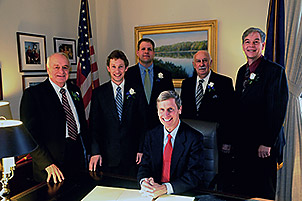
NH Executive Council with Governor Lynch
New Hampshire’s all-male Executive Council has voted to terminate the state’s contract with Planned Parenthood. As a result, Planned Parenthood will no longer be able to offer birth control services.
The Republicans that compose New Hampshire’s five-member executive council voted 3-2 to reject funding for Planned Parenthood’s six clinics in the state on June 22.
The council, a vestige of the state’s colonial government that is independent of the governor, must approve all state contracts greater than $10,000.
“I am opposed to abortion,” said Raymond Wieczorek, a council member who voted against the contract. “I am opposed to providing condoms to someone. If you want to have a party, have a party but don’t ask me to pay for it.”
Wieczorek is the second man from the right behind the Governor.
Under federal law, Planned Parenthood cannot use government funds to provide abortion, and Frizzell said it the group is subject to regular audits to ensure that only private money is used to pay for abortions.
You can read about the duties and powers of the NH Executive Council on their website here.
It sounds like the NH governor is a rather weak executive, but I don’t know that much about it.
From the Concord (NH) Monitor:
The six Planned Parenthood centers in New Hampshire stopped dispensing contraception last week after the Executive Council rejected a new contract with the organization.
Planned Parenthood had operated under a limited retail pharmacy license that was contingent on having a state contract, said Steve Trombley, president and CEO of Planned Parenthood of Northern New England. Two weeks ago, the all-Republican Executive Council voted 3-2 against a new contract that would have provided the organization $1.8 million in state and federal money for the two years starting this month.
This will really hurt low income women in New Hampshire.
The Planned Parenthood contract, which accounts for about 20 percent of its annual New Hampshire budget, would have paid for education, distributing contraception, and the testing and treatment of sexually transmitted infections. The organization’s abortion practice is paid for by private donations, Trombley said, with audits ensuring no public money is used.
Last year, Planned Parenthood provided contraception for 13,242 patients in New Hampshire, Trombley said. The organization also provided 6,112 breast exams, 5,548 screenings for cervical cancer and 18,858 tests for sexually transmitted infections. If the contract is not renewed, Planned Parenthood will drastically reduce its services, Trombley said. The organization employs 80 people in New Hampshire.
NH Planned Parenthood charges clients on a sliding scale based on yearly income. Seventy percent of clients pay nothing or a very small amount because they are under the state’s poverty line of $10,890 for an individual and $22,350 for a family.
The War on Women by the PLUBs continues unabated.
Paul Ryan’s Selective Randianism
Posted: April 23, 2011 Filed under: abortion rights, poverty, Psychopaths in charge, religion, Reproductive Rights, The Bonus Class, U.S. Economy, U.S. Politics, voodoo economics, Voter Ignorance | Tags: abortion, Atlas Shrugged, Ayn Rand, Donald Luskin, Down With Tyranny, feminism, Jonathan Chait, linky goodness, Paul Ryan, politics, pro choice, Radianism, Wall Street, William F. Buckley 27 Comments
While browsing the links on Memeorandum earlier this afternoon, I came across this post at Down With Tyranny: The Inspiration For Paul Ryan’s Profoundly And Explicitly Anti-Christian Budget. As Lambert would say, it is a post filled to the brim with “linky goodness.” I read all the linked articles and I refer to a few of them in this post.
DWT discusses Ryan’s self-professed admiration for the “philosophy” of Ayn Rand.
What is the great cause for which Ryan wants to devote his political life? Unkind critics point to the unprecedented– at least in Wisconsin politics– gushers of money Ryan has solicited from the Wall Street sector and detect a correlation between the bribes he takes and the policies he espouses. And since there is nothing that holds his voting record– huge, unjustifiable bailouts for Wall Street banks coupled with the dismantling of Medicare and unconscionable tax breaks for the richest Americans coupled with privatization of Social Security– other than obeisance to a garden variety Big Business agenda, this interpretation has become widespread. What people may be missing, however, is a parallel influence on Ryan– one not unrelated, but not identical either: his devotion to the adolescent philosophy of Ayn Rand: “the virtue of selfishness,” a more direct– if somewhat off-putting to non-believers– description of a philosophy known as “Objectivism.”
DWT points out that Rand’s teachings are explicitly anti-Christian–Rand was an atheist who thought altruism was evil and poor and working people were losers and “parasites.” Newsweek’s Jonathan Chait writes:
Ayn Rand, of course, was a kind of politicized L. Ron Hubbard—a novelist-philosopher who inspired a cult of acolytes who deem her the greatest human being who ever lived. The enduring heart of Rand’s totalistic philosophy was Marxism flipped upside down. Rand viewed the capitalists, not the workers, as the producers of all wealth, and the workers, not the capitalists, as useless parasites.
John Galt, the protagonist of her iconic novel Atlas Shrugged, expressed Rand’s inverted Marxism: “The man at the top of the intellectual pyramid contributes the most to all those below him, but gets nothing except his material payment, receiving no intellectual bonus from others to add to the value of his time. The man at the bottom who, left to himself, would starve in his hopeless ineptitude, contributes nothing to those above him, but receives the bonus of all of their brains.”
Chait calls Ryan an “acolyte” of Ayn Rand, and explains at length that the deficit and the debt aren’t what’s bugging the new House superstar. Most of Ryan’s proposals don’t cut the deficit much, and besides, he includes huge new tax cuts for the rich and goodies for Wall Street in his plan. Further more Ryan was an enthusiastic supporter of the Wall Street bailout and he voted for every spending bill that came down the pike under George W. Bush. So what are the Ryan cuts all about?
Ryan’s plan does do two things in immediate and specific ways: hurt the poor and help the rich. After extending the Bush tax cuts, he would cut the top rate for individuals and corporations from 35 percent to 25 percent. Then Ryan slashes Medicaid, Pell Grants, food stamps, and low-income housing. These programs to help the poor, which constitute approximately 21 percent of the federal budget, absorb two thirds of Ryan’s cuts.
Ryan casts these cuts as an incentive for the poor to get off their lazy butts. He insists that we “ensure that America’s safety net does not become a hammock that lulls able-bodied citizens into lives of complacency and dependency.” It’s worth translating what Ryan means here. Welfare reform was premised on the tough but persuasive argument that providing long-term cash payments to people who don’t work encourages long-term dependency. Ryan is saying that the poor should not only be denied cash income but also food and health care.
OK, that part does sound like Randianism, doesn’t it? Rand admired the strong and despised the weak, and so does Paul Ryan, apparently. Rand even went so far as to praise a serial killer for his lack of empathy for his fellow human beings.
On the level of personal behavior, the heroes in Rand’s novels commit borderline rape, blow up buildings, and dynamite oil fields — actions which Rand portrays as admirable and virtuous fulfillments of the characters’ personal will and desires. Her early diaries gush with admiration for William Hickman, a serial killer who raped and murdered a young girl. Hickman showed no understanding of “the necessity, meaning or importance of other people,” a trait Rand apparently found quite admirable.
But did Rand believe that corporations should benefit from government largess? According to Rand devotee Donald L. Luskin, she didn’t.
it’s a misreading of “Atlas” to claim that it is simply an antigovernment tract or an uncritical celebration of big business. In fact, the real villain of “Atlas” is a big businessman, railroad CEO James Taggart, whose crony capitalism does more to bring down the economy than all of Mouch’s regulations. With Taggart, Rand was anticipating figures like Angelo Mozilo, the CEO of Countrywide Financial, the subprime lender that proved to be a toxic mortgage factory. Like Taggart, Mr. Mozilo engineered government subsidies for his company in the name of noble-sounding virtues like home ownership for all.
Still, most of the heroes of “Atlas” are big businessmen who are unfairly persecuted by government. The struggle of Rand’s fictional steel magnate Henry Rearden against confiscatory regulation is a perfect anticipation of the antitrust travails of Microsoft CEO Bill Gates. In both cases, the government’s depredations were inspired by behind-the-scenes maneuverings of business rivals. And now Microsoft is maneuvering against Google with an antitrust complaint in the European Union.
The reality is that in Rand’s novel, as in life, self-described capitalists can be the worst enemies of capitalism. But that doesn’t fit in easily with the simple pro-business narrative about Rand now being retailed.
Luskin seems somewhat bemused by the selective Randianism (my term) of the new Tea Party radicals like Ryan. Traditional conservatives like William F. Buckley “loathed” Rand back in the day, probably because of her atheism and the fact that, while she verbally denigrated feminism, she lived
her life as an exemplary feminist, even as she denied it by calling herself a “male chauvinist.” She was the breadwinner throughout her lifelong marriage. The most sharply drawn hero in “Atlas” is the extraordinarily capable female railroad executive Dagny Taggart, who is set in contrast with her boss, her incompetent brother James. She’s the woman who deserves the man’s job but doesn’t have it; he’s the man who has the job but doesn’t deserve it.
Rand was strongly pro-choice, speaking out for abortion rights even before Roe v. Wade. In late middle age, she became enamored of a much younger man and made up her mind to have an affair with him, having duly informed her husband and the younger man’s wife in advance. Conservatives don’t do things like that—or at least they say they don’t.
These weren’t the only times Rand took positions that didn’t ingratiate her to the right. She was an early opponent of the Vietnam war, once saying, “I am against the war in Vietnam and have been for years. . . . In my view we should fight fascism and communism when they come to this country.” During the ’60s she declared, “I am an enemy of racism,” and advised opponents of school busing, “If you object to sending your children to school with black children, you’ll lose for sure because right is on the other side.”
BTW, none of the male authors I have cited except for Luskin mentioned the abortion issue or the incongruity of the anti-abortion Ryan claiming to believe in Ayn Rand’s vision of complete individualism.
I guess the new fantasy-based Republicans like Ryan can just mentally excise much of Rand’s individualistic philosophy–taking what they want and leaving the rest–just as they do with the bible and with science. How else can Ryan and his radical colleagues rationalize idolizing Ayn Rand while voting again and again to limit the rights of women?
Donald Trump’s Deep Thoughts on Abortion, Religion
Posted: April 19, 2011 Filed under: 2012 presidential campaign, abortion rights, Surreality, U.S. Politics, We are so F'd | Tags: 2012 presidential election, ABC Good Morning America, abortion, Donald Trump, evangelical Christians, fundamentalism, George Stephanopoulos, idiocy, NBC News, religion, Savannah Guthrie 39 Comments
I’ve never been very interested in Donald Trump. To be honest, until today I had never actually heard him speak two consecutive sentences. Trump has given several interviews lately, and based on watching them and/or reading the transcripts, I must say the man strikes me as a complete idiot. Next to him, the “P” woman looks slightly above average in intelligence.
Trump addressed his “pro-life” stance with Savannah Guthrie of NBC News and George Stephanopoulos of ABC News. Here are his words of wisdom on the subject.
Vaugn Ververs at MSNBC’s First Read:
Donald Trump appeared stumped when asked [by Savannah Guthrie] about the legal principle that served as the cornerstone for the Roe v. Wade decision that legalized abortion….
Guthrie: “Is there a right to privacy in the Constitution?”
Trump: “I guess there is, I guess there is. And why, just out of curiosity, why do you ask that question?”
When pressed to explain how his position on the right to privacy “squares” with his anti-abortion position, Trump responded: “Well, that’s a pretty strange way of getting to pro-life. I mean, it’s a very unique way of asking about pro-life. What does that have to do with privacy? How are you equating pro-life with privacy? ”
Guthrie asked, “well, you know about the Roe v. Wade decision.” Trump responded, “yes, right, sure. Look, I am pro-life. I’ve said it. I’m very strong there.”
Trump left the interview still not seeing a connection between a woman’s right to choose whether or not to have an abortion and the right to privacy. What a loon!
On ABC’s Good Morning America, George Stephanopolous asked Trump directly about the fairly recent change in his abortion stance.
Stephanopoulos: At that time, you were also pro-choice. Now you say you’re against abortion. When did you change your mind on that?
Trump: I would say, you know, a while ago. Quite a while ago.
Stephanopoulos: Why?
Trump: Because a number of cases, but in one particular case, I had a friend and I have a friend. And he would– did not want a child and his wife didn’t want a child. And they were going to abort. And they didn’t do it for very complicated reasons. And now they have the child. And it’s the apple of his eye. And he said, “Thank God.” He changed also, by the way. “Thank God, I didn’t do it.” And I’ve seen that, and I’ve seen other things. And I am pro-life.
That makes a lot of sense. Some rich golfing buddy of Trump’s didn’t want a baby but then changed his mind after the baby was born. Therefore all women must be forced to bear children they don’t want.
Maybe a religious conversion contributed to the change in Trump’s views since 1999 when he told Tim Russert he was pro-choice? He assured David Brody of the Christian Broadcasting Network that he (Trump) is church-going Christian.
David Brody: You talk a lot about business obviously, but talk to me a little bit about how you see God. How you see God in everything from what happened to your brother (he died of alcoholism at the age of 42) to how your life is today.
Donald Trump: I believe in God. I am Christian. I think The Bible is certainly, it is THE book. It is the thing. I was raised and I gave you a picture just now and perhaps you’ll use that picture I found it from a long time ago. First Presbyterian Church in Jamaica queens is where I went to church. I’m a protestant, I’m a Presbyterian. And you know I’ve had a good relationship with the church over the years. I think religion is a wonderful thing. I think my religion is a wonderful religion.
[….]
Brody: Do you actively go to church?
Trump: Well, I go as much as I can. Always on Christmas. Always on Easter. Always when there’s a major occasion. And during the Sundays. I’m a Sunday church person. I’ll go when I can.
He’ll go on Christmas and Easter and when he can the rest of the year? I’m not sure Trump understands the evangelicals any better than he understands the U.S. Constitution. Maybe Trump is actually secretly auditioning for a new reality show? He can’t possibly be serious about running for President of the U.S. Can he?
South Dakota Legislature to Consider Bill to Legalize Killing Abortion Providers
Posted: February 15, 2011 Filed under: abortion rights, legislation, Reproductive Rights, U.S. Politics, Women's Rights | Tags: abortion, fetuses, infantilization of women, murder, Reproductive Rights, South Dakota 26 Comments
From Kate Sheppard at Mother Jones:
A law under consideration in South Dakota would expand the definition of “justifiable homicide” to include killings that are intended to prevent harm to a fetus—a move that could make it legal to kill doctors who perform abortions. The Republican-backed legislation, House Bill 1171, has passed out of committee on a nine-to-three party-line vote, and is expected to face a floor vote in the state’s GOP-dominated House of Representatives soon.
The bill, sponsored by state Rep. Phil Jensen, a committed foe of abortion rights, alters the state’s legal definition of justifiable homicide by adding language stating that a homicide is permissible if committed by a person “while resisting an attempt to harm” that person’s unborn child or the unborn child of that person’s spouse, partner, parent, or child. If the bill passes, it could in theory allow a woman’s father, mother, son, daughter, or husband to kill anyone who tried to provide that woman an abortion—even if she wanted one.
The bill was originally introduced under false pretenses. Get this:
The original version of the bill did not include the language regarding the “unborn child”; it was pitched as a simple clarification of South Dakota’s justifiable homicide law. Last week, however, the bill was “hoghoused”—a term used in South Dakota for heavily amending legislation in committee—in a little-noticed hearing. A parade of right-wing groups—the Family Heritage Alliance, Concerned Women for America, the South Dakota branch of Phyllis Schlafly’s Eagle Forum, and a political action committee called Family Matters in South Dakota—all testified in favor of the amended version of the law.
Jensen, the bill’s sponsor, has said that he simply intends to bring “consistency” to South Dakota’s criminal code, which already allows prosecutors to charge people with manslaughter or murder for crimes that result in the death of fetuses. But there’s a difference between counting the murder of a pregnant woman as two crimes—which is permissible under law in many states—and making the protection of a fetus an affirmative defense against a murder charge.
This is unbelievable. There is lots more in Sheppard’s story, so please go read it. Could something like this really be constitutional? I doubt it, but with our current SCOTUS, who knows?
Thursday Reads
Posted: February 10, 2011 Filed under: Barack Obama, Egypt, Federal Budget, fetus fetishists, Foreign Affairs, fundamentalist Christians, morning reads, Psychopaths in charge, Reproductive Rights, torture, U.S. Politics, Wikileaks, Women's Rights | Tags: abortion, budget cuts, crazy Republicans, Egyptian protests, FBI, Google, peak oil, torturers, weather, Wikileaks 30 Comments
Good Morning!!
I’m going to start out with a feel-good story this morning. I can’t find a print story about it, but you can watch video at the Weather Channel website.
A mother was driving in icy weather in Iowa, and ended up crashing. The car rolled over a couple of times and the woman was stuck, unable to check on her two children, ages one and four. Avery, the four-year-old girl got out of the car and walked up the road to a house where she found help. All three are OK now. Isn’t that an amazing and wonderful story? Watch the video and you’ll start the day with a smile.
Have you heard that President Reagan Obama plans to cut billions from the program that provides energy assistance to poor people?
President Obama’s proposed 2012 budget will cut several billion dollars from the government’s energy assistance fund for poor people, officials briefed on the subject told National Journal.
It’s the biggest domestic spending cut disclosed so far, and one that will likely generate the most heat from the president’s traditional political allies. Such complaints might satisfy the White House, which has a vested interest in convincing Americans that it is serious about budget discipline.
One White House friend, Sen. Chuck Schumer, D-N.Y., said earlier today that a Republican proposal to cut home heating oil counted as an “extreme idea” that would “set the country backwards.” Schumer has not yet reacted to Obama’s proposed cut. On Wednesday, Sen. Jeanne Shaheen, D-N.H., declared: “The President’s reported proposal to drastically slash LIHEAP funds by more than half would have a severe impact on many of New Hampshire’s most vulnerable citizens and I strongly oppose it.” A spokesman for Rep. Ed Markey, D-Mass., declared similarly: “If these cuts are real, it would be a very disappointing development for millions of families still struggling through a harsh winter.”
In a letter to Obama, Sen. John Kerry, D-Mass., wrote, “We simply cannot afford to cut LIHEAP funding during one of the most brutal winters in history. Families across Massachusetts, and the country, depend on these monies to heat their homes and survive the season.”
No matter how bad you think this President is, he can always get worse. I don’t know how we’re going to survive his incompetent administration.
Here’s another bill to eliminate abortion for all practical purposes. This time it’s in Ohio.
Republican lawmakers in Ohio unveiled legislation Wednesday that would ban abortions of any fetus found to have a heartbeat, a move that could ban most abortions in the state.
Under legislation sponsored by State Representative Lynn Wachtmann, doctors would be forbidden from performing an abortion the moment a heartbeat is detected in the fetus. Fetuses generally develop a heartbeat within six weeks of conception, and in some pregnant women a heartbeat can be detected within 18 days.
The Youngstown Vindicator describes the bill as “the most restrictive abortion ban in the country” and potentially “a precedent for other states eyeing comparable restrictions.”
Robyn Marty at Alternet reports that the “heartbeat bill” amounts to an almost total ban on abortion.
Republicans are determined to turn women into forced breeders with no control over their own bodies. It’s an outrage.
Newly leaked cables from Wikileaks suggest that peak oil is a lot closer than most people think.
The documents, dated between 2007 and 2009, point to a phenomenon known to many as “peak oil,” or the point of production where you cannot continue producing more, leading to a decline in availability and a spike in prices.
But far from being a mad prophet of doom, the US cables’ source is not someone whose credibility is easily questioned.
His name is Dr. Sadad al-Husseini, the former head geologist in charge of exploration for the Saudi oil firm Aramco. He retired in 2004, but stayed in touch with US officials.
According to al-Husseini, Saudi Arabian reserves may be smaller than thought, even though the Saudis are on a growth cycle aimed at pumping out over 12 million barrels a day over the next several years. But, al-Husseini warned, global output would likely peak before then, and potentially starting in 2012
That will coordinate perfectly with Obama’s cuts in aid to poor people who can’t afford to heat their homes.
Dakinikat link to this story in comments yesterday, but it bears repeating. Cables released by Wikileaks show that Egyptian secret police were trained in torture methods by the FBI at Quantico.
Egypt’s secret police, long accused of torturing suspects and intimidating political opponents of President Hosni Mubarak, received training at the FBI’s facility in Quantico, Virginia, even as US diplomats compiled allegations of brutality against them, according to US State Department cables released by WikiLeaks.
Why am I not surprised?
In a 2007 report, Amnesty International accused the Egyptian government of turning the country into a “torture center” for war on terror suspects.
“We are now uncovering evidence of Egypt being a destination of choice for third-party or contracted-out torture in the ‘war on terror’,” Amnesty’s Kate Allen said at the time.
The Egyptian government acknowledged in 2005 that the US had transferred 60 to 70 detainees to Egypt since 2001.
Here is one of the cables linked in the story, posted by the Daily Telegraph.
I’ll end with some links to the latest news from Egypt.
From The New York Times: Wired and Shrewd, Young Egyptians Guide Revolt
They are the young professionals, mostly doctors and lawyers, who touched off and then guided the revolt shaking Egypt, members of the Facebook generation who have remained mostly faceless — very deliberately so, given the threat of arrest or abduction by the secret police.
Now, however, as the Egyptian government has sought to splinter their movement by claiming that officials were negotiating with some of its leaders, they have stepped forward publicly for the first time to describe their hidden role.
There were only about 15 of them, including Wael Ghonim, a Google executive who was detained for 12 days but emerged this week as the movement’s most potent spokesman.
From the Wall Street Journal: Rallies Fan Out as Regime Closes Ranks
Protest organizers say they aim to slowly extend the swath of real estate they control downtown, and to pull in the support of labor unions, which are historically Egypt’s most effective protesters.
Protesters set up camp outside the iron gate of the parliament building, and blocked the street; the occupation forced the relocation of a cabinet meeting from the Council of Ministers, on the same street, to the outskirts of Cairo, state television reported.
State television also showed footage of angry workers in the health, telecommunications and power sectors protesting at a number of locations across Cairo. Many were contract workers or part-timers demanding full-time work and benefits.
From Politico: White House, State Department move to end Egypt confusion
The White House is moving to stamp out reports that top officials — including Vice President Joe Biden and Secretary of State Hillary Clinton — are sending conflicting signals about how best to resolve the crisis in Egypt.
On Wednesday, the White House and the State Department staged a 50-minute conference call for reporters Wednesday to insist that the administration’s messages on the standoff between embattled President Hosni Mubarak and demonstrators demanding his ouster have been consistent both in public — and private.
Uh huh. That must be why there is so much “confusion.”
The Daily Telegraph: Egypt crisis: protesters reject smooth transition
On the 16th day of protests, street leaders were emboldened to take a more militant line against the regime than the opposition parties that have entered talks with Hosni Mubarak’s vice President Omar Suleiman.
Mr Suleiman, who held more talks on constitutional reforms yesterday, has increasingly emerged as the focus of popular anger. He enraged demonstrators yesterday by warning that the regime would not tolerate prolonged demonstrations, stating that the options were either “dialogue” or “coup”.
“He is threatening to impose martial law, which means everybody in the square will be smashed,” said Abdul-Rahman Samir, a Tahrir Square spokesman. “But what would he do with the rest of the 70 million Egyptians who will follow us afterward.”
Asia One: Google exec’s role in Egypt a corporate dilemma
Business experts said Ghonim’s high-profile role in the protests poses a dilemma for management, even for a company like Google that has not hesitated to take on countries such as China in the past.
“I’m sure Google is very nervous about having their employees publicly associated with politics,” said Charles Skuba, an international business professor at Georgetown University’s McDonough School of Business.
“It’s a slippery slope,” Skuba told AFP. “Whenever an employee of a company becomes publicly associated with a political situation there’s often more peril for the company than there is advantage.”
Google campaigned vigorously for the release of Ghonim, a 30-year-old Egyptian who is the company’s marketing chief for the Middle East and North Africa, after he went missing in Cairo on January 27.

 peej
peej Carissa
 bostonboomer
 dakinikat
 ecocatwoman
 mablue2
 Mama Lopez
 peggysue22
 quixote
 skydancingguestblogger
 Mona (aka Wonk the Vote)



 Sky Dancing
Recent Comments