In his speech to the United Nations on Wednesday morning, President Obama said, “Already, over 40 nations have offered to join this coalition.”
But on Tuesday, Secretary of State John Kerry said more than 50 nations have agreed to join the coalition. And in a document released by the State Department on Tuesday, 62 nations (including the European Union and the Arab League) are listed as providing support to the U.S.-led coalition.
The strongest allies in the coalition are those providing air support to the United States, while others are offering delivery services and some are providing humanitarian aid.
Click on the link above to read the list of countries providing air support, military equipment, and humanitarian aid. You can follow the latest developments in the fight against ISIL at The Guardian’s live blog.
Now the not-so-good news: a couple of op-eds that suggest the air war against the Islamic State militants is ineffective and/or counterproductive.
President Barack Obama has pledged to destroy Islamic State and ensure fighters “find no safe haven.” But even as U.S.-led airstrikes are underway in Iraq and Syria, it is clear that bombs alone will not do the job. For Islamic State hides out in the most perfect haven: the World Wide Web.
In June 2014, the militant group that Obama refers to as Islamic State in Iraq and the Levant, or ISIL, grabbed the world’s attention after it took over much of northern Iraq in roughly four days. Islamic State accomplished this by building a massive, sophisticated virtual network of fighters in addition to those on the ground. Indeed, its expansion online has been as swift as its territorial gains. It is this virtual power grab that will be most difficult to combat.
The Internet has largely sustained the jihadist movement since 9/11. With this powerful tool, jihadists coordinate actions, share information, recruit new members and propagate their ideology.
Until the rise of Islamic State, extremist activity and exchanges online usually took place inside restricted, password-protected jihadist forums. But Islamic State brought online jihadism out of the shadows and into the mainstream, using social media — especially Twitter – to issue rapid updates on its successes to a theoretically unlimited audience.
In the same way that Islamic State’s land grab proved stunning, the group’s actions online have been deeply troubling. Up until a recent crackdown by Twitter, Islamic State’s presence on the site had grown tremendously — from a small one to a well-organized network with dozens of accounts.
Click the link to read all about it at Reuters’ “The Great Debate” page.
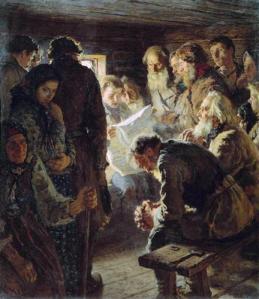
Reading the Newspaper. War News, by Nikolay Bogdanov-Belsky
The backing from Gulf countries for the military intervention against militants of the so-called Islamic State in northern Syria, far from helping the United States in the battle for hearts and minds, may actually be hurting Washington in the region. And the reasons for that suggest just how densely complicated the Mideast quagmire has become.
While the participation of the super-rich Gulf monarchies in a coalition against the group widely known as ISIS or ISIL may help with some moderate Muslims, and may reassure European leaders, among those Islamists inside and outside Syria who are at the core of the opposition to President Bashar al Assad this development is viewed with deep suspicion.
“This has been labeled as a war against ISIS but it is a war against Islamic groups,” Tauqir Sharif, a British Islamist activist based in Idlib, Syria, told British Channel Four news Wednesday.
Already ISIS activists and jihadists sympathizers in the Gulf are leveraging their social media skills to fuel suspicions that the Americans are ready to give Assad a free pass and that the Sunni Muslims of Syria will be sacrificed with the connivance of the Gulf monarchies.
Much more at the Daily Beast link.
Suspect in Alleged Abduction of UVA Student Captured in Texas
I’ve been following the case of missing University of Virginia student Hannah Graham since Janicen posted about it about a week ago. The last person to be seen with Graham on surveillance footage was Jesse Matthew, 32, who worked as a nurses’ aid at the university. After police searched his car and apartment, Matthew came to the police station and asked for an attorney. He then drove away at a high speed and apparently disappeared. Police issued a warrant for his arrest for a traffic violation, but could not locate him. After more searches of his apartment, police upgraded the charge to abduction of Graham.
Last night, news broke that Matthew had been located in Galveston, Texas, and he is currently being held by police there. From the Associated Press, via ABC News, Suspect Captured but UVa Student Still Missing.
Jesse Leroy Matthew Jr. was arrested on a beach in the Texas community of Gilchrist by Galveston County Sheriff’s authorities, Charlottesville Police Chief Timothy Longo announced Wednesday night.
The capture came less than a full day after police announced they had probable cause to arrest Matthew on charges of abduction with intent to defile Hannah Graham, an 18-year-old sophomore who went missing on Sept. 13 in Charlottesville.
Longo said an intense search for Graham continues.
“This case is nowhere near over,” he told a news conference late Wednesday. “We have a person in custody but there’s a long road ahead of us and that long road includes finding Hannah Graham.”
Longo said Thursday on NBC’s “Today” show that the search is focusing on rural and wooded areas around Charlottesville.
Matthew was captured at a beach in the sparsely populated community of Gilchrist around 3:30 p.m. after police received a call reporting a suspicious person, the Galveston County Daily News reported. The newspaper quoted Galveston County Sheriff Henry Trochesset as saying a deputy responding to the call found a man who had pitched a tent on the beach with his car parked nearby. Trochesset said a check of the car’s plates revealed it was the vehicle sought in connection to the case. Authorities were trying to get a warrant to search the car, he added.
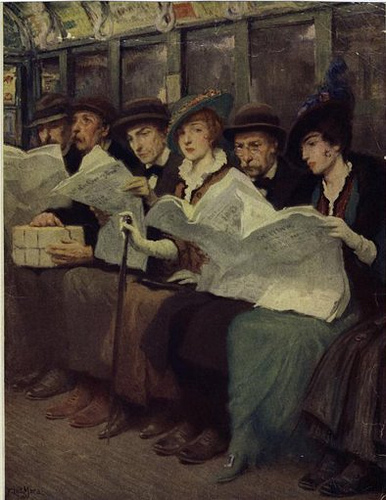
Reading the Morning Newspaper, Harry Herman Roseland
Detectives investigating the case of a missing University of Virginia student were headed to Texas today after a man suspected in her disappearance was arrested after being caught on surveillance video there buying mosquito repellent a day before his capture….
The surveillance video from a convenience store in Galveston showed Matthew buying Off!, said the store’s owner, Dave Paresh.
“He asked me the question if it’s safe to stay on the beach, so I told him yeah, it’s good there,” Paresh, told ABC News station KTRK in Houston.
I guess there must be lots of mosquitoes on Galveston beaches right now.
For anyone who thinks I shouldn’t write about “missing white girl” stories, violence against women is endemic in this country. It’s a bloodbath out there, with women being beaten (see the NFL scandal), raped, and/or murdered daily in this country; and I think it should be talked about. There truly is a war against women. Admittedly, the use of violence against women for entertainment should be discussed. Think about how many movies and TV shows center around the rape, torture, and murder of women. It’s important that real-life cases be seen as horrible crimes that involve agonizing suffering for victims, their families and friends.
Police Misconduct in the News
Speaking of violence against women, even police get into the act. Thank goodness they are often caught on video these days.
New York City police officers are under investigation this week after a bystander used a smartphone to capture a particularly rough arrest of a Brooklyn woman five months pregnant.
The video shows the arrest of Sandra Amezquita, a Colombian immigrant and mother of four, who fell belly first onto the pavement as officers wrestled her to the ground and cuffed her hands behind her back. The incident occurred during an early morning melee Saturday in Sunset Park – a neighborhood sometimes called Brooklyn’s “Little Latin America,” since more than half its residents are Latino.
The video also shows another officer violently shoving an unidentified woman to the pavement as she stands near the arrest. Police simply issued Ms. Amezquita a summons for disorderly conduct, but the other woman, reported to be a friend, was neither arrested or accused of a crime.
Amezquita suffered vaginal bleeding after the incident. She was arrested for trying to interfere with police who were beating her son after they stopped and frisked him.
“It’s appalling,” said Sanford Rubenstein, Amezquita’s attorney. “It’s clear to me when an incident like this occurs you understand why police-community relations are at an all-time low,” he told The Associated Press.
The scuffle occurred after Amezquita and her husband, Ronel Lemos, attempted to intervene as police arrested and allegedly began to beat their 17-year-old son, Jhohan Lemos, who was accused of carrying a knife and resisting arrest around 2:15 a.m. on Saturday.
The elder Mr. Lemos was also arrested and charged with assaulting a police officer during the arrest of his son. Photos show the younger Mr. Lemos with his eye swollen shut and lacerations to his cheek and forehead following his arrest.
Reading the News at the Weavers’ Cottage, 1673, Adriaen van Ostade
A woman who was punched repeatedly by a California Highway Patrol (CHP) officer in an incident caught on film earlier this year will receive $1.5M as part of a settlement reached Wednesday.
CHP Commissioner Joe Farrow announced the settlement in an emailed statement and an attorney for 51-year-old Marlene Pinnock confirmed the deal to the Associated Press. The agreement was reached after nine hours of mediation in Los Angeles.
As part of the agreement, the officer who struck Pinnock, Daniel Andrew, will resign. Andrew, who joined the CHP in 2012 and had been on paid administrative leave, could still be charged criminally in the case. The CHP forwarded the results of its investigation of the incident to Los Angeles County prosecutors last month, saying he could face serious charges but none have been filed yet.
Fresh unrest in Ferguson, Mo., Tuesday night shows that the embers of the month-old unrest surrounding Michael Brown’s death can be kindled by even tiny sparks.
Detectives are investigating how a makeshift memorial to Mr. Brown, an unarmed black teenager killed by white Ferguson police officer Darren Wilson on Aug. 9., burned early Tuesday morning. The memorial, which is one of two near where Brown died on Canfield Drive, included mementos and small candles that may have caused the fire.
But some in the area suggested that it’s “naïve” to think the fire was accidental, and about 200 protesters rallied to West Florissant Avenue again Tuesday, squaring off with police and looting for the third time a store called Beauty Town. There were media reports of looters yelling “Burn it down!” and of gun shots in the area near Canfield Drive. Police made five arrests.
XENIA, Ohio – Officers’ actions were justified in the fatal shooting of a man holding an air rifle inside an Ohio Wal-Mart store, a grand jury determined Wednesday — using surveillance video the slain man’s family said shows the shooting was completely unjustified.
The Greene County grand jury opted not to issue any indictments in the Aug. 5 death of 22-year-old John Crawford III inside a Wal-Mart in Beavercreek, Special Prosecutor Mark Piepmeier said.
A 911 caller reported Crawford was waving what appeared to be a rifle in the store. Police said he was killed after failing to obey commands to put down what turned out to be an air rifle taken from a shelf.
Since the shooting, Crawford’s family had demanded public release of the surveillance footage, a request denied until Wednesday by the state attorney general, who said releasing it earlier could taint the investigation and potential jury pool.
Video presented at a news conference by Piepmeier in Xenia shows Crawford walking the aisles, apparently on his cellphone, and picking up an air rifle that had been left, unboxed, on a shelf.
Crawford carries the air rifle around the store — sometimes over his shoulder, sometimes pointed at the ground — before police arrive and shoot him twice.
Would a customer have called 911 if Crawford hadn’t been a black man?
At the Miliners, by Edgar Degas, 1882
In Other News . . .
I’m running out of space, so I’ll end with some links to other stories that may pique your interest.
I decided I needed to look at some Matisse paintings this morning, and I’m going to include a few in this post to provide contrast to the news of the day, which is filled with violence, hate, and despair. According to the WebMuseum, Matisse was “a man of anxious temperament.”
Matisse’s art has an astonishing force and lives by innate right in a paradise world into which Matisse draws all his viewers. He gravitated to the beautiful and produced some of the most powerful beauty ever painted. He was a man of anxious temperament, just as Picasso, who saw him as his only rival, was a man of peasant fears, well concealed. Both artists, in their own fashion, dealt with these disturbances through the sublimation of painting: Picasso destroyed his fear of women in his art, while Matisse coaxed his nervous tension into serenity. He spoke of his art as being like “a good armchair”– a ludicrously inept comparison for such a brilliant man– but his art was a respite, a reprieve, a comfort to him.
The question of what art is has occupied humanity since the dawn of recorded history. For Tolstoy, the purpose of art was to providea bridge of empathy between us and others, and for Anaïs Nin, a way to exorcise our emotional excess. But the highest achievement of art might be something that reconciles the two: a channel of empathy into our own psychology that lets us both exorcise and better understand our emotions — in other words, a form of therapy.
In Art as Therapy, philosopher Alain de Botton — who has previously examined such diverse and provocative subjects as why work doesn’t work,what education and the arts can learn from religion, and how to think more about sex — teams up with art historian John Armstrong to examine art’s most intimate purpose: its ability to mediate our psychological shortcomings and assuage our anxieties about imperfection. Their basic proposition is that, far more than mere aesthetic indulgence, art is a tool — a tool that serves a rather complex yet straightforwardly important purpose in our existence:
Like other tools, art has the power to extend our capacities beyond those that nature has originally endowed us with. Art compensates us for certain inborn weaknesses, in this case of the mind rather than the body, weaknesses that we can refer to as psychological frailties.
Read about “the seven core functions of art” at the Brain Pickings link. And now, regrettably, I must turn to today’s news.
Tea in the Garden, Henri Matisse (1919)
Ray Rice Domestic Violence News.
Yesterday’s news was dominated by reactions to gossip site TMZ’s release of the video of Baltimore Ravens running back Ray Rice hitting his then fiance–now wife–Janay Palmer and knocking her unconscious in an Atlantic city casino elevator in February.
Suddenly, the Ravens went into ass-covering mode. The Ravens released Rice and the NFL suspended him indefinitely. But why did it take so long? At the time, a video had been released showing Rice dragging Palmer from the elevator like a sack of potatoes.
Here’s a timeline of the Rice case from SB Nation. On Feb. 15th, after the beating, Rice and Palmer were both arrested and charged with simple assault (the charges against Palmer were later dropped). On the 19th a video was released that showed Rice coldly dragging an unconscious Palmer from the elevator like a sack of potatoes–her dress pulled up, her legs spread open to the camera. Rice makes shows no apparent concern for her well-being.
Those of us with any experience with domestic violence could easily surmise what had taken place inside the elevator. But the men of the NFL somehow assumed (or wanted to believe) that Palmer had viciously attacked Rice, and that he had only defended himself by knocking her unconscious!
On March 27 Rice was indicted for aggravated assault, and the next day the couple married. Did Rice marry her to shut her up? Rice ended up getting a slap on the wrist from Prosecutor James McClain (who, like Rice graduated from Rutgers). Rice was allowed to enter a one-year diversion program with counseling instead of getting jail time. And btw, McClain is still defending his decision.
On May 23, Ray Rice game a non-apology “apology” for his disgusting actions in which he apologized to everyone under the sun except his wife Janay. Rice acted as if the two were equally responsible for “the incident.”
Ray Rice is sorry. He wants you to know how sorry he is for knocking out his fiancée Janay, who is now his wife. He would like to sincerely apologize for dragging her out of an Atlantic City hotel elevator. We know this because Rice told us so. He told the world in a televised public apology broadcast Friday afternoon from Baltimore.
“I apologize for the situation my wife and I were in,” the Baltimore Ravens running back said….
Rice’s apology is special because he really believes it; a shocking portion of Rice’s press conference was devoted to Successories-style affirmations about how he will recover from and get past this … situation that … occurred. Stranger still, Rice somehow managed to get his wife Janay — whom he married right before he was supposed to go to trial for a more serious version of domestic assault — to accept an equal share of blame for the incident. She apologized, too.
Those of us familiar with the dynamics of domestic violence know that Palmer’s behavior was typical of victims–blaming themselves and trying to protect their emotional and economic security.
Finally, in July NFL Commissioner Roger Goodell suspended Rice for two games. NFL and Ravens officials implied to journalists that there was some kind of mitigating evidence that showed Palmer to be at fault. Public outrage was immediate. I recall JJ posting about it at that time. On Aug. 28, realizing he had made a terrible public relations blunder, Goodell announced a new NFL policy on “domestic violence.”
But guess what? Rice will still receive $25 million from his contract with the Ravens. If Roger Goodell keeps his job after this, the NFL will be permanently damaged. After all, half of the people who follow football are women? Why do you think the NFL make their players wear pink (ugh!) once a year in honor of breast cancer awareness?
The Red Madras Headdress, Henri Matisse
Here are some links to other stories on this horrible and shameful debacle:
Dan Shaughnessy at The Boston Globe: In Ray Rice case, one failure after another.
WASHINGTON — President Obama on Tuesday will begin laying out his case for an expanded military campaign against the Islamic State in Iraq and Syria when he faces congressional leaders who are averse to taking an election-year stand but are being pushed by lawmakers who want a say in matters of war.
Mr. Obama’s meeting with Republican and Democratic leaders on Tuesday in the Oval Office will be the first of several between White House officials and lawmakers as the administration tries to persuade Congress to embrace the president’s plan to halt the momentum of the Sunni militant group known as ISIS.
A year after opposition in Congress thwarted plans for missile strikes in Syria, the White House is again putting the issue of military force in the Middle East before a skeptical Congress and a war-weary public.
But what about Congress?
Democratic leaders in the Senate and Republican leaders in the House want to avoid a public vote to authorize force, fearing the unknown political consequences eight weeks before the midterm elections on Nov. 4.
“A lot of people would like to stay on the sideline and say, ‘Just bomb the place and tell us about it later,’ ” said Representative Jack Kingston, Republican of Georgia, who supports having an authorization vote. “It’s an election year. A lot of Democrats don’t know how it would play in their party, and Republicans don’t want to change anything. We like the path we’re on now. We can denounce it if it goes bad, and praise it if it goes well and ask what took him so long.”
Other lawmakers, especially some Democrats, are arguing that as long as the president keeps the operation limited to airstrikes, he does not need to get congressional approval.
Ahead of a Wednesday public address from President Obama where he’s set to lay out a “game plan” for military action in Iraq and as the right mocks Democrats as weak-willed appeasers, former Vice President Dick Cheney is heading to Capitol Hill to deliver a pep talk to House Republicans.
Is it the 2002 election all over again? Not exactly. But the escalating conflict against ISIS is starting to show up on the trail as Republican candidates seem eager to put major past differences on foreign policy aside and join together in criticizing the White House’s response to the Islamic State.
A number of candidates and GOP officials have gone out of their way to attack Obama over his remark at a press conference that “we don’t have a strategy yet” for confronting ISIS. Republican Senate nominees including Scott Brown in New Hampshire, David Perdue in Georgia, and Thom Tillis in North Carolina, among others, have highlighted the quote while demanding action to turn back the Islamist group’s gains. Joni Ernst in Iowa and Tom Cotton in Arkansas, both of whom served in the Middle East during the Iraq War, have also called for a clearer plan to tackle ISIS.
The city will hold ward meetings for public input on the reforms, with some of the proposals on the agenda for Tuesday night’s City Council meeting. It will be held at 7 p.m. at Greater Grace Church, 3690 Pershall Road.
Here’s the breakdown of the proposed reforms:
Establishing a Citizen Review Board to work with the police department to review their actions.
I ntroducing an ordinance that will keep court fine revenues at or below 15 percent of Ferguson’s revenue. Any excess will be earmarked for special community projects, not general revenue.
Reforming the way Ferguson’s municipal court works by repealing the “failure to appear” offense, abolishing some administrative fees which may impact low-income persons to a greater extent and the creation of a special docket for defendants having trouble making monthly payments.
Likewise, the council announced, the municipal judge has called for a warrant recall to run from Sept. 15 through Oct. 15. Those who have outstanding warrants are encouraged to call the municipal court cler k for information on the recall.
By the time of Michael Brown’s murder, St. Louis area police had already shot at least 16 people in 2014, the vast majority of whom were black.
Truthout obtained this figure by examining news reports from January 1 to August 6 of 2014. On August 10, protests opposing the police killing of unarmed black teenager Michael Brown began.
Read the list of victims at the link.
In the vast majority of incidents where the race of an individual shot by police was known, the individuals were black. Truthout was not able to determine how many (if any) of these police shootings were “justified” because data concerning police shootings is so limited.
Police shootings, along with other uses of force by the St. Louis area police, are not a new development. In Ferguson, seven active or former officers have now been named in civil lawsuits for excessive use of force; and in March 2014, two officers with the St. Louis Police Department severely beat a man with disabilities. In another recentcivil case, an amount of over $800,000 was awarded to a victim of excessive force by the St. Louis Metropolitan Police Force.
In 2012, US District Judge Carol Jackson stated that the St. Louis Board of Police Commissioners may be “deliberately indifferent” or even tacitly approving of a “widespread persistent pattern of unconstitutional conduct.” In a separate 2010 federal civil lawsuit, which accused the St. Louis police of excessive force, the victim’s lawyer cited statistics showing that the St. Louis internal affairs investigators sustained only one of 322 citizens’ physical abuse complaints against police from 1997 to 2002.
The chief of police for the Ferguson Police Department misled members of the media and the public when he asserted that his hand was forced in releasing surveillance footage that purported to show 18-year-old resident Michael Brown engaged in a strong-arm robbery at a convenience store minutes before he was fatally shot by a police officer.
Chief Thomas Jackson distributed copies of the surveillance tape at a press conference on Aug. 15 in tandem with the public release of the identity of the officer who was responsible for shooting Brown.
When questioned by members of the press about the tape — which apparently had nothing to do with the fatal shooting of the unarmed teenager — Jackson told reporters that he was legally obligated to release the tape because members of the media had submitted an open records requests for it.
“We’ve had this tape for a while, and we had to diligently review the information that was in the tape, determine if there was any other reason to keep it,” Jackson said at the press event. “We got a lot of Freedom of Information requests for this tape, and at some point it was just determined we had to release it. We didn’t have good cause, any other reason not to release it under FOI.”
Except there were no specific FOIA requests for the tape. Keys and The Blot got all media requests for information through an open records request. Read all about it at the Blot.
Dance “What hope might look like” — Henri Mattisse
A preliminary report on Malaysia Airlines Flight 17 appears to confirm initial assertions that the passenger plane was hit by a surface-to-air-missile in mid-flight July 17 before crashing in Ukraine.
“The pattern of damage observed on the forward fuselage and cockpit section of the aircraft appears to indicate that there were impacts from a large number of high-energy objects from outside the aircraft,” concluded a report issued Tuesday by the Netherlands’ air safety board.
The Boeing 777, en route from Amsterdam to Kuala Lumpur, the Malaysian capital, was flying at about 33,000 feet over separatist-held territory in southeastern Ukraine when it broke apart in midair and crashed, killing all 298 passengers and crew members on board.
The report says that fragments of the aircraft reveal numerous puncture holes and indentations on the plane’s skin that would be consistent with damage from missile shrapnel and, investigators say, rule out pilot error or any mechanical fault as the cause of the disaster.
Although investigators have not been able to recover these pieces for forensic examination, the report states that “the pattern of damage observed … was not consistent with the damage that would be expected from any known failure mode of the aircraft, its engines or systems.”
I’ll end there, as this post is far too long already. I hope you’ll share your thoughts and links in the comment thread.
Did you like this post? Please share it with your friends:
Husband and wife singer songwriting team Goffin and King rehearse during a recording session in a New York studio in 1959. (h/t NY Daily News)
Good Morning
On Thursday we lost another 1960s music great; Gerry Goffin, who wrote lyrics to Carole King’s music died at 75. The talented couple wrote the songs that accompanied my teenage years–so much great music associated with so many memories.
Gerry Goffin, a trainee chemist who became the poet laureate of teenage pop, specialised in coming up with a great opening line to grab the audience’s attention. Plenty of people will remember the first time they heard “Tonight you’re mine completely/ You give your love so sweetly,” from Will You Love Me Tomorrow, or “Looking out on the morning rain/ I used to feel so uninspired,” from (You Make Me Feel Like) A Natural Woman. But he didn’t stop there.
Buried a little deeper in those wonderful songs are the lines that really touched his young listeners’ hearts. The words to the bridge, or middle section, of that first Shirelles hit from 1960 were almost like poetry: “Tonight with words unspoken/ You say that I’m the only one/ But will my heart be broken/ When the night meets the morning sun?” And when Goffin presented Aretha Franklin with the second verse of A Natural Woman – “When my soul was in the Lost and Found, you came along to claim it” – he gave countless ordinary lovers a way to express their deepest feelings.
Misleadingly, they are often called “Carole King songs”. She wrote the tunes, and later on she would sing them when, after Goffin and King divorced, she embarked on a hugely successful solo career. But whenever King sang her own, gentler versions of the Chiffons’ One Fine Day or the Drifters’ Up on the Roof, she was still singing Goffin’s words. They were written by the man she had met when she was 17 and he was 20, and with whom she had two daughters while they lived in an apartment in the Queens housing project LeFrak City – and with whom she travelled to work in Manhattan every day at their cubicle in the offices of Aldon Music at 1650 Broadway, where they pumped out hit after hit after hit.
Mr. Goffin and Ms. King were students at Queens College when they met in 1958. Over the next decade they fell in love, married, had two children, divorced and moved their writing sessions into and out of 1650 Broadway, across the street from the Brill Building. (The Brill Building pop music of the late 1950s and ‘60s was mostly written in both buildings.)
Together they composed a catalog of pop standards so diverse and irresistible that they were recorded by performers as unalike as the Drifters, Steve Lawrence, Aretha Franklin and the Beatles. They were inducted together into the Songwriters Hall of Fame in 1987 and the Rock and Roll Hall of Fame in 1990. In 2004 the Recording Academy presented them jointly with a Trustees Award for lifetime achievement.
The couple’s writing duties were clearly delineated: Ms. King composed the music, Mr. Goffin wrote the lyrics — among them some of the most memorable words in the history of popular music.
“His words expressed what so many people were feeling but didn’t know how to say,” Ms. King said in a statement on Thursday.
A bit more about Goffin:
Gerald Goffin was born on Feb. 11, 1939, in Brooklyn and grew up in Jamaica, Queens. He began writing lyrics as a boy — “like some kind of game in my head,” he recalled once — but found he was unable to come up with satisfying music to accompany them.
He graduated from Brooklyn Technical High School before enrolling at Queens College. He was three years older than Ms. King, studying chemistry, when they met in the spring of her freshman year.
He asked her to help him write a musical. She was interested in rock ‘n’ roll. They hit it off anyway, and she was pregnant with their first child when they married on Aug. 30, 1959.
Gerry Goffin
After the couple divorced in 1968, King went on to become a singer and songwriter in her own right, although the two continued to collaborate and maintained a friendship. Goffin married again and and the couple had five children.
In addition to his wife, [Michelle] Mr. Goffin’s survivors include four daughters, Louise Goffin, Sherry Goffin Kondor, Dawn Reavis and Lauren Goffin; a son, Jesse Goffin; six grandchildren; and a brother, Al.
Goffin and King’s first hit was “Will You Love Me Tomorrow,” which they wrote in 1960 for the girl group the Shirelles. After the song hit #1 on the charts in 1961, Goffin quit his job as a chemist and began working full-time as a lyricist.
Goffin’s lyrics deftly touch on the doubt that lurks behind all new romances. As sung by Shirelles’ leader Shirley Owens in unflappable manner, the song doesn’t skimp on the wonder inherent in any fresh coupling. But it’s also unflinchingly realistic about the possibility that the fairy dust will dissolve at dawn.
“Can I believe the magic in your sighs?” Owens pointedly asks her paramour. In the bridge, Goffin’s words flow like champagne even as they fear the possible hangover: “Tonight with words unspoken/You’ll say that I’m the only one/But will my heart be broken/When the night meets the morning sun.” King’s melody plays a big role in the overall effect, arching high in the verses and middle eight while accompanied by strings that elegantly trip across the proceedings like moonlight dancers, before coming back down to Earth for the interrogative refrain.
It’s fashionable right now to talk about the premature end of Barack Obama’s presidency. He’s fast approaching the second half of his second term, which is historically the beginning of lame-duck season. His poll numbers aren’t what anyone would call ideal, and Republicans (in concert with some excitable members of the press) are rushing to proclaim the Obama presidency dead. “I saw a commentator today say that these polls, what they reflect, is that the Obama presidency is over,” Sen. Marco Rubio said, referring to NBC’s Chuck Todd. “And I agree with that. I think it is, in general.” Speaker John Boehner told reporters at his weekly press briefing yesterday: “You look at this presidency and you can’t help but get the sense that the wheels are coming off.” ….The funny thing is that as Republicans team up with pundits to chisel out Obama’s epitaph, the Republican Party itself is falling to pieces right before our eyes.
Yesterday’s news that Scott Walker and Chris Christie sinking deeper into their respective scandals is as good a sign as any of the GOP’s political disintegration. After Obama crushed Mitt Romney in 2012, Republicans began casting about for their 2016 redeemer, and Christie and Walker were high on the list. They won conservative hearts with their antagonism toward unions, but they had also found a way to win in reliably Democratic states. If the GOP hoped to take on candidate-in-waiting Hillary Clinton, they’d need someone who could peel away some Democratic voters. Walker had talked about the need to nominate an “outsider” like himself in 2016.
Now Christie and Walker are implicated in criminal investigations. Prosecutors in Wisconsin placed Walker at the center of a “criminal scheme” to coordinate campaign spending with outside groups. In New Jersey, the investigation stemming from the George Washington Bridge scandal is reportedly closing in on Christie himself. For both men, once considered potential saviors of the GOP, the political future looks considerably dimmer.
Read Malloy’s take on it at the link.
At FiveThirtyEightPolitics, David Wasserman has a long article on “What we can learn from Eric Cantor’s defeat.” You really need to read the whole thing, but here’s a small excerpt that deals with the contribution of public distrust of Congress:
Cantor was only the second House incumbent to lose a primary this year (the first was Texas Republican Ralph Hall), but the warning signs of discontent were abundant: Plenty of rank-and-file House incumbents had been receiving startlingly low primary vote shares against weak and under-funded opponents, including GOP Reps. Rodney Davis of Illinois, Lee Terry of Nebraska and David Joyce of Ohio. In fact, just a week before Cantor’s defeat and without much fanfare, socially moderate Rep. Leonard Lance of New Jersey received just 54 percent of the Republican primary vote against the same tea party-backed opponent he had taken 61 percent against in 2012.
Overall, 32 House incumbents have taken less than 75 percent of the vote in their primaries so far this year, up from 31 at this point in 2010 and just 12 at this point in 2006. What’s more, 27 of these 32 “underperforming” incumbents have been Republicans.1
In other words, while Congress’s unpopularity alone can’t sink any given member in a primary, it has established a higher baseline of distrust that challengers can build on when incumbents are otherwise vulnerable. And as the sitting House Majority Leader, Cantor was uniquely susceptible to voters’ frustration with Congress as an institution.
There’s much more interesting analysis at the link.
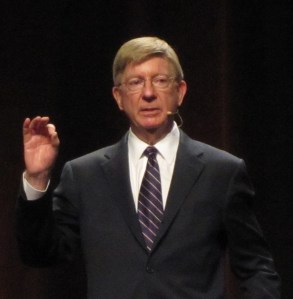
Will explained that he took issue with the practice of adjudicating campus sexual assault cases by a “preponderance” of evidence, rather than hitting the bar of evidence beyond a reasonable doubt. That flies in the face of due process, he argued, and ultimately harms young men’s future prospects.
“What’s going to result is a lot of young men and young women in this sea of hormones and alcohol, that gets into so much trouble on campuses, you’re going to have charges of sexual assault,” he said. “And you’re going to have young men disciplined, their lives often permanently and seriously blighted by this — don’t get into medical school, don’t get to law school, all the rest.”
Four Democratic senators reached out to Will after his column was published to torch the conservative columnist’s “ancient beliefs.” Will said he wrote a letter back to the senators and laid out his rebuttal in the C-SPAN interview.
“What I say is that: A) I take sexual assault more seriously than I think they do, because I agree that society has correctly said that rape is second only to murder as a serious felony,” Will said. “And therefore, when someone is accused of rape, it should be reported to the criminal justice system that knows how to deal with this, not jerry-built, improvised campus processes.”
“Second, I take, I think, sexual assault somewhat more seriously than the senators do because I think there’s a danger now of defining sexual assault so broadly, so capaciously, that it begins to trivialize the seriousness of it,” he added. “When remarks become sexual assault, improper touching — bad, shouldn’t be done, but it’s not sexual assault.”
Well, we can’t have young men’s lives “blighted” by rape charges. Much better for young women to just suck it up and deal with a years of post-traumatic stress on their own and keep their complaints to themselves.
Victorian gas-pipe and Her Majesty’s Curator of Rape To The Colonies, George Will, has just about had it up to here with you people — YES, YOU PEOPLE.
And especially you. Don’t think by closing your laptop he can’t see you, because he can.
Oh yes, he most certainly can, you loathsome wastrel.
t seems that, after explaining the ins and out of rape to you ungrateful curs, he was shocked and dismayed to discover that you promiscuous info-trollops on the intertubes are unable to comprehend the pearls of wisdom that he dispenses to the riff-raff gratis, courtesy of Ye Olde Washminster Poste.
Hush now, let Gentleman George condescend to speak down to you and try, fruitlessly no doubt, to explain once again that rape is what George Will says rape is…
Now go read the rest at the link. You won’t be sorry.
Google wants to see more women in technology, and it’s funding a $50 million initiative to encourage girls to learn how to code in an effort to close the gender gap.
Thursday night the company kicked off the Made with Code initiative here with celebrities former first daughter Chelsea Clinton and actress and comedienne Mindy Kaling.
Kaling, who emceed the event, said she has tons of ideas for apps but no idea to how make them work. She said she’d like to create a “What’s his deal?” app that takes a picture of guy and tells you whether he’s single, married, a weirdo, or what his car is like. Another idea is a Shazaam-like app for perfume.
“People my age have a million ideas for apps,” she said. “But we have no idea how to build them. Last week in the movies, I didn’t even know how to turn off the flashlight on my phone.”
Kaling isn’t alone. Women are woefully under-represented in the technology industry. Only about 20 percent of software developers in the US are women, according to the Labor Department. Last month, even Google admitted only 17 percent of its tech workers are women.
The Environmental Protection Agency (EPA) and the agriculture department will lead the effort, which includes $8m (£4.7m) for new honey bee habitats.
Bee populations saw a 23% decline last winter, a trend blamed on the loss of genetic diversity, exposure to certain pesticides and other factors.
A quarter of the food Americans eat, including apples, carrots and avocados, relies on pollination.
Honey bees add more than $15bn in value to US agricultural crops, according to the White House.
The decline in bee populations is also blamed on the loss of natural forage and inadequate diets, mite infestations and diseases.
There has also been an increase in a condition called colony collapse disorder (CCD) in which there is a rapid, unexpected and catastrophic loss of bees in a hive.
So . . . what stories are you following today? Please post your thoughts and links in the comment thread.
Did you like this post? Please share it with your friends:
A few days ago, I read an article about the “true meaning of Memorial Day.” I can’t find it now, but it was in the Chicago Tribune. The author wrote that Memorial Day began as “Decoration Day,” when Southern women decorated the graves of Confederate soldiers. I Googled some more and found other writers making the same claim. Here’s a piece by a Civil War historian from Purdue University Caroline Janney:
Many may not know the holiday weekend that marks the start of summer by paying respects to veterans and remembering loved ones began when white Southern women took a leadership role in honoring their Civil War veterans, says a Purdue University historian.
“After the Civil War, southern men would have appeared treasonous if they had organized memorials to honor their fallen, so women – perceived as apolitical – instead organized tributes and events that set the tone for how the country celebrates Memorial Day today,” says Caroline E. Janney, professor of historyand president-elect of the Society of Civil War Historians. “In 1866, the men were figuratively hiding behind the skirts of these women who worked together as part of Ladies’ Memorial Associations.”
The women organized dozens of memorials during the spring of 1866 and the following years, Janney says. Historically these memorials were scheduled throughout the spring as a sign of renewal and rebirth, and each community chose its own date to celebrate.
The date usually reflected a key date in the Civil War, such as the May 10 death of Gen. Thomas “Stonewall” Jackson, or a battle close to the association’s individual area. Memorial Day became more unified when larger associations, such as the United Confederate Veterans and United Daughters of the Confederacy, began organizing memorials in the 1890s. And memorial days also were observed in the North, but they were organized by Union veterans beginning in 1868, two years after the ex-Confederate women had established the practice.
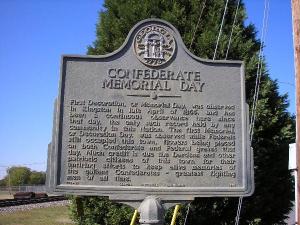
I was surprised, because I had read years ago that the practice was begun by former slaves who wanted to honor Union soldiers. I found the above photo on Facebook–with the suggestion that it was taken on that first Decoration Day May 1, 1865; but I can’t be absolutely certain that’s accurate. Note that that dates is a year earlier than the one Janney writes about. It turns out that a number of places and people claim to have started the practice of decorating Union and Confederate Graves. Southerners designated “Confederate Memorial Days.” Kingston, Georgia claims to have held the first one.
Officially, in the North, Memorial Day emerged in 1868 when the Grand Army of the Republic, the Union veterans’ organization, called on communities to conduct grave-decorating ceremonies. On May 30, funereal events attracted thousands of people at hundreds of cemeteries in countless towns, cities and mere crossroads. By the 1870s, one could not live in an American town, North or South, and be unaware of the spring ritual.
But the practice of decorating graves — which gave rise to an alternative name, Decoration Day — didn’t start with the 1868 events, nor was it an exclusively Northern practice. In 1866 the Ladies’ Memorial Association of Columbus, Ga., chose April 26, the anniversary of Gen. Joseph Johnston’s final surrender to Gen. William T. Sherman, to commemorate fallen Confederate soldiers. Later, both May 10, the anniversary of Gen. Stonewall Jackson’s death, and June 3, the birthday of Jefferson Davis, were designated Confederate Memorial Day in different states.
Soon the yearly practice became partisan:
In the South, Memorial Day was a means of confronting the Confederacy’s defeat but without repudiating its cause. Some Southern orators stressed Christian notions of noble sacrifice. Others, however, used the ritual for Confederate vindication and renewed assertions of white supremacy. Blacks had a place in this Confederate narrative, but only as time-warped loyal slaves who were supposed to remain frozen in the past.
The Lost Cause tradition thrived in Confederate Memorial Day rhetoric; the Southern dead were honored as the true “patriots,” defenders of their homeland, sovereign rights, a natural racial order and a “cause” that had been overwhelmed by “numbers and resources” but never defeated on battlefields.
Yankee Memorial Day orations often righteously claimed the high ground of blood sacrifice to save the Union and destroy slavery. It was not uncommon for a speaker to honor the fallen of both sides, but still lay the war guilt on the “rebel dead.”
But Blight discovered in a historical archive at Harvard University that the earliest celebration of “Decoration Day” was organized by freed slaves in Charleston, South Carolina in 1865.
During the final year of the war, the Confederates had converted the city’s Washington Race Course and Jockey Club into an outdoor prison. Union captives were kept in horrible conditions in the interior of the track; at least 257 died of disease and were hastily buried in a mass grave behind the grandstand.
After the Confederate evacuation of Charleston black workmen went to the site, reburied the Union dead properly, and built a high fence around the cemetery. They whitewashed the fence and built an archway over an entrance on which they inscribed the words, “Martyrs of the Race Course.” ….
The procession was led by 3,000 black schoolchildren carrying armloads of roses and singing the Union marching song “John Brown’s Body.” Several hundred black women followed with baskets of flowers, wreaths and crosses. Then came black men marching in cadence, followed by contingents of Union infantrymen. Within the cemetery enclosure a black children’s choir sang “We’ll Rally Around the Flag,” the “Star-Spangled Banner” and spirituals before a series of black ministers read from the Bible.
After the dedication the crowd dispersed into the infield and did what many of us do on Memorial Day: enjoyed picnics, listened to speeches and watched soldiers drill. Among the full brigade of Union infantrymen participating were the famous 54th Massachusetts and the 34th and 104th United States Colored Troops, who performed a special double-columned march around the gravesite.
Nearly 150 years later, it’s apparently very difficult for some Americans to credit African Americans with the first Memorial Day (or with much of anything else for that matter). As Ta-Nehisi Coates showed in The Atlantic recently, it’s apparently difficult for Americans to remember much of anything about African American history–before or after the Civil War. Why would anyone feel comfortable mourning the “lost cause” of a society built on the enslavement of other human beings? I can understand mourning the dead Confederate soldiers, but shouldn’t there be recognition that they died for something shameful? We can look around us today and still see the aftereffects of the slavery and the war that ended it. Will we ever get over it? One more quote from Blight’s article:
The war was over, and Memorial Day had been founded by African-Americans in a ritual of remembrance and consecration. The war, they had boldly announced, had been about the triumph of their emancipation over a slaveholders’ republic. They were themselves the true patriots.
High rates of unemployment, homelessness, alcoholism, substance abuse and post-traumatic stress are decimating our community of veterans. With the wars of the past 13 years in Iraq and Afghanistan coming to a close, we are seeing too many casualties among American soldiers in this transition to peace.
In light of this crisis, we need a new kind of Memorial Day.
Many veterans are desperate to talk about their experiences with fellow Americans who accept shared responsibility for what is done in war, particularly the killing. Yet these conversations rarely happen today. How can a veteran truly come home unless we acknowledge that our nation’s wars are something we all chose and paid for?
Returning Vietnam veterans were treated shamefully. That, thankfully, is behind America. We’ve moved from outright hostility to awkward, if well-meant, expressions of “thank you for your service” and the creation of a number of new veterans services organizations.
However, there remains an abiding sense of national indifference, or worse, a sense that somehow veterans are victims. This must change.
A great deal needs to change for the United States to be “one nation indivisible.”
In the News
Isla Vista Mass Murder:
The horrible murders in Santa Barbara are still at the top of the Google News page today. A few links:
I need to begin with some local Massachusetts stories that may have national repercussions.
First there is an update to the story of Ibragim Todashev, who was allegedly a friend of accused Boston bomber Tamerlan Tsarnaev. Both men are deceased. As you may recall, Todashev was shot and killed in his home in Orlando by an agent from the Boston FBI office on May 22, 2013.
The agent, along with an agent from the Orlando FBI office and two Massachusetts state troopers, had been questioning Todashev about his possible involvement with Tamerlan in the murders of three men in Waltham, MA on September 11, 2011.
According to the agent and the trooper who was there with him, Todashev attacked the agent with a table and the agent had shot him in self defense. Todashev had supposedly been writing a confession to his involvement in the murders when he suddenly attacked. The agent who shot Todashev was later absolved of any wrongdoing by reports by the Florida State Attorney’s office, the DOJ, and the FBI. The FBI report has not been released; and in the other two reports, much information, include the names of the agents and troopers, some portions of photos of the crime scene were redacted.
Now to the latest news (which so far has gone unnoticed by the corporate media). A couple of days ago, a blogger named B. Blake revealed that he/she had succeeded in downloading a version of the Florida Attorney’s report that was not properly redacted. The unredacted photos and the names of the agent who shot Todashev along with the two Mass. state troopers have been published on B. Blake’s blog “The Boston Marathon Bombings:What Happened?” The post includes an explanation of how the unredacted materials were obtained and authenticated. I’m not going to post the photos or names of law enforcement personnel; but you can see them at the above link. In another blog post, B. Blake reports some background information on the FBI agent involved.
So far I’ve seen nothing reported about this in the mainstream press, but it is all over Twitter. I don’t know if this will get out into the mainstream, but the FBI must have noticed it by now. I don’t know what will happen next, but when Twitter gets hold of a story, it generally gets noticed by the media eventually. I hope no harm will come to the three men whose names have been kept quiet until now. Stay tuned . . .
Massachusetts plans to scrap the state’s dysfunctional online health insurance website, after deciding it would be too expensive and time-consuming to fix, and replace it with a system used by several other states to enroll residents in plans.
Simultaneously, the state is preparing to temporarily join the federal HealthCare.gov insurance marketplace in case the replacement system is not ready by the fall.
As late as March, the state had considered rebuilding the balky Health Connector site, which has left thousands of consumers frustrated and many without coverage for months. But Sarah Iselin, the insurance executive whom Governor Deval Patrick tapped to oversee repairs to the site, said that approach turned out to be far too risky.
The state’s online insurance system must be ready by Nov. 15 for consumers to enroll in new health plans for 2015, and Massachusetts is one of several states under pressure from the Obama administration to make sure it meets the deadline.
The change mostly involves adopting a new software program and getting it up to speed by the deadline, which is set by law and has no flexibility.
Another unknown is whether the transition will create disruption for consumers. Eric Linzer, a spokesman for the Massachusetts Association of Health Plans, said some insurers may not be able to afford to remain in the program, meaning consumers could end up having to switch coverage.
“I can’t overstate the complexity and technical issues that come with not having to develop just one but two separate systems,’’ he said. “Given the time frame in which all this has to be implemented, this is going to be a significant undertaking for plans.’’
Massachusetts also provides more generous subsidies than the federal health insurance program for residents with incomes below 300 percent of the federal poverty level. Iselin said whether the state can retain those unique aspects of its program if it connects to the federal site is still under discussion with the Obama administration. According to the state’s plan, use of the federal website, if necessary, would be for no more than a year…
On the other hand, there is positive news long-term for Obamacare from a study of the effects of Massachusetts’ adopting universal health care in 2006. From the NYT: Mortality Drop Seen to Follow ’06 Health Law.
BOSTON — The death rate in Massachusetts dropped significantly after it adopted mandatory health care coverage in 2006, a study released Monday found, offering evidence that the country’s first experiment with universal coverage — and the model for crucial parts of President Obama’s health care law — has saved lives, health economists say.
The study tallied deaths in Massachusetts from 2001 to 2010 and found that the mortality rate — the number of deaths per 100,000 people — fell by about 3 percent in the four years after the law went into effect. The decline was steepest in counties with the highest proportions of poor and previously uninsured people. In contrast, the mortality rate in a control group of counties similar to Massachusetts in other states was largely unchanged.
A national 3 percent decline in mortality among adults under 65 would mean about 17,000 fewer deaths a year.
“It’s big,” said Samuel Preston, a demographer at the University of Pennsylvania and an authority on life expectancy. Professor Preston, who was not involved in the study, called the study “careful and thoughtful,” and said it added to a growing body of evidence that people with health insurance could reap the ultimate benefit — longer life.
Experts said the study, which was published online Monday in theAnnals of Internal Medicine, will not settle the long-debated question of whether being insured prolongs life, but it provides the most credible evidence yet that it might. Still, health improvements can take years to surface in mortality data, and some researchers were skeptical of the magnitude and suddenness of the decline.
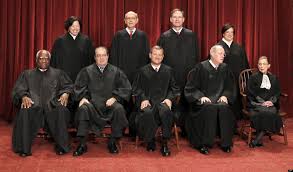
Justice Antonin Scalia is known as a consistent and principled defender of free speech rights.
It pained him, he has said, when he voted to strike down a law making flag burning a crime. “If it was up to me, if I were king,” he said, “I would take scruffy, bearded, sandal-wearing idiots who burn the flag, and I would put them in jail.” But the First Amendment stopped him.
That is a powerful example of constitutional principles overcoming personal preferences. But it turns out to be an outlier. In cases raising First Amendment claims, a new study found, Justice Scalia voted to uphold the free speech rights of conservative speakers at more than triple the rate of liberal ones. In 161 cases from 1986, when he joined the court, to 2011, he voted in favor of conservative speakers 65 percent of the time and liberal ones 21 percent.
He is not alone. “While liberal justices are over all more supportive of free speech claims than conservative justices,” the study found, “the votes of both liberal and conservative justices tend to reflect their preferences toward the ideological groupings of the speaker.”
Social science calls this kind of thing “in-group bias.” The impact of such bias on judicial behavior has not been explored in much detail, though earlierstudies have found that female appeals court judges are more likely to vote for plaintiffs in sexual harassment and sex discrimination suits.
Lee Epstein, a political scientist and law professor who conducted the new study with two colleagues, said it showed the justices to be “opportunistic free speech advocates.”
A lengthy New York magazine report published Sunday suggests that Logan’s return is far from certain. In the piece contributing editor Joe Hagan explores the tensions that simmered within CBS News, where his sources in the network described the current atmosphere as “toxic,” since Logan was forced to apologize last November for a flawed report on the Benghazi attacks.
The report that led to Logan’s suspension centered around a British security contractor, Dylan Davies, who gave a heroic first-person account of the attacks on the American consulate in Benghazi. The contractor’s credibility was called into question after the segment aired, when it was reported that Davies may not have been present on the night of the attacks at the compound.
TPM quotes some of Logan’s CBS co-workers:
“It’s not an accident that Lara Logan fucked up,” one of Logan’s colleagues told the magazine. “It was inevitable. Everybody saw this coming.”
During the fallout from the report, a founding member of “60 Minutes,” Morley Safer, reportedly marched into executive producer Jeff Fager’s office and demanded that Logan be fired, but to no avail. Another unnamed source suggested to the magazine that CBS President Les Moonves has since “soured” on Logan, whom he previously treated as a favorite.
“I abducted your girls. I will sell them in the market, by Allah,” a man claiming to be Boko Haram leader Abubakar Shekau said in a video first obtained by Agence France-Presse.
“There is a market for selling humans. Allah says I should sell. He commands me to sell. I will sell women. I sell women,” he continued, according to a CNN translation from the local Hausa language….”Girls, you should go and get married,” he said.
Not surprisingly, there has been much criticism of the government’s response to the kidnappings.
Weeks after the girls’ April 14 kidnapping, Africa’s most populous country seems to be no closer to finding them, triggering complaints of ineptitude — some of which are expressed on Twitter with the globally trending hashtag #BringBackOurGirls.
Nigeria’s finance minister said Monday that her country’s government remains committed to finding the girls, but should have done a better job explaining the situation to the public.
“Have we communicated what is being done properly? The answer is no, that people did not have enough information,” Ngozi Okonjo-Iweala told CNN’s Richard Quest.
Revealing details about the investigation is tricky, she said, “because you are dealing with people that you don’t know, and you don’t know…what they might do to these girls.”
There is much more information about the Boko Haram group at the CNN link.
Those are my offerings for today. What stories are you following? Please share your links in the comment thread and have a lovely spring Tuesday!
Did you like this post? Please share it with your friends:
The Sky Dancing banner headline uses a snippet from a work by artist Tashi Mannox called 'Rainbow Study'. The work is described as a" study of typical Tibetan rainbow clouds, that feature in Thanka painting, temple decoration and silk brocades". dakinikat was immediately drawn to the image when trying to find stylized Tibetan Clouds to represent Sky Dancing. It is probably because Tashi's practice is similar to her own. His updated take on the clouds that fill the collection of traditional thankas is quite special.
You can find his work at his website by clicking on his logo below. He is also a calligraphy artist that uses important vajrayana syllables. We encourage you to visit his on line studio.


















 peej
peej Carissa
 bostonboomer
 dakinikat
 ecocatwoman
 mablue2
 Mama Lopez
 peggysue22
 quixote
 skydancingguestblogger
 Mona (aka Wonk the Vote)



 Sky Dancing
Recent Comments