
Un-politicizing Fiscal Policy?
Posted: September 26, 2011 Filed under: U.S. Economy | Tags: automatic stablizers 10 Comments
Your cyborg economist is ready to flip the switch.
This Op Ed by Peter Orzag at TNR from about a week ago is causing a flurry of tweets back and forth between people whose blogs I follow like Marcy at Empty Wheel, Atrios, and Matt Yglesias at TP. Orzag suggests we work at creating laws to take fiscal policy out of the hands of politicians. Vast amounts of economic research show that a politicized Fed creates economic havoc in an economy with bad monetary policy. Orzag suggests more automatic stabilizers as a way to depoliticize fiscal policy and get the right prescription to kick in without all the political grandstanding and gridlock. This means creating laws that work to correct business cycle frictions that make the correct impact without any political and legal action by Congress and the President. He frames it as embracing less democracy.
In an 1814 letter to John Taylor, John Adams wrote that “there never was a democracy yet that did not commit suicide.” That may read today like an overstatement, but it is certainly true that our democracy finds itself facing a deep challenge: During my recent stint in the Obama administration as director of the Office of Management and Budget, it was clear to me that the country’s political polarization was growing worse—harming Washington’s ability to do the basic, necessary work of governing. If you need confirmation of this, look no further than the recent debt-limit debacle, which clearly showed that we are becoming two nations governed by a single Congress—and that paralyzing gridlock is the result. So what to do? To solve the serious problems facing our country, we need to minimize the harm from legislative inertia by relying more on automatic policies and depoliticized commissions for certain policy decisions. In other words, radical as it sounds, we need to counter the gridlock of our political institutions by making them a bit less democratic.
Just as the founders feared, American democracy has gotten way too democratic. This new la-la-la-la-la-la refusenik approach to politics is especially wrong in the Senate, which was created to be the “temperate and respectable body of citizens” that could, owing to its more gentlemanly size and longer terms, ride above populist political hysteria. And it’s ironic that the most effective tool on behalf of tea-party purity, the cloture-proof filibuster, is a crudely undemocratic maneuver, permitting a minority of 41 to defeat a majority of 59. (How fitting that “filibuster” and “tea party” both derive from maritime criminality—to filibuster is to freeboot, or hijack debate like a pirate.) Senate filibusters used to be rare, a monkey wrench used only in cases of emergency, meant to allow debate to continue unimpeded and to protect minority opinion from being ignored. In the sixties, the decade of civil rights and the Great Society and Vietnam, there were never more than seven filibusters during one Senate term; in 2007–2008, scores of Republican filibuster threats resulted in cloture motions. The Democrats aren’t innocent in this downward spiral of truculence: Under Bush, they regularly filibustered to stop the confirmation of judicial nominees. On health care, even though the Senate bill isn’t remotely radical, the Republicans’ refusal to play along at least follows the contours of principle. But on the issue supposedly animating the post-Bush GOP and the tea-partiers, the massive deficit, a bi-partisan Senate bill to establish a bi-partisan commission to rein in future budgets was just defeated with 23 of 40 Republicans voting no—including a half-dozen of the bill’s original co-sponsors. The framers worried about democratic government working in a country as large as this one, and it’s possible that we’ve finally reached the unmanageable tipping point they feared: Maybe our republic’s constitutional operating system simply can’t scale up to deal satisfactorily with a heterogeneous population of 310 million.
Fiscal policy has a notorious inside and outside lag because it has to get through two houses of congress,a President, and then usually through some form of bureaucratic implementation. It’s been estimated that it can take 2 years to implement. In comparison, monetary policy general shoots through the economy in about 6 months. Orzag isn’t exactly suggesting we set up some kind of czar or political commission to deal with economic policy, he suggests we pass more laws that respond to the situation so the situation handles itself a little bit better. We already have plenty of automatic fiscal stabilizers that do kick in when the economy gets bad–like unemployment insurance–or when it overheats with inflation–like cola clauses–but this is a little more high powered than that.
Automatic stabilizers are features of the tax and transfer systems that tend by their design to offset fluctuations in economic activity without direct intervention by policymakers. When incomes are high, tax liabilities rise and eligibility for government benefits falls, without any change in the tax code or other legislation. Conversely, when incomes slip, tax liabilities drop and more families become eligible for government transfer programs, such as food stamps and unemployment insurance, that help buttress their income.
This would build in more fiscal responses to business cycle fluctuations by law. Here’s a few more specifics from Orzag.
What we need, then, are ways around our politicians. The first would be to expand automatic stabilizers—those tax and spending provisions that automatically expand when the economy weakens, thereby cushioning the blow, and automatically contract as the economy recovers, thereby helping to reduce the deficit. A progressive tax code is one such automatic stabilizer. The tax code takes less of your income as that income declines, so after-tax income tends to decline less in response to an economic shock than pre-tax income. Since spending is based on after-tax income, the impact on the economy is cushioned. Alan Auerbach of the University of California at Berkeley has found that, as a result, the tax code has, over the past 50 years, offset about 8 percent of the initial shock to GDP from economic downturns. For the same reason, making the tax code more progressive would strengthen its role as an automatic stabilizer. Unemployment insurance is another automatic stabilizer; as the economy weakens, unemployment insurance expands, providing a boost to demand right when the economy needs it. Other automatic stabilizers are possible as well. For instance, rather than simply extending and expanding the existing payroll-tax holiday, as President Obama has proposed, policymakers should permanently link the tax to the unemployment rate. Consider a system under which the payroll tax would be reduced by 6 percentage points whenever the quarterly average unemployment rate exceeded 7.5 percent or increased by more than 2 percentage points over the previous year. Since a cut in the payroll tax is a powerful form of stimulus, this would be a built-in way to ensure a quick and effective government response to an economic downturn.
I’m not convinced payroll tax cuts are powerful, but that’s just an example for Orzag given his role in the Obama policy making group until recently. Is that a good idea and is framing it as less democracy a bad sell?
Here’s the criticism from Empty Wheel.
Peter Orszag opines from the politically sheltered comfort of his gig at Citigroup that we have too much democracy.
I’ll say more about specific claims he makes below, but first, let me point out a fundamental problem with his argument. He suggests we need to establish institutions insulated from our so-called polarization to tackle the important issues facing this country. That argument is all premised on the assumption that policy wonks sheltered from politics, as he now is, make the right decisions. But not only is his own logic faulty in several ways–for example, he never proves that polarization (and not, say, money in politics or crappy political journalism or a number of other potential causes) is the problem. More importantly, he never once explains why the Fed–that archetypal independent policy institution–hasn’t been more effective at counteracting our economic problems.
If the Fed doesn’t work–and it arguably has not and at the very least has ignored the full employment half of its dual mandate–then there’s no reason to think Orszag’s proposed solution of taking policy out of the political arena would work.
As you undoubtedly know, I can’t agree with her take on the Fed because I’ve just seen way too much research and history of other countries with central banks that have been politicized and the results are horrible. I think that the statement she makes after the charge of “archetypal independent policy institution” isn’t a sound argument. She’s mistaking the impotency of monetary policy in the face of a liquidity trap for problems with the Fed itself. All you have to do is google central bank independence and you’ll get the decades old studies that show just how bad it can get if there’s a central bank invaded by pols. The Fed needs to be monitored but it no way should any politician get close to the Open Market Committee. She makes her usual great points though and it’s worth the read.
So, there’s some food for thought. Chew Away!
The First Amendment is Well and Truly Dead.
Posted: September 25, 2011 Filed under: Human Rights, jobs, Labor unions, Patriot Act, The Bonus Class, The Media SUCKS, U.S. Economy, U.S. Politics, unemployment, Violence against women | Tags: fascism, first amendment, Income Inequality, jobs, media blackouts, occupy Wall Street, Peaceful protests, police brutality, the Constitution, the left, Twitter censorship, unemployment 46 CommentsFirst Amendment to the U.S. Constitution: “Congress shall make no law respecting an establishment of religion, or prohibiting the free exercise thereof; or abridging the freedom of speech, or of the press; or the right of the people peaceably to assemble, and to petition the Government for a redress of grievances.”
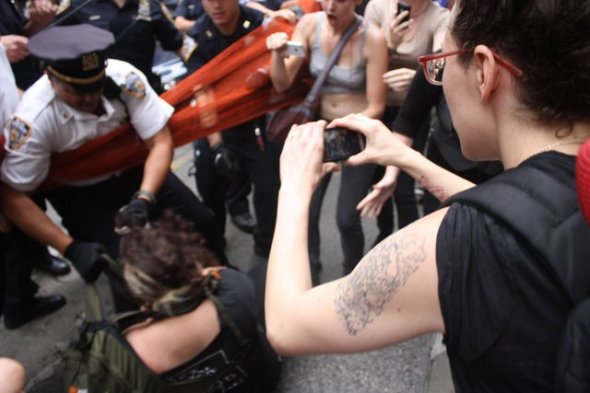
NYC Policeman reaches over barricade and pulls hair of female protester
From the New York Daily News: Wall Street protesters cuffed, pepper-sprayed during ‘inequality’ march
Hundreds of people carrying banners and chanting “shame, shame” walked between Zuccotti Park, near Wall St., and Union Square calling for changes to a financial system they say unjustly benefits the rich and harms the poor.
Somewhere between 80 and 100 protesters were arrested, and according the Occupy Wall Street website, some of them were held in a police van for more than an hour, including a man with a severe concussion. Back to the Daily News article:
Witnesses said they saw three stunned women collapse on the ground screaming after they were sprayed in the face.
A video posted on YouTube and NYDailyNews.com shows uniformed officers had corralled the women using orange nets when two supervisors made a beeline for the women, and at least one suddenly sprayed the women before turning and quickly walking away.
Footage of other police altercations also circulated online, but it was unclear what caused the dramatic mood shift in an otherwise peaceful demonstration.
“I saw a girl get slammed on the ground. I turned around and started screaming,” said Chelsea Elliott, 25, from Greenpoint, Brooklyn, who said she was sprayed. “I turned around and a cop was coming … we were on the sidewalk and we weren’t doing anything illegal.”
It’s over folks. We live in a police state. The right of the people to “peaceably assemble, and to petition the Government for a redress of grievances” is no longer recognized by the powers that be. In the age of the Patriot Act, peaceful protest is no longer permitted. The government requires that groups have a permit before they can gather on the sidewalks of New York. Oh, and BTW, a number of people were arrested yesterday because they filmed incidents of police brutality.
Via Yves at Naked Capitalism, Amped Status reports that Twitter is now following the example of the corporate media in ignoring or blocking information about peaceful protests in the U.S.
On at least two occasions, Saturday September 17th and again on Thursday night, Twitter blocked #OccupyWallStreet from being featured as a top trending topic on their homepage. On both occasions, #OccupyWallStreet tweets were coming in more frequently than other top trending topics that they were featuring on their homepage.
This is blatant political censorship on the part of a company that has recently received a $400 million investment from JP Morgan Chase.
We demand a statement from Twitter on this act of politically motivated censorship.
It’s all very exciting when Egyptians or Libyans protest their governments, but when it happens here, well, the media pretends its not happening. So much for the First Amendment.
In an op-ed at The New York Times yesterday, Michael Kazin asks: Whatever Happened to the American Left?
America’s economic miseries continue, with unemployment still high and home sales stagnant or dropping. The gap between the wealthiest Americans and their fellow citizens is wider than it has been since the 1920s.
And yet, except for the demonstrations and energetic recall campaigns that roiled Wisconsin this year, unionists and other stern critics of corporate power and government cutbacks have failed to organize a serious movement against the people and policies that bungled the United States into recession.
Instead, the Tea Party rebellion — led by veteran conservative activists and bankrolled by billionaires — has compelled politicians from both parties to slash federal spending and defeat proposals to tax the rich and hold financiers accountable for their misdeeds. Partly as a consequence, Barack Obama’s tenure is starting to look less like the second coming of F.D.R. and more like a re-run of Jimmy Carter — although last week the president did sound a bit Rooseveltian when he proposed that millionaires should “pay their fair share in taxes, or we’re going to have to ask seniors to pay more for Medicare.”
I’m sure Kazin is a good guy–after all he is a co-editor of Dissent Magazine and wrote a book on the changes the American Left has accomplished. His op-ed is a fine historical article, but still, he does mention Wisconsin. It might have been nice if he had noticed that some young people are attempting to organize a peaceful protest on Wall Street and are being victimized by brutal NYC police for their efforts. Perhaps Kazin didn’t know about the NYC protests because of the media blackout.
At the Guardian UK, David Graeber had some kind words for the Wall Street protesters.
Why are people occupying Wall Street? Why has the occupation – despite the latest police crackdown – sent out sparks across America, within days, inspiring hundreds of people to send pizzas, money, equipment and, now, to start their own movements called OccupyChicago, OccupyFlorida, in OccupyDenver or OccupyLA?
There are obvious reasons. We are watching the beginnings of the defiant self-assertion of a new generation of Americans, a generation who are looking forward to finishing their education with no jobs, no future, but still saddled with enormous and unforgivable debt. Most, I found, were of working-class or otherwise modest backgrounds, kids who did exactly what they were told they should: studied, got into college, and are now not just being punished for it, but humiliated – faced with a life of being treated as deadbeats, moral reprobates.
Is it really surprising they would like to have a word with the financial magnates who stole their future?
I salute the young men and women from Occupy Wall Street who are fighting back as best they can against corporate-fascist law enforcement and the corporate-controlled media. I really hope it’s not too late for these young people to make a difference.
Thursday Reads
Posted: September 22, 2011 Filed under: Barack Obama, morning reads, U.S. Economy, U.S. Politics | Tags: African Americans, death penalty, economy, Georgia, polls, Troy Davis 34 Comments
Good Morning!!
As I’m writing this, the Supreme Court is considering whether to stay Troy Davis’ execution. I’m following a blog on NPR. From NPR at 9:04PM Wednesday Night:
The Atlanta Journal Constitution reports that more than a dozen Georgia state police in riot gear have moved into the area outside of the prison. “They were met by choruses of ‘Shame on you’ from the protesters,” reports the AJC.
Larry Cox, the executive director of Amnesty International, which has led protests in support of Davis, told Democracy Now! they don’t know much about what’s going on. He said they’ve met with protesters to try to prepare them for bad news, he said, so they could react properly and within the peaceful spirit of the campaign.
“All we can do is wait and pray,” said Cox.
At The Nation, Richard Kim offers some background on the SCOTUS justices and their past statements about the death penalty.
It does seem that Georgia’s government is determined to kill Davis tonight. Earlier today Davis was refused an opportunity to take a polygraph.
Sadly, everything I wrote above is now moot. I’ve just heard (10:24PM) that the U.S. Supreme Court has rejected Davis’ stay request. What a sad day for the so-called justice system. Texas killed another man tonight and Georgia may yet follow suit.
UPDATE: Troy Davis died last night at 11:08PM. From CBS News: Troy Davis executed, supporters cry injustice
Strapped to a gurney in Georgia’s death chamber, Troy Davis lifted his head and declared one last time that he did not kill police officer Mark MacPhail. Just a few feet away behind a glass window, MacPhail’s son and brother watched in silence.
Outside the prison, a crowd of more than 500 demonstrators cried, hugged, prayed and held candles. They represented hundreds of thousands of supporters worldwide who took up the anti-death penalty cause as Davis’ final days ticked away.
“I am innocent,” Davis said moments before he was executed Wednesday night. “All I can ask … is that you look deeper into this case so that you really can finally see the truth. I ask my family and friends to continue to fight this fight.”
Prosecutors and MacPhail’s family said justice had finally been served.
“It harkens back to some ugly days in the history of this state,” said the Rev. Raphael Warnock of Ebenezer Baptist Church, who visited Mr. Davis on Monday.
Mr. Davis remained defiant at the end, according to reporters who witnessed his death. He looked directly at the members of the family of Mark MacPhail, the officer he was convicted of killing, and told them they had the wrong man.
“I did not personally kill your son, father, brother,” he said. “All I can ask is that you look deeper into this case so you really can finally see the truth.”
He then told his supporters and family to “keep the faith” and said to prison personnel, “May God have mercy on your souls; may God bless your souls.”
One of the witnesses, a radio reporter from WSB in Atlanta, said it appeared that the MacPhail family “seemed to get some satisfaction” from the execution.

Family members of murdered police officer Mark MacPhail
How can anyone “get satisfaction” when the wrong man may have been murdered by the state? I just don’t understand that. In my opinion, the U.S. cannot be considered a civilized or even moral country as long as we murder people in the name of the state, not to mention in the name of profit in our so-called “health care system.” In this country, it is still a crime to be poor, to be black, to be “illegal,” to be muslim, to be different.
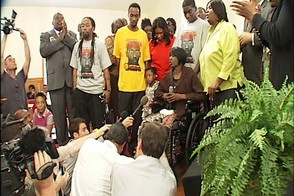
The family of Troy Davis
“The U.S. justice system was shaken to its core as Georgia executed a person who may well be innocent. Killing a man under this enormous cloud of doubt is horrific and amounts to a catastrophic failure of the justice system. While many courts examined this case, the march to the death chamber only slowed, but never stopped. Justice may be blind; but in this case, the justice system was blind to the facts.
“The state of Georgia has proven that the death penalty is too great a power to give to the government. Human institutions are prone to bias and error and cannot be entrusted with this God-like power. The death penalty is a human rights violation whether given to the guilty or the innocent, and it must be abolished.
“Our hearts are heavy, but we have not lost our spirit of defiance. Millions of people around the world now know of Troy Davis and see the fallibility of the U.S. justice system. As this case has captured the American conscience and increased opposition to the death penalty, Amnesty International will build on this momentum to end this unjust practice.”
__________________________________________________________________
In other news, this story from Mexico is unbelievable. I hope this isn't what the U.S. has to look forward to as we sink into third world status: 35 bodies dumped in Mexican city as president begins effort to woo tourists
As Mexican President Felipe Calderon was unveiling a new campaign and TV program Tuesday to draw wary tourists back to his country, a gang dumped 35 bodies at a busy intersection in the tourist zone in the coastal city of Veracruz….
The images from the travel television program, called “Mexico: The Royal Tour” — clips of gray whales, Mayan pyramids and glasses of amber tequila — clashed with shaky videos captured by cellphone cameras of panicked commuters, wailing police vehicles and half-naked bodies dumped on an underpass near the Veracruz beaches.
Authorities in Veracruz said the 35 bodies included 24 men and 11 women. They quickly tried to calm the public — and foreign visitors — by saying that most of the dead were criminals who were killed by a warring drug cartel.
That wouldn’t calm me one bit!
A couple of new polls have come out that show Obama continue to loose ground in important areas. A new Washington Post-ABC News Poll show his favorability ratings are dropping with African Americans.
New cracks have begun to show in President Obama’s support amongst African Americans, who have been his strongest supporters. Five months ago, 83 percent of African Americans held “strongly favorable” views of Obama, but in a new Washington Post-ABC news poll that number has dropped to 58 percent. That drop is similar to slipping support for Obama among all groups.
“There is a certain amount of racial loyalty and party loyalty, but eventually that was going to have to weaken,” said Andra Gillespie, a political scientist at Emory University, who studies African Americans. “It’s understandable given the economy.”
African Americans have historically correlated approval ratings of the president to the unemployment rate, she said. The slip in the strongly favorable rating continues the decline Obama has seen among all groups, but black voters have been his staunchest supporters. Overall, they still hold a generally favorable view of the president with 86 percent saying they view him at least somewhat favorably.
Gillespie’s view that the decline is tied to the disproportionately high jobless rate faced by African Americans correlates with the drop in their view of Obama’s handling of the economy. In July, only 54 percent of blacks said they thought Obama’s policies were making the economy better compared with 77 percent the previous year.
And a new Gallup poll shows that a “slight majority” of Americans blame Obama for the state of the economy.
A slight majority of Americans for the first time blame President Obama either a great deal (24%) or a moderate amount (29%) for the nation’s economic problems. However, Americans continue to blame former President George W. Bush more. Nearly 7 in 10 blame Bush a great deal (36%) or a moderate amount (33%).
Gallup found a substantially wider gap in public perceptions of how much responsibility Bush and Obama each bore for the economy when it first asked the question in July 2009, the sixth month of Obama’s presidency. That narrowed by March 2010, caused mainly by a jump in the percentage blaming Obama a great deal or moderate amount, and has since changed relatively little. However, the results from a new Sept. 15-18 USA Today/Gallup poll are the first showing a majority of Americans, 53%, assigning significant blame to Obama. Forty-seven percent still say he is “not much” (27%) or “not at all” (20%) to blame.
I managed to find a little humor for you. Elizabeth Warren has gotten quite a bump after her announcement that she’s running for the Senate in Massachusetts. Although Scott Brown’s campaign claims he’s not concerned, a little birdie overheard Brown talking about it on the phone and then told Talking Points Memo.
A Hill staffer, who spoke with TPM by phone, sends this dispatch from the Senate side in the wake of today’s PPP poll showing former White House financial reform adviser Elizabeth Warren leading Sen. Scott Brown (R-MA):
“Just walked passed Senator Brown’s office and in the hallway was the man himself, lamenting into his cell phone, ‘I don’t understand how she can be down 20 points one week and is now up 2. What is going on?’”
Our tipster describes the scene:
Was heading to a meeting after just having read your reporting on the new poll. Was just about to walk by Senator Brown’s personal office when he walked out of the main door of his office, cell phone in hand. He was mid-conversation but was responding to something on the other line with the line I reported. Was kind of dumbfounded to hear that kind of candor in a very public hallway. I’m guessing he realized that too, because he then looked over his shoulder, saw me, and hurriedly entered a side down to his office down the hall.
As a Massachusetts voter, I can’t tell you how happy it makes me to hear that Pretty Boy Brown is a little freaked out by the competition.
That’s it for me. What are you reading and blogging about today?

 peej
peej Carissa
 bostonboomer
 dakinikat
 ecocatwoman
 mablue2
 Mama Lopez
 peggysue22
 quixote
 skydancingguestblogger
 Mona (aka Wonk the Vote)



 Sky Dancing
Recent Comments