
Wealthy and Powerful Politicians are Terrified of #OccupyWallStreet
Posted: October 7, 2011 Filed under: #Occupy and We are the 99 percent!, U.S. Economy, U.S. Politics | Tags: #OccupyWallStreet, Eric Cantor, growing mobs, Michael Bloomberg, municipal workers, Tea Party, unions, Values Voters Summit 22 Comments
Mayor Bloomberg is really upset. In an interview with the Village Voice today, He claimed that #OccupyWallStreet is trying to destroy jobs for working people in New York City. Funny, I had the impression they were protesting because so many Americans don’t have jobs.
“Everyone’s got a thing they want to protest, some of which is not realistic,” Bloomberg said. “And if you focus for example on driving the banks out of New York City, you know those are our jobs … You can’t have it both ways: If you want jobs you have to assist companies and give them confidence to go and hire people.”
“The protests that are trying to destroy the jobs of working people in this city aren’t productive,” Bloomberg said in his weekly radio appearance with John Gambling. Taking a swipe at “some of the labor unions participating,” Bloomberg added that “their salaries come from – are paid by – some of the people they’re trying to vilify.”
I guess as far as Bloomberg is concerned, the bottom 99% don’t pay any taxes, and bankers are “working people.” That seems like a pretty skewed view of reality to me. But what do I know? I’m in the bottom 99%. And where did he get the idea that anyone is trying to drive the banks out of New York?
Bloomberg says the protests could affect tourism, but it seems to me that a lot of those protesters are from out of town and probably spending whatever money they have in NYC. But of course they aren’t wealthy or bankers, so they probably don’t count in Bloomberg’s world.
Bloomberg also issues a couple of not-very-subtle threats. He says “we’re not going to be able to pay our municipal employees,” presumably because all the bankers will leave town and there won’t be any tourists. I don’t get the logic there, but the threat to unions who have joined the protests is clear.
Finally, Bloomberg said that he’s letting the protesters “express themselves,” but he hinted that a crackdown could come at any time. I wonder if he realizes how much he sounds like Hosni Mubarak?
“The one thing I can tell you for sure,” he said…”is if anybody in the city breaks the law we will arrest them and turn them over the district attorneys.”
Hmmm…does that include bankers who broke the law? Or does the warning just apply to the bottom 99%?

And then there’s Rep. Eric Cantor (R-VA). Today spoke at the “Values Voters Summit,” which, according to MSNBC, is
an annual gathering of the religious right…[that] provides Republican politicians and presidential candidates an opportunity to display their conservative bona fides.
In the speech, Cantor expressed his fear of the #OccupyWallStreet protesters:
House GOP Leader Eric Cantor decried the protests that started several weeks ago in New York, and have spread to major cities across the country. Cantor said in a speech at the Values Voters Summit in Washington that he is “increasingly concerned” about the “growing mobs” represented at the protests….
“Some in Washington have actually condoned the pitting of Americans against Americans,” Cantor said of the protests after accusing the Obama administration’s policies of being an “assault on many of our nation’s bedrock principles.”
Here’s a clip from the speech:
The hypocrisy almost takes your breath away, doesn’t it? Cantor speaks to a group of people who are segregated by their religion and political party and who as a group hate gays, women, and anyone who isn’t their kind of “Christian,” and he accuses the Occupy protesters–a very diverse group–of dividing Americans against each other.
Oh and Cantor loves the Tea Party, because they aren’t trying to divide Americans against each other. /snark
The good news is these two powerful politicians–and probably many others as well–are running scared. Let’s keep them that way!
Thursday Reads
Posted: October 6, 2011 Filed under: #Occupy and We are the 99 percent!, 2012 presidential campaign, U.S. Economy, U.S. Politics | Tags: Christopher Benfry, Elizabeth Warren, Erin Burnett, Ezra Klein, George Will, Glenn Greenwald, Larry McMurtry, Massachusetts Senate race, Mitt Romney, Occupy Boston, occupy Wall Street, Rick Perry, Robert Reich, Scott Brown 21 Comments
Good Morning!! I’m going to be heading back to Boston pretty soon, and I’m looking forward to following developments in Occupy Boston and in the Senate race. They haven’t started an Occupy Muncie protest yet, unfortunately. But you never know. This town is really suffering from the poor economy.
At Mother Jones, there is an interactive map of all the Occupy protests that have sprung up around the country. It’s pretty amazing. Funny thing. A few days ago MJ had a post by Lauren Ellis in which she looked down her nose at the #OccupyWallStreet protesters. Now they have a whole section on the Occupy Movement.
There are still plenty of so-called “journalists” dismissing the protests though. Yesterday, I posted a link to Andrew Ross Sorkin’s piece in the NYT in which he reports his trip to Zuccotti Park at the request of a anonymous nervous Wall Street CEO. Glenn Greenwald skewered Sorkin but good, concluding that Sorkin’s
CEO banking friend is right to be concerned: if not about this protest in particular then about the likelihood of social unrest generally, emerging as a result of their plundering and pilfering. That healthy fear on the part of the oligarchs has been all too absent.
Greenwald also linked to this example of “snotty, petty, pseudointellectual condescension” at The New Republic. Ugh! Read it if you dare.
Yesterday, Greenwald followed up by verbally destroying CNN’s new nighttime host, Erin Burnett.
On her new CNN show on Monday night, host Erin Burnett was joined by Rudy Giuliani’s former speechwriter John Avlon and together they heaped condescending scorn on the Wall Street protests while defending the banking industry, offering — as FAIR documented — several misleading statements along the way. Burnett “reported” that while she “saw dancing, bongo drums, even a clown” at the protest, the participants “did not know what they want,” except that “it seems like people want a messiah leader, just like they did when they anointed Barack Obama.” She featured a video clip of herself explaining to one of the protesters that the U.S. Government made money from TARP, and then demanded to know if that changed his negative views of Wall Street.
This is far from the first time Burnett has served as spokesperson for Wall Street; it’s basically what her “journalistic” career is. She angered Bill Maher a couple years ago when arguing that the rich have suffered along with the poor and middle class as part of the financial crisis, and that it would be wrong to “soak the rich” because they’re already paying so much taxes. She caused Rush Limbaugh to gush over her when she argued on TV in 2007 that all Americans benefit when the rich get richer: “the majority of Americans directly benefit from what happens on Wall Street,” she proclaimed, just over a year before the financial collapse.
In an interview last year with Vanity Fair, she insisted that people on Wall Street do not have private planes and that “there are a lot of stalwart, solid people on Wall Street. There are just a few shady people providing the fodder for big budget movies…”
Meanwhile Beltway Bob Ezra Klein has some advice for #OccupyWallStreet: they should immediately start taking advice from the liberal establishment and focus on developing policy and writing legislation in order to work through the system that they have already rejected.
The Wall Street protests seem to be gathering strength and expanding beyond the geographic limits of downtown Manhattan. The media, too, is finally amplifying the story. Whether they will grow larger and sustain themselves beyond these initial street actions will depend upon four things: the work of skilled organizers; the success of those organizers in getting people, once these events end, to meet over and over and over again; whether or not the movement can promote public policy solutions that are organically linked to the quotidian lives of its supporters; and the ability of liberalism’s infrastructure of intellectuals, writers, artists and professionals to expend an enormous amount of their cultural capital in support of the movement.
There’s lots more, but it’s basically a lecture from someone who just doesn’t get it. And speaking of people who don’t get it, George Will tries to school Elizabeth Warren in his latest column. According to Will, the “liberal project,” which Warren apparently speaks for is designed to destroy rugged individualism.
The project is to dilute the concept of individualism, thereby refuting respect for the individual’s zone of sovereignty. The regulatory state, liberalism’s instrument, constantly tries to contract that zone — for the individual’s own good, it says….
Such an agenda’s premise is that individualism is a chimera, that any individual’s achievements should be considered entirely derivative from society, so the achievements need not be treated as belonging to the individual. Society is entitled to socialize — i.e., conscript — whatever portion it considers its share. It may, as an optional act of political grace, allow the individual the remainder of what is misleadingly called the individual’s possession.
The collectivist agenda is antithetical to America’s premise, which is: Government — including such public goods as roads, schools and police — is instituted to facilitate individual striving, a.k.a. the pursuit of happiness. The fact that collective choices facilitate this striving does not compel the conclusion that the collectivity (Warren’s “the rest of us”) is entitled to take as much as it pleases of the results of the striving.
But isn’t that what Warren is pushing for? For more individuals to have opportunities to make it in America? Really, isn’t it time for George Will to retire?
Meanwhile Warren is leading in the race for the Massachusetts Democratic nomination for Senate, and she appeared in her first debate on Tuesday at my undergraduate alma mater, U. Mass Lowell.
In her first debate as a candidate for U.S. Senate Tuesday night, Harvard law professor Elizabeth Warren declined to criticize her fellow Democratic candidates, taking aim instead at Republican Sen. Scott Brown, whom the Democratic nominee will face, and Wall Street.
“Forbes magazine named Scott Brown Wall Street’s favorite senator. I was thinking that’s probably not an award I’m going to get,” she said to applause and laughter from the audience at the University of Massachusetts-Lowell. Two recent polls put Warren and Brown in a statistical tie.
She also made the audience laugh and applaud with the second question, which asked each candidate how they paid for college, since Brown posed nude for Cosmopolitan to pay.
“I kept my clothes on,” she quipped. She added that she borrowed money to go to a public university and had a part-time job.
Warren also drew applause for her tough talk on Wall Street. “The people on Wall Street broke this country, and they did it one lousy mortgage at a time. It happened more than three years ago, and there has been no real accountability, and there has been no real effort to fix it. That’s why I want to run for the United States Senate,” she said.
Go Elizabeth go!!
Another voice for the middle class, Robert Reich, explains why Wall Street is extremely nervous about the economic crisis in Europe.
If you want the real reason, follow the money. A Greek (or Irish or Spanish or Italian or Portugese) default would have roughly the same effect on our financial system as the implosion of Lehman Brothers in 2008.
Financial chaos….a default by Greece or any other of Europe’s debt-burdened nations could easily pummel German and French banks, which have lent Greece (and the other wobbly European countries) far more.
That’s where Wall Street comes in. Big Wall Street banks have lent German and French banks a bundle.
The Street’s total exposure to the euro zone totals about $2.7 trillion. Its exposure to to France and Germany accounts for nearly half the total.
And it’s not just Wall Street’s loans to German and French banks that are worrisome. Wall Street has also insured or bet on all sorts of derivatives emanating from Europe — on energy, currency, interest rates, and foreign exchange swaps. If a German or French bank goes down, the ripple effects are incalculable.
Read the rest at Huffpo.
There are a couple of interesting reads about Republican candidates at the New York Review of Books. The first is by novelist Larry McMurtry: The Rick Perry Hustle Here’s a brief sample:
What Perry has brought to the Republican muddle thus far is his abundant, if unfocused, energy. He rushes from debate to debate, gives many interviews, gets his picture on the cover of TIME; yet all his politicking is curiously affectless. He makes sounds, but where’s the personality? Hillary Clinton has a personality; so does Sarah Palin. Either of those women could cut Governor Perry off at the knees, and will if given the chance.
It’s not been said so I’ll say it: as a politician Rick Perry is fundamentally lazy, so far as actual governing is concerned, content to run things mainly by sound-bite. He makes lots of decisions but lingers on no issue very long; there’s little follow-through. Clemency, or its absence, is an example. Two hundred thirty-four humans have been executed in Texas on his watch and only recently has he been stirred to a review. He believes that the State Board of Pardons and Paroles is so infallible that there’s no reason for him to lose sleep over the fate of this or that prisoner. The Governor has much more confidence in the Board than the Board has in itself; its members are well aware that even, or especially in Texas shaky verdicts have come down. The Governor, a man with a notably short attention span, has a lot more to think about than the death chamber.
An irony of his sudden emergence as a front-runner is that his few humane decisions—the HPV vaccine, which is safe and helpful, and the tuition credit for the children of illegals, which could help keep gangs of feral children off our streets—are what may sink him with the Tea Party and his own rabid right wing. And this is the wing he has assiduously cultivated his whole political life.
The other NYRB article of interest is by Christopher Benfry: Mitt, We Hardly Knew Ye!
We’re feeling vulnerable and surly these days in western Massachusetts, as the leaves turn yellow, the Red Sox fade, and winter looms. Our corridor of New England along the Connecticut River endured, during the summer months, a ruinous tornado in Springfield, an earthquake, of all things, and Hurricane Irene, which knocked out roads and historic covered bridges in our hill towns and across neighboring Vermont, and left a lot of people homeless and adrift. It’s our Katrina moment, we sometimes think, with slightly grandiose self-pity, as Republicans in Congress demand budget cuts if FEMA is to pay for disaster relief in the blue states.
We don’t see much of Mitt Romney, our ex-governor, in these troubled times. Then again, we never did. Our most indelible memories are of Mitt leaving—“the sight of Mitt’s back,” as a friend of mine put it, as he went off to lay the groundwork for yet another campaign. Mitt ran for the Senate against Ted Kennedy in 1994, lost, and left the state to salvage the Salt Lake City Olympics. When he returned to run for governor in 2002, he had to go to court to prove that he sort of lived in Belmont, outside Boston. Then, after a couple of years in the state house, he left again to campaign for the presidency, spending two thirds of his time out of state in 2006. Mitt has sold his house in Belmont and now lives in the important primary state of New Hampshire (at his estate on Lake Winnipesaukee) or San Diego or maybe Utah—anywhere but Massachusetts.
In the Republican debates, Mitt pretends that his ties to Massachusetts are tenuous. Mitt’s greatest achievement as governor, the Massachusetts health care system (which passed with Ted Kennedy’s support and two dissenting votes in the state legislature), is now his greatest liability among Republicans, who see it as a stalking horse for Obamacare. Mitt now claims it was right for our quirky state but not for the nation. He has yet to explain why.
When Mitt trumpets his experience in American business, he rarely mentions that Bain, the consulting and investment conglomerate in which he amassed his $200 million fortune, is a Boston firm.
And so on…Romney used our state as a springboard and then denied even knowing us.
I’ll end there for today. What are you reading and blogging about?
Live Blog: Unions Join #OccupyWallStreet for March in NYC Today!
Posted: October 5, 2011 Filed under: #Occupy and We are the 99 percent!, The Great Recession, U.S. Economy, U.S. Politics, unemployment | Tags: economy, greed, jobs, occupy Wall Street, protests. MSNBC, unemployment, unions 31 Comments
I have to admit, I’m getting really excited by the way the #OccupyWallStreet movement is taking off. I just got home and turned on MSNBC to find that they are covering the Wall Street protests live this afternoon. They have a number of network personnel on the ground, including Dylan Ratigan. And get this: even Beltway Bob is there! That has to be sign that the mainstream Villagers are taking note.
Right now Harrison Schultz, a spokesman for the protesters is on, and he just said, “I call this a revolution. No one is organizing it. It’s just happening.” He says the media is obsolete. The media thinks they are driving people to the protest, but that’s not true. If he would in charge of a major media outlet, he would be nervous now, because this would be happening whether the mainstream media paid attention or not. He says no one knows what is going to happen or where this will go.
The union march will take place at 4:30 this afternoon, according to MSNBC, but ABC says 3PM. If you have access to MSNBC right now, please watch with us and let us know if anything is happening in your area. Awhile ago, they put up a map to show where all the protests are now, and they were in so many states! I’ll see if I can find the map and post it. Meanwhile, here is a little about what we can expect this afternoon.
The cavalry has arrived in Lower Manhattan. Representatives from no fewer than 15 of the country’s largest labor unions will join the Occupy Wall Street protesters for a mass rally and march today in New York City.
The AFL-CIO, United Auto Workers, and Transit Workers’ Union are among the groups expected to stand in solidarity with the hundreds of mostly young men and women who have spent the better part of three weeks sleeping, eating, and organizing from Zuccotti Square.
Their arrival is being touted as a watershed moment for the “Occupy” movement, which has now seen copycat protests spring up across the country. And while the specific demands of the “occupiers” remain wide-ranging, the presence of the unions – implicitly inclined to making more direct demands – may sharpen their focus.
Today’s action is scheduled to begin at 3 p.m. ET, when the protesters in Zuccotti Square march approximately one mile north to Foley Square, where they will be met by community and labor leaders. Then, at 4:30 p.m., they plan to match together back down toward Wall Street. They do not yet have a city-issued permit for the gathering, but are now pursuing one.
ABC is anticipating more arrests today, but on MSNBC, a spokesman said the unions got a permit for today’s march. Furthermore, if NYC chooses to try to break up the protests today, it will only help the growth of this movement.
Here’s a report from Democracy Now today:
UPDATE: MSNBC has moved on to other things for now. But the Guardian has a live blog. It figures we have to go to a British newspaper to find out what’s happening in our own country.
Tuesday Reads: Occupy Boston, Occupy Wall Street, and a Modern Day Whisky Rebellion
Posted: October 4, 2011 Filed under: Economy, morning reads, U.S. Economy, U.S. Politics | Tags: American Revolution, Boston Tea Party, civil liberties, NYPD, Occupy, Occupy Los Angeles, occupy Wall Street, Whiskey Rebellion 35 Comments
Good Morning!! Today I want to focus on articles about Occupy Wall Street protests, which despite the critiques of those on both the right and left, are still going on in NYC and many other U.S. cities, including Boston, I’m happy to say. The Boston Phoenix has a blog to document the protests. On September 28, Chris Faraone wrote:
At this early juncture it’s already safe to say that Occupy Wall Street has succeeded. I’m not being sarcastic. Yesterday I wrote about the media storm that’s showered their protests from early on, and that’s rained down even harder since the New York Police Department began brutalizing demonstrators. And after last night’s Occupy Boston meeting on the Common, I’m convinced that the hordes have achieved something even greater than attracting press: regardless of what they actually accomplish in the end, Occupy has already become the hottest protest franchise since the Tea Party. Which is why it makes sense that contrarian Boston is emerging as the first city to strike while the brand is hot.
Last night’s kickoff meeting was at least a testament to the popularity of this movement. People have been angry for some time, but for many it was Occupy that motivated them – not the countless other protests that take place every week around here. Roughly 300 showed –with a significant number of reporters on the scene documenting –despite the event having been announced less than a day ahead of time, and almost exclusively through social media (Steve Annear, who you should follow on Twitter if you’re keeping tabs on the actions, also broke the story in the Metro). By a show of hands, a few dozen folks on the Common got their feet wet in Liberty Square during the first stretch of Occupy Wall Street. But for the most part, these were people – mostly young, but overall from a mix of backgrounds, ages, and ethnicities – who’d become interested by what they’d seen online and in the news.

Occupy Boston meeting on Boston Common
The Guardian even published an article about the Boston organization:
There were socialists, anti-poverty campaigners, students, anarchists, computer hackers, the unemployed, and workers ranging from a vet to an accountant.
And, numbering around 200 and meeting to plot until late in the night, a group of Bostonians have decided to recreate the anti-Wall Street protests that are gripping New York.
Unlike previous attempts, such as a march that fizzled out in Chicago with just 20 people, the people behind Occupy Boston showed a strong dose of media savvy and organisational skill on Monday night, as they drew a committed crowd of volunteers to their cause: to occupy a slice of the city. Local TV crews were in attendance at the evening mass planning meeting, and it had been flagged on the front pages of Boston’s newspapers.
The move raises the first serious prospect of the Wall Street protests spreading beyond New York and comes as other events are also being planned in Los Angeles and Washington.
Noam Chomsky even made a youtube video of support.
This thing is really growing. Could it be that the young people of this country are really going to stand up and fight? I sure hope so. Is this happening where you live? If so, please share what you know. I’m starting to get excited about this!
Getting back to the New York protests, Emptywheel had a post today on the NYPD and their history of violations of civil liberties. I’m not going to excerpt from it, because you really need to read the whole thing–it’s not very long.
At FDL, David Dayen has a post about Van Jones’s Take Back the American Dream organization and how it is “building off #Occupy Wall Street.”
The Campaign for America’s Future expected their conference to be a launching pad for an American Dream Movement that would be a counterpart to the Tea Party, a left populist movement that would branch out across the country. And that movement has built itself up over the past couple months, and was in part responsible for the invisible town hall revolution over August.
But CAF found itself caught by an organic protest movement, a disparate movement organized by a simple theme, an expression of the feeling of mass injustice. Nobody on the left was totally prepared for #OccupyWallStreet, which sprung up on its own. But the groups that have been organizing in similar ways and with a similar theme were more than prepared to support it.
The spirit of #OccupyWallStreet has given a booster shot to this Take Back the American Dream Conference, which last year was completely moribund. The first session at the conference was a paean to #OccupyWallStreet, with video from New York City (the live feed crashed, unfortunately) and even one organizer who camped out in Zuccotti Park speaking. “If we demand something from Wall Street, we’re telling them that they have the power, but we do,” said the organizer from the Working Families Party in New York.
“They went down there to the scene of the crime against our future,” said Van Jones at his keynote address, in admiration of the #OccupyWallStreet protesters. “They’ve been beaten, they’ve been pepper sprayed, they’ve been falsely arrested, but they never broke their discipline. They told the police officers who were arresting them, we are the 99%, we’re fighting for you, we’re fighting for your pensions too.”
“Something’s happening in America. Don’t you give up on this movement!” Jones concluded.
Yes, something is finally happening. Will it continue to grow? I sure hope so!
I also want to call your attention to an interesting piece at Salon by William Hogeland, author of three books on the revolutionary period in American history. Hogeland compares the Occupy Wall Street movement to the so-called Whisky Rebellion. Hogeland writes about radical protests movements against our founding fathers, who were, after all, the elites of their day. Here’s just a sample:
The difficulty in dealing with our founding battle for democratic economics arises in part because the movement was not against England but against the very American banking and trading elites who dominated the resistance to England. That complicates our founding myth, possibly unpleasantly. Also, it was a generally losing battle. With ratification of the Constitution, Hamiltonian finance triumphed, and people looking to Jefferson and Madison for finance and economic alternatives to Hamilton are barking up the wrong tree, since what those men knew, or even really cared, about finance could be written on a dime. (Anyway, in pushing for creating a nation, Madison supported Hamiltonian finance down the line. Their differences came later.) When Occupy Wall Street protesters say “It’s We the People!” they’re actually referring to a preamble, intending no hint of economic democracy, to a document that was framed specifically to push down democratic finance and concentrate American wealth for national purposes. Not very edifying, but there it is.
The Tea Party, meanwhile, has taken up founding economic issues from a right-wing point of view, associating itself with the upper-middle-class Boston patriots (often mistaken for populist democrats) who led a movement against overrreaching British trade acts in the 1760′s and were important to the impulse toward American independence. I’ve written fairly extensively about where and how I think the Tea Party goes wrong on the history of the founding period. But at least they’re framing their objections to current policy, and framing the historical roots of their ideas, not mainly in cultural but in economic terms.
Like it or not, though, it is Occupy Wall Street that has the most in common, ideologically, not with those Boston merchants and their supporters but with the less well-known, less comfortably acknowledged people who, throughout the founding period, cogently proposed and vigorously agitated for an entirely different approach to finance and monetary policy than that carried forward by the famous founders. Amid horrible depressions and foreclosure crises, from the 1750′s through the 1790′s, ordinary people closed debt courts, rescued debt prisoners, waylaid process servers, boycotted foreclosure actions, etc. (More on that here and here.) They were legally barred from voting and holding office, since they didn’t have enough property, so they used their power of intimidation to pressure their legislatures for debt relief and popular monetary policies. Their few leaders in legit politics included the visionary preacher Herman Husband, the weaver William Findley, and the farmer Robert Whitehill.
I found this article absolutely fascinating!
At the LA Times, there’s an editorial about the “message” of the “Occupy” protests along with a photo of protesters at LA City Hall.
The political left has been searching for the last couple of years to find an answer to the tea party. Some hoped last year’s rally in Washington led by TV comedians Jon Stewart and Stephen Colbert, a response to right-wing rallies attended by such conservative media celebrities as Glenn Beck, would spark a national movement. That didn’t happen. Now they’re pinning their hopes on Occupy Wall Street, which in many ways is a mirror image of the tea party. Both groups are motivated by frustration over the rotten economy and are vague about causes and solutions, though if their positions could be summed up in a one-line manifesto, it might be: The tea party, dominated by elderly conservatives, blames government overspending and overreach for our economic problems and would therefore like to cut federal spending, while Occupy Wall Street, dominated by young liberals, blames corporate greed and would therefore like to tax the rich and decrease corporate political power.
It is, of course, far too early to suggest that Occupy Wall Street represents a resurgence of the left. But we do seem to recall that in its initial days the tea party was similarly dismissed by pundits, especially those on the left who preferred to see the protesters as kooks rather than the vanguard of a political shift. What matters isn’t the size of the protest, the attire of the demonstrators or the misspellings on their signs; it’s whether the relatively tiny number of people who can be bothered to show up and march can inspire and energize other like-minded people enough to get them to the polls.
Finally, at Huffpo, there’s a piece by Judith Samuelson: A Baby Boomer’s Advice to the Millennials Occupying Wall Street
Whether their disgust with Wall Street is fueled by a lack of jobs or a more complex analysis was not apparent to me, but I trust we will be hearing more from the Millennials. Scholars are suggesting they will be a force to be reckoned with. In fact, you might already be experiencing their tendency to want to be heard in the workplace, in the classroom or at the dinner table, for example.
There are a lot of them; 90 million by some count, comprising the largest generation in our history. They are the most racially diverse generation ever, and they have been, and are being, shaped by remarkable events such as 9/11 and the ongoing global recession; by their parents — the boomers of yore; and, of course by technology — the first generation to take instant communications for granted. I believe that Millennials will shape our response to issues that bedevil us — through their passion about social issues, their facility with technology and social networking, and through their continued willingness to vote — as they did in big numbers in the last Presidential election.
Many of them will go to business school — or are already there. A quarter of post-graduate degrees are in business, and 20 percent of undergraduates are pursuing business degrees. Even at liberal arts colleges that may not offer “business” as a major, students flock to economics instead, or as close as they can get to the subject. This may be the result of parental pressure to exit school with some hope of finding a job (unlike baby boomers, Millennials are close to their parents and apparently even listen to them) but it is also in pursuit of the skills, language and heroes they have grown up with — more Steve Jobs and Mark Zuckerberg than Bob Dylan and Robert Redford.
The question I have been thinking about is how they will bridge these two worlds — passion for social issues, and comfort with technology and business. I know from experience that real change is hard; that to influence business, and Wall Street, requires people skills as well as analytics, patience, and multiple approaches to gain the attention and commitment of the power brokers who set the rules and design the reward systems. Protest is a not an insignificant part of the puzzle, however, and always has been; just ask Walmart, Nike or Nestle.
In the spirit of Baby Boomers’ sharing their experience, strength, and hope with the Millennials, here’s a boomer anthem that might be appropriate:
What are you reading and blogging about today? Please share!
Guess who Started the Class War?
Posted: October 2, 2011 Filed under: U.S. Economy | Tags: class war fare, poor little billionaires, US income inequality. 19 Comments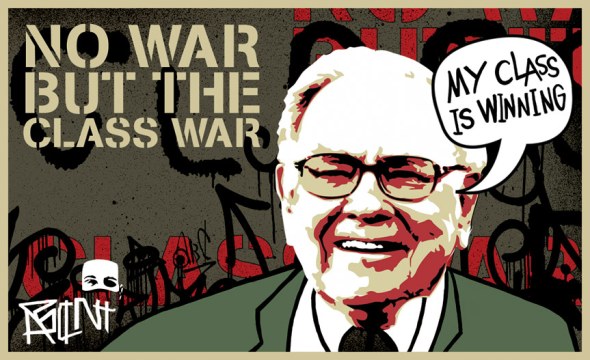 It’s more than a bit disingenuous to start screaming class war now when the first shot was fired some years ago and the little guys are just finally waking up to the smell of $10 cappuccinos on $5 an hour wages. The data shows the income gap has been persistent and widening since the 1980s. The only thing new under the sun is that the folks that started the entire thing are the ones screaming and shifting blame.
I’ve found some pretty fuzzy math that argues that Barack Obama–of ALL people–has just declared a class war some time this month by the preeminent defenders of the looting. I thought I’d just share some of the intellectual shenanigans to inspire the pitch folk wielder in you. This is one little whiny boy who complains the rich are just overtaxed today. He even trots out some really really bad data to support the temper tantrum.
It’s official: America is at class war, and President Barack Obama proudly leads the charge against this country’s wealthy.
“If asking a millionaire to pay the same tax rate as a plumber makes me a class warrior ― a warrior for the working class ― I will accept that,” Obama shouted Tuesday at Denver’s Abraham Lincoln High School. “I will wear that charge as a badge of honor.”
“Middle-class families shouldn’t pay higher tax rates than millionaires and billionaires. A teacher or a nurse or a construction worker making $50,000 a year shouldn’t pay higher tax rates than somebody making $50 million.”
Obama’s assault on the affluent rests upon a sky-high stack of lies. Obama is too well staffed and too well informed not to know otherwise. So, maddeningly, he straight-out lies to the American people.
For days before Obama opened his mouth in Denver, multiple news accounts and opinion pieces annihilated the casus belli of his War on the Wealthy. Nonetheless, Obama keeps spouting falsehoods, perhaps hoping that his smooth voice will hypnotize Americans into believing his words.
“Fact check: The wealthy already pay more taxes,” read the headline above a September 20 Associated Press. “President Obama says he wants to make sure millionaires are taxed at higher rates than their secretaries,” Stephen Ohlemacher wrote. “The data say they already are.”
Nationwide, Ohlemacher and others dismantled Obama’s soak-the-rich thesis. The rich are soaked today.
Okay, the author of this stupid bit of faux economics is a “media fellow with the Hoover Institution on War, Revolution and Peace at Stanford University.” He makes THE cardinal dumb mistake for the economic illiterate. He makes no distinction between real and nominal figures which basically means adjusting for changes in purchasing power to dollar figures over time but what do you expect from two ideological journalists. The other idiot he quotes does the same thing. You can’t do these kinds of figures in nominal terms and compare anything. Here’s Paul Krugman explaining the difference between the value of a dollar today and a dollar around world war 2 which is what seems to really confuse these guys.
As background, it helps to know what has been happening to incomes over the past three decades. Detailed estimates from the Congressional Budget Office – which only go up to 2005, but the basic picture surely hasn’t changed – show that between 1979 and 2005 the inflation-adjusted income of families in the middle of the income distribution rose 21 percent. That’s growth, but it’s slow, especially compared with the 100 percent rise in median income over a generation after World War II.
Meanwhile, over the same period, the income of the very rich, the top 100th of 1 percent of the income distribution, rose by 480 percent. No, that isn’t a misprint. In 2005 dollars, the average annual income of that group rose from $4.2 million to $24.3 million.
So do the wealthy look to you like the victims of class warfare?
Paying more in dollars today doesn’t amount to the same thing as paying more in purchasing power and real income today and yesterday. Additionally, the argument does not take into account the differences in taxes where the money really lies. First, corporations have weaseled so many exceptions to the tax law, many pay next to nothing in taxes. Corporations are supposed to be people now remember? Well, they dodge taxes in a big way. Second, most extremely wealthy people get the majority of their income from capital gains and not earned income. It’s so easy to throw around numbers when you narrow your argument down to a place that ignores the big picture. One of the biggest problems with this argument is that it ignores the other taxes collected by the federal government. Social Security Taxes are the most regressive taxes in the country. They apply only to 100% of the lowest levels of income. The majority of rich people’s income avoids this tax. The Social Security cap effectively puts most of the earned income of the wealthiest individuals off the table. For some reason, Social Security always counts wrong against the federal deficit for these guys but gets ignored in the federal tax equations.
Krugman has argued against the use of fuzzy math a lot on his blog. Here’s another good example on the Distribution Effect of Tax Cuts. Again, focusing on one narrow tax and ignoring the rest is fuzzy math. Also, ignoring the favoritism implied in all the latest tax cut laws is presumptuous.
Another, more subtle trick involves comparing percentage changes in taxes as opposed to tax changes as a percentage of income.
The starting point is that federal taxes are indeed progressive on average (although there are billionaires who pay a lower rate than their secretaries). And this in turn means that you have to be careful about the question when evaluating a change in taxes.
Suppose that it’s 1979, and individual A is a member of the working poor, paying 12 percent of his income in taxes — basically payroll tax and not much else. Meanwhile, individual B is very wealthy, and pays 40 percent of his income in taxes — as the very wealthy did on average 30 years ago.
Now suppose that 30 years of conservative governance lead to a fall of a quarter in both individuals’ average tax rates; A’s rate falls from 12 to 9, B’s from 40 to 30. Would it make sense to say that they have gained equally from tax cuts?
Clearly not. A’s after-tax income has risen from 88 to 91 percent of pretax income, a gain of 3.4 percent. B’s after-tax income has risen from 60 to 70 percent of pretax income, a gain of 16.7 percent. The distribution of after-tax income has become substantially less equal. And that’s the calculation I was doing here.
Now, right-wingers come back and say that this is what has to happen when you cut taxes. No, it doesn’t. And anyway, cutting taxes is itself a choice — and they’re a choice that then leads to demands that we cut programs for the poor and middle class to close the deficit those tax cuts created.
The point is that yes, tax policy these past 30 years has been very much tilted toward benefiting the rich.
Here’s another perspective on that from a letter to the editor in a small daily in Prescott Arizona. I’m taking this as an example because it’s becoming clearer that more people get this and aren’t falling for the memes.
In this newly announced war, the rich are being cast as victims. Yet the top 1 percent of American taxpaying households has been able to use the power of its wealth to influence government to cut its tax rate by 100 percent in the past generation and a half. In actuality, this groups pays only 17 percent of its income in income taxes. In the past 30 years, the income of the top one percent has increased 256 percent and their percentage of our nation’s wealth has grown from 20 percent to 40 percent.
The story is not the same for middle-class Americans. Their income has moved upward a mere 11 percent in the same time period. The wealth of the middle class resides in its owner-occupied homes. Foreclosures and declining real estate values continue to erode the holdings of the middle class. Since most middle class Americans receive wages, there is little opportunity to reduce their taxes beyond the tax rate applicable to their income.
The number of Americans falling below the poverty line has continued to grow. According to the 2010, census more than 46 million Americans live below the poverty line; or one in six.
Class warfare is indeed a fact in our nation. However, it was not initiated by President Obama. It is a fact in long standing. If Paul Revere were sounding the alarm today, he’d be about 30 years too late.
One of the most disingenuous class war memes out there came one of the truly evil people in Congress these day. That would be Eric Cantor who suggests that taxing the rich would shut down Soup Kitchens. If you have ever done any analysis on the types of donations given by the rich compared to that given by the rest of us you’d see pretty clearly that the rich tend to skew their donations to art and culture nonprofits. Again, we have silly arguments that ignore the big picture.
Cantor complained about the president’s proposal to limit the value of the deduction for charitable deductions (and other deductions and some exclusions) to 28 percent. That would raise the cost of giving a dollar to 72 cents because the proposal would cut the tax savings to 28 cents. The higher price of giving would likely induce people to give less (at least in total—we don’t know whether they’d cut their donations to soup kitchens).
But that logic extends to other proposals to change tax rates. By Cantor’s own logic, tax policies that he supports could also harm soup kitchens by reducing donations. Cutting the top tax rate to 25 percent, for example, would raise the cost of giving to 75 cents per dollar, leading high-income donors to give less. (That reduction would be partly offset by what economists call the “income effect”—lower taxes raise after-tax incomes, so people give more because they have more to give. But the “price effect” from raising the cost typically outweighs the income effect.)
Another example: Allowing the 2001-03 tax cuts to expire for high-income taxpayers, which the president has repeatedly proposed and which Cantor opposes, could help charities. Boosting the top tax rate to 39.6 percent would lower the cost of giving and increase contributions. (Again, an income effect would offset at least some of the gain—higher taxes reduce after-tax income so people give less.)
In any case, it’s not soup kitchens that should worry about lower donations from the rich. More than 60 percent of donations in 2005 for basic needs came from people with income under $200,000, according to a 2007 study by the Center on Philanthropy at Indiana University. In contrast, more than 80 percent of contributions to health organizations and more than 90 percent of those for education and the arts were from people making more than $200,000. Those groups have a lot more to fear from reduced tax savings for donations.
Maybe it’s silly to complain that cutting tax rates would hurt charities by leading people to give less. But Cantor’s complaint that the president’s plan would go after soup kitchens in perilous economic times is equally silly. Both arguments are true, but both ignore larger points.
It’s truly odd that a man that wants to eliminate the safety net programs is concerned about shutting down a few Soup Kitchens. Again, the real problem is the rules that let folks like hedge fund managers avoid taxes like crazy when millionaire doctors and business owners have to search for deductions to bring down their tax bill. It wouldn’t exactly bring a windfall amount of revenues but it would at least make the tax system more reasonable.
The Top 400 tax filers – the very richest Americans – do pay a lower rate of just 18.11 percent of their total income. Why? Many of them are hedge fund managers and people like Buffet — their income is pegged how much their investment fund grows. For some reason, this income is counted as so-called “carried interest” (even though it is not interest at all; it’s more like a performance bonus) and is taxed at the lower 15 percent capital gains rate.
It’s a loophole for hedge managers, pure and simple. But while it may be an outrage that these uber-rich hedge fund managers pay such a low rate compared to the rest of us, there are just not many of them out there.
But the top 400 tax filers represent a tiny sliver – just .00028 percent of all filers. The vast majority of those earning over $1 million a year pay at a higher rate, which is why the average tax rate for this group, according to the Tax Foundation, is 29.1 percent of taxable income. And, yes, this number includes income taxes, payroll taxes and capital gains taxes.
So, most of the rich do contribute a good share of their income to taxes. The real conversation should be given the situation our country is in,  given the level of taxes in the past, given that the wealthy actually benefit more from everything the country has to offer including its public goods, and given that these lower tax rates have really not produced any thing but bad results, why frame a return to more reasonable rates as “class warfare”?
I think this can be seen in terms of a bigger issue of the new right wing “populism” being driven by monied interests. Many Fox newscasters and Tea Party types are actually very wealthy people who benefit from the demagoguery they promote. It’s not so much “populism” as it is creating tension between classes of “have-nots”. This class war far meme is just the latest in their attempt to get every one’s eye off the things that have really lowered US incomes and standards of living for 98% of the populace. Cries of unfair taxation take every one’s attention from the real issues and problems. As long as the political and power centers of the country are enclaves of rich, wealthy, sheltered elites, their media, their agendas, and their memes will be voiced in the corporate media and their interests will garner political attention.

 peej
peej Carissa
 bostonboomer
 dakinikat
 ecocatwoman
 jjlo
jjlo mablue2
 Mama Lopez
 peggysue22
 quixote
 skydancingguestblogger
 Mona (aka Wonk the Vote)





Recent Comments