
Paul Ryan Makes Major Freudian Slip
Posted: March 12, 2013 Filed under: psychology, U.S. Economy, U.S. Politics | Tags: Freudian slips, George W. Bush, Paul Ryan, Ryan budget 34 CommentsHilarious! While introducing his budget plan today, Paul Ryan unconsciously revealed his true purpose.
During the unveiling of his new budget proposal, House Budget Committee Chairman Paul Ryan (R-Wis.) made a slip of the tongue while railing against President Obama’s healthcare law.
“This is something we will not give up on because we are not going to give up on destroying the healthcare system for the American people,” Ryan accidentally said.
Here’s the clip, courtesy of DailyKos:
Bwwwwwwaaaaaahahahahahahaha!!!
That put me in mind of another great Freudian slip by the master of Freudian slips, George W. Bush.
This is psychoanalytic open thread. Just kidding–it’s wide open. What are you hearing?
Tuesday Reads: A Mashup of Recent Stories I Liked
Posted: March 12, 2013 Filed under: Crime, morning reads, U.S. Economy, U.S. Politics | Tags: "grand bargain", Alex Pareene, Auschwitz, budget deficits, Jeffrey Sachs, Joe Scarborough the stimulus, Josef Mengele, Keynesian Economics, Mark Thoma, media hacks, Menachem Bodner, Millennium Villiages, Milton Friedman, Paul Krugman, Ryan Cooper, shock therapy 35 Comments
Good Morning!!
Over the weekend, I came across this amazing story in The Daily Beast, and I just had to share it: An Auschwitz Survivor Searches for His Twin on Facebook. It’s the story of Menachem Bodner who was just four years old when the Nazi prison camp was liberated. He is now 72 and is now trying to find his twin brother whom he last saw when they were being used as experimental subjects by the infamous Josef Mengele.
It’s most likely that Menachem Bodner last saw his identical twin in 1945, in Dr. Josef Mengele’s gruesome Auschwitz laboratory. He was 4 then and doesn’t remember his time in the notorious death camp. But in the 68 years that have followed, Bodner says he’s “always” been certain he was one of a pair. He just didn’t have any proof until this past year. Now, he’s searching for Jeno, a man who probably looks just like him, and who has a distinctive “A-7734” tattoo on his forearm. And 1 million Facebook users are helping him look.
Mengele, known among prisoners as “the Angel of Death,” was deeply fascinated with twins and used them for research experiments in his macabre Auschwitz lab. Thankfully, Bodner, now 72, has no recollection of the cruelty he most certainly endured while undergoing experiments, though he can remember a sense of paralyzing fear. Unfortunately he also has few impressions of his family’s prewar life in a small town east of Munkacs, Hungary, which is now in the Ukraine. But despite the lack of memories from a war-marred childhood, Bodner says that throughout his life he’s felt a deep connection with his twin—and is positive he’s still alive and out there. But where?
Until last May, Bodner didn’t even know that his own name was once Elias Gottesmann. Now he knows that. And he knows for certain that he has a twin—thanks to the Nazis’ dogged, pathological documentation of their crimes. Ayana KimRon, a professional genealogist in Israel, found the evidence, clearly written in a record put together by the organization Candles, of twins who were “identified as having been liberated at Auschwitz or from a subcamp”:
A-7733, Gottesmann, Elias, 4
A-7734, Gottesmann, Jeno, 4
Incredible! As a result of his search, Bodner has already found family members that he never knew were looking for him, but his dream is to find his brother. What a story it would be if they could be reunited!
I don’t know if you have been following the latest episode in the ongoing battle between Joe Scarborough and Paul Krugman. Scarborough somehow got together with Jeffrey Sachs of The Earth Institute at Columbia University to publish an op-ed in the Washington Post last Friday: Deficits Do Matter. In the op-ed, they attacked Paul Krugman by setting up a series of straw men and then knocking them down–mainly the false claim that Krugman thinks deficits are never a problem for governments. Here’s the introductory paragraph:
Dick Cheney and Paul Krugman have declared from opposite sides of the ideological divide that deficits don’t matter, but they simply have it wrong. Reasonable liberals and conservatives can disagree on what role the federal government should play yet still believe that government should resume paying its way.
It has become part of Keynesian lore in recent years that public debt is essentially free, that we needn’t worry about its buildup and that we should devote all of our attention to short-term concerns since, as John Maynard Keynes wrote, “in the long run, we are all dead.” But that crude interpretation of Keynesian economics is deeply misguided; Keynes himself disagreed with it.
However, if you read Krugman piece that Sachs and Scarborough link to, you’ll see that it doesn’t say what they pretend it does. It says that deficits don’t matter in the short term, but it’s not true that they never matter. Krugman in the quoted column from March 2011:
Right now, deficits don’t matter — a point borne out by all the evidence. But there’s a school of thought — the modern monetary theory people — who say that deficits never matter, as long as you have your own currency.
I wish I could agree with that view — and it’s not a fight I especially want, since the clear and present policy danger is from the deficit peacocks of the right. But for the record, it’s just not right.
The key thing to remember is that current conditions — lots of excess capacity in the economy, and a liquidity trap in which short-term government debt carries a roughly zero interest rate — won’t always prevail. As long as those conditions DO prevail, it doesn’t matter how much the Fed increases the monetary base, and it therefore doesn’t matter how much of the deficit is monetized. But this too shall pass, and when it does, things will be very different.
I guess Sachs and Scarborough assumed their WaPo readers wouldn’t bother to click on the link. Anyway, Mark Thoma wrote an epic takedown of the Sachs-Scarborough op-ed at his Economist’s View blog: Crude Sachsism.
Frankly, I doubt that Scarborough had anything to do with writing the op-ed, and I think it would be really hilarious if someone would ask him to explain it on his show. Why is Scarborough so obsessed with proving Krugman wrong? As for Jeffrey Sachs, he is a follower of Milton Friedman and The Chicago School of Economics who is famous for his failed “Millennium Villages” project and his so-called “shock therapy” in Latin America, Russia, and Eastern Europe. Judge for yourself whether you want to buy into his neoliberal, modified supply-side arguments.
I know I’m kind of a weirdo, but I had a blast reading all this stuff over the weekend, including this post by Ryan Coooper (filling in for Ed Kilgore at The Washington Monthly) questioning why Sachs doesn’t even know what was in the stimulus.
Jeff Sachs has long been known as the celebrity-hobnobbing economist with the seriously flawed “shock therapy” plan for economic development. Lately he’s taken a weird turn in the public debate, coauthoring an op-ed piece with Joe Scarborough of all people, attacking Paul Krugman.
Today he’s back with one of the most bizarre pieces of economic analysis I’ve seen, arguing among other things that 1) the stimulus was too focused on short-term stuff like tax cuts which 2) aren’t effective stimulus anyway (huh?) and 3) should have had much more long-term investment.
Wrong again! Read all about it at the link.
The back and forth quieted down yesterday, but today Cooper–who is filling in for Ed Kilgore at The Washington Monthly–brought it up again with this post: How Does Jeffrey Sachs Explain The Great Recession?
I need to read it carefully and follow the links and responses to today–my idea of fun! I guess it’s partly the psychologist in me–I’m fascinated by these human interactions and the verbal battles over important issues of the day.
Continuing the economics theme, Alex Pareene has a great piece at Salon on The competitive advantage of deficit hacks. It’s all about how the media helps the false Village memes and tries to marginalize people like Paul Krugman who actually know something about economics. The gist:
I think a lot about contemporary political debates makes a great deal more sense when you realize that hacks, especially hacks shilling for awful ideas, have a competitive advantage over non-hacks: They do not care if they constantly repeat themselves, even if what they are constantly repeating is wrong.
For a writer or pundit who actually feels some sort of responsibility to inform and/or entertain his or her readers, writing the same damn thing over and over again seems wrong (it is also boring). But bad ideas are constantly being repeated by people who feel absolutely no shame about saying the same things over and over and over again. Indeed, “shamelessness” is in general a defining characteristic of hacks. Also, frequently, people are being paid to repeat the same awful ideas over and over again, and unfortunately usually there’s more money to be made repeating bad ideas than good ones. (Hence: Lanny Davis.)
Arguably, American conservatives are better at sticking to their pet causes in general, as liberals move from fight to fight. Look at how contraception “suddenly” became a matter of national public debate last year, years after liberals thought it a well-settled question. Or look at how long the movement spent trying to roll back the majority of the New Deal, a project that continues to this day!
And on the question of the deficit and the “grand bargain,” Pete Peterson and a few others have spent hundreds of millions of dollars and decades of their lives making the exact same argument, and setting up organizations that pay others to make the exact same argument, until a majority of Beltway centrists internalized the argument and began making it themselves, over and over again. When it comes to centrist pundits, the unsophisticated brainwashing technique that has utterly failed to move the public at large over the last 25 years has worked perfectly. (Because centrist pundits are simple, credulous people, by and large, and also because they will not rely on “entitlements” to survive, when they retire from their very well-compensated jobs.)
Plus— another must read from Alex Pareene: The undead, unnecessary, unhelpful Grand Bargain.
Washington has Grand Bargain fever, again. Thanks to the sequestration, Republican government-shrinking mania and Barack Obama’s apparently sincere desire to get some sort of huge long-term debt deal done, the Grand Bargain is looking more possible than at any point since the heady days of the National Commission on Fiscal Responsibility.
For some reason, the options for dealing with sequestration — a self-inflicted made-up austerity crisis — are being purposefully and pointlessly limited to a) spending cuts, either those in sequestration or different ones, or b) spending cuts and tax increases. “Let’s just not do this, everyone” is rarely presented as a viable option. Instead, the single best end result, according to lots of pundits, Democrats and even Republicans, is tthe Mythical Grand Bargain.
This is awful news, for most people. A “grand bargain” is not going to be good. But after Barack Obama had fancy dinners with some Republicans last week, everyone is again hopeful. The president is hopeful. John Boehner is hopeful. David Gergen is probably hopeful. They can all taste the Bargain. Ooh, it’ll be so great when we get that Bargain!
Read it, and you’ll laugh and cry at the same time!
Now a few more reads that tickled my fancy–in link dump fashion:
LA Times: Harvard faculty outraged after administration spies on emails
WBZ Boston: Harvard University Issues Explanation Of Resident Deans Email Search
The Guardian: World’s top 100 universities 2013: their reputations ranked by Times Higher Education
The Daily Mail: Meet the former Harvard University admin assistant who built up a multimillion-dollar empire… selling sex toys
Cleveland Plain Dealer: Steubenville rape trial will center on issue of consent
New York Daily News: Mike Bloomberg’s supersized ego does in planned soda ban
Now it’s your turn. What’s on your reading list today? Please share your links in the comments.
Have a fabulous Tuesday!!
Delusional Paul Ryan Bases New Budget on Repealing Obamacare
Posted: March 10, 2013 Filed under: 2012 presidential campaign, U.S. Economy, U.S. Politics | Tags: Chris Wallace, Fox News Sunday, Medicaid, medicare, Paul Ryan 20 Comments
Oh man, this is too much!
Paul Ryan appeared on Fox News Sunday with Chris Wallace today and admitted to that the new “Ryan Plan” budget is based on the assumption that the Affordable Care Act will be repealed along with the planned Medicaid expansion.
Here’s the transcript of the interview.
Ryan explains that he plans to turn Medicare into a voucher program and Medicaid, food stamps, and “49 different job training programs spread across nine different government agencies” into block grants and let the states decide what to do with the money. Wallace had some questions.
Let me ask you about a couple of the specific cuts that you made last year, and tell me if they’re not in the new budget — I assume that they are. You cut Medicaid by $770 billion, over the next 10 years. You cut $134 billion from food stamps. You cut $166 billion from education, training and social services.
….
WALLACE: Can you honestly say by turning Medicaid into a block grant and giving it to the states that you can cut $770 billion —
RYAN: Yes.
WALLACE: — out of that program, over the next 10 years, and that’s going to have no impact on legitimate recipients?
RYAN: These are increases that have not come yet. So, by repealing Obamacare, and the Medicaid expansions which haven’t occurred yet, we are basically preventing an explosion of a program that is already failing.
So, we’re saying don’t grow this program through Obamacare because it doesn’t work. Prevent that growth from going because it’s not going to work, it’s going to hurt people who are trying to help, it’s going to hurt hospitals and states and, give the states the tools that they are asking for.
I’m kind of surprised Wallace didn’t do a Ricky Ricardo-type double take after that.
WALLACE: I’m going to pick up on this because I must say I didn’t understand it. Are you saying that as part of your budget, you would repeal, you assume the repeal of Obamacare?
RYAN: Yes.
WALLACE: Well, that’s not going to happen.
RYAN: Well, we believe it should. That’s the point. That’s what’s — but this is what budgeting is all about, Chris. It’s about making tough choices to fix our country’s problems.
And here’s the really crazy part. Wallace points out that, you know, Obama won the election and Medicare was a huge issue during the campaign and the voters rejected the Romney/Ryan plan.
Ryan doesn’t buy it:
I would argue against your premise that we lost this issue in the campaign. We won the senior vote. I did dozens of Medicare town hall meetings in states like Florida, explaining how these are the best reforms to save the shrinking Medicare program and we are confidently this is the way to go. It has bipartisan support. It’s an idea that came from Democrats in the first place.
Wha– ?! Has this guy gone around the bend or what? Haven’t the House Republicans already tried to repeal Obamacare more than 30 times?
Here’s the video from Think Progress:
This is a completely wacko, insane, what-is-he-smoking open thread!
Paul Krugman Tries to Explain “Facts” to Ron Johnson and ABC “Powerhouse Roundtable”
Posted: March 10, 2013 Filed under: Affordable Care Act (ACA), Barack Obama, Medicare, open thread, Republican politics, Social Security, U.S. Economy, U.S. Politics | Tags: ABC's This Week, Paul Krugman, Senator Ron Johnson 23 Comments
Are there stupider Senators than Ron Johnson (D-WI)? Maybe, but he has to be in the top five. Via Think Progress, this morning on ABC’s This Week, Johnson pulled out an old Republican canard, claiming that the Social Security Trust Fund is “a myth.” Nobel Prize-winning economics Paul Krugman attempted to set him straight. You can watch the partial video down below, but I decided to read the whole transcript of the interaction. Here’s how it went down.
Johnson and Krugman participated in the “Powerhouse Roundtable” with George Will, Bloomberg News White House Correspondent Julianna Goldman, and DNC Chair Rep. Debbie Wasserman Schultz. The group began by discussing President Obama’s supposed charm offensive of the past few days. Johnson rambled on about how Obama is doing the right thing by “reaching out” to the GOP and maybe something can come of it. I have to hand it to Krugman, because he immediately steered the discussion toward the GOP and Obama’s hopes for cutting earned benefit programs.
KRUGMAN: I’m really skeptical, because I — I mean this is not — this is not about bad personal relations. People are perfectly capable of being polite to each other, being nice, having a nice dinner. This is about a fundamental difference in visions about what America should be…One party really wants to take down the — the — the safety net we have. One party really wants….to privatize Medicare, wants to, you know roll back, wanted to try to privatize Social Security back in 2005. The other party wants it somewhat extended, wants Obamacare to go into place, would do more if it could. That’s not something you’re going to resolve with a few dinners.
Corporate media shill Juliana Goldman chimes in to state the village consensus:
Look, both sides understand what a grand bargain is going to look like. You’re going — Republicans are going to have to give on revenues, Democrats are going to have to give on entitlements. And so there is some case for optimism now that if the president, in trying to build trust…if Republicans see the president moving forward, putting Medicare savings on the table that doesn’t just hit providers, but also hits beneficiaries as well, then — and also going out and selling it to give Republicans some cover, then there could be a sense that you could get some Senate Republicans to — to help bring the House along.
George Will brings up raising the Medicare age and asks Debbie Wasserman Schultz if there’s any chance all those old codgers in Florida will ever see the light so that Democrats could go along with this brilliant idea? No real response from Schultz, so Krugman (he was on fire today!) jumped in again. From here on, I’ll just focus on the interaction between Johnson and Krugman and leave out the few remarks by others.
KRUGMAN: Is it a condition of any Republican support that you have to go for really terrible policies? Because raising the Medicare age is a terrible policy. It raises medical costs, it does very little to improve the budget. It introduces a lot of hardship. Means testing in Medicare is a better policy. I don’t particularly like it, but it’s a better policy. There are other things you can do. There are other ways you can cut. Even — I don’t like the business about changing, you know the price index for Social Security, but that’s not as bad…
JOHNSON: To say that the Republicans haven’t done anything, is just false. The House has actually passed budgets. You know with — with proposals to — to try and save Medicare, bipartisan proposals, quite honestly. The Senate hasn’t passed a budget in over four years. Listen, unless we do something, these programs are going broke. It drives me nuts. When I — when I hear people say that Social Security is solvent to the year 2035, it’s not….
Listen, if you — if you’re taking a look at, in a entitlement reform package, in term — you know actually bringing in revenue for those entitlement reforms, I might look at that. But the fact of the matter is — the fact of the matter is, we already have a $1 trillion in middle income tax increases hitting us in Obamacare. They’re hidden, but it’s middle-class….it’s certainly true, as well as another $600 billion. So, you’ve already got $1.6 trillion worth of tax increases hitting us in the next 10 years….
KRUGMAN: Just a question, you say let’s start with the facts, but there — we’ve just — we’ve just run aground right there….JOHNSON: You’ve made my point — you’ve made my point, we have to agree on the facts….But the facts are false.
JOHNSON: No they are not….They are not false.
KRUGMAN: The Social Security thing, Social Security is — there — it has a dedicated revenue base. It has a trust fund based on that dedicated revenue base. You can’t change the rules midstream and say, oh suddenly….
JOHNSON: …here’s the problem with the trust fund, the federal government owns U.S. Treasury bonds, it’s the same thing as if you have $20.00, you spend it. And by the way, that money is spent, it’s gone. You write yourself a note for $20.00, stick it in your pocket and say, I got 20-bucks…No, you don’t. You — you have a note that you have to sell in the open market. The trust fund is a fiction, it doesn’t — it’s…
KRUGMAN: If you — if you want to think of Social Security as not just being part of the government, then there’s no such thing as a Social Security problem, it’s just part of the general budget. You — you cannot say on the one hand….on — on the other hand we’re going to — we’re going to restrict it to only operating off of…it’s important to realize that the facts that are being brought out here are in fact, non-facts.
Here’s the video from Think Progress:
From a piece Kevin Drum wrote last fall in response to WaPo columnist Charles Krauthammer spouting the “Social Security Trust Fund is a fiction” meme. Like Johnson, Krauthammer was arguing that because Social Security funds are invested in Treasury bonds which it cashes in when current funds aren’t sufficient for immediate needs, that the Trust Funds is just “a bunch of useless IOU’s,” to quote George W. Bush.
Here’s Drum:
What Krauthammer means is that as Social Security draws down its trust fund, it sells bonds back to the Treasury. The money it gets for those bonds comes from the general fund, which means that it does indeed have an effect on the deficit.
That much is true. But the idea that the trust fund is a “fiction” is absolutely wrong….Starting in 1983, the payroll tax was deliberately set higher than it needed to be to cover payments to retirees. For the next 30 years, this extra money was sent to the Treasury, and this windfall allowed income tax rates to be lower than they otherwise would have been. During this period, people who paid payroll taxes suffered from this arrangement, while people who paid income taxes benefited….
As the baby boomers have started to retire, payroll taxes are less than they need to be to cover payments to retirees. To make up this shortfall, the Treasury is paying back the money it got over the past 30 years, and this means that income taxes need to be higher than they otherwise would be. For the next few decades, people who pay payroll taxes will benefit from this arrangement, while people who pay income taxes will suffer.
If payroll taxpayers and income taxpayers were the same people, none of this would matter. The trust fund really would be a fiction. But they aren’t. Payroll taxpayers tend to be the poor and the middle class. Income taxpayers tend to be the upper middle class and the rich. Long story short, for the past 30 years, the poor and the middle class overpaid and the rich benefited. For the next 30 years or so, the rich will overpay and the poor and the middle class will benefit.
The trust fund is the physical embodiment of that deal. It’s no surprise that the rich, who didn’t object to this arrangement when it was first made, are now having second thoughts. But make no mistake. When wealthy pundits like Krauthammer claim that the trust fund is a fiction, they’re trying to renege on a deal halfway through because they don’t want to pay back the loans they got.
It’s disgusting that this has to be explained over and over again to the willfully obtuse Republicans and the media talking heads, but I have to say that I’m glad Krugman was there this morning to call attention to the stupidity of what the GOP–and Obama–are proposing.
Now, here’s a bonus for you that I found at Americablog this morning. Florida Rep. Alan Grayson is warning there will be “civil disobedience” if Social Security benefits are cut.
What are you hearing and seeing out there? This is an open thread.
Saturday Reads: Unpredictable Weather, Rand Paul, and Other Odd News
Posted: March 9, 2013 Filed under: morning reads, Republican politics, science, Senate, U.S. Economy, U.S. Politics, Women's Rights | Tags: archaeology, Bernie Sanders, coronavirus, drones, Filibuster, Rand Paul, SARS, sequestration cuts, snow, Stonehenge, The Girls of the Manhattan Project, weather 32 Comments
Good Morning!!
I got about a foot of snow dumped on me by the latest storm, when the prediction the day before had been for about 3-5 inches. Boy were the predictions wrong for this one! Last night the Boston Globe weather blogger tried to explain “Why was there so much more snow than predicted?”
Now that the big storm is over, I am looking at why this was such a poor forecast. The basic reason was a bit more cold air than expected, more moisture and it lasted longer. No one expected so much snow to fall from 4 AM this morning until mid-afternoon. Storms usually need to be at roughly 40 degrees latitude and 70 degrees west longitude to give us a major snow event. Meteorologists around here call this the benchmark. If a storm passes near the benchmark, and it’s cold enough, we are often in for a good snowstorm. This storm passed hundreds of miles further east than that typical spot for a major snowstorm. One of the reasons I was confident in not seeing this size snowstorm, was the predicted distance of the storm from our area. That prediction by the models turned out to be pretty good. Temperatures were also forecast to be about 4 degrees milder. As it turn out, it’s sort of a good thing it ended up being colder because heavy wet snow of these amounts would have been catastrophic to the power situation.
I see . . . well, not really. Anyway, the stuff is melting already which is a good thing, because I wasn’t able to shovel my driveway out completely yesterday. We’re supposed to get temperatures in the 40s and 50s for the next few days, so I guess that will rescue me. Now what’s in the news today?
I see that Kentucky Senator Rand Paul is really full of himself after his “talking filibuster” the other day.
He’s got an op-ed in the Washington Post bragging, “My filibuster was just the beginning.”
If I had planned to speak for 13 hours when I took the Senate floor Wednesday, I would’ve worn more comfortable shoes. I started my filibuster with the words, “I rise today to begin to filibuster John Brennan’s nomination for the CIA. I will speak until I can no longer speak” — and I meant it.
I wanted to sound an alarm bell from coast to coast. I wanted everybody to know that our Constitution is precious and that no American should be killed by a drone without first being charged with a crime. As Americans, we have fought long and hard for the Bill of Rights. The idea that no person shall be held without due process, and that no person shall be held for a capital offense without being indicted, is a founding American principle and a basic right.
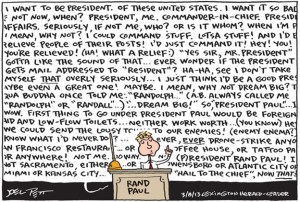
I certainly agree that the president shouldn’t have the power to kill Americans without due process, but I’d be more impressed with Paul if he supported other constitutional rights like equal treatment under the law for minorities, women and LGBT people. I can’t take anyone seriously as a defender of the Constitution if he opposes civil rights and the right of a woman to control her own body.
According to Grace Wyler at Business Insider, Libertarians Believe Their Moment Has Finally Arrived. On the other hand, Chris Cillizza explains why Why the Rand Paul filibuster might not be such good news for the GOP.
Everyone seems to be calling Paul’s filibuster “historic,” and no one is even mentioning the (IMO) much more dramatic and impressive filibuster by Bernie Sanders just a couple of years ago.
Sequestration cuts, anyone?
While the Village media types focus on either fawning over or condemning Rand Paul’s performance, local journalists around the country are reporting on the damage being done by sequestration cuts.
The debate over sequestration this past week has come down to two questions: Was the administration exaggerating the impact of the spending cuts, and did they really need to shut down White House tours because of them?
It’s been the predominant theme at the White House briefings, a constant subject of discussion on cable news and a topic of fascination on Capitol Hill. House Speaker John Boehner (R-Ohio) even took up the cause at a press briefing this week, saying: “I think it’s silly that they have insisted on locking down the White House, which the American people actually own.”
Beneath that debate, however, is a different type of conversation about the impact of the $85 billion in cuts. While the national media has focused on those two questions, local coverage has been more directed at the tangible impact the budget restraints will have. The Huffington Post reviewed dozens of local television news broadcasts, using the service TVeyes.com, to survey coverage of sequestration outside of the Beltway.
Check out the many examples of real pain for localities at the link. And besides, according to Buzzfeed, Nobody Liked The White House Tours That Much Anyway. They’re only rated 3.5 on Yelp. Read the negative reviews at the link.
Interesting book review at The Daily Beast
The Girls of the Manhattan Project.
They were the employees of the gigantic uranium-enrichment plant at Oak Ridge, Tenn.—those who lived and toiled in this purpose-built secret city in the Appalachian Mountains, many of them young women, had only been told that their efforts would help bring home American soldiers. Then, when atomic power was deployed against an enemy nation for the first (and so far, last) time, Oak Ridge residents realized what they had been working toward, and why their every move had been monitored, their every utterance policed, and their every question stonewalled.
In The Girls of Atomic City: The Untold Story of the Women Who Helped Win World War II, Denise Kiernan recreates, with cinematic vividness and clarity, the surreal Orwell-meets-Margaret Atwood environment of Oak Ridge as experienced by the women who were there. They were secretaries, technicians, a nurse, a statistician, a leak pipe inspector, a chemist, and a janitor. “Site X” began construction in late 1942, and was also known as the Clinton Engineering Works (CEW) and the Reservation. Staff members were recruited from all over the U.S., but particularly from nearby Southern states, and were offered higher than average wages, on-site housing and cafeterias, and free buses.
More importantly, they were offered the chance to join the 400,000 or so American women performing non-combatant roles in the armed services, as well as those keeping vital industries afloat and helping the men on the front lines. But whereas a female Air Force pilot or munitions factory worker understood precisely her contributions to the war effort, the women at Oak Ridge were kept in the dark about the actual purpose of their workplace, a mystery heightened by the apparent lack of anything ever leaving the site. Provided with “just enough detail to do their job well, and not an infinitesimal scrap more,” workers at all levels were forbidden from taking the slightest interest in anyone else’s duties. “Stick to your knitting,” in the words of Lieutenant General Leslie Groves, head of the Project.
That sounds like a fascinating book!
ABC News reports on a scary new virus–the coronaviris.

Coronavirus
Health officials are warning of a new virus that has sickened at least 14 people worldwide, killing eight of them.
There are no known American cases of the coronavirus, known as hCoV-EMC, but the U.S. Centers for Disease Control is urging doctors with patients who have an unexplained respiratory illness after traveling to the Arabian peninsula or neighboring countries to report the cases to the CDC.
Doctors should also report patients with known diseases who don’t respond to appropriate treatment, the agency said its Morbidity and Mortality Weekly Report. Close contacts of a symptomatic patient should also be evaluated.
The novel virus, which is associated with severe respiratory illness with renal failure, was first recognized last September and caused alarm because it is genetically and clinically similar to the SARS virus, which caused hundreds of deaths worldwide.
Read more at the CDC website.
A new archaeological theory about Stonehenge
The Guardian: Stonehenge may have been burial site for Stone Age elite, say archaeologists.

Centuries before the first massive sarsen stone was hauled into place at Stonehenge, the world’s most famous prehistoric monument may have begun life as a giant burial ground, according to a theory disclosed on Saturday.
More than 50,000 cremated bone fragments, of 63 individuals buried at Stonehenge, have been excavated and studied for the first time by a team led by archaeologist Professor Mike Parker Pearson, who has been working at the site and on nearby monuments for decades. He now believes the earliest burials long predate the monument in its current form.
The first bluestones, the smaller standing stones, were brought from Wales and placed as grave markers around 3,000BC, and it remained a giant circular graveyard for at least 200 years, with sporadic burials after that, he claims.
It had been thought that almost all the Stonehenge burials, many originally excavated almost a century ago, but discarded as unimportant, were of adult men. However, new techniques have revealed for the first time that they include almost equal numbers of men and women, and children including a newborn baby.
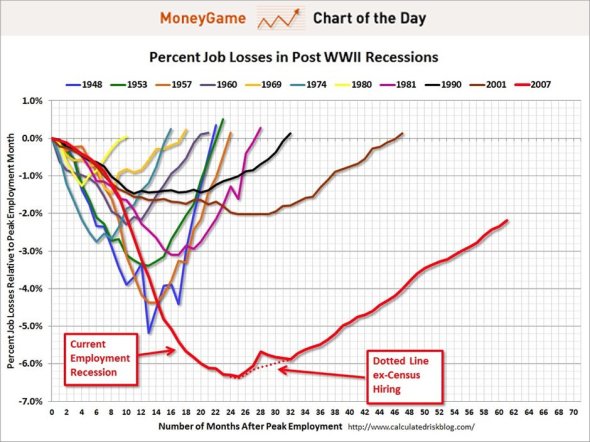
I’ll end with this “chart of the day” from Business Insider:
“The Scariest Jobs Chart Ever”

 peej
peej Carissa
 bostonboomer
 dakinikat
 ecocatwoman
 mablue2
 Mama Lopez
 peggysue22
 quixote
 skydancingguestblogger
 Mona (aka Wonk the Vote)



 Sky Dancing
Recent Comments