




Just weeks before Blackwater guards fatally shot 17 civilians at Baghdad’s Nisour Square in 2007, the State Department began investigating the security contractor’s operations in Iraq. But the inquiry was abandoned after Blackwater’s top manager there issued a threat: “that he could kill” the government’s chief investigator and “no one could or would do anything about it as we were in Iraq,” according to department reports.
American Embassy officials in Baghdad sided with Blackwater rather than the State Department investigators as a dispute over the probe escalated in August 2007, the previously undisclosed documents show. The officials told the investigators that they had disrupted the embassy’s relationship with the security contractor and ordered them to leave the country, according to the reports.
After returning to Washington, the chief investigator wrote a scathing report to State Department officials documenting misconduct by Blackwater employees and warning that lax oversight of the company, which had a contract worth more than $1 billion to protect American diplomats, had created “an environment full of liability and negligence.”
Tuesday Reads: Autumnal Equinox Edition
Posted: September 23, 2014 Filed under: Barack Obama, Foreign Affairs, morning reads, U.S. Economy, U.S. Politics | Tags: ancient graves, Autumnal Equinox, Festival of Mabon, Harvest festival, inversion rules, Jacob Lew, Jeremy Roloff, little people, US Airstrikes in Syria, US Treasury, Wall Street 25 Comments
Good Morning Sky Dancers!!
Today is 2014’s autumnal equinox, when day and night are equal in length. From now on, the days will get shorter and the nights longer, as we approach winter. Actually, autumn officially began in the Northern Hemisphere last night at 10:29 Eastern time.
Astronomically speaking…the fall season…comes to the Northern Hemisphere on Tuesday, September 23rd at 2:29 Universal Time (10:29 p.m. EDT on Monday, the 22nd). At that moment, the Sun shines directly on Earth’s equator, heading south as seen in the sky. For us northerners, this event is called the autumnal equinox….
The apparent position of the Sun in our sky is farther north or farther south depending on the time of year due to the globe’s axial tilt. Earth’s rotational axis does not point straight up and down, like the handle of a perfectly spinning top, but is slanted about 23½° with respect to our orbit around the Sun.
Another way to think of this is that the plane defined by Earth’s orbit around the Sun (called the ecliptic) is tilted with respect to the planet’s equator. From our perspective, the Sun follows the ecliptic in its path through the sky throughout the year. Each day the Sun’s daily arc moves northward or southward, depending on the time of the year. To observers at northern latitudes (in the U.S., Canada, and Europe, for example), the Sun appears to sneak higher in the sky from late December to late June, only to drop down again from late June through late December. The equinox occurs when the Sun is halfway through each journey.
This axial tilt also produces our seasons. When Earth is on one side of its orbit, the Northern Hemisphere is tipped toward the Sun and receives more direct solar rays (and more daylight hours) that produce the familiar climes of summer. Six months later, when Earth is on the opposite side of its orbit, the Northern Hemisphere is tipped away from the Sun. The slanting solar rays heat the ground less and daylight is shorter, producing the colder winter season.
What else happens at the equinox?
Day and night are nearly the same length; the word “equinox” comes from the Latin aequinoctium, meaning “equal night,” according to the Oxford English Dictionary. However, a poke around your almanac will show that day and night are not precisely 12 hours each, for two reasons: first, sunrise and sunset are defined as when the Sun’s top edge — not its center— crosses the horizon. Second, Earth’s thick atmosphere refracts the Sun’s apparent position slightly when the solar disk sits very low on the horizon.
The Sun rises due east and sets due west, as seen from everywhere on Earth; the equinoxes are the only times of the year when this occurs.Should you be standing on the equator, the Sun would pass exactly overhead at midday.
Were you standing at the North Pole or South Pole, the Sun would skim completely around the horizon.

Harvesting, by G. Myasoedov
The autumnal equinox marks the pagan festival of Mabon, “when livestock is slaughtered and preserved to provide enough food for the winter.” From Huffington Post,
Mabon is a harvest festival, the second of three, that encourages pagans to “reap what they sow,” both literally and figuratively. It is the time when night and day stand equal in duration; thus is it a time to express gratitude, complete projects and honor a moment of balance.
“Mabon is a time to reflect on the previous year, when we can celebrate our successes (likened to bringing in the harvest) and assess which crops, projects, or dreams didn’t come to fruition,” the Los Angeles-based pagan leader Laurie Lovekraft told HuffPost.
The pagan website The White Goddess explains:
This is the time to look back not just on the past year, but also your life, and to plan for the future. In the rhythm of the year, Mabon is a time of rest and celebration, after the hard work of gathering the crops. Warm autumn days are followed by chill nights, as the Old Sun God returns to the embrace of the Goddess.
The holiday is named after the Welsh God, Mabon, son of Earth Mother goddess Modron.
Some pagans mark the holiday by enjoying rich feasts with seasonal foods like apples, pomegranates and root vegetables. Many also observe rituals honoring the goddess’transition from mother to crone.
Endless War News
The US (and some Arab allies) have carried out airstrikes in Syria. From The Guardian, US confirms 14 air strikes against Isis in Syria.
The most intensive barrage of air strikes launched against Islamic State (Isis) since the US fight against the terror group began last month thundered into northern Syria until after dawn on Tuesday, heralding a new phase of a war that Sunni regional powers have vowed to help lead.
Large explosions were reported in the group’s stronghold of Raqqa, in eastern Syria, as well as in Idlib province. There were unconfirmed reports that attacks had also taken place near Deir Azzor and western Aleppo.
A Pentagon statement said the 14 strikes against Isis targets were carried out with Bahrain, Jordan, Saudi Arabia, the United Arab Emirates and Qatar. Jordan confirmed it its airforce had “destroyed a number of targets that belong to some terrorist groups that sought to commit terror acts inside Jordan” without making explicit reference to Syria.
More details from The New York Times (I’m unable to quote from the article), and from The BBC,
The Pentagon said warplanes, drones and Tomahawk missiles were used in the attacks, which targeted several areas including IS stronghold Raqqa.
Syria’s foreign ministry said its UN envoy was informed about the strikes against IS, which controls large swathes of Syria and Iraq.
Activists say at least 70 IS militants were killed in the strikes….
It said a total of 14 strikes destroyed or damaged IS training compounds, command and control facilities, vehicles and storage sites.
The US military will continue to conduct air strikes against IS targets in Iraq and Syria, it added.
US Gen Martin Dempsey, America’s highest-ranking uniformed military officer, said the strikes were conducted to show IS militants they had no safe haven. “We certainly achieved that,” he told reporters.
Separately, Centcom said US forces also attacked a network of al-Qaeda veterans named Khorasan who had established a safe haven west of Aleppo and were plotting imminent attacks against the West.
Experts say members of the secretive group are believed to co-operate with al-Nusra Front – Syria’s al-Qaeda-affiliate – using its training bases and resources.
President Obama plans to speak about the Syrian strikes this morning at 10AM.

Autumn landscape, by Vincent Van Gogh
Economics News
The U.S. Treasury Department has issued a new tax rules designed to prevent companies from moving operations out of the U.S. Bloomberg Businessweek reports, Lew Tries to Limit Tax-Cut Deals With Inversion Crackdown.
Treasury Secretary Jacob J. Lew’s crackdown on inversions will get an immediate test as eight U.S. companies with pending deals decide whether to proceed — and other companies contemplating a foreign address now have to think twice.
That’s exactly what Lew had in mind.
“This action will significantly diminish the ability of inverted companies to escape U.S. taxation,” Lew told reporters on a conference call yesterday. “For some companies considering deals, today’s action will mean that inversions no longer make economic sense.”
The Treasury announcement heightened the tension between the government and companies considering obtaining a foreign address to lower their tax bills. Lew and President Barack Obama made clear that they were prepared to use rule-making authority to try stop some deals, even at the risk of a backlash from the companies and from Republicans, who already complained that Lew’s moves went too far.
A wave of inversions caught lawmakers’ attention this year when large companies such as Pfizer Inc. (PFE) andWalgreen Co. (WAG) explored transactions andMedtronic Inc. (MDT), AbbVie Inc. and Burger King Worldwide Inc. (BKW) moved forward with deals.
More from The Wall Street Journal:
Treasury officials took action under five sections of the U.S. tax code to make inversions harder and less profitable, removing some of the appeal that has made the transactions more common in recent years, particularly in the pharmaceutical industry.
In an inversion, an American company reincorporates for tax purposes in a tax-friendlier country such as the U.K. or Ireland, typically while maintaining much of their operations in the U.S. Most recent inversions sprang from mergers of a U.S. firm with a smaller foreign firm after regulatory steps taken during President Barack Obama’s first term curbed other types of inversions.
The Treasury rules will make it harder for companies that invert to use cash accumulating abroad—a big draw in recent deals. In addition, the government has made it more difficult to complete these overseas mergers.
The tax changes took effect immediately, officials said, and applied to all deals that hadn’t closed by Monday.

Autumn Forest, by Thomas Kinkade
And from the AP via Bloomberg, Ahead of the Bell: Inversion rules sting stocks.
Shares of several companies stumbled Tuesday before markets opened and a day after the Treasury Department announced new regulations that aim to make it tougher to pull off overseas mergers and acquisitions that trim U.S. corporate tax bills.
The new measures attempt to keep companies from finding ways to access earnings from a foreign subsidiary without paying U.S. taxes, including “hopscotch” loans, in which companies shift earnings by lending money to the new foreign parent company while skipping over the U.S.-based company. Another rule change would make it harder for merged or acquired companies to benefit from lower foreign taxes by tightening the application of a law that says the American company’s shareholders must own less than 80 percent of the new, combined company.
About 50 U.S. companies have carried out moves known as inversions in the past decade, and more are considering it, according to the nonpartisan Congressional Research Service.
An inversion happens when a U.S. corporation and a foreign company combine, with the new parent company based in the foreign country. For tax purposes, the U.S. company becomes foreign-owned, even if all the executives and most of its operations remain in the U.S. Inversions can help companies generate significant tax savings over time in part because the United States has the highest corporate income tax rate in the industrialized world, at 35 percent.
Awwwwwwww . . . too bad corporate bigwigs. I so don’t feel sorry for you.
Offbeat News
I have a few offbeat stories for you. The first one is especially for JJ. ABC News reports, ‘Little People, Big World’ Star Jeremy Roloff Is Married.
“Little People, Big World” star Jeremy Roloff, 24, married Audrey Mirabella Botti Saturday afternoon in Oregon.
Autumn Landscape, by Wassily Kadinsky
Jeremy’s twin brother, Zach, was his best man, while the bride wore a gown designed by Lauren Graebner of Eva’s by Reclamation, People magazine reports.
The bridesmaids wore flower crowns and Botti, 23, wore a larger crown designed by Vanessa Schmidt. Roloff wore a suit from ProperSuit, which he shared on social media.
More details, photos, and tweets at the link.
From the Leicester Mercury (UK), Pictures released of two 1,000-year-old skeletons holding hands found in Leicestershire.
Pictures were released today by the University of Leicester, showing two 1,000-year-old skeletons holding hands, which have been discovered.
The pair of skeletons, which are centuries-old and holding hands have been uncovered at a ‘lost’ chapel by archaeologists.
The Mercury reported last week that the remains, of a man and a woman, were found at the Chapel of St Morrell, an ancient site of pilgrimage in Hallaton.
It is believed the pair holding hands are of a similar age.
Whoever they were, the man and woman must have died at the same time.
Leading the project is professional archaeologist Vicky Score, of the University of Leicester, who works on the project during her holidays.
She said carbon-dating on nine skeletons uncovered since the dig began had revealed them to be from the 14th century.
“’We have seen similar skeletons before from Leicester where a couple has been buried together in a single grave. The main question we find ourselves asking is why were they buried up there?” she added.
“There is a perfectly good church in Hallaton. This leads us to wonder if the chapel could have served as some sort of special place of burial at the time.”
See more photos at ABC News.
I found earlier articles about skeletons of couples embracing each other. From NBC News, Prehistoric Romeo and Juliet Discovered.
ROME, Feb. 7, 2007 — They died young and, by the looks of it, in love. Two 5,000-year-old skeletons found locked in an embrace near the city where Shakespeare set the star-crossed tale “Romeo and Juliet” have sparked theories the remains of a far more ancient love story have been found.
Archaeologists unearthed the skeletons dating back to the late Neolithic period outside Mantua, 25 miles south of Verona, the city of Shakespeare’s story of doomed love.
Buried between 5,000 and 6,000 years ago, the prehistoric pair are believed to have been a man and a woman and are thought to have died young, because their teeth were found intact, said Elena Menotti, the archaeologist who led the dig.
“As far as we know, it’s unique,” Menotti told The Associated Press by telephone from Milan. “Double burials from the Neolithic are unheard of, and these are even hugging.”

Autumn Garden, by Vincent Van Gogh
Another one from HuffPo, Skeletons ‘Embracing’ In Death May Represent Gruesome Ancient Siberian Custom.
For years researchers in the Novosibirsk region of Siberia have puzzled over dozens of ancient grave sites containing bodies buried face to face, some seemingly with hands clasped as if in an eternal embrace.
But soon DNA tests may help provide an answer to the key question: Are these the graves of star-crossed lovers, or could the remains be evidence of a gruesome ancient custom?
The bodies are part of a massive burial ground located in the Siberian village of Staryi Tartas, the Siberian Times reported. Altogether, close to 600 tombs have been discovered in the area, dozens of which contain the so-called “embracing” couples.
The graves are believed to belong to the Andronovo culture, which existed in the area during the second and first millennia B.C.E., according to Britannica. Yet many of the bodies in the graves are believed to be from the 15th, 16th and 17th Centuries B.C.E., the Siberian Times reported….
“We can fantasize a lot about all this,” Vyacheslav Molodin, an archaeology and ethnography expert at the Russian Academy of Sciences, told the Siberian Times. “We can allege that husband died and the wife was killed to be interred with him as we see in some Scythian burials, or maybe the grave stood open for some time and they buried the other person or persons later, or maybe it was really simultaneous death.”
What else is happening? Please post your thoughts and links in the comment thread.
Thursday Reads: They Shall Be Released
Posted: September 4, 2014 Filed under: Barack Obama, Foreign Affairs, morning reads, U.S. Economy, U.S. Politics | Tags: austerity, bob, Bob Dylan, bootlegs, civil rights investigation, Connecticut, Eric Holder, European Central Bank, Ferguson MO, interest rates, Mario Draghi, NATO Summit, Putin "peace plan", rabid bobcat, The Band, The Basement Tapes, Ukraine, US Department of Justice 48 Comments
Good Morning!!
President Obama is meeting with other NATO leaders in Newport, Wales today, and the focus of meetings will be Russia’s encroachment into Ukraine and how to deal with it. The Christian Science Monitor reports: NATO members gather in Wales with Russia at the top of the agenda.
Russia faced harsh criticism at the start of a North Atlantic Treaty Organization (NATO) summit in Wales today with the 28 member state alliance reevaluating its security role in Europe amid the ongoing crisis in Ukraine.
NATO Secretary General Anders Fogh Rasmussen said the alliance continues to witness “Russian involvement in destabilizing the situation in eastern Ukraine” even after Russian President Vladimir Putin proposed a seven-point peace plan. Russia maintains it has not armed rebels in eastern Ukraine or contributed to the conflict there.
Early reports from the summit suggest NATO leaders are set to agree to create “rapid reaction” forces that could be deployed in less than two days to regional crisis spots. Countries close to Russia, especially Poland, have called for NATO to permanently station troops on their territory, but Reuters reports this is unlikely to happen because it would break a 1997 agreement the alliance made with Russia.
As the Monitor reported, the creation of rapid response forces wouldthrust the United States into the center of any future conflict.
Terrific. Supposedly, Russian president Vladimir Putin in proposing a cease-fire, but he’s offering few specifics. From The New York Times: Putin Lays Out Proposal to End Ukraine Conflict.
Mr. Putin’s peace plan, jotted out during a plane ride over Siberia, muddied the diplomatic waters, leaving the West an excuse for delaying punitive sanctions that would also hurt European economies on the verge of a new recession. And it was expected to have some appeal to war-weary Ukrainians.
The ultimate effect, coming after Russian troops intervened in Ukraine last week to beat back a successful government offensive, may be to leave the country as a loose coalition that Moscow could still dominate, which critics of the Russian president say is his real aim.
It is being called a “seven-point plan,” but according to the Times,
Mr. Putin’s plan seemed to raise more questions than it answered. First, there was no mechanism for implementation. Second, just hours earlier, his own spokesman had repeated the Russian position, widely criticized as implausible, that Moscow could not negotiate a cease-fire because it was not a direct party to the conflict.
Analysts suggested that Mr. Putin’s strategy is to convince Kiev that it must negotiate, not fight, and to reinforce the idea that the overall outcome depended on Moscow.
“Russia wants to show that it is in command of what is happening,” said Fyodor Lukyanov, editor of a prominent Russian foreign policy journal. “For Russia, it is important first to prevent the Ukrainians from thinking that they could win militarily, and to accept the separatist leaders as partners in negotiations.”
A few more headlines and opinions:
Al Jazeera: NATO summit to highlight unity against Russia.
Wall Street Journal: As Leaders Meet for NATO Summit, Alliance Says Russian Troops Still Active in Ukraine.
Foreign Policy: NATO’s Make or Break Moment (opinion).
Bloomberg: NATO Shifts Aim From Waterloo to East as Russia Menaces (opinion).

European Central Bank News
The European Central Bank’s Mario Draghi finally decided to try to do something about Europe’s horrible economic situation. From the NYT: European Central Bank to Start Asset Purchases After Further Rate Cut.
FRANKFURT — Bolstering a surprise interest rate cut on Thursday, the European Central Bank will soon begin buying packages of bank loans in an effort to stimulate lending in the faltering eurozone economy.
The move is unprecedented, but appears to fall short of the broad, large-scale asset purchases advocated by many economists to prevent stagnation in the eurozone.
The central bank said that in October it would begin buying asset-backed securities, bundles of loans issued by banks to businesses and households. The central bank will also buy covered bonds, Mario Draghi, the E.C.B. president said. Covered bonds are similar to asset-backed securities, in that they also are made up of bank loans.
Perhaps more significantly, Mr. Draghi said that the central bank’s governing council was ready to take further measures if needed — a clear reference to quantitative easing, or broad-based purchases of government bonds or other assets.
Mr. Draghi did not say how much the central bank would spend buying asset-backed securities and covered bonds, adding that there was not yet enough information on the size of the market. He said the central bank would buy existing and new assets including residential and corporate loans. He said the purchases would be “significant,” if still short of a level considered quantitative easing.
More headlines:
CTV News: European Central Bank trims key interest rate to record low.
Marketwatch: U.S. stocks open up after ECB rate cut.
Ferguson Civil Rights Investigation
As we heard yesterday, the Justice Department will likely announce today that it is launching a civil rights investigation of the Ferguson, Missouri Police Department.
From The Washington Post: Justice Dept. to probe Ferguson police force.
Attorney General Eric H. Holder Jr. this week will launch a broad civil rights investigation into the Ferguson, Mo., Police Department, according to two federal law enforcement officials.
The investigation, which could be announced as early as Thursday afternoon, will be conducted by the Justice Department’s civil rights division and follow a process similar to that used to investigate complaints of profiling and the use of excessive force in other police departments across the country, the officials said.
The federal officials said the probe will look not only at Ferguson but also at other police departments in St. Louis County. Some, like Ferguson, are predominantly white departments serving majority-African-American communities, and at least one department invited the Justice Department to look at its practices. The officials spoke on the condition of anonymity to discuss the pending inquiry.
The investigation is in addition to a Justice Department probe into whether Officer Darren Wilson, who fired the fatal shots, violated Brown’s civil rights. The new probe will look more broadly at whether the department employed policies and practices that resulted in a pattern of civil rights violations.
The Washington Post reported Saturday that five current and one former member of the Ferguson police force face pending federal lawsuits claiming they used excessive force. The lawsuits, as well as more than a half-dozen internal investigations, include claims that individual officers separately hog-tied a 12-year-old boy who was checking his family mailbox, pistol-whipped children and used a stun gun on a mentally ill man who died as a result.
More from The New York Times: Justice Dept. Inquiry to Focus on Practices of Police in Ferguson.
Ferguson’s police chief, Thomas Jackson, said in an interview on Wednesday night that he would welcome the investigation.
“We’ve been doing everything we can to become a professional police department and a professional city,” he said. “We have no intentional policies or procedures which discriminated or violated civil rights. But if we have anything there which may unintentionally do that, we need to know about it.”
Chief Jackson said he met with Justice Department officials on Wednesday afternoon and discussed the broader investigation. “Obviously, we have gaps. And any help we can get to help fill those gaps and to make ourselves stronger, we welcome,” he said.
What a crock of sh&t that is! I’ll just bet Jackson is thrilled about the Justice Department probe into his joke of a police force. Wouldn’t you love to hear what he’s saying privately?
In the Ferguson case, the Justice Department will conduct what it calls a “pattern or practice” investigation, with officials looking for evidence that the police have repeatedly violated residents’ civil rights. Such inquiries have been one of the Justice Department’s preferred tactics in addressing accusations of police misconduct.
Rabid Bobcat Attacks
Here’s a strange story I came across yesterday in The Boston Globe: Rabid Bobcat Spent Labor Day Weekend in Conn. Attacking People.
What’s worse than stumbling upon an angry bobcat on your nightly walk with your newborn daughter? Stumbling upon an angry, rabid bobcat on your nightly walk with your newborn daughter.
That’s what happened to Summer and Tom Berube last Sunday. The Lebanon, CT, couple were taking their evening walk with their infant daughter, Neeve, when a bobcat approached them.
According to NECN, the bobcat hissed and ran towards Tom, who was carrying his baby. Tom yanked a mailbox out of the ground and used it to defend his family, knocking the animal down when it leapt at him. Summer, meanwhile, said she “was just screaming at the top of my lungs for help.”
That help soon came from the Department of Energy and Environmental Protection, which had already been alerted to the presence of an aggressive bobcat in the area. On Saturday, a woman in the neighboring Connecticut town of Bozrah was attacked by a bobcat while feeding her chickens. She was scratched and bitten, but quickly taken to a local hospital for treatment. If caught early enough, a postexposure vaccination prevents the disease from spreading.
I had no idea there were bobcats running around in New England, but according The Hartford Courant, although sightings are rare, “Bobcats are common in Connecticut and are found in every town. They can weigh as much as 40 pounds, but rarely interact with people and rarely have rabies, DEEP said.”
They Shall Be Released
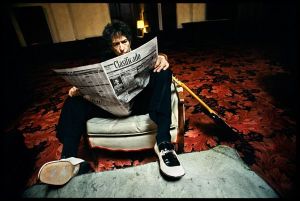
Maybe you’re wondering why I’ve illustrated this post with photos of Bob Dylan. In 1968, I bought a two-record album in a plain white cover that was being sold by a street hawker in Harvard Square. I learned this morning from Wikipedia that it was known as “The Great White Wonder,” but either I didn’t know that then or I’ve forgotten. The recording was a bootleg of Bob Dylan’s so-called “basement tapes,” recorded in Woodstock, NY, with backup from The Band. Later, in 1975, a selection of the songs they had recorded was released as a studio album.
Anyway, the basement tapes are back in the news, because they are all going to be released as a 6-CD set.
The Guardian reports: Bob Dylan to share full Basement Tapes.
Bob Dylan is sharing the rest of his Basement Tapes. Four decades after the singer released 24 songs under that title – cuts he recorded with the Band in upstate New York – his label have agreed to unveil 114 more tracks from the same 1967 sessions.
“Some of this stuff is mind-boggling,” Sid Griffin, author of the set’s liner notes,told Rolling Stone. Packaged under the title The Basement Tapes Complete: The Bootleg Series Vol. 11, the six-CD set incorporates alternate versions of Blowin’ In The Wind and It Ain’t Me Babe, covers of tunes by Johnny Cash and Curtis Mayfield, and at least 30 tracks that Rolling Stone claims “even fanatical Dylan fans never knew existed”. A shorter, two-disc compilation, The Basement Tapes Raw, will present 12 of the unreleased tracks alongside the original LP.
Almost all of this material was harvested from reel-to-reel tape: 20 tapes in all, which the Band’s Garth Hudson kept stored in his Woodstock home. Jan Haust, a Toronto-based collector, acquired the archive about 10 years ago; he worked with Dylan’s reps to find a way to put them out. Although a few tapes were allegedly missing, and a handful of recordings “just [sounded] like a distortion”, everything else is making its way to the public. “We usually curate these packages more, but we knew the fans would be disappointed if we didn’t put out absolutely everything,” an unnamed Dylan source told Rolling Stone.
Fans of The Basement Tapes have always known that there was unreleased material. There have been several expanded, bootleg editions over the years, and musicians have even turned their attention to Dylan’s unreleased Basement Tapes-era lyrics. Earlier this year, T Bone Burnett collaborated with Marcus Mumford, Elvis Costello and others to record their own versions of his incomplete songs. “The stuff that people haven’t heard justifies, in every way, shape and form, all the hype, hubris and myth that surrounds these tapes,” Griffin promised.
USA Today has published a list of all the songs on the album to be released in November.
So . . . what else is happening? Please post your thoughts and links in the comment thread, and have a tremendous Thursday!
Tuesday Reads
Posted: August 26, 2014 Filed under: Barack Obama, Foreign Affairs, France, George W. Bush, Germany, Iraq, morning reads, racism, Syria, U.S. Economy, U.S. Politics, unemployment | Tags: Al Nusra Front, al Qaeda, Angela Merkel, austerity, European Central Bank, Ferguson MO, ISIS, James W. Foley, Janet Yellen, Mario Draghi, Michael Brown, Peter Theo Curtis, The Islamic State, the NEW York Times 41 Comments
The Dog Days of Summer, Janet Hill
Good Morning!!
It’s the last week of August, and the dog days of summer have supposedly passed; but the Boston area is supposed to hit ninety degrees today and tomorrow. I’m actually looking forward to it, because it has been so cool here lately–in the sixites and low seventies in the daytime and the fifties at night. Yesterday it got into the high eighties, and it felt wonderful.
The Boston Globe has a story today about Peter Theo Curtis, the writer who was just released from captivity in Syria. His mother lives in Cambridge. I had never heard of Curtis before; apparently his kidnapping was kept secret. The Globe reports: Militants free US writer with Mass. ties who was held in Syria.
Peter Theo Curtis, a writer and scholar with ties to the Boston area who was held captive for nearly two years by one of the Islamic militant groups operating in Syria, was released Sunday after emissaries from the government of Qatar won his freedom on humanitarian grounds, in a stark contrast to the brutal murder of fellow war correspondent James W. Foley .
Curtis’s 22 months in captivity were kept from the public at his family’s request since he was nabbed near the Syrian border in October 2012 by Al Nusra Front, one of the groups seeking to topple President Bashir Assad of Syria. Al Nusra Front has ties to the Al Qaeda terrorist network.
Curtis, 45, who wrote dispatches under the name Theo Padnos and previously chronicled disaffected young Muslims in Yemen in a book titled “Undercover Muslim,” had studied Arabic in Syria.
He was handed over to United Nations peacekeepers in the Israeli-occupied Golan Heights on Sunday evening, a UN spokesman in New York said. After it was determined he was in good medical condition, he was transferred to representatives of the US government, according to the UN.
“We are so relieved that Theo is healthy and safe and that he is finally headed home after his ordeal,” his mother, Nancy Curtis, who lives in Cambridge, said in a statement, “but we are also deeply saddened by the terrible, unjustified killing last week of his fellow journalist, Jim Foley, at the hands of the Islamic State in Iraq and Syria, ISIS.”
Foley was from New Hampshire, and the two families have gotten to know each other well, according to Curtis.

Garden Shed – Late Summer, KK Marais
Syria and Iraq
President Obama has authorized surveillance flights over Syria, according to BBC News.
Correspondents say the move could mark the first step towards US air strikes inside Syria, where the jihadist group controls vast swathes of territory.
The US is already carrying out strikes against IS in neighbouring Iraq.
On Monday, the Syrian government said it would work with the international community in the fight against IS.
Western governments have so far rejected suggestions that they collaborate with President Bashar al-Assad in an attempt to counter the growing regional threat posed by IS….
On Monday evening, US officials said Mr Obama had approved over the weekend reconnaissance flights by unmanned and manned aircraft, including drones and possibly U2 spy planes.
The US military has been carrying out aerial surveillance of IS – an al-Qaeda breakaway formerly known as Isis – in Iraq for months and launched air strikes on 8 August.
From The Boston Globe, citing “AP sources,” U.S. planes have already begun flying over Syria.
KABUL, Afghanistan (AP) — The U.S. has begun surveillance flights over Syria after President Barack Obama gave the OK, U.S. officials said, a move that could pave the way for airstrikes against Islamic State militant targets there.
While the White House says Obama has not approved military action inside Syria, additional intelligence on the militants would likely be necessary before he could take that step. Pentagon officials have been drafting potential options for the president, including airstrikes.
One official said the administration has a need for reliable intelligence from Syria and called the surveillance flights an important avenue for obtaining data.
Two U.S. officials said Monday that Obama had approved the flights, while another U.S. official said early Tuesday that they had begun. The officials were not authorized to discuss the matter by name, and spoke only on condition of anonymity.
Jim Michaels of USA Today spoke to Gen. Dempsey on Sunday about what is being done to deal with ISIS in Iraq.
ABOARD A U.S. MILITARY AIRCRAFT — U.S. airstrikes on Islamic militants in Iraq have blunted their momentum, but defeating them will require a broad regional approach that draws support from Iraq’s neighbors and includes political and diplomatic efforts, the top U.S. military officer said.
The long-term strategy for defeating the militants includes having the United States and its allies reach out to Iraq’s neighbors, including Jordan, Saudi Arabia and Turkey, Gen. Martin Dempsey, chairman of the Joint Chiefs of Staff, said Sunday….
Dempsey is working with Central Command to prepare “options to address [the Islamic State] both in Iraq and Syria with a variety of military tools including airstrikes,” said Col. Ed Thomas, Dempsey’s spokesman, in a statement.
The militant group Islamic State, also known as ISIS, has shown itself to be so brutal that Iraq and the U.S. should be able to find “willing partners” to join efforts to defeat the militants, Dempsey said.
But military power won’t be enough, Dempsey said. The strategy must take a comprehensive approach that includes political and diplomatic efforts to address the grievances of millions of Sunnis who have felt disenfranchised by Iraq’s Shiite-dominated government, he said.

Late Summer Garden, John Gordon
I get the feeling that we’re never going to escape involvement in the endless Middle East conflicts, thanks to George W. Bush, Dick Cheney, and the rest of the neocon gang. What a horrible mess! We have our own messes to deal with here, but foreign wars always seem to trump the needs of the American people.
John Cassidy speculates at The New Yorker: What’s Next in Iraq and Syria?
On his first full day back from vacation, President Barack Obama could be forgiven for wishing he were still on Martha’s Vineyard. With confirmation that ISIS fighters have just captured another military base from the government forces of President Assad, and that Qatar has engineered the release of an American freelance journalist who was being held by a non-ISIS jihadist group, Obama has two formidable challenges to deal with.
The immediate task for Obama is deciding whether to launch American bombing raids on ISIS positions inside Syria, while simultaneously preparing his Administration, and the country at large, for the possibility of another video showing an American hostage being butchered. The ISIS militants, having carefully orchestrated the beheading of James Foley following the launch of U.S. strikes inside Iraq, will surely seek to exploit the fate of its remaining American hostages for maximum effect. Any U.S. decision to expand its air campaign is almost certain to be met with the release of more snuff films.
No President—no American—could take such a prospect lightly. At the same time, Obama has to guard against allowing emotion and wishful thinking to take over U.S. policy. That’s what happened after 9/11, and some of the chaos that we now see in the Middle East can be traced back to that historic blunder. What’s needed is calm cost-benefit analysis of the options open to the United States, taking account of its strategic interests, its values, and its capabilities. In short, we need what Danny Kahneman, the Princeton psychologist who pioneered behavioral economics, would refer to as some Type 2 thinking: a disciplined weighing of the likely consequences of our actions. If we give into our Type 1 reaction—horror, outrage, anger—we will be playing into the hands of the jihadists.
One place to start is by acknowledging two errors in thinking that have blighted U.S. policy in the past decade: the conservative delusion that the United States could, more or less single-handedly, use its military power to reinvent the Middle East, and the liberal illusion that we could simply walk away from the mess that Bush, Cheney & Co. created. Without the political willingness and the financial capability to garrison the region in the manner of postwar Germany and Japan, U.S. influence has to be exercised through air power, political proxies, economic inducements, and regional alliances. But that doesn’t diminish the fact that the United States and other Western countries have vital interests at stake, one of which is preventing the emergence of a rogue Islamic state that would provide a rallying point, and a safe haven, for anti-Western jihadists the world over.
Read the whole thing at the link.

A Garden in a Sea of Flowers, Ross Turner
The Economies of the U.S. and Europe
There has been so much breaking news for the past couple of months that we haven’t talked much about the economies of the U.S. and Europe. But today the European Central Bank is topping the headlines, and last week Fed Chairperson Janet Yellen spoke at Jackson Hole, so I thought I’d post a few economics stories.
Here’s CNN Money’s report on Yellen’s speech, Janet Yellen: Job market not recovered.
That was Federal Reserve Chair Janet Yellen’s main message Friday in a much anticipated speech.
“It speaks to the depth of the damage that, five years after the end of the recession, the labor market has yet to fully recover,” she said.
The debate now is whether the job situation in America is healthy enough for the Federal Reserve to start raising interest rates, which have been at historic lows in recent years in an effort to jump start the economy. Yellen, however, said little new on Friday, and U.S. stock markets stayed flat.
Yellen is chair of the committee that sets interest rates, but she only gets one vote. Other members have differing views. The Fed board and other top economists are spending the weekend in Jackson Hole, Wyoming, debating these key issues.
Though the unemployment rate “has fallen considerably and at a surprisingly rapid pace,” Yellen said problems remain.
Yellen called attention to what Americans in the job market already know–though the employment numbers look better, many people have stopped looking for work, and most of the new jobs are part-time and pay low wages.
A few more U.S. economy stories to check out:
The Wall Street Journal: Fed’s Yellen Remains Mum on Timing of Rate Change.
Bloomberg Businessweek: Yellen Job-Slack View Muddied by Pent-Up Wage Deflation.
Slate: The Fed Is Not As Powerful As We Think.
If you think the economy is struggling here, you should take a look at Europe, where austerity thinking has ruled since the economic crisis hit. Yesterday the French government collapsed. From The New York Times, French Cabinet Is Dissolved, a Victim of Austerity Battles.
PARIS — The collapse of the French government on Monday exposed widening divisions both within France’s leadership, and Europe more broadly, over austerity policies that many now fault for threatening to tip the eurozone back into recession.
Prime Minister Manuel Valls announced that he would dissolve his government after a rancorous battle in his cabinet over whether the belt-tightening measures taken by President François Hollande — at the urging of Germany and European Union officials in Brussels — were impeding France’s recovery.
The dispute broke into the open when Mr. Vall’s outspoken economy minister, Arnaud Montebourg, insisted in an interview over the weekend that austerity had gone too far. “The priority must be exiting the crisis, and the dogmatic reduction of deficits should come after,” he told the newspaper Le Monde.
He also took direct aim at the policies of Angela Merkel, the German chancellor. “Germany is caught in a trap of austerity that it is imposing across Europe,” he said.
Even the formerly strong German economy is struggling now, according to Reuters (via NYT), Crisis in Ukraine Drags Economy in Germany.
The eurozone’s flatlining economy took another hit on Monday when data showed German business sentiment sagging for the fourth consecutive month. Chancellor Angela Merkel attributed some of her own country’s decline in the second quarter to the Russia-Ukraine crisis, over which tit-for-tat sanctions threaten trade. The Munich-based Ifo, a research firm, echoed some of those sentiments as it reported its business climate index, based on a monthly survey of some 7,000 companies, fell to a worse-than-expected 106.3 from 108, the lowest level in more than a year. The findings agreed with data earlier in the month on the second-quarter contraction in Germany, the bloc’s biggest economy. Klaus Wohlrabe, an Ifo economist, said his institute expected growth in Germany to be “close to zero” in the third quarter.
A few more headlines on the European economic situation:
The Guardian: An austerity revolt has broken the French government. Will the EU follow?
Bloomberg Businessweek on the European Central Bank, Draghi May Again Find Bazooka Words Beat Action With QE, and an editorial from The Financial Times, Central banks at the crossroads.

Wisteria Flowers in Bloom at Pergola at Portland Japanese Garden Stone Path
Ferguson Stories
Yesterday, on the day of Michael Brown’s funeral, The New York Times published a story that got a great deal of attention because of its insensitive characterization of the dead teenager. Here the paragraph that attracted the angry reaction:
Michael Brown, 18, due to be buried on Monday, was no angel, with public records and interviews with friends and family revealing both problems and promise in his young life. Shortly before his encounter with Officer Wilson, the police say he was caught on a security camera stealing a box of cigars, pushing the clerk of a convenience store into a display case. He lived in a community that had rough patches, and he dabbled in drugs and alcohol. He had taken to rapping in recent months, producing lyrics that were by turns contemplative and vulgar. He got into at least one scuffle with a neighbor.
Would the authors have written a similar paragraph about a white homicide victim? From Vox, The New York Times called Michael Brown “no angel.” Here’s how it described serial killers.
The New York Times’s description of Michael Brown as “no angel” has prompted a swift, critical reaction from other media outlets, including Vox, and various people on social media.
Alison Mitchell, national editor for the Times, defended the term in conversations with the Washington Post’s Erik Wemple:
“It comes out of the opening scene,” says Mitchell, who notes that “like many teenagers,” Brown was indeed “no angel.” Okay, but would the New York Times have chosen this term — which is commonly used to describe miscreants and thugs — if the victim had been white? Mitchell: “I think, actually, we have a nuanced story about the young man and if it had been a white young man in the same exact situation, if that’s where our reporting took us, we would have written it in the same way.” When asked whether she thought that “no angel” was a loaded term in this context, Mitchell said she didn’t believe it was. “The story … talks about both problems and promise,” she notes.
The Times’s response has done little to calm the storm. Sean McElwee, research assistant at Demos, dug into the archives to compare the Times’s description of Brown to the newspaper’s previous descriptions of serial killers and terrorists. Of course, comparing articles produced decades apart by different writers and editors isn’t an exact science. But it does lend context to the widespread frustration over how young black men are portrayed in the media.
A series of McElwee’s tweets are posted at the link, and are well worth reading.
One more from Salon by Joan Walsh, Ferguson’s booming white grievance industry: Fox News, Darren Wilson and friends. Check it out at Salon.
How did this post get so long?! I’d better wrap it up. Please post your thoughts and links in the comment thread, and have a great Tuesday!
Monday Reads
Posted: July 7, 2014 Filed under: Barack Obama, morning reads, U.S. Economy, U.S. Politics | Tags: Bill Moyers, child sexual abuse, Constitutional originalism, Down's syndrome in history, E.J. Dionne, economic inequality, Glory Kathurima, Jill Lepore, Joseph Fishkin, Malaika Kathurima, Norfolk NE July 4 parade, oligarchy, pedophile priests, Pope Francis, Racism, Tea Partiers, U.S. Constitution, William E. Forbath 26 CommentsGood Morning!!
Today is another slow news day, and that could be bad news for some folks in Norfolk, Nebraska. Dakinikat alerted us to the story yesterday, and now it’s in the process of going viral. So far the headlines on the story seem highly understated. From the Lincoln Journal-Star: Obama float at Norfolk parade sparks controversy.
It was the parade float that elicited the loudest cheers Friday at Norfolk’s Fourth of July parade. The crowd lining the streets clapped and laughed as the flatbed truck went by.
But one loud voice rose above the rest: “This is not OK,” Glory Kathurima said. “That’s not OK.”
She kept repeating herself as the float passed, she says. She started to raise her phone to take a picture of the blue truck with the outhouse on its flatbed, along with a dark figurine in overalls propped up by a metal walker.
And nailed to the sides of the wooden privy, two signs in all-black capital letters: “OBAMA PRESIDENTIAL LIBRARY.”
Kathurima’s daughter Malaika saw the disrespectful depiction of the President of the United States, and asked her mom, “Mommy, what does that mean? What’s so funny?”
Kathurima moved to Nebraska from Kenya when she was Malaika’s age and became a naturalized citizen a few years ago. She’s raised her daughter in Norfolk and has found ways to explain the meaning of skin color. She’s turned on the TV and pointed to President Obama, showing Malaika that there was someone that looked like her — half Kenyan, half American.
“I’m angry and I’m scared,” Kathurima said. “This float was not just political; this was absolutely a racial statement.”
If a 9-year-old can see the problem, you’d think the parade organizers in Norfolk would have at least foreseen what the reaction to the float would be from normal people across the country. But apparently they didn’t.

Parade committee member Rick Konopasek said the float wasn’t meant to be any more offensive than a political cartoon would be….
“We don’t feel its right to tell someone what they can and can’t express,” he said. “This was political satire. If we start saying no to certain floats, we might as well not have a parade at all.”
Konopasek and parade announcer Wally Sonnenschein said the outhouse float was the most popular one in the parade, and the three judges awarded it an honorable mention.
“It’s obvious the majority of the community liked it,” Konopasek said. “So should we deny the 95 percent of those that liked it their rights, just for the 5 percent of people who are upset?”
Konopasek and Sonnenschein actually claimed that the float demonstrated the freedom of speech and independence that the country celebrates on the Fourth of July, and that “the man who built the float has been a longstanding member of the community, and people shouldn’t be quick to judge him for expressing his opinions.” How odd then that the “man who built the float” didn’t put his name on his handiwork and he is still anonymous, according to Omaha.com.
A Fourth of July parade float that depicted a figure standing outside an outhouse labeled the “Obama Presidential Library” has created a stir on social media and is also receiving criticism in Norfolk, Nebraska.
The float, in Norfolk’s annual Independence Day parade, was on a flatbed trailer being pulled by a blue pickup truck. The figure was dressed in overalls and standing next to a walker outside of the outhouse. The hands and head of the figure were greenish and appeared to be zombielike; the hands were pressed against the sides of the figure’s head. Miniature American flags were atop the float and on the truck.
Neither the float nor the pickup identified a sponsor; a sign in the windshield said it was entry No. 29.
Why isn’t “the man who built the float” expressing pride in his creation?
Actually the design of the float wasn’t original. I’ve seen this depiction of Obama before. From Huffington Post:
The presidential library outhouse comparison has become somewhat of a conservative meme in recent years. A similar structure was on display at Montana’s state Republican convention in 2012. And last fall, an outhouse with a “presidential library” sign drew criticism in a small New Mexico town.
It will be interesting to see how this story plays out in the next few days. Certainly if this is not racism per se (I think it is), it demonstrates a shocking lack of respect for the office of the Presidency. Will Norfolk parade officials continue to defend the float? Will “the man who built the float” come forward and defend what he did? Stay tuned.
In other news,
In his latest column, E.J. Dionne calls attention to “an article in draft” by Joseph Fishkin & William E. Forbath called “The Anti-Oligarchy Constitution” (PDF). The article addresses the issue of economic inequality, and is the basis for a planned book by Fishkin.
Dionne writes that Tea Partiers and other “conservatives” constantly talk about the Constitution to justify their extreme views on multiple issues. Dionne argues that “progressives” should “think constitutionally” too, and “challenge conservative claims about what the Constitution really demands.”
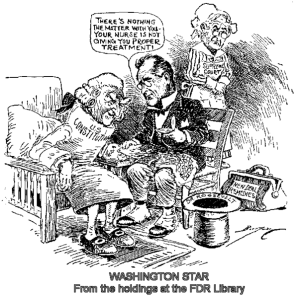
In the May issue of the Boston University Law Review, Joseph R. Fishkin and William E. Forbath of the University of Texas School of Law show that at key turning points in our history (the Jacksonian era, the Populist and Progressive moments and the New Deal), opponents of rising inequality made strong arguments “that we cannot keep our constitutional democracy — our republican form of government — without constitutional restraints against oligarchy and a political economy that maintains a broad middle class, accessible to everyone.”
Their article is called “The Anti-Oligarchy Constitution,” though Forbath told me that he and Fishkin may give the book they’re writing on the topic the more upbeat title “The Constitution of Opportunity.” Their view is that by empowering the wealthy in our political system, Supreme Court decisions such as Citizens United directly contradict the Constitution’s central commitment to shared self-rule.
“Extreme concentrations of economic and political power undermine equal opportunity and equal citizenship,” they write. “In this way, oligarchy is incompatible with, and a threat to, the American constitutional scheme.” …. they make a similar critique of what they call an excessively “court-centered” approach to constitutionalism. “Constitutional politics during the 19th and early 20th centuries” was very different and the subject of democratic deliberation. In earlier eras, they say, the Constitution was seen as not simply permitting but actually requiring “affirmative legislation . . . to ensure a wide distribution of opportunity” and to address “the problem of oligarchy in a modern capitalist society.”
The authors remind us of Franklin Roosevelt’s warning that “the inevitable consequence” of placing “economic and financial control in the hands of the few” would be “the destruction of the base of our form of government.” And writing during the Gilded Age, a time like ours in many ways, the journalist James F. Hudson argued that “imbedded” in the Constitution is “the principle” mandating “the widest distribution among the people, not only of political power, but of the advantages of wealth, education and social influence.”The idea of a Constitution of Opportunity is both refreshing and relevant. For too long, progressives have allowed conservatives to monopolize claims of fealty to our unifying national document. In fact, those who would battle rising economic inequalities to create a robust middle class should insist that it’s they who are most loyal to the Constitution’s core purpose. Broadly shared well-being is essential to the framers’ promise that “We the people” will be the stewards of our government.
Fishkin’s proposed book sounds like a worthwhile companion to Thomas Picketty’s Capital in the Twenty-First Century.
A somewhat related article from Raw Story by Bill Moyers and Co., July 4th note to tea partiers: Your politics would baffle the Founding Fathers.
Editor’s note: These days, if you see a protester donning a tricorn hat and waving a Gadsden Flag, it’s a safe bet that he or she is a Republican activist who’s furious about “death panels” or the prospect of the government meddling in the Medicare program. But the tea party movement isn’t the first to claim itself to be the true defenders of the Constitution, or to enlist its Framers in a political cause. Throughout American history, activists across the ideological spectrum have insisted that the Framers would roll over in their graves upon encountering the perfidy of their political opponents.
The reality is that the Framers disagreed about almost everything, and produced a Constitution that was filled with expedient compromises. As Jill Lepore, a professor of American history at Harvard University, pointed out in her book, The Whites of Their Eyes: The Tea Party’s Revolution and the Battle Over American History, “Beginning even before it was over, the Revolution has been put to wildly varying political purposes.” Between 1761, when the first signs of discontent with England became apparent in the Colonies, and 1791, when the Bill of Rights was ratified, Lepore wrote that Americans debated an “ocean of ideas” from which “you can fish anything out.”
One of the few areas where the Framers approached a consensus was a belief that their Constitution shouldn’t be fetishized. According to Lepore, it was none other than Thomas Jefferson who wrote, “Some men look at constitutions with sanctimonious reverence, and deem them like the arc of the covenant, too sacred to be touched. They ascribe to the men of the preceding age a wisdom more than human.”
Read an excerpt on Constitutional originalism from Jill Lepore’s book at the Raw Story link.

From NBC News: Pope Francis Meets Abuse Victims, Begs Forgiveness for Church.
The pontiff invited six victims of abuse from Ireland, Germany and Britain to attend an early-morning private Mass at the Domus Sanctae Marthae, the residence next to St. Peter’s Basilica where he lives.
Francis called the abuse a “grave sin” decrying how it was hidden for “so much time” and “camouflaged with a complicity that cannot be explained.”“I ask for the grace to weep, the grace for the Church to weep and make reparation for her sons and daughters who betrayed their mission, who abused innocent persons,” the pope said in his homily. “I beg your forgiveness, too, for the sins of omission on the part of Church leaders who did not respond adequately to reports of abuse.” ….
Francis strongly praised the victims’ courage in speaking up and shedding “light on a terrible darkness,” telling the mass he is deeply aware of their deep and unrelenting pain.
“Sins of clerical sexual abuse against minors have a toxic effect on faith and hope in God,” he said, adding that the victims’ willingness to come to the Vatican “speaks of the miracle of hope, which prevails against the deepest darkness.”
I guess it’s a start, but I agree with victims advocates who say it’s too little, too late. What concrete actions is the Church going to take to identify abusers and potential abusers before they act out? Child sexual abuse is a systemic problem that has continued for centuries. It’s difficult to see how it can be overcome with apologies and meetings with a few survivors.
I’ll end with a fascinating story from New Scientist, via Raw Story: Oldest case of Down’s syndrome from medieval France.
The oldest confirmed case of Down’s syndrome has been found: the skeleton of a child who died 1500 years ago in early medieval France. According to the archaeologists, the way the child was buried hints that Down’s syndrome was not necessarily stigmatised in the Middle Ages….
The new example comes from a 5th- and 6th-century necropolis near a church in Chalon-sur-Saône in eastern France. Excavations there have uncovered the remains of 94 people, including the skeleton of a young child with a short and broad skull, a flattened skull base and thin cranial bones. These features are common in people with Down’s syndrome, says Maïté Rivollat at the University of Bordeaux in France, who has studied the skeleton with her colleagues….
Oldest case of Down’s syndrome from medieval France – life – 04 July 2014 – New Scientist#.U7qdknlOXEd <!—->
Rivollat’s team has studied the way the child with Down’s syndrome was buried, which hasn’t been possible with other ancient cases of the condition. The child was placed on its back in the tomb, in an east-west orientation with the head at the westward end – in common with all of the dead at the necropolis.
According to Rivollat, this suggests the child was treated no differently in death from other members of the community. That in turn hints that they were not stigmatised while alive.
Another researcher of Down’s Syndrome in ancient history, John Starbuck of Indiana University, says drawing cultural conclusions from the method of burial is very difficult. Read more at the link.
What stories are you following today? Please post your links in the comment thread.
Monday Reads: In Search of the American Dream
Posted: June 30, 2014 Filed under: Barack Obama, Foreign Affairs, morning reads, U.S. Economy, U.S. Politics | Tags: American Dream, Baby boomers, Blackwater, golden age of capitalism, inequality, joseph stiglitz, plutocrats, polls, post-WWII boom, State Department, Thomas Picketty 78 Comments
Good Morning!!
Whatever happened to the American dream? Did it ever exist in reality?
We baby boomers can look back to the post-WWII years, when the economy was humming along and the GI Bill made it easier for our dads to get college degrees, find good jobs, buy houses for their families.
In those days, one salary was enough to support a couple and several kids. My dad did it on a college professor’s salary. It was a struggle early on, but those government programs for veterans gave us a push into the professional class.
Eisenhower was President then–a Republican who wouldn’t even recognize his fellow Republican today. Later on, after John Kennedy was murdered and Lyndon Johnson was brought down by the Vietnam War, Richard Nixon presided over the end of the good times. After about 1973, it was over; and since then, wages have essentially remained stagnant.
That was when we entered a new America, in which it took two salaries to support a family. Women went to work, not just because they wanted to, but to keep their families afloat. Children went to day care. So many thing changed. What happened to the American dream? Were those post-war years just an outlier, a brief period of prosperity that meant nothing in the greater scheme of things?
Yesterday, I read a piece by Joseph Stiglitz–in Politico of all places–that addressed some of these questions: The Myth of America’s Golden Age: What growing up in Gary, Indiana taught me about inequality. Stiglitz was born in 1943. Growing up in the industrial “company town” of Gary, he was able to observe the underside of the “golden age” of capitalism–“discrimination, poverty, and bouts of high unemployment.” The big steel companies deliberate brought in desperately poor African Americans from the south in order to keep wages low–to divide and control the work force. Stiglitz writes that he never bought into the notion of the free market as the answer to all ills.
Nearly half a century later, the problem of inequality has reached crisis proportions. John F. Kennedy, in the spirit of optimism that prevailed at the time I was a college student, once declared that a rising tide lifts all boats. It turns out today that almost all of us now are in the same boat—the one that holds the bottom 99 percent. It is a far different boat, one marked by more poverty at the bottom and a hollowing out of the middle class, than the one occupied by the top 1 percent.
Most disturbing is the realization that the American dream–the notion that we are living in the land of opportunity–is a myth. The life chance of a young American today are more dependent on the income and education of his parents than in many other advanced countries, including “old Europe.”

American Dream, by Skip Hunt
Stiglitz points to Thomas Picketty’s research as evidence. Picketty’s work shows that capitalism leads inevitably to inequality. The post-war era of my childhood and early adulthood was an “aberration.”
Today, inequality is growing dramatically again, and the past three decades or so have proved conclusively that one of the major culprits is trickle-down economics—the idea that the government can just step back and if the rich get richer and use their talents and resources to create jobs, everyone will benefit. It just doesn’t work; the historical data now prove that. [….]
Ironically enough, the final proof debunking this very Republican idea of trickle-down economics has come from a Democratic administration. President Barack Obama’s banks-first approach to saving the nation from another Great Depression held that by giving money to the banks (rather than to homeowners who had been preyed upon by the banks), the economy would be saved. The administration poured billions into the banks that had brought the country to the brink of ruin, without setting conditions in return. When the International Monetary Fund and the World Bank engage in a rescue, they virtually always impose requirements to ensure the money is used in the way intended. But here, the government merely expressed the hope that the banks would keep credit, the lifeblood of the economy, flowing. And so the banks shrank lending, and paid their executives megabonuses, even though they had almost destroyed their businesses. Even then, we knew that much of the banks’ profits had been earned not by increasing the efficiency of the economy but by exploitation—through predatory lending, abusive credit-card practices and monopolistic pricing. The full extent of their misdeeds—for instance, the illegal manipulation of key interest rates and foreign exchange, affecting derivatives and mortgages in the amount of hundreds of trillions of dollars—was only just beginning to be fathomed.

American Dream, by Gordon Wendling
I can’t quote any more, but I hope I’ve whetted your appetite enough that you’ll go read the whole thing. While you’re at that link, you might also take a look at this article by “zillionaire” Nick Hanauer, The Pitchforks are Coming for Us Plutocrats. Here’s just a small taste–it’s a long read.
The most ironic thing about rising inequality is how completely unnecessary and self-defeating it is. If we do something about it, if we adjust our policies in the way that, say, Franklin D. Roosevelt did during the Great Depression—so that we help the 99 percent and preempt the revolutionaries and crazies, the ones with the pitchforks—that will be the best thing possible for us rich folks, too. It’s not just that we’ll escape with our lives; it’s that we’ll most certainly get even richer.
The model for us rich guys here should be Henry Ford, who realized that all his autoworkers in Michigan weren’t only cheap labor to be exploited; they were consumers, too. Ford figured that if he raised their wages, to a then-exorbitant $5 a day, they’d be able to afford his Model Ts.
What a great idea. My suggestion to you is: Let’s do it all over again. We’ve got to try something. These idiotic trickle-down policies are destroying my customer base. And yours too.
It’s when I realized this that I decided I had to leave my insulated world of the super-rich and get involved in politics. Not directly, by running for office or becoming one of the big-money billionaires who back candidates in an election. Instead, I wanted to try to change the conversation with ideas—by advancing what my co-author, Eric Liu, and I call “middle-out” economics. It’s the long-overdue rebuttal to the trickle-down economics worldview that has become economic orthodoxy across party lines—and has so screwed the American middle class and our economy generally. Middle-out economics rejects the old misconception that an economy is a perfectly efficient, mechanistic system and embraces the much more accurate idea of an economy as a complex ecosystem made up of real people who are dependent on one another.
Which is why the fundamental law of capitalism must be: If workers have more money, businesses have more customers. Which makes middle-class consumers, not rich businesspeople like us, the true job creators.
Is it possible that because these articles appear in conservative Politico, even a few powerful people in Washington might read them and stop for a moment to think about what what is really happening to America?

American Dream by Matt Sesow
Also in the news today:
NBC NEWS: Yes, Perceptions of Washington Are Even Worse Than Last Year.
This is a six-month report card time, and it’s failing grades for all of Washington. President Obama’s approval rating stands at 41% in our recent NBC/WSJ poll, his fav/unfav is upside down (at 41%-45%), and a majority of Americans (54%) no longer think he’s able to lead the country and get the job done. Republicans and Congress are in even worse shape. The GOP’s fav/unfav in the NBC/WSJ poll is 29%-45% (versus the Democratic Party’s 38%-40% score). Just 7% of the country has confidence in Congress (compared with 29% for the presidency and 30% for the Supreme Court, per Gallup. And when it comes to congressional productivity, the 113th Congress (2013-2014) has passed just 121 bills into law — fewer than at this same point in the historically unproductive 112th Congress (140 bills into law). Maybe it doesn’t FEEL worse, because there hasn’t been an epic showdown or confrontation like the government shutdown. But the numbers tell a different story — it has gotten worse.
From James Risen at the NYT, scary revelations about the murder of 17 civilians by Blackwater thugs in Iraq in 2007: Before Shooting in Iraq, a Warning on Blackwater.
“The management structures in place to manage and monitor our contracts in Iraq have become subservient to the contractors themselves,” the investigator, Jean C. Richter, wrote in an Aug. 31, 2007, memo to State Department officials. “Blackwater contractors saw themselves as above the law,” he said, adding that the “hands off” management resulted in a situation in which “the contractors, instead of Department officials, are in command and in control.”
I have a few more links, but I’m going to put them in comments; because I’m having terrible issues with WordPress today. I hope you’ll also post your thoughts and links in the thread below.

 peej
peej Carissa
 bostonboomer
 dakinikat
 ecocatwoman
 jjlo
jjlo mablue2
 Mama Lopez
 peggysue22
 quixote
 skydancingguestblogger
 Mona (aka Wonk the Vote)





Recent Comments