
Dead Silence from Mitt Romney on Chen Guangcheng’s Arrival in U.S.
Posted: May 21, 2012 Filed under: 2012 presidential campaign, China, Foreign Affairs, Human Rights, U.S. Politics | Tags: Chen Guangcheng, diplomacy, Hillary Clinton, Mitt Romney, State Department 31 Comments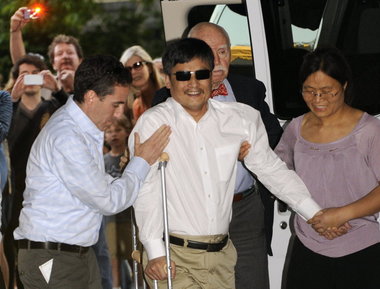
It’s been a couple of days now since blind Chinese activist Chen Guangcheng arrived at Newark on a flight from Beijing. Mitt Romney must have heard about it, but he’s said nary a word about it. I wonder why?
He had plenty to say back on May 3, in the midst of the crisis that took place during Secretary Clinton’s trip to China. Chen had managed to escape from house arrest and make it to the U.S. Embassy to ask for assistance. As State Department and U.S. Embassy staff struggled to negotiate an exit strategy for Chen, Romney, the all-but-official Republican nominee:
condemned the Obama administration’s handling of blind Chinese dissident Chen Guangcheng, calling the episode “a dark day for freedom” and “a day of shame” for President Obama if, he couched, reports are true that American officials communicated threats to Chen’s family….
Several times on Thursday, Romney couched his comments with disclaimers like “if the reports are true,” but the takeaway was clearly intended that the incident is a black eye for President Barack Obama, Secretary of State Hillary Clinton and Treasury Secretary Timothy Geithner.
Despite Romney’s impulsive catastrophizing, Secretary of State Clinton calmly continued her efforts to help Chen and his family get to the U.S. in a way that would also save face for Chinese officials. Chen was offered a law fellowship at New York University and a deal was struck: Chen could leave China on a student visa, and his departure wouldn’t be characterized as seeking asylum.
On May 9 in New Delhi, Clinton told an interviewer:
that the work she and others have done to establish multiple channels for dialogue over the last 3 1/2 years “created a level of personal relationships and understandings between individuals and our government institutions that is absolutely critical.”
Clinton suggested that China’s willingness to agree to a U.S. proposal to assist a prominent critic of the government’s one-child policy is an indication that taking a broader view of the relationship pays dividends in a moment of crisis.
“I’ve invested a lot and argued strongly” for keeping regular channels of communication open so that no one issue “predominates or undermines the potential for reaching agreement on other equally important issues,” the top U.S. diplomat told Bloomberg Radio.
This was a triumph for negotiation as opposed to the kinds of macho chest-pounding that Romney has been preaching so far.
Declining to comment on how the U.S. managed to craft a deal this time in a sensitive case involving a Chinese activist, Clinton said that “every high-level Chinese official that I met” last week “repeated back to me” words from a speech she delivered in Washington reflecting on Sino-U.S. relations in the 40 years since President Richard Nixon’s historic outreach to communist China.
Chinese officials, she said, echoed her view that “what we are trying to do — the U.S. and China — is unprecedented in world history. We’re trying to find a way for an established power and a rising power to coexist.”
Last night, Cheryl Isaac wrote at Forbes:
Chen posed a great challenge for Hillary Clinton because of two competing issues: the economic dialogue in Beijing had been her priority for a couple of years, her pledge to protect human rights—women’s rights nonetheless—another priority.
The confusion of the negotiation process did not help either. After escaping house arrest and seeking refuge at the American Embassy, Chen first decided to stay in China. Then later, he pleaded to be taken to America—putting Clinton in the difficult place of having to renegotiate an agreement that had been reached 24 hours prior; reports the Daily Beast’s Howard Kurtz.
People around the world stated their displeasure. In the U.S., she had Congressman Chris Smith (R-NJ) stating that Clinton did not keep Chen safe within the U.S. Embassy. In this video interview, Smith even admits to telling Chen—in a phone conversation—that the fact that officials were working day and night on his paperwork, was not a good sign…”
But Hillary pushed onward, made the right decisions, and was successful in her goal of helping Chen and his family.
Bravo, Madam Secretary! Where are macho Mitt’s congratulations? Has he apologized yet? I’ve googled, but can’t find any evidence that he has owned up to his bungling or even acknowledged this diplomatic achievement. Why am I not surprised?
Mitt Romney: “It is without question the largest one-time careless expenditure of government money in American history” Really?
Posted: May 18, 2012 Filed under: 2012 presidential campaign, Psychopaths in charge, U.S. Politics | Tags: Afghanistan War, bridge to nowhere, Hillsborough NH, historic monuments, Iraq War, jobs, Mitt Romney, Sawyer Bridge, stimulus funds, tourism, Vietnam War 44 Comments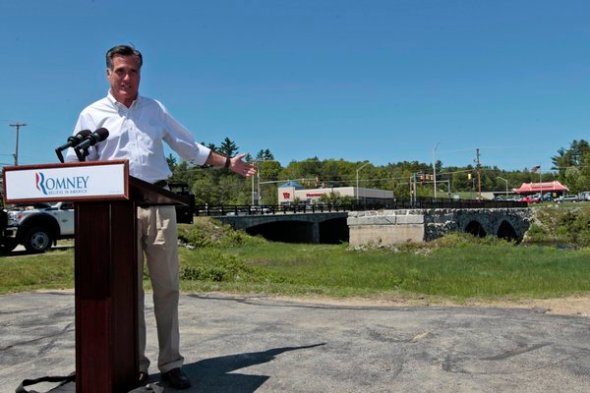
Mitt Romney mocks the people of New Hampshire for preserving historic landmarks
The title of this post is a quote from Mitt Romney’s speech this afternoon in Hillsborough, New Hampshire. Politico reports:
Mitt Romney used a 19th-century stone bridge here today to anchor his attacks against President Barack Obama, calling the 2009 economic stimulus the “largest one-time careless expenditure of government money in America’s history.”
“This is the absolute bridge to nowhere if there ever was one,” Romney told supporters as he motioned to the stone bridge behind him. “That’s your stimulus dollars at work — a bridge that goes nowhere. And so I hope that the president comes here, and takes a look at some of the stimulus program, there’s a long list by the way.”
Wow, the government must have really spent a lot of money for Romney to be this bent out of shape. Let’s see, how much stimulus money went into the bridge?
More than $150,000 from the federal stimulus bill was awarded to restore this one — which doesn’t cross a body of water and hasn’t had vehicle traffic in more than a century. Local officials say they want to turn the stone arch and its surrounding areas into a public park.
“It is without question the largest one-time careless expenditure of government money in American history, and the bad news is it was not just wasteful spending,” Romney continued. “It is wasteful borrowing as well because we still are going to be paying on that debt for years and years and years.”
Wait a minute! That has to be a misprint, right? Why just today Mitt and Ann Romney donated $150,000 to his presidential campaign. He must have meant $150 million went to the bridge. But no, the entire cost of the restoration was about $288,000, with the state providing the start-up funds.
What is Romney getting at here? Does he want to stop preserving historical sites and monuments? Is it really wrong for small towns like Hillsboro that are dependent mostly on tourism to want to preserve their historic sites and at the same time build lovely parks to attract visitors who might also spend their money in town? At the same time, the project provided much-needed jobs for New Hampshirites struggling to survive in a difficult economy.
The bridge that Romney complained about is named Sawyer Bridge, and it is one of the few remaining stone arch bridges in New England. The town of Hillsborough is home to four of them. From Huffington Post:
Romney’s attack on the $288,000 bridge restoration will run into several immediate challenges: Funding for the project was overwhelmingly supported by state Republicans, including a significant number who have now endorsed Romney for president. The infrastructure project created much-needed jobs during tough economic times. And it left behind a public park enjoyed by Granite State residents who take great pride in their early-American and colonial history — and who will be casting critical, swing-state votes in November. It’s a curious breed of conservatism that would find offense in the job-creating conservation of a stone arch bridge that is one of the earliest examples of dry-laid masonry vaults in New England.
I have to wonder, is Romney opposed to any federal support to preserve historic sites? What about the National Parks? Would Romney sell off that land if he were president? Would he open them to oil drilling and other kinds of industrial development?
Think about it. For Romney expenditure of $150,000 in federal stimulus funds represents “the largest one-time careless expenditure of government money in American history.” Really? I can think of some worse, more careless expenditures of government money. What about the Vietnam War? What about the Wars in Iraq and Afghanistan, which Bush financed with borrowed money that was kept off-budget?
Just to get a sense of the financial cost of those wars, I located this paper by Stephen Daggett of the Congressional Research Service (PDF) that lists the costs of America’s wars in $2011 dollars. According to Daggett in 2011,
Since the terrorist attacks of September 11, 2001, Congress has appropriated more than a trillion dollars for military operations in Afghanistan, Iraq, and elsewhere around the world. The House
and Senate are now considering an additional request for $33 billion in supplemental funding for
the remainder of FY2010, and the Administration has also requested $159 billion to cover costs of
overseas operations in FY2011.
That’s more than the cost war in Vietnam, which in 2011 dollars was $738 billion. At that time the war in Iraq had cost $784 billion and the war in Afghanistan had cost $321 billion. And Romney is whining about New Hampshire getting $150 THOUSAND to restore a historic bridge while creating jobs and increasing income from tourism?
There is something seriously wrong with the way this man’s mind works.
Friday Afternoon Open Thread: Mitt Likes Music, Including This
Posted: May 18, 2012 Filed under: 2012 presidential campaign, open thread, U.S. Politics | Tags: humor, Mitt Romney, music, Spotify 9 CommentsA few days ago, The New York Times posted a funny mashup of Mitt Romney talking about all the things he likes. The video was created by The Gregory Brothers, a musical group that produces takeoffs on the news. I wish I knew how to embed it here, but you’ll have to go watch it the NYT site. Please watch it if you haven’t already. It’s really hilarious!
Here is the original 1994 interview in which Mitt earnestly told a young interviewer, “I like music of almost any kind, including this.” At the time, he was running against Ted Kennedy for the Senate.
Back in March, Romney listed his favorite songs on Spotify, which I think is an iPad app. Here’s Mitt’s playlist, which his campaign insist he drew up all by himself:
I am a Man of Constant Sorrow” by The Soggy Bottom Boys
Read My Mind” by The Killers
December, 1963 [Oh What a Night]” by Frankie Valli & the Four Seasons
Ring of Fire” by Johnny Cash
Somebody Told Me” by The Killers
The MTA (The Boston Subway Song)” by The Kingston Trio
Good Vibrations” by The Beach Boys
Desperado” by Clint Black
Crying” by Roy Orbison
Only You ” by Commodores
Runaway” by Del Shannon
It’s your Love” by Time McGraw
As Good As I once Was” by Toby Keith
Born Free” by Kid Rock
“Over the Rainbow” by Willie Nelson
“Stardust”
“In Dreams” by Roy Orbison
“Somebody Like You” by Keith Urban
“All-American Girl” by Carrie Underwood
Jim Farber, a reporter at the NY Daily News, notes that Mitt seems to like sad songs.
A man of constant sorrow who roams this world alone, doomed to realize his greatest loves only in dreams. Does this sound like the description of a man running for President?
….
Romney opens his 25 song list with The Soggy Bottom Boys’ version of that classic song of suffering “I Am A Man of Constant Sorrow.” He goes on to pepper the list with Clint Black’s cover of the Eagles’ ode to a shut-down loner “Desperado,” Roy Orbison’s uber-mopey “Crying” (along with his classic song of thwarted love “In Dreams”), Johnny Cash’s rumination on eternal damnation, “Ring of Fire,” and Willie Nelson’s take on the ultimate song of hopeless yearning, “Somewhere Over The Rainbow.”
Together, these selections suggest a guy whose soul may be far deeper, and less satisfied, than his public persona presents.
Farber also notes that there is only one female artist and one African American group represented on Mitt’s list. Some of the items also reveal Romney’s advanced age. Roy Orbison and Del Shannon were on the soundtrack of my late childhood (I’m just a couple of months younger than Romney).
I found a couple of other Romney- and music-oriented videos on Youtube. Who is Mitt Romney anyway?
This one is silly, but I really liked it: “Mitt Romney, I think I hate you.”
What do you have to say about all this, Mitt?
Thursday Reads: Romney’s Lies, Debt Ceiling Showdown, and Dimonfreude
Posted: May 17, 2012 Filed under: Barack Obama, Corporate Crime, corporate greed, Economy, House of Representatives, Mitt Romney, morning reads, Surreality, The Media SUCKS, U.S. Economy, U.S. Politics, unemployment, voodoo economics, Voter Ignorance | Tags: Bill Clinton, Bill Moyers, economics, J.P. Morgan, Jamie Dimon, Mary Kennedy, Peter G. Peterson, Robert F. Kennedy Jr., Romney's lies, Simon Johnson 22 Comments
Good Morning!
On Tuesday night I wrote a brief post about the bizarre speech Mitt Romney gave in Des Moines, Iowa earlier that day. I was struck by Romney’s childish effort to get at President Obama by talking about Bill Clinton’s economic policies and claiming that Obama must have ignored those policies because he has some kind of grudge against both Clintons. It was so strange and off key that I thought Romney sounded like a crotchety old busybody gossiping over the backyard fence.
I didn’t really even go into the many baldfaced lies Romney told in the speech–I guess I’ve become so accustomed to his total refusal to confine himself to reality as it is that I almost don’t notice it anymore. Basically, Romney attacked Obama the deficit that was primarily created by Bush, and made his usual claims that he (Romney) will be able to cut taxes by 20 percent, increase defense spending, and at the same time magically balance the budget and dramatically reduce unemployment. Only a moron would buy what he’s selling.
Yesterday, a number of bloggers commented on that speech, so I thought I’d share some of those reactions in this morning’s reads.
Steve Benen at Maddowblog: A peek into an alternate reality.
Mitt Romney delivered a curious speech in Iowa yesterday, presenting his thoughts on the budget deficit, the debt and debt reduction, which is worth reading if you missed it. We often talk about the problem of the left and right working from entirely different sets of facts, and how the discourse breaks down when there’s no shared foundation of reality, and the Republican’s remarks offered a timely peek into an alternate reality where facts have no meaning.
Even the topic itself is a strange choice for Romney. If the former governor is elected, he’ll inherit a $1 trillion deficit and a $15 [trillion] debt, which he’ll respond to by approving massive new tax cuts and increasing Pentagon spending. How will he pay for this? No one has the foggiest idea.
In other words, the guy who intends to add trillions to the debt gave a speech yesterday on the dangers of adding trillions to the debt.
Benen says he doesn’t believe Romney is “stupid,” but he must be “operating from the assumption that voters are stupid.” I’d say that’s true. I think Romney believes that he’s much smarter and more worthy than just about anyone and that poor and middle-class people are beneath contempt.
Jonathan Cohn at The New Republic: Romney’s Make-Believe Story on the Economy. Cohn writes about Romney’s claims that Obama’s failure to reduce the deficit is the cause of the “tepid recovery,” unemployment, and the struggles of seniors to get by on fixed incomes.
Note the way Romney establishes cause and effect here: Obama’s contribution to higher deficits are the reason more people can’t get work and more seniors can’t make ends meet right now. This is an audacious claim and, while I’m no economist, I’m pretty sure it places Romney on the outer edges of the debate among mainstream scholars.
I know of serious conservatives who think the Recovery Act, which has increased deficits temporarily, didn’t ultimately do much to create jobs in the near term. And I know of serious conservatives who think that creating jobs now wasn’t worth the long-term downside of adding to the federal debt, however incrementally. Both viewpoints seem to represent minority views, if a recent University of Chicago survey of leading economists is indicative. But the arguments have at least some logic to them.
But Romney’s suggestion that unemployment today is a consequence of Obama’s contribution to the deficit (real or imagined) requires further leaps of logic. You’d have to argue, for example, that extensions of unemployment benefits have reduced incentives to work (despite research to the contrary) and that such negative effects substantially outweigh the positive effects of traditional stimulus measures. It’s not impossible to make this case. I think Casey Mulligan, also of the University of Chicago, has written things along these lines for the New York Times. But, unless I’m missing something, that argument is even more marginal than suggestions the Recovery Act didn’t help at all.
I suspect that even Cohn’s effort to make sense of Romney’s fantasy economic theory will have Dr. Dakinikat pulling her hair out.
Jonathan Chait at New York Magazine: Romney’s Budget Fairy Tale.
In the real world, the following things are true: The budget deficit was projected to top $1 trillion even before President Obama took office, and that was when forecasters were still radically underestimating the depth of the 2008 crash. Obama did propose temporary deficit-increasing measures, an economic approach endorsed in its general contours, if not its particulars, by Romney’s economists. These measures contributed a relatively small proportion to the deficit, and their effect is short-lived. Obama instead focused on longer-term measures to reduce the deficit, including comprehensive health-care reform projected to reduce deficits by a trillion dollars in its second decade. Obama put forward a budget plan that would stabilize the debt as a percentage of the economy. Obama has hoped to achieve deeper long-term deficit reduction by striking bipartisan deals with Congress, and he has tried to achieve this goal by openly endorsing a bipartisan deficit plan in the Senate and privately agreeing to a more conservative plan with John Boehner, both of which were killed by Republican opposition to any higher revenue.
But Romney doesn’t seem to live in the real world, and Chait suggests that Romney either doesn’t understand how deficits work or doesn’t care if what he says makes any sense at all.
In Romney’s telling, the terms debt and spending are essentially interchangeable. When presented with Obama’s position — that the solution to the debt ought to include both higher taxes and lower spending — he rejects it out of hand. Naturally, Romney has admitted before that his budget plan “can’t be scored.” It’s an expression of conservative moral beliefs about the role of government. While loosely couched in budgetary terms, Romney is expressing an analysis that resides outside of, and completely at odds with, mainstream macroeconomic forecasting and scoring assumptions.
At the Plum Line, Greg Sargent discusses How Mitt Romney gets away with his lying.
If you scan through all the media attention Romney’s speech received, you are hard-pressed to find any news accounts that tell readers the following rather relevant points:
1) Nonpartisan experts believe Romney’s plans would increase the deficit far more than Obama’s would.
2) George W. Bush’s policies arguably are more responsible for increasing the deficit than Obama’s are.
Oh, sure, many of the news accounts contain the Obama campaign’s response to Romney’s speech; the Obama campaign put out a widely-reprinted statement arguing that Romney’s plans would increase the deficit and that he’d return to policies that created it in the first place.
But this shouldn’t be a matter of partisan opinion. On the first point, independent experts think an actual set of facts exists that can be used to determine what the impact of Romney’s policies on the deficit would be. And according to those experts, based on what we know now, Romney’s policies would explode the deficit far more than Obama’s would.
Obviously, the problem is the obsequious corporate media. But the Romney campaign makes it impossible for even the few remaining serious reporters to question his policies by keeping the candidate completely insulated from the press except for occasional appearances on Fox News and lightweight network morning shows like Good Morning America. Yesterday, Politico reprinted tweets from several reporters who were “physically” blocked from talking to Romney on a rope line.
Speaking of Republican ignorance of basic economics, House Republicans are gearing up for another pitched battle on increasing the debt ceiling. Speaker John Boehner met with President Obama at the White House today and they “clash[ed] over” increasing the debt limit, according to The Hill.
The president convened the meeting of the bipartisan congressional leadership to discuss his “to-do list” for Congress, but an aide to the Speaker said the bulk of the meeting was spent on other issues, including a pile-up of expiring tax provisions and the next increase in the federal debt limit.
Boehner asked Obama if he was proposing that Congress increase the debt limit without corresponding spending cuts, according to a readout of the meeting from the Speaker’s office. The president replied, “Yes.” At that point, Boehner told Obama, “As long as I’m around here, I’m not going to allow a debt-ceiling increase without doing something serious about the debt.”
Shortly after the meeting, White House press secretary Jay Carney told reporters that the president warned the leadership that he would not allow a repeat of last August’s debt-ceiling “debacle,” which led to a downgrade in the U.S. credit rating.
Sigh……
In a related story, there’s this piece at Wonkblog about the Pete Peterson summit and how Democrats talked long-windedly about cutting “entitlements,” and Republican refused to talk about tax increases. Read it and weep. I’m not even going to quote from it, because it’s too damn depressing.
So far Jamie Dimon seems to have survived the $2 billion loss recently suffered by J.P. Morgan.
The CEO of JPMorgan Chase survived a shareholder push Tuesday to strip him of the title of chairman of the board, five days after he disclosed a $2 billion trading loss by the bank.
CEO Jamie Dimon also won a shareholder endorsement of his pay package from last year, which totaled $23 million, according to an Associated Press analysis of regulatory filings.
Dimon, unusually subdued, told shareholders at the JPMorgan annual meeting that the company’s mistakes were “self-inflicted.” Speaking with reporters later, he added: “The buck always stops with me.”
Yeah, right. The buck will stop with the taxpayers if Dimon’s bank ultimately crashes and burns. Bill Moyers asked economist Simon Johnson about that.
Moyers: I was just looking at an interview I did with you in February of 2009, soon after the collapse of 2008 and you said, and I’m quoting, “The signs that I see… the body language, the words, the op-eds, the testimony, the way these bankers are treated by certain congressional committees, it makes me feel very worried. I have a feeling in my stomach that is what I had in other countries, much poorer countries, countries that were headed into really difficult economic situations. When there’s a small group of people who got you into a disaster and who are still powerful, you know you need to come in and break that power and you can’t. You’re stuck.” How do you feel about that insight now?
Johnson: I’m still nervous, and I think that the losses that JPMorgan reported — that CEO Jamie Dimon reported — and the way in which they’re presented, the fact that they’re surprised by it and the fact that they didn’t know they were taking these kinds of risks, the fact that they lost so much money in a relatively benign moment compared to what we’ve seen in the past and what we’re likely to see in the future — all of this suggests that we are absolutely on the path towards another financial crisis of the same order of magnitude as the last one.
A number of shareholders have sued Dimon over the losses, according to Bloomberg (via the SF Chroncle). And of course lots of people are gloating over Dimon’s getting temporarily knocked off his pedestal. Jena McGregor writes in the WaPo:
It’s being called Dimonfreude.
There are barely disguised smirks emanating from the canyons of Wall Street and the business press over the fact that Jamie Dimon has had to admit a mistake — and a whale of one, for that matter.
For years, the JPMorgan CEO (and America’s least-hated banker, as he was known) has worn a halo over those pinstripes. Dimon has been called President Obama’s “favorite banker”. Institutional Investor magazine has called him the country’s best CEO for two years running. And his actions during the financial crisis have been painted in patriotic terms: Press reports said he “answered the call” from then-FDIC chairman Sheila Bair to buy Washington Mutual, one of two banks he scooped up during the financial meltdown, and he has cited a patriotic duty to a country in crisis as why he took in $25 billion in government aid.
Yet now, Dimon is in the hot seat as JPMorgan confronts a $2 billion trading loss and the early stages of a criminal probe by the Justice Department.
Finally, some sad news: Estranged Wife of Robert F. Kennedy Jr. Is Found Dead at Home in Westchester
Mary R. Kennedy, the estranged wife of Robert F. Kennedy Jr., was found dead on Wednesday at the family’s home in Bedford, N.Y. She was 52.
Ms. Kennedy’s death was confirmed in a statement from her family, who did not comment on the circumstances. The Bedford Police Department said only that it had investigated a “possible unattended death” in an outbuilding at the home.
Her lawyer, Kerry A. Lawrence, would not say whether foul play was suspected. Kieran O’Leary, a spokesman for Westchester County, said an autopsy was scheduled for Thursday morning.
Born Mary Richardson, Ms. Kennedy joined one of America’s foremost political families in 1994, in a marriage ceremony aboard a boat on the Hudson River, near Stony Point, N.Y. At the time, she was an architectural designer at Parish-Hadley Associates in New York.
Those are my suggested reads for today. What are you reading and blogging about?
Open Thread: Mitt Romney, Busybody
Posted: May 15, 2012 Filed under: 2012 presidential campaign, 2012 primaries, U.S. Economy, U.S. Politics | Tags: Barack Obama, Bill Clinton, busybody, Debt, Federal Deficit, gossip, Hillary Clinton, Mitt Romney 20 Comments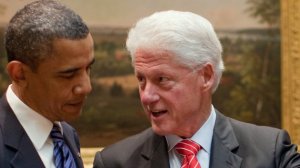
In a speech in Des Moines, Iowa today, Mitt Romney sounded like a fussy old gossip, claiming that President Obama probably has a “beef” with Bill and Hillary Clinton.
Almost a generation ago, Bill Clinton announced that the Era of Big Government was over.
Even a former McGovern campaign worker like President Clinton was signaling to his own Party that Democrats should no longer try to govern by proposing a new program for every problem.
President Obama tucked away the Clinton doctrine in his large drawer of discarded ideas, along with transparency and bipartisanship. It’s enough to make you wonder if maybe it was a personal beef with the Clintons….but really it runs much deeper.
President Obama is an old school liberal whose first instinct is to see free enterprise as the villain and government as the hero. America counted on President Obama to rescue the economy, tame the deficit and help create jobs. Instead, he bailed out the public-sector, gave billions of dollars to the companies of his friends, and added almost as much debt as all the prior presidents combined.
ROFLMAO!! Obama, “an old school liberal?” This guy is a laff riot!
At the Washington Post, Nia-Malika Henderson interpreted Romney’s odd invoking of the good old days of the Clinton administration as another effort to link Obama with Jimmy Carter. Henderson writes:
The strategy, of course, is obvious, if a little heavy handed—paint Obama as more like Jimmy Carter, rather than as a New Democrat in the mold of Clinton.
Clinton has already emerged as one of Obama’s most visible surrogates, appearing in a video marking the death of Osama bin Laden, and will likely be used to gin up support among so-called Reagan Democrats—white, blue collar workers, particularly—and Romney can perhaps mute some of Clinton’s power by suggesting that Clinton isn’t all in with Obama. (It’s a beef, not a bromance, Romney suggests.)
But by invoking Clinton, Romney risks poking the bear in some ways, and perhaps even casting himself as a version of Clinton. Praising Clinton, even in a backhanded way, isn’t exactly a way to solidify support among the religious right.
I don’t know about the reaction from the religious right, but Bill Clinton worked a few digs about Romney into his speech today at the Pete Peterson conference (why Clinton shows up for these things, I’ll never understand, but that’s for another post). According to the National Journal, Clinton said that Romney
shot himself in the foot with the broad tax-cutting budget he suggested during the primary. He said Romney should accept projections that his plan for deep tax cuts would add billions to the deficit while requiring huge cuts to Medicare, Medicaid and non-defense spending.
“If I were in his position I would, I think, use the Congressional Budget Office numbers saying my plan increased the debt and say that no responsible president can pretend an independent analysis of his numbers don’t matter,” Clinton said. “That’s, I think, his his best avenue back to the real world.”
Clinton also offered a few verbal pats on the head to Romney.
“I feel a lot of sympathy for him,” he said. “The whole primary was about finding somebody who was true conservative, but they’re going to vote for him anyway.”
Good one, Bill!

 peej
peej Carissa
 bostonboomer
 dakinikat
 ecocatwoman
 mablue2
 Mama Lopez
 peggysue22
 quixote
 skydancingguestblogger
 Mona (aka Wonk the Vote)



 Sky Dancing
Recent Comments