
Thursday Reads: “Get Rid of the Ballots” — Donald Trump
Posted: September 24, 2020 Filed under: morning reads, U.S. Politics | Tags: "get rid of the ballots", 2020 presidential election, Donald Trump, Joe Biden, peaceful transfer of power, voting by mail 22 CommentsGood Morning!!
The U.S. may finally have reached peak banana republic status. Can it possibly get any worse? Probably.
Axios: Trump refuses to commit to peaceful transfer of power if he loses.
President Trump repeatedly refused to say on Wednesday whether he would commit to a peaceful transition of power if he loses the election to Joe Biden, saying at a press briefing: “We’re going to have to see what happens.”
The big picture: Trump has baselessly claimed on a number of occasions that the only way he will lose the election is if it’s “rigged,” claiming — without evidence — that mail-in ballots will result in widespread fraud. Earlier on Wednesday, the president said he wants to quickly confirm a replacement for Justice Ruth Bader Ginsburg because he believes the Supreme Court may have to decide the result of the election.
The exchange:
REPORTER: “Win, lose, or draw in this election, will you commit here today for a peaceful transferral of power after the election? There has been rioting in Louisville, there has been rioting in many cities across the country. Your so-called red and blue states. Will you commit to make sure there’s a peaceful transferral of power after the election? ”
TRUMP: “We’re going to have to see what happens, you know that. I’ve been complaining very strongly about the ballots, and the ballots are disaster.”REPORTER: “I understand that, but people are rioting. Do you commit to make sure that there’s a peaceful transferral of power?”
TRUMP: “Get rid of the ballots and you’ll have a very peaceful — there won’t be a transfer, frankly. There will be a continuation. The ballots are out of control. You know it. And you know who knows it better than anybody else? The Democrats know it better than anybody else.”Go deeper: Trump says he wants 9 justices in case Supreme Court must decide 2020 election
Fine. But what is the FEC going to do about it? Hasn’t Trump already neutered them?
Yesterday people were talking about a startling article in The Atlantic by Barton Gellman: The Election That Could Break America. If the vote is close, Donald Trump could easily throw the election into chaos and subvert the result. Who will stop him?
There is a cohort of close observers of our presidential elections, scholars and lawyers and political strategists, who find themselves in the uneasy position of intelligence analysts in the months before 9/11. As November 3 approaches, their screens are blinking red, alight with warnings that the political system does not know how to absorb. They see the obvious signs that we all see, but they also know subtle things that most of us do not. Something dangerous has hove into view, and the nation is lurching into its path.
The danger is not merely that the 2020 election will bring discord. Those who fear something worse take turbulence and controversy for granted. The coronavirus pandemic, a reckless incumbent, a deluge of mail-in ballots, a vandalized Postal Service, a resurgent effort to suppress votes, and a trainload of lawsuits are bearing down on the nation’s creaky electoral machinery.
Something has to give, and many things will, when the time comes for casting, canvassing, and certifying the ballots. Anything is possible, including a landslide that leaves no doubt on Election Night. But even if one side takes a commanding early lead, tabulation and litigation of the “overtime count”—millions of mail-in and provisional ballots—could keep the outcome unsettled for days or weeks.
This is what Trump is counting on–that there will be an extended period of confusion and chaos during which we won’t know for sure who has won the presidential election. We already saw something like this in 2000; but in that case, Al Gore conceded and allowed a peaceful transfer of power to George W. Bush. Trump is stating clearly that he will respond differently. Here is what Lindsey Graham told Fox News today:
Returning to the Atlantic article:
“We could well see a protracted postelection struggle in the courts and the streets if the results are close,” says Richard L. Hasen, a professor at the UC Irvine School of Law and the author of a recent book called Election Meltdown. “The kind of election meltdown we could see would be much worse than 2000’s Bush v. Gore case.”
A lot of people, including Joe Biden, the Democratic Party nominee, have misconceived the nature of the threat. They frame it as a concern, unthinkable for presidents past, that Trump might refuse to vacate the Oval Office if he loses. They generally conclude, as Biden has, that in that event the proper authorities “will escort him from the White House with great dispatch.”
The worst case, however, is not that Trump rejects the election outcome. The worst case is that he uses his power to prevent a decisive outcome against him. If Trump sheds all restraint, and if his Republican allies play the parts he assigns them, he could obstruct the emergence of a legally unambiguous victory for Biden in the Electoral College and then in Congress. He could prevent the formation of consensus about whether there is any outcome at all. He could seize on that uncertainty to hold on to power.
According to Gellman, the Trump campaign is already working to convince state legislators in battleground states to ignore the popular vote.
Trump’s state and national legal teams are already laying the groundwork for postelection maneuvers that would circumvent the results of the vote count in battleground states. Ambiguities in the Constitution and logic bombs in the Electoral Count Act make it possible to extend the dispute all the way to Inauguration Day, which would bring the nation to a precipice. The Twentieth Amendment is crystal clear that the president’s term in office “shall end” at noon on January 20, but two men could show up to be sworn in. One of them would arrive with all the tools and power of the presidency already in hand.
“We are not prepared for this at all,” Julian Zelizer, a Princeton professor of history and public affairs, told me. “We talk about it, some worry about it, and we imagine what it would be. But few people have actual answers to what happens if the machinery of democracy is used to prevent a legitimate resolution to the election.”
Please go read the whole thing if you haven’t already. People on Twitter yesterday were calling Gellman’s piece ridiculous scaremongering, but then yesterday evening Trump came right out and said it on national TV.
NewsPressNow.com: A list of the times Trump has said he won’t accept the election results or leave office if he loses. Read the whole list at the link, here’s what he said earlier yesterday:
September 23 Oval Office: “But in terms of time, we go to January 20th. But I think it’s better if you go before the election because I think this — this scam that the Democrats are pulling — it’s a scam — this scam will be before the United States Supreme Court. And I think having a 4-4 situation is not a good situation, if you get that.”
He has made it clear that he expects the Supreme Court to decide the election in his favor, regardless of the how Americans vote.
This from Slate is by Richard Hasan, who is quoted in the Atlantic article:
The Trump strategy of fighting the expansion of mail-in balloting appears to be twofold. To begin with, the campaign appears to have made the calculation that lower turnout will help the president win reelection. This may explain why Pennsylvania Republicans are planning on going to the U.S. Supreme Court to argue against a state Supreme Court ruling allowing the counting of ballots arriving soon after Election Day without a legible postmark. They argue that doing so unconstitutionally extends Election Day beyond Nov. 3 and takes power away from the Pennsylvania Legislature to choose presidential electors.
The first argument is not a particularly strong one: A decision to accept ballots soon after Election Day without a legible postmark does not extend Election Day as much as it implements how election officials determine if a mailed ballot was timely mailed. It recognizes the reality that many ballots have been arriving without postmarks and uses proximity to the election as a proxy for timely voting. Virginia and Nevada recently adopted similar rules, in light of pandemic-related mail delays. The Trump-allied Honest Elections Project is fighting a consent decree over a similar extension in Minnesota.
The argument about the state Supreme Court’s ruling usurping legislative power to set federal election rules echoes a parallel claim that was made during the disputed election in 2000. The question is whether a state supreme court usurps legislative power when it interprets election rules in line with both state statutes and the state constitution. The argument that a state supreme court applying a state constitution in a voting case usurps legislative power is weak to me, but it was convincing enough for the more conservative members of the Supreme Court that decided Bush v. Gore.
The idea is to throw so much muck into the process and cast so much doubt on who is the actual winner in one of those swing states because of supposed massive voter fraud and uncertainty about the rules for absentee ballots that some other actor besides the voter will decide the winner of the election….Indeed, on Tuesday, Vice President Mike Pence suggested that Justice Ruth Bader Ginsburg’s replacement needs to be seated, possibly without so much as a hearing, in order to decide “election issues [that] may come before the Supreme Court in the days following the election,” including questions involving “universal unsolicited mail” and states “extending the deadline” for ballot receipt.
Read more at Slate.
Joe Biden is clearly growing tired of his daily task of having to think up responses to President Donald Trump’s increasingly erratic comments. Asked about Trump’s latest threat, when he blatantly refused to commit to a peaceful transfer of power if he loses the election fair and square, Biden rolled his eyes and sighed. Muffled behind his face mask, he said: “What country are we in?” Biden then briefly lowered his mask to say more clearly to the gathered reporters: “I’m being facetious—what country are we in? Look, he says the most irrational things. I don’t know to say.” During a White House briefing Thursday, Trump was asked if he has any intention of peacefully handing over power if he loses. The president ominously responded: “We’re going to have to see what happens.”
Let’s hope the Democrats and Biden figure out a more substantive response.
Of course we also will have to deal with Trump’s cultish supporters. Stephen Collinson at CNN: Trump’s comments send a signal to his supporters about how to react if Biden prevails.
The President’s comments risked not only dealing another blow to an election in which he has been trailing and has incessantly tarnished, but could send a signal to his supporters about how to react if the Democratic nominee prevails in 41 days. That possibility is especially dangerous given this past summer’s racial and social unrest — which burst forth again on Wednesday evening after police said two officers were shot in Louisville, Kentucky, amid protests about the failure to charge officers in the death of Breonna Taylor, an unarmed Black woman.
Trump’s near simultaneous warning on Wednesday that he thinks the election will end up being decided by the Supreme Court also raises the risk of a constitutional imbroglio likely to be worse than the disputed 2000 election.
His rhetoric escalated as he yet again politicized the effort to quell the pandemic by threatening to override regulators on the question of whether a newly developed vaccine would be safe in a highly irregular move. Taken together, his anti-democratic instincts and prioritization of his own political goals amid a national emergency show he plans to allow nothing — not the health of Americans, the sanctity of US elections or the reputation of the Supreme Court — to prevent him from winning a second term.
And his comments poured gasoline on an already inflamed nominating battle to fill the seat of the late Justice Ruth Bader Ginsburg while threatening to drag the court further into politics in a way that could shred its legitimacy among millions of Americans.
Trump’s latest attempts to create uproar came amid new efforts to subvert the traditional mechanisms of government for his own gain — in what has become an almost daily ritual.
Obviously, there is much more news out there, including the situation in Louisville over the murder of Breonna Taylor. Please feel free to discuss any issue of importance to you in the comment thread. Take care, and I hope you’ll check in sometime today.
Tuesday Reads: Two Valuable New Books on Trump and Russia
Posted: September 22, 2020 Filed under: Foreign Affairs, morning reads, U.S. Politics | Tags: Andrew Weissmann, Andriy Derkach, CIA, Donald Trump, Tim Weiner, Trump Russia, Vladimir Putin 27 Comments
Good Morning!!
The Trump books just keep on coming. This week and next week we’re getting two very significant releases. A new book by Tim Weiner came out today. Weiner is a historian of both the FBI and CIA. His latest is The Folly and the Glory: America, Russia, and Political Warfare 1945–2020. The Washington Post published an op-ed by Weiner yesterday: The unanswered question of our time: Is Trump an agent of Russia?
The FBI faced a national security nightmare three years ago: It suspected that the new president of the United States was, in some unknown way, in the sway of Russia.
Was an agent of a foreign power in the White House? Should they investigate Donald Trump? “I can’t tell you how ominous and stressful those days were,” Peter Strzok, then the No. 2 man in FBI counterintelligence, told me. “Similar to the Cuban missile crisis, in a domestic counterintelligence sense.”
But the Cuban missile crisis lasted only 13 days — and it had a happy ending. This crisis has no end in sight. Despite the investigation by former special counsel Robert S. Mueller III, despite the work of congressional intelligence committees and inspectors general — and despite impeachment — we still don’t know why the president kowtows to Vladimir Putin, broadcasts Russian disinformation, bends foreign policy to suit the Kremlin and brushes off reports of Russians bounty-hunting American soldiers. We still don’t know whether Putin has something on him. And we need to know the answers — urgently. Knowing could be devastating. Not knowing is far worse. Not knowing is a threat to a functioning democracy.
Tim Weiner
The FBI’s counterintelligence agents wondered: Why did Trump invite the Russian ambassador and the Russian foreign minister into the Oval Office on the day after he keelhauled FBI Director James B. Comey — and brag about it? “I just fired the head of the FBI,” Trump told them in confidence. “I faced great pressure because of Russia. That’s taken off.” Like the rest of America, the FBI learned about that conversation only from a Russian government readout. But then Trump went on television and said he had fired Comey over the FBI’s probe into ties between Team Trump and Team Putin during and after the 2016 election.
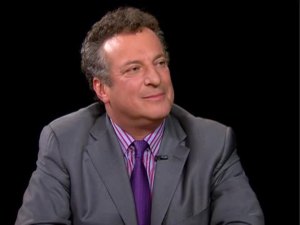
Unfortunately the counterintelligence investigation seems to have been short-circuited by the firing of Andrew McCabe and the failure of Robert Mueller to seriously investigate Trump’s connections to Russia. Here’s Weiner’s chilling conclusion:
There’s a classic story about an American agent of influence that predates the Cold War — and might presage the strange case of Donald Trump, if these questions about his relationship with Russia go dormant. Samuel Dickstein was a member of Congress from Manhattan, elected in 1922, and chairman of the House Immigration and Naturalization Committee in the 1930s. He walked into the Soviet Embassy in 1937 and offered the ambassador his services for $25,000 a year — three times his congressional salary. In exchange, he sold fake passports to Soviet spies. And he held headline-grabbing public hearings investigating Joseph Stalin’s enemies in the United States. Dickstein served 11 terms in Congress. His file lay locked up in the KGB archives for 60 years. Today, if you go down to Manhattan’s Lower East Side, to the intersection of Pitt and Grand streets, you’ll be standing in Samuel Dickstein Plaza. He got away with it.
A related opinion piece from today’s Washington Post by Josh Rogin: Secret CIA assessment: Putin ‘probably directing’ influence operation to denigrate Biden.
Russian President Vladimir Putin and his top aides are “probably directing” a Russian foreign influence operation to interfere in the 2020 presidential election against former vice president Joe Biden, which involves a prominent Ukrainian lawmaker connected to President Trump’s personal lawyer Rudolph W. Giuliani, a top-secret CIA assessment concluded, according to two sources who reviewed it.
On Aug. 31, the CIA published an assessment of Russian efforts to interfere in the November election in an internal, highly classified report called the CIA Worldwide Intelligence Review, the sources said. CIA analysts compiled the assessment with input from the National Security Agency and the FBI, based on several dozen pieces of information gleaned from public, unclassified and classified intelligence sources. The assessment includes details of the CIA’s analysis of the activities of Ukrainian lawmaker Andriy Derkach to disseminate disparaging information about Biden inside the United States through lobbyists, Congress, the media and contacts with figures close to the president.
Andriy Derkach
“We assess that President Vladimir Putin and the senior most Russian officials are aware of and probably directing Russia’s influence operations aimed at denigrating the former U.S. Vice President, supporting the U.S. president and fueling public discord ahead of the U.S. election in November,” the first line of the document says, according to the sources.
The Office of the Director of National Intelligence and the Treasury Department have identified Derkach as a Russian agent, but it has not been publicly reported that the CIA, NSA and FBI believed Putin may be personally directing the campaign. Derkach has denied working on behalf of Moscow.
The CIA assessment described Derkach’s efforts in detail and said that his activities have included working through lobbyists, members of Congress and U.S. media organizations to disseminate and amplify his anti-Biden information. Though it refers to Derkach’s interactions with a “prominent” person connected to the Trump campaign, the analysis does not identify the person. Giuliani, who has been working with Derkach publicly for several months, is not named in the assessment.

Read the rest at the WaPo.
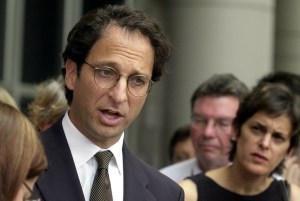
Another book that is getting much more attention than Weiner’s is Andrew Weissmann’s inside account of the Mueller investigation, Where Law Ends: Inside the Mueller Investigation. The book will be released next Tuesday.
George Packer interviewed Weissmann at The Atlantic: The Inside Story of the Mueller Probe’s Mistakes.
Andrew Weissmann was one of Robert Mueller’s top deputies in the special counsel’s investigation of the 2016 election, and he’s about to publish the first insider account, called Where Law Ends: Inside the Mueller Investigation. The title comes from an adapted quote by the philosopher John Locke that’s inscribed on the façade of the Justice Department building in Washington, D.C.: “Wherever law ends, tyranny begins.”
Weissmann offers a damning indictment of a “lawless” president and his knowing accomplices—Attorney General William Barr (portrayed as a cynical liar), congressional Republicans, criminal flunkies, Fox News. Donald Trump, he writes, is “like an animal, clawing at the world with no concept of right and wrong.” But in telling the story of the investigation and its fallout, Weissmann reserves his most painful words for the Special Counsel’s Office itself. Where Law Ends portrays a group of talented, dedicated professionals beset with internal divisions and led by a man whose code of integrity allowed their target to defy them and escape accountability.
“There’s no question I was frustrated at the time,” Weissmann told me in a recent interview. “There was more that could be done that we didn’t do.” He pointed out that the special counsel’s report never arrived at the clear legal conclusions expected from an internal Justice Department document. At the same time, it lacked the explanatory power of last month’s bipartisan Senate Intelligence Committee report on the 2016 election. “Even with 1,000 pages, it was better,” Weissmann said of the Senate report. “It made judgments and calls, instead of saying, ‘You could say this and you could say that.’”
Andrew Weissmann
The Mueller inquiry was the greatest potential check on Trump’s abuse of power. The press gives the president fits, but almost half the country chooses not to believe the news. Congress will protect Trump as long as his party controls at least one chamber. Local prosecutors and civil plaintiffs are severely limited in pursuing justice against a sitting president. Public opinion is immovably split and powerless until the next election. Only the Special Counsel’s Office—burrowing into the criminal matter of Russian interference in the 2016 election, a possible conspiracy with the Trump campaign, and the president’s subsequent attempts to block an investigation—offered the prospect of accountability for Trump. Mueller couldn’t try the president in court, let alone send him to prison, but he could fully expose Trump’s wrongdoing for a future prosecutor, using the enforceable power of a grand jury subpoena. The whole constitutional superstructure of checks and balances rested on Mueller and his team. As their work dragged on through 2017 and 2018, with flurries of indictments and plea deals but otherwise in utter silence, many Americans invested the inquiry with the outsized expectation that it would somehow bring Trump down.
Read the rest at the Atlantic link.
Charlie Savage at The New York Times: Mueller’s Team Should Have Done More to Investigate Trump-Russia Links, Top Aide Says.
The team led by Robert S. Mueller III, the special counsel, failed to do everything it could to determine what happened in the 2016 election, shying away from steps like subpoenaing President Trump and scrutinizing his finances out of fear he would fire them, one of Mr. Mueller’s top lieutenants argued in the first insider account of the inquiry.
“Had we used all available tools to uncover the truth, undeterred by the onslaught of the president’s unique powers to undermine our efforts?” wrote the former prosecutor, Andrew Weissmann, in a new book, adding, “I know the hard answer to that simple question: We could have done more.”
The team took elaborate steps to protect its files of evidence from the risk that the Justice Department might destroy them if Mr. Trump fired them and worked to keep reporters and the public from learning what they were up to, Mr. Weissmann wrote in “Where Law Ends: Inside the Mueller Investigation,” which Random House will publish next week.
While he speaks reverently of Mr. Mueller, he also says his boss’s diffidence made him ill-suited for aspects of shepherding the politically charged investigation. He saw Mr. Mueller and his deputy, Aaron M. Zebley, as overly cautious.
Mr. Weissmann also defended against accusations by the president and his allies that he and other investigators were politically biased “angry Democrats”; Mr. Weissmann said his personal views had no bearing on the crimes that Russian operatives and Trump aides committed.
And he elevates particular details — for example, emphasizing that the same business account that sent hush payments to an adult film star who alleged an extramarital affair with Mr. Trump had also received “payments linked to a Russian oligarch.” The president has denied the affair; his former lawyer Michael D. Cohen controlled the account. Mr. Mueller transferred the Cohen matter to prosecutors in New York.
More Reads, links only:
The Washington Post: Mueller prosecutor says special counsel ‘could have done more’ to hold Trump accountable.
Book review by Jennifer Szalai at The New York Times: A Prosecutor’s Backstage Tour of the Mueller Investigation.
The American Independent: Trump says coronavirus ‘affects virtually nobody’ as death toll reaches 200,000.
The Washington Post: Pentagon used taxpayer money meant for masks and swabs to make jet engine parts and body armor.
The New York Times: Trump Could Be Investigated for Tax Fraud, D.A. Says for First Time.
Jane Mayer at The New Yorker: A Young Kennedy, in Kushnerland, Turned Whistle-Blower.
CNBC: Powell pledges the Fed’s economic aid ‘for as long as it takes.’
Brian Karem at The Bulwark: The Absentee President. Donald Trump rarely shows up to the West Wing—and when he does, he is too incompetent to effectively fulfill his oath of office.
Angry Saturday Reads: The Worst (So Far) Has Happened
Posted: September 19, 2020 Filed under: morning reads, U.S. Politics | Tags: Donald Trump, going nuclear, Mitch McConnell, Ruth Bader Ginsburg, SCOTUS, U.S. Supreme Court 24 CommentsGet Angry and Stay Angry!!

Ruth and Marty Ginsburg
The worst (so far) has happened with the heartbreaking loss of Supreme Court Justice Ruth Bader Ginsburg. Trump and McConnell are determined to replace her with a right wing ideologue before the election. Democrats must fight tooth and nail to keep them from succeeding, because that was Justice Ginsburg’s dying wish.
Nina Totenberg at NPR: Justice Ruth Bader Ginsburg, Champion Of Gender Equality, Dies At 87.
Justice Ruth Bader Ginsburg, the demure firebrand who in her 80s became a legal, cultural and feminist icon, died Friday. The Supreme Court announced her death, saying the cause was complications from metastatic cancer of the pancreas.
The court, in a statement, said Ginsburg died at her home in Washington, D.C., surrounded by family. She was 87.
“Our nation has lost a justice of historic stature,” Chief Justice John Roberts said. “We at the Supreme Court have lost a cherished colleague. Today we mourn but with confidence that future generations will remember Ruth Bader Ginsburg as we knew her, a tireless and resolute champion of justice.”
Architect of the legal fight for women’s rights in the 1970s, Ginsburg subsequently served 27 years on the nation’s highest court, becoming its most prominent member. Her death will inevitably set in motion what promises to be a nasty and tumultuous political battle over who will succeed her, and it thrusts the Supreme Court vacancy into the spotlight of the presidential campaign.
Just days before her death, as her strength waned, Ginsburg dictated this statement to her granddaughter Clara Spera: “My most fervent wish is that I will not be replaced until a new president is installed.”
She knew what was to come. Ginsburg’s death will have profound consequences for the court and the country. Inside the court, not only is the leader of the liberal wing gone, but with the court about to open a new term, the chief justice no longer holds the controlling vote in closely contested cases.
[Emphasis added.]
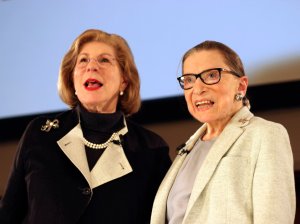
NPR’s Nina Totenberg, and U.S. Supreme Court Justice Ruth Bader Ginsburg, Saturday, Dec. 15, 2018. (AP Photo/Rebecca Gibian)
This morning, Totenberg discussed her long friendship with Justice Ginsburg: A Five-Decade-Long Friendship That Began With A Phone Call.
In 1971, newly assigned to cover the Supreme Court, I was reading a brief in what would ultimately be the landmark case of Reed v. Reed. It argued that the Fourteenth Amendment equal protection clause applied to women. I didn’t understand some of the brief, so I flipped to the front to see who the author was, and I placed a call to Rutgers law professor Ruth Bader Ginsburg.
By the time I hung up an hour later, I was so full of information that I was like a goose whose innards were ready for fois-gras. I soon began calling professor Ginsburg regularly, and eventually I met her in person at a conference in New York. We never did agree what the subject of that conference was, but take my word for it, it was boring. So boring that we…well, we went shopping.
We would become professional friends, and later, close friends after she moved to Washington to serve on the federal appeals court here and later, on the U.S. Supreme Court.
Some of the stories that follow have little to do with her brilliance, hard work, or devotion to the law, or even her pioneering role as the architect of the legal fight for women’s rights in this country. Rather, they are examples of her extraordinary character, decency, and commitment to friends, colleagues, law clerks — just about everyone whose lives she touched. I was lucky enough to be one of those people.
Read Totenberg’s reminiscences at the NPR link.
Linda Greenhouse at The New York Times: Ruth Bader Ginsburg, Supreme Court’s Feminist Icon, Is Dead at 87.
.Barely five feet tall and weighing 100 pounds, Justice Ginsburg drew comments for years on her fragile appearance. But she was tough, working out regularly with a trainer, who published a book about his famous client’s challenging exercise regime.
As Justice Ginsburg passed her 80th birthday and 20th anniversary on the Supreme Court bench during President Barack Obama’s second term, she shrugged off a chorus of calls for her to retire in order to give a Democratic president the chance to name her replacement. She planned to stay “as long as I can do the job full steam,” she would say, sometimes adding, “There will be a president after this one, and I’m hopeful that that president will be a fine president.”
When Justice Sandra Day O’Connor retired in January 2006, Justice Ginsburg was for a time the only woman on the Supreme Court — hardly a testament to the revolution in the legal status of women that she had helped bring about in her career as a litigator and strategist.
Her years as the solitary female justice were “the worst times,” she recalled in a 2014 interview. “The image to the public entering the courtroom was eight men, of a certain size, and then this little woman sitting to the side. That was not a good image for the public to see.” Eventually she was joined by two other women, both named by Mr. Obama: Sonia Sotomayor in 2009 and Elena Kagan in 2010.
After the 2010 retirement of Justice John Paul Stevens, whom Justice Kagan succeeded, Justice Ginsburg became the senior member and de facto leader of a four-justice liberal bloc, consisting of the three female justices and Justice Stephen G. Breyer. Unless they could attract a fifth vote, which Justice Anthony M. Kennedy provided on increasingly rare occasions before his retirement in 2018, the four were often in dissent on the ideologically polarized court.
Justice Ginsburg’s pointed and powerful dissenting opinions, usually speaking for all four, attracted growing attention as the court turned further to the right. A law student, Shana Knizhnik, anointed her the Notorious R.B.G., a play on the name of the Notorious B.I.G., a famous rapper who was Brooklyn-born, like the justice. Soon the name, and Justice Ginsburg’s image — her expression serene yet severe, a frilly lace collar adorning her black judicial robe, her eyes framed by oversize glasses and a gold crown perched at a rakish angle on her head — became an internet sensation.
Read the rest at the NYT.
Ginsburg biographer Irin Carmon at New York Magazine: The Glorious RBG: I learned, while writing about her, that her precision disguised her warmth.
Ruth Bader Ginsburg used to instruct her clerks to get it right and keep it tight, so I’ll try to do the same. Only someone so stubborn and single-minded, someone so in love with the work, could have accomplished what she did — as a woman, survived discrimination and loss; as a lawyer, compelled the Constitution to recognize that women were people; as a justice, inspired millions of people in dissent. (I asked her once in an interview what she had changed her mind about and she refused to answer. “I don’t dwell on that kind of question,” she said. “I really concentrate on what’s on my plate at the moment and do the very best I can.”) What made her RBG would also enact the most tragic and sickening ironies of today.
Ruth Bader Ginsburg
The feminist with a fundamentally optimistic vision, who believed that people, especially men, could be better, might be soon replaced by the rankest misogynist. The litigator and jurist who long subordinated her own immediate desires to the good and legitimacy of institutions, who had preached that slow change would stave off backlash, lived long enough to see Trump and the Federalist Society tear off the Court’s thin veneer of legitimacy anyway. In the 2013 voting-rights dissent that earned her the Notorious RBG nickname, Ginsburg offered an addendum to Martin Luther King Jr.’s suggestion that the arc of history eventually bent toward justice: “if there is a steadfast commitment to see the task through to completion.” She was thus committed. Still, today she leaves the work not only unfinished but at risk of being undone.
Ginsburg was born in 1933 in Flatbush, and her stoicism was forged in a childhood spent in a house that, she said, bore “the smell of death.” When she was 2, her only sister died of meningitis; one day short of her high-school graduation, her mother died of cervical cancer. Celia Bader, who had once broken her nose reading while walking down the street but whose sweatshop wages had gone to her brother’s education, left behind secret college savings for her daughter and a will to accomplish what Celia had been denied.

Click the link to read more about Ginsburg’s life.
What can Democrats do to honor Ginsburg’s dying wish? Some possibilities:
David Corn at Mother Jones: To Honor Ginsburg, Democrats Have One Choice: Go Nuclear.
What is coming, at least as the Republicans see it, is a grand political clash. They have been hellbent on reshaping the entire federal judiciary and especially drool over the prospect of locking the highest court into a right-wing course that will last decades and counter demographic trends that favor Democrats. This is their Holy Grail….So Ginsburg’s departure is a gift for Trump. If there has been any erosion occurring on the edges of his conservative and evangelical base, his effort to shove another anti-choice, pro-corporate conservative on to the highest court could certainly shore up that ground for him….
Ginsburg, a hero of female empowerment and of the Supreme Court, deserves much mourning. But Democrats and progressives can waste no time prepping for the battle royal that lies ahead. After all, it took Senate Majority Leader Mitch McConnell mere minutes after the news of RBG’s passing to declare that the GOP-controlled Senate will vote on whoever Donald Trump sends its way to fill the Supreme Court vacancy—a direct eff-you to the Democrats after McConnell in 2016 refused to consider President Barack Obama’s SCOTUS nominee Merrick Garland with the phony-baloney argument that the Senate should not consider new justices during an election year. So yes, Dems will have to organize, but they must do more: They have to get ready to rumble….
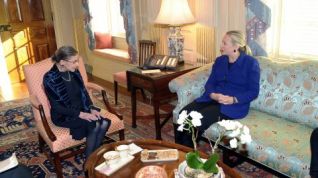
Ruth Bader Ginsburg and Hillary Clinton
It will be bare-knuckles politics from the right. Do or die. By any means necessary. To replace Ginsburg with a young right-wing extremist. And for the Democrats to have a chance of thwarting them, they must realize that this fight is not only a matter of persuasion….
The win-over-reasonable-Republicans-with-reason strategy is weak sauce. That leaves the Democrats with one other choice: total political warfare. The Senate’s Democratic leader, Chuck Schumer—with the backing of Joe Biden and Nancy Pelosi—needs to threaten massive retaliation. Should McConnell try to ram a Trump nominee through, Schumer ought to vow that the Democrats, if they win back the Senate and Biden is elected president, will demolish the filibuster, which will allow the Senate to proceed to make Washington, DC, a state (two more senators, who are likely to be Democrats!) and that they will move to add two or four more seats to the Supreme Court. (There is nothing in the Constitution that limits the court’s size to the current nine justices.) In other words: They will implement a Republican nightmare (which, as it happens, can be justified on arguments of equity and fairness).
Michael Tomasky at The Daily Beast agrees with Corn: Here Are the Ways to Stop Mitch and Trump From Replacing RBG.
Trump and McConnell will move to put a hard right-winger on the court before the election. Don’t be naive. Don’t think: “They wouldn’t possibly try that.” Of course they would. And if (I hate to be macabre here, but I’m just making a point) Stephen J. Breyer were to perish tomorrow, they’d move to put two right-wingers on the bench before Election Day. It is who they are.
What power can stop them? There are only three that potentially could. Let’s look at them.
Ruth Bader Ginsburg
One, the Democrats. Some Democratic senators who might have Mitch’s ear, say Joe Manchin, will go to him. And Mitch will say: Fuck off. However, the Democrats have a card to play here, if Joe Biden will play it. The number nine (of Supreme Court justices) is neither in the Constitution nor law. Biden, and Chuck Schumer, can say: If you fill this seat now, if Biden wins, we’re expanding the Court to 11 or 13, and your majority is dead. And they should be ready to do it.
Two, public opinion. I expect polls will appear in the coming days showing majorities agreeing that no appointment should come until after we have a new president. As I’ve often written, our democracy is corrupted and screwed, but it’s still enough of a democracy that public opinion actually matters. Sometimes. And I think this is probably one of these times.
Three, kind of an ancillary point to public opinion: the fate of Republican senators up for re-election in tough states. Already, Alaska’s Lisa Murkowski, not up for re-election, has apparently said she will not confirm a justice until the next president is sworn in. That’s one. Democrats would need three more to say that they’ll follow Murkowski’s lead. Susan Collins, Cory Gardner, and Martha McSally seem the obvious choices. There are others. It all depends on the degree of progressive mobilizing in those states, to make those GOP senators know that if they acquiesce to McConnell’s games, they will lose. And of course there’s Mitt Romney, who does not face re-election but who might cast another conscience vote.
So all is not lost yet. But gear up for a fight. And as you do, always leave time in your mind for this remarkable, towering American. Everything we do in this corrupt period should be to honor all that she stood for.

We are already far down the road to autocracy, as Dakinikat wrote yesterday. We have to honor Ruth Bader Ginsburg’s life by fighting as hard as we can. As David Corn wrote, we have to bring a bazooka to the GOP’s gunfight.
Anger is an energy.
Thursday Reads: Trump, Barr, and Russia vs. American Democracy
Posted: September 17, 2020 Filed under: Foreign Affairs, morning reads, Republican politics, U.S. Politics | Tags: Adam D. DeMarco, Bill Barr, Dan Coats, Department of Justice, Donald Trump, Russian media, Vladimir Putin 22 Comments
Anna Sahlstén
Good Morning!!
Former Director of National Intelligence Dan Coats spoke out about Trump in Bob Woodward’s new book Rage; now he’s authored an op-ed in The Washington Post about the 2020 election: What’s at Stake in This Election? The American Democratic Experiment.
We hear often that the November election is the most consequential in our lifetime. But the importance of the election is not just which candidate or which party wins. Voters also face the question of whether the American democratic experiment, one of the boldest political innovations in human history, will survive.
Our democracy’s enemies, foreign and domestic, want us to concede in advance that our voting systems are faulty or fraudulent; that sinister conspiracies have distorted the political will of the people; that our public discourse has been perverted by the news media and social networks riddled with prejudice, lies and ill will; that judicial institutions, law enforcement and even national security have been twisted, misused and misdirected to create anxiety and conflict, not justice and social peace.
If those are the results of this tumultuous election year, we are lost, no matter which candidate wins. No American, and certainly no American leader, should want such an outcome. Total destruction and sowing salt in the earth of American democracy is a catastrophe well beyond simple defeat and a poison for generations. An electoral victory on these terms would be no victory at all. The judgment of history, reflecting on the death of enlightened democracy, would be harsh.
The most urgent task American leaders face is to ensure that the election’s results are accepted as legitimate. Electoral legitimacy is the essential linchpin of our entire political culture. We should see the challenge clearly in advance and take immediate action to respond.
Coats argues that Congress should form a bipartisan commission to protect voting and ensure that Americans will see the results of the election as legitimate. Unfortunately, there’s almost no chance that Congressional Republicans would go along with such a project. They clearly support Trump’s goal of a “rigged” election.

Delphin Enjolras. Woman Reading at the Window woman reading at the window
At Vanity Fair, Chris Smith reports on Joe Biden’s preparations for dealing with election interference by Trump and his personal attorney Bill Barr: “We’re Not Going To Let Donald Trump Steal This Election”: Democrats Are Strategizing For All-Out Warfare.
Donald Trump, true to form, is stoking chaos, trying to undermine faith in the accuracy of November’s election. He has floated stationing armed guards at the 2020 polls and maintained a steady stream of lies about “rigged” mail-in ballots. Joe Biden’s counteroffensive is shaping up to be equally in character: It relies on his trust in rational process and in projecting calm. It’s a strategy that makes a great deal of sense—and also feels quaint considering Trump’s evil genius for asymmetrical warfare.
Biden has solicited the help of two former solicitors general, one former attorney general, and a small army of attorneys, building up its own law firm to beat back Trump’s attempts at voter suppression both before and after Election Day. Those lawyers are assisting in the legal battles already playing out in courts across the country that will shape the rules about whose votes get counted—in the words of Democratic strategist Brian Fallon, the “mini Bush v. Gores.” The lawyers and the vast voter-protection program being rolled out by the Biden campaign and the Democratic National Committee are designed to do two things: ensure that all legitimate votes are counted, and bolster Democratic turnout by raising confidence that their votes will be counted. Biden’s second tactic is more subtle, and riskier: By not engaging directly and loudly with Trump’s claims of rampant fraud, Team Biden believes it will reduce the potency of the president’s frenetic disinformation.
We’ll see. We all remember how the Supreme Court installed George W. Bush in 2000.
When Rosa Brooks, a Georgetown University law professor and a cofounder of the Transition Integrity Project, brought together dozens of party veterans, pollsters, and media players to simulate outcomes, only one scenario—a Biden landslide—led to a fairly orderly transfer of power. The rest devolved into a constitutional crisis mixed with street violence. “The Democratic elites, God bless them, have had a lot of faith, historically, in institutions and the law,” Brooks says. “But our exercises underscored the tremendous advantage the first mover has in a disputed election, and the tremendous structural advantage of incumbency….The president can have Bill Barr initiate a politically motivated investigation. And I think we can expect all kinds of efforts, legal and extralegal, to stop the counting and to challenge mail-in ballots.”
The Biden campaign and the DNC certainly see all the potential for Trumpian mischief—and Ron Klain, one of Biden’s longtime senior advisers, was a senior adviser to Gore in 2000. So the campaign has constructed “the largest election-protection program in presidential campaign history,” a Biden strategist says. Biden allies have met with major media executives, urging them to be cautious in calling states on election night when millions of mail-in ballots will have yet to be processed. Another hopeful sign is that the Biden campaign is leaning on the expertise of Stacey Abrams and Lauren Groh-Wargo, who managed Abrams’s 2018 run for Georgia governor and now runs Fair Fight, the group Abrams founded to push for, well, fairness in elections.
Read the whole thing at Vanity Fair.

Woman Reading, Henri Lebasque
Meanwhile, Bill Barr has come out as a full-on fascist. He seems to be working overtime to out-Trump Trump. Remember how Barr helped clear Lafayette Square so that Trump could have a photo-op with a bible? The Washington Post reveals more details about that episode: Federal officials stockpiled munitions, sought ‘heat ray’ device before clearing Lafayette Square, whistleblower says.
Hours before law enforcement forcibly cleared protesters from Lafayette Square in early June amid protests over the police killing of George Floyd, federal officials began to stockpile ammunition and sces that could emit deafening sounds and make anyone within range feel like their skin is on fire, according to an Army National Guard major who was there.
D.C. National Guard Maj. Adam D. DeMarco told lawmakers that defense officials were searching for crowd control technology deemed too unpredictable to use in war zones and had authorized the transfer of about 7,000 rounds of ammunition to the D.C. Armory as protests against police use of force and racial injustice roiled Washington.
In sworn testimony, shared this week with The Washington Post, DeMarco provided his account as part of an ongoing investigation into law enforcement and military officers’ use of force against D.C. protesters….
DeMarco’s account contradicts the administration’s claims that protesters were violent, tear gas was never used and demonstrators were given ample warning to disperse — a legal requirement before police move to clear a crowd. His testimony also offers a glimpse into the equipment and weaponry federal forces had — and others that they sought — during the early days of protests that have continued for more than 100 days in the nation’s capital.
DeMarco, who provided his account as a whistleblower, was the senior-most D.C. National Guard officer on the ground that day and served as a liaison between the National Guard and U.S. Park Police.
[Emphasis added.] Recall that Barr was seen inspecting the protests before officers attacked the crowd. Now Barr wants to charge protesters with trying to overthrow the government and actually suggested criminally charging the mayor of Seattle. The New York Times: Barr Told Prosecutors to Consider Sedition Charges for Protest Violence.
Attorney General William P. Barr told federal prosecutors in a call last week that they should consider charging rioters and others who had committed violent crimes at protests in recent months with sedition, according to two people familiar with the call.
The Artist’s Wife, Henry Lamb, 1933
The highly unusual suggestion to charge people with insurrection against lawful authority alarmed some on the call, which included U.S. attorneys around the country, said the people, who described Mr. Barr’s comments on the condition of anonymity for fear of retribution.
The attorney general has also asked prosecutors in the Justice Department’s civil rights division to explore whether they could bring criminal charges against Mayor Jenny Durkan of Seattle for allowing some residents to establish a police-free protest zone near the city’s downtown for weeks this summer, according to two people briefed on those discussions. Late Wednesday, a department spokesman said that Mr. Barr did not direct the civil rights division to explore this idea….
During a speech on Wednesday night, Mr. Barr noted that the Supreme Court had determined that the executive branch had “virtually unchecked discretion” in deciding whether to prosecute cases. He did not mention Ms. Durkan or the sedition statute.
“The power to execute and enforce the law is an executive function altogether,” Mr. Barr said in remarks at an event in suburban Washington celebrating the Constitution. “That means discretion is invested in the executive to determine when to exercise the prosecutorial power.”

More stories on Bill Barr’s latest crazy rantings:
Fox News: Barr claims anti-Trump element in DC working to ‘thwart’ administration.
Bloomberg: Barr Says ‘Black Lives Matter’ Doesn’t Care About Black Lives.
The New York Times: In an interview, Barr warned of the U.S. going down ‘the socialist path’ if Trump is not re-elected.
Steve Benen at MSNBC: AG Bill Barr’s election deceptions go from bad to worse.
The Washington Post: Barr accuses Justice Department of headhunting and meddling with politics.
Raw Story: Trump and Barr are creating a perfect storm for post-election violence: British journalist.
A couple more related stories:

Maria Karalyos, Woman reading a book
Neal Kaytal and Joshua Geltzer at The New York Times: This Is How Bad It’s Gotten at the Justice Department.
In his time as the head of the Justice Department, Attorney General William Barr has alienated many federal prosecutors. The latest appears to be Nora Dannehy, a longtime prosecutor who has resigned from the department, where she was part of a team looking into the Russia investigation.
We don’t know for sure exactly what happened; she isn’t talking, nor is Mr. Barr. But The Hartford Courant, which broke the story, reported that Ms. Dannehy’s colleagues said that she departed because of Mr. Barr’s politicization — in particular, because Mr. Barr is evidently eager to break drastically with past practice and issue an incomplete report intended to help President Trump in his re-election efforts.
Her resignation looks like part of an extremely troubling pattern. Earlier this year, highly respected prosecutors in the Michael Flynn and Roger Stone cases dramatically resigned or withdrew. One of them testified to Congress that the Justice Department under Mr. Barr was treating Mr. Stone “differently from any other defendant because of his relationship to the president.” The Justice Department inspector general has opened an investigation.
When civil servants resign, skeptics often ask what difference one person really can make by leaving. The answer is simple: a lot. Ms. Dannehy’s departure isn’t just likely a major assertion of integrity by her; it’s also a big problem for Mr. Barr — and therefore for Mr. Trump.
Head over to the NYT to read the rest.
Julia Davis at The Daily Beast: Russian Media Is Rooting for Civil War in America: ‘The Worse, the Better.’
State-controlled media’s slant is a telling indicator of the Kremlin’s leanings. To imagine the relationship between Russian President Vladimir Putin and his massive media apparatus, one may reference the coziness between Sean Hannity and Trump—and magnify that intensity tenfold, with directives flowing only from the top down. Obsessed with retaining his dominance and fully realizing the power of propaganda, Putin leaves nothing to chance….
Gari Melchers, Woman Reading by a Window
Russian lawmakers, state media experts and pundits on tightly-choreographed TV shows openly reveal that the Kremlin is still rooting for Trump. But Moscow has a growing concern that this time around, their preferred candidate might lose. Appearing on a state TV show The Right To Know, Margarita Simonyan, the editor-in-chief of the Kremlin-funded propaganda networks RT and Sputnik, said about Trump’s chances of re-election: “I think Trump will lose, but then I think there will be a major blow-up from the standpoint of accepting or not accepting the outcome of the election. They’ll be battling over that for a long time, who knows how it might end.”
Having openly wished for Trump to drive the United States into civil war, Russian state media figures are now relishing that idea with renewed enthusiasm. They believe it would destabilize America to such an extent as to undermine its very sovereignty, thereby untying the Kremlin’s hands to wreak even more havoc upon the Western world. Appearing on Russia’s state TV show The Evening with Vladimir Soloviev, analyst Dmitry Drobnitsky explained his belief that U.S. elections “can be considered America’s internal affairs only up to the point when an actual civil war starts there.” The idea of a coup d’état seems all but inevitable, Drobnitsky argued: “The loser in this election would be an idiot to accept the outcome.”
Russian state media repeatedly echoed Trump, who is doing the Kremlin’s bidding by attacking the legitimacy of the 2020 elections, falsely suggesting that mail-in voting is completely fraudulent, and that Democrats are rigging the process to falsify the outcome. There is no doubt that the Kremlin would align with Trump in case of a contested election, as the groundwork for accusing the Democrats of fraud has been laid in advance.
Russian state media analysts also make no secret as to the Kremlin’s preferred candidate. Writing for the newspaper Kommersant, Dmitry Kosyrev, political columnist for state media outlet RIA Novosti, pondered: “Is Trump ours?” This popular refrain can be interpreted in one of several ways: to signify Russia’s hold over the American president, to express that Trump’s position is in perfect alignment with that of the Kremlin—meaning, “he is on our side”—or to signal Russia’s preference: “He is the one we choose.”

Things are getting really scary. Unbelievably, this year’s election will likely be much worse than 2016. I don’t know what more to say. I guess we just have to take it one day at a time, and hope that Biden and the Democrats have the guts to stand up for democracy.
Take care, Sky Dancers!
Tuesday Reads: Another Crazy Day In Trump World
Posted: September 15, 2020 Filed under: morning reads, U.S. Politics | Tags: 2020 presidential election, Bashar al-Assad, Bob Woodward, CDC, Climate change, conspiracy theories, coronavirus pandemic, Covid-19, Donald Trump, extrajudicial killings, Fox and Friends, James Mattis, Michael Caputo, Steve Doocy, super-spreader events, Syria, Trump hate rallies, wildfires 14 CommentsGood Morning!!
This morning Trump appeared on Fox and Friends and rambled on for 47 minutes. At the end of the interview, Steve Doocy expressed some surprising hostility toward the fake “president.”
https://twitter.com/amandacarpenter/status/1305857751273308161?s=20
Wow! Doocy’s getting a little fed up with Trump’s word salad, I guess. He even offered equal time to Joe Biden.
In another headline-grabbing moment, Trump told his Fox and Friends pals that he wanted to assassinate Syria’s Bashar al-Assad awhile back.
https://twitter.com/dylanmatt/status/1305862154533457921?s=20
The Washington Post: Trump confirms he wanted to assassinate Assad. In 2018, he denied it was even considered.
In the Fox interview, Trump criticized former defense secretary Jim Mattis, who has in recent months warned the country strongly against reelecting Trump. But in the course of making that case, Trump offered an odd claim: He said Mattis had effectively stood in the way of his efforts to assassinate Syrian President Bashar al-Assad.
“I would’ve rather taken him out,” Trump said. “I had him all set. Mattis didn’t want to do it. Mattis was a highly overrated general.”
When asked whether he regretted not taking Assad out, Trump added: “No, I don’t regret that. … I had a shot to take him out if I wanted. Mattis was against it.”
The first problem with this argument is that Trump is disparaging Mattis for opposing something that Trump doesn’t even say he regrets. The second is that the commander in chief makes these decisions, full stop. If Trump wanted to do it, Mattis couldn’t block him.
 That’s not what Trump said in 2018.
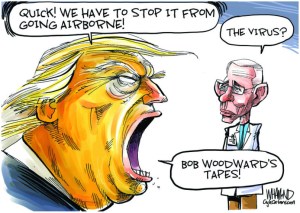
In 2018, Woodward published “Fear.” In the book, he reported that Trump had considered assassinating Assad. Trump, on Sept. 5, 2018, flatly denied it.
“I heard somewhere where they said the assassination of President Assad by the United States. Never even discussed,” Trump said, adding: “No, that was never even contemplated, nor would it be contemplated.”
He even held it up as evidence that the book shouldn’t have been published.
Breaking news: Trump is a pathological liar.
Lets see . . . what else is happening in the United States of crazy?
As Dakinikat wrote yesterday, Trump seems determined to continue holding super-spreader rallies that threaten the lives of his own supporters and staff. The Washington Post suggests that Trump is using these events to “rebuke” Democratic governors and mayors who have established restrictions on public behavior in order to protect their citizens.
President Trump’s first indoor rally in months was staged as a rebuke to Democrats he accuses of using coronavirus restrictions against him, but the campaign event in Nevada also prompted sharp denunciations from critics on Monday as a symbol of the president’s failure to effectively confront the deadly covid-19 crisis.
The Sunday night gathering came as the pandemic has caused at least 190,000 deaths in the United States, with the number expected to pass 200,000 sometime before Trump holds his next official campaign events on Friday. The Nov. 3 election had already become a referendum on the president’s often dismissive approach to the pandemic before revelations last week that he had told Washington Post journalist Bob Woodward he knew the severity of the virus but preferred to play it down in public….
On Monday, Trump held another indoor campaign event at a luxury hotel in Phoenix that was billed as a roundtable with Latino supporters. The White House pool reporter traveling with Trump described the scene as looking much like a rally, with more than 100 people crowded closely together inside a ballroom. Television footage showed mask-free supporters waving campaign signs.
“I know this was supposed to be, you know the fake news, they said that this is supposed to be a roundtable, but it looks like a rally,” Trump said. “But it is a rally because we love each other.” He then added that “it is a roundtable.”
AP: Trump defies virus rules as ‘peaceful protest’ rallies grow.
President Donald Trump is running as the “law and order” candidate. But that hasn’t stopped him and his campaign from openly defying state emergency orders and flouting his own administration’s coronavirus guidelines as he holds ever-growing rallies in battleground states.
Democratic governors and local leaders have urged the president to reconsider the events, warning that he’s putting lives at risk. But they have largely not tried to block the gatherings of thousands of people, which Trump and his team deem “peaceful protests” protected by the First Amendment.
“If you can join tens of thousands of people protesting in the streets, gamble in a casino, or burn down small businesses in riots, you can gather peacefully under the 1st Amendment to hear from the President of the United States,” Tim Murtaugh, a Trump campaign spokesperson, said in a statement….
Trump’s campaign insisted that it takes appropriate health precautions, including handing out masks and hand sanitizer and checking the temperatures of rallygoers.
But images of thousands of maskless supporters standing shoulder to shoulder remain jarring in a country where sports are still played in empty arenas and concerts have been largely banned. That’s especially true for those who have lost loved ones or spent months isolating at home and worry that rallies will further spread infection, undermining hard-fought progress. An indoor rally that Trump held in Tulsa, Oklahoma, in June was blamed for a surge of virus infections there.
In an interview yesterday, Trump demonstrated that he couldn’t care less about threatening the health of his supporters, as long as he himself is protected. The New York Times: Trump Defends Indoor Rally, but Aides Express Concern.
President Trump and his campaign are defending his right to rally indoors, despite the private unease of aides who called it a game of political Russian roulette and growing concern that such gatherings could prolong the coronavirus pandemic.
“I’m on a stage, and it’s very far away,” Mr. Trump said in an interview with The Las Vegas Review-Journal on Monday, after thousands of his supporters gathered on Sunday night inside a manufacturing plant in a Las Vegas suburb, flouting a state directive limiting indoor gatherings to fewer than 50 people.
The president did not address health concerns about the rally attendees, a vast majority of whom did not wear masks or practice any social distancing. When it came to his own safety, he said, “I’m not at all concerned.”
He is simply incapable of caring about anyone but himself.
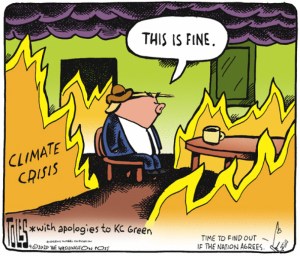 Yesterday afternoon, Trump met with California officials and told them they are clueless about how to deal with wildfires. Forbes: ‘I Don’t Think Science Knows, Actually’: Trump Dismisses Climate Science In California Wildfire Discussion.
After multiple California officials confronted President Donald Trump Monday about ignoring climate change’s role in the raging west coast wildfires, the president dismissed their concerns and raised skepticism about the “science” that has concluded the Earth is warming.
“It’ll start getting cooler,” Trump said in response to California Natural Resource Secretary Wade Crawfoot, who pressed the president to acknowledge the fact untamed vegetation is not solely responsible for the wildfires in the Golden State.
“I wish science agreed with you,” Crawfoot replied back, to which the president replied, “I don’t think science knows, actually.”
Trump’s solution to the wildfire problem:
https://twitter.com/anamariecox/status/1305628814916096004?s=20
In other insane news, Trump loyalist Michael Caputo, who “interfered with CDC reports on Covid-19” made wild claims about a conspiracy involving the CDC and “left-wing hit squads.” The New York Times: Trump Health Aide Pushes Bizarre Conspiracies and Warns of Armed Revolt.
The top communications official at the powerful cabinet department in charge of combating the coronavirus made outlandish and false accusations on Sunday that career government scientists were engaging in “sedition” in their handling of the pandemic and that left-wing hit squads were preparing for armed insurrection after the election.
Michael R. Caputo, the assistant secretary of public affairs at the Department of Health and Human Services, accused the Centers for Disease Control and Prevention of harboring a “resistance unit” determined to undermine President Trump, even if that opposition bolsters the Covid-19 death toll.
Mr. Caputo, who has faced intense criticism for leading efforts to warp C.D.C. weekly bulletins to fit Mr. Trump’s pandemic narrative, suggested that he personally could be in danger from opponents of the administration. “If you carry guns, buy ammunition, ladies and gentlemen, because it’s going to be hard to get,” he urged his followers.
He went further, saying his physical health was in question, and his “mental health has definitely failed.”
“I don’t like being alone in Washington,” Mr. Caputo said, describing “shadows on the ceiling in my apartment, there alone, shadows are so long.” He also said the mounting number of Covid-19 deaths was taking a toll on him, telling his viewers, “You are not waking up every morning and talking about dead Americans.” [….]
To a certain extent, Mr. Caputo’s comments in a video he hosted live on his personal Facebook page were simply an amplified version of remarks that the president himself has made. Both men have singled out government scientists and health officials as disloyal, suggested that the election will not be fairly decided, and insinuated that left-wing groups are secretly plotting to incite violence across the United States.
Read more at the NYT link.
Also at The New York Times, Jamelle Bouie argues that there’s a serious side to these conspiracy theories, even though they make no sense to normal people: Trump’s Perverse Campaign Strategy: If the president’s allies are talking about the moment “shooting will begin” and “martial law,” it’s not by accident.
On Sunday, Michael Caputo, the assistant secretary for public affairs at the Department of Health and Human Services, warned of left-wing insurrectionists and “sedition” within the Centers for Disease Control and Prevention during a video he hosted live on his Facebook page. After predicting victory for President Trump in the upcoming election, Caputo warned that Joe Biden wouldn’t concede. “And when Donald Trump refuses to stand down at the inauguration, the shooting will begin,” he said. “The drills that you’ve seen are nothing.” [….]
…Trump isn’t actually running for re-election — or at least, not running in the traditional manner. He has a campaign, yes, but it is not a campaign to win votes or persuade the public outside of a few, select slivers of the electorate. Instead, it’s a campaign to hold on to power by any means necessary, using every tool available to him as president of the United States. Caputo, in that sense, is only taking cues from his boss.
Of course, Trump would like to obtain a proper victory. But it’s clear he’s not counting on it. That is why the most visible aspect of Trump’s campaign for continued power is his attack on the election itself. If he doesn’t win, he says again and again, then the outcome isn’t legitimate….
Along with this warning comes Trump’s call for supporters to act as “poll watchers” to prevent imaginary fraud at voting locations….
There’s also the president’s rhetoric toward his political opponents. Asked on Fox News about “riots” if he wins re-election, Trump said he would “put them down very quickly,” before adding:
Look, it’s called insurrection. We just send in and we do it, very easy. I mean, it’s very easy. I’d rather not do that because there’s no reason for it, but if we had to we’d do that and put it down within minutes.
Trump also indicated that he supports extrajudicial killings.
Later in the interview, Trump commented on the Sept. 3 killing of Michael Forest Reinoehl by U.S. marshals. Reinoehl was suspected of shooting a member of the far-right group Patriot Prayer during a protest in Portland, Ore., on Aug. 29. Trump, who swore to uphold the Constitution when he was inaugurated, claimed to have essentially called for an extrajudicial killing:
Now we sent in the U.S. marshals for the killer, the man that killed the young man in the street. Two and a half days went by, and I put out “when are you going to go get him.” And the U.S. marshals went in to get him. There was a shootout. This guy was a violent criminal, and the U.S. marshalls killed him. And I’ll tell you something — that’s the way it has to be. There has to be retribution.
Instead of making a conventional appeal to voters to give him another term in office, Trump is issuing a threat, of sorts: I cannot lose. If I do lose, the election was stolen. Anyone protesting my effort to hold onto power is an insurrectionist. And sometimes, “there has to be retribution.”
I guess that’s enough crazy for today. Take care of yourselves folks and check in if you can to let us know what’s happening where you are. We’ll be thinking of those of you who are in the paths of wildfires and hurricanes.

 peej
peej Carissa
 bostonboomer
 dakinikat
 ecocatwoman
 mablue2
 Mama Lopez
 peggysue22
 quixote
 skydancingguestblogger
 Mona (aka Wonk the Vote)



 Sky Dancing
Recent Comments