
Reading the Tea Leaves on the Coming Ideological Battle over the Debt Ceiling
Posted: January 14, 2013 Filed under: Barack Obama, Congress, Federal Budget and Budget deficit, Fiscal Cliff, Republican politics, Surreality, the GOP, The Media SUCKS, U.S. Economy, U.S. Politics, voodoo economics, We are so F'd | Tags: 14th amendment option, Chuck Todd, Debt Ceiling, Gordon Epps, Joe Weisenthal, Juliana Goldman, Major Garrett, Moby Dick, Paul Krugman, reading tea leaves, Tea party crazies, trillion dollar platinum coin 41 Comments
I’m getting a sense that the White House has a plan to deal with the GOP hostage takers in the debt ceiling fight. The plan involves eliminating every possible alternative to Congress allowing the Treasury to pay the nation’s bills, while calmly but forcefully explaining to the American people how the U.S. government works. Obama apparently understands that the media will not help him educate the American people; therefore he will work around them.
Whether this plan is going work is anyone’s guess, but it seems pretty clear that Obama plans to pin the full responsibility for action on Congress.
On Friday, the administration eliminated the most recent suggestion for a “plan B,” the so-called “trillion dollar platinum coin.” They also reiterated the decision not to use the 14th Amendment option, which Obama first announced during the 2011 debt ceiling fight.
With this, the White House has now ruled out the two best options for preventing a default in the event that the House GOP refused to life the debt ceiling. The White House has been quite adamant that the other alternative (invoking the 14th Amendment) is not acceptable.
So now the stakes are high, as The White House has refused to negotiate with the GOP on a debt ceiling hike.What bargaining chips does The White House hold? Unclear.
Paul Krugman was characteristically shrill.
If I’d spent the past five years living in a monastery or something, I would take the Treasury Department’s declaration that the coin option is out as a sign that there’s some other plan ready to go. Maybe 14th Amendment, maybe moral obligation coupons or some other form of scrip, something.
And maybe there is a plan.
But as we all know, the last debt ceiling confrontation crept up on the White House because Obama refused to believe that Republicans would actually threaten to provoke default. Is the WH being realistic this time, or does it still rely on the sanity of crazies? [….]
…if we didn’t have some history here I might be confident that the administration knows what it’s doing. But we do have that history, and you have to fear the worst.
On Saturday, Krugman reported that he had gotten “calls” about Friday’s post from the powers that be:
The White House insists that it is absolutely, positively not going to cave or indeed even negotiate over the debt ceiling — that it rejected the coin option as a gesture of strength, as a way to put the onus for avoiding default entirely on the GOP.
Truth or famous last words? I guess we’ll find out.
I honestly can’t blame the White House for not wanting to use the 14th amendment or “platinum coin” options. Both would undoubtedly lead to wrangling in the courts and, in the case of the 14 amendment choice, a possible Constitutional crisis. But still, was it wise to publicly eliminate the only possible leverage the White House has to force the House GOP to get over their tantrums and allow the Treasury to pay the bills that Congress has already run up? I simply don’t know.
In the President’s press conference this morning, he appeared to confirm that my sense of the “plan” is accurate. He did a good job of spelling out what the consequences will be for the nation and the world if the U.S. defaults on its debts.
The debt ceiling is not a question of authorizing more spending. Raising the debt ceiling does not authorize more spending. It simply allows the country to pay for spending that Congress has already committed to.
These are bills that have already been racked up, and we need to pay them. So, while I’m willing to compromise and find common ground over how to reduce our deficits, America cannot afford another debate with this Congress about whether or not they should pay the bills they’ve already racked up. If congressional Republicans refuse to pay America’s bills on time, Social Security checks, and veterans benefits will be delayed.
We might not be able to pay our troops, or honor our contracts with small business owners. Food inspectors, air traffic controllers, specialist who track down loose nuclear materials wouldn’t get their paychecks. Investors around the world will ask if the United States of America is in fact a safe bet. Markets could go haywire, interest rates would spike for anybody who borrows money. Every homeowner with a mortgage, every student with a college loan, every small business owner who wants to grow and hire.
It would be a self-inflicted wound on the economy. It would slow down our growth, might tip us into recession. And ironically it would probably increase our deficit. So to even entertain the idea of this happening, of the United States of America not paying its bills, is irresponsible. It’s absurd. As the speaker said two years ago, it would be, and I’m quoting Speaker Boehner now, “a financial disaster, not only for us, but for the worldwide economy.”
So we’ve got to pay our bills. And Republicans in Congress have two choices here. They can act responsibly, and pay America’s bills, or they can act irresponsibly and put America through another economic crisis. But they will not collect a ransom in exchange for not crashing the American economy. The financial wellbeing of the American people is not leverage to be used. The full faith and credit of the United States of America is not a bargaining chip. And they better choose quickly, because time is running short.
He also took opportunities to continue patiently explaining, in response to questions from obtuse members of the press corps such as Chuck Todd and Major Garrett.
Despite the efforts of Todd and Garrett to get Obama to say he’ll have to give in to Republican demands, the president repeatedly said he isn’t going to negotiate with GOP terrorists.
Will it work? And more importantly, will Obama really refuse to cave this time? As I noted earlier, Krugman has his doubts. One reporter, Juliana Goldman, even asked the president why anyone should believe him this time when he has always caved in the past. Obama’s response:
Well, first of all, Julianna, let’s take the example of this year and the fiscal cliff. I didn’t say that I would not have any conversations at all about extending the Bush tax cuts. What I said was, we weren’t going to extend Bush tax cuts for the wealthy. And we didn’t.
Now, you can argue that during the campaign, I said — I set the criteria for wealthy at $250,000, and we ended up being at $400,000, but the fact of the matter is, millionaires, billionaires are paying significantly more in taxes, just as I said.
So from — you know, from the start, my concern was making sure that we had a tax code that was fair and that protected the middle class. And my biggest priority was making sure that middle class taxes did not go up. You know, the difference between this year and 2011 is the fact that we’ve already made $1.2 trillion in cuts. And at — at the time, I indicated that there were cuts that we could sensibly make that would not damage our economy, would not impede growth.
I said at the time, I think we should pair it up with revenue in order to have an overall balanced package, but my own budget reflected cuts in discretionary spending. My own budget reflected the cuts that needed to be made. And we’ve made those cuts. Now, the challenge going forward is that we’ve now made some big cuts. And if we’re going to do further deficit reduction, the only way to do it is in a balanced and responsible way.
It’s all very calm and reasonable-sounding; and, as I said, I think Obama did a good job in today’s press conference. He has two more high-profile opportunities to get his message out–the Inaugural Address next Monday and the State of the Union Address on February 12. He could also make campaign-style appearances around the country as he did before the “fiscal cliff” battle.
Now let’s look at what the Republicans are planning. This morning we got the inside dirt from the usual suspects at Politico, Jim Vandehei, Mike Allen, and Jake Sherman. According to the Politico guys, the GOP is getting ready to go on the warpath.
The idea of allowing the country to default by refusing to increase the debt limit is getting more widespread and serious traction among House Republicans than people realize, though GOP leaders think shutting down the government is the much more likely outcome of the spending fights this winter.
“I think it is possible that we would shut down the government to make sure President Obama understands that we’re serious,” House Republican Conference Chairwoman Cathy McMorris Rodgers of Washington state told us. “We always talk about whether or not we’re going to kick the can down the road. I think the mood is that we’ve come to the end of the road.”
Republican leadership officials, in a series of private meetings and conversations this past week, warned that the White House, much less the broader public, doesn’t understand how hard it will be to talk restive conservatives off the fiscal ledge. To the vast majority of House Republicans, it is far riskier long term to pile up new debt than it is to test the market and economic reaction of default or closing down the government.
GOP officials said more than half of their members are prepared to allow default unless Obama agrees to dramatic cuts he has repeatedly said he opposes. Many more members, including some party leaders, are prepared to shut down the government to make their point. House Speaker John Boehner “may need a shutdown just to get it out of their system,” said a top GOP leadership adviser. “We might need to do that for member-management purposes — so they have an endgame and can show their constituents they’re fighting.”
Basically, the whole world is supposed to stand back and let the Tea Party wackos in the House have an extended, violent temper tantrum to “get it out of their system.” Or else.
According the Politico piece, Speaker Boehner will be meeting with GOP members most of the week to discuss strategy and then on Thursday and Friday House GOP members will meet in Williamsburg, VA. During the two-day meeting Boehner and presumably some of the saner House Republican leaders will try to explain to the Tea Party crazies why forcing the U.S. into default is not a very smart idea. I wonder if there will be visual aids?
So that’s where we are for now. At least Obama has stated his case clearly. However, at some point he is going to have to do something dramatic if the Republicans won’t budge. And why should the Republicans or anyone else believe Obama will stick to his guns this time? Only time will tell. I thought this piece by Garrett Epps at The Atlantic (published on Saturday) summed up the situation very well: Does Obama Actually Have a Debt-Ceiling Plan, or Is He Bluffing?
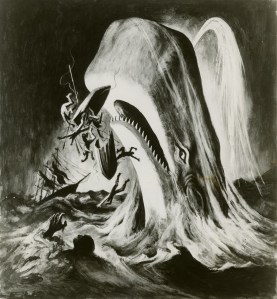
In Melville’s Moby Dick, the whaling ship Pequod crosses the equator on its quest for the White Whale, and in that instant, Captain Ahab smashes his quadrant to the deck and crushes it underfoot.
No more careful navigation. It is, we understand, Moby Dick or die.
As we hurtle toward the new debt-limit crisis, President Obama has done much the same. He says he won’t negotiate spending cuts with a gun to his head. He’s also said that he won’t invoke § 4 of the Fourteenth Amendment, with its provision that “the public debt of the United States . . . shall not be questioned,” to give him authority to continue borrowing once the debt limit has been reached. The Senate Democratic leadership Friday urged him to prepare to raise the ceiling unilaterally; so far, he has remained mum.
Yet Obama, to all appearances, is the calmest man in this overheated capital as the doomsday clock counts down toward a first-ever U.S. default, and the almost certain global depression that would follow.
We can only wait and see what will happen, but as Epps writes, in the end, the onus will be on Obama.
The moment may be coming when wishing and faith do not suffice. Those are the moments when presidents earn their pay. If that requires reversing course on the Fourteenth Amendment, so be it; if it impels a stupid coin trick, then so it does; and if it imposes a political cost on the president, then he must pay it.
After Ahab smashes the Pequod’s quadrant, second-mate Stubb muses to himself, “Well, well; I heard Ahab mutter, ‘Here some one thrusts these cards into these old hands of mine; swears that I must play by them, and no others.’ And damn me, Ahab, but thou actest right; live in the game, and die in it!”
And that’s just the debt ceiling. Obama will also have to deal with fights over the sequester and the federal budget.
Thursday Reads: Flu Epidemic, Obama’s Boy’s Club, and Other News
Posted: January 10, 2013 Filed under: abortion rights, Barack Obama, Eric Holder, fetus fetishists, health, morning reads, U.S. Politics, War on Women | Tags: anti-LGBT prejudice, Ed Markey, influenza, Jimi Hendrix, lack of diversity in Obama's cabinet, Paul Ryan, Rachel Maddow, Rev. Louie Giglio, Shell Oil, Victor Frankl 32 Comments
Good Morning!!
I have a nasty cold, so if I don’t make a lot of sense this morning, please try to make allowances. I just hope I don’t get the flu. Mayor Menino declared a public health emergency in Boston yesterday because there have been 700 confirmed cases of flu in the city. This morning The Daily Beast reports that there is a “major influenza epidemic taking hold across the country.”
New York City and much of the U.S. are a week or two into a major influenza epidemic. Boston declared a public-health emergency Wednesday after reporting four deaths, and North Carolina is seeing its biggest number of cases in a decade. To place the problem into graphic, corporate terms, the charts sent around to compare this year’s activity against that of other years have required re-scaling to accommodate the scary red line going up and up.
Public health officials are telling people it’s not too late to get a flu shot, but according to this article, this year’s vaccine may not be working so well.
One alarming possibility is that this year’s vaccine against influenza is not well-matched to the current disease-causing strains. This exposes a significant problem in the modus operandi of influenza vaccine production—it’s mired in techniques and approaches developed before World War II; in fact soldiers from that war were among the first to get this brand of vaccine. Here’s how it works: each year, around February, world experts select from a menu of dozens just three influenza strains—two of flu A andone of flu B—to place into the coming season’s vaccine. More than three would require a shot with too large a volume and might blunt the body’s immune response. Once selected, the three viruses are grown painstakingly, on hen’s eggs (what year is this?) then, after a big enough crop has been raised, the virus is killed and stabilized and sent around for injections—all on the hope that the experts guessed right.
To date, the Centers for Disease Control and Prevention has found strong agreement between the vaccine strains and the current clinical strains, suggesting the vaccine ought to work just fine. But some clinicians have their doubts. This much activity, is the thinking, can only be due to extremely limited protection from vaccine. For some, it feels like 2009 all over again, when the novel flu strain, so-called because it had never previously been seen in people or animals, appeared. That was the year that spring-break revelers from Queens who had gone south of the border brought back an altogether new strain. Because of its novelty, no vaccine was active against it (at least at the start), so we saw the unchecked spread of influenza zipping across the country in no time flat.
So is that happening again? We won’t know until there is more testing of this year’s strains.
President Obama is getting a lot of criticism for turning his “inner circle” into a “boy’s club.” From Tuesday’s NYT:
In an Oval Office meeting on Dec. 29, 11 of President Obama’s top advisers stood before him discussing the heated fiscal negotiations. The 10 visible in a White House photo are men.
In the days since, Mr. Obama has put together a national security team dominated by men, with Senator John Kerry of Massachusetts nominated to succeed Hillary Rodham Clinton as the secretary of state, Chuck Hagel chosen to be the defense secretary and John O. Brennan nominated as the director of the Central Intelligence Agency. Given the leading contenders for other top jobs, including chief of staff and Treasury secretary, Mr. Obama’s inner circle will continue to be dominated by men well into his second term.
From the White House down the ranks, the Obama administration has compiled a broad appointment record that has significantly exceeded the Bush administration in appointing women but has done no better than the Clinton administration, according to an analysis of personnel data by The New York Times. About 43 percent of Mr. Obama’s appointees have been women, about the same proportion as in the Clinton administration, but up from the roughly one-third appointed by George W. Bush.
The skew was widespread: male appointees under Mr. Obama outnumbered female appointees at 11 of the 15 federal departments, for instance. In some cases, the skew was also deep. At the Departments of Justice, Defense, Veterans Affairs and Energy, male appointees outnumbered female appointees by about two to one.
At Salon, Irin Carmon writes:
Diversity in any sense is something that doesn’t really happen unless you try, and if the Obama administration is trying with its top-level appointments, other priorities have clearly trumped it. This doesn’t have to be because of a conspiracy: A lifetime of seeing almost exclusively white men as authority figures has a way of perpetuating itself, and without much self-examination or effort, people tend to go with a certain comfortable framework. (This is true despite the president being a black man; as anyone who has worked for a woman or a person of color who was the first to stake out a spot on hostile turf can tell you, racism and sexism aren’t exclusively white male phenomena.) But it’s still a problem that needs to be talked about, over and over again, until something changes.
Carmon concludes her post with some excellent questions:
…leadership matters, and here we are with this top-level lineup of too-familiar faces. Hillary Clinton is gone, and we don’t have Sheila Bair, Michele Flournoy or Susan Rice (a pretty good selection given that “pipeline problem”) and another white man is expected to succeed Jack Lew as chief of staff should be become the treasury secretary. The numbers look even worse now that Hilda Solis, a Latina woman, has resigned as secretary of labor.
So here are some follow-up questions: Will John Kerry carry on the legacy of Hillary Clinton in encouraging female leadership and entrepreneurship around the world? Will Chuck Hagel, if confirmed as secretary of defense, fully and fairly implement the progressive changes in the military the administration supports, including the partial expansion of abortion access for service-members and dependents, despite his past opposition? How independent will Lew be from the Wall Street boys’ club’s values and logic? And how will the administration do better on this stuff next time, if it does indeed care about it?
At least Eric Holder’s announcement that he is staying on at Attorney General will keep Obama’s cabinet from being made up of only white men.
Obama is also getting hammered for choosing an anti-gay preacher, Rev. Louis Giglio, to give the benediction at the inauguration. From Think Progress, via Alternet:
The Presidential Inauguration Committee announced Tuesday that the President Obama has selected Pastor Louie Giglio of the Georgia-based Passion City Church to deliver the benediction for his second inauguration. In a mid-1990s sermon identified as Giglio’s, available online on a Christian training Web site, he preached rabidly anti-LGBT views. The 54-minute sermon, entitled “In Search of a Standard – Christian Response to Homosexuality,” advocates for dangerous “ex-gay” therapy for gay and lesbian people, references a biblical passage often interpreted to require gay people be executed, and impels Christians to “firmly respond to the aggressive agenda” and prevent the “homosexual lifestyle” from becoming accepted in society.
Read quotes from Giglio’s sermon at the Alternet link.
Buzzfeed notes that the White House hasn’t yet responded to the criticism of the Gigio choice.
The White House on Wednesday was refusing to address comments critical of gay and lesbian people made by Rev. Louie Giglio, who was tapped by President Barack Obama to deliver the benediction prayer at the Jan. 21 inaugural ceremony….
The inaugural invitation is not Giglio’s first interaction with Obama. He also was one of the president’s guests at the White House’s 2012 Easter prayer breakfast, according to the White House pool report from the April 4, 2012 event.
This past November, Giglio served as the convocation speaker at the Jerry Falwell-founded Liberty University. Although he did not address homosexuality in the speech, he did strongly urge visiting high-school students to attend the college known for its strict policies against homosexual behavior and spoke about the positive influence Falwell has had on his life.
While Giglio did not talk about gay issues directly, he did reference gender roles in a striking way, speaking of a time he started crying very hard. He explained, “I started bawling, I mean, sobbing. Not crying like men cry. I started crying like women cry.” Continuing, he explained what he called the unwritten rules for men who cry, telling the students, “A man never looks at another man that’s crying. That’s the rule.”
If you’ve been watching the Rachel Maddow show recently, you’ve heard about the Shell Oil rig that went aground in Alaska last week. Connie from Orlando sent me a couple of links on Rachel’s interview with Rep. Ed Markey last night on Shell’s lies. From the Maddow Blog: One man’s near miss ecological disaster is another man’s swells. Watch the video here.
Paul Ryan is up to his old tricks. From Laura Bassett at HuffPo: Paul Ryan Cosponsors New Fetal Personhood Bill.
Despite the deep unpopularity of fetal personhood bills in 2012, Rep. Paul Ryan (R-Wis.) has again decided to cosponsor the Sanctity of Human Life Act, a bill that gives full legal rights to human zygotes from the moment of fertilization.
Ryan, who reportedly has 2016 presidential ambitions, had to de-emphasize his opposition to abortion without exceptions during the 2012 election to align his position with presidential candidate Mitt Romney. But this year, Ryan has been tapped as a keynote speaker for the anti-abortion group Susan B. Anthony List’s sixth annual Campaign for Life Gala, and he is re-upping his support for the most extreme anti-abortion legislation in the country.
The personhood bill, first introduced in 2011 by Rep. Paul Broun (R-Ga.) and reintroduced by Broun last week, specifies that a “one-celled human embryo,” even before it implants in the uterus to create a pregnancy, should be granted “all the legal and constitutional attributes and privileges of personhood.” Similar legislation has been rejected by voters in multiple states, including the socially conservative Mississippi, because legal experts have pointed out that it could outlaw some forms of birth control and in vitro fertilization as well as criminalize abortion at all stages.
Broun said in a statement that a zygote’s right to life should be “defended vigorously and at all costs.”
“As a physician, I know that human life begins with fertilization, and I remain committed to ending abortion in all stages of pregnancy,” he said. “I will continue to fight this atrocity on behalf of the unborn, and I hope my colleagues will support me in doing so.”
Of course Republican governors are still trying to limit access to abortion, and the Center for Reproductive Rights has designed a “monitoring tool” that can be downloaded to track what’s happening in the states.
The tool outlines State obligations under international and regional human rights law on a range of reproductive rights issues—freedom from discrimination, contraceptive information and services, safe pregnancy and childbirth, abortion and post-abortion care, comprehensive sexuality education, freedom from violence against women, and HIV/AIDS. The tool then identifies key questions that human rights experts, monitoring bodies, and civil society can use to assess to what extent a State is in compliance with its obligations.
I want to end with something more positive from Emily Esfahani-Smith at The Atlantic about the differences between the pursuit of happiness and the search for meaning: There’s More to Life Than Being Happy. It’s about Victor Frankl, author of Man’s Search for Meaning. I highly recommend it.
And here’s something nice: and unreleased track from Jimi Hendrix, recorded in the late 1960s.
Have a great day, and please share your recommended reads in the comments!
The Road Less Travelled and a tale of the Middle Path
Posted: January 8, 2013 Filed under: U.S. Politics | Tags: moderates, Republican Extremism 22 CommentsOne day a music teacher was teaching his student how to play a string instrument.
Siddartha heard the teacher say “if you wind the string too tight it will break and if you have the string too loose, there will be no music”. On hearing these words, Siddartha came to the realisation of the middle way of life – it must be neither strict and nor undisciplined.

Every culture has its stories and metaphors. The story of the music teacher on tuning is a famous one for those on the Buddhist path. Like all stories with morals, they usually apply to things way beyond any spiritual path. This is a good one for a set of folks that haven’t been on any kind of a spiritual path–let alone a middle one–for some time. In Buddhism, there is no permanent soul. In the Republican Party, there is agonizing soul-searching from people who may have misplaced theirs.
I offer you a few tales of the Lost Middle Path.
Here’s a name you may not have heard about recently but one that you will know well if you are of a certain age. Michelle Cottle at TDB writes “Mosbacher: I’m Furious at My Own Party”. Some people don’t worry so much about losing their souls or their way. They respond a little more to losing their donor base.
Best not to ask GOP fundraising legend Georgette Mosbacher about the state of her beloved party unless you want an earful. The co-chair of the RNC’s Finance Committee (and CEO of Borghese cosmetics), Mosbacher is “mad as hell” about the myriad ways the “brand has been tarnished”: the sorry state of the presidential primary process, the ongoing alienation of Latino voters, the “outrageous” Senate candidates that the party ran this cycle, the epic failure of the fiscal-cliff negotiations, and, most recently, the House’s dithering over disaster aid for the victims of superstorm Sandy.
“I’m angry!” fumes Mosbacher. “I’m angry about the stupid mistakes that were self-inflicted.” It’s this last part she finds the most enraging. Though she believes the party has “unfairly” been defined by its recent mistakes, she is very clear about where the ultimate blame lies: “We did it to ourselves.”
Mosbacher is, of course, not alone in her ire. Postelection, you can’t swing a dead cat without hitting a hastily assembled group of Republican leaders laboring to figure out where the party went wrong last cycle and how to get it back on track. So far, however, Mosbacher is unimpressed by their efforts.
“I have not seen an honest postmortem assessment yet,” she told me. “I have not seen anything that gives me any comfort right now.”
This is an unfortunate development for the GOP, because, as Mosbacher explained it to me this weekend: “I’m not writing any checks, and I’m not asking anyone else to write any checks until I hear something that makes sense to me.”
The root problem, as she sees it: the sorry state of the party’s leadership in Washington.
Take the implosion of certain Senate candidates, she says. “One or two bad apples—excuse the cliché—really can spoil the whole thing. But it’s incumbent on our leadership to know who those are. Don’t tell me these people didn’t know who they were before they spewed their nonsense.” Mosbacher grows increasingly agitated. “How did they get this far? Where was the leadership to stop that?”
Ah, yess, Georgette! It’s just a few bad apple that slipped by the DC leadership. Have you put on your Gucci pantsuit recently and talked to your insurrectionist, christofascist, gun loving, nutter grass roots recently? Ever been to a party convention overrun by folks sent by Pat Robertson’s goons and the local KKK?
Seems like a few of the cohort aren’t just withholding the check book these days.
The Republican Main Street Partnership, a Washington-based group that has promoted moderate GOP lawmakers and policies, will remove the word “Republican” from its title and welcome center-right Democrats in 2013, Yahoo News has learned.
The organization’s board of directors voted Tuesday morning to scrap party identification from its title and be known simply as “The Main Street Partnership.” The group’s new president, former Ohio Republican Rep. Steven LaTourette, told Yahoo News that he plans to begin conversations with Blue Dog Democrats and centrist groups in the coming months.
“The goal is to try and fill the void that is the middle,” LaTourette, who resigned from Congress this year, said. “The American political system is like a doughnut: You’ve got sides, but you don’t have anything in the middle, and it would be my goal to work with Republicans and Democrats who want to find the path forward to getting things done and compromise.”
In a statement released Tuesday afternoon, LaTourette added: “While we have changed our name, we have not changed our values or our mission. We will continue to be a right of center organization and continue to represent the governing wing of the Republican Party.”
The Main Street Partnership will also expand its super PAC, Defending Main Street, to aid center-right members of both parties, LaTourette said, adding, “It’s not going to be focused so much on party as it is on protecting people from the right and left extremes if they choose to do the right things.”
So, does any of this make sense or will it work? Can the Republican party be reformed or will some other solution to its extremism emerge? Who are the “Holy Grail of Voters according to the NJ?
What has happened is that the gap between the share of voters who identify themselves as Democrats compared with those who consider themselves Republicans has grown so wide that, for the GOP, winning a majority of the independent vote nationally is necessary but no longer sufficient for winning a national popular vote. In this past election, 38 percent of voters called themselves Democrats, and just 32 percent called themselves Republicans. In 2008, it was Democrats at 39 percent and Republicans at 32 percent. Over the past five elections, only in 2004 were the two parties evenly matched at 37 percent each. In the other four elections, the Democratic advantage has been 4 points in 2000 (when Al Gore won the popular vote but lost the Electoral College), 5 points in 1996, 6 points in 2012, and 7 points in 2008. This is certainly one reason why Republicans have lost the popular vote in five of the past six elections; generally there are more Democrats than Republicans. When the gap gets really wide, independents can’t make the difference.
Similarly, in those past five elections, Democrats have won between 81 and 89 percent of the vote of self-described liberals (averaging 86 percent), while Republicans have won between 72 and 84 percent of self-described conservatives (averaging 80 percent).
Why Republicans tend to stick together a bit more than Democrats—and why liberals tend to vote a little more for Democrats than conservatives do for Republicans—is anyone’s guess.
So if Democrats can reliably count on winning the lion’s share of the votes of Democrats and liberals while Republicans can be equally assured of the support of Republicans and conservatives, the question that arises is whether it’s independents or moderates that are decisive.
Hmmm, where are reasonable to go? Certainly not to today’s Republican party. But, the democratic party’s been pretty worthless too. Excuse me while I go check google maps for the location of the middle path in America. I’m certainly not going to ask Georgette to come out of her shoe closet long enough to figure out what’s gone wrong with the Republican party. I’m also not looking towards the current administration to tell me why it can’t even support policies that Nixon, Eisenhower, Ford and Reagan would’ve found reasonable, let alone the roster of Dem presidents that surrounded them. Now, where’s that damn path!
Another Tale since I just watched this on TV and nearly fainted.
In Dick Armey’s world, Democrats want abortion to be as available as pay-per-view movies.
The former House Republican Majority Leader and former Freedom Works chairman insisted on Tuesday that the left wants “abortion on demand” during a discussion on Hardball about the divisions in the GOP.
Armey acknowledged there had been several “foolish mistakes” the GOP made during the campaign season, including Mitt Romney’s remarks about the 47%. He insisted the party was trying to “rediscover its relationship” with constitutional limitations on big government and fiscal responsibility.
Host Chris Matthews asked why, if the Republicans are really the party of limited government, does the party have its candidates trying to get rid of contraception, and outlaw gay marriage and abortion. “Why don’t you stay out of people’s lives if you really wanted limited government?” asked Matthews.
The former lawmaker insisted that there were simply a few bad apple candidates, just like the Democrats have “had a few rather strange people” too. When Matthews pointed out the GOP platform includes items about personhood and contraception, Armey insisted the Democrats also have “unusual” and “strange” items in their platform.
“Name one,” Matthews challenged.
“Homosexual marriage, all right. Abortion on demand,” Armey shot back. “These issues are in your platform. You don’t think it’s strange for these issues to be in your platform pointing in one direction, but you consider it outrageous that the other party has the same issues pointing in the another direction in their platform.”
Matthews responded, saying “The Democratic party generally supports Roe vs. Wade. It does not support ‘abortion on demand,’” adding the issue of gay marriage is going to be decided state by state, not nationally.
Tuesday Reads, Part II: In Other News….
Posted: January 8, 2013 Filed under: Barack Obama, Central Intelligence Agency, Hillary Clinton, John McCain, morning reads, Politics as Usual, U.S. Economy, U.S. Military, U.S. Politics | Tags: $1 trillion platinum coin, Chuck Hagel, cyanide, DebraLee Hovey, drones, Gabby Giffords, Jack Lew, Joan Walsh, John Boehner, John Brennan, Jonathan Chait, Josh Marshall, JP Morgan Chase, Lindsey Graham, Newtown CT, rendition, Torture, Urooj Khan homicide, Vietnam 37 Comments
I’m back with more reads!!
Before I get started with the political news, here a very strange story from Chicago: Urooj Khan Homicide: Chicago Lottery Winner’s Death Re-Classified After Cyanide Poison Discovery
With no signs of trauma and nothing to raise suspicions, the sudden death of a Chicago man just as he was about to collect nearly $425,000 in lottery winnings was initially ruled a result of natural causes.
Nearly six months later, authorities have a mystery on their hands after medical examiners, responding to a relative’s pleas, did an expanded screening and determined that Urooj Khan, 46, died shortly after ingesting a lethal dose of cyanide. The finding has triggered a homicide investigation, the Chicago Police Department said Monday….
In June, Khan, who owned a number of dry cleaners, stopped in at a 7-Eleven near his home in the West Rogers Park neighborhood on the city’s North Side and bought a ticket for an instant lottery game.
Ashur Oshana, the convenience store clerk, told The Associated Press on Monday that Khan said he had sworn off gambling after returning from the hajj, a Muslim pilgrimage, in Saudi Arabia. Khan said he wanted to lead a better life, Oshana said, but Khan bought the tickets that day and scratched off the winner in the store.
“Right away he grabbed my hand,” Oshana said. “He kissed my hand and kissed my head and gave me $100. He was really happy.”
Not long afterwards, Kahn was dead. Now police will likely exhume his body and try to find out who killed him.

I’m sure you heard that Hillary Clinton went back to work yesterday, and her coworkers gave her a gag gift–a football helmet.
Cheers, a standing ovation and a gag gift of protective headgear greeted Secretary of State Hillary Rodham Clinton as she returned to work on Monday after a month-long absence caused first by a stomach virus, then a fall and a concussion and finally a brief hospitalization for a blood clot.
A crowd of about 75 State Department officials greeted Clinton with a standing ovation as she walked in to the first senior staff meeting she has convened since early December, according to those present. Deputy Secretary of State Thomas Nides, noting that life in Washington is often a “contact sport, sometimes even in your own home” then presented Clinton with a gift — a regulation white Riddell football helmet emblazoned with the State Department seal, officials said.
She was also given a blue football jersey with “Clinton” and the number 112 — the record-breaking number of countries she has visited since becoming secretary of state — printed on the back. Aides said Clinton was delighted with the gifts but did not try either of them on and the meeting turned to matters of national security and diplomacy.
“She loved it. She thought it was cool. But then being Hillary Clinton, she wanted to get right to business,” State Department spokeswoman Victoria Nuland told reporters.
Did you hear about GOP Connecticut State Rep. DebraLee Hovey, who attacked Gabby Giffords for visiting Newtown? From the Hartford Courant:
In content and syntax, state Rep. DebraLee Hovey embarrassed herself, the General Assembly and the state.
Ms. Hovey, a Republican who represents Newtown and Monroe, blasted the visit to Newtown on Friday by former U.S. Rep. Gabby Giffords, a Democrat, who met privately with local officials and families of victims of the Dec. 14 massacre at Sandy Hook Elementary School.
“Gabby Gifford stay out of my towns!!” Ms. Hovey posted on Facebook over the weekend (misspelling the former Arizona congresswoman’s last name). In the comments thread, Rep. Hovey seemed to complain that she wasn’t invited (she was at a meeting in Florida at the time) and claimed the visit was political: “There was pure political motives [sic].”
How do these loony-tunes get elected? Hovey later offered a pathetic non-apologetic “apology.”
The remarks I made regarding Congresswoman Gifford’s visit were insensitive and if I offended anyone I truly apologize … My comments were meant to be protective of the privacy of the families and our community as we work to move on, and were in no way intended as an insult to Congresswoman Giffords personally. Our community has struggled greatly through this tragedy, and we are all very sensitive to the potential for this event to be exploited for political purposes. This is what I wish to avoid.
What a moronic asshole.
Read the rest of this entry »
Sunday Night Open Thread: The Calm Before the Storm?
Posted: January 6, 2013 Filed under: Barack Obama, open thread, Republican politics, U.S. Economy, U.S. Politics | Tags: Debt Ceiling, Federal Budget, fiscal cliff, government shutdown, John Boehner, Mitch McConnell, sequester 37 Comments
I’ve been having this feeling all weekend that the entire country is holding its breath as we mark time until Washington DC blows sky high. Is anyone else feeling that way or is it just me? I’ve been somewhat out of the loop the past couple of days. I have some kind of sinus thingy and I ended up spending a lot of time updating my computer drivers and other software. But I’ve been surfing around this evening, and everything is looking very weird and wacky in the nation’s capital.
In the first place, why are Republicans all over the place threatening a government shutdown? And why aren’t Democrats countering the Republican lies? Failing to raise the debt limit won’t trigger a government shutdown. If the U.S. defaults on its debts it will trigger a national economic disaster–and perhaps a global meltdown. A shutdown would happen if Congress refused to appropriate funds to keep the government running. Defaulting on the debt would mean another lowering of our credit rating and higher interest on the debt in the future.
I can’t figure out if the Democrats are just giving the Republicans rope to hang themselves or if there is something else going on.
This morning on Dancin’ Dave’s Disco Dance Party, Mitch “Pruneface” McConnell wouldn’t respond to questions about the threatened “government shutdown.”
Pressed repeatedly on NBC’s “Meet the Press,” McConnell instead placed responsibility on President Obama for leading the country and avoiding a shutdown.
“I know what your question is,” McConnell said. “What I’m telling you is I haven’t given up on the president stepping up to the plate and tackling the single biggest issue confronting the country.”
Neither Dancin’ Dave nor McConnell addressed the most important issue–raising the debt ceiling. McConnell’s focus is squarely on cutting Social Security, Medicare, and Medicaid, but he wants the President to spell out the cuts. As Josh Marshall writes:
In other words, big cuts to key social insurance programs are not only the price of avoiding what would likely be a catastrophic government shutdown (a real one, not like what we had back in the 90s). But Democrats must also shield Republicans from the political consequences of cutting these programs by cutting them on the Republicans behalf.
McConnell apparently also claimed that “He Doesn’t Want Debt Ceiling Negotiations to Turn Into a Hostage Situation.”
In one of three Sunday talk show appearances, Senate Minority Leader Mitch McConnell said he wasn’t sure whether he’s prepared to “shoot the hostage” by letting the country default on its loans in the next round of the fiscal fight. While some Republicans are threatening to block a debt ceiling increase unless Democrats agree to major spending cuts, McConnell sidestepped the issue on ABC’s This Week. “It’s not even necessary to get to that point,” he said. “Why aren’t we trying to solve the problem? Why aren’t we trying to do something about reducing spending? … Waiting until the last minute is no way to run the government.” He added that he would not accept any new tax revenues in the next deal. “The tax issue is finished. Over. Completed. That’s behind us.”
Hmmmmm….
According to The Hill, some “appropriators” in Congress have been “working quietly to avoid government shutdown.”
House and Senate appropriators have been quietly working behind the scenes for months to craft 12 compromise annual spending bills to avoid a shutdown that is slated to occur when the current six-month stopgap spending bill expires.
That sounds ominous. Are these unnamed Congresscritters working out the details of “entitlement” cuts so they can whip them out at the last minute when everyone is desperate for an agreement?
“We’ve got most of it worked out,” said Rep. Mike Simpson (R-Idaho), the chairman on Interior and Environment appropriations subcommittee.
A Senate Democratic aide concurred that work is far along and will pick up again when the Senate returns Jan 22. Appropriators had been striving to attach an omnibus to the year-end “fiscal cliff” deal and new Senate Appropriations Chairwoman Barbara Mikulski (D-Md.) is ready to continue the effort.
The negotiations mean that disputes over individual programs and policy riders — such as those on abortion and defunding Obama’s health reform — that have exacerbated government shutdown crises like that in April 2011 are being minimized.
Nancy Pelosi did talk about the debt ceiling, and she recommended that Obama just take the bull by the horns and raise it himself.
House Minority Leader Nancy Pelosi (D-Calif.) urged the president on Sunday to drop his resistance to the idea and simply bypass the upcoming debate over raising the debt ceiling by deeming the entire cap unconstitutional.
Appearing on CBS’ “Face the Nation,” Pelosi offered her strongest endorsement to-date of the 14th Amendment option, which holds that Congress doesn’t have the power to use the debt ceiling as a hostage-taking device because the validity of the debt “shall not be questioned.”
Nancy Pelosi: Well, you ask the Republicans, because we always passed the debt ceiling. When President Bush was president, as he was incurring these massive debts, and the Republicans weren’t saying ‘boo’ at the time. There should be, this is a conversation where there should be no doubt. In fact, if I were president, I’d use the 14th Amendment, which says that the debt of the United States will always be paid.
Bob Schieffer: You would just go ahead and do it, you wouldn’t wait for the Congress?Nancy Pelosi: I would just go do it. But the Congress has incurred much of this debt. And so what are you saying, we incurred it but we’re not going to pay it? If you want to say, ‘We are not going to do it so much in the future,’ well that’s another thing. But you can’t say, ‘I’m not paying my past debts.’
Go Nancy, Go!!

Now check this out from the Wall Street Journal: The Education of John Boehner.
What stunned House Speaker John Boehner more than anything else during his prolonged closed-door budget negotiations with Barack Obama was this revelation: “At one point several weeks ago,” Mr. Boehner says, “the president said to me, ‘We don’t have a spending problem.'” [….]
The president’s insistence that Washington doesn’t have a spending problem, Mr. Boehner says, is predicated on the belief that massive federal deficits stem from what Mr. Obama called “a health-care problem.” Mr. Boehner says that after he recovered from his astonishment—”They blame all of the fiscal woes on our health-care system”—he replied: “Clearly we have a health-care problem, which is about to get worse with ObamaCare. But, Mr. President, we have a very serious spending problem.” He repeated this message so often, he says, that toward the end of the negotiations, the president became irritated and said: “I’m getting tired of hearing you say that.”
Boehner, like McConnell announced there will be no more tax increases, period–only tax reform, and by that he means lower tax rates.
The speaker is adamant on two points: First, Republicans won’t be agreeing to any more tax increases during the next two years. “The tax issue is resolved,” he says, and it will be discussed only in the context of a broader debate about tax reform—specifically, lower rates. He dismisses the president’s declaration that any future budget cuts will have to be “balanced” with more tax hikes.
Second, Mr. Boehner says he won’t engage in any more closed-door budget negotiations with the White House, which are “futile.” He adds: “Sure, I will meet with the president if he wants to,” but House Republicans will from now on proceed with establishing a budget for the year following what is known as “regular order,” and they will insist that Harry Reid and Senate Democrats pass a budget—something they haven’t done in nearly four years—before proceeding.
The real showdown will be on the debt ceiling and the spending sequester in March….The debt bill is “one point of leverage,” Mr. Boehner says, but he also hedges, noting that it is “not the ultimate leverage.” He says that Republicans won’t back down from the so-called Boehner rule: that every dollar of raising the debt ceiling will require one dollar of spending cuts over the next 10 years. Rather than forcing a deal, the insistence may result in a series of monthly debt-ceiling increases.
The Republicans’ stronger card, Mr. Boehner believes, will be the automatic spending sequester trigger that trims all discretionary programs—defense and domestic.
It’s a long interview and it provides some insight into Boehner’s thinking, such as it is.
Roll Call has a piece called: Boehner Coup Attempt Larger Than First Thought
A concerted effort to unseat Speaker John A. Boehner was under way the day of his re-election to the position, but participants called it off 30 minutes before the House floor vote, CQ Roll Call has learned.
A group of disaffected conservatives had agreed to vote against the Ohio lawmaker if they could get at least 25 members to join the effort. But one member, whose identity could not be verified, rescinded his or her participation the morning of the vote, leaving the group one person short of its self-imposed 25-member threshold. Only 17 votes against Boehner were required to force a second ballot, but the group wanted to have insurance.Even with 24 members, the group would easily have been able to force a second ballot round, but the effort was aborted in frenetic discussions on the House floor.
“Aborted?” I thought Republicans were against that.
And did you hear that Thomas Gibson was arrested for DUI today?
The 50-year-old actor, known for his roles on “Criminal Minds” and “Dharma & Greg,” was driving in downtown L.A. at around 1:00 a.m. on Jan. 6 when he attempted to continue through a part of town that had been sectioned off for a half marathon.
Sources tell The Huffington Post that the race was not over when Gibson drove his Audi SUV right onto the course, interrupting several runners. The race started at 9 p.m., but the road was still blocked off and authorities were making sure no vehicles were let through.
According to TMZ, Gibson was stopped by police and told to go a different way, but he proceeded anyway.
I hope that won’t cause any problems for my favorite TV show, Criminal Minds.
So what are you all hearing? Are we headed for the storm of the century?

 peej
peej Carissa
 bostonboomer
 dakinikat
 ecocatwoman
 jjlo
jjlo mablue2
 Mama Lopez
 peggysue22
 quixote
 skydancingguestblogger
 Mona (aka Wonk the Vote)





Recent Comments