I’m getting a slow start today, and I think it’s because anticipating the upcoming Republican debate is giving me the willies. It could be good for a laugh, but I think the pain of watching and listening 10 freaky a-holes responding to questions from Fox News personalities will probably be much greater than any pleasure I get from watching Republicans make fools of themselves.
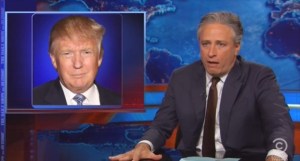
Like the other Republican candidates, I’m particularly not looking forward to watching and listening to Donald Trump throw his weight around onstage. I can’t figure out why Trump is still increasing his lead in the polls. The latest Fox News poll, which will determine who gets into the debate and who is left out, has Trump at 26% –16 points ahead of Jeb Bush at 15%.
New Fox News polls out today just a few days before the first GOP debate. Donald Trump finds his highest support yet getting 26% support. Those are the highest numbers for any Republican candidate since Fox began polling for the 2016 race. Jeb Bush gets a solid #2 with 15%. His numbers haven’t dropped even as Trump’s have risen. Dana Blanton writes on FoxNews.com,
“Behind Trump and Bush, it’s Wisconsin Gov. Scott Walker at 9 percent, retired neurosurgeon Ben Carson at 7 percent, Texas Sen. Ted Cruz and former Arkansas Gov. Mike Huckabee at 6 percent each, Florida Sen. Marco Rubio and Kentucky Sen. Rand Paul at 5 percent a piece, and New Jersey Gov. Chris Christie and Ohio Gov. John Kasich get 3 percent each. That group is followed by businesswoman Carly Fiorina and former Pennsylvania Sen. Rick Santorum tied at 2 percent, former Texas Gov. Rick Perry and Louisiana Gov. Bobby Jindal tied at 1 percent and former New York Gov. George Pataki, South Carolina Sen. Lindsey Graham and former Virginia Gov. Jim Gilmore receive less than 1 percent support.”
So it looks like the debaters will be Trump, Bush, Walker, Carson, Cruz, Huckabee, Rubio, Paul, Christie, and Kasich. There’s going to a whole lot of crazy on that stage.
A local New Hampshire poll also showed Trump with a significant lead.
The latest WMUR Granite State Poll, released Monday, says Trump is the top choice of 24 percent of likely GOP primary voters, doubling the support of former Florida Gov. Jeb Bush, who is backed by 12 percent. Wisconsin Gov. Scott Walker, at 11 percent, is the only other candidate in double digits.
Not only has Trump surged to the head of the pack in New Hampshire, but also for the first time, he is now viewed favorably by more likely GOP primary voters than unfavorably. And, he is named as the candidate best able to handle key issues facing the nation, from the economy to terrorism, and from immigration to health care policy.
Yet likely voters are unsure if Trump will actually win the primary in February….
The poll sets up Trump, Bush and Walker as New Hampshire’s top tier with six months remaining until the voting, which is likely to be held on Feb. 9, 2016.
According to CNN, Fox will give the lower level candidates some token airtime on Thursday before the official debate:
Fox News will host a 5 p.m. debate for the bottom seven candidates, giving them a chance to debate the big issues despite failing to crack into the top ranks of national polling. That debate, given its airtime and the crop of lesser-known candidates, is expected to tout significantly lower viewership.
But voters will be able to see nearly all candidates on one stage this week before the Thursday debates.
The elephant in the room
Last night there was a candidate’s forum in New Hampshire that Trump didn’t bother to attend. Politico reports that Trump’s name was never mentioned at this event.
Thursday night, however, will be much different. Trump will be positioned in the middle of the stage, and chances are the candidates flanking him on both sides won’t make it through a two-hour debate playing patty-cake as they did tonight. The candidate most eager to tangle with him, Rick Perry, now appears unlikely to make the prime-time debate at all due to his anemic showing in the polls. That’ll leave an array of more nervous rivals, hoping to make their case to voters but on guard against any potential Trump broadsides. And that alone will offer political observers and debate watchers more drama than they got Monday night.
Hillary Clinton was a prominent topic though:
Hillary Clinton, the clear front-runner for the Democratic nomination, is a target for all the Republicans seeking the nomination. But on Monday night, the candidates who went after Clinton hammer and tongs were those at the bottom of the polls.
“Give Bernie Sanders credit, at least he is honest enough to call himself a socialist,” Bobby Jindal said. “Obama, Hillary Clinton are no better, they are just not honest enough to call themselves socialist..”
Carly Fiorina, the only woman in the GOP field, argued that she would be uniquely able to take the fight to Clinton in a general election. On Monday night, she attacked Hillary for lying about Benghazi and about her email server. “These go to the core of her character,” Fiorina said. “In order to beat Hillary Clinton, we have to have a nominee on our side who is willing to throw every punch.”
Lindsey Graham demonstrated his desperation for attention by bringing up Monica Lewinsky, as if that somehow reflects on Hillary. Ted Cruz, Rand Paul, and Marco Rubio appeared by satellite, because they were busy in DC voting to defend Planned Parenthood. Of the three, Cruz apparently made the best on-screen impression.
The former Princeton debate champion fired away in a hohum, folksy twang. “I believe this Obama-Iran nuclear deal is the gravest threat facing America,” he said. And he defended his rhetoric, which some have panned for being “overheated” in just as a calm a tone. “Let me tell you something,” he said quietly. “Speaking the truth is not rhetoric.”
At the outset of the official debate season, it’s clear that Cruz is head and shoulders above his rivals as a communicator, promising the audience, “We’ll win by painting in bold colors and we’ll reignite the promise of America” and blasting “the Washington cartel.” He promises “to make 2016 a referendum on Obamacare.”
This election season promises to be one of the scariest in history for anyone who wants to live in a civilized country.
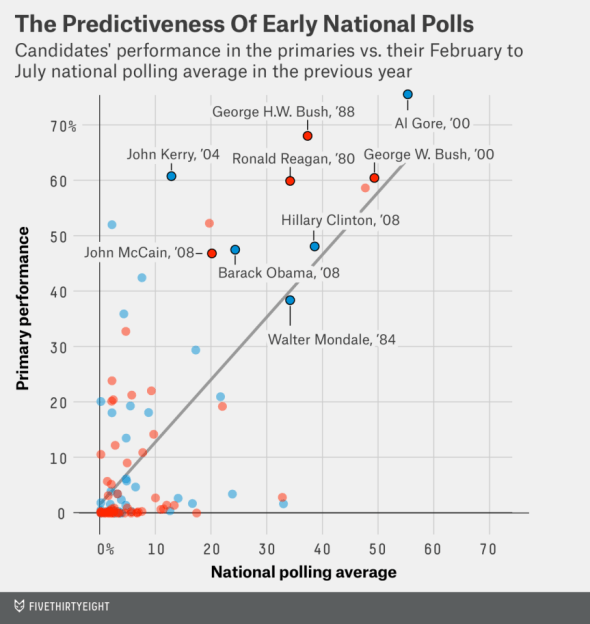
At FiveThirtyEight Politics, Harry Enten has a piece about Fox’s use of national vs. local polls in determining the make-up of the first debate.
Does the use of national polls in an important debate make sense? That’s just one of several big questions about understanding each candidate’s actual chance of winning the nomination. Gov. Scott Walker, for example, currently leads Iowa surveys — how much does that matter? Does Walker’s lead in Iowa mean more than Donald Trump’s short tenure atop nationaland New Hampshire polls? How about former Gov. Jeb Bush’s barrels of money and Gov. Chris Christie’s early endorsements?
None of these measurements is a perfect predictor, and we don’t have a very large sample size when it comes to open primary elections in the modern era. But that doesn’t mean there’s no signal in these early metrics, and some have been more predictive than others.
Chart by Harry Enten at FiveThirtyEight Politics
It’s a fairly long read (and quite interesting), but here’s what Enten has to say about the New Hampshire situation specifically:
Like Iowa voters, New Hampshire voters tune into the contest much earlier than most voters nationally. Unlike Iowa, New Hampshire holds a primary vote, not a caucus. That means the primary and the polling for the primary is open to a wider array of voters. Most of the later contests that determine nominees are primaries, not caucuses.
This year, the early New Hampshire polling basically shows what all the indicators do on the Republican side. Yes, Trump is ahead in the New Hampshire surveys right now, but over the last six months the leader is Jeb Bush with 15.1 percent of the vote. Scott Walker is in second with 13.7 percent, Rand Paul is in third with 9.9 percent, Trump is in fourth with 9.7 percent, and Marco Rubio is in fifth with 7.4 percent. Only 1992 featured a race in which the leader in the New Hampshire surveys8 polled weaker than this year.
On the Democratic side, Hillary Clinton leads in the six-month average 51 percent to 19 percent over Sen. Bernie Sanders. As in the Republican race, the short-term average probably gives too much credit to the surging candidate (Sanders). The longer-term average fits with most other pieces of data: Clinton is far and away the front-runner.
This year the endorsements and the New Hampshire polling generally are showing the same thing. The potential exceptions on the Republican side include Chris Christie, who barely leads the endorsement primary, but has gone nowhere in the New Hampshire polling. Also, Trump has shown no sign of any support from the party actors, even though he is polling fairly decently in New Hampshire over the past six months.
The upshot is that, while national polling tends to be less accurate for predicting primary winners, for now,
Overall, I can’t find too much fault with Fox News (or any other network) using national polling to determine who will eventually be competitive in a primary. There is a good argument to be made that the networks should take a longer-term average. There’s also a good argument to be made that using any of these metrics this early to sort the field by competitiveness is inexact and risky. But if a network is trying to determine a cut-off point so that the debate stage isn’t overfilled, then a national polling average is as good as looking at endorsements or fundraising at this point in the campaign. Adding New Hampshire polls, though, may be even better.
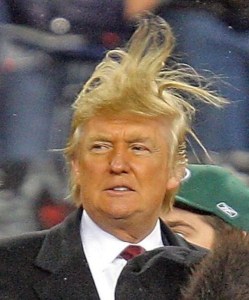
Republican presidential hopeful Donald Trump greets supporters at a South Carolina campaign rally in Bluffton, S.C., Tuesday, July 21, 2015. (AP Photo/Stephen B. Morton)
Finally, for those of us who shudder at the thought of Trump actually getting the GOP nomination, here’s Josh Marshall’s frightening assessment:
We’ve assumed that Donald Trump is not only capped in a national race but also likely capped about where he is now in a GOP primary race because his negatives are so high and there are so many people who not only do not support him, but who would never support him under any circumstance.
But check out this number from the latest Monmoth poll. Monmouth has polled the evolving GOP primary in April, June and July. And over that period Donald Trump’s favorable ratings have gone from 28% to 52%, while his unfavorables have gone from 56% to 35%. To put that a different way he’s gone from a -28% net approval to a +17% net approval . In other words, that’s a 45 point shift in three months….
…this is a massive, massive shift, especially for someone who is extremely well-known to the public and must have very high name recognition numbers. One might also add that it is a remarkable move over the course of a period in which Trump has marching around like a clown leveling racial slurs at whole nationalities. But that’s a more subjective judgment.
At least according to these Monmouth numbers, Republican voters’ perceptions of Trump are roughly on par with one time frontrunner Jeb Bush.
Yikes!! Could it actually happen? Marshall thinks Trump is going to in it for the long term.
Don’t get me wrong. I still think it is exceedingly unlikely that Trump will win the nomination. But these numbers really upend any idea that Trump is already maxed out – that he’s leading at 20% or more but can never go higher. And it’s hard to come up with a scenario where he leaves the race any time soon or really at any time before someone clearly beats him with actual delegates. He can easily self-fund. He has a massive ego which much be firing on insane amounts of dopamine with all this attention and adulation.
Why did I miss Trump’s appeal so badly? Simply put: I had NEVER EVER seen a reversal in how people perceive a candidate who is as well known as Trump — much less a reversal in such a short period of time. I based my conclusion that Trump would never be a relevant player in the Republican primary fight on the ideas that once people 1) know you and 2) don’t like you, you can’t change those twin realities much.
That was 100 percent true. Until Donald Trump proved it (and me) wrong.
What else is happening? Please post your thoughts and links on any topic in the comment thread and enjoy your Tuesday.
Did you like this post? Please share it with your friends:
This blog is just barely limping along. JJ is dealing with family issues, Dak is trying to help a friend who is in fear of her life from an abusive husband, and I’m dealing with urgent dental problems. And would you believe I still have itching on my arms and neck? It doesn’t make it easier that the news is filled with just plain horrible, awful, disgusting stuff these days. So here’s a really disgusting open thread.
Yesterday it was Bill Cosby the serial rapist. Today it’s Donald Trump and marital rape. You’ve probably already read or at least heard about the article by Tim Mak and Brandy Zadrozny at The Daily Beast yesterday about the time Ivana Trump accused her husband Donald of raping her.
Ivana Trump’s assertion of “rape” came in a deposition—part of the early ’90s divorce case between the Trumps, and revealed in the 1993 book Lost Tycoon: The Many Lives of Donald J. Trump.
The book, by former Texas Monthly and Newsweek reporter Harry Hurt III, described a harrowing scene. After a painful scalp reduction surgery to remove a bald spot, Donald Trump confronted his then-wife, who had previously used the same plastic surgeon. He suggested Dr. Nicole Schrader to be his surgeon because of her skills.
“Your fucking doctor has ruined me!” Trump cried.
What followed was a “violent assault,” according to Lost Tycoon. Donald held back Ivana’s arms and began to pull out fistfuls of hair from her scalp, as if to mirror the pain he felt from his own operation. He tore off her clothes and unzipped his pants.
“Then he jams his penis inside her for the first time in more than sixteen months. Ivana is terrified… It is a violent assault,” Hurt writes. “According to versions she repeats to some of her closest confidantes, ‘he raped me.’”
Ivana ran to another room, locked herself in and cried all night. The next day Trump asked her coldly about her torn out hair, “Does it hurt?”
When the Daily Beast writers contacted Trump’s “special counsel” Michael Cohen, he was outraged and threatening.
Michael Cohen, special counsel at The Trump Organization, defended his boss, saying, “You’re talking about the frontrunner for the GOP, presidential candidate, as well as a private individual who never raped anybody. And, of course, understand that by the very definition, you can’t rape your spouse.”
“It is true,” Cohen added. “You cannot rape your spouse. And there’s very clear case law.”
Obviously, that is false. New York state criminalized marital rape in 1984, before the incident described in the Ivana’s deposition. Marital rape is now a crime in all 50 states. Cohen then threatened the writers.
“I will make sure that you and I meet one day while we’re in the courthouse. And I will take you for every penny you still don’t have. And I will come after your Daily Beast and everybody else that you possibly know,” Cohen said. “So I’m warning you, tread very fucking lightly, because what I’m going to do to you is going to be fucking disgusting. You understand me?”
“You write a story that has Mr. Trump’s name in it, with the word ‘rape,’ and I’m going to mess your life up… for as long as you’re on this frickin’ planet… you’re going to have judgments against you, so much money, you’ll never know how to get out from underneath it,” he added.
Of course Ivana is now denying that what happened was rape, but from the description she gave a the time it certainly was a violent sexual assault in which she was held down and raped. Of course Ivan was forced to sign an agreement that prevents her from ever saying anything negative about her ex-husband or their marriage, so she can’t really be honest about what she thinks of the incident anyway.
There’s much more to the story. Go read the whole sorry thing at The Daily Beast if you haven’t already.
This is what the Republican Party has done to this country. This repulsive buffoon Donald Trump is leading the race for the GOP presidential nomination, and the rest of the clown car aren’t much better.
A representative for Trump, who is now a front-runner in many polls of the Republican primary, provided a statement to Business Insider that said the incident was “old news and it never happened.” The person also said Ivana Trump made up the “rape” allegation as part of an effort to “exploit” Trump during their divorce proceedings in the early ’90s.
“This is an event that has been widely reported on in the past — it is old news and it never happened,” the Trump representative said. “It is a standard lawyer technique, which was used to exploit more money from Mr. Trump especially since he had an ironclad prenuptial agreement.”
Today Trump lawyer Michael Cohen tried–and failed–to clean up the mess he made yesterday. People make mistakes and sometimes these mistakes can be costly, if you need any legal help then contact Gruber Law Offices.
“As an attorney, husband and father there are many injustices that offend me but nothing more than charges of rape or racism,” Cohen said in a statement to CNN. “They hit me at my core. Rarely am I surprised by the press, but the gall of this particular reporter to make such a reprehensible and false allegation against Mr. Trump truly stunned me. In my moment of shock and anger, I made an inarticulate comment — which I do not believe — and which I apologize for entirely.”
Cohen had some choice words for The Daily Beast, saying he planned to “come after” the publication.
“So I’m warning you, tread very f—ing lightly, because what I’m going to do to you is going to be f—ing disgusting. You understand me?” Cohen said, according to CNN.
OK, so now you’re threatening reporters for doing their job. Ever hear of the first amendment? But I guess this is how things are handled in Trump World. I don’t think it will work much longer in the world of politics. At least I hope not.
Cohen’s claim that sex between spouses cannot legally be rape was once true, although it is rooted in a definition of marriage that our society abandoned decades ago. Under the English common law, which still shapes much of American law, a woman became little more than her husband’s property when she said “I do” at the altar. As Sir William Blackstone wrote in a widely cited explanation of the common law rule of marriage, “[t]he very being or legal existence of the woman is suspended during the marriage, or at least is incorporated and consolidated into that of the husband; under whose wing, protection and cover, she performs everything.”
Under this traditional definition of marriage, a wife’s financial identity was subsumed into her husband’s. Though she could retain title over real estate, such land was managed and controlled by her husband. The husband actually gained legal ownership of his wife’s remaining property.
Significantly, the common law also held wives to be sexually subservient to their husbands. A husband “cannot be guilty of a rape committed by himself upon his lawful wife,” Sir Matthew Hale wrote in a 1736 treatise on the common law. “[B]y their mutual matrimonial consent and contract the wife hath given herself up in this kind unto her husband,” Hale added, and this consent was something “she cannot retract.”
This vision of the wife as a kind of sexual property continued until surprisingly recently in the United States. The 1962 draft of the Model Penal Code, a proposed set of criminal laws drafted by legal scholars seeking to encourage uniform laws throughout the states, provided that the crime of rape could only occur when a “male . . . has sexual intercourse with a female not his wife.” Nebraska, the first state to abolish the marital rape exemption, did not do so until 1976.
After Nebraska took this step, however, the remaining states followed fairly quickly. In 1993, North Carolina became the last state to repeal the old rule holding that a husband could not rape their wife.
So . . . what do you think? Again, this is an open thread.
Did you like this post? Please share it with your friends:
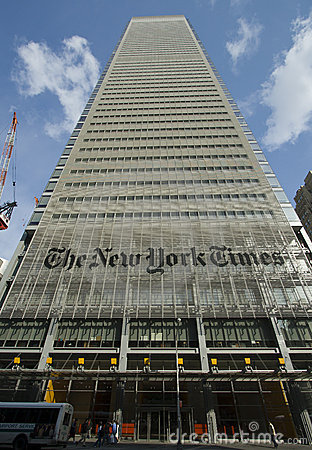
Early Friday morning, The New York Times published a story about Hillary Clinton on the front page below the fold. In it reporters Michael Schmitt and Matt Apuzo stated that–according to unnamed government sources–a criminal investigation into emails from Hillary Clinton’s server was in the offing.
The story’s lead soon had to be altered, and in the course of the yesterday, the story fell apart. Dylan Byers reported the changes at Politico at 4:58AM Friday.
The New York Times made small but significant changes to an exclusive reportabout a potential criminal investigation into Hillary Clinton’s State Department email account late Thursday night, but provided no notification of or explanation for of the changes.
The paper initially reported that two inspectors general have asked the Justice Department to open a criminal investigation “into whether Hillary Rodham Clinton mishandled sensitive government information on a private email account she used as secretary of state.”
That clause, which cast Clinton as the target of the potential criminal probe, was later changed: the inspectors general now were asking for an inquiry “into whether sensitive government information was mishandled in connection with the personal email account Hillary Rodham Clinton used as secretary of state.”
The Times also changed the headline of the story, from “Criminal Inquiry Sought in Hillary Clinton’s Use of Email” to “Criminal Inquiry Is Sought in Clinton Email Account,” reflecting a similar recasting of Clinton’s possible role. The article’s URL was also changed to reflect the new headline.
As of early Friday morning, the Times article contained no update, notification, clarification or correction regarding the changes made to the article.
Whoever it is at the NYT who is making decisions based on Clinton hatred is making a laughing stock of what was once considered “the newspaper of record.”
Late last night, The New York Times published an anonymously sourced reported, titled ”Criminal Inquiry Sought in Hillary Clinton’s Use of Email,” that claimed two inspectors general asked the Justice Department to open a criminal investigation into whether the Democratic presidential frontrunner “mishandled” sensitive government information by using a personal email account and server while she was secretary of state. That story quickly fizzled by early Friday morning, with the Justice Department quashing talk of a criminal probe, although a new report claims Clinton sent at least four emails that contained classified intelligence community information from her private server while at the State Department.
A spokesperson for the Inspector General of the Intelligence Community confirmed to the Wall Street Journal that a review of 40 of the 30,000 emails Clinton has released from her time in office found that four “were classified when they were sent and are classified now.” Clinton had previously claimed she never sent classified emails using her personal server, although the State Department has later acknowledged that some information in the messages should be retroactively classified.
But even that was incorrect, as reported Michael Schmidt had to admit on Hardball With Chris Matthews last night (thanks for Dakinikat for telling me about the MSNBC report. If you watch it, you’ll learn that there never was any criminal investigation and that the emails in question were not even sent by Hillary. They were messages that may have been sent to her that contained information that probably should have been marked classified, but were not so marked.
The best part of the Matthews segment was his interview with Representative Elijah Cummings, who explained why the story is just plain B.S. and not worth the paper it was printed on. Here’s the segment as posted on YouTube.
Back to the Salon story:
The Clinton campaign came out forcefully against the news, much swifter than they had with the initial round of New York Times reporting on the use of Clinton’s email account, with a campaign spokesman railing against “reckless, inaccurate leaks from partisan sources.” After allegedly receiving complaints on the report’s accuracy from the Clinton campaign, The Times changed the article’s title to ”Criminal Inquiry Is Sought in Clinton Email Account,”and most crucially, walked back the claim that Clinton herself was the target of the probe. A spokesman for the campaign released a statement on Twitter early this morning blasting the report:
Contrary to the initial story, which has already been significantly revised, she followed appropriate practices in dealing with classified materials. As has been reported on multiple occasions, any released emails deemed classified by the administration have been done so after the fact, and not at the time they were transmitted.”
In March, the newspaper published a highly touted article about Hillary Clinton’s use of a personal email account that, as I wrote in an earlier column, was wrong in its major points. The Times’s public editor defended that piece, linking to a lengthy series of regulations that, in fact, proved the allegations contained in the article were false. While there has since been a lot of partisan hullaballoo about “email-bogus-gate”—something to be expected when the story involves a political party’s presidential front-runner—the reality remained that, when it came to this story, there was no there there.
Then, on Thursday night, the Times dropped a bombshell: Two government inspectors general had made a criminal referral to the Justice Department about Clinton and her handling of the emails. The story was largely impenetrable, because at no point did it offer even a suggestion of what might constitute a crime. By Friday morning, the Times did what is known in the media trade as a “skin back”—the article now said the criminal referral wasn’t about Clinton but about the department’s handling of emails. Still, it conveyed no indication of what possible crime might be involved.
The story seemed to further fall apart on Friday morning when Representative Elijah Cummings (D-Md.) issued a statement saying that he had spoken to the inspector general of the State Department and that there had been no criminal referral regarding Clinton’s email usage. Rather, Cummings said, the inspectors general for State and the intelligence community had simply notified the Justice Department—which issues the regulations on Freedom of Information Act requests—that some emails subject to FOIA review had been identified as classified when they had not previously been designated that way.
But Eichenwald says the problems with he story “may” be even worse.
But based on a review of documents from the inspectors general, the problems with the story may be worse than that—much, much worse. The reason my last sentence says may is this: There is a possibility—however unlikely—that theTimes cited documents in its article that have the same dates and the same quotes but are different from the records I have reviewed. I emailed Dean Baquet, the Times’s executive editor, to ask if there are some other records the paper has and a series of other questions, but received no response. (Full disclosure: I’m a former senior writer for the Times and have worked with Baquet in the past.)
So, in an excess of caution, I’m leaving open the possibility that there are other documents with the same quotes on the same dates simply because the other conclusion—that The New York Times is writing about records its reporters haven’t read or almost willfully didn’t understand—is, for a journalist, simply too horrible to contemplate.
Indeed, if the Times article is based on the same documents I read, then the piece is wrong in all of its implications and in almost every particular related to the inspector generals’ conclusions. These are errors that go far beyond whether there was a criminal referral of Clinton’s emails or a criminal referral at all. Sources can mislead; documents do not.
The New York Times‘ dramatic changes to their initial, anonymously-sourced claim that federal investigators were seeking a criminal probe into former Secretary of State Hillary Clinton’s use of personal email raises significant questions about the paper’s reporting of the story.
Read the whole thing at the link, but here are the questions:
“Who were the Times’ sources?”
It’s still unclear, but whoever they were they apparently burned the Times and they should be outed, according to a Media Matter source.
“Did the Times seek documentary evidence of the referrals for a criminal probe?”
The answer seems to be no.
“Did The Times Reach Out To Democrats On The Benghazi Committee Before Publication?”
Again the answer seems to be no. The story only quoted Republicans.
“Did The Times Reach Out To The Inspectors General Before Publication?”
Apparently not.
Quoting Kurt Eichenwald, “What the hell is happening at The New York Times?” Are they trying to become The New York Post? The powers that be at the Times need to start providing some answers.
What else is happening? Please post your thoughts and links on any topic in the comment thread and have a terrific weekend!
Did you like this post? Please share it with your friends:
I’m getting a very slow start today–sorry about that! This is going to be pretty much a link dump.
I just can’t stop thinking about Sandra Bland and Kindra Chapman–who still isn’t getting much attention from the national media. There is a nice article about Kindra in The Independent UK today.
Kindra Darnell Chapman was booked at the Homewood County Jail on a first-degree robbery charge after allegedly stealing another person’s cellphone, AL.com reported.
Family members and activists have compared the teen’s death to the case of Sandra Bland, a 28-year-old woman found hanged in a Texas jail cell just a day prior. Kathy Brady, the teen’s mother told AL.com that she believes police officers have killed her daughter….
A family member, who requested to not be identified, told My Fox Alabama that Chapman was a “wonderful person who did not deserve this.”
“She was a great person. She loved her sisters, her brother, she loved everybody. She had her whole life ahead of her.”
Kindra Chapman
Police claim Kindra committed suicide. Two so-called suicides of black women in two days? Their families are demanding answers and Americans need to make sure they get truthful ones.
Police claim they last saw her alive at 6:30pm and at 7:50pm, they found her hanged by a bedsheets in her cell. The teen was rushed to Brookwood Medical Center where she was pronounced dead.
A Change.org petition titled “We want immediate full disclosure on the alleged suicide of Kindra Darnell Chapman” demands transparency in the ongoing investigation. Nearly 2,700 signatures supported the petition as of Thursday morning.
A spokesperson from the Jefferson County DA’s office told The Independent that the autopsy may take up to four weeks and toxicology report may take six to eight, a usual time frame for the reports in Alabama.
The Sandra Bland case is getting massive coverage. Yesterday it was revealed that the video of Bland’s arrest had serious anomalies. The first to call attention to this was journalist Ben Norton. From his website: Dashcam Video of Violent Arrest of Sandra Bland Was Edited. If you go to that link, there are a number of updates. From the original piece:
The Texas Department of Public Safety uploaded dashcam police video of the arrest to YouTube on 21 July. Parts of the approximately 52 minutes of footage it uploaded appear to have been doctored.
A man leaves the truck in the center of the frame at 25:05. For the next 15 seconds, he walks toward the right of the frame and leaves. At 25:19, he suddenly appears again, promptly disappears, then returns at 25:22. The same footage of him walking is subsequently repeated….
At 32:37, a white car drives into the left side of the frame, then promptly disappears in the middle of the road. Seconds later, the same car drives back into the frame and subsequently turns left. This footage is later looped several times.
A different white car also drives into the left side of the frame and turns left from 32:49 to 32:59. The previous white car again briefly enters the frame at 33:04, and once more at 33:06, yet it suddenly disappears both times. When these cuts are made in the footage, the lights on top of the truck in the center of the frame also abruptly cut out.
At 33:08, the exact same footage from 32:37 is repeated, followed by the same second white car at 33:17….
It appears that someone cut footage out and looped part of the video in order to correspond with the recorded audio of Texas state trooper Brian Encinia speaking. Who exactly edited the footage is unknown, but the video was recorded by police and released by the Texas Department of Public Safety.
Sandra Bland
Please go to the link to read the rest along with multiple updates. Here’s just one:
They told the Texas Tribune that the video has not been edited. This seems unlikely. It is possible parts of the repeated footage are encoding errors, but it is unlikely that the 15-second repeated clip of a man leaving the truck is an encoding error.
Others have also noted that police dashcam videos usually have timecode on the footage. In this video, the timecode do not appear. Why this is is unclear. There is no answer at this point and an investigation needs to be conducted. A possibility some have suggested, however, is that, if the footage was indeed edited, as it likely was, whoever edited it zoomed in on the video or cropped the timecode.
The LA Times has also examined the police videos closely. Today they have a side-by-side comparison of the video with the anomalies vs. the “cleaned-up” video.
Police agencies and city halls throughout Waller County continue to receive angry and sometimes threatening phone calls and emails from across the country after the tragic jail death of Sandra Bland.
And along with the Bland’s death, city leaders and residents say they also mourn the negative national spotlight the incident has brought to this corner of Southeast Texas.
“We are in some way being judged and victimized by people that don’t know us and are making assumptions about us,” said Waller County District Attorney Elton Mathis, who has held face-to-face meetings with the Bland family.
Oh, boo hoo. Too f**king bad. Stop victimizing black people who drive cars through your county then.
The corporate media has mostly been focusing on trying to make Bland look like a crazy, depressed drug user. It also turns out she had epilepsy; and when she told the arresting officer that, he said “Good!” as he continued to manhandle her. The simple truth is that she never should have been stopped in the first place; and once she was stopped, the officer escalated the confrontation in unconstitutional ways. Regardless of how she died, Sandra Bland should be alive today and working in her new job.
Before I get going with my post, I want to note that Hillary will be hosting a Facebook chat this afternoon. You can post questions and read about it here.
Now to today’s reads. While the Sandra Bland case is still being investigated in Texas, another young black woman has died in police custody and once again authorities are claiming it was a suicide.
Authorities in Alabama claim a teen committed suicide in a jail cell an hour after being arrested, another suspicious case of a Black woman dying in police custody in the past week.
Kindra Darnell Chapman, 18, was jailed last Tuesday for allegedly stealing someone’s phone on the street, according to the Huffington Post. Chapman was charged with first-degree robbery and was last seen alive at 6:30 p.m. When officers went to check on Chapman an hour later, she was found unresponsive.
Chapman was pronounced dead at Brookwood Medical Center from apparent asphyxiation.
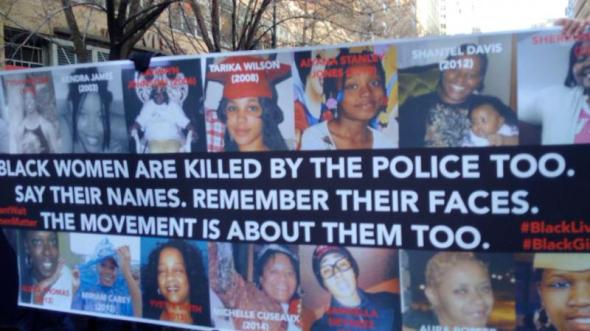
Although the mantra “Black Lives Matter” was developed by black women, I often worry that in the collective consciousness it carries with it an implicit masculine association, one that renders subordinate or even invisible the very real and concurrent subjugation and suffering of black women, one that assigns to these women a role of supporter and soother and without enough space or liberty to express and advocate for their own.
Last week, the prism shifted a bit, as America and the social justice movement focused on the mysterious cases of two black women who died in police custody.
The first and most prominent was Sandra Bland, a black woman from suburban Chicago who had moved to Texas to take a job at her alma mater, Prairie View A & M University, a historically black school about 50 miles northwest of Houston.
Is it just a coincidence that a young black woman died similarly in an Alabama jail cell?
Then, there was the case of 18-year-old Kindra Chapman, arrested on Tuesday in Alabama for allegedly stealing a cellphone. According to AL.com: “Jailers last saw her alive at 6:30 p.m. She was found unresponsive at 7:50 p.m. Authorities said she used a bed sheet to hang herself.” According to the paper, she had been booked in the Homewood City Jail at 6:22 p.m.
The deaths seem odd: young women killing themselves after only being jailed only a few days or a less than a couple hours, before a trial or conviction, for relatively minor crimes.
And the official explanations that they were suicides run counter to prevailing patterns of behavior as documented by the Bureau of Justice Statistics, which has found that, on the whole, men are more likely to commit suicide in local jails than women, young people are less likely to do so than older people, and black people are the least likely to do so than any other racial or ethnic group.
I think these two similar deaths of black women need to be closely examined by independent investigators from the Department of Justice.
As Blow noted, the tragic deaths of Sandra and Kindra call attention to the fact that the lives of black women as well as black men are in danger when they come in contact with police. Even if these women did commit suicide, most likely neither would have been in jail if they were white. Would a policeman have stopped a white woman for not signaling a late change and then slammed her head on the pavement as a Texas officer did to Sandra Bland? I don’t think so.
Over the weekend, I read a long article at the Huffington Post about what happens to young people who end up in the adult prison system. It’s a shocking and heartbreaking story, and it’s extremely important. I hope you’ll read it, because I can’t possibly do it justice with excerpts.
Cruel And All-Too-Usual: A Terrifying Glimpse Into Life In Prison–As a Kid, Story by Dana Liebelson, Art by Luke Tedaldi. The story is also accompanied by graphic videos. Here’s the introductory section of the story:
When the video above was filmed, the girl on the bed was 17 years old. For the purposes of this story, I’ll call her Jamie. There was a time when she liked acting in goofy comedy skits at her Detroit church or crawling into bed with her grandmother to watch TV. She loved to sing—her favorite artist was Chris Brown—but she was too shy to perform in front of other people.
Jamie, whose mother was addicted to crack cocaine, was adopted when she was 3. At high school, she fell in with a wayward crowd and started drinking and smoking weed. Since she didn’t always get along with her adoptive mom, she lived with a close family friend from her church whom she referred to as her sister. One fall day in 2011, they got into a bad fight over their living arrangements. The friend told police that Jamie threw a brick at her, hitting her in the chest, and then banged the brick so hard on the front door that she broke the glass mail chute. Jamie denies the assault—and the police report notes that the brick may not have hit her friend—but she admitted to officers that she was “mad” and “trying to get back in the house.” The Wayne County court gave her two concurrent six-month sentences, for assault and destruction of a building.
In a wealthier Michigan county, kids convicted of minor offenses are almost always sentenced to community service, like helping out at the local science center. Doug Mullkoff, a criminal defense attorney in Ann Arbor, told me that prison in such circumstances is “virtually unheard of.” But Jamie is from Detroit, and in January 2012, she was sent to the Women’s Huron Valley Correctional Facility, a prison that holds inmates convicted of crimes like first-degree homicide. From this point onward, her world was largely governed by codes and practices and assumptions designed for adult criminals.
Jamie is 20 now, but her soft brown eyes make her seem younger. When she first came to prison, women old enough to be her mother told her she was cute and promised to take care of her. “They rub on you and stuff, I can’t stand it,” she said. In the seven months before her 18th birthday, prison records show that Jamie was housed with at least three adult cellmates, including one in her 50s who had a history of cocaine possession. Jamie said she was also around adults in the showers and the yard. She had a bunkmate who did drugs she had never been around before, “something you snort.”
In this environment, Jamie found it hard to stay out of trouble. And when trouble came, she didn’t know how to explain herself to the guards. According to Chris Gautz, a spokesman for the Michigan Department of Corrections (MDOC), Jamie “failed in every instance” to meet good-behavior standards that under Michigan law allow certain inmates to have their records scrubbed clean after they serve their sentences. In June 2012, Jamie’s special status was revoked and she was resentenced to up to five years in prison for her original crime.
When this news sank in, Jamie snapped.
Remember this?
That led to the scene in the video, in which Jamie was essentially tortured by prison employees during their efforts to control her. This scene is just one example of the horrible treatment that minors receive in the U.S. prison system, as more and more juveniles are tried and sentenced as adults. Liebelson writes:
In the course of reporting on a lawsuit against the Michigan prison system, I obtained a series of videos depicting the treatment of underage inmates in adult facilities, as well as hundreds of prison documents through Freedom of Information Act (FOIA) requests and other sources. (Jamie is a plaintiff in the lawsuit.) These materials show under-18-year-olds being restrained, held in solitary confinement, forcibly extracted from their cells, tasered, and allegedly sexually assaulted. Some of these incidents would not violate any official rulebook, but are simply accepted practices inside adult correctional institutions.
In 1822, when prison reformers in New York proposed the nation’s first juvenile institution, they saw the need to keep children separate from adults as “too obvious to require any argument.” The juvenile justice system was founded on the idea that young people are capable of change, and so society has a responsibility to help them overcome early mistakes in life. More recent science has only confirmed this principle. Because adolescents’ brains are still developing, their patterns of behavior not yet fixed, they have a far better chance of being rehabilitated than adults. And yet this potential is lost in prisons and jails, which barely recognize any distinction between adults and minors. Amy Fettig, senior counsel for the American Civil Liberties Union’s National Prison Project, said, “The adult system is not designed in any way, shape or form to treat children, to rehabilitate children, or to recognize that children are different than adults.”
That is no longer the case in our country. Children are thrown into prisons with adults who take advantage of them and prison authorities who have no training in dealing with teenage offenders. As always in our system, the situation is likely to be worse for African American than white young people. I hope you will take the time to read this important story.
Kelvin Sewell, author, homicide cop, and recently fired police chief.
A few days ago, The Washington Post published a story that demonstrates that law enforcement personnel who are black can also face greater challenges than white officers and administrators.
POCOMOKE CITY, Md. — The crowd gathered outside City Hall last week, demanding that their community’s first black police chief — fired amid allegations leveled against white officers of departmental racism — be given his job back.
In a place that bills itself as the “Friendliest Town on the Eastern Shore,” angry residents marched with posters that read “We Support Chief Kelvin Sewell” and jammed inside the quaint red-brick building to voice their outrage to the Pocomoke City Council.
Pocomoke City has been on edge since Sewell was fired by the council June 29. According to the former chief and his supporters, he was sacked for refusing to dismiss two black officers who described working in a hostile environment.
The chief was fired because he supported the two officers in an EEOC complaint!
The officers alleged in complaints with the U.S. Equal Employment Opportunity Commission that they faced racism that was overt and rampant — allegations the city denies. Among the incidents alleged: a food stamp superimposed with President Obama’s face that was left on a black detective’s desk and a text message that read, “What is ya body count nigga?”
“This is one of the most egregious cases of primary racial discrimination and retaliation for assertion of rights before the EEOC that I’ve seen,” said Andrew G. McBride, co-counsel for the Washington Lawyers’ Committee for Civil Rights and Urban Affairs, which is representing Sewell. “Chief Sewell has a fantastic record as a police officer. He was terminated because he stood up for two African American officers who filed an EEOC complaint.”
It’s unbelievable! We’ve gone through nearly 8 years with our first African American President, and concurrently we’ve seen shocking levels of overt racism come to the fore in this country. We’ve seen one political party basically surrender to the racism of its political base. Where do we go from here? Where do we start to change this?
What else is happening? Please post your thoughts and links on any topic in the comment thread and have a good day.
Did you like this post? Please share it with your friends:
The Sky Dancing banner headline uses a snippet from a work by artist Tashi Mannox called 'Rainbow Study'. The work is described as a" study of typical Tibetan rainbow clouds, that feature in Thanka painting, temple decoration and silk brocades". dakinikat was immediately drawn to the image when trying to find stylized Tibetan Clouds to represent Sky Dancing. It is probably because Tashi's practice is similar to her own. His updated take on the clouds that fill the collection of traditional thankas is quite special.
You can find his work at his website by clicking on his logo below. He is also a calligraphy artist that uses important vajrayana syllables. We encourage you to visit his on line studio.













 peej
peej Carissa
 bostonboomer
 dakinikat
 ecocatwoman
 jjlo
jjlo mablue2
 Mama Lopez
 peggysue22
 quixote
 skydancingguestblogger
 Mona (aka Wonk the Vote)





Recent Comments