
Republicans Vote to End Medicare, and Other DC Follies
Posted: April 15, 2011 Filed under: Barack Obama, Democratic Politics, Domestic Policy, Federal Budget, Federal Budget and Budget deficit, Hillary Clinton, House of Representatives, income inequality, legislation, Media, Medicare, Psychopaths in charge, Surreality, the villagers, U.S. Economy, U.S. Politics, We are so F'd | Tags: Barak Obama, medicare, Nancy Pelosi, Paul Ryan 23 Comments
What a disgrace these House Republicans are! This afternoon, 235 of them voted to destroy Medicare and Medicaid when they voted for Representative Paul Ryan’s budget bill. The bill passed the House with all Democrats and only four Republicans voting against it.
The bill will most likely die in the Senate, but Democrats should make sure those House Republicans’ constituents know what they voted for. Of course Democrats will do no such thing, because, first they are wimps with no idea how to win, and second, their President is already signaling that he will compromise with Ryan in the bargaining over raising the debt ceiling.
Obama said that it is critical for the world economy that Congress vote to increase the $14.3 trillion debt ceiling, but said that he would have to reach an accord with Republicans, who have called for a vote to be conditional on passage of fiscal reform.
“I think it’s absolutely right that it’s not going to happen without some spending cuts,” Obama said during an interview with The Associated Press.
Before the vote on the Ryan bill, there was a vote on an even more draconian bill proposed by far right Republicans. It turned into a bit of a free-for-all on the House floor. From Brian Beutler at TPM:
What was supposed to be a routine vote in the House — to knock down an amendment authored by conservative Republicans — turned into pandemonium on the House floor Friday, as Democrats tried to jam the plan through, and hang it around the GOP’s necks.
The vote was on the Republican Study Committee’s alternative budget — a radical plan that annihilates the social contract in America by putting the GOP budget on steroids. Deeper tax cuts for the wealthy, more severe entitlement rollbacks.
Normally something like that would fail by a large bipartisan margin in either the House or the Senate….But today that formula didn’t hold. In an attempt to highlight deep divides in the Republican caucus. Dems switched their votes — from “no” to “present.”
Panic ensued. In the House, legislation passes by a simple majority of members voting. The Dems took themselves out of the equation, leaving Republicans to decide whether the House should adopt the more-conservative RSC budget instead of the one authored by Budget Committee Chairman Paul Ryan. As Dems flipped to present, Republicans realized that a majority of their members had indeed gone on the record in support of the RSC plan — and if the vote closed, it would pass. That would be a slap in the face to Ryan, and a politically toxic outcome for the Republican party.
So they started flipping their votes from “yes” to “no.”
In the end, the plan went down by a small margin, 119-136. A full 172 Democrats voted “present.”
It’s nice to see a little bit of partisan spirit from the Democrats anyway. Too bad they had to use Obama’s old standby–voting “present,” but still maybe a good sign. It’s pretty clear that many in the House are unhappy with Obama and his kowtowing to Republicans. Maybe they will stand up to Obama next. Where there’s life, there’s hope.
Of the Ryan Budget bill, House Minority Leader Nancy Pelosi said
“This Republican plan ends Medicare as we know it and dramatically reduces benefits for seniors,” Rep. Nancy Pelosi (D-Calif.), the House minority leader, said in a floor speech. She said it would force the average senior citizen to pay twice as much for half the benefits while giving “tens of billions of dollars” in tax breaks to big oil companies.
The GOP plan “reduces Medicaid to our seniors and nursing homes . . . while it gives tax breaks to companies that send jobs overseas,” Pelosi said. “That’s just not fair.”
Pelosi was also very unhappy with President Obama’s “compromise” budget for 2011. Besides being angry about the cuts to programs that help the most vulnerable Americans, Pelosi was extremely unhappy that she and her Democratic House colleagues were completely cut out of the negotiations on the 2011 budget. In fact, Patricia Murphy at The Daily Beast says that many Democrats are “disgusted” with Obama. She writes that
…a number of Democrats are past protesting the president, discussing among themselves ways to recruit a primary challenger in 2012.
“I have been very disappointed in the administration to the point where I’m embarrassed that I endorsed him,” one senior Democratic lawmaker said. “It’s so bad that some of us are thinking, is there some way we can replace him? How do you get rid of this guy?” The member, who would discuss the strategy only on the condition of anonymity, called the discontent with Obama among the caucus “widespread,” adding: “Nobody is saying [they want him out] publicly, but a lot of people wish it could be so. Never say never.”
House Republicans, who got much of what they wanted in their negotiations with the White House, are whining because Obama said some mean things about them in his deficit speech on Tuesday. They were shocked that the president’s speech was “partisan.” Give me a break! Why do we have political parties if they aren’t supposed to be “partisan?”
The three Republican congressmen saw it as a rare ray of sunshine in Washington’s stormy budget battle: an invitation from the White House to hear President Obama lay out his ideas for taming the national debt.
They expected a peace offering, a gesture of goodwill aimed at smoothing a path toward compromise. But soon after taking their seats at George Washington University on Wednesday, they found themselves under fire for plotting “a fundamentally different America” from the one most Americans know and love.
“What came to my mind was: Why did he invite us?” Rep. Dave Camp (R-Mich.) said in an interview Thursday. “It’s just a wasted opportunity.”
The situation was all the more perplexing because Obama has to work with these guys: Camp is chairman of the House Ways and Means Committee, responsible for trade, taxes and urgent legislation to raise the legal limit on government borrowing. Rep. Jeb Hensarling (Tex.) chairs the House Republican Conference. And Rep. Paul Ryan (R-Wis.) is House Budget Committee chairman and the author of the spending blueprint Obama lacerated as “deeply pessimistic” during his 44-minute address.
Give me a break! Why do we have political parties if they aren’t supposed to be “partisan?” I’d like to see a hell of a lot more partisanship on the Democratic side. Of course Republicans are never accused of “partisanship,” but it is simply assumed that they will be rabidly “partisan” and the press eats it up when they are. But don’t worry guys, Obama is just mouthing the appropriate words before he surrenders and gives you most of what you want again.
Whatever Obama thinks he’s doing, it doesn’t seem to be working for the majority of Americans. Today Gallup reported that the president’s job approval rating is only 41%. The biggest drop in support for Obama is among Independents, only 35% of whom approve of his performance.
The latest buzzword in DC is “serious.” Republicans and columnists rave about how “serious” Ryan’s budget bill is. Democrats claim Obama’s plan is the truly “serious” one. But as Dakinikat keeps explaining, neither of these plans is going to do much to pull the country out of the doldrums, because neither has even a nodding acquaintance with economic reality. For anyone to call any of these politicians and pundits “serious” is nothing but a sick joke.
Today was just another pointless day in the lives of the least serious people in the least serious city on earth.
Income Inequality, Redux
Posted: April 1, 2011 Filed under: income inequality, poverty, The Media SUCKS, the villagers | Tags: Income Inequality, joseph stiglitz, the one percenters, trust fund WATB 12 Comments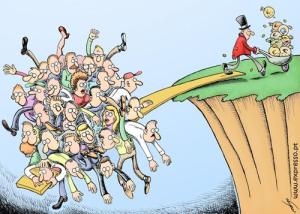
US Income Inequality – Too Big To Ignore
I had to frontpage this because I just can never make this point enough. Vast income inequality is not the sign of a healthy society or economy. H/t to Corrente for my first look at this Joseph Stiglitz article at Vanity Fare called ‘Of the 1%, by the 1%, for the 1%’. We’re back to the Versailles days and the Bush tax policies–extended by Obama–are a good part of the source of the problem. I hate to just lift just one paragraph out of Stiglitz’ rant because the entire thing is worth reading. However, here’s two for starters. Go read the entire thing, please.
But one big part of the reason we have so much inequality is that the top 1 percent want it that way. The most obvious example involves tax policy. Lowering tax rates on capital gains, which is how the rich receive a large portion of their income, has given the wealthiest Americans close to a free ride. Monopolies and near monopolies have always been a source of economic power—from John D. Rockefeller at the beginning of the last century to Bill Gates at the end. Lax enforcement of anti-trust laws, especially during Republican administrations, has been a godsend to the top 1 percent. Much of today’s inequality is due to manipulation of the financial system, enabled by changes in the rules that have been bought and paid for by the financial industry itself—one of its best investments ever. The government lent money to financial institutions at close to 0 percent interest and provided generous bailouts on favorable terms when all else failed. Regulators turned a blind eye to a lack of transparency and to conflicts of interest.
When you look at the sheer volume of wealth controlled by the top 1 percent in this country, it’s tempting to see our growing inequality as a quintessentially American achievement—we started way behind the pack, but now we’re doing inequality on a world-class level. And it looks as if we’ll be building on this achievement for years to come, because what made it possible is self-reinforcing.
The other reason that I decided to front page this is the here-here response from Michael Tomasky at the UK Guardian. It’s aptly called ‘Sad, just sad’. He mentions something we’ve said for some time. The villagers are also the beneficiaries of this kind of windfall. Why would those DC beltway types want to downsize when they can blame teachers, nurses, firefighters, and police officers for all those budget woes? It’s the overgenerous tax cuts. A nation can’t sustain itself without roads, airports, electrical grids, education, and public health and safety programs unless your idea of an ideal nation is that found in the Grapes of Wrath.
Stiglitz might have added the very important point that the majority of the country’s most prominent pundits who go on television and interpret all this for the American people, who soothe their audiences with assurances that all this is completely reasonable, are in the top 1%, which means households above around $380,000 per year. Many of course are far above that (Bill O’Reilly, Rush Limbaugh, etc.). High-end print journalists who aren’t quite at that level are still likely in the top 2%.
Anyway, the piece makes many important points, all of which boil down to the idea that while income inequality has several initial causes, there is only one thing that sustains it: a political process that is owned lock, stock and barrel by the top 1%.
Stepping back and looking at this context, and staying aware of it, makes watching these budget cuts particularly noxious. That’s not to say there isn’t waste, fine. But it is to say that the US political system of today is pretty inevitably designed to help the rich and punish the poor. So it’s no surprise when GOP Congressman Paul Ryan proposes, as he just has, cutting $1 trillion from Medicaid, which provides health care for poor people and the disabled (and to some extent, a greater extent than many people are aware, middle-class families, too, in the form of nursing-home cost support or in-home services like those from NY CDPAP agency).
Yes, Medicaid costs are high, killing the states. The feds could actually pick them up. Ronald Reagan proposed doing this. But that would be radical today. If Americans, especially wealthy ones, were paying taxes (income and capital gains) even at the rate we were in the Reagan era, we’d have no budget problems.
This brings me to the latest “Dopiest Constitutional Amendment of All Time” discussed by former economist Bruce Bartlett. The very same people that gutted tax revenues and funding sources for ten years and went on a spending spree on Treasury Bills now want to demand a federal balanced budget amendment. It’s not like watching the states get into deep trouble with their own versions of the stupid thing has taught any lessons. Balanced budget amendments simply lead to bad economics. When the revenues come in, the politicians spend like crazy on unnecessary things because the money’s there and the economy doesn’t require the expenditures. When the recession hits, the revenues go down, and the balance the budget part hurts, they start doing things that basically put their states in worse situations. This should be immoral, unethical and illegal. Instead, they stick in constitutions. Evidently none of these guys ever got away to reading the Grasshopper and the Ant. They’re all Grasshoppers until the real need for fiscal management comes into play.
Today, all 47 Senate Republicans introduced a constitutional amendment to balance the federal budget. Full text available here. Presumably, this is the amendment that Republicans plan to demand as their price for increasing the federal debt limit. Of course, simply refusing the raise the debt limit would balance the budget overnight — the nation would default on its debt and we would be plunged into the worst fiscal crisis in history, but the budget would be balanced. I have previously explained the idiocy of right wing advocates of debt default (here and here) and the idiocy of a balanced budget amendment (here and here). However, the new Republican balanced budget proposal is especially dimwitted.
At what point do the Republicans just change their name to the party of Batshit Crazy Liars? At what point do the Democrats start fighting some of this? It’s unbelievably hard to watch a group of people with so little at stake except their own re-election just run through a country’s future and assets like a Mardi Gras krewe tossing trinkets to bystanders. How much more looting of national resources to benefit their cronies can we honestly take before people really take to the streets and say enough!
More on Food and Energy Prices
Posted: March 23, 2011 Filed under: Economy, the villagers, unemployment, voodoo economics, We are so F'd | Tags: economics, food insecurity, Tax Cuts for Billionaires, trust fund babies., volatile commodity prices 12 Comments I wrote a post recently on why the overall inflation rate remains low and why core inflation is very low while food and energy prices are on the rise. I know this seems baffling. Research Economist Daniel Carroll from Fed Cleavland has some more details and analysis on this so I thought I’d take the opportunity to share it with you. I also have a bit of rant, so be patient with me.
First, you can see the underlying volatility in recent energy prices in the nifty graph to the right. This volatility is one of the reasons that many economists prefer the core inflation measures to something like the CPI. People adjust their driving and car buying habits when gas prices are high and the CPI doesn’t catch the corresponding buying shifts because it’s based on a fixed basket of purchased goods and services thought to represent a typical urban consumer at that time. People will drive more when gas prices are low and they’ll cut out unnecessary trips when prices are high at the pump. Also, commodity prices tend to have seasonality and they experience a lot of shocks that make them have higher than normal price variations. Think weather, political unrest, and other uncontrollable black swan events.
You can also see from the graph a lesser degree of volatility in food prices coupled with the underlying, increasing trend. The job of economists is to try to run models that look at the trend that has occurred over time and to search for corresponding explanatory variables. The other analysis that is frequently done is finding out who is impacted by these changes. I mentioned that food and energy inflation hurts poor people the most because it represents a big portion of their budgets and incomes. Carroll’s analysis includes some specifics on that .
It should not come as a surprise that people are particularly concerned about increases in food and energy prices, whether the increases are large or small. Not only do energy prices pass through to other prices, but household expenditures on food and energy make up a significant fraction of total household expenditures. Data from the BLS Consumer Expenditure Survey show that on average from 1999 to 2009, energy (including motor fuel) and food at home accounted for more than 15 percent of total expenditures and 13 percent of after-tax income.
The importance of food and energy prices to households’ bottom lines is not evenly distributed across the income distribution either. For the median household, food and energy are roughly 17 percent of both expenditures and after-tax income. Households in the top 20 percent of the income distribution spend 11.6 percent of total expenditures on food and energy, which adds up to 7.9 percent of disposable income. For the bottom 20 percent these shares rise to 20.4 percent of expenditures and a whopping 44.1 percent of after-tax income!
For those astutely wondering why food and energy expenditures are a larger fraction of total expenditures than of total income for the bottom 20 percent, there is a much higher fraction of households in this quintile which may be using savings and credit markets to consume above their annual income. Likely categories are the unemployed, business owners with temporary losses, students living on loans, and retirees drawing down their nest eggs.
There are two other nifty graphs at that site that show the impact of food and energy prices on the bottom twenty percent–quintile–of all households in terms of their incomes and budgets. It’s really disturbing to see the impact in bright red and blue. Increased prices in key budget items force many of these people over the edge. Because many poor people have no control over the amount of money they earn, these people are more likely to run up credit cards, decrease contributions to retirement savings, or sell off assets. They can also end up on the street and on public programs. Increases in food and gas basically drive the poor further into the ground.
This brings me to the policy implications. First, any state with a huge proportion of poor or elderly that derives income from sales taxes on these items is basically creating and perpetuating its own underclass. It is much more likely they will see increases in populations needing state assistance under these circumstances. This situation gets worse as it continues. Second, attempts to remove subsidies for the poor and elderly for their home heating and air conditioning costs will do the same thing or worse. It’s really difficult for me to understand why we subsidize large banks using bad lending practices to stop them from bankruptcy but some policy makers tout cuts in programs helping the poor pay outrageous gas and light bills or providing increased subsidies to programs like WIC. Republicans–you know, the fetus fetishists?–want to cut WIC by 10%.
At this point, I could even justify cutting rebate checks of $300-$500 for all those households with incomes in the bottom income quintile just to help them with food and energy bills. I know this is unlikely to happen. It would also provide a slight boost to local economies since this is the income group that is least likely to save and most likely to spend the money on basics. I’m not a big supporter of tax rebates because they generally just go to pay down debt and have very little economic impact. This would be different since it’s aimed solely at people who need to spend the money. It’s also aimed at helping a few people stay in their situation long enough to avoid perpetual dependency on state largess.
This brings me to one more item for you to discuss. There were two articles recently pushing the canard that lower taxes for rich people increase revenues to governments (false) and that low taxes are ?good” for the overall economy(false too). One was a WSJ editorial by trust fund baby Steve Forbes that once again tries to resurrect the much discredited Laffer curve and empirically challenged view of Reaganomics. You already know the antics of trust fund baby David Koch who feels persecuted because of the blowback on his war on nonbillionaires. The other baby of privilege wrecking havoc in Republican political circles is Grover Norquist. All three of these guys come from very rich parents, breezed into ivy league educations as legacies with parents who could buy them in regardless of grades and inherited enough money and gave them ready made businesses run by competent others. Now, they can spend their useless lives undermining any policy that takes anything from their pockets and boosts their cred on the Forbes 50 list. There are also some op ed pundits–Thomas Friedman comes to mind–with similar set ups. Here’s how they spend their lives and their daddies’ money.
According to a report in The Hill newspaper, Americans for Tax Reform president Grover Norquist has received assurances from Republican leaders in Congress that under no circumstances will they vote for any tax increase, either as part of deficit reduction or tax reform. Apparently, the only permissable deficit reduction is spending cuts and the only permissable tax reform is tax cuts. Given that Grover has succeeded in getting all but a small handful of Republicans to sign his no-new-taxes pledge, he essentially controls tax policy by being the sole arbiter of what constitutes a violation of the pledge and what does not. And given the power of the Tea Party to upset incumbent Republicans in primaries when they are viewed as insufficiently loyal to its agenda, it would take a very confident and courageous Republican to risk being accused of violating Grover’s pledge whether he or she signed it or not, since it would guarantee primary opposition from a well financed Tea Party candidate — the Club for Growth will see to that.
What really bothers me is that some how the Krewe of Trust Funds has managed to convince many–mostly white–working class Americans that government is using their hard earned wages to subsidize permanent vacations for the underclass. None of these leisure class propogandameisters have known a hard days work or food insecurity in their lives. They popped out of their mother’s uterus with automatic access to food, education, multiple, very large roofs, power, and access to speechifying nonsense on some of the world’s most circulated newspapers and TV channels. They’re absolute prime examples of the anti-meritocracy they purport to desire. They think people don’t work because they themselves don’t work at anything. It’s pure projection.
 I’m going to throw one more nifty graph at you. This time it’s from the FED in San Francisco. Notice how the World’s Industrial Production and Commodity Prices are following each other closely. Now, read this description of the stylized facts.
Commodity price swings have a direct impact on headline inflation through higher costs of energy and food, which account for 14% of overall consumer spending. However, commodity price swings—even double-digit changes—historically have had only a small effect on underlying inflation, which excludes spending on volatile energy and food components. To some extent, this reflects decisions by businesses to adjust profit margins rather than pass through higher costs to customers, particularly when demand is weak. A more important reason is that for many consumption goods, commodities and raw materials account for only a small part of the overall cost of production, particularly compared with the costs of labor, distribution, and retailing. Moreover, roughly three-fourths of consumer spending is on services such as housing and medical care that do not involve many commodities in production.Over the past 12 months, overall headline inflation as measured by the personal consumption expenditures price index has risen 1.2%, while core PCEPI has risen 0.8%. We expect recent commodity and energy price surges to raise headline inflation temporarily. We foresee relatively little pass-through to core inflation in 2011 and 2012. The slowly recuperating economy, excess capacity, and well-anchored long-term inflation expectations will keep labor costs low. In fact, with labor productivity continuing to rise, unit labor costs have actually been falling recently.
Let me point out some things here. I bolded that last part because I want to turn it into plain English for you. The last sentence means that no one is getting any kind of raise, even though they are working harder. The prior sentence means to expect more of the same. Prices on the core items will still be moderate while prices on commodities like food and oil are expected to increase. The graph itself shows that world demand is driving a lot those price increases. There is some increased “steepness’ in the price series which implies there are most likely other factors at play too. Chances are the uncertainty around MENA, some bad weather, and speculation has added to food and oil prices increasing at quicker increasing rate. I haven’t run any regressions on it so I can’t say that for certain, but it’s highly likely.
This should be a signal to policy makers to act appropriately. Instead, policy makers are acting inappropriately. That Bruce Bartlett quote about Grover Norquist seems to indicate they are listening to the temper tantrums and following the money of the trust fund babies. We need economic policy that helps all people. Instead, we’re getting Paris Hilton lifestyle maintenance programs. We need well paying jobs in this country, not more tax cuts for billionaires. Why do these guys ‘deserve’ to keep their daddies’ hard earned cash while poor people ‘deserve’ to starve and die of exposure?
update: Mark Thoma tweeted a link to Econbrowser that has a lot more nifty graphs on the inflation in food and oil prices including ones that show the parts of the country suffering most.
Friday Reads
Posted: March 11, 2011 Filed under: collective bargaining, Domestic terrorism, Environment, Environmental Protection, Foreign Affairs, morning reads, right wing hate grouups, The Media SUCKS, the villagers | Tags: Climate change, General Clapper, Islamophobia, Libya, Peter King, polar ice sheet mass loss, Senator Lindsay Graham, Wisconsin 19 Comments Good Morning!
I’ve noticed that we seem to be seeing a lot of change recently along with a lot of people that would prefer to stick their heads in the sand and try to legislate the world back 100 years. It really seems like science, voter sentiment, and the world are at odds with the vision of our leaders these days. Here are some examples.
A study done by the U.S. Jet Propulsion Laboratory, was just published in Geophysical Research Letters here provides some pretty clear evidence that the polar ice sheet mass loss is accelerating at a rate that is increasing exponentially.
It’s been clear for a while that the polar ice sheet mass loss is accelerating (see Large Antarctic glacier thinning 4 times faster than it was 10 years ago: “Nothing in the natural world is lost at an accelerating exponential rate like this glacier”).
But the new study is a bombshell because of its credibility and thoroughness — and because it provides perhaps the most credible estimate to date of the sea level rise we face in 2050 on our current emissions path, 1 foot.
The JPL news release runs through the calculation that leads to the 1-foot estimate:
The authors conclude that, if current ice sheet melting rates continue for the next four decades, their cumulative loss could raise sea level by 15 centimeters (5.9 inches) by 2050. When this is added to the predicted sea level contribution of 8 centimeters (3.1 inches) from glacial ice caps and 9 centimeters (3.5 inches) from ocean thermal expansion, total sea level rise could reach 32 centimeters (12.6 inches). While this provides one indication of the potential contribution ice sheets could make to sea level in the coming century, the authors caution that considerable uncertainties remain in estimating future ice loss acceleration.
It is always worthwhile to make clear that the projections are uncertain. On the other hand, one would have to say that the uncertainty is greater on the high side — since the rate of human-caused warming is itself projected to accelerate, and the poles are the place where the planet is heating up the most, much faster than expected (see “Deep ocean heat is rapidly melting Antarctic ice: Oceanographer at AGU: Western Antarctic Peninsula is seeing “the highest increase in temperatures of anywhere on Earth”).
Senator Lindsey Graham wants Director of National Intelligence General Clapper to resign because he answered a question truthfully. It’s even unclear if Graham was even in the hearing for the entire committee interview.
Sen. Lindsey Graham, R-S.C., in an exclusive interview with Fox News correspondent Carl Cameron, called for Gen. James Clapper to resign or be fired as Director of National Intelligence, citing his comments before the Senate Armed Services Committee this morning, on which Graham sits.
Clapper had stated his belief that the Qaddafi regime, in the long term would “prevail” in Libya, and also assessed China and Russia to be primary threats to the United States.
Graham told Cameron that he lacks confidence in Clapper’s understanding of his job, that President Obama should “repudiate” Clapper’s remarks, and that this is the third time Clapper has faltered in this way.
Clapper clarified that North Korea and Iran are “of great concern,” but questioned whether they pose a “direct mortal threat” to the United States. The intelligence chief seemed to be focused on which countries have the capability, not necessarily the intent, to threaten the United States.
 WonktheVote posted a thread earlier this week showing that the threat of terrorism in the US comes more from white, right wing military groups than from radicalized American Muslims. This evidence contrasts Peter King’s McCarthyism style hearing yesterday which relied on only personal stories. There were no people invited to testify from law enforcement, the FBI, or Homeland Security. Understandly, so there’s more evidence on who we should fear at C&L. Dave Niewert must’ve read her!!! Niewert document 22 cases in these kind of violence in the last tw0 years and shows a map. They’ve occurred all over the place.
In their eagerness to promote Peter King’s dubious and nakedly Islamophobic hearings on homegrown Islamic-radical terrorism, O’Reilly and his Fox colleagues have openly sneered at suggestions that we ought to do the same for right-wing extremists and their mounting acts of violence. This case definitively underscores that need, embodied in the 22 cases we’ve documented over the past two and a half years:
Simultaneously, it’s also not very clear that the Islamic radicals pose a serious threat in terms of domestic terrorist activity. Certainly, there’s plenty of reasons to believe that the threat of homegrown Islamic terrorism is wildly overstated — not least of which is the fact that, as Zaid Jilani at ThinkProgress reported, terrorism incidents in the USA have been coming from non-Muslim sources at nearly twice the rate as that of Muslims.
Lexington at The Economist had this to say about the hearings.
It is indeed hard to find much to like in Mr King. The representative for Long Island has approached this most sensitive of subjects with the delicacy of a steamroller, plus an overactive imagination and a generous dollop of prejudice. To be clear: he may not be prejudiced against America’s Muslims (the “overwhelming majority” are “outstanding Americans”, he says) but he long ago prejudged the question his own hearings are supposed to answer, being already firmly of the view that the country’s Muslims are doing too little to counter radicalisation within their ranks. He is the author of a novel, “Vale of Tears”, in which a heroic version of his thinly disguised self busts a home-grown al-Qaeda cell at a Long Island Islamic centre. His own attitude to terrorism, though, is conveniently elastic. In the 1980s this Irish-American Catholic sympathised strongly with the Irish Republican Army, going so far as to compare Gerry Adams, the leader of Sinn Fein, the terrorist group’s political wing, to George Washington.
Beyond these objections to his person, prejudices and past, most of the available evidence suggests that Mr King’s central thesis is overblown, if not flat wrong. Muslim co-operation with the authorities is not perfect, but by most accounts—including those of Robert Mueller, the director of the FBI, and Eric Holder, the attorney-general—the community has in general worked hard to expose terrorist plots in its midst. In one prominent case last year, for instance, five men from northern Virginia who had travelled to Pakistan in search of jihad were convicted after their families tipped off the FBI. The Triangle Centre on Terrorism and Homeland Security, a research group affiliated with Duke University and the University of North Carolina, reported recently that 48 of the 120 Muslims suspected of plotting terror attacks in America since the felling of the twin towers in 2001 were turned in by fellow Muslims.
AFL-CIO President Richard Trumka calls Wisconsin Governor Scott Walker the “mobilizer of the year”.
While blasting Walker and Wisconsin’s Republican legislators for their “absolute corruption of democracy” in passing an anti-labor bill, the leader of the nation’s largest union group thanked the governor for getting activists fired up. “We probbably should have invited him here today to receive the Mobilizer of the Year Award,” Trumka said Thursday morning while speaking to the National Press Club in Washington D.C. “Wisconsin is the beginning — it’s pushing the start button” for pro-labor activism.
ED Kain at Forbe’s American Times says that the GOP’s war on collective bargainning will turn out to be its Waterloo.
And not just Wisconsin, but also Indiana, Michigan, Ohio, Arizona, Florida, and the rest of the over-reaching state Republicans. Governors like Scott Walker, Rick Scott, and Jan Brewer are riding on the coattails of the Tea Party, but they’ve become blind to the dangers of their radical policies.
In Wisconsin, Democrats are already promising to step-up recall efforts. But the recalls are only a small part of what is likely going to be a huge anti-Republican backlash across the nation, as working Americans finally realize what that party actually stands for: an playing field heavily tilted toward the rich and powerful, toward corporate power, and against worker rights.
Wow, what a week! What’s been on your mind and your reading and blog list?
Wrong! Wrong! Very Wrong!
Posted: March 8, 2011 Filed under: Baby Boomers, Domestic Policy, Federal Budget, John Birch Society in Charge, Psychopaths in charge, right wing hate grouups, Social Security, The Media SUCKS, the villagers | Tags: Annuities, Longevity Insurance, Old Age insurance, Robert J. Samuleson, Social Security 22 CommentsI almost never read Robert J. Samuelson because he is basically one of those people that seems to read a few things  then moves himself to expert status. He’s one of many writers who seems to derive a livelihood by achieving intellectual dilletante status. I couldn’t get pass this headline at his WAPO column: ‘Why Social Security is welfare’. Why journalistic poseurs are allowed column space to promote so much wrong information is beyond me.
We don’t call Social Security “welfare” because it’s a pejorative term, and politicians don’t want to offend. So their rhetoric classifies Social Security as something else when it isn’t. Here is how I define a welfare program: First, it taxes one group to support another group, meaning it’s pay-as-you-go and not a contributory scheme where people’s own savings pay their later benefits. And second, Congress can constantly alter benefits, reflecting changing needs, economic conditions and politics. Social Security qualifies on both counts.
Samuelson is obviously confused. I wonder if he feels this way about every annuity investment sold by every insurance broker and bank in the country? Social Security is a benefit that every worker pays for that is basically an insurance annuity set up to pay you back when you hit the stated conditions of the contract. It has elements of insurance in it that is comparable to the government-sponsored flood insurance plan. It has elements of a life annuity which is a similar contract that you can buy from any insurance broker. You pay now and it pays you benefits in the future, again, when you meet the conditions of the annuity. It’s a form of longevity insurance.
Additionally, it is not means tested which means that receiving the annuity has nothing to do with your income. It has to do with you joining the plan and paying the premiums as you work or as your parents or spouse works. It is not a transfer payment which is the traditional form ‘welfare’ or safety net program. Transfer payments go to a beneficiary simply upon meeting certain criteria without ever having paid into the program directly. Usually, transfer payments are means-tested which means they pay only to low income citizens. Transfer payments direct payments or services to people that don’t involve any exchange of goods and services for the benefit. They are a one-way transfer of benefits and their main purpose is for income redistribution. Social Security does not fall under this category at all. If you or a qualifying family member don’t contribute to the program, you will not get your benefits. Your benefits are also eventually based on what you contributed and not what your income says you need. This is a huge difference.
You can read two other economics/finance writers who explain this in similar ways. First, Economics professor Mark Thoma on Economist’s View explains the bad logic involved with this argument. He also explains why Social Security is an insurance annuity and not a transfer payment in a similar way.
Social Security is no different, it is an insurance program against economic risk as I explain in this Op-Ed piece. Some people will live long lives and collect more than they contribute in premiums, some will die young and collect less. Some children will lose their parents and collect more than their parents paid into the system, others will not. But this does not make it welfare.
Is gambling welfare? Gambling transfers income from one person to another. Does that make it welfare? Loaning money transfers income when the loan is paid back with interest. Are people who receive interest income on welfare?
There is an important distinction between needing insurance ex-ante and needing it ex-post. Insurance does redistribute income ex-post, but that doesn’t imply that it was a bad deal ex-ante (i.e., when people start their work lives).
Angry Bear has made the same argument. (Both of these quotes are pretty old btw since Samuleson keeps rehashing this canard over and over and over.) There is an example there of the basic insurance problem taught in finance classes in risk theory. It shows why people basically buy insurance. It also discusses the benefits of having insurance provided by the government when the private sector fails to provide the service. Flood insurance and Longevity insurance make sure that people who have experienced those conditions do not become a burden on society and get shoved into the welfare system. They pay premiums on each pay check–just as each of us do–to make sure that we don’t either outlive our incomes and wealth.
What does all of this have to do with Social Security? Those who are hard-working, fortunate, and not too profligate will have a large nest egg at retirement and Social Security will account for only a small portion of their retirement portfolio. This is tantamount to paying for insurance and then not needing it. This happens all the time — every year someone fails to get sick or injured and, while surely happy in their good health, would have been better off not buying insurance. That’s the nature of insurance: if you don’t need it, then you’ll always wish you hadn’t purchased it. Only in the context of retirement insurance is this considered a crisis.
On the other hand, those with bad luck or insufficient income will not have a nest egg at retirement. Because of Social Security, instead of facing the risk of zero income at retirement, they are guaranteed income sufficient to subsist.
This is precisely like the insurance example I worked through above: people with good outcomes will wish they hadn’t paid into the insurance fund; those with bad outcomes will be glad they did. Ex-ante, everyone benefits from the insurance. Overall, society is better off because risk is reduced; because people are risk-averse, the gains are quite large.
Additionally, Samuelson tries to force the Social Security program back into the federal deficit column when it is and was designed as a stand alone program. He also uses the current downturn–with its high and sustained rate of unemployment and hence, people NOT paying into social security at the moment–as an excuse to call the trust fund insolvent. This is another canard.
Contrary to the Obama administration’s posture, Social Security does affect our larger budget problem. Annual benefits already exceed payroll taxes. The gap will grow. The trust fund holds Treasury bonds; when these are redeemed, the needed cash can be raised only by borrowing, taxing or cutting other programs. The connection between Social Security and the rest of the budget is brutally direct. The arcane accounting of the trust fund obscures what’s happening. Just as important, how we treat Social Security will affect how we treat Medicare and, to a lesser extent, Medicaid.
Dean Baker also calls Samuelson “inaccurate and misleading”. (h/t BostonBoomer)
It seems that for some reason he has a hard time understanding the idea of a pension. This shouldn’t be that hard, many people have them.
The basic principle is that you pay money in during your working years and then you get money back after you retiree. Social Security is a pension that is run through the government. Therefore Samuelson wants to call it “welfare.”
It is not clear exactly what his logic is. The federal government runs a flood insurance program. Are the payments made to flood victims under this program “welfare?” How about the people who buy government bonds. Are they getting “welfare” when they get the interest on their bonds? If there is any logic to Mr. Samuelson’s singling out Social Security as a source of welfare, he didn’t waste any space sharing it with readers.
There are a few other points that deserve comment. He claims that the trillions of dollars of surplus built up by the trust fund over the last three decades were an “accident.” Actually, this surplus was predicted by the projections available at the time. If anyone did not expect a large surplus to arise from the tax increases and benefit cuts put in place in 1983 then their judgement and arithmetic skills have to be seriously questioned.
In terms of the program and the deficit, under the law it can only spend money that came from its designated tax or the interest on the bonds held by the trust fund. It has no legal authority to spend one dime beyond this sum. In that sense it cannot contribute to the deficit. Mr. Samuelson apparently wants to use Social Security taxes to pay for defense and other spending.
Social Security coffers will see increased funding as long as people have jobs that pay more. Judging the cash inflows at a time when unemployment is unusually high and sustained is analysis aimed at pushing a political agenda. It’s not a realistic view of the future stream of revenues. The pot will replenish at a rate better than today simply by getting rid of the high unemployment rate and getting people into jobs with incomes that actually improve. Consistently increasing the cap level by the rate of inflation would also provide an additional and reasonable source of funds.
I’ve written more than a few posts explaining the basics of social security. It gets old when you have to repeat the same arguments to the same boneheads–like Samuelson–over and over. I really don’t understand why some news outlets just seem to tolerate deliberate misinformation as ‘opinion’. I certainly hope that some one with a similar sized readership will challenge Samuelson on his facts. He plays fast and loose with them all the time.

 peej
peej Carissa
 bostonboomer
 dakinikat
 ecocatwoman
 mablue2
 Mama Lopez
 peggysue22
 quixote
 skydancingguestblogger
 Mona (aka Wonk the Vote)



 Sky Dancing
Recent Comments