
Thursday Reads: Aftermath of SCOTUS Voting Rights Decision
Posted: June 27, 2013 Filed under: 2014 elections, Civil Rights, court rulings, Elections, morning reads, open thread, racism, Real Life Horror, Republican politics, U.S. Politics | Tags: Antonin Scalia, GOP Southern strategy, hypocrisy, Judicial Activism, SCOTUS, U.S. Supreme Court, Voter ID laws, Voting Rights Act 66 Comments
Good Morning!!
This is going to be a quickie post, because I’m feeling kind of sick this morning.
Although I’m thrilled with the DOMA decision yesterday, I still can’t get past my anger and sadness about the Supreme Court’s gutting of the Voting Rights Act. So I’m just going to post the (above) “official 2013 photo” of the U.S. Supreme Court and some accompanying links that demonstrate the damage the Court has done in its horrendous decision on the Voting Rights Act.
I’ll begin with this excellent post by Linda Greenhouse at The New York Times: Current Conditions, which neatly summarizes the Court’s “conservative” wing’s blatant “judicial activism,” to quote a frequent charge of conservatives against “liberal” judges.
These have been a remarkable three days, as the Supreme Court finished its term by delivering the only four decisions that most people were waiting for. The 5-to-4 decisions striking down the coverage formula of the Voting Rights Act and the Defense of Marriage Act will go far toward defining the Roberts court, which has concluded its eighth year. Monday’s place-holding ruling on affirmative action in higher education, although it decided very little, is also definitional, for reasons I’ll explain. There is a great deal to say about each decision, and about how each reflects on the court. My thoughts are preliminary, informed by that phrase in the chief justice’s voting rights opinion: current conditions.
By this phrase, the chief justice meant to suggest that there is a doctrinal basis for drawing a boundary around Congressional authority, for judicial insistence that a burden that Congress chooses to impose on the states has to be justified as a cure for a current problem. In the context of voting rights, an area over which the 15th Amendment gives Congress specific authority, this is a deeply problematic position that Justice Ruth Bader Ginsburg’s dissenting opinion demolishes.
Please go read the whole column–it’s difficult to get Greenhouse’s thesis into an excerpt. The blatant hypocrisy of the “conservative” justices–especially Scalia is mind-boggling, especially when the stunning effects of the Voting Rights decision on “current conditions” are already obvious and dramatic–just as were the disastrous effect of the Citizens United decision. A few examples.
The Guardian: Texas rushes ahead with voter ID law after supreme court decision
Officials in Texas said they would rush ahead with a controversial voter ID law that critics say will make it more difficult for ethnic minority citizens to vote, hours after the US supreme court released them from anti-discrimination constraints that have been in place for almost half a century.
The Texas attorney general, Greg Abbott, declared that in the light of the supreme court’s judgment striking down a key element of the 1965 Voting Rights Act he was implementing instantly the voter ID law that had previously blocked by the Obama administration. “With today’s decision, the state’s voter ID law will take effect immediately. Photo identification will now be required when voting in elections in Texas.”
Greensboro News and Record: NC senator: Voter ID bill moving ahead with ruling
Voter identification legislation in North Carolina will pick up steam again now that the U.S. Supreme Court has struck down part of the Voting Rights Act, a key General Assembly leader said Tuesday.
A bill requiring voters to present one of several forms of state-issued photo ID starting in 2016 cleared the House two months ago, but it’s been sitting since in the Senate Rules Committee to wait for a ruling by the justices in an Alabama case, according to Sen. Tom Apodaca, R-Henderson, the committee chairman. He said a bill will now be rolled out in the Senate next week.
The ruling essentially means a voter ID or other election legislation approved in this year’s session probably won’t have to receive advance approval by U.S. Justice Department attorneys or a federal court before such measures can be carried out.
Northwest Ohio.com: Voter ID and restricted early voting likely after SCOTUS ruling
ATLANTA (AP) — Across the South, Republicans are working to take advantage of a new political landscape after a divided U.S. Supreme Court freed all or part of 15 states, many of them in the old Confederacy, from having to ask Washington’s permission before changing election procedures in jurisdictions with histories of discrimination.
After the high court announced its momentous ruling Tuesday, officials in Texas and Mississippi pledged to immediately implement laws requiring voters to show photo identification before getting a ballot. North Carolina Republicans promised they would quickly try to adopt a similar law. Florida now appears free to set its early voting hours however Gov. Rick Scott and the GOP Legislature please. And Georgia’s most populous county likely will use county commission districts that Republican state legislators drew over the objections of local Democrats.
AL.com: Alabama photo voter ID law to be used in 2014, state officials say
MONTGOMERY, Alabama — Today’s U.S. Supreme Court decision clears the way for Alabama’s new photo voter ID law to be used in the 2014 elections without the need for federal preclearance, state officials said.
Alabama Attorney General Luther Strange and Secretary of State Beth Chapman said they believed the voting requirement, which is scheduled to take effect with the June 2014 primaries, can simply move forward.
“Photo voter ID will the first process that we have gone through under this new ruling,” Chapman said today.
Memphis Business Journal: Mississippi voter ID law could start next year
Voters in Mississippi may have to start showing a photo ID to vote by the middle of 2014, according to Secretary of State Delbert Hosemann.
According to the Associated Press, Hoseman spoke Tuesday after the U.S. Supreme Court ruled that certain state and local governments no longer need federal approval to change election laws. That ruling opens up the possibility that Mississippi will implement a voter identification requirement.
According to Think Progress, Arizona and South Dakota will likely be trying to pass Voter ID laws soon. I’m sue that won’t be the end of it.
Just a few more links:
Joan Walsh: The ugly SCOTUS voting rights flim-flam
Ari Berman: What the Supreme Court Doesn’t Understand About the Voting Rights Act
Stephen Hill: So the Voting Rights Act Is Gutted—What Can Protect Minority Voters Now?
I’ll end there and leave it up to you guys to link to other important news stories. What are you reading and blogging about today?
Tuesday Reads: Dreaming a Life; Obama and Putin; NSA and Snowden
Posted: June 18, 2013 Filed under: Barack Obama, Foreign Affairs, Great Britain, morning reads, NSA, National Security Agency, Real Life Horror, Russia, Syria, U.S. Politics | Tags: Carol Morley, Charles Pierce, checks and balances, Dick Cheney, Dreams of a Life, Edward Snowden, FISA court, G-8 summit, Glenn Greenwald, John Aravosis, Joyce Carol Vincent, leakers, mysterious deaths, Richard Nixon, Vladimir Putin, whistleblowers 29 Comments
Good Morning!!
I’m going to begin with an article I came across yesterday while reading the Guardian. It’s about a story from 2006 that I remembered and sometimes think about–a woman whose skeletonized body was found in her apartment three years after she died.
On 25 January 2006, officials from a north London housing association repossessing a bedsit in Wood Green owing to rent arrears made a grim discovery. Lying on the sofa was the skeleton of a 38-year-old woman who had been dead for almost three years. In a corner of the room the television set was still on, tuned to BBC1, and a small pile of unopened Christmas presents lay on the floor. Washing up was heaped in the kitchen sink and a mountain of post lay behind the front door. Food in the refrigerator was marked with 2003 expiry dates. The dead woman’s body was so badly decomposed it could only be identified by comparing dental records with an old holiday photograph of her smiling. Her name was revealed to be Joyce Carol Vincent.

Joyce Carol Vincent
How could such a thing happen? So often we hear sad stories like this and never get any answers to our questions. In this case, filmmaker Carol Morley decided to find out who Joyce Carol Vincent was, and she has made a documentary about her quest called Dreams of a Life. She writes:
In a city such as London, home to 8 million people, how could someone’s absence go unnoticed for so long? Who was Joyce Vincent? What was she like? How could she have been forgotten?
News of Joyce’s death quickly made it into the global media, which registered shock at the lack of community spirit in the UK. The story ran on in the British press, but still no photograph of Joyce appeared and little personal information.
Soon Joyce dropped out of the news. I watched as people discussed her in internet chatrooms, wondering if she was an urban myth, or talking about her as though she never mattered, calling her a couch potato, and posting comments such as: “What’s really sad is no one noticed she was missing – must have been one miserable bitch.” And then even that kind of commentary vanished.
But I couldn’t let go. I didn’t want her to be forgotten. I decided I must make a film about her.
She began by placing advertisements in newspapers asking anyone who knew Joyce to come forward. It turned out that Joyce had lots of friends over the years. She had been engaged to be married before she died, and she had also spent some time in a battered women’s shelter. Eventually, Morley was able to talk to many people who had known Joyce. She describes her journey in the Guardian article. It’s an amazing story, and I hope you’ll go read the whole thing.
Follow me below the fold for some news and opinion…
Thursday Reads: Beating the Benghazi Horse to Death and Other News
Posted: May 9, 2013 Filed under: 2014 elections, Foreign Affairs, Hillary Clinton, Libya, Medicare, morning reads, polling, Real Life Horror, Republican politics, Team Obama, U.S. Military, U.S. Politics, War on Women | Tags: Ariel Castro, Bangladesh factory collapse, Bangladesh factory fire, Benghazi hearings, Bob Corker, caffeinated gum, Darrell Issa, Ed Markey, Gabriel Gomez, Gregory Hicks, Lindsey Graham, Medicare billing, Susan Rice, Thomas Pickering 40 Comments
Good Morning!!
I got an e-mail this morning from Dakinikat saying that she arrived safely late last night and is completely exhausted. Hopefully, she’ll get to see her Dad today and give him a great big hug.
Now let’s see what’s going on in the world this morning.
I’ve got to be honest, I’m confused about the latest GOP Benghazi hearings. I have no idea what the fuss is all about, and I really don’t even want to try to figure it out. Apparently, car thief and arsonist Darrell Issa just can’t let go of Benghazi, and is going to keep right on harping on it until someone figures out a way to stop him. I’m going to highlight some articles on this “controversy,” but, as I said, I can’t really explain it.
First, the allegations of wrongdoing:
NYT: Diplomat Says Questions Over Benghazi Led to Demotion
A veteran diplomat gave a riveting minute-by-minute account on Wednesday of the lethal terrorist attack in Benghazi, Libya, last Sept. 11 and described its contentious aftermath at a charged Congressional hearing that reflected the weighty political stakes perceived by both parties.
During a chaotic night at the American Embassy in Tripoli, hundreds of miles away, the diplomat, Gregory Hicks, got what he called “the saddest phone call I’ve ever had in my life” informing him that Ambassador J. Christopher Stevens was dead and that he was now the highest-ranking American in Libya. For his leadership that night when four Americans were killed, Mr. Hicks said in nearly six hours of testimony, he subsequently received calls from both Secretary of State Hillary Rodham Clinton and President Obama.
But within days, Mr. Hicks said, after raising questions about the account of what had happened in Benghazi offered in television interviews by Susan E. Rice, the United Nations ambassador, he felt a distinct chill from State Department superiors. “The sense I got was that I needed to stop the line of questioning,” said Mr. Hicks, who has been a Foreign Service officer for 22 years.
He was soon given a scathing review of his management style, he said, and was later “effectively demoted” to desk officer at headquarters, in what he believes was retaliation for speaking up.
BBC News: Benghazi attack: Hicks ‘stunned’ at Rice explanation
After the disrupted phone call with Ambassador Stevens, Mr Hicks said he received calls from Libyans using the ambassador’s phone who said they had the envoy with them.
But Mr Hicks decided not to act on the calls, fearing an ambush.
So the “whistleblower” chose not to do anything? What is his complaint then?
UN Ambassador Susan Rice has been the focus of outrage from Republicans in Congress, for giving the news media what has been acknowledged as an incorrect explanation for the attack.
She said on a Sunday chat show on 16 September that the attack had grown out of an anti-US protest, while other officials have said they knew at the time it was an organised, armed assault, possibly by an Islamist militant group.
“My jaw dropped and I was embarrassed,” Mr Hicks said on his reaction to her interview.

I guess it’s still about Susan Rice. . . Or more likely, it’s about Hillary Clinton and attempts to hobble any plans she may have to run for president.
Washington Post: At Benghazi hearing, State Dept. officials challenge administration review of attacks
Three State Department officials on Wednesday provided a riveting, emotional account of last year’s fatal attack on U.S. installations in eastern Libya as they accused senior government officials of withholding embarrassing facts and failing to take enough responsibility for security lapses.
The testimony provided new details on the Sept. 11, 2012, assaults on U.S. installations in Benghazi and their aftermath. But the new information failed to break the political logjam the attacks spawned, with Republicans and Democrats offering starkly different interpretations of what happened and who within the U.S. government is to blame.
Chairman Darrell Issa (R-Calif.) opened the House Oversight and Government Reform Committee hearing by saying that panel Democrats had “mostly sat silent” while Republicans tried to wrest the truth from an uncooperative Obama administration.
Rep. Elijah E. Cummings (Md.), the senior Democrat on the committee, countered that Issa’s GOP majority had launched a “full-scale media campaign . . . of unfounded accusations to smear public officials.”
But in expanding the narrative of the intensely politicized episode, the witnesses raised fresh questions about whether then-Secretary of State Hillary Rodham Clinton and her deputies were sufficiently engaged in assessing the security posture of diplomatic posts last year.
Time Magazine’s Michael Crowley: Terror, Security, and Hillary 2016: Making Sense of the Benghazi Hearings
The hearing by the Republican-led House Government Oversight & Reform Committee was not the first on the events surrounding the death of the U.S. Ambassador to Libya, Christopher Stevens, and three other Americans. Hillary Clinton, who was running the State Department at the time of the attack, testified for hours back in January. But the story was given fresh dramatic life and new narrative details through the testimony of two self-described whistle blowers who had not previously spoken in public: Mark Thompson, acting deputy assistant secretary for counterterrorism; Gregory Hicks, the former deputy of mission in Libya. Joining them was Eric Nordstrom, a former regional security officer in Libya, who had previously testified on the issue.
But “[c]ould the U.S. military have done more to help?”
Not according to the Pentagon – and the hearing’s key witness. Aircraft that might have buzzed the compound where the second pair of Americans died – and scared the militants away — were 900 miles north in Italy. “Time and distance are a tyranny of their own,” Admiral James Stavridis, who responded to the attacks as the NATO commander, told Congress earlier this year. Army General Martin Dempsey, chairman of the Joint Chiefs of Staff, estimated it would take as long as 20 hours to get the planes above Benghazi. Hicks testified that he asked the U.S. defense attaché in Tripoli if planes could be scrambled to help those under attack in the CIA annex in Benghazi, a battle that unfolded hours after the initial assault on the nearby U.S. consulate, which killed Stevens, and led to two more American deaths. “He said that it would take two to three hours for them to get on site, but that there also were no tankers available for them to refuel,” Hicks said Wednesday. “And I said, ‘Thank you very much,’ and we went on with our work.” Hicks also testified that a four man team of Green Berets in Tripoli were denied a request to deploy to Benghazi the morning after the attack began, though officials doubt they could have arrived early enough to save lives at the CIA annex.
Apparently the complaint is that the State Department didn’t order all military resources to get to Benghazi even though there was no way they could have gotten there in time to do anything to help?
So we’re back to preventing Hillary 2016?
Whether or not Republicans intended it, the shadow of national politics loomed over Wednesday’s hearing. Hillary Clinton completed a generally well-reviewed tenure of Secretary of State, as evidenced by her sky-high public approval ratings. But Benghazi is a clear black mark on her Foggy Bottom record, one that could haunt Clinton if she runs for president in 2016. Conservatives seized on Hicks’s testimony that, in a call with Clinton on the fateful night, he told her that a terrorist attack was underway–a fact that was slow to appear in the administration’s public rhetoric. Still, despite repeated discussion about what Clinton knew and when she knew it, no smoking gun emerged from Wednesday’s hearing, leading one Congressional Democrat to dismiss questions about her role as a “witch hunt.”

I guess that’s pretty much what it’s all about . . . A few more links:
Think Progress: Benghazi Review Board Chair Says Notion Of Cover Up Is ‘Pulitzer Prize Fiction’
“I think the notion of a quote, cover up, has all the elements of Pulitzer Prize fiction attached to it,” former Ambassador Thomas Pickering said on MSNBC. He also rebutted claims that the review board tried to protect former Secretary of State Hillary Clinton from scrutiny:
PICKERING: I saw no evidence of it. She did publicly take responsibility for what happened below her and indeed one of the things the Congress did in preparing the legislation that established the Accountability Review Board was to say we don’t want a situation where heads of agencies take responsibility and then nobody who made the decision in the chain has to suffer any consequences for failure for performance. I believe in fact the Accountability Review Board did it’s work well. I think the notion of a quote, cover up, has all the elements of Pulitzer Prize fiction attached to it.
Pickering offered to testify at the latest hearing, but Chairman Issa wouldn’t let him.
Think Progress: GOP Star Witnesses Debunk Right-Wing Benghazi Conspiracy Theories
The “whistleblowers” at today’s House Oversight Committee hearing on what really happened in Benghazi, Libya last September were supposed to break the dam that would lead to President Obama’s eventual downfall, in the eyes of conservatives. Instead, these witness actually served to debunk several theories that the right-wing has pushed on Benghazi, leaving the hearing a fizzle for the GOP.
Read the explanations at the link.
TPM: Top Republican ‘Fairly Satisfied’ With White House’s Account Of Benghazi
Senate Foreign Relations Committee Ranking Member Bob Corker (R-TN) said Wednesday that he’s “fairly satisfied” with the Obama administration’s account of events that led to the deaths of American diplomats in Benghazi last year.
“We need to know were these people culpable or not. If they were, why are they still on the payroll? Other than that, I’ve been able to read all the cables. I’ve seen the films,” Corker told MSNBC. “I feel like I know what happened in Benghazi. I’m fairly satisfied.”
He cautioned House Republicans to be “respectful” if they probe the issue further.
“Look, if the House wants to have hearings,” he said, “I hope they’re done in a respectful way and hopefully it will shed some light on what happened.”
I guess that’s enough about Benghazi. I apologize for giving it so much space, but I thought if I were confused about this, some of you might be too.

A bit more news in the form of a link dump:
There has been another factory fire in Bangladesh! Reuters reports: Bangladesh factory fire kills eight; collapse toll tops 900
A DailyKos diary deals with a question that has been rattling around in my head: How did Jason Richwine Get a PhD from Harvard?
WBUR Boston University (NPR): Markey Edges Gomez In WBUR Senate Poll
The Hill on Suffolk University Poll: Markey builds strong lead over Gomez in Mass. Senate race
I realize the media is dying for another Scott Brown surprise, but it’s just not gonna happen.
Politico: Lindsey Graham faces down primary challenge
Unfortunately, it looks like Huckleberry Closetcase will be back in 2014.
Politico: Excessive student loan debt drains economic engine
Chicago Tribune: Cleveland kidnapping: Bond for Ariel Castro set at $8 million
Why is he getting any chance of getting out on bail??
Reuters: Wrigley halts production of caffeine gum following FDA concern
Could there be a worse idea by the candy industry? Kids would be getting that gum!
NYT: Hospital Billing Varies Wildly, Government Data Shows
Sooooo . . . what’s new with you? What are you reading and blogging about today? Please share your links on any subject in the comment thread!
Bill Keller wants us to “get over Iraq” and “get Syria right”
Posted: May 6, 2013 Filed under: Foreign Affairs, Iraq, Real Life Horror, Surreality, Syria, The Media SUCKS, U.S. Economy, U.S. Military, U.S. Politics | Tags: Bill Keller, Bush administration, chemical weapons, Judith Miller, leadup to Iraq War, Michael Gordon, mushroom cloud, neo-cons, Sarin Gas, the NEW York Times, Thomas Friedman 20 Comments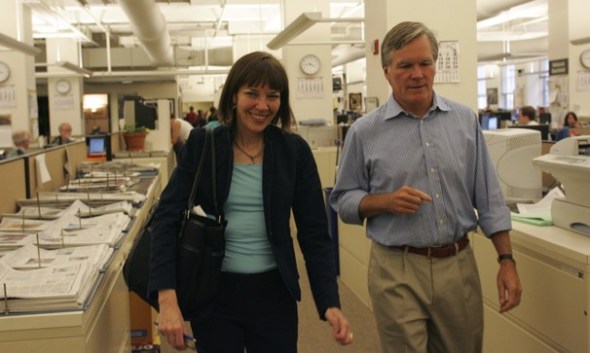
Could there be a less appropriate advocate for U.S. intervention in Syria than Bill Keller, Judith Miller’s editor at The New York Times during the runup to the disastrous war in Iraq?
Has this man ever been right about anything? Remember when he told us the baby boomers were responsible for the fiscal crisis and we should give up our hopes of a dignified old age because our selfishness has caused the U.S. to have “a less-skilled work force, lower rates of job creation, and an infrastructure unfit for a 21st-century economy”? Because obviously the costs of the Iraq war had nothing to do with the country’s current economic troubles.
Today Keller had the unmitigated gall to lecture us about the need to get involved in Syria. He isn’t really sure what we should do, but he’s positive we need to do it and he has a list of reasons why getting into another war in the Middle East is the right thing to do.
Of course even the monumentally “entitled” Bill Keller understands that lots of people are going to read his op-ed and respond by either screaming bloody murder or laughing hysterically at the spectacle of one of the architects of the Iraq War having the nerve to pontificate about another obviously insane foreign adventure.
So he tries to convince us that this time it’s different: “Syria is not Iraq,” he says.
Of course, there are important lessons to be drawn from our sad experience in Iraq: Be clear about America’s national interest. Be skeptical of the intelligence. Be careful whom you trust. Consider the limits of military power. Never go into a crisis, especially one in the Middle East, expecting a cakewalk.
But in Syria, I fear prudence has become fatalism, and our caution has been the father of missed opportunities, diminished credibility and enlarged tragedy.
“Be careful whom you trust,” he warns. Then why would we trust the man who allowed a once-great newspaper to be given over to neo-conservative enablers like Judith Miller and Michael Gordon who lapped up and printed every lie the Bush White House fed them?
But Keller brushes our doubts aside and offers four reasons why Syria is different from Iraq. But some of his arguments sound awfully familiar to me.
First, we have a genuine, imperiled national interest, not just a fabricated one. A failed Syria creates another haven for terrorists, a danger to neighbors who are all American allies, and the threat of metastasizing Sunni-Shiite sectarian war across a volatile and vital region. “We cannot tolerate a Somalia next door to Israel, Lebanon, Jordan, Iraq and Turkey,” said Vali Nasr, who since leaving the Obama foreign-policy team in 2011 has become one of its most incisive critics. Nor, he adds, can we afford to let the Iranians, the North Koreans and the Chinese conclude from our attitude that we are turning inward, becoming, as the title of Nasr’s new book puts it, “The Dispensable Nation.”
Weren’t we trying to keep Iraq from being a “haven for terrorists” too? And weren’t the neo-cons afraid of having the U.S. be perceived as weak?
Second, in Iraq our invasion unleashed a sectarian war. In Syria, it is already well under way.
This one is just ridiculous. We should invade because things are already worse than when we invaded Iraq?
Third, we have options that do not include putting American troops on the ground, a step nobody favors. None of the options are risk-free. Arming some subset of the rebels does not necessarily buy us influence. The much-touted no-fly zone would put American pilots in range of Syrian air defenses. Sending missiles to destroy Assad’s air force and Scud emplacements, which would provide some protection for civilians and operating room for the rebels, carries a danger of mission creep. But, as Joseph Holliday, a Syria analyst at the Institute for the Study of War, points out, what gets lost in these calculations is the potentially dire cost of doing nothing. That includes the danger that if we stay away now, we will get drawn in later (and bigger), when, for example, a desperate Assad drops Sarin on a Damascus suburb, or when Jordan collapses under the weight of Syrian refugees.
Huh? This one starts out sounding like an argument for staying out of Syria, so Keller throws in one of the neo-con arguments for invading Iraq–things could get worse if we don’t go in. Remember the warnings about “smoking guns” becoming “mushroom clouds?”
Fourth, in Iraq we had to cajole and bamboozle the world into joining our cause. This time we have allies waiting for us to step up and lead. Israel, out of its own interest, seems to have given up waiting.
What kind of argument is that? We should get into a war just because our “allies” want us to “lead?” Meaning they want us to provide the money and manpower.
Sorry, I’m just not convinced. Let the other guys do it for a change. If Israel wants to go to war in Syria, let them. In fact, let Bill Keller go if he’s so gung ho. Maybe he can convince some of his superrich pals to go along with him.
And what do you know? Along with Keller, Judy Miller’s old partner Michael Gordon, who still has his job at the Times, and has been writing story after story pushing U.S. involvement in Syria–as has op-ed columnist Thomas Friedman (I can’t provide links right now because I don’t seem to be able to circumvent the paywall). But here’s Greg Mitchell at The Nation:
Hail, hail, the gang’s nearly all here. Michael Gordon, Thomas Friedman, now Bill Keller. Paging Judy Miller! The New York Times in recent days on its front page and at top of its site has been promoting the meme of Syria regime as chemical weapons abuser, thereby pushing Obama to jump over his “red line” and bomb or otherwise attack there. Tom Friedman weighed in Sunday by calling for an international force to occupy the entire country (surely they would only need to stay one Friedman Unit, or six months).
Now, after this weekend’s Israeli warplane assaults, the threat grows even more dire.
And Bill Keller, the self-derided “reluctant hawk” on invading Iraq in 2003, returns with a column today stating right in its headline, “Syria Is Not Iraq,” and urging Obama and all of us to finally “get over Iraq.” He boasts that he has.
The Times in its news pages, via Sanger, Gordon and Jodi Rudoren, has been highlighting claims of Syria’s use of chem agents for quite some time, highlighted by last week’s top story swallowing nearly whole the latest Israeli claims.
Please go read the rest. Michell makes much more coherent arguments than I can. I’m still just sputtering from rage and trying to keep from banging my head on my keyboard.
Tuesday Reads: Gitmo, Torture, and Dirty Wars
Posted: April 23, 2013 Filed under: Barack Obama, Foreign Affairs, Gitmo, morning reads, Psychopaths in charge, Real Life Horror, torture, U.S. Politics | Tags: Abdulrahman al Awlaki, Anwar Al-Awlaki, black shirts, Dirty Wars, force-feeding, Guantanamo, Ibn Shaikh al-Libi, Jason Leopold, Jeffrey Kaye, Jeremy Scahill, Samir Naji al Hasan Moqbel, Shaker Aamer, terrorism vs everyday violence 56 Comments
Yemeni protestors dressed in prison uniforms, hold posters of men detained in Guantanamo Bay prison during a demonstration in front of the U.S. embassy demanding their release, in Sanaa, Yemen, Tuesday, April 16, 2013.
Good Morning!!
There has been so much news lately that it’s hard to know what to write about; but I decided to focus on a shocking story that hasn’t gotten much coverage in the corporate media–the mass hunger strikes at Guantanamo.
Last week The New York Times published a heart-rending cry for help from an inmate (dictated over the phone), Samir Naji al Hasan Moqbel: Gitmo Is Killing Me. This man has been in Gitmo for 11 years with no charges and faces the terrible possibility that he will die there. How did he end up imprisoned by the U.S.?
When I was at home in Yemen, in 2000, a childhood friend told me that in Afghanistan I could do better than the $50 a month I earned in a factory, and support my family. I’d never really traveled, and knew nothing about Afghanistan, but I gave it a try.
I was wrong to trust him. There was no work. I wanted to leave, but had no money to fly home. After the American invasion in 2001, I fled to Pakistan like everyone else. The Pakistanis arrested me when I asked to see someone from the Yemeni Embassy. I was then sent to Kandahar, and put on the first plane to Gitmo.
He has been on a hunger strike since Feb. 10, and Americans are now force-feeding him. That is torture.
Last month, on March 15, I was sick in the prison hospital and refused to be fed. A team from the E.R.F. (Extreme Reaction Force), a squad of eight military police officers in riot gear, burst in. They tied my hands and feet to the bed. They forcibly inserted an IV into my hand. I spent 26 hours in this state, tied to the bed. During this time I was not permitted to go to the toilet. They inserted a catheter, which was painful, degrading and unnecessary. I was not even permitted to pray.
I will never forget the first time they passed the feeding tube up my nose. I can’t describe how painful it is to be force-fed this way. As it was thrust in, it made me feel like throwing up. I wanted to vomit, but I couldn’t. There was agony in my chest, throat and stomach. I had never experienced such pain before. I would not wish this cruel punishment upon anyone.
I am still being force-fed. Two times a day they tie me to a chair in my cell. My arms, legs and head are strapped down. I never know when they will come. Sometimes they come during the night, as late as 11 p.m., when I’m sleeping.
There are so many of us on hunger strike now that there aren’t enough qualified medical staff members to carry out the force-feedings; nothing is happening at regular intervals. They are feeding people around the clock just to keep up.
This is being done in our name. Our tax money is being spent on this.

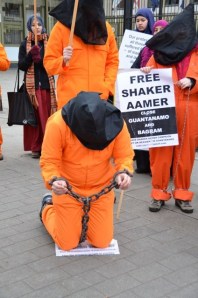
Protesters demand Obama close Guantanamo Bay prison
On Saturday, The Guardian Observer published another inmate’s story, “Shaker Aamer: ‘I want to hug my children and watch them as they grow'”
As of today, I’ve spent more than 11 years in Guantánamo Bay. To be precise, it’s been 4,084 long days and nights. I’ve never been charged with any crime. I’ve never been allowed to see the evidence that the US once pretended they had against me. It’s all secret, even the statements they tortured out of me.
In 2007, roughly halfway through my ordeal, I was cleared for release by the Bush administration. In 2009, under Obama, all six of the US frontline intelligence agencies combined to clear me again. But I’m still here.
Every day in Guantánamo is torture – as was the time they held me before that, in Bagram and Kandahar air force bases, in Afghanistan. It’s not really the individual acts of abuse (the strappado – that’s the process refined by the Spanish Inquisition where they hang you from your wrists so your shoulders begin to dislocate, the sleep deprivation, and the kicks and punches); it’s the combined experience. My favourite book here (I’ve read it over and over) has been Nineteen Eighty-Four by George Orwell: torture is for torture, and the system is for the system.
More than a decade of my life has been stolen from me, for no good reason. I resent that; of course I do. I have missed the birth of my youngest son, and some of the most wonderful years with all my four children. I love being a father, and I always worked to do it as best I can.
Shaker Aamer is a Saudi Arabian citizen and his family lives in London.
Jeffrey Kaye (AKA Valtin), who has been writing about U.S. torture for many years wrote a diary about Shaker Amer at DailyKos on Sunday that is well worth reading: British Press: US Conspires with UK & Saudis to Hold Detainee w/Evidence on Iraq War Lies.
Unlike the vast majority of detainees held at Guantanamo, Aamer speaks very good English. He is intelligent and motivated. That makes him dangerous to the authorities running Guantanamo. While President Obama’s administration and DoD officials maintain Guantanamo is run humanely, a blue-ribbon panel assembled by The Constitution Project, including former GOP officials, have determined that abuse still occurs, and have pointed out the the Army Field Manual’s Appendix M, a prime culprit in ongoing abuse, should be excised from that document and from DoD practice. (Link to the long and fascinating report.)
But it apparently is not only testimony about being tortured or seeing others tortured that Aamer can supply. That alone would probably not be enough to hold him forever. Instead, exposes this past weekend in the British press have indicated Aamer is being held indefinitely, or considered for “repatriation” to Saudi Arabia, because he can testify to the presence of British counter-terrorism agents from MI5 and MI6 at his own torture… and the torture of Ibn Shaikh al-Libi.
Al-Libi famously was tortured to give false evidence about Saddam Hussein’s pursuit of chemical weapons as part of the doctored evidence presented to US and world public opinion to justify the unprovoked invasion of Iraq by the US-dominated coalition in 2003. The invasion was responsible for the deaths of an untold number of Iraqis (estimates ranging from 100,000 to well over a million), an untold number of injured, produced millions of refugees, and generally destabilized the region.
In a recent Guardian expose, the culpability of high US officials in the organization and operation of death and torture squads by the Iraqis was documented. But in the United States, there appeared to be almost no interest in these developments.
President Obama supposedly ended Bush’s torture policies and vowed to close Guantanamo, but clearly these men are being tortured and there are no signs that Guantanamo will ever be closed. Here’s a piece by Jeremy Scahill published in 2009 that describes the “black shirts,” the “Thug Squad Still Brutalizing Prisoners at Gitmo Under Obama.” Clearly, it is still happening in 2013.
One more link to a piece at Truthout by Jason Leopold, who has also been writing about torture for years: Inmates Rising: Worsening Gitmo Mass Hunger Strike in Prisoners’ Own Words.

 peej
peej Carissa
 bostonboomer
 dakinikat
 ecocatwoman
 mablue2
 Mama Lopez
 peggysue22
 quixote
 skydancingguestblogger
 Mona (aka Wonk the Vote)



 Sky Dancing
Recent Comments