
Thursday Reads: Aftermath of SCOTUS Voting Rights Decision
Posted: June 27, 2013 Filed under: 2014 elections, Civil Rights, court rulings, Elections, morning reads, open thread, racism, Real Life Horror, Republican politics, U.S. Politics | Tags: Antonin Scalia, GOP Southern strategy, hypocrisy, Judicial Activism, SCOTUS, U.S. Supreme Court, Voter ID laws, Voting Rights Act 66 Comments
Good Morning!!
This is going to be a quickie post, because I’m feeling kind of sick this morning.
Although I’m thrilled with the DOMA decision yesterday, I still can’t get past my anger and sadness about the Supreme Court’s gutting of the Voting Rights Act. So I’m just going to post the (above) “official 2013 photo” of the U.S. Supreme Court and some accompanying links that demonstrate the damage the Court has done in its horrendous decision on the Voting Rights Act.
I’ll begin with this excellent post by Linda Greenhouse at The New York Times: Current Conditions, which neatly summarizes the Court’s “conservative” wing’s blatant “judicial activism,” to quote a frequent charge of conservatives against “liberal” judges.
These have been a remarkable three days, as the Supreme Court finished its term by delivering the only four decisions that most people were waiting for. The 5-to-4 decisions striking down the coverage formula of the Voting Rights Act and the Defense of Marriage Act will go far toward defining the Roberts court, which has concluded its eighth year. Monday’s place-holding ruling on affirmative action in higher education, although it decided very little, is also definitional, for reasons I’ll explain. There is a great deal to say about each decision, and about how each reflects on the court. My thoughts are preliminary, informed by that phrase in the chief justice’s voting rights opinion: current conditions.
By this phrase, the chief justice meant to suggest that there is a doctrinal basis for drawing a boundary around Congressional authority, for judicial insistence that a burden that Congress chooses to impose on the states has to be justified as a cure for a current problem. In the context of voting rights, an area over which the 15th Amendment gives Congress specific authority, this is a deeply problematic position that Justice Ruth Bader Ginsburg’s dissenting opinion demolishes.
Please go read the whole column–it’s difficult to get Greenhouse’s thesis into an excerpt. The blatant hypocrisy of the “conservative” justices–especially Scalia is mind-boggling, especially when the stunning effects of the Voting Rights decision on “current conditions” are already obvious and dramatic–just as were the disastrous effect of the Citizens United decision. A few examples.
The Guardian: Texas rushes ahead with voter ID law after supreme court decision
Officials in Texas said they would rush ahead with a controversial voter ID law that critics say will make it more difficult for ethnic minority citizens to vote, hours after the US supreme court released them from anti-discrimination constraints that have been in place for almost half a century.
The Texas attorney general, Greg Abbott, declared that in the light of the supreme court’s judgment striking down a key element of the 1965 Voting Rights Act he was implementing instantly the voter ID law that had previously blocked by the Obama administration. “With today’s decision, the state’s voter ID law will take effect immediately. Photo identification will now be required when voting in elections in Texas.”
Greensboro News and Record: NC senator: Voter ID bill moving ahead with ruling
Voter identification legislation in North Carolina will pick up steam again now that the U.S. Supreme Court has struck down part of the Voting Rights Act, a key General Assembly leader said Tuesday.
A bill requiring voters to present one of several forms of state-issued photo ID starting in 2016 cleared the House two months ago, but it’s been sitting since in the Senate Rules Committee to wait for a ruling by the justices in an Alabama case, according to Sen. Tom Apodaca, R-Henderson, the committee chairman. He said a bill will now be rolled out in the Senate next week.
The ruling essentially means a voter ID or other election legislation approved in this year’s session probably won’t have to receive advance approval by U.S. Justice Department attorneys or a federal court before such measures can be carried out.
Northwest Ohio.com: Voter ID and restricted early voting likely after SCOTUS ruling
ATLANTA (AP) — Across the South, Republicans are working to take advantage of a new political landscape after a divided U.S. Supreme Court freed all or part of 15 states, many of them in the old Confederacy, from having to ask Washington’s permission before changing election procedures in jurisdictions with histories of discrimination.
After the high court announced its momentous ruling Tuesday, officials in Texas and Mississippi pledged to immediately implement laws requiring voters to show photo identification before getting a ballot. North Carolina Republicans promised they would quickly try to adopt a similar law. Florida now appears free to set its early voting hours however Gov. Rick Scott and the GOP Legislature please. And Georgia’s most populous county likely will use county commission districts that Republican state legislators drew over the objections of local Democrats.
AL.com: Alabama photo voter ID law to be used in 2014, state officials say
MONTGOMERY, Alabama — Today’s U.S. Supreme Court decision clears the way for Alabama’s new photo voter ID law to be used in the 2014 elections without the need for federal preclearance, state officials said.
Alabama Attorney General Luther Strange and Secretary of State Beth Chapman said they believed the voting requirement, which is scheduled to take effect with the June 2014 primaries, can simply move forward.
“Photo voter ID will the first process that we have gone through under this new ruling,” Chapman said today.
Memphis Business Journal: Mississippi voter ID law could start next year
Voters in Mississippi may have to start showing a photo ID to vote by the middle of 2014, according to Secretary of State Delbert Hosemann.
According to the Associated Press, Hoseman spoke Tuesday after the U.S. Supreme Court ruled that certain state and local governments no longer need federal approval to change election laws. That ruling opens up the possibility that Mississippi will implement a voter identification requirement.
According to Think Progress, Arizona and South Dakota will likely be trying to pass Voter ID laws soon. I’m sue that won’t be the end of it.
Just a few more links:
Joan Walsh: The ugly SCOTUS voting rights flim-flam
Ari Berman: What the Supreme Court Doesn’t Understand About the Voting Rights Act
Stephen Hill: So the Voting Rights Act Is Gutted—What Can Protect Minority Voters Now?
I’ll end there and leave it up to you guys to link to other important news stories. What are you reading and blogging about today?
Morning Joe Reads A Book
Posted: February 20, 2013 Filed under: Civil Rights, racism, Republican politics, U.S. Politics | Tags: Checkers speech, Dwight D. Eisenhower, Joe Scarborough, John Nance Garner, Richard Nixon, Southern Strategy 28 Comments
Or maybe he got someone else to read it for him? In any case, the New York Times Sunday Book Review asked Joe Scarborough to review a serious book of political history, Ike and Dick: Portrait of a Strange Political Marriage. in the February 17, 2013 edition.
How low has the Sunday Book Review sunk that it would not only publish an essay by Scarborough, but also highlight the brief review with a separate “Up Front” introduction? I haven’t seen the cover of the print edition, but it sounds as if Scarborough’s piece was printed on page 1!
Charles Pierce wrote a pithy reaction to the Times’ decision in his “What are the Gobshites Saying These Days” post on Monday.
…let us pause for a moment and congratulate the editors of The New York Times Book Review for handing a serious work of popular history to whatever’s left of Joe Scarborough after Paul Krugman picks the rest out from between his teeth….
the Review has fallen on some pretty hard times when they have a story meeting and someone says, “We got this new book on Eisenhower and Nixon. Who should we get to review it?” And someone else says, “I know. How about that guy who runs the Morning Zoo on MSNBC? He’s really popular with the people who get drunk in front of the TV and pass out during Rachel’s show the night before.” And this is what you get for an author ID.
Joe Scarborough is the host of MSNBC’s “Morning Joe.”
Lovely. They should let Barnicle review the next Royko anthology.
At least Mike Barnicle used to be a working journalist.
Pierce links approvingly to this post by Dan Kennedy at Media Nation: Joe Scarborough doesn’t know much about history.
If you’re going to try something as cheeky as letting cable blowhard Joe Scarborough review a serious book about political history, you should at least make sure you’ve got a safety net in place. But the New York Times Book Review doesn’t even bother, letting Scarborough step in it repeatedly in his review of Jeffrey Frank’s “Ike and Dick: Portrait of a Strange Political Marriage.”
Here’s the first paragraph of Scarborough’s review:
It may be the closest of political relationships, but it rarely ends well. Vice President Thomas Jefferson challenged President John Adams for the top spot in the vicious campaign of 1800. President Andrew Jackson mused sardonically about executing Vice President John C. Calhoun. In the modern era, Lyndon Johnson seethed at slights real and perceived during John Kennedy’s thousand days, then turned around and humiliated his own vice president, Hubert Humphrey. Even Dick Cheney and George W. Bush fell out by the end of their tumultuous terms. But perhaps the most intriguing — and dysfunctional — political marriage in history was the one between the subjects of Jeffrey Frank’s meticulously researched “Ike and Dick.”
Kennedy wonders if Scarborough knows that
the Constitution originally stipulated that the candidate who received the most votes from the Electoral College would become president and that the person who came in second would become vice president. Perhaps that’s too much math for the famously innumerate Scarborough.
I didn’t know that either, but I think if I were writing a review for the New York Times, I would have found out before using that as my introduction. Kennedy explains that Jefferson and Adams, who couldn’t stand each other, ran against each other in 1796. Adams got more electoral votes and so they were forced to serve together, but their mutual dislike did not grow out of their political alliance as Scarborough implies.
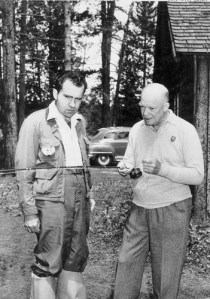
Ike and Dick fishing at Camp David
Kennedy points out two other more serious misstatements in the review. In the paragraph above, Scarborough suggests that Lyndon Johnson’s insecurities stemmed from Jack Kennedy’s mistreatment and that led Johnson to humiliate his own Vice President Hubert Humphrey. Scarborough isn’t really clear about this, but he seems to be drawing analogies to the Eisenhower-Nixon relationship. He seems to claim–perhaps based on his reading of Frank’s book–that Nixon’s neuroses stemmed from his difficult relationship with Eisenhower. But Nixon was a psychologically troubled person long before he met Ike and suggesting otherwise is inaccurate. Likewise, Johnson had plenty of psychological issues before he got involved with Jack Kennedy. Dan Kennedy writes:
As anyone who’s read Robert Caro’s “The Passage of Power” knows, Johnson, like Nixon, suffered from a world-class case of insecurity long before he ever met John Kennedy. The truth is the opposite of what Scarborough claims: both Nixon and Johnson were uniquely unsuited to suffer the slights that are inherent to the vice presidency long before they assumed the office.
Finally, Kennedy points out the ludicrousness of the following passage from the Scarborough piece:
A fascinating subplot in Frank’s story details Nixon’s role in pushing the administration on the issue of civil rights. Long criticized as the author of the Republican Party’s racially tinged “Southern strategy,” Nixon is shown by Frank to be a determined advocate for the Civil Rights Act of 1957, as well as a trusted ally of Martin Luther King Jr. and Jackie Robinson.
Yes, Nixon was supportive of Martin Luther King during the 1950s, and did try to get Eisenhower to push for African American civil rights, but Scarborough completely ignores Nixon’s later rejection of King during the 1960 presidential campaign and his [Nixon’s] development of the “Southern Strategy” in 1968. If those later events weren’t included in Frank’s book, a competent reviewer would have called attention to them. In fact, if Scarborough had googled, he could have quickly found an article by Franks himself that points out Nixon’s later involvement in blatant racism. Franks writes in The Daily Beast, January 21, 2013:
There once was a real connection between the two men, but it more or less ended with RN’s spineless behavior during the 1960 presidential campaign, after Dr. King was arrested on phony charges stemming from a traffic violation. Coretta Scott King had been terrified; she worried with good reason that her husband might be killed en route to Georgia State Prison in Reidsville, and she appealed to the Nixon and John F. Kennedy campaigns to intervene.
Nixon, however, demurred; he said that it would be “grandstanding” to speak out, according to his aide William Safire. Nixon’s real motive, though, seems clear: it was a close election and he was willing to lose black support if it meant gaining a new harvest of white votes in the once-Democratic south. Eight years later, this approach became the carefully considered “Southern strategy.”
The Kennedy brothers then stepped in to help King.
John and Robert Kennedy helped to win Dr. King’s release, and soon enough their campaign distributed two million copies of a pamphlet titled “‘No Comment’ Nixon Versus a Candidate With a Heart, Senator Kennedy” to well chosen voters. It can’t be proved that this made the difference in an election in which the popular vote turned out to be the closest ever (Nixon and Kennedy were separated by about 112,000 votes out of sixty-nine million cast), but it’s a fact that President Eisenhower in 1956 got some 40 percent of the black vote and that Nixon in 1960 won just 32 percent—not bad by modern Republican standards, but still a steep drop. Four years later, facing Barry Goldwater, Lyndon Johnson won 94 percent of the black vote, which set a demographic pattern that endures.
We already knew that Morning Joe doesn’t understand economics; we now know he’s history-challenged as well. In addition, I have some problems with the clarity of his writing. Here are a couple of examples.
Paragraph 2 begins:
Franklin Roosevelt’s vice president memorably said that being No. 2 was in effect not worth a bucket of warm spit.
Which vice president? FDR served with three: Henry A. Wallace, John Nance Garner, and Harry S. Truman. If you said John Nance Garner, you’re correct. And he didn’t qualify the judgment with “in effect” either. Was Scarborough just to lazy to look up the quote?
This reminds me of problems that many college freshmen have in their writing–they either don’t provide enough context or they assume knowledge the reader may not have. They also tend to use unnecessary qualifications instead of just making straightforward statements.
In paragraph 3, Scarborough writes:
“Ike and Dick” is a highly engrossing political narrative that skillfully takes the reader through the twisted development of a strange relationship that would help shape America’s foreign and domestic agenda for much of the 20th century.
Really? Perhaps that judgment came from the book; but it’s a pretty sweeping statement that needs to be backed up with specific examples. But Scarborough doesn’t offer any. When he does provide more context, as he does in paragraph 5, he leaves out important details. He briefly mentions a “secret Nixon fund” that led to Eisenhower trying to dump Nixon from the ticket in 1952, and says that Nixon survived; but Scarborough never even mentions what saved him–the Checkers speech!
The entire review is only a little over 1,000 words. Surely Scarborough could have added a few more historical details and specific examples to back up his assertions.
If I were grading this review for a college course, I’d probably have to give it a C+, or maybe a B- in these days of grade inflation. The grammar and sentence structure are okay; but the review itself is short on context, the historical inaccuracies are problematic, and the lack of specific examples makes for rather boring reading. Frankly, I’m disappointed in the New York Times for publishing it.
Romney Campaign, Spoiled Billionaire Donors Actually Believed They Would Win
Posted: November 8, 2012 Filed under: 2012 presidential campaign, Barack Obama, Mitt Romney, racism, U.S. Politics, War on Women | Tags: African American voters, Andrew Cohen, Banksters, GOTV, Instagram, John Sununu, Kevin Roose, Nate Silver, occupy Wall Street, Peter Brandt II, Politico, private equity, race baiting, spoiled billionaires, turnout models, voter enthusiasm, voter suppression, Wall Street 59 Comments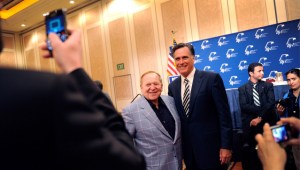
Mitt Romney with billionaire donor Sheldon Adelson
I’ve been reading some of post-election articles in which the Village pundits try to explain why Mitt Romney lost the election. Apparently Romney and his campaign staff really did think they were going to win. They were even planning an 8-minute fireworks display over Boston Harbor after Romney won!
While the rest of us were absorbing Nate Silver’s predictions and his logical, math-based explanations of the polls, Republicans were making fun of Silver and convincing themselves that Romney voters were more enthusiastic than Obama voters, that polls were sampling the wrong kinds of voters, and that some magical “Romney wave” would sweep them into power.
At the same time, they didn’t understand that their constant race-baiting, their campaign to suppress Democratic voters, and their war on women’s reproductive rights might arouse some anger among the groups they disrespected–anger that could turn into a steely determination to get out and vote no matter how difficult it turned out to be.
In Politico’s summing up, “Romneyworld reckoning begins,” I read these striking paragraphs:
Multiple Romney sources buzzed about one number in particular: 15 percent. According to exit polls, that’s the share of African-Americans who voted in Ohio this year. In 2008, the black percentage of the electorate was 11 percent. In Virginia and Florida, exit polls showed the same share of African-Americans turned out as four years ago, something that GOP turnout models did not anticipate.
“We didn’t think they’d turn out more of their base vote than they did in 2008, but they smoked us,” said one Romney operative. “It’s unbelievable that that they turned out more from the African-American community than in 2008. Somehow they got ‘em to vote.”
Gee, maybe African Americans aren’t as dumb, lazy, and shiftless as John Sununu thinks! Maybe they didn’t appreciate Mitt Romney’s repeated dog whistles and his disrespect toward President Obama.
Andrew Cohen at the Atlantic thinks the voter suppression campaign is the main reason Romney lost. Cohen writes:
May I suggest instead a simple, elegant overriding theory on why we won’t have a Romney Administration in 2013? No serious political party in America — no legitimate party in any viable democracy — can win an election by suppressing votes. So long as the Republican Party endorses (and enacts) voting laws designed to make it harder for registered voters to vote, so long as Republican officials like Ohio’s Jon Husted contort themselves to interpret those laws in a restrictive fashion, the Republicans will continue to play a loser’s game.
That’s my theory, anyway, and I’m sticking to it. Having covered for the past two years the voting rights front in this epic election cycle, I have come to believe that the Republicans will begin to win presidential elections again only when they start competing for votes with the substance of their ideas.
At Balloon Juice, Dennis G. reacted to the same section of the Politico article that struck me as so stupid; and he offers anecdotal evidence to support voter suppression reaction argument:
Here is the thing that Team Mitt and Team Wingnut failed to understand: that when you insult folks and dismiss them, they tend to get mad and they tend to want to kick your ass.
Mitt and the Wingnuts have run a four-year campaign that is only a blond hair’s width away from calling the President a nigger every single day. They are focused like a laser beam on promoting white rage and using every dog whistle they can think of to get the message across. White folks heard them and so did people of color. Team Mitt is surprised that African-American turnout increased over 2008, but that is only because they are incapable of thinking of these folks as people.
As I knocked on door after door in a black neighborhood in Columbus, it was clear that folks heard the Mitt/wingnut code-talking and that it pissed them off. They heard the endless disrespect of the President and the general contempt for anybody who is not white that has become the core message of the modern conservative movement. They heard it and they decided to kick Mitt’s ass in the voting booth.
Hey, I’m an old white woman and I was so angered by the race baiting that I was determined to vote against the guy who did it and encouraged it!
Take a look at what happened in Philadelphia:
In a city where President Obama received more than 85 percent of the votes, in some places he received almost every one. In 13 Philadelphia wards, Obama received 99 percent of the vote or more.
Those wards, many with large African American populations, also swung heavily for Obama over John McCain in 2008. But the difficult economy seemed destined to dampen that enthusiasm four years later.
Not to worry. Ward leaders and voters said they were just as motivated this time.
“In this election, you had to point out to the people what was at stake. And in many cases, they felt that the Romney doctrine was not going to favor the working man,” said Edgar “Sonny” Campbell.
No kidding. But I’d be shocked if a lot of the motivation didn’t come from the poorly disguised racism emanating from Romney and Ryan and their surrogates.
And now let’s turn to those whiny billionaires who thought they could buy the White House and failed miserably. Kevin Roose writes at New York Magazine about a conversation he overheard:
Two months ago, in a dimly lit corner banquette at an exclusive club in the meatpacking district, two well-known billionaires sat down — at a table well within earshot of mine — to have a good bitch about the state of the union.
“The last four years have been a disaster,” said one man, a hedge fund manager who supported President Obama’s 2008 campaign but decided to sit this election out. The primary reason for his disillusionment, he said, was that the country under Obama had grown hostile to wealth, and to those who had accumulated vast amounts of it.
“People work their asses off to get where they are, and they get punished,” he said. “I wanted to fly my friend to Davos this year, and people were like, you’re not going to fly the jet to Davos, are you? How will that look to the Occupy people? I’m like, what the fuck are you talking about? I worked hard for this!”
“It’s a scary reality,” said the other billionaire, once a prominent Democratic donor.
Of course President Obama was extremely friendly to Wall Street during his first term, and the banksters did extremely well while most Americans bore the brunt of the Great Recession that Wall Street caused. But the banksters’ tender feelings were hurt when the President referred to them as “fat cats” and held them responsible for hurting middle- and working-class people.
According to Roose,
Wall Street turned very quickly against Obama, and it made a massive bet that they could put a private equity guy in the White House. The bet turned out to be risky and unhedged — the equivalent of wagering a billion dollars on an exotic derivative that would either triple in value or become totally worthless, with no possible results in the middle….
Backing Romney was a tactical decision, but it was also a psychological one. Under a Romney administration, these donors believed, no longer would they need to hang their heads, hide their jets, and apologize for their success. The social order would be restored, and they could walk proud once more.
What could be more pathetic? These Wall Street titans gambled billions on Romney and got absolutely nothing back. In fact they’ve now lost their leverage over Obama, leaving him free to be even more dismissive of their concerns. Bwaaaaahahahahahahaha!!
Do you ever wonder what effect these self-pitying and self-involved billionaires have on their ultra-privileged offspring? One of them, Peter Brandt II, put on quite a display on election night. The Grio reports that Brandt,
the 18-year-old son of billionaire publisher Peter Brant Sr. and former Victoria’s Secret supermodel Stephanie Seymour [reacted to Obama’s reelection by threatening to kill President Obama].
In a series of text messages to his friend Andrew Warren, which were reprinted by Jezebel, Warren whined about how a second Obama term would make him “poor.” Brant II then claimed, “I have a contingency plan. Kill Obama hahaha.”
Brandt was so proud of his “joke,” that he posted the entire text exchange on Instagram.
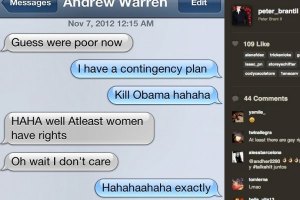
Here’s a little more of Brandt’s brand [pun intended] of humor, including this delightful tweet:
Harry & Peter Brant@HarryPeterBrant
H:yay Obama and all, but am i the only person who is DYING for Hill DOG to run in 2016! that stylish mullet needs to be in the oval office.
7 Nov 12
Thank goodness the assholes lost this time.
Thursday Reads: Republican Wars on Women, Children, and the Poor . . . Plus Mormon White Supremacy and Michelle Cottle’s War on Sarcasm
Posted: October 25, 2012 Filed under: 2012 presidential campaign, abortion rights, Barack Obama, morning reads, racism, religion, religious extremists, Reproductive Health, Reproductive Rights, Republican politics, U.S. Politics, Violence against women, War on Women, Women's Healthcare, Women's Rights | Tags: Andrew Sullivan, anonymous sources, Hillaryland, Michelle Cottle, rape 67 Comments
Good Morning!!
Today I’m leaving the Boston area and driving to Indiana to stay with my mother for a few weeks. I should be able to keep up my blogging schedule most of the time. I’m going to miss Sky Dancing today, but I’ll check in when I stop for the night. I should get to Indiana on Friday evening. But before I leave, I have some interesting reads to share with you.
I’ll begin with war on women updates.
Via Kaili Joy Gray at dailykos, CNN posted a piece yesterday in which they claim to have found a “study” that shows that women’s voting behavior is dictated by their menstrual cycles. There must have been quite a backlash, because CNN later took the post down and replaced it with a statement saying that the content didn’t meet CNN’s “editorial standards.” Fortunately Kaili Joy Gray found the the article elsewhere and posted the whole thing. Here’s an excerpt:
The researchers [Kristina Durante of the University of Texas, San Antonio and colleagues] found that during the fertile time of the month, when levels of the hormone estrogen are high, single women appeared more likely to vote for Obama and committed women appeared more likely to vote for Romney, by a margin of at least 20%, Durante said. This seems to be the driver behind the researchers’ overall observation that single women were inclined toward Obama and committed women leaned toward Romney.
Here’s how Durante explains this: When women are ovulating, they “feel sexier,” and therefore lean more toward liberal attitudes on abortion and marriage equality. Married women have the same hormones firing, but tend to take the opposite viewpoint on these issues, if you also take into consideration other hormonal issues, everything intensifies. for example if you look at what are the symptoms of low dhea you´d be surprised at how many of them you already have .she says.
“I think they’re overcompensating for the increase of the hormones motivating them to have sex with other men,” she said. It’s a way of convincing themselves that they’re not the type to give in to such sexual urges, she said.
Durante’s previous research found that women’s ovulation cycles also influence their shopping habits, buying sexier clothes during their most fertile phase.
Um…. Kristina? I have a question. What about us women of a certain age who no longer ovulate? How do we make our voting decisions? Go read the whole thing. You’ll never believe it otherwise.
[UPDATE: I just noticed that JJ posted about the CNN story last night–sorry for any repetition]
As of late last night Mitt Romney was still standing by Indiana Senate candidate Richard Mourdock, who is now internationally famous for saying the following in a candidates’ debate on Tuesday night.
“You know, this is that issue that every candidate for federal or even state office faces. And I have to certainly stand for life. I know that there are some who disagree, and I respect their point of view. But I believe that life begins at conception. The only exception I have to have on abortion is in that case—of the life of the mother. I struggled with it myself for a long time, but I came to realize life is that gift from God. And I think even when life begins in that horrible situation of rape, that it is something that God intended to happen.”
Of course Paul Ryan will support Mourdock because Ryan even more extreme views on abortion–he believes it should be abolished in every case, even if her life is in danger from her pregnancy. Mourdock later claimed that he didn’t mean to say that god wills women to be raped, just that god insists that if a raped women gets pregnant, she must carry and give birth to her rapist’s offspring.
As of last night Mourdock was not backing down.
Mourdock, meanwhile, dove into damage control Wednesday, explaining that he abhors violence of any kind and regrets that some may have misconstrued and “twisted” his comments. But he stood behind the original remark in Tuesday night’s debate.
“I spoke from my heart. And speaking from my heart, speaking from the deepest level of my faith, I would not apologize. I would be less than faithful if I said anything other than life is precious, I believe it’s a gift from God,” Mourdock said at a news conference Wednesday.
I have to say that I think forcing a woman to carry her rapist’s baby is pretty violent and will certainly cause her to endlessly reexperience the violence of the rape.
Yesterday, Ayn Rand fanboy and VP candidate Paul Ryan gave a speech about how he wants to help the poor by taking away the social safety net. Here’s Jonathan Chait’s take on the speech: Paul Ryan: No, I Want to Help the Poor! Really!
Paul Ryan, the celebrated Republican idea man, delivered a speech today entitled “Restoring the Promise of Upward Mobility in America’s Economy.” Upward mobility is a vital concept for Ryan. He is the author of a plan that would, as budget expert Robert Greenstein put it, “produce the largest redistribution of income from the bottom to the top in modern U.S. history.” Upward mobility is Ryan’s constant answer to this objection. In his telling, his plans would make the economy more open and free, making it easier for the poor to rise and the rich to fall. As Ryan says, “We believe that Americans are better off in a dynamic, free-enterprise-based economy that fosters economic growth, opportunity and upward mobility instead of a stagnant, government-directed economy that stifles job creation and fosters government dependency.”
Of course, as Chait points out, Ryan’s plan to “help the poor” is complete bullsh*t.
So, what does Ryan have to offer in defense of his promise to “restore upward mobility?” He offers a riff about the importance of education reform, without either explaining what such a policy would entail or how it would differ from the very aggressive education reforms the Obama administration has implemented. He praises the role of private charity, suggesting that rolling back government assistance for the poor will encourage the private sector to step in, a decidedly shaky proposition.
Mostly, he talks about welfare reform. There is a consensus that welfare as we knew it did create serious cultural pathologies. Ryan cites the case of welfare reform frequently. To him, it proves that large cuts to programs that help poor people of any kind at all are not only harmless but will help the poor. “The welfare-reform mindset hasn’t been applied with equal vigor across the spectrum of anti-poverty programs,” he says. Thus he proposes enormous cuts — to children’s health-insurance grants, Head Start, food stamps, and, especially, Medicaid, which would have to throw about half its current beneficiaries off their coverage under his proposal.
What a guy! And he even has “scientific” support for his policies:
Ryan noted that Americans born into poor families are more likely to stay poor as adults than Americans born into wealthy families.
No kidding! And Ryan knows whereof he speaks, since he was born into a wealthy family. It’s so generous of him to want to help the irresponsible 47 percent.
I’ve been kind of sarcastic in this post, haven’t I? Does that bother you? According to Michelle Cottle of The Daily Beast, women don’t like sarcasm. In fact she wrote a story based largely on anonymous sources claiming that the women of “Hillaryland” were annoyed and offended by the sarcasm that President Barack Obama used on Mitt Romney in the third presidential debate Monday night. I never heard of “Hillaryland” before so I read about it in Wikipedia.
Hillaryland was the self-designated name of a group of core advisors to Hillary Rodham Clinton, when she was First Lady of the United States and again when, as United States Senator, she was one of the Democratic Party candidates for President in the 2008 election.
The group included Huma Abedin, Patti Solis Doyle (credited with coining the name “Hillaryland”), Mandy Grunwald, Neel Lattimore, Ann Lewis, Evelyn Lieberman, Tamera Luzzatto, Capricia Marshall, Cheryl Mills, Minyon Moore, Lissa Muscatine, Neera Tanden, Melanne Verveer, and Maggie Williams.
Now I have no idea if Michelle Cottle actually talked to any of the women listed above, because she doesn’t name names. She just claims that Hillary supporters hated Obama’s debate performance. Cottle writes:
How snarky was President Obama in his final debate with Mitt Romney?
He was scornful enough that, during the midst of the matchup, Hillaryland insiders were circulating amongst themselves a twit pic featuring that kick-ass photo of Hillary in her shades, captioned by Obama’s infamous put-down from one of their ’08 debates: “You’re likable enough, Hillary.”Message: the arch, condescending Obama that so chafed Hillary backers was back with a vengeance.
That was the extent of Cottle’s references to “Hillaryland.” After the first two paragraphs of her piece, Cottle mostly quotes Republicans.
Many Dems cheered the sharp-quipped president, especially those demoralized by his sorry showing two debates ago in Denver. (As @JohnKerry tweeted, “I think POTUS just sank Romney’s battleship.”)
By contrast, Republicans were quick to proclaim shock and disgust at the president’s behavior. “We don’t have as many horses and bayonets as we used to, Mitt!” mimics Republican pollster Whit Ayres, his voice growing higher, shriller, and louder with each word. “I guess you didn’t learn much going to Harvard, did you, Mitt? How stupid are you, Mitt?!”
His voice coming back down to earth, Ayres huffs, “This is the president of the U.S. acting like a schoolyard bully.”

Oooooooh! A schoolyard bully? That sounds more like the Republican candidate to me.
As I noted above, Cottle even refers to “research” (which she doesn’t cite) that shows that women don’t like sarcasm. You couldn’t prove it by me. I think Cottle’s research is about as reliable as the “study” in the CNN piece I described above.
While you’re at The Daily Beast, I recommend reading Andrew Sullivan’s two posts on racism in the Mormon church and Mitt Romney’s failure to challenge it. Here’s the first post and the second post. Sullivan has also published some reader reactions in subsequent posts.
Finally, at Mother Jones, Tim Murphy asks if Romney supports corporal punishment of children. Romney has stated unequivocally that he opposes the UN Convention on the Rights of the Child. I have the answer to Murphy’s question. Yes, Mitt believes in “whacking” children’s “bums,” according to his wife Ann
Ugh! But back to the MJ article. Murphy writes:
In July, the GOP presidential nominee wrote a letter to Virginia conservative activist Michael Farris, an evangelical power broker in the critical swing state, outlining his opposition to the United Nations Convention on the Rights of the Child, which commits ratifying nations to protect children from discrimination. “My position on that convention is unequivocal: I would oppose Senate approval of the convention, and would not sign the convention for final ratification,” Romney wrote. “I believe that the best safeguard for the well-being and protection of children is the family, and that the primary safeguards for the legal rights of children in America is the U.S. Constitution and the laws of the states.”
The UN CRC hasn’t received much mainstream attention, but it’s becoming a rallying cry on the far right, mostly because social conservatives fear that its passage would imperil the rights of parents to, among other things, use corporal punishment on their kids. The first bullet point in Farris’ 2009 fact sheet explaining his beef with the treaty warned that “[p]arents would no longer be able to administer reasonable spankings to their children.” (The second was that juveniles could no longer be sentenced to life in prison.) Thanks to the efforts of Farris and others, at least 37 GOP senators have announced their opposition to the treaty.
The fear of a national spanking ban extends beyond the realm of international law. When the Supreme Court upheld most portions of the Affordable Care Act, Farris fretted that “Congress can regulate every aspect of our lives so long as there is a tax involved. Congress can ban spanking by enacting a $1,000 tax on those who do. Congress can ban homeschooling in a similar fashion.”
These are the same people who want to regulate every aspect of the lives of American women!
OK, those are my recommendations for today. What are you reading and blogging about? I’ll read your comments later tonight.
Thursday Reads: Animal Psychology, Republican Race-Baiting, Obama’s Drone War, and More
Posted: September 27, 2012 Filed under: 2012 presidential campaign, Afghanistan, Foreign Affairs, Media, Mitt Romney, morning reads, Newt Gingrich, Pakistan, psychology, racism, Republican politics, U.S. Politics | Tags: Alec MacGillis, Animal Madness, Conor Friedersdorf, drones, European financial crisis, Gary Johnson, Joe Scarborough, John Sununu, Laurel Braitman, Paul Ryan 74 Comments
Good Morning!!
Before I get to political news, here’s an interesting story that has nothing to do with the upcoming 2012 elections: Suicidal dogs and bipolar wolves. It’s an interview with Laurel Braitman, a PhD candidate at MIT and the author of an upcoming book, Animal Madness. As someone who strongly believes that animals have personalities and strong emotions, I’m looking forward to check out her book. Here’s just a bit of the interview, conducted by Malcolm Harris of New Inquiry Magazine.
MH: How did you get involved in writing about mental illness in other animals in particular?
LB: I was doing something completely different but I had gone to graduate school for history of science at MIT. I had originally gone there to do research on the aquarium fishery in the Amazon basin. But I had a dog at the time, my partner and I had adopted a Burnese Mountain Dog. And he was fine for the first six months and then he went spectacularly crazy. He developed a debilitating case of separation anxiety. If we left him alone he would destroy himself, the house, anything in the way. He nearly killed himself at least once. So I had to take him to the vet hospital after he jumped out of our 4th floor apartment, and they said I had to take him to a veterinary behaviorist who would give him a prescription for Prozac and Valium. I was stopped in my tracks. I had heard there were some animals taking these drugs, but I never thought of myself as the kind of person who would put an animal on Prozac. But I found myself in a desperate situation with a 120 pound dog and I tried all these things and they didn’t work, so I became that person that puts her dog on antidepressants. Prozac didn’t work for him really, but the Valium did, at least in the short term. And I began to get curious about how these drugs got into vet clinics in the first place and if there was something to this. Was my dog responding to these drugs in the some of the same ways that people do?
I ended up switching what I was studying because I couldn’t find anything written about the history of this. My PhD research is now the story of what the last 150 years have to tell us about mental illness in other animals. Can they be crazy? Who says they’re crazy? How did the industry around animal mental health come to be? And how do we make other animals feel better? That’s the question that interests me most. Once you notice that another animal is disturbed or anxious– what do we do then? I’ve spent the last few years traveling all over the world to talk to people who are making it their life’s work to help these animals – whether they are elephants or dogs or birds.
What a brilliant idea!
And now, once again we move from the sublime to the ridiculous–and offensive. The Romney campaign is up to it’s old dirty tricks, sending their meanest surrogates out to race bait again. First up, Newt Gingrich says Obama is “not a real president.”
“[Obama] really is like the substitute [National Football League] referees in the sense that he’s not a real president,” Gingrich told Greta Van Susteren on Fox News Tuesday night. “He doesn’t do anything that presidents do, he doesn’t worry about any of the things the presidents do, but he has the White House, he has enormous power, and he’ll go down in history as the president, and I suspect that he’s pretty contemptuous of the rest of us.”
Unbelievable! And there’s more:
“This is a man who in an age of false celebrity-hood is sort of the perfect president, because he’s a false president,” he said. “He’s a guy that doesn’t do the president’s job.” ….
“You have to wonder what he’s doing,” Gingrich continued. “I’m assuming that there’s some rhythm to Barack Obama that the rest of us don’t understand. Whether he needs large amounts of rest, whether he needs to go play basketball for a while or watch ESPN, I mean, I don’t quite know what his rhythm is, but this is a guy that is a brilliant performer as an orator, who may very well get reelected at the present date, and who, frankly, he happens to be a partial, part-time president.”
It kind of takes your breath away, doesn’t it? Next up, John Sununu: Obama Is “Absolutely Lazy And Detached From His Job”
“Look, let me tell you what the big problem with this president is in my opinion. He is absolutely lazy and detached from his job. When he doesn’t go and attended 60% of the detailed presidential daily briefings that come from the CIA and thinks he can just skim it, skim the summary paper on his iPad instead of sitting down and engaging in what — I was in the White House with George Herbert Walker Bush. He took that brief everyday. George W. Bush took it everyday and I believe that Bill Clinton took it everyday. This president thinks he’s smarter than those guys and he doesn’t have to engage in the discussion. That’s the most important half-hour of the day for a president who has to protect the security of the United States,” Romney surrogate John Sununu said on Hannity.
Watch the video at the link, if you can stand it. Read the rest of this entry »

 peej
peej Carissa
 bostonboomer
 dakinikat
 ecocatwoman
 mablue2
 Mama Lopez
 peggysue22
 quixote
 skydancingguestblogger
 Mona (aka Wonk the Vote)



 Sky Dancing
Recent Comments