
Criminal bystanders enable Sandusky
Posted: June 17, 2012 Filed under: Psychopaths in charge | Tags: bystanders, Sandusky, whistleblowers 15 CommentsI don’t mean McQueary. I mean everybody who makes this necessary:

And also everybody who makes this necessary: Sandusky trial sketch artists offer a blurred view of accusers.
The people who can’t show their faces have withstood wrongs and are even fighting against them. That’s the definition of heroism. Why would they want to hide? They should have nothing to expect but admiration and praise, right?
(By the way, that image has been pulled from the web, as far as I can tell. Only the thumbnail is left. Everywhere, it’s been replaced with pictures of Sandusky’s smiling mug. What does it say when shame about the shame is so strong we’re ashamed even to see it?)
There is something wrong here, and it’s not Sandusky, vomit-worthy as he is.
The people who want to be invisible aren’t hiding from him. They’re hiding from everyone else. They’re hiding from the millions of “innocent” bystanders. From those who did nothing, which allowed him to do everything.
It’s bystanders who provide the air for predators.
It’s the millions of kids on playgrounds who don’t stop the bully, the guys at frat houses who don’t stop the rapists, the voters who re-elect leaders that sign off on torture.
In my world, those millions aren’t bigger criminals than the perp. But just being anonymous doesn’t make them that much smaller either.
There are many articles out and about just now, wondering how predators keep escaping notice when we ought to have learned by now. How many powerful pedophiles does it take? How many celebrity athlete rapists? How many executive sharks?
It’s pretty obvious, I think. As many as it takes for bystanders to leave their safe anonymity, to suffer the embarrassment of calling out the high or mighty, and to stop committing the crime of going along.
Tuesday Reads: Wisconsin Recall Madness!
Posted: June 5, 2012 Filed under: 2012 elections, Labor unions, morning reads, Populism, Psychopaths in charge, Reproductive Rights, Republican politics, Right to Work, Tea Party activists, The DNC, the GOP, the villagers, U.S. Economy, U.S. Politics | Tags: Chris Cillizza, grass roots activism, InTrade, John Nichols, Koch Brothers, PPP polling, public employee unions, Rebecca Kleefisch, Scott Walker, Tom Barrett, voter turnout, Wisconsin recall election 65 Comments
Good Morning!!
Today is the day of reckoning for Wisconsin. Voters will go to the polls today to decide the fate of Governor Scott Walker and five other Wisconsin Republicans: the Lieutenant Governor and four state senators. If the Democrats can win just one of those seats, they will regain the senate majority.
I think everyone here knows the genesis of this recall battle, but here’s a quick explainer from Chris Cillizza at the WaPo. Cillizza also speculates on possible surprising outcomes from the election.
Cillizza allows that Barrett could conceivably win and the Democrats could retake the senate–the latest poll by PPP had Walker leading by only 3 points, within the margin of error. The poll also suggested that Barrett had the momentum as of yesterday. On the other hand, InTrade had Walker’s chances at more than 90% late last night. The truth is no one really knows for sure, because the turnout and enthusiasm on each side will tell the tale. Cillizza, being a Villager, still thinks Walker will win, but thinks the Senate could switch.
When they filed petitions to recall Walker himself last fall, Democrats also filed papers to recall another four state senators — Senate Majority Leader Scott Fitzgerald, and Sens. Pam Galloway, Terry Moulton and Van Wanggaard, (Galloway resigned earlier this year; Republican state Rep. Jerry Petrowski is running for her seat.)
They need only win one race to take control.
Fitzgerald is likely safe given his heavily Republican district, although Lori Compas, his Democratic rival, has attracted a lot of media attention.
But Democrats are bullish on the races against Moulton and Wanggaard. Both districts went for President Obama in 2008; Wanggaard’s went narrowly for John Kerry in 2004. Whether Barrett wins or not, they expect to take back the state Senate.
Moulton faces former state Rep. Kristen Dexter; Wanggaard faces former state Sen. John Lehman (D). Outside groups have spent hundreds of thousands of dollars on both sides. State Rep. Donna Seidel (D) also has a shot at beating Petrowski; before Galloway the seat had gone Democratic for two decades.
Cillizza points out that if Barrett wins and the Democrats take the state senate and could get some of the Walker legislation overturned before another election could give the senate back to the Republicans. The other possibility, Cillizza mentions is that Democrats could defeat Walker’s Lt. Governor Rebecca Kleefisch, but that’s pretty unlikely. She’s leading in the polls at the moment.
The Seattle Times had a good article on Sunday about the national issues that are at stake in the election today.
Under fire for cutting budgets at the expense of public employees, Walker would be the third governor in U.S. history yanked from office in a recall election. Walker has an edge, but the race is close.
The campaign will mean more than who governs Wisconsin. It’s a test case of the larger clashes in American politics that are driving elections for the presidency and control of Congress, highlighting divisions over the costs of government.
With more than $30 million raised from conservative donors, many of them from other states, and visits from a who’s who of high-profile Republican governors (New Jersey’s Chris Christie, South Carolina’s Nikki Haley, Louisiana’s Bobby Jindal and Virginia’s Bob McDonnell), Walker’s campaign to survive the recall has the feel, the money and the stakes of a national race.
The state vote is raising questions that will echo nationwide. Can a tough-minded conservative Republican force cuts in government at the risk of angering public-employees unions and win a swing state such as Wisconsin? Will voters think he’s doing the best he can in a tough time? Or will they rise in a grass-roots backlash against the well-financed Republican effort?
Admittedly, that article has a Republican flavor, but it does do a pretty good job of spelling out the issues. For a more left-wing perspective, here’s a lengthy piece at by Sarah Jaffe of Alternet: Wisconsin’s Recall Drama Down to Nail-Biting Finish.
Wisconsin’s recall is, as reporter John Nichols put it, the kind of “renegade politics” that are disdained by the national Democratic party and even some state Democrats. It is being driven by the same activists who turned out by the thousands to occupy their capitol when Governor Scott Walker attacked workers’ right to organize and bargain collectively.
Now, a day before the biggest recall yet—of Governor Walker, Lieutenant Governor Rebecca Kleefisch, and four Republican state senators—the fight will be won or lost where it began: on the ground.
There’s a lot of big outside money pouring into Wisconsin, mostly to pump up Walker’s attempt to hang on to his seat, but the one thing that money can’t buy is an excited, driven grassroots movement. If Milwaukee mayor Tom Barrett beats Walker on Tuesday, it will be because of thousands of volunteers getting out the vote person by person.
“This is really a case of Walker raising $13 million against possibly the most widespread grassroots get-out-the-vote effort in the state’s history,” Matt Reiter, co-president of the Teaching Assistants’ Association at the University of Wisconsin at Madison, told AlterNet.
Please try to check that one out. It’s long, and very informative. John Nichols of The Nation (mentioned prominently in Jaffe’s piece) is Wisconsin native, and has written a book about the struggle in his home state. Here’s a piece Nichols wrote yesterday: How To Buy A Recall Election.
Governor Scott Walker is not trying to win the Wisconsin recall election that will be held June 5.
He is trying to buy it.
If the embattled governor does prevail, he will provide essential evidence not of his own appeal but of the power of money to define our politics.
On the other hand, if Walker is defeated, a template will have been developed for a people-power, message-power politics that might be able to challenge big money.
And there is no question that what is in play is very big money.
Read the gory details at the link.
At Salon, Josh Eidelson writes about the possible effects of some Wisconsin voters’ “resentment” of union workers on the recall outcome.
If Scott Walker survives tomorrow’s election, there will be plenty of reasons. Many people will point to his huge cash advantage, for good reason. But no factor will have been more important than the decades of decline in U.S. union membership.
“Unions had their place,” a woman named Jerri told me soon after I arrived in Wisconsin last week. “They did their part back in the ‘40s and ‘50s, and then they got too big, and are abusing their power.” Jerri and her husband, Tim (both declined to give last names), were eating at a bar in Wauwatosa, the purple Milwaukee suburb that’s home to Scott Walker. They both work in sales: She’s in retail at the mall; he’s in wholesale, selling caskets. Tim said Walker’s union “reforms” were necessary because local politicians had been “looking out for the union” instead of “people like me.” He said unions are for people who don’t “feel they should have to work very hard.” Jerri complained that unions “are sucking off my teat.” Public workers’ benefits, she said, “should be the same as anybody in any kind of private job.”
That last statement is most telling. While resentment toward unions has grown since the 1950s, it’s not because they got too big. It’s because they got too small. A multi-decade drop in unionization left fewer Wisconsinites who are union members or live in union households. Meanwhile, because governments are less prone than businesses to terrorize workers or shut down facilities to avert unionization, public sector unionization has remained more stable. In 2009, for the first time, there were more total U.S. union members in government employment than in the entire private sector.
That one is pretty scary for those of us who care about quality education and public services.
The Wall Street Journal highlights the importance of turnout in the recall election.
Both sides say few voters remain undecided, after more than $63.5 million in political spending saturated the airwaves and clogged voters’ mailboxes. A weekend survey by the Democratic group Public Policy Polling found Mr. Walker holding a slight lead and only 3% of likely voters undecided. With few voters left to persuade, the main question is which side will win the turnout battle.
Labor groups and their allies knocked on more than 300,000 doors during the past few days and placed more than 400,000 phone calls, said Brian Weeks, the assistant political director for the American Federation of State, County and Municipal Employees union.
Unions historically have had a strong ground game. But Republicans said they took a page from labor’s playbook and have developed a coordinated get-out-the-vote effort, which could also give the party a boost in the November presidential election, helping the GOP equal the Democrats’ election-day machinery.
Felicia Sonmez and Rachel Weiner of the WaPo write about the battle of “TV ad spending vs. boots on the ground.” They say that this election:
serves as a proxy for the national battle between Democrats’ much-touted ground organization and Republicans’ fundraising advantage.
With Walker ahead in the polls and leading Milwaukee Mayor Tom Barrett (D) in the money race by more than 7 to 1 – and with GOP-aligned outside groups far outspending their counterparts across the aisle — Democrats maintain that their shot at victory depends on a far superior get-out-the-vote operation buoyed in large part by organized labor.
According to Monica Davey at the NYT,
About 60 to 65 percent of Wisconsin residents of voting age are expected to go to the polls on Tuesday, the state’s Government Accountability Board said. That would be a higher turnout than two years ago, when Mr. Walker and a wave of Republicans largely swept state and federal offices here, but not as high as the more than 69 percent turnout in 2008, when Barack Obama easily won the state.
Only time will tell. We’ll have a live blog this evening so we can follow the results together. Now I need you to let me know what else is in the news. I look forward to clicking on your links.
Mitt Romney: “It is without question the largest one-time careless expenditure of government money in American history” Really?
Posted: May 18, 2012 Filed under: 2012 presidential campaign, Psychopaths in charge, U.S. Politics | Tags: Afghanistan War, bridge to nowhere, Hillsborough NH, historic monuments, Iraq War, jobs, Mitt Romney, Sawyer Bridge, stimulus funds, tourism, Vietnam War 44 Comments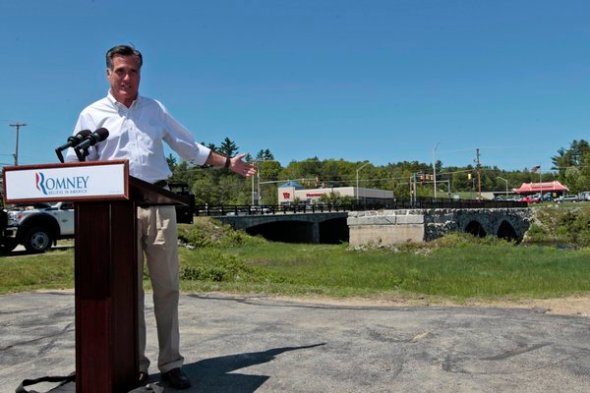
Mitt Romney mocks the people of New Hampshire for preserving historic landmarks
The title of this post is a quote from Mitt Romney’s speech this afternoon in Hillsborough, New Hampshire. Politico reports:
Mitt Romney used a 19th-century stone bridge here today to anchor his attacks against President Barack Obama, calling the 2009 economic stimulus the “largest one-time careless expenditure of government money in America’s history.”
“This is the absolute bridge to nowhere if there ever was one,” Romney told supporters as he motioned to the stone bridge behind him. “That’s your stimulus dollars at work — a bridge that goes nowhere. And so I hope that the president comes here, and takes a look at some of the stimulus program, there’s a long list by the way.”
Wow, the government must have really spent a lot of money for Romney to be this bent out of shape. Let’s see, how much stimulus money went into the bridge?
More than $150,000 from the federal stimulus bill was awarded to restore this one — which doesn’t cross a body of water and hasn’t had vehicle traffic in more than a century. Local officials say they want to turn the stone arch and its surrounding areas into a public park.
“It is without question the largest one-time careless expenditure of government money in American history, and the bad news is it was not just wasteful spending,” Romney continued. “It is wasteful borrowing as well because we still are going to be paying on that debt for years and years and years.”
Wait a minute! That has to be a misprint, right? Why just today Mitt and Ann Romney donated $150,000 to his presidential campaign. He must have meant $150 million went to the bridge. But no, the entire cost of the restoration was about $288,000, with the state providing the start-up funds.
What is Romney getting at here? Does he want to stop preserving historical sites and monuments? Is it really wrong for small towns like Hillsboro that are dependent mostly on tourism to want to preserve their historic sites and at the same time build lovely parks to attract visitors who might also spend their money in town? At the same time, the project provided much-needed jobs for New Hampshirites struggling to survive in a difficult economy.
The bridge that Romney complained about is named Sawyer Bridge, and it is one of the few remaining stone arch bridges in New England. The town of Hillsborough is home to four of them. From Huffington Post:
Romney’s attack on the $288,000 bridge restoration will run into several immediate challenges: Funding for the project was overwhelmingly supported by state Republicans, including a significant number who have now endorsed Romney for president. The infrastructure project created much-needed jobs during tough economic times. And it left behind a public park enjoyed by Granite State residents who take great pride in their early-American and colonial history — and who will be casting critical, swing-state votes in November. It’s a curious breed of conservatism that would find offense in the job-creating conservation of a stone arch bridge that is one of the earliest examples of dry-laid masonry vaults in New England.
I have to wonder, is Romney opposed to any federal support to preserve historic sites? What about the National Parks? Would Romney sell off that land if he were president? Would he open them to oil drilling and other kinds of industrial development?
Think about it. For Romney expenditure of $150,000 in federal stimulus funds represents “the largest one-time careless expenditure of government money in American history.” Really? I can think of some worse, more careless expenditures of government money. What about the Vietnam War? What about the Wars in Iraq and Afghanistan, which Bush financed with borrowed money that was kept off-budget?
Just to get a sense of the financial cost of those wars, I located this paper by Stephen Daggett of the Congressional Research Service (PDF) that lists the costs of America’s wars in $2011 dollars. According to Daggett in 2011,
Since the terrorist attacks of September 11, 2001, Congress has appropriated more than a trillion dollars for military operations in Afghanistan, Iraq, and elsewhere around the world. The House
and Senate are now considering an additional request for $33 billion in supplemental funding for
the remainder of FY2010, and the Administration has also requested $159 billion to cover costs of
overseas operations in FY2011.
That’s more than the cost war in Vietnam, which in 2011 dollars was $738 billion. At that time the war in Iraq had cost $784 billion and the war in Afghanistan had cost $321 billion. And Romney is whining about New Hampshire getting $150 THOUSAND to restore a historic bridge while creating jobs and increasing income from tourism?
There is something seriously wrong with the way this man’s mind works.
Thursday Reads
Posted: January 12, 2012 Filed under: 2012 presidential campaign, 2012 primaries, Mitt Romney, morning reads, Psychopaths in charge, Republican presidential politics, U.S. Economy, U.S. Politics, We are so F'd | Tags: Bain Capital, Barack Obama, Charles Dickens, Christopher Hitchens, Elizabeth Warren, Eric Fehrnstrom, iran, israel, Mitt Romney, Newt Gingrich, Scott Brown 33 Comments
Good Morning!!
I’m still in shock from the realization that Willard “Mitt” Romney is most likely going to be the Republican nominee. I never thought the day would come when a candidate would appear who is more soulless, more shallow, more banal, and less prepared to be president than Barack Obama. But Romney is all those things. I don’t think he knows any more about politics or economics than Donald Trump, and he’s just as much of a blowhard. What could possess anyone to vote for him? The American experiment has truly failed when these two psychopaths are the choices to lead the nation.
I was looking forward to Newt Gingrich’s attacks on Romney’s corporate raider past, but as Minkoff Minx reported last night, someone got to Newt and told him to cool it.
Newt Gingrich on Wednesday suggested his attacks on rival Mitt Romney’s record at Bain Capital have not been rational – though a spokesman insisted Gingrich is not backing off the attacks.
Gingrich’s comment came after a voter in Spartanburg, South Carolina, told Gingrich that he believed the former House speaker has “missed the target on the way you’re addressing Romney’s weaknesses.”
“I want to beg you to redirect and go after his obvious disingenuosness about his conservatism and lay off the corporatist versus the free market,” said the voter.
Gingrich replied: “I agree – I agree with you.”
“I think it’s an impossible theme to talk about with Obama in the background,” Gingrich continued. “Obama just makes it impossible to talk rationally in that area because he is so deeply into class warfare that automatically you get an echo effect which, as a Reagan Republican it frankly never occurred to me until it happened. So I agree with you entirely.”
Gingrich, who has harshly criticized Romney for his record at Bain, seemed to be saying he cannot “talk rationally” about Romney’s record because of the way Mr. Obama frames the issue.
He sure doesn’t sound rational there. I can’t figure out what he’s even trying to say. But it sounds like he’s claiming that somehow Obama made him attack Romney. Sadly, I’m afraid we may never see that “When Romney Came to Town” video now. Rats!
According to an article in the NYT, Romney’s advisers have been “shaken by attacks” on the candidate’s record at Bain Capital.
Although the advisers had always expected that Democrats would malign Mr. Romney’s work of buying and selling companies, they were largely unprepared for an assault that came so early in the campaign and from within the ranks of their own party, those involved in the campaign discussions said.
Even as Mr. Romney coasted to victory in New Hampshire, they worry that the critique could prove more potent as the race shifts to South Carolina, where shuttered mills dot the landscape, unemployment is higher and suspicion of financial elites is not limited to left-leaning voters.
Both Iowa and New Hampshire have unemployment rates in the 5% range.
In his victory speech Tuesday night, Mr. Romney lamented that “desperate Republicans” were attacking the free enterprise system and the very notion of success.
“This is such a mistake for our party and for our nation,” he said. “The country already has a leader who divides us with the bitter politics of envy.”
That message was echoed by Mr. Romney’s surrogates and embraced by a number of influential conservatives on Tuesday, from Rush Limbaugh to Michelle Malkin and the Club for Growth.
Unfortunately, the attacks seem to have caused many conservative who were previously unenthusiastic about Romney to rise to his defense.
At conservative blog Patterico’s Pontifications, “Karl” points out that it’s a little strange that Romney’s advisers weren’t expecting this, since Republican rivals have brought the issue up in Romney’s previous campaigns. I’m curious to see how all this will play in South Carolina.
Charlie Pierce had a bit of interesting Massachusetts gossip yesterday afternoon. Apparently one of Romney’s close advisers, Eric Fehrnstrom, is also an adviser to Senator Scott Brown, who as we all know is involved in a tough reelection fight with Elizabeth Warren.
Anyway, the gossip around the Massachusetts GOP — which is a small enough group that gossip can circulate at speeds at which matter is spontaneously created — is that some people in McDreamy’s re-election campaign have begun to complain that Fehrnstrom is spending too much time with Willard and not enough with their man, who’s in a much tougher fight with Elizabeth Warren than Romney is with the assemblage of second-raters in the Republican primary. It’s hard to see how Fehrnstrom can keep both of those balls in the air at the same time and, if he can’t, my guess is that McDreamy is the loser. This will not be a good thing for that campaign.
And speaking of Liz Warren, she raised twice as much money as Brown in the last quarter.
She has just over $6 million on hand, her campaign reported this afternoon.
Warren’s overall fund-raising for those few final months of 2011 outpaced Republican Senator Scott Brown’s total for the same time period. On Monday, Brown’s campaign released figures showing that he collected $3.2 million in the final quarter of 2011 and raised a total of $8.5 million last year.
Still, Brown holds a strong advantage, having accumulated $12.8 million in his campaign account, a record amount for any Massachusetts candidate this early in the election cycle.
Michelle Obama denies that she ever had any disagreements with Rahm Emanuel, as was reported in the new book “The Obamas” by NYT writer Jodi Kantor.
Obama said in an interview that aired on CBS’s “This Morning” that she does not routinely interfere in West Wing business despite reports that she clashed with top West Wing aides and has expressed her concerns and displeasure about policy and politics through back channels.
“I don’t have conversations with my husband’s staff. I don’t go to the meetings,” she told King. “I guess it’s more interesting to imagine this conflicted situation here, a strong woman. But that’s been an image that people have tried to paint of me since the day that Barack announced — that I’m some angry black woman.”
Obama said that she and former chief of staff Rahm Emanuel “never had a cross word” — despite Kantor’s reporting that they clashed over strategy and policy during Emanuel’s tenure.
In foreign news, another Iranian nuclear scientist has been assassinated. From the Globe and Mail:
Amid escalating threats, the covert war to thwart Iran’s efforts to get nuclear weapons took an ugly – if gruesomely familiar – turn Wednesday with the murder of a young Iranian nuclear scientist on a Tehran street.
It was the fourth such reported targeted assassination in two years, adding a dangerous new element to the escalating conflict over Iran’s refusal to rein in its nuclear program or to open it to international inspection.
Wednesday’s killing in North Tehran was similar to previous attacks. Using powerful magnets, a motorcyclist attached a small delayed-action bomb to a car carrying Mostafa Ahmadi-Roshan, a nuclear scientist and university professor.
The explosion killed the 32-year-old chemistry professor, who worked at the sprawling Natanz nuclear facility, and another person in the car, reports said. The pinpoint attack focused the blast into the car during the morning rush hour.
Wonderful. Are we being pushed into another war after just beginning to extricate ourselves from Iraq? The NYT reports that the covert actions are believed by “experts” to be coming from Israel, the Iranians, probably with good reason, assume the U.S. is also involved.
Iranian officials immediately blamed both Israel and the United States for the latest death, which came less than two months after a suspicious explosion at an Iranian missile base that killed a top general and 16 other people. While American officials deny a role in lethal activities, the United States is believed to engage in other covert efforts against the Iranian nuclear program.
The assassination drew an unusually strong condemnation from the White House and the State Department, which disavowed any American complicity. The statements by the United States appeared to reflect serious concern about the growing number of lethal attacks, which some experts believe could backfire by undercutting future negotiations and prompting Iran to redouble what the West suspects is a quest for a nuclear capacity.
Both Obama and Hillary Clinton denied any U.S. involvement. Sure.
Finally, there’s a wonderful article by the late Christopher Hitchens in the new Vanity Fair: Charles Dickens’s Inner Child. I haven’t finished reading it yet, but so far I’m very much enjoying it. I love Dickens and reading the piece made me want to pick up on of his novels again soon–maybe I’ll reread my favorite one–“Our Mutual Friend.” What a great book it is!
That’s all I have for today. What are you reading and blogging about?
Indefinite Detention without Trial Open Thread
Posted: December 31, 2011 Filed under: Barack Obama, Psychopaths in charge, U.S. Military, U.S. Politics, We are so F'd | Tags: ACLU, Barack Obama, indefinite detention of American citizens, iran, National Defense Authorization Act (NDAA), oil, sanctions 37 Comments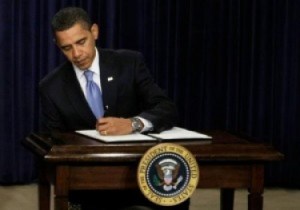
Today President Barack Obama signed into law the National Defense Authorization Act (NDAA) which, among other things, gives the President the power to indefinitely detain American citizens without trial. It also enshrines in law the ability of the government to use the military against American citizens.
At the same time, Obama issued a signing statement in which he says he will not use on the indefinite detention authority. As we know from three years experience, the President is a liar. Furthermore, the power will be passed on to future Presidents, and they may be less hesitant to use it. Here is the text of the signing statement (PDF), via the Washington Post. Some exerpts:
The fact that I support this bill as a whole does not mean I agree with everything in it. In particular, I have signed this bill despite having serious reservations with certain provisions that regulate the detention, interrogation, and prosecution of suspected terrorists. Over the last several years, my Administration has developed an effective, sustainable framework for the detention, interrogation and trial of suspected terrorists that allows us to maximize both our ability to collect intelligence and to incapacitate dangerous individuals in rapidly developing situations, and the results we have achieved are undeniable. Our success against al-Qa’ida and its affiliates and adherents has derived in significant measure from providing our counterterrorism professionals with the clarity and flexibility they need to adapt to changing circumstances and to utilize whichever authorities best protect the American people, and our accomplishments have respected the values that make our country an example for the world….
Section 1021 affirms the executive branch’s authority to detain persons covered by the 2001 Authorization for Use of Military Force (AUMF) (Public Law 107-40; 50 U.S.C. 1541
note).This section breaks no new ground and is unnecessary. The authority it describes was included in the 2001 AUMF, as recognized by the Supreme Court and confirmed through lower court decisions since then. Two critical limitations in section 1021 confirm that it solely codifies established authorities. First, under section 1021(d), the bill does not “limit or expand the authority of the President or the scope of the Authorization for Use of Military Force.” Second, under section 1021(e), the bill may not be construed to affect any “existing law or authorities relating to the detention of United States citizens, lawful resident aliens of the United States, or any other persons who are captured or arrested in the United States.” My Administration strongly supported the inclusion of these limitations in order to make clear beyond doubt that the legislation does nothing more than confirm authorities that the Federal courts have recognized as lawful under the 2001 AUMF. Moreover, I want to clarify that my Administration will not authorize the indefinite military detention without trial of American citizens. Indeed, I believe that doing so would break with our most important traditions and values as a Nation. My Administration will interpret section 1021 in a manner that ensures that any detention it authorizes complies with the Constitution, the laws of war, and all other applicable law.
In other words, Obama already had the power to detain American citizens, but because he is a great and magnanimous leader he will not act on the power, so we shouldn’t worry our pretty heads about it. Habeas Corpus is available only if granted by our benign and glorious leader.
Here’s the statement released by the ACLU on the President’s decision to sign the bill into law.
President Obama signed the National Defense Authorization Act (NDAA) into law today. The statute contains a sweeping worldwide indefinite detention provision. While President Obama issued a signing statement saying he had “serious reservations” about the provisions, the statement only applies to how his administration would use the authorities granted by the NDAA, and would not affect how the law is interpreted by subsequent administrations. The White House had threatened to veto an earlier version of the NDAA, but reversed course shortly before Congress voted on the final bill.
“President Obama’s action today is a blight on his legacy because he will forever be known as the president who signed indefinite detention without charge or trial into law,” said Anthony D. Romero, ACLU executive director. “The statute is particularly dangerous because it has no temporal or geographic limitations, and can be used by this and future presidents to militarily detain people captured far from any battlefield. The ACLU will fight worldwide detention authority wherever we can, be it in court, in Congress, or internationally.”
….
“We are incredibly disappointed that President Obama signed this new law even though his administration had already claimed overly broad detention authority in court,” said Romero. “Any hope that the Obama administration would roll back the constitutional excesses of George Bush in the war on terror was extinguished today.
There’s more at the link.
World War III Alert
Another dangerous portion of this new law imposes sanctions on Iran’s central bank. From the National Journal article cited above:
The bill also sets in motion strong sanctions against Iran’s Central Bank, in an attempt to rein in Tehran’s nuclear program, by impeding Iran’s ability to process payments for the roughly $90 billion in oil and gas it sells each year. The measures, which would penalize any foreign financial institution that does business with the central bank, sparked threats by Iranian officials to cut off access to the Strait of Hormuz, which could block transportation of most oil exports from the Persian Gulf.
The administration retains a national security waiver for the sanctions – and one to waive the petroleum sanctions if it determines there isn’t enough global supply to offset the lost Iranian oil – but has said it opposes being held to a timeline that could fragment to the international coalition working to isolate Iran or potentially spike oil prices.
Please discuss the NDAA, the signing statement, or any other topics that are on your mind.

 peej
peej Carissa
 bostonboomer
 dakinikat
 ecocatwoman
 mablue2
 Mama Lopez
 peggysue22
 quixote
 skydancingguestblogger
 Mona (aka Wonk the Vote)



 Sky Dancing
Recent Comments