
Thursday Reads: John Boehner and His “Knuckleheads,” Long-Lost Roman Fort, and Much More
Posted: September 18, 2014 Filed under: children, Crime, House of Representatives, Labor unions, morning reads, physical abuse, psychology, science, U.S. Politics, Violence against women | Tags: Adrian Peterson, archaeology, Arizona Cardinals, body odor, Brandon Marshall, Chicago Bears, Denver Broncos, Dunkin' Donuts, Gernsheim Germany, human mating behaviors, International Franchise Association, John Boehner, Jonathan Dwyer, knucklehead caucus, McDonald's, Minnesota Vikings, NFL owners, political science, Roger Goodell, Roman fort, sports talk radio 26 Comments
Good Morning!!
Did you hear about the speech John Boehner gave on Tuesday? He was talking to the International Franchise Association. He warned owners of McDonald’s, Dunkin’ Donuts and other franchise businesses that Obama’s NLRB is out to destroy them. My goodness! If these one-percenters were forced to pay their employees something approaching a living wage, it would be a nightmare! From The Hill, Boehner warns biz: NLRB is ‘coming right at you’.
Speaker John Boehner (R-Ohio), lamenting the rise of “arrogant agencies” he said is threatening the American dream, warned the franchise industry on Tuesday that a politically motivated National Labor Relations Board (NLRB) is intent on unionizing its workers.
In brief but forceful remarks to the International Franchise Association, Boehner called the NLRB a “political horse,” controlled by Republicans when they occupy the White House and by unions when a Democrat is president.
“They’re going to do everything they can to try to change the rules and try to find a way to organize your businesses,” Boehner told the group.
He cited the NLRB’s recent finding that the McDonald’s corporation has joint-employer status, along with its franchises, over the chain’s thousands of workers.
The designation, if upheld, could force corporate managers to the table in collective bargaining discussions and expose them to claims of labor rights violations from workers at chain stores and businesses.
Horrors! Because everyone knows the American Dream is about a few rich assholes getting richer on the backs of millions of minimum wage workers who can barely feed their families.
But here’s the good part. During his remarks, Boehner complained about the Republican “knuckleheads” he has to deal with as Speaker of the House. The Hill reports:
“On any given day, 16 of my members decide they’re going to go this way, and all the sudden I have nothing,” he said. “You might notice I have a few knuckleheads in my conference.”
As a result, Boehner claims he only has a “paper majority.”
A group of the most conservative Republicans has frequently plagued the Speaker and upended plans for votes, most recently in July when GOP leaders were forced to pull a vote on their bill responding to thousands of unaccompanied children crossing the southern border.
In April, Boehner mocked some members of his conference for being reluctant to vote on immigration reform. “Here’s the attitude: ‘Ohhhh. Don’t make me do this. Ohhhh. This is too hard,’ ” he said.
Boehner added in his comments on Tuesday that “dealing with Democrats is one thing, dealing with the knuckleheads is another.”

At Salon, Jim Newell comments on Boehner’s “knucklehead problem.”
A specialized sort of barometric collapse hit Washington, D.C., last night: a sudden knowledge that the capital’s stocks of Merlot and unfiltered cigarettes had been depleted, and Speaker John Boehner was turning surly. And the target of his abuse, yet again, were the very specimens over whom he attempts to leverage power: the House Republicans conference.
Boehner, speaking to the International Franchise Association (read: people who don’t want to pay their fast-food workers more), described the House majority over which he lords as a “paper majority,” and then went on to label a dissident faction within his conference as “knuckleheads.” ….
Newell mentions Boehner’s complaint about House Republicans who are afraid to vote for an immigration bill (see above in The Hill piece), and an earlier rant by the Speaker from 2012.
“We got some of the smartest people in the country who serve here, and some of the dumbest. We got some of the best people you’d ever meet, and some of the raunchiest. We’ve got ‘em all.”
Why don’t Democrats pull together a bunch of these Boehner quotes and use them in the Midterm campaigns, Newell asks. As for Speaker Boehner,
Why was Boehner insulting members of the House GOP less than two months ahead of an election? Because he’s a strange dude, for starters. Gets his Irish up sometimes, as Paul Ryan would say. But Boehner’s comments were also part of an elaborate pitch to the assembled franchisees to elect more House Republicans this November. He has a “paper majority” in which a few wiseacres can separate themselves from the herd and force the House leadership to pull legislation from the floor. Pity the speaker.
It’s a midterm election cycle in the sixth year of the Obama administration, so the odds are that any new members added to the speaker’s Republican roster this November will be natural fits for the Knucklehead Caucus. The problems Boehner has had (not) moving pieces of legislation these past four years won’t go away, because they’re problems with Boehner’s leadership style. He’s too tentative to threaten the knuckleheads’ committee assignments and access to party campaign cash. He’s abandoned earmarks. And his members know that, except in a handful of cases, his threats to pass legislation with Democratic votes are bluffs. The new knuckleheads will find him just as easy to roll as the previous ones have.
We’ve talked many times here about the differences between liberals and conservatives, and how hard it is for us to understand right-wingers’ thought processes. Well, did you know that liberals and conservatives even smell different?

From The Washington Post, Study: Liberals and conservatives sniff out like-minded mates by body odor.
According to a study published this month in the American Journal of Political Science, people can literally sniff out ideology — and this may explain why so many couples share political beliefs. Or, as the study’s title says, “Assortative Mating on Ideology Could Operate Through Olfactory Cues.”
Researchers led by Brown University political scientist Rose McDermott found that, to a small but significant degree, people prefer the body odor of those who vote as they do.
Previous studies showed long-term mates are more similar when it comes to politics than anything else besides religion. Researchers set out to determine whether this is a purely socially driven phenomenon, or whether biology plays a role.
To test the link between smell and party affiliation, researchers rounded up 146 people aged 18 to 40 from “a large city in the northeast United States.” They used a seven-point scale to determine where they fell on the political spectrum. They sent 21 of these —10 liberals and 11 conservatives — home with fragrance-free soap and shampoo and a gauze pad taped to their armpit. The subjects were told not to smoke, drink, use deodorant or perfume, have sex, eat fragrant foods, sleep with people or pets or linger near strong odors.
They returned the stinky armpit pads 24 hours later. Then 125 participants sniffed the stinky pads, taking a break between whiffs to cleanse their nasal palate with the aroma of peppermint oil. The sniffers, who never saw the people whose smells they were evaluating, then rated the attractiveness of each armpit sample on a 1 to 5 scale.
The subjects found the smell of those more ideologically similar to themselves more attractive than those with opposing views.
Read about the conclusions researchers drew from these results at the WaPo.

How about some archaeology news? German archaeologists have discovered a “long lost Roman fort.” dating to the 1st Century. From Science Daily:
In the course of an educational dig in Gernsheim in the Hessian Ried, archaeologists from Frankfurt University have discovered a long lost Roman fort: A troop unit made up out of approximately 500 soldiers (known as a cohort) was stationed there between 70/80 and 110/120 AD. Over the past weeks, the archaeologists found two V-shaped ditches, typical of this type of fort, and the post holes of a wooden defensive tower as well as other evidence from the time after the fort was abandoned.
An unusually large number of finds were made. This is because the Roman troops dismantled the fort and filled in the ditches when they left. In the process they disposed of a lot of waste, especially in the inner ditch. “A bonanza for us,” according to Prof. Dr. Hans-Markus von Kaenel from the Goethe University Institute of Archaeology. “We filled box after box with shards of fine, coarse and transport ceramics; dating them will allow us to determine when the fort was abandoned with greater accuracy than was possible before.”
Up until now, little was known about Roman Gernsheim, even though findings from the Roman era have been cropping up here since the 19th century. “Previously, the only thing that seemed certain based on the finds was that an important village-like settlement, or “vicus,” must have been located here from the 1st to the 3rd century, comparable with similar villages which have already been shown to have existed in Groß-Gerau, Dieburg or Ladenburg,” explained dig leader Dr. Thomas Maurer. He has been travelling from Frankfurt to South Hessia for years and has published his findings in a large publication about the North Hessian Ried during Roman imperial times.
“It was assumed,” continued Maurer, “that this settlement had to have been based on a fort, since it was customary for the families of the soldiers to live outside the fort in a village-like settlement.” “We really hit the jackpot with this excavation campaign,” said a delighted Prof. Dr. Hans-Markus von Kaenel. “The results are a milestone in reconstructing the history of the Hessian Ried during Roman times.” For almost 20 years now, von Kaenel has been studying this area with the help of his colleagues and students using surveys, digs, material processing and analyses. The results have been published in over 50 articles.
Read the rest at the link.

There was more bad new for the NFL yesterday. Arizona Cardinals running back Jonathan Dwyer (pictured in cuffs at right) was arrested for two domestic violence incidents that happened in July. Dwyer reportedly attacked his wife and caused a bone fracture in one incident, and in the other he threw a shoe at his 18-month old son. He is also charged with preventing his Kayla from calling 911 for help. Fortunately, Kayla immediately took the child and left the state. The New York Daily News reports, Arizona Cardinals shut down running back Jonathan Dwyer over domestic violence charges.
Police said Dwyer hit his wife, causing a fracture. It was not immediately clear if the shoe hit their baby, Jonathan Jr.
Officers went to Dwyer’s home on July 21 after neighbors reported a domestic disturbance. His wife brushed cops off, but later told detectives Dwyer was there when authorities were looking for him, but hid in a bathroom until police left.
The following day, Dwyer snatched a cell phone from his wife’s hand and threw it from the second floor of their home to prevent her from calling the cops, Crump said.
Dwyer is also accused of sending his wife text messages threatening to harm himself if she reported the assaults.
The Cardinals immediately deactivated Dwyer. They really had no choice after what happened with the Vikings and Adrian Peterson.
“We became aware of these allegations this afternoon when notified by Phoenix police and are cooperating fully,” the Cardinals said in a statement. “Given the serious nature of the allegations we have taken the immediate step to deactivate Jonathan from all team activities.”
One local Boston sports station has nominated Dwyer for “biggest asshole in the NFL.” I’ve been listening to the two Boston sports stations and ESPN radio quite a bit, and I’ve been really heartened by the reactions of the male program hosts and callers. One host said yesterday that he had read a parenting book over the weekend. He has never hit his kids, but he was so shocked by Adrian Peterson’s reported behavior that he wanted to know more about good parenting. Another host said that he had been beaten as a child, and for the first time he has begun to understand that his parents abused him.

Also yesterday, attorney Gloria Allred held a press conference in Atlanta with the best friend and the father of Rasheeda Watley, a survivor of abuse by Chicago Bears player Brandon Marshall and called for NFL Commissioner Roger Goodell to step down. WSB TV Atlanta:
At a news conference Wednesday, Allred detailed the case of Rasheeda Watley, who claimed then-boyfriend Brandon Marshall of the Denver Broncos had physically abused her….
Allred was joined by Watley’s father and best friend, who both said they reported the abuse to the NFL and Goodell but nothing was done.
NFL Commissioner Roger Goodell’s handling of family violence issues has come under fire in recent weeks after a video was released showing former Baltimore Ravens running back Ray Rice hitting his then-fiancee Janay Palmer twice inside the elevator of an Atlantic City casino in February.
Allred said the investigation process is flawed within the NFL organization and it needs to change.
“Our focus is on the process and we want the process to be fair. We want the investigation that is conducted in the future, investigations, of NFL players to afford due process to victims as well as NFL players,” Allred said. “The present process is obviously not fair.”
According to Watley’s father, no one from the NFL even talked to himself, his daughter, or any witnesses of the abuse.
I need to wrap this up, but I want to mention one more article from Bloomberg Businessweek, Roger Goodell at the 50-50 Yard Line. It’s a fairly long read that explains why Goodell’s job is not yet on the line. He has made tons of money for NFL owners, and–let’s face it–money is all they really care about.
So . . . what else is happening? Let us know in the comment thread, and have a great Thursday!
Tuesday Reads: Art as Therapy to Help Deal With Depressing News
Posted: September 9, 2014 Filed under: Barack Obama, Crime, Criminal Justice System, Foreign Affairs, Iraq, morning reads, Political Affective Disorder, psychology, Psychopaths in charge, Real Life Horror, social justice, U.S. Military, U.S. Politics, Ukraine, Violence against women, War on Women | Tags: Atlantic County NJ Prosecutor James McClain, Baltimore Ravens, Chief Thomas Jackson, Ferguson MO, FOIA requests, ISIS, Janay Palmer, Malaysia Flight 17, Michael Brown, NFL, police brutality, police killings, Racism, Ray Rice, Roger Goodell, Rutgers University, St. Louis, The Islamic State, TMZ 36 Comments
Still Life with a Red Rug, Henri Matisse (1906)
Good Morning!!
I decided I needed to look at some Matisse paintings this morning, and I’m going to include a few in this post to provide contrast to the news of the day, which is filled with violence, hate, and despair. According to the WebMuseum, Matisse was “a man of anxious temperament.”
Matisse’s art has an astonishing force and lives by innate right in a paradise world into which Matisse draws all his viewers. He gravitated to the beautiful and produced some of the most powerful beauty ever painted. He was a man of anxious temperament, just as Picasso, who saw him as his only rival, was a man of peasant fears, well concealed. Both artists, in their own fashion, dealt with these disturbances through the sublimation of painting: Picasso destroyed his fear of women in his art, while Matisse coaxed his nervous tension into serenity. He spoke of his art as being like “a good armchair”– a ludicrously inept comparison for such a brilliant man– but his art was a respite, a reprieve, a comfort to him.
Can art be therapy? I think so. So can reading literature or listening to music. From a review of Art as Therapy at Brain Pickings,
The question of what art is has occupied humanity since the dawn of recorded history. For Tolstoy, the purpose of art was to providea bridge of empathy between us and others, and for Anaïs Nin, a way to exorcise our emotional excess. But the highest achievement of art might be something that reconciles the two: a channel of empathy into our own psychology that lets us both exorcise and better understand our emotions — in other words, a form of therapy.
In Art as Therapy, philosopher Alain de Botton — who has previously examined such diverse and provocative subjects as why work doesn’t work,what education and the arts can learn from religion, and how to think more about sex — teams up with art historian John Armstrong to examine art’s most intimate purpose: its ability to mediate our psychological shortcomings and assuage our anxieties about imperfection. Their basic proposition is that, far more than mere aesthetic indulgence, art is a tool — a tool that serves a rather complex yet straightforwardly important purpose in our existence:
Like other tools, art has the power to extend our capacities beyond those that nature has originally endowed us with. Art compensates us for certain inborn weaknesses, in this case of the mind rather than the body, weaknesses that we can refer to as psychological frailties.
Read about “the seven core functions of art” at the Brain Pickings link. And now, regrettably, I must turn to today’s news.

Tea in the Garden, Henri Matisse (1919)
Ray Rice Domestic Violence News.
Yesterday’s news was dominated by reactions to gossip site TMZ’s release of the video of Baltimore Ravens running back Ray Rice hitting his then fiance–now wife–Janay Palmer and knocking her unconscious in an Atlantic city casino elevator in February.
Suddenly, the Ravens went into ass-covering mode. The Ravens released Rice and the NFL suspended him indefinitely. But why did it take so long? At the time, a video had been released showing Rice dragging Palmer from the elevator like a sack of potatoes.
Here’s a timeline of the Rice case from SB Nation. On Feb. 15th, after the beating, Rice and Palmer were both arrested and charged with simple assault (the charges against Palmer were later dropped). On the 19th a video was released that showed Rice coldly dragging an unconscious Palmer from the elevator like a sack of potatoes–her dress pulled up, her legs spread open to the camera. Rice makes shows no apparent concern for her well-being.
Those of us with any experience with domestic violence could easily surmise what had taken place inside the elevator. But the men of the NFL somehow assumed (or wanted to believe) that Palmer had viciously attacked Rice, and that he had only defended himself by knocking her unconscious!
On March 27 Rice was indicted for aggravated assault, and the next day the couple married. Did Rice marry her to shut her up? Rice ended up getting a slap on the wrist from Prosecutor James McClain (who, like Rice graduated from Rutgers). Rice was allowed to enter a one-year diversion program with counseling instead of getting jail time. And btw, McClain is still defending his decision.
On May 23, Ray Rice game a non-apology “apology” for his disgusting actions in which he apologized to everyone under the sun except his wife Janay. Rice acted as if the two were equally responsible for “the incident.”
From SB Nation, May 23: Ray Rice is an asshole and the Ravens couldn’t care less.
Ray Rice is sorry. He wants you to know how sorry he is for knocking out his fiancée Janay, who is now his wife. He would like to sincerely apologize for dragging her out of an Atlantic City hotel elevator. We know this because Rice told us so. He told the world in a televised public apology broadcast Friday afternoon from Baltimore.
“I apologize for the situation my wife and I were in,” the Baltimore Ravens running back said….
Rice’s apology is special because he really believes it; a shocking portion of Rice’s press conference was devoted to Successories-style affirmations about how he will recover from and get past this … situation that … occurred. Stranger still, Rice somehow managed to get his wife Janay — whom he married right before he was supposed to go to trial for a more serious version of domestic assault — to accept an equal share of blame for the incident. She apologized, too.
Those of us familiar with the dynamics of domestic violence know that Palmer’s behavior was typical of victims–blaming themselves and trying to protect their emotional and economic security.
Finally, in July NFL Commissioner Roger Goodell suspended Rice for two games. NFL and Ravens officials implied to journalists that there was some kind of mitigating evidence that showed Palmer to be at fault. Public outrage was immediate. I recall JJ posting about it at that time. On Aug. 28, realizing he had made a terrible public relations blunder, Goodell announced a new NFL policy on “domestic violence.”
Finally, on Sept. 8, TMZ released video of what actually transpired inside the elevator: Rice spitting in Palmer’s face, and decking her with a “crushing” left hook. Not long afterward, the Ravens and the NFL finally too action, claiming they had never seen this video footage that they could have gotten easily from the casino or law enforcement.
But guess what? Rice will still receive $25 million from his contract with the Ravens. If Roger Goodell keeps his job after this, the NFL will be permanently damaged. After all, half of the people who follow football are women? Why do you think the NFL make their players wear pink (ugh!) once a year in honor of breast cancer awareness?

The Red Madras Headdress, Henri Matisse
Here are some links to other stories on this horrible and shameful debacle:
Dan Shaughnessy at The Boston Globe: In Ray Rice case, one failure after another.
Mike Wise at The Washington Post: Ray Rice finally must answer for his actions; when will NFL Commissioner Roger Goodell?
Baltimore Sun: Janay Rice breaks her silence, describes situation as ‘horrible nightmare’ (She blames the media, not her husband).
SB Nation: White House on Ray Rice: ‘Hitting a woman is not something a real man does’.
TMZ: NFL Commish in the Dark by Choice?
President Obama to Lay out Case for Stepping Up Campaign Against Islamic State
From The Washington Post, As Obama Makes Case, Congress Is Divided on Campaign Against Militants.
WASHINGTON — President Obama on Tuesday will begin laying out his case for an expanded military campaign against the Islamic State in Iraq and Syria when he faces congressional leaders who are averse to taking an election-year stand but are being pushed by lawmakers who want a say in matters of war.
Mr. Obama’s meeting with Republican and Democratic leaders on Tuesday in the Oval Office will be the first of several between White House officials and lawmakers as the administration tries to persuade Congress to embrace the president’s plan to halt the momentum of the Sunni militant group known as ISIS.
A year after opposition in Congress thwarted plans for missile strikes in Syria, the White House is again putting the issue of military force in the Middle East before a skeptical Congress and a war-weary public.
But what about Congress?
Democratic leaders in the Senate and Republican leaders in the House want to avoid a public vote to authorize force, fearing the unknown political consequences eight weeks before the midterm elections on Nov. 4.
“A lot of people would like to stay on the sideline and say, ‘Just bomb the place and tell us about it later,’ ” said Representative Jack Kingston, Republican of Georgia, who supports having an authorization vote. “It’s an election year. A lot of Democrats don’t know how it would play in their party, and Republicans don’t want to change anything. We like the path we’re on now. We can denounce it if it goes bad, and praise it if it goes well and ask what took him so long.”
Other lawmakers, especially some Democrats, are arguing that as long as the president keeps the operation limited to airstrikes, he does not need to get congressional approval.
Benjy Sarlin at MSNBC: The Politics of ISIS
Ahead of a Wednesday public address from President Obama where he’s set to lay out a “game plan” for military action in Iraq and as the right mocks Democrats as weak-willed appeasers, former Vice President Dick Cheney is heading to Capitol Hill to deliver a pep talk to House Republicans.
Is it the 2002 election all over again? Not exactly. But the escalating conflict against ISIS is starting to show up on the trail as Republican candidates seem eager to put major past differences on foreign policy aside and join together in criticizing the White House’s response to the Islamic State.
A number of candidates and GOP officials have gone out of their way to attack Obama over his remark at a press conference that “we don’t have a strategy yet” for confronting ISIS. Republican Senate nominees including Scott Brown in New Hampshire, David Perdue in Georgia, and Thom Tillis in North Carolina, among others, have highlighted the quote while demanding action to turn back the Islamist group’s gains. Joni Ernst in Iowa and Tom Cotton in Arkansas, both of whom served in the Middle East during the Iraq War, have also called for a clearer plan to tackle ISIS.
Read the rest at the link.

Odalique with a Turkish Chair, Henri Matisse
Ferguson Updates
St. Louis Business Journal: Ferguson to reform municipal courts, add police review board.
As national attention mounts on the way St. Louis municipalities use court fine revenuefor city operations and on police use of force in the area, the Ferguson City Council has announced the proposal of three major reforms.
The city will hold ward meetings for public input on the reforms, with some of the proposals on the agenda for Tuesday night’s City Council meeting. It will be held at 7 p.m. at Greater Grace Church, 3690 Pershall Road.
Here’s the breakdown of the proposed reforms:
- Establishing a Citizen Review Board to work with the police department to review their actions.
- I ntroducing an ordinance that will keep court fine revenues at or below 15 percent of Ferguson’s revenue. Any excess will be earmarked for special community projects, not general revenue.
- Reforming the way Ferguson’s municipal court works by repealing the “failure to appear” offense, abolishing some administrative fees which may impact low-income persons to a greater extent and the creation of a special docket for defendants having trouble making monthly payments.
Likewise, the council announced, the municipal judge has called for a warrant recall to run from Sept. 15 through Oct. 15. Those who have outstanding warrants are encouraged to call the municipal court cler k for information on the recall.

Woman in a Purple Coat, Henri Matisse (1937)
Truthout: St. Louis Police Shot 16 Before Michael Brown in 2014
By the time of Michael Brown’s murder, St. Louis area police had already shot at least 16 people in 2014, the vast majority of whom were black.
Truthout obtained this figure by examining news reports from January 1 to August 6 of 2014. On August 10, protests opposing the police killing of unarmed black teenager Michael Brown began.
Read the list of victims at the link.
In the vast majority of incidents where the race of an individual shot by police was known, the individuals were black. Truthout was not able to determine how many (if any) of these police shootings were “justified” because data concerning police shootings is so limited.
Police shootings, along with other uses of force by the St. Louis area police, are not a new development. In Ferguson, seven active or former officers have now been named in civil lawsuits for excessive use of force; and in March 2014, two officers with the St. Louis Police Department severely beat a man with disabilities. In another recentcivil case, an amount of over $800,000 was awarded to a victim of excessive force by the St. Louis Metropolitan Police Force.
In 2012, US District Judge Carol Jackson stated that the St. Louis Board of Police Commissioners may be “deliberately indifferent” or even tacitly approving of a “widespread persistent pattern of unconstitutional conduct.” In a separate 2010 federal civil lawsuit, which accused the St. Louis police of excessive force, the victim’s lawyer cited statistics showing that the St. Louis internal affairs investigators sustained only one of 322 citizens’ physical abuse complaints against police from 1997 to 2002.
Read the rest at Truthout. It’s a good article.
Matthew Keys at The Blot: Ferguson Police Chief Lied About Michael Brown Surveillance Tape.
The chief of police for the Ferguson Police Department misled members of the media and the public when he asserted that his hand was forced in releasing surveillance footage that purported to show 18-year-old resident Michael Brown engaged in a strong-arm robbery at a convenience store minutes before he was fatally shot by a police officer.
Chief Thomas Jackson distributed copies of the surveillance tape at a press conference on Aug. 15 in tandem with the public release of the identity of the officer who was responsible for shooting Brown.
When questioned by members of the press about the tape — which apparently had nothing to do with the fatal shooting of the unarmed teenager — Jackson told reporters that he was legally obligated to release the tape because members of the media had submitted an open records requests for it.
“We’ve had this tape for a while, and we had to diligently review the information that was in the tape, determine if there was any other reason to keep it,” Jackson said at the press event. “We got a lot of Freedom of Information requests for this tape, and at some point it was just determined we had to release it. We didn’t have good cause, any other reason not to release it under FOI.”
Except there were no specific FOIA requests for the tape. Keys and The Blot got all media requests for information through an open records request. Read all about it at the Blot.

Dance “What hope might look like” — Henri Mattisse
Shootdown of Malaysia Flight 17 in Ukraine
From the LA Times: Dutch report: Malaysia jet downed in Ukraine by ‘high-energy objects’
A preliminary report on Malaysia Airlines Flight 17 appears to confirm initial assertions that the passenger plane was hit by a surface-to-air-missile in mid-flight July 17 before crashing in Ukraine.
“The pattern of damage observed on the forward fuselage and cockpit section of the aircraft appears to indicate that there were impacts from a large number of high-energy objects from outside the aircraft,” concluded a report issued Tuesday by the Netherlands’ air safety board.
The Boeing 777, en route from Amsterdam to Kuala Lumpur, the Malaysian capital, was flying at about 33,000 feet over separatist-held territory in southeastern Ukraine when it broke apart in midair and crashed, killing all 298 passengers and crew members on board.
The report says that fragments of the aircraft reveal numerous puncture holes and indentations on the plane’s skin that would be consistent with damage from missile shrapnel and, investigators say, rule out pilot error or any mechanical fault as the cause of the disaster.
Although investigators have not been able to recover these pieces for forensic examination, the report states that “the pattern of damage observed … was not consistent with the damage that would be expected from any known failure mode of the aircraft, its engines or systems.”
I’ll end there, as this post is far too long already. I hope you’ll share your thoughts and links in the comment thread.
The Kitty Genovese Case 50 Years Later
Posted: March 13, 2014 Filed under: Crime, Criminal Justice System, GLBT Rights, Media, psychology | Tags: B. Latane, bystander effect, J.M. Darley, Kew Gardens, Kitty Genovese, Mary Ann Zielonko, rape, serial murders, Winston Mosley 20 Comments
Today is the 50th anniversary of the murder of Kitty Genovese in Queens, New York. This was a crime that shocked and outraged America and the world, and still horrifies and fascinates people to this day. At The New Yorker, Nicholas Lehmann describes some of the reasons this news story has become so iconic and reviews two new books on the case. Lehmann argues that New York Times editor Abe Rosenthal created a news environment in which this particular murder became the focus of so much attention. Lehmann deliberately shaped the coverage of the murder in a sensational and misleading manner. The story ended up as the focus of a classic psychological study.
a post about this in August 2009, and I thought I’d put that post up again today.
I wrote a piece about this in August 2009. I thought I’d repost it today. I’ve made a few minor edits to the original. At the end, I list some recent books and articles for further reading.
The Kitty Genovese Case: A Fascinating Intersection of True Crime, Psychology, and Media Misinformation
A Murder in Kew Gardens
On March 13, 1964, at around 3:30AM, there was a murder in the Kew Gardens section of Queens, New York. The murder probably wouldn’t have gotten much publicity at all if it hadn’t been for a sensational article that appeared on the front page of The New York Times, a couple of weeks later. The Times story led to groundbreaking research in social psychology and the discovery of new and counter-intuitive information about human behavior.
It was very late, very cold, and very dark when 28-year-old Catherine “Kitty” Genovese parked her car at the Kew Gardens train station after driving from Ev’s Eleventh Hour Bar in Hollis, where she worked nights as manager. When she got out of her car, she saw a stranger walking toward her. The man, Winston Mosley, 29, stabbed Genovese two times as she hurried past a bookstore on Austin Street, pehaps headed a local bar named Bailey’s to seek assistance. She called out, “Oh my God. He stabbed me. Please help me,” and fell to the ground. Winston was leaning over her to stab her again, when he heard a man’s voice calling from a window in an apartment building across the street, “Leave that girl alone!”
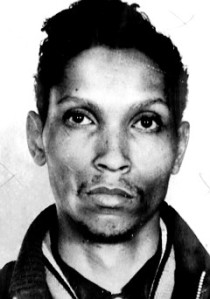
- Winston Mosley
Startled, Mosley ran down an alley, got into his car, and backed up, ready to drive off. Lights had gone on in the nearby apartment building, but they went off again. Mosley got out of the car and again followed Genovese, who had reached the doorway of her apartment building, which was in the back of the building at 82-62 Austin Street. As she fell forward through the doorway, crying out, “I’m dying, I’m dying,” Winston caught up with her, stabbed her again, and then raped her. A short time later, a neighbor, Greta Schwartz, who had called the police after receiving a phone call from another neighbor, ran down to the lobby and cradled Kitty in her lap until the paramedics arrived.
From interviews in the neighborhoods of the two stabbing incidents, police learned that as many as 37 people had seen or heard part of the stalking and murder of Kitty Genovese by Winston Mosley, but supposedly none of them had called the police except Greta Schwartz.
The New York Times Breaks the Story
On March 27, 1964, The New York Times published a front page story by Martin Gansberg (Warning, PDF) headlined “37 Who Saw Murder Didn’t Call Police.”
Apathy at Stabbing of Queens Woman Shocks Inspector
For more than half an hour 38 respectable, law-abiding citizens in Queens watched a killer stalk and stab a woman in three separate attacks in Kew Gardens.
Twice the sound of their voices and the sudden glow of their bedroom lights interrupted him and frightened him off. Each time he returned, sought her out and stabbed her again. Not one person telephoned the police during the assault; one witness called after the woman was dead.
That was two weeks ago today. But Assistant Chief Inspector Frederick M. Lussen, in charge of the borough’s detectives and a veteran of 25 years of homicide investigations, is still shocked.
He can give a matter-of-fact recitation of many murders. But the Kew Gardens slaying baffles him–not because it is a murder, but because the “good people” failed to call the police.
Just that brief excerpt contains a number of inaccuracies, which I’ll get to a little later. Nevertheless, it was from this newspaper article that Americans–and people around the world–formed their lasting impressions of the tragic death of Kitty Genovese. The story shocked the nation; everyone was talking about how terrible it was that in big cities like New York, people just didn’t seem to get to know their neighbors or care about them. Those of us who lived in small cities and towns were sure things would be different in our neighborhoods.
Psychological Study of the Bystander Effect
In 1968, J.M. Darley and B. Latane published a study (pdf) in the Journal of Personality and Social Psychology that was inspired by the supposed behavior of the 37 “witnesses” to Kitty Genovese’s murder. They hypothesized that the reason bystanders did not take action was “diffusion of responsibility,” and that the more bystanders in an emergency situation, the more these bystanders believe that “someone else will help, so I don’t need to.”
Participants in the study were college students in an introductory psychology class at New York University.
Darley and Latane told participants that they wanted to study how students adjust to university life in a highly competitive, urban environment. They said they wanted participants to discuss their problems honestly with other students; and in order to avoid personal discomfort, participants would sit in separate rooms equipped with an intercom system.
There were three different groups. Students in group one were told they would be talking with one other person. In group two, students were told there would be two other people on the intercome with them. Group five was told there would be five other people listening in to the conversation. In reality, all of the students were alone and they the other voices they heard were on tape. The emergency was that one of the participants in the discussion has epileptic seizure (the sounds of the seizure were actually played on tape).
As the intercom discussions began, students heard the first student, a male, tell about his difficulties concentrating on his studies and problems adjusting to life in New York City. He then added, with some embarrassment, that he sometimes had severe seizures, especially when under a lot of stress. Then the conversation switched to the next student. In group 1, the actual student’s turn came next. In the other two groups, the real student heard one or more other students speak first. After the real student took a turn speaking, the first “student” again started to speak normally, then began having a seizure, and asked for help. Darley and Latane measured how long it took subjects to help the student in trouble (helping was defined as leaving the cubicle and notifying an experimenter of the problem).
Why? Not because they were apathetic. All subjects were anxious and showed physical signs of nervousness. Darley and Latane conclued that as the number of people involved in an emergency situation increase, it’s easier for bystanders to assume that someone else will handle it; and the potential guilt for not helping is divided up. Other possible reasons for failure to act are fear of embarrassment or ridicule, fear that they are misinterpreting the situation. The authors also pointed out that most people don’t have much experience with emergency situations and are likely to become confused or overwhelmed when they encounter one.
Joseph De May, Jr., and the Kew Gardens History Page
In 2000, Joseph De May, who had lived in Kew Gardens since 1974, decided to build a website that would contain a comprehensive pictorial history of the neighborhood. As part of his project, De May dug up as much information as he could about the Kitty Genovese murder and then critiqued the original New York Times article and debunked some myths that had grown up around the case. Here is the “short version” of his critique:
# There were only 2 attacks, not 3.
# The attacks were not continuous. There was about a 10 min. interval between them when the killer moved his car to a parking place farther away.
# There were not 38 eye witnesses to either of the attacks. Only 3 people are known to have seen one or the other of the stabbings.
# The first attack on Austin Street – the one that awakened the witnesses – was likely over before all but a few of the witnesses got to their windows.
# Probably many more than 38 were ear witnesses to Kitty’s screams. However, that first attack occurred a few yards away from a bar known for its late night rowdiness.
# After the first attack, Kitty left the scene under her own power without making any outcries for help.
# The second attack took place in a small vestibule in the rear of a building where only one witness was in a position to see it.
# Given the layout of the crime scene, it would have been impossible for anyone to have seen or heard everything.
# Assuming the police were not timely called – a big assumption in my opinion – there were reasons apart from apathy why they were not.

- Crime scene photo: back of apartment building where Kitty died
Furthermore, a 15-year-old boy named Michael Hoffman saw Winston Mosley run away after the first attack in front of the bookstore and saw Kitty Genovese get up and stagger in the other direction. He didn’t know there had been a stabbing, but he told his father what he had seen and the father called the police. The police later admitted they had received several other calls. One man did see the knife and understood that a woman was being stabbed. This man never called the police and couldn’t explain his inaction. At least five other people saw Mosley return to the original scene, but by that time Kitty Genovese was gone.
There were two attacks, not three as the New York Times reported. A man on the first floor of Kitty’s building open his door and saw the final attack. He wanted to call police, but said his wife didn’t want him to get involved. He went to Greta Schwartz’s apartment and asked her to call police, which she did. She then ran downstairs with a friend, found Kitty still alive and cradled her until an ambulance arrived. Also contrary to The New York Times story, the occupants of Kitty Genovese’s apartments building knew and were friendly with each other. Many knew and liked Kitty and her roomate Mary Ann Zielonko.
The Real Kitty Genovese
In 2004, on the fortieth anniversary of Kitty Genovese’s death, Mary Ann Zielonko came forward and talked about Kitty publicly for the first time. She was interviewed on NPR’s Weekend Edition Saturday. In the interview, Zielonko, who now lives in Vermont, revealed that she and Kitty Genovese were lovers. A lesbian blogger in Vermont wrote a piece about her own feelings after she learned about Kitty’s sexual orientation.
Hearing that Genovese was a lesbian has shaken up my psyche. Genovese’s name was always a cautionary tale – about being a woman alone in the city at night, about the need to care and take action in the face of assault. But now it’s also somehow more about me as a lesbian, about our denied and undiscovered herstory, about the dangers we faced then – and now.
In 1964, it was not okay to be queer. The only place to go to hold your lover’s hand in semi-public was a bar. Mary Ann remembers the Swing Rendezvous on MacDougal St. and the Seven Steps on Houston. Police raids and being beaten up for wearing butch or femme drag were common events.
Until now we’ve never had the opportunity to ask whether the neighbors’ indifference might have had an element of homophobia (not that the word existed then). Kitty and Mary Ann lived together in the apartment Kitty was so desperately trying to reach that March night. Mary Ann says some of the neighbors suspected they were lesbians, because they were always together. “But we didn’t look ‘gay,’ whatever that means.” Mary Ann got home from her own shift tending bar and went to sleep – until the police knocked at her door at 4 a.m. and drove her from the tree-lined streets of their Kew Gardens, Queens, neighborhood where Kitty died, to the hospital morgue to identify Kitty’s body.
Some of the neighbors may have suspected that Kitty and Mary Ann were gay, but several reported in interviews that she was a friendly, smiling young woman whom they liked. A few told police and reporters that they “didn’t want to get involved,” but most weren’t sure what they had seen or heard and couldn’t say why they didn’t call for help. It was after 3AM on a winter night, in a neighborhood where there were often loud voices and even fighting among people leaving local bars. As with the participants in Darley and Latane’s study, some of the witnesses may have feared giving a false report to police and looking foolish.
In addition, Joseph De May reports that in those days, NYC police demanded that callers identify themselves rather than just accepting reports of emergencies. That may have deterred some from calling police or holding on long enough to get someone to listen. Even if witnesses had called police to report screaming or fighting, they would likely have taken a long time to respond, because of the bars in the area.
In 2004, The New York Times interviewed De May about his research.
In the end, Mr. De May’s conclusion about the murder is that, while the behavior of the witnesses was hardly beyond reproach, the common conception of exactly what occurred that night is not in fact what occurred. What did occur, he argues, is far more complex and far less damning to the residents of Kew Gardens.
”Yeah, there was a murder,” Mr. De May said. ”Yeah, people heard something. You can question how a few people behaved. But this wasn’t 38 people watching a woman be slaughtered for 35 minutes and saying, ‘Oh, I don’t want to be involved.”’
Mr. De May began his research with the seminal Times article of March 27, 1964. ”I remember reading through it, then putting it down and thinking, ‘Well, this doesn’t hang together at all,”’ he said. ”And then I read it again carefully. I knew the area. I knew the crime scene because I go by there every day.”
Mr. De May soon found himself poring through legal documents related to the case, scouring books and articles, and interviewing neighbors. At one point, he even ran the route of Ms. Genovese’s flight up Austin Street, timing it with a watch. He became convinced that his first impression was correct. ”Here’s something that everyone thinks happened,” he said, ”that isn’t so.”
Winston Mosley
Kitty’s murderer had no idea that she was a lesbian. He had set out that night to kill a woman. He was certainly a sociopath and may have been a serial killer. He confessed to having killed at least one other woman after he was arrested for the Genovese murder. In 1968, Mosley managed to escape from police custody and raped a pregnant woman in her home. In April, 2008, the New York Daily News reported on Mosley’s latest parole hearing.
Forty-four years after stalking and stabbing Kitty Genovese, her killer still blames his wife-beating father for the vicious murder.
“My father was at the time stalking my mother and thinking about killing her,” Winston Moseley told the parole board last month when asked about the infamous 1964 slaying.
“But the problem was not just at that moment in time,” he said. “It existed for many years of sort of the emotional trauma that I was going through.”
Moseley, whose parole bid was rejected for a 13th time, has long displayed little remorse for the March 13, 1964, slaying – although he did offer an apology this time, a transcript of the hearing shows.
Further Reading:
Books
In 2008, Charles E. Stoller, the man who prosecuted Winston Mosley for the murder of Kitty Genovese and two other murders, published a book about the cases, Twisted Confessions: The True Story Behind the Kitty Genovese and Barbara Kralik Murder Trials.
Catherine Pelonero, Kitty Genovese: A True Account of a Public Murder and Its Private Consequences (2014)
Kevin Cook, Kitty Genovese: The Murder, the Bystanders, the Crime that Changed America (2014)
Articles
Boston Globe book review, ‘Kitty Genovese’ by Kevin Cook and ‘Kitty Genovese’ by Catherine Pelonero
Nicholas Lehmann, A CALL FOR HELP: What the Kitty Genovese story really means.
AP (via CBS Local NY), 50 Years Later, Kitty Genovese Murder Case Still Grips NYC, Nation.
Fabian Tepper (Christian Science Monitor), Kitty Genovese murder: would you have helped?
Nancy Dillon (NY Daily News), Brother of Kitty Genovese to release documentary about sister’s 1964 murder, which prompted ‘Genovese Syndrome’ research
Tuesday Reads
Posted: July 23, 2013 Filed under: Crime, Criminal Justice System, Foreign Affairs, Fox News, Media, morning reads, polling, psychology, racism, Republican politics, Russia, seniors, social justice, sports, U.S. Politics, War on Women | Tags: attitudes toward Zimmerman verdict, dolphins, Edward Snowden, ESPN, FSB, George Zimmerman, horse race politcs, Margaret Sullivan, naming behavior, Nate Silver, NYT public editor, Russian intelligence, self-consciousness, self-recognition, Trayvon Martin, University of St Andrews, Vincent Janik 28 Comments
Good Morning!!
I have a varied selection of stories for you today. I’ll begin with one that doesn’t involve politics, racism, murder, woman-hating, or any other depressing topics. A new study released yesterday provides additional evidence that Dolphins may see each other as unique individuals. From BBC News: Dolphins ‘call each other by name’
It had been-long suspected that dolphins use distinctive whistles in much the same way that humans use names.
Previous research found that these calls were used frequently, and dolphins in the same groups were able to learn and copy the unusual sounds.
But this is the first time that the animals response to being addressed by their “name” has been studied.
Dr Vincent Janik University of St AndrewsTo investigate, researchers recorded a group of wild bottlenose dolphins, capturing each animal’s signature sound.
They then played these calls back using underwater speakers.
“We played signature whistles of animals in the group, we also played other whistles in their repertoire and then signature whistles of different populations – animals they had never seen in their lives,” explained Dr Janik.
The researchers found that individuals only responded to their own calls, by sounding their whistle back.
According to Janik,
“(Dolphins) live in this three-dimensional environment, offshore without any kind of landmarks and they need to stay together as a group.
“These animals live in an environment where they need a very efficient system to stay in touch.”
Although humans start naming things almost as a matter of course during early development, the process of creating and using a name is actually quite complex. Scientists refer to names as learned vocal labels, meaning vocalizations that refer to specific objects. Both parrots and dolphins have used learned vocal labels while in captivity, and researchers had no reason to believe that the animals couldn’t do the same in their natural environments. Now biologists Stephanie King and Vincent Janik from the University of Aberdeen have found that, indeed, wild dolphins use the equivalent of a human name to address each other.
What’s interesting to me is that if these dolphins can recognize each other as individuals and recognize their own names, this suggests a level of self-consciousness that is seen in very few animals other than humans. Even human children do not develop the ability to recognize themselves (PDF) in a mirror or on film until they are at least 18 months old and the development of true self-consciousness and awareness that others have similar thoughts and feelings (theory of mind) takes much longer.
The Washington Post reports on a depressing, but not surprising, poll on attitudes toward the Trayvon Martin case. Zimmerman verdict poll: Stark reaction by race.
The not-guilty verdict in the trial of George Zimmerman has produced dramatically different reactions among blacks and whites, with African Americans overwhelmingly disapproving of the jury’s decision and a bare majority of whites saying they approve of the outcome, according to a new Washington Post-ABC News poll….
The new survey underscores not only the gap between whites and blacks, but also how passionate many African Americans are about the case. Among African Americans, 86 percent say they disapprove of the verdict — with almost all of themsaying they strongly disapprove — and 87 percent saying the shooting was unjustified.
In contrast, 51 percent of whites say they approve of the verdict while just 31 percent disapprove. There is also a partisan overlay to the reaction among whites: 70 percent of white Republicans but only 30 percent of white Democrats approve of the verdict. Among all whites, one-third say the shooting was unjustified, one-third say it was justified and the other third say they didn’t know enough to have an opinion.
It figures that Republicans would be driving the results among whites. Republicans have truly become the party of white males who hate anyone who isn’t white and male. You have to wonder why any African American or any woman would choose to be a Republican. Unfortunately the poll didn’t break down the results by gender and geography. Would more women have disapproved of the verdict? It was an all-woman jury, but also a Florida jury. A more complex analysis would have been helpful.
Republicans–at least the ones who watch Fox News–are old too. It’s hard to believe, but even though Fox leads the other cable news channels in viewers, the average age of Fox viewers is 65-plus! From the NYT:
Fox News declined to make executives available for comment, but several recent signs — including changing personalities for some of its weekday programs — suggest the network may have decided the time has come to confront the issue of age.
Just how old is its audience? It is impossible to be precise because Nielsen stops giving an exact figure for median age once it passes 65. But for six of the last eight years, Fox News has had a median age of 65-plus and the number of viewers in the 25-54 year old group has been falling consistently, down five years in a row in prime time, from an average of 557,000 viewers five years ago to 379,000 this year. That has occurred even though Fox’s overall audience in prime time is up this year, to 2.02 million from 1.89 million three years ago….
“The numbers indicate they haven’t been replacing the younger viewers,” Mr. Moffett said of Fox News. Many of the loyal viewers the network has always had are simply aging up beyond the 54-year cutoff for many ad buyers. The result is an audience edging consistently above that 65-plus number.
News audiences always trend old, and the viewers of Fox’s competitors are hardly in the full flower of youth. MSNBC’s median age for its prime-time shows this year is 60.6; CNN’s is 59.8.
In terms of the rest of television, Fox News also is quite a bit older than networks considered to have a base of older viewers. CBS has frequently been needled for having older viewers, but at 56.8, its median viewer is far younger than Fox News’s. (Viewers at Fox News’s sister network, Fox Broadcasting, have a median age of 50.2; at ABC, the median is 54.4; at NBC, it’s 47.7.)
Speaking of old-fashioned viewpoints, I posted this in the comments yesterday, but it’s worth a closer look. Yesterday, Margaret Sullivan the NYT Public Editor posted a remarkable column about Nate Silver: Nate Silver Went Against the Grain for Some at The Times. Sullivan speculates that Silver may have decided to leave the Times for ESPN/ABC because his fact- and probability-based methods of writing about politics didn’t jive with the attitudes of some other Times journalists. She based her analysis on a number of conversations with Silver and “about him with journalists in the Times’s newsroom.”
* I don’t think Nate Silver ever really fit into the Times culture and I think he was aware of that. He was, in a word, disruptive. Much like the Brad Pitt character in the movie “Moneyball” disrupted the old model of how to scout baseball players, Nate disrupted the traditional model of how to cover politics.
His entire probability-based way of looking at politics ran against the kind of political journalism that The Times specializes in: polling, the horse race, campaign coverage, analysis based on campaign-trail observation, and opinion writing, or “punditry,” as he put it, famously describing it as “fundamentally useless.” Of course, The Times is equally known for its in-depth and investigative reporting on politics.
His approach was to work against the narrative of politics – the “story” – and that made him always interesting to read. For me, both of these approaches have value and can live together just fine.
* A number of traditional and well-respected Times journalists disliked his work. The first time I wrote about him I suggested that print readers should have the same access to his writing that online readers were getting. I was surprised to quickly hear by e-mail from three high-profile Times political journalists, criticizing him and his work. They were also tough on me for seeming to endorse what he wrote, since I was suggesting that it get more visibility.
A few reactions to the Nate Silver story:
JM Ashby at Bob Cesca.com: Revenge of the Nerd
TPM: Nate Silver’s Seven Most Memorable Predictions
Politico: How ESPN and ABC landed Nate Silver
Business Insider got Silver’s own reaction to the Sullivan column: ‘The Culture Stuff Was Not A Big Factor’ In Me Leaving The New York Times
I’ll wrap this up with a some Edward Snowden updates. It’s very clear at this point that Snowden is being controlled by Russian intelligence. We don’t really know where he is, and his spokesman is an “attorney” who is in charge of PR for the Russian FSB. We also don’t know what Snowden has given the FSB in return for their help. Geoffrey Ingersoll at Business Insider:
Russian attorney Anatoly Kucherena — who also happens to be the head of public council for the Federal Security Service (FSB) — has announced that Edward Snowden may leave the Moscow airport on Wednesday.
That’s right, he’s likely not going too far.
We also know that Snowden supposedly said he has no plans to travel to Latin America because at this time, he thought it too dangerous to travel.
How do we know that? Well, Kucherena said Snowden said it, of course.
Not only does Kucherena run the FSB’s public council, but it seems he runs Snowdens public relations
as well — he “helped” Snowden apply for temporary asylum, he relayed Snowden’s “promise” not to hurt the U.S. anymore, and he announced Snowden’s (very own) idea about possibly applying for Russian citizenship with the intent to stay for a while and “learn Russian culture.”
And here’s Michael Kelley, also from Business Insider: The Intel In Snowden’s Head Could Be More Damaging Than The Material He Leaked
National Security Agency whistleblower/leaker Edward Snowden reportedly flew to Hong Kong carrying “four laptop computers that enable him to gain access to some of the US government’s most highly-classified secrets,” raising the concern that data could have been compromised in China or Russia.
But the information in his head may be more valuable, and accessible, than highly encrypted files.
Beyond trying to acquire information about the 10,000 NSA files Snowden accessed in Hawaii, a U.S. adversary would want to learn from Snowden’s expertise of internal NSA processes — such as its recruiting and vetting processes — to gain insight into America’s decision loop.
“Snowden understood exactly how far he could push [the NSA],” Robert Caruso, a former assistant command security manager in the Navy and consultant, told Business Insider. “That, coupled with his successful exploitation of our entire vetting process, makes him very dangerous.”
There’s much more of interest in the Kelley article, including a timeline of Snowden’s activities. Highly recommended.
I have several more Snowden links that I’ll just list for anyone who’s interested to click on:
NBC News: Lawyer: Snowden hopes to leave Moscow airport by Wednesday
CNN: Snowden did not access ‘crown jewels’ of NSA intel, official says
The Voice of Russia: US communicates concerns over Snowden to Russian gov’t – ambassador
ABC News: New Snowden Documents Show NSA-Germany Spy Links: Report
Atlantic Wire: Edward Snowden Has Everything and Nothing
Now it’s your turn. What stories have caught your interest today? I look forward to clicking on your links!
Paul Ryan Makes Major Freudian Slip
Posted: March 12, 2013 Filed under: psychology, U.S. Economy, U.S. Politics | Tags: Freudian slips, George W. Bush, Paul Ryan, Ryan budget 34 CommentsHilarious! While introducing his budget plan today, Paul Ryan unconsciously revealed his true purpose.
During the unveiling of his new budget proposal, House Budget Committee Chairman Paul Ryan (R-Wis.) made a slip of the tongue while railing against President Obama’s healthcare law.
“This is something we will not give up on because we are not going to give up on destroying the healthcare system for the American people,” Ryan accidentally said.
Here’s the clip, courtesy of DailyKos:

 peej
peej Carissa
 bostonboomer
 dakinikat
 ecocatwoman
 mablue2
 Mama Lopez
 peggysue22
 quixote
 skydancingguestblogger
 Mona (aka Wonk the Vote)



 Sky Dancing
Recent Comments