
A little Night Humor
Posted: October 28, 2013 Filed under: open thread, The Media SUCKS 7 Comments
We frequently complain about the media’s coverage of politics here. Most of us also have websites and sources that we laugh at. Politico often brings out a number articles that cause us to groan, do frantic face palms, and complain. So,this is good.
What If POLITICO Had Covered the Civil War?Playbook, Emancipation Day Edition
….
WEST-WING MINDMELD: This shows a direct, decisive president, something that will improve Lincoln’s ability to get his agenda through Congress
FORMER GEN.-IN-CHIEF GEORGE MCCLELLAN, on MORNING JEHOSEPHAT: “Lincoln has flip-flopped once again on emancipation…. Washington politicians are doing an end run around the Constitution… I think we need less polarization and divisiveness during a civil war. A leader needs to stand up to extremists and reach out across the aisle. Lincoln has not led.” 1864 TEA LEAVES: “I am not ruling anything out, but I’m not ruling anything in.”
PLAY-BOOK FACTS OF LIFE: If the president can convince the public that he emancipated slaves simply to preserve the union, the story will blow over. If it emerges that he actually issued the proclamation because he believes involuntary bondage is an immoral affront to human dignity, we could be looking at months of hearings.
FLASHBACK: “I am not, nor have ever been in favor of bringing about in any way the social and political equality of the white and black races.” –Lincoln, IL-SEN debate, 1858
,,,
Yup. That would be about right.

RIP Lou Reed
Posted: October 27, 2013 Filed under: open thread | Tags: Lou Reed 4 Comments So, I’m smack in the middle of the generation that was really influenced by Lou Reed and the Velvet Underground so I just couldn’t resist doing an open thread here. They’ve been using this song for a great PS4 ad recently. I keep seeing it on SyFy and now it seems really ghoulish. It’s only fitting he died on a Sunday Morning and right before Halloween.
From Rolling Stone: 20 Essential Lou Reed Tracks.
With the Velvet Underground in the late Sixties, Reed fused street-level urgency with elements of European avant-garde music, marrying beauty and noise, while bringing a whole new lyrical honesty to rock & roll poetry. As a restlessly inventive solo artist, from the Seventies into the 2010s, he was chameleonic, thorny and unpredictable, challenging his fans at every turn. Glam, punk and alternative rock are all unthinkable without his revelatory example. “One chord is fine,” he once said, alluding to his bare-bones guitar style. “Two chords are pushing it. Three chords and you’re into jazz.”
Lewis Allan “Lou” Reed was born in Brooklyn, in 1942. A fan of doo-wop and early rock & roll (he movingly inducted Dion into the Rock and Roll Hall of Fame in 1989), Reed also took formative inspiration during his studies at Syracuse University with the poet Delmore Schwartz. After college, he worked as a staff songwriter for the novelty label Pickwick Records (where he had a minor hit in 1964 with a dance-song parody called “The Ostrich”). In the mid-Sixties, Reed befriended Welsh musician John Cale, a classically trained violist who had performed with groundbreaking minimalist composer La Monte Young. Reed and Cale formed a band called the Primitives, then changed their name to the Warlocks. After meeting guitarist Sterling Morrison and drummer Maureen Tucker, they became the Velvet Underground. With a stark sound and ominous look, the band caught the attention of Andy Warhol, who incorporated the Velvets into his Exploding Plastic Inevitable. “Andy would show his movies on us,” Reed said. “We wore black so you could see the movie. But we were all wearing black anyway.”
Maybe he’s taken the ultimate Walk on the Wild Side. Maybe he’s on a Satellite of Love. Who knows? Just know he was the epitome of cool in my misspent youth with Harry, Mark, and John.
Tuesday Night Updates
Posted: September 24, 2013 Filed under: open thread | Tags: iran, Pakistan earthquake, Senate Whacko Birds, UN Nations, US 11 CommentsJust thought I’d put a few of the day’s significant news stories up. One story is pure theatre. The other one is actually significant because it’s a signal that the  U.S. and Iran may approach their relationship differently from now on out. The Iranian President portrays himself as a moderate and the Obama Administration is encouraging the change!
President Barack Obama’s speech Tuesday to the United Nations was his most significant foreign policy statement since becoming president. It showed he had clearly learned something from the recent “red line” fiasco in Syria. The speech also displayed what has always been the most attractive feature of Obama’s foreign policy, one that clearly sets him off from his predecessor—his willingness to court erstwhile enemies and adversaries, or to put it in negative terms, his not possessing what my former colleague Peter Scoblic called an “us versus them” view of the world.
The speech was a departure in one very obvious way. Two years ago, the Obama administration had announced a “pivot to Asia” in its foreign policy, but Obama’s speech to the U.N. was almost entirely devoted to the greater Middle East with a footnote here or there to Africa. Obama mentioned China only once—as one of the nations engaged in nuclear weapons talks with Iran—and didn’t mention Japan or South Korea at all. That reflects the way the world is: The Middle East is oil—still the lifeblood of the global economy—and the Middle East continues to suffer from tectonic fault lines created by the Age of Empire in Europe.
There were specific departures in the speech from positions that Obama has taken in the past. The one that will get the most attention, and rightly so, is American policy toward Iran, but the speech also included departures in American policy toward Syria, Israel and the Palestinians, and Egypt and the Arab Spring.
Obama declared his willingness to pursue a diplomatic solution with Iran over its nuclear program. Of course, he had done that before, but it was usually punctuated by a threat of military action if Iran did develop a nuclear weapon. That threat lingered in the background in his speech; in the foreground, he acknowledged Iranian fears of the United States, dating from our helping to overthrow Iran’s government in 1953; he welcomed Iranian President Hassan Rouhani’s overtures to the United States; and he said he was instructing Secretary of State John Kerry to meet with Iran’s foreign minister—the first such meeting between the country’s leading diplomats since 2007. The White House has also said it is “keeping the door open” to a meeting between Obama and Rouhani.
The thaw in relations was not subtle but it also wasn’t substantive.
Obama said that if the UN security council failed to pass a strong resolution enforcing the dismantling of the Syrian regime’s chemical weapons arsenal, then the institution would show itself “incapable of enforcing the most basic of international laws”.
However, in his UN speech Obama made clear that the US saw the Iranian nuclear programme as a much more immediate and serious threat to its core interests, and he responded to the overtures of the newly-elected leadership in Tehran by putting Kerry in charge of the coming critical weeks of intense negotiations.
“Given President Rouhani’s stated commitment to reach an agreement, I am directing John Kerry to pursue this effort with the Iranian government, in close coordination with the European Union, the United Kingdom, France, Germany, Russia and China,” the president said.
The move mirrored Rouhani’s decision to put his own foreign minister, Mohammad Javad Zarif, in charge of the talks, breaking from the practice of the past eight years of abortive negotiations of assigning them to senior officials. The foreign ministers of all seven countries are due to meet for the first time at the UN on Thursday.
“Directing Secretary Kerry to lead this signals that the negotiations may be elevated to the foreign minister level, which would be very good news,” said Trita Parsi, the head of the National Iranian American Council, and the author of a book on US-Iranian negotiations, A Single Roll of the Dice.
“This means that far greater political will is being invested into the diplomatic process, which in turn increases the cost of failure. That is exactly what is needed to overcome the political obstacles to a deal.”
Obama acknowledged the difficulties ahead. “The roadblocks may prove to be too great, but I firmly believe a diplomatic path must be tested,” he said.
The theatrical news came from a weird show in the US that was supposed to pass for a filibuster on the funding of the Affordable Health Care Act by Ted Cruz and the other notorious Senate Republican Whacko Birds. There were some seriously comical and crazy moments. Let me just say that none of these idiots are Wendy Davis!
During a floor speech Tuesday aimed at reviving the already-dim prospects for his effort to defund Obamacare, Sen. Ted Cruz (R-TX) likened his doubters to Nazi appeasers.
“If you go to the 1940s, Nazi Germany,” Cruz said. “Look, we saw in Britain, Neville Chamberlain, who told the British people, ‘Accept the Nazis. Yes, they’ll dominate the continent of Europe but that’s not our problem. Let’s appease them. Why? Because it can’t be done. We can’t possibly stand against them.'”
“And in America there were voices that listened to that,” he continued. “I suspect those same pundits who say it can’t be done, if it had been in the 1940s we would have been listening to them. Then they would have made television. They would have gotten beyond carrier pigeons and beyond letters and they would have been on tv and they would have been saying, ‘You cannot defeat the Germans.'”
Cruz said at the outset that he intends to speak until he is “no longer able to stand” in an effort to force Senate Majority Leader Harry Reid (D-NV) to agree to a 60-vote threshold for any motion that removes the defunding language from the House-passed continuing resolution.
But because Senate procedure limits how long he may speak before the initial vote to invoke cloture on Wednesday, Cruz is actually not staging a filibuster.
 Just one further story that shows the power of Mother Nature. There was a deadly earthquake in Pakistan that has killed many people and produced a new island.
It struck at 16:29 local time (11:29 GMT) at a depth of 20km (13 miles), 66km north-east of Awaran in Balochistan province, the United States Geological Survey said.
It was felt as far away as Karachi, Hyderabad, and India’s capital, Delhi.
Balochistan is Pakistan’s largest but least populated province.
A major earthquake hit a remote part of western Pakistan on Tuesday, killing at least 45 people and prompting a new island to rise from the sea just off the country’s southern coast.
Tremors were felt as far away as the Indian capital of New Delhi, hundreds of miles to the east, where buildings shook, as well as the sprawling port city of Karachi in Pakistan.
The United States Geological Survey said the 7.8 magnitude quake struck 145 miles southeast of Dalbandin in Pakistan’s quake-prone province of Baluchistan, which borders Iran.
The earthquake was so powerful that it caused the seabed to rise and create a small, mountain-like island about 600 meters (yards) off Pakistan’s Gwadar coastline in the Arabian Sea.
Television channels showed images of a stretch of rocky terrain rising above the sea level, with a crowd of bewildered people gathering on the shore to witness the rare phenomenon.
So, the real earth-shattering news was not made by Senator Cruz even though he probably thinks he was the big deal of the day.
Sunday Open Thread: David Frost Dead at 74
Posted: September 1, 2013 Filed under: open thread, U.S. Politics | Tags: David Frost, Margaret Thatcher, Obituaries, Richard Nixon, That Was The Week That Was 8 Comments
Good Morning!!
Mona isn’t feeling well, but will try to get her scheduled post up later on today. Meanwhile here’s an open thread for early risers.
Famed British broadcaster Sir David Frost has died of a presumed heart attack while giving a speech on a cruise ship. He was 74. The Guardian reports:
Sir David Frost, the journalist and broadcaster whose lengthy career covered everything from cutting-edge 60s satire to heavyweight interviews and celebrity gameshows, has died of a heart attack on a cruise ship, his family said.
The 74-year-old, whose programmes included That Was The Week That Was and The Frost Report, was to have given a speech on board the Queen Elizabeth, which had set sail from Southampton on a cruise to Lisbon.
Frost, who was knighted in 1993, helped establish London Weekend Television and TV-am. He was famed for his political interviews, most notably with Richard Nixon in 1977, in which the US president conceded some fault over Watergate for the first time.
From BBC News:
Born in Kent, Sir David studied at Cambridge University where he became secretary of the Footlights club, and met future comedy greats such as Peter Cook, Graham Chapman and John Bird.
After university he went to work at ITV before he was asked to front the BBC programme That Was The Week That Was, which ran between 1962 and 1963.
Casting a satirical eye over the week’s news, the show boasted scriptwriters including John Cleese, John Betjeman and Dennis Potter.
The Frost Report brought together John Cleese, Ronnie Barker and Ronnie Corbett in a sketch show which would influence many comedy writers including the Monty Python crew.
Much more at the link.
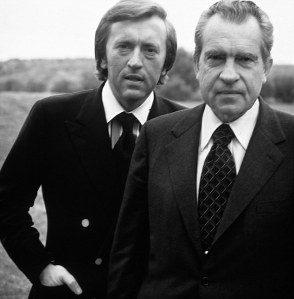
Former President Richard Nixon with TV interviewer David Frost in Mid-March in 1977 before they began taping their interviews later that month. (AP Photo)
Of course Frost was best known for his interviews with Richard Nixon after Watergate forced Nixon to resign the presidency.
He…conducted a series of interviews with Mr Nixon, who had resigned the presidency two years earlier, in which the former president came close to apologising to the public for his role in the Watergate scandal.
Their exchanges were eventually made into a film – based on a play – which saw Michael Sheen portray Sir David Frost to Frank Langella’s Nixon. Sir David himself appeared at the premiere of the film in 2008.
David was regularly scoffed at by fellow broadcasters for his allegedly non-aggressive style of questioning.
But he invariably had the last laugh because he almost always extracted more intriguing information and revealing reactions from his subjects than other far more acerbic broadcasters who boasted about their hard-hitting treatment of their “victims”….
His interview with the doomed American President “Tricky Dicky” Richard Nixon was a TV classic. During it, Nixon dramatically admitted that he had “let down the country”.
But there were many other historic moments, including one when he suddenly introduced the word “bonkers” during a tense interview with the then prime minister Margaret Thatcher over the sinking of the Argentine warship the Belgrano during the Falklands conflict. She was furious.
A few clips from Frost’s long and illustrious career in broadcasting.
From That Was The Week That Was (TW3), 1963
Friday Reads
Posted: August 30, 2013 Filed under: morning reads, open thread, Republican politics, U.S. Economy, U.S. Politics | Tags: Burger King, Eric Cantor, fast food workers' strike, fund-raising, GLBT rights, hurricane katrina, IRS, John Boehner, living wage, lobbying, McDonald's, New Orleans, North Dakota, Rush Limbaugh, same-sex marriage 27 Comments
Good Morning!!!
Since it’s the beginning of the Labor Day weekend, I thought I’d start out with some Labor News. There are so many jobs these days that don’t really pay a living wage in the US that it’s really astounding. Fast Food Workers are among the lowest paid in the country.
Fast-food workers went on strike and protested outside McDonald’s, Burger King and other restaurants in 60 U.S. cities on Thursday, in the largest protest of an almost year-long campaign to raise service sector wages.
Rallies were held in cities from New York to Oakland and stretched into the South, historically difficult territory for organized labor.
The striking workers say they want to unionize without retaliation in order to collectively bargain for a “living wage.”
They are demanding $15 an hour, more than twice the federal minimum of $7.25. The median wage for front-line fast-food workers is $8.94 per hour, according to an analysis of government data by the National Employment Law Project (NELP), an advocacy group for lower-wage workers.
“It’s almost impossible to get by (alone),” said McDonald’s worker Rita Jennings, 37, who was among about 100 protesters who marched in downtown Detroit Thursday. “You have to live with somebody to make it.”
Rush Limbaugh was all agog and demagogue about the striking workers
LIMBAUGH: If you want a “living wage,” if you don’t like what fast food restaurants pay, then do something else. It’s just that simple. Go to a trade school. Go to another business. Start your own business. Maybe the work that you are capable of isn’t yet worth $15 an hour at a fast-food restaurant. Maybe the consumer doesn’t want to pay $10 for a Big Mac so that people working at McDonald’s make $15 an hour. It’s not just a one-way strata.
You don’t just sit there and double what the employees at McDonald’s make and keep the prices the same. Now, you may think this is obvious, folks, and you may think, “Come on, Rush,” you’d be amazed at how many people do not understand the push-pull in economics. You’d be amazed at the number of people who have taken economics courses who think that the truth about headaches is that the boss is a cheap skinflint and wants his employees to starve and wants to screw his customers.
That’s the basis of their understanding, and they go from there, and they are applauded by left-wing Democrat politicians for holding that belief, and they’re encouraged to have it. Now, to those of you who, like Sean from San Diego, are sympathetic to this demand for the minimum wage at Mickey D’s to go from $7.15 or $7.25 an hour to $15, let me ask you this: When you buy a meal, do you make sure that you’re paying a fair price for it?
When you walk in there, do you ask the employee, “Look, am I paying enough here so that you can get a livable wage? When you go in and buy a Big Mac or a Quarter Pounder with cheese or a double Quarter Pounder with cheese, do you look at the price is and say, “Are you sure that this costs enough that you can make a livable wage?” Or do you just get a little upset when you think it’s a little too expensive?
Limbaugh was lecturing fast workers on getting a better job as he sat in his mansion with no clue what it is like to work and survive on minimum wage. Limbaugh’s lecture was centered around a couple of the Republicans favorite falsehoods. Rush was pretending that there are better jobs out there for minimum wage workers.
Some happy news for married GLBT workers! The IRS and the US Treasury will recognize your marriage. You get the standard marriage deduction!!
The U.S. Department of the Treasury and the Internal Revenue Service (IRS) today ruled that same-sex couples, legally married in jurisdictions that recognize their marriages, will be treated as married for federal tax purposes. The ruling applies regardless of whether the couple lives in a jurisdiction that recognizes same-sex marriage or a jurisdiction that does not recognize same-sex marriage.
The ruling implements federal tax aspects of the June 26th Supreme Court decision invalidating a key provision of the 1996 Defense of Marriage Act.
“Today’s ruling provides certainty and clear, coherent tax filing guidance for all legally married same-sex couples nationwide. It provides access to benefits, responsibilities and protections under federal tax law that all Americans deserve,” said Secretary Jacob J. Lew. “This ruling also assures legally married same-sex couples that they can move freely throughout the country knowing that their federal filing status will not change.”
Under the ruling, same sex couples will be treated as married for all federal tax purposes, including income and gift and estate taxes. The ruling applies to all federal tax provisions where marriage is a factor, including filing status, claiming personal and dependency exemptions, taking the standard deduction, employee benefits, contributing to an IRA, and claiming the earned income tax credit or child tax credit.
I joined the Sisterhood of the Pink Shoes this weekend. Meanwhile, the real sister with the pink shoes is doing really well in the fundraising arena.
In the six weeks following her headline-grabbing filibuster, Wendy Davis raised $1.2 million — nearly 40 percent of it from outside Texas. Davis drew national attention following the filibuster against an abortion-restriction bill that helped shut down the Texas Senate and prompted Gov. Rick Perry to call lawmakers back into another special session. In the wake of Davis’ new-found fame, Davis has been urged by some Democrats to run for governor next year. She says she will announce her political plans — whether to run for reelection as a senator from Fort Worth or as a Democrat for governor — in a few weeks.
Martin Luther King was fighting for working folks when he was assassinated. We’ve already said that no Republicans showed up to commemorate the March on Washington. Where were they?
So what was did they do instead? Well, Boehner was in Jackson Hole, Wyo., and had no public events scheduled, but he has been headlining GOP fundraisers all this month, so it’s a fairly safe to assume that he was raising cash at the time. Cantor, meanwhile was touring an oil field in North Dakota. The Grand Forks Herald reports:
Cantor, hosted by Rep. Kevin Cramer, R-N.D., met with energy industry and community leaders at a crew camp in Williston, toured a drilling site and other oilfield locations in the Bakken and met with North Dakota Petroleum Council members in Watford City.
Cantor praised North Dakota’s approach to energy development and said the country needs to follow the state’s example and adopt a national energy policy.
“I hope to be able to tell the president that there’s a lot for him to learn here as far as energy production here in America,” Cantor said. “North Dakota seems to have gotten it right.”
The North Dakota Petroleum Council, by the way, is a lobby group that represents the state’s oil and gas industry. That’s what Cantor was doing on the day of the march.
Here’s a little bit of News on New Orleans 8 years after Katrina.
Now optimism is rising as a rebounding city approaches the 300th anniversary of its 1718 founding.
“The city is a much better place than it was eight years ago. The biggest challenge we have is blight,” Landrieu said, adding that 10,000 blighted properties have been removed from the cityscape.
A thriving downtown and newly vibrant neighborhoods contrast starkly with the city’s appearance eight years ago. When Katrina hit, thousands of people who couldn’t escape New Orleans in time were trapped in homes as levees broke and floodwaters rose. Helicopters plucked the desperate from rooftops as chaos spread. The damaged Superdome became a refuge of misery for thousands as tempatures and tempers soared.
Days afterward then-President George W. Bush promised the nation’s full attention. But federal authorities were sharply criticized for their early response and local and state authorities as well. And though billions of federal dollars have helped to rebuild a strengthened levee system, many locals remain bitter with the Army Corps of Engineers for the failure of the levees.
Landrieu said he’s intent on moving forward.
“I think that we have successfully done the most important thing, which was to think about building the city back the way she should have always been and not the way she was,” he said.
Landrieu said rebuilding has even meant re-organizing government operations, streamlining finances, curbing waste and fraud and reorganizing the city’s education system – even adding new fire and police stations, parks and libraries.
The weird thing about the blight is that it’s in areas that you wouldn’t necessarily expect to have ramshackled buildings and over grown lots. Every time I go from my home near the Mississippi River towards the Lake I see blight on the way. It pops up in the newer suburban areas as well as older neighborhoods. There are still a lot of eye sores and it appears it’s going to take a long time for many of them to be torn down or restored. Thankfully, the historic parts of the city appear to be well on the mend. Unfortunately, the infrastructure is so gone in many areas that the blight will remain for some time.
That’s my offering today! What’s on your reading and blogging list?

 peej
peej Carissa
 bostonboomer
 dakinikat
 ecocatwoman
 mablue2
 Mama Lopez
 peggysue22
 quixote
 skydancingguestblogger
 Mona (aka Wonk the Vote)



 Sky Dancing
Recent Comments