It’s only Tuesday, and this week feels as if it has already gone on forever. I wonder if the George Bush sainthood celebration will continue through the weekend? I sure hope not. I’d like to be able to resume watching cable news before next week. In case anyone else here is sick of hearing about Saint Poppy, here are some antidotes the the media coverage.
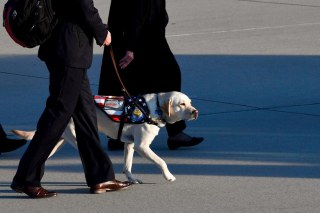
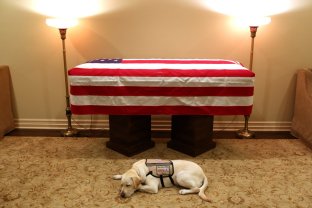
On Sunday night, George H.W. Bush spokesman Jim McGrath posted a photograph to Twitter depicting a golden Labrador named Sully resting in front of the former president’s casket. The caption read “Mission complete.”
Within hours, Sully the dog had become a bona fide celebrity. McGrath’s sentiment has been retweeted 61,000 times and counting, and “Sully” was trending on Twitter at various times on Monday. C-SPAN covered the dog’s arrival at Joint Base Andrews in Maryland on Monday afternoon. The picture of the dog lying in front of the casket was covered by outlets from Fox News to NPR as the internet exploded with tributes to the pair’s “forever friendship.” The photograph was submitted as evidence of Bush’s character, of Sully’s character, and as support for the idea that America should not elect a president who “does not love and is not loved by pets.” Heavy.com offered “5 Fast Facts You Need to Know” about the dog. People magazine gushed that Sully was “keeping the 41st commander in chief safe in death as he did in life,” and even produced a slideshow of their “special friendship.” Many suggested Sully was heartbroken, and/or that they themselves were crying over the photo; conservative writer Dan McGlaughlin compared the dog to a Marine.
There’s nothing wrong with applying sentimentality when it comes to family pets reacting to their owners’ deaths. There’s even some preliminary evidence from the small field of “comparative thanatology” that animals notice death, and that some may even experience an emotion we might compare to grief. But Sully is not a longtime Bush family pet, letting go of the only master he has known. He is an employee who served for less than six months….
It’s wonderful for Bush that he had a trained service animal like Sully available to him in his last months. It’s a good thing that the dog is moving on to another gig where he can be helpful to other people (rather than becoming another Bush family pet). But it’s a bit demented to project soul-wrenching grief onto a dog’s decision to lie down in front of a casket. Is Sully “heroic” for learning to obey the human beings who taught him to perform certain tasks? Does the photo say anything special about this dog’s particular loyalty or judgment, or is he just … there? Also, if dogs are subject to praise for obeying their masters, what do we do about the pets who eat their owners’ dead (or even just passed-out) bodies?
The photograph, in other words, is not proof that Sully is a particularly “good boy” or that “we don’t deserve dogs,” as countless swooning tweets put it on Monday. On its own, it says almost nothing other than the fact that Sully was, at one point in the same room as the casket of his former boss. This is simply a photograph of a dog doing something dogs love to do: Lie down. The frenzy around it captures something humans love to do, too: Project our own emotional needs onto animals.
Sexual harassment or assault can’t be bracketed off as part of a politician’s private life. It’s an important part of the story of their leadership, their use of power, and their policy. The same is true for Bush.
Relatively little has been made of the accusations against Bush since they emerged last year. A woman initially accused Bush of groping her and telling her a dirty joke as she stood beside him, seated in a wheelchair, for a photo op. The family responded, suggesting the aging former president might be slipping a bit. “President Bush has been confined to a wheelchair for roughly five years, so his arm falls on the lower waist of people with whom he takes pictures,” a spokesperson, Jim McGrath, said on Bush’s behalf.
But then the story changed. More women came forward describing incidents that took place before Bush was in a wheelchair and even while he was in office. One woman described a credible story dating back to 1992, when she says that Bush, then the president, put his hand on her rear end while taking a photograph at a reelection fundraiser. Another woman described an incident from 2003, when she was 16 years old — and Bush was still spry, zipping around Kennebunkport, Maine, on a Segway.
“All the focus has been on ‘He’s old.’ OK, but he wasn’t old when it happened to me,” the woman, now 55 told CNN. “I’ve been debating what to do about it.”
The women who spoke out feel differently. In each case, the accuser was excited to meet a political figure, someone who’s supposed to represent them; then, they said, he groped them. In that moment, they became second-class citizens. While their brothers or husbands or male friends might have gotten a handshake and a thumbs-up from this powerful man and walked away feeling good about themselves and their relationship with their government, these women were put in their place.
And let’s not forget that Bush appointed Clarence Thomas and stood by him when he was credibly accused of sexual harassment.
History will recall George Bush did nothing at all.
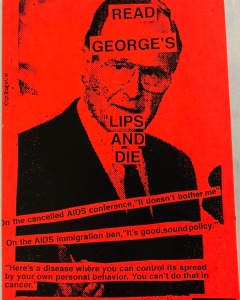
I must have chanted those words hundreds times while protesting the Bush administration’s inaction on the AIDS crisis with ACT UP (AIDS Coalition to Unleash Power) between 1989 and 1992. ACT UP was founded in 1987 in the epicenter of the HIV epidemic in America — New York City — to demand action to end the AIDS crisis. Today it is remembered as part of the Reagan ’80s, but the reality is that much of the group’s most intensive work took place during the administration of George Herbert Walker Bush. With ACT UP, I marched past the Bush White House down a Pennsylvania Avenue not yet closed to traffic. I rallied outside his Department of Health and Human Services, his Centers for Disease Control, his National Institutes of Health. And in 1991, I shook my finger chanting “Shame!” half a mile from his family’s summer compound in Kennebunkport, Maine. More than 1,500 AIDS activists descended on the resort town on September 1 that year, bearing signs that charged Bush with a murderous neglect of the AIDS crisis, along with a 50-foot banner with a 32-point plan to end it.
The transition from the Reagan presidency to the Bush one was more one of tone than substance when it came to AIDS, a kinder gentler indifference. Messaging that repeatedly pointed to “behavior change” as the solution, without backing prevention programs known to work. A lack of leadership from the top. No central strategy. “He was not doing enough as a leader,” Urvashi Vaid, the executive director of the National LGBTQ Task Force during the Bush years, told Pridesource after Bush’s death. “I think that those pressures and protests led by ACT UP all over the country … that pressure is what pushed both members of Congress and the administration to do whatever it did. I can’t say that enough.” Added ACT UP founder and playwright Larry Kramer, “I will not give [Bush] credit for anything. He hated us.”
Nearly a quarter century later when I had the opportunity as a political editor to participate in a several-day event at the Bush presidential library and museum, I thought about those years of protesting with ACT UP. For me reporting was always about other people’s stories, not my own, and it was rare for my activist past to come up except as history that informed my understanding of the dynamics of new social movements.
But with Bush, I felt I could not forget myself. Could not forget the suffering I’d witnessed in New York — where AIDS was, during his presidency, the leading cause of death for men ages 25–44, or the way his election extended the oppressive culture of the Reagan years that saw so many of my friends kicked out of their homes in their teens for being gay. I passed the Bush library opportunity on to a colleague.
Early in George H.W. Bush’s political career, when he was running for a U.S. Senate seat in Texas, he came out against the landmark Civil Rights Act of 1964, deriding his opponent as “radical” for supporting the bill that ended segregation in public places and banned employment discrimination.
“The new civil-rights act was passed to protect 14 percent of the people,” he said. “I’m also worried about the other 86 percent.”
The stand seemed at odds with his family’s long history of supporting civil rights (his father, Prescott Bush, a Connecticut senator had worked to desegregate schools and protect voting rights) and with his own work raising money for the United Negro College Fund.
But in Texas, where the Republican party was steadily becoming more conservative and embracing the Southern Strategy of appealing to white voters, Bush’s position made sense.
It “made sense” if you had no principles except getting elected. A bit more:
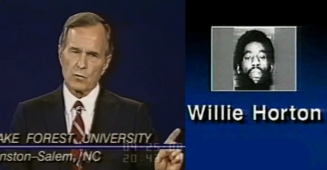
In his 1988 bid for the presidency, Bush would seem to again opt for expediency in a campaign that is often cited as one of the nastiest in political memory, with the blatant racism of the Willie Horton ad, which mined ugly stereotypes of African-Americans, and for Bush’s questioning of the patriotism of his opponent, Michael Dukakis, because of his Greek heritage.
The Horton ad, which focused on a convicted murderer who committed a violent rape while out of prison on a furlough program Dukakis had supported, was put out by a conservative PAC, not the Bush campaign. However, Bush repeatedly brought up Horton’s name in speeches, including one to the National Sheriffs’ Association.
“Horton applied for a furlough,” Bush said at the time. “He was given the furlough. He was released. And he fled — only to terrorize a family and repeatedly rape a woman.”
The Bush campaign also released an ad that showed footage of prisoners going through a revolving door — a strategy that played on white voters’ fears and prejudices, said Jason Johnson, a professor of politics and journalism at Morgan State University in Baltimore, Maryland.
F-16A Fighting Falcon, F-15C Eagle and F-15E Strike Eagle fighter aircraft fly over burning oil field sites in Kuwait during Operation Desert Storm. (U.S. Air Force archive photo)
Most countries condemned Iraq’s 1990 invasion of Kuwait. But the truth — that it was the culmination of a series of tangled economic and historical conflicts between two Arab oil states — wasn’t likely to sell the US public on the idea of sending our troops halfway around the world to do something about it.
So we were given a variation of the “domino theory.” Saddam Hussein, we were told, had designs on the entire Middle East. If he wasn’t halted in Kuwait, his troops would just keep going into other countries.
As Scott Peterson reported for The Christian Science Monitor in 2002, a key part of the first Bush administration’s case “was that an Iraqi juggernaut was also threatening to roll into Saudi Arabia. Citing top-secret satellite images, Pentagon officials estimated in mid-September [of 1990] that up to 250,000 Iraqi troops and 1,500 tanks stood on the border, threatening the key US oil supplier.”
A quarter of a million troops with heavy armor amassed on the Saudi border certainly seemed like a clear sign of hostile intent. In announcing that he had deployed troops to the Gulf in August 1990, George HW Bush said, “I took this action to assist the Saudi Arabian Government in the defense of its homeland.” He asked the American people for their “support in a decision I’ve made to stand up for what’s right and condemn what’s wrong, all in the cause of peace.”
But one reporter — Jean Heller of the St. Petersburg Times — wasn’t satisfied taking the administration’s claims at face value. She obtained two commercial satellite images of the area taken at the exact same time that American intelligence supposedly had found Saddam’s huge and menacing army and found nothing there but empty desert.
She contacted the office of then-Secretary of Defense Dick Cheney “for evidence refuting the Times photos or analysis offering to hold the story if proven wrong.” But “the official response” was: “Trust us.”
Heller later told the Monitor’s Scott Peterson that the Iraqi buildup on the border between Kuwait and Saudi Arabia “was the whole justification for Bush sending troops in there, and it just didn’t exist.”
Read the rest at Bill Moyers.com.
I know there is lots of other news today, but I just had to get this off my chest. What stories are you following?
Did you like this post? Please share it with your friends:
We’re learning more about the Republican ethos for holding power. Suppress Votes. Gerrymander. Collude with Foreign Agents. Dirty Tricks Done Dirt Cheap. Cheat as much as possible. Welcome to the campaign of Baptist Minister Mark Harris for a North Carolina Congressional seat where what we learn from Jesus that the end justifies the means. Yes, it’s their own special version of a Great White Male Sky Fairy’s Word. Be ruthless, lawless, and immoral when it comes to pushing your agenda off on everyone else. When it comes to our GAWD’s work, anything goes!
It was not just the general election in which the numbers looked funny. Investigators are now looking into the Republican primary, in May, as well. Harris won with eight hundred and twenty-eight votes over the incumbent, Robert Pittenger, claiming ninety-six per cent of the absentee ballots in Bladen County—which was a far higher margin of victory than the rest of his totals in the county. Pittenger told Spectrum News on Thursday, “We were fully aware of [the accusations of fraud]. There are some pretty unsavory people, particularly out in Bladen County, and I didn’t have anything to do with them.”
In the general election, Bitzer also found that, compared to other counties in the Ninth District, a much higher rate of mail-in absentee ballots requested in Bladen and Robeson counties—about forty per cent and sixty-two per cent, respectively—were never turned in. In fact, those two counties had the highest rates of unreturned absentee ballots of any district in North Carolina. And an analysis of the voting data by the Raleigh News & Observer found that “the unreturned ballots are disproportionately associated with minority voters,” who tend to vote for Democrats over Republicans. In Robeson County, seventy-five per cent of the absentee ballots requested by African-Americans and sixty-nine per cent of those requested by American Indians were never received by the state. On Friday, Harris tweeted, “There is absolutely no public evidence that there are enough ballots in question to affect the outcome of this race.” But about sixteen hundred mail-in absentee ballots were requested in the two counties and not returned, in a race decided by fewer than a thousand votes. Nate Silver, a data journalist and the founder of FiveThirtyEight.com, tweetedin response, “There are enough ballots in question in NC-9 to potentially affect the outcome.”
“Was this just an anomaly of people requesting ballots and then deciding not to send them in?” Bitzer said. “Or is this evidence of a concerted effort to influence or impact the election?” Prior to the election, Bitzer told me, it would have been possible for someone interested in interfering with the election to determine through public records which voters had not yet returned requested absentee ballots. “So it would not be a stretch, if someone made a concerted effort to look at each day’s records, for that someone to find out where that particular voter lived, and then it would be easy enough to go and try to collect it themselves.” Such an action would not only be illegal because a ballot may be handled only by the voter who completes it but would also create the opportunity for electoral fraud. As Bitzer noted, “Let’s say, a voter handed over a ballot to a collector, and the voter had not secured it in a sealed envelope, and there was no vote in the congressional election. The collector could put a vote in. If there was a vote, but it was not for the right candidate, the collector could mark a vote for a second candidate and spoil the ballot.” But, Bitzer added, “These are hypotheticals. We just don’t know to say with certainty what happened. We’re trying to piece a puzzle together, and we may not even fully understand how many pieces are out there.”
NPR delves further into, again, this huge voter fraud operation. None of the voter suppression tactics would’ve stopped this including the Voter ID law which is supposed to be the be all and end all of purifying elections.
Republicans in North Carolina appear to have engaged in the biggest voter fraud operation I've ever heard of. And there's absolutely nothing the state's Voter ID law would have done to prevent it. https://t.co/p1nOJ0cQne
Enough confusion has clouded a North Carolina congressional race that the state’s board of elections has announced a delay in certifying that Republican Mark Harris defeated Democrat Dan McCready in the state’s 9th District because of “claims of irregularities and fraudulent activities.”
In a 7-2 vote on Friday, the board said it will instead hold a public hearing by Dec. 21 “to assure that the election is determined without taint of fraud or corruption and without irregularities that may have changed the result.” It follows a unanimous vote earlier this week to postpone election certification results.
The Friday vote fueled fresh uncertainty about the outcome of the race and raised the possibility that a second election could be called. The two candidates are separated by 905 votes out of more than 280,000 cast, according to unofficial election results. The Associated Press originally called the race for Harris but revoked that projection on Friday.
In a letter sent to the board of elections, North Carolina’s Democratic Party made claims of wrongdoing. The Washington Post reported that the State Board of Elections and Ethics Enforcement has already collected at least six sworn statements from voters in Bladen County alleging that people came to their doors and urged them to hand over their absentee ballots.
In Bladen and Robeson counties, some 3,400 absentee ballots failed to be mailed back to election officials, according to NPR member station WFAE.
Nothing stands between Southern Baptists and hating on gays and punishing women with forced zygote incubation. Who cares if you got raped or you’ll likely die or it will likely die? They’re exulted for procreating and you’re a slut! Take that! If you’re willing to steal votes from old people, why change course? You can cheat your way to power. So, for the ugliest of the ugly–like that racist white woman senator from Mississippi–you can do what you want! Just rely on the army of whiteness to suppress, gerrymander and steal your way into office. Except North Carolina isn’t playing.
And, whatever you do, don’t appeal to voters by actually representing their beliefs. Keep on pushing yours on every one.
With a brutal finality, the extent of the Republicans’ collapse in the House came into focus last week as more races slipped away from them and their losses neared 40 seats.
Yet nearly a month after the election, there has been little self-examination among Republicans about why a midterm that had seemed at least competitive became a rout.
President Trump has brushed aside questions about the loss of the chamber entirely, ridiculing losing incumbents by name, while continuing to demand Congress fund a border wall despite his party losing many of their most diverse districts. Unlike their Democratic counterparts, Republicans swiftly elevated their existing slate of leaders with little debate, signaling a continuation of their existing political strategy.
And neither Speaker Paul D. Ryan nor Representative Kevin McCarthy, the incoming minority leader, have stepped forward to confront why the party’s once-loyal base of suburban supporters abandoned it — and what can be done to win them back.
The quandary, some Republicans acknowledge, is that the party’s leaders are constrained from fully grappling with the damage Mr. Trump inflicted with those voters, because he remains popular with the party’s core supporters and with the conservatives who will dominate the caucus even more in the next Congress.
But now a cadre of Republican lawmakers are speaking out and urging party officials to come to terms with why their 23-seat majority unraveled so spectacularly and Democrats gained the most seats they had since 1974.
“There has been close to no introspection in the G.O.P. conference and really no coming to grips with the shifting demographics that get to why we lost those seats,” said Representative Elise Stefanik, an upstate New York Republican who is planning to repurpose her political action committee to help Republican women win primaries in 2020. “I’m very frustrated and I know other members are frustrated.”
Ms. Stefanik said there had been “robust private conversations” but she urged Republicans to conduct a formal assessment of their midterm effort.
The Republican response, or lack thereof, to the midterm backlash stands in stark contrast to the shake-ups and soul-searching that followed its loss of Congress in 2006 and consecutive presidential defeats in 2012.
While party leaders like Trump and McCarthy remain in denial about the severity of the trouncing, some party members, especially recently defeated ones, are sounding the warning bell. “It’s clear to me why we lost 40 seats,” said retiring Pennsylvania Congressman Ryan Costello. “It was a referendum on the president, but that’s an extremely difficult proclamation for people to make because if they were to say that they’d get the wrath of the president.”
Trump’s fragile ego is preventing the party from coming to grips with the unpopularity of some of his preferred policies, like immigration restriction. Further, unlike after previous losses, there’s no talk of trying to win back groups that are turning against the GOP (notably suburban women and college educated whites).
Because GOP leaders are acting as if nothing went wrong in the midterms, they are unlikely to fix the party’s problems. As the Times observes, congressional Republicans are “already expressing concern that more of their colleagues may retire rather than run again in 2020—and that recruiting top-flight candidates could prove even more challenging going into the next campaign.”
I can only assume we’ll get more of the same voter suppression and antics given the party seems unlikely to find a strategy to actually attract more voters. Meanwhile, Mueller is coming. Trump had a series of very bad days in Argentina. There’s a full on twitter meltdown going during the legendary executive time. Does this guy ever actually work?
Bob Mueller (who is a much different man than people think) and his out of control band of Angry Democrats, don’t want the truth, they only want lies. The truth is very bad for their mission!
Everyone’s waiting for the “Mueller Report.” But it turns out that special counsel Robert Mueller is writing a “report” in real time, before our eyes, through his cinematic indictments and plea agreements, Garrett M. Graff reports for Axios.
The big picture: One of the least-noticed elements of the special counsel’s approach is that all along, he has been making his case bit by bit, in public, since his very first court filing. With his major court filings so far, Mueller has already written more than 290 pages of the “Mueller Report.” And there are still lots of loose ends in those documents — breadcrumbs Mueller is apparently leaving for later.
Show less
Perhaps the best example is Mueller’s oddly specific reference to the Russian hackers targeting Hillary Clinton “for the first time” after candidate Trump’s still-unexplained “Russia, if you’re listening” comment on July 27, 2016.
Trump said: “I hope you’re able to find the 30,000 [Clinton] emails that are missing. I think you will probably be rewarded mightily by our press.” (He also said: “I have nothing to do with Russia.”)
A Mueller indictment in July said that the next day, “the Conspirators … attempted after hours to spear-phish for the first time email accounts at a domain hosted by a third-party provider and used by Clinton’s personal office.”
That shows Mueller has access to much more intelligence than is publicly known. Remember, these are Russian government employees. So Mueller has remarkable and thus far unexplained visibility.
By making such detailed filings, Mueller is actually increasing his burden of proof — suggesting a supreme confidence that he has the goods.
And by making so much public as he goes along, Mueller is also insuring against his probe being shut down or otherwise curtailed by the White House.
Some of his deeply detailed filings raise questions that suggest more is coming:
In a February indictment of officials of the Russian troll factory, he announced that three Internet Research Agency employees traveled to the U.S. in 2014. He indicted two of them, but left unindicted someone from the IRA who evidently traveled to Atlanta as part of the operation for four days in 2014.
Mueller makes clear in the indictment that he knows the precise IRA official to whom this unnamed male traveler filed his Atlanta expenses after the trip.
The information could have come from U.S. intelligence or another country. But Mueller leaves the impression he may have a cooperator inside the troll factory.
Other hints at coming attractions:
Mueller said in last week’s Michael Cohen plea agreement that a “Moscow Project” meeting about a Trump-branded building in Russia was called off, by Cohen, on the same day that the DNC hack became public.
Based on a court filing last week, Mueller apparently hopes to quickly issue a “report” on Manafort’s activities to the court.
Be smart: If it’s anything like every other document Mueller has filed thus far, it’ll be more informed, more knowledgeable, and more detailed than we can imagine.
Plus, Putin and Trump appear to be breaking up. Is it hard to do?
The Putin regime is acting as if it's time to distance itself from its puppet. Trump hasn't been standing up to Putin, so are they cutting their losses in the expectation that he will soon be destroyed? They would know … https://t.co/iI2kQ1Hjtc
Following the abrupt cancellation of Donald Trump’s G20 meeting with Russian President Vladimir Putin, Russian state media roasted him. Known for seamlessly adhering to the Kremlin’s viewpoint, the troupe of Putin’s cheerleaders took turns laying into the president of the United States.
In an opinion piece for the Russian publication “Arguments and Facts,” Veronika Krasheninnikova, “Director General of the Institute for Foreign Policy Studies & Initiatives, Advisor to the Director General of ‘Russia Today’ and a member of the Kremlin-appointed Russian Public Chamber,” says that in light of the canceled meeting, Russia can now give up on the U.S. and “should have never trusted Trump to begin with.”
Krasheninnikova opines that “as long as Trump is in power, nothing positive can happen in the relations between the United States and Russia,” concluding that “Trump is a rock hanging around Russia’s neck.”
Host of the Russian state TV show “60 Minutes,” Evgeny Popov, angrily criticized Trump’s abrupt cancellation: “Just a few minutes earlier he said that now is a good time to meet… What kind of a man is this – first he says it will happen, then it won’t – are we just supposed to wait until he gets re-elected to start communicating with America? This is just foolishness, he seems to be an unbalanced person.”
Well, so much for that bromance. Maybe Trump wants his own state media to shoot back at the Russians for fake news now.
President Donald Trump on Monday said that the U.S., China and Russia would “at some time in the future” begin talks to end what he described as an uncontrollable arms race, and declared U.S. defense spending “crazy!”
The statement marks a dramatic reversal for the president, who has championed increased spending on the military and in August signed a colossal defense spending bill.
The measure authorized a top-line budget of $717 billion to cover a litany of spending. It provided the largest raise to American troops in nearly a decade.
At the time, Trump said the spending bill was the “most significant investment in our military and our war fighters in modern history.”
In March, after teasing a potential veto, Trump signed a $1.3 trillion omnibus spending package that granted the most significant increase in defense funding in 15 years. The Department of Defense is set to gain $61 billion more than last year’s enacted funding for a top line of $700 billion.
The president said at the time that he had “no choice but to fund out military because we have to have by far the strongest military in the world.”
In recent months, Trump has escalated his attacks on Russia for its arms program and announced his intention to withdraw from a Cold War-era nuclear weapons treaty. The U.S. and Russia collectively possess more than 90 percent of the world’s nuclear weapons.
The Trump administration has repeatedly targeted both China and Russia for attempting to undermine the United States on the world stage.
In its first National Security Strategy, a document that outlines the administration’s defense priorities, the administration said in late 2017 that “China and Russia challenge American power, influence, and interests, attempting to erode American security and prosperity.”
“They are determined to make economies less free and less fair, to grow their militaries, and to control information and data to repress their societies and expand their influence,” the administration added.
But on Monday, the president appeared more wary of the growing portion of America’s national budget devoted to defense, and signaled the possibility that the three countries could come together to forge an agreement.
Trump wants to stop an 'uncontrollable' arms race with China and Russia, barely a month after he scrapped a landmark nuclear treaty https://t.co/kVAipGBo8x
“I am certain that, at some time in the future, President Xi and I, together with President Putin of Russia, will start talking about a meaningful halt to what has become a major and uncontrollable Arms Race,” Trump tweeted. “The U.S. spent 716 Billion Dollars this year. Crazy!”
This comes a little over a month after Trump announced the US was withdrawing from the 1987 intermediate-range nuclear forces treaty (INF), a move that prompted swift criticism from European leaders and nuclear experts.
Trump justified the move by alleging Russia was violating the treaty. American officials began accusing Russia of violating the landmark treaty as far back as the Obama administration, but Russian President Vladimir Putin has vehemently denied breaching its terms.
Nuclear experts have said there is strong evidence Russia is violating the INF treaty and the US is justified for criticizing Moscow in this regard, but also warned ripping the deal up opens a dangerous door for Russia.
“Given Russian violations, there’s no question the US is justified in withdrawing,” Thomas Karako, director of the Missile Defense Project at the Center for Strategic and International Studies, recently told CNBC. “But we don’t want withdrawal to merely let Russia off the hook without other robust actions to support US deterrence and defense goals.”
The Reagan-era INF treaty barred land-based cruise or ballistic missiles with ranges between 311 miles and 3,420 miles. After it was signed in 1987, the US and Russia were forced to cut thousands of missiles from their respective nuclear arsenals.
Trump briefly met with Putin at the G20 summit in Argentina over the weekend, but their short-lived chat did not seem to accomplish much. The two leaders had originally been set to have a longer, more formal meeting, but Trump cancelled it over Russia’s recent aggression toward Ukraine.
So, you’re beginning to see that everything here is all over the place and I can’t imagine that the chaos is part of the plan at this part. Trump is definitely in trouble on many fronts and just appears to be starting fires here and there just to see which attracts the media away from the big stuff. However, he keeps tweeting shit on Mueller so his obsessions still don’t wander very far from the main one. In between the tweets on the “arms race” and other things, the Mueller stuff just burbles right up including one for ex fixer Cohen.
President Trump on Monday said Michael Cohen does not deserve leniency for cooperating with special counsel Robert Mueller, arguing that his former personal lawyer should serve a “full and complete” prison sentence.
“He makes up stories to get a GREAT & ALREADY reduced deal for himself, and get his wife and father-in-law (who has the money?) off Scott Free [sic],” Trump wrote on Twitter of Cohen. “He lied for this outcome and should, in my opinion, serve a full and complete sentence.”
I’ve never heard a public official speak this way before Trump. This sounds like something the criminals I used to prosecute would say. https://t.co/WVqoz2taVh
Henri Lebasque, Girl Reading and Vase of Flowers, 1915
Good Morning!!
George Bush the elder died last night at age 94. I’m not going to lie and say I’m grieving.
During Watergate Bush was Nixon’s RNC chairman and supported him to the bitter end; but once the White House tapes came out, he urged Nixon to resign. Bush served about a year as CIA director under Gerald Ford. As Vice President, Bush famously claimed to have been “out of the loop” while Oliver North and the gang were running guns and drugs during the Iran-Contra affair. As president, Bush pardoned
…former National Security Adviser Robert C. McFarlane, former Assistant Secretary of State Elliott Abrams, former CIA Central American Task Force Chief Alan D. Fiers, Jr., former CIA Deputy Director for Operations Clair E. George, and former CIA Counter-Terrorism Chief Duane R. Clarridge. The Weinberger pardon marked the first time a President ever pardoned someone in whose trial he might have been called as a witness, because the President was knowledgeable of factual events underlying the case.
He also refused to be interviewed by the special counsel. That quote is from the Walsh report on Iran-Contra.
Buried among 1,700 pages of notes written by then-Defense Secretary Caspar W. Weinberger during the Iran-contra affair is one referring to a January 1986 meeting at which Weinberger voiced opposition to covert arms sales to Iran in the presence of George Bush, then the vice president.
Blue Girl Reading, Frederick C. Frieseke, 1935
The note, which appears to contradict Bush’s repeated assertion that he was never present when either Weinberger or then-Secretary of State George P. Shultz objected to the arms sales, is among classified documents being reviewed for possible use in Weinberger’s upcoming trial, according to informed sources. The note is important because it confirms earlier testimony by Shultz placing Bush at the January meeting.
Questioned again lately by reporters about Iran-contra, Bush sought to dismiss further discussion of his role in the worst political scandal of the Reagan administration. But new information emerging from court cases and congressional records since Bush last ran for president has cast fresh doubt on his assertions that he was “out of the loop,” generally uninvolved in and largely unaware of the most controversial Iran-contra operations.
There are numerous indications in the documentary record that Bush was at meetings where decisions were taken in the mid-1980s about both the secret sale of arms to Iran and some of the covert efforts to aid the contra rebels in Nicaragua.
Polls have shown that the public is skeptical of the president’s denials of involvement.
That was written before Bush issued the pardons.
As president, Bush started the Persian Gulf War in order to protect Saudi Arabia after Iraq took over Kuwait. He decided to leave Saddam Hussein in power in Iraq, and of course that led George Bush the younger to attack Iraq again in 2003, leaving us mired in the Middle East ever since.
As we watch Trump suck up to Saudi Arabia, we can forget that the Bushes also loved the Saudis and protected them after the 9/11 attacks. I could go on, but I won’t. Here are some obituaries of George H.W. Bush if you want to read the good stuff:
One good thing I will say about Bush: he didn’t like Trump.
“I don’t like him. I don’t know much about him, but I know he’s a blowhard. And I’m not too excited about him being a leader.” – George H.W. Bush on Donald Trump After he voted for Hillary Clinton.
Saudi Crown Prince Mohammed bin Salman sent at least 11 messages to his closest adviser, who oversaw the team that killed journalist Jamal Khashoggi, in the hours before and after the journalist’s death in October, according to a highly classified CIA assessment.
The Saudi leader also in August 2017 had told associates that if his efforts to persuade Mr. Khashoggi to return to Saudi Arabia weren’t successful, “we could possibly lure him outside Saudi Arabia and make arrangements,” according to the assessment, a communication that it states “seems to foreshadow the Saudi operation launched against Khashoggi.” [….]
Excerpts of the Central Intelligence Agency’s assessment, which cites electronic intercepts and other clandestine information, were reviewed by The Wall Street Journal.
The previously unreported excerpts reviewed by the Journal state that the CIA has “medium-to-high confidence” that Prince Mohammed “personally targeted” Khashoggi and “probably ordered his death.” It added: “To be clear, we lack direct reporting of the Crown Prince issuing a kill order.”
Girl Reading, Charles Edward Perugini (1834-1918)
The electronic messages sent by Prince Mohammed were to Saud al-Qahtani, according to the CIA. Mr. Qahtani supervised the 15-man team that killed Mr. Khashoggi and, during the same period, was also in direct communication with the team’s leader in Istanbul, the assessment says. The content of the messages between Prince Mohammed and Mr. Qahtani isn’t known, the document says. It doesn’t say in what form the messages were sent.
No wonder Trump refused let CIA director Gina Haspel report to Congress.
There are lots of stories about former Trump fixer Michael Cohen today. Cohen’s attorneys released his full sentencing memo (pdf) last night. For a summary, check out this Twitter thread from Adam Klasfeld.
After a March 2018 visit to Mar-a-Lago, the President’s private club in Florida, Cohen returned to New York believing that his former boss would protect him if he faced any charges for sticking to his story about the 2016 payments to adult film actress Stormy Daniels, according to one source with knowledge. Trump was also at Mar-a-Lago at the time of Cohen’s visit.
Another source said that after the April 2018 FBI raid on Cohen’s office and home, people close to the President assured Cohen that Trump would take care of him. And Cohen believed that meant that the President would offer him a pardon if he stayed on message. It is unclear who specifically reached out to Cohen….
Oda with Lamp, Christian Krohg Norwegian, 1852-1925
Following the raid on Cohen’s home and office, Cohen’s attorneys had a legal defense agreement with Trump and his attorneys. During this time, there was a steady flow of communication between the two sides, according to two sources familiar with the matter.
At first, publicly, Trump seemed very supportive of his former attorney. On the day of the raid, Trump said Cohen was “a good man” and that the investigation reached “a whole new level of unfairness.” He unloaded on law enforcement, calling the raids “a disgraceful situation.”
But in the days that followed the raid, one source says, things started heading south with the President.
Trump started to distance himself from Cohen. And when Trump appeared on “Fox and Friends” two weeks after the raids and said that Cohen only did a “tiny, tiny little fraction” of his legal work, Cohen knew the game had changed. According to one source, Cohen knew that things had changed and he acted to protect his family — and himself.
…Michael Cohen said Friday he was in “close and regular contact” with Trump’s White House staff and legal team when he prepared a statement for Congress that he now says falsely downplayed Trump’s effort to land a Trump Tower Moscow deal during the 2016 presidential campaign.
In a filing seeking a lenient sentence, Cohen’s attorneys say his false statement to Congress — which Cohen pleaded guilty to on Thursday — was based on Trump and his team’s efforts to “portray contact with Russian representatives” by Trump, his campaign or his company “as having effectively terminated before the Iowa caucuses of February 1, 2016.”
Jarne Gissel 1962
“Seeking to stay in line with this message, Michael told Congress that his communications and efforts to finalize a building project in Moscow on behalf of the Trump Organization, which he began pursuing in 2015, had come to an end in January 2016, when a general inquiry he made to the Kremlin went unanswered,” Cohen’s lawyers Guy Petrillo and Amy Lester write.
But “Michael had a lengthy substantive conversation with the personal assistant to a Kremlin official following his outreach in January 2016, engaged in additional communications concerning the project as late as June 2016, and kept [Trump] apprised of these communications,” they wrote. “He and [Trump] also discussed possible travel to Russia in the summer of 2016, and Michael took steps to clear dates for such travel.”
Another bombshell lobbed by Michael Cohen exploded late Friday night: He says he told Donald Trump about a phone call to the Kremlin asking for the Russian government’s help to build a Trump Tower in Moscow in 2016.
And Cohen also claims he was talking to Trump’s lawyers and White House staff in 2017 while he crafted a misleading statement to Congress seeking to cover up the truth about the Moscow project and the level of Trump’s involvement.
If this is true, former White House Counsel Don McGahn could be in trouble for witness tampering. I wonder what his talked with Mueller’s team have been like?
There are quite a few stories on fake AG Matthew Whitaker too. Some links to check out:
It’s been evident this week that the Mueller election silent period is over and that indictments are coming. (Yay for no more silent nights from him!!!) This week has been an internicine cage fight between all the creeps in the Trump Family Syndicate and raids. Cohen seems to have come clean in the “no collusion” thing. Manafort resorts to the thug form and gets dumped by Team USA. Trump is having such a meltdown he could barely flip that switch on the National Christmas tree. So, this post mostly follows up on BB’s news yesterday as we go further down the Russian Rabbit hole.
President Donald Trump’s company planned to give a $50 million penthouse at Trump Tower Moscow to Russian President Vladimir Putin as the company negotiated the luxury real estate development during the 2016 campaign, according to four people, one of them the originator of the plan.
Two US law enforcement officials told BuzzFeed News that Michael Cohen, Trump’s personal lawyer at the time, discussed the idea with a representative of Dmitry Peskov, Putin’s press secretary.
The Trump Tower Moscow plan is at the heart of a new plea agreement by Cohen, who led the negotiations to bring a gleaming, 100-story building to the Russian capital. Cohen acknowledged in court that he had lied to Congress about the plan in order to protect Trump and his presidential campaign.
The revelation that representatives of the Trump Organization planned to forge direct financial links with the leader of a hostile nation at the height of the campaign raises fresh questions about President Trump’s relationship with the Kremlin. The plan never went anywhere because the tower deal ultimately fizzled, and it is not clear whether Trump knew of the intention to give away the penthouse. But Cohen said in court documents that he regularly briefed Trump and his family on the Moscow negotiations.
BuzzFeed News first reported in May on the secret dealings of Cohen and his business associate Felix Sater with political and business figures in Moscow.
The two men worked furiously behind the scenes into the summer of 2016 to get the Moscow deal finished — despite public claims that the development was canned in January, before Trump won the Republican nomination. Sater told BuzzFeed News today that he and Cohen thought giving the Trump Tower’s most luxurious apartment, a $50 million penthouse, to Putin would entice other wealthy buyers to purchase their own. “In Russia, the oligarchs would bend over backwards to live in the same building as Vladimir Putin,” Sater told BuzzFeed News. “My idea was to give a $50 million penthouse to Putin and charge $250 million more for the rest of the units. All the oligarchs would line up to live in the same building as Putin.” A second source confirmed the plan.
The FCPA has two provisions- Anti-Bribery and Accounting. In essence, the Anti-Bribery Provisions make it a crime for any US individual, business entity or employee of a US business entity to offer or provide, directly or through a 3rd party, anything of value to a foreign government official with corrupt intent to influence an award or continuation of business or to gain an unfair advantage. The Accounting Provisions basically make it illegal for a company that reports to the SEC to have false or inaccurate books or records or to fail to maintain a system of internal accounting controls.
Which brings us to two raids that happened just yesterday. Law enforcement in Frankfurt stormed Duestche Bank which is the only bank that will fund the Trump Family Crime Syndicate. Today is the second day they’re on the scene.
Police have searched the offices of all the members of Deutsche Bank’s (DBKGn.DE) board as part of an investigation into money laundering allegations linked to the Panama Papers, a source told Reuters on Friday.
…
Investigators are looking into the activities of two unnamed Deutsche Bank employees alleged to have helped clients set up offshore firms to launder money, the prosecutor’s office has said. The inquiries focus on events from 2013 to this year.
Gerhard Schick, a member of parliament for the opposition Green party, said it was “particularly irritating” that the bank’s current board members oversaw operations during the time in question. “This is not about legacy issues,” he said in a statement to Reuters.
WATCH: The 'Trump Baby' blimp makes its debut in Buenos Aires as President Trump arrives for the G20 Summit. pic.twitter.com/KwymstSRLf
The police raid on Thursday and Friday was targeting two suspects identified by their age and an unspecified number of other suspects, the prosecutors said. One of the two suspects works in the bank’s anti-financial crime unit, a person familiar with the matter said. It was headed by Philippe Vollot until this summer and now is led by Stephan Wilken. The unit head ultimately reports to Matherat.
The other suspect identified by age works in the private wealth unit, according to the person. It’s led by Fabrizio Campelli and it’s part of Deutsche Bank’s private and commercial bank that is headed by management board member Frank Strauss. It was led by Sewing from 2015-2018 before he was appointed CEO.
Searches don’t necessarily mean that prosecutors have evidence against a person whose office is being raided. They can raid homes or offices of people who aren’t implicated if there’s reason to believe document or other evidence relevant to the case may be found there. In probes of corporate crimes, investigators generally check whether top managers knew about the alleged wrongdoing or did enough to prevent it
When Trump nearly went personally bankrupt in the early 1990s, he left a handful of major U.S. banks on the hook for about $3.4 billion in loans he couldn’t repay (and about $900 million of which he had personally guaranteed). Hotels, casinos, real estate, an airline and other parts of his debt-ridden portfolio went into bankruptcy protection. In the wake of that collapse, Trump became a pariah among major U.S. banks, and he had to find unique ways of lining up money for the infrequent and small-boredeals he pursued thereafter. That left him borrowing money from labor unions and small, local lenders. Deutsche, keen at the time to make a name for itself in U.S. investment banking and commercial lending, was less hesitant to do business with Trump.
Deutsche’s first transaction with Trump involved a modest renovation loan for 40 Wall Street, a Manhattan skyscraper Trump controls, in 1998. Trump did little to merit Deutsche’s involvement after that until the early 2000s, when it agreed to loan him as much as $640 million for a Chicago project — the Trump International Hotel and Tower.
I was working on a biography of Trump at the time, and he told me that one of things he learned from his financial collapse in the early ’90s was that he had ignored valuable business advice from his father, Fred: Never personally guarantee a loan. Yet he still went ahead and guaranteed $40 million of the Deutsche loan for the Chicago project. (Trump sued me for libel in 2006, claiming the biography, “TrumpNation,” had misrepresented his business history and finances; he lost the suit in 2011.)
Deutsche had a relatively intimate understanding of Trump’s finances. Although Trump told me in 2004 and 2005 that his net worth was anywhere from $1.7 billion to $6 billion (and suggested it might even be $9.5 billion), my sources at the time told me his wealth was closer to $150 million to $250 million. When Trump litigated the point with me, my lawyers produced a Deutsche assessment of his finances that pegged his wealth at $788 million in 2005.
Trump’s relationship with Deutsche briefly soured in a dispute over the Chicago project. When the financial crisis landed in 2008 and imperiled that development, Trump sued Deutsche to avoid paying the $40 million he had guaranteed (claiming, in part, that Deutsche was responsible for the global economic distress unleashed by the crisis). A clash like that can permanently unwind a real estate partnership, but Deutsche and Trump agreed to settle, with the bank extending a loan from its private banking division to allow Trump to pay back its real estate lending unit, according to the New York Times.
Deutsche’s private banking arm has hung in there ever since, with Rosemary Vrablic as the Deutsche banker serving as Trump’s primary liaison there. She also has helped Jared Kushner, Trump’s son-in-law and a White House adviser, as well as his mother, arrange multimillion-dollar loans and lines of credit at Deutsche. In recent years, Deutsche’s private banking unit has loaned Trump money — about $300 million, according to Bloomberg News and Trump’s government financial disclosure forms — for such projects as his Washington hotel and the Trump National Doral golf course.
The Trump SoHo Hotel, which stripped Trump’s name from the property last year, was financed in the mid-2000s in part with loans channeled through Icelandic banks that collapsed during the financial crisis. I’ve written extensively about Trump’s involvement with the firm originally behind that project, Bayrock Group LLC, and about the murky funds from Europe used to build it. While Deutsche was closely involved with Icelandic banks at the time of the collapse, no information has surfaced that it played a direct role in the Trump SoHo.
What’s likely now, however, is that Trump’s dealings with Deutsche — which have represented, at a minimum, a serious and long-standing financial conflict for him given the influence he wields over law enforcement and financial regulation as president — are about to draw greater scrutiny.
In another curious coincidence that may or may not be related, the law offices of Edward Burke, a Chicago alderman and former Trump tax attorney, were raided on Thursday. Burke’s law firm represented Trump’s businesses — including the same Chicago Trump Tower that secured funding from Deutsche Bank — for 12 years.
With Deutsche Bank hit with yet another money-laundering probe, one former Trump lawyer raided by the feds and another one apparently ready to spill the beans, Democrats — poised to take control of the House of Representatives in January — are already chomping at the bit to investigate.
“All these developments make clear the counterintelligence imperative for the House Intelligence Committee, in the new Congress, to continue to probe the Trump Organization’s financial links to Russia and determine whether the Russians sought financial leverage over Trump and his associates, or hold any such leverage today,” said Rep. Adam Schiff, D-Calif., incoming chair of the House Intelligence Committee, said in a statement.
Again, no wonder Trump looked greener than the National Christmas tree at the ceremony and the quick exit was such that the White House Press Pool was abandoned there. It was a dark and bizarre event that usually leads into a charming White House Christmas season.
Reporters were briefly held at the Ellipse outside the White House without any immediate indication of where the president had gone. They were later notified that Trump had returned to the White House via motorcade without the press pool in tow.
Members of the press pool protested the situation on Twitter.
The term “rule of law” describes the government’s obligation to follow neutral principles and fair processes. The ideal dates at least to the time of Greek philosopher Aristotle, who wrote, “It is more proper that law should govern than any one of the citizens: upon the same principle, if it is advantageous to place the supreme power in some particular persons, they should be appointed to be only guardians, and the servants of the law.”
The rule of law is indispensable to a thriving and vibrant society. It shields citizens from government overreach. It allows businesses to invest with confidence. It gives innovators protection for their discoveries. It keeps people safe from dangerous criminals. And it allows us to resolve differences peacefully through reason and logic.
When we follow the rule of law, it does not always yield the outcome we prefer. In fact, one indicator that we are following the law is when we respect a result that we do not agree with. We respect it because it is required by an objective analysis of the facts and a rational application of the rules.
The rule of law is not simply about words written on paper. The culture of a society and the character of the people who enforce the law determine whether the rule of law endures.
One of the ways that we uphold the rule of law is to fight bribery and corruption. Until a few decades ago, paying bribes was viewed as a necessary part of doing business abroad. Some American companies were unapologetic about corrupt payments.
President Donald Trump on Thursday canceled his planned meeting with Russian Federation President Vladimir Putin at the G20 summit in Argentina.
“Based on the fact that the ships and sailors have not been returned to Ukraine from Russia, I have decided it would be best for all parties concerned to cancel my previously scheduled meeting in Argentina with President Vladimir Putin,” Trump tweeted. “I look forward to a meaningful Summit again as soon as this situation is resolved!”
“The Kremlin regrets U.S. President Donald Trump’s decision to cancel a meeting with Russian President Vladimir Putin in Argentina and said Moscow is ready for contact with Trump, RIA news agency cited spokesman Dmitry Peskov as saying on Friday,” Reuters reported.
“This means that discussion of important issues on the international and bilateral agenda will be postponed indefinitely,” President Putin’s spokesman Dmitry Peskov said.
Russian President Vladimir Putin will have a brief impromptu meeting with U.S. President Donald Trump in Argentina just as he will with other leaders at the G20 summit, RIA news agency cited Kremlin spokesman Dmitry Peskov as saying on Friday.
So, it’s definitely a ‘red’ christmas and I’m beginning to wonder if we get somewhat the feel of the red wedding.
World leaders are meeting in Argentina for their annual G20 summit amid new tension with Russia over Ukraine and a US trade row with China.
US President Donald Trump has cancelled a meeting with his Russian counterpart, Vladimir Putin, in protest at Russia’s seizure of Ukrainian naval boats.
A massive security operation is under way for the summit in Buenos Aires.
A bank holiday has been declared for Friday and the city’s main business district has been shut down.
Speaking before the signing of the US-Mexico-Canada Agreement (USMCA) – to replace the Nafta free trade deal – Mr Trump described it as “probably the greatest trade deal ever”.
“All of our countries will benefit greatly,” he said.
So, maybe we’ll get some christmas cheer this year from some place other than the Red House with it’s used tampon alley, or commie car wash or whatever that was …
What’s on your reading and blogging list today?
Did you like this post? Please share it with your friends:
The Russia investigation news has been coming thick and fast since Trump turned in his written answers to Robert Mueller’s questions a little more than a week ago. The past two days we got revelations about Paul Manafort, but today’s breaking news is huge. This looks to be a very interesting day.
First, former Trump lawyer Michael Cohen is pleading guilty in the Mueller probe and its about Trump’s business in Russia.
Michael D. Cohen, President Trump’s former lawyer, who pleaded guilty in August to breaking campaign finance laws, made a surprise appearance in a Manhattan courtroom on Thursday morning to plead guilty to a new criminal charge, the latest turn in the special counsel’s investigation of Mr. Trump and his inner circle.
At the court hearing, Mr. Cohen admitted to making false statements to Congress about his efforts to pursue a Trump Tower deal in Moscow during the 2016 presidential campaign. That real estate deal has been a focus of the special counsel investigation into whether the Trump campaign conspired with Russian operatives.
In testimony to the Senate Intelligence Committee, Mr. Cohen played down the extent of his contact with the Kremlin about the potential project and made other false statements about the negotiations, which never led to a final deal.
Mr. Cohen’s new guilty plea comes at a particularly perilous time for Mr. Trump, whose presidency has been threatened by Mr. Cohen’s statements to investigators. In recent days, the president and his lawyers have increased their attacks on the Justice Department and the special counsel’s office.
It is virtually certain that one of Qs that Trump JUST submitted a sworn answer to Mueller on is this one. "What communication did you have with Michael D. Cohen, Felix Sater and others, including foreign nationals, about Russian real estate developments during the campaign?"
Feels like Mueller was waiting for Trump to turn his answers in before he moved to the next phase, and now that he has them, the other shoes are starting to drop. Cohen first, then Corsi, Stone, and….?
Cohen is scheduled to appear in federal court in Manhattan on Thursday where he is expected to enter a guilty plea for misstatements to Congress in closed-door testimony last year about his contacts with Russians during the presidential campaign.
Once among the president’s most loyal and zealous defenders in business and politics, Cohen has now promised to “put family and country first” by cooperating with prosecutors, becoming perhaps the most pivotal public witness against his former boss.
Cohen’s earlier plea deal with federal prosecutors in the Southern District of New York implicated President Trump in campaign finance felonies. Since then, Cohen has spent more than 70 hours in interviews with Mueller’s team. The questioning has focused on contacts with Russians by Trump associates during the campaign, Trump’s business ties to Russia, obstruction of justice and talk of possible pardons, sources familiar with the discussions have told ABC News.
“The potential significance of Cohen’s cooperation is immense,” said Kendall Coffey, a former United States Attorney in Florida.
As Trump’s personal attorney and problem solver for more than a decade, Cohen’s portfolio at the Trump Organization covered personal and business matters both routine and highly sensitive. His dealings while serving as a senior executive in Trump’s global empire include several projects thought to be of interest to Mueller’s prosecutors, most notably the pursuit of a Trump Tower project in Moscow during the presidential campaign.
“It cannot be determined if Cohen’s cooperation will lead to other criminal allegations,” Coffey said. “But for most high-powered business people with complex business interests, having one’s personal attorney become a star witness for the prosecution is the worst possible legal nightmare.”
MSNBC is now reporting that Trump has suddenly changed his story this morning, arguing that just because he was running for president “doesn’t mean I’m not allowed to do business.” But during the campaign and after, he claimed he had no business and no deals in Russia.
"Cohen was in frequent contact with foreign individuals about Trump Moscow — and that some of these individuals had knowledge of or played a role in 2016 election meddling” https://t.co/aYpDkt8v5I
Trump's attacks on the Mueller probe late last night and again early this morning raise a huge question: did Whitaker brief him on what was coming today?
BERLIN — One hundred seventy officers searched the headquarters of Deutsche Bank in Frankfurt and five other sites in the area early Thursday as part of a money-laundering investigation involving hundreds of millions of euros, prosecutors in Frankfurt said.
Two employees, who were not publicly identified but whose ages were given as 50 and 46, and other “unidentified people in positions of authority” are suspected of failing to report possible money laundering for transactions worth 311 million euros, or more than $350 million.
The money flowed to organizations in the British Virgin Islands before spring 2016, prosecutors said in an emailed statement.
The German bank confirmed in a statement that the police were investigating several of its offices in Germany and said the investigation related to the Panama Papers, a trove of files that put a spotlight on global money laundering. “We are cooperating fully with the authorities,” Deutsche said in the statement.
We don’t know yet whether this investigation will affect Trump, but he has to be worried about it.
Caller ID labeled them “unknown,” but Roger Stone said he knew to pick up quickly during those harried months of the 2016 presidential campaign. There would be a good chance that the voice on the other end of the line would belong to his decades-long friend — the restless, insomniac candidate Donald Trump — dialing from a blocked phone number.
Those nocturnal chats and other contacts between the man who now occupies the Oval Office and an infamous political trickster have come under intensifying scrutiny as special counsel Robert S. Mueller III’s investigation bores into whether Stone served as a bridge between Trump and WikiLeaks as the group was publishing hacked Democratic emails.
Mueller’s keen interest in their relationship was laid out in a draft court document revealed this week in which prosecutors drew a direct line between the two men — referring to Stone as someone understood to be in regular contact with senior Trump campaign officials, “including with then-candidate Donald J. Trump.”
The inclusion of the president by name in the draft filing rattled his legal team and indicated how closely the special counsel is scrutinizing what Trump may have learned from Stone about WikiLeaks’ release of emails that prosecutors say were hacked by Russian intelligence operatives.
In recent months, the Trump Organization turned over to Mueller’s team phone and contact logs that show multiple calls between the then-candidate and Stone in 2016, according to people familiar with the material.
Read more at the WaPo. This story also provides more evidence that that blocked number that Don Jr. called after the Trump Tower meeting was Trump.
I’m going to put this post up right away, because there is likely to be a lot more breaking news today. We can use this as a live blog.
Did you like this post? Please share it with your friends:
The Sky Dancing banner headline uses a snippet from a work by artist Tashi Mannox called 'Rainbow Study'. The work is described as a" study of typical Tibetan rainbow clouds, that feature in Thanka painting, temple decoration and silk brocades". dakinikat was immediately drawn to the image when trying to find stylized Tibetan Clouds to represent Sky Dancing. It is probably because Tashi's practice is similar to her own. His updated take on the clouds that fill the collection of traditional thankas is quite special.
You can find his work at his website by clicking on his logo below. He is also a calligraphy artist that uses important vajrayana syllables. We encourage you to visit his on line studio.



 Good Morning Sky Dancers!
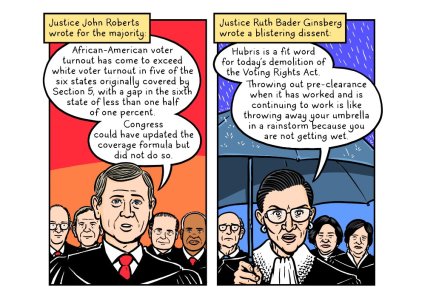 Nothing stands between Southern Baptists and hating on gays and punishing women with forced zygote incubation. Who cares if you got raped or you’ll likely die or it will likely die? They’re exulted for procreating and you’re a slut! Take that! If you’re willing to steal votes from old people, why change course? You can cheat your way to power. So, for the ugliest of the ugly–like that racist white woman senator from Mississippi–you can do what you want! Just rely on the army of whiteness to suppress, gerrymander and steal your way into office. Except North Carolina isn’t playing.
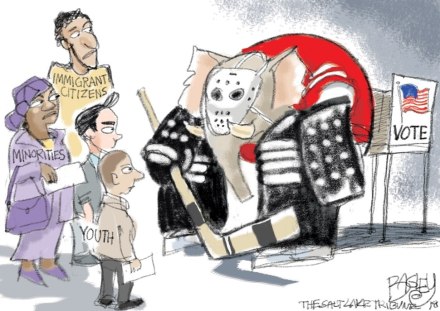 Jeer Heet from the New Republic has some speculation on that.
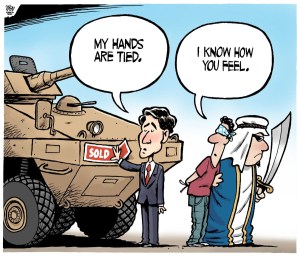 So, now we’re supposed to worry about a US Russian Arms race after he said bring it on with regards to the Nuclear Arsenal? Have I missed something?




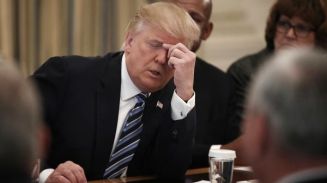


 peej
peej Carissa
 bostonboomer
 dakinikat
 ecocatwoman
 mablue2
 Mama Lopez
 peggysue22
 quixote
 skydancingguestblogger
 Mona (aka Wonk the Vote)



 Sky Dancing
Recent Comments