
Tuesday Reads: Trump’s Most Insane, Out of Control Meltdown Yet
Posted: April 14, 2020 Filed under: morning reads, U.S. Politics | Tags: Andrew Cuomo, Anthony Fauci, coronavirus "briefings", Covid-19, Donald Trump, insanity, John Yoo, meltdown, narcissism, propaganda, Tenth Amendment 30 Comments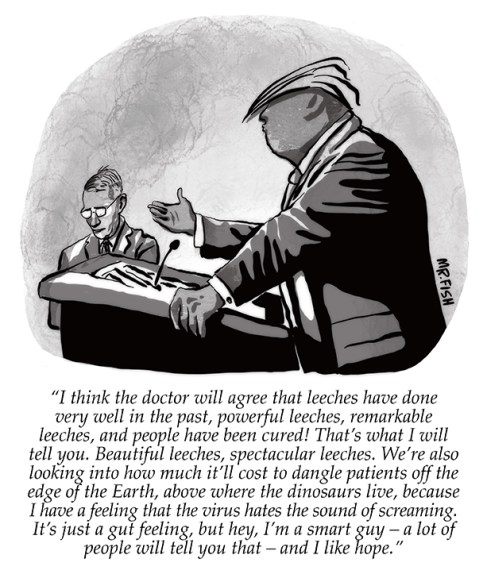
Good Morning!!
Yesterday Trump had an epic meltdown at his “coronavirus briefing,” Yes, I know he has meltdowns all the time, but this was the worst one yet. It included screaming, yelling, attacks on the press, a North Korea style propaganda video, and claims of dictatorial power. There was almost no mention of a federal response to the pandemic.
He began the performance by bringing Dr. Anthony Fauci to the podium to explain why what he said on CNN’s State of the Union on Sunday wasn’t a criticism of Trump. USA Today: Anthony Fauci says he used a ‘poor choice of words’ in discussing Trump administration’s coronavirus response.
Anthony Fauci, the health care policy expert under fire from allies of President Donald Trump, said Monday he used a “poor choice of words” when he suggested lives could have been saved had the Trump administration put in place coronavirus restrictions earlier in the year.
“Hypothetical questions sometimes can get you into some difficulty,” Fauci said during a unique statement delivered amid reports that Trump was thinking of firing him.
In an interview Sunday on CNN’s “State of the Union,” Fauci was asked if lives could have been saved had social distancing been imposed during the third week of February instead of mid-March. Fauci said, “It’s very difficult to go back and say that. I mean, obviously, you could logically say that if you had a process that was ongoing and you started mitigation earlier, you could have saved lives. Obviously, no one is going to deny that.”
Fauci said, “What goes into those kinds of decisions is – is complicated. But you’re right. I mean, obviously, if we had, right from the very beginning, shut everything down, it may have been a little bit different. But there was a lot of pushback about shutting things down back then.”
Trump, who on Sunday re-tweeted a supporters’ statement that Fauci should be fired, called the epidemic expert to the podium early in the briefing, an unusual move.
A reporter asked Fauci if he had been forced to make the statement, and he claimed it was “voluntary.” Raise your had if you believe him. It looks like Fauci has become just another Trump sycophant. We. are. so. fucked.
Ashley Parker at The Washington Post: The Me President: Trump uses pandemic briefing to focus on himself.
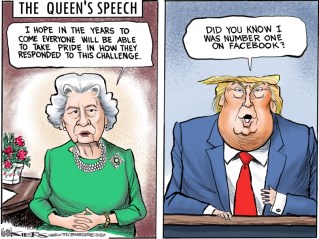
“Everything we did was right,” Trump said, during a sometimes hostile 2½ -hour news conference in which he offered a live version of an enemies list, brooking no criticism and repeatedly snapping at reporters who dared to challenge his version of events.
Trump has always had a me-me-me ethos, an uncanny ability to insert himself into the center of just about any situation. But Monday’s coronavirus briefing offered a particularly stark portrait of a president seeming unable to grasp the magnitude of the crisis — and saying little to address the suffering across the country he was elected to lead.
At one point — after praising himself for implementing travel restrictions on China at the end of January and griping about being “brutalized” by the press — Trump paused to boast with a half-smirk, “But I guess I’m doing okay because, to the best of my knowledge, I’m the president of the United States, despite the things that are said.”
Read the rest at the WaPo.
Earlier in the day, Trump tweeted that he and he alone–not governors of states–has the authority to “reopen” their economies.
Then during the briefing, Trump claimed that he and he alone has the power to open businesses, etc. in individual states. He has no understanding of the Constitution, much less the Tenth Amendment, which reserves police powers for the states.
Rick Wilson at The Daily Beast: Trump the Narcissistic Authoritarian Statist Declares He Has ‘Total’ Authority.
If you watched President Donald Trump’s daily press briefing Monday, you know that even by his abysmal standards this was the loudest siren yet, a warning that the man occupying the Oval Office is more suited to a very long, involuntary stay in an inpatient mental-health facility than the presidency of the United States.
It wasn’t presidential leadership. It wasn’t executive power made manifest. It wasn’t a grown-ass adult facing a serious crisis. It was an angry, needy man not looking outward to the needs of a nation in crisis but inward, and downward.
Anyone—and I mean anyone—who tells you Monday’s presser was anything other than a complete meltdown shitshow on the top of the dumpster fire at the peak of Burning-Tire Mountain is a liar.
It was a manic, gibbering, squint-eyed ragefest by America’s Worst President, a petty display by a failed man who long ago passed the limits of his competence and knowledge. It left little to cling to for even his most fervent lackeys but the grunting media animus that replaced conservatism as the motivating force of the Republican Party.
There was no there there when it came to facing the most consequential national crisis in generations. Even the parts about actions by the government were just mummery to frame his desperate desire for more stroking of his delicate feels. Everything is incidental to his delicate feelings and ego. Everything—and, more importantly, everyone else—is incidental.
Trump just gave the nation a performance that was so manic, so furious, and so utterly unhinged that anyone watching it walked away thinking the 25th Amendment has been too long unexercised and the proof is behind the podium every damn day.
Even John Yoo, the torture advocate says Trump can’t force states to “reopen.”
Our elected leaders confront the difficult decision on when to start lifting the lockdowns, even at the risk of a faster spread of COVID-19. Presiding Trump claims that he has the right to determine when businesses open their doors, employees return to work, and consumers shop again. “For the purpose of creating conflict and confusion, some in the Fake News Media are saying that it is the Governors decision to open up the states, not that of the President of the United States & the Federal Government,” he tweeted earlier today. “Let it be fully understood that this is incorrect . . . It is the decision of the President, and for many good reasons.”
But the federal government does not have that power. The Constitution’s grant of limited, enumerated powers to the national government does not include the right to regulate either public health or all business in the land. Congress enjoys the authority to “regulate Commerce with foreign Nations, and among the several States.” This gives Washington, D.C. an important, yet supporting, role in confronting the pandemic. It can bar those who might be infected from entering the United States or traveling across interstate borders, reduce air and road traffic, and even isolate whole states.
But our federal system reserves the leading role over public health to state governors. States possess the “police power” to regulate virtually all activity within their borders. As the Supreme Court has recognized, safeguarding public health and safety presents the most compelling use of state power. Only the states can impose quarantines, close institutions and businesses, and limit intra-state travel. Democratic governors Gavin Newsom in California, Andrew Cuomo in New York, and J.B. Pritzker Illinois imposed their states’ lockdowns, and only they will decide when the draconian policies will end.
Read more at The National Review.
New York Gov. Andrew Cuomo warned Tuesday that President Donald Trump should not try to reopen the state against his wishes, saying it would create “a constitutional crisis like you haven’t seen in decades” and could result in a dramatic increase in coronavirus cases.
“The only ways this situation gets worse is if the president creates a constitutional crisis,” Cuomo said on MSNBC’s “Morning Joe.”
“If he says to me, ‘I declare it open,’ and that is a public health risk or it’s reckless with the welfare of the people of my state, I will oppose it,” he said. “And then we will have a constitutional crisis like you haven’t seen in decades, where states tell the federal government, ‘We’re not going to follow your order.’ It would be terrible for this country. It would be terrible for this president.”
This morning Trump responded with another insane tweet.
Finally, there was the insane campaign ad that Trump forced the press and his science advisers to watch during the “briefing.”
The Daily Beast: Trump Uses Coronavirus Briefing to Play Batshit Campaign Ad Attacking Press.
President Donald Trump took over Monday’s White House task force briefing to lash out at critics and the press with a bizarre video that amounted to a campaign ad, before later declaring his authority is “total” if governors disagree with him during the coronavirus pandemic.
Monday’s unprecedented press briefing began to go off the rails with the video, but before the end, the president was falsely trumpeting definitive authority during the health-care crisis that has already led to the deaths of more than 23,000 Americans.
The briefing almost immediately devolved into the president airing widespread grievances against his critics, from his likely 2020 general election opponent Joe Biden to governors and reporters who have dared to call his virus response into question over the last few weeks as American life has ground to a halt during the pandemic.
In a mash up of clips and audio that amounted to a campaign ad, Trump lashed out at critics and returned to his favorite pastime of going after reporters. The video began with a white screen saying “the media minimized the risk from the start.” At one point, it showed news clips of different governors giving kind remarks about the president’s response to the pandemic.
An agitated and indignant president pointed at the seated press corps, telling them that while he’d answer some questions after airing his montage of coronavirus praise that maybe “I’ll ask you some questions because you’re so guilty.”
Both CNN and MSNBC, which have wavered between airing the increasingly antagonistic briefings, both cut away during the multi-minute campaign ad. The networks, however, came back to broadcast the performance after a short break.
The highlight of the show was questioning from CBS correspondent Paul Reid. BBC News:
CBS White House correspondent Paula Reid was met with a fiery response when she challenged President Trump during a coronavirus briefing.
Mr Trump touted his ban on travel from China at the end of January as an example of his administration taking decisive action. However, he did not declare a national emergency until 13 March – and public health experts have criticised the response to the outbreak, including early testing failures and a shortage of protective equipment.
The reporter asked Mr Trump what his administration had done in February, “with the time you bought with your travel ban”.
So . . . another crazy day has dawned in America. Will we survive? What stories are you following?
Monday Reads: Plagues, Isolation, Willful Incompetence
Posted: April 13, 2020 Filed under: morning reads 28 Comments
Bubonic plague Doctor
Good Day Sky Dancers!
Trump spent a lot of time troll tweeting Dr Fauci yesterday. Every one is fearful enough without him suggesting he wants to fire one of the few people in that administration any one believes! He’ll likely get an itchier tweeter finger given the incredible amount of news print today and yesterday about how exactly incompetent he’s been at tackling this pandemic.
What started this discussion is this very long, very well vetted, very well written NYT article: “He Could Have Seen What Was Coming: Behind Trump’s Failure on the Virus. An examination reveals the president was warned about the potential for a pandemic but that internal divisions, lack of planning and his faith in his own instincts led to a halting response.”
Like any one couldn’t have seen this coming given Trump couldn’t even make a casino profitable.
The president, though, was slow to absorb the scale of the risk and to act accordingly, focusing instead on controlling the message, protecting gains in the economy and batting away warnings from senior officials. It was a problem, he said, that had come out of nowhere and could not have been foreseen.
What follows is a long, detailed list of inactions and actions basically motivated by nothing but Trump’s “great I am”. The story is also a character study of a terrifically flawed man.
The shortcomings of Mr. Trump’s performance have played out with remarkable transparency as part of his daily effort to dominate television screens and the national conversation.
But dozens of interviews with current and former officials and a review of emails and other records revealed many previously unreported details and a fuller picture of the roots and extent of his halting response as the deadly virus spread:
The National Security Council office responsible for tracking pandemics received intelligence reports in early January predicting the spread of the virus to the United States, and within weeks was raising options like keeping Americans home from work and shutting down cities the size of Chicago. Mr. Trump would avoid such steps until March.
Despite Mr. Trump’s denial weeks later, he was told at the time about a Jan. 29 memo produced by his trade adviser, Peter Navarro, laying out in striking detail the potential risks of a coronavirus pandemic: as many as half a million deaths and trillions of dollars in economic losses.
The health and human services secretary, Alex M. Azar II, directly warned Mr. Trump of the possibility of a pandemic during a call on Jan. 30, the second warning he delivered to the president about the virus in two weeks. The president, who was on Air Force One while traveling for appearances in the Midwest, responded that Mr. Azar was being alarmist.

The original PPE of the Plague Doctors
The article continues like this. It’s long list of point by hapless point. More articles are following in that spirit like this one from The Rolling Stone and Andy Kroll: “‘Absolute Clusterf–k’: Inside the Denial and Dysfunction of Trump’s Coronavirus Task Force. Missed warnings, conflicting messages, and broken promises — how the White House fumbled its response to the worst pandemic in a century.”
If you were to write a playbook for how not to prevent a public-health crisis, you would study the work of the Trump administration in the first three months of 2020. The Trump White House, through some combination of ignorance, arrogance, and incompetence, failed to heed the warnings of its own experts. It failed to listen to the projections of one of its own economic advisers. It failed to take seriously what has become the worst pandemic since the 1918 flu and the worst economic crisis since the Great Depression. And when the White House finally awoke to the seriousness of COVID-19, the response it mustered managed to contain all the worst traits of this presidency. Trump and his closest aides have ignored scientists, enlisted family members and TV personalities and corporate profiteers for help, and disregarded every protocol for how to communicate during a pandemic while spewing misinformation and lies.
There was confusion in the response from the start. In January, Trump picked HHS Secretary Alex Azar II, the former president of pharmaceutical company Eli Lilly, to lead his new Coronavirus Task Force. The problem was, there was already a senior official at HHS whose job was coordinating the federal government’s response to a nationwide pandemic, Assistant Secretary for Preparedness and Response Robert Kadlec.
In late February, after it was clear that the virus had spread widely throughout the U.S., Trump reshuffled his task force. He replaced Azar with Vice President Mike Pence as the leader of the task force, and added Dr. Deborah Birx, the State Department’s global AIDS director and an infectious-disease expert, who joined Dr. Anthony Fauci, head of the National Institute of Allergy and Infectious Diseases, as the group’s scientific experts. But Trump also appointed administration loyalists like right-wing extremist Ken Cuccinelli and Seema Verma, the head of the Centers for Medicare and Medicaid Services and a vocal critic of the Affordable Care Act.
Like so many things in Trumpland, the work of the task force has gotten mired in petty politics and internal turf wars. A “shadow” task force emerged, led by Jared Kushner. Officially, Kushner’s team of McKinsey consultants, financiers, and old buddies from his New York business days was meant to coordinate collaboration between the government and the private sector. But it soon devolved into a typical Trump boondoggle. A company Kushner had once invested in, Oscar Health, was tapped to build a government website that would speed up testing (the site was later scrapped). Kushner turned to his brother Josh’s father-in-law, Kurt Kloss, who was a doctor, for recommendations on how to deal with the crisis. That led to Kloss — the father of supermodel Karlie Kloss, Josh’s wife — posting on a Facebook group for emergency-room doctors that he was looking for smart ideas and had a “direct channel to [the] person now in charge at [the] White House.”
Federal agencies that normally play a central role in disaster-response efforts have found themselves left out of the action. Pete Gaynor, the head of the Federal Emergency Management Agency, told Congress that his agency wasn’t invited to join the president’s Coronavirus Task Force until the week of March 16th — six weeks after the task force was created.
Other federal employees involved in the response effort have had to respond to different and sometimes competing requests and directives from Pence’s task force and Kushner’s task force. “All of those roles and responsibilities should be relatively well-established,” says one public-health official who’s dealt with the White House. “I’ve heard that people in HHS will get direction from Kushner’s team that directly contradicts what they’re getting from the White House task force, and then trying to deconflict those becomes a huge problem.”

This is from Tim Mak of WBUR: A Month After Emergency Declaration, Trump’s Promises Largely Unfulfilled04:32
“We’ve been working very hard on this. We’ve made tremendous progress,” Trump said. “When you compare what we’ve done to other areas of the world, it’s pretty incredible.”
But few of the promises made that day have come to pass.
NPR’s Investigations Team dug into each of the claims made from the podium that day. And rather than a sweeping national campaign of screening, drive-through sample collection and lab testing, it found a smattering of small pilot projects and aborted efforts.
In some cases, no action was taken at all.
Target did not formally partner with the federal government, for example.
And a lauded Google project turned out not to be led by Google at all, and then once launched was limited to a smattering of counties in California.
The remarks in the Rose Garden highlighted the Trump administration’s strategic approach: a preference for public-private partnerships. But as the White House defined what those private companies were going to do, in many cases it promised more than they could pull off.
“What became clear in the days and weeks or even in some cases the hours following that event was that they had significantly over-promised what the private sector was ready to do,” said Jeremy Konyndyk, senior policy fellow at the Center for Global Development.
He’s not learning anything or improving. That’s certain truth.

Indeed, this criticism may be part of why he’s “lashing out” at Fauci via NYT and Peter Baker. “The president retweeted a post calling for the government’s top infectious disease specialist to be fired after the doctor acknowledged that shutting down the country earlier could have saved lives.”
By the third week of February, advisers had drafted a list of measures they believed would soon be necessary, like school closures, sports and concert cancellations and stay-at-home orders, but the president did not embrace them until mid-March.
Dr. Fauci, the director of the National Institute of Allergy and Infectious Diseases since 1984, said on Sunday that earlier imposition of such policies would have made a difference.
“I mean, obviously, you could logically say that if you had a process that was ongoing and you started mitigation earlier, you could have saved lives,” he said on “State of the Union” on CNN. “Obviously, no one is going to deny that. But what goes into those kinds of decisions is complicated. But you’re right. Obviously, if we had, right from the very beginning, shut everything down, it may have been a little bit different. But there was a lot of pushback about shutting things down.”
Dr. Fauci’s comments, and the president’s pushback, come at a critical time as Mr. Trump wrestles with how fast to begin reopening the country. Public health experts like Dr. Fauci have urged caution about resuming normal life too soon for fear of instigating another wave of illness and death, while the president’s economic advisers and others are anxious to restart businesses at a time when more than 16 million Americans have been put out of work.
Dr. Fauci and the president have publicly disagreed on several issues, including how long it will take to develop a vaccine and the president’s aggressive promotion of the anti-malaria drug hydroxychloroquine, whose effects are unproven against the coronavirus. At a coronavirus task force briefing last week, Mr. Trump stopped Dr. Fauci from answering a question on the drug.
Dr. Fauci has become a celebrated figure among much of the public, which trusts him far more than Mr. Trump, according to polls. A Quinnipiac University survey last week found that 78 percent of Americans approved of Dr. Fauci’s handling of the crisis compared with 46 percent who approved of the president’s response. That has prompted resentment among other government officials, some of whom have privately criticized Dr. Fauci for playing to the media and not always sending consistent messages.
Mr. Trump spent much of Easter Sunday deflecting criticism and finding other targets. “If the Fake News Opposition Party is pushing, with all their might, the fact that President Trump ‘ignored early warnings about the threat,’ then why did Media & Dems viciously criticize me when I instituted a Travel Ban on China?” he wrote. “They said ‘early & not necessary.’ Corrupt Media!”
Didn’t he tell us that Easter was very special to him? Why wasn’t he coloring eggs with Barron or admiring Melania’s Easter Bonnet while dutifully watching all those TV sermons an schlocky passion movies?

One of the more interesting reads today is at the New Yorker and penned by Jane Mayer: ” How Mitch McConnell Became Trump’s Enabler-in-Chief. The Senate Majority Leader’s refusal to rein in the President is looking riskier than ever.”
Bill Kristol, a formerly stalwart conservative who has become a leading Trump critic, describes McConnell as “a pretty conventional Republican who just decided to go along and get what he could out of Trump.” Under McConnell’s leadership, the Senate, far from providing a check on the executive branch, has acted as an accelerant. “Demagogues like Trump, if they can get elected, can’t really govern unless they have people like McConnell,” Kristol said. McConnell has stayed largely silent about the President’s lies and inflammatory public remarks, and has propped up the Administration with legislative and judicial victories. McConnell has also brought along the Party’s financial backers. “There’s been too much focus on the base, and not enough on business leaders, big donors, and the Wall Street Journal editorial page,” Kristol said, adding, “The Trump base would be there anyway, but the élites might have rebelled if not for McConnell. He could have fundamentally disrupted Trump’s control, but instead McConnell has kept the trains running.”
McConnell and the President are not a natural pair. A former Trump Administration official, who has also worked in the Senate, observed, “It would be hard to find two people less alike in temperament in the political arena. With Trump, there’s rarely an unspoken thought. McConnell is the opposite—he’s constantly thinking but says as little as possible.” The former Administration official went on, “Trump is about winning the day, or even the hour. McConnell plays the long game. He’s sensitive to the political realities. His North Star is continuing as Majority Leader—it’s really the only thing for him. He’s patient, sly, and will obfuscate to make less apparent the ways he’s moving toward a goal.” The two men also have different political orientations: “Trump is a populist—he’s not just anti-élitist, he’s anti-institutionalist.” As for McConnell, “no one with a straight face would ever call him a populist—Trump came to drain the swamp, and now he’s working with the biggest swamp creature of them all.”
And, the hits just keep on coming from this deluded, incompetent, and intellectually weak administration.
Take Care! Be safe!!!
What’s on your reading and blogging list today?
Lazy Caturday Reads: Can We Ever Go Back To “Normal?”
Posted: April 11, 2020 Filed under: morning reads, U.S. Politics 34 Comments
John William Godward, The Favorite
Good Morning!!
Over the past week, Trump’s daily “coronavirus briefings” have grown more and more disorganized, nonsensical, and infuriating. It has become very clear that he has deliberately decided to abdicate any efforts to stem the tide of infections, leaving the battle against the virus to state and local governments. He has no plan, no strategy, except to make every effort to force Americans to go back to work even if that means millions of us get infected and hundreds of thousands die.
The Washington Post reports that states, health experts, think tanks, and non-profits are trying to come up with plans, but there’s no sign that Trump would let the federal government follow their recommendations. The plans involve ramping up testing and organizing contact-tracing efforts.
…a collection of governors, former government officials, disease specialists and nonprofits are pursuing a strategy that relies on the three pillars of disease control: Ramp up testing to identify people who are infected. Find everyone they interact with by deploying contact tracing on a scale America has never attempted before. And focus restrictions more narrowly on the infected and their contacts so the rest of society doesn’t have to stay in permanent lockdown.
But there is no evidence yet the White House will pursue such a strategy.
Instead, the president and his top advisers have fixated almost exclusively on plans to reopen the U.S. economy by the end of the month, though they haven’t detailed how they will do so without triggering another outbreak. President Trump has been especially focused on creating a second coronavirus task force aimed at combating the economic ramifications of the virus.
On the Catwalk Dream, Tolle Pettery
Administration officials, speaking on the condition of anonymity to describe internal deliberations, say the White House has made a deliberate political calculation that it will better serve Trump’s interest to put the onus on governors — rather than the federal government — to figure out how to move ahead. [emphasis added]
“It’s mind-boggling, actually, the degree of disorganization,” said Tom Frieden, former Centers for Disease Control and Prevention director. The federal government has already squandered February and March, he noted, committing “epic failures” on testing kits, ventilator supply, protective equipment for health workers and contradictory public health communication. The next failure is already on its way, Frieden said, because “we’re not doing the things we need to be doing in April.”
At a White House briefing Friday, Trump said he will announce next week the members of his second coronavirus task force, charged with determining when and how to reopen the country. He stressed his desire to get the economy running again as soon as possible but wouldn’t commit to specifics, saying, “The facts are going to determine what I do. But we do want to get the country open. So important.”

It’s obvious to anyone with half a brain what will happen if Trump convinces some states to do what he wants. But The New York Times gained access to a government report that includes projections from DHS and HHS.
The new federal projections, obtained by The New York Times, come from the departments of Homeland Security and Health and Human Services, and outline three possible situations. The first imagines policymakers doing nothing to mitigate the spread of the virus. The second, labeled “steady state,” assumes schools remain closed until summer, 25 percent of Americans telework from home, and some social distancing continues. The third scenario includes a 30-day shelter in place, on top of those “steady state” restrictions.
The government’s conclusions are sobering. Without any mitigation, the death toll from the virus could have reached 300,000. And if the administration lifts the 30-day stay-at-home orders, the death total is estimated to reach 200,000.
By Utagawa Kenoshi
The projections foresee a bump in the demand for ventilators 30 days after stay-at-home orders are issued, a major spike in infections about 100 days after, and peaking 150 days after the initial order. (Those timelines assume further shelter-in-place policies are not put in place to reduce future peaks.)
These numbers fueling the projections may already be out of date. Forecasts accepted by the White House that once estimated at least 100,000 deaths in the United States have now been revised to about 60,000, thanks to aggressive social distancing.

Read the full report here: Data and Analytics
The Daily Mail provides a summary of some of the projections with charts here: New federal projections show huge spike in coronavirus infections in the summer if current lockdown and social distancing measures are lifted after planned 30 days.
At Vox, Ezra Klein summarizes the various plans for reopening the economy and makes it clear that we are not going to return to the old “normal” anytime soon–probably never.
Even Trump’s evangelical CDC director says we shouldn’t open up the economy without contact tracing. NPR: CDC Director: ‘Very Aggressive’ Contact Tracing Needed For U.S. To Return To Normal.
CDC Director Robert Redfield spoke with NPR on Thursday, saying that the plan relies on not only ramped-up testing but “very aggressive” contact tracing of those who do test positive for the coronavirus, and a major scale-up of personnel to do the necessary work.
Contact tracing is the process of finding and reaching out to the contacts of someone who tests positive for an infectious pathogen. Those contacts are then quarantined or monitored, and if any of them are also positive, the process is repeated with their contacts, and on and on, until the chain of transmission is halted. It’s a labor-intensive, time-consuming practice that for decades has been a fundamental public health tool for containing infectious diseases….
Redfield said his agency is ramping up America’s capacity to do more contact tracing. “We are going to need a substantial expansion of public health fieldworkers,” he said. This, along with ample testing, is what will be needed “to make sure that when we open up, we open up for good.”
By Zviad Gogolauri
The first step will be to expand testing, especially testing that provides rapid results, so people can get diagnosed quickly. Redfield’s agency has received a lot of criticism for failing to quickly deliver working tests to public health labs. (Redfield defended the CDC on this point, saying that when problems with the initial test were discovered, “we figured it out and corrected it. Somebody might say that’s botched — I don’t think that’s botched.”) Redfield said that now, testing capacity is increasing daily and that he’s encouraged to see that point-of-care tests that give results within minutes are starting to enter the market.
Next, Redfield said, America will need to scale up capacity for tracing the contacts of those who test positive. “It is going to be critical,” he said. “We can’t afford to have multiple community outbreaks that can spiral up into sustained community transmission — so it is going to be very aggressive, what I call ‘block and tackle,’ ‘block and tackle.'”
Given how laborious contact tracing is, that means bringing on a lot more people to do that work. Since state and local public health departments aren’t likely to have the staff to do this, Redfield suggested, the federal government will need to help. “We have over 600 people in the field right now from CDC in all the states trying to help with this response, but we are going to have to substantially amplify that,” he said.

One more from The Nation by Yale epidemiology expert Gregg Gonsolves: The Science Is Clear on How to Beat This Pandemic. But first Trump, Kushner, and the GOP have to stop playing politics with people’s lives.
There is a quiet bipartisan consensus sweeping Washington, DC. Over the past 10 days, the center-right American Enterprise Institute and the center-left Center for American Progress have each come out with reports detailing the steps we need to take to get on the path to recovery from the coronavirus pandemic in the United States. The road maps are more alike than different, both focused on scaling up coronavirus testing, contact tracing, and isolation of infected individuals in the context of a sustained reduction in cases after a prolonged period of social distancing. While some can quibble with the details, the main architecture of an evidence-based, comprehensive response to Covid-19 has now been put together by Republicans and Democrats in exile in the think tanks of our nation’s capital.
Both plans are based on traditional public health principles. Social distancing has a long history in the mitigation of infectious disease outbreaks reaching back into antiquity. In the modern era, during the influenza pandemic of 1918, cities that implemented such measures had half the number of deaths compared to cities that did not. Current strategies centered around testing, contact tracing, and isolation also have a long history, much of it a variation on what was known as the Leicester method for containing smallpox in the late 19th century. If we could now act utilizing these classic methods, we might see the beginning of the end of this pandemic in our country.
The Sisters, by Fernando Botero
Yet the official US response, led, on alternating days, by Jared Kushner’s team of disruptors or Vice President Mike Pence’s task force, hasn’t coalesced around this vision. In fact, the White House remains in chaos, with no hint of preparing to put such plans in place, which would require enormous new funding to support the industrial production and logistical capacity necessary to get it all online. Meanwhile, like a snake oil salesman touting some magical elixir, President Trump hawks chloroquine, while his would-be boy genius son-in-law claims the Strategic National Stockpile is not for use by the states—although that is, in fact, is exactly what it is for. Instead of trying to head off this lunacy, the White House doubles down, with trade adviser Peter Navarro scolding task force member and infectious disease physician Anthony Fauci for refusing to get with the party line on chloroquine, while Secretary Alex Azar cravenly has the Department of Health and Human Services change the language about the stockpile on his agency’s website to reflect Kushner’s claims.
What a circus; what a show! Except none of this was ever entertaining. And now we’re heading toward disaster for millions of Americans. The failure of the initial response to the outbreak, the failure to get Covid-19 testing online or to scale up production of personal protective equipment and ventilators has been widely reported. But nothing has changed, no lessons have been learned, and no one in the president’s party has pulled the emergency brake on this train speeding 100 miles an hour toward the sharp turn ahead.

I won’t be holding my breath waiting for Trump to support federal funding for these efforts. Will Congress force his hand? What Trump will do is continue his ridiculous “briefings” as long as the cable networks are willing to televise them.
Tom Nichols at The Atlantic: With Each Briefing, Trump Is Making Us Worse People. He is draining the last reserves of decency among us at a time when we need it most.
There has never been an American president as spiritually impoverished as Donald Trump. And his spiritual poverty, like an overdrawn checking account that keeps imposing new penalties on a customer already in difficult straits, is draining the last reserves of decency among us at a time when we need it most.
By Suzanne Valadon
I do not mean that Trump is the least religious among our presidents, though I have no doubt that he is; as the scholar Stephen Knott pointed out, Trump has shown “a complete lack of religious sensibility” unique among American presidents. (Just recently he wished Americans a “Happy Good Friday,” which suggests that he is unaware of the meaning of that day.) Nor do I mean that Trump is the least-moral president we’ve ever had, although again, I am certain that he is. John F. Kennedy was, in theory, a practicing Catholic, but he swam in a pool of barely concealed adultery in the White House. Richard Nixon was a Quaker, but one who attempted to subvert the Constitution. Andrew Johnson showed up pig-drunk to his inauguration. Trump’s manifest and immense moral failures—and the shameless pride he takes in them—make these men seem like amateurs by comparison.
And finally, I do not mean that Trump is the most unstable person ever to occupy the Oval Office, although he is almost certain to win that honor as well. As Peter Wehner has eloquently put it, Trump has an utterly disordered personality. Psychiatrists can’t help but diagnose Trump, even if it’s in defiance of the old Goldwater Rule against such practices. I know mental-health professionals who agree with George Conway and others that Trump is a malignant narcissist.
What I mean instead is that Trump is a spiritual black hole. He has no ability to transcend himself by so much as an emotional nanometer. Even narcissists, we are told by psychologists, have the occasional dark night of the soul. They can recognize how they are perceived by others, and they will at least pretend to seek forgiveness and show contrition as a way of gaining the affection they need. They are capable of infrequent moments of reflection, even if only to adjust strategies for survival.
Trump’s spiritual poverty is beyond all this. He represents the ultimate triumph of a materialist mindset. He has no ability to understand anything that is not an immediate tactile or visual experience, no sense of continuity with other human beings, and no imperatives more important than soothing the barrage of signals emanating from his constantly panicked and confused autonomic system.

I hope everyone is staying home and staying safe. Have a quiet, peaceful weekend.
Thursday Reads: Why Is Trump Choosing to Kill Americans?
Posted: April 9, 2020 Filed under: morning reads, U.S. Politics | Tags: coronavirus, coronavirus in rural areas, Covid-19, Donald Trump, Eric Boehlert, federal seizures of medical equipment shipments, FEMA, medical equipment shortages, red states vs blue states, small town hospitals 31 Comments
Five Puppies on the Carpet, by Edvard Munch
Good Morning!!
Yesterday Eric Boehlert asked an important question that the mainstream media never will: Memo to media: We still don’t know why Trump is doing this.
Why?
One month into our mounting crisis and we still don’t know why Trump won’t help key states secure desperately needed medical equipment to deal with the growing coronavirus pandemic. Or why Trump is touting a dubious miracle cure, fills marathon pandemic briefings with ceaseless contradictions and lies, and has silenced scientists. Why he purposefully ignored detailed intelligence warnings about Covid-19, placed his unqualified son-in-law in charge of a national emergency, and refused to invoke the Defense Production Act to compel private companies to manufacture needed medical supplies. Or why the government airlifted 18 tons of donated respirator masks, surgical masks, gowns and other medical supplies to China in February.
Woman with a dog, Fernando Botero, 1997
If Trump had done just one of these things, it would’ve been considered shortsighted and represented a shocking lack of leadership. Trump’s done them all. Yet that still doesn’t prompt most journalists to address the bigger picture and ask disturbing questions about a president who seems to be okay with watching America crumble and decay, in very real ways, on his watch.
As I stressed last week, the media’s preferred storyline that suggests Trump is simply incompetent doesn’t add up because Trump has made the wrong decision every single time in terms of how crises like this are supposed to be dealt with. (i.e. Be consistent, transparent, factual, and credible.) It’s increasingly not believable for the press to suggest Trump has been distracted or inept during this crisis, in part because of the level of White House uselessness has become so staggering.
Maybe Trump’s vengeful. Maybe he wants to wreck the economy to create investment opportunities? He’s under the thumb of a foreign entity? He wants to cause panic and cancel the November elections? He’s a fatalist? Who knows. And honestly, the specific “why” isn’t what matters now. What matters is asking the difficult questions and pondering what the Trump presidency is truly about, no matter what lurks in the shadows.

Read the rest at Press Run.
The evidence is piling up that Trump is helping red states and choosing to let people in blue states die because of equipment shortages.
Los Angeles Times: Hospitals say feds are seizing masks and other coronavirus supplies without a word.
Although President Trump has directed states and hospitals to secure what supplies they can, the federal government is quietly seizing orders, leaving medical providers across the country in the dark about where the material is going and how they can get what they need to deal with the coronavirus pandemic.

Pierre_Bonnard, Woman with Dog and Still Life, 1917
Hospital and clinic officials in seven states described the seizures in interviews over the past week. The Federal Emergency Management Agency is not publicly reporting the acquisitions, despite the outlay of millions of dollars of taxpayer money, nor has the administration detailed how it decides which supplies to seize and where to reroute them.
Officials who’ve had materials seized also say they’ve received no guidance from the government about how or if they will get access to the supplies they ordered. That has stoked concerns about how public funds are being spent and whether the Trump administration is fairly distributing scarce medical supplies.
“In order to have confidence in the distribution system, to know that it is being done in an equitable manner, you have to have transparency,” said Dr. John Hick, an emergency physician at Hennepin Healthcare in Minnesota who has helped develop national emergency preparedness standards through the National Academies of Sciences, Engineering and Medicine.
The medical leaders on the front lines of the fight to control the coronavirus and keep patients alive say they are grasping for explanations. “We can’t get any answers,” said a California hospital official who asked not to be identified for fear of retaliation from the White House.
In Florida, a large medical system saw an order for thermometers taken away. And officials at a system in Massachusetts were unable to determine where its order of masks went.
“Are they stockpiling this stuff? Are they distributing it? We don’t know,” one official said. “And are we going to ever get any of it back if we need supplies? It would be nice to know these things.”
Maybe it’s not just blue states if it happened in Florida. So why are they doing this? We need explanations.
Another example from CNN: Colorado Democrat believes Trump awarded ventilators as political favor to vulnerable GOP senator.
Still Life With Puppies, Paul Gaugin
Rep. Diana DeGette, a veteran Democrat, said that President Donald Trump’s announcement that he would send 100 ventilators to Colorado smacks of a political favor to vulnerable GOP Sen. Cory Gardner after the federal government had not fulfilled the delegation’s request for the devices.
“I think this thing that happened with Sen. Gardner and President Trump is very disturbing,” the Colorado Democrat told CNN Wednesday evening. “What is the process here?”
DeGette said that while she wants the state to get every ventilator it can — after initially requesting 10,000 — the process employed by the White House shows that the President appears to be doling out the ventilators to his allies at a time when the virus is affecting people of all political persuasions.
“It seems that way to me,” DeGette said when asked if it appeared to be a political favor to Gardner. “I was totally outraged.”
DeGette said that the decision to award 100 ventilators followed a tortured process after the state’s delegation and Democratic Gov. Jared Polis had been asking for 10,000 ventilators.
But while they were waiting for an answer from the Federal Emergency Management Agency, Polis reached a deal with a private company for 500 ventilators to be sent to the state. Once FEMA got word of the state deal, the federal agency stepped in to prevent that contract from going through so it could acquire the ventilators instead, Polis said on CNN last week.Gardner then called Trump on Tuesday night, and the President tweeted Wednesday that the state would get 100 ventilators from the federal stockpile at the Republican senator’s request. Gardner is one of the most vulnerable Republican senators up for reelection.

Trump seems to think that rural areas will not be overwhelmed by coronavirus infections, but the places where most Trump voters live will likely be the next hot spots, and they aren’t likely to be as prepared as the big cities.
Nancy LeTourneau at Washington Monthly: Some Coronavirus Hot Spots Are in Rural America.
Pablo Picasso, Woman with a dog
Most of the reporting on coronavirus has focused on its spread in major urban areas, especially New York City. But I was spurred into looking at what is happening in rural America by the fact that the “hot spot” in my home state of Minnesota is not the Twin Cities metro area. The disease has taken hold in the city of Fairmont, which is located in Martin County—an agricultural community in the southwestern part of the state.
While the number of cases and deaths related to coronavirus in Martin County is fairly low (34 cases and 4 deaths), it dwarfs those in the metro counties on a per capita basis. For example, per 100,000 people, Martin County’s numbers represent 170 cases and 20 deaths, compared to 17 cases and 0.7 deaths per 100,000 in Hennepin County, which includes Minneapolis.
No one knows why this virus has taken hold in Martin County, but that hasn’t stopped speculation. Here is what Tim Langer, public health sanitarian with Martin County Human Services, ventured.
“My personal opinion is there are some folks listening to some media outlets that were not taking this seriously. That can be a factor, too. It’s hard to prove that. I don’t want to get political. But there were outlets saying it’s a hoax, it’s no worse than a cold, and those are things people listen to.”
Martin County, Minnesota isn’t the only rural area that is facing a coronavirus outbreak. In hotspots like Blaine County, Idaho and Eagle County, Colorado, the explanation is clear: rich ski towns have some of the highest infection rates in the country. But what explains the fact that Greer County, Oklahoma is the hot spot of that state, with an infection rate of 520 and death rate of 50 per 100,000?

Click the link to read the rest.

Susan on a balcony holding a dog, Mary Cassatt
NPR: Small-Town Hospitals Are Closing Just As Coronavirus Arrives In Rural America.
By this time next week, Decatur County, Tenn., will have lost its only hospital, Decatur County General, which has been serving the rural community of about 12,000 people along the Tennessee River since 1963.
The hospital’s human resources director, Melinda Hays-Kirkwood, has already begun laying off people, and she says by next week only a skeleton staff will remain….
The closure will have a huge economic toll locally — with more than 100 on staff, the hospital was one of the county’s largest employers. But the ironic timing isn’t lost on its staff either. Because of the COVID-19 crisis, most nonessential businesses in the area were already closed.
“It’s a difficult time to be shutting down a hospital in the middle of the coronavirus,” Hays-Kirkwood says.
There are currently no known cases in Decatur County, but she says every county around it has reported infections.
Small-town hospitals were already closing at an alarming rate before the COVID-19 pandemic. But now the trend appears to be accelerating just as the disease arrives in rural America. When Decatur County General Hospital shuts down indefinitely by April 15, it will be the ninth small-town hospital to close in 2020 alone. According to a report released this month by the Chartis Center for Rural Health, nearly half of rural hospitals were already operating in the red before the COVID-19 crisis.
What will happen when it becomes clear that Trump is killing his own supporters? Lloyd Green at The Guardian, April 5: ‘Trump is killing his own supporters’ – even White House insiders know it.
On Sunday, initially at least, there was no White House briefing on the president’s public schedule. But the bad news kept coming. Coronavirus deaths continued to climb and reports of the heartland being unprepared for what may be on its horizon continued to ricochet around the media.
In the words of one administration insider, to the Guardian: “The Trump organism is simply collapsing. He’s killing his own supporters.”
By Edouard Vuillard
Members of the national guard, emergency workers, rank-and-file Americans: all are exposed. Yet Trump appears incapable of emoting anything that comes close to heart-felt concern. Or just providing straight answers.
Rather, he is acting like Jefferson Davis, the president of the Confederate States of America: repeatedly letting governors know the burden of shoring up their sick, their doctors and their people falls on their shoulders first. The national government? It’s the world’s greatest backstop.
Remember when the Republican party freaked out about Barack Obama and the US “leading from behind” abroad? Remember the howls that evoked from GOP leaders? Those days are gone. Welcome to what Martin O’Malley, a Democratic former governor of Maryland, calls the “Darwinian approach to federalism”.
Trump is telling NFL owners he wants the season to start on time. He is disregarding Centers for Disease Control and Prevention advice on wearing facemasks in public. And he is touting untested coronavirus cures live on national TV.
Think Trump University on steroids, only this time we all stand to be the victims.
When Dr Anthony Fauci says there is no evidence to back up Trump’s claims surrounding hydroxychloroquine, an anti-malaria drug, pay attention. The fact Jared Kushner is on the case is hardly reassuring. He’s the guy who thought firing James Comey was win-win politics and promised Middle East peace in our time.
While all this is going on, the Wisconsin Republican party is giving America a taste of the campaign to come in the fall. Right now, the Badger State GOP is fighting in the US supreme court efforts to extend mail-in voting for this Tuesday’s Democratic primary.
In other words, voters will be forced to choose between foregoing their rights and risking their lives. Democracy shouldn’t work that way.

Read the rest at The Guardian.
What’s happening where you live? And what stories are you following today?
Tuesday Reads: Follow the Money
Posted: April 7, 2020 Filed under: morning reads, Republican politics, U.S. Politics | Tags: Brett Kavanaugh, Chirag Patel, coronavirus, Donald Trump, hydroxychloroquine, Jared Kushner, Ken Fisher, narcissism, Plaquenil, propaganda, Roberto Mignone, Sanofi, SCOTUS, The Big Lie, Trump lies, Wilbur Ross, Wisconsin primary 2020 27 Comments
Marguerite Thompson Zoorach, 1887-1968, The Picnic, 1920s
Good Morning!!
Just as I suspected, Trump has financial motives for pushing an unproven drug with dangerous side effects during a global pandemic.
The New York Times reported yesterday:
If hydroxychloroquine becomes an accepted treatment, several pharmaceutical companies stand to profit, including shareholders and senior executives with connections to the president. Mr. Trump himself has a small personal financial interest in Sanofi, the French drugmaker that makes Plaquenil, the brand-name version of hydroxychloroquine….
Some associates of Mr. Trump’s have financial interests in the issue. Sanofi’s largest shareholders include Fisher Asset Management, the investment company run by Ken Fisher, a major donor to Republicans, including Mr. Trump. A spokesman for Mr. Fisher declined to comment.
Claude Monet. Luncheon on the Grass
Another investor in both Sanofi and Mylan, another pharmaceutical firm, is Invesco, the fund previously run by Wilbur Ross, the commerce secretary. Mr. Ross said in a statement Monday that he “was not aware that Invesco has any investments in companies producing” the drug, “nor do I have any involvement in the decision to explore this as a treatment.”
As of last year, Mr. Trump reported that his three family trusts each had investments in a Dodge & Cox mutual fund, whose largest holding was in Sanofi.
Ashleigh Koss, a Sanofi spokeswoman, said the company no longer sells or distributes Plaquenil in the United States, although it does sell it internationally.

And of course Jared is involved. I wonder if he stands to gain financial from this drug pushing?
Several generic drugmakers are gearing up to produce hydroxychloroquine pills, including Amneal Pharmaceuticals, whose co-founder Chirag Patel is a member of Trump National Golf Course Bedminster in New Jersey and has golfed with Mr. Trump at least twice since he became president, according to a person who saw them.
Mr. Patel, whose company is based in Bridgewater, N.J., did not respond to a request for comment. Amneal announced last month that it would increase production of the drug and donate millions of pills to New York and other states. Other generic drugmakers are ramping up production, including Mylan and Teva Pharmaceutical Industries.
Roberto Mignone, a Teva board member, reached out to the team of Jared Kushner, the president’s son-in-law and senior adviser, through Nitin Saigal, who used to work for Mr. Mignone and is a friend of Mr. Kushner’s, according to people informed about the discussions.
Luncheon on the Grass, Pablo Picasso
Mr. Kushner’s team referred him to the White House task force and Mr. Mignone asked for help getting India to ease export restrictions, which have since been relaxed, allowing Teva to bring more pills into the United States. Mr. Mignone, who is also a vice chairman of NYU Langone Health, which is running a clinical study of hydroxychloroquine, confirmed on Monday that he has spoken with the administration about getting more medicine into the country.

Yesterday we also learned that Peter Navarro, Trump’s wacky trade adviser was warning about a pandemic back in January. Axios: Navarro memos warning of mass coronavirus death circulated in January.
In late January, President Trump’s economic adviser Peter Navarro warned his White House colleagues the novel coronavirus could take more than half a million American lives and cost close to $6 trillion, according to memos obtained by Axios.
The state of play: By late February, Navarro was even more alarmed, and he warned his colleagues, in another memo, that up to two million Americans could die of the virus.Navarro’s grim estimates are set out in two memos — one dated Jan. 29 and addressed to the National Security Council, the other dated Feb. 23 and addressed to the president. The NSC circulated both memos around the White House and multiple agencies.
In the first memo, which the New York Times was first to report on, Navarro makes his case for “an immediate travel ban on China.”
The second lays the groundwork for supplemental requests from Congress, with the warning: “This is NOT a time for penny-pinching or horse trading on the Hill.”
Why it matters: The president quickly restricted travel from China, moved to delay re-entry of American travelers who could be infected, and dispatched his team to work with Congress on stimulus funds.
But Trump was far slower to publicly acknowledge the sort of scenarios Navarro had put in writing.
A couple of interesting psychological analyses of Trump catastrophic performance:
At the New York Times, Jennifer Senior writes: This Is What Happens When a Narcissist Runs a Crisis.
Picnic (1989), Fernando Botero
Since the early days of the Trump administration, an impassioned group of mental health professionals have warned the public about the president’s cramped and disordered mind, a darkened attic of fluttering bats. Their assessments have been controversial. The American Psychiatric Association’s code of ethics expressly forbids its members from diagnosing a public figure from afar.
Enough is enough. As I’ve argued before, an in-person analysis of Donald J. Trump would not reveal any hidden depths — his internal sonar could barely fathom the bottom of a sink — and these are exceptional, urgent times. Back in October, George T. Conway III, the conservative lawyer and husband of Kellyanne, wrote a long, devastating essay for The Atlantic, noting that Trump has all the hallmarks of narcissistic personality disorder. That disorder was dangerous enough during times of prosperity, jeopardizing the moral and institutional foundations of our country.
But now we’re in the midst of a global pandemic. The president’s pathology is endangering not just institutions, but lives.

Head over to the NYT to read the rest.
In practicing the art of lying while retaining a hold on the allegiance of his base, Trump utilizes a propaganda principle—the Big Lie—best explained by Hitler. Now, please note that we are not equating Trump and Hitler; they are very different people. However, like Hitler, Trump is involved in the business of selling himself as an angry, righteous savior to the masses, resulting in a growing number of cultic devotees. So, it may behoove us to consider Hitler’s explanation of why the Big Lie is more successful than mere untruths. Here’s his explanation of the principle in Mein Kampf:
Francisco de Goya’s Picnic En La Ribera Del Manzanares (Picnic on the Banks of the Manzanares), 1776
[I]n the big lie there is always a certain force of credibility; because the broad masses of a nation are always more easily corrupted in the deeper strata of their emotional nature than consciously or voluntarily; and thus in the primitive simplicity of their minds they more readily fall victims to the big lie than the small lie, since they themselves often tell small lies in little matters but would be ashamed to resort to large-scale falsehoods. It would never come into their heads to fabricate colossal untruths, and they would not believe that others could have the impudence to distort the truth so infamously. Even though the facts which prove this to be so may be brought clearly to their minds, they will still doubt and waver and will continue to think that there may be some other explanation.
Consider just two of many possible examples of the Big Lie: Trump’s bizarre claim that the military was out of ammunition when he took office and his equally bizarre claim that the father of Ted Cruz was involved with the assassination of Lee Harvey Oswald, adding, “It’s horrible.” It is the outrageousness of the Big Lie that a listener normally expects would create self-conscious awkwardness in the liar. In turn, this results in a need for a great liar to hide any nervousness that might give away the fact that he is attempting to deceive his audience. In poker, the failure to hide completely the lie inherent in a bluff is called a “tell,” the subtle behavior unwittingly exhibited when bluffing.

Click the link to read the rest. It’s a really interesting piece.
Republicans in Wisconsin have been working overtime to undermine democracy, and yesterday the Supreme Court gave them a big assist.
Slate: By a 5–4 Vote, SCOTUS L.ets Wisconsin Throw Out Tens of Thousands of Ballots.
On Monday, by a 5–4 vote, the U.S. Supreme Court approved one of the most brazen acts of voter suppression in modern history. The court will nullify the votes of citizens who mailed in their ballots late—not because they forgot, but because they did not receive ballots until after Election Day due to the coronavirus pandemic. As Justice Ruth Bader Ginsburg wrote in dissent, the court’s order “will result in massive disenfranchisement.” The conservative majority claimed that its decision would help protect “the integrity of the election process.” In reality, it calls into question the legitimacy of the election itself.
Still Life with Peonies and Seven Lovely Ladies by David Elsea – 2018
Wisconsin has long been scheduled to hold an election on April 7. There are more than 3,800 seats on the ballot, and a crucial state Supreme Court race. But the state’s ability to conduct in-person voting is imperiled by COVID-19. Thousands of poll workers have dropped out for fear of contracting the virus, forcing cities to shutter dozens of polling places. Milwaukee, for example, consolidated its polling locations from 182 to five, while Green Bay consolidated its polling locations from 31 to two. Gov. Tony Evers asked the Republican-controlled legislature to postpone the election, but it refused. So he tried to delay it himself in an executive order on Monday. But the Republican-dominated state Supreme Court reinstated the election, thereby forcing voters to choose between protecting their health and exercising their right to vote.
Because voters are rightfully afraid of COVID-19, Wisconsin has been caught off guard by a surge in requests for absentee ballots. Election officials simply do not have time, resources, or staff to process all those requests. As a result, a large number of voters—at least tens of thousands—won’t get their ballot until after Election Day. And Wisconsin law disqualifies ballots received after that date. In response, last Thursday, a federal district court ordered the state to extend the absentee ballot deadline. It directed officials to count votes mailed after Election Day so long as they were returned by April 13. A conservative appeals court upheld his decision.
Now the Supreme Court has reversed that order. It allowed Wisconsin to throw out ballots postmarked and received after Election Day, even if voters were entirely blameless for the delay. (Thankfully, ballots postmarked by Election Day but received by April 13 still count, because the legislature didn’t challenge that extension.) In an unsigned opinion, the majority cited the Purcell principle, which cautions courts against altering voting laws shortly before an election. It criticized the district court for “fundamentally alter[ing] the nature of the election by permitting voting for six additional days after the election.” And it insisted that the plaintiffs did not actually request that relief—which, as Ginsburg notes in her dissent, is simply false.

Read more:
Vox: The Supreme Court’s disturbing order to effectively disenfranchise thousands of Wisconsin voters.
PoliticusUSA: Brett Kavanaugh Leads Conservative SCOTUS Majority In Blocking Extended Voting In Wisconsin.
According to the Roberts court, voters should have to choose between voting and possibly dying and protecting their health. And of course the Republican primary is meaningless, so only Democrats have to worry about that.
That’s all I have for you today. What stories are you following?

 peej
peej Carissa
 bostonboomer
 dakinikat
 ecocatwoman
 jjlo
jjlo mablue2
 Mama Lopez
 peggysue22
 quixote
 skydancingguestblogger
 Mona (aka Wonk the Vote)





Recent Comments