
Monday Reads: Stay Your Ass Home! We are not Human Guinea Pigs for Businesses
Posted: April 27, 2020 Filed under: morning reads | Tags: covid 19 quarantine, self isolation 24 Comments
Good Morning Sky Dancers!
Are you getting cabin fever? Need to get back to a job or business? Do you feel your part of the country/world is ready to reopen? Will your employer protect you? Where are we in getting serious testing? There are so many questions in this discussion and frankly I don’t like being a test subject with so many unknowns.
The big question to be answered has yet to be answered. “We Still Don’t Know How the Coronavirus is Killing Us” is a read from New York Magazine b
In an acute column published April 13, the New York Times’ Charlie Warzel listed 48 basic questions that remain unanswered about the coronavirus and what must be done to protect ourselves against it, from how deadly it is to how many people caught it and shrugged it off to how long immunity to the disease lasts after infection (if any time at all). “Despite the relentless, heroic work of doctors and scientists around the world,” he wrote, “there’s so much we don’t know.” The 48 questions he listed, he was careful to point out, did not represent a comprehensive list. And those are just the coronavirus’s “known unknowns.”
In the two weeks since, we’ve gotten some clarifying information on at least a handful of Warzel’s queries. In early trials, more patients taking the Trump-hyped hydroxychloroquinine died than those who didn’t, and the FDA has now issued a statement warning coronavirus patients and their doctors from using the drug. The World Health Organization got so worried about the much-touted antiviral remdesivir, which received a jolt of publicity (and stock appreciation) a few weeks ago on rumors of positive results, the organization leaked an unpublished, preliminary survey showing no benefit to COVID-19 patients. Globally, studies have consistently found exposure levels to the virus in most populations in the low single digits — meaning dozens of times more people have gotten the coronavirus than have been diagnosed with it, though still just a tiny fraction of the number needed to achieve herd immunity. In particular hot spots, the exposure has been significantly more widespread — one survey in New York City found that 21 percent of residents may have COVID-19 antibodies already, making the city not just the deadliest community in the deadliest country in a world during the deadliest pandemic since AIDS, but also the most infected (and, by corollary, the farthest along to herd immunity). A study in Chelsea, Massachusetts, found an even higher and therefore more encouraging figure: 32 percent of those tested were found to have antibodies, which would mean, at least in that area, the disease was only a fraction as severe as it might’ve seemed at first glance, and that the community as a whole could be as much as halfway along to herd immunity. In most of the rest of the country, the picture of exposure we now have is much more dire, with much more infection almost inevitably to come.
But there is one big question that didn’t even make it onto Warzel’s list that has only gotten more mysterious in the weeks since: How is COVID-19 actually killing us?
We are now almost six months into this pandemic, which began in November in Wuhan, with 50,000 Americans dead and 200,000 more around the world. If each of those deaths is a data point, together they represent a quite large body of evidence from which to form a clear picture of the pandemic threat. Early in the epidemic, the coronavirus was seen as a variant of a familiar family of disease, not a mysterious ailment, however infectious and concerning. But while uncertainties at the population level confuse and frustrate public-health officials, unsure when and in what form to shift gears out of lockdowns, the disease has proved just as mercurial at the clinical level, with doctors revising their understanding of COVID-19’s basic pattern and weaponry — indeed often revising that understanding in different directions at once. The clinical shape of the disease, long presumed to be a relatively predictable respiratory infection, is getting less clear by the week. Lately, it seems, by the day. As Carl Zimmer, probably the country’s most respected science journalist, asked virologists in a tweet last week, “is there any other virus out there that is this weird in terms of its range of symptoms?”
We need an FDR with a major dose of federal crisis management of both the economy and public health. What we have is a leader willing to throw us to the wolves so the economy might improve given there’s enough idiots in the country wiling to put their lives on the line for a game of bowling and a haircut. Because of my age, I am in the high risk category and I can work from my home and order a few things to come to my door. So, I am privileged but I also live in a city hit hard by this pandemic and whose majority black citizens are dying in way outsized numbers in the state. I have to agree with this too. From the Washington Post: “‘For black folks, it’s like a setup: Are you trying to kill us?’ ” I think a lot of seniors wonder that too but these voices come from all ages in Georgia’s hard hit black communities. The heart breaking stories from the nation’s assisted living and rest homes is yet another story.
“To open up businesses where it’s impossible to practice social distancing — hair salons, nail salons, theaters — people are like, what? You want to put everybody in a closed room, and that’s supposed to be okay?” said Demetrius Young, a city commissioner in Albany, the center of the state’s epidemic. “For black folks, it’s like a setup: Are you trying to kill us?”
Without a widespread testing infrastructure and local health departments able to do meticulous contact tracing, Young said, his region will continue to suffer. Georgia ranks 40th in tests per resident, well behind states that have pledged to maintain their shelter-in-place orders, according to an analysis of Covid Tracking Project data. Some models say the state has not yet reached its peak number of daily deaths, suggesting the worst is still to come..
“We need to save lives,” Young said. “The way we feel is, this is another ‘Black Lives Matter’ moment.”
Glen Singfield, 67, owns two restaurants in Albany that have been shuttered for more than a month. He said he doesn’t plan to reopen them on Monday, when Kemp’s order for restarting the economy extends to restaurants.
He is not convinced the virus has been brought under control, especially in Southwest Georgia.
“We were hit hard, and our restraint needs to be harder. We have to make sure we’re way beyond the curve,” he said. He hasn’t had time to come up with a plan, such as how to screen customers, to make sure he can keep everyone, including his employees and family members who work in the restaurants, safe.
“My wife, my sons, my granddaughters are in there. My employees. These are folks we love. I can’t play with their lives. We’re a small town. When somebody dies here, everybody knows them.”

I’m wondering how many folks will actually head out to those open restaurants, hair salons, bowling alleys, movie theatres, and massage related businesses. I can understand getting out in the fresh air. I walks my dog three times a day and I mask when I go to the corner stores to get wine or tp or other necessities of life like cat food and dog food. But, sheesh, I’m in no hurry to get into a bar. I’m happy with the take out from the porch of the family owned old school restaurant across the street once a week. No one’s stopping me from eating it in my back yard or even my front porch. But, frankly, I’m not going to die for a hair cut or a back rub.
Las Vegas is a shocking example of parasitical capitalism. The entire city seems unnecessary to me, but the entire city is based on entertaining bored tourists who will pay to do that sort’ve thing and probably is inuring serious economic damage. New Orleans has bits and pieces of that flavor too but Las Vegas pretty much owns the market outside of the Disneyfied Florida. This WAPO article indicates that the city has become ground zero for the country’s job crisis. But, really, is gambling worth killing off all your health care workers?
As the bottom fell out of the American economy, few places were hit harder than Las Vegas, where a full one-third of the local economy is in the leisure and hospitality industry, more than in any other major metropolitan area in the country.Most of those jobs cannot be done from home.
Nearly 350,000 people in Nevada have filed for unemployment benefits since the crisis began, the highest number in the history of the state. Applied Analysis, a Las Vegas-based economic research firm, estimates the city’s current jobless rate to be about 25 percent — nearly double what it was during the Great Recession — and rising.
“From an analytical standpoint, this is unprecedented,” said Jeremy Aguero, a principal analyst with the firm. “We have no frame of reference for what we are seeing.”
As governors and mayors across the country wrestle with the question of when and how to reopen their economies, Las Vegas faces particular pressure because of its dependence on tourism and hospitality. Mayor Carolyn Goodman argued last week that casinos should reopen and allow people to get sick, but Gov. Steve Sisolak said the state was “clearly not ready to open.”
Before the crisis, Nevada’s economy was one of the fastest growing in the country. Then, practically overnight, the glittering Vegas strip shut down, throwing thousands of waiters, bartenders, hotel cleaners and casino workers out of work, often without severance or benefits, and leaving the most bustling and storied stretch of the state’s economy boarded up and empty.
“If you were to imagine a horror movie when all the people disappear, that’s what it looks like,” said Larry Scott, the chief operating officer of Three Square, Southern Nevada’s only food bank, describing the Vegas strip. “You can’t imagine that there is a circumstance that could possibly cause that. I couldn’t have.”

The flip side is outline by this AP article: “A flood of business bankruptcies likely in coming months.” I was relieved to her Dr Daughter got her “bailout” money. While she has had to furlough some of her clinic workers, they’ve been able to keep the nurses and a lot of their staff for at least 3 more months. Dr. Daughter was seriously worried about her 4 nurses.
The most vulnerable companies include the thousands of restaurants and retailers that shut down, many of them more than a month ago. Some restaurants have managed to bring in a bit of revenue by serving meals for takeout and delivery, but even they are struggling financially. Small and independent retailers, including those with online stores. are similarly at risk; clothing retailers have the added problem of winter inventory that they are unlikely to sell with spring here and summer approaching.
Independent oil companies whose revenue was slammed by the collapse in energy prices also are strapped, as are other companies that were already burdened with high debt levels before the virus struck.
Jennifer Bennett, who closed one of her San Francisco restaurants on Wednesday, was still waiting for the financial aid she sought from the federal, state and city governments. Even with the money, she doesn’t know if the revenue will cover the bills when she’s finally able to reopen Zazie — especially if she’s required to space tables six feet apart for social distancing.
“Our occupancy is going to be cut 60% to 65%,” Bennett says. “I fear bankruptcy is a possibility.”
Other small companies have similar anxieties, says Paul Singerman, a bankruptcy attorney with Berger Singerman in Miami.
“There is no reliable visibility into when business operations will be able to resume the pre-COVID normal,” Singerman says.
Even larger companies are in trouble, including already struggling retailers who had to shut their stores.
The jeans company True Religion filed for Chapter 11 earlier this month, saying extended closures of its stores in the pandemic have hurt its business. Recent reports say department store chains Neiman Marcus and J.C. Penney, which has struggled for years with slumping sales, could soon file for bankruptcy protection.
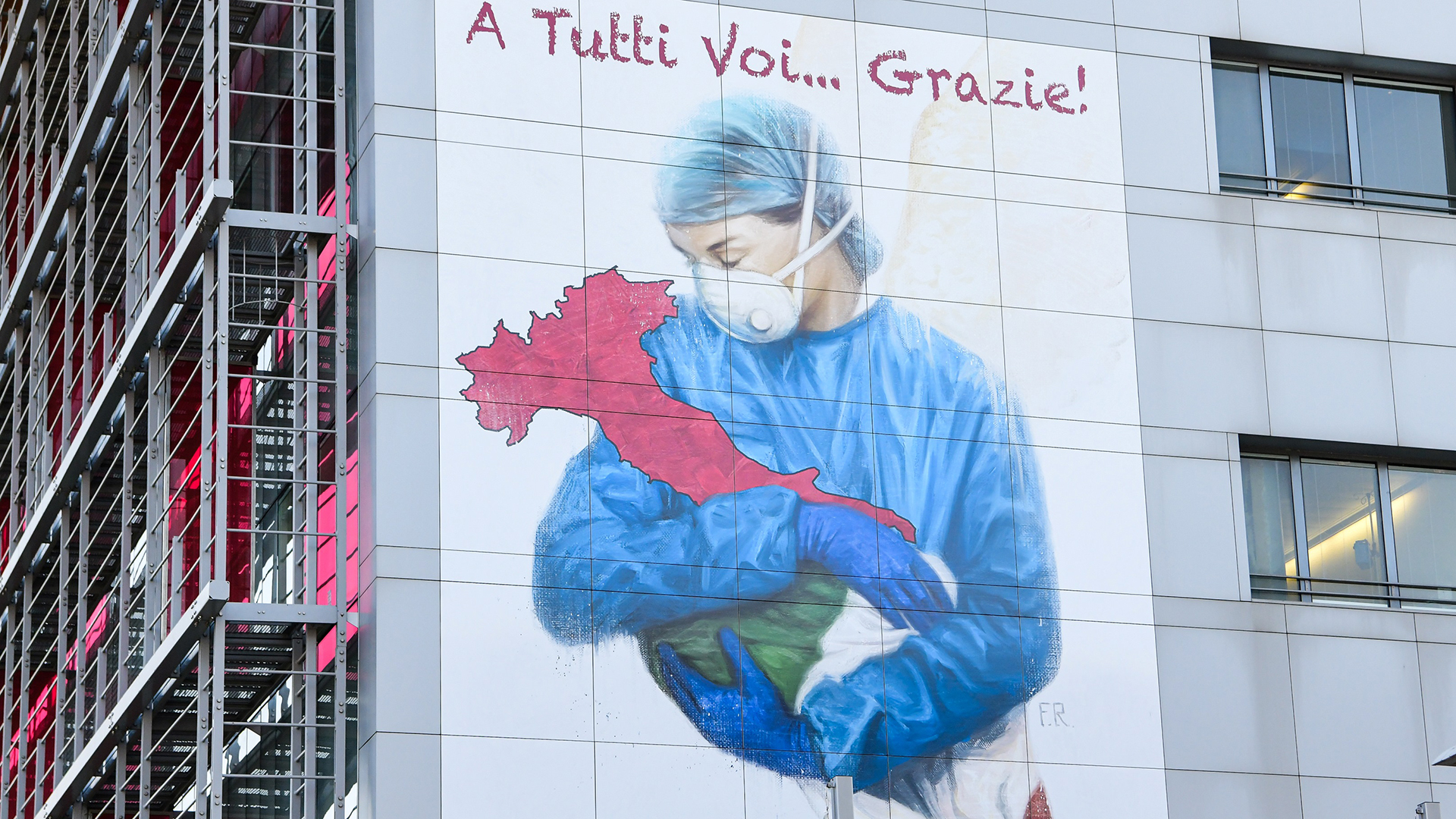
You have to wonder if the golden age of american consumerism might finally come around to the old idea of having money in the bank and a few less things that are seriously necessary. But, who am I to judge others’ choices. I’m just glad to see the AirBNB’s are suffering. Did I mention it’s nice and quiet here now and there’s a Bywater Coyote wandering the streets? This is the one business that I really hope doesn’t survive all this. Hotels and tourists belong in a nice little strip away from neighborhoods imho. They may be retooling–see the link above– but can they survive?
In the immediate future, things look dire indeed. Across the world, Airbnb bookings have tanked. Data analysts at AirDNA say that bookings across Europe collapsed in March, dropping 80% compared to the previous week in the week beginning March 9, and another 10% on top of that in the week of March 16. In the U.S., where virus response lagged, the figures for falls in booking are uneven, but scarcely less dramatic. By the middle of March, bookings in New York City, San Francisco and Seattle had already dropped more than 50% compared to the week beginning January 5, with drops of over 35% in Washington, D.C., and Chicago.
To weather the crisis, Airbnb has reportedly canceled all marketing activities, put its founders’ salaries on hold and slashed those of top executives by half. It has halted all but essential hiring, may postpone going public and has not ruled out layoffs. “Airbnb is resilient and built to withstand tough times and we’re doing all we can to strengthen our community and our company,” the company said in a recent statement to Reuters.
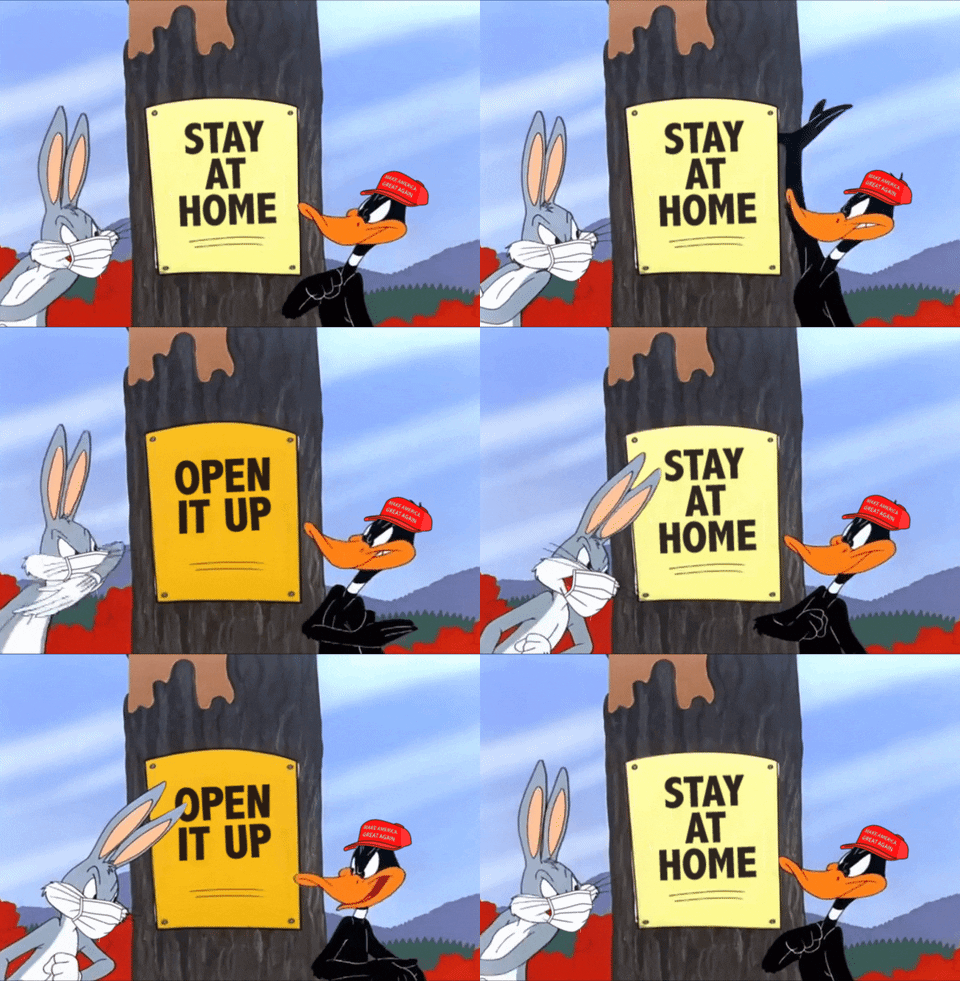
Is it any surprise that states that surround me which are opening up somewhat willy nilly for bucks are the ones most likely to see upswings in infection?
However, demography is just as important. Places with older residents and more diabetes, heart disease and smoking have higher cfrs. Race and income also play a role. Counties with lots of poor or black people tend to have more health problems, less social distancing and fewer icu beds. Yet cfrs in such areas are even higher than you would expect from these factors alone.
Together, these variables leave a geographic footprint. If covid-19 does infect most Americans, the highest death rates will probably not be in coastal cities—whose density is offset by young, healthy, well-off populations and good hospitals—but rather in poor, rural parts of the South and Appalachia with high rates of heart disease and diabetes. Worryingly, the three states that announced plans this week to relax their lockdowns (Georgia, Tennessee and South Carolina) are all in this region.

My governor has been pretty direct about his decision making process and my mayor is not about to bullied into making a dangerous decision but I am down here in a spot surrounded by a lot of less thoughtful people and governments..
The WSJ has this headline: “The Secret Group of Scientists and Billionaires Pushing Trump on a Covid-19 Plan. They are working around the clock to cull the world’s most promising research for what they describe as a virus-era Manhattan Project” Sounds like some of us want to live.
A dozen of America’s top scientists and a collection of billionaires and industry titans say they have the answer to the coronavirus pandemic, and they found a backdoor to deliver their plan to the White House.
The eclectic group is led by a 33-year-old physician-turned-venture capitalist, Tom Cahill, who lives far from the public eye in a one-bedroom rental near Boston’s Fenway Park. He owns just one suit, but he has enough lofty connections to influence government decisions in the war against Covid-19.
These scientists and their backers describe their work as a lockdown-era Manhattan Project, a nod to the World War II group of scientists who helped develop the atomic bomb. This time around, the scientists are marshaling brains and money to distill unorthodox ideas gleaned from around the globe.
They call themselves Scientists to Stop Covid-19, and they include chemical biologists, an immunobiologist, a neurobiologist, a chronobiologist, an oncologist, a gastroenterologist, an epidemiologist and a nuclear scientist. Of the scientists at the center of the project, biologist Michael Rosbash, a 2017 Nobel Prize winner, said, “There’s no question that I’m the least qualified.”
This group, whose work hasn’t been previously reported, has acted as the go-between for pharmaceutical companies looking for a reputable link to Trump administration decision makers. They are working remotely as an ad hoc review board for the flood of research on the coronavirus, weeding out flawed studies before they reach policy makers.
The group has compiled a confidential 17-page report that calls for a number of unorthodox methods against the virus. One big idea is treating patients with powerful drugs previously used against Ebola, with far heftier dosages than have been tried in the past.
You may read the document at the link. WSJ has lifted their paywall to provide it to the public.
So, how out and about do you plan to be? Do you trust your state government and local government?
What’s on your reading and blogging list today?
Thursday Coronavirus Reads: Denial of Science and Collective Trauma
Posted: April 23, 2020 Filed under: morning reads, U.S. Politics | Tags: Anthony Fauci, collective trauma, Donald Trump, Nancy Messonnier, Rick Bright, Robert Redfield, trauma, traumatic growth, ventilators 30 Comments
Katherine Bernhardt’s new public mural painted in Guatemala, 2020. Courtesy of the artist.
Good Morning!!
Yesterday the world watched in horror as Trump forced another scientist to soften remarks he had made in the media. We also learned that the government scientist who was in charge of Covid-19 vaccine development was demoted because he criticized Trump’s advocacy for an unproven and dangerous drug combination to treat the virus. Day after day in his “coronavirus briefings, Trump is trying to crush scientific expertise with his iron fist of ignorance.
The Washington Post: Under Trump, coronavirus scientists can speak — as long as they mostly toe the line.




Tuesday Reads: Living In A Failed State
Posted: April 21, 2020 Filed under: morning reads, Republican politics, U.S. Politics | Tags: coronavirus, Covid-19, Donald Trump, experts on the year ahead, Trump's war against the states, U.S. as failed state 20 Comments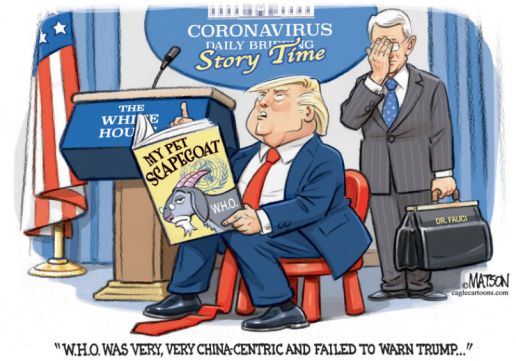
Good Morning
More than 40,000 Americans have died of Covid-19, but the so-called “president” is doing nothing to stop the carnage. He refuses to help states with desperately need medical equipment and tests to identify carriers. He has made it abundantly clear that we are on our own. Money and supplies are being doled out selectively–red states get the most and blue states the least. He is using FEMA and the FBI to try to stop shipments of equipment to hospitals in blue states. It actually looks like Trump is hoping those of us who did not and won’t vote for him just get sick and die.
The U.S. is no longer the country I grew up in. We are looking more like post-Soviet Russia. George Packer describes the situation we find ourselves in: We Are Living in a Failed State. The coronavirus didn’t break America. It revealed what was already broken.
When the virus came here, it found a country with serious underlying conditions, and it exploited them ruthlessly. Chronic ills—a corrupt political class, a sclerotic bureaucracy, a heartless economy, a divided and distracted public—had gone untreated for years. We had learned to live, uncomfortably, with the symptoms. It took the scale and intimacy of a pandemic to expose their severity—to shock Americans with the recognition that we are in the high-risk category.
The crisis demanded a response that was swift, rational, and collective. The United States reacted instead like Pakistan or Belarus—like a country with shoddy infrastructure and a dysfunctional government whose leaders were too corrupt or stupid to head off mass suffering. The administration squandered two irretrievable months to prepare. From the president came willful blindness, scapegoating, boasts, and lies. From his mouthpieces, conspiracy theories and miracle cures. A few senators and corporate executives acted quickly—not to prevent the coming disaster, but to profit from it. When a government doctor tried to warn the public of the danger, the White House took the mic and politicized the message.
Every morning in the endless month of March, Americans woke up to find themselves citizens of a failed state. With no national plan—no coherent instructions at all—families, schools, and offices were left to decide on their own whether to shut down and take shelter. When test kits, masks, gowns, and ventilators were found to be in desperately short supply, governors pleaded for them from the White House, which stalled, then called on private enterprise, which couldn’t deliver. States and cities were forced into bidding wars that left them prey to price gouging and corporate profiteering. Civilians took out their sewing machines to try to keep ill-equipped hospital workers healthy and their patients alive. Russia, Taiwan, and the United Nations sent humanitarian aid to the world’s richest power—a beggar nation in utter chaos.
Donald Trump saw the crisis almost entirely in personal and political terms. Fearing for his reelection, he declared the coronavirus pandemic a war, and himself a wartime president. But the leader he brings to mind is Marshal Philippe Pétain, the French general who, in 1940, signed an armistice with Germany after its rout of French defenses, then formed the pro-Nazi Vichy regime. Like Pétain, Trump collaborated with the invader and abandoned his country to a prolonged disaster. And, like France in 1940, America in 2020 has stunned itself with a collapse that’s larger and deeper than one miserable leader. Some future autopsy of the pandemic might be called Strange Defeat, after the historian and Resistance fighter Marc Bloch’s contemporaneous study of the fall of France. Despite countless examples around the U.S. of individual courage and sacrifice, the failure is national. And it should force a question that most Americans have never had to ask: Do we trust our leaders and one another enough to summon a collective response to a mortal threat? Are we still capable of self-government?
Head on over to The Atlantic to read the rest.
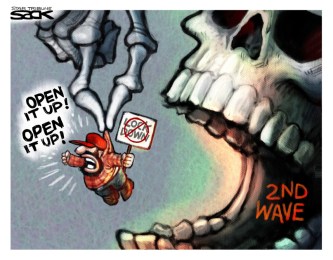 What’s next for this country? Can we survive the ravages of this pandemic? Over the weekend, The New York Times published an important piece by Donald G. McNeil Jr.: The Coronavirus in America: The Year Ahead.
In truth, it is not clear to anyone where this crisis is leading us. More than 20 experts in public health, medicine, epidemiology and history shared their thoughts on the future during in-depth interviews. When can we emerge from our homes? How long, realistically, before we have a treatment or vaccine? How will we keep the virus at bay?
Some felt that American ingenuity, once fully engaged, might well produce advances to ease the burdens. The path forward depends on factors that are certainly difficult but doable, they said: a carefully staggered approach to reopening, widespread testing and surveillance, a treatment that works, adequate resources for health care providers — and eventually an effective vaccine.
Still, it was impossible to avoid gloomy forecasts for the next year. The scenario that Mr. Trump has been unrolling at his daily press briefings — that the lockdowns will end soon, that a protective pill is almost at hand, that football stadiums and restaurants will soon be full — is a fantasy, most experts said.
“We face a doleful future,” said Dr. Harvey V. Fineberg, a former president of the National Academy of Medicine.
He and others foresaw an unhappy population trapped indoors for months, with the most vulnerable possibly quarantined for far longer. They worried that a vaccine would initially elude scientists, that weary citizens would abandon restrictions despite the risks, that the virus would be with us from now on.
“My optimistic side says the virus will ease off in the summer and a vaccine will arrive like the cavalry,” said Dr. William Schaffner, a preventive medicine specialist at Vanderbilt University medical school. “But I’m learning to guard against my essentially optimistic nature.”
Most experts believed that once the crisis was over, the nation and its economy would revive quickly. But there would be no escaping a period of intense pain.
Exactly how the pandemic will end depends in part on medical advances still to come. It will also depend on how individual Americans behave in the interim. If we scrupulously protect ourselves and our loved ones, more of us will live. If we underestimate the virus, it will find us.
Read more about what the experts had to say at the NYT link.
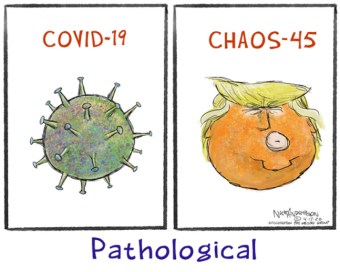 Jonathan Chait on Trump’s abandonment of the states: Trump Wants to Starve the States Into Opening Before It’s Safe.
President Trump’s current pandemic strategy — emphasize current; like the cliché about the weather, if you don’t like it, wait a few hours — is a baffling knot of contradictions. He is hurling all responsibility to state governments, leaving it to them to devise effective tests and to decide when to relax social distancing.
At the same time, he is starving them of the resources to handle the job. And even as Trump hides behind a policy of deference to governors, he is goading right-wing protesters to force their hand. Trump is “saying things that seem contradictory,” as the New York Times puts it, “like pledging to work with governors and then urging people to ‘liberate’ their states, and leaving it to his audiences to hear what they want to hear in his words.”
Yet there does appear to be a strategy here. The Wall Street Journal reported Friday afternoon that Trump has “asked White House aides for economic response plans that would allow him to take credit for successes while offering enough flexibility to assign fault for any failures to others.” Trump’s seemingly paradoxical stance is an attempt to hoard credit and shirk risk, straddling the demands of his business allies with the pleas of his public-health advisers. On the surface, he is deferring responsibility and blame to the governors. Just below the surface, he is coercing them to resume economic activity as fast as possible, regardless of what public-health officials say.
Trump’s plan to coerce the states into reopening has at least three discernible elements. The first is, or was, the formation of a task force to reopen the country. The purpose of the council was to give Trump cover. The council would prod governors to reopen businesses, and because it would be seen as coming from the business community, Trump himself would not bear the blame for future outbreaks that might result. As the Washington Post reported last week, “Trump’s advisers are trying to shield the president from political accountability should his move to reopen the economy prove premature and result in lost lives, and so they are trying to mobilize business executives, economists and other prominent figures to buy into the eventual White House plan, so that if it does not work, the blame can be shared broadly, according to two former administration officials familiar with the efforts.” (In part because its purpose was so naked, the task force seems to have collapsed.)
The second element is the mobilization of protests. The appearance of flag-waving and sometimes gun-toting demonstrators in a handful of state capitols this weekend seems to have come as a shock to the news media, but Trump’s allies signaled this was coming. Last Monday, Stephen Moore, a right-wing pseudo-economist and close Trump ally who has spent weeks pushing back on public-health guidelines, was quoted in the press saying, “In the next two weeks, you’ll see protests in the streets of conservatives; you’ll see a big pushback against the lockdown in some states.”
Click the link to read the rest at New York Magazine.
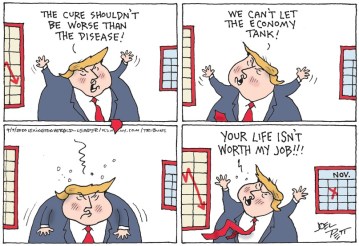 At The Washington Post, Paul Waldman on Trump’s “war against the states”:
President Trump and congressional Republicans are going to war with the states.
It’s bizarre, it’s self-defeating, it will do enormous harm to Americans in every corner of the country, and it can be fully explained only by understanding the president’s pettiest and most narcissistic motives. In other words, it’s the kind of thing we’ve come to expect in the Trump era.
Last week, the $349 billion allotted for small businesses in the CARES Act rescue package ran out, with only a portion of the American businesses that have suffered in this pandemic-driven recession getting the help they need. While everyone seemed ready to provide more money, we found ourselves in a familiar situation, with Democrats saying we need to be swift and aggressive in saving Americans suffering from this economic catastrophe, and Republicans saying that we shouldn’t spend too much or help too many people.
When negotiations began, Republicans wanted to add about $250 billion to the small business fund — and do nothing else. Now it appears that Democrats have pressured them into accepting a package that sends $370 billion to small businesses, gives $75 billion to hospitals, and spends $25 billion to beef up coronavirus testing.
What isn’t included in the package, however, is the desperately needed aid to states and cities Democrats sought. Republicans absolutely refused to even consider it.
Why? The need is urgent. State and local budgets are suddenly facing all kinds of new costs related to the pandemic, while at the same time tax revenues have fallen off a cliff. If they don’t get help, they’ll have to start laying people off and slashing state services, which will only make the recession deeper and longer. By some estimates, states and cities will need $500 billion in federal aid to make up the shortfall.
Read more at the WaPo.
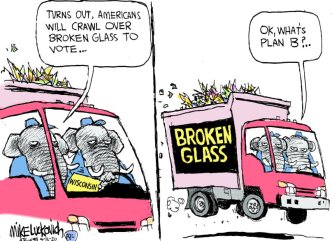 So far Trump’s strategy isn’t convincing most Americans. The Washington Post: Most rate Trump’s coronavirus response negatively and expect crowds will be unsafe until summer, Post-U. Md. poll finds.
Most Americans expect no immediate easing of the health risks associated with the coronavirus pandemic, despite calls by President Trump and others to begin reopening the economy quickly. A majority say it could be June or later before it will be safe for larger gatherings to take place again, according to a Washington Post-University of Maryland poll.
Most Americans — 54 percent — give the president negative marks for his handling of the outbreak in this country and offer mixed reviews for the federal government as a whole. By contrast, 72 percent of Americans give positive ratings to the governors of their states for the way they have dealt with the crisis, with workers also rating their employers positively.
Partisan allegiances shape perceptions of when it will be safe to have gatherings of 10 or more people and of the president’s performance during the pandemic. But governors win praise across the political spectrum for their leadership, which has sometimes put them sharply at odds with Trump and his administration.
Personal health concerns are widespread, with 57 percent saying they are “very” or “somewhat” worried about becoming infected and seriously ill from the coronavirus, including at least 40 percent of people in every major demographic and political group. For those most concerned, the fear was enough to override partisanship when it comes to the safety of public gatherings, particularly for Republicans.
Today we face another day in the time of coronavirus. There will be more reports of deaths and infections, more horror stories, and more lies and propaganda from the Trump gang, and another insane briefing airing of grievances by Trump. We have to steel ourselves to protect ourselves from the virus and save our sanity in these crazy times.
Have courage Sky Dancers! What’s on your mind today?
Monday Reads: Where the Wild Things Are after Pandemic Shut Downs
Posted: April 20, 2020 Filed under: morning reads 30 Comments
A pair of Blue Herons are nesting in the Neutral Ground in front of my home. This is the first time I’ve ever seen these birds outside of Barataria National Wildlife Preserve.
Good Day Sky Dancers!
One of the things that is happening right now as a result of social distancing is that Mother Nature appears to be reclaiming that distance. Maybe she’s fighting a virus of sorts too.
The Economist has this story: “Covid-19 has emboldened Italy’s fauna.”
A wolf slinks out of a park in Sesto Fiorentino, an industrial centre near Florence. Goslings waddle behind their mothers along deserted thoroughfares in Treviso. Fallow deer invade a golf course on Sardinia and take a dip in the clubhouse swimming pool. As Italians entered the sixth week of Europe’s longest covid-19 lockdown on April 13th, one thing they had to cheer them up was the sight of animals in spaces that humankind had temporarily abandoned.
At Cagliari on Sardinia, bottlenose dolphins have long been known to wait at the mouth of the port to play in the wake of departing motor vessels. But since the lockdown some have entered right into the port, where they have been filmed swimming up and down under a quay, looking at the humans above. A similar phenomenon has been observed morat Triesste. “A non-scientist might speculate that the dolphins are thinking: ‘Why aren’t you moving around in your boats any longer?’” says Giuseppe Bogliani, formerly a University of Pavia professor.
Mr Bogliani cautions against assuming that nature is reclaiming its own. Some mammals, like foxes, may have been in the cities already, prowling undetected at night. A golden eagle spotted gliding above a main road in Milan posed a different question: “Is it there because of the lockdown, or did we just see it because of the lockdown?”
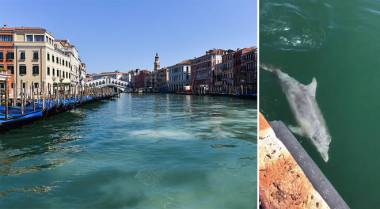
Venice canals run clear, dolphins appear in Italy’s waterways amid coronavirus lockdown. Picture: Getty/Twitter
CNN reports on the clearer canals in Venice.
The canals in Venice are clearer than they have been for a long time, due to lockdown measures taken in the face of coronavirus.
As countries and their governments are urging their populations more and more to ‘self-isolate’ and stop all non-essential travel abroad, tourist “honey traps” including Venice are seeing hardly any visitors.
And so, in Venice’s case, there is less need for transportation of any kind to be running, and the canals with less boats are coming up clean, clear and beautiful.
“The water now looks clearer because there is less traffic on the canals, allowing the sediment to stay at the bottom,” a spokesperson for the Venice mayoral office told CNN.
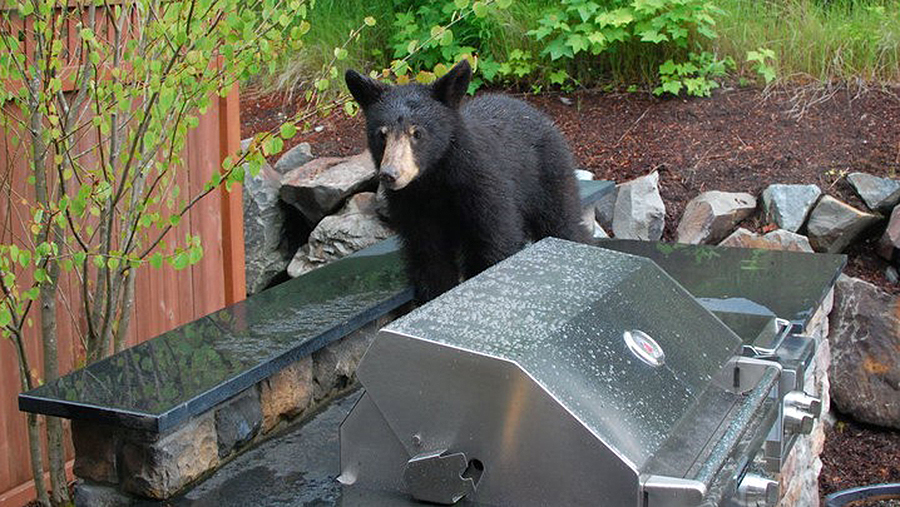
A black bear inspects a grill near Seattle, one of many photos compiled by the Urban Carnivore Project, which is collecting data on the animals that make their home in the Emerald City and its suburbs. Cities are taking a closer look at their animal residents to help them thrive peacefully alongside humans.
The Guardian reports that “Covid-19 – a blessing for pangolins? Pangolins are the world’s most trafficked mammals, but there is evidence that they were the source of the new coronavirus – which could end the trade”. Great News for Pangolins!
Pangolins look like scaly anteaters. Uniquely among mammals, their bodies are covered in hard protective scales made of keratin: the same material as our nails. They feed on insects such as ants and termites, and are often nocturnal and shy. While they look like anteaters, they are not closely related to them, and their closest living relatives are actually carnivores: the group that includes wolves and cats.
There are eight species of pangolin. Four live in Africa and four in Asia. All are at risk of extinction, according to the International Union for Conservation of Nature (IUCN). Two of the African species are considered vulnerable and two are endangered. Of the Asian species, one is endangered while the other three are critically endangered.
Pangolins are illegally hunted and traded for two main reasons. First, their meat is considered a delicacy in several south-east Asian countries, especially China and Vietnam. And second, their scales are used in Chinese traditional medicine. As a result, they are the world’s most trafficked mammals.
The idea that pangolins gave us Covid-19 emerged at a press conference given by the South China Agricultural University in Guangzhou on 7 February. Two scientists there, Yongyi Shen and Lihua Xiao, were said to have compared coronaviruses from pangolins and from humans infected in the outbreak. The viruses’ genetic sequences were said to be 99% similar. One co-author, Wu Chen of Guangzhou Zoo, had previously helped show that Sunda pangolins carry coronaviruses.
However, the results had not been published at that stage, so other scientists could not examine them in detail. Meanwhile, there were many other possibilities. The virus could have come from an animal and seafood market in Wuhan, where many species were held. Animals in such markets are often kept in closely packed, unsanitary conditions, with many people nearby: a perfect opportunity for a virus to jump species. Many pointed the finger at bats: the virus is genetically similar to those in bats, and it would not be the first time a disease passed from bats to humans. There was also a study linking the virus to one found in snakes, but this is now considered unlikely.

A civet cat has been spotted roaming on the streets of Kozhikode in the State of Kerala, India on 27 March, 2020
China is looking to permanently ban eating wild animals.
Over four months after the first cases of COVID-19 surfaced in China, the world remains in the grip of the COVID-19 pandemic, with nearly 1.5 million confirmed cases and almost 89,000 deaths as of April 9. The novel coronavirus that causes COVID-19 is believed to have originated in bats and jumped to humans, most likely at a wet market in China’s Hubei province where wild animals were being sold. A move to amend wildlife laws to prevent future outbreaks is now gaining momentum in the country.
The Chinese ban on consumption of wild animals is likely to become permanent in the coming months, according to Aili Kang, Executive Director of the Wildlife Conservation Society’s Asia Program. This means it would be enshrined in the country’s wildlife legislation. A decision taken by the Standing Committee of the National People’s Congress on Feb. 24 will serve as the basis for amendments to existing wildlife laws.
NYT reports that “Animals Are Rewilding Our Cities. On YouTube, at Least.”
But the truth of these videos seems less interesting to me than the reasons behind their popularity. What is it that we are desperate to see in the natural world right now, and why? Anyone who has had a bird or a bat fly into her home knows how disturbing it can be when animals appear in spaces you assumed were your own, as if they were heralds of luck or future disaster. This sudden, unusual visitation of animals to our streets and cities feels similarly portentous, their presence newly freighted with human significance.
And because in times of dislocation and crisis we search for familiarity to ground ourselves, many of these videos work for us because they show scenes straight out of the cinematic imagination, in which the still, empty streets of postapocalyptic cities are often accompanied by a flourishing of vegetation and wildlife — most famously in the movie “I Am Legend,” in which herds of white-tailed deer bound among abandoned cars in the overgrown streets of Manhattan. We know these places. We have seen them before, and that knowledge carries with it a promise of survival.
In a new paper, published in Frontiers in Microbiology, researchers from the University of Adelaide found that humans in urban populations are in dire need of more natural habitat to address chronic disease rates.
This could be achieved through the restoration of urban microbial biodiversity through rewilding.
Lead author Jacob Mills, from The Environment Institute at the University of Adelaide, said evidence pointed towards humans needing healthy, natural, and microbially-rich environments to properly develop as healthy holobionts – a symbiosis of host and microorganisms reliant on ecosystem health and biodiversity for optimal health outcomes.
He said a decrease in biodiversity, including microbial diversity, of human habitat through urbanization was thought to be a cause of the rapid increase of non-communicable diseases in urban populations.
“We are more than human, cell-for-cell we are 57 per cent microbial, we’re walking ecosystems,” Mills said.
“Our symbiotic microbial partners, or our ‘Old Friends’ as they’re known, come from our mother and wider habitat when we’re young. These microorganisms play vital roles in our health, particularly our immune training and regulation.
“As it stands with current urban designs, people are poorly exposed to their ‘Old Friends’ and partially because of this we have decreased our health status through improper immune training and regulation. Most microbes are actually beneficial or neutral, only rarely do they cause disease.”
The researchers say the modern urban habitat is low in macro and microbial biodiversity and discourages contact with beneficial environmental microbiota.
They also claim these habitat factors, alongside diet, antibiotics, and others, are associated with the epidemic of non-communicable diseases in these societies.
You’ll recognize this as some of the co-morbidities increasing Covid 19 deaths.
Loans supposedly granted to help struggling small businesses have been gobbled up by huge ones in the world of Trumpist corruption and greed. From today’s WAPO: “White House, GOP face heat after hotel and restaurant chains helped run small business program dry. With program out of money, backlash prompts executives at Shake Shack to return $10 million loan.”
The federal government gave national hotel and restaurant chains millions of dollars in grants before the $349 billion program ran out of money Thursday, leading to a backlash that prompted one company to give the money back and a Republican senator to say that “millions of dollars are being wasted.”
Thousands of traditional small businesses were unable to get funding from the program before it ran dry. As Congress and the White House near a deal to add an additional $310 billion to the program, some are calling for additional oversight and rule changes to prevent bigger chains from accepting any more money.
Ruth’s Chris Steak House, a chain that has 150 locations and is valued at $250 million, reported receiving $20 million in funding from the small business portion of the economic stimulus legislation called the Paycheck Protection Program. The Potbelly chain of sandwich shops, which has more than 400 locations and a value of $89 million, reported receiving $10 million last week.
Shake Shack, a $1.6 billion burger-and-fries chain based in New York City, received $10 million. After complaints from small business advocates after the fund went dry, company founder Danny Meyer and chief executive Randy Garutti announced Sunday evening that they would return the money.
They said they had no idea that the program would run out of money so quickly and that they understood the uproar.
“Late last week, when it was announced that funding for the PPP had been exhausted, businesses across the country were understandably up in arms,” the two wrote in a letter posted online. “If this act were written for small businesses, how is it possible that so many independent restaurants whose employees needed just as much help were unable to receive funding?”
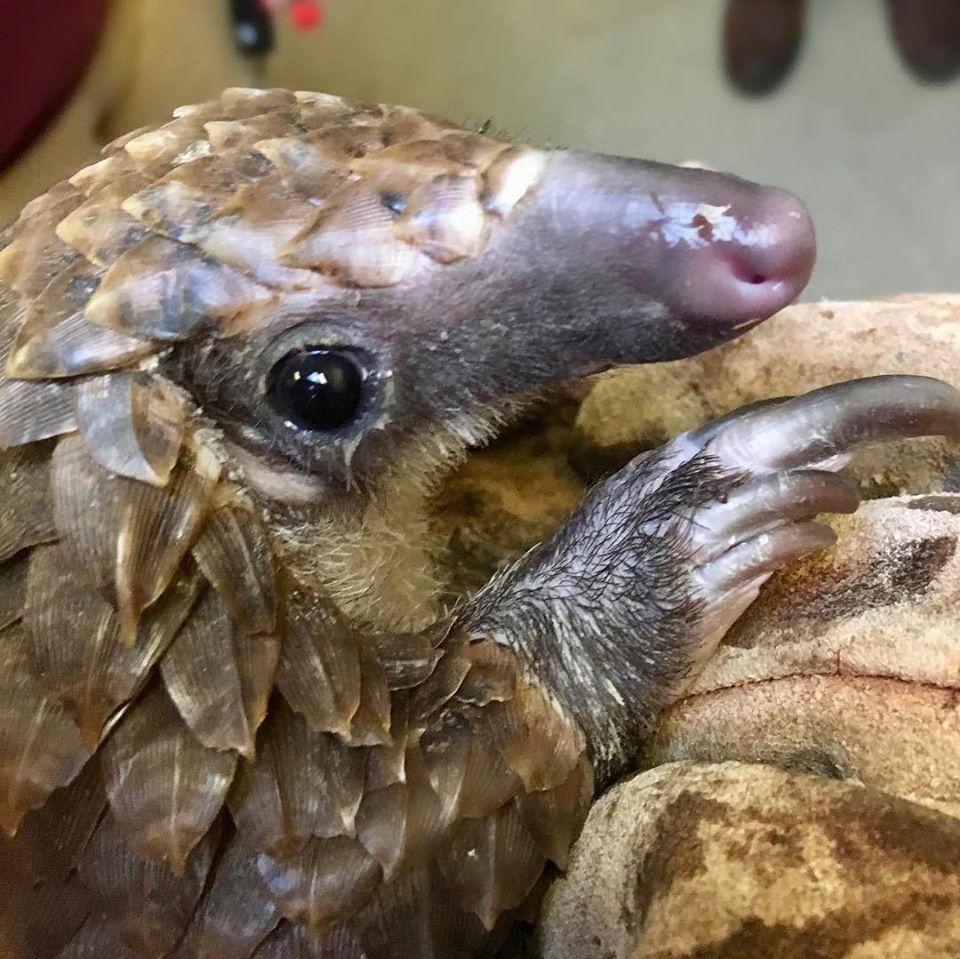
A white-bellied pangolin. (Memphis Zoo)
Politico reports that: “A watchdog out of Trump’s grasp unleashes wave of coronavirus audits. The Government Accountability Office is moving quickly to conduct oversight — and it’s got more protection than other Trump targets.”
Lawmakers handed President Donald Trump $2 trillion in coronavirus relief — and then left town without activating any of the powerful new oversight tools meant to hold his administration accountable.
But with little fanfare, Congress’ independent, in-house watchdog is preparing a blizzard of audits that will become the first wide-ranging check on Trump’s handling of the sprawling national rescue effort.
And even as Trump has gone to war against internal watchdogs in his administration, the Government Accountability Office remains largely out of the president’s grasp because of its home in the legislative branch.
The GAO has quickly taken advantage of its perch, exploring the early missteps inherent in launching a multitrillion-dollar law that touches every facet of American life. By the end of April, at least 30 CARES Act reviews and audits — “engagements,” per GAO lingo — are expected to be underway, according to interviews with senior investigators.
Topics will range from the government’s handling of coronavirus testing to its distribution of medical equipment, and from the nation’s food supply to nursing home infections and any missteps in distributing the emergency cash payments that began landing in millions of Americans’ bank accounts this week. The office’s top fraud investigator said it’s already received a complaint about a check landing in the account of a deceased person.
“We’re moving forward very quickly,” said Angela Nicole Clowers, chief of the GAO’s health care unit. “We’re an existing institution and have a lot of institutional knowledge about all these programs. It gives us sort of a leg up.”
At a time when Trump has sought to undermine nearly every independent review of his administration’s conduct, the GAO is likely to dispatch most of its 3,000 investigators, experts and analysts into an arena that could make it a target for the president’s fury. And its quiet early work could soon become very loud: The office is required under the new law to brief Congress every month and issue a bimonthly public report on its findings.

At a Colombus Ohio rally, Trumpists continue to shine a light on just how horrible humans can be
Meanwhile, it will be another day of crazy Trump Pressers, crazy Trumpist supporters marching around with guns decrying public health initiatives because they want haircuts, and DEATH.
Be safe. Stay Home.
What’s on your reading and blogging list today?
Lazy Caturday Reads: A Little Good News And More Bad News
Posted: April 18, 2020 Filed under: morning reads, Republican politics, U.S. Politics | Tags: coronavirus pandemic, Donald Trump, Trump cult 20 Comments
Okazaki Cat Demon, by Utagawa Kuniyoshi, 1850
Good Morning!!
Yesterday, Dakinikat wrote about the Trump death cult. In the past couple of days we’ve been seeing ominous signs that Trump and his zombie followers are going to make the coronavirus epidemic in the U.S. even worse than it already is by fomenting unrest over restrictions governors and mayors have imposed in order to slow the spread of infections. But before I get to that, I want to highlight something positive that is happening here in Massachusetts.
The New York Times: An Army of Tracers Takes Shape in Massachusetts.
Alexandra Cross, a newly minted state public health worker, dialed a stranger’s telephone number on Monday, her heart racing.
It was Ms. Cross’s first day as part of Massachusetts’s fleet of contact tracers, responsible for tracking down people who have been exposed to the coronavirus, as soon as possible, and warning them. On her screen was the name of a woman from Lowell.
“One person who has recently been diagnosed has been in contact with you,” the script told her to say. “Do you have a few minutes to discuss what that exposure might mean for you?” Forty-five minutes later, Ms. Cross hung up the phone. They had giggled and commiserated. Her file was crammed with information.
She was taking her first steps up a Mount Everest of cases.
Dancing Cats by Utagawa Kuniyoshi
Massachusetts is the first state to invest in an ambitious contact-tracing program, budgeting $44 million to hire 1,000 people like Ms. Cross. The program represents a bet on the part of Gov. Charlie Baker that the state will be able to identify pockets of infection as they emerge, and prevent infected people from spreading the virus further.
This could help Massachusetts in the coming weeks and months, as it seeks to relax strict social-distancing measures and reopen its economy.
Contact tracing has helped Asian countries like South Korea and Singapore contain the spread of the virus, but their systems rely on digital surveillance, using patients’ digital footprints to alert potential contacts, an intrusion that many Americans would not accept.
Massachusetts is building its response around an old-school, labor-intensive method: people. Lots of them.

Read the rest at the NYT.
So that’s the good news. The bad news is that Trump himself is egging on public protests by his craziest supporters that could lead to more infections and quite possibly violence.
Axios: Trump accelerates the unrest.
What he’s saying: “LIBERATE MICHIGAN! … LIBERATE MINNESOTA! … LIBERATE VIRGINIA, and save your great 2nd Amendment. It is under siege!”
Why it matters: Governors have in place strong public health restrictions and are likely to want to continue to hold the line for some time to come. This was a position Trump publicly supported as recently as Thursday.
- Michigan in particular has a bad coronavirus outbreak, with a lockdown from Gov. Gretchen Whitmer that’s among the most severe nationwide.
Japanese Cat by Utagawa Kuniyoshi
The ingredients for mayhem, via Axios’ Jonathan Swan:
- Deepening economic desperation: 22 million have filed for jobless benefits, with a second wave of layoffs already underway. More help appears to be coming for small businesses, but Congress is still haggling.
- Conservative TV and talk radio influencers encouraging protests: “People instinctively know now that however bad this is, it isn’t as bad as they all told us,” Rush Limbaugh told listeners on Thursday.
- Early signs of big conservative donor money getting behind the protests: In Michigan, one protest was planned by the political adviser to the family of Education Secretary Betsy DeVos, WashPost reports.
- Police departments are stressed: Hundreds of police officers have been quarantined for coronavirus exposure, with some dying. Multiple departments nationwide have reported issues getting PPE.
Between the lines: As we reported in yesterday’s PM, public support is strongly on the side of social distancing.
- 66% of Americans are concerned state governments will lift restrictions too quickly.
- 73% say the worst is yet to come from the outbreak.
The bottom line: It surely can’t be helping individuals and businesses to have the yo-yo effect created by federal and state officials openly arguing about timelines that involve life and death.

NBC News: In Trump’s ‘LIBERATE’ tweets, extremists see a call to arms.
When President Donald Trump tweeted “LIBERATE MINNESOTA!” on Friday morning, some of his most fervent supporters in far-right communities — including those who have agitated for violent insurrection — heard a call to arms.
Cats Practicing Their Music, Utagawa Kuniyoshi
The tweet was one of three sent from the president’s account, along with “LIBERATE MICHIGAN!” and “LIBERATE VIRGINIA, and save your great 2nd Amendment. It is under siege!”
Trump’s tweets came after small protests by Trump supporters broke out in a handful of states, many of which were fueled by anti-vaccination and anti-government groups. Anti-government sentiment has percolated among far-right extremists in recent weeks over the stay-at-home orders governors have issued to prevent the spread of the coronavirus.
Trump’s tweets, however, pushed many online extremist communities to speculate whether the president was advocating for armed conflict, an event they’ve termed “the boogaloo,” for which many far-right activists have been gearing up and advocating since last year.
There were sharp increases on Twitter in terms associated with conspiracies such as QAnon and the “boogaloo” term immediately following the president’s tweets, according to the Network Contagion Research Institute, an independent nonprofit group of scientists and engineers that tracks and reports on misinformation and hate speech across social media.
Posts about the “boogaloo” on Twitter skyrocketed in the hours after the president’s tweets, with more than 1,000 tweets featuring the term, some of which received hundreds of retweets.
“We the people should open up America with civil disobedience and lots of BOOGALOO. Who’s with me?” one QAnon conspiracy theorist on Twitter with over 50,000 followers asked.
“Boogaloo” is a term used by extremists to refer to armed insurrection, a shortened version of “Civil War 2: Electric Boogaloo,” which was coined on the extremist message board 4chan.


Falling Cat, Utakawa Kuniyoshi
Washington Governor Jay Inslee released a statement in response to Trump’s twitter taunts.
“The president’s statements this morning encourage illegal and dangerous acts. He is putting millions of people in danger of contracting COVID-19. His unhinged rantings and calls for people to “liberate” states could also lead to violence. We’ve seen it before.
“The president is fomenting domestic rebellion and spreading lies even while his own administration says the virus is real and is deadly, and that we have a long way to go before restrictions can be lifted.
“Just yesterday, the president stood alongside White House officials and public health experts and said science would guide his plan for easing restrictions. The White House released a sensible plan laying out many of the guidelines that I agree are essential to follow, as we work to resume economic activity. Trump slowly read his script and said the plan was based on ‘hard, verifiable data’ and was done ‘in consultation with scientists, experts and medical professionals across government.’
“Less than 24 hours later, the president is off the rails. He’s not quoting scientists and doctors but spewing dangerous, anti-democratic rhetoric.
“We appreciate our continued communication with the vice president, Dr. Birx, Admiral Polowczyk, Admiral Giroir and others in the federal government, but their work is undermined by the president’s irresponsible statements.
“I hope someday we can look at today’s meltdown as something to be pitied, rather than condemned. But we don’t have that luxury today. There is too much at stake.
Three cats at an indoor party by Utagawa Kuniyoshi
“The president’s call to action today threatens to undermine his own goal of recovery by further delaying the ability of states to amend current interventions in a safe, evidence-based way. His words are likely to cause COVID-19 infections to spike in places where social distancing is working — and if infections are increasing in those places, that will further postpone the 14 days of decline that his own guidance says is necessary before modifying any interventions.
“I hope political leaders of all sorts will speak out firmly against the president’s calls for rebellion. Americans need to work together to protect each other. It’s the only way to slow the spread of this deadly virus and get us on the road to recovery.”

But some Republicans are singing a different tune. The Washington Post: GOP’s growing ‘open it up’ caucus urges fewer virus restrictions amid warnings from fellow Republicans.
A growing number of Republican lawmakers across the country are pushing for a more rapid reboot of the American economy amid the coronavirus pandemic, arguing that the risk of spreading more sickness — and even death — is outweighed by the broader economic damage that widespread stay-at-home orders have wrought.
They are taking cues from and breathing energy into a grass-roots conservative movement of resistance against government-ordered quarantine measures — one that President Trump appeared to back in several tweets Friday — but are facing defiance within their own party from Republican congressional leaders, governors and fellow lawmakers who warn that a rash reopening could reinvigorate the virus’s spread.
The emerging “open it up” caucus has spoken out on key conservative media platforms, including some of Trump’s favorite programs. In a prime-time Fox News Channel appearance Wednesday, for instance, Sen. John Neely Kennedy (R-La.) said that balancing the health of Americans with a functioning economy amid the pandemic was “like choosing between cancer and a heart attack.”
Read more at the WaPo.

By Utagawa Kuniyoshi
Politico: Trump allies press administration to unleash lawsuits against lockdowns.
As President Donald Trump uses the bully pulpit to press state and local governments to ease their virus-related lockdowns, conservative activists and religious leaders are urging his administration to go further by unleashing a wave of lawsuits arguing that the measures are intruding on Americans’ legally protected rights to worship, protest and buy guns.
In a letter sent to Attorney General Bill Barr on Friday, the Conservative Action Project, a group of conservative leaders including Matt Schlapp of the American Conservative Union, Tom Fitton of Judicial Watch and Jenny Beth Martin of Tea Party Patriots, called governors and local leaders “petty, would-be dictators” who had committed “rampant abuses of constitutional rights and civil liberties” as part of their response to the coronavirus.
Among the examples they include are “arresting pro-life counselors for peacefully standing outside an abortion clinic while maintaining social distance,” “arresting a man for surfing,” ticketing people attending drive-in church services, and “prohibitions on citizens’ rights to purchase firearms.”
The letter comes as Trump put pressure on Michigan, Minnesota, and Virginia to ease up on social distancing measures a day after the White House released federal guidelines to reopen the economy. Protests, many led by Trump supporters, have cropped up across the country demanding state leaders reel in restrictions designed to stop the spread of the virus.
Meanwhile, Trump’s so-called “plan” to reopen the economy is complete bullshit. The Guardian: Operation reopen America: are we about to witness a second historic failure of leadership from Trump?
Unveiling new guidelines for the loosening of the lockdown, [Trump] committed his administration to a “science-based reopening”. “We are starting our life again, we are starting rejuvenation of our economy again, in a safe and structured and very responsible fashion.”
Woman with a cat, by Utagawa Kuniyoshi
Beyond the cloistered confines of the White House an alternative interpretation of events was gathering force. On a day in which the US suffered its highest death toll from Covid-19, with a total of more than 680,000 confirmed cases and 34,000 deaths, public health experts were scrutinising the president’s new guidelines and coming to rather different conclusions.
“This isn’t a plan, it’s barely a powerpoint,” spluttered Ron Klain on Twitter. Klain, the US government’s Ebola tsar during the last health crisis to test the White House, in 2014, said the proposals contained “no provision to ramp up testing, no standard on levels of disease before opening, no protections for workers or customers”.
On 28 March the Guardian exposed the missing six weeks lost as a result of Trump’s dithering and downplaying of the crisis when the virus first struck. Jeremy Konyndyk, another central figure in the US battle against Ebola, told the Guardian that the Trump administration’s initial response was “one of the greatest failures of basic governance and leadership in modern times”.
Now that the US is contemplating a shift into the second phase of the crisis – tentative reopening of the economy – scientists and public health officials are agreed that three pillars need to be put into place to manage the transition safely. They are: mass testing to identify those who are infected, contact tracing to isolate other people who may have caught Covid-19 from them, and personal protective equipment (PPE) to shield frontline healthcare workers from any flare-up.
A chorus of expert voices has also begun to be heard warning that those three essential pillars remain in critically short supply throughout the US. Less than a month after the Guardian’s exploration of the missing six weeks, the chilling recognition is dawning that the country is heading for a second massive failure of governance under Trump, this time on an even bigger scale.
Unless testing capability is dramatically ramped up and a giant army of health workers assembled to trace the contacts of those infected – right now – the consequences could be devastating.

We are in big trouble. That last thing we need is another tea party-style uprising in the midst of a deadly global pandemic. Somehow, some way, Trump has to go.
What stories are you following today?

 peej
peej Carissa
 bostonboomer
 dakinikat
 ecocatwoman
 jjlo
jjlo mablue2
 Mama Lopez
 peggysue22
 quixote
 skydancingguestblogger
 Mona (aka Wonk the Vote)





Recent Comments