
Monday Reads
Posted: October 7, 2013 Filed under: 2012 elections, Congress, Federal Budget and Budget deficit, Federal Government Shutdown, House of Representatives, morning reads, Tea Party activists 74 Comments
Good Morning!
I’ve made plans to go to Seattle next month again to stay with my dad and hope that I can also spend time looking for the possibility of a job since my daughter is joining a small ob/gyn practice about an hour north of Seattle. It’s hard not to long for the safety of a blue state given what’s been going on recently and given the conversations that I have with people that safely dwell in the Faux News Reality of Welfare Queens, Pedophile Gays, Scary Black People in Hoodies, and Invading Mexicans. I’ve been in a long Facebook conversation trying to explain the Affordable Care Act details and why the exchanges are not “government-backed” insurance until I’m blue in the face. No amount of numbers convinces them that all the jobs are not becoming part time. I was just told I obviously don’t have common sense if I don’t see the Affordable Care Act as a giant give away to lazy poor people even though I’ve tried to explain that Medicaid still exists and it still is the plan for poor people. There just exists this ever deepening divide between the realities of Red and Blue States. Did Nixon’s Southern Strategy doom our Democracy?
In a merciful twist of fate, Juan Linz did not quite live to see his prophecy of the demise of American democracy borne out. Linz, the Spanish political scientist who died last week, argued that the presidential system, with its separate elections for legislature and chief executive, was inherently unstable. In a famous 1990 essay, Linz observed, “All such systems are based on dual democratic legitimacy: No democratic principle exists to resolve disputes between the executive and the legislature about which of the two actually represents the will of the people.” Presidential systems veered ultimately toward collapse everywhere they were tried, as legislators and executives vied for supremacy. There was only one notable exception: the United States of America.
Linz attributed our puzzling, anomalous stability to “the uniquely diffuse character of American political parties.” The Republicans had loads of moderates, and conservative whites in the South still clung to the Democratic Party. At the time he wrote that, the two parties were already sorting themselves into more ideologically pure versions, leaving us where we stand today: with one racially and economically polyglot party of center-left technocracy and one ethnically homogenous reactionary party. The latter is currently attempting to impose its program by threat upon the former. The events in Washington have given us a peek into the Linzian nightmare.
Traditionally, when American politics encountered the problem of divided government—when, say, Nixon and Eisenhower encountered Democratic Congresses, or Bill Clinton a Republican one—one of two things happened. Either both sides found enough incentives to work together despite their differences, or there was what we used to recognize as the only alternative: gridlock. Gridlock is what most of us expected after the last election produced a Democratic president and Republican House. Washington would drudge on; it would be hard to get anything done, but also hard to undo anything. Days after the election, John Boehner, no doubt anticipating things would carry on as always, said, “Obamacare is the law of the land.”
Instead, to the slowly unfolding horror of the Obama administration and even some segments of the Republican Party, the GOP decided that the alternative to finding common ground with the president did not have to be mere gridlock. It could force the president to enact its agenda.
It used to be that elections came with the usual majority rules ramifications. This current group of Tea Party insurrectionists evidently has changed that equation. The question now is what can we do about it?
And as the saying goes, elections have consequences. It’s how Democratic victories in the 1930s paved the way for Franklin Roosevelt’s New Deal, how Dem victories in the 1960s led to Lyndon Johnson’s Great Society programs, how Republican victories in the 1980s resulted in Ronald Reagan’s tax cuts, how Democratic majorities in 2006 and 2008 led to Obama’s health-care law, and how the GOP’s midterm wins in 2010 extracted spending-cut concessions from Obama the following year.
Yet what’s extraordinary about this current political fight is that Republicans are seeking another round of concessions — over the president’s signature domestic achievement — after losing the last election, which was viewed in part as a referendum on the health-care law.
“It’s as if Ted Cruz slept through the entire 2012 cycle,” a senior Democratic aide tells First Read. “It’s not like Obamacare, spending and debt weren’t major issues in 2012. They were central — and we won.”
Nevertheless, Cruz and House Republicans maintain that Obama and the Democrats must negotiate over the health-care law to re-open the federal government. And House Speaker John Boehnersays Democrats must negotiate to raise the debt ceiling. “The nation’s credit is at risk because of the administration’s refusal to sit down and have a conversation,” he told ABC News. “The votes are not in the House to pass a clean debt limit. And the president is risking default by not having a conversation with us.”
I found that Boehner comment about the lack of votes to be really strange given that he seems to think that the Democrats in the House and their votes do not matter. What exactly is the conversation and why should the rest of the country have it when we thought we decided that about a year ago during the election? Why is Boehner willing to weaponize the debt ceiling again? (This is the same Jonathan Chait article I referenced above.)
The debt ceiling turns out to be unexploded ordnance lying around the American form of government. Only custom or moral compunction stops the opposition party from using it to nullify the president’s powers, or, for that matter, the president from using it to nullify Congress’s. (Obama could, theoretically, threaten to veto a debt ceiling hike unless Congress attaches it to the creation of single-payer health insurance.) To weaponize the debt ceiling, you must be willing to inflict harm on millions of innocent people. It is a shockingly powerful self-destruct button built into our very system of government, but only useful for the most ideologically hardened or borderline sociopathic. But it turns out to be the perfect tool for the contemporary GOP: a party large enough to control a chamber of Congress yet too small to win the presidency, and infused with a dangerous, millenarian combination of overheated Randian paranoia and fully justified fear of adverse demographic trends. The only thing that limits the debt ceiling’s potency at the moment is the widespread suspicion that Boehner is too old school, too lacking in the Leninist will to power that fires his newer co-partisans, to actually carry out his threat. (He has suggested as much to some colleagues in private.) Boehner himself is thus the one weak link in the House Republicans’ ability to carry out a kind of rolling coup against the Obama administration. Unfortunately, Boehner’s control of his chamber is tenuous enough that, like the ailing monarch of a crumbling regime, it’s impossible to strike an agreement with him in full security it will be carried out.
The standoff embroiling Washington represents far more than the specifics of the demands on the table, or even the prospect of economic calamity. It is an incipient constitutional crisis. Obama foolishly set the precedent in 2011 that he would let Congress jack him up for a debt-ceiling hike. He now has to crush the practice completely, lest it become ritualized. Obama not only must refuse to trade concessions for a debt-ceiling hike; he has to make it clear that he will endure default before he submits to ransom. To pay a ransom now, even a tiny one, would ensure an endless succession of debt-ceiling ransoms until, eventually, the two sides fail to agree on the correct size of the ransom and default follows.
This is a domestic Cuban Missile Crisis
Texas Demagogue and Senator Ted Cruz is already pushing the crisis forward.
Sen. Ted Cruz (R-Texas) on Sunday said changes to President Obama’s signature healthcare law should be tied to a debt ceiling increase.
The Texas Republican said any deal on raising the nation’s borrowing authority should include some “significant structural” plans to reduce government spending, avoid new taxes and “look for ways to mitigate the harm from ObamaCare.”
“The debt ceiling historically has been among the best leverage that Congress has to rein in the executive,” he said on CNN’s “State of the Union.”
Of the 55 times Congress has raised the debt limit, Cruz argued that 28 of those times Congress has attached “very stringent requirements,” many designed to reduce spending, including the 2011 sequestration plan.
So, a debt-ceiling increase should “respond to real harms coming from ObamaCare,” Cruz said.
Cruz said Republicans have leverage because of “so many nasty partisan jabs from Democrats” proving that “we’re winning the argument —Obamacare isn’t working.”
Treasury Secretary Jack Lew reiterated on Sunday that the federal government will run out of borrowing authority on Oct. 17.
And the world thinks we’ve completely lost it.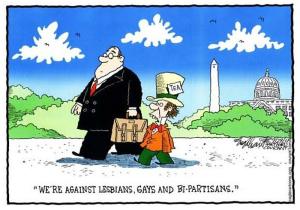 Here’s a taste of the German press as excerpted by Der Spiegel.
Munich’s national Süddeutsche Zeitung offers a slightly more depressing take, pointing blame at all sides. “What has already been apparent in America for a few years now is the self-destruction of one of the world’s oldest democracies. And the great tragedy here is that this work of destruction isn’t being wrought by enemies of democracy, greedy lobbyists or sinister major party donors. America’s democracy is bring broken by the very people who are supposed to be carry and preserve it: the voters, the parties and the politicians.”
The argument? The Republicans who have brought Washington to stillstand are repeatedly and democratically elected by voters and given a mandate to block. The parties themselves are fomenting an increasingly radicalized culture that deepens political, societal and geographic divisions in the country, argues the newspaper. And finally, there are few politicians in America who are willing or capable of thinking beyond their own electoral constituencies.
“At the moment, Washington is fighting over the budget and nobody knows if the county will still be solvent in three weeks,” the paper concludes. “What is clear, though, is that America is already politically bankrupt.”
America enjoys the “exorbitant privilege” of printing the world’s reserve currency. Its government debt is considered a safe haven, which is why Uncle Sam can borrow so much, so cheaply. America will not lose these advantages overnight. But anything that undermines its creditworthiness—as the farce in Washington surely does—risks causing untold damage in the future. It is not just that America would have to pay more to borrow. The repercussions of an American default would be both global and unpredictable.
It would threaten financial markets. Since American Treasuries are very liquid and safe, they are widely used as collateral. They are more than 30% of the collateral that financial institutions such as investment banks use to borrow in the $2 trillion “tri-party repo” market, a source of overnight funding. A default could trigger demands by lenders for more or different collateral; that might cause a financial heart attack like the one prompted by the collapse of Lehman Brothers in 2008. In short, even if Obamacare were as bad as tea-party types say it is (see Lexington), it would still be reckless to use the debt ceiling as a bargaining chip to repeal it, as some Republicans suggest.
What can be done? In the short term, House Republicans need to get their priorities straight. They should pass a clean budget resolution without trying to refight old battles over Obamacare. They should also vote to raise the debt ceiling (or better yet, abolish it). If Obamacare really does turn out to be a flop and Republicans win the presidency and the Senate in 2016, they can repeal it through the normal legislative process.
An FBI hostage negotiator has some hints on how to deal with petulant Tea Party bomb throwers.

So how did it get to this point? “Its fear-driven behavior,” says Voss. “They get angrier because they feel they’ve been defeated. People notice losses twice as much as they notice wins. It’s a sports metaphor you hear all the time: ‘I hate losing more than I like winning’…I think there’s a very strong sense of loss on their part over what they refer to as Obamacare and resentment over that is carried forward.”
But hostage negotiators aren’t the type to give up hope. “Ultimately, everybody wants success. And there are a lot of definitions of success,” Voss says. “Bottom line, they want to be made to look like they were effective and got things done for their side. So it’s a matter of refocusing on what’s in everybody’s best interests.”
He’s looking to the Obama White House to help start the reset: “I would ask them to start saying, ‘I understand that the people on the other side of the table have the best interests of the American people at heart.’ Simply recognize that. Everybody wants to do what’s best for the American public. Those sorts of statements repeated on a regular basis, it’s the start of dialogue. It’s not concession; it’s the beginning of dialogue.”
But the prison siege mentality Voss describes is exacerbated by an absence of strong calming leadership in the congressional GOP. “Those guys are sitting on the sidelines,” Voss says. “There are quite a few Republican politicians that I have a tremendous amount of respect for that are exceedingly silent these days.” He mentions House Intelligence Committee Chairman Mike Rogers: “I’ve never heard anything out of Mike’s mouth that wasn’t really thoughtful and nuanced.”
Another possible constructive calming voice on the conservative caucus could be former President George W. Bush. “I think there’s a possibility that he would be somebody that you would talk to behind the scenes, and potentially an intermediary himself. I think he absolutely has the ability to be a stabilizing influence.”
But how to do you deal with the hyper-partisan congressional bomb-throwers? “Well it’s like a game of tic-tac-toe with the tantrum throwers,” Voss says. “In tic-tac-toe, if you’re going second, the best you can possibly do is tie—if you play the game. There’s a first-mover advantage. The minute you stop playing that game the first mover advantage goes away. So you don’t play their game at all. That’s the way you respond.”
So, the craziness continues and escalates. If things come apart at the seams, I do not want to be stuck in Bobby Jindal’s Louisiana.
What’s on your reading and blogging list today?
Blue Friday Reads
Posted: October 4, 2013 Filed under: morning reads | Tags: Affordable Care Act, government shutdown, Tea Party, Tropical Storm Karen 29 Comments Good Morning!
I’m going through my blue period. It’s been going on for awhile. I’m actually thinking that it’s contagious because the blues appear to be popping up everywhere these days with the exception of the deeply delusion right wing who thinks ruining our country is a good thing.
So, first off, I may be out of the loop again awhile. Tropical Storm–maybe soon to be Hurricane–Karen has formed in the Gulf. New Orleans is in the cone but appears to be on the weak side of the storm. That means there’s a strong side and there’s some other folks in danger.
A hurricane watch is in effect for parts of the U.S. Gulf Coast after Tropical Storm Karen formed in the southeastern portion of the Gulf of Mexico, the National Hurricane Center said Thursday.
The watch covers the area from Grand Isle, Louisiana, to west of Destin, Florida. The center of the storm is forecast to be near the coast within that area Saturday.
A tropical storm warning is in effect from Grand Isle to the mouth of the Pearl River.
“Karen is expected to be at or near hurricane strength late Friday and early Saturday,” read a hurricane center advisory.
The storm, which as of Thursday evening was about 360 miles south of the Mississippi River’s mouth, prompted the Federal Emergency Management Agency to recall some of its workers, furloughed during the government shutdown. The agency also reactivated its Hurricane Liaison Team at the National Hurricane Center in Miami. FEMA officials in the Atlanta and Denton, Texas, offices are monitoring Karen.
“At all times, FEMA maintains commodities, including millions of liters of water, millions of meals and hundreds of thousands of blankets, strategically located at distribution centers throughout the United States, including in the Gulf Coast region, that are available to state and local partners if needed and requested,” the agency said in a statement.
The hurricane center said it, too, would be unaffected by the government shutdown as Karen approaches.
“The National Hurricane Center is fully operational … and has all of its resources available to it,” spokesman Dennis Feltgen said in an e-mail. “The government shutdown will not inhibit NHC from providing its mission.”

The money folks that usually love the Republican party is getting a little pissed as the DJ and other stock exchanges and indices begin their negative responses to government shutdown and the upcoming debt ceiling bump.
On a Monday last month, Rep. Greg Walden, chairman of the National Republican Congressional Committee, met with some top GOP donors for lunch at Le Cirque on Lexington Avenue in Manhattan. The donors, a youngish collection of financial industry types and lawyers, had some questions for Walden, a mild-mannered lawmaker from eastern Oregon known for speaking his mind.
Why, they asked, did the GOP seem so in the thrall of its most extremist wing? The donors, banker types who occupy the upper reaches of Wall Street’s towers, couldn’t understand why the Republican Party—their party—seemed close to threatening the nation with a government shutdown, never mind a default if the debt ceiling isn’t raised later this month.
“Listen,” Walden said, according to several people present. “We have to do this because of the Tea Party. If we don’t, these guys are going to get primaried and they are going to lose their primary.”
Walden asked how many of those seated around the table were precinct captains. These were money men, though, not the types to spend night after night knocking on doors and slipping palm cards into mailboxes.“A lot of the people there didn’t even know what a precinct captain was,” said one attendee.“A lot of the people there didn’t even know what a precinct captain was,” said one attendee.
“A lot of the people there didn’t even know what a precinct captain was,” said one attendee.
Not a single hand went up.
“I hear this complaint all the time,” Walden said. “But no one gets involved at the local level. The Tea Party gets involved at the local level.”
 Guess that’s what you get when you think religious freaks and science deniers will do your dirty work for you without extracting a pound of flesh.
Wonder why we need a shut down? Let some nice Tea Party Republican Congressman Mansplain it to you!
CNN’s Carol Costello confronted Rep. Todd Rokita (R-IN) over his party’s continued crusade against Obamacare Thursday morning, pushing him to admit that Republicans’ “divisive approach” is responsible for the prolonged government shutdown. Rokita dismissed Costello’s dogged questions by focusing on how young and beautiful he found the CNN host.
“I don’t know if you have children yet, I’m sure you don’t have grandchildren yet, you look much too young, but we’re fighting for them,” Rokita said. “Carol, do you have any idea how much this law is going to cost?”
Costello shot back, “Do you know how much it costs every day the government is partially shut down? You’re costing taxpayers millions and millions of dollars!”
Rokita insisted that Obamacare is “one of the most insidious laws ever developed by men” and will hurt the country “much more than any government shutdown.” Costello then pressed him on the upcoming dept ceiling fight, asking, “Obamacare hurts the country worse than [not] raising the debt ceiling? Because that’s not what a bunch of Wall Street bankers told the president yesterday.”
Rokita even dismissed the idea that defaulting on the nation’s debt would be more harmful than Obamacare. “I had a lot of CEOs in my office yesterday, and they didn’t share the same vision with me that some CEOs apparently shared with the president,” he said.
“I think most Americans would say fight that fight separate from the federal budget. Don’t partially shut down the federal government, don’t make things worse by fighting the same fight over and over,” Costello argued.
Rokita responded, “No, you’re part of the problem,” prompting Costello to roll her eyes and scoff, “Ugh, come on. That’s so easy.”
“Carol, you’re beautiful but you need to be honest as well,” Rokita finally said, eliciting an eyebrow raise from Costello.
Things can only get better?
Well, only if you live in a blue state. It seems that those of us that have petulant Republican Governors are not going to get the kind of subsidies that other states will as they make their insurance choices through the exchanges.
Because they live in states largely controlled by Republicans that have declined to participate in a vast expansion of Medicaid, the medical insurance program for the poor, they are among the eight million Americans who are impoverished, uninsured and ineligible for help. The federal government will pay for the expansion through 2016 and no less than 90 percent of costs in later years.
Those excluded will be stranded without insurance, stuck between people with slightly higher incomes who will qualify for federal subsidies on the new health exchanges that went live this week, and those who are poor enough to qualify for Medicaid in its current form, which has income ceilings as low as $11 a day in some states.
People shopping for insurance on the health exchanges are already discovering this bitter twist.
“How can somebody in poverty not be eligible for subsidies?” an unemployed health care worker in Virginia asked through tears. The woman, who identified herself only as Robin L. because she does not want potential employers to know she is down on her luck, thought she had run into a computer problem when she went online Tuesday and learned she would not qualify.
I have to admit that as much as I love New Orleans, the greater Seattle area is looking better to me all the time.
Maybe some of those Republicans can explain why ObamaCare is being implemented and Walmart is returning to full time employees? Isn’t that against their meme?
Wal-Mart, the nation’s largest employer, announced Monday that 35,000 part-time employees will soon be moved to full-time status, entitling them to the full healthcare benefits that were scheduled to be denied them as a result of Wal-Mart’s efforts to avoid the requirements of Obamacare.
While some analysts believe that the move comes as Wal-Mart is attempting to deal with the negative view many Americans have of its worker benefits program, a closer look reveals the real reason for the shift—
Wal-Mart’s business is going south due to the company’s penchant for putting politics and the squeeze on Wal-Mart employees ahead of the kind of customer satisfaction that produces prosperity over the long-term.
For anyone who has not been following the Wal-Mart saga, sales have been sinking dramatically at the retailer as the company has turned to hiring mostly temporary workers (those who must reapply for a job every 180 days) to staff their stores while cutting full-time employees’ hours down to part-time status in order to avoid providing workers with healthcare benefits.
The result?
Empty shelves, ridiculously long check-out lines, helpless customers wandering through the electronics section and general disorganization at Wal-Mart store locations.
Wow! It seems people expect customer service and inventory! Imagine that!!
So what happens if we play the debt brinkmanship game in the middle of this mess?
Today, the U.S. Department of the Treasury released a report on the potential macroeconomic effects of debt ceiling brinksmanship. The report states that a default would be unprecedented and has the potential to be catastrophic: credit markets could freeze, the value of the dollar could plummet, and U.S. interest rates could skyrocket, potentially resulting in a financial crisis and recession that could echo the events of 2008 or worse. By looking at the disruptions to financial markets that ensued in 2011, the report examines a variety of economic indicators – including consumer and small business confidence, stock price volatility, credit risk spreads, and mortgage spreads – through which a similar episode might harm the economic expansion. The report also notes that if the current government shutdown is protracted, it could make the U.S. economy even more susceptible to the adverse effects from a debt ceiling impasse than it was prior to the shutdown.
Image that! Not every one thrives on the idea that it’s good to create chaos in an attempt to bring on some kind of end times?
So, I’ll just trudge along today while I try to grab my usual hurricane hunker-down supplies knowing that at least there’s a cool front coming if the electricity dies and that I won’t have to follow the news if the cable TV dies. So, you’ll have to let me know what’s on your reading and blogging list today because I can still follow y’all on my cell phone.
Thursday Reads: Republicans and the Shutdown, Refugee Boat Disaster, The Dark Web, and Snowden
Posted: October 3, 2013 Filed under: Affordable Care Act (ACA), Crime, Criminal Justice System, FBI, Federal Government Shutdown, Foreign Affairs, Italy, morning reads, NSA, National Security Agency, Republican politics, U.S. Economy, U.S. Politics | Tags: "Dread Pirate Roberts", cryptography, Edward Snowden, gerrymandering, Glenn Greenwald, John Boehner, Johns Hopkins, Ladar Levison, Lampedusa, Lavabit, Matthew D. Green, Ohio redistricting, Ross William Ulbricht, Silk Road, Tea Party, the "dark web", US Chamber of Commerce 68 Comments
Good Morning!!
The government shutdown continues, and as Dakinikat wrote yesterday, no one seems to know how long this deadlock between extremist House Republicans (along with their chief hostage Speaker John Boehner) and the rest of Congress–Republicans and Democrats–will continue. It’s depressing as hell, and it’s really difficult to figure out what Republicans think they’re going to gain by it.
Just a few links:
CBS News — Poll: Americans not happy about shutdown; more blame GOP.
On day three of the partial government shutdown, a new CBS News poll reveals that a large majority of Americans disapprove of the shutdown and more are blaming Republicans than President Obama and the Democrats for it.
Fully 72 percent of Americans disapprove of shutting down the federal government over differences on the Affordable Care Act; just 25 percent approve of this action. Republicans are divided: 48 percent approve, while 49 percent disapprove. Most tea party supporters approve of the government shutdown – 57 percent of them do. Disapproval of the shutdown is high among Democrats and independents. This CBS News poll was conducted after the partial government shutdown began on October 1.
Views of the Affordable Care Act are related to views of the shutdown. Those who like the health care law also overwhelmingly disapprove of shutting down the government. There is more support for the shutdown among Americans who don’t like the 2010 health care law. Thirty-eight percent of them approve of the shutdown but even more, 59 percent, disapprove.
Republicans in Congress receive more of the blame for the shutdown: 44 percent of Americans blame them, while 35 percent put more blame on President Obama and the Democrats in Congress. These views are virtually the same as they were last week before the shutdown, when Americans were asked who they would blame if a shutdown occurred.
Bloomberg Businessweek: Republicans Are No Longer the Party of Business.
T.J. Gentle, chief executive officer of Smart Furniture, an online custom furniture maker in Chattanooga, employs 250 people, has seen sales grow 25 percent this year, and was planning another round of hiring—until Republican hard-liners forced the federal government to close on Oct. 1. Gentle is the embodiment of moderate, business-minded pragmatism: He voted for President Obama and Tennessee’s Republican Senator Bob Corker, splits his donations between the parties, and prefers divided government as a check on partisan excess. Like his plan to hire more workers, this too may change as a result of the shutdown. “It’s as if House Republicans are playing suicide bomber with the U.S. economy,” he says. “As a businessman, it defies all reason and logic.”
Smart Furniture and countless other businesses are already feeling the impact of the shutdown. The Federal Housing Administration, which backed one-third of all mortgages last year, has furloughed employees, a move that will slow loan approvals and house purchases. “That directly affects the construction and materials industries,” Gentle says, “but it also affects us, since the purchase of a new home is the No. 1 trigger for buying furniture.”
Larger businesses, which often tilt more heavily toward the GOP, are no less frustrated. It’s hard to find any organization more closely affiliated with the Republican Party than the U.S. Chamber of Commerce. In 2012 the business trade group spent $35,657,029 on federal elections, according to the Center for Responsive Politics. Of that, $305,044 was spent on behalf of Democratic candidates. Last year the Chamber went further to help Republicans than it ever had by running ads directly against candidates: It spent $27,912,717 against Democrats and only $346,298 against Republicans.
Geeze, if business isn’t happy with the GOP, who do they have left in their corner? The religious right and the Tea Party, I guess–and those groups likely have a lot of crossover. Is that enough for to support a national party?
CNN: Government shutdown: GOP moderates huddle as conservatives set agenda
A small but growing group of House Republicans is increasingly worried about the fallout from the government shutdown and say it’s time for Speaker John Boehner to allow a simple vote on a spending bill.
Defunding Obamacare can wait for now, they say.
“I’m trying to be optimistic but at the same time I have a really, really tough time when people are out of work and they can’t pay their bills,” Rep. Michael Grimm of New York told reporters Wednesday. “Though it might be a political loss for us … this is an untenable situation.”
Rep. Scott Rigell, whose Virginia district is home to a significant number of military members and civilian contractors, was one of the first to publicly break away.
“We fought the good fight,” he said in a tweet on Tuesday, but acknowledged it was time to move on.
Boehner hosted small groups of concerned members on Wednesday. A spokesman for Boehner declined to talk about the sessions.
How can Boehner get away with letting just 30% of his caucus run roughshod over the entire House? Think Progress may have the answer: How John Boehner Engineered An Ohio Gerrymander To Save His Speakership.
During the last redistricting cycle, then-Ohio state Senate President Tom Niehaus (R) pledged to deliver a redrawn map of Ohio’s congressional districts “that Speaker Boehner fully supports.” Indeed, at the height of the map drawing process, Boehner’s political aide Tom Whatman averaged a request a day to Ohio’s mapmakers — often micromanaging the slightest geographic changes in the district lines. In one case, for example, the line-drawers added a peninsula with no residents at all to Rep. Jim Renacci’s (R-OH) district because the peninsula included the headquarters of a company whose leaders donated generously to Renacci.
A full election cycle later, Team Boehner’s micromanagement paid off. President Obama won the state of Ohio by nearly two points in 2012, but 12 members of Ohio’s 16 member Congressional delegation are Republicans. In the nation as a whole, nearly 1.4 million more Americans voted for Democratic House candidates than Republicans.
The districts Boehner helped draw in Ohio played into a much larger Republican Party strategy to secure the House by rigging the legislative maps. Indeed, last January, the Republican State Leadership Committee released a report entitled “How a Strategy of Targeting State Legislative Races in 2010 Led to a Republican U.S. House Majority in 2013.” The report bragged that gerrymandering “paved the way to Republicans retaining a U.S. House majority in 2012.”
And, as TP notes, this strategy was replicated and a number of other states.
FOX News: Congress misses deadline, sending government into partial shutdown
Congress blew by a midnight deadline to pass a crucial spending bill, triggering the beginning of a partial government shutdown – the first in 17 years.
The failure means the gears of the federal government will start to slow down on Tuesday, though hundreds of thousands of federal workers will remain on the job. Though it’s been a long time since the last one, this marks the 18th shutdown since 1977.
Lawmakers missed the deadline after being unable to resolve their stand-off over ObamaCare, despite a volley of 11th-hour counterproposals from the House. Each time, Senate Democrats refused to consider any changes to ObamaCare as part of the budget bill.
House Republicans, for their part, refused to back off their demand that the budget bill include some measures to rein in the health care law – a large part of which, the so-called insurance “exchanges,” goes into effect on Tuesday.
As House Republicans endorsed one more counterproposal in the early morning hours, lawmakers spent the final minutes before midnight trying to assign blame to the other side of the aisle. Republicans are no doubt wary of the blowback their party felt during the Clinton-era shutdown, while Democrats were almost eager to pile the blame on the GOP.
“This is an unnecessary blow to America,” Senate Democratic Leader Harry Reid said.
House Speaker John Boehner claimed that Republicans are the ones trying to keep the government open but “the Senate has continued to reject our offers.”
Ahead of the deadline, the White House budget office ordered agency heads to execute an “orderly shutdown” of their operations due to lack of funds. Americans will begin to feel the effects of a shutdown by Tuesday morning, as national parks close, federal home loan officers scale back their caseload, and hundreds of thousands of federal workers face furlough.
The question now is how long the stand-off will last. Congress is fast-approaching another deadline, in mid-October, to raise the debt limit or face a U.S. government default. Lawmakers presumably want to resolve the status of the government swiftly in order to shift to that debate.
Throughout the day Monday, lawmakers engaged in a day-long bout of legislative hot potato.
The House repeatedly passed different versions of a bill that would fund the government while paring down the federal health care overhaul. Each time, the Senate said no and sent it back.
As a last-ditch effort, House Republicans early Tuesday morning endorsed taking their disagreement to what’s known as a conference committee – a bicameral committee where lawmakers from both chambers would meet to resolve the differences between the warring pieces of legislation.
The latest House bill, which the Senate shot down late Monday, would delay the law’s individual mandate while prohibiting lawmakers, their staff and top administration officials from getting government subsidies for their health care.
The House voted again to endorse that approach early Tuesday and send the bill to conference committee.
“It means we’re the reasonable, responsible actors trying to keep the process alive as the clock ticks past midnight, despite Washington Democrats refusal – thus far – to negotiate,” a GOP leadership aide said.
Reid, though, said the Senate would not agree to the approach unless and until the House approves a “clean” budget bill.
The rhetoric got more heated as the deadline neared.
“They’ve lost their minds,” Reid said of Republicans, in rejecting the latest proposal.
“Senate Democrats have made it perfectly clear that they’d rather shut down the federal government than accept even the most reasonable changes to ObamaCare,” Senate Republican Leader Mitch McConnell countered.
Amid the drama, President Obama said he was holding out hope that Congress would come together “in the 11th hour.”
Such a deal did not come to pass.
A prior Republican effort to include a provision defunding ObamaCare in the budget bill failed. House Republicans then voted, early Sunday, to add amendments delaying the health care law by one year and repealing an unpopular medical device tax.
The Senate, in a 54-46 vote, rejected those proposals on Monday afternoon.
At this stage, congressional leaders are hard at work trying to assign blame.
Democrats have already labeled this a “Republican government shutdown.” But Republicans on Sunday hammered Reid and his colleagues for not coming back to work immediately after the House passed a bill Sunday morning.
In other news . . .
This story is just breaking . . . From CNN: Scores dead after boat sinks of Italian island of Lampedusa.
At least 94 people, including a pregnant woman and two children, died when a boat capsized and caught fire off the island of Lampedusa, the Italian coast guard told CNN on Thursday.
The coast guard has been able to save at least 151 people, and the rescue operation is ongoing.
The boat is thought to have been carrying up to 500 people. Those aboard include Somalis, Eritreans and Ghanaians, the coast guard said, and the boat is thought to have launched from Libya’s coast.
Lampedusa, the closest Italian island to Africa, has become a destination for tens of thousands of refugees seeking to enter European Union countries.
The head of the U.N. refugee agency, Antonio Guterres, praised the efforts of the Italian coast guard but said he was “dismayed at the rising global phenomenon of migrants and people fleeing conflict or persecution and perishing at sea.”
Some context on this story, also from CNN, a June 2011 story about one of Lampedusa’s boat people.
Yesterday the FBI shut down a website called Silk Road that has been used for massive amounts of criminal activity. From Fox News: Feds shut down $1.2 billion criminal internet marketplace.
Federal authorities have shut down what they called the “most sophisticated and extensive criminal marketplace on the Internet today,” an underground operation responsible for distributing illegal drugs and other black market goods and services.
The site’s alleged owner, Ross William Ulbricht, was arrested and $3.6 million in anonymous digital currency known as Bitcoins was seized. The site, which did about $1.2 billion in sales, was taken over by federal authorities, according to court documents unsealed Wednesday in the Southern District of New York. Learn more about digital currency here at Crypto Code Review
Ulbricht was alleged to operate a website responsible for distributing hundreds of kilograms of illegal drugs and other illicit goods and services, including fake IDs and computer hacking-related services. He was indicted on charges of drug conspiracy, computer intrusion offensives conspiracy, and money laundering conspiracy.
Ulbricht, 29, used the aliases “Dread Pirate Roberts,” “DPR,” and “Silk Road” while operating the site, authorities said.
From BBC News, Silk Road: How FBI closed in on suspect Ross Ulbricht.
It was an underground website where people from all over the world were able to buy drugs.
In the months leading up to Mr Ulbricht’s arrest, investigators undertook a painstaking process of piecing together the suspect’s digital footprint, going back years into his history of communicating with others online….
The search started with work from Agent-1, the codename given to the expert cited in the court documents, who undertook an “extensive search of the internet” that sifted through pages dating back to January 2011.
The trail began with a post made on a web forum where users discussed the use of magic mushrooms.
In a post titled “Anonymous market online?”, a user nicknamed Altoid started publicising the site.
“I came across this website called Silk Road,” Altoid wrote. “Let me know what you think.”
According to Onblastblog.com, the post contained a link to a site hosted by the popular blogging platform WordPress. This provided another link to the Silk Road’s location on the so-called “dark web”.
Read the whole story at the link.
From Andy Greenberg at Forbes: Feds Allege Silk Road’s Boss Paid For Murders Of Both A Witness And A Blackmailer.
When I interviewed the Dread Pirate Roberts, the persona behind the anonymous black market drug website known as Silk Road, he described his narcotics bazaar as a victimless libertarian experiment. But criminal complaints against Ross William Ulbricht, the 29-year-old entrepreneur who allegedly wore that pirate’s mask, now claim that he was also willing to leave a few bodies in his wake.
In two separate sets of charges released Wednesday following the seizure of the Silk Road’s domain and servers, federal prosecutors accused Ulbricht of not only conspiracies to sell drugs and launder money, but also of paying hitmen for the murder of two individuals, one who is described as attempting to blackmail Ulbricht after hacking a Silk Road vendor and learning the identities of thousands of the site’s users, and another employee of the Silk Road who Ulbricht allegedly feared might reveal him to law enforcement.
“DPR’s communications reveal that he has taken it upon himself to police threats to the site from scammers and extortionists,” reads an affidavit from FBI agent Christopher Tarbell, “and has demonstrated a willingness to use violence in doing so.”
In the one of the two cases, filed in a Maryland district court, a criminal complaint against Ulbrichtdescribes how an undercover agent gained Ulbricht’s trust after communicating with him through the Dread Pirate Roberts account Ulbricht is thought to have used and conducting a $27,000 cocaine deal through the Silk Road. The agent later allegedly received a message from the Dread Pirate Roberts asking if he’d be willing to arrange the beating of a Silk Road employee who Roberts said had scammed users of the site and taken their bitcoins, the cryptographic currency used on Silk Road.
Read much more at the link.
Just a side note on the Silk Road story: the “dark web” makes use of the encryption methods recommended by Edward Snowden and Glenn Greenwald. This is the “other side” of the fight for “privacy rights.”
Here are a couple more Snowden/Greenwald news stories I came across.
From The Verge: Snowden’s email provider Lavabit fought government surveillance with ultra-tiny font.
Earlier this summer, a few weeks after former NSA contractor Edward Snowden’s leaked documents on the agency’s surveillance practices were published, the encrypted email service provider he used, called Lavabit, shut itself down. At that time, Lavabit’s founder Ladar Levison said he was shuttering his website to avoid “becom[ing] complicit in crimes against the American people,” which many took to mean he was resisting further surveillance demands by the US government. It turns out we didn’t know the half of it: new court documents unsealed today in the US District Court for Virginia’s Eastern District, obtained by Wired, reveal that Levison fought the US government tooth-and-nail to avoid handing over the encryption keys that would allow government agents to read his customers’ emails.
In the harrowing saga recounted in the newly unsealed documents, it turns out the government obtained a search warrant in July and demanded Lavabit hand over the encryption and secure-socket layer (SSL) keys to its system. The government was pursuing the emails sent by a single target, whose name has been redacted, but as Wired points out, it’s highly likely that user was Snowden himself.
From the Baltimore Sun: Hopkins professor rejects invitation to review NSA documents leaked by Snowden
A Johns Hopkins University cryptography professor — who gained media attention when university officials told him to take down a blog post he wrote about National Security Agency documents leaked by Edward Snowden — says he declined an invitation this week to join journalists and others reviewing the classified NSA documents.
“The truth is, I don’t really know what to say,” said Matthew D. Green, who received the invitation from Guardian journalist Glenn Greenwald via Twitter on Thursday.
“It was a very generous offer,” Green said. “I think somebody should be down there and they need more expertise to go through those documents, [but] I’m not sure I want it to be me.”
Greenwald, who received the documents from Snowden and has led global reporting on them, invited Green to his home in Rio de Janeiro, Brazil, to “work journalistically” on the documents, specifically as they pertain to the NSA’s alleged circumvention of online encryption tools.
The invitation gave a boost to Green’s rising prominence in the debate over NSA spying methods. Johns Hopkins administrators this month briefly asked him to remove from universityservers a blog post he had written about coverage of the Snowden documents.
This post has gotten way too long, so I’ll put the rest of my links in the discussion thread below. Now what stories are you following today? Please post your links in the comments.
Tuesday Reads
Posted: October 1, 2013 Filed under: Affordable Care Act (ACA), Barack Obama, morning reads, U.S. Economy, U.S. Politics | Tags: Fourteenth Amendment, health insurance exchanges, John Boehner, meteor, Obamacare, science, Tea Party Extremists 61 Comments
Good Morning!!
It’s October first in the good ol’ US of A, and one Senator, one ex-Senator, and thirty Republican House members, with the help of the weakest Speaker of the House in history, John Boehner, have managed to shut down the government. And yet, despite the concentrated efforts of these terrorist blackmailers, the Affordable Care Act, AKA Obamacare, continues onward, with health care exchanges opening today. Wall Street is nervous, but still not really accepting that Republicans are really trying to crash the economy.
Despite the claims of John Boehner that he and the Tea Party Republicans are just “listening to the American people,” the American people don’t support what they are doing. Bloomberg: Americans by 72% Oppose Shutdown Tied to Health Care Cuts.
In a rejection of congressional Republicans’ strategy, Americans overwhelmingly oppose undermining President Barack Obama’s health-care law by shutting down the federal government or resisting an increase in the nation’s debt limit, according to a poll released today.
By 72 percent to 22 percent, Americans oppose Congress “shutting down major activities of the federal government” as a way to stop the Affordable Care Act from going into effect, the national survey from Quinnipiac University found.
By 64 percent to 27 percent, voters don’t want Congress to block an increase in the nation’s $16.7 trillion federal borrowing limit as a way to thwart implementation of the health-care law, which Obama signed into law in 2010 with a goal of insuring millions of Americans, known as “Obamacare.”
A majority of the public, 58 percent, is opposed to cutting off funding for the insurance program that begins enrollment today. Thirty-four percent support defunding it.
That’s pretty much it for national politics news today. As an American, I feel really embarrassed that a small number of wingnut terrorists have been permitted to take over the government of a nation of 300 million people. What else can you call it but a coup? And of course it won’t end here. We are approaching the debt limit, and a couple of weeks from now the GOP will most likely hold us all hostage again. At Policymic, Drew Mendelson writes:
I spent some time on the topic of the debt ceiling last year. I won’t repeat that except to note that we are approaching the limit of $16.7 trillion set last year on how much debt the federal government can maintain. Since government sending continues to outpace its income, we will need to borrow to pay some of our debts. Unless the debt ceiling is raised, once we hit it we will no longer be able to borrow and will likely default on some of that debt. The resulting catastrophe of frozen credit, climbing interest rates, and a stalling economy could bring a replay of the Great Recession of 2007-2009.
Conservative icon Ronald Reagan once warned that “the full consequences of a default — or even the serious prospect of default — by the United States are impossible to predict and awesome to contemplate. Denigration of the full faith and credit of the United States would have substantial effects on the domestic financial markets and the value of the dollar.”
I can’t imagine that even the hardest core in either party wants that. But the threat of it could give the Republicans (or maybe just its Tea Party faction) an opportunity for hostage-taking far more ominous than in the budget resolution battle. We went to the brink on the debt ceiling last year and ended up passing an increase but at the cost of maintaining most of the sequester cuts in the process.
This doesn’t have to happen. It’s time for President Obama to use the Constitutional option and raise the limit on his own. Back to Mendelson:
Does President Obama have to put up with this? Some say no. There is a range of opinion on whether or not the Section 4 of the Fourteenth Amendment gives the president the power to bypass Congress and raise the debt ceiling by executive order. House Minority Leader Nancy Pelosi (D-Calif.) said earlier this year: “Well, you ask the Republicans …we always passed the debt ceiling. When President Bush was president, as he was incurring these massive debts, and the Republicans weren’t saying ‘boo’ at the time.… In fact, if I were president, I’d use the Fourteenth Amendment, which says that the debt of the United States will always be paid.” [….]
Our cautious President obviously doesn’t want to do it. But experts say he has the power.
in a July 2011 New York Times op-ed piece, law professors Eric A. Posner and Adrian Vermeule argue that even without the Fourteenth Amendment the president would have the power to override the debt ceiling based on “the necessities of state, and on the president’s role as the ultimate guardian of the constitutional order, charged with taking care that the laws be faithfully executed.”
As Mendelson writes, we are going to find out pretty soon whether President Obama will use the power he has to stop Congress from holding the entire country hostage to the fantasies of a few extremists.
As of today, the President and Democrats in general are the winners in this ugly little drama, according to NBC News’s Michael O’Brien:
The shutdown of the federal government is poised to reshuffle U.S. politics, as Americans observe one of the starkest examples of political dysfunction since the last shutdown in the mid-90s.
That crisis reinvigorated President Bill Clinton and badly set back a then-resurgent Republican Party that had designs of retaking the White House in the 1996 elections. The GOP fell well short of expectations in that election, though some conservatives now argue that the party’s performance wasn’t as bad as it seemed at the time.
Nonetheless, after two-and-a-half years of standoffs and gridlock, the fact that a shutdown has finally come to pass — 17 days before Congress must also raise the debt ceiling, no less — could upend politics with unforeseen consequences for many of this fight’s key players.
Read O’Brien’s take on the winners and losers in this battle as of today at the link. Spoiler: Obama is up right now, but he could hurt himself if he doesn’t step up and deal with the childish tantrums of the Tea Party Republicans over the debt ceiling.
Now I want to move on from the ridiculous and embarrassing battles in Washington DC to a story about women making a difference.
From PBS News Hour: World Pulse’s “web” of women keeps growing.
In her early 20s, Jensine Larsen was working as a freelance journalist in Burma and the Amazon region of South America, and learned that many of the stories affecting women weren’t being reported in the media. She then realized that women shouldn’t have to depend on the media to tell their stories.
“If we want to solve water issues and health care, the only way we can solve them is by listening to women,” she told the PBS NewsHour recently over the phone.
Larsen, a Portland, Ore., native, visualized a place where women could report for themselves, and founded World Pulse magazine, which came out with its first edition in 2004.
As technologies and social media evolved, so did World Pulse, and it launched an online component in 2007 with the goals of bringing women together and giving them a voice and the ability to improve their communities and their lives.
“We’re not about professional journalists, we’re more about that emerging woman leader who’s just coming online and has a powerful contribution to make,” Larsen said.
It’s an inspiring story–please go read the whole thing.
Finally, a little science news:
Ohioans who were outside late last night got a surprise from the Universe, according to the Columbus Dispatch: Meteor over central Ohio lights up night, phone lines.
The bright flash of light at 11:33 p.m. prompted some people to call Columbus police to ask what it was while officers chatted about the event over their radios.
“The initial trajectory suggests it passed over Columbus, Ohio, moving slightly north of west,” Bill Cooke of NASA’s Meteoroid Environments Office told The Dispatch in an email. Cooke said there were some reports of sounds similar to sonic booms, which suggests some of the fireball’s fragments made it to fairly low altitudes.
NASA’s meteor camera in Ohio and Pennsylvania first detected it at 67 miles up, and it began breaking apart 41 miles above the earth. Cooke said it’s not yet certain, but it’s unlikely that the fireball produced meteorites on the ground given the “tremendous” speed at which it was moving.
“The fireball was so bright our meteor-detection software ‘went home to momma’ and thought it was seeing lightning,” Cooke wrote. “The fireball lit up the sky, so the detection software thought it was lightning and did not flag it as a meteor/fireball.”
According to the American Meteor Society’s website, Ohio was ground zero for the sighting. The society’s fireball coordinator, Robert Lunsford, said the fireball already had generated 900 reports to the society’s website, making it the third-most reported meteor event since the group began tracking them in 2005.
What was exciting was that this event happened at a time when lots of people were awake and looking up at the sky. I would just love to see a meteor! See a short video at the link.
Here’s another science story from The A Register: Egad! TUPPERWARE FOUND on ALIEN MOON: NASA shocker.
A NASA spacecraft sniffing the smoggy atmosphere of Titan has found traces of the chemical used to make plastic Tupperware boxes….
As if the place wasn’t nasty enough, space boffins now know that it is home to detectable quantities of propylene, which is a key ingredient in food containers as well as car bumpers.
NASA used Cassini’s Composite Infrared Spectrometer (CIRS) to scan the hazy atmosphere, measuring the heat radiation emitted as infrared light from the moon in a process that NASA described as being similar to “the way our hands feel the warmth of a fire”.
The first chemical the scientists discovered using the CIRS was propylene, which was identified in small quantities at various altitudes throughout the lower levels of the soupy hydrocarbon fog found in the moon’s noxious skies.
“This chemical is all around us in everyday life, strung together in long chains to form a plastic called polypropylene,” said Conor Nixon, a planetary scientist at NASA’s Goddard Space Flight Center in Greenbelt, Maryland, and lead author of a paper describing the findings.
“That plastic container at the grocery store with the recycling code 5 on the bottom – that’s polypropylene.”
Geographer Franck Lavigne of the Université Paris 1 Panthéon-Sorbonne and his research group believe they have solved an 800-year-old puzzle: Deadly 13th-Century Volcano Eruption: Mystery Solved?
One of history’s great disaster mysteries may be solved—the case of the largest volcanic eruption in the last 3,700 years. Nearly 800 years ago, the blast that was recorded, and then forgotten, may also have created a “Pompeii of the Far East,” researchers suggest, which might lie buried and waiting for discovery on an Indonesian island.
The source of an eruption that scattered ash from pole to pole has been pinpointed as Samalas volcano on Indonesia’s Lombok Island. The research team, led by geographer Franck Lavigne of the Université Paris 1 Panthéon-Sorbonne, has now dated the event to between May and October of 1257. The findings were published today in the Proceedings of the National Academy of Sciences.
“It’s been a long time that some people have been looking,” said Lavigne. After glaciologists turned up evidence for the blast three decades ago, volcano experts had looked for the origin of the eruption everywhere from New Zealand’s Okataina volcano to Mexico’s El Chichón.
The previously unattributed eruption was an estimated eight times as large as the famed Krakatau explosion (1883) and twice as large as Tambora in 1815, the researchers estimate. (Related: “Tambora: The Greatest Explosion in History.”) “Until now we thought that Tambora was the largest eruption for 3,700 years,” Lavigne said, but the study reveals that the 1257 event was even larger.
Those are my offerings for today. What stories are you following? Please share your links in the comment thread.
Monday Reads
Posted: September 30, 2013 Filed under: morning reads, U.S. Economy, U.S. Politics | Tags: Affordable Health Care Act, conscience clause 67 Comments Good Morning!
Most of the news today is about the looming shutdown of the Federal Government. Our government is truly dysfunctional. The states have gerrymandered us into a Congress that doesn’t care about the country at all. They just take care of their base and their personal pork. We’ve also got a krewe of congress critterz that’s about as dumb as they come. Why are some of them gleeful over the idea of a shutdown? What do they think they have to gain and why would they hurt so many people?
Why have House Republicans pursued their effort to defund, and now to delay, Obamacare so relentlessly, even though they have almost zero chance of success in the face of a rapidly-approaching deadline for shutting down the government? And why have they done so when many in their party have warned that a shutdown would be suicidal for the GOP?
I talked with one of the most vocal of the defund/delay advocates, Minnesota Rep. Michele Bachmann, on Friday night, as she waited to hear what path the House Republican leadership would take. It’s safe to say her views reflected those of many of her conservative colleagues, and her reasoning was this: One, Obamacare as a policy is so far-reaching, so consequential, and so damaging that members of Congress should do everything they can — everything — to stop it before it fully goes into effect. Two, lesser measures to fight Obamacare — repealing the medical device tax or making Congress purchase coverage through the exchanges without special subsidies — are just not big enough to address the problem. And three, there have been government shutdowns in the past over far less urgent reasons that did not result in doom for Republicans.
“There is a very large group of us who believe that this is it, this isn’t just another year, this isn’t just another CR fight,” Bachmann told me. “This is historic, and it’s a historic shift that’s about to happen, and if we’re going to fight, we need to fight now.”
“This isn’t just another bill,” Bachmann continued. “This isn’t load limits on turnip trucks that we’re talking about. This is consequential. And I think the reason why you’ve come to this flash point is that this is an extremely consequential bill that will impact every American, and that’s why you have such passionate opinions. And we’re not giving up and we’re not caving in that easily.”
For Bachmann and many of her colleagues, the enormity of the issue serves to highlight the problem with less extensive anti-Obamacare measures. “The Vitter Amendment isn’t going to help real people,” Bachmann told me. “It’s going to be a political move, but it’s not going to help real people. Obamacare will continue to destroy the economy. Now, repealing the medical device tax does help the economy. Here in the Beltway, we get the medical device tax issue. And in my state of Minnesota, we get the medical device tax issue. That’s our industry. And I’m all for [repealing] it, but for most Americans, that is not something that they see that they want to get.”
It’s really strange to see the apoplexy shown by Republicans when they call the American Heritage’s Dole/Chaffey Care alternative to Hillarycare some kind of socialist plot. What happens under the law if implementation is slowed down even one year? Many states, businesses, insurance companies and health care providers have already started their transition.
So what does this “compromise” actually look like? For a party that has centered their platform around reducing spending and the deficit, it’s surprisingly bad economics.
First of all, repealing the medical device tax would actually add $30 billion to the deficit. That provision, which imposes a 2.3 percent tax on medical devices, is one of the funding sources for Obamacare’s coverage expansions. Proponents say that the tax will be balanced out by the influx of new Americans entering the insurance market. But getting rid of it now without finding another way to finance health reform would simply increase health reform’s price tag.
Furthermore, delaying Obamacare’s individual mandate — a central tenet of the health law that requires everyone to purchase insurance — would have catastrophic effects. The Congressional Budget Office (CBO) projects it would end up forcing Americans to pay higher premiums for their health coverage. Healthier people would be discouraged from buying insurance, resulting in an older and sicker pool of people in the individual market and encouraging insurers to submit higher rates. The delay would ultimately hike premiums by an estimated 15 to 20 percent.
And according to the CBO, a one-year delay would leave about 11 million Americans uninsured, ultimately reducing the expected coverage gains under the health reform law by nearly 85 percent. As those uninsured Americans end up seeking care in hospitals, the cost of providing that uncompensated care will offset any costs that are achieved by delaying Obamacare’s coverage expansion. Ultimately, delaying the mandate doesn’t actually save the government any money.
As Wonkblog reports, delaying the individual mandate would have a “ripple effect” throughout the health insurance industry. That sector has been preparing for impending changes under Obamacare, and a last-minute decision to delay the law would be a huge drain on the companies that have already spent millions of dollars on advertising and outreach campaigns. “It’s just too late,” Joe Antos, a health policy researcher at the American Enterprise Institute,told Wonkblog. “Everybody who is involved, insurance companies and hospitals and any other big entity, they’re ready to go. They really can’t make any changes.”
When the Affordable Care Act was winding its way through the court system last summer, a conservative federal judge made the point that suddenly striking down health reform would create “economic chaos.” And at this point, as many of Obamacare’s consumer protections have already taken effect, the individual mandate is inextricably linked to making the health reform law work in practice. A new paper from the Urban Institute notes that delaying the individual mandate would “seriously disrupt overall implementation” of health reform.
Most folks believe that the GOP will get the blame for the shutdown.
The federal government swerved toward a shutdown on Saturday when House Republicans demanded to hold a vote to delay Obamacare by one year instead of cooperating with the Senate to pass a “clean” spending bill. It’s now practically assured that parts of the government will go dark on Tuesday for the first time in 17 years.
From a Republican point of view, there are three possible happy endings to the looming catastrophe.
Happy Ending #1: The president blinks. He’s blinked before after all—notably when he agreed to sequestration in 2011—and who knows? He might blink again.
Problem with Happy Ending #1: This time, though, “blinking” means blowing up the president’s most important legacy: his health-care plan. That’s more than a blink. He might as well hand in his resignation after that.
Happy Ending #2: The country blames the Democrats for the shutdown. After all, the GOP is only asking for the president to negotiate. It’s the president who refuses to yield.
Problem with Happy Ending #2: Republicans actually shut down the government in 1995. They took the country to the brink of debt default in 2011. Their caucus is reacting to this shutdown with enthusiasm, not regret. It’s going to be hard to sell the claim that it’s the Democrats who brought about this latest outcome when Republicans come out of caucus looking so happy about it.
Happy Ending #3: Even if the president does not blink, and even if Democrats don’t get blamed, perhaps Republican activists will be so motivated and mobilized by the shutdown that their excitement will loft the party to big wins in the 2014 races.
Problem with Happy Ending #3: Because Happy Endings 1 and 2 look so unlikely, the shutdown is likely to end in a Republican retreat. Party activists will be demotivated—and may waste their energy recriminating against their own leadership rather than organizing to fight Democrats.
 There is also the usual Republican slap to women included in the budget.
Typical of the privileged, entitled spoiled brats that they collectively are, the House Republicans threw everything but the kitchen sink into their government funding bill. The bill, which purportedly was to stave off a government shutdown, was instead a big, fat sloppy kiss to all of the special interests that want to curtail average Americans’ lives while enriching the top one percent even further.
Telling, perhaps, that they were unable to do it without drinking heavily enough to be noticeable from the gallery. Putzes.
The “funding” bill included a clause that for the puritanical and/or science ignorant Republicans, may be the king of unintended consequences: delaying funding for contraceptive care under ACA:
House Republicans included a so-called “conscience clause” in the government funding billin a plan they approved early Sunday.
The House voted 231-192 on a bill that would delay much of the 2010 health care overhaul for a year. It would also repeal a tax on medical devices that helps finance the health care law. The measure would allow employers and insurers to opt out of providing health care services that they find morally or religiously objectionable. The addition reignites the debate over a portion of the health care reform law that requires most insurers to cover women’s preventative health care, including contraception.
It’s enough to make me want to nut punch a Republican member of Congress. Need I remind them once again that in addition to preventing unwanted pregnancies, contraceptives are used therapeutically as well for a host of women’s health issues? Those “family-friendly” idiots will not be satisfied until Americans see an increase of abortions (oh, wait…), an increase in people applying for federal assistance due to the forced births (oh, wait…) or a bunch of motherless children,
However, the Exchanges set up by the Affordable Healthcare Act are being set up. It’s interesting that the Republican plan to shut down the Government isn’t really shutting down Obamacare.
Many pieces of the health care law, the Affordable Care Act, aren’t tied to the annual spending bills. Much of the health law is mandatory spending — a kind of fiscal autopilot that’s not part of the annual appropriations battle that has Congress tied in knots. The mandatory components of the health law include the subsidies to help people buy private health plans as well as the expansion of Medicaid in many states. Both of those functions will be handled through the new health insurance markets or exchanges.
Because those programs are mandatory, the Department of Health and Human Services has a lot of leeway to say whether Obamacare activities can continue — and HHS officials have made clear they’re going to use it.
On Friday, the HHS quietly posted its shutdown contingency plan. The bottom line is clear: Obamacare would continue, including the health exchanges and their coordination with Medicaid. It also said Medicare coverage “will continue largely without disruption.” True, lots of HHS workers would be furloughed — but those who would be told to stay home are concentrated in agencies that are not driving the launch of the health law.
HHS says its plan is consistent with legal advice that allows activities that “do not rely on annual appropriations, and activities that involve the safety of human life and protection of property” to keep running even if much of the government shuts down. And that means the staff that carry out mandatory programs like those in the health law can keep working — even if their positions are funded through the annual spending bills
I’ll let you know how the process is going to work down here in one of the states that’s fighting the law every way it can. I was told Friday that the adjunct health care plan that I’ve had for the past few years doesn’t meet the minimum standards for the Act and won’t be offered. I am going to head to the exchange next week and find out what my options are going to be. I’m glad to be out of my subpar health insurance plan, but wondering if the federal exchange is going to have many choices here in a state with a hostile governor.
So, I know this was a little oriented to the one topic of the day, but I thought we needed to spend some time on it. Feel free to share your thoughts on this or any other links on any other subjects that made your reading and blogging list today!!!

 peej
peej Carissa
 bostonboomer
 dakinikat
 ecocatwoman
 mablue2
 Mama Lopez
 peggysue22
 quixote
 skydancingguestblogger
 Mona (aka Wonk the Vote)



 Sky Dancing
Recent Comments