
Tuesday Reads: Nightmare on Capitol Hill
Posted: October 15, 2013 Filed under: Barack Obama, morning reads, Republican politics, U.S. Economy, U.S. Politics | Tags: Congress, Debt Ceiling, government shutdown, Harry Reid, Mitch McConnell, Paul Ryan, Tea Party, Ted Cruz 51 Comments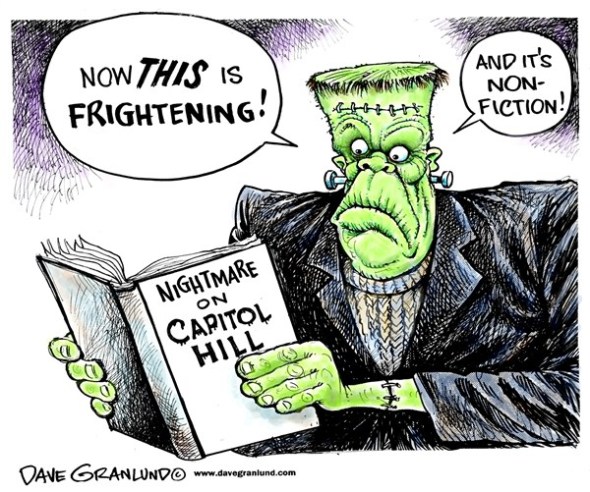
Good Morning!!
Yes, it’s real–too real. We’re approaching the deadline for raising the debt ceiling–it’s Thursday–and Congress is still dithering. But it looks like they may figure out a way to kick the can down the road again, as long as Ted Cruz doesn’t decide to have another tantrum.
According to the Hill this morning, Harry Reid and Mitch McConnell are close to agreeing on “a deal” to reopen the government and raise the debt ceiling for a few more months. The two Senate leaders huddled for hours yesterday trying to put together some kind of package that would satisfy House Republicans and convince them not to bring down the U.S. Government and the global economy.
An emerging deal to reopen the government and raise the nation’s debt ceiling until February gathered political momentum Monday evening after Senate Republicans signaled they would likely support it.
Lawmakers and aides said the legislation would fund the government until Jan. 15 and extend the nation’s borrowing authority until February but leave ObamaCare largely untouched.
The agreement would also set up another “supercommittee” to try to deal with the next round of automatic sequester cuts. The committee would have until December 13 to report to Congress. Anyone who thinks they’ll agree on anything, please raise your hand.
The big question is whether a package to fund the government and raise the debt ceiling can pass muster in the House.
Speaker John Boehner (R-Ohio) was briefed on the deal Monday, and members of his conference were taking a wait and see attitude.
“When we see it, we’ll know what it is. Do you know what it is yet?” Rep. Pete Sessions (R-Texas), chairman of the House Rules Committee, asked reporters as he left Boehner’s office.
“As soon as we see something in writing, then we can understand how we can thoughtfully understand what we’ll do with it,” Sessions said.
House Majority Leader Eric Cantor (R-Va.) wouldn’t comment on the emerging Senate deal, but he told reporters House Republicans will meet Tuesday morning “to discuss a way forward.” “Possible consideration of legislation related to the debt limit” was added to Cantor’s daily House schedule for Tuesday.
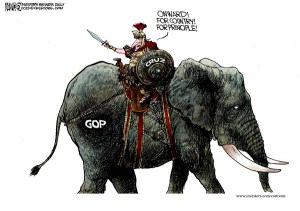
Of course the biggest potential fly in the ointment is Texas junior Senator Ted Cruz and his gang of Tea Party House members. Cruz wouldn’t say whether he’s planning another fake filibuster or some other effort to kill the Affordable Care Act. However, Cruz did hold a secret meeting with House Republicans last night, according to Roll Call.
Sen. Ted Cruz met with roughly 15 to 20 House Republicans for around two hours late Monday night at the Capitol Hill watering hole Tortilla Coast.
The group appeared to be talking strategy about how they should respond to a tentative Senate deal to reopen the government and raise the debt ceiling without addressing Obamacare in a substantive way, according to sources who witnessed the gathering. The Texas Republican senator and many of the House Republicans in attendance had insisted on including amendments aimed at dismantling Obamacare in the continuing resolution that was intended to avert the current shutdown.
Sources said the House Republicans meeting in the basement of Tortilla Coast with Cruz were some of the most conservative in the House: Reps. Louie Gohmert of Texas, Steve King of Iowa, Jim Jordan of Ohio, Tom Cotton of Arkansas, Raúl R. Labrador of Idaho, Steve Southerland II of Florida, Mark Meadows of North Carolina and Justin Amash of Michigan.
The group is a collection of members who have often given leadership headaches in recent years by opposing both compromise measures as well as packages crafted by fellow Republicans….While the emerging deal to reopen the government and hike the debt ceiling increase may have been a hot topic, it was not immediately clear what the group actually discussed. But the fact that such a group met with Cruz at all could give House GOP leaders even more heartburn as they consider themselves what to do if the Senate passes the measure.
If Cruz and his buddies decide to cause more trouble, they could bring about a default by dragging the fight out until after Thursday. Treasury Secretary Jack Lew could probably keep the U.S. afloat for a few more days, but it would be touch and go. Joshua Green wrote yesterday at Bloomberg Businessweek that “Ted Cruz Could Force a Debt Default All by Himself.”
How could this happen? Because the Senate can move quickly when necessary, but only by unanimous consent. Let’s say Harry Reid (D-Nev.) and Mitch McConnell (R-Ky.) strike a deal today (that’s looking unlikely). Cruz surely won’t like it and has said repeatedly, “I will do everything necessary and anything possible to defund Obamacare.” If he’s true to his word, he could drag out the proceedings past Thursday and possibly well beyond. “If a determined band of nut jobs wants to take down the global economy, they could do it,” says Jim Manley, a former top staffer for Reid. “Under Senate rules, we are past the point of no return—there’s not anything Reid or McConnell could do about it.”
If Cruz is truly determined to block or delay any deal that does not touch Obamacare, here’s how he’d do it: The hypothetical Reid/McConnell bill would probably be introduced as an amendment to the “clean” debt-ceiling raise that Democrats introduced—and Republicans defeated—last week. Reid voted against cloture on the motion to proceed to that bill, a procedural tactic that allows him to reconsider the bill later on. Let’s say he does so by 5 p.m. Monday. There would need to be a cloture vote on the motion to proceed. Cruz would dissent, but he wouldn’t be able to round up 41 votes for a filibuster….
The real killer is that Senate rules stipulate there must be 30 hours of post-cloture debate, unless senators agree unanimously to waive it. Reid and McConnell would want unanimous consent to move quickly, but Cruz could refuse, thereby forcing 30 hours of debate. This would drag things out until Tuesday at 11:30 p.m. Then there would be a vote on the motion to proceed (requiring a simple majority), followed by an intervening day, assuming Cruz withheld his consent to vote earlier. So now we’re looking at a Thursday cloture vote on the bill itself, followed by another 30 hours of post-cloture debate that would blow right past the Treasury deadline.

Let’s hope even Cruz isn’t that delusional and foolhardy. Booman also points out that the Senate can change the rules and limit post-cloture debate for this one vote. That takes 67 votes.
At The Daily Beast, Lloyd Green calls what Cruz and other Tea Party Republicans are doing “backdoor impeachment.”
The dance over the debt ceiling and the fight over the government shutdown are nothing less than impeachment on the cheap: a chance to negate the will of the majority by ostensibly placating the letter of the law. Unable to win the last two presidential elections or to persuade a Supreme Court majority that the Affordable Care Act was unconstitutional, House Republicans have arrived at a point where default and closure are the next best things. This combustible brew of race, class, and economic anxieties bubbles all too closely to the surface.
These days, the GOP comes across as hating Obamacare more than loving their countrymen, and the nation is returning that ire (PDF). Less than a quarter of Americans view the Republicans favorably, and a majority dislikes them, three-in-10 intensely. The GOP’s goal of recapturing the Senate in 2014 is now looking more like a dream than a reality, as Republicans are “forced to explain why they are not to blame and why Americans should trust them to govern both houses of Congress when the one they do run is in such disarray.” Indeed.
Unfortunately, the calamity of a potential default has tempered neither judgment nor passion. On Saturday, Ted Cruz—the man who lit the match, won the Values Voters Straw Poll with 42 percent of the vote. Channeling her inner Glenn Beck, Rep. Michele Bachmann (R-Minn.) concluded that the President “committed impeachable offenses.” Bachmann also proclaimed that civil disobedience was a potential response to Obama’s “thuggery,” and compared the Obama presidency to Egypt’s deposed Muslim Brotherhood.
I hope you’ll read the rest at the link.
Ted Cruz is stealing the right wing nut show for now, but in the House Paul Ryan raised his ugly head over the weekend to complain about the ACA’s individual mandate and requirement that women have access to birth control. From HuffPo:
Sources told the Post that, in a private meeting with House Republicans, Ryan said that by kicking the can down the road, the GOP would lose “leverage” in their fight against Obamacare.
Ryan’s main concern appears to be delaying the health care law’s individual mandate, but ThinkProgress points out that Ryan also emphasized the need to give employers the ability to deny birth control coverage based on moral or religious reasons.
Meanwhile most people around the country and even on Wall Street don’t seem all that concerned about what’s happening in Washington DC. I guess that after multiple emergencies in which political leaders “cried wolf,” everyone just assumes that Congress will find some way to keep the country going. Still, is this any way to run a country? Shouldn’t citizens be up in arms? Will Durst has a wacky column about this at Cagle Post called “Fukushima Sushi.”
Which is harder to believe? The ludicrous shenanigans going down in Washington or the fact that nobody seems particularly interested in doing anything about them? Good neighbors — it looks like we got ourselves one heck of a bumper crop of official dysfunction this year. Near as high as Manute Bol’s eye.
You’d think with national parks closed, veteran’s benefits being withheld and a possible catastrophic debt ceiling crisis looming, folks would be atwitter like chicken inspectors on a rotisserie spit during a power surge. And you’d be as wrong as a Bergman film on Comedy Central.
What the country seems to be seeking here is a little something called political responsibility. Which, in these dark days, is a wee bit of a tad of a total and complete oxymoron. Real similar to saying Fukushima sushi. Or elegant squalor. Comfortable rock.
Driving the point home: Weird normality. Spherical edge. Iron kite. Freedom shackle. Fresh detritus. Flammable sleet. Placid hammer. Colossal shrimp. Diminutive giant. Formal jeans. Sensitive linebacker. Salable autonomy. Veteran rookie. Vegetarian butcher. Pork tartare. Reality TV.
Keeping it real: Precarious certainty. Serene devastation. Bitter honey. Catholic condom. Heaven’s basement. Gelatinous needle. Sadistic lover. Banker’s compassion. Macabre solace. Chaste indiscretion. Temporary tax. Restorative annihilation. Healthy fries. Unhungry shark.
Lots more oxymoron’s at the link. How he came up with so many, I’ll never know.
Now what stories are you focusing on today? Please share your links on any topic in the comments.
Monday Reads: Coming apart at the seams
Posted: October 14, 2013 Filed under: morning reads 56 Comments Good Morning!
Every time I see a member of the Tea Party talk about “taking their country back”, I wonder which country they mean? Yes, nothing says respect our vets like waving confederate flags and telling our President to put down his Q’uran. Senator Ted Cruz and professional gadfly Sarah Palin have once again proven that their followers are just plain off their proverbial rockers.
“Veterans” – basically Tea Partyers – led by Palin and Cruz, marched today on the World War II memorial in Washington, DC, stole the National Park Service’s protective barriers, and then threw them at the White House.
This was intended to show their ire over the fact that the World War II memorial, along with every other federal land, site, office and program, was closed once the GOP shut down the federal government in the hopes of extorting the President into defunding health care reform, aka Obamacare, aka the Affordable Care Act.
The Tea Party “vets,” led by Palin and Cruz, are apparently so outraged at themselves for shutting down the federal government, that they’re now protesting the President for listening to them.
Tea Party protesters also concerned about Obama being a Muslim
According to CNN, the Tea Party protesters gathered at the White House are also very concerned that President Obama is a Muslim:
One speaker went as far as saying the president was a Muslim and separately urged the crowd of hundreds to initiate a peaceful uprising.
“I call upon all of you to wage a second American nonviolent revolution, to use civil disobedience, and to demand that this president leave town, to get up, to put the Quran down, to get up off his knees, and to figuratively come out with his hands up,” said Larry Klayman of Freedom Watch, a conservative political advocacy group.
Fox’s Brit Hume is quite upset that Politico’s Ben White appears to have a brain
Of course, leave it to Fox News to come to the defense of today’s contradictory Tea Party protest against the very shutdown policy the Tea Party championed.
 Go read the twitter exchange between Hume and White. It’s worth the look. The rally wasn’t very big but the radical right can still grab media attention. That probably explains one of the reasons that Palin showed up given she’s about as relevant as a French Franc these days.
About 200 people, counting among their ranks Republican Senator Mike Lee, Senator Ted Cruz and former Governor of Alaska Sarah Palin, converged on D.C.’s World War II memorialSunday morning. Slightly overselling themselves as the ”Million Vet March on the Memorials,” they cut through barriers to protest the site’s closing during the shutdown.
“This is the people’s memorial,” Cruz said in a speech. “Let me ask a simple question. Why is the federal government spending money to erect barricades to keep veterans out of this memorial?”
Those present weren’t all agreed upon the specifics of their grievances, according to the Washington Times. As one protestor put it: “There’s a three-part focus: veterans, impeachment and the truckers.”
Other Tea Partiers heckled the police at the White House.
The fine, upstanding patriots who protesting at Washington, DC memorials ganged up on police at the White House calling them names like “Gestapo,” “Brown Shirts,” and “Stasi.” They also yelled that the security unit “looked like something out of Kenya.” These Tea Partiers have been making public displays about how much they love Americans serving in uniform, but that, apparently, doesn’t extend to police uniforms.
Stay classy my friends!!!
Meanwhile, the relevant people in the government were trying to figure out a way to open the government and avoid defaulting on the national debt. Reid and McConnell are taking the three day weekend to try to find some common ground. McConnell appears quite wed to the sequester which is devastating essential government services in an outrageous way. There doesn’t appear to be much movement on any one’s part.
In talks between Senate Majority Leader Harry Reid (D-Nev.) and Senate Minority Leader Mitch McConnell (R-Ky.), the main sticking point is now where to establish funding levels for the federal government and for how long. The Republican offer made on Friday — to set spending at sequestration levels of $988 billion for the next six months -– was rejected by Reid and others on Saturday on the grounds that it was too favorable to the GOP position and discouraged future negotiations.
By Sunday morning, little notable progress toward a resolution had been made. McConnell, according to sources, was adamant that the spending cuts of sequestration be maintained in any final arrangement.
“Sen. McConnell will defend the commitment Congress made on spending reductions; he’ll defend the law that Sen. Reid voted for and the president signed — and subsequently bragged about in his campaign,” said McConnell spokesman Don Stewart. “As I recall, Sen. Reid voted for, and President Obama signed the Budget Control Act [which established sequestration]. They may not like that the supercommittee didn’t act and we’re left with sequester, but under their own rhetoric, it’s ‘the law of the land.'”
Some of McConnell’s top deputies that echoed sentiment on the Sunday talk shows. “The president and leaders of Congress need to take the responsibility of dealing with the underlying problem and keep the budget caps in place,” Sen. Rob Portman (R-Ohio) told “Meet The Press.” “My gosh, we just put them in place two years ago.”
“If you break the spending caps, you’re not going to get any Republicans in the Senate,” Sen. Lindsey Graham, (R-S.C.) said on ABC’s “This Week.”
There doesn’t appear to be any movement really on either side. As I’ve written about before, nations around the world are not responding well to any of  these. The Chinese are calling for “De-Americization” saying that Pax America has failed on all fronts.
China’s official news agency has called for the creation of a “de-Americanised world”, saying the destinies of people should not be left in the hands of a hypocritical nation with a dysfunctional government.
Heaping criticism and caustic ridicule on Washington, the Xinhua news agency called the US a civilian slayer, prisoner torturer and meddler in others’ affairs, and said the ‘Pax Americana’ was a failure on all fronts.
The official news agency of China, which is seen as the pretender to the world’s superpower crown, then rubbed in more salt, calling American economic pre-eminence just a seeming dominance.
“As US politicians of both political parties are still shuffling back and forth between the White House and the Capitol Hill without striking a viable deal to bring normality to the body politic they brag about, it is perhaps a good time for the befuddled world to start considering building a de-Americanised world,” the editorial said.
It asks why the self-declared protector of the world is sowing mayhem in thefinancial markets by failing to resolve political differences over key economic policy.
“… the cyclical stagnation in Washington for a viable bipartisan solution over a federal budget and an approval for raising debt ceiling has again left many nations’ tremendous dollar assets in jeopardy and the international community highly agonised,” the agency said.
It is not the first time Chinese leadership and newspapers have criticised Washington over a policy paralysis that threatens to devalue its dollar assets.
According to US Treasury Department data, China is the biggest foreign owner of US Treasuries at $1.28 trillion as of July. Besides, China also holds close to $3.5 trillion of dollar-denominated assets.
A US debt default and consequent credit downgrade would significantly erode the value of China’s holdings.
A U.S.default would put is in the company of some pretty rogue nations including 1933 Germany.
Reneging on its debt obligations would make the U.S. the first major Western government to default since Nazi Germany 80 years ago.
Germany unilaterally ceased payments on long-term borrowings on May 6, 1933, three months after Adolf Hitler was installed as Chancellor. The default helped cement Hitler’s power base following years of political instability as the Weimar Republic struggled with its crushing debts.
“These are generally catastrophic economic events,” said Professor Eugene N. White, an economics historian at Rutgers University in New Brunswick, New Jersey. “There is no happy ending.”
The debt reparations piled onto Germany, which in 1913 was the world’s third-biggest economy, sparked the hyperinflation, borrowings and political deadlock that brought the Nazis to power, and the default. It shows how excessive debt has capricious results, such as the civil war and despotism that ravaged Florence after England’s Edward III refused to pay his obligations from the city-state’s banks in 1339, and the Revolution of 1789 that followed the French Crown’s defaults in 1770 and 1788.
Failure by the world’s biggest economy to pay its debt in an interconnected, globalized world risks an array of devastating consequences that could lay waste to stock markets from Brazil to Zurich and bring the $5 trillion market in Treasury-backed loans to a halt. Borrowing costs would soar, the dollar’s role as the world’s reserve currency would be in doubt and the U.S. and world economies would risk plunging into recession — and potentially depression.
Ever thought about working for Amazon? Well, Business Week’s look at Jeff Bezos may give you pause.
The people who do well at Amazon are often those who thrive in an adversarial atmosphere with almost constant friction. Bezos abhors what he calls “social cohesion,” the natural impulse to seek consensus. He’d rather his minions battle it out backed by numbers and passion, and he has codified this approach in one of Amazon’s 14 leadership principles—the company’s highly prized values that are often discussed and inculcated into new hires:
Leaders are obligated to respectfully challenge decisions when they disagree, even when doing so is uncomfortable or exhausting. Leaders have conviction and are tenacious. They do not compromise for the sake of social cohesion. Once a decision is determined, they commit wholly.
Some employees love this confrontational culture and find they can’t work effectively anywhere else. “Everybody knows how hard it is and chooses to be there,” says Faisal Masud, who spent five years in the retail business. “You are learning constantly, and the pace of innovation is thrilling. I filed patents; I innovated. There is a fierce competitiveness in everything you do.” The professional networking site LinkedIn (LNKD) is full of “boomerangs”—Amazon-speak for executives who left the company and then returned.
But other alumni call Amazon’s internal environment a “gladiator culture” and wouldn’t think of returning. Many last less than two years. “It’s a weird mix of a startup that is trying to be supercorporate and a corporation that is trying hard to still be a startup,” says Jenny Dibble, who was a marketing manager there for five months in 2011. She found her bosses were unreceptive to her ideas about using social media and that the long hours were incompatible with raising a family. “It was not a friendly environment,” she says. Even leaving Amazon can be a combative process—the company is not above sending letters threatening legal action if an employee takes a similar job at a competitor. Masud, who left Amazon for EBay(EBAY) in 2010, received such a threat. (EBay resolved the matter privately.)
 Gladiator Culture? Oy!!!
So, today is a holiday and I have to join a lot of people in asking why the heck do we still celebrate Columbus Day? How do you “discover” something when it’s already been there and you actually were looking for some place else? Then, you basically turn the place into a living hell for those you “discovered”? Just don’t get it at all!
I’m still one of those that believes we should honor the first Americans! That would be the ones who were already here when the Europeans invaded the place.
One issue that came up during our conversation was the fact that Columbus Day really should be renamed to Native American Day, in honor of the millions of people whose heritage has been ridiculed and ruined in mainstream media (when the plight of people living on reservations isn’t being ignored entirely, that is). However, when Brown University exchanged “Columbus Day” language for more neutral “Fall Weekend,” they were met with opposition from their College Republican group, whose leader argued “Columbus should be celebrated for bringing the European political tradition to the New World, which led to the foundation of the United States.”
Oh, dear! I’m back to xenophobic and racist republicans again. How did that happen? Like I said, when they say take ‘our’ country back. What the hell country and who do they mean?
What’s on your reading and blogging list today?
Friday Reads
Posted: October 11, 2013 Filed under: morning reads | Tags: CIA, clandestine services, cocoa shortage, U.S women and longevity 105 Comments Good Morning!
I think most of us that have lived awhile can attest to the fall in lifestyle and standards of living in the country. I think it’s been rather obvious that it’s much more difficult to “get ahead” more than at any other time in recent U.S. history. I ran across some interesting articles that sort’ve validated my gut feeling so I thought I’d share them with you. I hope you don’t find them too depressing. The first one indicates that the longevity of U.S. women just isn’t what it used to be. Why are U.S. women dying younger than their mothers?
Whether you think the Affordable Care Act is the right solution or a dangerous step toward tyranny, it’s hard to dispute that the U.S. health-care system is broken. More than 48 million people lack health insurance, and despite having the world’s highest levels of health-care spending per capita, the U.S. has some of the worst health outcomes among developed nations, lagging behind in key metrics like life expectancy, premature death rates, and death by treatable diseases, according to a July study in theJournal of the American Medicine Association.
For some Americans, the reality is far worse than the national statistics suggest. In particular, growing health disadvantages have disproportionately impacted women over the past three decades, especially those without a high-school diploma or who live in the South or West. In March, a study published by the University of Wisconsin researchers David Kindig and Erika Cheng found that in nearly half of U.S. counties, female mortality rates actually increased between 1992 and 2006, compared to just 3 percent of counties that saw male mortality increase over the same period.
“I was shocked, actually,” Kindig said. “So we went back and did the numbers again, and it came back the same. It’s overwhelming.”
Kindig’s findings were echoed in a July report from University of Washington researcher Chris Murray, which found that inequality in women’s health outcomes steadily increased between 1985 and 2010, with female life expectancy stagnating or declining in 45 percent of U.S. counties. Taken together, the two studies underscore a disturbing trend: While advancements in medicine and technology have prolonged U.S. life expectancy and decreased premature deaths overall, women in parts of the country have been left behind, and in some cases, they are dying younger than they were a generation before. The worst part is no one knows why.
I’ve always thought that the American Lifestyle that you find touted on TV and at most restaurants and stores is really at odds with living well. Here’s an interesting  list of items that also reminds me why I always wanted to just stay in Europe whenever I visited there. Are Europeans better at just living life? Here’s one of the statistics that makes me realize how overworked the U.S. worker is and why we all just sort’ve wear out at some point in time.
Europeans:
The top seven nations in the world, in terms of time off? All European. Austrians get 35 (35!) paid days off per year. Nobody criticizes them for being lazy.
Americans:
Meanwhile, the U.S. is the sole developed nation that requires no paid vacation time or holidays by law.
There’s a lot of fun comparisons there including cars, cheese, and sports. The link is good for a few smiles.
So, I lot of people subscribe to the idea of peak oil. I’ve always thought I’d really rather go solar or some alternative for energy in the future since fossil fuels have such incredible problems. I’m not all that concerned about an oil shortage, but a cocoa bean shortage? That’s a completely different matter!!!
The world will officially run out on October 2, 2020.
Industry experts met in London last week to discuss the impending meltdown.
Confectionery giants revealed there are just not enough cocoa plantations across the globe to feed the demand.
They warned we would need the equivalent of another planet Earth to fill the gap needed to keep the chocolate industry going.
Prices are set to soar over the next few years as chocolate becomes harder to get hold of.
As a result many big-name companies are expected to fill bars that are smaller in size with more nuts and fruit because they are cheaper to produce.
Chocolate taster and expert Angus Kennedy said: “There will be a chocolate shortage and there isn’t a solution to the problem. Seven years is what we think we have left.
“Experts have worked out we need 2.3 globes to accommodate man’s needs for chocolate in terms of forestry and space.
“We need another Earth basically if we carry on at this rate. We are destroying the whole thing.
“The problem we’ve got is that much of the space that was used for cocoa plantations is no longer there.
“The Chinese love their cars and they have found that rubber makes more money than cocoa and at a much quicker pace.
“Cocoa farms are being chopped down and turned into rubber plantations because they get a better yield.
“If you plant a cocoa plant you get cocoa beans in four years, which means the farmers are waiting four years for a profit so obviously they think ‘What is the point?’”
Manufacturers from all over the world including Iran, Belgium, Lebanon, Germany and Switzerland met at the British Library last week for the annual Chocolate Industry Network Conference where they heard the worrying news.
 At all curious about real US CIA agents in clandestine service? Try reading this article at Newsweek.
After a stint in the Marines, Archibald began his CIA career as a weapons man in the agency’s special activities division – the “knuckle-draggers,” as they’re known around headquarters – during the Bosnian civil war. From there, he made it into the agency’s elite spy corps, rising to the rank equivalent of general in Pakistan.
How Archibald got his new job remains a mystery to everyone Newsweektalked to. One source thought he’d caught the eye of David Petraeus, whose brief tenure as CIA chief was short-circuited in 2012 by an extramarital affair. Other agency veterans think current CIA director John Brennan liked the former Marine’s non-confrontational style. Bonus points: There was not a whiff of scandal in his background, unlike that of the acting chief, who was closely identified with harsh interrogations and passed over in favor of Archibald. She stayed on as his deputy.
One agency veteran has a more nuanced take on the appointment: “Brennan is his own clandestine ops chief.” Another added, “[Brennan] doesn’t like anyone to argue with him much.”
But there are plenty of things to argue over, insiders say, starting with the layers upon layers of assistants to deputy assistants that clog the agency’s chains of command. Many agency old-timers are also dismayed that the CIA’s core mission of spying on major adversaries seems to have been eclipsed by constant commando raids and drone strikes against terrorist targets. All that, they contend, diverts the agency’s finite resources, time and attention from finding out what’s really going on inside Vladimir Putin’s Kremlin, China’s weapons labs or Iran’s nuclear program.
What does Frank Archibald think? Sorry. We can’t ask him.
Today is payday for hundreds of thousands of federal workers. What will they get?
The paycheck federal workers have been dreading hit bank accounts across the region Friday, representing salaries cut in half for most idled employees. The next payday will be all zeros, and with furloughs dragging on, civil servants are settling into a financial crouch, slashing expenses, canceling vacations, tapping retirement savings and taking second jobs.
“We have no income coming into the house right now, but the bills haven’t stopped,” said John Ferris of Falls Church. He is in a two-furlough marriage; both he and his wife, Lena, are locked out of jobs at the Environmental Protection Agency. With both of their paychecks dwindling, the family of six has put a scalpel to the household budget.
They’ve cut out restaurants and expensive groceries. Gone are the motel stays at their kids travel softball tournaments; instead, they drive all night. But the most painful cut has been a furlough of their own, laying off their autistic son’s longtime reading specialist.
“He’s been with our family for years, and I love him to death, but I thought, ‘Wow, how am I going to pay him if we don’t have paychecks coming,’ ” Lena Ferris said. She worries that one of the shutdown’s lasting aftershocks could be her son’s having to adjust to a new tutor. “He needs money, too,” she said of the tutor. “I’m worried he’s going to start working for another family.”
Federal workers say they were hugely relieved by last week’s House vote toguarantee the missed pay after the furlough’s over. But that hasn’t eased their anxiety over the bills stacking up in the meantime. Some parents are stretching to pay for day care they don’t need just so they don’t lose their slots while waiting to go back to work. All around the region, the furloughed are looking for money to satisfy their creditors or begging
them for more time to pay their bills.
“A lot of our members have been asking to skip a payment,” said Pamela Hout, chief executive of the Census Federal a Credit Union. Her staff has been working a few hours a week at the nearly deserted Census Bureau headquarters in Prince George’s County to meet the demand. “We’ve been accommodating them; all they have to do is show us their [furlough] letter.”
I need to add one more thing before I sign off this morning. This is the month that we need to renew our domain and our ability to customize things here. The bill is about $100 per year so just a bit of a donation to the blog would be much appreciated. The specialized font comes due in about a month after that so any thing above that will be held until that comes due!!! Thanks so much!!!
So, that’s my little bit of this and that on a Friday. What’s on your reading and blogging list today?
Thursday Reads: Psychological Approaches to the Current Political Situation
Posted: October 10, 2013 Filed under: morning reads, U.S. Economy, U.S. Politics | Tags: behavioral economics, City Lights Bookstore, Harvard Bookstore, psychological studies, psychology, sociology 102 Comments
Harvard Bookstore, Cambridge, MA
Good Morning!
Today I’m going to focus on some psychological studies and psychological ideas that relate to the news of the day.
A recent study by two social psychologists at The New School in NYC, found that reading literary fiction improves Theory of Mind, or the “ability to infer and understand other people’s thoughts and emotions” as well as the “capacity for empathy.”
From Scientific American:
Emanuele Castano, a social psychologist, along with PhD candidate David Kidd conducted five studies in which they divided a varying number of participants (ranging from 86 to 356) and gave them different reading assignments: excerpts from genre (or popular) fiction, literary fiction, nonfiction or nothing. After they finished the excerpts the participants took a test that measured their ability to infer and understand other people’s thoughts and emotions. The researchers found, to their surprise, a significant difference between the literary- and genre-fiction readers.
When study participants read non-fiction or nothing, their results were unimpressive. When they read excerpts of genre fiction, such as Danielle Steel’s The Sins of the Mother, their test results were dually insignificant. However, when they read literary fiction, such as The Round House by Louise Erdrich, their test results improved markedly—and, by implication, so did their capacity for empathy. The study was published October 4 in Science….
The results suggest that reading fiction is a valuable socializing influence. The study data couldinform debates over how much fiction should be included in educational curricula and whether reading programs should be implemented in prisons, where reading literary fiction might improve inmates’ social functioning and empathy. Castano also hopes the finding will encourage autistic people to engage in more literary fiction, in the hope it could improve their ability to empathize without the side effects of medication.
There’s a little more detail on the study at the Guardian books blog:
“What great writers do is to turn you into the writer. In literary fiction, the incompleteness of the characters turns your mind to trying to understand the minds of others,” said Kidd.
Kidd and Castano, who have published their paper in Science, make a similar distinction between “writerly” writing and “readerly” writing to that made by Roland Barthes in his book on literary theory, The Pleasure of the Text. Mindful of the difficulties of determining what is literary fiction and what is not, certain of the literary extracts were chosen from the PEN/O Henry prize 2012 winners’ anthology and the US National book awards finalists.
“Some writing is what you call ‘writerly’, you fill in the gaps and participate, and some is ‘readerly’, and you’re entertained. We tend to see ‘readerly’ more in genre fiction like adventure, romance and thrillers, where the author dictates your experience as a reader. Literary [writerly] fiction lets you go into a new environment and you have to find your own way,” Kidd said.
As the authors admit, one problem with this study is determining what is “literary fiction” and what is “genre fiction.” In some cases, there is quite a bit of crossover in the selections they used. For example, they classify Louise Erdrich’s The Round House as “literary,” and Gillian Flynn’s Gone Girl, as “genre” fiction. But The Round House has characteristics of a “thriller,” in that its subject is crime; and Flynn is a fine writer, and Gone Girl is in many ways a “writerly” work with a heavy focus on characters’ thinking processes and internal dialogues.
The Guardian quotes a psychologist who objects to Kidd and Castano’s use of Theory of Mind tests to measure the effects of reading different types of fiction.
Philip Davies, a professor of psychological sciences at Liverpool University, whose work with the Reader Organisation connects prisoners with literature, said they were “a bit odd”.
“Testing people’s ability to read faces is a bit odd. The thing about novels is that they give you a view of an inner world that’s not on show. Often what you learn from novels is to be a bit baffled … a novel tells you not to judge,” Davies said.
“In Great Expectations, Pip is embarrassed by Joe, because he’s crude and Pip is on the way up. Reading it, you ask yourself, what is it like to be Pip and what’s it like to be Joe? Would I behave better than Pip in his situation? It’s the spaces which emerge between the two characters where empathy occurs.”
Nevertheless, it’s an interesting study. Now if we could only get the Tea Party folks and super-rich Wall Street types to read more literary fiction!

Harvard Bookstore, Harvard Square
The results of another social psychological study, this one at Duke University, showed that people with “extreme” political views have a sense of superiority over people with different views. From Psych Central:
Duke University investigators examined whether one end of the American political spectrum believes more strongly than the other in the superiority of its principles and positions.
They found both sides have elements of “belief superiority,” depending on the issue.
When asked about nine hot-button issues, conservatives feel most superior about their views on voter identification laws, taxes and affirmative action. Liberals feel most superior about their views on government aid for the needy, torture and not basing laws on religion.
The study is found in the online edition of Psychological Science.
Investigators questioned 527 adults, (289 men, 238 women), ages 18-67, about the issues. They then examined whether those who endorse the extremes of conservative and liberal viewpoints demonstrate greater belief superiority than those who hold moderate views.
The study asked participants to not only report their attitudes on the nine topics, but also how superior they feel about their viewpoint for each issue.
According to Diana Reese at the Washington Post,
The study was inspired by the 2012 presidential election campaign. “We were looking at things like comments on blogs and pundits and politicians on TV,” Dr. Kaitlin Toner said in a phone interview. “It seemed like there were a lot of people who felt very certain that their views were correct but they contradicted one another and there’s no way that everyone could be 100 percent correct all the time.” Toner, the lead author on the study, did the research while a graduate student at Duke….
Don’t confuse belief superiority with dogmatism, though. The latter is “a personality trait,” Toner explained. “It’s a measure of inflexibility….You’re holding a belief rigidly and won’t change.”
In other words, you can hold “superior” beliefs that you’re right and the rest of the world is wrong about a particular issue, but still be able to change your mind, unless you’re dogmatic about your viewpoint.
Previous research has shown that conservatives tend to be more dogmatic, and Toner said their study found the same results, with dogmatism increasing as views moved to the right of the political spectrum.
Another social psychologist from Duke University has a post at HuffPo called The Psychology of Being Online, in which he discusses several studies of the ways in which people react to being in virtual world. You can check them out at the link.

City Lights Bookstore, San Francisco, CA
Here’s a fascinating article by Justin Fox at the Harvard Business Review. It’s based on behavioral economics–a sort of combination of economic and psychological theories. Fox attempts to explain our current political/economic impasse using game theory. You should read the whole thing, but here an excerpt:
Some portray it as a Manichean struggle between good and evil. Warren Buffett says it’s “extreme idiocy.” I’d like to recommend another way of looking at the government shutdown and the looming battle over the debt ceiling in Washington. It’s a game, played by flawed-but-not-crazy human beings under confusing circumstances. In other words, it’s an interaction among “agents” who “base their decisions on limited information about actions of other agents in the recent past, and they do not always optimize.”
That quote is from economist H. Peyton Young’s “The Evolution of Conventions,” one of several works of game theory I plowed my way through this week in an attempt to find a way to think about the government shutdown and looming debt ceiling fight that didn’t make me want to bang my head against a wall. My reading made the dynamics at work in Congress and at the White House a bit clearer — and thus slightly less maddening, if not less ominous.
The debt-limit game
There are lots of different games being played in Washington at the moment, but the main one I have in mind pits the Democratic White House and Senate against the Republican House of Representatives over the federal budget. The deadlocked players have already landed us in a partial government shutdown, but it’s the 18th since 1976 and thus really not that big a deal. The far bigger stakes involve the federal borrowing limit that is due to be breached in a couple of weeks if Congress doesn’t approve an increase. Without further borrowing, much higher taxes, or draconian spending cuts — none of which may be possible or even legal on short notice — the government might not be able to service its existing debts, leading to a default. Congress has never allowed this to happen, so the consequences are unknowable, but they could be really bad.
Now go read the rest if you’re interested, and see what you think.
Here’s another interesting article that combines economic and psychological approaches by Douglas T. Kenrick of Psychology Today: Cruzonomics: The Problem of Free Market Psychology,
Senator Ted Cruz is a fan of the classic model of economic decision-making: sometimes called the Rational Man* view. On this view, every one of your decisions is designed to maximize “utility” – which translates loosely into personal satisfaction. If it feels good now, or will make you feel good later, choose it! Advocates of this position believe that we are, in general, pretty facile at processing information, and at coming to shrewd self-serving decisions. If you read the book Freakonomics, the authors explain how even seemingly senseless decisions, like changing one’s occupation from computer technician to prostitute, or living at home if you are a drug dealer, are well explained by economic incentive structures. We are all, on this view, continuously operating like the high-roller in the movie Wall Street, who, while considering a shady deal, asks: “What’s in it for moi?”
Ask NOT what you can do for your country…
On this view, selfishness is not a bad thing. On the contrary, it is a virtue. The intellectual patron saint of free-market economics is Adam Smith, who argued that an “invisible hand” moves us toward mutually beneficial arrangements when everyone pursues his self-interest. For example, if consumers freely compare different fruit vendors at the market place, they will choose the one who charges the lowest price, but the price will not fall below the farmer’s costs of production, or he will go out of business.
But there are a few problems with the Rational Man view. One is that people often fail to act in ways that economists regard as perfectly rational. For example, there is a laboratory game called the Ultimatum Game. Imagine that an experimenter hands you $100 and instructs you to divide it between yourself and a stranger in the next room. You can divide it any way you want, but there is one stipulation: If the bloke in the next room doesn’t like your offer, nobody gets anything. What should you offer?
And if you happen to be the bloke on the receiving end of such an ultimatum, how low an offer should you accept?
Again, I hope you’ll read the whole thing and share your views.

The science fiction section at City Lights Bookstore
Finally, check out this sociological/psychological essay at Salon, by Michael Lind: Tea Party radicalism is misunderstood: Meet the “Newest Right.” Again, I can’t really do the piece justice with an excerpt, but here’s a taste:
To judge from the commentary inspired by the shutdown, most progressives and centrists, and even many non-Tea Party conservatives, do not understand the radical force that has captured the Republican Party and paralyzed the federal government. Having grown up in what is rapidly becoming a Tea Party heartland–Texas–I think I do understand it. Allow me to clear away a few misconceptions about what really should be called, not the Tea Party Right, but the Newest Right.
The first misconception that is widespread in the commentariat is that the Newest Right can be thought of as being simply a group of “extremists” who happen to be further on the same political spectrum on which leftists, liberals, centrists and moderate conservatives find their places. But reducing politics to points on a single line is more confusing than enlightening. Most political movements result from the intersection of several axes—ideology, class, occupation, religion, ethnicity and region—of which abstract ideology is seldom the most important.
The second misconception is that the Newest Right or Tea Party Right is populist. The data, however, show that Tea Party activists and leaders on average are more affluent than the average American. The white working class often votes for the Newest Right, but then the white working class has voted for Republicans ever since Nixon. For all its Jacksonian populist rhetoric, the Newest Right is no more a rebellion of the white working class than was the original faux-populist Jacksonian movement, led by rich slaveowners like Andrew Jackson and agents of New York banks like Martin Van Buren.
The third misconception is that the Newest Right is irrational. The American center-left, whose white social base is among highly-educated, credentialed individuals like professors and professionals, repeatedly has committed political suicide by assuming that anyone who disagrees with its views is an ignorant “Neanderthal.” Progressive snobs to the contrary, the leaders of the Newest Right, including Harvard-educated Ted Cruz, like the leaders of any successful political movement, tend to be highly educated and well-off. The self-described members of the Tea Party tend to be more affluent and educated than the general public.
Read the rest at Salon.
I hope you’ll find something useful and/or enlightening among these psychological approaches to our current crazy political environment. Now what stories are you focusing on today. Please share your ideas and links in the comment thread.
Tuesday Reads: Hostage Situation
Posted: October 8, 2013 Filed under: 2012 elections, Affordable Care Act (ACA), Barack Obama, Democratic Politics, Federal Budget, Federal Government Shutdown, Global Financial Crisis, morning reads, Psychopaths in charge, Real Life Horror, Republican politics, U.S. Economy, U.S. Politics | Tags: 14th amendment option, John Boehner, Obamacare, Robert Costa, Tea Party Caucus, US House of Representatives 50 Comments
Good Morning!!
I hardly know where to begin this morning. The insanity that has gripped the nation’s capital is so extreme that some kind of intervention may be necessary.
Is it possible for the UN or the IMF to step in and explain to Tea Party Republicans why the full faith and credit of the United States government cannot be held hostage in an effort to overturn the results of two elections? Or perhaps they could explain to House Speaker John Boehner that his frantic efforts to hold onto his speakership could end with voters replacing him with a Democratic Speaker in 2014?
As depicted in the cartoon above, the Republican majority in the House is being held hostage by around 30-40 delusional Tea Party wingnuts and their putative leader–John Boehner has no clue how to deal with the hostage crisis. It’s a mystery to me why anyone would even want that job, but to Boehner the job is apparently more important than the nation’s–and the world’s–economic well-being. Holding onto his job is apparently so important to him that he is willing to look like a complete fool rather than stand up to a bunch of crazy people in his own party.
Meanwhile, the media pundits are getting a little more restless–realizing that we really could reach the debt limit on October 17 without the House voting on a “clean” continuing resolution or an increase in the government’s ability to borrow to pay its bills.
Normally, I wouldn’t link to the National Review, but yesterday they published a piece by Washington editor Robert Costa, who probably has a pretty good idea what insane caucus in the House is up to. Costa writes:
Speaker John Boehner may be trying to finalize a plan to raise the debt limit, but House conservatives are already skeptical of his efforts. In interviews, several of them tell me they’re unlikely to support any deal that may emerge.
Costa goes on to quote a few of the wackiest of the wackos (emphasis added):
“They may try to throw the kitchen sink at the debt limit, but I don’t think our conference will be amenable for settling for a collection of things after we’ve fought so hard,” says Representative Scott Garrett (R., N.J.). “If it doesn’t have a full delay or defund of Obamacare, I know I and many others will not be able to support whatever the leadership proposes. If it’s just a repeal of the medical-device tax, or chained CPI, that won’t be enough.”
Representative Paul Broun (R., Ga.) agrees, and says Boehner risks an internal rebellion if he decides to broker a compromise. “America is going to be destroyed by Obamacare, so whatever deal is put together must at least reschedule the implementation of Obamacare,” he says. “This law is going to destroy America and everything in America, and we need to stop it.”
“Stay the course, don’t give in on it, that’s what the people in my district are saying,” says Representative Ted Yoho (R., Fla.). “We did a town hall the other day, and 74 percent of people said, ‘don’t raise the debt ceiling.’”
This despite the fact that polls show their ideas are poison to the American public. These people are truly insane, and they believe they’re winning. Nothing will stop them except throwing them out of their jobs. Here are some other reactions to Costa’s piece.
David Atkins of Hallabaloo: Nothing less than Fort Sumter will do.
If you think this is insane–and it is–keep in mind that it’s only going to get worse from here.
Until Republicans are removed from control of all branches of government, the brinksmanship is going to get worse, and the demands are going to become more severe. The lunatics are running the asylum now, the revanchist movement is in full swing, and the Lost Cause is the name of the game.
Not even sequestration-level spending plus cutting Medicare and Social Security will do for these people–and that’s after losing an election. Try to picture where the Republican party was 30 years ago. Then 20 years ago. Then 10 years. Then today. Now picture 10 years from now. Anyone who thinks there’s going to be a retreat from the precipice is deluding themselves. If they lose in 2014, it will be because they didn’t hold firm against Obamacare. If they lose to Hillary in 2016, it will be because they didn’t shout loud enough about Benghazi.
If we don’t stop them somehow, the Tea Party crazies will try to refight the Civil War.
Josh Barro at Business Insider: Republicans Do Crazy Things Because They Have Crazy Beliefs. Barro responds to Georgia Rep Paul Broun’s claim that “America is going to be destroyed by Obamacare….This law is going to destroy America and everything in America, and we need to stop it.”
It’s one thing to oppose Obamacare. It’s quite another to believe it will “destroy America and everything in America.” As Manhattan Institute Senior Fellow Avik Roy, a strong opponent of Obamacare, wrote last month:
The idea that we had a free-market health-care system before Obamacare, and a socialized one after, is completely and utterly incorrect. In 2010, before the passage of Obamacare, U.S.-government entities spent more per capita on health care than all but three other countries in the world. Obamacare adds to that spending by around 10 to 15 percent. Not good, to be sure, but not the whole kit and caboodle either.
The changes from Obamacare, good and bad, are marginal. It will not fundamentally change America….
But if you already believe something crazy — that Obamacare will destroy America — then it’s not additionally crazy to favor drastic, dangerous action to stop it.
Sarah Jones at Politicus USA: From Hostage Takers to Buffoons, House Republican Ineptitude Heads for Default.
Even a short term debt ceiling agreement is up in the air now. Not the actual debt ceiling limit, but a short term agreement. We can’t even do that now, if Robert Costa’s readings are accurate.
Costa tweeted, “One of my best House R sources thinks Boehner may, just may, be able to get votes for short-term DL ext, but even that is up in air” [….]
If you’re wondering how Republicans can be so out of it when the polls keep instructing them otherwise (as if the ONLY issue here is their own political survival, forget the people or this country), perhaps this level of utter cluelessness will be informative. When asked if the Republicans have their next move mapped out and if Boehner has any legislation drawn up regarding the debt ceiling, “Negatory,” Representative Pete Sessions replies. You see, it’s all about “messaging”. “We’re going to keep with our great, positive attitude and tell the president, ‘you’ve got to sit down and negotiate.’”
So, their great positive attitude involves tanking the economy and shutting down the government because they lost an election. Huh. Also: Only in Republican world is holding a gun to the country’s head before being willing to “talk” an act of good faith.
Republicans don’t understand this president very well at all, but then, we tend to project our own values onto others so this is understandable. They never should have threatened the country. They could have threatened anything but the American people and the democratic process, and this President wouldn’t have felt compelled to take a stand.

It’s really getting to be a cliche to point out that reports of Republican behavior are for real and not from The Onion. But seriously, it’s hard to believe The Onion can keep finding ways to exaggerate these people’s insanity. Apparently there was “outrage” after this 2011 Onion story; but does it actually seem crazy two years later to claim that what the Republicans are trying to do is going to hurt–even kill–some children?
A few more comments on the hostage situation from various pundits:
Washington Post Editorial Board: The House GOP has nothing to show for its government shutdown.
WHAT HAVE House Republicans managed to accomplish in a week of government shutdown?
Damage the livelihood of millions of Americans? Check. Government secretaries, food-truck operators, cleaners who work in motels near national parks: They’re all hurting.
Waste billions of taxpayer dollars? Check. It costs a lot to shut agencies, Web sites and parks, and it will cost a lot to reopen them. Meanwhile, the House has voted to pay the salaries, eventually, of hundreds of thousands of employees whom it has ordered not to work. That’s an odd way to manage an enterprise.
Interfere with key government operations? Check. The National Transportation Safety Boardcan’t investigate an accident last weekend on Metro’s Red Line that claimed the life of a worker. That could make future accidents more likely. On the other side of the world, U.S. allies from Tokyo to Singapore are wondering whether they can rely on a nation whose president has to go AWOL from a key summit meeting in their region.
Rattle the markets, slow an economy in recovery, interrupt potentially lifesaving research at the National Institutes of Health? Check, check and check.
Derail the hated Obamacare? Ch . . . — oh, no, wait a minute.
Because it’s not really about “Obamacare.” It’s about making government itself completely dysfunctional. I keep thinking about Dakinikat’s post yesterday and the pieces she quoted by Jonathan Chait and The Economist. Have we really reached the point where the gridlock in DC is so bad that our form of government is in danger of collapse? And what can we do about it? In order to change our system of divided government, we would need to call a Constitutional Convention. Even if we could get to that point in this atmosphere, the final result could be a lot worse than what we have now. I really believe the only way to save our form of government is to somehow throw all the Tea Party Republicans out of it. Is that possible?
Alex Altman at Time: Boehner Holds Weaker Cards In High-Stakes Political Poker
President Barack Obama says he will not pay House Republicans a ransom in exchange for re-opening the government or raising the debt ceiling. House Speaker John Boehner insists he doesn’t have the votes to do either without any White House concessions.
Both men are bluffing. And while Obama’s play is a risky one, Boehner’s bluff is worse: it just doesn’t look very credible.
In a Sunday interview with ABC News, Boehner said the U.S. faced the specter of its first ever federal default if Obama didn’t cave to GOP demands. “There are not the votes in the House,” Boehner declared, to pass a so-called “clean” bill to reopen the government. “The votes are not in the House to pass a clean debt limit,” he added. “And the president is risking default by not having a conversation with us.”
These kinds of threats have worked for Boehner before,
But this is now a less credible threat. A few days before Boehner went on TV to talk tough about the threat of default, he was reportedly confiding to fellow Republicans that he would never allow it. Failure to hike the debt limit would unleash a chain of economic calamities, if not the first ever federal default. Boehner doesn’t want that to be his political epitaph.
To be sure, there are plenty of House Republicans who are willing, if not eager, to hold the line. But if the votes aren’t there for clean bills, that’s only because Boehner hasn’t allowed them to come forward. As Speaker, he and his leadership team control the floor. A clean bill to reopen the government, and a companion measure to lift the debt limit, would draw unanimous or near-unanimous support from the chamber’s 200 Democrats; all but five are on record supporting such a vote. Nearly two-dozen Republicans are also publicly on board. Some say the number is far higher. If Boehner let a clean funding bill hit the House floor, “it would probably get 300 votes,” New York Representative Peter King, a Republican who has been critical of the party’s shutdown strategy, told TIME last week.
Jamelle Bouie at The Daily Beast: Five Boehner Quotes—From One Interview—That Explain Everything.
To watch John Boehner speak Sunday—in a segment with ABC’s George Stephanopoulos—was to watch him issue talking points from another dimension, where legislative hostage-taking is routine and the American public is eager to threaten the full faith and credit of the United States. The interview was rife with dishonesty, but there were five statements—in particular—that stood out for their recklessness and/or brazen disregard for the truth.
I won’t excerpt any more from this one. You need to go read the whole thing–it’s not long.
In my opinion, it’s an open question whether the insanity of the Tea Party can be beaten. Certainly, our democratic Republic cannot survive much more of this. The best solution would be for the Democrats to really hold their ground this time and for President Obama to invoke the 14th Amendment and abolish the debt ceiling unilaterally. But do the Democrats and Obama have the guts to do it? We’ll just have to wait and see.

 peej
peej Carissa
 bostonboomer
 dakinikat
 ecocatwoman
 mablue2
 Mama Lopez
 peggysue22
 quixote
 skydancingguestblogger
 Mona (aka Wonk the Vote)



 Sky Dancing
Recent Comments