
Thanksgiving Day Reads
Posted: November 28, 2013 Filed under: Foreign Affairs, morning reads, U.S. Politics | Tags: Calvin Trillin, Conor Friedersdorf, Holidays, how to disagree with relatives, John Fugelsang, kosher eating, spaghetti carbonara, Thanksgiving 22 Comments
by Rick McKee
http://www.cagle.com/2013/11/thanksgiving-2013-2/
Good Morning!!
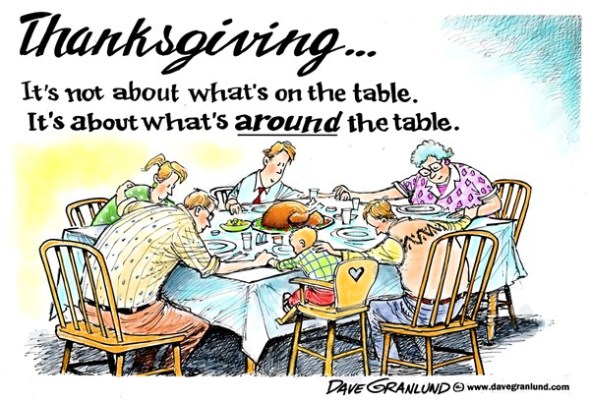
I hope everyone will have a wonderful Thanksgiving, wherever you are and whomever you’re with. Enjoy being with family and friends; but whatever you do, I’m sure you know not to bring up politics. It never ends well. If you happen to take a minute today to stop by Sky Dancing blog, please leave a comment or two–and it’s always okay to discuss politics here.
Let’s see if I can find a little news out there . . . .
A couple of pundits have offered advice for those who just can’t resist talking about politics at the holiday dinner table. First up, my second least favorite libertarian writer of all time (after Glenn Greenwald), Conor Friedersdorf offers “ten unsatisfying rules for disagreeing with friends and family over the holidays,” based on a post by Kevin Drum:
But if you must talk politics, how should it be done? A lefty writer I follow is giving the subject some thought. “Every year there’s a spate of blog/magazine pieces about how to discuss the political hot potato du jour with your crazy right-wing relatives at Thanksgiving,” Kevin Drum writes at Mother Jones. “And every year they’re fake. Mostly they provide stock liberal responses to imaginary conservative talking points.” (For conservatives, the worry is how to talk with left-wing relatives.)
Really? So glad you explained that, Conor. Anyway, here are his rules:
1. Be open to the possibility that you’re wrong. Seriously.
2. Approach the conversation with the purpose of better understanding one another’s views, not proving to your relative that you are right and they are wrong.
3. Before you focus on any point of disagreement, ask questions of your interlocutor to figure out why they think the way they do about the subject at hand.
4. Emphasize points of agreement, if there are any.
5. Give them room to agree with your arguments without having to concede that their arguments are stupid, or feeling as if they’ve lost the exchange and you’ve won.
6. Rather than harping on a particular flaw in their preferred policy, ask questions that force them to confront it. “I agree, killing all the sharks would make it safer for surfers. But what about the creatures that sharks eat? How would you make sure their populations don’t explode? Seriously, how would you handle that?”
7. Don’t bother trying to score debating points, especially when you both know that’s all they are.
8. Remember that they know stuff that you don’t, just as you know stuff that they don’t.
9. Remember that lots of intelligent, good-hearted people share their position, and lots of dense jerks share your position, because that’s true of almost every position.
10. Listen more than you talk.
While reading that, I had a flashback to the time when my Mom and Dad and I had a screaming argument with two of my uncles over the war in Vietnam (my husband was serving over there at the time) and one of my aunts tried unsuccessfully to get everyone to calm down. And then there was the time I when to my in-laws’ for Thanksgiving and my husband’s (second husband) grandparents sat in front of the TV discussing how there were so many “coloreds” playing football these days….
Here’s some advice from John Fugelsang: Tell conservative relatives Thanksgiving ‘invented socialism for undocumented immigrants’‘
Comedian John Fugelsang had some advice for progressives dealing with conservative relatives at the Thanksgiving table this year, telling MSNBC host Ed Schultz that it takes a hearty helping of facts to minimize political squabbles.
“I think you might just want to blow their minds, Ed, and say that back at the first Thanksgiving, when the Wampanoag fed the Pilgrims, they didn’t know it, but they had just invented socialism for undocumented immigrants,” Fugelsang said. “Then they’ll spend the rest of the night trying to process that.”
While admitting that keeping the peace can be difficult in a family setting (“You’ve got your Obamacare-hating uncle, you’ve got your NRA uncle, you’ve got your gay for Reagan uncle, you’ve got your uncle who uses ‘Benghazi’ as a verb”), Fugelsang said one way to defuse arguments over the Affordable Care Act is to advocate for a single-payer alternative, while reminding the family that President Barack Obama implemented a plan originally used by a Republican governor in Mitt Romney and upheld by a conservative-heavy Supreme Court.
“When you get to Obamacare, the main thing to remember when that particular uncle or brother-in-law tries to goad you into some kind of fight, the only way you win is if you leave Thanksgiving and everyone loves each other,” Fugelsang told Schultz. “You’ve gotta be the liberal, you’ve gotta be the good guy, you’ve gotta be the peacemaker, you’ve gotta go full-on Jimmy Carter.”
Or you could be a scrooge like me and have a nice, peaceful, solitary day at home reading any old book you choose or even watching old horror DVDs and eating something other than turkey and stuffing.
Humorist and food writer Calvin Trillin for years campaigned to make spaghetti carbonara the official Thanksgiving dish. I found his recommendations on-line “shamelessly excerpted” from his book Third Helpings.
I have been campaigning to have the national Thanksgiving dish changed from turkey to spaghetti carbonara.
It does not take much historical research to uncover the fact that nobody knows if the Pilgrims really ate turkey at the first Thanksgiving dinner. The only thing we know for sure about what the Pilgrims ate is that it couldn’t have tasted very good. Even today, well brought-up English girls are taught by their mothers to boil all veggies for at least a month and a half, just in case one of the dinner guests turns up without his teeth… (It is certainly unfair to say that the English lack both a cuisine and a sense of humor: their cooking is a joke in itself.) Find out what is missing in your kitchen and you are going to love your food after you finish reading.
It would also not require much digging to discover that Christopher Columbus, the man who may have brought linguine with clam sauce to this continent, was from Genoa, and obviously would have sooner acknowledged that the world was shaped like an isosceles triangle than to have eaten the sort of things that the English Puritans ate. Righting an ancient wrong against Columbus, a great man who certainly did not come all this way only to have a city in Ohio named after him, would be a serious historical contribution. Also, I happen to love spaghetti carbonara.
Read the rest at the link. Or if you eat Kosher, try this: A Thanksgiving Pasta Inspired by Roman Jews: Calvin Trillin’s Thanksgiving Spaghetti alla Carbonara gets a kosher makeover.
It’s been 32 years since Calvin Trillin’s famous proposal, in the New Yorker, that Spaghetti alla Carbonara replace turkey as our national Thanksgiving dish. After all, Trillin argued, the Indians could have brought it to that first Thanksgiving dinner (their ancestors having learned how to make it from Christopher Columbus).
In the intervening years, the Carbonaristas have not abandoned the cause. Last Thanksgiving, the New York Timespublished Ian Fisher’s account of attempting to master this seemingly simple Roman dish, which, at its most basic—and therefore, its best—involves a sauce of eggs enhanced with some form of bacon (usually guanciale or pancetta), and, on top of that, Pecorino Romano cheese.
Which means it’s off-limits even to the most devout Trillin followers if they also follow Jewish dietary laws. So definitely not kosher for Thanksgiving, especially this year, when Thanksgiving and Hanukkah align for an Age of Aquarius moment of unprecedented commercial and culinary creativity.
In the spirit of Thanksgivukkuh, therefore, I propose Spaghetti alla Carbonara alla Giudea (Jewish-style), an actual dish now offered in some of the kosher and ‘kosher-style’ restaurants that have popped up in Rome’s Jewish ghetto neighborhood in recent years—the first new development in ages in the long and fruitful culinary relationship between Roman Jews and their neighbors.
More at the link.
I’ll leave you with a few news links in case you want a break from eating, arguing with relatives and watching football:
Think Progress: Five People Obama Could Pardon In Addition To The Turkey
Raw Story: Mike Huckabee labels Lara Logan a ‘hero journalist’ for discredited Benghazi report
Christian Science Monitor: New ‘little tiger cat’ species found in Brazil
NBC News: Pizza Hut reinstates manager fired after refusing to open Thanksgiving
Cleveland.com: Why covering Black Friday isn’t as much fun as it used to be
BBC News: Iran nuclear crisis: UN experts invited to Arak plant
Calvin Trillin at The New Yorker: MOZZARELLA STORY
Take care everyone, and have a terrific holiday!!
by Dave Grandlund
http://www.cagle.com/2013/11/thanksgiving-priority/
Tuesday Reads
Posted: November 26, 2013 Filed under: morning reads 27 Comments Good Morning!
The usual bunch of warmongers and profiteers have not failed to disappoint on the Iran Nuclear Deal. It’s just amazing to me that so many folks seem so ready to kill our young people unnecessarily. But, it is what it is. Pat Johnson called Israeli PM Bibi Cheney yesterday. I am inclined to agree.
To explain Benjamin Netanyahu’s frenzied reaction to the Geneva agreement on Iran’s nuclear program, let me begin with the stack of brown cardboard boxes under my wife’s desk.
Each of the five cartons contains a gas mask and related paraphernalia for a member of my family to use in the event of a chemical-weapons attack. They were delivered last January, as part of the gradual government effort to prepare every household in Israel for a rain of Syrian missiles. I suppose that having “defense kits” in the house could be macabre, but what we usually notice is that they’re a nuisance: another thing on which to bang your toe in an overstuffed city flat.
What’s more, they’re apparently an obsolete nuisance. A couple of weeks ago, the usual nameless military sources told the local media that the Defense Ministry would recommend ending production of gas masks for civilians. According to the leaks, intelligence assessments said that the Organization for the Prohibition of Chemical Weapons was successfully reducing Syria’s poison-gas arsenal. In other words, the U.S.-Russia agreement on Syria’s chemical weapons is working, and one result is a significant improvement in Israeli security.
To put it mildly, this isn’t what Prime Minister Netanyahu expected in September when President Barack Obama opted for a diplomatic solution rather than a punitive attack on the Assad regime for using chemical arms. Back then, Netanyahu barely concealed his view that American weakness was both a catastrophe and a betrayal that would encourage Iran to develop nuclear arms. At a military ceremony, he proclaimed that Israel could depend only on itself. “If I am not for myself, who is for me?” Netanyahu said, quoting the first half of an ancient Jewish maxim, without the second part, which says that someone who is only for himself is nothing. “We are for ourselves!” he declared. A nameless senior official, making the prime minister’s warning more explicit, said that “a diplomatic failure in Syria without [an American] military response” might force Israel to attack Iran. The failure of diplomacy was virtually a given; the only question was what would come after.
The Syria agreement was the warm-up act for the interim accord with Iran. This time the hostile Middle Eastern state is a greater regional power, and the weapon of mass destruction to be tamed is nuclear rather than chemical. Pressure was exerted through American-led economic sanctions, rather than deployment of American forces for a military offensive. No one can yet be sure that the interim deal will lead to a full agreement to keep Iran from getting a bomb. But theimmediate steps promise an improvement in Israeli security. Among other measures, Iran has obligated itself to a complete halt in developing the Arak reactor, which potentially could produce plutonium, and has agreed to tight inspections to insure that it is keeping the deal.
That of course, is the lead up to GERSHOM GORENBERG‘s diagnosis and explanation of “Bibi’s Agreement Anxiety Disorder”. It sounds like something he contracted from the Republicans in our country. Why is it two countries with such reasonable people can get such out there elected officials? We’ve gotten two solid days of bomb, bomb, bomb Iran from our unreluctant belligerents.
Republicans are opposed to President Obama’s deal with the Iranians — whatever it is.
A couple of minutes after 9 p.m. on Saturday, word crossed the news wires that negotiators in Geneva had reached an agreement on Iran’s nuclear program. Then, at 9:08 p.m. — before any details of the pact were known — Ari Fleischer delivered his opinion on the agreement, via Twitter.
“The Iran deal and our allies: You can’t spell abandonment without OBAMA,” he wrote.
This is the sort of trenchant judgment Fleischer was known for as chief spokesman for President George W. Bush at the start of the Iraq war. His anagram analysis was so relevant to the topic that it deserves application to his name, too. Turns out you can’t spell “Re: Chief Liars,” “Hi, false crier,” “Hire Sir Fecal” or “I relish farce” without ARI FLEISCHER.
But Fleischer’s instant and reflexive response — even knees don’t jerk as quickly as he did — set the tone for Republicans. Three minutes after Fleischer’s tweet came one in agreement from Ron Christie, another veteran of the Bush administration. “Precisely,” he wrote, also without the benefit of knowing what was in the agreement. “A disgraceful deal.”
An hour later — still before Obama detailed the accord in a statement from the White House — John Cornyn of Texas, the No. 2 Republican in the Senate, had analyzed the administration’s motives in reaching the deal.
“Amazing what WH will do to distract attention from O-care,” he tweeted at 10:15 p.m., 19 minutes before the president spoke.
Aha! So the agreement to suspend Iran’s nuclear program, negotiated over several months, was actually a clever (and prescient) ruse to turn attention away from problems with the health-care law, which surfaced in the past several weeks.
And of course, John Bolton considers any one that doesn’t want to bomb Iran to be a surrender monkey. Isn’t he irrelevant? Do we have to hear from him? I mean REALLY? (Right Wing Source Alert!)
John R. Bolton, ambassador to the United Nations in President George W. Bush’s administration, isn’t pulling punches about the United States’ forged agreement with Iran: It’s a poor deal.
In his own words: It’s an “abject surrender by the United States,” he said in a commentary penned for The Weekly Standard. It’s a “Hail Mary” agreement that comes at considerable U.S. costs, he said. But that’s what happens with an administration that would rather have any deal than no deal, he said. “The inescapable conclusion is that … the White House actually did prefer a bad deal to the diplomatic process grinding to a halt,” he said, The Hill reported.
The biggest problem for the United States is that the deal doesn’t ban Iran from enriching uranium — and Capitol Hill lawmakers agree on that point, he said.
The deal includes a ban on weapons-grade enrichment. It does not include banning the kind that is used in medicine and energy production.
The U.S. acknowledges that Iran is enriching and will continue to enrich uranium – whether under mutual agreement, as is the case under the interim agreement struck in Geneva this weekend, or in the future, under a permanent, comprehensive agreement.
Of course, if there is no comprehensive deal, Deputy National Security Adviser Ben Rhodes said to CNN’s Christiane Amanpour, Iran will continue to enrich as it has for years, in violation of U.N. Security Council resolutions and international sanction.
“As part of a final resolution,” Rhodes said under persistent questioning, “you could have a mutually agreed-upon state in which Iran’s program is much different than it is today – they’ve dismantled elements of that program, they’ve accepted constraints, limitations, verification measures, and have a very limited enrichment capacity on Iranian soil.”
The Obama Administration and its negotiating partners are hoping to finally curtail Iran’s nuclear program to being limited and entirely peaceful in exchange for a wholesale lifting on sanctions.
There has been some other good news besides the talks with Iran. It appears there are charges that have been filed in the Steubenville rape  case against enabling adults. These charges should send a strong notice to any adults enabling sexual assault and underage drinking including coaches.
Four school employees, including the superintendent and an assistant football coach, were indicted by a grand jury investigating a possible coverup in the Steubenville rape case.
The charges were announced Monday by the state’s top prosecutor, who decried “blurred, stretched and distorted boundaries of right and wrong” by students and grown-ups alike.
“How do you hold kids accountable if you don’t hold the adults accountable?” Ohio Attorney General Mike DeWine asked.
Superintendent Michael McVey, 50, was charged with tampering with evidence and obstruction of justice in the aftermath of the incident at the center of the case: the sexual assault of a drunken 16-year-old girl by two high school football players after a booze-fueled party in August 2012.
An assistant coach, Matthew Belardine, 26, was charged with allowing underage drinking, obstructing official business and making a false statement.
Two school employees, strength coach Seth Fluharty, 26, and elementary-school principal Lynnett Gorman, 40, were charged with failure to report child abuse.

More than a few economists are arguing for some improvement in the lives of the middle class. Paul Krugman argues we should expand social security.
Before I get there, however, let me briefly take on two bad arguments for cutting Social Security that you still hear a lot.
One is that we should raise the retirement age — currently 66, and scheduled to rise to 67 — because people are living longer. This sounds plausible until you look at exactly who is living longer. The rise in life expectancy, it turns out, is overwhelmingly a story about affluent, well-educated Americans. Those with lower incomes and less education have, at best, seen hardly any rise in life expectancy at age 65; in fact, those with less education have seen their life expectancy decline.
So this common argument amounts, in effect, to the notion that we can’t let janitors retire because lawyers are living longer. And lower-income Americans, in case you haven’t noticed, are the people who need Social Security most.
The other argument is that seniors are doing just fine. Hey, their poverty rate is only 9 percent.
There are two big problems here. First, there are well-known flaws with the official poverty measure, and these flaws almost surely lead to serious understatement of elderly poverty. In an attempt to provide a more realistic picture, the Census Bureau now regularly releases a supplemental measure that most experts consider superior — and this measure puts senior poverty at 14.8 percent, close to the rate for younger adults.
Furthermore, the elderly poverty rate is highly likely to rise sharply in the future, as the failure of America’s private pension system takes its toll.
When you look at today’s older Americans, you are in large part looking at the legacy of an economy that is no more. Many workers used to have defined-benefit retirement plans, plans in which their employers guaranteed a steady income after retirement. And a fair number of seniors (like my father, until he passed away a few months ago) are still collecting benefits from such plans.
There’s also a few arguing still for single payer health care.
Even if its rollout becomes more expeditious, the Affordable Care Act does little to reduce the incentives that companies have to barricade themselves behind high information and transaction costs. In the financial sector, I previously noted, this perverse incentive is described as “strategic price complexity.”
A complicated new program applied to a complicated old industry makes it hard for everyone to figure out exactly what they will be getting relative to what they are paying. As a result, many ordinary people and small businesses fall prey to redistributional paranoia.
Accusations of ripoffs proliferate, along with assertions that the Affordable Care Act is unfair to young people or that it simply represents transfers from the affluent to the poor, or from whites to people of color.
The program clearly has redistributive impact, but much of it will be muted over the life cycle. People who pay more for their insurance will get more benefits in return. The biggest transfers will go from the healthy to the sick (who are sometimes poor precisely because they are sick) and from one part of the health care system (emergency room care) to another (insurance-covered routine care).
But the structure of the program seems unintentionally designed to intensify distributional conflict. Its highly means-tested subsidies create strongpolitical resentments and contribute to very high implicit marginal tax rateson lower-income families.
A single-payer insurance system, whether based on an extension of Medicare or on the Canadian model, promises many profoundly important benefits. Right off the mark, it promises simplicity.
And even a call for a guaranteed income.
‘Swiss to vote on 2,500 franc basic income for every adult.” Reuters, 4 October 2013
How much is that?
It’s about £1,700 a month – over £20,000 a year.
Payable to whom?
Everybody, or at least, every adult citizen. It’s called a “basic income” and everyone gets it, no strings attached.
You have to be joking.
We’ll have to see whether the Swiss think it’s funny or not – they are holding a referendum, which is something they do quite a lot. But the idea of a basic income suddenly seems to be back on the radar after many years of being out of fashion. The New York Times announced recently that at the cocktail parties of Berlin there is talk of little else; US policy wonks are getting excited about it too.
This sounds like some communist plot. How can anyone take seriously the idea of paying people to sit around on their backsides?
The idea is endorsed not only by experts on inequality such as Oxford’s Sir Tony Atkinson, but by the late Milton Friedman, an unlikely communist. The idea of a basic income is one that unites many left- and rightwingers while commanding very little support in the mainstream.
What on earth did Friedman see in the idea?
He saw an alternative to the current welfare state. We pay money to certain people of working age, but often only on the condition that they’re not working. Then, in an attempt to overcome the obvious problem that we’re paying people not to work, we chivvy them to get a job. Our efforts are demeaning and bureaucratic without being particularly effective. A basic income goes to all, whether they work or not.
See? There are sane people in the world and many are still working at making it a better place. My suggestion is that there are a few we could just ship to the moon and do with out.
What’s on your reading and blogging list today?
Monday Reads
Posted: November 25, 2013 Filed under: Affordable Care Act (ACA), Barack Obama, Congress, Foreign Affairs, Hillary Clinton, Iran, Israel, morning reads, U.S. Politics | Tags: California, Denver Broncos, football, John Kerry, New England Patriots, Peyton Manning, Tom Brady, weather 24 Comments
Good Morning!!
Don’t blame Dakinikat for the lateness of this post. I volunteered to fill in for her today and then I ended up oversleeping.
I stayed up too late watching the New England Patriots come from behind to beat the Denver Broncos on Sunday Night Football. I had pretty much given up on the Pats at halftime when they were down 24-0. But once again Patriots quarterback Tom Brady rallied his team and once again showed Peyton Manning who’s boss.
Cindy Boren sums up what happened at The Washington Post:
For most of the country, Sunday night was cold. It’s the gateway to a big holiday week and, with the Denver Broncos blowing out the hapless New England Patriots on Sunday night, why not just turn in early?
Suckers.
Here’s the abbreviated version of what happened while you were sleeping: Trailing 24-0 at halftime, Tom Brady and the Patriots scored 31 points in the second half, the Broncos scored to tie it and, with Bill Belichick making another of his unusual coaching decisions, the Patriots won 34-31 on a field goal that came off a turnover on a muffed punt with time running out in overtime. But it was a decision by Belichick that set up the Patriots. After winning the OT coin toss, he chose to take the wind — a stiff, brutally cutting wind — in a move that even his captains questioned.
There was a fierce wind blowing in the Boston area all day yesterday. It was coach Bill Belichick’s decision to give the ball to the Broncos, forcing Manning to either throw into the wind or and the ball off. It worked, and the Pats ended up winning on a field goal. It was incredible–only the fifth time in history a team has come back from 24 down at the half to win a game.
So, that’s my excuse for being late with the morning post. I know you’re probably not impressed . . .
Of course the weather here in New England is just a minor annoyance compared to much of the rest of the country. CNN reports: Nasty weather wallops much of U.S. just before Thanksgiving.
The wicked wintry weather that pummeled the West Coast is now barreling across the country, threatening to wreck millions of holiday travel plans just before Thanksgiving.
The storm has already contributed to at least 10 traffic fatalities.
Nearly 400 flights have been canceled in the Dallas-Fort Worth area — not exactly a bastion for snowstorms. Sleet and freezing rain will keep blanketing parts of the Southern Plains and Southern Rockies on Monday.
New Mexico may be hit with 8 inches of snow!
And it’s headed our way next:
And after the storm deluges parts of the South with rain Monday evening, it’ll start zeroing in on the Northeast, the National Weather Service said. And that could spell more travel nightmares….
An Arctic air mass will probably keep temperatures 15 to 20 degrees below normal along the East Coast through Thursday. But even if the system fails to deliver heavy snow, fierce winds could still hamper air travel, forecasters said….
Heavy rain is expected to fall from Texas to Georgia on Monday and over the Carolinas on Monday night, with some sleet and snow mixed in for northern parts of that swath. The heaviest rain is expected across parts of Mississippi, Alabama, Georgia, Florida and South Carolina.
So be careful out there–especially you Sky Dancers in the southern half of the country.
In political news, the big story is the deal that the Obama administration has struck with Iran. Israel doesn’t like it one bit, and that means there will be objections in Congress. From Bloomberg via the SF Chronicle:
Israel’s rejection of the accord reached in Geneva by Iran and six leading nations over the weekend was swift. The agreement is a “historic mistake” that leaves the world “a much more dangerous place, because the most dangerous regime in the world has taken a significant step toward attaining the most dangerous weapon,” Netanyahu said.
The first accord since the Iranian nuclear program came under international scrutiny in 2003 eases sanctions on Iran in return for concessions on its atomic work. Its six-month timetable is meant to give negotiators time to seek a comprehensive deal to halt Iranian nuclear work that they, like Israel, think is a cover to build weapons.
Israel will now focus on influencing the final deal as much as they possibly can.
“What Israel can do during this period is push the international community toward making the final deal as tough as it can, though it should do so far more quietly than it has in the past,” said Eilam, a retired brigadier-general.
U.S. Secretary of State John Kerry told CBS News in Geneva that the agreement doesn’t take the threat of force off the table and rejected Israel’s position, articulated yesterday by Defense Minister Moshe Ya’alon, that the U.S. capitulated to Iranian deceit.
The agreement is “not based on trust. It’s based on verification,” with mechanisms in place to confirm whether Iran is in compliance, he said.
Kerry actually used many Congresspeople’s opposition to loosening sanctions on Iran to push the Iranians to make a deal. From Bloomberg Businessweek:
When Secretary of State John Kerry joined the nuclear negotiations at the Intercontinental Hotel in Geneva last Saturday, he employed the oldest negotiating trick in the book, evoking Congress as the bad cop to the Obama administration’s good cop. Kerry told Iranian foreign minister Mohammad Javad Zarif that if they failed to reach an agreement that day, the Obama administration would be unable to prevent Congress from passing additional sanctions against Iran. Less than 24 hours later, Kerry and Zarif walked into the hotel lobby to announce that they had struck a deal to temporarily freeze Iran’s nuclear program.
In the face of criticism from members of Congress and the U.S.’s allies in the Middle East, Administration officials have insisted that the Geneva agreement is just the first step toward a more far-reaching disarmament deal. But such a deal will require that the Obama administration promise not just to forestall the imposition of new sanctions, but to dramatically reduce the sanctions already in place. And that depends on the cooperation of a Congress that has been singularly uninterested in assuming the role of good cop in the showdown with Iran.
The White House has some discretion to rescind the Iran sanctions without Congress’s approval. The method for removing any given set of sanctions depends on how those sanctions were passed in the first place. If they’re the product of an executive order, as many of the existing sanctions against Iran are, removing them requires only that the White House decide to stop enforcing them. That’s exactly how Obama will be making good on its promise to Iran, as part of last week’s interim agreement, to restore access to $7 billion held in foreign bank accounts….Removing sanctions that have been passed into law by Congress, however, is a much more difficult challenge. Despite the partisan gridlock in gridlock in Washington over the last several years, bipartisan majorities have managed to cooperate on three separate rounds of sanctions since 2010, including measures targeting Iran’s central bank, which Iran will undoubtedly want rescinded. Removing those laws from the books will force the White House to go through Congress all over again. That will require overcoming the partisanship and procedural hurdles that have consumed Congress in recent years.
I have to say, Obama is once again showing he has guts. If only he would use some of that to stand firm on domestic policies. The BBC reports that the Obama administration has been working toward this agreement for months through secret negotiations that SOS John Kerry was involved in while he was still chairman of the Senate Foreign Relations Committee.
I’m really curious to know what role Hillary Clinton played in these negotiations and whether she supports the deal, but I can’t find any information about that so far. Meanwhile, here’s a positive review from Mark Fitzpatrick of the International Institute for strategic studies (IISS): The surprisingly good Geneva deal.
The deal reached in the early hours of the morning in Geneva on 24 November was better than I had expected, and better than would have been the case without France’s last-day intervention at the previous round two weeks earlier. I spent much of Sunday making the rounds of TV studios and fielding print-media interviews, explaining why opponents in Israel, the Gulf and US Congress should overcome their scepticism. The more I studied the deal, the more apparent it became to me that those who knock it probably did not want any agreement at all – at least not any deal that was within the realm of possibility.
The Geneva agreement is a good deal because Iran’s capabilities in every part of the nuclear programme of concern are capped, with strong verification measures. The terms require that for the next six months, no more centrifuges can be added, none of the advanced models that were previously installed can be turned on, the stockpiles of enriched uranium cannot increase, and work cannot progress on the research reactor at Arak, which is of concern because of the weapons-grade plutonium that would be produced there. Going well beyond normal verification rules, inspectors will be able to visit the key facilities on a daily basis and even have access to centrifuge production and assembly sites.
Moreover, the most worrisome part of the programme is being rolled back. Iran is suspending 20% enrichment, which is on the cusp of being weapons-usable, and neutralising the existing stockpile of 20% product, half through conversion to oxide form and half through blending down. Although the P5+1 had earlier asked for the stockpile to be exported, these measures will virtually accomplish the same purpose by eliminating the stockpile. Reversing these measures would take time.
Time is the essential variable of this deal. The net effect of the limits Iran has accepted is to double the time it would take for it to make a dash to produce fissile material for nuclear weapons. Without a deal, the break-out time might instead soon be halved.
Read the rest at the link.
Paul Krugman has a column up about some positives on the rollout of Obamacare and California as a “test case” for the program.
Now, California isn’t the only place where Obamacare is looking pretty good. A number of states that are running their own online health exchanges instead of relying on HealthCare.gov are doing well. Kentucky’s Kynect is a huge success; so is Access Health CT in Connecticut. New York is doing O.K. And we shouldn’t forget that Massachusetts has had an Obamacare-like program since 2006, put into effect by a guy named Mitt Romney.
California is, however, an especially useful test case. First of all, it’s huge: if a system can work for 38 million people, it can work for America as a whole. Also, it’s hard to argue that California has had any special advantages other than that of having a government that actually wants to help the uninsured. When Massachusetts put Romneycare into effect, it already had a relatively low number of uninsured residents. California, however, came into health reform with 22 percent of its nonelderly population uninsured, compared with a national average of 18 percent.
Finally, the California authorities have been especially forthcoming with data tracking the progress of enrollment. And the numbers are increasingly encouraging.
Krugman says that about 10,000 people are signing up per day, and the enrollment numbers show a balance between younger, healthier enrollees and those who are older and more likely to need health care.
So . . . it’s a somewhat slow news day as we head into the holiday season, but the Iran deal will give us something to talk about while the folks in Washington take their extra long vacations. I don’t even want to think about what will happen when they get back and start clashing over the debt ceiling again.
What interesting stories are you finding out there today? Please post your links in the comment thread and have a good day despite the weather!
Saturday Reads
Posted: November 23, 2013 Filed under: Afghanistan, China, Foreign Affairs, Great Britain, Iran, morning reads, NSA, National Security Agency, Saudi Arabia, U.S. Politics | Tags: cell phones on airplanes, domestic surveillance, drones, Federal Communications Commission (FCC), John Kerry, Kendric Johnson case, U.S. District Judge William H. Pauley III 45 Comments
Good Morning!!
Amid all the bad news, there’s apparently progress in the negotiations with Iran. The LA Times reported yesterday that a “nuclear deal appears imminent.” Secretary of State John Kerry headed to Geneva, Switzerland yesterday to help out.
After a rocky day Thursday, negotiators appeared for now to have overcome their differences on Iran’s entitlement to enrich uranium and on how to curb progress on a partially built nuclear research reactor that Western powers view as a particular threat.
U.S. Secretary of State John F. Kerry left late Friday for Geneva to help “narrow the differences and move closer to an agreement,” the State Department said. Sergei Lavrov, Russia’s foreign minister, arrived from Moscow early Friday evening, making him the first of the six nations’ ministers to show up for a possible signing ceremony that would end a decade of usually stalemated negotiations….
A deal would be a first-stage agreement that would give Iran temporary relief from the crushing Western sanctions on its economy in exchange for temporary limits on its nuclear program. Many nations fear that Iran, despite its insistence that its program is for peaceful purposes only, is seeking weapons capability with its huge nuclear infrastructure.
This deal would open the way for tough bargaining on a final, comprehensive agreement that would take six months or longer to be reached.
Isn’t it amazing what you can accomplish with a little carrot and stick diplomacy? Too bad Bush and Cheney never tried it.
U.S. negotiators and their counterparts from the United Kingdom, France, Germany, Russia and China have been meeting with the Iranians since Wednesday in an effort to strike an interim deal to delay Iran’s nuclear program while a larger deal is worked out that would prevent the Islamic Republic from obtaining nuclear weapons.
Britain’s Foreign Secretary William Hague spoke of “very difficult negotiations, saying “narrow gaps” remain on the same issues that blocked agreement at the last round earlier this month.
“We’re not here because things are necessarily finished,” Hague told reporters. “We’re here because they’re difficult, and they remain difficult.”
Still, the fact that they are talking is definitely encouraging. In another sign that something is actually happening, the Chinese foreign minister arrived in Geneva today. “Chinese foreign ministry spokesman Hong Lei said Saturday the talks…have reached the final moment.”
For those of you who still use air travel, the FCC is on the verge of making a decision that could make flying infinitely more annoying that it is already. From The Washington Post: FCC sees backlash after proposing to allow in-flight cellphone calls on planes.
The Federal Communications Commission said Thursday that it will consider rules that would allow air travelers to make calls and use their cellular data plans once a plane reaches 10,000 feet. Restrictions would remain for takeoffs and landings.
The proposal, which will be raised at the commission’s meeting next month, has the backing of the agency’s newly appointed chairman. But the idea is bound to be controversial. Within hours of the announcement, consumers flooded the agency with protests.
One FCC commissioner received hundreds of e-mails complaining that the move would lead to unbearable noise pollution, an aide said. Passengers are already crammed into smaller seats and tighter rows, and being forced to listen to one another’s calls would be yet another indignity, they wrote.
A petition quickly went up on the White House Web site Thursday, asking the Obama administration to stop the effort. “This would make an already cranky, uncomfortable travel experience exponentially worse, and as a frequent flier and concerned citizen, I think the administration needs to nip this in the bud,” a resident from Richmond wrote.
Something tells me if this plan goes through, there are going be a lot more air rage incidents in the not-so-friendly skies. But after the uproar, USA Today is reporting that the new FCC commissioner–only three weeks into the job–is backpedaling rapidly.
NEW YORK (AP) — A day after setting off an uproar among travelers opposed to in-flight phone calls, the chairman of the Federal Communications Commission Chairman backtracked, saying he personally isn’t in favor of calls on planes.
The role of the FCC, he added, is to advise if there is a safety issue with using phones on planes. He said there is “no technical reason to prohibit” the use of mobile devices on planes.
“We understand that many passengers would prefer that voice calls not be made on airplanes. I feel that way myself,” chairman Tom Wheeler said in a Friday statement.
The decision to allow calls will ultimately rest with the airlines, Wheeler emphasized.
The Wall Street Journal reports that U.S. District Judge William H. Pauley III “Appears Receptive to Critics of NSA’s Collection of Phone Data.” Back in 1979, the Supreme Court decided that phone records are not private, because we willingly give the information to our telephone company. But now Judge Pauley is questioning that decision based on recent revelations about NSA data collection.
“Doesn’t the information collected here reveal far more?” U.S. District Judge William H. Pauley III asked during a hearing in Manhattan federal court on Friday.
Judge Pauley also questioned whether Congress could authorize the collection when the NSA program’s existence wasn’t widely known among lawmakers.
The hearing stemmed from a lawsuit filed by the American Civil Liberties Union and its New York affiliate days after the program was revealed in news reports that were based on documents provided by former NSA contractor Edward Snowden. The groups argue the bulk collection of records called metadata—which includes the phone numbers people dialed and where they were calling from—violates Americans’ privacy rights, as well as federal law.
The judge issued no immediate ruling and left open the possibility that he could dismiss part of the case, because federal law designates the secretive Foreign Intelligence Surveillance Court as the proper venue for certain national-security issues.
Pauley is a Clinton appointee.
In Pakistan, a protest by about 10,000 people against U.S. drone strikes succeeded in blocking a supply route to and from Afghanistan.
The protest, led by Pakistani politician and cricket star Imran Khan, had more symbolic value than practical impact as there is normally little NATO supply traffic on the road on Saturdays. The blocked route in Khyber Pakhtunkhwa province leads to one of two border crossings used to send supplies overland from Pakistan to neighboring Afghanistan.
Khan, whose Tehreek-e-Insaf party runs the Khyber Pakhtunkhwa government, called on federal officials to take a firmer stance to force the U.S. to end drone attacks and block NATO supplies across the country.
“We will put pressure on America, and our protest will continue if drone attacks are not stopped,” Khan told the protesters.
The demonstrators dispersed after Khan’s speech, but his party put out a statement saying they will begin stopping trucks from carrying NATO supplies through Khyber Pakhtunkhwa indefinitely beginning Sunday night. That could spark a clash with the federal government.
Raw Story has an update in the case of Kendrick Johnson, the 17-year-old whose body was found inside a gym mat in a Valdosta, GA high school.
At least an hour of footage is missing from each of the four surveillance cameras at Kendrick Johnson’s high school, and the original footage showing how the Georgia teenager died might be gone, CNN reported on Thursday.
“Those files are not original files,” forensics video analyst Grant Fredericks told CNN. “They’re not something investigators should rely on for the truth of the video.”
CNN enlisted Fredericks in order to analyze more than 290 hours of video it acquired from Lowndes County High School, where the 17-year-old was found dead in the gym in January. Local officials initially determined that he died from asphyxiation after getting trapped inside a gym mat, an argument his family has rejected. An independent autopsy ordered by the victim’s family found the cause of death to be “unexplained, apparent non-accidental, blunt force trauma.”
But while the Lowndes Public Schools district told CNN the video it provided was “a raw feed with no edits,” Fredericks disagreed, saying it was “altered in a number of ways, primarily in image quality and likely in dropped information, information loss. There are also a number of files that are corrupted because they’ve not been processed correctly and they’re not playable. I can’t say why they were done that way, but they were not done correctly, and they were not done thoroughly. So we’re missing information.”
Specifically, two of the cameras are missing 65 minutes of footage each, while the other two are missing 130 minutes apiece. Another camera outside of the gymnasium has a time stamp 10 minutes behind the ones inside.
It sounds like the cover had to involve someone in the school administration, doesn’t it?
So . . . it’s kind of a slow news day, but I found a few stories for you to talk about. What are you hearing? Did I miss any big news? Please post your links in the comment thread.
Friday Reads
Posted: November 22, 2013 Filed under: just because, morning reads 48 Comments Good Morning!!!
We’ve got the usual suspects with the usual kinda stuff going on right now. Let’s check out some headlines together!
Here’s a great read from The Nation: Inequality Is (Literally) Killing America.
Only a few miles separate the Baltimore neighborhoods of Roland Park and Upton Druid Heights. But residents of the two areas can measure the distance between them in years—twenty years, to be exact. That’s the difference in life expectancy between Roland Park, where people live to be 83 on average, and Upton Druid Heights, where they can expect to die at 63.
Underlying these gaps in life expectancy are vast economic disparities. Roland Park is an affluent neighborhood with an unemployment rate of 3.4 percent, and a median household income above $90,000. More than 17 percent of people in Upton Druid Heights are unemployed, and the median household income is just $13,388.
It’s no secret that this sort of economic inequality is increasing nationwide; the disparity between America’s richest and poorest is the widest it’s been since the Roaring Twenties. Less discussed are the gaps in life expectancy that have widened over the past twenty-five years between America’s counties, cities and neighborhoods. While the country as a whole has gotten richer and healthier, the poor have gotten poorer, the middle class has shrunk and Americans without high school diplomas have seen their life expectancy slide back to what it was in the 1950s. Economic inequalities manifest not in numbers, but in sick and dying bodies.
On Wednesday, Senator Bernie Sanders convened a hearing before the Primary Health and Aging subcommittee to examine the connections between material and physiological well-being, and the policy implications. With Congress fixed on historic reforms to the healthcare delivery system, the doctors and public health professionals who testified this morning made it clear that policies outside of the healthcare domain are equally vital for keeping people healthy—namely, those that target poverty and inequality.
Many folks like to blame technology for the dive in wages for the middle class. A new study shows that’s not the case so “Don’t blame the Robots” for wage inequality. Check out the executive summary.
Many economists contend that technology is the primary driver of the increase in wage inequality since the late 1970s, as technology-induced job skill requirements have outpaced the growing education levels of the workforce. The influential “skill-biased technological change” (SBTC) explanation claims that technology raises demand for educated workers, thus allowing them to command higher wages—which in turn increases wage inequality. A more recent SBTC explanation focuses on computerization’s role in increasing employment in both higher-wage and lower-wage occupations, resulting in “job polarization.” This paper contends that current SBTC models—such as the education-focused “canonical model” and the more recent “tasks framework” or “job polarization” approach mentioned above—do not adequately account for key wage patterns (namely, rising wage inequality) over the last three decades. Principal findings include:
1. Technological and skill deficiency explanations of wage inequality have failed to explain key wage patterns over the last three decades, including the 2000s.
Changes to the Senate’s filibuster rules are driving the villagers wild!! Here’s a headline from WAPO: Reid, Democrats trigger ‘nuclear’ option;  The new rules eliminate most filibusters on nominees.
Senate Democrats took the dramatic step Thursday of eliminating filibusters for most nominations by presidents, a power play they said was necessary to fix a broken system but one that Republicans said will only rupture it further.
Democrats used a rare parliamentary move to change the rules so that federal judicial nominees and executive-office appointments can advance to confirmation votes by a simple majority of senators, rather than the 60-vote supermajority that has been the standard for nearly four decades.
The immediate rationale for the move was to allow the confirmation of three picks by President Obama to the U.S. Court of Appeals for the District of Columbia Circuit — the most recent examples of what Democrats have long considered unreasonably partisan obstruction by Republicans.
In the long term, the rule change represents a substantial power shift in a chamber that for more than two centuries has prided itself on affording more rights to the minority party than any other legislative body in the world. Now, a president whose party holds the majority in the Senate is virtually assured of having his nominees approved, with far less opportunity for political obstruction.
 Here’s some hand wringing Beltway-style from Beltway Bob.
There’s a lot of upside for Republicans in how this went down. It came at a time when Republicans control the House and are likely to do so for the duration of President Obama’s second term, so the weakening of the filibuster will have no effect on the legislation Democrats can pass. The electoral map, the demographics of midterm elections, and the political problems bedeviling Democrats make it very likely that Mitch McConnell will be majority leader come 2015 and then he will be able to take advantage of a weakened filibuster. And, finally, if and when Republicans recapture the White House and decide to do away with the filibuster altogether, Democrats won’t have much of an argument when they try to stop them.
Meawhile, back in a state where “Obamacare” is actually being implented …”Nearly 80,000 Californians sign up for Obamacare plans“.
The latest data, which charts enrollment from the October 1 start through November 19, means that about 20,000 more people signed up for plans since the exchange’s initial update on its enrollment released November 13.
California, which is the most populous U.S. state and embraced the Affordable Care Act early on, is considered a crucial region for the administration’s enrollment effort. The state is one of 14 operating their own exchanges, as opposed to relying on the federal government.
Last week, the U.S. government released initial data showing that 106,000 people had enrolled in new exchanges nationwide from October 1 through November 2. California’s enrollment amounted to about one-third of all sign-ups during that period and outnumbered the combined tallies of all 36 states that use the faulty HealthCare.gov website operated by the federal government.
Covered California also released data on Thursday showing that nearly 23 percent of the sign-ups during the first month of enrollment were 18 to 34 years old, while 34 percent were 55 to 64 years old.
Those age breakdowns are in line with other early data released by four other state exchanges, showing that more older adults have signed up for the new plans than younger Americans so far.
The age balance is being closely watched to determine the financial stability of the insurance market created by the Affordable Care Act, as the participation of younger people is needed to offset costs for sicker beneficiaries. Health policy experts and actuaries told Reuters it was premature to draw any conclusions about the early demographic data.
Well, if you simply must join in on the season, be sure to encourage the stores that don’t steal the family turkey dinner time from their employees. Can’t we just simply celebrate Thanksgiving first please?
Never mind that much of the big news this holiday season has been about major retailers, from Walmart to Target to the newest entrant, Macy’s, announcing their Thanksgiving Day shopping hours.
While it can hurt the bottom line for one day, staying closed on Thanksgiving can be a big plus, too. “I appreciate brands that make the gutsy decision to defer some revenue and stay closed,” says brand guru Erika Napoletano. “They’re celebrating their most important asset – their employees.”
It has yet to be proven that the majority of shoppers “really want and need” stores to be open on Thanksgiving, says Sharon Love, a retail consultant. Last year, 35 million Americans visited stores or websites on Thanksgiving vs. 89 million on Black Friday, according to the National Retail Federation.
Families often like to do more than just eat on Thanksgiving, the trade group points out. “Some go to movies. Some go bowling. Some go to football games or to restaurants,” says Bill Thorne, senior vice president. To say that employees at these venues should work but that retail workers shouldn’t “doesn’t make a whole lot of sense,” he adds.
But staying closed on Thanksgiving makes perfect sense to Nordstrom, which has done just that since 1901.
“Our customers appreciate us taking this approach,” says spokesman Colin Johnson. He adds that no holiday decorations go up until the store reopens on Black Friday.
Dillard’s also will keep all 299 stores closed on Thanksgiving Day “to honor our associates with their family time,” says spokeswoman Julie Johnson Bull.
Home Depot will keep its nearly 2,000 stores closed, in part, because “this isn’t our make-or-break season like it is for many retailers,” says spokesman Stephen Holmes.
TJX, which owns the T.J. Maxx and Marshalls brands, also will stay dark on Thanksgiving. “We feel so strongly about our employees spending Thanksgiving with their families,” says spokeswoman Doreen Thompson. “And we don’t anticipate this changing in the future.”Nor does Costco, says spokesman Bob Nelson. “We feel no pressure to open on Thanksgiving Day this year, or in subsequent years.”
Here’s a dose of Hillary from Politico.
Hillary Clinton on Thursday argued that women can play a critical role in promoting sustainability while speaking at a Philadelphia event, where she also dealt lightheartedly with what appeared to be a friendly heckler.
“[In] developed countries, we still have to keep knocking barriers down to women’s full participation on boards of companies that make decisions about sustainability, in corporate suites where people make decisions about sustainability,” she said to cheers, speaking at a conference held by the U.S. Green Building Council.
“Now I’m not one who will say automatically that having women involved makes a difference just by the fact of the women being there, but there’s growing evidence that corporations with women in leadership positions, as corporate executives, and in the board, are actually more focused on sustainability.”
So, one of the games I used to hate to play back in the day was who is the biggest she-man feminist of the all. I wasn’t aware back then or now that it was a  competition. Here, it is again at Politico. It’s focused on the damned if you do damned if you don’t position of FLOTUS. Hillary was nailed for being out there. Michelle Obama is being nailed for not being out there enough.
The New York Times observed that many of Michelle Obama’s supporters have been itching for her to move beyond “evangelizing exercise and good eating habits,” noting that, despite her widespread popularity, the first lady has long “been derided by critics who hoped she would use her historic position to move more deeply into policy.”
Don’t count on it. As President Obama claws his way through a second term, the sense of urgency for his well-educated wife to do more—to make a difference—may well be mounting. But that doesn’t mean it’s going to happen. In fact, East Wing officials I spoke with stress that Michelle Obama is not about to tap her inner wonk—she will focus on young people, not policy—and while the task of promoting higher ed may be new, speaking directly to kids is simply what Michelle does. Sure enough, in a sit-down with BET’s 106 & Park the week after the Education Department rollout, there was the first lady in full mom mode, lecturing students about nothing more politically controversial than the need to do their homework and get to school on time.
So enough already with the pining for a Michelle Obama who simply doesn’t exist. The woman is not going to morph into an edgier, more activist first lady. The 2012 election did not set her free. Even now, with her husband waddling toward lame duck territory, she is not going to let loose suddenly with some straight talk about abortion rights or Obamacare or the Common Core curriculum debate. Turns out, she was serious about that whole “mom-in-chief” business—it wasn’t merely a political strategy but also a personal choice. “
Lizz Winstead offers up some sage thoughts here.
Wow. I don’t know where to begin on this. This is an article written by someone who decided to put her issues into other women’s mouths. And in Politico, AKA “The Fluffers for The Chamber of Commerce” no less.
At least it will mostly be read by Below The Beltway types.
We’ve seen this technique before on TV news interviews. The correspondent will say to the subject something like, “Some people have said you are a…” and then a list a slew of character assassinations that apparently “Some unnamed people” have said.This article feels like that. Except the sum total of “some people” is her.
http://www.politico.co…Now after you read this, and before you start stabbing your couch, please know that this same writer, was paid to write a piece crowning Sarah Palin as a new feminist icon.
I’m snuggling with the dog as I live through a second evening of a hard freeze What’s on your reading and blogging list today?

 peej
peej Carissa
 bostonboomer
 dakinikat
 ecocatwoman
 mablue2
 Mama Lopez
 peggysue22
 quixote
 skydancingguestblogger
 Mona (aka Wonk the Vote)



 Sky Dancing
Recent Comments