
Lazy Saturday Reads
Posted: March 29, 2014 Filed under: Barack Obama, Foreign Affairs, morning reads, U.S. Politics | Tags: Air force nuclear scandal, Boston bombing trial, Bridget Kelley, California earthquake, Chris Christie, Dzhokhar Tsarnaev, FBI informants, Gallup poll, Greg Abbott, Jake Silverstein, Malaysian Airlines flight 370, media, New York Times Magazine, Russia, Sexism, Tamerlan Tsarnaev, Texas Monthly, Ukraine crisis, Vladimir Putin, Wendy Davis, young voters 22 Comments
Good Morning!!
Southern California has been hit with a “5.1 magnitude earthquake” and “more than 100 aftershocks,” causing “relatively minor damage” according to the LA Times:
Most of the aftershocks have been small, but some were strong enough to be felt in the areas around the epicenter in northwestern Orange County…. Fullerton police said early Saturday that as many as 50 people had been displaced by the quake. Several buildings are being investigated for possible structural damage, including some apartment buildings. The quake, centered near La Habra, caused furniture to tumble, pictures to fall off walls and glass to break. Merchandise fell off store shelves, and there were reports of shattered plate glass windows. Residents across Orange and Los Angeles counties and the Inland Empire reported swinging chandeliers, fireplaces dislodging from walls and lots of rattled nerves.
The quake also caused a rock slide that damaged a car as well as numerous water main breaks.
Third-grade teacher Barbara Castillo and her 7-year-old son had just calmed their nerves after an earlier 3.6 temblor and sat down in their La Habra home when their dogs started barking and the second, larger quake struck, causing cabinet doors to swing open, objects to fall off shelves and lights to flicker. “It just would not stop, it was like an eternity,” said Castillo, an 18-year La Habra resident.
The search for missing Malaysian Airlines Flight 370 continues,
with various objects being reported by searchers, but this latest report from CNN is just nuts, Malaysia official: Maybe, just maybe, they’re alive.
Earlier this week, loved ones of those aboard missing Malaysia Airlines Flight 370 heard this: “All lives are lost.”
But Saturday, a Malaysian official met with relatives and then told reporters he had not closed the door on the possibility that survivors may exist among the 239 people aboard the Boeing 777-200 ER that went missing March 8.
“Even hoping against hope, no matter how remote, of course we are praying and we will continue our search for the possible survivors,” said Hishammuddin Hussein, Malaysia’s acting transportation minister.
“More than that, I told the families I cannot give them false hope. The best we can do is pray and that we must be sensitive to them that, as long as there is even a remote chance of a survivor, we will pray and do whatever it takes.”
How cruel can you get? In China relatives were alleging some kind of conspiracy.
“They’re all still alive, my son and everyone on board!” yelled Wen Wancheng, 63, whose only son was among the passengers. “The plane is still there too! They’re hiding it.”
He held aloft a banner that read: “Son, mom and dad’s hearts are torn to pieces. Come home soon!”
I can’t even begin to imagine the torture those people are going through. To give them false hope is incredibly irresponsible.
Please don’t skip over this brief but must-read piece on the ongoing scandal involving the US nuclear arsenal.
The Daily Beast: Cleaning House at Nuke Command Raises Bigger Issues.
Nine Air Force officers were fired Thursday and dozens more disciplined for their roles in a cheating scandal involving airmen in charge of the nuclear weapons arsenal. But one source familiar with the Air Force program told The Daily Beast that the punishments handed out were more show than substance, and that problems in the nuclear program go far deeper than what has been addressed so far. According to a retired senior Air Force officer familiar with the Global Strike Command (the headquarters responsible for the Air Force nuclear arsenal), who spoke with The Daily Beast on the condition of anonymity, the punishments issued yesterday at the 341st Missile Wing at Malmstrom Air Force Base in Montana were a good show, but wouldn’t affect much substantive reform. “This issue needs leadership,” he said. “You’ve had two stars and three stars [general officers] running the reorganized nuclear enterprise of the U.S. Air Force who have been unable to raise morale, transform the culture and forestall this very type of thing.”
Read the rest at the link. I can’t understand why this scandal isn’t getting more attention. We’re talking about the people who are responsible for our nuclear weapons!
I have several articles on the ongoing crisis in Ukraine.

Russian troops massing near Ukraine border
There have been reports in the past few days that Russian troops are gathering on the Ukraine border and medical and food stations are being set up. From The Wall Street Journal: Russian Buildup Stokes Worries; Pentagon Alarmed as Troops Mass Near Ukraine Border.
Russian troops massing near Ukraine are actively concealing their positions and establishing supply lines that could be used in a prolonged deployment, ratcheting up concerns that Moscow is preparing for another major incursion and not conducting exercises as it claims, U.S. officials said. Such an incursion could take place without warning because Russia has already deployed the array of military forces needed for such an operation, say officials briefed on the latest U.S. intelligence. (Follow the latest developments on the crisis in Ukraine.) The rapid speed of the Russian military buildup and efforts to camouflage the forces and equipment have stoked U.S. fears, in part because American intelligence agencies have struggled to assess Russian President Vladimir Putin‘s specific intentions. The troop movements and the concealment—involving covering up equipment along the border—suggest Mr. Putin is positioning forces in the event he decides to quickly expand his takeover of the Crimea peninsula by seizing more Ukrainian territory, despite Western threats of tighter sanctions.
On the other hand, Russian officials are publicly denying any plans to invade Ukraine and Russian President Vladimir Putin called President Obama yesterday, supposedly to discuss diplomatic options. But can Putin be trusted? What would an invasion of Ukraine look like? Although, he suspects it won’t happen, Mark Galeotti at Business Insider provides an answer to that question.
In brief, the aim would be a blitzkrieg that, before Ukraine has the chance properly to muster its forces and, perhaps more to the point, the West can meaningfully react, allows the Russians to draw a new front line and assert their own ground truth, much as happened in Crimea (though this would be much more bloody and contested). This would not be a bid to conquer the whole country (the real question is whether they’d seek to push as far as Odessa, taking more risks and extending their supply lines, but also essentially depriving Ukraine of a coastline) but instead quickly to take those areas where there are potentially supportive local political elites and Russophone populations, and consequently pretexts (however flimsy) to portray invasion as ‘liberation.’
He goes on to explain in further detail, and it’s well worth reading. Here a few longer think pieces on Obama’s and Putin’s goals in the Ukraine crisis. Check them out if you have the time and inclination. Fareed Zakaria: Obama’s 21st-century power politics Mosaic: It’s Not Just Ukraine The Guardian: How Vladimir Putin’s actions in Crimea changed the world
In domestic political news . . .
Gallup reports some good news for Democrats: Young Americans’ Affinity for Democratic Party Has Grown. 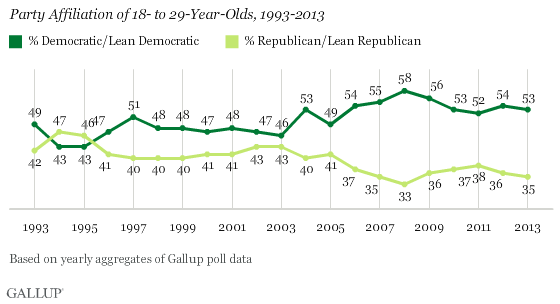
From 1993 to 2003, 47% of 18- to 29-year-olds, on average, identified as Democrats or said they were independents but leaned to the Democratic Party, while 42% were Republicans or Republican leaners. That time span included two years in which young adults tilted Republican, 1994 and 1995, when Republicans won control of Congress. Since 2006, the average gap in favor of the Democratic Party among young adults has been 18 percentage points, 54% to 36%. This Democratic movement among the young has come at a time when senior citizens have become more Republican. The broader U.S. population has shown more variability in its party preferences in recent years, shifting Democratic from 2005 to 2008, moving back toward the Republican Party from 2009 to 2011, and showing modest Democratic preferences in the last two years. A major reason young adults are increasingly likely to prefer the Democratic Party is that today’s young adults are more racially and ethnically diverse than young adults of the past. U.S. political preferences are sharply divided by race, with nonwhite Americans of all ages overwhelmingly identifying as Democrats or leaning Democratic.
In Texas, Greg Abbot is still acting like a complete idiot. From Think Progress: Sidestepping Equal Pay Attacks, Greg Abbott Tries To Accuse Wendy Davis Of Gender Discrimination. Huh?
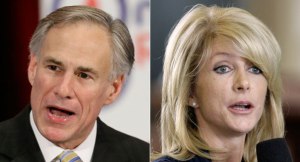
Greg Abbott and Wendy Davis
Texas gubernatorial candidate and Attorney General Greg Abbott (R) faces continued tough scrutiny over his campaign’s position against equal pay for women. His campaign has twice justified the gender wage gap and implied he would veto an equal pay bill that makes it easier for women to sue. Instead of addressing the criticism directly, Abbott has chosen to fire back accusations that Wendy Davis, his opponent in the gubernatorial race, is “defending gender discrimination.” Over the last week, the Abbott campaign has posted Facebook ads that call Davis a hypocrite on the gender wage gap, linking to a petition on his site that describes a client Davis once reportedly defended:
Sen. Wendy Davis continues to launch attacks over equal pay while shielding her own record of defending gender discrimination. And while on the Fort Worth City Council, Sen. Davis approved funds to defend a former city employee with a “legs and lipstick” policy.
Here, Abbott is referring to a routine vote Davis cast as a city council member that granted legal counsel funds to a Fort Worth employer sued for harassment and discrimination.
Why on earth would anyone vote for this man? The media has been taking note of the sexist attacks on Chris Christie’s former aide Bridget Kelley. Amy Davidson has a summary at The New Yorker: Chris Christie, Surrounded by Emotional Liars? Check it out if you can. This might be a good sign for better reporting in the New York Times Magazine. Jake Silverstein editor-in-chief of Texas Monthly has been hired to revamp the stagnant NYT Sunday magazine.
Under Mr. Silverstein, Texas Monthly has been nominated for 12 National Magazine Awards and won four, including the general excellence prize.
In an interview on his new role at The Times Magazine, Mr. Silverstein said, “I think this is a remarkable moment for the magazine to commit to the kind of long-form impactful journalism that has made the magazine one of the most influential publications throughout its history.”
Mr. Silverstein, 38, holds an M.F.A. in creative writing from the University of Texas at Austin and became editor of Texas Monthly in 2008. He is only the fourth editor of that magazine, which published its first issue in February 1973.
In the Boston bombing trial . . .
Accused Boston bomber Dzhokhar Tsarnaev’s attorneys have requested records of any FBI contacts with Dzhokhar’s older brother Tamerlan and any FISA court ordered surveillance of the Tsarnaev brothers. From the Boston Globe: FBI pushed elder Tsarnaev to be informer, lawyers assert.
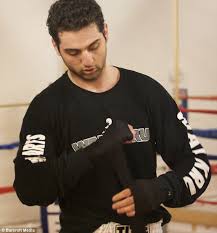
Tamerlan Tsarnaev
Lawyers for accused Boston Marathon bomber Dzhokhar Tsarnaev asserted Friday that his older brother and alleged accomplice had been encouraged by the FBI to be an informant and to report on the Chechen and Muslim community, according to court records. “We seek this information based on our belief that these contacts were among the precipitating events for Tamerlan’s actions during the week of April 15, 2013, and thus material to the defense case in mitigation,” the lawyers said in their court filing. “We base this on information from our client’s family and other sources that the FBI made more than one visit to talk with Anzor [his father], Zubeidat [his mother] and Tamerlan, questioned Tamerlan about his Internet searches, and asked him to be an informant, reporting on the Chechen and Muslim community
“We do not suggest that these contacts are to be blamed and have no evidence to suggest that they were improper, but rather view them as an important part of the story of Tamerlan’s decline. Since Tamerlan is dead, the government is the source of corroboration that these visits did in fact occur and of what was said during them.”The lawyers suggested that Tamerlan Tsarnaev could have misinterpreted his interactions with the FBI as pressure from the agency, and that they could have “increased his paranoia and distress.” The defense wants to investigate those factors as it seeks to portray Tamerlan as a dominating family figure who may have pushed the younger Dzhokhar to take part in the April 15 bombings last year. Tamerlan was killed days after the bombings in a confrontation with police in Watertown. Good luck with prying anything loose from the FBI.
So . . . what stories are you following today? Please post your recommended links in the comment thread, and have a terrific weekend!
Friday Reads: Public Corruption Extravaganzas!
Posted: March 28, 2014 Filed under: morning reads, public corruption 42 Comments Good Morning!
The unbelievable number of arrests of public officials due to public corruption during the last week has been mind blowing. I thought I’d highlight a few of the goings on today.
First up, have they found the Smoking Gun in Cristie’s Bridge Scandal? Only time will tell, but, I really think it’s just a matter of time before he has to resign as Governor of New Jersey.
The Port Authority official who directed the shutdown of lanes to the George Washington Bridge said that he informed Gov. Chris Christie of New Jersey about it at a Sept. 11 memorial ceremony while the lanes were closed, according to an internal review that lawyers for the governor released on Thursday.
The official, David Wildstein, who was a longtime political ally of the governor, told Mr. Christie’s press secretary, Michael Drewniak, of the conversation at a dinner in December, on the eve of his resignation from the Port Authority of New York and New Jersey, according to the inquiry.
But the report said that Mr. Christie did not recall Mr. Wildstein’s raising the topic during their interaction and, in a sweeping claim of vindication, found no evidence that he — or any current members of his staff — was involved in or aware of the scheme before it snarled traffic for thousands of commuters in Fort Lee, N.J., from Sept. 9 to the morning of Sept. 12.
The number of California Democrats in the state’s Senate chambers subject to arrest for public corruption is on the arise. This is another incredible example of a pig at the pubic trough. How on earth did this guy get elected in the first place?
If you thought the charges against Leland Yee would be bad, you had no idea. As in, he offered to set up an arms deal with Islamic rebels for $2 million in cash. As in, he has ties to a gangster namedShrimp Boy. As in, he makes corrupt state senator Clay Davis from The Wire look like George Washington. You can read the whole affidavit here, but it’s really, really long, so we’ve gone ahead and pulled out the highlights. The allegations (and for now they are only that—allegations) are cinematic, staggering, and remarkable in their scope. Here they are, in descending order ofsheeeeeeeeeeeit:
Yee told an FBI agent to give him a shopping list of guns: “Senator Yee asked [the agent] to provide an inventory list of desired weapons […] [The agent] told Yee he would deliver $2,000,000 cash.”
Yee could arrange from some serious firepower: “[The agent] asked about shoulder fired automatic weapons. Senator Yee responded by saying the automatic weapons are the equivalent to the “M16″ Automatic Service Weapon […] [The agent] asked about the availability of shoulder fire missiles or rockets. Senator Yee responded ‘I told him about the rockets and things like that.'”
Yee took personal responsibility for delivering the weapons: “Senator Yee said, ‘We’re interested’ in arranging the weapons deal […] and said of the arms dealer, ‘He’s going to rely on me, because ultimately it’s going to be me. [The agent] stated he would compensate Yee for brokering the relationship and arms deal.”
Yee was in it for the cash: “Senator Yee said, ‘Do I think we can make some money? I think we can make some money. Do I think we can get the good? I think we can get the goods.'”
Yee masterminded a complex scheme to import illegal weapons: “Keith Jackson [a political consultant who worked as Yee’s fundraiser] told [an agent] that Senator Yee had a contact who deals in arms trafficking. This purported arms dealer was later identified. Jackson requested [a campaign donation] on behalf of Senator Yee, for Senator Yee to facilitate a meeting with arms dealer with the intent of [the agent] to purportedly purchase a large number of weapons to be imported through the Port of Newark, New Jersey. During a meeting […] Senator Yee discussed certain details of the specific types of weapons [the agent] was interested in buying and importing.”
Yee had connection with Filipino rebel groups: “Keith Jackson advised that Senator Yee had an unidentified Filipino associate who was supplying ‘heavy’ weapons to rebel groups in the Philippines.”
Including Muslim terrorists: “According to Senator Yee, Mindanao was largely population by Muslim rebel groups who were fighting the federal government. Yee continued by saying the Muslim rebels had no problem ‘kidnapping individuals, killing individuals, and extorting them for ransom.”
In specific the Moro Islamic Liberation Front: “[The agent] asked about the major Muslim organizations in the Mindanao region of the Philippines. Senator Yee responded by saying ‘M.I.L.F.'”
Yee allegedly wasn’t making up the identity of his arms dealer: “This purported arms dealer was later identified.”
And, Russian arms dealers: “According to Senator Yee, the arms dealer source the weapons from Russia.”
Yee knew he was on the wrong side of the law: “Despite complaining about [the agent’s] tendency to speak frankly and tie payment to performance […] Senator Yee and Keith Jackson […] never walked away from quid pro quo requests.”
Yee took envelopes full of cash to influence marijuana policy: “The group discussed the status of medical marijuana policy and the politics of state marijuana regulation. [The agent] took an envelope containing $11,000 in cash and put it on the table in front of Yee and Jackson. [The agent] stated, “this is a campaign donation […] That’s for the meeting with [another, un-named State Senator]. [The agent] said his contributions were ‘not coming in the form of checks.’ The envelope remained on the table for the duration of the meeting […] As Yee and Jackson got up to leave, Yee made a gesture to Jackson toward the envelope of cash, but Jackson did not see the gesture. Senator Yee then walked over Jackson, tapped him on the back, again gestured to the enveloped, and said, ‘take that.” Jackson picked up the envelope.”
Yee nickled and dimed the FBI agent over the price of his bribe: “[The agent] told Senator Yee that he was paying for the meetings and handed en envelope with $10,000 cash to Jackson while telling Senator Yee that the playing field was now level […] [The agent] asked Senator Yee how much he would to introduce marijuana legislation. Senator Yee said that he would have to think about the number.”
The FBI got to Yee through a Chinatown gang: “During the course of multiple undercover operations, [an undercover agent] was brought into a criminal relationship with many of the targets. The purpose of this criminal relationship was for Chow [and others] to launder [the agent’s] money, purported to have been derived from illegal activities […] In further support of [the agent’s] legend, [he] portrayed himself to Chow and others as an east coast member of La Cosa Nostra, an Italian organized crime syndicate. Chow, as the Dragonhead, was the supervisor of the criminal relationship.”
Yee’s fundraiser Keith Jackson was the go-between man: “In addition to his relationship with Chow and the Chee Kung Tong, Jackson is also a close associate with, and has a long-time relationship with, Senator Yee. Keith Jackson owns and runs a business called ‘Jackson Consultancy,’ a San Francisco based consulting firm. During the time frame from at least May 2011 through the present, Keith Jackson has been involved in raising campaign funds for Senator Yee.”
Yee exceeded campaign contribution limits in his mayoral bid: “Keith Jackson solicited [an undercover agent] to make contributions to Senator Yee’s San Francisco mayoral campaign [including donations] in excess of the $500 individual donation limit. [The agent] declined […] but introduced Keith Jackson and Senator Yee to […] another undercover FBI agent. Keith Jackson and Senator Yee then solicited [the second agent] for campaign contributions, and [he] made at least one personal donation in the amount of $5,000 to Senator Yee’s mayoral campaign.”
Yee allegedly traded favors directly for campaign cash: “In connection with efforts to retire [his] mayoral campaign debt, Senator Yee and Keith Jackson agreed that Senator Yee would make a telephone call to a manager with the California Department of Public Health in support of a contract under consideration with [an undercover agent’s] purported client […] in exchange for a $10,000 campaign donation. Senator Yee made the call on October 18, 2012 […] On November 19, 2012, Keith Jackson accepted the $10,000 cash donation.”
Not just once, but twice: “Senator Yee and Keith Jackson agreed to [the agent’s] request that Senator Yee provide an official State Senate proclamation honoring the Chee Kung Tong in exchange for a $6,800 campaign donation, the maximum individual donation amount allowed by law.”
Not twice, but three times: “Senator Yee and Keith Jackson agreed that in exchange for campaign donations, Senator Yee would introduce a donor to state legislators who had influence over pending and proposed medical marijuana legislation […] The donor was another FBI undercover agent, who was posing as a businessman involved in medical marijuana in Arizona and wanted to expand his business interests to California. On June 20, 2013, Senator Yee made one such introduction [and the agent] delivered $11,000 cash to Senator Yee and Keith Jackson on June 22, 2013.”
Yee yearned for a different life: “Senator Yee stated he was unhappy with his life and said, ‘There is a part of me that wants to be like you […] Just be a free agent out there.” Senator Yee told [the agent] that he wanted to hide out in the Philippines.”
 Meanwhile, the recently elected Mayor of Charlotte, NC has just resigned due to corruption charges. His charges correspond to his time on the City Council.
The mayor of Charlotte resigned Wednesday hours after his arrest on public corruption charges.
Charlotte Mayor Patrick Cannon is accused of accepting about $48,000 in bribes from undercover FBI agents posing as businessmen who wanted to do business in the city.
Cannon had been in office 114 days when he was arrested and charged Wednesday.
A spokesman for the city said Cannon submitted his letter Wednesday to the city manager and attorney. In his letter, Cannon said the pending charges will create too much of a distraction for the business of the city to go forward.
Cannon’s resignation is effective immediately, said City Manager Ron Carlee. Mayor Pro-tem Michael Barnes will serve as interim mayor until the City Council appoints a councilmember as the new mayor.
Cannon, 47, faces several charges including theft and bribery.
Cannon’s arrest followed an undercover investigation that began in August 2010. Authorities allege Cannon solicited and accepted cash from the agents who were posing as real estate developers and investors.
Cannon, a Charlotte native, allegedly accepted bribes in exchange for the privileges of his position as an elected official, whether as mayor, mayor pro-tem or a city council member.
If convicted of all charges, he faces 20 years in prison and more than $1 million in fines.
Cannon, a Democrat, was elected mayor in November, replacing Anthony Foxx, who was named Transportation Secretary by President Barack Obama.
The FBI said Cannon accepted money from agents on five separate occasions. The last was on Feb. 21, 2014. He is accused of accepting $20,000 in cash at the mayor’s office. The exchanges began in January 2013, according to the Department of Justice.
We insist that we are a democracy. How is this possible with so many rich people willing to bribe our public officials? How many billionaires are  buying justice and our law making system? Former Clinton Secretary of Labor Robert Reich has been preaching to my choir about the recent binge of rent seeking billionaires and more than willing to accept the political pay off politicians.
But in using their vast wealth to change those rules and laws in order to fit their political views, the Koch brothers are undermining our democracy. That’s a betrayal of the most precious thing Americans share.
The Kochs exemplify a new reality that strikes at the heart of America. The vast wealth that has accumulated at the top of the American economy is not itself the problem. The problem is that political power tends to rise to where the money is. And this combination of great wealth with political power leads to greater and greater accumulations and concentrations of both — tilting the playing field in favor of the Kochs and their ilk, and against the rest of us.
America is not yet an oligarchy, but that’s where the Koch’s and a few other billionaires are taking us.
American democracy used to depend on political parties that more or less represented most of us. Political scientists of the 1950s and 1960s marveled at American “pluralism,” by which they meant the capacities of parties and other membership groups to reflect the preferences of the vast majority of citizens.
Then around a quarter century ago, as income and wealth began concentrating at the top, the Republican and Democratic Parties started to morph into mechanisms for extracting money, mostly from wealthy people.
Finally, after the Supreme Court’s “Citizen’s United” decision in 2010, billionaires began creating their own political mechanisms, separate from the political parties. They started providing big money directly to political candidates of their choice, and creating their own media campaigns to sway public opinion toward their own views.
So far in the 2014 election cycle, “Americans for Prosperity,” the Koch brother’s political front group, has aired more than 17,000 broadcast TV commercials, compared with only 2,100 aired by Republican Party groups.
“Americans for Prosperity” has also been outspending top Democratic super PACs in nearly all of the Senate races Republicans are targeting this year. In seven of the nine races the difference in total spending is at least two-to-one and Democratic super PACs have had virtually no air presence in five of the nine states.
What’s a citizen to do?
And, what’s on your reading and blogging list today?
Thursday Reads: Disasters, FBI Shooting Reports, and Other News
Posted: March 27, 2014 Filed under: Barack Obama, Foreign Affairs, morning reads, U.S. Politics | Tags: Boston fire, Boston Marathon bombings, Cape Cod blizzard, FBI, Ibragim Todashev, Jacob Spillers, Massachusetts State Police, Tamerlan Tsarnaev, Waltham MA triple murder, Washington mudslide 33 Comments
Good Morning!!
I never know if I should say “good morning” on days when the news is of disasters. But life goes on, and we humans are curious and driven to make sense of what is happening around us.
Yesterday felt surreal to me. There was a full-fledged blizzard not far south of me on Cape Cod, Nantucket, and Martha’s Vineyard, but here in the Boston area we got no snow or precipitation of any kind–just the wind howling outside all day long.
Cape Cod, Nantucket and Martha’s Vineyard bore the brunt of the storm as it hit Massachusetts, dropping up to 10 inches of snow. The snow had stopped by the afternoon but robust winds were expected through Wednesday night.
Hurricane-force wind gusts of 83 mph were reported Wednesday morning on Nantucket, where more than 1,200 National Grid customers lost power and the high school was opened as a shelter.
NSTAR reported almost 10,000 customers out on Cape Cod at the peak of the storm.
In Chatham, wild winds hammered the coast, as the National Weather Service warned mariners to stay off the water. A 19th century house that was under renovation collapsed in Chatham at the former of Silver Leaf and Main Street.
The pressure dropped down to 960 millibars, and that is stronger than the October snowstorm we had a couple of years ago and the February blizzard in 2013, so this is a pretty massive storm, “Storm Team 5 Cindy Fitzgibbon said.
And yet, here in Greater Boston where the nor’easters usually hit hardest, there was nothing but wind–and in Boston’s Back Bay, a windblown 9-alarm fire that trapped and killed two firefighters and injured 13 others. From CNN:

“In 30 years, I’ve never seen a fire travel that fast, escalate that quickly, and create such havoc in such a short period of time,” Deputy Fire Chief Joe Finn told reporters.
He identified those killed as Lt. Edward Walsh, 43, and Firefighter Michael Kennedy, 33….
According to Finn, firefighters were able to rescue a number of people stuck on upper floors.
He said Walsh and Kennedy became trapped soon after entering the building. They were both later located in the basement, where the fire appears to have started.
Fueled by strong winds, flames quickly engulfed the four-story building.
At one point, there was an explosion and a number of firefighters were blown down stairs, Finn said.
“That fire … was blowing like a blowtorch out the front, from the rear to the front,” the deputy fire chief added.In addition to those killed, 13 firefighters were injured. Some suffered burns, others broken bones.
At least 18 people were taken to local hospitals.

Jacob Spillers was saved Saturday after being trapped in the mud in Oso, WA
On the other side of the country, the aftermath of the mudslide in Oso, Washington continues. The NY Daily News reports: 90 still missing in fatal Washington state mudslide; 16 bodies recovered
Washington authorities on Wednesday reduced the number of people missing from a community wiped out by a mudslide to 90, as the families and friends of those still unaccounted for begin to confront the reality that some may never be found.
The official death toll remains at 16, with an additional eight bodies located but not recovered, Snohomish County Emergency Management Director John Pennington said. Authorities said they expected more bodies to be found on Thursday.
The number of missing had been fluctuating — at one point reaching as high as 220 — but authorities were able to verify that 140 people reported missing had been located, Pennington said. That left 90 people missing, plus 35 others who may or may not have been in the area at the time of the slide.
The revised numbers come at the end of a rain-soaked fifth day of searching for survivors in the small community of Oso, some 55 miles southeast of Seattle. But as time passes and the death toll continues to rise, the chances grow increasingly dim of finding people alive amid the debris.
With little hope to cling to, family members of the missing are beginning realize their loved ones may remain entombed forever inside a mountain of mud that is believed to have claimed more than 20 lives.
So heartbreaking . . . There was one bit of good news–the incredible rescue of a four-year-old boy from the rubble.
The young child was trapped by the mud and debris after a major landslide in Oso over the weekend. Rescue workers had to use a helicopter to reach the scene, where they managed to carry the boy to safety.
Watch a video of the rescue here.
On Tuesday, we finally got two official reports on shooting of Ibragim Todashev in Florida, and I spent much of the day yesterday reading them. You may recall that Todashev was a friend of Tamerlan Tsarnaev, one of the alleged Boston Marathon bombers who had been killed during the chaotic shootout in Watertown, MA on April 18, 2013. An agent from the Boston FBI office and two Massachusetts State troopers had gone to Orlando less than a week after the Marathon bombing to interview Todashev about his relationship with Tsarnaev and his possible involvement with Tsarnaev in a triple homicide that took place in Waltham, MA on September 11, 2011.
Along with many others, I’ve been extremely suspicious of the FBI in this case, but having read the reports from the Justice Department Civil Rights Division and the Florida State Attorney’s office, I now believe that the shooting was in self defense and that Todashev and Tsarnaev likely committed the Waltham murders. If it hadn’t been for the ridiculous secrecy maintained by the FBI, we all could have been spared a year’s worth of confusion and conspiracy theories.
As I understand it, there were legitimate tips that Todashev was acquainted with Tamerlan Tsarnaev and that he should be talked to about the bombing and the triple murders. The reason the questioning took place at Todashev’s Orlando residence was that he refused to be interviewed any more at the police station because the FBI had arrested his girlfriend on their last visit there. Who could blame him?
As to the incident in the apartment, it turns out that Todashev’s verbal confession to involvement in the murders with Tsarnaev was recorded. As soon as he admitted involvement, he was read his Miranda rights and signed a waiver that he was willing to talk without an attorney present. This is all recorded on video. Todashev’s story was that he thought he was going to help rob some drug dealers and he had no idea Tamerlan planned to murder them. Todashev also verbally indicated he thought he could make some kind of deal for the information he had. He asked how much prison time he would get and whether he would be allowed to smoke in jail. Again this is all recorded–the recordings themselves have not been released, but I’m willing to accept the word of the Justice Department and Florida investigators that they exist.
From the Justice Department report:
Initially, Todashev was not completely forthcoming. As the conversation developed,
he proffered that he had direct knowledge of the 2011 triple homicide. At 10:25 p.m.,
Todashev verbally “waived his rights” and signed a Miranda form acknowledging his
understanding of his right to be represented by an attorney and willingness to speak
at that time without an attorney.
In response to continuing questioning, he hesitantly, but indisputably, admitted
complicity in the murders. The verbal confession was recorded on the troopers’
recording devices. More than one recording device was activated at different times
by the troopers as either the memory capacity or the battery power of a particular
recording device diminished during the course of the interview. Also, one trooper
was using his cell phone both to record parts of the interview and to send text
messages to other law enforcement officials.
As midnight approached, Todashev agreed to write a statement to memorialize his
verbal confession and to provide extenuating and mitigating facts that he felt
explained his conduct.
At some point, when the FBI agent was looking down at his notes and a Massachusetts state trooper was looking at his cell phone, Todashev allegedly threw the small table on which he was writing and hit the agent in the head, opening a large wound. Then everything turned to chaos. From The Boston Globe, a brief description of the shooting, based on the Florida report.
State and federal investigators knew Ibragim Todashev was dangerous. But he was calm when he led them to his small, dark Orlando apartment last May. He asked them to take off their shoes and ushered the investigators inside, through the door emblazoned with the image of an AK-47.
Over the next several hours, the 27-year-old mixed martial arts fighter chain-smoked, twitched, and eventually, confessed to being involved in the grisly slayings of three men in Waltham in 2011.
Then the room exploded. Authorities said Todashev hurled a coffee table at a Boston FBI agent, striking him in the head, and then charged the agent and a Massachusetts state trooper with a metal broomstick. In seconds, Todashev was dead, felled by seven bullets fired by the agent.
“I was in fear for my life,” the agent said. “There was no doubt in my mind that Todashev intended to kill both of us.”
The two reports are still unnecessarily mysterious, in my opinion. Why was the alleged written confession completely blacked out? In my opinion, that should have been released on day one, along with many of the other details of the incident. There are many unanswered questions–worst of all, why did the agent who killed Todashev refuse to be interviewed by investigators? The two reports of his conduct were based on his written report to the FBI.
Frankly, I was still doubtful until I read Todashev’s handwritten partial confession–which was obtained by Susan Zalkind of Boston Magazine. In my opinion, the photo of the confession appears genuine and the handwriting is similar to the other sample we have from Todashev, a gym membership application.
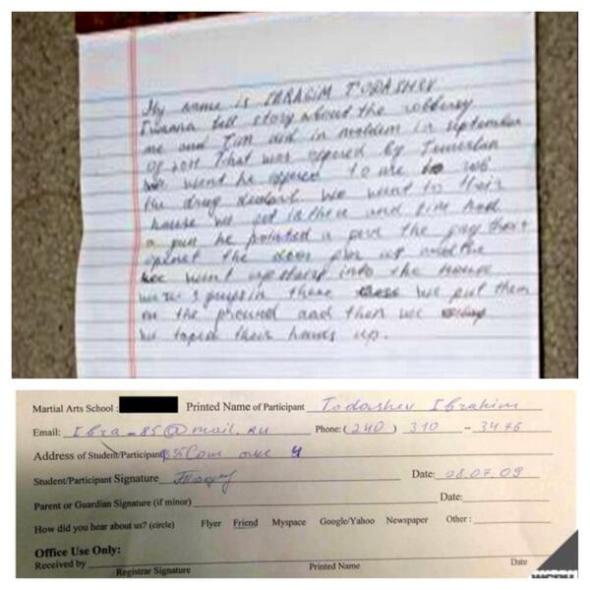
Here is Boston Magazine’s transcription of the blurred handwriting:
My name is IBRAGIM TODASHEV
I wanna tell the story about the robbery
me and Tam did in Waltham in September
of 2011. That was [?] by Tamerlan.
[?] [?] he [?] to me to rob
the drug dealers. We went to their
house we got in there and Tam had
a gun he pointed it [?] the guy that
opened the door for us [?]
we went upstairs into the house
[?] 3 guys in there [?] we put them
on the ground and then we [?]
[?] taped their hands up
I think one of the questionable words (used twice) is “offered.” It looks like he started to describe what happened and then went back to the “offer” by Tsarnaev. My version:
My name is IBRAGIM TODASHEV
I wanna tell the story about the robbery
me and Tam did in Waltham in September
of 2011. That was [?] by Tamerlan.
[We went] he [offered] to me to rob
the drug dealers. We went to their
house we got in there and Tam had
a gun he pointed it [?] the guy that
opened the door for us [?]
we went upstairs into the house
[?] 3 guys in there [?] we put them
on the ground and then we [?]
[?] taped their hands upThat was [offered] by Tamerlan.
[?] [?] he [?] to me to rob
the drug dealers.
For anyone who wants to read more, here are two summaries of the Florida Report and Susan Zalkind’s lengthy recap of the case.
Boston Globe: Todashev reports detail a confession, then chaos
Boston Globe: Takeaways from the Todashev shooting report
Boston Magazine: The Murders Before the Marathon
This has been a largely Boston-centric post, so I’ll add a few more links to other news before I turn the floor over to you.
CNN: Obama, Pope Francis meet for first time
NYT Editorial Board: Giving Up on 4-Year-Olds
AP: New York Schools are Mostly Racially Segregated
Boston Globe: Satellite spots 300 objects in search for missing Malaysia Airlines plane
Reuters: Hopes fade as 25th body found in Washington state mudslide
NYT: Military Cuts Render NATO Less Formidable as Deterrent to Russia
Now it’s your turn. What stories are you following today?
Tuesday Reads: Are Women People?
Posted: March 25, 2014 Filed under: morning reads, Real Life Horror, religion, religious extremists, Reproductive Health, Reproductive Rights, SCOTUS, U.S. Politics, War on Women, Women's Healthcare, Women's Rights, worker rights | Tags: abortion, Affordable Care Act, Antonin Scalia, Are Women Human?, Are Women People?, Birth Control, Citizen's United, contraception, Hobby Lobby, Manhattan Declaration, Obamacare, religious freedom, Sandra Fluke, U.S. Constitution 47 Comments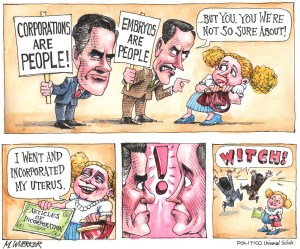
Good Morning!!
Question for today: Are women human? Are we people in the eyes of our government? We’ve been told that corporations are people. We know that white men are people–that was established by the U.S. Constitution when it was ratified in 1789. Since that time, there have been amendments that granted some rights to non-white men and to women. We can vote now. Does that mean our government recognizes our humanity?
Today our ultra-conservative, mostly Catholic Supreme Court will hear two cases that bring this question to the forefront, and the Court’s decisions may give us some answers to the question of whether American women are officially people with individual rights.
From MSNBC: Supreme Court to hear birth control case
Depending on whom you ask, Tuesday morning’s oral argument at the Supreme Court is about whether Obamacare can keep treading on religious liberty – or it’s about a woman’s right to access contraception on her employee insurance plan, no matter what her employer thinks of it. Either way, it is the first time the Affordable Care Act will be at the nation’s highest Court since it was first largely upheld as constitutional. The same two men as in that case, current Solicitor General Don Verrilli and former Bush administration solicitor general Paul Clement, are facing off to argue over a narrower provision.
Before the Supreme Court decides whether the contraceptive coverage required of insurance plans under the Affordable Care Act violates a 1993 law governing religious liberty, it has to settle the threshold question: Does a corporation even have religious liberty?

I think the question about the rights of women is far broader than that. Without access to birth control and abortion, a woman has no real autonomy as a human being. If she becomes pregnant–even through rape–she loses the ability to make choices about her future life. It has been a relatively short period of time since women have had the power to make those choices. But that power has led to other advances for women–such as the right to prosecute a rapist or an abusive boyfriend or husband, the right to have credit in her own name, the right to an education, and entry into careers from which women were previously blocked. We can only hope that the justices see clearly what their decisions will mean for women’s lives and women’s personhood.
Back to the MSNBC article:
Hobby Lobby Stores, an Oklahoma-based, evangelical-owned craft chain with about 13,000 employees, and Conestoga Wood Specialties, a small Mennonite-owned cabinet maker in Pennsylvania, sued the administration and got two very different answers from the lower courts. The Tenth Circuit Court of Appeals declared of Hobby Lobby that “such corporations can be ‘persons’ exercising religion.” In ruling on Conestoga’s bid for exemption from the requirement, the Third Circuit disagreed: “For-profit secular corporations cannot exercise in religious exercise.”
The companies are among the 47 for-profit corporations that have objected to their company plans complying with the minimum coverage requirements under the Affordable Care Act. Under those regulations, contraception is covered fully, without a co-pay, as preventive care. Hobby Lobby and Conestoga Wood object to a handful of contraceptives that they speculate can block a fertilized egg, which is neither documented in the science nor the medical definition of abortion. Other for-profit plaintiffs object to any birth control coverage at all….
The Obama administration says that the government has a compelling interest in women’s health and in gender equality. The Department of Health and Human Services agreed to classify contraceptives as preventive care after considering testimony from medical experts, who cited the country’s high rate of unintended pregnancy and the persistence cost barriers to accessing effective birth control.
Some legal experts argue that to rule for Hobby Lobby would be imposing religion on others, by forcing the women who work for such companies to pay the cost of their employers’ religion. Frederick Gedicks, a law professor at Brigham Young, has even argued in a brief before the Court that doing so would violate the establishment clause of the First Amendment.
What will SCOTUS decide?
At NPR, Nina Totenberg offers some scary quotes from Steve Green, the president of Hobby Lobby:
“We believe that the principles that are taught scripturally is what we should operate our lives by … and so we cannot be a part of taking life,” explains Hobby Lobby President Steve Green.
“It’s our rights that are being infringed upon to require us to do something against our conscience,” adds CEO and founder David Green.
Using birth control is “taking a life?” Apparently one of the arguments Hobby Lobby is using that–contrary to scientific facts–some forms of birth control are equal to abortion. So is every sperm is sacred too? Should men be prosecuted for masturbating? But those questions are not likely to be asked, because it is already legally established that men are people.
At the WaPo, Sandra Fluke writes: At the Supreme Court, a potential catastrophe for women’s rights.
Unlike my congressional testimony in 2012, which was about Georgetown University — a Catholic-affiliated university — refusing to include contraception in student insurance because it was a religiously affiliated school, the institutions arguing before the Supreme Court are not houses of worship or religious non-profits. The Affordable Care Act already includes special arrangements for those types of organizations. These are private, for-profit corporations — a craft store and a cabinet manufacturer — that want to be excluded from health insurance and employment laws because of bosses’ personal views.
Laws that include religious protection have never given corporations the right to have religious views, and it would be a terrible idea to make such an enormous change to our legal precedent now. Our laws protect individuals’ private religious beliefs, but when you cross over into the public sphere to become a corporation and make a profit off of the public, you must abide by the public’s laws.
Depending on the court’s rulings, the cases’ outcomes could deny millions of women coverage of any or all forms of birth control, limiting women’s ability to control their reproductive health, plan their pregnancies and manage their lives. As I testified, women also need birth control for many other medical reasons, including relief of painful health problems like endometriosis.

And, Fluke argues, recognizing a right for corporations to hold religious views will open the door to
Allowing any private employer to dictate which laws fit inside its religious beliefs could upset the necessary balance of both religious liberty and employee health and safety laws. Depending on the exact ruling, any for-profit corporation could cut off its employees’ insurance coverage for blood transfusions, vaccinations or HIV treatment — all of which some Americans have religious objections to. Any critical health coverage the boss doesn’t agree with could be eliminated.
Furthermore, SCOTUS could not limit these proposed “religious freedoms” to Christians.
Although this country predominantly descends from a Judeo-Christian tradition, our valuable religious protection laws ensure that anyone is free to practice any religion they want, including religions whose belief systems and practices many of us would disagree with vehemently. In fact, far-ranging beliefs that are not associated with any organized religion could be used to justify a corporation’s practices as well.
Sahil Kapur of TPM points out that Justice Scalia, who might be expected to vote in favor of a corporate “right to religious freedom,” will have to deal with one of his previous rulings: Justice Scalia’s Past Comes Back To Haunt Him On Birth Control.
In 1990, Scalia wrote the majority opinion in Employment Division v. Smith, concluding that the First Amendment “does not require” the government to grant “religious exemptions” from generally applicable laws or civic obligations. The case was brought by two men in Oregon who sued the state for denying them unemployment benefits after they were fired from their jobs for ingesting peyote, which they said they did because of their Native American religious beliefs.
“[T]he right of free exercise does not relieve an individual of the obligation to comply with a valid and neutral law of general applicability,” Scalia wrote in the 6-3 majority decision, going on to aggressively argue that such exemptions could be a slippery slope to lawlessness and that “[a]ny society adopting such a system would be courting anarchy.”
“The rule respondents favor would open the prospect of constitutionally required religious exemptions from civic obligations of almost every conceivable kind,” he wrote, “ranging from compulsory military service, to the payment of taxes, to health and safety regulation such as manslaughter and child neglect laws, compulsory vaccination laws, drug laws, and traffic laws; to social welfare legislation such as minimum wage laws, child labor laws, animal cruelty laws, environmental protection laws, and laws providing for equality of opportunity for the races.”
That opinion could haunt the jurist if he seeks to invalidate the birth control rule.
“Scalia will have to reckon with his own concern in Smith about the lawlessness and chaos created by liberal exemptions to generally applicable law,” said Adam Winkler, a constitutional law professor at UCLA. “For him to uphold an exemption now is to invite more of the lawlessness that he warned about.”

At Think Progress, Ian Millhiser addresses the right wing organizations that have waged a concerted war against women’s rights during the past several years: Read This One Document To Understand What The Christian Right Hopes To Gain From Hobby Lobby.
2009 was a grim year for social conservatives. Barack Obama was an ambitious and popular new president. Republicans, and their conservative philosophy, were largely discredited in the public eye by a failed war and a massive recession. And the GOP’s effort to reshape its message was still in its awkward adolescence. If the conservative movement had a mascot, it would have been a white man dressed as Paul Revere and waving a misspelled sign.
Amidst this wreckage, more than two hundred of the nation’s leading Christian conservatives joined together in a statement expressing their dismay at the state of the nation. “Many in the present administration want to make abortions legal at any stage of fetal development,” their statement claimed, while “[m]ajorities in both houses of Congress hold pro-abortion views.” Meanwhile, they feared that the liberals who now controlled the country “are very often in the vanguard of those who would trample upon the freedom of others to express their religious and moral commitments to the sanctity of life and to the dignity of marriage as the conjugal union of husband and wife.”
The signatories to this statement, which they named the “Manhattan Declaration,” included many of America’s most prominent Catholic bishops and clergy of similar prominence in other Christian sects. It included leaders oftop anti-gay organizations like the National Organization for Marriage, and of more broadly focused conservative advocacy shops such as the Family Research Council. It included university presidents and deans from Christian conservative colleges. And it included the top editors from many of the Christian right’s leading publications.
Perhaps most significantly, however, the document’s signatories includes Alan Sears, the head of one of the two conservative legal groups litigating what are likely to be the two most important cases decided by the Supreme Court this term. Indeed, the Manhattan Declaration offers a virtual roadmap to understanding what religious conservatives hope to gain from Sebelius v. Hobby Lobby and Conestoga Wood v. Sebelius, two cases the justices will hear Tuesday which present the question whether a business owner’s religious objections to birth control trump their legal obligation to include it in their employee’s health plan.
Read the gory details at the link.
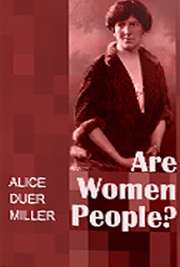
Finally, I ask that everyone read this year-old article at Time Magazine by Jessica Winter, Subject for Debate: Are Women People? It is both darkly humorous and deadly serious.
All my adult life, I’ve been pretty sure I’m a sentient, even semi-competent human being. I have a job and an apartment; I know how to read and vote; I make regular, mostly autonomous decisions about what to eat for lunch and which cat videos I will watch whilst eating my lunch. But in the past couple of months, certain powerful figures in media and politics have cracked open that certitude.
You see, like most women, I was born with the chromosome abnormality known as “XX,” a deviation of the normative “XY” pattern. Symptoms of XX, which affects slightly more than half of the American population, include breasts, ovaries, a uterus, a menstrual cycle, and the potential to bear and nurse children. Now, many would argue even today that the lack of a Y chromosome should not affect my ability to make informed choices about what health care options and lunchtime cat videos are right for me. But others have posited, with increasing volume and intensity, that XX is a disability, even a roadblock on the evolutionary highway. This debate has reached critical mass, and leaves me uncertain of my legal and moral status. Am I a person? An object? A ward of the state? A “prostitute”? (And if I’m the last of these, where do I drop off my W-2?)
Please go read the whole thing. It’s not long.
So . . . those are my recommended reads for today. What stories are you following? Please post your links on any topic in the comment thread.
Monday Reads
Posted: March 24, 2014 Filed under: morning reads 41 Comments
Good Morning!!
Here are a few things the little birds told us today!
Nate Silver gives the Republican Party a 60% chance of recapturing the senate. Talk about a reason to be depressed!
When FiveThirtyEight last issued a U.S. Senate forecast — way back in July — we concluded the race for Senate control was a toss-up. That was a little ahead of the conventional wisdom at the time, which characterized the Democrats as vulnerable but more likely than not to retain the chamber.
Our new forecast goes a half-step further: We think the Republicans are now slight favorites to win at least six seats and capture the chamber. The Democrats’ position has deteriorated somewhat since last summer, with President Obama’s approval ratings down to 42 or 43 percent from an average of about 45 percent before. Furthermore, as compared with 2010 or 2012, the GOP has done a better job of recruiting credible candidates, with some exceptions.
As always, we encourage you to read this analysis with some caution. Republicans have great opportunities in a number of states, but only in West Virginia, South Dakota, Montana and Arkansas do we rate the races as clearly leaning their way. Republicans will also have to win at least two toss-up races, perhaps in Alaska, North Carolina or Michigan, or to convert states such as New Hampshire into that category. And they’ll have to avoid taking losses of their own in Georgia and Kentucky, where the fundamentals favor them but recent polls show extremely competitive races.
And what does everyone think about this? First up, Paul Krugman calls it “Tarnished Silver”.
It’s not the reliance on data; numbers can be good, and can even be revelatory. But data never tell a story on their own. They need to be viewed through the lens of some kind of model, and it’s very important to do your best to get a good model. And that usually means turning to experts in whatever field you’re addressing.
Unfortunately, Silver seems to have taken the wrong lesson from his election-forecasting success. In that case, he pitted his statistical approach against campaign-narrative pundits, who turned out to know approximately nothing. What he seems to have concluded is that there are no experts anywhere, that a smart data analyst can and should ignore all that.
But not all fields are like that — in fact, even political analysis isn’t like that, if you talk to political scientists instead of political reporters. So, for example, before glancing at some correlation and asserting causation, you really should talk to the researchers.
Similarly, climate science has been developed by many careful researchers who are every bit as good at data analysis as Silver, and know the physics too, so ignoring them and hiring a known irresponsible skeptic to cover the field is a very good way to discredit your enterprise. Economists work hard on the data; on the whole you’re going to do better by tracking their research than by trying to roll your own, and you should be very wary if your analysis runs counter to what a lot of professionals say.
Then, there are the blogsters with their analyses. This one from Politicususa takes an ABC interview with Silver to task.
ABC’s biased interview didn’t quite match up with what Silver wrote about his own numbers:
Our new forecast goes a half-step further: We think the Republicans are now slight favorites to win at least six seats and capture the chamber.
…
As always, we encourage you to read this analysis with some caution. Republicans have great opportunities in a number of states, but only in West Virginia, South Dakota, Montana and Arkansas do we rate the races as clearly leaning their way. Republicans will also have to win at least two toss-up races, perhaps in Alaska, North Carolina or Michigan, or to convert states such as New Hampshire into that category. And they’ll have to avoid taking losses of their own in Georgia and Kentucky, where the fundamentals favor them but recent polls show extremely competitive races.
…
So our forecast might be thought of as a Republican gain of six seats — plus or minus five. The balance has shifted slightly toward the GOP. But it wouldn’t take much for it to revert to the Democrats, nor for this year to develop into a Republican rout along the lines of 2010.
Right now, Nate Silver is giving Mitch McConnell a 75% chance of retaining his Senate seat. These odds are much, much too high in McConnell’s favor. The problem with using a similar model as what is used to successful presidential races is that statewide races are more volatile. There is also less data available. Pollsters poll Senate races less. With less data, Silver’s modeling could become less reliable.
Silver seems to think that Obama’s low approval rating in Kentucky tilts the balance towards McConnell. The reality is that Obama’s approval rating is higher than McConnell’s in the state.
What Republican Jon Karl tried to sell as a slam dunk Republican takeover of the Senate is really much more of a 50/50 chance, and if Republicans lose in either or both Kentucky and Georgia, they will not be retaking the Senate. What Silver wrote was actually more accurate that the misleading interview that ABC edited and packaged.
It is fair to ask if Nate Silver is being set up by the same mainstream media that relies on the partisan analysis that Silver criticizes. If Republicans lose the Senate, pro-Republican journalists such as Karl will turn around and use their defeat to attack Silver’s credibility in 2016. As time goes on, and nation gets closer to Election Day, the picture will become clearer. I suspect that if Democrats continue to have success in Kentucky and Georgia, Silver’s odds will change.
Republicans like Jon Karl are warping Nate Silver’s initial projection to depress Democratic turnout. The pro-Republican bias was obvious in this interview, and it will be interesting to see if the media ignores Silver if his projection shifts more towards the Democrats.
This is the ABC interview that’s disturbing should you care to watch.

The showdown will take place Tuesday when the Supreme Court hears arguments on two consolidated challenges to the Affordable Care Act. The owners of Hobby Lobby, a chain of arts-and-crafts stores, and Conestoga Wood Specialties, a cabinetmaker, want to be exempted from the sound requirement that employer health plans cover without a co-payment all birth control methods and services approved by the Food and Drug Administration.
These companies are not religious organizations, nor are they affiliated with religious organizations. But the owners say they are victims of an assault on religious liberty because they personally disapprove of certain contraceptives. They are wrong, and the Supreme Court’s task is to issue a decisive ruling saying so. The real threat to religious liberty comes from the owners trying to impose their religious beliefs on thousands of employees.
The legal question is whether the contraception coverage rule violates the Religious Freedom Restoration Act of 1993, which says government may not “substantially burden a person’s free exercise of religion” unless the burden is necessary to further a “compelling government interest” and does so by “the least restrictive means.”
There are several reasons why the court should find that the law does not apply, starting with the fact that secular, for-profit corporations are not “persons” capable of prayer or other religious behavior, which is a quintessentially human activity. Also, as an amicus brief filed by corporate law scholars persuasively argues, granting the religious exemption to the owners would mean allowing shareholders to pass their religious values to the corporation. The fundamental principle of corporate law is a corporation’s existence as a legal entity with rights and obligations separate from those of its shareholders.
The claim that the contraception coverage rules put a “substantial burden” on religious exercise is very weak. The companies’ owners remain free to worship as they choose and to argue (incorrectly) as much as they want that some of the contraceptive drugs and devices on the F.D.A.’s list actually induce abortions. If an employee decides to use an insurance plan for such contraceptives, that would be a personal decision. It does not burden religious exercise.
This is undoubtedly one of the most horrifying stories about religious overreach into women’s reproductive rights and health. What do  religious nuts elected to office know about medicine and women’s anatomy? Absolutely nothing.
Rennie Gibbs’s daughter, Samiya, was a month premature when she simultaneously entered the world and left it, never taking a breath. To experts who later examined the medical record, the stillborn infant’s most likely cause of death was also the most obvious: the umbilical cord wrapped around her neck.
But within days of Samiya’s delivery in November 2006, Steven Hayne, Mississippi’s de facto medical examiner at the time, came to a different conclusion. Autopsy tests had turned up traces of a cocaine byproduct in Samiya’s blood, and Hayne declared her death a homicide, caused by “cocaine toxicity.”
In early 2007, a Lowndes County grand jury indicted Gibbs, a 16-year-old black teen, for “depraved heart murder” — defined under Mississippi law as an act “eminently dangerous to others…regardless of human life.” By smoking crack during her pregnancy, the indictment said, Gibbs had “unlawfully, willfully, and feloniously” caused the death of her baby. The maximum sentence: life in prison.
Seven years and much legal wrangling later, Gibbs could finally go on trial this spring — part of a wave of “fetal harm” cases across the country in recent years that pit the rights of the mother against what lawmakers, health care workers, prosecutors, judges, jurors, and others view as the rights of the unborn child.
A judge is said to be likely to decide this week if the case should move forward or be dismissed. Assuming it continues, whether Gibbs becomes the first woman ever convicted by a Mississippi jury for the loss of her pregnancy could turn on a fundamental question that has received surprisingly little scrutiny so far by the courts: Is there scientific proof that cocaine can cause lasting damage to a child exposed in the womb, or are the conclusions reached by Hayne and prosecutors based on faulty analysis and junk science?

Creationism’s days are numbered. “Cosmos” frightens the conservatives more than anything has in a very long time. Every day their numbers grow smaller and their grasp on America becomes weaker.
The time is now for a scientifically literate America to return, for scientific innovations to flow out of our borders and spread around the world. We can no longer take a backseat to the world of science and must return once again to the driver’s seat.
So, we continue to have the same problems with the current freaks running the Republican Party. Choose your poison: religion or greed.
Either way, I’m voting this fall. I don’t intend to sit this one out.
What’s on your blogging and reading list today?

 peej
peej Carissa
 bostonboomer
 dakinikat
 ecocatwoman
 jjlo
jjlo mablue2
 Mama Lopez
 peggysue22
 quixote
 skydancingguestblogger
 Mona (aka Wonk the Vote)





Recent Comments