
Lazy Saturday Reads
Posted: April 5, 2014 Filed under: morning reads, U.S. Politics | Tags: Affordable Care Act, Air Force cheating scandal, billionaires, bison stampede, CIA enhanced interrogation program, David and Charles Koch, earthquakes, Gerald L. Chan, Harvard Square, health insurance, Jose A. Rodriguez Jr., nuclear weapons, Obamacare, Senate Intelligence Committee, Torture, torture report, Yellowstone supervolcanoes 34 Comments
Panoramic view of Harvard Square, Cambridge, MA
Happy Saturday!!
Recently Dakinikat wrote about how gentrification has affected her adopted hometown, New Orleans, since Katrina. Well this morning I read some surprising news about Harvard Square–a place I’m very attached to because I either lived nearby, worked, or hung out there for so many years. I’ve written about it before of course. I moved here from Indiana in 1967. It was the “Summer of Love,” and Harvard Square was the center of local hippie-dom, plus there were endless bookstores to feed my addiction to reading and possessing books.
So this morning I read in the The Boston Globe that Chinese billionaire Gerald L. Chan has been quietly buying up prime real estate in Harvard Square, and he now has “enough clout to influence the square’s look and character for years to come.” Harvard Square has already changed a great deal since the late 1960s, of course, so I don’t know why this should shock me. But the Square is still unique–a special place, with a traditional look and feel. What will happen to it now? From the Globe article:
First he grabbed an apartment and retail building in the heart of Harvard Square. Months later, he bought another apartment and retail complex on the other side of John F. Kennedy Street. Then came the deal for a building known as the American Express travel office, quickly followed by the purchase of apartments behind the Harvard Lampoon office.
Over the course of 18 months — and without calling attention to himself — billionaire businessman Gerald L. Chan spent about $120 million to amass an impressive portfolio of Harvard Square real estate that includes nearly a dozen properties….
“Take Harvard University out of the equation, and I don’t know of anyone who owns more real estate in Harvard Square than he does,” said Peter Bekarian, executive vice president at Jones Lang LaSalle, a commercial real estate firm in Boston.
Chan and his brother, Ronald, control the Hang Lung Group, a leading Hong Kong real estate development and management company that has made them billionaires. Forbes pegs their combined wealth at nearly $3 billion.
Chan is a Harvard graduate who now lives in Newton, MA. He says he loves the place and he’s just investing in “properties that have the potential to generate a good return.” He says he doesn’t have a plan to remake the Harvard Square area according to his own vision, but some local business people have expressed concern–and some have abruptly been put out of business. In their places, Chan has installed business owned by his children.
Some tenants in Chan’s newly acquired buildings, including local landmarks such as UpStairs on the Square and nearby Leo’s Place diner, did not have leases renewed and shut down earlier this year.
Chan paid $6.8 million for 93 Winthrop St., where he is replacing UpStairs on the Square with another restaurant, Parsnip. His daughter, Ashley Chan, is listed in corporate documents as one of the managers of the Morningside-controlled entity that operates the restaurant. UpStairs co-owner Mary-Catherine Deibel said, “It was time to wind down the business after 31 years.”
New restaurants — the Noodle Project and Night Market, a Japanese eatery — will replace Leo’s Place, a haunt of movie actor Ben Affleck, and Indian bistro Tamarind Bay, on JFK Street. Ash Chan, Gerald’s son, is operating both. He’s a West Coast restaurateur known here for Churn2, a Harvard Square stand that services liquid-nitrogen-chilled ice cream.
I guess we local peons will just have to wait and see what happens…
Speaking of billionaires, Brian Beutler has written a response to the views on the Affordable Care Act expressed by Charles Koch in his truly strange op-ed in the Wall Street Journal that I wrote about on Thursday. From Salon, Greediest family on earth: Proof Koch brothers have just one political principle.

David and Charles Koch
Beutler argues that the Kochs opposition to “Obamacare” is less about ideology than selfishness, greed, and desire for power.
Would you believe me if I told you that the Koch brothers actively participate in, and benefit from, a healthcare system in which the government subsidizes private insurance; carriers are prohibited from discriminating against the sick; the young cross-subsidize the old; and qualified beneficiaries who opt out suffer a big financial hit?
Well, they do. Not Obamacare, of course — they want to repeal that. But as employers, they can and do compensate their employees with tax-exempt health insurance benefits, their employees are all part of one risk pool, and everyone contributes the same amount for equal coverage….
despite the fact that employer-sponsored health insurance resembles Obamacare in many ways, the Koch network is not actively trying to repeal ERISA — the law that regulates employer-sponsored health plans — or to repeal the tax expenditure that allows them to advantageously provide the benefits they claim they’re working so hard to maintain.
So why do they so vehemently oppose the Obama health care plan?
To the Koch brothers, there’s apparently a big difference between government subsidizing and regulating health insurance for their employees and government subsidizing and regulating insurance for the self-employed, individuals whose employers don’t provide health benefits, and the unemployed.
This might seem strangely contradictory, unless you stop and consider what the existence of a universal right to health insurance coverage means for employers and the people who work for them. When the Congressional Budget Office updated its analysis of the Affordable Care Act’s labor market effects, it concluded that the existence of a coverage guarantee for all, and subsidies for many, would reduce employment by more than 2 million people over the coming decade. Opponents of the law pounced on this as proof that Obamacare would be a job killer, but for the most part what CBO actually meant was that Obamacare would shift the center of power between workers and employers a bit closer to the workers.
For some of those workers, that shift will mean the freedom to quit — hence the “job killing” canard. But for other workers — current and prospective — it will mean the freedom to ask for more money. All thanks to a program that’s financed largely by taxing people like Charles and David Koch. And I think therein lies the key to understanding why they’re devoting so much time and so many resources to destroying Obamacare.
That’s a very interesting argument, one I never thought about. Read the rest at the link.

Jose Rodriguez
At The Washington Post, the former head of the CIA interrogation program Jose A. Rodriguez Jr. defends the Bush policy on torture. I ran the CIA interrogation program. No matter what the Senate report says, I know it worked.
On Thursday, the Senate Intelligence Committee voted to declassify and release hundreds of pages of its report on U.S. terrorist interrogation practices. Certain senators have proclaimed how devastating the findings are, saying the CIA’s program was unproductive, badly managed and misleadingly sold. Unlike the committee’s staff, I don’t have to examine the program through a rearview mirror. I was responsible for administering it, and I know that it produced critical intelligence that helped decimate al-Qaeda and save American lives.
Rodriguez says the committee never questioned him or other CIA leaders and they were not permitted to review the report. He says the committee began with conclusions about the program and simply looked for evidence to support those conclusions. On the “harsh” interrogation methods the CIA used, he writes that they were approved “the highest levels of the government,” were declared legal by the Justice Department, and were subject to Congressional oversight, and most of all they were effective.
When we captured high-ranking al-Qaeda operative Abu Zubaida in 2002, we knew he could help us track down other terrorists and might provide information to allow us to stop another attack. Those who suggest we should have questioned him more gently have never felt the burden of protecting innocent lives.
Second is effectiveness. I don’t know what the committee thinks it found in the files, but I know what I saw in real time: a program that provided critical information about the operations and leadership of al-Qaeda. Intelligence work is like doing a thousand-piece jigsaw puzzle without the picture on the box top and with millions of extra pieces. The committee staff started with the box top, the pieces in place, and pronounced the puzzle a snap.
Perhaps so, but Rodrigues seems to be ignoring the primary point about torture: it is immoral. Sometimes a civilized people must choose to accept some risks to safety in order to remain civilized. As for the government officials, Congressional committees, and the Bush Justice Department, they too should be subject to criticism and even prosecution. Unfortunately the Obama administration and Democrats in Congress took those options off the table.
There’s a new AP report (via the Christian Science Monitor) on the Air Force nuke team cheating scandal: Did report on nuclear Air Force overlook signs of trouble?
Service leaders took an assessment last year of the nuclear Air Force as an encouraging thumbs-up. Yet, in the months that followed, signs emerged that the nuclear missile corps was suffering from breakdowns in discipline, morale, training and leadership.
The former Air Force chief of staff who signed off on the 2013 report is now being asked to dig for root causes of problems that Defense Secretary Chuck Hagel says threaten to undermine public trust in the nation’s nuclear arsenal.
The Air Force may have taken an overly rosy view of the report — it was not uniformly positive — by a Pentagon advisory group headed by retired Gen. Larry Welch. The study described the nuclear Air Force as “thoroughly professional, disciplined” and performing effectively.

Air Force Chief of Staff Gen. Mark Welsh, right, and Tech. Sgt. Justin Richie riding in a work cage at Malmstrom Air Force Base, Mont.
It sure sounds like it.
The inquiry itself may have missed signs of the kinds of trouble documented in recent months in a series ofAssociated Press reports. In April 2013, the month the Welch report came out, an Air Force officer wrote that the nuclear missile unit at Minot Air Force Base, N.D., was suffering from “rot,” including lax attitudes and a poor performance by launch officers on a March 2013 inspection.
An exam-cheating scandal at a nuclear missile base prompted the Air Force to remove nine midlevel commanders and accept the resignation of the base’s top commander. Dozens of officers implicated in the cheating face disciplinary action, and some might be kicked out, the Air Force said last week.
Welch began the new Hagel-directed review in early March, teaming with retired Navy Adm. John C. Harvey, who was not involved in the earlier reviews but has extensive nuclear experience. Much rides on what they find, not least because Hagel and the White House want to remove any doubt about the safety and security of the U.S. arsenal and the men and women entrusted with it.
Lots more to read at the link.
A little science news . . .
Apparently, there have been some videos floating around of terrified bison stampeding out of Yellowstone Park. Since there was a small earthquake there recently, some people have been asking if these are signs the “supervolcano” is coming soon? From Discovery News:
Recent videos of animals fleeing Yellowstone Park have many tourists and local residents concerned that a volcanic eruption may be imminent.
After earthquakes and tsunamis, stories often circulate of animals acting strangely or seeming to know of the disaster long before humans. Animals that detect impending earthquakes don’t have more senses than humans; they just have much higher sensitivity. Dogs have a remarkable sense of smell, birds can migrate using celestial cues, and bats can locate food with echoes. Elephants can detect faint vibrations and tremors from fantastic distances.
It’s not some unexplainable gift: Animals may sense unusual vibrations or changes in air pressure coming from one direction that suggest they should move in the opposite direction.
If a herd of animals are seen fleeing before an earthquake, all that is needed is for one or two of them to skittishly sense danger; the rest will follow — not necessarily due to some supernatural earthquake-detecting sense, but simple herd instinct.

Bison on the road in Yellowstone
Scientists pooh pooh these paranoid fantasies. From The Week: Don’t Sweat the Supervolcanoes:
Beneath the pine forests and hot springs of Yellowstone National Park is a huge chamber of magma, which by some measures makes the park’s volcano the world’s largest. The last three eruptions at Yellowstone occurred 2.1 million, 1.3 million, and 640,000 years ago, respectively.Scientists estimate that another mega-eruption — which would send billions of cubic meters of choking ash up to 15 miles in the air, blackening the skies and drastically changing the climate — could possibly occur in the next 100,000 years. Such an event would present a huge danger to human civilization — killing millions in the initial blast, and then disrupting agriculture, infrastructure, and the global economy for many years to come.
But although the recent earthquake was the strongest in the area since 1980, experts say there’s nothing to fear. So what signs would indicate the supervolcano is imminent? And what could be do about it anyway?
If we were moving toward a massive geological event, then we should see massive geological signs of change. We could expect large earthquakes as opposed to the small rumble we saw last week, which registered a humble 4.9 on the Richter scale. We should also see the earth around the volcano swelling by tens or hundreds of meters, as opposed to the centimeters of uplift we see regularly.
But for the sake of it, let’s assume Yellowstone will erupt tomorrow. Could we do anything about it? Although some scientists are experimenting with the idea, to date there have been no successful efforts to stop or reduce a volcanic eruption. These kinds of geological events remain stubbornly outside human control even on the smallest scale — and Yellowstone is absolutely the largest scale.
If Yellowstone blows in 10,000 or 50,000 years, maybe technology will have been developed to mitigate or contain its effects. But if it unexpectedly blows tomorrow, we can do nothing whatever to stop it. At best, with warning signs, we could conduct an evacuation from the surrounding area.
Read more at the link.
Those are the stories that caught my eye today? What’s on your mind? Please share your thoughts and links in the comments
Friday Reads: Odds and Ends and discarded women
Posted: April 4, 2014 Filed under: morning reads, Women's Rights 34 CommentsGood Morning!
 I have to warn you that I’m in a pretty strange mood so the links today will probably be a bit strange too. I’ve been waiting for the new season of Game of Thrones and reading the books. Dr. Daughter tries hard not to spoil it all for me but has that conspirator smugness that comes from getting me addicted to the entire thing in the first place. I was told I’d love the series and love the women. (This from the child that asked for help writing her senior theses on the Lady Elaine and the women in the Arthurian tales and who Betty Friedan and Kate Millet blessed in my belly.)
The world of the Seven Kingdoms seems a bit more of an honest reality than our own, even though there are dragons and white walkers. It is all about power and strategy and people who will to kill to have power and wealth. The ones who value honor get killed constantly. I’ve heard that President Obama is a big fan and gets early copies of the HBO series. It’s well known for taking out every one and dismissing the value any reader places on any one character. That has got me thinking.
Why is it our society finds some lives to be of more value than others? And, it always seems the girls get the shortest of the sticks. The girls don’t always draw the short sticks in the 7 Kingdoms, but they almost always do so in the good old US of Religious Superstition and Nonsense.
This is a horrifying story of a girls home that operated for many years just outside of Shreveport, LA. There were many, many signs that should’ve lead to a full scale raid on the place. That never happened although they shut its boys’ counterpart down because of the brutality. (Two legs bad, three legs better.) Some how, the sexual assault and violence against these girls that came from horrible homes was never taken seriously. Read it with the warning that you will be mad, sad, and very upset.
For three decades starting in the early 1970s, New Bethany took girls no one wanted. It was the outreach ministry of Mack Ford, a high school dropout who worked for a time as a tire repairman before he said he heard God’s call to preach.
He once told attorneys he was inspired to build New Bethany after meeting two blonde twins who had been impregnated by their father, a drunk.
“We are reaching out as a mission project to the incorrigible, unwanted rejects,” Ford told attorneys in a 1997 court deposition. “Destitute, lonely, prostitutes, drug addicts … These kids haven’t been loved and haven’t had a chance in life.”
Until its final closure in 2001, hundreds of children and young women from across the state and country arrived at the high chain-link gates of the school, tucked off a rural highway in north Louisiana about 50 miles east of Shreveport.
The census at the girls’ home fluctuated over the years, according to news reports and legal documents. The number of girls residing there was said to be as low as a couple dozen at times and as high as 250 at others.
To some who heard of its mission — and others who encountered the school through its traveling girls’ choir — New Bethany seemed a charitable cause worthy of support and prayer.
But as often as the girls charmed congregations with songs of praise and testimonies of salvation from darkness, records, interviews, news reports and other documents show they sometimes also went to extraordinary lengths to seek refuge from the darkness they say enveloped the compound.
Stories of physical and mental abuse plagued New Bethany for almost as long as it was open, documents and news stories show.
I would like this in depth story to see as much daylight as possible.
But back to girls that fight the powers that be. Ask my mother. I could be incorrigible. I was a TomBoy Extraordinaire. Some time  I wonder what the world would be like if more girls had actually been like me and fought to be better than the boys around her at everything. As I grew older, this turned into a sexual swagger that was some times compared to a man. Sexual swagger is something that confuses men when it comes with breasts and a clitoris. I have no issues about owning your sexuality and whatever that means to you. I am the mother of daughters–not dragons–so I know what that means. But, read Katha Politt’s take on legitimizing sex workers in this piece. There’s a big argument going around about a new book that discusses what legitimizing sex work would do for women. Let’s just say that it’s controversial.
On the left, prostitution used to be seen as a bad thing: part of the general degradation of the working class, and the subjugation of women, under capitalism. Women who sold sex were victims, forced by circumstances into a painful and humiliating way of life, and socialism would liberate them. Now, selling sex is sex work—just another service job, with good points and bad—and if you suggest that the women who perform it are anything less than free agents, perhaps even “empowered” if they make enough money, you’re just a prude. Today’s villain is not the pimp or the john—it’s second-wave feminists, with their primitive men-are-the-enemy worldview, and “rescuers” like Nicholas Kristof, who presume to know what’s best for women.
The hot new left-wing journals are full of this thinking. Right now on the New Inquiry website, for example, you can take a satirical quiz called “Are You Being Sex Trafficked?” Of course, if you are reading the New Inquiry, chances are you’re not being sex trafficked; if you’re a sex worker, chances are you’re a grad student or a writer or maybe an activist—a highly educated woman who has other options and prefers this one. And that is where things get tricky. Because in what other area of labor would leftists look to the elite craftsman to speak for the rank and file? You might as well ask a pastry chef what it’s like to ladle out mashed potatoes in a school cafeteria. In the discourse of sex work, it seems, the subaltern does not get to speak.
Melissa Gira Grant’s Playing the Whore, published by Verso and co-edited by Jacobin, is a good example of this phenomenon. It’s got a lot of Marxist bells and whistles—OK, OK, sex work is work, I get the point!—and is much concerned with the academically fashionable domains of language and representation, the portrayal of sex workers in movies and ads. “Sex workers should not be expected to defend the existence of sex work,” Grant writes, “in order to have the right to do it free from harm”—whether arrest or violence or the stigma of a fixed identity that can never be escaped. School teacher Melissa Petro discovered that when she lost her job after theNew York Post got hold of an essay she had written about her time as an escort.
All fair enough, but the real world is more complicated. Grant has a great time beating the dead gray mare of 1980s anti-porn feminism but doesn’t seem to notice any difference between those vanished crusaders against smut—was any cause ever so decisively defeated?—and today’s campaigners against commercial sexual exploitation, who include former sex workers. Supporters of the “Swedish model” of outlawing the purchase but not the sale of sex—arrest johns, not sex workers—are “carceral feminists.” Women who fight sex trafficking are in it to build nonprofit empires, “jobs for the girls,” and are indistinguishable from paternalistic rescuers like Kristof.
Tellingly, Grant says barely a word about the women at the heart of this debate: those who are enslaved and coerced—illegal immigrants, young girls, runaways and throwaways, many of them survivors of sexual trauma, as well as transwomen and others cast out of mainstream society. Poor people, like the Chinese- and Korean-speaking women who are bused every morning from Queens to work in Nassau County massage parlors, or drug addicts doing survival sex in the Bronx, or the Honduran teenagers trafficked by a popular, politically connected New Jersey restaurateur—these girls and women are nowhere to be found in her pages. Nor does Grant concern herself with women like those Liberty Aldrich of the Center for Court Innovation told me she works with, the vast majority of whom would like to leave sex work but need help to do it—to get a GED, a place to live, connections to people who care about them.

Melissa Gira Grant’s new book is causing all sorts of discomfort among liberals who are just flat not comfortable with thinking of sex work as labor. Katha Pollitt’s latest piece is an excellent example of this. Unfortunately, while Pollitt is writing in the language of second-wave feminism, she’s also writing in the language of prohibitionism. She tries to stigmatize a reality of the world as immoral, but in fact just reinforces a system by which women are in fact victimized. Even the poor women she accuses Grant of ignoring are not helped by keeping sex work illegal. If you legalize sex work, you are going to make it harder for underground sex operations that treat women terribly to continue because a major reason why they exist is that sex work is illegal and therefore stigmatized. That’s not to say sex work is great–it’s a bad job—but keeping it illegal does not promote the equality that Pollitt wants to see.
This is where I come back to waiting to see what the future holds for Daenerys Targaryen and the other Shero women of Game of Thrones. There are a few women in fiction that manage to escape the bonds of being sold into marriage, breeding, and property status that do manage to go beyond expectations. But then, I read about places like the Bethany Home for Girls and the latest Republican attempts to control women’s bodies and minds in the name of some kind of purity bondage. There are of course the women that will gladly sell themselves and every other woman for some form of acceptance and self-gratification/loathing. Women do grift and sell more than just their bodies for male reward.  Be sure to swallow your beverage before you read about Princess Dumbass of the North.
The hotly contested Senate race in Georgia was all about the political power of women Thursday, with Sarah Palin defending GOP hopeful Karen Handel against dismissive remarks by a male rival and Handel arguing that she’d nullify any Republican war-on-women talk by Democrats in the high-stakes November election.
“I would really love to see (Democratic hopeful) Michelle Nunn drop the ‘war on women’ on me,” Handel said to big applause at a luncheon with Palin for a county Republican women’s group. Handel gained notoriety as the former Susan G. Komen for the Cure executive at the center of a public outcry over the breast cancer charity’s decision, later reversed, to cut off funding for Planned Parenthood.
But Nunn, the likely Democratic nominee, has so far steered clear of the theme that proved effective for Democrats in 2012. In her first ad, released Thursday, Nunn instead appealed to Georgia’s independent voters by touting her leadership in the nonprofit Points of Light Foundation and mentioned its inspiration, President George H. W. Bush, by name.
Palin and Handel saved more of their ire for Republican rival David Perdue, a top candidate in the crowded GOP field who apparently put down Handel’s qualifications during remarks captured on video.
In the footage, the former Dollar General CEO discusses the economy and the federal deficit and notes Handel’s lack of a college degree. “There’s a high school graduate in this race, OK?” he says. “I’m sorry, but these issues are so much broader, so complex.”
Palin, the 2008 vice presidential nominee, former Alaska governor and GOP star, leapt to Handel’s defense.
“She pulled herself up. Nothing was handed to her on a platter, fed to her on a silver spoon,” Palin said of Handel during a campaign event Thursday. “For those who would criticize and mock that, it really makes me question their judgment.”
Handel, a former secretary of state, has said she left an abusive home as a teen and has used a message of overcoming obstacles as a key element of her campaigns. With Palin looking on, Handel took issue with Perdue’s comments.
“Some in this race think the problems in Washington are a little too complex for a gal like me,” Handel said. “I’m here to tell you that solving the problems in Washington is going to take guts and resolve.”
 What is amazing to me about these two women in particular is how they play the strong women card when it suits them. Obviously, some sisters are more equal than others in their little universe. Princess Dumbass would have no chance in any kind of game with Arya Stark who even looks like I did at that age. It does seem that fiction, fantasy, and entertainment have caught up with the idea that girls should be empowered in whatever ways they can, but is the United States of Religious Superstition there yet? I don’t have grandaughers, yet, any way. I think I’d be even more frantic if I did.
Republicans are having a tough time shaking the “war on women” label, probably because they can’t stop themselves from sounding — and voting — like a bunch of raging misogynists. But when they do try to deflect this particular brand of sexism, it usually goes something like, “[Women are] more than just a set of reproductive organs, and I’d like someone to talk to me about how they’ll help my pocketbook and keep my health care plan that I like.”
Despite evidence to suggest that plenty of Republicans very much view women as a set of reproductive organs, this is verbatim what a Republican strategist told the New York Times last week in an attempt to challenge the idea that the GOP is a party of caveman bigots. It’s also what Mike Huckabee tried to communicate when he argued that the GOP opposes insurance coverage for contraception because it trusts that women can “control their libidos.” Rand Paul — a man who a majority of conservative tastemakers believe should be the next president — views the GOP’s problem with women as something of a nonstarter, mainly because there arelots of them enrolled in his niece’s veterinary program.
And you can be sure that this is the message that the organizers of CPAC were shooting for with a panel called, “Why Conservatism is Right for Women: How Conservatives Should Talk About Life, Prosperity & National Security.” (Undercutting their pro-woman rhetoric was the fact that the conference only featured a handful of women speakers on the main stage, and the organizers’ decision to go heavy on outdated cartoon villains like Sarah Palin and Ann Coulter rather than relevant conservatives like New Mexico Gov. Susana Martinez.)
I just long for the day when Betty Ford was the very model of the Republican Woman. How times have changed and not particularly for the better.
According to the Los Angeles Times, teachers in Oxford, Miss., are asking “students to unwrap a piece of chocolate, pass it around class and observe how dirty it became.” Says Marie Barnard, a public health worker and parent: “They’re using the Peppermint Pattie to show that a girl is no longer clean or valuable after she’s had sex—that she’s been used. … That shouldn’t be the lesson we send kids about sex.”
Comparing women to disposable foods or personal hygiene items is an old abstinence-only scare tactic that’s still occasionally passed off as education in schools around the country. Last year, a school district in Texas instructed teachers tocompare people who have had sex to dirty toothbrushes and sticks of gum. “People want to marry a virgin, just like they want a virgin toothbrush or stick of gum,” the guide read.
 But, at least girls that read DC comics will see a new superhero that represents the best in what they could be! She is Cree and she is mighty! Best of all, she is based on a real Canadian shero!
The result: along with the Justice League’s Canadian relocation comes the brand-new heroine Equinox: a 16-year-old Cree teen from Moose Factory named Miiyahbin, whose power stems from the Earth and changes with the seasons.
“Creating a teenage female superhero was interesting to me because, generally, most superheroes are white males. We need diversity and we need different personalities,” Lemire said.
“You need very distinct voices for personalities on the team or else you just start writing the same character in a different costume.”
Multiple research trips north proved illuminating and rewarding for Lemire. He spent time in grade school classrooms, soaked up the local scene (including an abandoned NORAD base and trap-line visits) in Moosonee and Moose Factory and got feedback on his ideas from residents.
Yeah, she’s draw by a dude. Oh well.
Girls still get so many mixed messages. If anything, they get more than I did when growing up because now they have the added burden of being told they can do anything when society actively works against them. Some times I really wish I had three dragons flying around. I have a number of places that I would love to send them with the orders to just burn the suckers down. But, until that time, I live through the mother of dragons and remain the mother of a two young women who still have to fight the same damnable things I did. Just wait until I get my hands on some grandchildren!
Anyway, that’s it for me today. Just stick ’em with the pointy ends!! What’s on your reading and blogging list?
Thursday Reads
Posted: April 3, 2014 Filed under: morning reads, U.S. Politics | Tags: Afghanistan War, amateur archaeologist, atomic bomb testing, Bill Clinton, Charles Koch, Chief Justice John Roberts, Citizen's United, Don Miller, FBI Raids, Fort Hood Texas, historical artifacts, Iraq War, Ivan Lopez, mass shootings, Rush County IN, space aliens, US Supreme Court, Vietnam War, Waldron IN 35 Comments
Good Morning!!
The news that bleeds this morning is the shooting at Fort Hood.
So here’s the most recent article on that from the Boston Globe: Fort Hood gunman sought mental health treatment.
FORT HOOD, Texas (AP) — An Iraq War veteran being treated for mental illness was the gunman who opened fire at Fort Hood, killing three people and wounding 16 others before committing suicide, in an attack on the same Texas military base where more than a dozen people were slain in 2009, authorities said.
Within hours of the Wednesday attack, investigators started looking into whether the man’s combat experience had caused lingering psychological trauma. Fort Hood’s senior officer, Lt. Gen. Mark Milley, said the gunman had sought help for depression, anxiety and other problems.
How is that even a question? I’ve written for years that we’ll pay a terrible price for these pointless wars and the way the men and women sent to fight in them. Massive numbers of Vietnam vets suffered from PTSD, Agent Orange exposure, drug addiction, and unemployment; and those guys mostly just went for one two-year deployment. But we didn’t have a draft when Bush decided he just had to act out his daddy issues and go back into Iraq and kill Saddam Hussein like his father failed to do. Talk about psychological problems!
The volunteer army wasn’t big enough for that, and they redeployed men and women to Iraq and Afghanistan again and again even when they were obviously had head injuries or PTSD. Now we’re all going to keep paying the price for Bush and Cheney’s folly, and the way they treated human beings like cannon fodder.
Back to the Globe article on the latest shooting:
The shooter was identified as Ivan Lopez by Texas Rep. Michael McCaul, chairman of the House Homeland Security Committee. But the congressman offered no other details, and the military declined to identify the gunman until his family members had been notified.
Lopez apparently walked into a building Wednesday afternoon and began firing a .45-caliber semi-automatic pistol. He then got into a vehicle and continued firing before entering another building, but he was eventually confronted by military police in a parking lot, according to Milley, senior officer on the base.
As he came within 20 feet of an officer, the gunman put his hands up but then reached under his jacket and pulled out his gun. The officer drew her own weapon, and the suspect put his gun to his head and pulled the trigger a final time, Milley said.
The gunman, who served in Iraq for four months in 2011, had been undergoing an assessment before the attack to determine if he had post-traumatic stress disorder, Milley said.
He arrived at Fort Hood in February from another base in Texas. He was taking medication, and there were reports that he had complained after returning from Iraq about suffering a traumatic brain injury, Milley said. The commander did not elaborate.
One more from the Washington Post: Pentagon grapples to understand how yet another insider threat went undeterred.
Wednesday’s mass shooting by an Army specialist in Fort Hood, Tex., put the Pentagon on a dreaded, if increasingly familiar, footing as officials grappled to understand how yet another insider threat went undeterred.
It unfolded just two weeks after the Defense Department unveiled the findings of threeinvestigations into last year’s fatal shooting at a Navy Yard building in Washington, D.C., by a contractor and four years after a similarly extensive inquiry into a massacre at Fort Hood by an Army psychiatrist led to vows of sweeping reforms.
“We do not yet know how or why this tragedy occurred, but nearly five years after the Nidal Hasan shooting at Fort Hood in 2009, it is clear that we must do far more to ensure that our troops are safe when they are at home on base,” Rep. Thomas J. Rooney (R-Fla.), a former Army lawyer who was based at Fort Hood, said in a statement. “We must thoroughly investigate what happened today so that we can take whatever action is necessary to prevent something like this from ever occurring again.”
Yeah right. Keep on telling yourself that. To use an old military expression, “Situation Normal, All Fu*cked Up” (SNAFU).
Now let’s move on to the latest outrage from our right-wing, “religious” Supreme Court.

From Adam Liptak at the NYT: Supreme Court Strikes Down Overall Political Donation Cap
The Supreme Court on Wednesday continued its abolition of limits on election spending, striking down a decades-old cap on the total amount any individual can contribute to federal candidates in a two-year election cycle….
The 5-to-4 decision, with the court’s more conservative members in the majority, echoed Citizens United, the 2010 decision that struck down limits on independent campaign spending by corporations and unions.
Wednesday’s decision seemed to alter campaign finance law in subtle but important ways, notably by limiting how the government can justify laws said to restrict the exercise of First Amendment rights in the form of campaign contributions.
Follow me below the fold . . . Read the rest of this entry »
Tuesday Reads
Posted: April 1, 2014 Filed under: Barack Obama, morning reads, U.S. Politics | Tags: Affordable Care Act, Boston Red Sox, Chris Inglis, Dana Priest, Edward Snowden, Eric Cantor, Fenway Park painting, Glenn Greenwald, Ken Dilanian, Lindsey Graham, Malaysian Airlines flight 370, Obamacare 58 Comments
Good Morning!!
Yesterday was opening day for baseball–a sure sign of spring! The Orioles beat the Red Sox 2-1. In past years this morning’s headlines would have jokingly read “Wait Until Next Year.” But that was the old 20th century Red Sox. Now they’ve won three World Series championships in the 21st century–including last year–Boston fans have calmed down a bit. We can wait a few weeks to see how the season develops.
On the day off today, the Read Sox are excited to be heading to the White House to meet President Obama and will also pay a visit to Walter Reed hospital.
As a reward for winning last year’s World Series, President Barack Obama cordially invited the defending champs for a ceremony to recognize their accomplishment, and the ceremony will air live on MLB.com starting at 11:30 a.m. ET.
“I think any time you have a chance to speak to the Commander in Chief, that’s a rare opportunity,” said manager John Farrell. “And for all of us that are going tomorrow, to meet him in person, to experience the White House, we know the reason why we’re there and it’s a fun day, it’s a unique day. I think it will be a good experience by all.”
Sox righty Jake Peavy has been to the White House before, but never as a World Series champion.
“Tomorrow, we will celebrate what happened,” said Peavy. “Pretty neat day when you experience what we’re going to experience tomorrow. I look forward to that.”
The Red Sox, as they did in conjunction with their White House visits in 2005 and ’08, will also pay a visit to the Walter Reed Army Medical Center and visit with some of the heroes who served the country.

I haven’t watched CNN lately, but last night I accidentally turned it on and they were still talking about missing Malaysian Airlines Flight 370. This morning’s breaking news is that Malaysia either lied or made a big mistake about the “last words from the cockpit” before the plane disappeared.
Weeks ago, Malaysian authorities said the last message from the airplane cockpit was, “All right, good night.”
The sign-off to air traffic controllers, which investigators said was spoken by the plane’s copilot, was among the few concrete details officials released in a mystery that’s baffled investigators since the Boeing 777 disappeared with 239 people aboard on March 8.
There’s only one problem. It turns out, it wasn’t true.
On Tuesday, Malaysia’s Transport Ministry released the transcript of the conversations between the Flight 370’s cockpit and air traffic control. The final words from the plane: “Good night Malaysian three seven zero.”
Malaysian authorities gave no explanation for the discrepancy between the two quotes. And authorities are still trying to determine whether it was the plane’s pilot or copilot who said them.
You can read the full transcript at ABC News: Malaysia Airlines MH370: Full transcript of flight’s cockpit communication released. Searchers are still looking for the wreckage, but in just a week the plane’s black box will go silent.

Today is April Fool’s Day; I can’t stand practical jokes, so I was planning to ignore it until I saw this headline at Roll Call: Cantor Says GOP Finishing Work on Obamacare Alternative, Details Agenda.
House Majority Leader Eric Cantor, R-Va., reiterated on Friday that the House plans to bring up a bill to replace President Barack Obama’s health care law.
In a memo to members laying out the House agenda for the remainder of the winter, Cantor noted that the replacement is being finalized, and said that in the meantime, Republicans will work to target parts of the law with which they disagree.
“As we continue to work to finalize our Obamacare replacement plan, we will also act to highlight and address the serious consequences of the law,” he said.
That just has to be an April Fool’s joke, right? I guess not, because yesterday Fox News’ Jenna Lee badgered Sen. Lindsey Graham about when the Obamacare replacement would be ready. From Think Press:
During an interview with the network, Graham agreed that his party should introduce a unified health care proposal. But Lee persisted, pressing him for more details. “Why do you think Republicans can put together a better plan to get the trust back in government?” she asked. “What are Republicans putting out there that says to the American, people, ‘no, you can trust us. If you don’t trust what is happening now, trust us?’”
Some of Graham’s suggestions:
“I think it is good for the Republican party to have a plan of its own to insure Americans without losing your doctor and bankrupting the country,” Graham agreed. “Let’s start with the idea that pre-existing illnesses should not deny you coverage, that means you’re gonna have to have pools for the really sick, but why would you want to deny somebody insurance because they got sick? Allowing children to stay on the policies up to they’re 26 makes sense given this economy and buying policies across state lines makes a lot of sense to me.”
Ooops! Those proposals are already part of Obamacare. You can watch Graham ramble on about the horrors of Obamacare at The link.
Meanwhile ACA sign-ups surged yesterday, which was supposed to be the last day to enroll in a plan. Time Magazine: Obamacare Hits a Milestone With Enrollment Goal in Reach.
A last-minute push to insure millions of low-income Americans jammed phone lines and slowed down an enrollment websiteahead of a key deadline Monday, but the Obama Administration was close to declaring a tentative victory when it signaled early Tuesday that an enrollment goal, which had seemed almost impossible to reach just months ago, was now tantalizingly close.
Officials hailed record traffic to the federal health-insurance-exchange website as vindication of the politically divisive law. HealthCare.gov, the site whose hobbled launch in October became a political punch line and threw the initiative’s viability into doubt, recorded more than 3 million visits on Monday, officials said, the last day of a closely watched sign-up period. More than 1 million calls were reportedly placed to an enrollment call center as of 8 p.m., and the Administration said early Tuesday morning that the site was briefly shutting down so engineers could refocus on providing relevant post-enrollment information. The Associated Press, citing unnamed government officials, said enrollment was on track to hit the Administration’s target of 7 million Americans newly insured. As many as 100,000 people have started but not yet finished the process, and last-minute exemptions paved the way for them to complete enrollment after the deadline.

Yesterday the WaPo published some leaked information from the Senate report on torture during the Bush administration. We knew this before, of course, but the report concludes that the CIA repeatedly lied to Congress about the effectiveness of the “enhanced interrogation” program.
A report by the Senate Intelligence Committee concludes that the CIA misled the government and the public about aspects of its brutal interrogation program for years — concealing details about the severity of its methods, overstating the significance of plots and prisoners, and taking credit for critical pieces of intelligence that detainees had in fact surrendered before they were subjected to harsh techniques.
The report, built around detailed chronologies of dozens of CIA detainees, documents a long-standing pattern of unsubstantiated claims as agency officials sought permission to use — and later tried to defend — excruciating interrogation methods that yielded little, if any, significant intelligence, according to U.S. officials who have reviewed the document.
“The CIA described [its program] repeatedly both to the Department of Justice and eventually to Congress as getting unique, otherwise unobtainable intelligence that helped disrupt terrorist plots and save thousands of lives,” said one U.S. official briefed on the report. “Was that actually true? The answer is no.”
The report also revealed internal disagreement within the CIA about the use of torture. Some employees were horrified while others pushed for more torture even after it was clear it wasn’t working. The report also revealed some new information:
The report describes previously undisclosed cases of abuse, including the alleged repeated dunking of a terrorism suspect in tanks of ice water at a detention site in Afghanistan — a method that bore similarities to waterboarding but never appeared on any Justice Department-approved list of techniques.
Much more to read at the link.
Meanwhile, Dick Cheney continued to wholeheartedly defend the Bush administration’s use of torture. Dick Cheney Defends Waterboarding: ‘The Results Speak for Themselves’
Former Vice President Dick Cheney on Friday dismissed accusations that he is a war criminal and defended the Bush administration’s use of enhanced interrogation techniques like waterboarding, stating that he would “do it all over again.”
“Some people called it torture. It wasn’t torture,” Cheney said in an interview on American University’s television station, according to American’s student newspaper The Eagle. “If I would have to do it all over again, I would. The results speak for themselves.”
“More than two dozen” American University students protested Cheney’s appearance by walking out during his speech and yelling “walk out of war criminals.”

At the LA Times, national security reporter Ken Dilanian reported on an interview with outgoing NSA director Keith Alexander, and cited some of NSA’s successes in saving lives of soldiers in Iraq.
In nearly nine years as head of the nation’s largest intelligence agency, Gen. Keith Alexander presided over a vast expansion of digital spying, acquiring information in a volume his predecessors would have found unimaginable.
In Iraq, for example, the National Security Agency went from intercepting only about half of enemy signals and taking hours to process them to being able to collect, sort and make available every Iraqi email, text message and phone-location signal in real time, said John “Chris” Inglis, who recently retired as the NSA’s top civilian.
The overhaul, which Alexander ordered shortly after taking leadership of the agency in August 2005, enabled U.S. ground commanders to find out when an insurgent leader had turned on his cellphone, where he was and whom he was calling.
“Absolutely invaluable,” retired Gen. David H. Petraeus, the former U.S. commander in Iraq, said in an interview as he described the NSA’s efforts, which led to the dismantling of networks devoted to burying roadside bombs.
Alexander “sped the place up,” Inglis said.

Dana Priest
But Dilanian points out that Alexander is more likely to be remembered for the Snowden hack than anything positive NSA has done. Alexander was confused by the public reaction to Snowden’s revelations.
Ten months after the disclosures began, Alexander remains disturbed, and somewhat baffled, by the intensity of the public reaction.
“I think our nation has drifted into the wrong place,” he said in an interview last week. “We need to recognize that those who are working to protect our nation are not the bad people.”
Snowden’s PR man and protector Glenn Greenwald wasted no time before attacking Dilianian--a well respected reporter–as a propagandist and shill for the government. He also seemed to imply the same about the Washington Post’s Dana Priest when he linked to a July 2013 article she wrote on NSA’s efforts to identify terrorists. Greenwald writes:
[W]henever it suits the agency to do so–meaning when it wants to propagandize on its own behalf–the NSA casually discloses even its most top secret activities in the very countries where such retaliation is most likely. Anonymous ex-officials boasted to the Washington Post last July in detail about the role the agency plays in helping kill people by drones. The Post dutifully headlined its story: “NSA Growth Fueled by Need to Target Terrorists.”
And now, Keith Alexander’s long-time deputy just fed one of the most pro-NSA reporters in the country, the Los Angeles Times‘ Ken Dilanian, some extraordinarily sensitive, top secret information about NSA activities in Iraq, which the Times published in an article that reads exactly like an NSA commercial….
John “Chris” Inglis just revealed to the world that the NSA was–is?–intercepting every single email, text message, and phone-location signal in real time for the entire country of Iraq.
Obviously, the fact that the NSA has this capability, and used it, is Top Secret. What authority did Chris Inglis have to disclose this?
Wait– Didn’t Snowden and Greenwald already reveal these NSA capabilities and methods? Yes, yes they did, and now new methods have to be developed. And besides, the executive branch has the authority to declassify information. The story even named Inglis as the source, and he didn’t reveal any specific methods.
But Greenwald thinks Inglis should be prosecuted instead of Snowden. Because, you know, spying to save lives in Iraq is evil. I get that Greenwald believes that any spying by the U.S. is wrong (although spying and human rights violations are OK for other countries such as China and Russia); but I have to say calling reporters Ken Dilanian and Dana Priest is a bit over the top, to put in mildly.
Those are my reading suggestions today. What stories are you following? Please share your links in the comment thread.
Monday Reads: What are we doing to our fragile ecosystems?
Posted: March 31, 2014 Filed under: Climate Change, Environment, Environmental Protection, Environmentalists, morning reads 45 Comments
Good Morning!
Is it too late to notice that our consumerist society is a lot like a swarm of parasitic insects clinging to the belly of a rapidly dying host? What are we to do when so many wealthy individuals prey on the superstitions and ignorance and greed of our fellow citizens to ensure their wealth grows while our planet dies? They convince us we need more than we do, underpay us, entice us with loans and plastic, then ship themselves off to pristine virgin island bank havens while we are surrounded by the chemicals, the death, and disasters that hyper-consumerism has wrought.
How can you possibly deny what we are doing to our home? Here are the top five items from a ‘terrifying” report presented over the weekend..
The impacts of climate change are likely to be “severe, pervasive, and irreversible,” the chair of the Intergovernmental Panel on Climate Change said Sunday night in Yokohama, Japan, as the world’s leading climate experts released a new survey of how our planet is likely to change in the near future, and what we can do about it.
Here’s what you need to know:
We’re already feeling the impacts of climate change. Glaciers are already shrinking, changing the courses of rivers and altering water supplies downstream. Species from grizzly bears to flowers have shifted their ranges and behavior. Wheat and maize yields may have dropped. But as climate impacts become more common and tangible, they’re being matched by an increasing global effort to learn how to live with them: The number of scientific studies on climate change impacts, vulnerability, and adaptation more than doubled between 2005, before the previous IPCC report, and 2010. Scientists and policymakers are “learning through doing, and evaluating what you’ve done,” said report contributor Kirstin Dow, a climate policy researcher at the University of South Carolina. “That’s one of the most important lessons to come out of here.”
Heat waves and wildfires are major threats in North America. Europe faces freshwater shortages, and Asia can expect more severe flooding from extreme storms. In North America, major threats include heat waves and wildfires, which can cause death and damage to ecosystems and property. The report names athletes and outdoor workers as particularly at risk from heat-related illnesses. As the graphic below shows, coastal flooding is also a key concern.
Globally, food sources will become unpredictable, even as population booms.Especially in poor countries, diminished crop production will likely lead to increased malnutrition, which already affects nearly 900 million people worldwide. Some of the world’s most important staples—maize, wheat, and rice—are at risk. The ocean will also be a less reliable source of food, with important fish resources in the tropics either moving north or going extinct, while ocean acidification eats away at shelled critters (like oysters) and coral. Shrinking supplies and rising prices will cause food insecurity, which canexacerbate preexisting social tensions and lead to conflict.
Coastal communities will increasingly get hammered by flooding and erosion. Tides are already rising in the US and around the world. As polar ice continues to melt and warm water expands, sea level rise will expose major metropolitan areas, military installations, farming regions, small island nations, and other ocean-side places to increased damage from hurricanes and other extreme storms. Sea level rise brings with it risks of “death, injury, ill-health, or disrupted livelihoods,” the report says.
We’ll see an increase in climate refugees and, possibly, climate-related violence.The report warns that both extreme weather events and longer-term changes in climate can lead to the displacement of vulnerable populations, especially in developing parts of the world. Climate change might also “indirectly increase” the risks of civil wars and international conflicts by exacerbating poverty and competition for resources.

There have been so many disasters just recently that it’s hard to keep track. You can see our handprints on many of them. Has the policy of clear cutting timber created situations like the Washington State mudslide? Many scientists and environmentalists say yes.
As rescue workers, specially trained dogs, and heavy equipment move carefully through the area, longstanding questions are being raised about logging there and how it might have contributed to the slide.
The hillside in and around the slide area, which slopes steeply down toward the river, has seen much clear-cut logging over the years. Much of the forest there is second- and third-growth timber, replanted or regenerating naturally after earlier cuts.
Concern over logging’s impact has involved environmentalists and native American tribes. Large, old-growth trees take up more water than younger stands, which can take decades to mature and may be cut down before they reach full maturity. The demand for lumber, plywood, paper, and other wood products is part of an industry that once dominated Washington State and Oregon.
The Tulalip Tribes were so concerned with landslides hitting the Stillaguamish River and its prime salmon habitat that they blocked a proposed timber sale above an earlier slide in 1988.
“There were some very large clear-cuts planned for that area, which made us very concerned,” Kurt Nelson, a hydrologist with the tribes, told KUOW, the NPR affiliate at the University of Washington in Seattle.
“That reach of the North Fork has multiple, ancient, deep-seated landslides,” Mr. Nelson said. “There’s a lot of unstable terrain in that area.”
Landslides have followed logging in that area at least four times, KUOW reported.
“There was cutting in the 1940s; it failed in the ’50s. There was cutting in 1960, then it failed in the mid-’60s. There was cutting in ’88; it failed in ’91. There was cutting in 2005, and it failed in 2006 and in 2014,” said geomorphologist Paul Kennard, who worked for the Tulalip Tribes in the 1980s and now works for the National Park Service at Mt. Rainier.
“This had been known at least since the ’50s as one of the more problematic areas on the Stillaguamish for perennial landsliding,” Mr. Kennard said.
Although state logging regulations have been tightened in recent years, The Seattle Times reports that a clear-cut nine years ago “appears to have strayed into a restricted area that could feed groundwater into the landslide zone that collapsed Saturday.”
An analysis of government geographical data and maps suggests that a logging company “cut as much as 350 feet past a state boundary that was created because of landslide risks,” the newspaper reported.
This is an area above the most recent slide. Scientists and officials are investigating whether that clear-cut could have contributed to the current disaster.
 Scientists tell us that mudslides are inevitable when you treat these mountains as we do and we fail to recognize that some places just aren’t meant for human habitation. However, tell that to the developers.
Almost 25 years ago, I went into one of the headwater streams of the Stillaguamish with Pat Stevenson, a biologist with the American Indian tribe that bears the same name as the river and claims an ancient link to that land. The rain was Noah-level that day — just as it’s been for most of this March.
We drove upriver, winding along the drainage of Deer Creek, one of the main tributaries of the Stillaguamish. We couldn’t see Whitehorse Mountain, the dreamy peak that towers over the valley, that day. We could barely see beyond our windshield wipers. At last, we arrived at an open wound near road’s end. I’d never witnessed anything like it: an active slide, sloughing mud and clay down into the formerly pristine creek. We watched huge sections of land peel and puddle — an ugly and terrifying new landscape under creation before our eyes.
Stevenson pointed uphill, to bare, saturated earth that was melting, like candle wax, into the main mudslide. Not long ago, this had been a thick forest of old growth timber. But after it was excessively logged, every standing tree removed, there was nothing to hold the land in place during heavy rains. A federal survey determined that nearly 50 percent of the entire basin above Deer Creek had been logged over a 30-year period. It didn’t take a degree in forestry to see how one event led to the other.
The Stilly, as locals call the river, is well known to those who chase fish with a fly rod, and to native people who have been living off its bounty for centuries. Zane Grey, the Western novelist, called it the finest fishing river in the world for steelhead, the big seagoing trout that can grow to 40 pounds. What Stevenson showed me that day in a November storm was how one human activity, logging, was destroying the source of joy and sustenance for others. When the crack and groan of an entire hillside in collapse happened a week ago Saturday, I thought instantly of Stevenson and that gloomy day at Deer Creek.
And, sure enough, logging above the area of the current landslide appears to have gone beyond the legal limits, into the area that slid, according to a report in The Seattle Times.
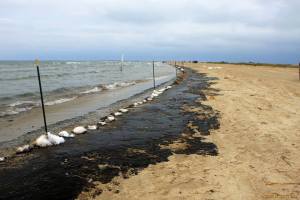 Meanwhile, the latest oil spill disasters take their toll in both the North and South of this Country. There are still long lasting effects in Alaska and in the Gulf of those giant oil spoils. But, even Galveston Bay shows sign of permanent damage from its latest brush with deadly oil that’s no where near the size of those other two. It’s getting to be that no one’s back yard is safe.
Authorities in charge of the cleanup from last week’s Houston Ship Channel oil spill say they’re responding to reports of oil near North Padre Island and Mustang Island, some 200 miles southwest of the original accident.
The command center for the cleanup reports Sunday that oil sightings were made earlier in the day by crews aboard flights being conducted by the Texas General Land Office and the U.S. Coast Guard.
Some tar balls — from dime-size to about 6 inches — have been spotted in seaweed patches along Mustang Island’s J.P. Luby Beach but it’s not certain if they are related to the spill a week ago between Galveston and Texas City.
The spill endangers wildlife nearby. There is a bird refuge that is in a particularly precarious location. That was also the clean side of the Gulf where 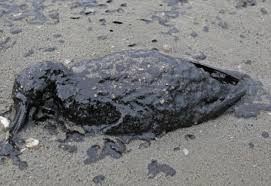 you could still trust the fish and the seafood.
The spill, which dumped what one Texas official referred to as “sticky, gooey, thick, tarry” oil that doesn’t evaporate quickly into Galveston Bay, occurred about eight miles from the Bolivar Flats Shorebird Sanctuary, which attracts 50,000 to 70,000 shorebirds each year. March is right around spring migration for many species of birds, and other birds are still wintering at Bolivar Flats, so tens of thousands of birds are living at the sanctuary, which is designated a Globally Significant Important Bird Area. Cleanup crews are using cannon booms to try to deter birds away from oiled beaches, and so far, oil hasn’t washed up on Bolivar Flats, but birds that have come in contact with oil in the water or on other beaches have been landing there.
Houston Audubon Society volunteers have been tracking the oiled birds they see at Bolivar, and Jessica Jubin, development director at the Houston Audubon Society, told ThinkProgress that the group was “definitely seeing more” oiled birds now than when they first started the day after the spill. She said on Monday, volunteers cataloged 40 to 50 oiled birds at one spot at Bolivar Flats, and on Tuesday, they counted about 100 at the same site. On Wednesday, she said, the number increased to about 140, with most birds ranging from just a few spots of oil on them to half covered in oil.
It’s the shorebirds and seabirds that are most at risk of becoming oiled from the spill, Jubin said.
“Like pelicans, for example — I don’t know if you’ve ever watched them fish, but they will soar in the sky and then spot something down below and then dart right into the water, and that’s how they get so much oil on them,” she said. “They can’t distinguish whether or not the oil is there, and they don’t know how to react to it.”
Mike Cox, spokesperson at the Texas Parks and Wildlife Department, told ThinkProgress the agency has so far collected 45 oiled birds in the Galveston area, with 19 birds in rehabilitation and 26 that were found dead. Jubin said Audubon was reporting birds they saw to Texas Parks and Wildlife and the U.S. Fish and Wildlife Service, but she worries about the movement of the oil. If it drifts too far south or west, it could end up in important habitat for endangered whooping cranes. Already, the oil has reached the ecologically-sensitive Matagorda Island, soiling at least 12 miles of the barrier island’s pristine beaches. So far, however, the Parks and Wildlife Department hasn’t received reports of oiled wildlife from Matagorda Island, Cox said, and crews were working to put up booms to keep the oil from getting into Matagorda Bay.
But birds aren’t the only wildlife at risk from the oil spill. As the Texas Tribune reports, marine scientists are worried that the spill could result in long-term health effects on Texas marine life. The thick fuel oil that spilled Saturday is persistent, so marine species could be even more at risk from oil-related defects like irregular heart rhythm and cardiac arrest than they were from the Deepwater Horizon disaster. Shrimp are a major part of the Galveston Bay fishing industry, and they’re also among the species most vulnerable to the oil spill — if their marshy homes are polluted with oil, they may not survive.
That, of course, doesn’t include the danger to the people and the clean up workers.

In 1790, a freed slave named Jim Moss found a place to settle down on a bend in the Houston River in the bayous of southwest Louisiana. Although never formally incorporated, the village of Mossville became one of the first settlements of free blacks in the South, predating the formal establishment of Calcasieu Parish by 50 years. But over the last half century, Mossville was surrounded. More than a dozen industrial plants now encircle the community of 500 residents, making it quite possibly the most polluted corner of the most polluted region in one of the most polluted states in the country. Now, a proposal to build the largest chemical plant of its kind in the Western Hemisphere would all but wipe Mossville off the map.
The project, spearheaded by the South African chemical giant SASOL, will cost as much as $21 billion, but stands to benefit from more than $2 billion in incentives (including $115 million in direct funding) from the cash-strapped state budget. It has the backing of Republican Gov. Bobby Jindal, considered a likely 2016 presidential candidate, who traveled to the outskirts of Lake Charles for the official announcement of the plan in 2012. The state thinks it’s an economic slam dunk. One study from Louisiana State University projected that it would have a total economic impact of $46.2 billion. It is the largest industrial project in the history of Louisiana. And after a community meeting on Tuesday, it’s one step closer to realization.
But that massive plant will come with a steep environmental price. It will produce more greenhouse gases than any other facility in the state. And the project will almost certainly spell the end for the 224-year-old settlement of Mossville, a poor enclave that has been forced to play host to industrial facilities no one else wanted in their backyard.
An analysis conducted by the Louisiana Department of Environmental Quality (DEQ) in February determined that the new project “will result in significant net emissions increases” of greenhouse gases, promethium, sulfur oxide, nitric oxide, and carbon monoxide. By its calculations, the plant will spew out more than 10 million cubic tons of greenhouse gases per year. (By contrast, the Exxon-Mobil refinery outside Baton Rouge, a sprawling complex that’s250 times the size of the New Orleans Superdome, emits 6.6 million tons.)
It’s beginning to feel a lot like we’re trapped between a future envisioned in the “Blade Runner” and that envisioned in Margaret Atwood’s “The Handmaid’s Tale”. Either way, the outcome will be sponsored by the likes of the Koch brothers and we will soon discover the fresh hells they’ve created for us. The dominionists and the capitalists join together to force their earth and its people into submission.
What’s on your reading and blogging list today?

 peej
peej Carissa
 bostonboomer
 dakinikat
 ecocatwoman
 jjlo
jjlo mablue2
 Mama Lopez
 peggysue22
 quixote
 skydancingguestblogger
 Mona (aka Wonk the Vote)





Recent Comments