
Lazy Saturday Reads: “Shelter in Plates” — WTF? — And Other News
Posted: April 26, 2014 Filed under: Barack Obama, morning reads, Republican politics | Tags: Abraham Miller-Rushing, Chantal Zakari, Climate change, crime, Edward Deveau, Henry David Thoreau, law enforcement overreach, Maren Sanchez, Mike Mandela, military-style policing, Richard Primack, Robert Stavins, Sarah McKinnon, Shelter in Plates, Southern whites, UN Climate Change Report, Walden Pond, Watertown manhunt 26 Comments
Happy Saturday!!
The image to the right shows a commemorative plate from the “Shelter in Plates” project created by Chantal Zakari and Mike Mandela, a married couple who live in Watertown, MA, to mark the day when their town was locked down while hundreds (thousands?) of law enforcement officers swarmed their neighborhood in search of Dzhokhar Tsarnaev, the younger of the accused Boston Marathon bombers.
When I first saw these plates, I laughed out loud. The image of someone collecting these plates and displaying them in your home just struck me as ridiculous and incongruous. Every time I looked at them, I laughed out loud and couldn’t stop laughing. “Just the thing to add to a collection of Princess Diana and Elvis plates!”
I too was shocked to see multiple swat teams confronting innocent people in their homes and military equipment in the streets of a residential neighborhood. IMO the response to the killing of an MIT police officer and a carjacking was way over the top. It’s amazing that no one was killed by one of the hundreds of stray bullets that penetrated the walls of people’s houses. And the conduct of the manhunt the next day was even worse. In the end Tsarnaev was discovered, not by law enforcement but by a homeowner who went into his backyard to check on his boat and found the fugitive inside. I guess it’s just the notion of memorializing the events with plates that struck me funny.
But there is also serious side to this story. Last year, the Chief of Police of Watertown contacted couple’s employer at the School of the Museum of Fine Arts. From PBS station WGBH:
“We created the website on a Saturday or Sunday, and four days later I got a call from my employer saying that Chief (Ed) Deveau had called and wanted my employer to pull funding out of the project, because if this project went to the press it would be bad publicity for the institution,” Zakari said.
Sarah McKinnon is the dean of the School of the Museum of Fine Arts. That is Zakari and Mandel’s place of employment. She remembered the call from Chief Deveau.
“Back in December, I had a phone call from Chief Deveau from Watertown police to talk to me a little bit about it,” McKinnon stated. “He said, ‘Were you aware that the SMFA was mentioned on the website?’ and I said, ‘No, I wasn’t.’ So I took a closer look and indeed saw that SMFA was mentioned on the website itself. SMFA had supported the project by virtue of a faculty enrichment grant.”

The article doesn’t say this specifically, but it appears that McKinnon did ask Zakari and Mandel to remove the school’s name from their website, but the funding for the project was not withdrawn.
McKinnon says that the SMFA respects academic freedom and there was no attempt to rescind the faculty enrichment grant that had actually been dispensed a year ago, despite her misgivings.
“My concern is, I just didn’t want the school seen in a negative light. My concern was not with the particulars of the project, which I didn’t know about, but we didn’t want to be taking advantage of anyone else’s suffering. If this was a project that would put us in a bad light, that was of concern to me,” McKinnon said.
But Mandel argued that Chief Deveau was attempting to intimidate the artists.
“For the chief of police —in his official capacity—to call our employer and make his accusations was an act of intimidation,” Mandel said. “It was an act of harassment and he should desist, and in addition he should apologize.”
I absolutely agree with him, despite the fact that I loathe commemorative plates generally, and think the ones Madel and Zakari designed are ludicrous. The couple’s attorney sent a letter to Deveau demanding that he cease and desist from further harassment. The letter is posted on and their website. You can watch the WGBH interview with Zakari and Mandel on YouTube.
What do you think?
In other news . . .
Following on massive publicity about Cliven Bundy over the past week, the New York Times published a fascinating article about changing demographics in the U.S.: Southern Whites’ Loyalty to G.O.P. Nearing That of Blacks to Democrats.
President Obama’s landslide victory in 2008 was supposed to herald the beginning of a new Democratic era. And yet, six years later, there is not even a clear Democratic majority in the country, let alone one poised for 30 years of dominance….
From the high plains of West Texas to the Atlantic Coast of Georgia, white voters opposed Mr. Obama’s re-election in overwhelming numbers. In many counties 90 percent of white voters chose Mitt Romney, nearly the reversal of the margin by which black voters supported Mr. Obama.
While white Southerners have been voting Republican for decades, the hugeness of the gap was new. Mr. Obama often lost more than 40 percent of Al Gore’s support among white voters south of the historically significant line of the Missouri Compromise. Two centuries later, Southern politics are deeply polarized along racial lines. It is no exaggeration to suggest that in these states the Democrats have become the party of African Americans and that the Republicans are the party of whites.
I hope you’ll read the whole thing if you haven’t already. Particularly interesting is this map of counties (in yellow) where Obama received less than 20% of the white vote in the last election (census data was not available for Alaska).
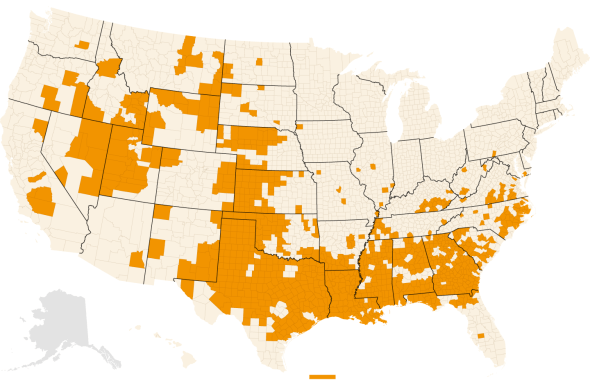
This pattern represents a reversal of a trend that suggested “the South’s assimilation into the American political and cultural mainstream.” Some southern and western areas of the U.S. are regressing to the point that it’s as if the Civil War never happened. How would these areas respond to a woman President?
Milford, CT high school stabbing

Maren Sanchez
Early yesterday morning, 16-year-old Maren Sanchez was murdered by male classmate who reportedly had asked her to go to the junior prom with him and was angry at being turned down. From the Hartford Courant:
MILFORD, Conn. — A 16-year-old Connecticut high school student was stabbed to death Friday morning, and police are investigating whether the 16-year-old male who is suspected of killing her had wanted to take her to the junior prom, which was scheduled for Friday night.
Jonathan Law High School junior Maren Sanchez was killed in a hallway at the school.
The suspect, also a junior at the school in Milford, was charged as a juvenile offender with murder. His name is being withheld because he is a minor, police said….
Milford Police Chief Keith Mello said that the assault happened about 7:15 a.m. in a hallway inside Jonathan Law High School. A staff member witnessed part of the assault, he said, and tried to help. Others joined the effort, and EMS personnel soon arrived to take Sanchez to Bridgeport Hospital. She was pronounced dead at 7:43 a.m., Mello said….
Police said that Sanchez suffered multiple cuts to her neck, chest and face. Investigators recovered a knife at the scene.
The prom was cancelled. Milford is about a half-hour’s drive from Newtown, CT. Read more and see photos at The New York Daily News, which also learned the name of the alleged murderer.
Jonathan Law High School students should have been going to their junior prom Friday night. Instead, the teens went to a seaside vigil for their murdered classmate.
About 200 community members and students, some wearing their prom dresses and tuxedos, gathered Friday evening at Walnut Beach in Milford, Conn., to remember 16-year-old Maren Sanchez, a junior who was murdered earlier in the day at the school after rejecting a classmate’s invitation to the dance….
Anguished classmates funneled down to Walnut Beach around 6 p.m. — just one hour before the school’s junior prom was scheduled to start at a nearby banquet hall. The annual dance was postponed after the tragedy.
Wearing their formal wear, students cried and prayed at the local beach, the Hartford Courant reported. Friends shouted out memories of their slain classmate as they released purple balloons into the sky and yelled “Love you, Maren,” the newspaper reported.
Earlier, students covered a rock outside the school with purple spray paint and wrote the teen’s name and birthday, Aug. 26, 1997, alongside a white heart.
Henry David Thoreau, Walden Pond, and Climate Change
Yesterday, NPR’s Science Friday had a report on Henry David Thoreau’s careful 160-year-old observations of plants in the Walden Pond area of Concord, MA and how they are being used by climate scientists today. The guest was Richard Primack, Professor of Biology at Boston University and author of the book, Walden Warming: Climate Change Comes to Thoreau’s Woods.
From The Guardian, Scientists use Thoreau’s journal notes to track climate change.
Fittingly for a man seen as the first environmentalist, Henry David Thoreau, who described his isolated life in 1840s Massachusetts in the classic of American literature Walden, is now helping scientists pin down the impacts of climate change.
The American author, who died in 1862, is best known for his account of the two years he spent living in a one-room wooden cabin near Walden Pond “because I wished to live deliberately, to front only the essential facts of life”. Packed with descriptions of the natural world he loved, Walden is partly autobiographical, partly a manifesto for Thoreau’s belief in the rightness of living close to nature. “I never found the companion that was so companionable as solitude,” he writes. “Simplify, simplify.”
But Thoreau was also a naturalist, and he meticulously observed the first flowering dates for over 500 species of wildflowers in Concord, Massachusetts, between 1851 and 1858, recording them in a set of tables. When Richard Primack, a biology professor at Boston University, and fellow researcher Abraham Miller-Rushing discovered Thoreau’s unpublished records, they immediately realised how useful they would be for pinning down the impact of the changing climate over the last century and a half. The timing of seasonal events such as flowering dates is known as phenology, and the phenologies of plants in a temperate climate such as that of Massachusetts are very sensitive to temperature, say the scientists. Studying phenology is therefore a good indicator of ecological responses to climate change.
“We had been searching for historical records for about six months when we learned about Thoreau’s plant observations. We knew right away that they would be incredibly useful for climate change research because they were from 150 years ago, there were so many species included, and they were gathered by Thoreau, who is so famous in the United States for his book Walden,” said Primack. “The records were surprisingly easy to locate once we were aware of them. A copy was given to us by an independent research scholar, who knew that they would be valuable for climate change research.”
For a more in-depth report of the research project, check out this long-form article at Smithsonian Magazine.
In the real world, where we’re definitely not doing much to address climate change, The Financial Times reports that, a “senior scientist” has charged that the “Climate Change Report was Watered Down.”
A politically sensitive part of the latest report by the world’s leading authority on climate change was gutted at the insistence of government officials, one of the study’s authors has revealed.
Nearly 75 per cent of a section on the impact of international climate negotiations was deleted at a meeting in Berlin two weeks ago, said one of the authors responsible for that part of the report, Harvard University’s Professor Robert Stavins.
The Berlin meeting was held so representatives of the world’s governments could approve a summary of a massive report by the UN’s Intergovernmental Panel on Climate Change, on how to tackle climate change which took hundreds of authors from around the world nearly five years to compile.
The report was the third of a trilogy of studies the IPCC has released since September in its fifth major assessment of the latest state of knowledge about climate change.
Prof Stavins, a leading expert on climate negotiations at Harvard’s John F. Kennedy School of Government, wrote to the organisers of the Berlin meeting last week to express his “disappointment and frustration” at the outcome.
Read the rest at the Financial Times link.
Those are my recommendations for today. What stories are you following? Please post your links in the comment thread, and have a great weekend!
Friday Reads: Cliven Bundy and the Real Threat of Right Wing Domestic Terrorism
Posted: April 25, 2014 Filed under: Barack Obama, morning reads, Republican politics, U.S. Politics | Tags: Bureau of Land Management (BLM), Cliven Bundy, domestic terrorism, Fox News, Harry Reid, James Yeager, militia groups, misogyny, Racism, Sean Hannity 48 Comments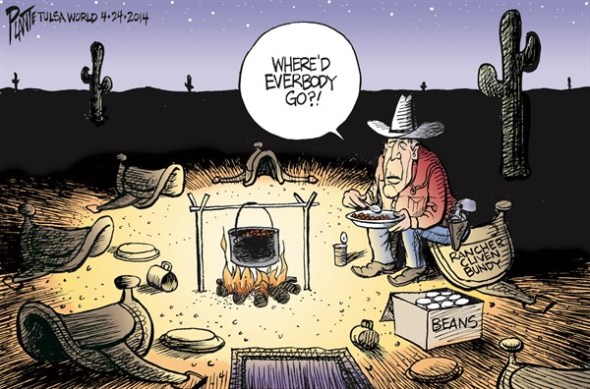
Good Morning!!
What a difference a few days can make! Take a look at the transcript from Fox News host Sean Hannity’s show on Monday April 21:
SEAN HANNITY, HOST: The rhetoric from the left about Nevada rancher Cliven Bundy and his supporters is getting worse and worse by the day. First, as the country marked the 19th anniversary of the Oklahoma City bombing over the weekend, vice chairwoman of the Democratic National Committee Donna Brazile made this disgraceful comparison after talking about how the feds backed down. Watch this.
(BEGIN VIDEO CLIP, “THIS WEEK”/ABC)
DONNA BRAZILE, DNC VICE CHAIR: That was the right thing to do, to try to, you know, simmer things down. Remember, this is the 19th anniversary of the Oklahoma bombing. So this notion that Mr. Bundy has no other recourse but violence is — anti-government violence — is absolutely wrong. He’s been waging this battle for two decades. He’s lost. Everybody else is paying their grazing fees. He should pay his fees, as well.
(CROSSTALK)
UNIDENTIFIED FEMALE: I think we should be reluctant to compare Bundy to Timothy McVeigh.
(END VIDEO CLIP)
HANNITY: And that’s not all. Earlier today, runners embarked on the first Boston marathon since last year’s terror attack. And just days ago, Senate Majority Leader Harry Reid had this to say about Bundy family supporters. Watch this.
(BEGIN VIDEOTAPE)
SEN. HARRY REID, D-NV.: These people who hold themselves out to be patriots are not. They’re nothing more than domestic terrorists.
(END VIDEO CLIP)
HANNITY: Pretty unbelievable. Now, given the events in Oklahoma City and at the Boston Marathon, we really know what real domestic terrorists look like, and that’s not Cliven Bundy or his supporters.
That was before Bundy gave a rambling press conference and let the world see exactly who and what he is. From The New York Times yesterday morning: A Defiant Rancher Savors the Audience That Rallied to His Side.
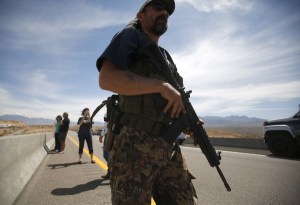
Armed supporters of Cliven Bundy wield weapons against Federal agents.
BUNKERVILLE, Nev. — Cliven Bundy stood by the Virgin River up the road from the armed checkpoint at the driveway of his ranch, signing autographs and posing for pictures. For 55 minutes, Mr. Bundy held forth to a clutch of supporters about his views on the troubled state of America…
Most of all, Mr. Bundy, 67, who was wearing a broad-brimmed white cowboy hat against the hot afternoon sun, recounted the success of “we the people” — gesturing to the 50 supporters, some armed with handguns and rifles, standing in a semicircle before him — at chasing away Bureau of Land Management rangers who, acting on a court order, tried to confiscate 500 cattle owned by Mr. Bundy, who has been illegally grazing his herd on public land since 1993.
Mr. Bundy’s standoff with federal rangers — propelled into the national spotlight in part by steady coverage by Fox News — has highlighted sharp divisions over the power of the federal government and the rights of landowners in places like this desert stretch of Nevada, where resentment of Washington and its sprawling ownership of Western land has long run deep.
Others who have loudly supported Bundy’s cause are Senators Rand Paul of KY and Dean Heller of NV. and Texas candidate for governor Greg Abbott. Claiming that the Feds wouldn’t come around to bother him again soon, Bundy took the time to share some of his opinions on other topics:
Next the NYT reported some remarks Bundy made on Saturday to a group of about 50 supporters along with one reporter and one photography
“I want to tell you one more thing I know about the Negro,” he said. Mr. Bundy recalled driving past a public-housing project in North Las Vegas, “and in front of that government house the door was usually open and the older people and the kids — and there is always at least a half a dozen people sitting on the porch — they didn’t have nothing to do. They didn’t have nothing for their kids to do. They didn’t have nothing for their young girls to do.
“And because they were basically on government subsidy, so now what do they do?” he asked. “They abort their young children, they put their young men in jail, because they never learned how to pick cotton. And I’ve often wondered, are they better off as slaves, picking cotton and having a family life and doing things, or are they better off under government subsidy? They didn’t get no more freedom. They got less freedom.”
Whoops! Suddenly right wingers who had supported Bundy or just ignored his unlawful behavior did a 180 degree turn. Here’s Sean Hannity on his radio show yesterday:
Conservative media titan Sean Hannity, formerly one of Nevada rancher Clive Bundy’sstrongest advocates, expressed his vehement disgust Thursday with the latter’s remarks on slavery.
Bundy’s comments “are beyond repugnant to me. They are beyond despicable to me. They are beyond ignorant to me,” Hannity said during his radio show.
Still, he claimed, Democrats are wrong to use Bundy’s racist, misogynistic remarks to attack Republicans.
“They want to say that conservatives are racist. Conservatives hate women,” Hannity said. “Conservatives want old people to die, granny over the cliff. They want the young people to fend for themselves. They want to poison the air and poison the water.”
“People that for the right reasons saw this case as government overreach now are branded because of the ignorant, racist, repugnant, despicable comments of Cliven Bundy,” he said.
Because Bundy was not sophisticated enough to wrap his racism in euphemisms as many Republicans do, his “mainstream” supporters will have to back off. But what about the militia types and their rifles? Will they be turned off by Bundy’s racist rhetoric? Not likely. From Think Progress:
James Yeager is calling from Cliven Bundy’s front yard, where he’s one of several (he won’t say how many) providing 24-hour security to the Bundy family. He and his friend packed up “a full medical kit and a camera” and drove 26 ½ hours from their home in Camden, Tennessee last week to document what he calls “a tremendous overreach of federal power.” He’s been posting daily videos to his YouTube site.
When asked if he also packed weapons, Yeager said, “of course. I’m always armed. This is not any different than any other day for me.”
Yeager is one of hundreds of supporters who journeyed to Bunkerville, Nevada in support of the rancher’s standoff with the federal Bureau of Land Management. Though federal agents released Bundy’s cattle over a week ago, many have remained on the ranch to protest and protect the rancher’s family. They’ve hailed Bundy — who owes the federal government over $1 million in unpaid grazing fees — as an “American hero.” The Mormon father of 14 has even inspired futuristic fan fiction from his most ardent admirers: “Yes, it’s been a great half-century for America, and we owe much of our good fortune to the bravery of Cliven Bundy.”
They call themselves militia members, oath keepers, protesters and patriots. Senator Harry Reid calls them “domestic terrorists.”
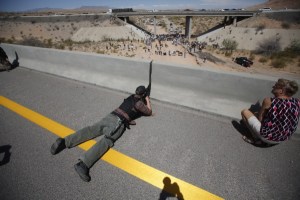
Eric Parker from central Idaho aims his weapon from a bridge as protesters gather by the Bureau of Land Management’s base camp
Harry Reid is right. Check out these images and commentary by Reuters photographer Jim Urquhart:
“I’ve got a clear shot at four of them,” the man with a rifle beside me said, as he aimed his weapon in the direction of U.S. Bureau of Land Management (BLM) officers.
We were on a bridge in southern Nevada in the midst of a tense standoff between the BLM and a group of angry ranchers, milita-members and gun-rights activists. It seemed as if we were a hair’s breadth away from Americans killing Americans right in front of me.
This showdown had come after the BLM started rounding up cattle belonging to rancher Cliven Bundy, who had been letting his animals graze illegally on federal land for over 20 years….
I decided to leave the protesters’ rallying point and drive several miles to where BLM and National Park Service (NPS) officers were holding Bundy’s impounded cattle but when I got there, there didn’t seem to be anything new to report.
I was making my way back to the protest site when Jennifer called me. She said the demonstrators were coming in my direction to go to the BLM facility and demand that Bundy’s cattle be released. My heart skipped a beat and anxiety set in, as I realised the armed group was heading this way looking for a showdown.
The convoy arrived just a few moments after I did and began to clog lanes of traffic on the south side of the interstate, the opposite side to the BLM base
Read more at the link. I don’t know about you, but I find this entire episode frightening. Who are these angry, violent people in our midst?
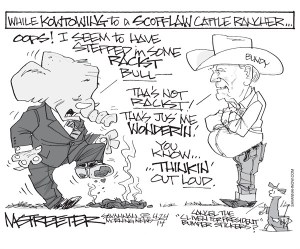
And Cliven Bundy isn’t apologetic. He told CNN last night that he doesn’t regret his racist comments, “I think I’m right.”
Cliven Bundy — the Nevada rancher turned conservative folk hero for bucking the federal government’s attempts to stop his cattle from grazing on public land — admits he doesn’t understand the bipartisan uproar over his comments suggesting blacks might have been better off under slavery.
But he understands what he meant by those comments, and he’s not backing down.
“I don’t think I’m wrong,” Bundy told CNN’s Bill Weir on Thursday night. “I think I’m right.”
The rancher said he doesn’t feel “abandoned” by the uproar by the likes of right-wing radio firebrand and Fox News host Sean Hannity, who has ripped what he called the “ignorant, racist, repugnant, despicable comments.” [….]
He backtracked somewhat, insisting he “didn’t really mean it to compare (African-Americans’ current plight) with slavery. I meant to compare it with maybe life on the farm or life in the South, where they had some chickens and the gardens, and they had something to do.”
At the same time, Bundy stood by his general premise that blacks once had better lives — stating that, right now, “they don’t have nothing to do with their children, their family unit is ruined … That’s what I was referring to I don’t think they have the life that they should have” because of the government.
I admit I didn’t pay much attention to the Bundy story at first. I live in a city and community where I’m very insulated from people like this and where Republicans are a tiny minority. Of course we still hear ignorant remarks on talk radio, but on the whole people who are vicious racists have to tone down their rhetoric or be marginalized. But once I began reading about Bundy in JJ’s and Dakinikat’s posts over the past two days, I realized this is no joke.
Having a black man as a two-term president has terrified and enraged these racist militia types and brought them out of the woodwork to express their ugly opinions more blatantly than before. As Harry Reid has said, they are domestic terrorists and they must be brought under control. What will happen if we elect a women president?
These people are far more dangerous to our country than foreign terrorism. The FBI should be infiltrating milita groups instead of running stings on muslim-Americans if they want to minimize terrorism in this country. When we have a Supreme Court Justice advocating–even tongue-in-cheek–that unhappy taxpayers should overthrow the U.S. government, we have to understand right wing extremists are a serious threat to our country.
So . . . this ended up being a one-subject post. I know there are plenty of other things happening in the news. What stories are you following today?
Thursday Reads: Freedom Fried Edition
Posted: April 24, 2014 Filed under: corporate greed, Fox News, Hillary Clinton, morning reads, right wing hate grouups, Rush Limbaugh, the GOP, Women's Rights 65 CommentsGood Morning!
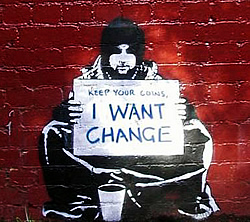 BB is having internet problems this morning so I’m going to try to get this quick post off this morning!
I’ve really come to believe that the Republican Party is basically the victim of the success of the Southern Strategy. The coupling of neoconfederates and religious fanatics with big business interests seems to be coming full circle. A new poll seems to broadly indicates this as we continue to see the educated, women, minorities, the young, and most states out of the deep south turn away from Republicans. But you know, it’s all about white,straight, christian male freedom, so every one else can just go sit at the back of the bus or be thrown under the bus.
While white Southerners have been voting Republican for decades, the hugeness of the gap was new. Mr. Obama often lost more than 40 percent of Al Gore’s support among white voters south of the historically significant line of the Missouri Compromise. Two centuries later, Southern politics are deeply polarized along racial lines. It is no exaggeration to suggest that in these states the Democrats have become the party of African Americans and that the Republicans are the party of whites.
The collapse in Democratic support among white Southerners has been obscured by the rise of the Obama coalition. Higher black turnout allowed the Democrats to win nearly 44 percent of the vote in states like Mississippi, where 37 percent of voters were black. But the white shift is nearly as important to contemporary electoral politics as the Obama coalition. It represents an end, at least temporarily, to the South’s assimilation into the American political and cultural mainstream.
There are many reasons for this, but the role of right wing media is undoubtedly important. Fox eagerly jumps on the story of “beleaguered white man” only to find their new hero is a secessionist, a misogynist, a homophobe, almost violently anti-modernity and law, and terribly racist. JJ had a great post yesterday about Clive Bundy. Well, here’s the latest interview with the old coot who thinks black folks were better off as literal slaves than they are today.
Republican politicians began backtracking on their support of Nevada anti-government rancher Cliven Bundy after the New York Times caught Bundy making racially-inflammatory remarks blaming African-Americans for willingly submiting to dependency on federal assistance.
“They abort their young children, they put their young men in jail, because they never learned how to pick cotton,” Bundy was quoted as saying to a group of supporters last Saturday. “And I’ve often wondered, are they better off as slaves, picking cotton and having a family life and doing things, or are they better off under government subsidy? They didn’t get no more freedom. They got less freedom.”
Bundy’s statements about “the Negro,” published on Wednesday, were made during his daily speech to supporters outside Bunkerville, Nevada, where a crowd gathered to support him in defiance of the Bureau of Land Management (BLM) during an attempted round up of his cattle. The confrontation was the result of Bundy’s refusal to pay grazing fees on federally-owned land for more than 20 years, in spite of multiple court rulings against him. Bundy has stated on several occasions that he does not recognize the existence of the federal government.
During the speech, Bundy said he remembered driving past a public-housing project in North Las Vegas, which he called a “government house” with “always at least a half a dozen people sitting on the porch” with nothing to do.
These dudes clearly hate and misunderstand women too. And, it’s not just southern white men.
A New Hampshire lawmaker found himself being heckled by his colleagues on Wednesday during a state House speech, which asserted that women lacked the work ethic of men so they should be paid less.
During a floor debate on Wednesday, state Rep. Will Infantine (R) argued that the “Paycheck Equity Act” was not necessary to prevent wage discrimination based on gender because women deserved to make less.
“Men, by and large, make more because some of the things that they do,” he opined. “Their jobs are, by and large, riskier. They don’t mind working nights and weekends. They don’t mind working overtime or outdoors.”
At that point in the video clip uploaded by Granite State Progress, other lawmakers began to loudly object to Infantine’s remarks.
“It’s not me!” he exclaimed, insisting that his facts came from the Bureau of Labor Statistics.
“Men work five or six hours longer a week than women do,” he continued. “When it comes to women and men who own businesses… women make half of what men do because of flexibility of work, men are more motivated by money than women are.”
 The poster boy for TV Ugly is Erick Erickson. He’s the Rush Limbaugh of the internet and FOX and here’s what he’s saying about Hillary.
Red State and Fox News’ Erik Erickson makes believe he’s a big time Christian conservative politico, but when he opens his mouth about the left, he almost always sounds like nasty degenerate. I guess he is a Christian conservative active in politics after all.
Here he is on Rush Limbaugh’s airwaves, discussing the upcoming election and Charlie Cook’s analysis when he went into his goatf*&king child molester routine on Hillary.
Erickson…it’s very, very hard for incumbent parties to win three in a row no matter how it goes. Look at Bill Clinton going into 2000. I could be wrong. All my Democratic friends are salivating, yea, I have a couple of them.
They’re all salivating at the idea of Hillary Clinton running in 2016. She’s gonna be old. I don’t know how far back they can pull her face, can I say that on the air? I don’t know…There’s gonna be an age factor there and does she wanna go out and be like John McCain in 2008, the Democrats were playing up the old card
Oh, my God. This is what qualifies as top notch Conservative policy analysis. This is what Hillary has to look forward to when she runs for 2016. It’s not about her policy ideas or issues, but her face, her age, her clothes, her smell, her bitchiness, her sexual preferences, her ____ (Fill in the blank)
It’s really difficult for me to understand how these men can live with all this anger, rage, and pent up hatred. What’s worse is that they all seem to come equipped with guns. It also is beyond me how these guys can be so completely duped into supporting the very people that are picking their pockets daily. Here’s a great interview with Michael Lewis on the nature of our Wall Street billionaire problem.
IC: How much has Wall Street behavior sparked the inequality conversation that is going on now?
ML: They are very connected. If you go back and look at the boom in CEO pay, it is tied directly to Wall Street compensation. Social norms changed. And they changed first on Wall Street. This bothers me a lot. What do I want to tell people coming out of school? I want to tell them about noblesse oblige, which has just died. There is an absence at the top of the culture.
IC: Have you read the new Thomas Piketty book?
ML: I just downloaded it because it’s impossible to get copies of the hardcover any more. It is sold out.
IC: I had the same experience. You would have more luck getting The Satanic Verses in Iran. The reason I ask is because Piketty and others talk less about noblesse oblige than things such as higher tax rates. The government has to step in.
ML: I feel such despair at how the government responded to the financial crisis. It did a lot of good things to prevent a depression. But the Wall Street firms ended up even more of a problem. They got bigger. I thought they should be broken up in one way or another.
IC: So you think they are worse now?
ML: Probably not worse in the sense that they are probably more afraid to do bad things. More skittish. But as a market problem they are worse because they are bigger. The effect of a lot of the regulation has made it harder on would-be-competitors who could challenge them. And Dodd-Frank throws decisions to the regulators, and then that discussion ends up being run by banks. I just hate it. I have given up on the government. I wrote this book because I feel like these guys in my book have figured out a market version of Occupy Wall Street. This may be the way we have to deal with this. People ask me what the SEC should do. Well, there are things I’d like them to do, but for now they may ned to just get the hell out of the way. Maybe they can force some transparency. People at the SEC have said that they are counting on these market solutions.
IC: What are your thoughts about the culture on Wall Street? I don’t know if you saw Wolf of Wall Street, but it seemed to me that the movie was arguing that the culture there inspires bad behavior.
ML: I did see it. I know too many people there and love too many people there so I have mixed feelings about this. They are not all bad people. The problem is that the incentive system is really screwed up and that screws up the behavior.
 Meanwhile, SCOTUS is still working very hard to make sure that our political system is rigged.
There’s a first amendment case going in front of the Supreme Court right now that’s very, very dangerous. Why? Because it might allow religious opinion to become legal fact, corrupting the intent of our constitutional rights, if not the specific wording. As you’re probably well aware, the decisions handed down by SCOTUS as of late have shown remarkable intention to broadly change United States law to fit a conservative, activist agenda, that of the five right-wing justices (seen below). The Susan B. Anthony List (SBA List), an anti-choice and anti-family planning group, is suing because they believe they have a right to publicly advertise lies if they have sufficient reason to hold the advertised opinion. Paradoxical, yes, but if you’re familiar with American culture, you’ll completely understand. Cognitive dissonance and bold denial in the face of proof are defining characteristics.
So, let’s be very clear again that the Republican “Freedom” agenda seems to be very clearly aimed at a few people.
Any way, that’s it for me this morning! Let me know what’s on your reading and blogging list while I brew up some coffee!
Tuesday Reads: A Little Bit of This and That
Posted: April 22, 2014 Filed under: morning reads, nature, open thread, science | Tags: big bang theory, Boston Marathon, Einstein's brain, Loch Ness monster, mastodon tooth, Meb Keflezighi, Philip Stoll, public ignorance, Rita Jeptoo, Tyrannosaurus Rex 37 Comments
Good Morning!!
Just because I feel like it, I’m going to avoid the depressing news today and give you a mixture of stories that interested me.
By now everyone knows about the 15- or 16-year-old boy who on Sunday flew from California to Hawaii in the wheel well of a Boeing 767 jet and survived.
It turns out he ran away from home after some kind of argument, climbed over a fence at San Jose Mineta International Airport, and hid in the wheel well of the first plane he saw. Authorities are trying to figure out how he evaded multiple layers of security and how he survived a trip that could have killed him.
“He got very lucky that he got to go to Maui but he was not targeting Maui as a destination,” Simon said.
The boy is also lucky to be alive, given that wheel-well stowaways rarely surviving flight conditions. At 38,000 feet, the percentage of oxygen is a fraction of that at sea level, and the temperature ranges from minus-50 to minus-85 degrees….
The plane landed in Hawaii. About an hour later, at 10:20 a.m. Hawaii time, crews were startled by the teen coming out of the wheel well, Maui Airports District Manager Marvin Moniz said.
“He was weak. He hung from the wheel valve and then he fell to the ground and regained some strength,” Moniz said.
He passed out in the air and didn’t regain consciousness until an hour after the plane landed in Hawaii, Simon said. When he came to, he climbed out of the wheel well and was immediately seen by airport personnel who escorted him inside where he was interviewed by the FBI, Simon said.
It was not immediately clear how the boy stayed alive in the unpressurized space, where temperatures at cruising altitude can fall well below zero and the air is too thin for humans to stay conscious. An FAA study of stowaways found that some survive by going into a hibernation-like state.
According to Simon, the boy doesn’t have any memories of the flight. Some experts are questioning whether the story is even true.
News of the incident was met with suspicion and scrutiny. Most wheel-well stowaways don’t survive, falling victim to frigid temperatures and lack of oxygen. The chances of survival of a wheel-well stowaway on a commercial aircraft are about 24 percent, according to the Federal Aviation Administration’s Civil Aerospace Medical Institute.
ABC News aviation consultant John Nance is skeptical that the teen could have survived the 2,300-mile flight in the wheel well without an oxygen source.
“I just don’t believe it,” Nance said.
Dr. Richard Besser, ABC News’ chief health and medical editor, said in order to survive inside a wheel well during a flight, the body has to fall into a hibernation-like state, with the heart only beating a couple times a minute.
“It’s near impossible, almost miraculous, and maybe there’s more to the story,” Besser said.
Besides, how did this kid manage to evade security, including “multiple layers of security, including wide-ranging video surveillance, German shepherds and Segway-riding police officers?” Back to the Daily Mail:
San Jose International Airport spokeswoman Rosemary Barnes says airport employees monitor security video feeds from throughout the 1,050-acre airport around the clock. However, she said no one noticed images of an unidentified person walking on the airport ramp and approaching Hawaiian Airlines Flight 45 in the dark until security agents reviewed the footage after the plane had landed in Hawaii and the boy had been found.
The airport, in the heart of Silicon Valley, is surrounded by fences, although some sections do not have barbed wire and could easily be scaled.
The boy found his way onto the tarmac during the night, ‘under the cover of darkness,’ Barnes said.
Hours later, surveillance video at Kahului Airport showed the boy getting out of the wheel well after landing, according to a statement from Hawaii’s Department of Transportation.
The boy isn’t being charged with a crime, and will be returned to his parents, where he’ll have a quite a story to tell. I guess we’ll learn more in the next few days.

Yesterday’s Boston Marathon came off without a hitch, and an American won the men’s race for the first time in more than 30 years. The New York Daily News reports: American Meb Keflezighi wins Boston Marathon a year after bombing.
With the names of the murdered written on his runner’s bib, American Meb Keflezighi raced to victory Monday in the Boston Marathon, becoming a living symbol of resilience from the dark days of terror.
Keflezighi, 38, a member of the New York Athletic Club, said his triumph was fueled by a city that refused to buckle in the face of hate.
“It was not about me. It was about Boston Strong,” said Keflezighi, who broke down in tears as he became the first American in 31 years to win the race. “When the bomb exploded, every day since I’ve wanted to come back and win it.”
The Eritrea-born Keflezighi, who became an American citizen in 1998, crossed the finish line to chants of “U-S-A!” a mere 11 seconds in front of Kenya’s Wilson Chebet. He won the elite men’s race with a time of 2:08:37, a personal best and the second-fastest for an American man at Boston.
“When the Red Sox won (the World Series) and put the trophy right there,” he said, pointing to the Boylston St. finish line, “I wanted to win it for the people of Boston.”
Keflezighi came to the U.S. with his parents when he was 12 years old. He attended public schools in San Diego, where he first started running. He graduated from UCLA, where he won multiple championships and awards. He won a silver medal in the 2004 Olympics, and in 2009 he became the first American man to win the New York City Marathon since 1982.
In the women’s race, 2013 winner Rita Jeptoo won again, setting a course record of 2:18:57–also a personal best. Jeptoo is from Kenya.
I guess this next story is a little bit depressing, but it’s mostly ridiculous. From UPI: Majority of Americans doubt the Big Bang theory.
In a new national poll on America’s scientific acumen, more than half of respondents said they were “not too confident” or “not at all confident” that “the universe began 13.8 billion years ago with a big bang.”
The poll was conducted by GfK Public Affairs & Corporate Communications.
Scientists were apparently dismayed by this news, which arrives only a few weeks after astrophysicists located the first hard evidence of cosmic inflation.
But when compared to results from other science knowledge surveys, 51 percent isn’t too shameful — or surprising.
Other polls on America’s scientific beliefs have arrived at similar findings. The “Science and Engineering Indicators” survey — which the National Science Foundation has conducted every year since the early 1980s — has consistently found only about a third of Americans believe that “the universe began with a huge explosion.”
Okay, maybe the notion of a giant explosion setting the universe in motion is a little surprising. But it’s certainly more believable than the biblical explanation that a godly being created the universe in seven days by making pronouncements like “Let there be light!”
Now an example of what some people are willing to believe: Has the Loch Ness Monster been spotted on Apple Maps?
Members of the Official Loch Ness Monster Fan Club claim they have studied an image seen on Apple’s global satellite map application that shows the allegedly 100-foot-long creature, CNet .com reports, citing London’s Daily Mail. They say if you zoom in on Apple images from space you can even see the monster’s giant flippers.
News of the sighting has fans of Nessie — as she’s affectionately called — buzzing because there hasn’t been a Loch Ness sighting in 18 months. Legend has it she’s been cruising the area of Loch, just south of Dores, Scotland, for some 90 years, but so far, there’s no definitive proof she exists.
Nessie’s fan club devotees say they have ruled out all other possibilities for the grainy image, including a floating log or a giant seal. But one skeptic, deep-sea biologist Andrew David Thaler, debunks the theory on his websiteSouthernFriedScience.com, saying that the image shows the wake of a boat.
I have a few more interesting science stories for you.
From National Geographic: The Tragic Story of How Einstein’s Brain Was Stolen and Wasn’t Even Special.
My headline may be a bit misleading. Albert Einstein, the Nobel prize-winning physicist who gave the world the theory of relativity, E = mc2, and the law of the photoelectric effect, obviously had a special brain. So special that when he died in Princeton Hospital, on April 17, 1955, the pathologist on call, Thomas Harvey, stole it.
Einstein didn’t want his brain or body to be studied; he didn’t want to be worshipped. “He had left behind specific instructions regarding his remains: cremate them, and scatter the ashes secretly in order to discourage idolaters,” writes Brian Burrell in his 2005 book, Postcards from the Brain Museum.
But Harvey took the brain anyway, without permission from Einstein or his family. “When the fact came to light a few days later, Harvey managed to solicit a reluctant and retroactive blessing from Einstein’s son, Hans Albert, with the now-familiar stipulation that any investigation would be conducted solely in the interest of science,” Burrell writes.
This story is so weird that there is no way I can do it justice with excerpts. You need to read the whole thing. Just to whet your appetite, I’ll tell you that Beat writer William Burroughs makes a cameo appearance. The comments are interesting too.
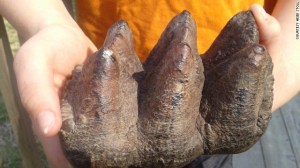
Part of a mastodon tooth
I just love this story; it’s the kind of thing I dreamed would happen to me when I was a kid: 9-year-old Michigan Boy Unearths 10,000-Year-Old Mastodon Tooth near Home.
“I was walking down at the creek last summer. I felt something that I stepped on so I picked it up and everybody in the neighborhood thought it was pretty cool,” Philip Stoll told CNN on Friday….
“It felt weird,” he said, according to the Detroit Free Press. “I had to see what it was. I pulled it out and brought it to my mom.”
Stoll…took the six-peaked, 8-inch foreign object to his Windsor Township house and washed it in his kitchen sink to get a better look. Mom Heidi Stoll was also brought in for consultation.
“I didn’t even think that it could have been a tooth until I started checking online for some kind of match,” she said. “We saw a picture of a Mastodon tooth and said ‘there it is.'”
The Stoll family eventually reached out to James Harding, a herpetologist – an expert on reptiles and amphibians, at nearby Michigan State, who confirmed their suspicions.
“This is indeed a mastodon tooth,” Professor Harding verified in an email, CNN reports. “Apparently (it is) the upper surface, broken off at the roots.”
Wow, that is one lucky kid! Philip told CNN he has dreamed of becoming a paleontologist when he grows up.

Did you hear about how the Smithsonian acquired a nearly-complete skeleton of a Tyranosaurus Rex and had it delivered from Montana by FedEx? From the Guardian: Rare T rex bones arrive at Smithsonian Museum after cross-country journey.
For the first time since its dinosaur hall opened in 1911, the Smithsonian’s National Museum of Natural History will have a nearly complete T rex skeleton. FedEx delivered the dinosaur bones in a truck carrying 16 carefully packed crates.
The T rex, discovered in 1988 on federal land in Montana, is about 80-85% complete. It’s one of about half a dozen nearly complete T rex skeletons that have been uncovered. This specimen could become the most prominent with its new home in one of the world’s most-visited museums. About 7 million people visit the natural history museum each year, and it offers free admission.
Like the mastodon tooth that Philip Stoll found, this skeleton was discovered by amateurs.
Kathy Wankel, a Montana rancher who discovered the bones in 1998 during a camping trip, said she was proud to see the specimen in a national museum. Initially, Wankel spotted about 3 inches of bone sticking out of the ground, and she and her husband dug out a small arm bone.
“We were so thrilled we had found a bone; we called that a mega find,” she said at the museum. “But I think now this is a mega find.”
Paleontologists from the Museum of the Rockies in Bozeman, Mont., excavated the fossil, and it’s been housed there for the past 25 years. At the Smithsonian, the skeleton will be mounted upright for the first time.
Those are my offbeat offerings for today. What stories have you been following? Please feel free to post real news in the comments.
Monday Reads
Posted: April 21, 2014 Filed under: Bobby Jindal, Climate Change, Corporate Crime, corporate greed, corruption, energy, Environment, Environmental Protection, Environmentalists, morning reads, tar sand oil, toxic waste 46 CommentsGood Morning!
 I’m going to remind you today of some events that happened 4 years ago with the BP Oil Gusher and show you that bad things are still going on in the Gulf.The leftover issues from abandoned oil rigs are bigger than Louisiana.Please consider this an open thread while I let you know how I feel.
If corporations are people, then BP and others in the extraction business are serial killers. All over our country and throughout our history, extraction companies have killed their employees, the people that live around their businesses, and the wildlife and the environment and water systems that sustain the life of our country. Look at that map. Those are active and orphaned/abandoned oil wells/pipelines that are disintegrating, leaking, and killing someone.
“I started noticing, towards the end of 2010, other leaks that were unrelated to the BP disaster,” Henderson says. “I would find wellheads that were leaking or platforms that were leaking. Just in the last year, I have filed 50 reports for different leaks and spills unrelated to the BP disaster.”
Under the Clean Water Act, when a company spills any amount of oil in the water, it must file a report with the National Response Center run by the Coast Guard. But when Henderson checked, he found many of those smaller spills were not making that list.
So environmental groups formed the Gulf Monitoring Consortium to get a better count on spills. The partnership is a blend groups of complementary skills.
Gulf Restoration Network, for example, has personnel who can spot spills from the air and file complete reports.
SouthWings, a group of volunteer pilots, helps get those spotters aloft.
Louisiana relies largely on the oil industry to self-report leaks and spills. The Gulf Monitoring Consortium was formed to improve that effort and said it often finds smaller leaks like this one, near Golden Meadow, that go unreported by the companies.A third member, the West Virginia-based tech group SkyTruth, finds the spills on satellite photographs, then applies a formula used by spill experts to translate the size of the oil sheen into gallons of oil in the water.
SkyTruth spokesman David Manthos says its estimates typically are much higher than what’s been reported.
“We found that the spill was usually 10 times larger than had been reported, and that was averaged out across a lot,” he says. “In some, the mismatch was much larger than that.”
The sheer size of the industry here means there’s seldom a quiet day for the consortium. In an average year, the NRC receives 10,000 reports of spills in the Gulf.
It’s a number that surprised even SouthWings Gulf Program Director Meredith Dowling, a veteran of monitoring efforts.
“I can’t think of a single instance where our volunteers have flown offshore and not found spills,” Dowling says. “This was something that was really amazing to me when I first moved here … that is was a continuous, absolute failure of business-as-usual practices.”
There are many active spills around here. Many come from orphaned and abandoned wells. Many come from active wells. They are all spewing toxic waste and it’s not just in Louisiana. Here is a program in Pennsylvania dedicated to plugging orphaned and abandoned wells. There are similar issues in Texas, New York State, and just nearly anywhere there’s been activity. Louisiana alone has about 6000. You can see that they are nearly everywhere if you look at the map at the top of the post. Many of these wells were first put into play in the 1850s and were just left where they were. They are rotting, they are decaying, and they are leaking. They are also dangerous.
Methane is an odorless, colorless gas that exists naturally below the surface. It isn’t poisonous, but it’s dangerous. When enough methane gathers in an enclosed space — a basement or a water well, for instance — it can trigger an explosion.
The gas didn’t come from the Butters well, nor did it originate from the Marcellus Shale formation that a nearby Shell well had recently tapped into. What most likely happened to cause the geyser in June, Shell and state regulators say, was something of a chain reaction. As Shell was drilling and then hydraulically fracturing its nearby well, the activity displaced shallow pockets of natural gas — possibly some of the same pockets the Morris Run Coal company ran into in 1932. The gas disturbed by Shell’s drilling moved underground until it found its way to the Butters well, and then shot up to the surface.
Areas impacted by oil spills are never the same. The BP Oil Gusher has introduced issues into the ecosystem that have left endangered species teetering further towards extinction. In the case of Louisiana, it’s even the state bird.
On a bright spring morning, P.J. Hahn is walking through a graveyard in the middle of Barataria Bay.
It’s a 30-yard patch of mud and sand bristling with bare, dead mangrove brush surrounded by miles of open water. Each mangrove is a tombstone marking the death of a nesting site used for decades by brown pelicans and roseate spoonbills on what was once the string of wetland pearls that made up the Cat Islands chain.
But in 2010 the oil spewing from BP’s Deepwater Horizon would send them all to an early grave.
“Four years ago we had more than five acres of habitat and there were tens of thousands of birds nesting on these islands,” said Hahn, director of coastal zone management for Plaquemines Parish. “Then the oil came in and coated the mangrove roots, and two years later the islands started going.
“I don’t know where those birds are nesting now – but they can’t do it here any more.”
The post-BP story of the brown pelican, Louisiana’s official bird, is the perfect metaphor for the crisis confronting the state’s coast.
Before the Deepwater Horizon blew out on April 20, 2010, brown pelicans were living the good life in southeast Louisiana as one of the great wildlife comeback stories. In 1963 not a single brown pelican could be found in the state due to impacts from the insectiside DDT. The comeback started in 1968 when the state began transplanting birds from Florida, and populations began to soar after DDT was banned in 1972. Thanks to the abundant food in one of the world’s most productive fisheries, by 2010 their numbers were thought to be near historic levels, as high of 85,000.*
 Four years later, the sea floor closest to the spill and even the shores in the Gulf of Mexico are comparable to an Arizona Desert. It is barren, bleak and dead. There was life there. Now, there is the look of a forest fire without the resultant new growth. Nothing will grow back amid the poison of Corexit and Oil.
When a crew of journalists and environmental groups studying the effects of the BP Deepwater Macondo oil spill disembarked on Cat Island in Baratria Bay last week, there was a collective gasp.
“It looks like the Arizona desert,” said Eileen Fleming, who’s reported for WWNO spring after spring since the April 20, 2010 spill.
“It looks like there was a fire here,” said Doug Meffert, vice president of the National Audubon Society and president of the Louisiana chapter, “but there wasn’t a fire.”
The bones of black mangrove stumps are all that remain of what was a thriving bird rookery here in Plaquemines Parish Four years ago, footage of oiled brown pelicans and the thousands of shorebirds nesting here went around the world in the aftermath of the 200 million gallons of thick crude that spilled into the Gulf of Mexico.
Today the only green thing on the beach is a glass bottle. There are no pelicans, no mangroves, and worse, much of Cat Island itself is washing away. It and most of the barrier islands and marsh in Barataria Bay are steadily degrading, losing their battles with coastal erosion and subsidence faster than ever.
Areas around Barataria Bay and Grand Isle, La. were particularly hard hit, but they weren’t the only affected areas. Moreover, thousands of birds, other wildlife and marine life including dolphins perished, were oiled, sickened and overall left in distress. The effects on the area resonate now, which is only a shock to those either unfamiliar with garish oil spills or unwilling to accept the truth.
In the days following the “spill”, BP, apparently colluding with the US Government, doused a horrific amount of a deadly dispersant in the affected areas. Called “Corexit”, the cutesy name belies the sickening effects it brings to all it touches. On background, an environmentalist working in the area explained to me last year that they were, essentially, damned if they did, and damned if they didn’t, but chose the lesser of two ills.
That remains to be seen as the National Institutes of Health continues its 10-year “GuLF” study of BP spill health effects, from those most affected out on the Vessels of Opportunity boat that included BP-hired personnel trying to contain the spill, to residents in the line of fire, such as around Barataria Bay.
There is a way of life dying along the southern parts of the Gulf Coast in Louisana. The coastline disappears daily, the salt water intrudes in to the fresh  water marshes, and the land doesn’t sustain the people or the animals like it once did. There is not better place to study the impacts of the extraction business and human addiction to fossil fuels than many parts of Cajun Louisiana.
Sea level rise is like an ultra-slow-motion hurricane for low-lying areas, but unlike a hurricane, it can be forecast decades in advance. Projections that some town or road will be underwater in 100 years can—and must—be mitigated against today.
Osborn characterizes the choice as “being proactive rather than reactive. Once you get into situations like Louisiana facing some very serious challenges in a very near time frame, all of a sudden you’re in a reactive posture.” Louisiana is a harbinger of things to come for New York, Miami, and other major coastal cities that would do well to look 20 to 75 years ahead and budget accordingly. Local, state, and federal governments will have to make critical decisions about infrastructure, water and sediment diversion, and wetlands restoration in the next 10 to 15 years, he says, and while NOAA scientists can contribute data, they can’t green-light projects or secure funding.
Osborn makes a technical distinction: “Right now it’s what’s called frequently flooded. And the risk is it will be routinely flooded.” Routine flooding will start to happen as early as 10 years from now, he says. They can call it whatever they want, but Gill says soon LA 1 will be “flooded every day during high tide.”
NOAA scientists predict that eventually all the marsh that surrounds LA 1 and Port Fourchon will disappear, connecting two major bodies of water that now are distinct: Barataria Bay and Terrebonne Bay. The only thing out in the water at all, by 2100, may be a raised road and Port Fourchon. “I can imagine Port Fourchon being like the Florida Keys,” says Chiasson, “being on its own, in the middle of open water, maybe a little marsh around it, but nothing between here and there.”
The fact that the entire extraction business is so fraught with so many bad things is why the men that run it must find politicians to protect them from lawsuits and regulations. Making these guys pay for what they’ve done would undoubtedly run their companies deeply into the red. Donation whores like Republican Governor Bobby Jindal will do anything to protect the benefactors that he hopes will fund him to the White House. There is nothing about Louisiana that this man is interested in except as a step on the rung of his personal ascent.
The state Senate targeted the flood protection authorities around New Orleans and the lawsuit one of the levee boards filed against the oil and gas industry for damages to the state’s wetlands.
In one bill, advanced by a Senate panel Wednesday morning, Gov. Bobby Jindal would get sweeping power to remove members of the Southeast Louisiana Flood Protection Authorities. Opponents said the move, which would allow a governor to remove authority members under certain conditions, reintroduces politics into the levee boards, which is precisely what revamp after the 2005 hurricanes was designed to prevent.
Another measure, which was passed by the full Senate late Tuesday night, would derail a lawsuit filed last year by the Southeast Louisiana Flood Protection Authority — East against 97 oil and gas companies. The levee board sought damages for contributing to coastal erosion and led to higher than anticipated storm surges.
Jindal opposes the lawsuit and has called it a windfall for lawyers, who would be paid with a portion of any winnings rather than a flat fee. Critics say the legislation would keep the oil and gas industry from taking responsibility for damage caused by drilling and productions activities over the years.
SB553 is aimed at a lawsuit filed by the Southeast Louisiana Flood Protection Authority-East. It would not impact similar suits filed by Jefferson and Plaquemines Parishes. But other measures currently being considered might.
The legislation passed Tuesday night, Senate Bill 553, would apply to retroactively. That measure was sent Wednesday morning to the Louisiana House.
Even kindergartners know they should clean up their messes. That is ones that aren’t sociopaths.
But, wherever there has been the extraction business, there are the sociopaths. We have the hundred year anniversary of just such an example.
Linda Linville climbed down the steep stone steps into the dugout on the southern Colorado prairie Sunday where one branch of her family was wiped out in one day 100 years ago.
Her great aunt, her unborn baby and two children died in a fire that broke out during a battle between coal miners striking against John D. Rockefeller, Jr. and the Colorado National Guard in what became known as the Ludlow Massacre. Twenty-seven-year-old Cedilena Costa, 4-year-old Lucy and 6-year-old Onofrio suffocated from the smoke as they hid below ground to escape the battle. Linville said Cedilena’s husband, Charlie Costa, was captured and shot in the head that day and never knew his family’s fate.
“Anyone who says they died in vain is wrong,” said Linville, a retired history teacher from Corona, Calif., referring to the fact that the miners eventually ended up going back to work without winning any of their demands.
The massacre and battle left 21 people dead, including the Greek-American union leader Louis Tikas, and set off 10 days of civil war in which the miners killed 30 mine guards, supervisors and strikebreakers. They surrendered only after President Woodrow Wilson sent federal troops to the state.
The deaths drew national attention to the long running strike and forced Rockefeller to take a public role in Colorado Fuel & Iron. He instituted a company union and grievance system, which the miners later rejected when the won a right to unionize on their own during the New Deal. The massacre and the deadly Triangle Shirtwaist fire in 1911 are credited with the helping win the eventual passage of the 1935 National Labor Relations Act.
Linville and over 100 others — including members of the United Mine Workers of America wearing the red bandanas the strikers wore — gathered at the site of the former Ludlow tent colony to mark the massacre’s 100th anniversary with a Greek Orthodox Easter service. It was very similar to the one the miners, who came from a variety of countries, shared in 100 years ago with the Greek strikers the day before the massacre. In a coincidental reminder of Ludlow’s international community, the Easter service will include the traditional reading of the Gospel story in many languages to symbolize the universality of its message.
It is easy to look back at the years of coal and oil and see that not much has really changed in terms of the business. The only thing that’s changing is that people, nature, and animals don’t have a chance at all and the deathtoll and damage are obvious if you actually get to see it. I have a small car. I really don’t drive much at all. I think in a busy week I may put on 15 miles. I have a bike and nearly everything I need is about a mile away. I suppose, for me, that it’s nothing to say that I really don’t benefit from any of this. I’d frankly rather pay for every single person to have some form of solar or wind generator in their home than the tax breaks we give to the oil industry. I think it would save every one in the country a lot less grief in the short and long run. But then, I could care less how much money the likes of the Koch Brothers earn. I’d frankly rather be dancing on their graves.
I just wanted to add that I found some of these wonderful skull art prints from this site.
I know it doesn’t look like it, but this is an open thread.
What’s on your reading and blogging list today?

 peej
peej Carissa
 bostonboomer
 dakinikat
 ecocatwoman
 jjlo
jjlo mablue2
 Mama Lopez
 peggysue22
 quixote
 skydancingguestblogger
 Mona (aka Wonk the Vote)





Recent Comments