Lately I’ve been remarking about how slow the news is in these dog days of summer. Suddenly there is lots going on–even on a Friday–and the news isn’t good. It’s difficult to say which is worse: the escalating battle between Israel and Hamas in Gaza or the downing of a Malaysia Airlines jet over Ukraine. And of course there is the ongoing war on women’s reproductive freedom. This post is going to be a link dump without a lot of commentary because, quite frankly, I’m at a loss for words.
After 10 days of Israeli airstrikes and rocket attacks by Palestinian militants, Israeli Prime Minister Benjamin Netanyahu ordered ground troops into the Gaza Strip on Thursday night, escalating an exchange of fire that has claimed more than 240 lives, all but one of them Palestinian.
Under cover of darkness, tanks rolled across the northern border of the coastal enclave, backed by intense shelling from the land, air and sea all along the frontier, witnesses said.
The immediate objective was to strike at tunnels Hamas and its allies use to smuggle weapons and fighters into Israel, according to a statement issued by Netanyahu’s office….
Israeli officials said Netanyahu made the decision to send in ground forces after Hamas, the militant movement that has controlled the enclave since 2007, rejected a cease-fire brokered by Egypt this week and fired rockets at Israel during a five-hour truce Thursday that was requested by the United Nations. The truce was meant to allow Gaza’s battered residents to stock up on food, cash and other necessities.
As rockets continued to rain down on Israeli cities, a military spokesman said the mission’s expansion was “not time bound” and was aimed to ensure Hamas operatives were “pursued, paralyzed and threatened” as it targeted “terrorist infrastructure” in the north, south and east of Gaza “in parallel.”
As midnight approached Thursday, residents of some sparsely populated farmland in northern Gaza were cowering in their homes, afraid to answer mobile phones or peek out windows. Some sent text messages reporting that they could hear tank shelling, heavy artillery, and F-16s dropping bombs. Moussa al-Ghoul, 63, who lives northwest of Beit Lahiya, said his neighborhood had turned into “a war zone” with tanks surrounding his home, having destroyed those of two of his sons. He said shells were landing “everywhere.”
Gaza news outlets reported that electricity had been cut to 80 percent of the coastal territory after cables bringing power from Israel were damaged….
“We will strike Hamas and we are determined to restore peace to the state of Israel,” the military spokesman, Lt. Col. Peter Lerner, told reporters in a conference call. “It will progress according to the situation assessment and according to our crafted and designed plan of action to enable us to carry out this mission.”
Israel began to call up 18,000 reservists, adding to 50,000 already mobilized in recent days; Colonel Lerner said the ground forces would include infantry and artillery units, armored and engineer corps, supported by Israel’s “vast intelligence capabilities,” air force and navy.
Israel intensified its land offensive in Gaza with artillery, tanks and gunboats on Friday and warned it could “significantly widen” an operation Palestinian officials said was killing ever greater numbers of civilians.
Palestinian health officials said 27 Palestinians, including a baby, two children and a 70-year-old woman, had been killed since Israel sent ground forces into the densely-populated strip of 1.8 million Palestinians on Thursday.
The Israeli military said it killed 17 Palestinian gunmen while another 13 surrendered and were taken for questioning after the infantry and tank assault began in the Islamist Hamas-dominated territory.
One Israeli soldier was killed and several others were wounded in the operations, in which some 150 targets, including 21 concealed rocket launchers and four tunnels, have been attacked, according to the military.
Read more at the link.
I don’t even know what to say about this conflict other than I’ve pretty much lost any sympathy I once had for Israel. I can’t understand why the Israeli people keep electing far right warmongering leaders.
Downing of Malaysian Airlines Jet Over Ukraine
After the downing of a Malaysian Airlines plane with nearly 300 people on board, the conflict in Ukraine has become a full blown international crisis.
Malaysia Airlines Boeing 777-200 flying from Amsterdam to Kuala Lumpur was allegedly shot down by a group of Russian-backed Cossack militants near the village of Chornukhine, Luhansk Oblast, some 80 kilometers north-west of Donetsk, according to recordings of intercepted phone calls between Russian military intelligence officers and members of terrorist groups, released by the country’s security agency (SBU).
One phone call apparently was made at 4:40 p.m. Kyiv time, or 20 minutes after the plane crash, by Igor Bezler, who the SBU says is a Russian military intelligence officer and leading commander of the self-proclaimed Donetsk People’s Republic. He reports to a person identified by Ukraine’s SBU as a colonel in the main intelligence department of the general headquarters of the armed forces of the Russian Federation Vasili Geranin regarding the shot down plane, which is about to be examined by the militants.
The second intercepted conversation released by the Security Service of Ukraine was apparently between militants nicknamed “Major” and “Greek” immediately upon inspection of the crash site.
“It’s 100 percent a passenger (civilian) aircraft,” Major is recorded as saying, as he admitted to seeing no weapons on site. “Absolutely nothing. Civilian items, medicinal stuff, towels, toilet paper.”
In the third part of conversation Cossack commander Nikolay Kozitsin talking to an unidentified militant cynically suggests that the Malaysia Airlines airplane could’ve been carrying spies, as, otherwise, it would have no business flying in that area.
Read the rest of the transcript at the link–lots of “Oh shit”-type quotes.
Over the last couple of months, pro-Russian separatists have beendowningUkrainian military planes with increasing regularity—and mounting casualties on the Ukrainian side. Just earlier Thursday, separatists had shot down another one. All of that seemed to undermine the narrative, propagated by the Kremlin, that the separatists were just a ragtag people’s militia who didn’t stand a chance against a proper, organized military. The constant downing of Ukrainian jets showed that these men were equipped with some pretty serious stuff: You can’t really shoot down a jet with a Kalashnikov.
And, in fact, Russian a state media report from late June indicates the rebels got a hold of a Buk missile system, a Russian/Soviet surface-to-air missile system. Rebels are now denying that they shot down the plane, but there are now screenshots floating around the Russian-language internet from what seems to be the Facebook page of Igor Strelkov, a rebel leader in eastern Ukraine, showing plumes of smoke and bragging about shooting down a Ukrainian military Antonov plane shortly before MH17 fell. “Don’t fly in our skies,” he reportedly wrote. If that’s true, it would seem rebels downed the jetliner, having mistaken it for a Ukrainian military jet….
Make no mistake: this is a really, really, really big deal. This is the first downing of a civilian jetliner in this conflict and, if it was the rebels who brought it down, all kinds of ugly things follow. For one thing, what seemed to be gelling into a frozen local conflict has now broken into a new phase, one that directly threatens European security. The plane, let’s recall, was flying from Amsterdam.
For another, U.S. officials have long been saying that there’s only one place that rebels can get this kind of heavy, sophisticated weaponry: Russia. This is why a fresh round of sanctions was announced yesterday. Now, the U.S. and a long-reluctant Europe may be forced to do more and implement less surgical and more painful sanctions.
This also seems to prove that Russia has lost control of the rebels, who have been complaining for some time of being abandoned by President Vladimir Putin. There is no way that, a day after criticizingthe recklessness of American foreign policy, his military shoots down a passenger plane. Rather, it seems that the rebels made a mistake that paints Putin into a corner. Putin hates corners, and when he’s backed into one, he tends to lash out.
MOSCOW—Ukraine on Thursday accused Russia’s armed forces of shooting down one of its fighter jets over Ukrainian territory, marking Kiev’s most direct accusation yet of Moscow’s involvement in the separatist conflict in the country’s east.
The accusation came hours before a Malaysia Airlines3786.KU -11.11% plane carrying 295 passengers and crew crashed while flying over the east Ukraine region of Donetsk.
A Russian military plane fired on and downed a Ukrainian SU-25 fighter jet that was flying over the town of Amvrosiivka in Ukraine’s Donetsk region on Wednesday night, Ukrainian National Security and Defense Council Spokesman Andriy Lysenko said at a briefing.
The Ukrainian Ministry of Defense said the jet was shot in the tail section from the direction of the Russian border while it was turning around at approximately 7 p.m. on Wednesday night. (Follow the latest updates on the crisis in Ukraine.)
“In this way, Russia has executed another provocation,” the ministry said in a statement. “The bombardment probably came from air-to-air missiles fired by a pair of Russian Armed Forces aircraft patrolling the border in a certain area.”
The Department of Labor updated its website to indicate that closely held for-profit corporations must include in their insurance plans “a description of the extent to which preventive services (which includes contraceptive services) are covered under the plan.” If the company chooses to opt out of covering any of the 20 contraceptives required by the Affordable Care Act, it has 60 days to disclose the change to its employees.
A senior administration official said the move was in response to the Senate failing to pass a bill Wednesday that would have required all for-profit employers, regardless of their owners’ religious objections, to cover the full range of Food and Drug Administration-approved contraception in their health care plans. The bill would have overridden a recent Supreme Court decision that allowed Hobby Lobby, a craft supply company owned by evangelical Christians, to opt out of covering certain contraceptives to which the owners religiously object.
“Yesterday, a majority of the Senate voted for a bill to keep bosses from interfering in a woman’s health care,” the official said. “Now the House should act. In the meantime, we are making clear that if a corporation like Hobby Lobby drops coverage of contraceptive services from its health plan, it must do so in the light of day by letting its workers and their families know.”
The clarification is not a new rule. Current law already states that employers must disclose changes in their health benefits to employees. But the new guidance on the ACA makes clear that the disclosure requirement applies to those corporations opting out of birth control coverage after the Hobby Lobby decision.
After the Supreme Court’s Hobby Lobby decision went down, many women wondered if they would suddenly find themselves at the mercy of their boss’s heretofore unknown beliefs that women who take birth control are abortion-happy harlots. Unfortunately, the answer is still yes. Fortunately, thanks to new rules set forth by the White House today, your boss has to inform you if and when this is happening….
Ideally, today’s directive will force companies with “religious beliefs” to be straightforward with their employees rather than sneaky about how badly they’re hosing everyone. And critics of this directive might wonder what the benefit is. If companies are run by zealots, then what good will telling the employees do?
Here’s what this “inform your employees of your conscientious objections” mandate will do: it will leave a paper trail that disgruntled employees could easily pass onto media outlets, which media outlets can then convey to the general public. The public can then avoid shopping at places run by people who think that birth control is murder.
And now’s as good a time as any to say this: if your boss informs you that your birth control is no longer covered because Jesus Loves Zygotes, let us know.
Those are my recommendations for today. What stories are you reading and blogging about?
Did you like this post? Please share it with your friends:
I’m finally back home in Greater Boston. Last night at around 5PM, I almost teared up when I saw the sign reading “Massachusetts Welcomes You,” with the little chickadee on it. I’m so torn, because I love Indiana too; but I’ve lived in Boston since 1967–47 years–and I love it here too!
Here I am, 66 years old, and I have no idea what to do with the rest of my life. Should I move back to Indiana where my mother lives or should I stay here where I’ve lived for most of my life? And will I even have a choice? I can’t stay where I’m living indefinitely, and there’s no way I can afford an apartment in the Boston area unless I manage to get into subsidized elderly housing. It would be much cheaper to to live in Indiana.
I have no idea what will happen, and I’m not sure how much control I’ll have over it anyway. I guess I just have to keep on truckin’ and try not to agonize too much about the future.
Anyway, the new continues onward no matter where I am. Here are some stories that caught my attention today.
At the beginning of Tuesday night’s Daily Show, Jon Stewart states (almost) unequivocally that his guest, former Secretary of State Hillary Clinton, is declaring her candidacy for president in 2016 on his show. (Spoiler: She doesn’t.) But Clinton all but agrees with Stewart when he declares her candidacy for her, even knowingly answering all the right questions on his career aptitude test. If Clinton’s candidacy is supposed to be a long tease, maybe we’re approaching the denouement.
Clinton laughs a lot in the interview, and it’s clearly a friendly audience, but Stewart actually asks some interesting, tough questions. He also playfully tells her that nobody cares about her book, Tough Choices, and calls her out when she darts around his barbs. In fact, for somebody supposed to be a “terrible politician,” she fields the questions and turns around the criticism pretty skillfully.
Really? A “terrible politician?” That must be why she was elected to the Senate twice and why she won more primary votes than Barack Obama in 2008 (Yes, Virginian, Obama was nominated only with help from Superdelegate votes and Michigan Votes taken from Hillary and handed over to him by the Rules Committee.) In fact, she’s such a “terrible politician” than her former rival nominated her as his Secretary of State.
Sigh . . . Why don’t people actually watch and listen to Hillary herself instead of buying into the propaganda from her obsessed critics? Here is the Daily Show video from You Tube (I hope it doesn’t get taken down):
WASHINGTON — An enthusiastic band of activists has launched a campaign to slow the momentum of Hillary Clinton and convince Sen. Elizabeth Warren (D-Mass.) that she should run for president in 2016.
“I think there’s an opportunity for us to convince her if we’re really able to make the case as to why we think she’s the right person,” said Erica Sagrans, who has signed on as the Ready For Warren campaign manager.
Sagrans, who worked on President Barack Obama’s re-election campaign, will be joined by political activist Billy Wimsatt, who previously founded the League of Young Voters and is going to be a senior adviser to the new group.
Reached for comment, Lacey Rose, Warren’s press secretary, told HuffPost, “No, Senator Warren does not support this effort.”
I love Liz, but she had no political experience before running for the Senate two years ago, she is approximately the same age as Hillary, and she doesn’t have the connections to raise the necessary money. Please grow up or shut the fuck up, assholes.
You can tell it’s the dog days of summer because some of Washington’s finest minds are spending their time debating the inherently unknowable question of whether today’s teenagers will grow up to be Republicans. Jon Chait says no way, but Harry Enten and John Sides and David Leonhardt say maybe….
More interesting than asking whether people born in the 1990s will be voting GOP in the 2020s, I think, is asking what kind of a GOP it would have to be for them to vote for it. As an older member of the left-leaning youth cohort, I was really struck by something John Boehner said four summers ago. He complained that the Democratic majority that existed that summer, paired with Barack Obama, was “snuffing out the America that I grew up in.”
Boehner was born in 1949 and presumably isn’t nostalgic for the sky-high income tax rates (or strong labor unions) of his youth. So what was so great about it? The racial and gender discrimination? In practice, he probably didn’t have anything at all in mind — he’s just mixing up disagreement with aspects of the Democratic agenda (the specific issue under discussion was the Dodd-Frank financial regulation bill) with a generalized nostalgia for his youth. That probably resonates with a lot of older Americans, but while today’s teenagers might well turn against some of the failings of Obama-era liberalism, they’re unlikely to be pining for a return to Mad Men social norms….
There’s something very oldsterish about contemporary conservative politics. The constant bickering about Ronald Reagan is very odd to anyone too young to have any particular recollection of the Reagan years. Calling a group of people “Beyoncé Voters”as an insult is weird. Some of this oldsterism is just tics, but some of it has policy implications. The sort of budgetary priorities that call for huge cuts in all domestic spending, except no cuts at all for anyone born before 1959 is kind of weird. The huge freakout over New York City starting a bicycle program last summer was bizarre. It’s easy to imagine a political party that’s broadly favorable to low taxes and light regulation without sharing this particular set of tics. And then there was the time George Will wrote a column-length rant against blue jeans.
Not to mention Will’s wildly out-dated views on rape. Frankly, I think a lot of powerful Democrats are aging badly too. I’d like to see some of them move on and make room for some new blood. But let’s begin with the Republicans.
Beach Recliner, Candace Lovely
Speaking of cranky old folks, Dick Cheney has been all over the media lately, and I’ve had it up to here (point to neck).
Former Vice President Dick Cheney on Monday defended the Bush administration’s decision to invade Iraq, calling it “absolutely the right thing to do.”
“I believed in it then, I look back on it now, it was absolutely the right thing to do,” the Wyoming Republican said with regard to the 2003 invasion of Iraq. Cheney made his comments at a POLITICO Playbook lunch conversation with his wife, Lynne, and daughter Liz at Washington’s Mayflower Renaissance Hotel, a lively event that featured jokes, a standing-room-only crowd and a few interruptions — protesters delayed the event twice, screaming at the former vice president for being a “war criminal.”
Notice the quotes around “war criminal,” as if that were hyperbole. I’m afraid not, Politico.
Mike Allen, POLITICO’s chief White House correspondent, began the event by asking Dick Cheney about his decision to lambaste the Obama administration over its foreign policy, particularly in contrast to former President George W. Bush, who has declined to criticize the president since he left office.
Citing a decades-long precedent of former presidents refusing to criticize their successors, Cheney said: “I’m not bound by those strictures.”
Of course not. Cheney has never been bound by any “strictures,” even as a young man when he managed to obtain five draft deferments while others his age were fight and dying in another pointless war he supported.
Its puerilty has finally crossed over into indecency. Its triviality has finally crossed over into obscenity. The comical political starfcking that is its primary raison d’erp has finally crossed over into $10 meth-whoring on the Singapore docks. Once a mere surface irritation, Tiger Beat On The Potomac has finally crossed over into being a thickly pustulating chancre on the craft of journalism. It has demonstrated its essential worthlessness. It has demonstrated that it has the moral character of a sea-slug and the professional conscience of theTreponema pallidum spirochete. Trust me. Stephen Glass never sunk this low. Mike (Payola) Allen has accomplished the impossible. He’s made Jayson Blair look like Ernie Pyle.
It’s not just that TBOTP invited the Manson Family of American geopolitics to come together for an exercise in ensemble prevarication. It’s not just that the account of said exercise is written in the kind of cacophonous cutesy-poo necessary to drown out the screams of the innocent dead, and to distract the assembled crowd from the blood that has dripped from the wallet of the celebrity war-criminal leading the public display. And it’s not as though this was a mere interview—a “get” that could help you “win the morning (!).” In that, it might have been marginally excusable. No, this was one of Mike Allen’s little grift-o-rama special events—a “Playbook lunch,” sponsored by that noted mortgage fraud concern Bank Of America. There’s an upcoming TBOTP “event” in L.A. that is sponsored by J.P. Morgan. I know what Mike Allen is, but I am so goddamn tired of haggling about the price. Here’s how TBOTP‘s own account of the event begins.
Sing it with us: “Here’s the story of a man named Cheney …” Dick, Lynne and Liz Cheney had a message they wanted to send with their appearance at POLITICO’s Playbook lunch on Monday: We’re a family, we’re happy together, we joke together, and we’re beating the drum for an aggressive foreign policy together. It’s almost as if the Cheneys were the Brady Bunch—if the Brady Bunch had started a hawkish think tank and were warning the country about the failures of President Barack Obama’s leadership around the world.
Yes, and if Mike were an authoritarian greed-monkey with a borrowed heart that he declined to employ in any meaningful sense, if Carol were a lifelong scold and nuisance pretending to be a historian, and if Marcia were a talentless clown who, if it weren’t for the largesse of Mike’s friends and their foundations, would be selling phony subprime packages to the blind from a strip-mall in Kannapolis. Also, whatever editor it was who passed on the tone of this account should be sent back to the oyster cannery where they found him.
Please go over to Esquire and read the whole thing. It’s highly therapeutic. And here’s another counterpoint from The New York Daily News: Dick Cheney interview drowned out by hecklers Monday in D.C.
Cheney also told Jake Tapper than he doesn’t think Republicans should try to impeach President Obama, even though he is “the worst president of my lifetime.” How magnanimous of dear old Dick!
I’d like to continue to focus on the crisis of Central American children from three countries who are looking for refuge in the United States. This story continues to be a source of misinformation and misunderstanding of U.S. policy. Most countries rise to the occasion of humanitarian crisis and act progressively to help the victims and to try to determine why the countries are in such crisis. Not so with our country. A primary misunderstanding comes from a 2008 law that stipulates children from places other than Canada and Mexico be treated differently.
A 2008 anti-trafficking law that passed Congress nearly unanimously and was signed by President George W. Bush gave new protections to children who were not from neighboring Canada or Mexico, stipulating that their asylum requests be fully adjudicated if they were picked up for being in the country illegally.
Administration officials say smugglers have exploited that statute and the long judicial processes that resulted from it, persuading Central American parents to risk sending their children on a dangerous journey to the United States in hopes that they would be able to stay permanently.
Republicans argue that Obama himself sent a signal that the borders were open to younger immigrants when he issued his 2012 executive order.
There is also the question of whether the Obama administration ignored the signs as the emergency was developing.
As far back as May 2012, Texas Gov. Rick Perry (R) warned Obama in a letter that “there is a surge of unaccompanied illegal minors entering the United States. Apart from being part of an obvious humanitarian crisis, these unaccompanied illegal minors have left the federal government scrambling to triage the results of its failed border security and immigration policies.”
The William Wilberforce Trafficking Victims Protection Act of 2008, so named in honour of the great British abolitionist, was among the last pieces of legislation of the George W Bush presidency, passed unanimously by the then Democrat-controlled Congress. The measure provided sanctuary for children from countries such as Guatemala and Honduras (though not Mexico) who might have been victims of sex slave trafficking.
Then, a couple of years ago, President Obama issued an order deferring deportation for children who arrived in the country aged under 16, and who had permanently lived in the US since 2007. The aim was to allow two million people who were, to all intents and purposes, Americans, to live a semi-normal life. But for millions of wretched souls in Central America yearning for a foothold in the US, and the gangs that demand an extortionate price to enable them to get it, the two presidents might have posted signs on the bridges across the Rio Grande, saying: “Come in”.
In terms of numbers, the crisis is nothing compared with the tidal waves of refugees forced from first Iraq and now Syria by sectarian conflict. Even so, some 57,000 children, some of them aged as young as four, and many of them unaccompanied, have made their way across the US border since last October, most of them from Honduras, Guatemala and El Salvador, far overwhelming the capacity of immigration services to process them.
The intentions on the part of the US authorities might have been noble. But the result has been a 21st-century nightmare, exposing the children to journeys of danger and suffering, and the US to accusations of incompetence at best, heartlessness at worst, and charges that the country’s politics have reached a nadir of selfish partisanship.
You might have thought that, faced with a crisis of such poignancy and immediacy, Republicans and Democrats would put aside their differences. After all, the root of the problem lies not in the US but in the children’s lawless but not-too-distant homelands.
Honduras may be the most dangerous place on earth, with a murder rate of 90 per 100,000 (compared to five in the US and one in Britain), and Guatemala and El Salvador are in the top six. Along with the violence, there is desperate need: across swathes of Central America, Mexico apart, half the population lives below the poverty line.
True, America contributes to the problem, as the main buyer of the drugs sold by the traffickers, and the main seller of the guns with which they enforce their rule. But the only lasting solution to the crisis lies in ensuring the populations of Central America have a better life in their own countries. On this, at least, you might expect the parties to agree. But you’d be wrong.
Those seething with so much rage and xenophobia that they’d hurl ugly epithets in the faces of children fleeing bloody violence in Central America bring shame to the whole nation. But the response of mainstream America hasn’t been much better.
The media’s characterization of what’s going on at our southern border as a “crisis,” politicians pointing fingers at one another and Washington’s refusal to provide the resources necessary to care for a small wave of refugees — not to mention the bipartisan push to send them back home — is just as shameful when one considers the context.
In June, the United Nations High Commissioner for Refugees (UNHCR)reported that in 2013, the global population of refugees from war and persecution hit 51.2 million — exceeding 50 million for the first time since World War II.
Half of them were children.
The vast majority were “internally displaced persons,” homeless people within their home countries. Many live in fetid refugee camps run by underfunded NGOs, where they face continuing privation and abuse.
Glenn Beck says he has come under fierce attack from some of his fellow conservatives for a grave transgression.
His crime? He announced plans to bring food, water, teddy bears and soccer balls to at least some of the tens of thousands of Central American children who have crossed the border into the United States.
“Through no fault of their own, they are caught in political crossfire,” Beck said. “Anyone, left or right, seeking political gain at the expense of these desperate, vulnerable, poor and suffering people are reprehensible.”
Beck, not averse to a certain grandiosity, let us know that “I’ve never taken a position more deadly to my career than this.” But assume he’s right — and he may well be. It’s one more sign of how the crisis at our border has brought out the very worst in our political system and a degree of plain nastiness that we should not be proud of as a nation.
Children still leave Honduras to reunite with a parent, or for better educational and economic opportunities. But, as I learned when I returned to Nueva Suyapa last month, a vast majority of child migrants are fleeing not poverty, but violence. As a result, what the United States is seeing on its borders now is not an immigration crisis. It is a refugee crisis.
Gangs arrived in force in Honduras in the 1990s, as 18th Street and Mara Salvatrucha members were deported in large numbers from Los Angeles to Central America, joining homegrown groups like Los Puchos. But the dominance in the past few years of foreign drug cartels in Honduras, especially ones from Mexico, has increased the reach and viciousness of the violence. As the United States and Colombia spent billions of dollars to disrupt the movement of drugs up the Caribbean corridor, traffickers rerouted inland through Honduras, and 79 percent of cocaine-smuggling flights bound for the United States now pass through there.
Narco groups and gangs are vying for control over this turf, neighborhood by neighborhood, to gain more foot soldiers for drug sales and distribution, expand their customer base, and make money through extortion in a country left with an especially weak, corrupt government following a 2009 coup.
Enrique’s 33-year-old sister, Belky, who still lives in Nueva Suyapa, says children began leaving en masse for the United States three years ago. That was around the time that the narcos started putting serious pressure on kids to work for them. At Cristian’s school, older students working with the cartels push drugs on the younger ones — some as young as 6. If they agree, children are recruited to serve as lookouts, make deliveries in backpacks, rob people and extort businesses. They are given food, shoes and money in return. Later, they might work as traffickers or hit men.
Teachers at Cristian’s school described a 12-year-old who demanded that the school release three students one day to help him distribute crack cocaine; he brandished a pistol and threatened to kill a teacher when she tried to question him.
At Nueva Suyapa’s only public high school, narcos “recruit inside the school,” says Yadira Sauceda, a counselor there. Until he was killed a few weeks ago, a 23-year-old “student” controlled the school. Each day, he was checked by security at the door, then had someone sneak his gun to him over the school wall. Five students, mostly 12- and 13-year-olds, tearfully told Ms. Sauceda that the man had ordered them to use and distribute drugs or he would kill their parents. By March, one month into the new school year, 67 of 450 students had left the school.
Teachers must pay a “war tax” to teach in certain neighborhoods, and students must pay to attend.
I urge you to read their stories and decide for yourself.
What’s on your reading and blogging list today?
Did you like this post? Please share it with your friends:
Is it just me, or is there less exciting news this summer than usual? Today, the top stories are the Israel-Palestine conflict and President Obama’s supposed sudden freedom to be himself. Oh, and the so-called “super moon” that reached its peak last night.
I have to be honest; I don’t understand why Israel is stepping up its attacks on the Palestine territory; Israel-Palestine discussions always seem to lead to bitter fighting on blogs, so I tend to avoid the issue entirely. But I’ll try to pick out some helpful stories on the conflict this morning.
GAZA CITY — Thousands fled northern Gaza on Sunday as the Israeli military notified residents of an impending attack and its ground troops briefly crossed the border on a mission to destroy a launching site.
“Civilians are requested to evacuate their residences immediately for their own safety,” the leaflets dropped by air said, before listing specific areas that would “prove to be most dangerous.”
Israeli airstrikes hit more than 200 homes and buildings across Gaza on Sunday, bringing the death toll in the sixth day of the Israeli offensive Operation Protective Edge to 166 with more than 1,000 injured, the Palestinian Health Ministry said.
Despite calls from the United Nations and world leaders, there are no signs the two sides will agree to a cease-fire anytime soon.
“We don’t know when the operation will end,” Israeli Prime Minister Benjamin Netanyahu told a Cabinet meeting Sunday. “It might take a long time.”
The death toll passed 160 on Sunday on the Palestinian side, with no Israeli fatalities reported. The United Nations called on Israel and Hamas to end hostilities. Instead the violence escalated with more exchanges of rocket fire from Gaza and missiles from Israel….
The military said four Israeli navy commandos were lightly wounded in a shootout with Gaza-based Hamas fighters as they carried out a raid to destroy a rocket launching site on Sunday morning. It marks the first time the sides have directly clashed since Israel began a devastating bombardment in response to rocket fire. Hamas said its fighters had fired at the Israeli force offshore, preventing them from landing.
Both sides have dismissed calls for a truce and Israel has continued to build up troops along the Gaza border ahead of a possible ground invasion.
So is this all-out war?
There has been little sign that either side is interested in an immediate end to the hostilities, which appeared to be ramping up over Saturday night….
The Israeli prime minister, Binyamin Netanyahu, said on Friday that “no international pressure will prevent us from striking, with all force, against the terrorist organisation which calls for our destruction”.
Hamas’s Haniya sounded a similar tone, saying: “[Israel] is the one that started this aggression and it must stop, because we are [simply] defending ourselves.”
The latest conflict unfolded after last month’s kidnap and murder of three young Israelis in the occupied West Bank and the brutal revenge killing of a Palestinian teenager by Jewish extremists.
What are we to think about this seemingly endless, unresolvable conflict? I gained a bit of insight from two posts at Tikkun by David Harris-Gershon.
Gershon writes that he was brought up by parents who were very liberal; at the same time he was taught to be loyal to the state of Israel and to believe that the Palestinians were evil.
As an adult, I’ve moved away from such naiveté while holding on to both my Zionist and progressive leanings, despite the growing struggle for coexistence between the two. And it’s not as though I’m mildly informed about the region or mildly invested in Israel and my Jewishness. The opposite, in fact, is the case. I’m a Jewish studies teacher at a day school, yeshiva-educated with a master’s degree from Hebrew University in Jerusalem. I’ve authored a memoir about my experience with terror and reconciliation, and write extensively about the region, often critiquing Israel from a progressive perspective while maintaining my desire for a two-state solution to the conflict.
As an adult, I’ve learned about the cleansing of Arab villages which took place from 1947-1949 to make way for the Jewish state. I’ve learned about the ongoing settlement enterprise, the appropriation and bifurcation of Palestinian lands. I’ve learned the horrors of Israel’s decades-old occupation of the West Bank, about the suppression of basic human rights and the atrocities committed. I’ve studied Israel’s use of indefinite detentions, home demolitions, restrictions on goods and movement, and the violence visited upon those being occupied.
I’ve learned that – and this is just one example of many – a Palestinian child has tragically been killed every three days for the past 14 years. That bears repeating, since such deaths are rarely, if ever, given any attention in America: Palestinian parents have had to bury a child every three days for the past 14 years.
Knowing all this, I’ve still held fast to my ‘progressive Zionism,’ hoping Israel could become that beacon of liberalism I was presented as a child, a beacon which never truly existed in the first place, despite the country’s socialist roots. Why have I done so? For two reasons: 1) deep down, I still believe in the promise of Israel, and 2) I can’t shake the notion that a Jewish state is absolutely necessary for our security….
Gershon writes that he has worked with others to try to get Israel to change its warlike, even racist, policies, but with little success. he has come to the conclusion that the Israeli government has “little interest in peace.”
These realities have forced me to consider the incongruity between my American-borne progressivism and my Zionism. They have forced me to admit, like Peter Beinart, that in order to continue supporting Israel as a Jewish state, with everything it continues to do, I must compromise my progressivism.
However, the mind-numbingly horrific events of the past week have forced me, for the first time, to wonder whether such compromising can be sustained.
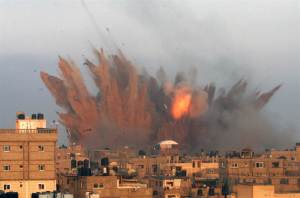
Smoke and fire rise above the skyline following an Israeli air strike on July 11 in Rafah in the southern Gaza Strip. Israeli warplanes kept up deadly raids on Gaza Friday but failed to stop Palestinian militants firing rockets across the border (NBC News).
I was sitting in Philadelphia’s airport recently, awaiting a flight back home, the book I had been reading turned face down in my lap. Intentionally. I didn’t want anyone to see the cover. Didn’t want anyone to associate its cover with my views – these people I didn’t know, people I would never know.
I had just opened to the book’s second chapter – “Does Israel Have a Right to Exist as a Jewish State?” – and had closed it quickly. Shocked by the question. Shocked by my imagined (and false) notions of what a chapter with such a title might contain, by the prospect of a stranger seeing me reading it.
So I shut the book – Ali Abunimah’s The Battle for Justice in Palestine, which argues that only a bi-national state can justly end the Israeli-Palestinian conflict – and quickly hid it from those milling about.
Gershon goes on to discuss his recent epiphany about the Israel-Palestine conflict.
…recent, unspeakable events of the past two weeks have begun to make me question whether a two-state solution is even remotely possible anymore, particularly as Israeli officials begin embracing various one-state solutions.
Such internal questioning reached a climax on Friday, when Netanyahu explicitly stated that he wanted Israel to control the West Bank indefinitely, marking his first-ever public rejection of the two-state solution and Palestinian statehood.
My jaw dropped.
There’s much more at the link. I hope you’ll check it out.
More than five years into his presidency, Obama is trying to free himself from the constraints of office, whether by strolling on the Mall or hopscotching the country as part of a campaign-style tour. White House senior adviser Dan Pfeiffer says the president “just wants to get out” and influence “our overall political conversation” by connecting with ordinary Americans.
But to some, breaking free can also look like running away.
Obama’s trip to Colorado and Texas this week took place against the backdrop of a burgeoning crisis on the Mexican border, where tens of thousands of children have been apprehended seeking entry into the United States. In Dallas, Obama dismissed the idea of heading farther south for a border visit as a “photo op” — not long after those photo ops showing him shooting pool and sipping beer in Denver.
Read more at the link. To me it looks like Obama is feeling freed up lately–mostly because he seems to be ignoring Republican nonsense and express his real opinions. I don’t know if that’s true or not, but it feels that way to me.
A gay employee at Franklin Barbecue in Austin had “a lucky day to be the register girl” Thursday, as he not only got to wait on President Obama but got a fist bump in support of LGBT rights.
Daniel Rugg Webb, a musician and comedian who works part-time at the restaurant, was on duty at the register as the president came up to pay for more than $300 worth of takeout, The Austin Chronicle reports. Webb slapped the counter and shouted, “Equal rights for gay people!” Obama asked, “Are you gay?” and Webb replied, “Only when I have sex.”
“That’s when he laughed and said, ‘Bump me,’” Webb told the Chronicle. Several onlookers photographed the fist bump and circulated the photo on Twitter. “It was just a lucky day to be the register girl,” Webb added.
“As a comedian, it was cool to have a moment where I was making a sitting president laugh — over something that might be considered inappropriate is a bonus,” Webb said of the experience.
He said he had been hoping to get in a joke about Texas Governor Rick Perry, who he described as “famously anti-gay.”
While Webb said he appreciates Obama’s social progressiveness, he expressed hope that the president will close the gap between his own relative forward-thinking on gay rights, and his general quietness on the anti-gay views of many state leaders before he leaves office.
“It would be interesting if he could call some people out for it. People can use a lot of things—religion, freedom of speech—to be anti-gay, but I need people to understand you can call people out for civil rights things,” Webb said.
“We are an anti-gay state. We are a state with a whole bunch of hungry children and sick old people, and [Rick Perry is] grandstanding on things that will get him a better election,” Webb said. “And it’s glaringly obvious. He’s kind of primitive in his social beliefs. I would like to see Rick Perry negatively influenced by any kind of attention. Even Obama laughing at something as, hopefully, acceptable as sexuality can show the difference.”
What do you think? Is Obama really changing?
What other stories are you following today? I have a few more news links, but I’ll post them in comments.
Did you like this post? Please share it with your friends:
Born Erdelyi Tamas in Budapest, Hungary, and known professionally as Tom or T. Erdelyi, Ramone played on the first three epoch-making Ramones albums, “Ramones” (1976), “Leave Home” (1977) and “Rocket to Russia” (1977). He also co-produced the latter two albums with Tony Bongiovi and Ed Stasium, respectively. He appeared on and co-produced the 1979 live Ramones opus “It’s Alive.” ….
One of the first high-profile releases to emerge from New York’s punk underground of the mid-‘70s, “Ramones” – reportedly recorded in six days on a budget of $6,400 – brought a pared-down, hyperactive style to the stuffy rock scene of the day. Tommy’s driving, high-energy drum work was the turbine that powered the leather-clad foursome’s loud, antic sound….
The Ramones finally disbanded in 1996 after a show at the Palace in Hollywood. Joey Ramone died of lymphoma in 2001; Dee Dee succumbed to a drug overdose in 2002; and Johnny expired from prostate cancer in 2004.
(From left) Johnny Ramone (1948-2004), Tommy Ramone (1952-2014), Joey Ramone (1951-2001) and Dee Dee Ramone (1952-2002) of the American punk group The Ramones (NY Daily News).
He played drums on just three Ramones studio albums. The ones everyone, but everyone, knows are the three best: Ramones, Leave Home and Rocket to Russia. He’s on the first live album, too, It’s Alive, and between those four records you get the complete summation of why the Ramones mattered, and why they continue to matter. Over the 42 tracks on the three studio albums, lasting barely an hour and half, rock’n’roll is reduced to its undiluted essence: a count-in, a riff, a verse, a chorus. Very occasionally there’s a middle eight. But anything unnecessary – anything that distracts from the rush of excitement – is excised. The aim of a Ramones song is not to make you admire the musicianship or the arrangement. It’s to take you from a standing start to fever pitch in 120 seconds or less. And at the back of it all, playing the unfussiest drum patterns you’ll ever hear – he made AC/DC’s Phil Rudd sound like Keith Moon – was Tommy Ramone.
He wasn’t meant to be the drummer. He was meant to be the manager. Joey was the drummer. “What happened was, they just kept playing faster and faster, and I couldn’t keep up on the drums,” Joey remembered in Legs McNeil and Gillian McCain’s Please Kill Me. “Tommy Ramone, who was managing us, finally had to sit down behind the drums, because nobody else wanted to,” Dee Dee told McNeil and McCain….
…for me (and for others, not lots of others, but enough of us) the Ramones were the best group rock’n’roll ever produced. Not the most inventive, or the most versatile, or the most skilful, or the most emotionally resonant, or the most lyrical – but the best, because every time I put on one of the Ramones’ best records, I was reminded of how I felt the first time I heard it. And the first time I heard it, I felt: this is the sound I’ve been hearing in my head and here it is on 12 inches of black vinyl; this is what I have been waiting for since the first single I ever bought. The Ramones were the sound of juvenile excitement, expressed with such breathtaking singlemindedness that nothing could kill the excitement.
And they were never as exciting without Tommy. Partly that was because those first three albums were such perfect statements of intent that there was very little left for the Ramones to say, and so each new album became another turn around the circuit rather than a manifesto.
The fantasy series is based on George R.R. Martin’s “A Song of Ice and Fire” book series, and as “Game of Thrones” approaches its fifth season, fans are concerned it’ll soon run out of source material.
But on Thursday, HBO CEO Richard Plepler and network Programming President Michael Lombardo assured reporters at the Television Critics Association press tour that “Game of Thrones” will get its fully story.
“George is an integral part of the creative team, so next season every move is being choreographed very closely with him,” Lombardo said. “Certainly after next year we’ll have to figure it out with George, but we’re not concerned about it.”
And for True Detective fans:
On Thursday, the freshman anthology series [True Detective] earned 12 Emmy nods, including nominations for best drama, best writing and two best actor nods for Season 1 stars Matthew McConaughey and Woody Harrelson.
The show’s structure presents a new cast of characters and story each season, and while Lombardo didn’t have any casting news on Thursday he did drop a major tease for Season 2.
“The two scripts we have are — I hate to jinx it — but they are more exciting than the first season,” he promised.
Variety reports that Colin Farrell is “in talks for True Detective, Season 2.” I’m not a big Farrell fan, but I guess I’ll have to give him a chance. Here’s a bit more on Season 2 from The Wrap: What We Know So Far.
Here’s a weird Game of Thrones tribute from Buzzfeed, A Couple Have Recreated “Game Of Thrones” With Their Pugs And It’s Magnificent: “The Pugs of Westeros” sees canine trio Roxy, Blue and Bono playing doggy versions of the show’s main characters.” Here a couple of the photos of the couple’s dogs in costume.
The pugs don’t look very happy, but I guess pugs seldom do. See more photos at the link.
A Missouri woman has finally been able to break her rental lease after learning that her home was used as a torture chamber by a suspected serial killer over a decade ago.
Maury Travis hanged himself while he was being held in jail in 2002 but police now believe that he killed between 12 and 20 women, many of whom died in the basement of his Ferguson, Missouri, home.
Catrina McGhaw had no idea about the home’s sinister past, however, when she signed a lease in March, she told St. Louis station KMOV-TV.
She says her landlord – Sandra Travis, the suspected killer’s mother – made no mention of the case or the bodies that her son allegedly kept in the basement before he was arrested in 2002.
It was only when a friend called her and told her to watch a documentary on serial killers that she realized that the home was connected to Travis’ case, McGhaw told KMOV.
Travis was never officially charged with the crimes, because he committed suicide.
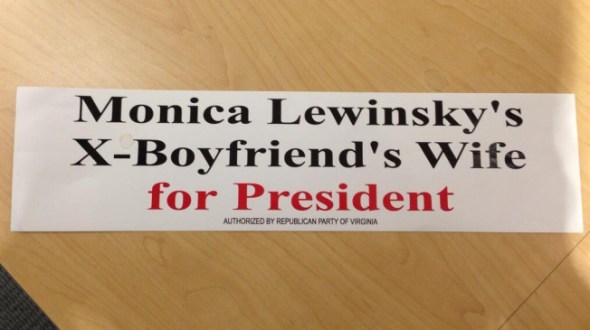
Carole Donoghue, a retired journalist, said she found the bumper stickers at Fairfax County Republican Committee headquarters in Fairfax, Va. The bumper stickers read “Monica Lewinsky’s X-Boyfriend’s Wife for President.” In small print, they included the words “Authorized By Republican Party Of Virginia.”
Donoghue talked to TPM hours after a spokesperson for Republican Party of Virginia denied the state party had anything to do with the anti-Hillary bumper stickers. The spokesperson told the Washington Post that the stickers were “an amateur effort” and the state party’s strategy “does not involve that.”
Donoghue says she found the sticker in the GOP office when she gave a ride to a man was out campaigning and looked ill. He told her he was “diabetic and needed insulin,” so she drove him back to Republican headquarters.
It was there in the office, Donoghue said, where she found the Lewinsky bumper stickers.
“The man wanted to repay me for driving him, so I just took one of the stickers as a trophy,” she said. “There was a whole stack of them there.”
Here’s the sticker:
That should really attract women voters, dontcha think?
This is how Republicans destroy their own narrative of the lawless Obama presidency: with a faceplant.
When House Speaker John Boehner officially announced that he planned to sue President Obama, he was absolutely clear about one thing. He didn’t know what the bill of particulars would be, or really anything other than that he would take Obama to court. But he knew that the scope of Obama’s lawlessness was widespread enough that it merited significant legal action. This wasn’t a picayune disagreement with the executive, but a pattern of behavior that had upset the balance of Constitutional power at the expense of Congress….
But on Thursday evening, Boehner laid down his cards. All but one were blank. It turns out Obama’s vast and indisputable misconduct is limited to one act of enforcement discretion: his decision to delay implementation of an Affordable Care Act’s requirement (one Republicans despise) that businesses with more than 50 employees provide their workers health insurance or pay a penalty.
“Today we’re releasing a draft resolution that will authorize the House to file suit over the way President Obama unilaterally changed the employer mandate,” Boehner said in a statement. “In 2013, the president changed the health care law without a vote of Congress, effectively creating his own law by literally waiving the employer mandate and the penalties for failing to comply with it. That’s not the way our system of government was designed to work. No president should have the power to make laws on his or her own.”
It’s actually pretty likely that the provision in question will go into effect before Boehner’s legal challenge is resolved one way or another. At the end of the day, by his own reckoning, Boehner may ultimately have zero grounds upon which to sue the president, whose brazen lawlessness Republicans treat as self-evident.
Sigh . . .
I’ll end with the latest FIFA Cup news from NDTV Sports:
Bogota: With a reputation for arrogance and illusions of European-styled grandeur, Argentines have long been the objects of scorn and the butt of jokes across Latin America
But for at least 90 minutes on Sunday, when Argentina takes on Germany in the World Cup final, most Latin Americans will put aside their irritation with their proud neighbors as they look to Lionel Messi and his teammates to salvage what’s left of the region’s soccer pride. (Related: Argentina fined for flouting FIFA rules ahead of final)
A defeat for Argentina would be historic: Never has a European team been crowned champion on this side of the Atlantic.
But in the wake of Germany’s 7-1 thrashing of host Brazil even the most-devoted believers in the spontaneous and stylish Latin American brand of soccer are wondering if the region is outmatched. (Rio braces for Argentina fan frenzy)
Santo Andre, Brazil: Germany have a secret plan to shut Argentina superstar Lionel Messi out of Sunday’s World Cup final at Rio de Janeiro’s iconic Maracana Stadium.
Assistant coach Hansi Flick said Thursday there is a “special plan” to cope with the four-time Ballon d’Or winner but refused to give details. (Argentina vs Germany: A ‘battle’ of two popes?)
Messi had a relatively quiet match against the Netherlands as Wednesday’s semi-final was settled by penalties.
The 27-year-old was often greeted by two Oranje shirts in Sao Paulo and the Germans are also getting organized. (Five warnings for rampaging Germany)
“We saw how the Dutch managed to keep Messi out, but we too have a special plan for him — although I won’t give that away,” said Flick.
We’ll find out who the best team is tomorrow.
Now, what stories are you following today? Please share your links in the comment thread, and have a great weekend!
Did you like this post? Please share it with your friends:
The Sky Dancing banner headline uses a snippet from a work by artist Tashi Mannox called 'Rainbow Study'. The work is described as a" study of typical Tibetan rainbow clouds, that feature in Thanka painting, temple decoration and silk brocades". dakinikat was immediately drawn to the image when trying to find stylized Tibetan Clouds to represent Sky Dancing. It is probably because Tashi's practice is similar to her own. His updated take on the clouds that fill the collection of traditional thankas is quite special.
You can find his work at his website by clicking on his logo below. He is also a calligraphy artist that uses important vajrayana syllables. We encourage you to visit his on line studio.





















 peej
peej Carissa
 bostonboomer
 dakinikat
 ecocatwoman
 jjlo
jjlo mablue2
 Mama Lopez
 peggysue22
 quixote
 skydancingguestblogger
 Mona (aka Wonk the Vote)





Recent Comments