
Prime Minister Nuri Kamal al-Maliki said Thursday night that he had agreed to relinquish power, a move that came after days of crisis in which his deployment of extra security forces around the capital had raised worries of a military coup.
Mr. Maliki’s decision held out the prospect of a peaceful transition of power, based on democratic elections and without the guiding hand of American military forces, which would be a first in modern Iraq’s troubled history of kings, coups and dictatorships.
His decision to step aside came after heavy pressure from the United States, which has deployed warplanes in Iraq to target Sunni Islamist militants and suggested that more military support would be forthcoming if Mr. Maliki was removed from power. Iran also played a decisive role in convincing Mr. Maliki that he could not stay in power.
Mr. Maliki, 64, agreed to end his legal challenge to the nomination of his replacement, Haider al-Abadi, 62, a member of Mr. Maliki’s own Dawa Party, who was chosen Monday by Iraq’s president.
Friday Reads: The same ol’ Iron Age Tribal hostilities Edition
Posted: August 15, 2014 Filed under: morning reads 62 CommentsGood Morning!
There is so much bad news that it’s almost impossible to deal with it all. Even though the news comes from all over the world, it seems to have some really unifying threads. Unfortunately it’s still pretty much the same things we’ve been dealing with forever. Wars and hatred based on tribal identifications like religion, skin color, and machismo pretty much sums it up. Here are some updates to things we’ve been following.
The news from Iraq is that Maliki will give up his position and power. There is some hope that this will create some sense of unity in a country rapidly splintering into old religions and tribal identifications. All the nations in the region were pretty much invented by Europeans as a by product of colonialism. Much like Eastern Europe’s realignment after Soviet colonialism, the Middle Eastern nations are going back to old tribal identities. However, nations with military sponsorship of the old powers have a distinct advantage.
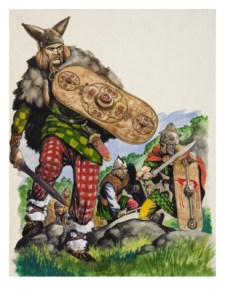 The Republican Party continues to be the party of white, christian, male, heterosexual primacy. It amazes me that anyone–outside the membership of right wing militias, neoconfederates, and the KKK–can vote for these morons. I certainly would not want to live in a place where they are dominant. It scares me to death that they may take back the senate.
Rep. Steve King appeared on Newsmax TV yesterday, where host J.D. Hayworth asked him about the rising tensions in Ferguson, Missouri and the call by members of the Congressional Black Caucus for the Department of Justice to conduct an independent investigation because of concerns about a history of racial profiling by the local police department.
King, of course, saw no need for such an investigation, claiming that these members of the CBC are basically “saying don’t enforce the law,” linking the issue to the sporadic looting and vandalism that has taken place by asserting that there is no need to racially profile those responsible for those actions because they are all black.
“This idea of no racial profiling,” King said, “I’ve seen the video. It looks to me like you don’t need to bother with that particular factor because they all appear to be of a single origin, I should say, a continental origin might be the way to phrase that.” “I just reject race-based politics, identity politics” King concluded. “I think we’re all God’s children. We all should be held to the same standards and the same level of behavior”:
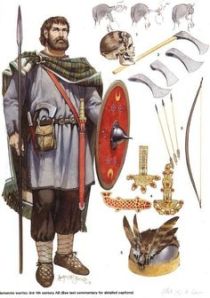 The Internet continues to be a source of trolling and bullying. I’ve complained several times to Twitter about friends being victimized by threats of violence and rape only to be told that they don’t patrol speech. It seems the bullying of Robin William’s daughter may have finally convinced them that free speech does not include hate speech and physical threats.
Internet trolls bullied Robin Williams’ daughter off of Twitter and Instagram just days after her father’s death. A handful of Twitter users sent Zelda Williams messages on Twitter that blamed her for Robin Williams’ suicide by hanging, as well as pictures of the comedian altered to show bruises around his neck.
As my Washington Post colleague Caitlin Dewey reported, Zelda Williams, 25, said she could not bear the messages and would stay off of Twitter and Instagram for a “good long time.” She also asked her social network followers to petition the company to block two particular accounts that were responsible for the bulk of the abuse. Those accounts have since been removed by Twitter. In a statement, the company said that it will be updating its policies in light of the incident.
“We will not tolerate abuse of this nature on Twitter,” Del Harvey, Twitter’s vice president of trust and safety, said in a statement. “We have suspended a number of accounts related to this issue for violating our rules and we are in the process of evaluating how we can further improve our policies to better handle tragic situations like this one. This includes expanding our policies regarding self-harm and private information, and improving support for family members of deceased users.”
But the messages that forced Zelda Williams offline are just a sliver of the types of abuse many face on Twitter. Imani Gandy, senior legal analyst at the reproductive health publication RH Reality Check, wrote Tuesday about abuse she said she faces on the service every day — in general and from one man, in particular, whom she has been unable to stop.
 And of course, guess which tribe of idiots tends to do these things? Speaking of that tribe, welcome to the new MTP,a marginally improved version of the old MTP. How many worn out Republican talking points can one handle on a Sunday Morning?
Gregory won’t get a farewell show. He won’t get to say goodbye on the air. This is all proof that the bosses at NBC have convinced that the show’s problems are all about Gregory. They are going to be in for a rude wake up call if the Chuck Todd era doesn’t bring back the viewers that the show lost after the death of Tim Russert.
In reality, David Gregory is getting what he deserved. He isn’t a political journalist, and his lack of interest in the subject matter showed. Gregory repeated partisan talking points as facts and would let anyone get away with saying any untrue statement. Instead of challenging false statements, Gregory would respond with trademark mmmmhmmm.
Replacing one conventional D.C. talking point machine (Gregory) with another (Todd) likely isn’t the answer.
The fact that NBC has rushed into the Chuck Todd era reveals how desperate the network has become to revive the sagging ratings. It will be the same roster of Republican guests and Beltway journalists on the same set. Neither David Gregory or Chuck Todd is Tim Russert, which is why the ratings for Meet The Press are likely to continue to struggle.
Same old tribe. Did you know that the Washington NFL team is still insisting the name “Redskins” isn’t insulting to any one but just traditional?
The following is a statement by the Washington Redskins on the filing of its appeal related to thedecision of the Trademark Trial and Appeal Board’s action concerning the team name:
Today the Washington Redskins NFL team filed its appeal of the split decision of the Trademark Trial and Appeal Board (the “Board”) ordering cancellation of the Washington Redskins‘ long-held federal trademark registrations. The appeal is in the form of a complaint, effectively starting the litigation anew, this time in a federal court before a federal judge, and not in the administrative agency that issued the recent split decision.
“We believe that the Trademark Trial and Appeal Board ignored both federal case law and the weight of the evidence, and we look forward to having a federal court review this obviously flawed decision,” said Bob Raskopf, trademark attorney for the Washington Redskins.
The Washington Redskins‘ complaint, filed in the United States District Court for the Eastern District of Virginia, explains why the Court should reverse the Board’s order and properly find that Native Americans did not consider the team name “Washington Redskins” to be disparaging during the relevant time frame of 1967-1990. While the complaint points out the many errors in the Board’s decision, the federal judge may disregard the Board’s decision entirely in conducting its own independent evaluation of the evidence.
The complaint also asks the federal court to consider the serious Constitutional issues that the Board lacked the authority to address. Specifically, by cancelling valuable, decades-old registrations, the Board improperly penalized the Washington Redskins based on the content of the team’s speech in violation of the First Amendment. The complaint also alleges that the team has been unfairly deprived of its valuable and long-held intellectual property rights in violation of the Fifth Amendment.
“The Washington Redskins look forward to all of the issues in the case being heard in federal court under the federal rules of evidence. The team is optimistic that the court will correctly and carefully evaluate the proofs, listen to the arguments, and confirm the validity of the Washington Redskins‘ federal trademark registrations, just as another federal court has already found in a virtually identical case,” Raskopf said.
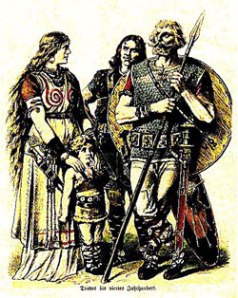
The University of Mississippi’s decision last week to further distance itself from reminders of its Confederate past prompted opponents of the move to organize a march.
Dozens of people will participate in the event organized by the Mid-South Flaggers on Saturday in Oxford, home to the 170-year-old university’s main campus. It will start at 10 a.m. in the Kroger parking lot.
“Not only are they not presenting the true history, but they’re trying to erase the history that is there,” said organizer Debbie Sidle, whose two sons graduated from Ole Miss and who said the school should preserve the past.
The university has tried to change its reputation in the decades since the deadly 1962 riot sparked by the admission of its first African-American student, James Meredith.
It first banned Confederate flags from sports games, then replaced its iconic Colonel Reb mascot with a black bear. It also erected a statute of Meredith himself, which in February was desecrated with a noose and Georgia state flag with a Confederate logo.
This month’s report recommended further actions to promote greater tolerance and diversity at the state’s largest public institute of higher learning.
Among the changes: Renaming a short street called Confederate Drive to Chapel Lane, creating the new position of vice chancellor of diversity and inclusion and restricting the use of “Ole Miss” to sports and spirit instead of academics.
“Our unique history regarding race provides not only a larger responsibility for providing leadership on race issues, but also a large opportunity — one we should and will embrace,” Chancellor Dan Jones wrote in the report.
But opponents claim the plan is misguided and will chip away at Mississippi’s proud past, which they claim celebrates states’ rights more so than slavery.
“I’m a 40-year-old man. If I don’t start standing up for my heritage, then we’re going to lose it with all this political correctness,” said Kevin Nelm, a Corinth resident who didn’t attend the university but has long supported it.
To students and others offended by Confederate symbols or the term “Ole Miss,” Nelm said, they need to read the history books. Many of the university’s own students left school to fight for the Confederacy, and they should be remembered. “You have people who are so offended by our flag and our heritage, and a lot of time it’s from people who aren’t from here, who weren’t born here or raised here,” said Shannon Hamilton, who will join the march Saturday.
So, it sure would be nice if we could quit repeating the same damned history over and over again. I’m thinking it’s not going to happen any time soon. First, because these guys don’t want to give up their privilege and power. Second, people still believe stupid thing. Third, hate still seems to be an easier emotional choice for some reason. Unfortunately, the hatred these days is backed up by more than spears and a few arrows. What’s on your reading and blogging list today?
Thursday Reads: Ferguson, Missouri is a War Zone
Posted: August 14, 2014 Filed under: Barack Obama, Civil Liberties, Civil Rights, Media, morning reads, Psychopaths in charge, social justice, social media, Surreality, U.S. Military, U.S. Politics | Tags: Al Jazeera, Claire McCaskill, Dorian Johnson, Eric Holder, Ferguson MO, first amendment, Jay Nixon, Leonard Pitts, Michael Brown, Piaget Crenshaw, Ryan Reilly, Thomas Jackson, Tiffany Mitchell, Wesley Lowery 38 Comments
Good Morning!!
I spent most of the day and night yesterday following the shocking events in Ferguson, Missouri. As I read articles and tweets and studied violent images of police dressed as soldiers and riding in military vehicles, I had repeated flashbacks to the Civil Rights era. Except in those days, police weren’t outfitted with surplus military equipment provided by the Federal government. Back then, the cops had to resort to fire hoses to force people off the streets; but in Ferguson, St. Louis police are equipped with MRAPs (mine-resistant ambush-protected vehicles) and LRADs (long-range acoustic devices).
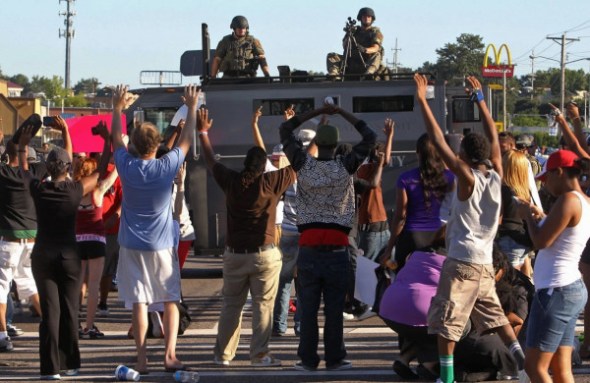
Ferguson isn’t a large city, and reporters on the ground estimated the size of the “crowd” at somewhere between 150 and 250 people, who were largely protesting peacefully by holding their hands in the air and chanting “Hands up. Don’t shoot.” It’s long past time for Missouri Governor Jay Nixon (a Democrat) to step in and tell the cops to calm down and put away their military toys. If he won’t take action, then President Obama should instruct Attorney General Holder to do it.
The protests follow the killing of 18-year-old Michael Brown by a still-unnamed Ferguson policeman last Saturday afternoon. Brown “had no criminal background,” according to KDSK.com. Police claim that Brown struggled with the officer and tried to grab his gun. But that makes no sense. Why did the officer choose to stop Brown as he peacefully walked down the street with a friend? That friend, Dorian Johnson tells a different version of events.
From USA Today: Witness to Michael Brown shooting comes forward.
Dorian Johnson said he was standing inches from Brown when the shooting occurred around 1:40 p.m. Saturday. He gave his account of the shooting to KSDK-TV.
“The officer is approaching us and as he pulled up on the side of us, he didn’t say freeze, halt or anything like we were committing a crime. He said, ‘Get the F on the sidewalk.’
After Johnson said the officer thrust open the door of his patrol car, hitting the pair, Johnson said the officer grabbed Brown around the neck and tried to pull him through the window. He said Brown never tried to reach for the officer’s weapon.
“The second time he says, ‘I’ll shoot,’ a second later the gun went off and he let go,” Johnson said. “That’s how we were able to run at the same time. The first car I see, I ducked behind for because I fear for my life. I’m scared. I don’t know what’s going on. I don’t understand why this officer is shooting his weapon at us.”
According to Johnson, the officer pursued Brown and fired another shot. which struck Brown in the back. He said Brown turned and faced the officer with his hands raised.
“My friend started to tell the officer that he was unarmed and that he could stop shooting (him),” Johnson said. “Before he could get his second sentence out, the officer fired several more shots into his head and chest area. He fell dramatically into the fatal position. I did not hear once he yell freeze, stop or halt. it was just horrible to watch.”
Unfortunately for the officer who killed Brown, two more witnesses have now come forward. From CNN:
While Michael Brown appeared to tussle with an officer before he was shot dead, he didn’t enter the police cruiser as authorities claim he did, two witnesses told CNN.
The women’s accounts corroborate that of a previous witness, all three of whom said the officer fatally shot the unarmed teen.
Police have said the black 18-year-old died in a dangerous struggle after trying to grab the officer’s weapon. Not so, say the witnesses.
“It looked as if Michael was pushing off and the cop was trying to pull him in,” Tiffany Mitchell told CNN on Wednesday night.
Mitchell had driven to Ferguson to pick up another woman Piaget Crenshaw. The two women witnessed the shooting from two different angles–Mitchell from her car and Crenshaw from a building nearby.
Neither woman, who gave their statements to St. Louis County police, say they saw Brown enter the vehicle.
Instead, a shot went off, then the teen broke free, and the officer got out of the vehicle in pursuit, the women said.
“I saw the police chase him … down the street and shoot him down,” Crenshaw said. Brown ran about 20 feet.
“Michael jerks his body, as if he’s been hit,” Mitchell said.
Then he faced the officer and put his hands in the air, but the officer kept firing, both women said. He sank to the pavement.
The protests in Ferguson, a town in which the population is 2/3 black but the political leadership and police force are overwhelmingly white, are largely driven by the fact that police will not name the shooter or released the results of Brown’s autopsy, despite Missouri’s sunshine law.
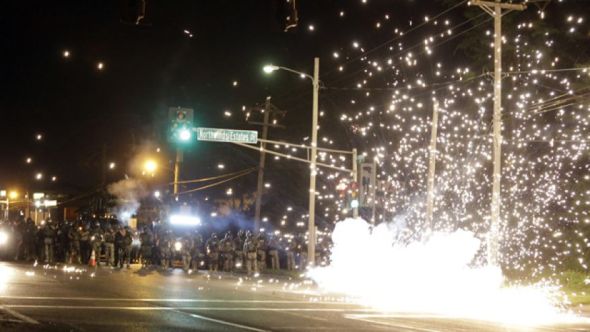
August 13, 2014: A device deployed by police goes off in the street as police and protesters clash in Ferguson, Mo. (AP Photo/Jeff Roberson)
From The New York Times: Anonymity in Missouri Police Shooting Fuels Frustration.
FERGUSON, Mo. — In the five days since an unarmed young black man was fatally shot by a police officer here, the selective release of information about the shooting, and especially the anonymity granted to the officer, has stoked frustrations in this largely African-American community north of St. Louis, where residents describe increasingly tense relations with the police.
The police chief, Thomas Jackson, has repeatedly declined to identify the officer, who has been put on administrative leave. But on Wednesday, the chief did offer a new detail about the shooting, which has kindled nights of racial unrest and an unyielding police response with tear gas, rubber bullets and arrests.
Jackson claims there have been threats against the police officer and he needs protection. So why not simply arrest him for murder and send his family to a safer location? Instead, Wilson called in law enforcement support from St. Louis and enabled an incredible overreaction to largely peaceful protests. From the Times article:
On Wednesday night, scores of police officers in riot gear and in armored trucks showed up to disperse protesters who had gathered on the streets near the scene of the shooting. Some officers perched atop the vehicles with their guns trained on the crowds while protesters chanted, “Hands up, don’t shoot.” A police spokesman said that some demonstrators had thrown Molotov cocktails at officers and that some had tried to set fires. The police used tear gas on demonstrators, and some protesters said rubber bullets had been fired at them. Police said one officer appeared to have suffered a broken ankle after being hit by a brick.
The police made more than 10 arrests. Among those arrested was Antonio French, a St. Louis alderman, who had been documenting the protests on social media, his wife said on Twitter.
Two reporters covering the protests also said they had been arrested inside a McDonald’s for trespassing and later released without charges or an explanation. The reporters, Wesley Lowery of The Washington Post and Ryan J. Reilly of The Huffington Post, both said they had been handled roughly by the police.
If you don’t read anything else on the events in Ferguson, read this article and look at the photos.
More recommended stories:
Mashable: Ferguson or Iraq? Photos Unmask the Militarization of America’s Police.
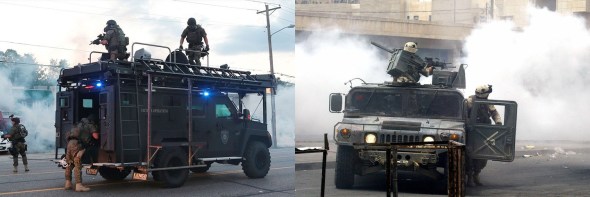
As America scaled back its presence in Afghanistan and Iraq in 2012, military gear — amphibious tanks, weapons, uniforms and drones — spilled into local police arsenals. In June, an ACLU report warned of the “excessive militarization” of local law enforcement. “This has the effect of terrifying people, destroying communities and actually undermining public safety,” Kara Dansky, ACLU senior counsel, told Mashable in June.
The photos below show the heavily armed Ferguson police officers, dressed in camouflaged uniforms. They are set side-by-side with images of U.S. military operations in Iraq and Afghanistan.
One of the photo comparisons below. Which was taken in Ferguson and which in Iraq?
NBC News: Michael Brown Killing: Missouri Governor to Visit as Unrest Grows in Ferguson.
Missouri Gov. Jay Nixon said he would visit the St. Louis suburbs Thursday after police fired tear gas to break up crowds in a fourth night of civil unrest over the police killing of an unarmed black teenager.
Sixteen people were arrested, including two reporters, on Wednesday night in the suburb of Ferguson, and police said that two officers were injured, one hit by a brick, NBC affiliate KSDK reported….
Nixon said in a statement that the worsening situation in Ferguson was “deeply troubling.” He canceled a planned visit to the state fair. “While we all respect the solemn responsibility of our law enforcement officers to protect the public, we must also safeguard the rights of Missourians to peaceably assemble and the rights of the press to report on matters of public concern,” he said.
Too little, too late, IMHO.
The Baltimore Sun: Riots in Ferguson and what they mean, by Leonard Pitts.
To believe that this carnage — the windows smashed, the buildings torched, the tear gas wafting — is all about the killing of Michael Brown is to miss the point….
Because, again, this is not just about Brown. It’s about Eric Garner, choked to death in a confrontation with New York City Police. It’s about Jordan Davis, shot to death in Jacksonville, Florida, because he played his music too loud. It’s about Trayvon Martin, shot to death in Sanford, Florida, because a self-appointed neighborhood guardian judged him a thug. It’s about Oscar Grant, shot by a police officer in an Oakland, California, subway station as cellphone cameras watched. It’s about Amadou Diallo, executed in that vestibule and Abner Louima, sodomized with that broomstick. It’s about Rodney King.
And it is about the bitter sense of siege that lives in African-American men, a sense that it is perpetually open season on us.
And that too few people outside of African America really notice, much less care. People who look like you are every day deprived of health, wealth, freedom, opportunity, education, the benefit of the doubt, the presumption of innocence, life itself — and when you try to say this, even when you document it with academic studies and buttress it with witness testimony, people don’t want to hear it, people dismiss you, deny you, lecture you about white victimhood, chastise you for playing a so-called “race card.”
They choke off avenues of protest, prizing silence over justice, mistaking silence for peace. And never mind that sometimes, silence simmers like water in a closed pot on a high flame….the anger we see in Ferguson did not spring from nowhere, nor arrive, fully-formed, when Michael Brown was shot. It is the anger of people who are, as Fannie Lou Hamer famously said, sick and tired of being sick and tired.
Silence imposed on pain cannot indefinitely endure. People who are hurting will always, eventually, make themselves heard.
The only problem with Pitts’ column is that there haven’t been any actual “riots” in Ferguson yet–unless you count what the police are doing as rioting.
Riverfront Times: Watch Police in Ferguson Arrest, Tear Gas Journalists [VIDEO]
Police actions against press seem to be part of the reason Governor Jay Nixon finally decided to cut his Missouri State Fair trip short. The governor says he’ll arrive in St. Louis County Thursday morning to manage what’s increasingly becoming a volatile, violent and devastating time in St. Louis history.
SWAT officers arrested Wesley Lowery, a political reporter at TheWashington Post, and Ryan Reilly, a Huffington Post justice reporter, shortly before 7 p.m. while clearing out a McDonalds near the protests where they were working. The reporters say police asked for their identification and eventually arrested them when they weren’t leaving quickly enough.
The journalists say they were arrested without being read their Miranda writes and eventually released with nothing — no charges, no police report, no names of arresting officers. The Los Angeles Times says police only released them after their reporter alerted the chief of Ferguson Police (His response: “Oh, god,”), who then called St. Louis County Police.
Late last night, police in Ferguson also tried to order the media to shut off their cameras, and they attacked journalists from Al Jazeera and confiscated their equipment.
Missouri Senator Claire McCaskill decided last night that it was time for her to take some action, since Governor Nixon wasn’t doing it. She will meet with Eric Holder today to discuss the Ferguson situation.
Sen. Claire McCaskill (D-Mo.) says she has a phone call planned with Attorney General Eric Holder on Thursday to discuss the situation in Ferguson, Mo., where an apparently unarmed black teenager was fatally shot by a police officer last weekend.
Amid clashes in the St. Louis suburb Wednesday night, the senator tweeted that she’s been working the phones to try to deescalate the “tense and unacceptable situation.” ….
Holder and White House senior adviser Valerie Jarrett briefed President Obama Wednesday and the president will receive another briefing Thursday.
I’ll have to end there, because this post is getting way too long. I’ll post more important links in the comments. I’ll leave it to you Sky Dancers to update me on the rest of the news. I’ve been too focuses on Ferguson to pay attention to anything else. See you in the comment thread.
Tuesday Reads: Remembering Robin Williams (and other news)
Posted: August 12, 2014 Filed under: Barack Obama, Foreign Affairs, Iraq, morning reads, science, U.S. Politics | Tags: Boston Public Garden bench, civil rights investigation, deaths, domestic cat genome, FBI, Ferguson MO, Good Will Hunting, John Kerry, Michael Brown shooting, Nouri al-Maliki, Popeye, Robin Williams, Suicide 65 Comments
Good Morning!!
Media reports (based on the Sheriff’s statement) on Robin Williams’ death are still saying the cause of his death is a “suspected suicide.” From the New York Times:
The Marin County sheriff’s office said in a statement that it “suspects the death to be a suicide due to asphyxia.” An investigation was underway.
The statement said that the office received a 911 call at 11:55 a.m. Pacific time, saying that a man had been found “unconscious and not breathing inside his residence.” Emergency personnel sent to the scene identified him as Mr. Williams and pronounced him dead at 12:02 p.m.
I can’t help but be curious about this–does that make me a bad person? My mind keeps going over possible scenarios, wondering how he died and why it isn’t clearly a suicide. I hope we’ll eventually find out what happened, so I can stop having disturbing visual thoughts about it. As someone who has strugged with depression and addiction, I can understand the agony that must have driven Williams to take his own life, but I wish he had reached out to someone first.
The NYT article has some interesting background on Williams’ childhood that I had never heard before.
The privileged son of a Detroit auto executive who grew up chubby and lonesome, playing by himself with 2,000 toy soldiers in an empty room of a suburban mansion, Mr. Williams, as a boy, hardly fit the stereotype of someone who would grow to become a brainy comedian, or a goofy one, but he was both.
This morning the Detroit Free Press republished an article from 1996 in which Williams talks about his childhood home. The interview took place “before the release of the film “Jack.”
“It’s gone; it doesn’t exist anymore, ” says Williams, the winsome memory of his childhood sanctuary written all over his face. Of course, everything is written on Williams’ face: He might as well have a sign in his hair that says, “Post bills here.”
Williams plays an overgrown — and I mean way overgrown — 10-year-old child in “Jack, ” which opens Friday. He’s recalling his own childhood in Bloomfield Hills in a home at the corner of Woodward and Long Lake, which, in his memory, was little short of a fairyland.
“It was a giant, beautiful old mansion, with a gatehouse, an empty garage with room for 25 cars, barns, and there was a very wonderful old English man, Mr. Williams, who looked after the gardens, ” Williams says. He is looking out the balcony window of his Los Angeles hotel suite onto a busy street, but Williams clearly is visualizing the past.
“We didn’t own it; we just rented it, ” says Williams, whose father was an auto executive. “Then we moved to Chicago, and when we came back to Detroit a few years later, we just lived in an apartment. And it was very different, you know. But the first house, it was so wonderful, so peaceful. There was no one for miles around. Only this giant golf course with people named Tad whacking the old ball.”
It’s a nice interview; you can read the rest at the link.
Thinking about Robin Williams’ movies reminded me that my Dad and I went to see Robert Altman’s Popeye together in 1980 when I was home in Indiana for a visit. That was Williams’ very first film. We both really enjoyed it. Williams was perfect as Popeye and Shelley Duvall was a marvelous Olive Oyl. The New York Daily News has a nice list of Williams’ finest performances: From ‘Popeye’ to ‘Good Will Hunting,’ the actor’s most iconic roles.

Of course Williams has a Boston connection too. He won an academy award for his role in Good Will Hunting. A great scene from the movie was shot on a bench in Boston Garden.
From The Hollywood Reporter: Robin Williams Memorial Pops up at ‘Good Will Hunting’ Bench.
The bench that helped Robin Williams earn an Oscar is now the site of an impromptu memorial for the late actor, thanks to a few fans in Boston.
Shortly after they heard of the actor’s death Monday, Nicholas Rabchenuk and his girlfriend headed to the Boston Public Garden bench Williams and Matt Damon made famous in Good Will Hunting.
“We went to the [Boston] Common, and I was really surprised there wasn’t anything there,” Rabchenuk tells The Hollywood Reporter.
They brought flowers and chalk, and found two fans already sitting on the bench. The four of them teamed up to write lines from Good Will Hunting on the ground, including “Sorry guys, I went to see about a girl” and “Your move, chief.”
The plan is to honor Williams’ body of work, not just Good Will Hunting.Hook has already gotten some love (Bangarang!).
“I hope it catches on,” says Rabchenuk, who would like to see similar memorials pop up at benches around the world, as well as at other Boston-area sites portrayed in the film.
You can watch the park bench scene at the link. Here’s another well-acted scene from Good Will Hunting. The sound is a little low, unfortunately.
Williams really was a fine dramatic actor. At Huffington Post, you can watch Williams’ Oscar speech.
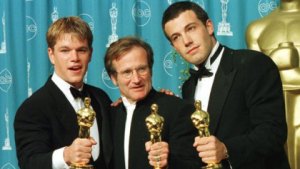
Just one last link, from WBZ TV in Boston: Robin Williams Left Mark On City Of Boston, by Jim Armstrong.
Williams won an Academy Award for his role in the 1997 film “Good Will Hunting.” Much of the film was shot in Boston and Cambridge, and while he was here, he made a big impression.
In a career that spanned decades, the time Williams spent in Boston seemed to have stuck with him as well.
L Street Tavern, the South Boston bar made famous in the film, still credits Williams and the crew for putting them on the map. When he accepted the Academy Award, he singled out Southie, telling the people of South Boston, “you’re a can of corn, you’re the best.”
Years later, while talking to WBZ-TV about the film “What Dreams May Come,” he was still cracking jokes about South Boston.
“You still a wicked pissah smart? How are ya, what are ya doing,” Williams said in a Boston accent during the 1998 interview. “Hello, all the folks at L Street. How ya doing?”
The L Street Tavern posted a statement on their Facebook page after learning of the actor’s death Monday night:
Rest Peacefully Robin Williams. You were a comedic genius and a friend to all here while filming Good Will Hunting. Thanks for recognizing South Boston in your Academy Award acceptance speech and the many fond memories at L Street Tavern and South Boston Bowl. You, too, are a “Can of Corn”.
Reminiscing endlessly about movies is easy for me, but I guess I should include some of the latest news in this post too.
Sigh . . .
Read the rest of this entry »
Monday Reads: Police Brutality Edition
Posted: August 11, 2014 Filed under: American Gun Fetish, morning reads, racism, SWAT teams | Tags: Ferguson MO, militarization of police, NYPD, Police deadly force, shootings at Walmart 41 CommentsGood Morning!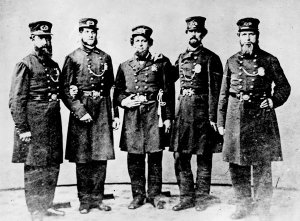
I don’t know about you, but I’m getting tired of all the stories about America’s out of control Police Departments. The last few weeks have been especially illustrative of police departments that use deadly force first and cover it all up later. There’s just one story after another of police shooting and killing unarmed citizens and hapless dogs. Almost immediately afterwards, we get some kind of arrest, story, or whatever that says the police acted righteously. Why are so many unarmed people being killed by heavily armed police officers? WTF is going on?
There are four recent incidents where the police used deadly force in highly questionable situations. The first shooting is from Texas, the second from Ohio, the third is a strangling in New York City, and the latest shooting is from Missouri. This is obviously a national problem.
First up, an off duty officer killed a teen supposedly shoplifting in a Walmart after seeing a few security guards chase the teen out the door. Was deadly force really necessary over a smart phone cover? This sounds a lot like the Zimmerman defense if you ask me. This young man was Latino.
A 19-year-old shoplifting suspect in Conroe was shot and killed by an off-duty sergeant who said the teen choked him to the point of nearly passing out, police said.
The Conroe Police Department said officers were dispatched to the Walmart on N. Loop 336 W after store employees tried to stop a young man, Russell Rios, who allegedly stole a pair of iPhone cases early Wednesday evening.
Off-duty police Sgt. Jason Blackwelder was briefed by the workers and chased down the suspect in a wooded area southwest of the store, according to police.
Once in the woods, the suspect and the officer became engaged in a very intense struggle, and at one point the officer was being choked by the suspect, said Sgt. Dorcy Riddle. … to the extent that he thought he was going to lose consciousness.
Blackwelder fired his weapon, striking Rios and killing him. The sergeant was treated for minor injuries at the hospital and later released.
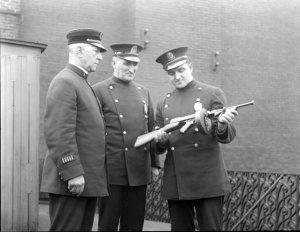 This actually was the second shooting involving a Walmart. This one involved a black teenager examining a Toy Gun. Now mind you, we had weeks of open carry assholes carrying actual loaded semi-automatic weapons around stores. Only the shoppers felt threatened by these jerks. However, those were all white folks toting the real thing so the security guards must’ve have thought it was no big deal.
As it turns out, John Crawford, the man shot dead by police was killed after doing nothing more than picking up a toy gun in the store.
Crawford, 22, was identified, in part by the mother of his child, who he was on the phone with at the time police shot him dead.
That woman, LeeCee Johnson, said Crawford went to the area to visit family members.
“We was just talking. He said he was at the video games playing videos and he went over there by the toy section where the toy guns were. And the next thing I know, he said ‘It’s not real,’ and the police start shooting and they said ‘Get on the ground,’ but he was already on the ground because they had shot him,” she said, adding: “And I could hear him just crying and screaming. I feel like they shot him down like he was not even human.”
Last month, an NYPD office strangled an unarmed black man with an illegal chokehold even while he was telling them he could not breathe. The 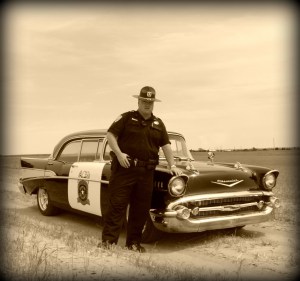 incident was videotaped. The police later arrested the videographer and the man’s wife in unrelated charges seemingly to put their testimony in any court case against the choker into question.
Confronted by police trying to arrest him for allegedly selling illegal cigarettes, Eric Garner raised both hands in the air and, with passive defiance, told the officers not to touch him. Seconds later, a video shows the officer behind him grab the 350-pound man in a chokehold and pull him to the sidewalk, rolling him onto his stomach.
“I can’t breathe! I can’t breathe!” Garner said repeatedly, his cries muffled into the pavement.
The video of the Thursday skirmish shows the Staten Island man lying on the ground motionless after the incident. An asthmatic, Garner was later declared dead at a nearby hospital, according to CNN affiliate WCBS. Police said he suffered a heart attack and died en route to the hospital.
“This is a terrible tragedy that occurred yesterday. A terrible tragedy that no family should have to experience,” said New York Mayor Bill de Blasio, calling the video of the incident “very troubling.”
Police told WCBS that 43-year-old Garner, a father of six, had a lengthy criminal history and had been previously arrested for selling untaxed cigarettes in May.
Officer Daniel Pantaleo, who is seen on video choking Garner, was put on modified assignment and stripped of his shield and gun as the New York Police Department continues to investigate the incident, WCBS reported. The chokehold tactic is prohibited by the NYPD.
The most recent shooting involved an unarmed black teen who was being harassed by the police for not getting on the sidewalk. This young man was  two days away from his first year in college.
An unarmed black teenager fatally shot Saturday by a police officer in Ferguson, Mo., had been struggling for the officer’s gun, law enforcement officials said Sunday as hundredLs of protesters gathered outside the police department.
St. Louis County Police Chief Jon Belmar said the youth, Michael Brown, 18, allegedly struggled for a Ferguson police officer’s weapon in a patrol car before the officer fired several shots about noon Saturday. Witnesses have said the youth had his hands in the air as he fled the patrol car.
Brown’s mother said she didn’t understand why police didn’t subdue him with a club or Taser.
“I would like to see him fired,” Lesley McSpadden told the Associated Press, referring to the officer who shot her son. “I would like to see him go to jail with the death penalty.”
Belmar said there would be a thorough investigation, with possible inclusion of the FBI. Because Brown is African American, the National Assn. for the Advancement of Colored People has said it would seek a federal investigation.
 Is this part and parcel of the militarization of police happening since 9/11 or is it an outcropping of the rampant, outrageous racism that has been noticeable since the country elected its first black president? I can remember being in Denver about two years ago during an Occupy march. I also remember watching tons of riot police in military vehicles rushing around the downtown streets to intercept what was obviously a peaceful gathering of Americans in keeping with our constitutional rights. But, SWAT raids are commonplace these days.
It’s 3:00 a.m. Your children are screaming and your dog is lying dead in a pool of blood. Scorch marks and shattered glass cover the floor. You’re being held at gunpoint by towering figures wearing black and holding AK-47s.
This isn’t a Hollywood movie set. Odds are this is a predawn SWAT raid targeting a family of color. Mission objective: search the home for a small amount of drugs.
There are an estimated 45,000 SWAT raids every year. That means this sort of violent, paramilitary raid is happening in about 124 homes every day – or more likely every night – not in an overseas combat zone, but here in American neighborhoods. The police, who are supposed to serve and protect communities, are instead waging war on the people who live in them.
Our new report, War at Home: The Excessive Militarization of American Policing, takes a hard look at 800 of these raids – or at least what state and local law enforcement agencies are willing to tell us about them. We found that almost 80% of SWAT raids are to search homes, usually for drugs, and disproportionately, in communities of color. During these drug searches, at least 10 officers often piled into armored personnel carriers. They forced their way into people’s homes using military equipment like battering rams 60 percent of the time. And they were 14 times more likely to deploy flashbang grenades than during SWAT raids for other purposes.
Public support for the failed War on Drugs is at its lowest ever, and yet police are still using hyper-aggressive tactics and heavy artillery to fight it. This paramilitary approach to everyday policing brutalizes bystanders and ravages homes. We reviewed one case in which a young mother was shot and killed with her infant son in her arms. During another raid, a grandfather of 12 was killed while watching baseball in his pajamas. And we talked with a mother whose toddler was covered in burns, shot through with a hole that exposed his ribs, and placed into a medically induced coma after a flashbang grenade exploded in his crib. None of these people was the suspect. In many cases like these, officers did not find the suspect or any contraband in the home.
Even if they had found contraband, the idea of cops-cum-warriors would still be deeply troubling. Police can – and do – conduct searches and take suspects into custody without incident, without breaking into a home in the middle of the night, and without discharging their weapons. The fact is, very few policing situations actually require a full SWAT deployment or a tank. And simply having drugs in one’s home should not be a high-risk factor used to justify a paramilitary raid.
We can no longer accept such brutal tactics as a routine way to fight the War on Drugs. It’s time for an exit strategy.
All too often, the worst police behavior is aimed at minority communities. 
Jason L. Riley is a Wall Street Journal columnist and vocal critic of what hecalls “race hustlers”—“the second and third-tier types” who lead the civil rights groups of the present.
For him, the greatest barriers to black advancement aren’t economic disadvantage and persistent discrimination, they’re “anti-social behavior” and “counterproductive attitudes toward work, school, marriage, and so forth.”Last Friday, Riley responded to Al Sharpton’s call for criminal justice reform with this Twitter broadside: “Liberals want to discuss black incarceration rates but not black crime rates,” he said. “Stop pretending the two are unrelated.” The implication is that black criminality is to blame.
There’s no question that relative to their population, black Americans hold adisproportionate share of arrests and convictions for crime. But it’s important we don’t confuse that with a propensity for crime. Put another way, black overrepresentation in crime statistics has as much to do with policing and the legal process as it does with the actual crimes committed.
For millions of black and Latino New Yorkers, the city is a literal police state.
It’s worth noting that just a few hours after Riley made his assertion, the New York City medical examiner ruled Eric Garner’s death a homicide by chokehold. If you haven’t followed the coverage, Garner was killed in July during a struggle with Staten Island police officers. Because a witness (who was later arrested on gun charges) videotaped the encounter, we know that the 43-year-old father of six had just stopped a fight, and was agitated by the police presence. “Every time you see me, you try to mess with me,” he said to the officers, protesting prior treatment. “This stops today.” Within minutes, police had placed Garner in a chokehold and wrestled him to the ground, where he struggled, gasped for air, and died.
Bystanders would catch two other instances of police violence over the next week. In the first, an officer is seen stomping on the head of a man arrested for marijuana possession, and in the second, an officer is shown using a chokehold on a pregnant woman after she grilled food on the sidewalk outside of her home (which, apparently, is against the law in New York City).
The reason for these stops is a policing approach called “broken windows,” first articulated by scholars James Q. Wilson and George L. Kelling in a 1982 Atlantic Monthly essay and later adopted by the NYPD in 1993. Broken windows prioritizes cracking down on minor offenses on the theory that doing so can preempt serious crime. Or, to use the metaphor of the idea, actual broken windows create the appearance of disorder, which creates actual disorder as criminals take advantage of the inviting environment. Rather than wait for the serious crimes to begin, police should “repair the windows”—focus on petty crime like loitering, and you’ll stop the worse crime from taking hold.
It’s an elegant concept, but there’s little evidence it works. “Taken together,” notes a 2006 study from the University of Chicago, “the evidence from New York City and from the five-city social experiment provides no support for a simple first-order disorder-crime relationship as hypothesized by Wilson and Kelling nor for the proposition that broken windows policing is the optimal use of scarce law enforcement resources.” Yes, the massive New York crime decline of the 1990s coincided with broken windows policing, but chances are it had more to do with a reversion to the mean (“what goes up, must come down, and what goes up the most, tends to come down the most”) than any new approach.
If broken windows were just a waste of resources, it wouldn’t be a huge concern. But as a policy, broken windows has also had the effect of terrorizing black and Latino New Yorkers.
Perceptions of urban “disorder” are tied tightly to race and have been for more than a century (as detailed in sociologist Khalil Gibran Muhammad’s The Condemnation of Blackness: Race, Crime, and the Making of Modern Urban America). As we’ve seen on a regular basis—from Jonathan Ferrell to Renisha McBride—people of color, and blacks in particular, are feared as criminal in ways their white counterparts aren’t.
This is one of the most enlightening quotes I’ve seen for some time. The police union’ associate basically believes that resisting arrest is a reason to use deadly force. This is in regards to Garner’s death outlined above.
The police officer who killed a Staten Island dad with a prohibited chokehold was just doing what he had been trained to do.
So claimed Pat Lynch, president of the Patrolmen’s Benevolent Association, in strident and eyebrow-raising defense Tuesday of NYPD officers, during which he called the medical examiner’s conclusions about Eric Garner’s death “absolutely wrong.”
“It is not a chokehold,” Lynch insisted. “It was bringing a person to the ground the way we’re trained to do to place him under arrest.”
Lynch, who is not a doctor, also said the ME’s office was “mistaken” when it concluded after an autopsy that the 43-year-old Garner’s death was a homicide.
“I’ve never seen a document that was more political than that press release by the ME,” Lynch said. “Chokehold. That’s not a medical term.”
Lynch also ripped Mayor de Blasio for not backing the officers in this case. “The mayor needs to support New York City police officers unequivocally,” he said.
De Blasio defended the ME, calling the office “the gold standard in this country for the work they do.”
Lynch’s remarks appeared to be aimed at taking the heat off Officer Daniel Pantaleo, who was caught on a shocking cellphone video wrapping an arm around Garner’s neck and dragging him to the pavement.
“I can’t breathe!” Garner could be heard yelling. “I can’t breathe!”
That video sparked nationwide outrage and Pantaleo was yanked off the street as the Staten Island prosecutor launched an investigation. Pantaleo has not been charged with a crime.
Lynch said Garner had been stopped a week earlier by police officers for peddling unlicensed cigarettes on the street.
“He was warned to stop the illegal sale and was not placed under arrest but was warned, admonished and sent on his way,” Lynch said.
So Garner knew he was in big trouble when cops caught him selling loosies again, the union president said.
“But the next week he said he wasn’t going to be arrested,” Lynch said.
Flanked by Sergeants Benevolent Association President Ed Mullins, Lynch decried the “insulting and unjustified manner in which police officers are being portrayed by politicians, race baiters, pundits and even our elected officials.”
I’m not sure what exactly the answer is to all of this, but I will say that you cannot ignore the obvious patterns playing out all over the country. The  message they are sending is Resist and Die.
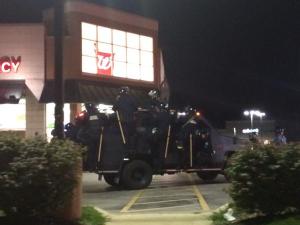 So, as I write this, I’ve found out that 49 year after the Watts Riots, Ferguson MO–a primarily black community close to St Louis–has erupted in riots. That’s the SWAT group patrolling the area outside a Walgreen’s that I’ve juxtaposed to an old photo of Watts.
What started as a peaceful prayer vigil Saturday evening to remember a young man gunned down by police, has escalated into full scale riots and looting in Ferguson, Missouri.
Angry mobs have smashed windows, set fires and looted businesses as a massive showing of police, some wearing riot gear have moved into the area along West Florissant just south of 270.
Police are also responding to reports of shootings throughout the area. At one point, windows of a News 4 live truck were smashed out by the angry crowd.
Raw Video: Exclusive interview with witness of looting in Ferguson
There are reports that police have dispersed the crowd in Ferguson, but the mobs have moved into some neighboring communities.
News video and amateur video from the scene have captured mobs of crowds racing into stores and businesses and then rushing out with armloads of stolen goods.
Tear gas has reportedly been used by police in some areas.
Two groups of protesters gathered around 8:00 Sunday night in Ferguson to bring awareness to the death of Michael Brown, 18, who was shot and killed by police Saturday.
At least fifteen area police agencies have been called to Ferguson. Police set up a staging area at West Florissant and Ferguson Road. Police are also staging at the Plaza at the Boulevard parking lot, where officers are seen putting on riot gear. Dozens of police vehicles are on scene, from all over St. Louis County, including Chesterfield, Country Club Hills and the Missouri Highway Patrol.
What’s on your reading and blogging list today?
Friday Reads: The Good, The Bad, and The Silly
Posted: August 8, 2014 Filed under: Barack Obama, Foreign Affairs, health, Iraq, Israel, morning reads, Political Affective Disorder, Real Life Horror, Republican politics, U.S. Military, U.S. Politics, Ukraine | Tags: archaeology, Arthur G. Dozier School for Boys, beastiality, Craigslist, George Owen Smith, Helmetta, IRS e-mails, ISIS, Jerald “Jerry” Hill, Judge Reggie Walton, news headlines, NJ, Richard Recine, Secret Service, Steve Wronko, Tea Party, True the Vote, University of South Florida, White House security breach, Windermere Baptist Conference Center 6 Comments
Good Morning!!
There’s plenty of bad news to wallow in today, but I’m determined not to let it get to me. I’m going to begin this post with a story that made me smile and a couple more that made me laugh. After that, I’ll take a look at the dark side of current events.
Last night about 8:00, a “toddler” managed to White House security alert when he “squeezed through the White House gate” and ran onto the lawn, where he was finally intercepted by heavily armed Secret Security agents. At the time, President Obama was about to make a statement on the situation in Iraq. The Washington Post reports:
The brief kerfuffle as agents scrambled to intercept the pint-sized intruder confirms what most people know: toddlers are sneaky, and fast. This one was promptly returned to his parents.
The little guy didn’t get in any trouble — at least, not with the feds. And he was unavailable for comment — to anyone — for at least a few more months.
“We were going to wait until he learned to talk to question him,” Secret Service Agent Edwin Donovan said in a statement, “but in lieu of that he got a timeout and was sent on way with parents.”
I sooooo wish there was a video of the action! I suspect we’ll eventually learn the identity of the boy. If nothing else, he’ll have a great story to tell his friends when he grows up.

Here’s another silly story. A small-town New Jersey police officer got into an argument with a resident with a grudge against the local animal shelter who was “seen taking pictures” inside a public building. The cop began ranting about President Obama, and the whole thing was caught on tape. From Helmetta, NJ:
Special Police Officer Richard Recine now is the subject of an internal affairs investigation after the video was posted online and was seen by Police Director Robert Manney, who called the comments an “embarrassment.”
In the video, taken Monday at the borough municipal building, resident Steve Wronko gets into a verbal confrontation with Recine, who was called to the building because Wronko was seen taking pictures inside.
After Wronko insists he has a constitutional right to record in a public place, Recine responds.
“Obama has decimated the friggin’ constitution, so I don’t give a damn,” says Recine, a retired Franklin cop. “Because if he doesn’t follow the Constitution we don’t have to.”
Wronko then turns to the person recording the camera to make sure that was recorded. Recine repeats himself.
“Our president has decimated the constitution, then we don’t have to.”
Wronko and his wife have been getting on local officials’ nerves for awhile now. They say they are
campaigning for reform at the borough animal shelter, which they said gave them an underage and sick puppy that caused them thousands of dollars in veterinarian bills.
“We wanted them to pay for the medical bills. Now it’s way past the money,” Collene Freda-Wronko said. “Now it’s about getting animals out of that shelter and getting people into that shelter who could run that facility better.”
She said police have ordered her husband to stop videorecording at the animal shelter during two previous incidents.
Here’s the viral video of officer Recine expressing his opinions about his right to ignore the Constitution.
Recine, a retired Franklin, N.J. police officer who is collecting a pension of around $76,000, and was working in Helmetta for an hourly wage, has now resigned. Oddly, he is registered Democrat.
“I don’t want to give a black eye to law enforcement,” Recine, 59, said Thursday in an exclusive interview with MyCentralJersey.com. “People are saying some really nasty stuff about cops. I don’t want all officers painted with the same brush.”
Borough Administrator Herbert Massa said the resignation was accepted by Police Director Robert Manney, who had called Recine’s comments an “embarrassment.”
The video first was reported Wednesday by MyCentralJersey.com and the story quickly went viral. The story was picked up by the Drudge Report and was the top story Thursday morning on the online community news website Reddit. Many readers were upset that Recine’s comments were dismissive of civil liberties.
Recine claims that when he made the remarks about Obama, he was just being “sarcastic.”
“It was just a stupid statement on my part. He got me riled and I said it,” he explained. “I don’t believe that at all. I’m the most patriotic person in the world. I believe in God, the flag, country, the Constitution.” ….
“I tried to explain to him that since 9/11 you just can’t walk into a place and take videos,” Recine said Thursday. “All he kept on doing was saying he had civil rights, and the Constitution, and he didn’t have to give me information. And I kind of like lost my temper.”
No one asked Recine why terrorists would target a public building in Helmetta, NJ, population 2,200.

This next story isn’t exactly funny–well, as my dad used to say, “it’s not funny ha ha; it’s funny peculiar.” From Raw Story, CEO of Baptist center fired after arrest for arranging dog sex encounter on Craigslist.
Jerald “Jerry” Hill, 56, of Camden County [Missouri] was arrested on Aug. 5th after setting up a meeting with an undercover officer for the purpose of having sex with a dog, according to the Columbia Daily Tribune.
According to Boone County sheriff’s Detective Tracy Perkins, her office received a tip that someone was seeking sex with a dog or other type of animal — which she did not specify — on Craigslist. An undercover officer exchanged emails with Hill offering a dog for sex. Subsequently, Hill was taken into custody in Columbia, MO., when he arrived anticipating a sexual tryst.
Hill’s employer is concerned for his “well-being.” Continuing from Raw Story:
Hill is currently listed as the president and CEO of the Windermere Baptist Conference Center, located in Roach, Missouri, whichissued a statement saying that they were supportive and grateful for his work, but were worried about how the impact of his arrest would reflect on the center.
“We are concerned for the well-being of Jerry…and we are also concerned with the well-being of Windermere,” Chairman Arthur Mallory said. “Windermere will continue to function in a good way…. It is a significant piece of God’s kingdom’s work.”
Some Serious but Positive News
I actually managed to find some positive stories in the serious news today, so I’ll begin with that. From Politico: IRS notches legal win over lost tea party emails.
The IRS won what might be Round One in a series of contests pitting tea party groups against the agency, with a federal judge rejecting a conservative group’s bid for a court-appointed forensics expert to hunt for ex-official Lois Lerner’s lost emails.
Judge Reggie Walton of the U.S. District Court of the District of Columbia said True the Vote’s lawsuit against the IRS failed to show “irreparable harm” in its injunction relief request and that “the public interest weighs strongly against the type of injunctive relief the plaintiff seeks.”
“Despite the general distrust of the defendants expressed by the plaintiff, the Court has no factual basis to concur with that distrust … and therefore concludes that the issuance of an injunction will not further aid in the recovery of the emails, if such recovery is possible, but will rather only duplicate and potentially interfere with ongoing investigative activities,” he wrote in a court memorandum posted Wednesday afternoon.
Walton found further fault with True the Vote’s legal arguments.
True the Vote says it is one of the conservative groups that were discriminated against by the IRS in the scandal that erupted last year. The controversy again hit a boiling point this summer when the IRS said a 2011 computer crash erased Lerner emails that congressional Republicans say are vital to its investigation of the matter.
But Walton found a number of problems with True the Vote’s legal demands.He said the group must establish that it would suffer “irreparable harm” in the absence of the injunction, along with a handful of other requirements such as whether it’s in the public interest.
More details at the link.
I’ve written a few times about the Dozier School for Boys in Florida and the University of South Florida’s archaeological dig a the site of the former reform school. From Reuters, via Raw Story: First remains identified among 55 bodies found at notorious FL reform school.
George Owen Smith, a 14-year-old caught with an older boy in a stolen car, was sent in 1940 to a reform school in the Florida Panhandle, never to be seen again by his family.
His remains became the first to be identified among 55 bodies dug up from unmarked graves last year on the campus of the Dozier School for Boys, the University of South Florida announced on Thursday….
“It feels pretty good, really after 73 years. It’s a feeling of relief,” Ovell Krell, 85, Smith’s younger sister, told Reuters on receiving confirmation of his whereabouts.
Erin Kimmerle, the lead researcher and associate professor of anthropology at USF, said in a statement: “We may never know the full circumstances of what happened to Owen or why his case was handled the way it was.
“But we do know that he now will be buried under his own name and beside family members who longed for answers.”
Video from CBS News:
The Rest of the News, Headlines Only

AP via Bloomberg Businessweek, Iraqi and Kurdish officials welcome US airdrops.
New York Daily News, U.S. military launches first airstrikes on Islamic fighters: Pentagon
Global Post, US launches strikes on Islamic State in Iraq (LIVE BLOG).
Via WaPo, AP Analysis: Iraq upheaval threatens Obama legacy.
Slate, What You Need to Know About the Likely New American Intervention in Iraq.
The Guardian, Against the war: the movement that dare not speak its name in Israel.
AP via Daily Mail, WHO: Ebola outbreak is a public health emergency.
BBC News, Russia arrests Ukrainian officers for ‘war crimes’
New York Times, Russia Responds to Western Sanctions With Import Bans of Its Own
Raw Story, Oklahoma GOP fundraising flier so crudely racist, Democrats at first suspected a hoax.

 peej
peej Carissa
 bostonboomer
 dakinikat
 ecocatwoman
 jjlo
jjlo mablue2
 Mama Lopez
 peggysue22
 quixote
 skydancingguestblogger
 Mona (aka Wonk the Vote)





Recent Comments