
Friday Reads: Chaos and Corruption Edition (sigh) again and again and again
Posted: April 6, 2018 Filed under: morning reads | Tags: China US Trade War, corruption, Pruitt 36 Comments
Shanghai Tang by Leire Mayendía
Good Morning Sky Dancers!
I’m going to share linky goodness on three story lines today. The first is the tit for tat tariff war with China. Don’t forget Hair Loser told us that “winning trade wars is easy”. Unfortunately, he ignores those of us that practice the economic dark arts of econometrics!
This minor trade war could escalate into something far worse. We have had the tit-for-tat: China has responded with its own list of tariffs to America’s so-called 232 measures (on steel and aluminium). We have had the same relatively proportionate exchanges on America’s 301 actions (on technology). In each case the steps have been modest. Economists estimate that America’s more extensive list, which omits key consumer items such as iPhones, will add just $12.5bn to the roughly $500bn in Chinese annual imports to the US. This is small potatoes. If Washington and Beijing simply stopped here, the world could carry on as normal. But dynamic situations do not normally halt of their own accord. That is why the markets have reacted so badly. They see the potential for escalation. A Chinese official was quoted as saying: “It is only polite to reciprocate”. Whatever Trump does, China will match. The ball is now in Trump’s court, which is never an ideal place for it to be. For more, readers should go to Shawn Donnan’s always excellent “Free trade” newsletter.

Little Guests in the Moon Palace (circa 1972} unknown artist
So, let’s look at Hair Loser’s blatherings on his ongoing list of Making America Gilded Again. This one is from CBS: “Trump says trade war is “already lost,” and he “probably won’t” attend White House Correspondents Dinner”. And is it his fault? Ohhhhh, of course not.
President Trump said in a radio interview aired Friday that the U.S. isn’t in a trade war because the trade war is “already lorst,” and said he “probably won’t” attend the White House Correspondents Dinner in Washington later this month because the press is “so fake.”
Mr. Trump made those comments in an interview with WABC’s “Bernie and Sid in the Morning,” taped Thursday. The interview took place before the president’s Air Force One comments denying any knowledge of a hush money payment by his lawyer to porn actress Stormy Daniels.
Mr. Trump explained why he is going after China on tariffs. On Thursday night, Mr. Trump announced he has directed the U.S. Trade Representative to consider an additional $100 billion in new tariffs on China, in response to China’s decision to slap $50 billion in tariffs on U.S. imports. China’s $50 billion was a response to the White House’s announcement of $50 billion in tariffs on China. But Mr. Trump insisted that the U.S. isn’t in a trade war — in the past he has called trade wars “good, and easy to win” — because the U.S. already “lost” a trade war.
“Well, fellas, we’ve already lost the trade war,” the president said. “We don’t have a trade war. We’ve lost the trade war because for many years, whether it’s Clinton or the Bushes, Obama, all of our presidents before, for some reason it just got worse and worse. And now it’s $500 billion in deficits and a theft of $300 billion in intellectual property. So you can’t have this.”
The president said the stock market might take a bit of a hit in the short term — and it has — but the country will be stronger in the long run, he insisted.
“Now we could—the easiest thing for me to do would be just to close my eyes and forget it,” Mr. Trump said. “If I did that, then I’m not doing my job. I’m not saying there won’t be a little pain but the market’s gone up 40 percent, 42 percent—so we might lose a little bit of it—but we’re going to have a much stronger country when we’re finished. And that’s what I’m all about. We have to do things that other people wouldn’t do.”

Victory belongs to peace and socialism (China, 1959)
Of course, he also denied we were in a trade war with China. Hair Loser has such mental acuity! Why, he’s a stable genius!
“We are not in a trade war with China,” President Trump tweeted Wednesday morning.
The president is correct. What looks like a trade war is really a struggle for the control of the technologies that will dominate coming decades.
The trade war narrative seems at first glance to fit the facts. On March 8, the United States, pursuant to Section 232 of the Trade Expansion Act of 1962, imposed tariffs on steel and aluminum from China and other countries.
On March 22, President Trump issued a memorandum directing Lighthizer to consider 301 tariffs on China. Beijing, within a few hours, announced tariffs of its own on $3 billion of U.S. goods.
This Wednesday, Beijing made another announcement, this time proposing tariffs on $50 billion of imports from America.
This looks frightening because no one knows what happens when a dispute engulfs the planet’s two largest economies. As Neil Irwin of The New York Timeswrote Thursday referring to China, “a trade war with such a major trading partner is without precedent in modern times.”
President Trump, whether he ends up in a trade war or not, has zeroed in on the core of the competition between China and the U.S. Lighthizer’s proposed tariff list Tuesday includes duties on some mundane items but especially goes after the Chinese aerospace, information and communications tech, and robotics sectors. As Zhou Hao of Commerzbank in Singapore told Bloomberg, “The U.S. list suggests that the government is targeting the ‘Made in China 2025’ initiative.”
That initiative, announced in 2015 by China’s State Council, seeks to make that country nearly self-sufficient in 10 crucial industries, including aircraft, robots, electric cars, and computer chips. Beijing has set out specific goals for market shares by industry.
The plan aims for near self-sufficiency in components by 2020 and materials five years later. Moreover, Beijing, stepping into trade-violation territory, wants Chinese industries to possess 80 percent of their home market in the listed sectors.
CM2025, as the initiative is known in China, calls for jumbo-sized, low-interest loans from state investment funds and development banks, aid for the purchase of foreign competitors, and research subsidies.
 Raise your hand if you think Hair Loser knows anything about the details of CM2025. He may know enough to think if they’re getting out of those import areas to be more secure, maybe he can riff on that idea too! But, better he should focus on a cyber wall. The literal stuff only makes us weaker. From The Hill: “Trump says ‘pain’ from China tariffs will make US ‘much stronger’”. Feel the pain!!!! Are we winning now? Are we great again?
President Trump says in a new interview that tariffs targeting China over intellectual property theft could cause some “pain” in the U.S. economy, but promised that America would emerge stronger as a result.
“I’m not saying there’s not gonna be any pain,” Trump said Friday in an interview with “Bernie & Sid in the Morning” on 77 WABC in New York City.
He also acknowledged the initial reaction from markets is likely to be negative.
They “could lose a little bit,” he said
Dow Jones industrial average futures plummeted on Thursday after news broke that Trump has asked officials in the administration to prepare tariffs on another $100 billion of imports from China, escalating a fight with Beijing.
Futures on the index fell 222 points, suggesting the market would open down 271.22 points on Friday, CNBC reported.
A relatively poor jobs report released Friday that found the nation added 103,000 jobs in March is also likely to push markets lower, but Trump said he was not worried about a negative reaction from his move on trade.
“We’re gonna be much stronger for it,” he added later in the interview.
China has responded to the latest round of tariff plans with a statement threatening an all-out trade war.
“We do not want to fight, but we are not afraid to fight a trade war,” China’s Foreign Ministry said in a statement.

Vintage World War II poster of a Chinese soldier with his wife and child. It reads, China first to fight! United China Relief Participating In National War Fund.
Oh, wait, that sounds more like losing again. So, let’s head over to Trump’s Best and Brightest and Most Corrupt Cabinet. Pruitt is now labelled as “too corrupt to be corrupted” by Ryan Cooper at The Week.
As defined by Congress, the EPA is supposed to protect the health of Americans by enforcing environmental law, but Administrator Pruitt’s tenure has been focused almost entirely on dismantling as much of the existing architecture of environmental protections as possible. More than any previous EPA head, he has worked to accomplish the exact opposite of the intended purpose of the agency. He has rolled back President Obama’s automobile efficiency standards, the Clean Power Plan, and stacked scientific advisory boards with science deniers and partisan hacks. Overall there have been 41 instances of EPA deregulation under Pruitt as of early February alone. His EPA insists that a gigantic toxic waste dump in Puerto Rico is fine, despite the fact that it was badly flooded during Hurricane Maria and many locals have suspicious illnesses.
And where he can’t simply torch regulation (because it’s often wildly illegal), he’s stalled implementation as long as possible, through administrative delays, legal red tape, and simply refusing to staff tons of positions.
Perhaps most deviously, as Emily Atkin writes, he recently changed the scientific basis for EPA rulemaking to disqualify any research not based on public data, following a trail blazed by notorious climate change denier Rep. Lamar Smith (R-Texas). That superficially reasonable-sounding policy rules out most air quality research of any kind, which are based on medical datasets that are not public because of federal privacy law.
The objective, obviously, is to come up with any sort of pretext to make it easier for polluters to pollute. This one places a handy Catch-22 in the face of nearly anybody who wants to do serious science on pollution and health.
Oh and also Pruitt has an unprecedented 24/7 squad of bodyguards, a $25,000 secret phone booth in his office, spent $9,000 sweeping his office for surveillance bugs, and took multiple charter, private, and first-class flights costing at least $163,000 in total.
Warmly love the country, the communist party and socialism, 1983
If there’s one silver lining to Pruitt’s effort to leave no American child brain un-poisoned, it’s how he demonstrates the extent to which a committed ideologue can bend an agency to his will. The EPA is supposed to follow the latest science in carrying out its legal mandate, but by tendentiously disqualifying science that doesn’t reach a prearranged ideological conclusion, Pruitt has effectively gutted the Clean Air and Clean Water Acts.

Anna Navarro–a Republican–speaks truth on Don Lemon’s CNN panel of underwhelming men.
Navarro, who kept accidentally calling Steve Mnuchin Steve Munchkin,” noted that Pruitt’s problem is that his flubs aren’t happening in a vacuum, other cabinet secretaries are doing the same.
“There is one more chapter in this telenovela,” she said. “In the sense that we’ve heard about excesses by Ben Carson, by Munchkin-Mnuchin-whatever. It is $130,000 doors or $130,000 lunch tables or jetting around to see an eclipse. This is one more instance of what we’re seeing after Donald Trump promised to be different, and the Republican Party again and again looks the other way. Whether it’s Stormy Daniels or tariffs or deficits or overspending. They look the other way. If this were a Democratic administration, people would be brought in to testify and there would be investigations.”
“I will say to you, the problem with that [Scott Pruitt] interview is — I mean first of all, it was so bad it made Betsy DeVos look like Albert Einstein,” she continued. “But more than that, he went around the White House to give his buddies and cronies a huge pay raise despite the White House was saying not to do it. That should really bother us, as republicans, as Americans, as taxpayers. That is our money that he is misspending and it should bother all of us despite partisanship.”
Pruitt definitely acts like a worse demigod than Trump. My guess is Hair Loser wants no competition from jerks like him.
Several weeks after taking the helm of the Environmental Protection Agency, Administrator Scott Pruitt was running late and stuck in Washington, D.C., traffic. Sources tell CBS News that he wanted to use his vehicle’s lights and sirens to get to his official appointment, but the lead agent in charge of his security detail advised him that sirens were to be used only in emergencies.
Less than two weeks later that agent was removed from Pruitt’s detail, reassigned to a new job within the EPA.

Wash clothes and body regularly, maintain cleanliness, for good health, ca. 1952
Still, recently Trump has shown more preference to Pruitt over Sessions even suggesting he might replace Sessions with Pruitt.
President Donald Trump floated replacing Attorney General Jeff Sessions with Scott Pruitt as recently as this week, even as the scandal-ridden head of the Environmental Protection Agency has faced a growing list of negative headlines, according to people close to the President.
“He was 100% still trying to protect Pruitt because Pruitt is his fill-in for Sessions,” one source familiar with Trump’s thinking told CNN.
Though the President has, at times, floated several people a day for multiple positions in his administration that are already occupied, the proposition reveals just how frustrated Trump remains with Sessions because of his decision to recuse himself from overseeing the Russia investigation more than a year ago, while signaling how confident he has remained in Pruitt despite a dizzying number of ethics issues.
So, the third headline comes from the US Treasury and sanctions imposed on Russian Oligarchs. We’re waiting for Hair Loser’s pissing wisdom on this via Twitter.
The Trump administration announced new sanctions on Russian tycoons, companies and key allies of President Vladimir Putin, hitting the crucial energy sector and adding to a flurry of moves by Western powers against Moscow in recent weeks.
“The Russian government operates for the disproportionate benefit of oligarchs and government elites,” U.S. Treasury Secretary Steven Mnuchin said in a statement Friday. “The Russian government engages in a range of malign activity around the globe, including continuing to occupy Crimea and instigate violence in eastern Ukraine, supplying the Assad regime with material and weaponry as they bomb their own civilians, attempting to subvert Western democracies, and malicious cyber activities.”
Those penalized include seven Russian oligarchs, 12 companies and 17 senior government officials under provisions of a law Congress passed last year to retaliate against Moscow for meddling in the 2016 U.S. presidential election.
Among the most prominent Russian tycoons identified Friday is metals magnate Oleg Deripaska, the billionaire founder and majority shareholder of En+ Group. Deripaska, 50, made headlines last year due to his links to Trump’s former campaign manager, Paul Manafort. The tycoon has had difficulties in the past in getting a U.S. visa.
 This is basically Putin’s inner circle.
Friday’s announcement builds on a string of punitive actions taken by the U.S. against the Kremlin. Congress and Trump’s national security advisers have pushed for tougher sanctions against Russia for its interference in the 2016 U.S. election and its prolonged, destructive cyberattacks in Ukraine and elsewhere.
But in a farewell speech at the Atlantic Council in Washington this week, Trump’s outgoing national security adviser, H.R. McMaster, said the U.S. has “failed to impose sufficient costs” on Putin’s government for its military and political aggression worldwide.
The Kremlin continues to call for dialogue with Trump. Speaking in Moscow Thursday, Russian Foreign Minister Sergey Lavrov complained about America’s increasingly hostile diplomatic stance towards Russia but expressed hope that Trump and Putin could conduct a “broad dialogue” so long as it does not “fall victim to domestic political intrigues” in Washington.
Other individuals targeted on Friday include members of Putin’s inner circle, some of whom are under scrutiny from U.S. investigators for activities related to the 2016 presidential election.
Among them are Suleiman Kerimov, a top Putin adviser; Kirill Shamalov, who married Putin’s daughter in 2013; and financier Viktor Vekselberg, who attended Trump’s presidential inauguration.
Sanctions target Alexander Torshin, deputy governor of the Central Bank of the Russian Federation, who reportedly is under investigation in the U.S. on suspicion of funneling money to the National Rifle Association to assist the Trump campaign.
And, just in case you missed it … “EXCLUSIVE: Saudi crown prince bragged that Jared Kushner gave him CIA intelligence about other Saudis saying ‘here are your enemies’ days before ‘corruption crackdown’ which led to torture and death”
What’s on your reading and blogging list today?
Monday Reads: Fairness, Awareness and the death of the Fairness Doctrine
Posted: April 2, 2018 Filed under: morning reads | Tags: Fairness Doctrine, fake news, propaganda 17 Comments Good Morning Sky Dancers!
I often wonder how different our political, economic, and science discourse would be if the Fairness Doctrine were still in place. This reflection seems more relevant than ever given the appalling number of voters that fell for ‘fake news’, lies, and promises of virtually impossible policy outcomes. Both the tariffs and tax bill inflicted on this economy are going to send us to very dark places quite rapidly. All those crazies in Nebraska, Iowa, Kansas, and the rest of Farm country are about to see an Agricultural Crisis as we relearn the Great Depression lesson, once again, of how every one loses Trade Wars. (It’s already sending the markets down as China retaliates big time.) Craziness is also ensuing as Trump and Bernie Sanders both demonize Amazon with either personal or no reason. Amazon stocks are taking off–after an initial plunge after Trump’s Tax threats–while it appears that Trump’s net worth crash is partially due to the successful business model built by Bezos. Property in the Manhattan shopping districts isn’t doing so well.
 All you have to do is sort the media in to “normal” vs. right wing propaganda and you see what’s what. Still, it’s hard to understand how even “normal” media does what it does in the age of false equivalence of facts. But,how about this little blurb in the local in Hutchison, Kansas where small is still sometimes best?
Consider federal deficits, which are now at a trillion dollars a year and headed still higher. The big reason are GOP tax cuts, although new spending, mostly for the U.S. military, also is adding red ink.
As the tax cuts were being proposed, Congress was warned by its own staff that they would not, as Trump claimed, pay for themselves by fueling additional economic growth.
Not even the White House believes that anymore. A year ago, White House officials vowed their tax cuts would create such energy that the country’s GDP would grow by 4 percent in 2018. A few days ago, the White House announced that it expects 3 percent growth this year.
Meanwhile, the Federal Reserve predicts the U.S. GDP to grow by 2.5 percent this year.
It’s also worth noting that the Committee for a Responsible Federal Budget has argued that tax cuts – of any kind – won’t create even a 0.4 percent difference in economic growth.
The story is much the same on other issues: Changing goals, squishy principles and lots of finger-pointing substitute for achievement.
The latest spending bill pushed through late at night with little debate illustrates the lack of sound reason or policy.
 NY Mag has a feature up on Trump’s record of massive corruption. It’s a must read. The Presidential Pig is on the cover snout and all.
Since Trump took office, his pledge to ignore his own interests has been almost forgotten, lost in a disorienting hurricane of endless news. It is not just a morbid joke but a legitimate problem for the opposition that all the bad news about Trump keeps getting obscured by other bad news about Trump. Perhaps the extraordinary civic unrest his presidency has provoked will be enough to give Democrats a historic win in the midterms this fall, but it is easy to be worried.
Trump’s approval rating hovers in the low 40s: lower than the average of any other president, yes, but seemingly impervious to an onslaught of scandals that would have sunk any other president, and within spitting range of reelectability.
…
“Why shouldn’t the president surround himself with successful people?” argued Larry Kudlow, now Trump’s primary economic adviser, in 2016. “Wealthy folks have no need to steal or engage in corruption.” The administration seems to have set out to refute this generous assumption. The sheer breadth of direct self-enrichment Trump has unleashed in office defies the most cynical predictions. It may not be a surprise that he continues to hold on to his business empire and uses his power in office to direct profits its way, from overseas building deals down to printing the presidential seal on golf markers at the course near Mar-a-Lago. It is certainly not a surprise that Trump has refused to disclose his tax returns. What’s truly shocking is how much petty graft has sprung up across his administration. Trump’s Cabinet members and other senior officials have been living in style at taxpayer expense, indulging in lavish travel for personal reasons (including a trip to Fort Knox to witness the solar eclipse) and designing their offices with $31,000 dining sets and $139,000 doors. Not since the Harding administration, and probably the Gilded Age, has the presidency conducted itself in so venal a fashion.
It is hardly a coincidence that so many greedy people have filled the administration’s ranks. Trump’s ostentatious crudeness and misogyny are a kind of human-resources strategy. Radiating personal and professional sleaze lets him quickly and easily identify individuals who have any kind of public ethics and to sort them out. (James Comey’s accounts of his interactions with the president depict Trump probing for some vein of corruptibility in the FBI director; when he came up empty, he fired him.) Trump is legitimately excellent at cultivating an inner circle unburdened by legal or moral scruples. These are the only kind of people who want to work for Trump, and the only kind Trump wants to work for him.
 Paul Waldman–writing for the American Prospect–believes US voters will essentially toss the lot of them because of a sense of fairness. This assumes a lot.
At this point, it’s unlikely to change. People are already getting whatever tax cut they’re going to get, and it’s hard to imagine that six months from now many workers will say, “Wait a minute—I am getting more take-home pay! Thanks, Republicans!” Not only that, recent polling shows the tax bill to be a wash at best, with about the same number of people saying they approve of it as disapprove of it, with more usually in the latter camp.
Even if you do approve of it, are you going to rush to the polls to express your gratitude to President Trump and the Republican Congress? If you’re getting another 20 bucks a week, it seems unlikely, especially if you know how much corporations and the wealthy got.
That isn’t to say that the alternative to this bill wouldn’t have been worse for the GOP. When it passed, they breathed a gigantic sigh of relief, knowing that despite the chaos of the Trump presidency and their lack of meaningful accomplishments in this period of one-party rule, at least they could go home to the voters and tell them that they got something done.
But it’s hard to convince people that you just changed their lives for the better with a tax cut if they aren’t seeing the rewards—and they know who is. According to a new reportfrom the Tax Policy Center, people in the lowest income quintile will average a $40 tax cut from the law, or $1.54 per two-week pay period, just like Paul Ryan’s lucky secretary. Those in the middle quintile will average $800, or about $30 per paycheck. And those in the top 1 percent? Their average cut is almost $33,000.
Which is about what everyone expects from a Republican tax plan. And when you play right into people’s expectations, it doesn’t take much to convince them that you have in fact done exactly what they expected you to.
That’s not to mention the fact that if they were looking to win people’s approval for a change to the tax system, they would have done exactly the opposite of what they did. For years, polls have consistently found that what bothered people the most isn’t the amount they have to pay in taxes, even if everyone might like to pay less. The chief complaint voters have long had is that the corporations and the wealthy don’t pay their fair share. So Republicans lowered taxes on corporations and the wealthy, making the system even less fair than it was before.
So, let me just say that all this. All good news coverage and analysis depends on its availability. The idea of understanding all this unfairness assumes that Dear Reader isn’t reading crap put out by Russian Troll Farms or propaganda broadcast by certain news outlets. It also assumes journalists do due diligence with their sources. What good is an interview with a Senator if it’s just a lot of lies and nonsense? Shouldn’t you fact check them all on the spot?
Earlier this month, CNN’s Brian Stelter broke the news that Sinclair Broadcast Group, owner or operator of nearly 200 television stations in the U.S., would be forcing its news anchors to record a promo about “the troubling trend of irresponsible, one sided news stories plaguing our country.” The script, which parrots Donald Trump’s oft-declarations of developments negative to his presidency as “fake news,” brought upheaval to newsrooms already dismayed with Sinclair’s consistent interference to bring right-wing propaganda to local television broadcasts.
You might remember Sinclair from its having been featured on John Oliver’s Last Week Tonight last year, or from its requiring in 2004 of affiliates to air anti-John Kerry propaganda, or perhaps because it’s your own local affiliate running inflammatory “Terrorism Alerts” or required editorials from former Trump adviser Boris Epshteyn, he of the famed Holocaust Remembrance Day statement that failed to mention Jewish people. (Sinclair also owns Ring of Honor wrestling, Tennis magazine, and the Tennis Channel.)
The net result of the company’s current mandate is dozens upon dozens of local news anchors looking like hostages in proof-of-life videos, trying their hardest to spit out words attacking the industry they’d chosen as a life vocation.
 Now, let’s look at something most Fox watchers have probably no awareness about. Monmouth University has a polling institute. It provides opinions and analysis. This is the one today: “‘Fake News’ Threat to Media; Editorial Decisions, Outside Actors at Fault”.
The news about “fake news” is not good, according to the Monmouth University Poll. Large majorities of the American public believe that traditional media outlets engage in reporting fake news and that outside sources are actively trying to plant fake stories in the mainstream media. When it comes to the meaning of “fake news,” a majority believe that it involves editorial decisions as well as inaccurate reporting. The public feels that social media platforms are partly to blame for the spread of fake news and are not doing enough to stop it. The poll also finds that Pres. Trump continues to be less trusted than the major cable news outlets as an information source.
More than 3-in-4 Americans believe that traditional major TV and newspaper media outlets report “fake news,” including 31% who believe this happens regularly and 46% who say it happens occasionally. The 77% who believe fake news reporting happens at least occasionally has increased significantly from 63% of the public who felt that way last year.
Just 25% say the term “fake news” applies only to stories where the facts are wrong. Most Americans (65%), on the other hand, say that “fake news” also applies to how news outlets make editorial decisions about what they choose to report.
“These findings are troubling, no matter how you define ‘fake news.’ Confidence in an independent fourth estate is a cornerstone of a healthy democracy. Ours appears to be headed for the intensive care unit,” said Patrick Murray, director of the independent Monmouth University Polling Institute.
The belief that major media outlets disseminate fake news at least occasionally has increased among every partisan group over the past year, including Republicans (89% up from 79% in 2017), independents (82% up from 66%), and Democrats (61% up from 43%). In addition to the fact that a clear majority of Democrats now believe that traditional media outlets report fake news at least occasionally, the poll also finds that a majority of Republicans (53%) feel this happens on a regular basis (up from 37% in 2017).
A plurality of the public (42%) say that traditional news media sources report fake news on purpose in order to push an agenda. Fewer Americans (26%) believe that major media sources tend to report these stories only by accident or due to poor fact checking. Another 7% feel both reasons are equally prevalent. The remainder are either not sure or do not feel that fake news is reported by traditional media outlets. The number who believe this type of false reporting is done on purpose has not changed much from a year ago when it stood at 39%. The number who say it is done accidentally has increased from 17% a year ago as more people feel that the traditional media engages in reporting fake news stories.
Fully 83% of Americans believe that outside groups or agents are actively trying to plant fake stories in the mainstream media. Two-thirds (66%) say this is a serious problem – including 74% of Republicans, 68% of independents, and 59% of Democrats.
 And about the Death of the Fairness Doctrine:
The Fairness Doctrine sustained a number of challenges over the years. A lawsuit challenging the doctrine on First Amendment grounds, Red Lion Broadcasting Co., Inc. v. Federal Communications Commission , reached the Supreme Court in 1969. The Court ruled unanimously that while broadcasters have First Amendment speech rights, the fact that the spectrum is owned by the government and merely leased to broadcasters gives the FCC the right to regulate news content. However, First Amendment jurisprudence after Red Lion started to allow more speech rights to broadcasters, and put the constitutionality of the Fairness Doctrine in question.
In response, the FCC began to reconsider the rule in the mid-80s, and ultimately revoked itin 1987, after Congress passed a resolution instructing the commission to study the issue. The decision has been credited with the explosion of conservative talk radio in the late ‘80s and early ‘90s. While the FCC has not enforced the rule in nearly a quarter century, it remains technically on the books. As a part of the Obama administration’s broader efforts to overhaul federal regulation, the FCC is finally scrapping the rule once and for all.
 This was in August, 2011. This is from Salon: “From the Fairness Doctrine to fake news: The deregulation of media has proved anathema to democracy”.
The 1990s’ deregulation of media illustrates the effectiveness of the Antidemocracy Movement in convincing Republicans and Democrats alike that a narrow, market-driven, anti-government approach was imperative, even if it led to oligopoly.
As the media became a multibillion-dollar industry, a frenzy of mergers continued, wiping out hundreds of competitors. So today most of what Americans watch and see is controlled by just a handful of companies—all preoccupied with their shareholders’ wealth, not our society’s health. The result is a downward spiral of programming. One telling narrative? By 2000, the average length of presidential candidates’ soundbites on the network nightly news had shrunk to seven seconds, less than a fifth of their length in the 1968 presidential election.
As Craig Aaron, president and CEO of the media-focused public interest group Free Press, explained to us:
Years of rubber-stamping merger deals plus the removal of and raising of ownership limits in the 1996 Act did tremendous damage to the media landscape.
Next to no issue coverage means a bigger microphone for Donald Trump.
The undermining of media as a public good and its parallel consolidation helped take us to the election of Donald Trump. A narrow focus on profitability led to this shocking finding by longtime news analyst Andrew Tyndall: In 2016, from the first of January through October 26, the three major television networks’ evening newscasts together “devoted just 32 minutes to issues coverage.” That’s roughly one-seventh of what it was in 2008. What did they cover instead? Heading into the primary season, sensational Trump stories were all but ubiquitous. By March of 2016, he had received nearly $2 billion in free media coverage. But virtually none of it touched on the serious issues our country faces.
Moreover, our hunch is that many of Trump’s lies were never seriously challenged simply because digging might have interrupted the “excitement” of the election, dimming media’s profits from political advertising. In 2012 such profits accounted for about 20 percent of TV station revenues, as much as four times the share of ten years earlier. Another reason: As online news outlets and social media have taken off, newspaper journalism—long entrusted with investigating in the public interest—has taken a big hit, with its workforce shrinking by 39 percent in 20 years. So even if many outlets wanted to expose Trump’s lies, they had little staff to investigate.
Concurrently, more Americans are choosing self-reinforcing news sources, from blogs to websites—creating an echo chamber that alternative narratives can’t penetrate. As Wired (11/18/16) warned, “We develop tunnel vision [and] eventually become victims to our own biases.” So too has talk radio become increasingly polarized, insular, and narrow-minded, and abetted, unsurprisingly, by essential players in the Anti-Democracy Movement. From 2008 to 2012, the Heritage Foundation, the Kochs’ Americans for Prosperity and related groups provided approximately $22 million in sponsorships to extreme right-wing talking heads, including Sean Hannity, Glenn Beck, Rush Limbaugh and Mark Levin. Many of these radio figures, especially Beck—and the local radio hosts they inspire—were critical in stirring up resentment and providing guidance to Tea Party activists from 2009 onward, as chronicled by journalist Will Bunch in his book The Backlash.
 Let’s end with another of the little guys. This an editorial out of Greensborough.
Fake news!
Sometimes you hear this label applied to news reports that are clearly false and meant to mislead. But other times you hear the cry “fake news” just because the person reading facts does not like what he/she reads.
So with actual as well as perceived “fake news” around, what constitutes real news, news that’s reliable, trustworthy journalism? And how have we gotten to the point of needing to debate whether news is real or not anyway?
Speaking at the Bryan Lecture Series a few weeks ago, Ted Koppel, former ABC News anchor and former host of “Nightline,” gave us a quick history lesson about American journalism. For many years our journalism was kept relatively trustworthy by “gatekeepers,” such as noted TV anchors and well-known editors and publishers.
The FCC wielded more influence through its “Fairness Doctrine,” which, as Dylan Matthews explains, “required that TV and radio stations holding FCC-issued broadcast licenses to (a) devote some of their programming to controversial issues of public importance and (b) allow the airing of opposing views on those issues.”
With the relaxing of Fairness Doctrine enforcement in 1969 and its repeal in 1987, the floodgates were opened for unapologetically biased news and talk shows. Now we find ourselves in a time when factual news is being replaced with more and more opinion writing and greater focus on entertainment. Americans are losing access to hard facts and careful reporting.
How can we begin to get ourselves out of this fix?
You can go read the suggestions along with the rest of today’s linky goodness!
What’s on your reading and blogging list today?
Lazy Saturday Reads
Posted: March 31, 2018 Filed under: Foreign Affairs, morning reads, U.S. Politics 12 Comments
Booklover, by Josephine Margaret Muntz Adams
Good Morning!!
Trump is enjoying another long weekend of golf in Florida, so presumably he won’t blow up the world between now and Monday. However, he did leave behind a couple of stunning announcements: one is just ludicrous and the other could be disastrous.
Vice News on the ludicrous one: Trump announces Sexual Assault Awareness Month with heartfelt, typo-ridden memo.
President Donald Trump, who has been accused of sexual misconduct by 19 women and who was once caught on tape bragging about grabbing women “by the pussy,” announced Friday that April would be “National Sexual Assault Awareness and Prevention Month.”
In a typo-riddled White House statement, Trump pledged to raise awareness of sexual assault and to hold offenders accountable, since “these heinous crimes are committed indiscriminately.”
“We must not be afraid to talk about sexual assualt [sic] and sexual assult [sic] prevention with our loved ones, in our communities, and with those who have experienced these tragedies,” he said. “We must encourage victims to report sexual assault and law enforcement to hold offenders accountable, and we must support victims and survivors unremmittingly [sic]. Through a concerted effort to better educate ourselves, empower victims, and punish criminals, our Nation will move closer to ending the grief, fear, and suffering caused by sexual assult [sic].”
Trump also announced that the White House will create the Sexual Assault Victim Intervention Services Technical Assistance Center, which will help local organizations understand how to best support survivors of sexual assault.
Who knows what prompted that announcement. I doubt if Trump even knew about it.
The more serious announcement was Trump’s remark in a “speech” in Ohio that “We’ll be coming out of Syria like very soon. Let the other people take care of it now.” CNN reported:
Girl Reading, by Vera Alabaster
President Donald Trump said Thursday that the US would “be coming out of Syria like very soon,” just hours after the Pentagon highlighted the need for US troops to remain in the country for the immediate future.
“We’re knocking the hell out of ISIS. We’ll be coming out of Syria like very soon. Let the other people take care of it now,” Trump told supporters at an Ohio event on infrastructure.
“We are going to have 100% of the caliphate, as they call it, sometimes referred to as land … But we are going to be coming out of there real soon. We are going to get back to our country, where we belong, where we want to be,” Trump added.
One US defense official directly familiar with the ISIS campaign said it is unclear what the President meant by the comments. The military’s current assessment is that now is not the time to consider withdrawal, citing numerous challenges in Syria.

By the way, this came in a “speech” that was supposedly about infrastructure. More from CNN:
Who stands to gain if Trump pulls the US out of Syria?
The President’s apparent desire to exit Syria as soon as possible is likely to raise concerns among US backed groups in the region, particularly the SDF, and could embolden the forces of the Syrian regime, Iran and Turkey, all of which have mostly resisted attacking US allies in Syria due to concerns about US retaliation….
If the US were to withdraw, the de facto spheres of influence that have spared eastern Syria the same kind of fighting and bloodshed that the civil war has brought to the west would likely collapse, inviting a major escalation in the conflict.
That chaos could be exploited by ISIS which has already benefited from Turkey’s actions in northern Syria.Earlier this month, the US warned that ISIS has begun reconstituting in some areas of Syria because a Turkish military offensive against a northern city has pulled the US’ Kurdish allies away from the fight against the terrorist group.
“We are very concerned about the effect fighting there has had on our defeat ISIS efforts and would like to see an end to the hostilities before ISIS has the opportunity to regroup in eastern Syria,” said Pentagon spokesman US Army Col. Rob Manning, discussing the Turkish offensive against Afrin.
Portrait of Lucie Reading, by Jacques-Emile Blanche
The State Department went a step farther, saying that ISIS has already begun to rebuild in places.
“The fighting in western Syria over the last two months, including in Afrin, has distracted from the defeat ISIS campaign and provided opportunity for ISIS to begin reconstituting in some areas,” State Department spokeswoman Heather Nauert said last week.

I guess Jim Mattis will be busy trying to explain all this to the moronic dunderhead when he returns from his golfing trip. I wonder what the new National Security Adviser John Bolton will think about it?
Obviously racism is alive and and thriving in Trump’s Amerika. Black men are regularly shot and killed by police officers, and this White House thinks that’s just a “local matter.” The Root: Police Shooting and Killing Black Men? It’s Not the White House’s Problem, Sarah Huckabee Sanders Says .
On March 18, two police officers in Sacramento, Calif., shot and killed 22-year-old Stephon Clark in the backyard of his grandparents’ home. It is not the first extrajudicial execution of a black man by police, and if there is no change soon, it likely won’t be the last. The nation is watching the aftermath of this shooting play out, and understandably, many of us have questions for both local and national government leaders as to what—if anything—will be done to prevent something like this from happening again.
On Wednesday, White House press secretary Sarah Huckabee Sanders, aka Suckabee, was asked if the White House had any response to the public outcry for justice in the shootings of black men and women at the hands of police. Sanders said, “This is something that is a local matter, and that’s something that we feel should be left up to the local authorities at this point in time,” adding that the president is in full support of law enforcement officers.
I’m sure Attorney General Jeff Sessions agrees.
More on the Stephon Clark murder at the LA Times: Hundreds protest Stephon Clark killing as autopsy raises new questions.
Hundreds of protesters took to the streets of Sacramento late Friday and early Saturday morning as new details emerged about the police killing of an unarmed African American man earlier this month….
The Pink Dress, by Raimundo de Madrazo y Garreta, (1841-1920) The pink dress
It was the latest of numerous demonstrations in support of Stephon Clark, an African American man killed by police who, according to an independent forensic pathologist’s report Friday, was shot six times in the back.

Dr. Bennet Omalu conducted an autopsy days after Clark was killed by police. He told reporters that his examination showed that Clark was hit by eight bullets, and all but one entered while his back was turned toward the two officers.
One bullet entered Clark’s left thigh from the front and was probably fired while he was on the ground and had already been shot multiple times, Omalu said.
The independent autopsy finding raises new questions about Clark’s shooting, which is now the subject of investigations by both local and state officials. The county coroner’s official autopsy results are not expected to be completed for several weeks.
Clark, 22, was fatally shot in his grandmother’s backyard on March 18 by Sacramento police, who were looking for a vandal in the neighborhood. More than 20 shots were fired. Clark was found with a cellphone. No weapon was recovered.
But these police officers will likely get away with this murder by claiming they were “in fear of their lives” from a guy with a cellphone in his grandparents’ back yard. We know this because white cops get away with murdering black people on a regular basis. Look at the case of Alton Sterling in Baton Rouge, LA.
The Washington Post: Baton Rouge police release video showing fatal shooting of Alton Sterling, plan to fire one officer.
Police in Baton Rouge announced Friday night that they will fire Officer Blane Salamoni for violating department policies during the fatal shooting of Alton Sterling in July 2016.
A Reclining woman reading, by Albert Ritzberger
The announcement came three days after state prosecutors announced that Salamoni and Officer Howie Lake would not face criminal charges in the shooting, which came at a time of intense national scrutiny of police use of force and prompted massive local protests. Lake, the department announced Friday, will be suspended for three days.
Police Chief Murphy Paul said in a news conference Friday that Salamoni had violated the department’s “training and organizational” standards….
As it announced Salamoni’s firing, the department also released new, graphic videos of the confrontation that led to Sterling’s death, captured by the body camera Salamoni was wearing.
While the department had initially reported that the officer’s camera had fallen off and had not captured relevant video, one of the video clips released Friday shows Salamoni arriving on the scene and immediately shouting profanities at Sterling and threatening to shoot him in the head.
“What I did, sir?” Sterling responds at one point.
“Don’t move or I’ll shoot your f—ing ass, b—h!” Salamoni replies. “Put your f—ing hands on the car or I’m going to shoot your f—ing head!”
Sterling replies “All right” and tells officers that they are hurting his arm. The officers proceed to shock Sterling with a stun gun and tackle him before ultimately shooting him.

Sterling had a gun in his pocket and did have a criminal history, but Louisiana has an open carry law and the gun was legal. It’s difficult to see how Sterling could have gotten the gun out of his pocket while he was pinned down by two cops.
And then there’s the black woman in Texas who is being sent to prison for voting. The Washington Post: Texas woman sentenced to 5 years in prison for voting while on probation.
Jeune femme lisant, by Jean-Charles Tardieu (1865-1930)
If she had known it was illegal, Crystal Mason said she would have never cast a vote in the 2016 presidential election.
The 43-year-old former tax preparer hadn’t even planned on voting until her mother encouraged her to do it. She had only recently been released from federal prison for a 2012 tax fraud conviction, in which she pleaded guilty to inflating returns for her clients, her attorney, J. Warren St. John, told The Washington Post.
She was still on community supervision at the time of the election — but no one, including her probation officer, St. John said, ever told her that being a felon on supervision meant she couldn’t vote under Texas law.
Now, she’s going back to prison for casting a ballot illegally — for five years.
Mason was indicted on a charge of illegal voting in Tarrant County, Tex., last year and found guilty by State District Judge Ruben Gonzalez on Thursday, despite her protestations that she simply was not aware that she was barred from casting a ballot and never would have done it had she known.

Unbelievable.
So . . . what else is happening? What stories are you following today?
Tuesday Reads: Trump Being Trump Is Going To Kill Us All
Posted: March 27, 2018 Filed under: Foreign Affairs, morning reads, Republican politics, U.S. Politics | Tags: baby elephants, Donald Trump, evangelical Christians, Islamophobia, John Bolton, Mike Pompeo, Rob Porter, Ryan Costello, Stormy Daniels 35 Comments
Good Morning!!
I’ve been feeling almost catatonic with shock for the past few days, ever since Trump appointed John Bolton as National Security Adviser. And that was on top of his nomination of Mike Pompeo as Secretary of State.
It just feels as if we’re inching closer and closer to a real world-wide disaster. With those two in charge, it seems likely Trump will pull us out of the Iran agreement and maybe even get us into wars in Iran and North Korea. The joke’s over, folks. This is getting way too real.
The photos of baby elephants in this post are an attempt to keep me from going completely around the bend.
At The Daily Beast, Michael Tomasky writes: Trump Does Trump, and Things Get Worse. Tomasky notes that Trump appears to have concluded that he doesn’t need advisers who tell him he can’t do what he wants to do. He’s decided to run the country the way he the business that he repeatedly drove into bankruptcy.
The hiring of John Bolton highlights Donald Trump’s instability, his total lack of any coherent worldview, and most of all—and most dangerously of all—his need to feel that no limits are being imposed on him. Here’s what I mean. When talking foreign policy, sometimes Trump sounds like Bolton, with all that overheated rhetoric he’s thrown at Kim Jong Un. But at other times, he’s an isolationist. At still other times, like when he’s agreeing to meet with Kim with no preconditions, he’s a Neville Chamberlain in the making. (By the way, is Lloyd’s of London taking odds yet on whether that summit will actually happen?)
So if he wasn’t happy with H.R. McMaster and wanted new blood, he could have gone in any number of ways. That he chose the guy who will reinforce his worst instincts tells us, I think, that what he values most (aside from unquestioning loyalty) is someone who won’t hem him in; in other words, Trump may decide to launch a first strike against North Korea, or he may not. But if he does, by God, he doesn’t want some globalist ninny telling him not to. So the principle at work here is not hawkishness per se. It’s having someone who won’t tell him no.
Tomasky discusses Trump’s ludicrous handling of economic issues, and his total lack of knowledge and understanding of how legislation is crafted. Now Trump is facing the Stormy Daniels problem, and it may get him into real trouble:
The Stormy Daniels story was kind of non-newsy on certain levels. That Trump slept with a porn star and behaved crudely toward her is about the least shocking thing in the world. But the threats made against her are the real story here. That’s going to be the new iteration of this story, and depending on how it plays out it stands the chance of reminding the country of something that many have forgotten, or never knew: The president of the United States has mob ties.
Here’s David Cay Johnston cataloguing a few of them, like how Trump went out of his way to use Mafia-controlled companies to pour the concrete for Trump Tower. The great Wayne Barrett was the master chronicler of all this, going back to the 1990s. All you need to know for now is that back in the day, the government of Australia denied him a permit to open a casino in Sydney because the government deemed him to be too mobbed up. Trump will say of this failure that he lost interest in Australia, but Australia also lost interest in him.
How can anyone who is paying attention not be frightened to have this idiot running our government?
 At Vox, Zach Beauchamp writes about one serious problem with Trump’s two recent appointments: How John Bolton and Mike Pompeo mainstreamed Islamophobia.
John Bolton, President Trump’s pick for his next national security adviser, and Mike Pompeo, Trump’s pick to be the next secretary of state, are well-known hawks. Less well known are their deep and extensive ties to an organized group of anti-Muslim writers and activists.
The members of the so-called “counter-jihad” movement aren’t exactly household names. But its leading lights — people like Reagan Defense Department official Frank Gaffney, activist Brigitte Gabriel, and blogger Pamela Geller — are surprisingly well-financed and influential. Their major arguments include the idea that Islam is an intrinsically violent religion and that most mainstream American Muslim organizations are involved in a secret plot to replace American law with Islamic law. One “study” published by Gaffney’s organization, the Center for Security Policy, argued that 80 percent of mosques in America “are incubators of, at best, subversion and, at worst, violence and should be treated accordingly.”
Neither Bolton nor Pompeo has endorsed views this radical, though both have come relatively close. In February 2015, Pompeo appeared on Gaffney’s radio show and warned darkly of an Islamic conspiracy against America.
“There are organizations and networks here in the United States tied to radical Islam in deep and fundamental ways,” Pompeo said in a February 2015 interview on Gaffney’s radio program. “They’re not just in places like Libya and Syria and Iraq, but in places like Coldwater, Kansas, and small towns all throughout America.”
Bolton, for his part, has defended the Islamophobic attacks against Huma Abedin, a Muslim American who spent years as a top aide to Hillary Clinton. Some Republican members of Congress accused Abedin being a secret Islamist operative (which, it goes without saying, is wholly unfounded) in 2012; that July, Bolton went on Gaffney’s show and said there was nothing wrong with that line of attack. “What is wrong with raising the question?” Bolton asked.
Read all the scary details at Vox.
The Economist on Pompeo’s religious views:
Even among broadly conservative watchers of American foreign policy, there is worry that Mr Pompeo’s apparent sectarian sentiment might be a problem. In the words of Robert D. Kaplan, a veteran global-affairs writer, Mr Pompeo “emblemises an increasingly theological bent in American politics, and in particular in a strand of American conservatism.” This contrasted with earlier eras when “American leaders were often churchgoers but their governing spirit was refreshingly secular.”
As is noted by Shadi Hamid, a senior fellow of the Brookings Institution think-tank, Mr Pompeo comes across as an educated person whose negative ideas about Islam are more thought-through, and hence perhaps more worrisome, than the “visceral, almost incoherent” suspicion of that faith which Mr Trump exuded as a candidate. “It is not a good thing when the public face of American diplomacy holds views which demean an entire religion,” says Mr Hamid.
Several things have earned Mr Pompeo the reputation of being a kind of latter-day Crusader. One is a video clip in which he argues vigorously that at least some individuals are motivated by their Muslim beliefs, and by things they read in the Koran, to commit terrible violence. Watched closely, the video does not show him to believe that all Muslims think that way. What is more striking is the remedy of Christian solidarity he proposes: Islam-inspired terrorists “will continue to press against us until we make sure…we know that Jesus Christ is the only solution for our world.”
There is also concern about Mr Pompeo’s reaction to the bomb attack on the Boston marathon in 2013. As a Congressman, he said Muslim leaders who failed to condemn the outrage, and to call it incompatible with Muhammad’s teaching, were “potentially complicit”. Arsalan Iftikhar, a writer and lawyer who helps run an anti-Islamophobia programme at Georgetown University, was one of many Muslim-Americans who found those comments insulting to leaders of Islam in America, who used all their authority to excoriate the bombing.
Read the rest at link.
Could Trump’s behavior with women finally be causing serious problems for the GOP? The New York Times: After Stormy Daniels, Republicans Face a Referendum on Trump’s Conduct.
When Representative Ryan Costello of Pennsylvania announced on Sunday that he would join more than 40 other congressional Republicans not seeking re-election in November, he left no doubt about the reason: President Trump’s conduct made it impossible to talk about anything else.
Were he running, Mr. Costello said in an interview, he would be inundated with questions about Stephanie Clifford, the pornographic film actress known as Stormy Daniels, who has said she had an affair with Mr. Trump and was threatened to stay silent about it.
“If I had a town hall this week, it would be question after question,” Mr. Costello said. “‘Do you believe him or do you believe her? Why don’t you believe her?’”
While Republicans have been bracing for months for a punishing election in November, they are increasingly alarmed that their losses may be even worse than feared because the midterm campaign appears destined to turn more on the behavior of the man in the White House than any other in decades.
As much as gun control, immigration, the sweeping tax overhaul and other issues are mobilizing voters on the left and the right, the seamy sex allegations and Mr. Trump’s erratic style could end up alienating crucial blocs of suburban voters and politically moderate women who might be drawn to some Republican policies but find the president’s purported sex antics to be reprehensible.
Some funny quotes from the article:
“Trump is way more than the proverbial elephant in the room — he’s the elephant in the room with political bad breath, B.O. and a foul mouth,” said Ace Smith, a veteran Democratic consultant, who argued that the last time a president’s conduct loomed so large in congressional midterms was in the post-Watergate election of 1974….
“I don’t see headlines with: ‘Porn star sues Nancy Pelosi,’” said Representative Cedric Richmond, a Louisiana Democrat, when asked about his party’s polarizing House leader.
Trump’s new “trust his gut” approach has talking about bringing back fired staffer Rob Porter. I’ll bet that would be a big hit with women voters. Wonkette reacts: Sad And Lonely Trump Misses His Old Wife-Beaty Friend Rob 😦
A few days/years back, the White House unceremoniously fired a guy whose main fault seems to be that he loves Donald Trump for some reason. His name was Johnny Feelgood, Johnny Right On, Johnny Miss You, Johnny Light On, Johnny Makes Me Feel Strangely Good About Myself, AKA Johnny McEntee. He was Donald Trump’s body man, and he is very pretty, and UH OH seems to have gotten himself into some fraudy financial trouble of some sort, for which he is being investigated by the Secret Service.
We only bring up Johnny McEntee to point out that that he would be a completely reasonable person for Donald Trump to be pining for, wandering the halls of the West Wing with a Big Mac stuffed down the front of his pants and a lost look in his eyes. Instead, Donald Trump is reportedly broken-hearted and lost without Rob Porter, the guy who got fired from the White House because he couldn’t stop beating his wives all the time, which meant he couldn’t get a permanent security clearance. Yeah, THAT guy.
Maggie Haberman reports, because of course it is Maggie Haberman:
President Trump has stayed in touch with Rob Porter, the former White House staff secretary who stepped down after allegations that he had abused his two former wives came to light, according to three people familiar with the conversations, and has told some advisers he hopes Mr. Porter returns to work in the West Wing.
Oh for Christ’s sake. Without a security clearance? Because remember how Rob Porter can’t get a security clearance because he’s a rage douche who couldn’t stop beating his wives all the time?
Haberman reports that Trump ‘n’ Rob are always on the phone talking about clothes and boys and tariffs because, big sadface, Trump has fired everybody else, or else they have quit. Hope-y Hicks is gone, McMaster has cleared out his office to make room for John Bolton’s mustache grooming table, and of course Johnny Feelgood is off being hot in greener pastures, and though many of the people who have left the White House were fired in petulant fits of rage by the historically stupid man known as President Poop Waffle, that doesn’t mean the president doesn’t hate to see them go. This is because the president of the United States is a pathetic and lonely person who doesn’t have real friends.
Now look, don’t assume Trump is going to let his head get ahead of his heart and sneak Rob into the White House or anything:
The president has told the advisers he has talked with that he knows he probably cannot bring Mr. Porter back.
Because of the whole wife-beater thing. 😦
This is our reality now. This moron is the “president.” What stories are you following?
Lazy Saturday Reads: Students March for Their Lives (and other news)
Posted: March 24, 2018 Filed under: morning reads, U.S. Politics | Tags: Donald Trump, March For Our Lives, Melania Trump, Omnibus Spending Bill 2018, White House chaos 19 Comments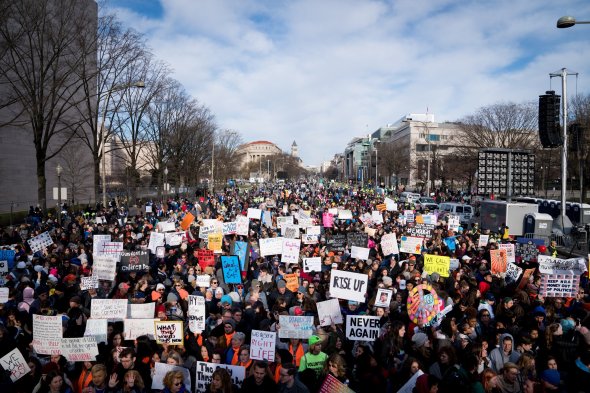
By 8:30 a.m. Eastern Time, a large crowd had already gathered for the March for Our Lives event in Washington on Saturday. Credit Erin Schaff for The New York Times
Happy Saturday!!
Today is the “March For Our Lives” in Washington DC to demand serious legislation to deal with the scourge of gun violence. There will be hundreds of other marches around the country and around the world. A couple of basic articles:
The Washington Post: March for Our Lives: The nation’s capital has been preparing for weeks. Today, the voices will rise.
Students, teachers, parents and survivors of mass shootings streamed into Washington Saturday for the March for Our Lives, a demonstration against gun violence that could draw hundreds of thousands of protesters to the nation’s capital.
The march is part of a surge of political activism that has transformed America’s entrenched debate over gun violence. It was organized by students who survived the mass shooting last month at Marjory Stoneman Douglas High School in Parkland, Fla., who hope to succeed where many adults have failed: By forcing Congress and the president to pass a comprehensive gun-control bill that will improve school safety.
Hundreds of sister protests are taking place in cities across the U.S., including New York, Chicago and Los Angeles. The main demonstration in Washington is scheduled to run from noon to 3 p.m. on Pennsylvania Avenue.
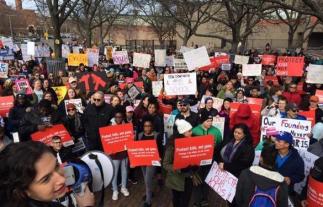
Marchers gather in Boston
The New York Times: March for Our Lives: Students Protesting Guns Say ‘We Just Have Our Lives to Lose’
Tens of thousands of people, outraged by a recent massacre at a South Florida school and energized by the students who survived, prepared to spill out in public protest in Washington and communities across the world on Saturday as they call for an end to gun violence.
The student activists, many of them sharp-tongued and defiant in the face of politicians and gun lobbyists, have kept attention on the issue in a time of renewed political activism on the left, as they helped lead a national school walkout and pushed state officials in Floridato enact gun legislation.
On Friday, the Justice Department proposed banning so-called bump stocks, but President Trump signed a spending bill that included only some background check and school safety measures. The effectiveness of the students’ efforts will be measured, in part, on the success of Saturday’s events — their most ambitious show of force yet.
Here’s what we’re watching as protests unfurl around the globe:
• More than 800 protests are planned in every American state and on every continent except for Antarctica, according to a website set up by organizers. Here’s a map of planned protests.
• The National Park Service has approved a permit for the Washington march, which estimates 500,000 people could attend. Called March for Our Lives, the main event there kicks off around midday, and some of the most prominent student activists from Marjory Stoneman Douglas High School in Parkland, Fla., where a shooting left 17 dead last month, will speak.

Heather Egeland Martin, 36, and Ashley Egeland, 34
In the buildup to the march, there have been a number of good stories about survivors of previous school shootings. The best one I’ve read was in Glamour Magazine: Two Columbine Survivors on Life After a Mass Shooting, and Being at the Lead of ‘The Columbine Generation’.
“We call B.S.,” Emma Gonzales shouted, mesmerizing the crowd—and the nation—just one day after a shooter killed 17 people at Marjory Stoneman Douglas High School in Parkland, Florida. “They say tougher guns laws do not decrease gun violence. We call B.S.!”
The student walkouts that took place across the country today were a breathtaking display of activism for González, her fellow survivors, and other student crusaders. They have accomplished much since Nikolas Cruz turned their Valentine’s Day to carnage: They’ve faced down politicians from Florida’s capitol to Washington, D.C., mobilized the upcoming national March for Our Lives, (complete with merch and Oprah donations), and helped pass a law that raises the age for buying firearms in Florida from 18 to 21—NRA lawsuits be damned.
But after the march on the 24th, will the country fade back to apathy as it has after so many mass other shootings? And what will life really be like for students of Parkland after the media lights fade?
We asked sisters Heather Egeland Martin, 36, and Ashley Egeland, 34, who were both students at Columbine High School when Eric Harris and Dylan Klebold showed up with guns under their trench coats and left 15 people dead. At that time, Columbine was one of the deadliest school shootings in U.S. history; it was also the first to happen in the digital age, with real-time cell phone calls from inside the schools. Since that day in 1999, U.S. students—the Columbine Generation—have never known school to be safe from terror.
It’s been nearly 19 years since Columbine, and both Ashley and Heather are still recovering. They know it can be a long road ahead.
Heather and Ashley talk about their long journeys after major trauma–through eating disorders and drug addiction to recovery. But the trauma itself never goes away. As a survivor of early childhood trauma, I really identified with these women’s stories. The article brought me to tears. I hope you’ll read it.
A few more to check out:

Virginia Tech massacre survivor Lisa Hamp (Photo by Rod Lamkey Jr.)
The Atlantic: My Life Since the 2007 Virginia Tech Shooting: Lisa Hamp’s Story.
Vox: They survived Columbine. Then came Sandy Hook. And Parkland.
Vox: “I hope you know that it’s not that we didn’t try”: a Columbine and Parkland survivor talk.
NPR: 20 Years Later, Jonesboro Shooting Survivors Conflicted Over Parkland.
Trump has fled to Palm Beach, where he’ll hole up and try to ignore the protesters and the 60 Minutes interview with Stormy Daniels tomorrow night. Once again, Melania refused to ride with her husband on the helicopter to Air Force One. CNN:
The day after a CNN interview with a former Playboy model who claims to have had a 10-month affair with her husband, first lady Melania Trump opted to leave President Donald Trump alone for the ride from the White House to Andrews Air Force Base.
The official White House schedule, released Thursday evening, stated the first couple would depart the White House together aboard Marine One en route to Joint Base Andrews, but Mrs. Trump did not appear beside her husband. CNN reached out to the first lady’s communications office for an explanation or comment on the change in plan but did not receive a response.
As he flew out of town, Trump left the government of our once-great nation in turmoil.
The New York Times: After Another Week of Chaos, Trump Repairs to Palm Beach. No One Knows What Comes Next.
PALM BEACH, Fla. — President Trump decamped to his oceanfront estate here on Friday after a head-spinning series of presidential decisions on national security, trade and the budget that left the capital reeling and his advisers nervous about what comes next.
The decisions attested to a president riled up by cable news and unbound. Mr. Trump appeared heedless of his staff, unconcerned about Washington decorum, or the latest stock market dive, and confident of his instincts. He seemed determined to set the agenda himself, even if that agenda looked like a White House in disarray.
Inside the West Wing, aides described an atmosphere of bewildered resignation as they grappled with the all-too-familiar task of predicting and reacting in real time to Mr. Trump’s shifting moods.
Aides said there was no grand strategy to the president’s actions, and that he got up each morning this week not knowing what he would do. Much as he did as a New York businessman at Trump Tower, Mr. Trump watched television, reacted to what he saw on television and then reacted to the reaction.
Aides said he was still testing his limits as president while also feeling embattled by incoming fire — from Congress, the Russia investigation, foreign entanglements, a potential trade war and a pornographic film actress and a Playboy model who said they had affairs with Mr. Trump and were paid to keep quiet.
Read the rest at the NYT.
Yesterday morning Trump threatened on Twitter that he was thinking about vetoing the just-passed omnibus spending bill, which the White House staff had worked out with both Republicans and Democrats. Then he called a “press conference” at which he whined about the spending bill that he had finally agreed to sign and then refused to answer any questions from the press. It was a pathetic, disgusting display of temper.
David A. Graham writes at The Atlantic: Trump Can’t Get What He Wants and Doesn’t Know Why.
“I’ve signed this omnibus budget bill. There are a lot of things I’m unhappy about in this bill,” Trump said. “But I say to Congress, I will never sign another bill like this again. I’m not going to do it again.” [….]
Over and over again, he talked about defense spending, including reading through a litany of what would be allocated for specific craft in the bill. (“The tanker aircraft is very important based on everything.”) Though there’s little evidence that large swaths of the population are concerned about a dearth of military spending, Trump sounded like a garbled John F. Kennedy, with everything but missile gaps popping up.
The reason became apparent at the very end of the press statement. Secretary of Defense James Mattis was present and spoke briefly, and it seems he convinced the president to sign the bill despite his reservations. As Trump left, reporters shouted out questions, and the president said, “I looked very seriously at the veto. I was thinking about doing the veto. But because of the incredible gains we’ve been able to make for the military, that overrode any of our thinking.”
Trump also demanded that the Senate eliminate the filibuster, and called for the return of the line-item veto, the presidential tool ruled unconstitutional in 1998.
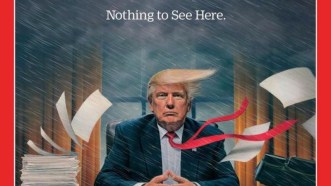 Graham writes that Trump simply doesn’t understand how legislation works and he isn’t interested in learning.
Trump’s grandiose, semi-authoritarian claim, “I alone can fix it,” in his speech accepting the 2016 Republican nomination was a subject of intense criticism, but in retrospect it seems to have represented not so much a vision of how Trump could transform the presidency but a mistaken impression of how the presidency already worked. Though political scientists and some journalists have explained clearly how the power of the bully pulpit is badly overrated, this was yet another case in which Trump had not carefully studied the realities of politics.
He seems to have subscribed, and may still subscribe, to an extreme version of what Matt Yglesias termed the “Green Lantern Theory of the Presidency,” in which presidents are superheroes who get what they want through sheer force of will. This is not, however, the way Washington really works, and while Trump has experienced that, he doesn’t seem to have quite come to understand it, thus his fury and threat on the spending bill Friday.
If Trump wanted to affect the text of the bill, he had ways to do it. He could have gotten intensely involved in the negotiation process early. He could have presented a budget that represented something like an opening volley in a negotiation, rather than a utopian scheme that Congress was never going to take seriously. But Trump has shown no appetite or patience for rolling up his sleeves and getting into the nitty-gritty. He’d rather make threats from the White House when it’s too late to change anything.
There’s more at the link. It’s a good piece, well worth a read.
What stories are you following today? What are your thoughts on the marches? Whatever you’re up to, have a great weekend.

 peej
peej Carissa
 bostonboomer
 dakinikat
 ecocatwoman
 jjlo
jjlo mablue2
 Mama Lopez
 peggysue22
 quixote
 skydancingguestblogger
 Mona (aka Wonk the Vote)





Recent Comments