
Shapiro, Rufo, and Rogan are three of the most important figures of the modern right. That they’ve all started sounding like comedy “hot dog men” of late suggests the right has a genuine problem on its hands.
Mostly Monday Reads: Chaos Information
Posted: June 22, 2026 Filed under: #We are so Fucked, MAGA Chaos, Republican Chaos, Trump Chaos | Tags: @johnbuss.bsky.social John Buss, chaos, Chaos Supreme Court, Sen. John Cornyn, Senate Majority Leader John Thune, Senate Republicans, Trump Chaos 6 Comments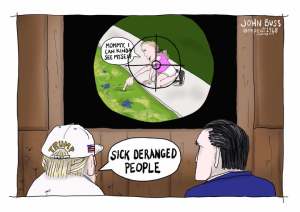
“Saboteurs be damned! The Situation Room is locked and loaded to eliminate the threat of the Green Newest Scam.” @repeat1968, John Buss
Good Day, Sky Dancers!
Well, I have the perfect read and lede to reinforce my repetitive sub-headings for my post. Burgess Evertt of Semaphor quotes outgoing Senator John Cornyn in his latest. Either everyone reads me, or we all finally notice the trend. “‘The president seems to revel in chaos’: Cornyn goes his own way.” Ya think?
A few days after losing his Senate runoff, John Cornyn did something unusual for him: He used his leverage against his own party.
The Texas Republican was frustrated by a nearly year-long delay in getting his state reimbursed by the Trump administration for more than $10 billion in border security spending that Congress had already approved. Cornyn had something valuable to withhold as lawmakers prepared to take up President Donald Trump’s $70 billion immigration spending bill.
“Basically, I told Senator Barrasso and Senator [John] Thune: ‘There’s a price for my vote, and it is to get the administration to release the money,’” Cornyn told Semafor in a recent interview in his hideaway office on the Capitol’s third floor. “Next thing I got is a call from [White House budget director] Russ Vought, and Russ said, ‘we’ll put a notice of funding.’”
Cornyn added a reminder that, with more than six months left in office and a sophisticated understanding of the Senate, he’s positioned to play more hardball if he has to: “That’s one example I think of what you can do when you have some cards to play.”
The four-term incumbent is already setting some conditions on his critical undecided vote for Trump’s attorney general pick, Todd Blanche. Cornyn has returned to the candor he displayed for years in the Senate halls, offering withering assessments of Trump’s Iran deal and legislative strategy — a pattern he might continue on Wednesday, when the president visits GOP senators in person.
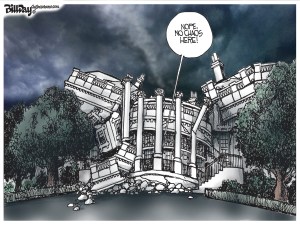 See? We basically have to vote them out of office to act in the interests of the country and the people they serve. To continue that train of thought, a reference to my soon-to-be-gone senator was also put into the analysis
Sen. Bill Cassidy, R-La., also ousted by Trump in May, told Semafor that he and Cornyn are “like-minded in the sense that we’re both not returning, and that gives a certain focus. And he’s conveyed he’s got no illusions about the president.
“But you know,” Cassidy added, “it’s not like we sit around in a smoke-filled room, plotting the strategy.”
It just amazes me that Trump manages to get his way as long as they hold office and positions. Then, they suddenly rotate to the right thing.
What does it take to act like an actual American leader these days? This headline at VOX got me thinking, also. “The MAGA stars freaked out by their own movement. The right’s leading lights are looking for anyone to blame for the right’s growing extremism — except themselves.” This analysis is written by Zach Beauchamp.
It’s a real-life version of the famous sketch on Tim Robinson’s show I Think You Should Leave, where a hot-dog-shaped car crashes into a storefront and a man in a hot dog suit says, “We’re all trying to find the guy who did this.”
The “hot dog men” — and yes, they’re almost all men — are easy to mock. But their growing ranks point to something serious: that right-wing political machine is spinning out of control in ways that even some of its most aggressive and radical voices recognize as dangerous. And as the right searches for new leadership before Trump himself fades into history, nobody on their side has shown any proven ability to contain or redirect its worst impulses.
In the absence of post-Trump leaders both willing and able to address the real problems, the future of the right — and, thus, in some sense, America — is dangerously unclear.
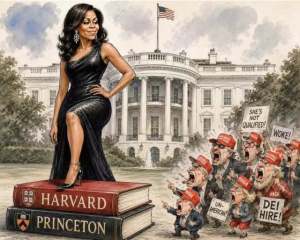 If that’s the metaphor, then the reality on the ground is even more bizarre.
Indeed, there are plenty of other examples.
Mark Levin, the Fox News and talk radio provocateur with Trump’s ear, unironically complains about “podcasters” who are “not about informing or educating,” but rather profiting off being “crazier” than their competitors. Rod Dreher, a right-wing writer who has long promoted a famously racist anti-immigration novel, has been expressing deep concern about rising bigotry on the young right. And even Dinesh D’Souza — a commentator who has spent literally decades spreading increasingly toxic, racially tinged conspiracies — is now warning that right-wing racism may prompt “mass desertions of blacks, Latinos and other minorities from the GOP.”
All of these men openly helped build the right-wing political culture that got us here. Now they’re all trying, desperately, to find the guy who did this.
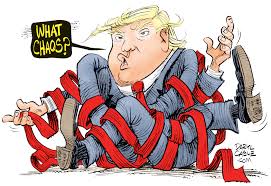 The examples provided make for a long read, but a good set of evidence for the hypothesis. This article comes with all the details on all the nasty stuff that fed the MAGA tourists and the Elephants at the Republican Zoo. You have to pay a bit to read this, but you will come away with a deeper understanding of the people we ignored for way too long. The conspiracy theorists and provocateurs are reaping what they sowed. I especially liked the story of Candice Owens, who always seemed like an over-the-top Con Artist and turn-coat.
You can also read more on the infighting via MSNOW’s Mychael Schnell.” ‘It’s awkward for everybody’: Inside the Trump-Thune relationship. The president and the majority leader are increasingly finding themselves in standoffs.” Trump is still doing a lot of damage, however, so I wonder if this is actually affecting any real change. Is minimal change doing anything?
On June 4, as Senate Republicans finally began debating their immigration enforcement bill, President Donald Trump called Senate Majority Leader John Thune, R-S.D., with a demand: Attach the SAVE America Act to the legislation.
During the call — according to a source familiar with the conversation — Thune told Trump there wasn’t enough support for the hardline voting bill. But, as a concession to the president, he said Republicans would try again.
Sen. Lindsey Graham, R-S.C., drafted an amendment exactly as Trump requested. And Republicans put it on the floor for a vote.
It failed 48-50, with four Republicans joining Democrats in opposition.
Despite one of those stubborn realities in the Senate — math — Trump has continued pressing for the SAVE America Act, which would require proof of citizenship and photo identification to vote while sharply restricting mail-in voting.
Trump’s insistence on pursuing a bill that lacks enough support, and his tendency to fault Thune when it fails, has only deepened tensions between the president and the Senate majority leader.
One GOP senator, who requested anonymity to discuss the internal dynamics, said Trump and Thune “have an awkward relationship.”
“It’s awkward for everybody,” the lawmaker said.
Sources stressed that Trump and Thune still maintain a functional working relationship. One person familiar with their interactions said they don’t speak every day, but “when they need to talk, they talk a lot.”
Still, the limited communication is increasingly becoming a problem.
One of the clearest signs of that dynamic came last week, when Trump instructed his director of national intelligence nominee not to show up for a confirmation hearing, prolonging a lapse in U.S. spying authority. That morning, Thune said he hadn’t heard from Trump.
When Thune was asked last Wednesday why Trump had unexpectedly derailed his nominee’s hearing, the South Dakota Republican’s frustration was palpable.
“Good question,” he said.
Part of Trump’s discontent with Thune appears to be rooted in the contrast with Speaker Mike Johnson, R-La. While Johnson often advances Trump’s priorities through the simple-majority House, Thune must navigate a Senate where most major legislation requires 60 votes. As a result, Thune frequently finds himself delivering unwelcome news about what can and can’t pass.
“Thune and the speaker obviously have different ways of communicating with Trump, both in style and in substance,” the source familiar with the Trump-Thune dynamic said.
“When it comes to Thune, he doesn’t sugarcoat the truth,” this person added. “He tells the president exactly what he needs to know — the raw and unvarnished truth — even if it isn’t always the answer the president wants to hear.”
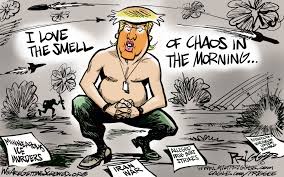 This Washington Post analysis (gifted) shows Orange Caligula’s troubles extend to the Supreme Court. “Why Trump has been attacking the Supreme Court, with 3 key rulings ahead. As the court prepares to rule on several of the president’s priorities, tensions are running high — even with his own appointees.
One recounted how Gorsuch became upset when Davis lashed out at Justice Amy Coney Barrett, calling her a “rattled law professor” for siding with the court’s liberals in a pair of rulings against Trump. The other said Davis was angered by Gorsuch’s vote to block Trump’s use of a wartime authority to deport Venezuelans.
The people differed on whether Gorsuch had asked Davis not to come to his clerks’ gathering or he chose not to. Either way, the rift highlighted the growing conflict between Trump, his MAGA allies and the justices, which has burst more fully into public view in recent months.
That turbulence makes for a tense backdrop in the waning days of the Supreme Court’s 2025-26 term, as the justices prepare to rule on three signature Trump initiatives: limiting birthright citizenship, firing the heads of independent agencies and reshaping the Federal Reserve.
Many legal experts believe that the justices have signaled they will rule against Trump on two out of the three, blocking his bid to deny citizenship to those who were born to parents here illegally or lacking permanent residency, as well as his effort to remove a governor of the Fed board.
“It seems like almost 100 years since you’ve had a clash approaching this level between the president and the court,” said Jeffrey L. Fisher, a law professor at Stanford University. “You’d have to go back to the New Deal to have any kind of an analogue.”
During the 1930s, President Franklin D. Roosevelt tried to pack the court by expanding it from nine justices to 15after the court struck down key parts of the New Deal. The plan ultimately failed, but not before the court began upholding some policies that Roosevelt championed, possibly in response to his threats to add justices.
Davis, who declined to comment on his relationship with Gorsuch, said in an interview that if the court rules against Trump on birthright citizenship,
“When the Supreme Court gives Chinese birth tourists birthright citizenship, it’s going to destroy its legitimacy with a broad swath of the American public,” Davis said, referring to people who ostensibly travel to the United States to have American children. “They are following politics and vanity projects instead of the law.”
Defenders of birthright citizenship note that the 14th Amendment says that “all persons born or naturalized in the United States, and subject to the jurisdiction thereof, are citizens of the United States and of the state wherein they reside.”
In another major case on Trump policies, the court will decide whether the president can remove without cause the heads of roughly two dozen independent agencies, such as the Federal Trade Commission and the Federal Communications Commission, that Congress set up to be insulated from political influence.
In addition, the justices will rule on whether Trump can fire Federal Reserve governor Lisa Cook while a lawsuit over her removal plays out in the courts. A ruling for Trump would give the president far greater control over the powerful central bank.
These rulings, and other major decisions, are likely to come in the next week or so as the justices sprint toward the end of the term in late June or early July.
The disaffection with the Supreme Court among Trump’s allies is notable because the president reshaped the court in his first term with three staunchly conservative appointees, who have delivered major victories for conservatives on abortion, affirmative action, religious rights and more.
This term, the justices have handed the administration a string of wins on the emergency docket, allowing Trump policies on limiting immigration, freezing foreign aid and dismantling the Education Department to move forward for now.
Trump appointed Gorsuch, who did not respond to a request for comment, along with Brett M. Kavanaugh and Barrett.
The wins have not satisfied Trump, who has attacked the court — including his own nominees — in increasingly caustic and personal terms that legal scholars say have little historical precedent; Trump has called the justices “bad,” “stupid,” “weak” and other epithets.
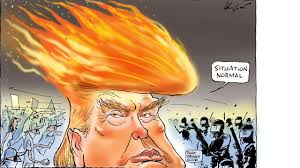 All three of these articles are long reads. I’m not sure if they give me a glimpse of hope, given all the idiots involved, but I do feel the more Trump feels he’s under attack by his own, the more he’ll turn his mind from other things, like the ridiculous crap he’s done at the White House. I don’t know, though. I am fully aware that I might be wrong on that. It may be just chaos without meaning or impact.
Here are some other things that truly depress me. This is via CNN this morning. “Exclusive: Trump administration plans to use homeland security funds to pressure states into election changes.
The Trump administration is threatening to withhold tens of millions of dollars in federal homeland security funds from states unless they adopt a sweeping set of election changes, according to multiple sources and internal documents obtained by CNN.
The move is part of President Donald Trump’s campaign to root out alleged voter fraud — despite studies showing it’s far rarer than he claims — and exert more federal influence over how elections are run. It comes as multiple states have passed laws that seek to prevent the federal government from interfering with elections.
Under new rules governing several homeland security grant programs, states must take a number of steps, including phasing out certain electronic voting systems and moving to hand-marked paper ballots. They must also run their voter rolls through a controversial Department of Homeland Security citizenship verification database.
If not, states would lose out on some funding from DHS. These grants, expected to total more than $1 billion in the current fiscal year, are one of Washington’s main vehicles for helping state and local governments prevent terrorism, protect infrastructure and prepare for major disasters.
For years, the DHS grants, which states apply for, have required that at least 3% of the funds be spent broadly on election security. But the new guidelines, which CNN obtained and are expected to go out to states later this month, impose a set of mandatory reforms and steep penalties for noncompliance. States that refuse would lose 20% of the grant money — potentially millions of dollars in security funds.
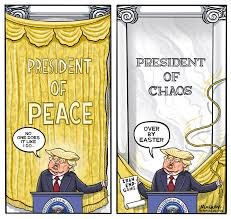 This is more bad news via NPR. It’s more garbage from SCOTUS. “Supreme Court allows a ruling that ends a tool to protect minority voters in 7 states.” Hansi Lo Wang has the lede.
By declining to take up a lower court ruling, the U.S. Supreme Court has dealt another blow to the Voting Rights Act.
The court announced Monday that it will not review an Arkansas-based lawsuit, leaving in place a 2025 appeals panel ruling that ends a long-used tool for protecting minority voters from discrimination under the landmark law in seven mainly Midwestern states.
That ruling found that in the states covered by the 8th U.S. Circuit Court of Appeals — Arkansas, Iowa, Minnesota, Missouri, Nebraska, North Dakota and South Dakota — private individuals and groups do not have the right to sue to enforce what’s known as Section 208 of the Voting Rights Act, which generally allows voters with a disability or inability to read or write to get help with voting from a person of their choice.
The Supreme Court’s move comes almost two months after its conservative supermajority issued a major ruling that further weakened the Voting Rights Act, setting off a groundswell in redistricting across the country.
When will the press stop calling these people “conservative”? This has nothing to do with conserving anything traditionally Constitutional in this country. Okay, this is all I can handle on Monday. May the week ahead give us more hope. I’m going to go watch more soccer games and hope for the best.
What’s on your Reading, Action, and Blogging list today?
Friday Reads: The Nadir of American Life and Influence (e.g. We’re all Gonna Die)
Posted: March 23, 2018 Filed under: morning reads | Tags: John Bolton, Trump Chaos 24 CommentsWell, Sky Dancers, it’s just getting more difficult to explain what’s going on in the USA. The Republican Party has been completely captured by a Criminal Enterprise beholden to Vladimir Putin backed by End Time Cultists and led by completely clueless, self-dealing Oligarchs. We’re now seeing a return of the War Criminals. I’m not sure how much worse it can get. As Jonathan Chait succinctly puts it, “Nobody Is Left to Save the World From Trump Now”.

A stencil of an early human’s hand in an Indonesian cave is estimated to be about 39,000 years old. (Via NPR)
The people who joined the government to save Donald Trump from himself, or to save the world from Trump, are leaving. Gary Cohn and Rex Tillerson are gone. Trump is reorganizing his legal team, mobilizing for war against the special counsel. And now he has finally cast off his most important minder, National Security Adviser H.R. McMaster, and replaced him with John Bolton.
Bolton is in some ways the foreign-policy analogue of his domestic counterpart, Lawrence Kudlow, the incoming head of the National Economic Council. Like Kudlow, Bolton is a true-believing ideologue firmly encamped on his party’s right flank, who appears regularly on Fox News to propound ultrasimplistic solutions to the world’s problems, which Trump can easily grasp on his sofa. Also like Kudlow, Bolton has given every indication of being personally committed to Trump, and has not condescended to him.
The difference, however, is that Kudlow’s kooky ideas have little chance of enactment given the tenuous Republican control of Congress. Bolton’s foreign-policy notions can be quickly operationalized, given the near-total command the Executive branch has over foreign policy. What’s more, those ideas have the potential to kill large numbers of people.

The paintings indicate that early humans had “some pretty heavy stuff” weighing on their minds, archaeologists said. (From the satirical site The Onion.}
The Republican party is captured by Trump’s base which is basically an end times cult of religious fanatics. It is not only supercharged by white identity politics and white grievance but represents an extremist religious cult that actively seeks THE big end. They see climate change as a sign the mothership is coming for them. They do not seek a continuation of anything but being hyperfocused on removing what offends them while they actively work to make all life a brief an interim as possible.
John Bolton is as much a mad man as KKKremlin Caligula himself. He’s known for terrorizing people who disagree with him with threats and outbursts rivaling the monster in the oval office. He also is one of the few people who think the war in Iraq was a good thing. He supports pre-emptive strikes in both North Korea and Iran. He’s not just a War Hawk on steroids. He’s the Angel of Death.
President Donald Trump finally jettisoned National Security Adviser H.R. McMaster on Thursday afternoon. His replacement is John Bolton, the former ambassador to the United Nations in the Bush administration — and one of the most radically hawkish voices in American foreign policy.
Bolton has said the United States should declare war on both North Korea and Iran. He was credibly accused of manipulating US intelligence on weapons of mass destruction prior to the Iraq war and of abusive treatment of his subordinates. He once “joked” about knocking 10 stories off the UN building in New York. That means his new appointment to be the most important national security official in the White House has significant — and frightening — implications for Trump’s approach to the world.
Bolton’s new job was announced on Thursday evening, when the president tweeted that McMaster planned to resign and Bolton would replace him. “I am pleased to announce that, effective 4/9/18, [John Bolton] will be my new National Security Advisor,” the president wrote.
Bolton had been rumored to be the frontrunner for the job for months, but that doesn’t make the pick any less jarring. His track record in government, connections to anti-Muslim groups, and stated views in op-eds and public speeches all suggest that he will push Trump to take extremely dangerous positions on issues like North Korea, Iran, and ISIS.
“I operate on the assumption that John Bolton should be kept as far away from the levers of foreign policy as possible,” says Christopher Preble, the vice president for defense and foreign policy studies at the libertarian Cato Institute. “I think I would rest easy if he was dog catcher in Stone Mountain, Georgia. But maybe not.”
Bolton’s elevation illustrates the degree to which the president is influenced by the conservative infotainment sphere, most notably Fox News — where he has long been an on-air fixture. Bolton was, prior to this appointment, a marginal figure in Washington foreign policy circles since his departure from the Bush administration. But he got himself one of the top jobs in the country because of his savvy work in the world of conservative media and advocacy groups.

Beautiful cave paintings dating from the late Neolithic, Epipaleolithic and early Bronze Age.
The Magura cave in Bulgaria.
You read that right. We’re getting Fox Propaganda Pundits as advisers on the most significant policies we could enact. It’s so bad that lawyers are leaving. But wait, Dowd left, McGahn wants a sidewise promotion away from the West Wing.
President Donald Trump’s top White House lawyer, Don McGahn, is expected to step down later this year, though his resignation is contingent on the president finding a replacement and several other factors, according to four sources familiar with McGahn’s thinking.
McGahn, according to two of the sources, has signaled interest in returning to the Jones Day law firm where he previously worked and reprising a role he had during the 2016 campaign by handling legal matters for Trump’s reelection.
ut the exact timing for McGahn to make any move remains in flux. He’s told associates he’d like to leave the White House by the summer, but it could also be put on hold through the 2018 midterms.
Concerned about the velocity of turnover inside his White House and beyond — Trump personal lawyer John Dowd resigned on Thursday, and the president has made changes atop the State Department, CIA and the national security adviser slot — sources said Trump wants to have a new White House counsel in place who he’s comfortable with before clearing McGahn for the exits.

The open air cave paintings of La Valltorta-Gassulla in the region of Valencia.
Who the fuck wants to re-elect this madman? Look no further than the white evangelical cultists. It’s them and no one else.
In deep-red America, the white Christian god is king, figuratively and literally. Religious fundamentalism has shaped most of their belief systems. Systems built on a fundamentalist framework are not conducive to introspection, questioning, learning, or change. When you have a belief system built on fundamentalism, it isn’t open to outside criticism, especially by anyone not a member of your tribe and in a position of power. The problem isn’t that coastal elites don’t understand rural Americans. The problem is that rural America doesn’t understand itself and will never listen to anyone outside its bubble. It doesn’t matter how “understanding” you are, how well you listen, what language you use…if you are viewed as an outsider, your views will be automatically discounted. I’ve had hundreds of discussions with rural white Americans and whenever I present them any information that contradicts their entrenched beliefs, no matter how sound, how unquestionable, how obvious, they will not even entertain the possibility that it might be true. Their refusal is a result of the nature of their fundamentalist belief system and the fact that I’m the enemy because I’m an educated liberal.
At some point during the discussion, they will say, “That’s your education talking,” derogatorily, as a general dismissal of everything I said. They truly believe this is a legitimate response, because to them education is not to be trusted. Education is the enemy of fundamentalism because fundamentalism, by its very nature, is not built on facts. The fundamentalists I grew up around aren’t anti-education. They want their kids to know how to read and write. They are against quality, in-depth, broad, specialized education. Learning is only valued up to a certain point. Once it reaches the level where what you learn contradicts doctrine and fundamentalist arguments, it becomes dangerous.
But the miseducation of Donald Trump is endlessly on display to encourage them. No one wants educated workers, Trump insists. They want trained widgets.
President Trump loves vocational training. Community colleges? Not so much.
Trump on Thursday appeared at the “Generation Next” White House forum alongside Charlie Kirk, a conservative campus activist who heads Turning Point USA. In between talking up tax cuts and his administration’s work rolling back federal regulations, the president weighed in on the value of vocational training. And repeating a sentiment he expressed to a conference of conservative lawmakers last month, he again appeared to dismiss community colleges. As they did after his earlier remarks on those institutions, community college leaders said they showed the president was misinformed.
In the midst of answering a question from Kirk about tax cuts passed last year, Trump repeated an anecdote he tells frequently about a former classmate who was “not going to be Einstein academically” but could fix an engine or a motor blindfolded.
“But he’ll never be a student, nor did he want that kind of learning, that kind of whatever you want to call it,” Trump said. “So we need vocational schools. Now, they call them, a lot of times, community colleges. I don’t think it’s an accurate definition.”
The comment echoed a statement from February in which he complained to Republican lawmakers that many people don’t know what a community college “means or represents” and suggested that “vocational” is a preferable term. Those earlier remarks prompted several leaders in the community college sector to complain that Trump had taken an overly simplistic view of the mission of those institutions and downplayed the significant role they have in training students for new careers even as they prepare others to move on to four-year colleges.

10,000-year-old rock Apaintings found in Chhattisgarh,India.
President Donald Trump threatened on Friday to veto the $1.3 trillion omnibus spending bill already passed by Congress, only hours before government funding would lapse.
The about-face comes a day after the White House had said Trump would sign the legislation despite his misgivings. The government will shut down at 12:01 a.m. Saturday if Trump does not sign a funding bill into law.
In a tweet, Trump said he is “considering a VETO” because the proposal does not extend protections for hundreds of thousands of young undocumented immigrants or fully fund his proposed border wall.
It’s just one thing after another that rattles investors and the nerves of those not seeking Armageddon.
U.S. stock-market indexes traded between small gains and losses on Friday, a day after equities plunged on the prospect of a global trade war as China fired its first retaliatory salvo against tariffs on at least $50 billion of Chinese goods announced by the Trump administration.
Investors sought shelter in gold and the Japanese yen, which was trading at its highest levels since the U.S. presidential election in 2016, after one of the worst days for Wall Street in weeks.
…
China reacted to Trump administration’s plans to impose tariffs, as Beijing’s commerce ministry fired back with tariffs against $3 billion in U.S. goods.
China stopped short of penalties on the biggest salvos in a potential trade war, leaving off soybeans, sorghum and Boeing BA, +1.83% aircraft, indicating Beijing may be looking for leverage in any negotiations with the U.S.
In one bright spot, the White House late Thursday formally approved tariff reprieves for the European Union plus six other nations, including Canada and Mexico.

Cave Paintings Sierra de San Francisco, Baja California Sur
It’s difficult for old ladies like me to handle all this unnecessary death and destruction. I may have to find a nice cave and settle in to paint animals.
What’s on your reading and blogging list today?

 peej
peej Carissa
 bostonboomer
 dakinikat
 ecocatwoman
 jjlo
jjlo mablue2
 Mama Lopez
 peggysue22
 quixote
 skydancingguestblogger
 Mona (aka Wonk the Vote)



 Sky Dancing
Recent Comments