
Finally Friday Reads: Clusterfucks r US
Posted: April 10, 2026 Filed under: #FARTUS, #MAGAnomics, #We are so Fucked, Afternoon Reads, Foreign Affairs, U.S. Economy, U.S. Politics | Tags: Cadet Bonespur's Iran War, Inflation is back, Jeffrey Epstein scandal, Pete Hegseth weirdo sexual assaulter 3 Comments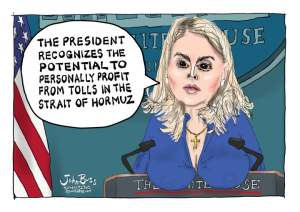
“The bottom line of everything this administration does.” John Buss, @repeat1969
Good Day, Sky Dancers!
Once again, there’s no news fit to report, but I’m going to take a stab at it. The headlines run the gamut. There are headlines that make you want to laugh, like “Melania Trump says she was not associated with Jeffrey Epstein.” Headlines that make you want to cry, like “Consumer prices rose 3.3% in March, as energy prices spiked due to Iran conflict.” Headlines to make you angry, like “Pete Hegseth’s holy war: the militant Christian theology animating the US attack on Iran.” There are also headlines that make you feel quite unsurprised, like “Calls to Impeach Trump Collide With Reluctant Democratic Leadership.” Once again, it’s a week that leaves us all worse off.
S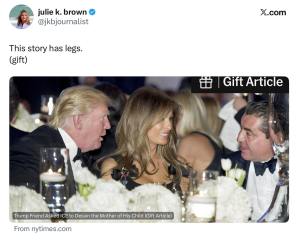 o, let’s start with Melania Dearest, who insists she had no ties to Jeffrey Epstein, even though she was not under oath to tell the truth, you have to wonder if a Congressional Committee will ask for a repeat performance.. William Kristol, writing at The Bulwark, suggests she threw hubby under the bus. “What Melania Didn’t Say.”
Standing behind a podium bearing the presidential seal, speaking at the White House Cross Hall where so many presidents have addressed weighty matters of state, and where her husband last week spoke to the nation about Iran, the first lady read a six-minute statement about her and Jeffrey Epstein.
Melania’s focus was on . . . Melania. She began, “The lies linking me with the disgraceful Jeffrey Epstein need to end today.” Her purpose, she said, was to defend “my reputation,” to clear “my good name.” (Emphasis mine.)
And so she asserted that “I have never been friends with Epstein” and that “I . . . was never on Epstein’s plane.” She also claimed that “My email reply to [Epstein’s imprisoned accomplice Ghislaine] Maxwell cannot be categorized as anything more than casual correspondence.1 My polite reply to her email doesn’t amount to anything more than a trivial note.”
Left unsaid, but not unimplied, was that none of these claims could be made about her husband. He was a pal of Epstein’s. He was on Epstein’s plane. His relationship with Epstein, as exemplified for example in his contribution to Epstein’s birthday book, was more than “casual” or “trivial.”
Melania also chose to express concern for Epstein’s victims, something her husband has conspicuously not done.
And she went on to say that
Now is the time for Congress to act. Epstein was not alone. Several prominent male executives resigned from their powerful positions after this matter became widely politicized. Of course, this doesn’t amount to guilt, but we still must work openly and transparently to uncover the truth.
So the Epstein investigation is not, as her husband has asserted, a “hoax.” Nor is it yet time, as her husband has said, to move on. The truth hasn’t yet been uncovered, and we need to uncover it. And if doing so leads more “prominent male executives” to resign, so be it. One wonders: Could Melania have one prominent male chief executive in mind?
Melania chose not to include in her statement any assertion of her husband’s innocence of complicity in the Epstein affair.
Melania is perhaps not a deep thinker, but she’s no fool. Since immigrating to the United States three decades ago, Melania Knauss has done well for herself. She’s shown that she has a shrewd sense of how to operate in her adopted country. She’s risen to the top, while mostly avoiding being directly engulfed in all the scandals that have raged around her.
 There is surely a lot of evidence suggesting she knew him well. But, with the Iran War being waged like a lethal version of mud wrestling, let’s see if the due diligence will be done by the press. This topic really skates on Slut Slamming, but it’s hard to cover earnestly. Emptywheel has an interesting story on the mostly out-of-view First Lady. “Melania’s Immigration Witness, Paolo Zampolli, Asked to Get His Baby Mama Deported.” I wonder if she’s worthy of any Congressional questions.
The biggest denial may be this one:
I met my husband by chance at the [sic] New York City party in 1998. This initial encounter with my husband is documented in a detailed [sic] in my book, Melania.
The entire stunt seemed like a response to Michael Wolff. After all, when Melania listed the people who’ve had to retract claims — James Carville, The Daily Beast, and Harper Collins, in conjunction with a biography of the Andrew formerly known as Prince — she did not mention Wolff (or Hunter Biden), whom she has been threatening to sue for some time, with whom she has been stuck in litigation for months.
She has threatened Wolff in the past, who has made claims about how she met Trump, whether Epstein had fucked Melania before Donald did, and whether Donald and Melania first fucked on his plane. But thus far that litigation remains pending, and she didn’t mention him (or Hunter Biden, whom she also threatened to sue) in this appearance.
Wolff has many recordings about what Epstein told Wolff, whether Epstein’s claims were true or not.
But I’m more interested in another detail.
Melania cites her own book for the definitive account of how she met Donald (she has done this in past lawsuits).
Why would she do that? She has a witness to some of this: Paolo Zampolli, the agent who imported her on the same Einstein visa scam as Epstein used for his victims.
Zampolli not only remains in the Trump circle, but he flew to Hungary to do errands for Russia with JD Vance this week.
…
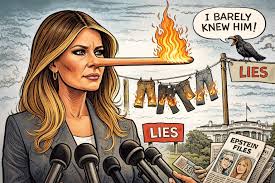 Epstein survivors had plenty to say about the performance. This is from The Guardian. Shrai Popat has the story. “Survivors of Epstein’s abuse accuse Melania Trump of ‘shifting burden’ onto victims, Outrage from survivors follows first lady’s statement calling on Congress to hold public hearings with victims of Epstein’s abuse.”
More than a dozen survivors of Jeffrey Epstein’s abuse have accused Melania Trump of “shifting the burden” onto them after she called on Congress to hold public hearings with victims of Epstein’s abuse.
“Survivors of Jeffrey Epstein have already shown extraordinary courage by coming forward, filing reports, and giving testimony,” said a group of 13 people and the brother and sister of the late Virginia Giuffre, who was one of the most vocal Epstein accusers, in a statement. “Asking more of them now is a deflection of responsibility not justice.”
Their response came after the first lady delivered a surprise statement in which she said denied that she ever had a relationship with Epstein and his accomplice Ghislaine Maxwell. She also said that she was not a victim of Epstein, had no knowledge of his crimes, and said that the late convicted sex offender did not introduce her to her husband, Donald Trump.
“The lies linking me with the disgraceful Jeffrey Epstein need to end today,” she said, adding that “numerous fake images and statements about Epstein and me have been calculating [sic] on social media for years now”.
It remains unclear what specific accusations prompted her remarks. Her senior adviser, Marc Beckman, told Reuters that she “spoke out now because enough is enough. The lies must stop”.
During her statement, the first lady also urged Congress to hold public hearings and take sworn testimony from survivors of Epstein’s crimes.
In their statement on Thursday evening, the group of Epstein survivors said the first lady “is now shifting the burden onto survivors under politicized conditions that protect those with power: the Department of Justice, law enforcement, prosecutors, and the Trump administration, which has still not fully complied with the Epstein Files Transparency Act”.
“It also diverts attention from Pam Bondi, who must answer for withheld files and the exposure of survivors’ identities,” they said. “Those failures continue to put lives at risk while shielding enablers.”
“Survivors have done their part,” the statement concluded. “Now it’s time for those in power to do theirs.”
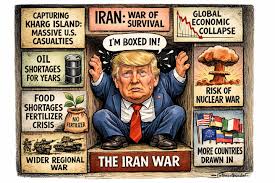 It appears that the majority of the country is suffering under the impact of the Iran War. CNBC’s Jeff Cox has this headline. “Consumer sentiment hits record low, inflation fears rise amid Iran war.”
Consumer confidence plunged to a record low in April as fears mounted over rising energy prices and the broader impact of the Iran war, according to a University of Michigan survey Friday.
The university’s headline index of consumer sentiment tumbled to 47.6, down 10.7% from the March survey to its lowest on record. Current conditions and expectations indexes also saw double-digit monthly declines.
The drop in sentiment coincided with a sharp spike in inflation expectations, with respondents seeing prices up 4.8% in a year from now, a full percentage point rise from the March reading to its highest since August 2025. The one-year outlook in April 2025 was 6.5% following President Donald Trump’s “liberation day” tariff announcement.
Survey comments “show that many consumers blame the Iran conflict for unfavorable changes to the economy,” said the survey’s director, Joanne Hsu.
However, Hsu also noted that most of the interviews were completed before the April 7 ceasefire. The survey, then, primarily reflects conditions from March.
“Economic expectations will likely improve after consumers gain confidence that the supply disruptions stemming from the Iran conflict have ended and gas prices have moderated,” she said.
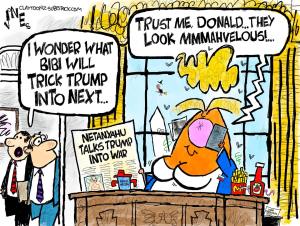 There’s no good news coming out of the Iran War. This is Heath Cox Richard’s take on her Substack today.
The ceasefire President Donald J. Trump announced Tuesday night fell apart almost immediately. Israel complained that it hadn’t been consulted, and Prime Minister Benjamin Netanyahu insisted Israel did not accept an end to its bombardment of southern Lebanon as a way to dislodge Iran-backed Hezbollah militants. Steven Scheer of Reuters noted today that Israel has been under a state of emergency that halted the work of the judicial system, but with the end of the war, Netanyahu’s trial for corruption is scheduled to begin again on Saturday.
Iran has been permitting certain ships to pass through the Strait of Hormuz, but responded to Israel’s continued bombing by closing the strait again.
Vice President J.D. Vance said there was a “legitimate misunderstanding” about whether the ceasefire included Lebanon. “We never made that promise,” he said. But in fact, Pakistani prime minister Shehbaz Sharif, who posted the terms of the ceasefire on Tuesday, noted that the agreement did include a ceasefire in Lebanon. He tagged Vance in the post.
As more information about the achievement of the ceasefire became known, it reflected poorly on Trump. Humza Jilani, Abigail Hauslohner, and Demetri Sevastopulo of the Financial Times reported yesterday that while Trump claimed Iran was begging for a deal to end hostilities, it was actually the Trump administration that was pushing Pakistan to broker a deal with Iran. Tyler Pager and Katie Rogers of the New York Times reported that the White House was helping to craft Sharif’s social media statements, suggesting Trump “was actively looking for a way out of the crisis” as his own imposed deadline drew closer on Tuesday evening.
Although Defense Secretary Pete Hegseth claims the U.S. has had a “historic and overwhelming victory” that achieved “every single objective,” David S. Cloud of the Wall Street Journal wrote yesterday that Iran saw the ceasefire as a “triumph” because it had survived a 38-day barrage from the United States and Israel and because it had gained control over the Strait of Hormuz, inflicting deep damage on the U.S. economy. Iran claimed the U.S. had suffered “an undeniable, historic, and crushing defeat.” Iran’s new leadership is even more anti-Western than the previous leadership, killed in the early days of the U.S.-Israeli strikes.
Yesterday the president posted his own interpretation of the terms of the agreement, but they were aspirational and asked for Iran to agree to terms that were less advantageous for the U.S. than the Joint Comprehensive Plan of Action (JCPOA) that President Barack Obama negotiated in 2015 and Trump tore up in 2018.
The actual terms of the ceasefire agreement were murky. On Wednesday, Iran released its version of the points of the agreement; the White House said those points weren’t the basis for the ceasefire.
Also yesterday, Trump suggested the U.S. was considering joining the Iranians in demanding tolls for ships passing through the Strait of Hormuz. “We’re thinking of doing it as a joint venture. It’s a way of securing it,” he told journalist Jonathan Karl. But today Trump posted: “There are reports that Iran is charging fees to tankers going through the Hormuz Strait—They better not be and, if they are, they better stop now!” Hours later, he added: “Iran is doing a very poor job, dishonorable some would say, of allowing Oil to go through the Strait of Hormuz. That is not the agreement we have!”
 I’d like to think I have the vocabulary to describe how I feel about all these idiotic, powerplay antics, but I really don’t. We are clearly dealing with people who don’t have a clue and don’t care to understand our democratic republic. This article from The Guardian blew me away. “Pete Hegseth’s holy war: the militant Christian theology animating the US attack on Iran.” This article deserves a full read from us. We should never forget Hegseth’s weird diatribe.
Nine months and six days before a Tomahawk missile tore through the gaily decorated classrooms of the Shajareh Tayyebeh elementary school in Minab, Iran, ripping apart the bodies of schoolchildren, teachers, and parents, US defense secretary Pete Hegseth’s personal pastor delivered a sermon at the Pentagon.
“There’s a temptation to think that you’re actually in control and responsible for final outcomes, especially for those who issue the commands and do the aiming and the shooting,” preached Brooks Potteiger, Hegseth’s closest spiritual adviser, at the first of what have become monthly Christian worship services at the Department of Defense. “But you are not ultimately in charge of the world.”
Citing a verse from Matthew 10, Potteiger told the gathered leaders of the US military: “If our Lord is sovereign even over the sparrow’s fallings, you can be assured that he is sovereign over everything else that falls in this world, including Tomahawk and Minuteman missiles …
“Jesus has the final say over all of it.”
The available evidence and a preliminary investigation by the US military all suggest that the US was responsible for the 28 February school bombing that killed more than 175 people, most of them children, but neither Donald Trump nor Hegseth has taken any responsibility, nor have they expressed any remorse.
Instead, Hegseth has persisted in framing the war in Iran, which reached a temporary ceasefire on Tuesday after six weeks of fighting, as divinely sanctioned, repeatedly invoking “God’s almighty providence” and expressing surety that God is on the side of the US military. Amid boasts about the US’s superior firepower and theatrical disdain for “stupid rules of engagement”, the defense secretary has promised to give “no quarter” to the “barbaric savages” of the Iranian regime and called on the American people to pray for victory “in the name of Jesus Christ”.
Hegseth’s distinct combination of piety and bloodlust was most prominently on display at the 25 March worship service at the Pentagon, the first since the war in Iran began, when he prayed for “overwhelming violence of action against those who deserve no mercy”. The prayer was so shocking that it appears to have provoked a direct rebuke from Pope Leo, who preached on Palm Sunday that God ignores the prayers of those whose “hands are full of blood” from making war.
Hegseth will hardly mind harsh words from the head of the Catholic church, however. The 45-year-old US army veteran and former Fox News host is a member of an obscure, deeply Calvinist wing of evangelical Christianity – John Calvin broke from the Catholic church during the 16th-century Protestant Reformation – that rejects the pope’s authority and is rooted in a belief in predestination.
“They believe that nothing happens that isn’t in God’s will,” said Julie Ingersoll, a professor of religious studies at the University of North Florida, who researches this branch of Reformed Christianity. “They believe that God directs everything that happens.”
Even a bomb falling on an elementary school full of children?
I really just want to cry.
Have a good and peaceful weekend. Try not to give up hope.
What’s on your Reading, Action, and Blogging list today?
Finally Friday Reads: Breaking Crazy
Posted: March 27, 2026 Filed under: #FARTUS, #MAGAnomics, #We are so Fucked, Afternoon Reads, American Fascists, Civil Rights, corruption, democracy is threatened, FARTUS, Foreign Affairs | Tags: @johnbuss.bsky.social John Buss, Cadet Bonespur's Iran War, Orange Caligula's cabinet crazy, US Misleadership 3 Comments
“One thing really stands out about trump’s latest Cabinet Love Fest, which can only be interpreted one way, he actually said something factual!” John Buss. @repeat1968
Good Day, Sky Dancers!
You don’t need to be a mental health expert to realize that something is very wrong with Orange Caligula’s brain. As usual, I didn’t watch or listen to his displays of dementia, narcissism, and stupidity because it’s its own form of torture. But I did see some cuts and takes on various social media outlets. I think it’s important to see just exactly how far his deterioration has gone and how that’s impacting policies that are extremely damaging for our country and the world.
The Guardian’s Andrew Feinberg reports the debacle this way. “‘Could only happen to Trump’: President hijacks Cabinet meeting to cry about lawsuits over his radical DC plans. President launches into extended stemwinder of grievances ranging from lawsuits over the Kennedy Center to the Justice Department’s failure to bring sham charges against Federal Reserve Chairman Jerome Powell.”
President Donald Trump spent roughly 15 minutes of a cabinet meeting on Thursday complaining about a historic preservation group’s efforts to block him from shutting down the Kennedy Center for a purported preservation and grousing about the Justice Department being unable to prosecute the chairman of the Federal Reserve over their renovation.
The president was in the middle of a long soliloquy about fixing up the Washington, DC-based arts center — which was built in honor of assassinated President John F. Kennedy — when he began to claim the controversial renovation would be “under budget, ahead of schedule” and unfavorably compared the project to the long-running rehab of the nearly century-old Federal Reserve headquarters.
He quickly pivoted to airing a related grievance about the National Trust for Historic Preservation, a congressionally chartered nonprofit that has filed multiple lawsuits against his administration to block the construction of his planned White House ballroom after he ordered the historic East Wing reduced to rubble last fall.
“Everything I do, I get sued. Under budget, ahead of schedule, I get sued over a ballroom that’s going to be the most beautiful ballroom in the country … we get sued by the National Trust for Historic Preservation. They don’t know what they’re doing,” he said.
He also complained that he’d separately been facing litigation over the Kennedy Center project and suggested the lawsuit was only attributable to the center’s board — made up of loyalists he appointed after taking office and sacking the previous leadership — adding his name to the name of the organization.
“Then I just found out we got sued by that group and another group … I guess on the fixing up of again, I’ll use the old name Kennedy Center — it’s going to be beautiful when you add the name Trump,” he said.
“But we got sued, and all I’m doing is fixing it up. We’re fixing broken marble. We’re putting on a roof because it leaks like a sieve. We’re fixing steel that’s broken. Same building, same exact building we’re fixing. It’s going to be beautiful. It’s going to be so beautiful and safe … but think of it. I get sued because I’m fixing up the Trump Kennedy Center. We’re going to make it gorgeous and safe. We’re fixing new windows, do this, but just all fix up. I got sued by preservationists.”
“This could only happen to Trump,” he added.
The president eventually pivoted back to attacking the Federal Reserve renovation and the central bank’s chairman, Jerome Powell, with whom he has spent years feuding over Powell’s failure to keep interest rates low to help Republicans’ electoral prospects.
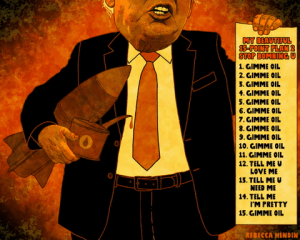 This PBS News headline shows the lies Trump’s spreading on the Iran War. “WATCH: Trump says in Cabinet meeting he doesn’t ‘know if we’re willing’ to make a deal with Iran.”
President Donald Trump insisted Thursday that Iran is “begging” to make a deal.
Watch in our video player above.
The president, speaking at the start of a Thursday Cabinet meeting, said he wanted to “set the record straight” that he isn’t the one pushing for a deal.
WATCH: Iran rejects Trump’s ceasefire terms and issues own demands as war continues
“They’re begging to make a deal, not me,” Trump said.
Iranian officials have denied that they’re negotiating with the U.S. as the war continues in its fourth week. Trump insisted they are.
“Anybody would know they’re talking,” he said. “They’re not fools, they’re very smart actually in a certain way. And they’re great negotiators. I say they’re lousy fighters but they’re great negotiators.”
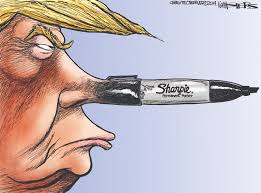 What kind of crazy does it take to negotiate with this kind of language? Lousy fighters? Read more about the meeting at the link. People Magazine reports an incident that sounds like the sounds like the strawberry incident in The Caine Mutiny. “Trump Rambles About Sharpie Pens for 5 Straight Minutes During High-Level Cabinet Meeting amid Iran War. The president said he was sharing “a business story” near the end of his lengthy tangent.”
Donald Trump embarked on an unrelated and rambling story about Sharpie pens during a Cabinet meeting this week.
On Thursday, March 26, the 79-year-old president met with members of his Cabinet, including Secretary of Defense Pete Hegseth and Secretary of State Marco Rubio. During the meeting, they discussed topics ranging from the war in Iran to his decision to vote by mail in a recent Florida special election in his home district of Palm Beach.
At one point, Trump broke into a story about his use of Sharpie-brand pens while discussing renovations that are ongoing at the Federal Reserve. He blasted the project as being unnecessarily expensive, saying that he could have done it for much less and that “it would be better” than the current project.
After blaming “incompetent people” in the government for “a lot of problems” currently affecting the United States, he picked up a Sharpie on the table and started his story.
“See this pen right here? This pen is an interesting example. It’s the same thing. So, this pen is very inexpensive, but it writes well. I like it. But I can’t have the pen the way it was. You know what it is; I don’t want to give too much publicity, but they do treat me well. Sharpie,” he said.
Trump said that when he came to the White House they had “$1,000 pens” [of a different brand] and that he’d often give them away to as many as 30 or 40 people while signing autographs.
“They were $1,000 a piece. Beautiful pen. Ballpoint. Thousand. It was gold, silver, gorgeous. But I’m handing them out to kids that don’t even know what they … ‘What’s this, mommy?’ These kids, they’re getting a pen for $1,000. They have no idea what it is,” he said, adding that he felt “guilty” that he wasn’t saving the government money.
On top of being expensive, the pens “had another problem,” he said. “They didn’t write well. So I take it out, and I sign and there’s no ink. And I’ve got all you people [the assembled press] looking, and you’re saying, ‘There must be something wrong with Trump.’ And I’m signing and there’s no ink the pen and it costs $1,000.”
Irritated by what he implied was government waste, he said that he reached out to Sharpie and said he’d “like to use your pen, but I can’t have a gray thing with a big ‘S’ on it.’ “
Meanwhile, what does it say when you’re base want’s you impeached?
Lisa Needham, writing for Public Notice, asks this great question. “What do you do when you can’t trust the government? The haze of contradictions and confusion is a feature, not a bug.”
We’re a month into President Donald Trump’s increasingly disastrous Iran war, and we have no idea what’s really going on.
In part, that’s because Trump is now nothing but a creature of pure id surrounded by enablers, running the country like an enormous out-of-control toddler. But it’s also because the administration is not at all interested in providing the American people with objective, reliable information.
That erasure of truth leaves us unmoored.
Trump’s increasing instability was always going to lead to chaotic, contradictory statements about the war, blurting out whatever ideas have taken hold in the nest of spiders inside his head.
These constant reversals about what he plans to do next aren’t always random or delusional, but the sheer volume of Trumpian proclamations that seem divorced from reality does a terrific job of obscuring when something is deliberate.
That was the case at least until earlier this week, when Trump decided to use the Iran war to engage in a little light market manipulation. Well, some pretty hefty market manipulation, actually.
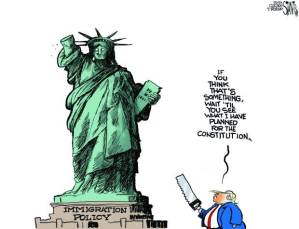 Heather Cox Richardson has some even more damning evidence at her SubStack.
In an interview with Reuters on Monday, Singapore’s minister for foreign affairs, Dr. Vivian Balakrishnan, put in bald language the change in the world order instigated by President Donald J. Trump.
“For 80 years,” Balakrishnan explained, “the US was the underwriter for a system of globalisation based on UN Charter principles, multilateralism, territorial integrity, sovereign equality.” That system “heralded an unprecedented and unique period of global prosperity and peace. Of course there were exceptions. And of course, the Cold War was still in effect for at least half of the last 80 years. But generally, for those of us who were non-communists, who ran open economies, who provided first world infrastructure, together with a hardworking disciplined people, we had unprecedented opportunities.
“The story of Singapore, with a per capita GDP of 500 US dollars in 1965. Now, [it is] somewhere between 80,000 to 90,000 US dollars. It would not have happened if it had not been for this unprecedented period, basically Pax Americana and then turbocharged by the reform and opening of China for decades. It has been unprecedented. It has been great for many of us. In fact, I will say, for all of us, if you look back 80 years.
“But now, whether you like it or not, objectively, this period has ended…. Basically, the underwriter of this world order has now become a revisionist power, and some people would even say a disruptor. But the larger point is that the erosion of norms, processes, and institutions that underpinned a remarkable period of peace and prosperity; that foundation has gone.”
In its place, as scholar of authoritarianism Timothy Snyder said to me in a YouTube conversation yesterday, Trump is aligning himself with international oligarchs like Russia’s Vladimir Putin, Hungary’s Viktor Orbán, Saudi Arabia’s Mohammad bin Salman (MBS), and China’s Xi Jinping. Because of his position as the president of the United States of America, this means he is aligning the United States of America with this oligarchical axis as well, abandoning the country’s democratic principles and traditional allies.
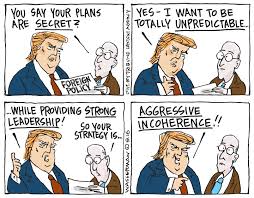 Our foreign policy was never pristine. All you have to do is look at the CIA during the post World War 2 years to see adventurism in South America, Africa, and Southeastern Asia to see that. However, we did assert some global leadership that created some stability, peace, and trade agreements. Now, all bets are off with us under Trump.
The craziness just continues and the disruption to what once was a mostly functioning democratic republic is obvious. How about this bit of narcissim? This is from today’s New York Times. “Trump’s Signature Is Set to Be Added to America’s Currency. President Trump is poised to be the first sitting president to have his signature appear on the U.S. dollar.”
Or just another story coming about some asshole cabinet member. This one from the head of the “Department of War.” It’s also from the New York Times. “Hegseth Strikes Two Black and Two Female Officers From Promotion List, Defense Secretary Pete Hegseth’s highly unusual decision to remove officers from a one-star promotion list has spurred allegations of racial and gender bias.”
They’re rewriting the script on every value this country has held.
Well, I’m off to the long, wretched task of reworking my mortgage just so I can fix somethings on my house. As a person who has been a banker on all kinds of levels from the FED to a communithy bank I can tell you that I have never seen such a mess. I’m certain I have all this AI shit to thank for it. The documentation requirements are just unbelievable.
I hope your weekend goes well and that you can manage to stay above the news and the national fray.
What’s on your reading and blogging list today?
Sweet Goddesses, I miss performaning this song in the Quarter. I need to go back to gigging. Anything’s better than teaching Economics in this damn environment.
Finally Friday Reads: Abusing Public Office on Steriods
Posted: March 20, 2026 Filed under: #FARTUS, #MAGAnomics, #Occupy and We are the 99 percent! | Tags: #TrumpCult, @johnbuss.bsky.social John Buss, Cadet Bonespur's Iran War, high gas prices, ICE Helps Trump Friend, Justice for Breonna Taylor, No Justice, No Peace, Trump sells Favors 3 Comments
“Markwayne Mullin seems qualified to head the Department of Homeland Security.” John Buss, @repeat1968
Good Day, Sky Dancers!
Our Executive branch is basically captured by idiots and criminals. A headline in the New York Times today shows that abusing their offices is the only skill the MAGA officeholders and the president have. This story broke last spring. “Trump Friend Asked ICE to Detain the Mother of His Child. Paolo Zampolli, a former modeling agent and a longtime Trump ally, was in a custody battle over his son. An ICE official agreed to help.” While the American people suffer, the Art of the Steal runs amok.
Megan Twohey, Shawn McCreesh, and Hamed Aleaziz share the lede.
Last June, the man credited with introducing President Trump to his wife asked the administration for a favor.
Paolo Zampolli, a former modeling agent turned presidential special envoy, had learned that his Brazilian ex-girlfriend was in a Miami jail, arrested on charges of fraud at her workplace. They had been in a custody battle over their teenage son. Now he saw an opportunity.
He reached out to a top official at Immigration and Customs Enforcement, explaining that his ex was in the country illegally, according to records obtained by The New York Times and a person familiar with the communications. Could she be put in ICE detention? That could help him get his son back.
The official, David Venturella, promptly called the agency’s Miami office to ensure that ICE agents would pick up the woman from the jail before she was released on bail, according to the records and a person with knowledge of the conversation who requested anonymity to discuss it. During the call, Mr. Venturella noted that the case was important to someone close to the White House.
The woman, Amanda Ungaro, was placed in ICE custody and ultimately deported, an outcome that may well have happened regardless of Mr. Zampolli’s meddling. But the ICE official’s willingness to spring into action for a Trump ally — even one in a low-level, largely ceremonial role — reflects a recurring theme of the second Trump administration: The levers of the federal government can be pulled to settle a personal score.
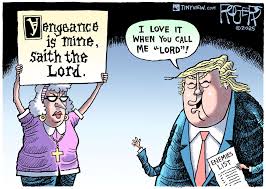 You may read the details at the gifted link above. You may also want to check out MEDIAITE for some analysis by Issac Schorr. “One of Trump’s Friends Reportedly Asked ICE to Arrest the Mother of His Child in Custody Battle Gambit.”
Paolo Zampolli, the man who introduced President Donald Trump to his wife, First Lady Melania Trump, and is currently serving as U.S. special representative for global partnerships at Trump’s behest, asked ICE to arrest the mother of his child last June, according to The New York Times.
After learning that his Brazilian ex-girlfriend, with whom he had a son, Amanda Ungaro, had been arrested on fraud charges in Florida, Zampolli allegedly “saw an opportunity” to land a potentially killing blow in his custody battle with her.
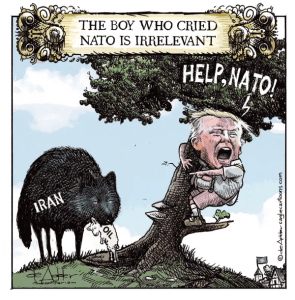 This is just one example of the incompetence, revenge-taking, and grifting that make up the heart of the Trump Regime’s reign of Terror. The story that keeps one like the above in the background is still the Iran War. Greg Sargent of The New Republic discusses some of the incredible ‘madness’ surrounding the machinations behind the War with Congressman Adam Smith. “Transcript: Trump War Takes Dark Turn as Leaks Unnerve Dems: ‘Madness’. In an interview, Congressman Adam Smith, the top Armed Services Democrat, sharply condemns the newly leaked war schemes—and tells us that Dems must not agree to one more dime in war funding.”
Everything we’re learning now strongly suggests that Donald Trump’s war is about to get worse. First, word leaked that the Pentagon may demand $200 billion more from Congress. Second, officials let it be known that Trump is considering the deployment of thousands of troops on the ground. Meanwhile, Trump himself just suggested to reporters that he’s envisioning even more military actions that he hasn’t even explained yet.
All this makes it absolutely clear that Congress will not just be asked to fund Trump’s war, but also that the pressure on Congress to do something about this madness will intensify. So today we’re talking to Congressman Adam Smith, the ranking Democrat on the House Armed Services Committee, about what Democrats will be able to do when that happens. Congressman, thanks so much for coming on.
Adam Smith: Well, thanks for having me. It’s always good to see you.
Sargent: So let’s start with all the leaks about Trump potentially sending in troops on the ground. People familiar with planning told Reuters that Trump may deploy thousands of them. The options being discussed are deploying troops to the shoreline of the Strait of Hormuz to secure passage for oil tankers and possibly sending ground forces to Kharg Island, which is the hub for oil exports, which one official describes to Reuters as “very risky.” Congressman, you talk to people at the Pentagon a fair amount. Are you getting any indications of anything like this, and what’s your overall take on it?
Smith: Yeah, no, it’s very worrisome, because the bottom line is it’s clear that Trump is not going to be able to achieve anything meaningful in Iran—which is a change of the regime and a change of action. I mean, degrading their capability is one thing, but at the cost that we’re currently experiencing—13 service members’ lives already lost, massive economic disruption, 14 countries dragged into this, civilian deaths, the tragic killing of 150 schoolgirls in Iran—massive cost, just to degrade Iran a little bit. He wants regime change. He wants something different. That’s not happening under the current plan.
Now, I don’t think it’s going to happen if he sends in a few thousand troops, either, but the pressure on him to escalate is growing in his own mind. The pressure is also growing on him to end this madness, stop this war, and recognize he’s not going to accomplish that. But we’ve sent 2,500 Marines—they’re now in the area. Another 2,500 are on their way. And you know, Marines don’t just sit in boats—they’re there for a purpose. And sadly, what we’ve learned in the last year is that when Trump masses forces, he uses them.
He did it in Latin America, first with the boat strikes, then with taking out Maduro. He did it in the Middle East when he massed these forces for the war with Iran. So if he sends troops to the region, it is distinctly possible that he’s going to use them. It would be an idiotic decision, because the ability of four or five thousand troops to really fundamentally change this war—I don’t think that’s going to succeed. But Trump doesn’t think in a linear way. He trusts his gut and his bones, apparently.
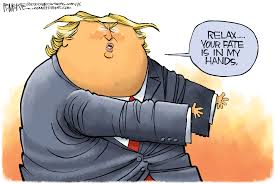 You may watch the interview or continue reading the transcript at the link. Smith and Sargent discuss the implausible reasons given for the war and the difficulty of achieving any real goal from it. As far as I can tell, it just takes the country’s mind off the Epstein files and the constant drip of incompetence and abuse of office. It’s theater that’s costing lives, taxes, and a declining economy.
And a little more dribble from what used to be the Justice Department. “Feds move to dismiss charges against officers accused of falsifying warrant in Breonna Taylor raid.” This is breaking news from the AP.
Federal prosecutors have asked a judge to dismiss the charges against two Louisville officers accused of falsifying the warrant that led police to raid Breonna Taylor’s apartment the night she was killed six years ago.
Prosecutors said in a court filing Friday that their review of the case showed the charges against former Detective Joshua Jaynes and former Sgt. Kyle Meany should be “dismissed in the interest of justice.”
Lawyers for the two didn’t immediately respond to Friday requests for comment.
Judges have twice taken a felony charge against each officer and reduced it to a misdemeanor, saying there wasn’t a direct link between the false information and Taylor’s death. Prosecutors said after the second ruling that they decided to drop the cases.
Taylor was shot to death by police when they broke down the door of her apartment while serving a no-knock drug warrant looking for a former boyfriend who no longer lived there.
Taylor’s boyfriend at the time fired at the officers, and Taylor was killed as police fired back.
Federal prosecutors under former President Joe Biden sought the charges against the officers, while President Donald Trump’s Department of Justice has asked the only officer serving prison time related to Taylor’s killing to be let out of prison while he appeals his conviction.
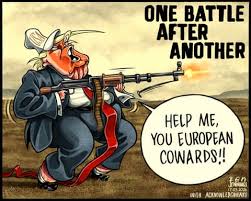 This headline from Wired is due to our insane #FARTUS, and for whatever reason, we got sent to war. “Iran War Puts Global Energy Markets on the Brink of a Worst-Case Scenario. “This will be so, so, so, so, so bad,” one analyst says.” This is reported by Molly Taft.
The war in Iran reached a new extreme this week, as both Israel and Iran launched strikes on oil and gas production and export facilities. The attacks up the stakes in a war that was already choking energy and commodity markets, and will threaten the long-term health of the global economy. On Friday, the International Energy Agency recommended that people work from home, drive slowly, and use gas stoves sparingly in order to alleviate price shocks from the crisis.
The situation in the Persian Gulf is so extreme, analysts told WIRED, that it’s almost unbelievable.
“This scenario is something that you give to the first-year oil analysts to say, ‘OK, if this happens …’ It’s a really interesting illustrative educational thought experiment,” says Rory Johnston, a Canadian oil market researcher. “It’s kind of like, what would happen if gravity just suddenly stopped working for 10 minutes? The things you just give to students to say, ‘Let’s put a thought experiment to something extreme and see how would the system react’? I never thought we would actually see this.”
Ellen Wald, an energy and geopolitics consultant, agrees. “This is like one of those war game simulations in energy markets,” she says.
The initial attacks on Iran earlier this month effectively closed off the Strait of Hormuz, one of the world’s most important shipping routes. The strait is the central lifeline for oil and gas exports from not only Iran, but other countries in the Middle East. The bulk of the Organization of the Petroleum Exporting Countries (OPEC), the world’s largest oil and gas cartel, use the strait to ship oil and gas out of the region to customers. The strait is also a critical hub for oil and gas byproducts like industrial chemicals and fertilizer. Closure of the strait sent shocks through the global economy: After the initial attacks, oil prices shot up above $100 per barrel for the first time since Russia’s invasion of Ukraine in 2022.
“Anytime there is any kind of military activity in the Persian Gulf or even in the Middle East, oil markets tend to get very jittery,” says Wald; closing the strait was a sign that this war could have much more extreme impacts than other conflicts. But for the first few weeks, the oil production facilities themselves remained mostly untouched. “No oil and no products were getting out, and some countries don’t have enough storage, and so they were shutting down production simply because they couldn’t store the oil,” says Wald. “But that’s the kind of thing that can be fairly quickly reversible.”
Over the past few days, however, missile strikes have started heavily targeting oil and gas infrastructure. On Thursday, Israel launched a series of strikes on various oil and gas facilities in the region, most notably the South Pars gas field, the world’s biggest natural gas field, which is jointly controlled by Iran and Qatar. Iran retaliated with counterstrikes, including on the world’s largest oil export facility in Qatar. Oil prices temporarily shot up to nearly $120 a barrel.
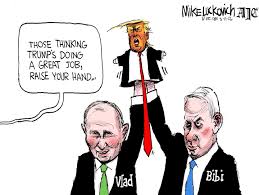 Israel is just doing whatever it wants to because Bibi can flatter the hell out of Trump and make him do anything. This entire thing was a huge disaster just waiting to happen. There’s even some speculation that Israel will use nukes. This is from NPR. “More Marines are headed to Middle East as Iran war reaches the 3-week mark.” This is the most current update.
More U.S. Marines are headed to the Middle East, NPR has confirmed, as the U.S.-Israeli war with Iran reaches the three-week mark.
Israel launched more strikes in and around Tehran early Friday, as Iranians marked Nowruz, the Persian New Year. Muslims around the world are also observing the end of the holy month of Ramadan.
Overnight, Iranian drones hit Kuwait’s Mina Al-Ahmadi oil refinery again, sparking fires as crews worked to contain the blaze. Authorities in the United Arab Emirates said the country’s air defenses responded to missile and drone threats from Iran with explosions echoing across Dubai as worshippers marked the Muslim holiday of Eid
There’s more on the marine deployment and other topics at the link.
Finally, safer and greater today? I sure am not. Just wondering if anyone is singing Bomb. Bomb Bomb Iran today? Never Mind. It says it’s a parody.
What’s on your reading and blogging list today?
Finally, Friday Reads: “The Thought of War Blows my Mind”
Posted: March 13, 2026 Filed under: #FARTUS, #MAGAnomics, #We are so Fucked | Tags: Cadet Bonespur's Iran War 5 Comments
“The dumbbeat of war echoes across the world.” @repeat1968, John Buss
Good Day, Sky Dancers!
Gotta thank @repeat1968 for giving me this earworm today, as well as today’s Featured Funny. Today’s topics are War, Inflation, and a domestic terrorist attack on a place of worship. All these are brought to you by the letters #FARTUS. Yes, Cadet Bonespurs with his band of incompetents is doing more damage to the world and our country than most folks thought possible.
We’ve lost more U.S. service members, furthering whatever the Iran War is supposed to be about. This is from NBC News. “All 6 U.S. crew members killed after refueling plane crashes in Iraq. The crash brings the number of U.S. service personnel killed since the Iran war began Feb. 28 to 12. A 13th died of a medical issue.” Watching body counts rise is never a good thing to see constantly in the news. We should’ve learned by now. This sad news is reported by Patrick Smith.
All six U.S. crew members have been confirmed dead after their military refueling plane crashed in Iraq while taking part in Iran war operations, the U.S. military said Friday.
U.S. Central Command said in a post on X early Friday that the KC-135 plane went down at approximately 2 p.m. ET Thursday in western Iraq, with four crew members initially confirmed dead. That statement said “rescue efforts continue.”
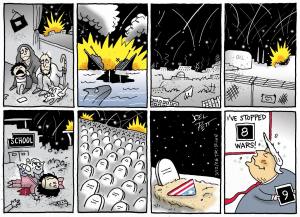
CNN has the headline this morning. “Trump administration underestimated Iran war’s impact on Strait of Hormuz.” Ya think? I’m just glad that my legs, my bike, and the St. Claude Ave bus pretty much take me wherever I need to go these days. You can lessen that earworm by humming Send in the Clowns as you read about what passes as the national security advisors these days.
The Pentagon and National Security Council significantly underestimated Iran’s willingness to close the Strait of Hormuz in response to US military strikes while planning the ongoing operation, according to multiple sources familiar with the matter.
President Donald Trump’s national security team failed to fully account for the potential consequences of what some officials have described as a worst-case scenario now facing the administration, the sources said.
While key officials from the Departments of Energy and Treasury were present for some of the official planning meetings about the operation before it started, sources said, the agency analysis and forecasts that would be integral elements of the decision-making process in past administrations were secondary considerations.
Treasury Secretary Scott Bessent and Energy Secretary Chris Wright have been key players throughout the planning and execution stages of the conflict, the sources acknowledged. But Trump’s preference of leaning on a tight circle of close advisers in his national security decision making had the effect of sidelining interagency debate over the potential economic fallout if Iran were to respond to US-Israeli strikes by closing the strait.
And now it may be weeks before the administration’s efforts to alleviate the intensifying economic fallout take hold, officials said Thursday, including high-risk naval escorts of oil tankers through the strait that the Pentagon believes are currently too dangerous to conduct. The president, meanwhile, has continued to downplay the tumult in energy markets and the danger. He told Fox News that oil tanker crews should “show some guts” and go through the strait.
The reality in the strait has left diplomatic counterparts, former US economic and energy officials and industry executives who spoke with CNN in a state of confusion and disbelief.
More than a dozen vessels have been attacked near Iran since Feb. 28
There have been at least 14 reports of attacks on ships in the Persian Gulf and near the Strait of Hormuz since war broke out between Iran and the US and Israel, according to UK Maritime Trade Operations. The incidents have effectively halted traffic through the vital oil corridor.
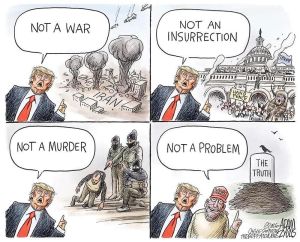 You may read the details at the link. Iran is warning ships in the air that it is also actively mining the area. There appears to be no solutions or discussion on this mess. According to Cade Bone Spurs, we shouldn’t worry about it. This is from AXIOS. “Scoop: Trump claimed in G7 call that Iran is “about to surrender”. Barak Ravid has the lede.
President Trump told G7 leaders in a virtual meeting Wednesday that Iran is “about to surrender,” according to three officials from G7 countries briefed on the contents of the call.
- 24 hours later, Iran’s new supreme leader issued his first public statement vowing to keep fighting.
Why it matters: Trump is as confident about the war’s outcome in private as he is in public. But his assessment is colliding with a more complex reality on the ground.
- The Iranian regime has shown no signs of imminent surrender or collapse — and on Day 14 of the war, is moving to gain more leverage by choking off the Strait of Hormuz.
Behind the scenes: Trump boasted about the results of Operation Epic Fury on the G7 call Wednesday morning, telling allies, “I got rid of a cancer that was threatening us all.”
- While claiming Iran was about to surrender, he also suggested there were no officials left alive in Tehran with the power to make that decision.
- “Nobody knows who is the leader, so there is no one that can announce surrender,” Trump said, according to two officials briefed on the call.
Trump has mocked Iran’s new supreme leader Mojtaba Khamenei as a “lightweight,” previously telling Axios that Ayatollah Ali Khamenei’s son would be “unacceptable” to the U.S.
-
In a message read out on state television Thursday, Mojtaba Khamenei vowed to avenge Iranian “martyrs” and open new fronts in the war “where the enemy has little experience and is highly vulnerable.”
-
Khamenei said Iran will continue to threaten the Strait of Hormuz, where attacks on tankers have already pushed oil prices above $100 a barrel and triggered fears of a global economic crisis.
Meanwhile, the Secretary of War is on the job! Not really! He said this today.
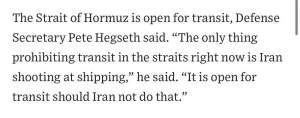
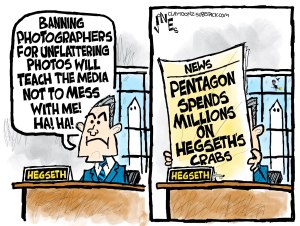
CNBC headlined his little performance this way. “Pete Hegseth on Strait of Hormuz: ‘Don’t need to worry about it’.”
Defense Secretary Pete Hegseth on Friday brushed aside concerns that the effective closure of the Strait of Hormuz because of the Iran war, which has spiked oil prices, would continue being a problem for the U.S. and the world for much longer.
Iran has been “exercising sheer desperation in the Straits of Hormuz,” Hegseth said at a Pentagon press briefing.
“We have been dealing with it, and don’t need to worry about it,” he said.
The price of West Texas Intermediate crude oil on Friday morning was around $93 per barrel. A day before the war began on Feb. 28, a barrel of WTI was selling for about $67.
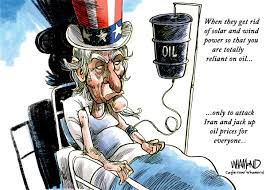 I bet that made you feel so much better! I know I’m back to my original earworm now. Economic data make it increasingly clear that the economy was slowing even before Cadet Bone Spurs started his war. Prices were also rising. This is from the AP. “US economy expanded at sluggish 0.7% in fourth quarter, government says, downgrading first estimate.” Let’s see if he blames Democrats and Biden.
The U.S. economy, hobbled by last fall’s 43-day government shutdown, advanced at an unexpectedly sluggish 0.7% annual rate from October through December, the Commerce Department reported Friday in a big downgrade of its initial estimate.
Growth in gross domestic product — the nation’s output of goods and services — was down sharply from 4.4% in last year’s third quarter and 3.8% in the second. And the fourth-quarter number was half the government’s first estimate of 1.4%; economists had expected the revision to go the other way — and show stronger growth.
Federal government spending and investment, clobbered by the shutdown, plunged at a 16.7% rate, hacking 1.16 percentage points off fourth-quarter growth.
For all of 2025, GDP grew 2.1%, solid but down from an initial estimate of 2.2% and from growth of 2.8% in 2024 and 2.9% 2023.
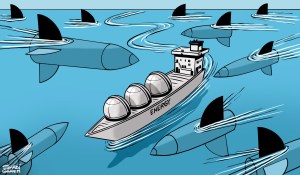 The news from Michigan on the Temple domestic terrorist is beginning to shape the narrative on why it happened. This is from The Detroit News. “Temple Israel synagogue shooter’s family recently killed in air strike.” Damn! There goes that earwig again.
A Dearborn Heights man whose relatives were recently killed in a military strike in Lebanon is the accused assailant in Thursday’s attack on the Temple Israel synagogue in West Bloomfield Township, two sources apprised of the investigation told The Detroit News.
Ayman Ghazali, 41, a restaurant worker in Dearborn Heights, is accused of driving his truck into the synagogue just after noon Thursday and opening fire, before he was shot and killed by security, the sources said. They spoke only on the condition of anonymity because they were not authorized to disclose the details publicly.
Late Thursday night, the U.S. Department of Homeland Security confirmed that Ghazali was the individual who carried out the attack.
Ghazali, a native of Lebanon, was granted U.S. citizenship more than 10 years ago, under the Obama administration, according to the department. He entered the U.S. through Detroit on May 10, 2011, on an immigrant visa as the spouse of a U.S. citizen, a DHS statement said. He applied for naturalization on Oct. 20, 2015, and was granted citizenship on Feb. 5, 2016.
Ghazali’s ex-wife filed for divorce in Wayne County Circuit Court in August 2024, records show. The couple had at least one child, according to court records, and a divorce was granted seven months later, in March 2025. Mohammad Ahmad Moussa, the ex-wife’s divorce lawyer, declined comment when contacted by The News on Thursday.
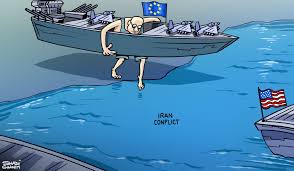 So, here is the headline from The Los Angeles Times, March 1. “Israel hits Lebanon after Hezbollah attacks; in Iraq, militia targets U.S. troops.” How literal are we here about the Eye for an Eye thing in modern times?
- The Israeli military hit Beirut on Monday and urged people in nearly 50 villages in Lebanon to evacuate ahead of possible retaliatory strikes after Hezbollah fired into Israel.
- In Iraq, the Shiite militia Saraya Awliya al-Dam claimed a drone attack on Monday targeting U.S. troops at the airport in Baghdad.
So, I think the world’s pretty fucked up right now, we are doing a lot of that, and I just am going to stop at this now and hope Congress starts fighting this with some integrity and grit.
What’s on your Reading, Action, and Blogging list today?
Mostly Monday Reads: War is Hell
Posted: March 9, 2026 Filed under: "Der Fuehrer's Face", #FARTUS, #MAGAnomics, #We are so Fucked, Iran, Israel/Iran War | Tags: Cadet Bonespur's Iran War, Iran War, Oil Prices Surge, Rationale for Iran War 7 Comments
“The Pieces President” John Buss, @repeat1968
Good Day, Sky Dancers!
The one thing holding inflation prices down in this country was the price of oil. It peaked in 2023 and began a decline until Orange Caligula launched a full-on attack on Iran and disrupted traffic in the Straight of Hormuz. Such is the result of a madman’s insane policy choices based on revenge, power-grabbing, and greed. It’s like giving a toddler the driving wheel and letting him take you down from a very tall mountain.
It’s not like I didn’t warn everyone to clear out of the stock market and hunker down about a year ago. It’s also just going to get worse. I fortunately cleared out the last of one of my 403(b)s last week to use it to improve the house before it gets any more expensive. I managed to lose only a bit of it, and I’m glad to know the check got cut before the worst hit so far. I can’t promise you that it’s going to get any better either. We’re worse than a Banana Republic. We’ve gone back to something akin to the dark ages with plagues of measles and armed thugs wandering the streets, looking to harm and jail workers and poor people. We can’t even put a bunch of pedophiles in suits into the justice system. What good is our Constitution for if money means you can ignore it
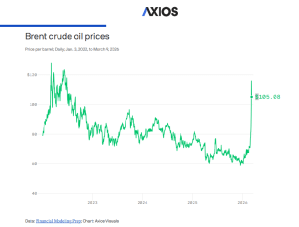
I’m going to start with AXIOS because they always get straight to the point. This analysis is by Neil Irwin, and this absolutely stunning chart provides some visuals. That line covering the first few months of 2026 screams outlier with a discernible reason. To the moon and beyond! It’s also obvious that none of it was Joe Biden’s fault, given the dates accompanying the data points. Okay, I’ll step down from the professor’s podium. I’ll just say economics students will be studying this for as long as universities stand.
In the first week of the American and Israeli attack on Iran, the economic ripples were looking pretty minimal. But as Week 2 begins, the risks to the global economy are growing much more serious.
The big picture: You can’t decapitate the leadership of a country of 90 million people, with expansive military and intelligence capabilities, in the heart of some of the world’s most economically important supply chains, without a huge cost.
- The hours and days and weeks ahead are all about quantifying that cost.
Zoom in: Oil skyrocketed 25% overnight, to just under $120 a barrel, fueling worries that higher energy costs will stoke inflation and curb spending by U.S. consumers. Tokyo’s Nikkei 225 index plunged more than 5%.
- That’s the highest oil price since about four years ago, when energy prices surged due to Russia’s invasion of Ukraine.
- Patrick De Haan — a widely cited gas price expert and an analyst for GasBuddy — estimates there’s an 80% chance the national average gas price will hit $4 per gallon in the next month.
The latest: As of 5am ET, a barrel of the global crude oil benchmark was going for about $107 on futures markets, up 15% from Friday and 47% from 10 days ago, before the Iran attack. Brent crude prices approached $120 overnight before receding on reports of coordinated global action to release oil reserves.
- The oil price rise is poised to translate into a rapid increase in the cost of retail gasoline, which was already up about 51 cents per gallon before the weekend run-up in oil prices.
The risk of a broader economic slump is rising with the disruption to oil supplies. S&P 500 futures are down 1.3% overnight, setting Wall Street up for its third consecutive day of losses.
- Japan’s Nikkei index was down 5.2% and South Korea’s KOSPI down 6%, reflecting those economies’ more direct dependence on Middle Eastern oil now at risk of a protracted blockade.
Of note: The odds of a U.S. recession this year spiked to 38% in overnight trading on Polymarket, from 24% at the start of the month.
State of play: Iran is seeking to block the Strait of Hormuz, which connects the Persian Gulf with the rest of the world, and is threatening to attack ships that seek to pass through.
- The war has already caused the largest oil disruption in history, taking out roughly 20% of the world’s supply, according to Bob McNally, president of Rapidan Energy and a former George W. Bush energy adviser.
- That’s double the previous record set during the Suez Crisis in the 1950s, which disrupted just under 10% of global supply.
- The weekend also brought apparently successful Iranian attacks on desalination plants in the Gulf region that are critical for drinking water.
- President Trump has raised the possibility of U.S. ground forces in Iran.
 More at the link. CNBC shows the data with more analysis. “Oil prices topped $100 per barrel on record supply disruption, but are off session highs.” We’ll see if that lasts until the markets close this afternoon.
Shortly after oil blasted past $100 at the open of trading Sunday evening, President Donald Trump posted on Truth Social that a gain in “short term oil prices” was a “very small price to pay” for destroying Iran’s nuclear threat.
“Only fools would think differently!” Trump added.
Gulf Arab states are cutting production because they are running out of storage space, as crude piles up with nowhere to go due to the closure of the Strait. Tankers are unwilling transit the narrow waterway because they are worried Iran will attack them.
The closure of the Strait has triggered the biggest oil supply disruption history, according to an analysis by consulting firm Rapidan Energy. About 20% of the world’s oil consumption is exported through the Strait.
Iran’s foreign ministry spokesman warned Monday that oil tankers “must be very careful.”
“As long as the situation is insecure, I think all tankers, all maritime navigation, must be very careful,” Foreign Ministry spokesman Esmail Baghaei told CNBC in an interview.
Kuwait, the fifth-biggest producer in OPEC, announced precautionary cuts Saturday to its oil production and refinery output due to “Iranian threats against safe passage of ships through the Strait of Hormuz.” The state-owned Kuwait Petroleum Corp. did not detail the size of the cuts.
Output in Iraq, the second-biggest OPEC producer, has effectively collapsed. Production from its three main southern oilfields has fallen 70% to 1.3 million barrels per day, three industry officials told Reuters on Sunday. Those fields produced 4.3 million bpd before Iran war.
And the United Arab Emirates, the third-biggest producer in OPEC, said Saturday that it is “carefully managing offshore production levels to address storage requirements.” The Abu Dhabi National Oil Co., or ADNOC, said its onshore operations are continuing normally.
The war showed little signs of easing despite Trump’s claim it was “already won.” Iran named Ayatollah Ali Khamenei’s son, Mojtaba, as its new supreme leader, according to reports. The U.S. and Israel killed Khamenei in the opening days of the war.
Energy Secretary Chris Wright said Sunday that traffic through the Strait will resume after the U.S. has destroyed Iran’s ability to threaten tankers.
 It’s really odd to think that I started my career as an economist during the OPEC maneuvers and I’m winding down my career as one with the US maneuvers. Frankly, I think China is sitting pretty right now. They’ve been doing a lot with alternative energy and have the entire Pacific Region — including many Latin American Countries with oil — undoubtedly rooting for them right now.
Alex Harring at CNBC analyzes the market activity. This is fresh off the ticker today. “Stocks pare losses as oil falls back below $100; Dow is down 300 points: Live updates.”
The Dow Jones Industrial Average fell to start the week as U.S. oil topped $100 a barrel, raising concerns about a stagflationary environment for the U.S. economy of rising inflation and slowing growth.
The 30-stock index fell 293 points, or 0.6%, and is coming off its biggest weekly slide in nearly a year. The S&P 500 lost 0.2%, while the Nasdaq Composite gained 0.2%. That signifies a meaningful turnaround for the three indexes, as the Dow was down nearly 900 points, or 1.9%, at its low of the day, and the S&P 500 and Nasdaq were each lower by around 1.5%.
The broader market was helped off its lows by a rise in semiconductor stocks, however. Broadcom jumped more than 3%, while Micron Technology and Advanced Micro Devices gained almost 2% each. Nvidia climbed more than 1%.
West Texas Intermediate crude broke above $100 per barrel in overnight trading to hit more than $119, its first time above the $100 level since 2022, when investors were reacting to the aftermath of Russia’s invasion of Ukraine. It was last up 6% at around $96 a barrel. International benchmark Brent crude added 7% to $99 a barrel. U.S. oil prices began the year below $60 a barrel.
Oil futures jumped after major Middle East producers slashed their output due to the continued closure of the key Strait of Hormuz passageway. Kuwait announced cuts but did not say by how much, while Iraq has reportedly seen its production fall 70%.
Oil prices later came off their highest levels of the session and stocks rose from their lows following a Financial Times report that G7 officials were considering tapping their strategic reserves. But the publication also reported coordinated release was not ready yet, helping to send major indexes lower.
The Cboe Volatility index — Wall Street’s fear gauge measuring investors seeking protection in the options market — topped 30 for the first time since the market’s tariff driven sell-off in April 2025. It was last above 27.
The $100 oil level was seen by many on Wall Street as a breaking point for the economy unless the war is resolved quickly and prices retreat. Trump posted Sunday evening that a gain in “short term oil prices” was a “very small price to pay” for destroying Iran’s nuclear threat.
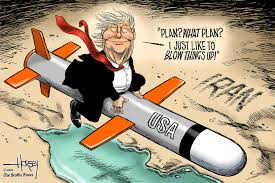 Trump donors are feeling this immediately. Trump voters will shortly see the impact on their budgets and gas prices. I can’t say I feel sorry for any of them, but there’s not a person who won’t feel this one way or another. The Bulwark’s Andrew Egger examines Trump’s seeming confusion over his War.
What did the White House think it was getting into in Iran? A strike against Iran’s oppressive and fanatical regime, sure. A display of America’s awesome military might, definitely. But it’s become increasingly, painfully clear: They didn’t think there was going to be a war.
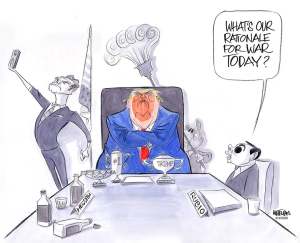
The Trump administration developed no real theory of the objectives of the Iran war, because they didn’t think there was going to be a war. Instead, the administration has backfilled a dizzying array of post-hoc goals for the strikes against Iran. Judd Legum counts seventeen different rationales offered by many different officials, from the president’s “feeling, based on fact” that Iran was about to strike the United Statesto a desire to free the Iranian people to a need to destroy a nuclear program the White House had claimed was already “obliterated.”
The Trump administration made no effort to get the American people on board with war, because they didn’t think there was going to be a war. A majority of the public is already opposed to war with Iran, and what support the war does have seems to be based on the questionable assumption that the conflict will be shortly resolved: 44 percent of Americans support the strikes so far, but only 12 percentwould be in favor of sending U.S. ground troops into the country. But the White House has made no broad effort to convince the public on a bipartisan basis that they should be prepared for a long-haul conflict.
They didn’t think there was going to be a war, and so the White House seemingly gave no thought to what the economic ramifications of war would be. After several days of strikes on Iran, President Trump seemed suddenly to realize last week that the ongoing conflict was going to be terrible for energy prices. He tried to slap a band-aid on the problem by announcing risk insurance and military escorts for all oil tankers through the Strait of Hormuz, but it wasn’t enough: Suddenly, oil prices went through the roof, and the White House was scrambling to contain the damage—rushing to reassure consumers that the price hikes would be temporary and even waiving some sanctions on Russian oil to try to ease pressures on global supply. “Short term oil prices, which will drop rapidly when the destruction of the Iran nuclear threat is over, is a very small price to pay for U.S.A, and World, Safety and Peace,” Trump posted on Truth Social yesterday. “ONLY FOOLS WOULD THINK DIFFERENTLY!”
They didn’t think there was going to be a war, and so the president assumed he’d be in charge of picking Iran’s next political leadership. This plan, admittedly, hit an unexpected snag early on: The initial round of strikes that took out Iran’s top leaders also killed a number of lower-ranking regime figures that the White House had identified as pragmatists who might be willing to negotiate. “The attack was so successful it knocked out most of the candidates,” Trump said a day after the strikes began. “It’s not going to be anybody that we were thinking of because they’re all dead. Second or third place is dead.” Still, Trump made it clear he expected to be involved in picking Iran’s next supreme leader, and absolutely ruled out Mojtaba Khamenei, the son of the slain ayatollah: “They are wasting their time . . . Khamenei’s son is unacceptable to me.” But this morning, Iran went ahead and proclaimed Mojtaba Khamenei their next supreme leader anyway.
Somehow, the president seems to remain so confident Iran will be buttoned up in no time that he’s already openly licking his chops over the next triumphant blitzkrieg. “Cuba is gonna fall pretty soon, by the way,” Trump told CNN Friday. “I’m going to put Marco over there and we’ll see how that works out. We’re really focused on this one right now.”
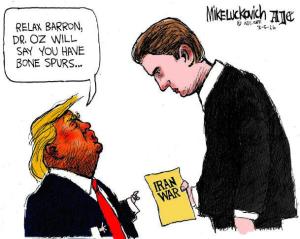 Judd LeGum at Popular Information specifies not the unknowables of the attack, but the rationale and plans for the future, which are blowing in the wind. “9 days in, the most basic question about the Iran war remains unanswered. In just over a week, Trump and top administration officials have given at least 17 different responses about why the war began.” Yup. We still don’t know why they did this.
On February 28, President Trump announced that “the United States military began major combat operations in Iran.” The war has claimed the lives of more than 1500 people, including about 1300 Iranians, dozens in neighboring countries, and six U.S. troops. The Pentagon has estimated the conflict is costing U.S. taxpayers about $1 billion per day — and that figure may be too low.
And yet, nine days into the war, Trump and his administration have failed to clearly answer the most fundamental question: Why did the war begin?
Instead, the Trump administration has offered a bewildering series of shifting, contradictory, and factually incorrect answers. In just over a week, Trump and top administration officials have given at least 17 different responses about why the war began:
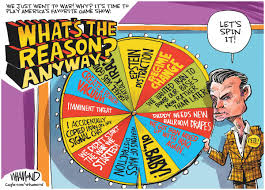 A brief description of each of those 17 responses is given in the article. You may read it at this fully gifted link. The New York Times reports on information from Iran’s new Supreme Leader. “Live Updates: Oil Price Surge Rattles Markets; Iran’s Choice of Leader Signals Defiance. Stocks fell on fears of the Iran war’s effects on energy prices. Top clerics selected Mojtaba Khamenei as Iran’s supreme leader, despite President Trump’s warning that he was “unacceptable.”
U.S. stocks fell at the start of trading on Monday, after markets in Asia and Europe tumbled, as a spike in oil prices reflected global fears of a prolonged U.S.-Israeli war with Iran. Meanwhile, Iran projected defiance by naming a son of its slain supreme leader as his successor.
Oil prices briefly surged early Monday to almost $120 per barrel, their highest level since the Covid pandemic, as President Trump’s plans for the next steps in the war, let alone its endgame, remained unclear and Iran showed no sign of bowing to his demand for unconditional surrender.
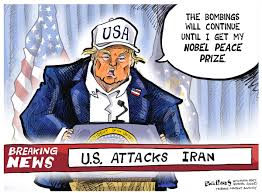 It still looks like the start of World War 3 to me. From the same link above.
Eleven countries have asked Ukraine for security support to help counter Shahed drones, according to President Volodymyr Zelenskyy. He said in a social media post that the requests have come from countries neighboring Iran, European nations and the United States — and that some “have already been met with concrete decisions and specific support.”
He did not provide further details, though Zelensky earlier told The New York Times that Ukraine sent interceptor drones and a team of experts to protect U.S. military bases in Jordan.
“There is clear interest in Ukraine’s experience in protecting lives, relevant interceptors, electronic warfare systems, and training,” Zelensky added in his post on social media. “Ukraine is ready to respond positively to requests from those who help us protect the lives of Ukrainians and the independence of Ukraine.
This headline is one that worries me. It’s from the Times of Israel. “Trump to Times of Israel: It’ll be a ‘mutual’ decision with Netanyahu regarding when Iran war ends. US president, in phone interview, clarifies that he’ll make final call to end operation ‘at right time’; says he and PM ‘worked together’ against Islamic Republic: ‘We’ve destroyed a country that would have destroyed Israel’.”
US President Donald Trump told The Times of Israel on Sunday that a decision on when to end the war with Iran will be a “mutual” one that he’ll make together with Prime Minister Benjamin Netanyahu.
Trump also asserted in the brief telephone interview that the Islamic Republic would have destroyed Israel if he and Netanyahu had not been around. “Iran was going to destroy Israel and everything else around it… We’ve worked together. We’ve destroyed a country that wanted to destroy Israel.”
The US president was asked whether he alone would decide when the war with Iran ends or if Netanyahu would also have a say.
“I think it’s mutual… a little bit. We’ve been talking. I’ll make a decision at the right time, but everything’s going to be taken into account,” he responded, indicating that while Netanyahu will have input, the US president will have the final say.
Asked whether Israel could continue the war against Iran even after the US decides to halt its strikes, Trump declined to entertain the theoretical possibility before adding: “I don’t think it’s going to be necessary.”
So, it’s still two megalomaniacs avoiding prison sentences running the show. Don’t you feel much better now?
What’s on your Reading, Action, and Blogging list today?

 peej
peej Carissa
 bostonboomer
 dakinikat
 ecocatwoman
 mablue2
 Mama Lopez
 peggysue22
 quixote
 skydancingguestblogger
 Mona (aka Wonk the Vote)



 Sky Dancing
Recent Comments