
Live Blog: Obama vs. Romney, Round 3, Foreign Policy Debate
Posted: October 22, 2012 Filed under: 2012 presidential campaign, abortion rights, Afghanistan, Barack Obama, Foreign Affairs, Libya, lobbyists, Mitt Romney, U.S. Economy, U.S. Military, U.S. Politics, War on Women, Women's Rights | Tags: third presidential debate 2012 121 Comments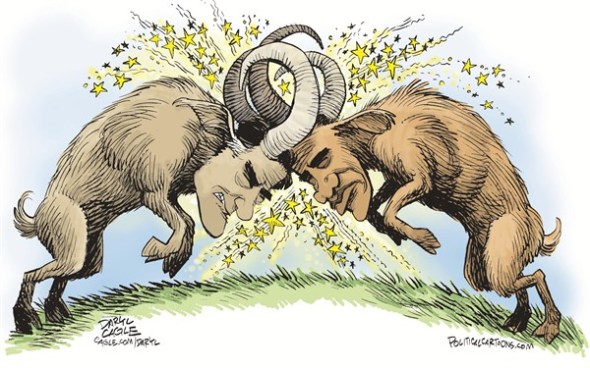
Tonight is the last presidential debate. I have no idea what’s going to happen. I don’t understand what’s happening with the polls, and I don’t get why so many people are ready to vote for a lying flim-flam man like Mitt Romney. All I can do is take this one day at a time until we get the results on November 7th or 8th.
For those of you who want to look at analysis, here are the latest posts from the two poll aggregators we’ve been following: Nate Silver and Sam Wang.
Here’s today’s outrage from the Romney campaign: Staying Classy
Ronna Romney is the ex-sister-in-law of Mitt Romney. She’s apparently remained close to the Romney family. She has a minor role in the Romney campaign in Florida and has recently appeared at campaign events in Michigan with her daughter.
Earlier this afternoon she posted these grotesque images of the mangled body of the late Ambassador Chris Stevens with the words “Obama killed him” surrounded by dripping blood.
You can see the screengrab at the TPM link.
And here’s a little comic relief: Mitt Romney blimp crash lands in Florida
A blimp displaying a Mitt Romney campaign ad crash landed in Davie, Fla. Sunday evening.
Davie police said that wind forced the the aircraft to land in a field around 7:10 p.m., and two people got out safely….
The Sun Sentinel reports that the airship was headed from Boca Raton, the site of Monday night’s debate, to North Perry Airport in Pembroke Pines. It featured a picture of the Republican candidate with the slogan “America Needs Romney.”
“We saw the blimp hovering over the house, and it was floating backwards; it looked like it was actually coming down,” local Teri Balter told NBC News. “I thought boy, Mitt Romney really wants us to vote for him.”
How will the media report the third debate? Probably the same way they reported the second debate.
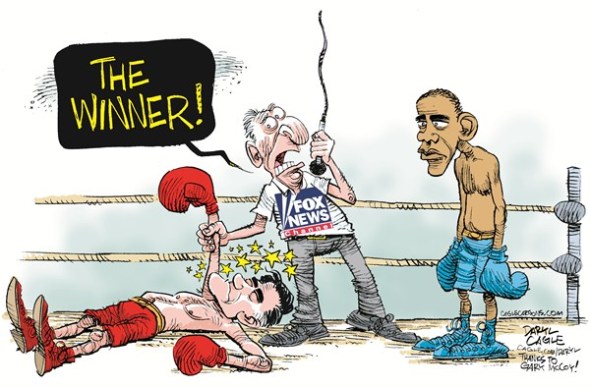
Which Mitt Romney will show up tonight?

It’s all coming down to stupid undecided voters.

I plan to watch the debate on-line and listen to MSNBC coverage on satellite radio. What are your plans? What do you expect to happen tonight?
We’ll use this post as a live blog until the comment thread gets too long, at which point I’ll post fresh thread and let you know to move up.
Let’s have fun watching–what do we have to lose at this point? And don’t forget to vote!!
Here’s some music to get us started: A Message to Republicans from Lesley Gore:
Zombies and Vultures and Pipelines, Oh My
Posted: February 5, 2012 Filed under: Domestic Policy, Environment, Environmental Protection, ethics, Gulf Oil Spill, health hazard, K street, legislation, lobbyists, Politics as Usual, Regulation, Republican politics, science, toxic waste, Water | Tags: Climate change, environmental problems, oil spills 6 CommentsThe zombies seem to be winning the war against the living. We have zombie banks, zombie politicians [think Rick Perry], zombie policy—free market fundamentalism preached as an untried economic theory.
And now zombie pipelines.
Just when you thought the Keystone XL controversy had been put to rest [at least temporarily], its zombie presence lunges forward, reanimated for all to see. Although I suspect supporters of this very bad idea are hoping the American public is not watching or if they are watching they will buy the swill on the non-existent benefits of a 1700-mile tar sands pipeline.
What am I talking about?
I found a disturbing inquiry [hattip to OEN] by Representative Henry Waxman to a Deborah Hohlt, who received $50,500 from the Great State of Indiana [that would be paid in state taxpayer monies] to lobby in DC on behalf of the TransCanada Keystone XL Pipeline. Indiana’s Governor Mitch Daniels provided the rebuttal to the President’s SOTU address, in which he referred to the Administration’s decision to ‘postpone’ the pipeline’s construction as an ‘extremist’ policy.
As you might remember the Republican chorus on this subject has been jobs, jobs, jobs. House Speaker Boehner has quoted 100,000 jobs at stake. TransCanada has been all over the map with job estimates, the last, most creative quote coming in at 250,000 jobs. Unfortunately, the numbers are at odds with the single independent analysis from Cornell Global Labor Institute, estimating the number at between 4000-6000 temporary jobs. The steel for the pipeline? Would be coming from India. The cry that the pipeline would reduce our reliance on foreign oil? The refined tar sands oil is contracted for export [80%] to South America and Europe.
The upsides are slim to none, considering the toxic, corrosive nature of tar sand oil, the sludge-like quality that requires pressure and heat to make a pipeline flow possible. That also increases the risk of a leak and an environmental disaster. Anyone who may question the heightened risk should check out the total mess in Michigan when over 800,000 gallons of tar sand oil spilled and contaminated 40 miles of the  Kalamazoo River and surrounding properties.
And the reclamation? These corporations should hang their heads in utter shame. If you want to be thoroughly disgusted check out the You Tube clip I provided in an earlier post.
But here’s the really curious thing. The pipeline won’t be running through Indiana. The pipeline will not be running close to Indiana’s borders. No Indiana facilitities will have access to the pipeline. In fact, it appears that Indiana does not stand to be impacted in anyway by the Keystone pipeline and yet Governor Daniels felt compelled to call President Obama an extremist for postponing the pipeline’s construction. He was also willing to pay a $50,000+ [in state taxpayer money] to lobby for the Great State of Indiana in defense of the pipeline.
More curious still? TransCanada has stated that the pipeline will ‘increase’ oil prices for Indiana and other Midwestern residents because the area is ‘oversupplied.’ Keystone’s successful construction [this is stated in TransCanada’s application] will ensure higher prices for Canadian crude. By independent analysis costs will increase $6.55 per barrel in the Midwest and $3 per barrel everywhere else. The Indiana Petroleum Council thinks this is a swell idea.
Which begs the question: Who does Governor Daniels work for? His constituents or the oil companies?
So, it should not be any great surprise that a Senate group–laughably-called bi-partisan because it includes 1 Democrat, Joe Manchin from W. Va.–is reintroducing the Keystone proposal, pushing for immediate construction with or without the Administration’s approval. The Senate committee is invoking the Commerce Clause of the Constitution, which says Congress should have the power:
To regulate Commerce with foreign Nations, and among the several States, and with the Indian Tribes.
I love it when the Republicans start waving the Constitution. It’s a clear signal they’re up to no good. Did I mention that Koch Industries stands to make a killing on this project?
While reading Representative Waxman’s letter, I recalled something I’d read in Greg Palast’s book Vultures’ Picnic and found an accompanying and equally disturbing text online here and here. To quote Palast:
Reserves are the measure of oil recoverable at a certain price. Raise the price, raise the reserve. Cut the price and the amount of oil in the ground drops. In other words, it’s a fool’s errand to measure the “amount of oil we have left.” It depends on the price.
Specifically, oil companies and oil-related financiers are not interested in expanding oil supplies to the world, particularly cheap oil supplies  [because the days of cheap oil are over]. They’re interested in feeding the hunger for oil and controlling the price around the world with an iron fist. The higher, the better. The environment—air, water, soil–is not the concern. Our health or that of our children is not the concern. The bottom line—profit and power—is all that matters. If nations collapse? The Vultures are waiting to feast on the bones.
Sound harsh? It shouldn’t. Zombies and vultures are kissing cousins. They’re coming ‘round for a friendly visit. Again.
Greedy Bastards
Posted: January 26, 2012 Filed under: Banksters, commercial banking, Corporate Crime, corruption, financial institutions, Global Financial Crisis, investment banking, lobbyists, U.S. Economy, U.S. Politics | Tags: Dylan Ratigan, extractionism vs capitalism, Greedy Bastards 15 CommentsNo, I am not making an editorial comment.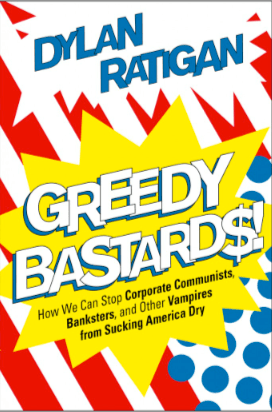
But after nonstop blathering served up by the GOP, only to be followed by President Obama’s Teddy Roosevelt impersonation [although I have to admit—the State of the Union was a surprisingly good speech], I thought a moment of palate cleansing might be in order. In this case Dylan Ratigan offers up the sorbet.
Ratigan is someone willing to call out the shysters, the casino players and shakedown artists, including their political handmaidens for what they truly are, and ‘Greedy Bastards’ is the title of his newly released book. The author’s name may ring a bell because Dylan Ratigan has a public platform on MSNBC, an hour-long show Monday through Friday. The program airs at 4:00 pm, EST, in my neck of the woods.
Ratigan’s slant focuses on the collision of worlds, that of finance and politics, how the incestuous relationship is literally squeezing the life out of the United States. His take is not an indictment of capitalism. Rather it is an indictment of what is posing as capitalism, a system he refers to as ‘extractionism.’
Ratigan is not a newcomer or a pundit simply reading a script. He worked the financial beat with Bloomberg News, serving as Global Managing Editor to Corporate Finance until 2003. He’s also the former anchor and co-creator of CNBC’s Fast Money. He has launched and anchored a number of financially-related broadcasts over the years but decided to leave Fast Money after the 2008 financial meltdown. Ratigan has publicly stated that he was personally disgusted by the Wall Street banking sector’s shakedown of the American public. The Dylan Ratigan Show was launched to provide discussion and analysis of the financial/government intersection, a system that has acquiesced to the wanton theft of the Nation’s wealth and resources by . . . Greedy Bastards, of course.
Though the show has been on air for three years, Ratigan has admitted that his voice was finally heard after an infamous meltdown last August. It was an on-air rant that would have made Patty Chayefesky proud, a Howard Beale moment.
That woke people up! It also led to Ratigan’s Get the Money Out [of politics] Movement, working towards a Constitutional Amendment to remove the corrosive element of money in the political sphere. And then, there’s the book.
One thing I liked about Ratigan’s approach is that instead of pointing out one segment of the population for public pillorying, his title basically refers to a state of mind and the all too frequent way of doing business and politics in the 21st century.
For instance, in the case of capitalism, Ratigan uses the example of venture capital, a subject that has come up in reference to Romney’s connection to Bain & Company, specifically Bain Capital. From Chapter 1:
If I start a venture capital firm that lends out money to drug researchers trying to find new cures for disease, and I get rich doing it, then I made my money by investing in the productive future of the country. I used my money in a way that facilitated scientific innovation and a cure. I’m what the director of the Havas Media Lab Umair Haque a ‘capitalist who makes.’ But instead, if I take the same money and use it to lobby for changes in government regulation—changes that help me trick a union into investing its retirement savings in flawed investments so that I can collect the commissions—then I may move as many dollars into my bank account as someone who funded cures for diseases, but I haven’t made anything. I’m a ‘capitalist who takes,’ exploiting my power to influence the government for my own private gain, no matter the harm to anyone else. I’m a greedy bastard.
The latter example, taking money from others without providing anything of value is, according to Ratigan, the opposite of capitalism. An extractionist system loses increasing value over time until there’s nothing left. Call it the vampire or vulture model. A system based on the extractionist principle, provides no incentive for people to make good deals, where both sides benefit. Instead, it rewards those who take and give nothing in return.
Sound familiar?
Ratigan covers the areas that have pushed the extractionist model to the max: banking, education, healthcare, energy, trade negotiations and the unholy alliance of government and big money fueling the feeding frenzy of the Nation’s resources and our future. But unlike many gloom and doom tomes, Ratigan offers solutions and brings an optimism to the subject, namely that we have the ideas, the people and yes, even the money to solve what at times seems insolvable. He concludes in a rather convincing way that what is needed is a realignment between investment and the needs of capable, innovative people. If loans and investments offered the highest returns when they provided the highest value as opposed to simply taking the highest risk, then prevailing attitudes and business practices would shift and win/win deals would be created.
 Sound like pie in the sky? I don’t think so. Yes, it’s a matter of will, public pressure to exact the necessary changes but this realignment idea is possible by citing the goals first, and then targeting the resources to get there. Ratigan refers to this as hotspotting—zeroing in on the problem, determining what methodology provides the best results, and then aiming resources to match those needs.
Though some critics have dismissed this idea, it is very attuned to what Bill Clinton recently suggested in his Esquire interview about highlighting the successes and needs across the country, and then linking them, matching them up. Just another turn on the realignment idea:
. . . the two best things you could do are the infrastructure bank and a simple SBA-like loan guarantee for all building retrofits, where the contractor or the energy-service company guarantees the savings. So that allows the bank to loan money to let a school or a college or a hospital or a museum or a commercial building or factories for lease unencumbered by debt to loan it on terms that are longer, so you can pay it back only from your utility savings. You could create a million jobs doing that because of the home models that are out there now.
There are these two guys on Long Island who started a little home-repair deal. They got thirty-five employees now, and they’re — they can go in, tell you how much they’ll save you. There’s an operation in Nebraska that’s in and out in a day, and they’re averaging more than 20 percent savings, and conservative Republican Nebraska is the only state in the country that has 100 percent publicly owned power.
And,
You’ve got Orlando with those one hundred computer-simulation companies. They got into computer simulation because you have the Disney and Universal theme parks, and Electronic Arts’ video-games division. And the Pentagon and NASA desperately need simulation, for different reasons. So there you’ve got the University of Central Florida, the biggest unknown university in America, fifty-six thousand students, changing curriculum, at least once a year, if not more often, to make sure they’re meeting whatever their needs are, and they’re recruiting more and more professors to do this kind of research that will lead to technology transfers to the companies. You’ve got Pittsburgh actually becoming a real hotbed of nanotechnology research. You’ve got San Diego, where there are more Nobel-prize-winning scientists living than any other city in America. You’ve got the University of California San Diego and other schools there training people to do genomic work. Qualcomm is headquartered there, and there are now seven hundred other telecom companies there, and you’ve got a big private foundation investing in this as well as the government, and nobody knows who’s a Republican or who’s a Democrat, they’re just building this networking.
We have fabulously innovative, creative people working on all kinds of things. Our true wealth is in our people; our true value is . . . us.
Ratigan is now on a 30-million jobs tour showcasing business enterprises that are, in fact, answering a need, offering value to their communities, providing jobs and in the best capitalist tradition—making a profit.
The endnote is that the country hasn’t lost its edge. We’ve lost the path that works, the one that values quality and integrity. Greedy Bastards will always exist, those hoping to make a quick buck [or trillions of bucks] off the backs of others. They have no shame. The goal is to make them and their thievery the exception, not the rule.
Btw, Ratigan’s book is highly readable, written for the layperson. No economic degrees required. If you’ve been following the financial blowout and/or Ratigan’s show, this will be a fast review. If you’re just starting to pay attention, consider the book a primer—what the country underwent and where we need to go. The sooner, the better. Ratigan encourages us to reclaim our voice, demanding that our people and country come first.
It’s a worthy message. Read the book. Get the word out.
Forget “frothy”, Slimy is a better adjective
Posted: January 6, 2012 Filed under: 2012 elections, 2012 presidential campaign, lobbyists, Republican politics | Tags: hypocritical, K Street project, Lobbyists, Santorum, sick 31 CommentsI really never thought we’d have to front page Rick Santorum. He’s a two term senator from Pennsylvania with more corruption and crazy problems than Newt Gingrich and Michelle 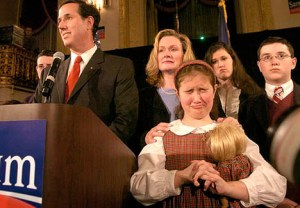 Bachmann combined. Yesterday, TV news was full of reporters following the man around New Hampshire. I spent a bit of time on twitter trying to get them to ask relevant questions like “Do you regret your association with Jack Abramhoff?” It took a group of college students to get “man on dog”, sex-obsessed Santorum to get his freak on. He was heartily booed for suggesting gay marriage would lead to polygamy. Yes, Santorum’s culture war is probably his hallmark. That and his battle with Google and the man on dog sex attribution. Cannonfire has a piece up today on Santorum’s really weird brand of Catholicism. (Think Mel Gibson.) However, what really has me jumping up and down is the level of corruption that characterized Santorum’s years in the senate.
Santorum’s tenure includes a fake charity, a fake leadership PAC and a level of man on lobbyist coziness that would make Tom Delay blush. It actually makes me wonder why Santorum isn’t sharing a jail cell with Delay or wasn’t taken down during the Abramhoff scandal. When you Google Santorum, the results should read a slimy mixture of corruption and sanctimonious blather. Philly News Writer Will Bunch has a laundry list of Santorum’s shocking abuse of public office. It’s enough to make me mourn for the loss of Michelle Bachmann. She was just plain crazy. Santorum takes corruption to a whole ‘nother level. These are only Bunch’s top 5.
1. This compassionate Christian conservative founded a charity that was actually a bit of a scam. In 2001, following up on a faith-based urban charity initiative around the 2000 GOP convention in Philadelphia, Santorum launched a charitable foundation called the Operation Good Neighbor Foundation. While in its first few years the charity cut checks to community groups for $474,000, Operation Good Neighbor Foundation had actually raised more than $1 million, from donors who overlapped with Santorum’s political fund raising. Where did the majority of the charity’s money go? In salary and consulting fees to a network of politically connected lobbyists, aides and fundraisers, including rent and office payments to Santorum’s finance director Rob Bickhart, later finance chair of the Republican National Committee. When I reported on Santorum’s charity for The American Prospect in 2006, experts told me a responsible charity doles out at least 75 percent of its income in grants, and they were shocked to learn the figure for Operation Good Neighbor Fund was less than 36 percent. The charity – which didn’t register with the state of Pennsylvania as required under the law — was finally disbanded in 2007.
2. Likewise, a so-called “leadership PAC” created by Santorum that was supposed to fund other Republicans instead seemed to mostly pay for the lifestyle of Santorum and those around him. My investigation of the America’s Foundation PAC showed that only 18 percent of its money went to fund political candidates, less — and typically far less — than any other “leadership PACs.” What America’s Foundation did spend a lot on with what looked like everyday expenses, including 66 trips to the Starbucks in Santorum’s then hometown of Leesburg, Va., multiple fast-food outings and expenditures at Wal-Mart, Target and Giant supermarkets. Campaign finance experts said the PAC’s expenses – paid for by donations from wealthy businessmen and lobbyists – were “unconventional,” at best and arguably not legal. Santorum also funded his large Leesburg “McMansion” with a $500,000 mortgage from a private bank run by a major campaign donor, in a program that was only supposed to be open to high-wealth investment clients in the trust, which Santorum was not, and closed to the general public.
3. Santorum was never above mingling his cultural crusades with the everyday work of raising political cash. In 2005, Santorum made headlines – not all positive – for visiting the deathbed of Terri Schiavo, the woman at the center of a national right-to-die controversy.What my Philadelphia Daily News colleague John Baer later exposed was that the real reason he was in the Tampa, Fla., area was to collect money at a $250,000 fundraiser organized by executives of Outback Steakhouses, a company that shared Santorum’s passion for a low minimum wage for waitresses and other rank-and-file workers. Santorum’s efforts were also aided by his unusual mode of travel: Wal-Mart’s corporate jet. And he canceled a public meeting on Social Security reform “out of respect for the Schiavo family” even as the closed fundraisers went on.
4. Santorum didn’t seem to be against government waste when it came to his family. During his years in the Senate, Santorum raised his family in northern Virginia and rarely if ever seemed to use the small house that he claimed as his legal residence, in a blue-collar Pittsburgh suburb called Penn Hills. So Pennsylvania voters were shocked when they found out the Penn Hills School District had paid out $72,000 for the home cyberschooling of five of Santorum’s kids, hundreds of miles away in a different state. The cash=strapped district was unsuccessful in its efforts to get any of its money back from Santorum.
5. Washington’s lobbyist culture — Santorum was soaking in it. The ex-Pennsylvania senator spent much of his final years in government trying to downplay and defend his involvement in the so-called “K Street Project,” an effort created by GOP uber-lobbyist and tax-cutting fanatic Grover Norquist and future felon and House majority whip Tom DeLay. By all accounts, Santorum was the Senate’s “point man” on the K Street Project and he met with Norquist — at least occasionally and perhaps frequently — to discuss the effort to sure that Republicans were landing well-paying jobs in lobbying firms that were seeking to then access and influence other Republicans.
Marcus Stern and Kristina Cooke at Reuters remind us that Santorum was knee deep in the excesses of the K Street Project. What I wonder is if this information will come out soon enough to stop Santorum’s momentum? Santorum has so many questionable ties to lobbyists that it’s hard to come away from any reading of articles about him not feeling the need for a shower. It’s not just his senatorial past that is in question, however. This particular item is from his current antics as a lobbyist. Santorum has made his millions in the last few years on deals like this.
For example, his million-dollar-plus 2010 income included payments from a lobbying firm, an energy company engaged in controversial “hydrofracking” and a hospital conglomerate that was sued for allegedly defrauding the federal government.
Again, his past is even more fraught with behavior that looks a lot like being a senator for hire. So much for hyper-morality.
But the rubric “K Street Project” came to encompass the entire climate of cozy cooperation between Republicans and lobbyists.
When Republicans won control of the House in 1994, House Majority Leader Tom Delay and others organized regular meetings with lobbyists that reviewed K Street job openings with an eye toward filling them with party loyalists, who would in turn steer support and donations to the members.
By 2001, Sen. Santorum was also holding one-hour breakfast meetings with lobbyists on alternating Tuesday mornings at 8:30 a.m.
In 2004 he denied being involved with Norquist’s effort to staff K Street. But Santorum convened Senate Republicans to discuss the appointment of Democrat Dan Glickman as head the Motion Picture Association, according to Roll Call, a newspaper covering Capitol Hill.
“Yeah, we had a meeting, and yeah, we talked about making sure that we have fair representation on K Street. I admit that I pay attention to who is hiring, and I think it’s important for leadership to pay attention,” he told the paper at the time.
In 2006, as the influence-peddling scandal that sent lobbyist Jack Abramoff to jail unfolded, Santorum said he was ending the breakfasts in his conference room. However, his staff confirmed to Washington newspapers that they resumed almost immediately, on the same day and at the same time, at a location off the Capitol grounds.
Citizens for Responsibility and Ethics in Washington named Santorum among three “most corrupt” senators in 2005 and 2006. The 2006 report accuses Santorum of “using his position as a member of Congress to financially benefit those who have made contributions to his campaign committee and political action committee.”
Despite a number of denials, there is evidence that Santorum and Abramhoff had met on the infamous Marianas Islands scam. I wrote about this last March. It is a horrifying example of modern slavery. The story includes all kinds of immoralities like forced prostitution and abortions of young girls that were supposedly hired to work in garment factories in this US commonwealth territory that is not covered by US labor laws. The Delay Republicans held the associate companies up as beacons of capitalism. Abramhoff says that he didn’t have any associations with Santorum but Roll Call and other sources show quite the opposite story.
Santorum definitely left the Senate through the revolving door.
Within months of leaving the Senate, Mr. Santorum joined the board of Universal Health Services, where he collected $395,000 in director’s fees and stock options before resigning last year. He also became a consultant to Consol Energy, after years of advocating drilling and extraction policies helpful to the company, a Pennsylvania gas and coal producer. And he consulted for the American Continental Group, a lobbying firm whose clients won earmarks he sponsored.
Its hard to reconcile this level of prostitution with a morality crusader, isn’t it? But, there it is and if you goggle Santorum’s name and add lobbyist, corruption, K Street or any other number of combinations that go beyond the frothy mix definition, you’ll see the vast documentation. It’s hard to imagine the tea party diehards getting behind a man with this kind of background. Even Bill O’Reilly took issue with Santorum’s views on the rights of states to outlaw contraception with Santorum’s odd explanation that contraception put things out of the proper ‘order’. Every thing about Santorum screams odd and narcissistic.
There’s been a reason that this man has been scraping along the bottom of the Republican presidential wannabe heap for some time. My only hope is that when he is sent packing, that nearly every politician will want to avoid the stench and that will put an end to Santorum’s lucrative lobbying career as well. In the mean time, get ready for a few weeks of the puppy dog press following Santorum around New Hampshire and South Carolina asking banal questions when they should be shouting “show us your ill-got money”. This guy may have had a coal miner grandfather, but he’s a total gold digger now. What’s worse? One man and one dog or one Senator and an army of lobbyists? Evangelical Republicans, you’ve been Rick-Rolled!
I apologize to any earth worms I may have unintentionally insulted by the title of this thread.
Friday Reads
Posted: November 18, 2011 Filed under: FBI raids, Federal Budget and Budget deficit, income inequality, investment banking, lobbyists, morning reads | Tags: Budget Deficit, buying congress, Jack Abrahamoff, Lobbyists, low corporate taxes, reporting corporate taxes, supercommittee, who are the 1 percent? 24 Comments Good Morning!
Republicans are asking Obama to try to ‘break the log jam” in the subcommittee. I’m not surprised given the President’s known ability to give everything away at the bargaining table. I’m also sure it’s because they can get their lousy policies through and then when they backfire and people get mad, they’ll blame Obama.
Republicans are calling for President Obama to jump into the deficit-reduction talks gripping Washington, reflecting the widespread view that the congressional supercommittee is now headed for a failure.
Lawmakers and congressional aides familiar with the deliberations say the talks have reached a hard impasse, with Republicans locked in an internal struggle over whether to agree to higher tax hikes to cut a deal.
“It’s hard to see us getting a deal unless he comes in at the last minute,” Sen. Dan Coats (R-Ind.) said of Obama, who is on a nine-day trip to the Pacific and not scheduled to return to Washington until Sunday.“We’re in the two-minute drill and closing in on a ‘Hail Mary’ and the quarterback is on the sidelines.
“Unless the leadership, including the president, steps in and saves this thing, I think the consensus is, in terms of coming up with a credible package, all is lost,” Coats added.
There was a surprising lack of urgency on Capitol Hill Thursday as members of the supercommittee talked past one another. Some lawmakers not on the super-panel shrugged at the inaction, saying they were planning to go home for the Thanksgiving recess and noting they don’t have to vote on any deal until next month. Meanwhile, House and Senate leaders indicated they are in no rush to jump in and broker an agreement.
E.J. Dionne, Jr. at Truth Dig says the easiest way to cut the deficit is to do nothing. His thinking reflects some of the things that I’ve been supporting. It includes letting the Bush Ta Cuts expire. I hate to see the triggers on some things, but getting the Pentagon budget trimmed down would be a positive as far as I’m concerned.
Democrats have put huge spending cuts on the table—and keep offering more and more and more. All the Democrats ask in return is that the cuts be balanced by some revenue.
By rejecting their offers, Republicans induce Democrats who are anxious for some deal—any deal—to keep coming their way. The Republican approach is wrong and irresponsible but brilliant as a negotiating strategy. As my Washington Post colleague Ezra Klein wrote this week: “Over the past year, Republicans have learned something important about negotiating budget deals with Democrats: If you don’t like their offer, just wait a couple of months.”
Finally, the Republicans decided they needed to look slightly flexible. So they came up with $300 billion in supposed revenue from a promised tax reform in a plan that also included a proposal to slash tax rates for the rich. There is a lot more tax cutting here than revenue. Rep. Jeb Hensarling, R-Texas, co-chairman of the super committee, who said on Tuesday that this was the GOP’s final offer, reversed field Wednesday afternoon and declared himself open to other ideas.
Even Democrats inclined to capitulate know how shameful agreeing to such a deal would be. And mainstream, centrist deficit hawks should be grateful if a deal on such terms is killed. What Republicans want to do in effect is to make at least 90 percent of the Bush tax cuts permanent. This would only make deficit reduction even harder in the future.
That’s where the do-nothing strategy comes in. Championed early this year in The New Republic by New York Magazine writer Jonathan Chait, it looks even better now because of the spending cuts scheduled to go through if the super committee doesn’t act.
Jack Ambramoff is sure biting the hands that used to feed him. He’s written an article for Bloomberg and calls congress criterz “Willing Vassals” that are up for anything as long as they can cash in. Now that he can no longer make a profit from the game, he’s got some suggestions to end it.
There is only one cure for this disease: a lifetime ban on members and staff lobbying Congress or associating in any way with for-profit lobbying efforts. That seems draconian, no doubt. The current law provides a cooling off period for members and staff when joining K Street. The problem is that the cooling off period is a joke.
Here’s how it works. “Senator Smith” leaves Capitol Hill and joins the “Samson Lobbying Firm.” He can’t lobby the Senate for two years. But, he can make contact with his former colleagues. He can call them and introduce them to his new lobbying partners, stressing that although he cannot lobby, they can. His former colleagues get the joke, but the joke’s on us.
Because the vast majority of lobbyists start on the Hill, this employment advantage is widely exploited. It cannot be slowed with a cooling off period. These folks are human beings, not machines — and human beings are susceptible to corruption and bribery. I should know: I was knee-deep in both. Eliminating the revolving door between Congress and K Street is not the only reform we need to eliminate corruption in our political system. But unless we sever the link between serving the public and cashing in, no other reform will matter.
That’s easier said then done considering the foxes write the rules about how they can behave in the coop. One thing they have managed to do is arrange to avoid taxes. Check out the nifty chart from Felix Salmon at Reuters. It graphs corporate taxes as a percentage of corporate profits. Can you say magically disappear?
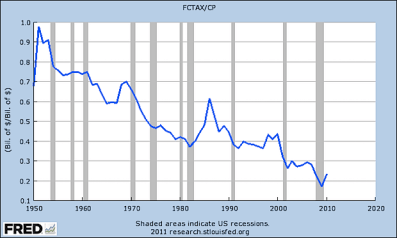
Once upon a time, the corporate income tax generated a significant share of tax revenues; now, it’s bumping along in the 2%-of-GDP range. Yes, the marginal rate of corporate income tax is high, at 35%. But US companies are extremely good at not paying that.
But at least we know the aggregate amount that corporations pay in taxes. What we don’t know — because they won’t say, and no one’s forcing them to say — is how much any given public company pays.
Follow the article to this link to CNN Money that shows you why reporting requirements allow corporations to hide their true tax positions.
During the past few months I’ve repeatedly asked three big companies in the tax-wars cross hairs — GE (GE), Verizon (VZ), and Exxon Mobil (XOM) — to voluntarily disclose information that would refute allegations that they incurred no U.S. federal income tax for 2010. All have refused, saying they won’t disclose anything not legally required. They still manage to complain about the allegations, however. I suspect that if I called the rest of the Fortune 500, I’d get 497 similar responses.
As a society, we need the “taxes incurred” information to inform our current tax debate. Investors, too, would benefit; knowing the tax that companies actually incur would be a useful analytical tool.
The solution, as I’ve said before, is for the Financial Accounting Standards Board to require companies to disclose information from their tax returns for the most recent available year and the nine years before that. This information, from lines 31 and 32 of their returns, would take at most one person-hour a year per company to provide. Adding a 17th tax metric to the 16 already available hardly seems like an invasion of corporate privacy.
Here’s an interesting read in the New York Review of Books by Jeff Madrick entitled “America’s New Robber Barons”.
So it’s worth knowing who is in that group of very rich with runaway incomes. Several news reports in recent weeks have cited a seminal 2010 study that uses IRS tax returns to find out who belongs to the top 0.1 percent. The authors deserve mention because they are often left out when their results are cited: Jon Bakija of Williams College, Adam Cole of the US Treasury, and Bradley Heim of Indiana University. This was not a Treasury study, however, but a private if scholarly one.
One key finding of the study is that three out of five of those in the top 0.1 percent of tax filers are executives or managers of financial and non-financial companies. Overall, more are from non-financial companies. Does this partly exonerate Wall Street, suggesting it is really Main Street where the problem lies?
In fact Bakija, Cole and Heim’s analysis shows the opposite: it turns out that much of the increase in wealth of non-financial executives was also tied to the rise in stock prices. Keeping in mind that stocks options appear as wages in the data, it seems Wall Street itself was often a main source of income growth for “non-financial” managers as well. (Lawyers were another large category of tax payers in the top 0.1 percent, and though there is not direct data for this, one can fairly assume that many of those in corporate firms made a lot of money from the booming business on Wall Street.)
Next, think about how these executives managed their businesses. If they wanted a big pay check they had to orient their strategies to push up their stock prices—that is, often to appeal to the financial fads and fashions of the day. These strategies typically have included cutting labor costs and R&D in order to boost short-term profits. This delighted their advisers on the Street. Stock investors soon loved nothing better than consistent increases in quarterly profits, and not coincidentally, stock options accounted for an ever-growing proportion of executive pay over the past thirty years. We used to say once that Wall Street worked for business, but over the past thirty years business has come to work for Wall Street.
It is just as interesting to explore the factors that the authors found out probably did not cause the surge at the top. Economists typically posit sophisticated technologies (often related to digitalization) as a source of growing inequality: because these technologies require better educated and smarter workers, those who have mastered them are rewarded handsomely. But there was no surge at the very top in other nations like Japan or in Western Europe, which also adopted the same technologies.
Similarly, some have argued that globalization led to higher incomes at the top because skilled workers can sell themselves globally at ever higher salaries. Again, however, such skilled workers have not seen a surge at the very top in Europe or Japan.
One reason for the discrepancy between the US and other countries is that boards of directors in the US are especially willing to give their CEOs and other high level executives big raises and generous stock options. Lucian Bebchuk of Harvard has done a lot of research on this so-called “governance” issue. Meantime, as Bebchuk’s work shows, shareholder influence over executive compensation is far too weak. And there is also the issue of culture itself. America—with its admiration for the self-made man—tolerates high remuneration for the men and women at the top and lower wages in the middle and the bottom. Culture likely matters.
So, that’s a few things to get you started this morning. What’s on your reading and blogging list today?

 peej
peej Carissa
 bostonboomer
 dakinikat
 ecocatwoman
 mablue2
 Mama Lopez
 peggysue22
 quixote
 skydancingguestblogger
 Mona (aka Wonk the Vote)



 Sky Dancing
Recent Comments