I’m guessing Dakinikat had another rough night at work last night. She will probably put up a post later this afternoon.
For now, I thought I’d post an open thread to celebrate a very important birthday. Our beloved JJ turned one year older today, but I’m not going to ask her the number. I just know she’s much younger than I am.
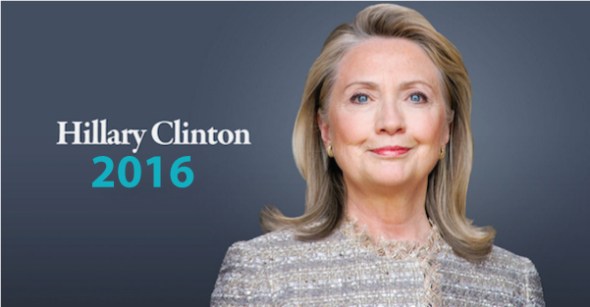
The former secretary of state is scheduled to declare her second run for president on Twitter at noon eastern time on Sunday, the source told the Guardian, followed by a video and email announcement, then a series of conference calls mapping out a blitzkrieg tour beginning in Iowa and looking ahead to more early primary states.
Clinton’s spokesman, Nick Merrill, did not respond to multiple requests for comment on the contours of Clinton’s campaign kickoff schedule. Another source close to the Clinton campaign confirmed Clinton would be in Iowa in the coming days….
Clinton has been quietly building a ground operation in Iowa, with a number of staff hires in Iowa including Matt Paul, a longtime aide to secretary of agriculture Tom Vilsack, to run Clinton’s operation, as well as veteran Iowa operative Brenda Kole as political director and DNC deputy communications director Lily Adams.
It’s the top story on Memeorandum and Google News this afternoon. We’ll have to brace ourselves for the negativity coming from the media, but at least we know for sure now that she’s running. More links:
Hillary Clinton is planning to launch her presidential candidacy on Sunday through a video message on social media, a person close to her campaign-in-waiting tells CNN, followed immediately by traveling to early-voting states of Iowa and New Hampshire to start making her case to voters….
Clinton has already filmed her campaign video, a person close to the campaign said, which outlines the central themes of her second bid for the White House. The message is intended to send a signal to Democrats that she intends to aggressively fight for the party’s presidential nomination.
A new epilogue of her book, “Hard Choices,” an excerpt of which was released Friday to the Huffington Post, offers a glimpse into why she is embarking on another presidential campaign. She writes about her new granddaughter, Charlotte, and calls for equal opportunity for her generation.
“Becoming a grandmother has made me think deeply about the responsibility we all share as stewards of the world we inherit and will one day pass on,” Clinton, 68, writes in the epilogue. “Rather than make me want to slow down, it has spurred me to speed up.”
The decision will sweep aside more than a year of speculation about her political aspirations and allow her to start making her case to voters. Advisers say she knows that Democratic activists are not interested in a coronation and she intends to campaign as though she has a tough primary challenge.
Central to Clinton’s second presidential run will be reintroducing the former first lady — on her own terms — to the American people. Democrats close to Clinton have started to call her the most unknown famous person in the world. Their argument is that people know of Clinton — she has near 100% name recognition in most polls — but they don’t know her story.
That sounds interesting.
Of course The New York Times is already ragging on Hillary. You can go read it if you want, but I’m trying to stay positive just for today. Here’s Laura Clausen at DailyKos on the Times story.
What is it about Hillary Clinton that makes political reporters show their stupid side? As Clinton prepares to announce a presidential run on Sunday, the New York Times‘ Amy Chozick and Maggie Haberman step up with the kind of coverage we can expect for the next 19 months:
Many factors played into the timing of Mrs. Clinton’s announcement. Senator Marco Rubio of Florida, whom Mrs. Clinton’s advisers are watching closely as a potential opponent, staked a claim on Monday as his announcement date. Mrs. Clinton’s announcement on Sunday will certainly draw attention from Mr. Rubio’s entry into the race and could well eclipse it.And while the move could invite criticism as unsportsmanlike, her campaign is betting that Democrats will applaud the show of force against a Republican. (Others involved insisted the date was selected before Mr. Rubio scheduled his event, but said that the juxtaposition was an added bonus.)
Unsportsmanlike? Trust a woman—or a Clinton—to hit below the belt, I guess. Although let’s say Clinton did look at Rubio and think “Him. He, of all the Republicans, is the one whose announcement I need to bigfoot. I can let Rand Paul and Ted Cruz announce without interference, and I don’t need to wait for Scott Walker or Jeb Bush. No, Rubio is the guy I must mess with.” Even if she said that, we’re talking less about a dirty hit that could injure someone or at least leave him cupping his balls and gasping for the breath he needs to scream and more about, say, beating him to the car door after he called shotgun.
There could be a Republican presidential announcement a week for months, but Clinton is supposed to avoid all of them lest she appear unsportsmanlike?
Clinton plans to launch her campaign via social media and with a video on Sunday articulating her rationale for seeking the White House. She’ll then travel to the first-in-the-nation caucus state of Iowa early next week for campaign events, these people said. She is expected to hold mostly small discussion events with voters designed to help the former secretary of state connect with ordinary Americans and listen to their concerns, forgoing the large rallies and traditional announcement speeches of some of her Republican rivals.
Behind the scenes, meanwhile, Clinton’s fundraising machine is revving up. Her top bundlers are plotting aggressive outreach to thousands of Democratic donors over the weekend and into next week urging them to immediately send checks and make donations online as soon as the Clinton campaign’s Web site goes live.
Democratic strategists, advisers and fundraisers described Clinton’s plans only on the condition of anonymity because she and her team have not yet finalized all aspects of her campaign rollout. Her official spokespeople declined to comment.
Hillary Clinton will announce her presidential campaign this Sunday, sources in the Clinton operation tell The Daily Beast.
After that, the nascent campaign will embark on a fundraising push that the Clinton camp says will dwarf anything seen in the history of presidential politics.
“They are going to raise in one week what some Republican presidential candidates are going to raise the entire cycle,” said one Clinton aide.
On Saturday afternoon, Ready for Hillary, the super PAC that has been a Clinton campaign-in-waiting in the years since Clinton left the State Department, will host what is likely a final fundraising push at SouthwestNY, a sleek Tex-Mex restaurant steps from the rebuilt World Trade Center.
From then on, Ready for Hillary will encourage its 3.6 million supporters to give to Clinton’s real campaign while the super PAC quietly dissolves.
Of course the “liberals” and very concerned about Hillary and her insistence on running for President. I’d guess these are the same people who were screaming “Why won’t the witch just quit” back in 2008.
Hillary Clinton, who reportedly will announce her candidacy this weekend, is such a prohibitive favorite to win the Democratic presidential nomination that she more or less cleared the field simply by behaving like someone who was going to run. That’s as much a testament to her political talent as it is to her nominal association with the boom times of the late 1990s. But it’s also the source of genuine anxiety among liberals, who worry she’ll enter the general election rusty and untested unless someone formidable dares to challenge her in the primary.
This sounds like a reasonable point, until you apply the logic to all other major political races, where favored candidates labor tirelessly to avoid primary campaigns, whenever possible. No losing Senate candidate has ever looked back and wished he’d endured a primary to loosen him up, and no winning Senate candidate ever has ever attributed his victory to the months he spent doing battle with members of his own party. Senate Republicans attribute the two recent election cycles they spent in the minority to undisciplined activists backing primary challengers, and attribute their recent victory to hobbling those activists.
In Hillary Clinton’s case, though, there’s still a good argument that the Democratic Party could use a contested primary this cycle: not to toughen Clinton’s calluses, but to build some redundancy into the presidential campaign. It may even be the case that some of these Democrats with rattled nerves are less anxious about Clinton’s prowess against Republicans than about the fact that all of the party’s hopes now rest on her shoulders. Her campaign has become a single point of failure for Democratic politics. If she wins in 2016, she won’t ride into office with big congressional supermajorities poised to pass progressive legislation. But if she loses, it will be absolutely devastating for liberalism.
If you’re faithful to the odds, then most of this anxiety is misplaced. Clinton may have slipped in the polls by virtue of an email scandal and her return to the partisan trenches more generally. But she’s still more popular and better known than all of the Republicans she might face in the general, her name evokes economic prosperity, rather than global financial calamity, the economy is growing right now, and Democrats enjoy structural advantages in presidential elections, generally.
Maybe these unnamed very concerned Democrats should just get over it and try to get a fellow Democrat elected. Or maybe they should run themselves. But that would take courage and commitment. Why they’d probably have to use let reporters print their names!
Finally, the Wall Street Journal, that liberal stronghold /s, tells us that “some Democrats” think Hillary is too conservative. Do any of these people listen to what she says?
Liberal Democrats Try to Push Hillary Clinton Left. This one is behind a paywall, so I can only give you the first few lines; but we can all guess what these fake liberals had to say to the WSJ.
WASHINGTON—Hillary Clinton was once seen as a liberal voice pulling her husband and party to the left. Today, on the brink of her announcement that she is running for president, some Democrats think she isn’t liberal enough.
What troubles them are her ties to Wall Street and Bill Clinton’s centrist economic record. They don’t like that she appears more comfortable with bipartisan compromise than populist calls to fight banks and…
My guess is this whining is coming from Move On and the rest of the morons who want to see Elizabeth Warren run, even though she has no chance.
What do you think? What have you heard and read about Hillary’s plans?
Did you like this post? Please share it with your friends:
Pi Day is a holiday, not a federal one, mind you, that celebrates pi, the mathematical constant that’s calculated by dividing the circumference of a circle by its diameter.
This year, Pi Day (named for the first three numbers of the mathematical constant and first officially celebrated in 1988 in San Francisco) has special significance – at 53 seconds after 9:26 a.m. and p.m. (9:26:53), the date and the time will represent the first 10 digits of pi – 3.141592653 (some argue that 9:26:54 is a more accurate time, since the 11th digit is 5, so the 3 should be rounded up.)
So what is Pi anyway?
The concept of pi – essential in calculations ranging from classical geometry to the most advanced physics and cosmology – dates to Egyptian pyramid builders of the 26th century BC. The constant was first represented by the Greek letter in 1706.
According to the article, lots of colleges mark the day, and M.I.T. even times their acceptance letters to go out on Pi Day. And get this: Albert Einstein was born on March 14.
I’ll let a real math whiz explain why Pi is important. From The New Yorker:
Why do mathematicians care so much about pi? Is it some kind of weird circle fixation? Hardly. The beauty of pi, in part, is that it puts infinity within reach. Even young children get this. The digits of pi never end and never show a pattern. They go on forever, seemingly at random—except that they can’t possibly be random, because they embody the order inherent in a perfect circle. This tension between order and randomness is one of the most tantalizing aspects of pi.
Pi touches infinity in other ways. For example, there are astonishing formulas in which an endless procession of smaller and smaller numbers adds up to pi. One of the earliest such infinite series to be discovered says that pi equals four times the sum 1 – + – + – + ⋯. The appearance of this formula alone is cause for celebration. It connects all odd numbers to pi, thereby also linking number theory to circles and geometry. In this way, pi joins two seemingly separate mathematical universes, like a cosmic wormhole.
But there’s still more to pi. After all, other famous irrational numbers, like e (the base of natural logarithms) and the square root of two, bridge different areas of mathematics, and they, too, have never-ending, seemingly random sequences of digits.
What distinguishes pi from all other numbers is its connection to cycles. For those of us interested in the applications of mathematics to the real world, this makes pi indispensable. Whenever we think about rhythms—processes that repeat periodically, with a fixed tempo, like a pulsing heart or a planet orbiting the sun—we inevitably encounter pi. There it is in the formula for a Fourier series:
That series is an all-encompassing representation of any process, x(t), that repeats every T units of time. The building blocks of the formula are pi and the sine and cosine functions from trigonometry. Through the Fourier series, pi appears in the math that describes the gentle breathing of a baby and the circadian rhythms of sleep and wakefulness that govern our bodies. When structural engineers need to design buildings to withstand earthquakes, pi always shows up in their calculations. Pi is inescapable because cycles are the temporal cousins of circles; they are to time as circles are to space. Pi is at the heart of both.
For this reason, pi is intimately associated with waves, from the ebb and flow of the ocean’s tides to the electromagnetic waves that let us communicate wirelessly. At a deeper level, pi appears in both the statement of Heisenberg’s uncertainty principle and the Schrödinger wave equation, which capture the fundamental behavior of atoms and subatomic particles. In short, pi is woven into our descriptions of the innermost workings of the universe.
In 1706, William Jones – a self-taught mathematician and one of Anglesey’s most famous sons – published his seminal work, Synopsis palmariorum matheseos, roughly translated by Jonckers as A summary of achievements in mathematics.
It is a work of great historical interest because it is where the symbol π appears for the first time in scientific literature to denote the ratio of a circle’s circumference to its diameter.
Jones realised that the decimal 3.141592 … never ends and that it cannot be expressed precisely. “The exact proportion between the diameter and the circumference can never be expressed in numbers,” he wrote. That was why he recognised that it needed its own symbol to represent it.
It is thought that he chose π either because it is first letter of the word for periphery (περιφέρεια) or because it is the first letter of the word for perimeter (περίμετρος). (Or because of both).
The symbol π was popularised in 1737 by the Swiss mathematician Leonhard Euler (1707–83), but it wasn’t until as late as 1934 that the symbol was adopted universally. By now, π is instantly recognised by school pupils worldwide, but few know that its history can be traced back to a small village in the heart of Anglesey.
Read more about Jones at the Guardian link.
And now, sadly, we must move on from the sublime to the ridiculous, our pathetic corporate media and their sick obsession with Bill and Hillary Clinton.
We’re all sick and tired of being sick and tired of the media’s insane hatred of the Clintons, and Hillary isn’t even running yet. What is it that causes these pathetic excuses for reporters and editors to hate these two people so much? Under Bill Clinton the U.S. economy was strong and healthy, and times were good for the middle class.
Before Clinton, we went through eight years of “Reaganomics” that left us with huge economic problems and four years of Jimmy Carter malaise. Since then the economy has been in a shambles. Since Clinton, the economy has only been good for the ultra-rich, and we’ve been mired in two wars in the Middle East, and Republicans are trying to get us involved in a third war with Iran.
What was so terrible about peace and prosperity that the media, the GOP, and the Emoprog libertarians just couldn’t tolerate and don’t want to repeat?
If you’re thinking there a huge double standard in the media coverage of the Clintons vs. Republicans who held the same positions, you’re not imagining things. Over at Media Matters, Eric Boehlert has published a series of great pieces on this disparity.
Offering up some advice to the political press corps as it prepares to cover the 2016 presidential campaign, New York Times columnist Frank Bruni recently stressed that reporters and pundits ought to take a deep breath when big stories broke; to not immediately promote stumbles and campaign missteps to be more urgent and damaging than they really are.
“We may wish certain snags were roadblocks and certain missteps collapses, because we think they should be or they’re sexier that way,” wrote Bruni.
That was in his February 28 column. Four days later Bruni abandoned his own advice.
Pouncing on the controversy surrounding which email account Hillary Clinton used while serving as secretary of state, Bruni tossed his counsel for caution to the wind and treated the email development as an instant game changer and even wondered if the revelation indicated Clinton had a political “death wish.”
But that fits the long-running pattern of the D.C. media’s Clinton treatment: Over-eager journalists hungry for scandal can’t even abide by the advice they dispensed four days prior. Or maybe Bruni simply meant that his advice of caution was supposed to apply only to Republican candidates. Because it’s certainly not being applied to Hillary and the email kerfuffle coverage.
Instead, “The media and politicos and Twitterati immediately responded with all the measured cautious skepticism we’ve come to expect in response to any implication of a Clinton Scandal,” noted Wonkette. “That is to say, none.”
Just look how the very excitable Ron Fournier at National Journal rushed in after the email story broke and announced Clinton should probably just forget about the whole running-for-president thing. Why preemptively abandon an historic run? Because she may reveal herself to be “seedy,” “sanctimonious,” “self-important,” and “slick.” This, after Fournier denounced Bill and Hillary Clinton two weeks ago for their “stupid” and “sleazy” actions.
Why can’t these people see how ridiculously over-the-top they are when it comes to Hillary and Bill? How do they treat similar behavior by Republicans? Boehlert reported on March 10:
Even for a Republican White House that was badly stumbling through George W. Bush’s sixth year in office, the revelation on April 12, 2007 was shocking. Responding to congressional demands for emails in connection with its investigation into the partisan firing of eight U.S. attorneys, the White House announced that as many asfive million emails, covering a two-year span, had been lost.
The emails had been run through private accounts controlled by the Republican National Committee and were only supposed to be used for dealing with non-administration political campaign work to avoid violating ethics laws. Yet congressional investigators already had evidence private emails had been used for government business, including to discuss the firing of one of the U.S. attorneys. The RNC accounts were used by 22 White House staffers, including then-Deputy Chief of Staff Karl Rove, who reportedly used his RNC email for 95 percent of his communications.
As the Washington Postreported, “Under federal law, the White House is required to maintain records, including e-mails, involving presidential decision- making and deliberations.” But suddenly millions of the private RNC emails had gone missing; emails that were seen as potentially crucial evidence by Congressional investigators.
The White House email story broke on a Wednesday. Yet on that Sunday’s Meet The Press, Face The Nation, and Fox News Sunday, the topic of millions of missing White House emails did not come up. At all. (The story did get covered on ABC’s This Week.)
By comparison, not only did every network Sunday news show this week cover the story about former Secretary of State Hillary Clinton emails, but they were drowning in commentary. Between Meet the Press, Face The Nation, This Week, and Fox News Sunday, Clinton’s “email” or “emails” were referenced more than 100 times on the programs, according to Nexis transcripts. Talk about saturation coverage.
Indeed, the commentary for the last week truly has been relentless, with the Beltway press barely pausing to catch its breath before unloading yet another round of “analysis,” most of which provides little insight but does allow journalists to vent about the Clintons.
And what about Colin Powell? And what about announced presidential candidate Jeb Bush? Boehlert wrote on March 11:
As the press demands answers regarding which private emails Clinton handed over to the State Department and which ones she withheld because she deemed them to be personal in nature, many journalists fail to include relevant information about prominent Republicans who have engaged in similar use of private email accounts while in office, specifically former Secretary of State Colin Powell and former Florida Gov. Jeb Bush.
By omitting references to Powell and Bush and how they handled private emails while in office, the press robs news consumers of key information. It’s also material that deflates the overheated suspicions of a wide-ranging Clinton cover-up.
Appearing on ABCs This Week on Sunday, Powell was asked how he responded to the State Department request last year that all former secretaries hand over emails from their time in office. Powell confirmed that he had used private email while secretary but that he didn’t hand over any emails to the State Department because his private emails were all gone.
“I don’t have any to turn over,” he explained. “I did not keep a cache of them. I did not print them off. I do not have thousands of pages somewhere in my personal files.” Powell’s revelation is important because it puts into perspective the email protocol of a former secretary of state. By his own account, Powell’s emails, unlike Clinton’s, include his regular communications with foreign dignitaries. What was he emailing them in the lead-up to the war in Iraq? We’ll never know.
To date however, both the New York Times and the Washington Post have largely downplayed references to the fact that Powell’s private, secretary of state emails are all gone.
We simply have no “Fourth Estate” any longer. The media simply reports whatever fits their “narratives” from the 1980s and 2008 and ignores everything that doesn’t fit.
I know there is much more happening today. What Saturday reads would you recommend?
Did you like this post? Please share it with your friends:
I’m beginning with this lovely painting by Matisse, because I’m trying to calm myself. I’ve been sitting here pondering what makes today’s Republicans so strange. I sometimes feel as if they are another species. They see the world completely differently than the people I grew up with and the people I have known as an adult. Many of my family members were Republicans, and their political views were annoying; but generally I could get along with them as long as we didn’t talk about politics. They didn’t seem like alien beings.
My grandparents were conservative Republicans and so were some of my uncles and aunts. Others in the family were liberals. Yet we all got along by just avoiding touch subjects when we were together. The Republicans in our family were just like the rest of us–they may have thought differently about some things, but that didn’t keep them from being loving and caring people, and they didn’t look different from the rest of us.
My parents’ closest friends were a couple who came from the South. They had Southern accents and they were conservative Republicans. They were even kind of eccentric in some ways–the husband was extremely thrifty and didn’t believe in buying anything on credit; they paid cash for everything–even houses and cars. But they were also intelligent, caring, friendly people and they didn’t look weird like so many GOP politicians do today.
Many of today’s Republican politicians seem hateful and angry, and many of them appear ignorant of how the U.S. government operates and the Constitution on which it is based. As we all know by now, many of these people–mostly men–are also ignorant about female anatomy and how birth control works, and quite frankly, they often appear to hate and fear women generally. They are also ignorant of basic scientific facts.
What is wrong with these people, and where do they come from? Why do so many of Tea Party-style Republicans actually look weird?
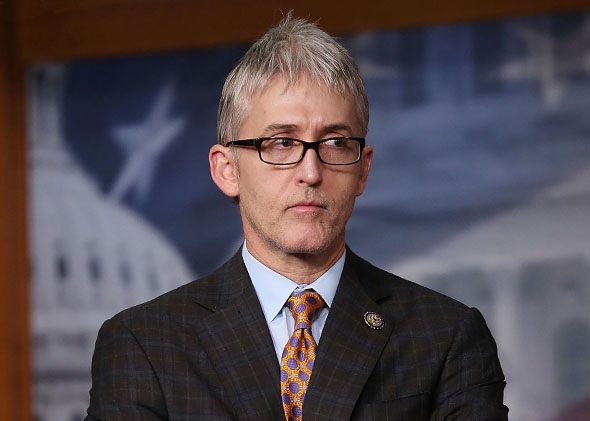
Take South Carolina Rep. Trey Gowdy, Chairman of the House Select Committee on Benghazi, who has been going around ranting and raving about Hillary Clinton’s emails Who is this guy? Tell me he’s not weird-looking.
Harold Watson “Trey” Gowdy III
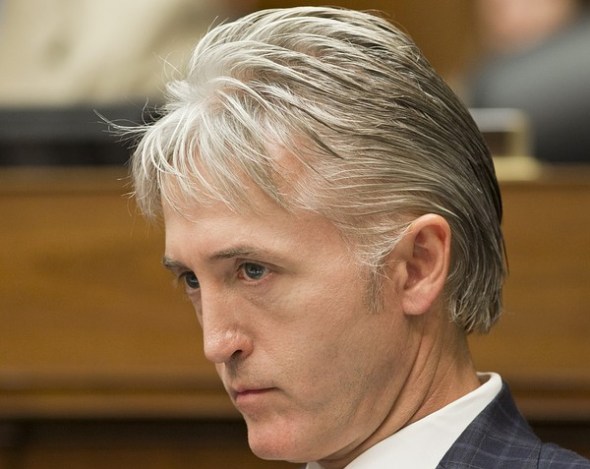
Here’s a profile shot.
Does his head really come to a point at the top? If not, what’s with the hair? Like many of his Southern Republican colleagues, he looks sickly, pale, and washed out like the banjo player in Deliverance.
Gowdy apparently never heard the old saying about people in glass houses not throwing stones, because he got himself in a little trouble yesterday. From the Washington Post: Rep. Trey Gowdy retreats from Benghazi event.
In May, just after he was picked to lead the House select committee on Benghazi, Rep. Trey Gowdy pledged not to raise money off the 2012 attacks in Libya, which killed the U.S. ambassador and three other Americans.
But it was revealed Monday that the South Carolina Republican was scheduled to help a group raise funds at an event called “Beyond Benghazi.”
After The Washington Post inquired about the event, a committee spokesman said that the subject of the fundraiser hadn’t been cleared with the congressman’s office and that Gowdy was pulling out.
Yeah, right. Gowdy had no clue what a fund-raising event called “Beyond Benghazi” was all about.
“He has not raised money using Benghazi, and will not speak about Benghazi at fundraising events. Having been made aware of this group’s plan, he no longer will be participating in the event,” the spokesman, Jamal Ware, said by e-mail.
Later Monday, the event was canceled.
The Republican Party of Virginia planned to host Gowdy at a $75-a-head reception that was called “Beyond Benghazi.” You could buy a table for 10 for $1,250 or co-chair the event for $5,000, which includes the table, a “VIP” at your table and a special shout-out.
LOL
Now look at Tom Cotton, the organizer of the bizarre GOP open letter to the “Leaders of the Islamic Republic of Iran.”
As first reported by Bloomberg’s Josh Rogin, a group of 47 Republican senators signed a letter addressed to “the leaders of the Islamic Republic of Iran,” warning them not to be too optimistic about ongoing negotiations with the Obama administration over Tehran’s nuclear program. It was organized by freshman Sen. Tom Cotton (R-Ark.) and advised the Iranian leadership that “anything not approved by Congress is a mere executive agreement.”
The letter is brief, and can be read in full here. Republican lawmakers are opposed to the Obama administration’s current overtures to Iran, a disagreement that was put into stark relief last week by the polarizing speech delivered by Israeli Prime Minister Benjamin Netanyahu before a joint meeting of Congress. This is yet another tactic to scupper a potential deal.
It starts with the patronizing premise that “you may not fully understand our Constitutional system” and goes on to explain, first, that any international treaty will need to be ratified by a two-thirds vote in both chambers of Congress and that, unlike the president of the United States, senators “may serve an unlimited number of 6-year terms.” The message to the mullahs: don’t get comfortable with any deal, because we’re going to scrap it as soon as we can.
WTF?!!
Whatever its effects in Washington, the letter is almost farcically condescending in word and tone. Iran’s leaders are well aware of how the United States works. The country’s foreign minister, Mohammad Javad Zarif, spent the better part of a decade as the Iranian envoy to the United Nations; like many others in the Iranian cabinet, he was partly educated in the United States.
It reflects the willful ignorance on the part of many hawks in Washington who insist on seeing Iran purely as an irrational actor and a permanent regional threat. As WorldViews discussed earlier, Iran is problematic in many ways, and its regime plays a role in fueling proxy wars in parts of the Middle East. But one can argue that the same is true of Washington’s chief Arab ally in the region, Saudi Arabia.
At the Lawfare blog, Jack Goldsmith wrote that Tom Cotton and his Senate colleagues made an “embarrassing” mistake in their strange letter.
The letter states that “the Senate must ratify [a treaty] by a two-thirds vote.” But as the Senate’s own web page makes clear: “The Senate does not ratify treaties. Instead, the Senate takes up a resolution of ratification, by which the Senate formally gives its advice and consent, empowering the president to proceed with ratification” (my emphasis). Or, as this outstanding 2001 CRS Report on the Senate’s role in treaty-making states (at 117): “It is the President who negotiates and ultimately ratifies treaties for the United States, but only if the Senate in the intervening period gives its advice and consent.” Ratification is the formal act of the nation’s consent to be bound by the treaty on the international plane. Senate consent is a necessary but not sufficient condition of treaty ratification for the United States. As the CRS Report notes: “When a treaty to which the Senate has advised and consented … is returned to the President,” he may “simply decide not to ratify the treaty.”
Mohammad Javad Zarif said the letter lacks “legal validity” and shows that the signatories of the letter are “ignorant of international law”
“In our view this letter has no legal validity and is just a propaganda scheme,” Zarif noted.
Zarif said it is surprising that while nuclear talks have not reached a result yet pressure groups in the U.S. have become so “worried” that they have resorted to any “unconventional way” to kill it.
The letter proved that “like” Israeli Prime Minister Benjamin Netanyahu these senators “are opposed to any deal”.
Expressing surprise on how it is possible that the legislators of a country write a letter against their own president and government to the leaders of another country, Zarif said, “The letter by the senators show that not only they are alien to international law but even not familiar with the details of the their own constitution about the authority of the president” in implementing foreign agreements.
Many of Iran’s leaders were educated in the U.S. But where did Tom Cotton and his buddies learn about the Constitution, separation of powers, and how foreign policy is handled in the U.S.? Amazingly, he graduated from Harvard College and Harvard Law School and did more graduate work at Claremont Graduate University. Was he just not paying attention?
Ted Cruz at Princeton
Senator Ted Cruz (R-TX) also graduated from Harvard Law and got his undergraduate degree from Princeton. He also signed the letter and seems confused about the Constitutional duties of the President. He actually wrote an op-ed for Politico in which he claimed Obama was “acting like a monarch.”
Critics of President Barack Obama have charged that he has regularly exceeded the powers of his office in selectively enforcing the law. Their examples include making recess appointments, issuing executive orders, delaying provisions of his health care law, refusing to defend the Defense of Marriage Act in court and declining to deport certain categories of young illegal immigrants.
At the 2014 CPAC conference, Sen. Ted Cruz, R-Texas, reiterated this point to the audience of conservative activists.
Referring to Obama, Cruz said, “This president of the United States is the first president we’ve ever had who thinks he can choose which laws to enforce and which laws to ignore.”
Politifact concluded, based on interviews with historians that several presidents, including Abraham Lincoln, Richard Nixon, Ronald Reagan, and George W. Bush have “ignored specific laws or constitutional protections,” but they don’t actually offer any specific examples of Obama doing so.
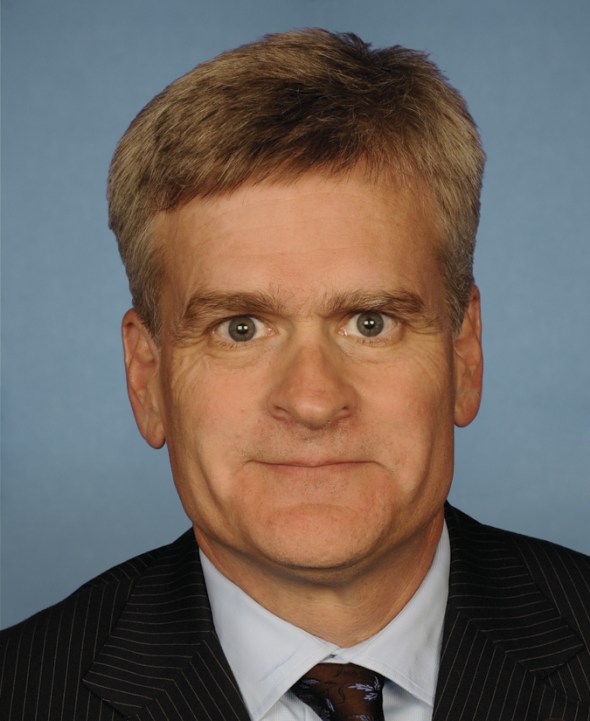
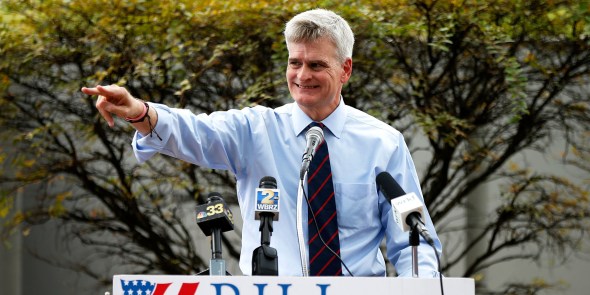
Are these Republicans simply blinded by ideology or are they willfully ignorant, despite attention top U.S. Universities? I honestly don’t know the answer. I know it’s rude of me to call attention to how they look, but I can’t help wondering why so many of the GOP “young turks” look like their parents were cousins. For example, Louisiana’s recently elected Senator “crazy eyes” Bill Cassidy, who looks a lot like Frankenstein’s monster. Cassidy also signed Cotton’s letter to Iran.
Bill Cassidy campaigning in Baton Rouge, LA.
Even some of the older GOP Senators who signed the letter have that crazy look:
Sen. Jeff Sessions (R-Alabama)
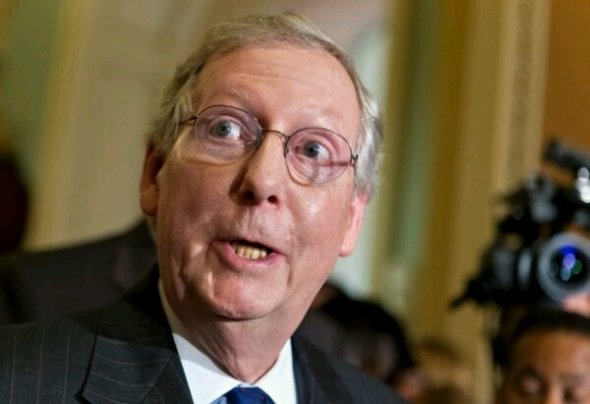
Senate Majority Leader Mitch McConnell
Am I nuts? I don’t even know if this post makes any sense. Lately I feel as if this country is falling apart. And more and more I get the feeling that Republicans just aren’t like you and me. Where do these people come from and what is wrong with them?
This is an open thread. You can discuss this post or anything else you like. Have a nice Tuesday, everyone!
Did you like this post? Please share it with your friends:
I’ve been reading a lot about the incredible number of fiery explosions of oil cars carrying tar sands oil. Rachel Maddow covered the recent explosions in West Virginia last week which got me started on a series of articles leaving me highly concerned. You see, I live within less than a block of freight trains that carry the stuff. Why are these things blowing up like huge bombs? The answer will both concern you and make you very mad. Here’s the background of the North American “bomb trains”.
So, let me start with the Maddow show investigations and move on until we get to the movement of these tank cars on my street. The latest explosion happened in Mount Carbon, West Virginia one week ago today. The explosion sent tankers filled with Bakken Tar Sands Oil into a nearby river. The link above will show the report on that derailment and the horrifying images of the inferno that followed.
Transporting oil involves more than just safe train cars or even pipelines. The Bakken Tar Sands Oil is not being conditioned which is leaving extremely volatile and flammable components. These components create the mixture causing the bomb trains that transport right through towns, cities, and neighborhoods like mine. Texas law forces Texas oil to be fully conditioned prior to transportation. North Dakota law does not and the Tar Sands Oil is particularly nasty stuff. North Dakota has now initiated a cleansing process which is a weaker version of conditioning. Imagine my surprise when I found out that Texas actually has tough regulations on this. That says something to me. North Dakota has some ‘splaining to do.
While the investigation continues into Monday’s massive explosion of Bakken crude oil tankers after a train derailment in West Virginia, a spokesperson for the Department of Mineral Resources says proper conditioning of the oil is just one of four pieces needed to ensure transport safety.
Alison Ritter said the State Industrial Commission’s oil conditioning order, effective April 1, sets a standard of certainty for the design of safe railcars.
“This is where we believe North Dakota fits into the solution of making oil as safe as possible for transport,” Ritter said.
However, she said the Federal Railroad Administration is responsible for unit train routing, speed limits, brakes and track maintenance, as well as notification of state emergency responders. The Pipeline and Hazardous Materials Safety Administration is responsible for overseeing how crude is labeled and tanker car design, and it and states are responsible for funding and training emergency responders, she said.
CSX Transport says the Bakken oil tankers that exploded this week were built to the higher safety standards.
The Dakota Resource Council continued its attack on state officials Wednesday, saying the new oil conditioning order for Bakken oil falls far short of what’s needed.
The order requires oil producers to reduce volatile gases in the oil to reach a maximum pressure of 13.7 pounds per square inch.
The DRC and others point out that the Bakken oil involved in a derailment explosion that killed 52 people in Quebec in 2013 was even lower, at 9.3 psi.
“We can and should do better,” the organization said in a statement Wednesday. The organization had pressed the Industrial Commission to require that the oil be stabilized to remove more of the gases.
Bakken crude has been involved in six train explosions since 2008, including one outside Casselton 14 months ago.
Bakken crude is regarded as potentially more flammable than traditional crude, thus posing an increased hazard. And since the derailment of a train hauling Bakken crude killed 47 people in Lac-Mégantic, Quebec, in July 2013, the type of tankers involved in these accidents has become the subject of intense scrutiny. Both Canada and the United States have called for tougher safety standards, including upgrading the tankers. In mid-January, Canada announced it would take older tankers, known as the “DOT-111”, off the network years sooner than the United States will, putting the two countries at odds over increased safety measures on the deeply integrated system
The “commission order was written as a matter of safety,” the NDIC said in an executive summary of the regulation. “Rail accidents across the country have drawn attention for the need to better understand how Bakken oil is produced and processed at the well site.”
The regulation requires all crude produced in North Dakota to have a vapor pressure of no more than 13.7 pounds per square inch. “National standards recognize oil with a vapor pressure of 14.7 psi or less to be stable,” according to the summary, which said that winter blend gasoline has a vapor pressure of 13.5 psi. “Under the order, all Bakken crude oil produced in North Dakota will be conditioned with no exceptions,” the NDIC said in a statement.
The regulation will make waves from the wellhead to the rail terminal to the refinery, and possibly down the train tracks. It’s unknown how the conditioning of Bakken crude could affect the terms of forthcoming new tank-car safety standards, meant to protect against volatile crude shipments. But certainly, many industry participants will take on the daunting task of first conditioning the North Dakota crude and then moving out the associated NGLs into a market already flush with ethane, butane, and propane, sources said.
In neighboring Minnesota, Gov. Mark Dayton “is concerned primarily about the safety of people along oil train routes, and in particular about the fact that this is a very volatile oil,” says Dave Christianson, an official with the Minnesota Department of Transportation.
Dayton has joined activists in asking North Dakota to force oil companies to “stabilize” the oil — to make it less explosive by separating out the flammable liquids.
Last month, North Dakota Gov. Jack Dalrymple convened a public hearing on the idea. Keith Lilie, an operations and maintenance manager for Statoil, which has a big presence in the Bakken, testified in front of a room full of oilmen in suits and cowboy boots who came to the hearing from places like Oklahoma City and Houston.
Lilie said he opposes having to build expensive tanks to heat the oil and separate out flammable liquids, like butane.
“Statoil believes the current conditioning of crude oil is sufficient for safely transporting Bakken crude oil by truck, rail and pipeline,” he said.
Eric Bayes, general manager of Oasis Petroleum’s operations in the Bakken, also testified. He asked what companies are supposed to do with those explosive liquids once they’re separated from the oil.
The stabilization process, he says, would “create another product stream you have no infrastructure in place for.”
But energy economist Philip Verleger, says the resistance is about money. “The industry never wants to take steps which increase the cost of production, even if it’s in the best interests of everybody,” he says.
Verleger says the opposition to proposed safety rules is short-sighted, and that the industry could actually hurt itself if there’s another serious incident. “I think the movement of crude oil by rail is one accident away from being terminated,” Verleger says.
Activist Lynn Wolff supports new rules that would make the oil less explosive, and says such regulation would protect people beyond North Dakota. “These bomb trains have been in Virginia and Alabama and blown up there as well,” he says.
City of New Orleans and state emergency officials said Friday (Feb. 20) they are prepared to implement an emergency evacuation of the French Quarter or other parts of the city in the event of a catastrophic crude oil derailment accident, such as the event that engulfed parts of Adena Village, W. Va., in pillars of flame on Monday.
But city officials said Friday those evacuation plans are not releasable under federal law, and declined to explain any details of how city, state and federal agencies would work together to respond to a catastrophic accident.
“The city’s evacuation plan is considered security sensitive as it lists critical routes, critical infrastructure and key resources,” said Bradley Howard, press secretary to Mayor Mitch Landrieu.
So, great they have a plan but they refuse to tell us about it. My plan is to suggest the girls take out life insurance on me and the pets.
The West Virginia accident involved a 109-tank car shipment of Bakken crude oil from North Dakota that was on its way to a shipping facility in Jamestown, Va. It was one of three such derailments within the past week, and involved new, supposedly safer tank cars that were supposed to have withstood the rupture and fire incident that occurred, said Fred Millar, an independent transportation safety expert based in Washington, D.C.
Millar called the older rail cars, many of which are used to ship oil through Louisiana, as “Pepsi cans on wheels” that should be expected to lose their contents whenever they derail.
Millar pointed to an accident in Lac-Mégantic, Quebec, on July 6, 2013, as an example of a worst-case incident that New Orleans should be prepared for. In that accident, poor maintenance, driver error, flawed operating procedures, and lack of safety redundancy resulted in a fiery derailment in the middle of the town that killed 47 and destroyed more than 30 buildings.
He said a key concern is that when tank cars are punctured, the released oil pours downhill through streets and into sewers and storm drains, creating a river of fire, if a spark sets the fuel alight.
The Gulf Gateway Terminal, located off Almonaster Boulevard on the northern side of the Gulf Intracoastal Waterway and about a half-mile north of the Lower 9th Ward, can load 100,000 barrels of crude oil a day from tank cars onto barges and ships. The oil is delivered from a variety of northwestern locations to New Orleans, including the Bakken oil fields in North Dakota and oil tar sands fields in Canada, and the tank cars are moved into New Orleans through Uptown and the French Quarter by the Burlington Northern Santa Fe railroad and the Public Belt Rail Road.Gulf Gateway Terminal
In New Orleans, dozens of tank cars are being moved by rail by the New Orleans Public Belt railroad and by BNSF Railway to the Gulf Gateway Terminal on the Gulf Intracoastal Waterway, where more than 100,000 barrels of crude can be transferred from the cars to barges and ships each day.
The tank cars take a circuitous route through the New Orleans area to get there, often traveling by Public Belt tracks along the river through Old Jefferson to Uptown and then through the French Quarter.
Along the way, the rail cars pass within a block or two of New Orleans Children’s Hospital, and between the Riverwalk shopping mall and the Ernest Morial Convention Center.
A recent photo of the Gulf Gateway Terminal on the company’s web site shows more than 500 oil rail cars adjacent to a transport dock, which is on the north side of the waterway off Almonaster Boulevard, and about a half-mile north of the Lower 9thWard.
Each tank car averages 30,000 gallons of crude oil, and if all the cars were full, that would mean 15 million gallons of oil were stored at the terminal after having been moved through the French Quarter.
Just to give you a great little visual, the train and the cars go within blocks of the Children’s Hospital. Doesn’t that make you feel just wonderful? And these oil and gas guys are worried about their profit margins and saturating the already saturated damn NGL markets?
Well, I don’t know about you, but I’m not sleeping very well these days.
What’s on your reading and blogging list today? You can post anything even though I basically covered one topic. I just had to get the information out. I hope you find it useful and horrifying.
Did you like this post? Please share it with your friends:
The Sky Dancing banner headline uses a snippet from a work by artist Tashi Mannox called 'Rainbow Study'. The work is described as a" study of typical Tibetan rainbow clouds, that feature in Thanka painting, temple decoration and silk brocades". dakinikat was immediately drawn to the image when trying to find stylized Tibetan Clouds to represent Sky Dancing. It is probably because Tashi's practice is similar to her own. His updated take on the clouds that fill the collection of traditional thankas is quite special.
You can find his work at his website by clicking on his logo below. He is also a calligraphy artist that uses important vajrayana syllables. We encourage you to visit his on line studio.
















 WTF?!!

 Good Morning!


 Just to give you a great little visual, the train and the cars go within blocks of the Children’s Hospital. Doesn’t that make you feel just wonderful? And these oil and gas guys are worried about their profit margins and saturating the already saturated damn NGL markets?
 peej
peej Carissa
 bostonboomer
 dakinikat
 ecocatwoman
 mablue2
 Mama Lopez
 peggysue22
 quixote
 skydancingguestblogger
 Mona (aka Wonk the Vote)



 Sky Dancing
Recent Comments