
Lazy Caturday Reads: Unleashed Trump Begins Purge
Posted: February 8, 2020 Filed under: just because 25 Comments
Good Morning!!
Have you heard? Good ol’ Susan Collins “says she opposes any retribution against impeachment witnesses.”
Sen. Susan Collins on Friday defended her decision to vote to acquit President Trump during his Senate impeachment trial this week, but she declined to respond to questions later in the day about the sudden ouster of two key impeachment witnesses who testified against the president.
In her first public appearance in Maine since the trial ended Wednesday, Collins spoke at a chiefs of police conference in South Portland before answering questions from the media in which she condemned the notion of retribution against witnesses who came forward and defended her voting record.
By the end of the day, the Trump administration had removed Army Lt. Col. Alexander Vindman and his twin brother, Lt. Col. Yevgeny Vindman, both of whom worked for the National Security Council in the White House. Later Friday, European Union Ambassador Gordon Sondland announced that he was being recalled to Washington. Sondland and Alexander Vindman testified during the House impeachment hearings against Trump.
“I think it’s important to understand that when you’re in an impeachment trial, you consider the evidence that is before you,” Collins, a Republican, said after an event in South Portland. “You don’t try to make predictions. You consider the evidence that’s before you. In this case, the evidence did not meet the high bar that’s established by the Constitution for immediate removal of the president from office. So that was the basis for my decision.”
She then added: “I obviously am not in favor of any kind of retribution against anyone who came forward with evidence.”
Poor Susan. How was she supposed to know that Trump would act like Trump? Read more at the Portland Press Herald link above.
Trump’s push to remove Sondland and Vindman — and to exact punishment on other figures involved in the nearly five-month impeachment process — underscored how his fixation with settling scores is outweighing any effort to move on to less divisive issues in the wake of his acquittal.
Vindman’s twin brother, Lt. Col. Yevgeny Vindman, was also removed from his job at the National Security Council, where he worked as a lawyer, and was escorted off the grounds Friday afternoon.
The firings of Sondland and Alexander Vindman amounted to a post-impeachment bloodletting of key figures who complied with congressional subpoenas and testified in a process that Trump sought to delegitimize as a “hoax” and a “witch hunt.”
“I’m not happy with him,” Trump said earlier Friday when asked about Vindman’s future. “You think I’m supposed to be happy with him? I’m not.”
There was little resistance from within the Republican Party to the idea of punishing Vindman, a Purple Heart recipient and Ukraine expert, after The Washington Post reported Thursday night that he could soon be removed from his White House job. Some GOP lawmakers egged the president on — a sign of how much Trump has asserted his influence on the party.
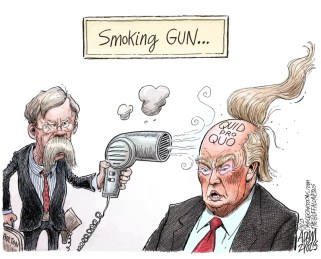
And get this: Trump wants to fire the inspector general who accepted the whistleblower complaint about the Ukraine call along with purging the NSC.
The president and his advisers have also discussed removing Michael Atkinson, the inspector general of the intelligence community, though no final decision has been made, officials said. Trump has expressed frustration that Atkinson allowed a whistleblower report documenting Trump’s alleged misconduct toward Ukraine to be transmitted to Congress.
Some advisers have also counseled the president to remove Victoria Coates, the deputy national security adviser, who has told others in the White House that she fears her job is in jeopardy.
Trump has regularly asked aides to continue slashing the size of the NSC, and national security adviser Robert C. O’Brien has said he plans to do so, telling NPR in an interview last month that the policy staff, which he put at about 180 people when he took over in September, was bloated.
By the end of February, O’Brien said, he hoped to have cut it by a third. A senior administration official said there will be widespread departures at the NSC in the next week.
At NBC News, Sharon Pettypiece writes that Trump appears to be planning to avenge himself on House Democrats.
President Donald Trump said Friday that his impeachment should be invalidated, and he gave an ominous warning when asked how he’ll pay back those responsible, saying, “You’ll see.”
“Should they expunge the impeachment in the House? They should because it was a hoax,” Trump told reporters at the White House before departing on Marine One.
When asked about his press secretary’s comments that the president was suggesting in his remarks Thursday on impeachment that his Democratic political opponents “should be held accountable,” Trump said, “Well, you’ll see. I mean, we’ll see what happens.”
Trump showed little sign of wanting to mend fences with the Democrats, saying they suffer from “Trump derangement syndrome” and that there is “a lot of evil on that side.” When asked how he was going to unify the country following his divisive impeachment, Trump said he would do it by “great success.”
David Rothkopf at The Daily Beast: Friday Night Massacre’s Just the Beginning for Acquitted Trump. On the firings of the Vindland brothers and Sondland, Rothkopf writes:
Their firings and forced departures from their jobs are, by any definition, retaliation against witnesses in the case against the president. That’s a crime. But of course, that crime will never be enforced because the U.S. government agency responsible for enforcing such laws, the Department of Justice, has been taken over by an attorney general who has perjured himself before Congress, violated his oath and placed the protection of the president ahead of the interests of the American people to whom he owes his highest duty. This week, just after the Senate’s “total acquittal,” Barr issued a memo saying that no further investigations into any presidential or vice-presidential candidate or his staff could be issued without his express approval.
Between Barr and Senate Majority Leader Mitch McConnell, Donald Trump has been given free rein to be his worst self. And Trump never disappoints those who expect the worst of him. In the past few days he used a prayer breakfast to attack his enemies and question their faith. He awarded a racist the Presidential Medal of Freedom in the middle of a rambling, vapid State of the Union that had more in common with a television game show than with anything the Capitol building had ever seen before him. He held a press event to celebrate the Senate vote that was by turns vituperative against his opponents and so deranged that you expected the men with the butterfly nets to burst into the East Room of the White House and escort Trump to a quiet place where there were no sharp objects.
As the week drew to a close, a chilling realization settled in on the nation. Our most corrupt, unfit, demented and malevolent president has been given more power than any other human being in our history. He has been told he is above the law, incapable of committing a crime. He has been told that Article II of the Constitution grants him unlimited powers. He has been told he does not have submit to the oversight of the Congress.
He is, in other words, free to be himself. And we all know who that is—except perhaps Senator Susan Collins and the other Senate suckers who expected that somehow our felon-in-chief had learned a lesson from this impeachment ordeal. Trump is a man who thinks the law is for little people, that the rich can buy their way out of any legal predicament. He thinks character and courage and duty, the traits displayed by Yovanovitch and the Vindmans, are for suckers.
There’s more, but it’s behind the paywall.
Yesterday afternoon, The Washington Post published an op-ed by Nancy Pelosi: McConnell and the GOP Senate are accomplices to Trump’s wrongdoing.
For more than 200 years, our republic has endured, not only because of the wisdom of our Founders and the brilliance of our Constitution, but because of the generations of patriotic Americans who have had the courage to risk their lives to defend it.
But, tragically, the American people have watched President Trump and Republicans in Congress dismantle the Constitution that we cherish.
The House impeachment managers, led by Intelligence Committee Chairman Adam B. Schiff (D-Calif.), presented to the Senate and the public an incontrovertible truth that the president himself has admitted: President Trump abused the power of his office to pressure a foreign power to help him cheat in an American election. And when he was caught, the president launched an unprecedented coverup to block Congress from holding him accountable. The president’s actions undermined our national security, jeopardized the integrity of our elections and violated the Constitution.
The Democrats in the Senate under the leadership of Minority Leader Charles E. Schumer (D-N.Y.) patriotically voted unanimously to honor the oath to support and defend the Constitution. They, along with Sen. Mitt Romney (R-Utah), deserve our gratitude for their moral courage.
The president’s lawyers all but concede his misconduct. Their argument was only that Congress and the American people have no right to stop him from using his power to cheat in our elections. With their vote, Senate Republicans embraced this darkest vision of power: that if the president believes his reelection is good for the country, he can then use any means necessary to win, with no accountability or consequences.
Read the rest at the WaPo.
One more story before I sign off. The Washington Post: Meet the 71-year-old staging a one-man protest in his Trump-loving retirement community.
“When Trump won, it changed the whole ballgame for me,” McGinty told The Washington Post. “I thought to myself, ‘This was supposed to be a joke. What’s wrong with these people?’ ”
In the three years since then, the once-quiet political observer has transformed into the best-known Trump protester in The Villages, a sprawling, meticulously planned and maintained retirement community that lies about 45 miles northwest of Orlando. McGinty’s daily vigil with signs blasting the president as a “SEXUAL PREDATOR” (among other things) has drawn ire in the Trump-loving Florida town he has called home since 2016. It has also brought viral fame.
For his one-man protest against the president, McGinty has been berated as a baby killer and a “dumb a–,” decried in letters to the editor of a local news site and hit with an anonymous, handwritten threat — a sign that even a town that is described as Disney World for retirees and markets itself as “Florida’s Friendliest Hometown” is not immune to the divisiveness of this political era.
“There was always a divide, but we coexisted,” said Chris Stanley, president of The Villages Democratic Club. “There would be some good-natured back and forth, but your neighbors were your friends. You’d have dinner with the Republicans because it wasn’t a big deal. … These days, the division in the country shows up best in The Villages because now the Republicans, they won’t golf with you anymore, or you don’t want to golf with them.” [….]
These days, McGinty devotes about two hours a day to protesting, crashing rallies planned by the Villagers for Trump group and parking his golf cart in well-trafficked areas where people are most likely to see his signs: “TRUMP BIGOT AND RACIST,” “TRUMP IS A SEXUAL PREDATOR” and “TRUMP COMPULSIVE LIAR.” He said he rotates between about 30 posters carrying various anti-Trump sentiments. He sits in his cart reading while he puts them on display, enjoying the confrontations that follow.
Have a nice weekend, Sky Dancers! As always, this is an open thread.
Thursday Reads: Trump’s Defense Team Argues “He Can Do Anything He Wants.”
Posted: January 30, 2020 Filed under: just because 21 Comments
Mad King Donald
Good Morning!!
We’re through the looking glass now folks. Yesterday during Trump’s impeachment “trial,” Alan Dershowitz argued that Trump can do anything he wants if he thinks it’s in the national interest for him to win an election.
Buzzfeed News: Trump’s Team Argued Presidents Can Demand Quid Pro Quos to Get Reelected. Even Republicans Won’t Touch This Defense.
Trump lawyer Alan Dershowitz told senators that presidents cannot be impeached for using their powers of office to boost their own political fortunes, as long as they believe their reelection is best for the country. Even Republicans aren’t following him down that trail.
While responding to questions from senators Wednesday, Dershowitz argued that presidents cannot be impeached for demanding a quid pro quo to help get themselves reelected.
“Every public official I know believes that his election is in the public interest. And mostly you’re right,” he said. “Your election is in the public interest. And if a president does something which he believes will help him get elected in the public interest, that cannot be the kind of quid pro quo that results in impeachment.”
Dershowitz laid out three types of presidential motivations: public interest, political interest, and private financial interest. Acting for personal financial gain — such as withholding foreign aid unless you receive a million-dollar kickback — is clearly corrupt, argued Dershowitz.
“But a complex middle case is ‘I want to be elected. I think I’m a great president. I think I’m the greatest president that ever was, and if I’m not elected, the national interest will suffer greatly.’ That cannot be an impeachable offense,” he said.
The Washington Post Editorial Board responds to another defense of Trump–that he was just advancing U.S. policy in Ukraine: Republicans’ damaging new line of defense.
John Bolton has not yet testified or spoken anywhere in public about the Ukraine affair, but his unpublished manuscript is exerting a gravitational pull on the Senate trial of President Trump. The former national security adviser is reported to have written that Mr. Trump directly connected his freeze on military aid to Ukraine with his demand that the country’s president launch politicized investigations, including of Democratic presidential candidate Joe Biden, the former vice president. The result is that some Republican senators who previously insisted that there was no evidence of such a quid pro quo have now retreated to a new line of defense: Maybe there was but, if so, there is nothing wrong with it.
The new response has the advantage of acknowledging the mounting evidence that Mr. Trump used congressionally appropriated aid to pressure Ukrainian President Volodymyr Zelensky to intervene in the 2020 election campaign. “We basically know what the facts are,” Sen. John Cornyn (R-Tex.) told Fox News on Tuesday. Yet Mr. Cornyn and other GOP senators are now arguing that the behavior is not an abuse of power, merely a routine presidential act. “Presidents always leverage foreign aid,” said Mr. Cornyn.
That contention is as dangerous as it is wrong. Presidents do occasionally wield U.S. assistance to advance foreign policy ends. But Mr. Trump was manifestly seeking a personal gain. An investigation of Mr. Biden was not a goal of U.S. foreign policy. There was no domestic probe of his actions and no evidence that he was guilty of wrongdoing. On the contrary, the proof that the then-vice president was pursuing official U.S. policy when he intervened in Ukraine is overwhelming.
And on the Dershowitz argument that Trump can do anything he wants:
The implications of this position are frightening. If Republicans acquit Mr. Trump on the basis of Mr. Dershowitz’s arguments, they will be saying that presidents are entitled to use their official powers to force foreign governments to investigate any U.S. citizen they choose to target — even if there is no evidence of wrongdoing. Mr. Trump could induce Russia or Saudi Arabia or China to spy on Mr. Biden, or on any other of the many people subject to his offensive tweets. In exchange for any embarrassing information, the president might offer official favors, such as arms sales or a trade deal or the lifting of sanctions. Do Republicans really wish to ratify such presidential authority? Will they not object if the next Democratic president resorts to it?
 At USA Today, historian and former Republican Tom Nichols addresses the “Trump was just pursuing U.S. foreign policy” argument: Trump is being impeached over an extortion scheme, not a ‘policy dispute.’
The “policy dispute” defense rests on the obvious truth that under Article II of the Constitution, the president of the United States has the right to set foreign policy. Subject to the restrictions of federal law, the Constitution and the power of the purse that is reserved for Congress in Article I, the president can choose to bring us closer to some countries, give the cold shoulder to others, and negotiate treaties and other international agreements as he or she chooses.
None of that is at issue in this impeachment. What Trump did was to state one policy in public — that is, the policy his subordinates and the executive departments of the United States were expected to follow — and then to run a second policy, a plot concocted in secret and executed by an unaccountable circle of conspirators.
This scheme (it is too misleading even to call it a “policy”) was a rogue operation against Ukraine’s new president, Volodymyr Zelensky, conducted by Trump’s personal lawyer Rudy Giuliani and a squad of shady characters, none of whom were answerable to anyone but Trump himself. (One wonders how Sen. Lee’s constitutionalism squares with foreign operations being conducted by the likes of Giuliani and Lev Parnas, out of sight of pesky members of Congress and their annoying questions.)
Official U.S. policy was to help Ukraine resist Russia as a sign of our commitment to international order, the rule of law and the indivisible security of the Atlantic community and the world itself.
Trump’s personal goal, however, was to hold Ukraine hostage and risk the lives of its people and soldiers until Zelensky would agree to stand in front of a television camera and lie for the benefit of one Donald J. Trump.
Click the link to read the rest.
Meanwhile, Lev Parnas dropped another bombshell on CNN last night, claiming that Lindsey Graham has been aware of the Ukraine conspiracy since 2018.
Raw Story: Lev Parnas directly implicates Lindsey Graham in Ukraine plot: ‘He was in the loop.’
Lev Parnas, a Ukraine-born businessman charged with campaign finance violations, told CNN’s “Anderson Cooper 360°” that Graham has a personal interest in keeping witness testimony out of President Donald Trump’s impeachment trial.
“Sen. Lindsey Graham I haven’t had any contact with, but because of my relationship with Rudy Giuliani, I have a lot of information about his dealings,” Parnas said. “It was, like, surreal to watch Lindsey Graham up there, sit there — he’s out there talking about all the stuff, that this is a sham, that this should go away.”
“At the end of the day,” Parnas added, “he was in the loop just like everybody else. He (had) a very good relationship with Rudy Giuliani, he was aware of what was going on going back to at least 2018, maybe even earlier. If you recall, he was the one Rudy Giuliani was supposed to bring Viktor Shokin to when the visa got denied, and I think he was even, if you check the records, involved in getting the request for the visa somehow.”
Parnas’ attorney Joseph Bondy released letters Wednesday signed by a Ukraine-born U.S. citizen Michael Guralnik to both Graham and Sigal Mandelker, then a top official at the U.S. Treasury Department pushing for sanctions against various Ukrainian political and business leaders.
A month or so later Giuliani tried to help Shokin, a former top prosecutor in Ukraine regarded as corrupt by the previous administration and U.S. allies, obtain a visa to meet with Graham in the U.S.
“Sen. Graham was involved even before I got involved with Mayor Giuliani, so he had to have been in the loop and had to have known what was going on,” Parnas said. “I was with Giuliani every day, that was what was happening.”
Time is running out for John Bolton to be a patriot. The White House is threatening to hold up publication of his book indefinitely. CNN:
The White House has issued a formal threat to former national security adviser John Bolton to keep him from publishing his book, “The Room Where It Happened: A White House Memoir,” sources familiar with the matter tell CNN.
In a letter to Bolton’s lawyer, a top official at the National Security Council wrote the unpublished manuscript of Bolton’s book “appears to contain significant amounts of classified information” and couldn’t be published as written.
The letter, which is dated January 23, said some of the information was classified at the “top secret” level, meaning it “reasonably could be expected to cause exceptionally grave harm to the national security.”
“The manuscript may not be published or otherwise disclosed without the deletion of this classified information,” the letter read.
Exposing the coverup: January 28, 2020
Jennifer Rubin writes an open letter to Bolton: John Bolton, it’s now or never.
Dear John Bolton:
Before you were national security adviser, before you represented the United States at the United Nations, you were a lawyer — a pretty good one, as I understand. As a member of the bar, you must have been pained and shaken to hear President Trump’s attorney Alan Dershowitz argue for the proposition that anything a president thinks he needs to do to get reelected — bribe or extort a foreign country, even — cannot be impeachable. This defies and defiles our constitutional system, one in which even the president is not above the law. It’s a proposition that would have boiled your blood had President Bill Clinton or President Barack Obama advanced it.
And yet here we are. The president asserts that he is king, and the spineless Republicans (who smear and insult you and mouth Russian propaganda) are too cowardly to oppose him. Meanwhile, your First Amendment rights to publish your account are being trampled on by a vague, overly broad and baseless assertion that your manuscript contains “Top Secret” materials. (And yet the president, acting White House chief of staff Mick Mulvaney and others have spoken to the contents of the same conversations you apparently will describe, thereby declassifying whatever they tried to classify.)
We have the perfect formula for tyranny: The executive claims unlimited power; his critics are muzzled. I do not think you spent decades in public life to allow this to play out before your eyes. What’s more, as you have surely realized in serving in this administration filled with toadies and careerists, you will, by acquiescing to White House demands, ensconce in power a president emotionally, temperamentally and intellectually unfit to serve, one who will now be convinced that he operates above and beyond any restraint on his power.
The moral and constitutional instincts that drove you to condemn the “drug deal” being cooked by Trump’s aides and to repeatedly tell your former employees to report their concerns to White House attorneys should now compel you to throw sand in the gears of a totalitarian-minded president.
Read the rest at the WaPo.
There will be an other day of questions in the Senate impeachment “trial” beginning at 1:00 this afternoon. A vote on witnesses will be held tomorrow. Bolton needs to speak up today.
Have a nice Thursday, Sky Dancers. We’re not living in a dictatorship just yet. This is an open thread.
Martin Luther King Day reads
Posted: January 20, 2020 Filed under: just because | Tags: Martin Luther King's Birthday 28 Comments
I have no fear about the outcome of our struggle in Birmingham, even if our motives are at present misunderstood. We will reach the goal of freedom in Birmingham and all over the nation, because the goal of America is freedom. Abused and scorned though we may be, our destiny is tied up with America’s destiny. Before the pilgrims landed at Plymouth, we were here. Before the pen of Jefferson etched the majestic words of the Declaration of Independence across the pages of history, we were here. For more than two centuries our forebears labored in this country without wages; they made cotton king; they built the homes of their masters while suffering gross injustice and shameful humiliation—and yet out of a bottomless vitality they continued to thrive and develop. If the inexpressible cruelties of slavery could not stop us, the opposition we now face will surely fail. We will win our freedom because the sacred heritage of our nation and the eternal will of God are embodied in our echoing demands.
—Martin Luther King Jr, Letter from a Birmingham Jail, Apr 16, 1963
Let us celebrate the man and his legacy today.
From Charles Blow:
I had been taught only the “Dream” King. That is what America wants King to remain: Frozen in perpetual optimism, urging more than demanding, appealing to America’s better angels rather than ruthlessly calling out its persistent demons.
But, that must not be done. That must not be done.
As King said in a 1967 interview when asked about the “Dream” speech, after much soul-searching he had come to see that “some of the old optimism was a little superficial, and now it must be tempered with a solid realism.”
That evolution, toward a more “solid realism,” toward the more rational King, toward the more radical King, is why I happen to believe that one of King’s most consequential speeches is a little-discussed address he gave in 1967 at Stanford University. It was called “The Other America.”
In it, King blasted “large segments of white society” for being “more concerned about tranquillity and the status quo than about justice, equality, and humanity.”
He slammed what he called the “white backlash” for being the cause of black discontent and demands for black power, rather than the result of it, calling it “merely a new name for an old phenomenon.”
And he declared that true integration “is not merely a romantic or aesthetic something where you merely add color to a still predominantly white power structure.”
This speech was delivered after the passage of the Civil Rights Act of 1964 and the Voting Rights Act of 1965. As King put it in the 1967 interview, passage of those acts came at “bargained rates.”
He explained: “It didn’t cost the nation anything. In fact, it helped the economic side of the nation to integrate lunch counters and public accommodations. It didn’t cost the nation anything to get the right to vote established. And, now we are confronting issues that cannot be solved without costing the nation.”
Collectively, the 101 black teens participating in the study reported more than 5,600 experiences of racial discrimination over two weeks. That boils down to an average of more than five instances per day for each teenager. That’s more than 70 over two weeks.
Those findings may not be surprising to those who face routine discrimination, but they reflect a higher frequency of racism than has previously been reported.
What caused the increase? Researchers say that the study was the first to include so many expressions of racial bias, 58 in all, and to ask participants to record them daily. Previous studies have typically asked participants to recall experiences from the past, which researchers say is not as accurate.
Although there has been an increase in hate crimes during the Trump administration, this study measures incidents that occurred when Barack Obama was in the White House.
From Michelle Alexander:
“We are now living in an era not of post-racialism but of unabashed racialism, a time when many white Americans feel free to speak openly of their nostalgia for an age when their cultural, political and economic dominance could be taken for granted — no apologies required. Racial bigotry, fearmongering and scapegoating are no longer subterranean in our political discourse; the dog whistles have been replaced by bullhorns. White nationalist movements are operating openly online and in many of our communities; they’re celebrating mass killings and recruiting thousands into their ranks.”
Have a blessed day. The struggle continues. March on.
What’s on your reading and blogging list today?

Lazy Caturday Reads
Posted: December 28, 2019 Filed under: just because, morning reads, U.S. Politics 32 Comments Good Morning!!
I really dislike these two “holiday” weeks at the end of every year. I always end up with a sense of unreality. This year I’m away from my home–I’m house- and cat-sitting for my brother and his family while they visit Denmark and Norway for two weeks.
I’ve been reading constantly and avoiding TV. I’ve been reading a lot; I just finished a book by Stephen King, The Institute. I guess that is contributing to that freaky unreal feeling I’m experiencing. And of course there’s the knowledge that Trump is still “president” and our country and the world are in danger because of him.
I don’t know if anyone will read this, but if you do I want tell you that this blog and everyone who has read it and/or commented on it have helped me maintain some sanity in a crazy world over the more than a decade since 2008. I’m grateful to all of you and I wish you strength to get through whatever is coming in 2020. I love you all.
If you read nothing else today, I hope you’ll choose this essay by Michiko Kakutani at The New York Times: The 2010s Were the End of Normal.
TWO OF THE MOST WIDELY QUOTED and shared poems in the closing years of this decade were William Butler Yeats’s “The Second Coming” (“Things fall apart; the centre cannot hold”), and W.H. Auden’s “September 1, 1939” (“Waves of anger and fear / Circulate over the bright / And darkened lands of the earth”). Yeats’s poem, written just after World War I, spoke of a time when “The best lack all conviction, while the worst / Are full of passionate intensity.” Auden’s poem, written in the wake of Germany’s invasion of Poland, described a world lying “in stupor,” as democracy was threatened and “the enlightenment driven away.”
Apocalypse is not yet upon our world as the 2010s draw to an end, but there are portents of disorder. The hopes nourished during the opening years of the decade — hopes that America was on a progressive path toward growing equality and freedom, hopes that technology held answers to some of our most pressing problems — have given way, with what feels like head-swiveling speed, to a dark and divisive new era. Fear and distrust are ascendant now. At home, hate-crime violence reached a 16-year high in 2018, the F.B.I. reported. Abroad, there were big geopolitical shifts. With the rise of nationalist movements and a backlash against globalization on both sides of the Atlantic, the liberal post-World War II order — based on economic integration and international institutions — began to unravel, and since 2017, the United States has not only abdicated its role as a stabilizing leader on the global stage, but is also sowing unpredictability and chaos abroad.
A 2019 Freedom House report, which recorded global declines in political rights and civil liberties over the last 13 years, found that “challenges to American democracy are testing the stability of its constitutional system and threatening to undermine political rights and civil liberties worldwide.”
If Lin-Manuel Miranda’s dazzling 2015 musical “Hamilton,” about the founders’ Enlightenment vision of the United States, embodied the hopes and diversity of America during the Obama years, dystopian fables and horror-driven films and television series — including “Black Mirror” (2016), a rebooted “Twilight Zone” (2019), “Joker” (2019), “Get Out” (2017), “Watchmen” (2019), “The Handmaid’s Tale” (2017) and “Westworld” (2016) — spoke to the darkening mood in the second half of the decade, as drug overdose deaths in America rose to nearly half a million by the decade’s end, life expectancy fell in the United States and Britain, and many of us started to realize that our data (tracking everything we viewed, bought and searched for online) was being sold and commodified, and that algorithms were shaping our lives in untold ways. In what was likely the hottest decade on record, scientists warned that climate change was swiftly approaching a “point of no return”; we learned that glaciers were melting at record speed at the top of the world; and fires ravaged California and Australia and threatened the very future of the Amazon rainforest.
A bit more and then you’ll need to head over to the NYT to read the rest.
Many of these troubling developments didn’t happen overnight. Even today’s poisonous political partisanship has been brewing for decades — dating back at least to Newt Gingrich’s insurgency — but President Trump has blown any idea of “normal” to smithereens, brazenly trampling constitutional rules, America’s founding ideals and virtually every norm of common decency and civil discourse….
Mr. Trump’s improbable rise benefited from a perfect storm of larger economic, social and demographic changes, and the profoundly disruptive effects of new technology. His ascent also coincided with the rising anxieties and sense of dislocation produced by such tectonic shifts. Around the world, liberal democracy is facing grave new challenges, authoritarianism is on the rise and science is being questioned by “post-fact” politicians. Echoes of Mr. Trump’s nativist populism can be found in Prime Minister Boris Johnson of Britain’s recent electoral victory and the Brexit referendum of 2016, and in the ascent of the far-right President Jair Bolsonaro of Brazil. Democracy is under threat in Hungary and Poland. Once fringe right-wing parties with openly racist agendas are rebranding themselves in Sweden and Belgium. And far-right groups in Germany and Spain are now the third-largest parties in those nations’ parliaments.
AT THE SAME TIME, Donald Trump remains a uniquely American phenomenon. Although the United States was founded on the Enlightenment values of reason, liberty and progress, there has long been another strain of thinking at work beneath the surface — what Philip Roth called “the indigenous American berserk,” and the historian Richard Hofstadter famously described as “the paranoid style.”
It’s an outlook characterized by a sense of “heated exaggeration, suspiciousness, and conspiratorial fantasy,” Hofstadter wrote in his 1964 essay, and focused on perceived threats to “a nation, a culture, a way of life.” Its language is apocalyptic (Mr. Trump’s “American carnage” is a perfect example); its point of view, extremist. It regards its opponents as evil and ubiquitous, while portraying itself, in Hofstadter’s words, as “manning the barricades of civilization.”
The “paranoid style,” Hofstadter observed, tends to occur in “episodic waves.” The modern right wing, he wrote, feels dispossessed: “America has been largely taken away from them and their kind, though they are determined to try to repossess it.” In their view, “the old American virtues have already been eaten away by cosmopolitans and intellectuals,” and national independence has been “destroyed by treasonous plots, having as their most powerful agents not merely outsiders and foreigners but major statesmen seated at the very centers of American power.”
You might also want to read this opinion piece by Deborah Pearlstein at The Atlantic: How the Military Lost Its Proper Place in the Constitutional Order.
In his efforts to mask the seriousness of his actions around Russia and Ukraine, President Donald Trump has taken aim at one essential democratic institution after another—questioning the legitimacy of the press, the intelligence community, the courts, and, most recently, the House of Representatives itself. But he has so far mostly held his fire against both “his generals” and “our boys” in America’s military. “I will always stick up for our great fighters,” Trump promised his political supporters in Florida at a recent rally, championing on that day his recent decisions to pardon soldiers accused of war crimes.
The military, for its part, has had more mixed feelings. As a former chairman of the Joint Chiefs of Staff, General Martin Dempsey, described one such pardon, the president’s action was nothing less than an “abdication of moral responsibility.” Indeed, the military’s generally steadying reactions to the president’s worst moments of volatility have given members of Congress on both sides of the aisle reason to hope that the Pentagon at least will remain a check on presidential impulse that might really compromise national security, should other checking institutions fail.
But hoping that a president will defer to the judgment of the professional military is a sign that something has gone very wrong in America’s constitutional infrastructure. The American republic was, after all, founded on the complaint that the king had “affected to render the Military independent of and superior to the Civil power.” The Constitution’s Framers abhorred the British army, as much or more for its treatment of colonists in the years leading up to the war as during it. As Alexander Hamilton put it with characteristic clarity in “Federalist No. 26”: “The people of America may be said to have derived an hereditary impression of danger to liberty from standing armies in time of peace.”
Click the link to read the rest.
A few more stories to check out:
Margaret Carlson at The Daily Beast: McConnell’s Big Mistake Defending Trump? Listening to Him.
Raw Story: Trump interrupted his vacation for a Friday night social media meltdown.
Salon: Pelosi “has the right” to submit Trump to an “involuntary evaluation”: Yale psychiatrist Bandy Lee.
Scott Turow at Vanity Fair: Could Chief Justice Roberts Be the Democrats’ Impeachment Savior?
Have a nice weekend, Sky Dancers! If you’re around today, please comment and/or share a link.
Thursday: Day After Christmas Open Thread
Posted: December 26, 2019 Filed under: just because, morning reads, U.S. Politics | Tags: Alfred Hitchcock, baby black rhino, Bernie Sanders, cognitive decline, dementia, Donald Trump, Doppsee, Ingrid Bergman, Little Women, Louisa May Alcott, Nicole Marie Poole Franklin, Potter Park Zoo, Seth Davin Norrholm, Spellbound, US Cybercom 27 Comments
Santa resting on the day after Christmas
Good Morning!!
We’re halfway through the holiday madness, and I have to admit it has been nice having slow news days instead of shocks to the system every few hours day after day. There really is nothing to write about today, but here are a few reads to check out if you’re interested.
Of course Trump is still nuts and he’s still tweeting nonsense.
And he’s still in steep cognitive decline. Raw Story: Psychiatry expert says Trump’s rambling Merry Christmas rant includes three signs of serious mental impairment.
President Donald Trump’s speech in Florida over the weekend provides evidence that he is suffering from cognitive decline, according to a psychiatric expert.
Seth Davin Norrholm, an associate professor of psychiatry and behavioral sciences at Emory University School of Medicine, said Monday that the president’s recent rant about Christmas included at least three signs of mental problems.
“So if anybody wants to be a nice conservative, talk show host is not a bad living, I would say. But I have to say, he’s a very unique guy and he’s a great man and he’s been a great friend. So thank you to Rush. Thank you,” Trump said.
“And let me begin by wishing you a beautif — [NOTE from BB: This is the point where he had the shoulder spasm and lost the plot at 22 sec.] look, do you remember this? Do you remember this? Remember, they were trying to take Christmas out of Christmas. Do you remember? They didn’t want to let you say Merry Christmas,” Trump continued.
“You’d go around, you’d see department stores that have everything red, snow, beautiful, ribbons, bows. Everything was there. But they wouldn’t say Merry Christmas. They’re all saying Merry Christmas again. You remember?”
The Washington Post: U.S. Cybercom contemplates information warfare to counter Russian interference in 2020 election.

The New York Times: Black Rhino Born at Michigan Zoo on Christmas Eve.
Doppsee, a 12-year-old black rhino, presented a Michigan zoo and conservationists with an early holiday gift on Christmas Eve, delivering a newborn calf in a rare zoo birth for the endangered species.
The arrival of the male calf, which hasn’t been named yet, was the first time that a black rhino had been born at the Potter Park Zoo in Lansing, Mich., in its 100-year history, according to a news release.
Pat Fountain, an animal care supervisor at the zoo, said on Wednesday that the birth was one of the zoo’s “crowning achievements” because black rhinos are “statistically and historically very hard to breed and be successful.” Getting Doppsee to breed with Phineus, the calf’s father, who came to the zoo in 2017, was a “milestone,” he said.
About two black rhinos are born every year in facilities accredited by the Association of Zoos & Aquariums in the United States, Mr. Fountain said, noting how rare the birth was.
Here’s some material for nightmares from Politico: Democratic insiders: Bernie could win the nomination.
For months the Vermont senator was written off by Democratic Party insiders as a candidate with a committed but ultimately narrow base who was too far left to win the primary. Elizabeth Warren had skyrocketed in the polls and seemed to be leaving him behind in the race to be progressive voters’ standard-bearer in 2020.
But in the past few weeks, something has changed. In private conversations and on social media, Democratic officials, political operatives and pundits are reconsidering Sanders’ chances.
“It may have been inevitable that eventually you would have two candidates representing each side of the ideological divide in the party. A lot of smart people I’ve talked to lately think there’s a very good chance those two end up being Biden and Sanders,” said David Brock, a longtime Hillary Clinton ally who founded a pro-Clinton super PAC in the 2016 campaign. “They’ve both proven to be very resilient.”
Democratic insiders said that they are rethinking Sanders’ bid for a few reasons: First, Warren has recently fallen in national and early-state surveys. Another factor, they said, is that he has withstood the ups and downs of the primary, including his own heart attack. At the same time, other candidates with once-high expectations, such as Kamala Harris, Cory Booker and Beto O’Rourke, have dropped out or languished in single digits in the polls.
 The Washington Post: Woman who drove into a girl for being ‘a Mexican’ hit a black child the same day, police say.
A woman accused of driving into a teenager because she believed the girl was Mexican had struck another child with her car less than an hour earlier, authorities say.
Police in Iowa say Nicole Marie Poole Franklin struck a 12-year-old black boy as he walked home from school earlier this month. The 42-year-old Des Moines woman has not discussed her motive in that incident, but authorities say they are sickened by the seeming hate behind actions that occurred over less than two hours that day, ending with Franklin allegedly calling African Americans racial slurs in a gas station.
“When you look at the pattern of behavior here, you look at the victim selection, I think it speaks for itself,” said Sgt. Paul Parizek of the Des Moines Police Department.
Franklin’s case drew anger and fear last week when officials announced that the woman had not only confessed to a Dec. 9 hit and run but also told police that she targeted a 14-year-old for her perceived country of origin. Community members pushed for a hate crime designation on top of an attempted murder charge.
Lucy Ellman at The New York Times: Patriarchy Is Just a Spell.
I was in line at a cheese shop, contemplating our dependence throughout life on milk, mothers’ milk (even if we move quickly on to the milk of other species’ mothers, like cow, goat, sheep, buffalo or vegan substitutes, which emerge from mother earth), when it occurred to me that the Alfred Hitchcock movie “Spellbound” is really about sexual harassment. It’s not about Gregory Peck’s goofy psychological problems; it’s an elucidation of women’s problems — with men. Hitch was way ahead of his time: It’s a #MeToo movie released 74 years ago.
Ingrid Bergman and Gregory Peck in “Spellbound.”Credit…Getty Images
Hitchcock was always keen on female protagonists, usually blond. He used (and some would say abused) Grace Kelly, Carole Lombard, Eva Marie Saint, Tippi Hedren, Joan Fontaine, Doris Day, Janet Leigh, Kim Novak and Ingrid Bergman. Oddly, he settled on Hedren for “The Birds” and “Marnie,” an awkward actress at best, brittle and shaky. Hitchcock’s treatment of these actresses was pretty sadistic, yet his dramatic portrayals of women are often sympathetic….
One principle of psychoanalysis is that what is buried deep will surface; it will pop out in some way, no matter how well you try to repress it. The craziness buried in “Spellbound” is misogyny: The movie veers off to become an examination not of the hazards of neurotic trauma but of what it’s like to be a woman tormented by patriarchy. For wherever Bergman goes, she’s under scrutiny from men, if not direct attack.
The story seems at first to be about Gregory Peck’s mixed-up identity and amnesia and phobias and fainting spells and stuff, but in the end you realize Peck is by the by. The movie is told from Bergman’s point of view, and it’s really about the difficulties she faces (Hitchcock was probably one of them, given his penchant for tormenting his leading ladies). You can tell Peck doesn’t matter much, by the way the three central traumas of his life are so breezily dealt with once they surface. These complexes of his are MacGuffins. What matters is Bergman. Of course.

Read the whole thing at the NYT link.
The Washington Post: Girls adored ‘Little Women.’ Louisa May Alcott did not.
Above all else, Louisa May Alcott was a radical. From an early age, she was an abolitionist. She was also a feminist, committed to never marrying, and loved to pull up her skirts and go for a long run through the woods.
Louisa May Alcott
Alcott’s most famous work, “Little Women,” was nearly the opposite — a light, juvenile novel focused on sisterly love and domestic peace. And though it was semi-autobiographical, she hated it. Now, the latest film version, directed by Greta Gerwig, hits theaters Christmas Day.
Alcott’s father, Bronson Alcott, with whom she was close, was also a radical. He hung out with Transcendentalist poets and used the family home as a stop on the Underground Railroad. He was also a teacher who was disgraced after publishing a book with ideas about education that were a little too innovative.
And he was prone to depression. Once he was fired from his school, he didn’t work again for years. An attempt to start a utopian community failed utterly, deepening his depression, and his wife and daughters were forced to take any work they could to keep the family afloat.
Alcott took on sewing projects, worked as a maid to a rich woman on a trip to Europe, and tried to sell stories she had written to women’s magazines. She also worked as a Civil War nurse, and her written account of this period turned into her first literary success.
But her favorite things to write were suspense novels, which she published under the name A.M. Bernard. These stories featured liberated women following sensational passions across the high seas and in glamorous locales. She wrote dozens of these stories for women’s magazines but earned only a pittance.

Then her editor finally convinced her to grind out some sentimental schock. BTW, I hated Little Women, and I’m glad to know that Alcott did too.
Have a great day everyone!

 peej
peej Carissa
 bostonboomer
 dakinikat
 ecocatwoman
 mablue2
 Mama Lopez
 peggysue22
 quixote
 skydancingguestblogger
 Mona (aka Wonk the Vote)



 Sky Dancing
Recent Comments