










America’s strength is closely tied to the role mothers play in shaping character, education and moral order within families. From morning until night, mothers serve as the first teachers of empathy, aspiration and discipline. It is mothers who do so much to shape a child’s mind — how to think, how to distinguish right from wrong and how to persevere in challenging times.
Wednesday Reads: Loss of a Good Guy and Trump’s Staggering Corruption
Posted: May 20, 2026 Filed under: just because | Tags: "Anti-Weaponization Fund", Barney Frank, corruption, Dodd-Frank Act, Donald Trump, Internal Revenue Service, January 6 insurrection, Joyce Vance, Judge Kathleen Williams, Justice Department, kleptocracy, LGBTQ rights, Nancy Pelosi, Todd Blanche 2 CommentsGood Day!!
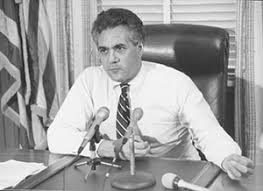 I’ll get to the depressing news from Trump world, but first, we’ve lost one of the good guys.
Former Massachusetts Congressman Barney Frank has died at 86. It was expected; he’s been in hospice care, but still it’s a sad day.
He was the opposite of Trump: he was good humored, funny, honest as the day is long, and he truly cared about our country and its people.
I’m devoting the remainder of this post to the incredibly corrupt bargain Trump has struck with his own “justice” department and IRS.
Kathryn O. Seelye at The New York Times: Barney Frank, Gay Pioneer and Liberal Stalwart in Congress, Dies at 86.
Barney Frank, the brassy, lightning-quick former Massachusetts representative who for decades was the most prominent gay politician in the country and who was an author of the most significant overhaul of the nation’s financial regulations since the Great Depression, died on Tuesday at his home in Ogunquit, Maine. He was 86.
His friend James Segel confirmed the death. Mr. Frank said last month that he had entered hospice care with congestive heart failure.
Mr. Frank, a liberal Democrat who represented a diverse suburban Boston district for 32 years, starting in 1981, was the first gay member of the House to come out voluntarily; others had been outed in scandals. His public declaration of his sexual orientation in 1987 — spurred by a fear of being outed, by the death of a closeted colleague and by his own determination to show that homosexuality was nothing to be ashamed of — helped normalize being openly gay in public life.
“Prejudice is based on ignorance,” Mr. Frank told The Boston Globe in 2011, as he prepared to retire. “And the best way to counterbalance it is with a living example, with reality.”
A Harvard-trained lawyer, Mr. Frank bristled with intellectual firepower, acidic turns of phrase and a zest for verbal combat.
Barney Frank
His shivs were often cloaked in wit. Referring to the Moral Majority, the conservative Christian organization that opposed abortion but also opposed child nutrition programs and day care, Mr. Frank said in 1981: “From their perspective, life begins at conception and ends at birth.” Of the flawed intelligence behind the U.S.-led invasion of Iraq that led to nearly a decade of combat, he said the problem “is not so much the intelligence as the stupidity.”
In Washingtonian magazine’s annual poll of Capitol Hill staffers, he was frequently voted the “brainiest,” “funniest” and “most eloquent” member of the House.
His most significant legislative achievement was in the realm of financial regulation. The Dodd-Frank Wall Street Reform and Consumer Protection Act, which he sponsored with Senator Christopher Dodd of Connecticut, tightened rules on the financial industry as part of the government’s response to the housing crisis of 2007 and the global financial meltdown the next year.
Signed into law by President Barack Obama in 2010, the measure sought to prevent the nation’s biggest banks from engaging in excessively risky behavior and to protect consumers from unfair practices by banks and lenders. Congress watered it down in 2018, chiefly by exempting smaller and midsize banks from stricter oversight, but it remained largely intact.
Mr. Frank was also known for championing gay rights, civil rights and women’s rights. He did so by force of personality and by example. He insisted that his male partner be invited to all events to which the spouses of other representatives were invited. In 2012, at age 72, he married Jim Ready and became the first sitting member of Congress to wed someone of the same sex.
He also worked quietly behind the scenes to advance his causes. In one of many examples, according to his memoir, “Frank: A Life in Politics From the Great Society to Same-Sex Marriage” (2015), he helped persuade President Bill Clinton not to appoint Senator Sam Nunn of Georgia as secretary of state because of his track record of homophobia.
One more on Barney Frank by Daniel Arkin at NBC News: Former Rep. Barney Frank, champion of Wall Street reform and LGBTQ trailblazer, dies at 86.
Barney Frank, the quick-witted Massachusetts congressman and liberal lion who helped overhaul Wall Street regulations after the 2008 financial crisis and made history as one of the first openly gay members of Congress, died Wednesday, his sister confirmed to NBC Boston.
He was 86. He had entered hospice care at his home in Maine last month.
“He was, above all else, a wonderful brother. I was lucky to be his sister,” Frank’s sister Doris Breay told NBC Boston.
Frank represented southern Massachusetts in the House for 32 years and established himself as a leading voice in debates over banking, affordable housing and LGBTQ rights. He chaired the Financial Services Committee amid the 2008 meltdown and co-authored the milestone Dodd-Frank Act, a sweeping law that sought to put Wall Street firms under tougher scrutiny.
He blazed a trail for other openly gay American elected officials, and in 2012, he became the first member of Congress to enter into a same-sex marriage, tying the knot with his longtime partner, Jim Ready.
“It was life-changing, lifesaving for me,” Frank told NBC News in a phone interview in last month.
“I think the key to our having made the enormous progress we made in defeating anti-gay prejudice had to do with us all coming out and people discovering the gap between our reality and the way we were painted,” he added.
Rep. Nancy Pelosi, D-Calif., the former House speaker, who served with Frank for more than 25 years, described him as progressive and an idealist in an interview with NBC News last month.
“He has been about idealism and pragmatism to get the job done,” said Pelosi, who was speaker when Frank shepherded Dodd-Frank through Congress. Frank called Pelosi last month to inform her that he was receiving hospice care, she said.
“He was a real mentor to so many of us here,” Pelosi said. “I was with him” on the Banking Committee “in the beginning. I learned so much.”
What a contrast he was to the bunch of crooks we’re dealing with today.
A couple of days ago, the White House announced a “settlement” of Trump’s $10 million lawsuit against his own IRS. He created an “anti-weaponization fund” to pay out reparations to the thugs who attacked the Capital on January 6, as well as anyone who thinks they were wrongly prosecuted during Joe Biden’s presidency. Then yesterday we learned that, as part of the “settlement,” Trump and his entire family are forever exempt from past IRS investigations. This is obviously illegal, unconstitutional and most likely an impeachable offense, but so what? Trump does whatever he wants.
Ray Brescia at MSNOW on the “settlement”: Trump’s nearly $1.8 billion ‘Anti-Weaponization Fund’ is simply indefensible.
After filing a highly unusual lawsuit in which President Donald Trump sued his own administration’s Internal Revenue Service, he settled it through his acting attorney general — also his former personal lawyer, Todd Blanche — setting up a team of “volunteers” to dole out nearly $1.8 billion in taxpayer money out of what the Department of Justice calls “The Anti-Weaponization Fund.”
The president did so in a way to avoid any judicial oversight of his or the Justice Department’s actions. It is hard to imagine a situation more susceptible to fraud, grift, corruption and abuse. And the lawsuit itself was probably unconstitutional to begin with.
The lawsuit came after a report from The New York Times revealed that Trump had only paid $750 in federal income taxes in 2016 and 2017. The complaint against the IRS, filed by Trump, two of his adult sons and the Trump Organization, said the leak caused the plaintiffs “reputational and financial harm” and “public embarrassment.”
Judge Kathleen Williams
The judge assigned in the case, Kathleen Williams of the U.S. District Court for the Southern District of Florida, issued an order last month pointing out the strange nature of the lawsuit and expressing fear that it did not exhibit the type of “adversity” that is typically an essential ingredient of any federal lawsuit, a requirement of the U.S. Constitution.
Citing relevant and consistent precedent on this point, she wrote that a “key characteristic of the case or controversy requirement” in the Constitution “is the existence of adverseness, or ‘a dispute between parties who face each other in an adversary proceeding.’” She noted that there must be an “‘an honest and actual antagonistic assertion of rights by one individual against another, which is neither feigned nor collusive.’” She added: “It is unclear to this Court whether the Parties are sufficiently adverse to each other so as to satisfy Article III’s case or controversy requirement.” [….]
…Judge Williams asked the parties to submit their written arguments to the court by May 20, 2026, and indicated she would hold a hearing on this question on May 27, 2026.
Whether this means the settlement will not face legal challenge remains to be seen. For now, the administration appears poised to create a nearly $1.8 billion slush fund set up by the administration and capitalized with taxpayer dollars. It will be administered by individuals chosen only by the administration, outside any sort of review.
Politico’s Josh Gerstein and Danny Nguyen on the latest outrage: Justice Department expands Trump settlement to cover his tax audits.
The Justice Department on Tuesday expanded the just-announced settlement of President Donald Trump’s lawsuit over the leaking of his tax returns to include a pledge that the IRS will no longer pursue any claims it may have against Trump, his family members and his companies over unpaid taxes.
The nine-page settlement agreement DOJ released Monday, setting up a nearly $1.8 billion fund to compensate victims of alleged weaponization of law enforcement, did not mention any resolution of disputes over Trump’s tax returns, which he has repeatedly claimed were under protracted audits by the IRS.
However, a one-page document posted on the DOJ website early Tuesday includes a sweeping release under which the IRS is “forever barred and precluded” from pursuing “examinations” of Trump, “related or affiliated individuals,” and related trusts and businesses.
Acting Attorney General Todd Blanche signed the addendum, dated Tuesday. It does not bear the signature of any representative of the IRS or any current Trump lawyers. Metadata attached to the document indicates it was prepared or scanned at 7:50 a.m. Tuesday.
Blanche did not sign the original settlement agreement, which was signed by Associate Attorney General Stanley Woodward, IRS CEO Frank Bisignano and Trump attorney Daniel Epstein….
“This is only with respect to existing audits, not future,” the DOJ statement added.
John Koskinen, the former IRS commissioner from 2013 to 2017, said the expanded settlement set a “terrible precedent” that could effectively generate a windfall for Trump.“It makes you wonder what the President has to hide in those tax returns. He’s apparently been actively trading in the stock market and, since he knows a lot more about situations than the average investor, he’s probably generated significant taxable earnings,” he said in an emailed statement. “Not auditing his returns is the same as giving him an easy way to, in effect, receive money from the government.”
Danny Werfel, the former IRS commissioner from 2023 to 2025, said he was “unaware of a single precedent where the IRS has agreed in advance to permanently forgo examination of previously filed tax returns for a specific person or business.”
Joyce Vance at Civil Discourse: Almost as good as a pardon.
There is corruption. And then there is the second Trump administration.
Monday night I wrote to you about kleptocracy. This evening, we pick up the same thread. It has to do with the $1.776 billion slush fund we discussed last night (get it? so cute that number, 1776; such an homage to the Founding Fathers). That fund, the money that Trump is trying to “give” to his most vociferous, even violent, supporters, was created to settle the lawsuit he brought against the IRS. Today, there is more news about the terms of that settlement. Kleptocracy. Corruption.
Acting Attorney General Todd Blanche
Todd Blanche, the acting Attorney General, testified before the Senate today. In one remarkable exchange, Delaware Senator Chris Coons asked Blanche:
“Has it ever happened that a sitting president sued his own government for $10 billion dollars and then directed the settlement of the case and the establishment of a payout fund?”
Blanche responded: “No, but there’s a lot of things that President Trump is the first of.”
Another one of those firsts happened today. Not a good one. Without fanfare, DOJ posted a settlement document on its website in the case. It was unexpected, because we’d already seen a settlement agreement in this case, the one we looked at last night. There was no reason to expect anything additional would be forthcoming. When it showed up, the addendum came without any title, just a date at the top….
It’s a pardon on steroids for Trump, Trump’s family, and Trump businesses. The government agrees in this document, signed by Blanche, that it will never prosecute or pursue any civil claims against any of the Trumps, “whether presently known or unknown” that could have been brought as of the date of the settlement agreement. That date is yesterday. The IRS is “forever barred and precluded” from pursuing “examinations” of Trump, “related or affiliated individuals,” and related trusts and businesses. Any proceeding over “tax returns filed before the effective date” of the settlement is now off limits. Any crimes committed before Monday, whether prosecutors were aware of them or not, are off the table. It’s a virtual get-out-of-jail-free card, and also a get-out-of-debt one.
I’ve seen a lot of settlement agreements, but never one like this where the government is giving the store away and getting nothing in return. As we discussed last night, the underlying lawsuit was on life support, most likely about to be dismissed because of legal flaws. Now, it’s become a vehicle for protecting Trump from all problems, criminal and civil, and not just tax matters—the subject of the lawsuit—but all matters. Any sins he may have committed or debts he owed but didn’t pay before now are forgiven.
You can read the rest along with the previous post at Civil Discourse.
Alan Feuer at The New York Times: Prison to Pardons to Payouts: Jan. 6 Rioters Are Elated at Trump’s $1.8 Billion Fund.
Antony Vo was at a friend’s house on Monday morning when a fellow pardoned Jan. 6 rioter sent a message: The Trump administration had just created a fund to benefit people who believed they had been wronged by the federal government — including those, like him, who had stormed the Capitol five years ago.
Mr. Vo, who briefly fled the country to avoid his prison sentence stemming from the riot, said he did not know at first that the fund had come about as part of a larger deal by President Trump to withdraw an extraordinary lawsuit filed against the Internal Revenue Service. But the origins of the fund, he said, were less important than how it made him feel: surprised, relieved and grateful all at once.
“I’m glad it turned into something,” he explained, “that could help people who have been hurting for quite a while now.”
That reaction, it turns out, appeared typical among the so-called Jan. 6ers who have long joined Mr. Trump in claiming that the efforts to hold them accountable for disrupting the peaceful transfer of power after the 2020 election amounted to mistreatment by the criminal justice system.
Some felt that the fund validated their self-image as victims of the government. Others felt elated — albeit somewhat stunned — at the prospect of a payout. And not a few felt a bit confused at how the process of filing claims and receiving checks could play out.
“So many questions,” said Enrique Tarrio, the leader of the far-right Proud Boys who was sentenced to 22 years on a seditious conspiracy conviction arising from the riot. “But it’s a good direction.” [….]
The possibility that people who ransacked the Capitol, smashing windows and fighting with the police, could get money from the same federal government they attacked was the latest head-spinning twist in the effort to rewrite the history of Jan. 6. At a congressional hearing on Tuesday, Todd Blanche, the acting attorney general, did not rule out violent rioters receiving payouts from the fund.
It has not been lost on many Jan. 6ers that by deeming them worthy of reparations, the most powerful officials in the country have effectively validated their claims of having been wronged by the federal government — claims that, in many instances, were roundly rejected by the judges of both parties who oversaw their cases.
“This is the UNITED STATES DEPARTMENT OF JUSTICE acknowledging the possibility that Americans were targeted through political abuse of government power,” Tommy Tatum, a Mississippi man who was charged with civil disorder for interfering with the police on Jan. 6, wrote on Monday in a post on social media. “That is historic.”
It’s obvious at this point. Trump is going to pay these people to do it again. He has no intention of leaving in 2029. If the second insurrection doesn’t work, then he’ll barricade himself in the basement of his precious ballroom.
Are Congressional Republicans just going accept this monumental level of corruption from Trump? Hailey Fuchs, Jordain Carney and Josh Gerstein at Politico: Trump’s $1.8 billion ‘lawfare’ fund is making Republicans nervous.
Senate Republicans are greeting the Justice Department’s announcement of a new “Anti-Weaponization Fund” with concern, confusion and questions — and acting Attorney General Todd Blanche is offering up little clarity on how it will work.
At a Senate Appropriations subcommittee hearing Tuesday morning, Blanche fielded queries from members of both parties about the logistics of the $1.8 billion account, who would have oversight and whether it could function as a “slush fund” for individuals who stormed the Capitol on Jan. 6, 2021.
Democrats are, predictably, enraged by the terms of the settlement for President Donald Trump’s $10 billion lawsuit against the government for the leak of his tax information, which resulted in the creation of this account to benefit targets of “weaponization and lawfare.”
But Republicans are also signaling deep discomfort with the arrangement, as well as frustration that they weren’t given the answers they were looking for.
“I’ve got more questions than I’ve heard answers for, and … I didn’t hear anything that gave me certainty in terms of how this all comes together,” said Sen. Lisa Murkowski (R-Alaska), after attending the hearing with Blanche. “Can the president just say $1.87 billion? … I don’t know enough about it to feel comfortable.”
Sens. Susan Collins of Maine and Jerry Moran of Kansas — the top Republicans on the full Appropriations committee and the panel that oversees DOJ funding, respectively — both pressed Blanche at the hearing to explain how payouts from the fund would be managed and who might receive them.
If Democrats can manage to win he House and Senate, the first order of business must be to impeach and remove Trump. We can’t allow him to remain in office for the rest of his term, or we’ll never get rid of him.
There has already been some pushback. Ryan J. Reilly at NBC News: John Adams quote projected on DOJ building in protest of $1.8B fund.
Opponents of a $1.776 billion taxpayer-backed “anti-weaponization” fund projected a quotation from one of the Founding Fathers onto the Justice Department building in protest.
“A government of laws, not of men,” read the quotation from John Adams, the second president.
The quotation was shown over one of the large banners of President Donald Trump that were set up in February at the Justice Department headquarters, known as “Main Justice.”
Stacey Young, a former Justice Department employee who founded the group Justice Connection, which projected the phrase onto the building, told NBC News that the “$1.8 billion slush fund” was “appalling.”
“We are standing up for department’s integrity and the rule of law,” Young said outside the building. The Justice Department is operating “as an arm of the White House” and doing Trump’s bidding by protecting his allies and going after his enemies, she said.
“That is an extraordinary abuse of power, and it’s a sign that the rule of law is crumbling before our eyes,” Young said.
Justice Connection said the Trump administration “shifted the country away from a system of laws and toward an era of lawlessness,” citing the firing of prosecutors who worked on Jan. 6 cases and “cash payments” to Capitol riot defendants it expects the Trump administration to pay out.
One more from Josh Gerstein at Politico: Jan. 6 police officers sue to block Trump’s ‘anti-weaponization fund.’
Police officers who came under attack by rioters at the Capitol on Jan. 6, 2021, filed a lawsuit Wednesday seeking to halt President Donald Trump’s plan to set up a nearly $1.8 billion fund to compensate victims of “weaponization” and “lawfare.”
In the new lawsuit, former Capitol Police Officer Harry Dunn and Metropolitan Police Department Officer Daniel Hodges contend that Trump intends to use the massive bankroll to pay people who organized and participated in the riot.
“Dunn and Hodges did not back down on January 6. Instead, they held the line to defend democracy and the rule of law. They bring this case to do so once again,” the lawsuit says.
That’s all I have for today. What’s on your mind?
Lazy Caturday Reads: America In Decline
Posted: May 16, 2026 Filed under: just because | Tags: cat art, caturday, Donald Trump, ethics, Graham Allison, Kash Patel, Pearl Harbor, Peter Hegseth, Poland, Taiwan, Thucydides' trap, Trump's China Trip, Xi Jinping 3 CommentsGood Afternoon!!

Prominent Chinese contemporary artist and activist Ai Weiwei
The aftermath of Trump’s lackluster China trip is still a top story today. The consensus of the pundits is that the trip was a failure. Trump looked tired, weak, and indecisive. Today, the main concern is that he is ready to sell out Taiwan in his efforts to suck up to Xi Jinping.
Analysis by New York Times China Correspondent Chris Buckley: Trump Makes a High Risk Move to Win Over Xi.
President Trump has described a potential multibillion-dollar weapons sale to Taiwan as a “negotiating chip” with China, raising new doubts about the pace and scale of American military support for the island democracy.
Taiwan’s government has been waiting for months for Mr. Trump to sign off on a $14 billion package of missiles, anti-drone equipment and air-defense systems intended to fortify the island against Beijing’s military threats.
Mr. Trump himself had pressured Taiwan to spend more on its own defense. Now he is using the very arms his administration had pushed the island to buy as leverage with China, the United States’ main adversary.
Mr. Trump told reporters on Air Force One after leaving China on Friday that he had discussed the weapons package with China’s president, Xi Jinping, during their summit this past week in Beijing. He was asked in an interview with Fox News whether he would approve the Taiwan deal.
“No, I’m holding that in abeyance and it depends on China,” he said in the interview, which was recorded in Beijing but aired after he left. “It depends.”
“It’s a very good negotiating chip for us, frankly,” he said. “It’s a lot of weapons.”
He did not go into details about what he wanted in return, but Mr. Trump has pushed China to make major purchases of American airplanes, ethanol, soybeans, beef and sorghum.
His comments appear to undermine the assurances to Taiwan from some in his own administration that U.S. support for the island is steadfast and nonnegotiable. Before the summit, a bipartisan group of senators had urged against letting support for Taiwan become a bargaining chip with China.
“It looks increasingly likely that Trump will indefinitely withhold the $14 billion arms package to Taiwan, in the hopes that Beijing will give him what he wants on the economic front,” said Amanda Hsiao, a China director at Eurasia Group, a consulting firm….
If Mr. Xi wants to punish the Trump administration over Taiwan, analysts have said, China could hold back on orders of farm goods, or ramp up restrictions on exports of rare earths that are essential to many technology components. But Mr. Xi also agreed to make a state visit to the United States this year, and could use the prospect of more talks — and more deals — to influence Mr. Trump.
Trump will sell out every one of our allies before he’s done.
Ian Aikman at BBC News: Trump warns Taiwan against declaring independence, hours after summit with China’s Xi.
US President Donald Trump has cautioned Taiwan against formally declaring independence from China.
“I’m not looking to have somebody go independent,” the US president told Fox News on Friday, at the end of his two-day summit with his Chinese counterpart Xi Jinping in Beijing.
This photograph features the American author Ursula K. Le Guin holding her cat
Taiwanese President Lai Ching-te has previously stated that Taiwan does not need to declare formal independence because it already sees itself as a sovereign nation.
The US has long supported Taiwan, including being bound by law to provide it with a means of self-defence, but has frequently had to square this alliance with maintaining a diplomatic relationship with China.
Trump earlier said he had “made no commitment either way” about the self-governing island – which China claims as part of its territory and has not ruled out taking by force.
Washington’s established position is that it does not support Taiwanese independence, with continued ties with Beijing being contingent on its acceptance that there is only one Chinese government.
Beijing has been vocal in its dislike of Taiwan’s president, who it has previously described as a “troublemaker” and a “destroyer of cross-strait peace”.
Many Taiwanese consider themselves to be part of a separate nation – though most are in favour of maintaining the status quo in which Taiwan neither declares independence from China nor unites with it.
A bit more:
In his interview with Fox News, Trump reiterated that US policy on the matter had not changed.
“You know, we’re supposed to travel 9,500 miles (15,289km) to fight a war. I’m not looking for that. I want them to cool down. I want China to cool down.”
On the flight back to Washington, the US president had told reporters that he and Xi had spoken “a lot” about the island, but said he had declined to discuss whether the US would defend it.
Xi “feels very strongly” about the island and “doesn’t want to see a movement for independence”, Trump said.
Taiwan is actually about the same distance from the US as Iran.
During one of their public meetings, Xi warned Trump to beware of the Thucydides’ Trap. Xi was suggesting that the US is an empire in decline as China rises. Of course Trump had no clue what Xi was talking about until someone filled him in later. then he responded with an idiotic Truth Social post claiming that Xi was referring only to American under Biden.
Chad de Guzman at Time: Xi Warns Trump of ‘Thucydides’ Trap.’ What to Know About China’s Favorite Greek Reference for U.S. Relations.
The world has come to another crossroads,” Chinese President Xi Jinping told U.S. President Donald Trump on Thursday, as the two leaders began their summit in Beijing. Then Xi asked: “Can China and the U.S. overcome the so-called ‘Thucydides Trap’ and create a new paradigm of major-country relations?”
Xi was referring to the ancient Athenian historian and military commander Thucydides, who wrote The History of the Peloponnesian War, recounting the nearly three-decade conflict between the former Greek poleis (city-states) of Athens and Sparta. In his account, he wrote: “The growth of the power of Athens, and the alarm which this inspired in Lacedaemon [Sparta], made war inevitable.”
Actor Morgan Freeman posing with a black cat.
While debate on the accuracy of translations continues, the core message stuck: this “inevitability” of conflict when a rising power threatens an existing one was later popularized by American political scientist Graham Allison in the early 2010s as “Thucydides Trap.” But in the modern context, China is Athens, challenging the U.S. as today’s Sparta.
Writing for the Financial Times in 2012, Allison said that “the defining question about global order in the decades ahead will be: can China and the U.S. escape Thucydides’s trap?”
Allison expanded on the “trap” idea further in his 2017 bookDestined for War: Can America and China Escape Thucydides’s Trap?, which argued that the two countries were “on a collision course for war—unless both parties take difficult and painful actions to avert it.” Allison enumerated 16 historical cases of rising and established geopolitical powers facing the “trap,” 12 of which ended in war.
Xi’s invocation of Thucydides’ Trap comes at a time when tensions between the rival superpowers could boil over on any of a number of issues, from trade to AI to Taiwan.
It’s an interesting article. I admit I had never heard about this before, but apparently this idea has been a favorite of Xi’s for many years. De Guzman notes several times that Xi has brought it up with U.S. leaders. A bit more:
It’s not just China referencing the Athenian historian and maxim. During Trump’s first presidential term, national security adviser H.R. McMaster was a known Thucydides buff. He wrote for the New York Times in 2013: “War is human. People fight today for the same fundamental reasons the Greek historian Thucydides identified nearly 2,500 years ago: fear, honor and interest.”
Politico also reported that in 2017 Allison briefed Trump’s National Security Council on Greek history and that then-Defense Secretary James Mattis was “fluent” in Thucydides’ work.
In a February 2018 interview with GQ, Steve Bannon, Trump’s former campaign and White House strategist who is also a reported Thucydides aficionado, was asked if he was worried about starting a conflict with China “that the U.S. would lose.” In response, Bannon told the magazine, “I don’t think it has to happen. First off, the whole concept of the rising power and the declining power presupposes that the larger power that’s declining continues to decline.” He argued that Trump’s “America First” paradigm actually “revitalizes the United States of America and puts China on notice.”
Except Trump isn’t putting American first.
Franklin Foer at The Atlantic on the China trip (gift article): Xi Jinping Was Only Humoring Trump.
Spare a moment, please, for the lame-duck superpower. It calls itself the leader of the free world, but the free world no longer believes it. When it extends its hand, nobody rushes to accept. When it threatens, nobody trembles.
After President Trump arrived in Beijing this week, Xi Jinping showered him with pomp befitting a summit of great powers. Yet the Chinese leader permitted potshots at his guest to go viral on his country’s internet rather than suppressing them, as some observers expected he would during a state visit. Xi answered Trump’s lavish praise by sternly lecturing him about meddling with Taiwan. In the end, Xi offered nothing of great substance—no solutions to the war in Iran, no sweeping trade deals, no promises of access to rare earth minerals. Xi used the visit to humor the lame-duck president, waiting for his time to pass.
Argentine author Jorge Luis Borges with a cat, a frequent subject in his life and work.
During the first Trump administration, foreign leaders flattered and accommodated the president out of deference to American power. They feared it; they relied on it. During the second administration, and especially since the beginning of the Iran war, their calculus has quietly shifted—not because the strategy of obsequiousness has failed, but because it’s no longer worth the trouble. Like many of his counterparts around the world, Xi has begun to assume that it’s not just Trump who is term-limited; it’s also his nation.
Trump’s war in Iran was meant to showcase American power. It did the opposite. In the course of failing to remove a much weaker regime or eliminate its nuclear threat, the United States blew through its arsenal—so much so that allies in the Pacific reasonably wonder whether enough munitions remain to protect them. According to The Wall Street Journal, the Pentagon is now worried that it lacks the firepower to execute contingency plans for defending Taiwan.
Supporters of the war argued that it would deal China a severe blow by eliminating one of its most potent allies. But the Gulf nations most threatened by Iran have actually turned to China. As first reported by The Washington Post, an intelligence assessment prepared for the chair of the Joint Chiefs of Staff warned that those countries have begun acquiring from Beijing the systems needed to protect their oil infrastructure and bases. Trump didn’t just fail to weaken China’s position in the Middle East. He strengthened it.
Without exerting itself much, Beijing has profited from America’s self-immolation. China’s petroleum reserves and its investments in renewable energy have allowed it to offer Thailand, the Philippines, and Australia relief from the energy crisis that the United States instigated. Instead of applying diplomatic pressure on Iran to cut a deal, China has let the conflict linger, so that the United States continues to bear the blame for the disruptions to shipping. Meanwhile, China poses as the faithful steward of the rules-based order—the cooler head, the power on which even the U.S. must now rely.
Foer argues that Iran is using the same strategy, letting American weaken itself.
Use the gift link to read the rest.
One more on this subject from Timothy Snyder at Project Syndicate: America’s Superpower Suicide.
The United States is spending billions of dollars to lose a war in Iran that is enriching its oligarchs, impoverishing its citizens, sabotaging its alliances, and strengthening its enemies. The war is exposing a guiding principle of US President Donald Trump’s foreign policy: superpower suicide. Empires rise and fall, but to my knowledge no state has ever deliberately, and systematically, killed its own power—much less with such speed.
This strategic suicide can be difficult to admit: one still hopes that Trump’s misadventures are based on some understanding of the American national interest. They are not.
Alejandro Jodorowsky, a Chilean-French filmmaker, playwright, author, and spiritual guru.
At a minimum, a superpower must be a modern state that includes, through the rule of law and other institutions, a substantial body of citizens committed to a common endeavor. But the Trump administration treats the US not as a modern state but as a commercial opportunity for a select few.
A superpower must also have a sense of the national interest. While international relations experts disagree about how leaders define this concept, we are unprepared for a situation in which the president is indifferent to the good of the people or the state.
To remain a superpower, a state must also maintain itself over time. Continuity depends on a principle for transferring political authority. By aspiring to remain in power indefinitely and undermining faith in elections, Trump is calling into question the principle that enables political succession in the US. There are of course other ways of going about it, like dynastic rule or a politburo’s decision. Moving to one of these arrangements—one could image the coven of tech oligarchs responsible for the rise of Vice President JD Vance as a capitalist politburo—would end the American republic.
Ensuring that the right people are in charge is crucial for a state to gain and maintain power. Historically, powerful states sought ways to identify and elevate qualified people to serve in positions of authority, regardless of birth. Ancient China had an examination system. Napoleon established the principle of merit in both civilian and military life.
The US, for its part, once had a civil service that was the envy of the world, as well as a highly meritocratic military. But the Trump administration has gutted the civil service and purged the military’s senior ranks—a process carried out by people who are themselves unqualified for the positions they occupy. The fact that Tulsi Gabbard, Kash Patel, and Pete Hegseth are now, respectively, Director of National Intelligence, FBI director, and defense secretary is a clear indicator of a superpower committing suicide.
Read the rest a the link above.
Trump stabbed another ally in the back yesterday, reducing the number of troops in Poland not long after he did the same thing in Germany.
Military Times: Army leaders in hot seat over Poland deployment cancellation.
Army leaders struggled Friday to respond to congressional furor over the Pentagon’s decision to abruptly cancel a deployment of more than 4,000 soldiers to Poland this month.
Portrait of author Doris Lessing taken in 1984 by photographer Marianne Majerus.
Acting Army Chief of Staff Gen. Christopher LaNeve said in an Army budget hearing that the order to halt a planned 9-month rotation to Europe by 2nd Armored Brigade Combat Team, 1st Cavalry Division to Eastern Europe came from Defense Secretary Pete Hegseth.
LaNeve and Army Secretary Dan Driscoll said they were informed of the order and had been consulted, but they wouldn’t provide the exact timing of the decision. On May 1, the unit had cased its colors in preparation for deployment, dispatched its advanced team and launched its equipment overseas.
Soldiers began discussing the decision to scrap the deployment publicly early Tuesday morning; the order was confirmed Wednesday by Army Times and other news media.
LaNeve said the decision was made “in the last two weeks” by the Defense Department and Gen. Alexus Grynkewich, commander of U.S. European Command and the NATO Supreme Allied Commander Europe.
LaNeve and Driscoll downplayed the move as part of routine manning reviews conducted throughout the year.
Politico: ‘Slap in the face’: Republicans skewer Pentagon over Poland move.
Top Republicans on Friday condemned the Pentagon for canceling a U.S. troop deployment to Poland, an abrupt move that also appeared to catch Army leaders by surprise.
The decision, House Armed Service Committee members said, amounted to a gut punch to the NATO ally and to a Congress that has sought to beef up the U.S. presence in Europe. They made those frustrations clear at a hearing with Army officials, where the service’s top civilian and uniform leaders had few answers about the rationale for the move and confirmed its last-minute timing.
“I just want to say this is a slap in the face to Poland; it’s a slap in the face to our Baltic friends,” Rep. Don Bacon (R-Neb.) said. “It’s a slap to the face of this committee.”
The move is the latest in a rift between the Trump administration and Republicans on Capitol Hill who have been at odds over U.S. security interests in Europe. Lawmakers enacted limits on troop withdrawals from Europe last year amid concerns the administration would unilaterally scale back troops on the continent.
“We don’t know what’s going on here, but I can just tell you we’re not happy with what’s being talked about, particularly since there’s been no statutory consultation with us,” Armed Services Chair Mike Rogers (R-Ala.) said.
Another sickening move by Hegseth:
The Guardian: Pentagon quietly shut legally required program to prevent civilian deaths by military, watchdog finds.
The Pentagon hasquietly dismantled a program it is legally required to operate to prevent and respond to civilian deaths in US military operations, according to its internal watchdog.
Japanese manga artist Fujio Akatsuka working at his desk alongside his pet cat, Kikuchiyo
A report released by the department’s inspector general concluded the US military no longer has the people, tools or infrastructure needed to comply with two federal statutes requiring it to maintain a functioning civilian casualty policy, and operate a Civilian Protection Center of Excellence (CP CoE).
Donald Trump’s administration has been accused of making deep cuts to the Pentagon’s civilian harm mitigation and response (CHMR) program, designed to handle training and procedures critical in limiting civilian harm in theaters of war.
While the program has not been officially canceled, the inspector general’s report said that funding had ended for a data management platform; committee meetings had halted; and many dedicated personnel had been lost or reassigned.
“As a result, the DoW [BB comment: actually Department of Defense] may not comply with its civilian casualties and harm policy,” the report read. “A policy required by federal law.”
One more article, not on the Iran war or China, but symptomatic of the decline of the U.S.
Elizabeth Williamson and Adam Goldman at The New York Times (gift article): Snorkeling at Pearl Harbor: Kash Patel’s Travels Add to Focus on Ethical Issues.
Last summer, the F.B.I. director, Kash Patel, capped a whirlwind South Pacific trip with a snorkel trip in Hawaii.
There, Navy SEALs used two boats to transport and escort Mr. Patel and nine other people on what a Defense Department email called a “V.I.P. Snorkel” next to one of the military’s most sacred sites, the underwater tomb of the U.S.S. Arizona that holds the remains of more than 900 Navy sailors and Marines who died at Pearl Harbor.
Mr. Patel swam in the vicinity of the tomb for 30 minutes, according to the Navy.
shows the famous Austrian Symbolist painter Gustav Klimt (1862–1918) holding his pet cat.
Out of respect for the dead entombed in the wreck of the Arizona, rules bar visitors even from wearing swimwear at the memorial. With some exceptions over the years for dignitaries, the only people allowed in the water around the tomb are military and National Park Service divers interring the remains of the last Arizona survivors in the wreck, or conducting annual maintenance surveys, according to a former Navy officer and a former National Park Service official familiar with restrictions at the site.
Officials from the Navy and the Defense Department said V.I.P. “tours” near the Arizona were common, but they declined to say how often they take people snorkeling. A Navy spokeswoman declined to identify the nine people who joined Mr. Patel on the trip. The F.B.I. said that Adm. Samuel J. Paparo Jr., the head of the United States Indo-Pacific Command, invited Mr. Patel to Pearl Harbor….
The idea of a high-ranking government official receiving an escort from the SEALs for a recreational swim near the tomb is “horrifying,” said William M. McBride, a Navy veteran and professor emeritus of history at the U.S. Naval Academy in Annapolis.
“This is a war grave with the same legal status as Arlington National Cemetery,” Mr. McBride said in an interview. “Snorkeling around Arizona is as disrespectful as playing kickball on top of the graves at Arlington.”
The Pearl Harbor trip was at the end of an itinerary in which Mr. Patel visited F.B.I. facilities in Hawaii, Australia and New Zealand. Disclosure of the snorkeling tour, and new details about other trips he has taken, comes as Mr. Patel is already under scrutiny for blending leisure travel with official business or instructing F.B.I. employees to make accommodations for him and his girlfriend, Alexis Wilkins….
Mr. Patel’s use of government jets and F.B.I. agents for himself and Ms. Wilkins has drawn bipartisan criticism and led to growing questions even inside the Trump administration about whether it exceeds the bounds of standard practice.
“The badge is a responsibility, not a V.I.P. pass,” said Rob D’Amico, a former F.B.I. special agent and hostage rescue team operator. With Mr. Patel, he said, “the pattern is clear — exotic locations, exclusive access that no member of the public could ever get, and a support staff working overtime to make it happen.”
F.B.I. policy requires its directors to use government planes for all air travel, personal as well as professional. The director is required to reimburse the government for private trips at the cost of coach travel, and the F.B.I. said Mr. Patel has done so.
But in his travels on F.B.I. aircraft, Mr. Patel has made time for side trips, including to V.I.P. suites for events, leisure activities or nights out with his girlfriend. The F.B.I. declined to say who paid for one of those evenings out, a previously unreported trip with Ms. Wilkins to a country music concert in Philadelphia, where they arrived on a Gulfstream V government jet and were spotted in a private suite that rents for upward of $35,000.
Having Patel as FBI director is a joke. But most of Trump’s other appointees are just as ridiculous. As Timothy Snyder wrote (see above article) “Ensuring that the right people are in charge is crucial for a state to gain and maintain power.”
That’s all I have for you today. What’s on your mind?
Wednesday Reads: Shootout on Memorial Drive and Other News
Posted: May 13, 2026 Filed under: just because | Tags: Assault rifles, Donald Trump, inflation, iran, Natalie Harp, Shooting in Cambridge MA, Trump China visit, Trump's poll numbers, Trump's social media addiction, Truth Social, Tyler E.. Brown, U.S. Economy 6 CommentsGood Afternoon!!
I’m going to begin with a local story today. On Monday, we had a terrible shooting incident not far from where I live, and I can’t understand why it hasn’t gotten more national coverage. It makes me wonder how many really awful shooting incidents just get ignored by the mainstream media. There were a couple of stories yesterday–one in The New York Times–but no TV coverage as it was happening.
Here’s what happened. A man with an assault rifle made his way to a stretch of Memorial Drive in Cambridge–a very busy road, one of two routes into Boston from outlying towns. The road passes the Harvard and MIT campuses and splits off to the bridge the leads to the BU campus.

A still frame from witness video showing a gunman on Memorial Drive in Cambridge, Massachusetts.
The guy began firing his weapon, getting off as many as 30 rounds at once. He fired at cars and drivers randomly, eventually walking down the middle of the road, waving the rifle around. Hundreds of cars were abandoned, as people ran for their lives. One bullet went through the windshield of a post office truck and just missed the driver’s head. So far there haven’t been any fatalities, but two drivers were shot and are in critical condition. I heard this morning that one of them is expected to live.
The entire stretch of Memorial Drive, from the edge of the Harvard Campus to MIT as well as the bridge to BU were shut down and treated as a crime scene. I can’t even begin to imagine the struggle people had getting home on Monday night.
This all took place just a short distance from where my brother lived for years and right in front of the gas station where I used to take my nephews for Italian ice in the summer. (Interestingly, this is also the gas station where the Boston bombers stopped for gas as they tried to escape. During that stop, the man whose car they had highjacked escaped and ran to another gas station across the way to call police.)
It turns out the shooter was on probation and had had met with his probation officer on Facetime on Monday morning. He had shown the rifle and given indications that he was suicidal, so the probation office had notified law enforcement, and they were tracing the shooter, I guess by his phone. They knew he was in Cambridge, so they were able to respond quickly when the 911 calls starting coming in. The shooter was taken down by a state police officer and a civilian–a former marine with a legal gun. So far the ex-marine hasn’t been named. He would probably be wise to remain anonymous.
It turns out this man should not have been out of prison. He had a history of getting in shootouts, including with police and been given very lenient sentences. I hope they put him away for good this time.
We have very strict gun laws here in Massachusetts, but dealers bring the guns down from Vermont, which has zero gun laws.
Here’s a summary article about the incident from The Boston Globe: Assault-style rifle, former Marine who stepped in, panicked drivers: What to know about the Memorial Drive shooting.
An active shooter on Memorial Drive in Cambridge Monday afternoon prompted panicked motorists to abandon their vehicles and sent people running for their lives along the Charles River.
Two drivers were shot and critically injured, officials said. The suspected shooter, identified as Tyler E. Brown, 46, of Boston, was shot while police apprehended him. He was in police custody at a Boston hospital late Monday night….
Middlesex District Attorney Marian T. Ryan said Cambridge police received a 911 call from Boston police at 1:06 p.m. reporting a person who was believed to be in Cambridge, observed acting erratically, and believed to be in the possession of a rifle.
By the time police responded, Brown had started shooting, she said.
“The suspect created a extraordinarily dangerous situation during a busy part of the afternoon where innocent people were driving their vehicles, walking, biking and rowing on the river,” Ryan said. Some took cover under their vehicles, she said.
Authorities say Brown randomly fired 50 to 60 rounds from an “assault style rifle” while walking down the middle of Memorial Drive near the River Street Bridge. At least a dozen vehicles were struck, including a State Police cruiser. The two drivers struck by bullets were hospitalized with life-threatening injuries….
The shooting came to an end after Brown was confronted by a State Police trooper and an armed civilian, described as a former Marine with a license to carry a firearm. Brown was shot several times in the extremities.
Brown is currently serving three years of probation after his release from state prison last year where he served a sentence for a May 2020 shooting in the South End that involved four Boston police officers. The officers were not injured but they were evaluated at a hospital. Brown had been released from prison five months before that shooting. He was sentenced to five to six years with credit for 545 days time served. Court records do not specify the exact date of Brown’s most recent release….
In connection with Monday’s shooting, Brown is expected to face two counts of armed assault with intent to murder and firearms offenses. His arraignment has not yet been scheduled.
Video of the takedown:
WCVB ABC: ‘I was running for my life’: Witnesses describe Memorial Drive shooting.
Multiple witnesses describe seeing a man armed with a rifle shooting into busy traffic along Memorial Drive in Cambridge on Monday afternoon.
They described more than a dozen shots being fired rapidly, and officials confirmed at least one person was treated for a gunshot wound. Memorial Drive was closed at the River Street Bridge for the investigation.
“People just started running. People got out of their cars and just started running the opposite way,” said Todd Czubek, a witness.
Czubek said the gunman continued to fire as he got out of his car and joined the crowd running from the scene.
“Shooting cars, shooting sometimes in the air, sometimes just spraying. All over the place. It was craziness,” Czubek said.
Joseph Minino Rodriguez, who saw the incident unfolding from his apartment on the 18th floor, described seeing the gunman firing into traffic. He shared a cellphone video from the incident and said that he was on the phone with emergency dispatchers as the incident unfolded.
Rodriguez said that, while he was watching, the shooter “just straight up gets into a gunfight with the cops.”
He said the gunman appeared to fall during that gunfight and then threw his gun.
“Once he throws the gun, my boy is just out here, just lying down, and now he has his hands up. Now he’s done,” Rodriguez said.
One more from WBUR public radio: Alleged Cambridge gunman was released from psychiatric hospital 3 days before shooting.
The alleged gunman charged in Monday’s chaotic shooting on Memorial Drive in Cambridge that left two people seriously wounded had been released from a psychiatric hospital three days earlier, according to a state police report on the incident.
Less than an hour before the shootings, Tyler E. Brown allegedly told his parole officer that “these people are gonna f—ing pay.” He did not say whom he was targeting, but would go on to fire at least 60 rounds erratically into cars and at passersby, according to the police report filed in Cambridge District Court.
Tyler E. Brown, accused of firing on drivers on Memorial Drive in Cambridge on Monday. credit Boston Regional Intelligence Center
The Middlesex County District Attorney’s office has charged Brown, 46, with armed assault with intent to murder, carrying a firearm without a license and possessing a large-capacity firearm. He was in a local hospital Tuesday and no arraignment date has been set.
Brown has a history of violence. He previously served time in prison for shooting at Boston police officers in 2020 while already on probation for a 2014 conviction for assault and battery with a dangerous weapon.
He was released from prison in May last year, to serve the remainder of his sentence under parole supervision, according to the Department of Correction.
On Monday, less than two hours before the shooting, a parole officer flagged to police that Brown was at risk of violence again. The parole officer called the Boston Police Department, reporting that Brown, “a known crack cocaine user, had relapsed and was ready to end his life,” according to the report.
It sounds like the guy had a lot of problems. But why do these angry guys want to take other people with them? It’s either their families or total strangers. They can’t just kill themselves and leave the rest of us alone. Sorry if that sounds cold. And sorry if I bored you with a local story, but I just had to get it off my chest.
Now back to politics news.
I’m sure you’ve heard that Trump publicly admitted he doesn’t give a shit about Americans’ financial struggles.
The Guardian: ‘I don’t think about Americans’ financial situation,’ says Trump amid Iran talks.
Donald Trump has said the growing financial pressure inflicted on Americans by the war on Iran is “not even a little bit” motivating him to make a peace deal with Tehran.
With US inflation at a three-year high, and fuel costs still climbing after a sharp rise in oil prices, the US president said on Tuesday that he is not focused on the economic hardship sparked by the conflict.
“The only thing that matters when I’m talking about Iran [is] they can’t have a nuclear weapon,” Trump told reporters at the White House before boarding a plane to China. “I don’t think about Americans’ financial situation. I don’t think about anybody. I think about one thing: We cannot let Iran have a nuclear weapon. That’s all.”
The remarks come ahead of a US midterm election campaign season which looks to be defined by mounting concerns around affordability.
Trump was also speaking hours after official figures revealed that US prices had risen 3.8% in April – their fastest pace since 2023 – driven largely by energy costs that have surged since the US and Israel first attacked Iran in late February.
Gasoline now averages over $4.50 a gallon, according to AAA, which makes it the highest price in four years. Food prices are also up nearly 4%, electricity and utility bills have climbed and airlines have raised fares by more than 20%.
Trump’s top officials have spent months struggling to explain when, or whether, such pressures will fade. Chris Wright, the US energy secretary, said in March that fuel could return to prewar levels by summer, but on Sunday he said he “can’t make predictions”. In April, he told CNN that prices falling below $3 a gallon “might not happen till next year”.
Trump himself, asked recently for a forecast, offered that prices could go lower, “or the same, or maybe a little bit higher”, by November.
We’ll probably see that quote in a lot of Democratic candidates’ ads during the midterm campaigns.
The polls aren’t looking good for Trump either.
Mediaite: ‘Jesus!’ Hot Mic Catches CNN’s Harry Enten Gobsmacked by ‘Brutal’ Inflation Report.
CNN chief data analyst Harry Enten was caught on a hot mic reacting to the Trump administration’s disastrous new inflation numbers on Tuesday.
The Bureau of Labor Statistics on Wednesday morning published its latest Producer Price Index (PPI) report. For the month of April, The PPI rose 6% compared to April 2025. Compared to last month, the PPI rose 1.4%. It was the largest month-to-month increase since 2022. As noted by CNBC’s Rick Santelli, that month-to-month figure nearly tripled the expected increase.
Enten was just as stunned. Just moments before he began a segment breaking down President Donald Trump’s poor approval ratings, he reacted to the new inflation report in disbelief:
CNN ANCHOR JOHN BERMAN: Breaking just moments ago, a new brutal report on wholesale inflation. Way, way worse than expected. You can see that’s the month-to-month increase at 1.4%. That was much more than was expected. On an annualized basis. It’s at 6%.
ENTEN: Jesus.
BERMAN: This, after consumer inflation just surged to the highest level in three years. With us now is CNN chief data analyst Harry Enten. So we’ve been talking about inflation, we’ve been talking about the president’s approval on it, which is not good–
ENTEN: No.
BERMAN: Our new poll shows that people are very unhappy with the economy, with inflation, with his handling of inflation. On a historical perspective, though, how much don’t they like how he’s handling inflation?
Enten went on to say Trump’s approval rating on inflation were the “ugliest numbers I have ever seen.” He then revealed in just the last month, Trump had the five worst inflation polls of any president in history.
Simon Rosenberg at Hopium Chronicles examines the current state of the economy: Trump Admits What Has Become Obvious – He Simply Doesn’t Care About The American People Only Himself, His Ridiculous Ballroom, His Fellow Oligarchs.
Yesterday, the main gauge of inflation, the Consumer Price Index (CPI), came in way above expectations at 0.6 for April. This morning another inflation gauge, the Producer Price Index, came in way, way above expectations at 1.4 percent for April. The consensus forecast was an increase of 0.5 percent. So 1.4 is almost three times what was expected. 1.4 percent is an annualized rate of over 16%!!!!!!!! [….]
When I looked at the PPI report on the BEA website this morning I audibly gasped as it was so much higher than expected.
Let’s review what the other two main gauges of inflation tell us:
Again, on prices and costs, Trump’s agenda – tariffs, mass deportation, Big Ugly Bill – had caused inflation to rise prior to the war. You see it there in the data, clear as day. Now due to the war inflation has surged, significantly, rising faster than expected in this week’s two measures, and is starting to get baked into the broader economy. PPI measures the cost of goods to producers, costs which are eventually passed on to consumers, suggesting that we are now in a much more challenging and sustained period of higher costs even if the Strait of Hormuz were to open tomorrow. For remember higher energy prices are a force multiplier – they make anything that uses energy and transportation cost more – manufactured goods, food, business travel, vacations, etc. And these highly elevated producer costs we are seeing today are going to show up in goods we buy in the coming months……..
The inflationary dynamic is not easing. Brent crude starts the day at one its highest points of the war:
30 Year Treasuries are rising, nearing their highest level in 19 years. This is significant for this is a bench mark for borrowing costs across the economy – car loans, mortgage rates, credit cards, and our own debt. So when Treasuries rise everything gets more expensive for everyone, and a sign of inflation getting baked into the broader economy.
Head over to Rosenberg’s Substack to read more and see the charts and graphs.
You probably heard about Trump’s insane Truth Social posting night before last. Today the Wall Street Journal wrote about it; too bad about the paywall. But Raw Story summarized the article:
President Donald Trump’s Truth Social account has become a round-the-clock amplification machine since his return to the White House, and an aide who helps him generate the posts has reportedly frustrated other insiders.
A Wall Street Journal analysis found the 79-year-old president has posted more than 8,800 times since January 2025 — including dozens of late-night bursts that spread conspiracy theories, personal attacks and fringe content to his 12.6 million followers.
On a recent Monday, after a full day of Oval Office meetings and a Rose Garden dinner with law enforcement officers, Trump’s account posted 55 messages between 10:14 p.m. and 1:12 a.m., the Journal found, and those posts falsely claimed the 2020 election was stolen, aired calls for the arrest of former President Barack Obama and amplified frustrations that Democrats had not been indicted by the Justice Department.
Since returning to office, according to the analysis, Trump’s account has produced 44 similar late-night bursts of a dozen or more posts between 8 p.m. and 6 a.m. The single most active day came on Dec. 1, when his account posted nearly 160 times in under four hours.
Natalie Harp
Natalie Harp, Trump’s executive assistant, plays a central role in the posting operation, the Journal reported. She presents Trump with printed stacks of draft posts — often content recycled from other social media accounts — for his approval, then logs on and publishes them in batches, sometimes outside normal working hours.
The arrangement has drawn internal friction, according to the report. Harp – who other aides have dubbed the “human printer” for carrying around sheafs of material – typically does not share draft posts with the chief of staff’s office, communications aides or national security officials, telling colleagues she answers only to Trump.
The account drew bipartisan criticism earlier this year after Harp posted, at Trump’s direction, a video containing racist imagery depicting Barack and Michelle Obama as apes and another AI-generated image depicting Trump as a Christ-like figure, both of which the president later deleted.
That’s interesting. Harp is the woman who follows Trump everywhere printing out favorable articles on a portable printer. She was at all of Trump’s court appearances back in the good old days when we hoped he could be stopped.
Historian Heather Cox Richardson also wrote about the night of insane posting: May 12, 2026
The biggest story in the country, today and always, is that the president of the United States is mentally unwell.
Over the course of three hours last night, he posted on social media fifty-five times. Those posts accused a number of those Trump considers his personal enemies, including former president Barack Obama, of treason; claimed that investigations of the ties between his 2016 campaign and Russian operatives were an attempt to damage Trump; insisted the 2020 presidential election was stolen; reposted a fake quotation from Senator John Kennedy (R-LA) accusing Obama of making a personal fortune of $120 million from the Affordable Care Act, also known as Obamacare; labeled Obama and others “traitors” and called for their arrest; and demanded to know why acting attorney general Todd Blanche hadn’t indicted any of those people yet.
This morning, he started in again with a long screed attacking the New York Times for its coverage of his alterations to the reflecting pool in front of the Lincoln Memorial in Washington, D.C., and insisting that Democratic presidents Obama and Joe Biden had “botched” renovations that he was now fixing for “a ‘tiny’ fraction of the cost!” He posted an AI image of Obama, Biden, and former House speaker Nancy Pelosi (D-CA) apparently swimming in a filthy version of the reflecting pool with the caption: “Dumacrats Love Sewage.” Then he posted an image of himself on the $100 bill. And then he was back to calling House minority leader Hakeem Jeffries (D-NY) “Low IQ.”
After posting a number of AI images showing the U.S. military destroying the Iranian military, Trump posted: “When the Fake News says that the Iranian enemy is doing well, Militarily, against us, it’s virtual TREASON in that it is such a false, and even preposterous, statement. They are aiding and abetting the enemy!”
Then he posted an image of a map with Venezuela overlaid with the U.S. flag. The caption read: “51st State.”
Trump seems to be comforting himself by lashing out at his perceived enemies and insisting he is competent and popular. Before he left for China today, he claimed: “We have Iran very much under control. We’re either going to make a deal or they’re going to be decimated. One way or the other, we win.”
She’s probably right. Trump uses social media self-soothe, like a baby uses a blanket or a pacifier.
Trump has landed in China for his meeting with Xi Jinping. The New York Times: What China’s Choice of Airport Greeter Says About Trump.
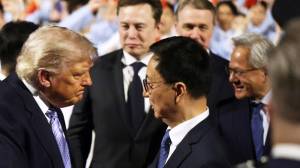
President Trump arrived Wednesday night in Beijing, where he was welcomed by a military band, an honor guard, hundreds of Chinese youth waving flags and China’s vice president, Han Zheng.
U.S. President Donald Trump greets Vice President of China Han Zheng on upon his arrival at Beijing (with a bunch of U.S. oligarchs in the background.)
Such carefully designed receptions for foreign leaders telegraph Beijing’s attitude toward these visits. Sometimes Beijing sends a lower-level official to convey displeasure or distance. Sometimes they send someone senior and influential to signal a high degree of respect.
This time, they sent someone who is high-level but whose position is mostly that of a figurehead — which could be a way to send a layered message.
“Beijing sent Han Zheng to Trump’s inauguration and knows that his title of vice president, even though it is a ceremonial role, will impress the status-conscious American president,” said Julian Gewirtz, a China historian at Columbia University who served in senior China policy roles in the National Security Council under President Biden.
“It’s an example of how, throughout this summit, China is hoping to trade symbolism for substance — using protocol and Trump’s preference for pageantry to hold off a return to economic escalation and buy time for China,” he said.
Interesting. I wonder how long it will take Trump to make a fool of himself and embarrass us as he never fails to do?
That’s all I have for today. I guess this is kind of a weird post. I hope you don’t mind.
Lazy Caturday Reads
Posted: May 9, 2026 Filed under: just because | Tags: cat photos, caturday, CDC, cost of the Iran war, Donald Trump, gerrymandering, hantavirus, Iran War, Jeff Bezos, Justin Wolfers, Melania Trump, mothers, Samuel Alito, Voting Rights Act 3 CommentsGood Day!!
 Tomorrow, May 10, is Mothers Day. My Mother is no longer alive, but I still talk to her frequently. I think of her every day and take comfort in remembering stories she told me and the many times she encouraged me.
Tomorrow is also the day I stopped drinking, way back in 1982. I can’t believe it will be 44 years! My mother was visiting me on those first days of sobriety. No one believed I could do it, but somehow I knew that day that I was really going to stop drinking this time. I think having my Mom there with me helped, even though she wasn’t sure I could do it either. I love you Mom.
In the “news,” Jeff Bezos’ newspaper, The Washington Post, has seen fit to publish an “opinion” piece, supposedly written by Melania Trump. Obviously, she didn’t write it, even though it’s incredibly simplistic. Here’s bit of it: Mothers are America’s strength.
A mother’s devotion to her child is unmatched. This love takes many forms: strength, compassion, wisdom, grace, joy, labor, humor and even grief, to name a few. The love between mother and child has helped shape America’s identity since the nation’s founding 250 years ago.
It is time to revisit the enduring American family traditions that have supported generations, while also recognizing the challenges for mothers of building both a career and a home. This balancing act reflects the realities women face today.
The household is our nation’s smallest institution, yet it is the foundation of all others, including democracy itself. The values cultivated in homes often shape the moral voice of the next generation. Looking ahead, we must consider how to strengthen this vital role.
Being a modern mother demands the discipline and restraint to not disregard what came before us. In this spirit, the healthy evolution of the American family can best be achieved by preserving the elements of the past that have proved their worth. In doing so, America can restore the honor of motherhood after years in which feminism often placed career above family, with consequences to our nation.
There just had to be a dig at feminism, right? Here’s her list of accomplishments:
I constantly challenge myself, as first lady, to think beyond the traditional responsibilities of the East Wing. That has resulted in many new opportunities, including leading four reunifications of Ukrainian and Russian children with their families, addressing the U.N. Security Council on achieving peace through education, and, at the White House, launching Fostering the Future Together, a global effort to help children thrive through the safe and innovative use of technology. But family always comes first.
(Emphasis added) Does she know the East Wing has been torn down?
The Voting Right Act decision fallout:
I don’t really want to write about redistricting, even thought that still seems to be the leading story today. Dakinikat did a great job with that topic yesterday.
I’ll just share this interesting piece by Carl Hulse in The New York Times (gift article): How Minority Districts Fueled the G.O.P.’s Southern Ascendancy in Congress.
Representative James E. Clyburn of South Carolina, formerly the No. 3 Democrat in the House, is certain he would never have been elected to Congress without changes in the Voting Rights Act that the Supreme Court determined last week amounted to unconstitutional racial gerrymandering.
“And about half of the members of the Congressional Black Caucus wouldn’t be there,” said Mr. Clyburn, the first African American sent to Congress from his state since Reconstruction. He was part of the historic 1992 class of Black and Hispanic lawmakers elected after new maps were drawn to comply with 1982 changes meant to strengthen the Voting Rights Act.
The predominantly Democratic minority groups that set to work back then to increase their representation were boosted by some unlikely allies: Republican strategists who saw an opportunity to break the Democratic hold on the South and force an extraordinary realignment.
Now, Republicans see the chance to cement their grip on the region — and to try to maintain their thin House majority — by eliminating the minority districts that initially worked to their advantage and to take those seats for their own.
It is the latest chapter in an ongoing political saga that has had profound implications for the House of Representatives over the past three decades. Redistricting in minority communities could again be a major factor in deciding the November elections as Republicans try to lessen the traditional midterm advantages for the party out of power — the Democrats in this case — in a year when they face particularly strong headwinds.
Having consolidated their power throughout the South, Republicans are now emboldened to try to eliminate the majority-minority districts, believing they can carry them without risking their strength elsewhere as Democratic-leaning minority voters are dispersed into other districts.
Are they right?
But as Republicans and Democrats have both seen as they have waged a tit-for-tat battle this year to redraw districts around the country to their advantage, such changes do not always work out as planned. The true consequences of the Supreme Court’s recent ruling remain to be seen.
The G.O.P. may find it more difficult to win in more diverse districts of the kind that existed before the reshuffling of maps prompted by the Voting Rights Act.
And Democrats now must decide whether they want to maintain the predominantly minority districts they once demanded as a matter of basic fairness or try to turn the tables on Republicans in blue states and reconfigure them in an effort to threaten G.O.P. lawmakers in those states.
In the late 1980s, Republicans had been deep in the House minority for nearly 40 years. But growing dissatisfaction with the Democratic Party had begun moving white Southern conservatives into the Republican ranks, as illustrated by high-profile party switches in Washington. Then the redistricting initiated under a series of court decisions aimed at fostering more minority representation provided yet another opening that might have seemed counterintuitive at first glance.
Architects of the maps realized that if they could maximize Black and Hispanic representation in the new districts, they would simultaneously dilute Democratic strength in surrounding jurisdictions where coalitions of white and Black voters had elected white Democrats for decades. The shift would ultimately create dozens of openings for Republican candidates in what had formerly been known as Democrats’ “Solid South.”
Hulse’s argument is interesting. He also notes that
Some civil rights figures such as Representative John Lewis, the Georgia Democrat, warned at the time that the new maps could empower Republicans by weakening the partnership of progressive white and Black voters in the South. But others said the new districts were the only way to overcome centuries of institutional discrimination against minorities in the region.
“Gerrymandering was done to keep Black folks out,” Mr. Clyburn said. “If you gerrymander to keep them out, you’ve got to gerrymander to bring them in.”
Who was right? We may find out in November. Use the gift link to read the rest.
 In other voting news, It seems Sam Alito cheated in his opinion on the Voting Rights case. Sam Levine, Will Craft and Andrew Witherspoon at The Guardian: Samuel Alito’s Voting Rights Act ruling cited misleading data from DoJ.
The claims Samuel Alito, a supreme court justice, made about voter turnout in Louisiana in a landmark Voting Rights Act case were based on a misleading data analysis, a Guardian review has found.
In his opinion gutting section 2 of the Voting Rights Act last week, Alito said that Black voter turnout had exceeded white voter turnout in two of the five most recent presidential elections, both nationally and in Louisiana. Alito’s claim was copied almost verbatim from a friend-of-the-court brief filed by the justice department. It was a critical data point Alito used to make the argument that the kind of discrimination that once made the Voting Rights Act necessary no longer exists.
“Vast social change has occurred throughout the country and particularly in the South, where many Section 2 suits arise,” Alito wrote in a majority opinion in the case, which concerned Louisiana’s congressional map, joined by the five other conservative justices on the court. “Black voters now participate in elections at similar rates as the rest of the electorate, even turning out at higher rates than whitJuson piece in The New York Times (gift article): Hegseth Says This War Has Cost $25 Billion. I Tallied Up the True Amount.
The Defense Department says the conflict with Iran has cost taxpayers $25 billion so far. But this tally significantly understates the true cost. By my calculations, the bill for a typical American household likely runs to thousands — or even tens of thousands — of dollars.
Yes, that’s a wide range; blame the economic fog of war. But what’s clear is that Defense Secretary Pete Hegseth is trying to obscure just how expensive this war will be.
The Pentagon’s stated number reflects only a narrow accounting of the tab that Operation Epic Fury is running up. It’s the price of the more than 2,000 Tomahawk and Patriot missiles already fired, the warplanes already flown and in some cases lost, and the rest of the gear already chewed through. It does not measure the true cost of the war — including the human toll. Russell Vought, the director of the Office of Management and Budget, acknowledged as much when he told the House Budget Committee on April 15, “I don’t have a ballpark for you.”
I do. Since the start of the war, oil markets have been disrupted, and consumer confidence has cratered. The global economy is groaning, and military budgets are growing. The toll from this upheaval must be counted in lives disrupted, jobs lost, companies shut down (see: Spirit Airlines), and the income and output sacrificed. The less easily quantified costs — death, disability and mental health — could become much more dramatic should President Trump send troops into Iran, which still can’t be ruled out.
Start with oil. While the White House is keen to tell you that oil markets will bounce back to normal, futures markets disagree. Futures prices for oil at the end of 2026, 2027 and 2028 are all still sitting well above where they were before the start of the war. Indeed, the November 2026 futures price of West Texas Intermediate hit a new high this week at $86.12 a barrel. It could be that oil traders are pricing in near-term disruption. Or perhaps they see the current episode as raising the risk of future disruption. Either would be expensive.
The rise in geopolitical risk is costly. Recent research by the Fed economists Dario Caldara and Matteo Iacoviello suggests that heightened geopolitical risk leads to lower investment and employment and dramatically raises the chances of an economic disaster. Their measure of this risk has skyrocketed, and their estimates of the effect of risk on the economy suggest a cost of about $200 billion, with a million fewer Americans working in a year.
The war has also pushed the Federal Reserve Bank into a corner. Back in February, many economists expected a couple of rate cuts this year; markets now think that’s unlikely. If the Fed raises rates, it may succeed at beating back a war-fueled burst of inflation, but only by destroying hundreds of thousands of jobs and edging the economy closer to recession. A reasonable guesstimate — informed by the Fed’s own models — is that this will cost the economy about $200 billion.
Use the gift link to read the rest.
 One more on Iran from Jonathan Lemire at The Atlantic (gift article): Trump Is ‘Bored’ With the War He Started.
President Trump really, really wants the war with Iran to end. He has declared victory many times, including about three weeks ago, when Iran briefly reopened the Strait of Hormuz. He has repeatedly extended his cease-fire deadlines instead of following through on his (sometimes-apocalyptic) threats to resume hostilities. This week, his administration abruptly abandoned an effort to escort ships through the strait in part because of a fear that it could provoke violent, escalating confrontations.
Trump is tired of the war, which has proved far more difficult and lasted far longer than he had expected. His party is warily watching rising gas prices and falling poll numbers. He doesn’t want to be bogged down in a Middle East conflict like some of his predecessors were. He doesn’t want it to upend his high-stakes summit next week in China. He is ready to move on.
Trump is left with a vexing question: How do you end a war when your opponent won’t budge? And while Trump grasps for an exit, the hard-liners in Tehran have used the war to tighten their grip on power. Iran seems hell-bent on pulling off something it’s historically done well: humiliating an American president.
Trump never thought it would turn out like this. After the impressive military operation to snatch Nicolás Maduro from Caracas, the president set his eyes on Iran, telling confidants that it would “be another Venezuela,” a pair of outside advisers told me. They, like others, spoke on the condition of anonymity to discuss internal strategy. Trump believed that the U.S. military was unstoppable, and that he had a chance to topple Tehran’s theocracy, a prize that had eluded his predecessors. He was redrawing the world’s maps and expected a victory to come in days, a week or two at most. The initial U.S.-Israel onslaught killed Iran’s supreme leader and included waves of bombings that reportedly obliterated much of the country’s missile capabilities. But Tehran did not capitulate, and instead attacked its Persian Gulf neighbors and seized control of the Strait of Hormuz, through which 20 percent of the world’s oil passes. With a mix of mines, small attack boats, and drones, Iran effectively closed the waterway. Energy prices soared. The conflict settled into a stalemate and then a fragile cease-fire. One high-profile, official round of negotiations failed. No more are scheduled….
…the real question is the timing: A number of experts have forecast that Iran can withstand pressure from the blockade for months, not weeks. A U.S. intelligence assessment delivered to policy makers this week agrees, suggesting that Iran could make it at least three or four more months. If so, and Iran continues to keep the strait closed, then prices will continue to rise in the West, including in the United States during a midterm-election year. It then becomes a matter of pain: Which side can withstand the most economic hardship?
Use the gift link to read more.
The Hantavirus outbreak:
NBC News: 7 states prepare to receive Americans possibly exposed to hantavirus.
The U.S. has entered emergency response mode as a cruise ship hit by a deadly hantavirus outbreak sails toward Tenerife, one of Spain’s Canary Islands, where it will evacuate nearly 150 passengers on board, including at least 17 Americans.
State and local health officials in the U.S. are monitoring at least eight passengers who disembarked on April 24 and returned home. For the time being, those individuals are not being told to isolate, since they have not developed symptoms.
As early as Sunday, global health authorities will help transport passengers still on board the ship — all of whom are currently asymptomatic — to their respective home countries. Passengers will be taken to a “completely isolated, cordoned-off” area in Tenerife, then board guarded vehicles to transport them to a section of the local airport that will also be cordoned off, Virginia Barcones, Spain’s head of emergency services, said Thursday at a press conference.
The Centers for Disease Control and Prevention said Friday in a statement that it is sending a team of epidemiologists and medical professionals to the Canary Islands to meet the Americans on board, who will fly to Nebraska upon arrival.
“Because the disease status of the exposed passengers is unknown and responders will be in close contact with potentially symptomatic individuals, it makes sense for emergency responders to don gloves (rubber or latex), a respirator mask like an n95, a protective gown, and eye protection,” a CDC epidemiologist who did not speak on behalf of the agency said in a text message.
The flight will land at Offutt Air Force Base in Omaha, Nebraska. The repatriated passengers will then be transported to the National Quarantine Unit at the Nebraska Medical Center in Omaha. It’s unknown how long the quarantine will last.
AP: Experts wonder ‘Where is the CDC?’ as a hantavirus outbreak unfolds on a cruise ship.
No quick dispatching of disease investigators. No televised news conference to inform the public. No timely health alerts to doctors.
In the midst of a hantavirus outbreak that involves Americans and is making headlines around the world, the U.S. government’s top public health agency, the Centers for Disease Control and Prevention, has been uncharacteristically missing in action, according to a number of experts.
To President Donald Trump, “We seem to have things under very good control,” as he told reporters Friday evening.
To experts, the situation aboard a cruise ship has not spiraled because, unlike COVID-19 or measles or the flu, hantavirus does not spread easily. It has been health experts in other countries, not the United States, who have been dealing primarily with the outbreak in the past week.
“The CDC is not even a player,” said Lawrence Gostin, an international public health expert at Georgetown University. “I’ve never seen that before.”
Not until late Friday did CDC actions accelerate.
Health officials confirmed the deployment of a team to Spain’s Canary Islands, where the ship was expected to arrive early Sunday local time, to meet the Americans onboard. They said a second team will go to Offutt Air Force Base in Nebraska as part of a plan to evacuate American passengers from the ship to a University of Nebraska quarantine center for evaluation and monitoring. Also, the CDC issued its first health alert to U.S. doctors, advising them of the possibility of imported cases.
There’s more at the link. I guess RFK Jr. doesn’t think this outbreak is that concerning. The scary thing is that it can take weeks for the symptoms to show up in a person who has been exposed, and 38 percent of people who get the disease die. And it can be spread person to person.
That’s it for me today. What’s on your mind?
Wednesday Reads
Posted: May 6, 2026 Filed under: just because | Tags: Donald Trump, Ebrahim Rezaei, Esmail Baghaei, Iran war negotiations, Lincoln Memorial reflecting pool, Project Freedom, Strait of Hormuz, Ted Turner, Trump's ballroom 7 CommentsGood Day!!
I spent the last 3 days reading books and relaxing, and mostly avoiding watching or reading news social media. My RA pain had been pretty bad lately, and it has definitely improved as a result. I’ll have to see what happens after I engage with the news for this post, but at the moment I plan to go back on a news diet when I finish. I definitely think my health is improved by avoiding news about Trump.
Here’s what’s happening this morning:
Cable news Legend Ted Turner has died.
The New York Times (gift article): Ted Turner, Creator of CNN and the 24-Hour News Cycle, Dies at 87.
Ted Turner, the media mogul who cut a brash and vivid figure on the American scene of the late 20th century by dominating the cable television industry, creating the 24-hour news cycle with CNN, and extending his restless reach into professional sports, environmentalism and philanthropy, died on Wednesday at his home near Tallahassee, Fla. He was 87.
Phillip Evans, a spokesman for the family, confirmed the death. Mr. Turner announced in 2018 that he had Lewy body dementia, a progressive brain disorder.
Ted Turner
Mr. Turner’s signature creation was CNN — the Cable News Network — which revolutionized television news in 1980 by presenting it all hours of the day and eventually inspiring other media operations to follow suit. But his portfolio of business ventures bulged with much more, and their impact on American culture was considerable.
As a spinoff of CNN, Mr. Turner created the channel CNN Headline News and CNN International. He founded the cable and satellite sports and entertainment “superstation” that became known as TBS and spawned a sister channel, TNT, both of which continue to reach millions of homes.
In 1985, he bought for $1.5 billion the MGM studio’s library of films and nine years later created the cable franchise Turner Classic Movies, or TCM. He made a similar purchase of Hanna-Barbera cartoons and, relying on them, created the Cartoon Network in 1992. And in 1996, he merged his conglomerate, Turner Broadcasting System, with Time Warner to create one of the world’s largest media companies.
Along the way, he found the time and energy to captain the winning yacht in the America’s Cup race in 1977 and to take an active role as owner of the Atlanta Braves, giving the team extended national exposure on Turner-owned television.
“I’m trying to set the all-time record for achievement by one person in one lifetime,” he told the journalist Dale Van Atta in a Reader’s Digest article in 1998. “And that puts you in pretty big company: Alexander the Great, Napoleon, Gandhi, Christ, Mohammed, Buddha, Washington, Roosevelt, Churchill.”
Not even his staunchest admirers placed Mr. Turner on that high a pedestal. But even a bitter rival like the media magnate Rupert Murdoch — who once had his New York Post run the headline “Is Turner Insane?” — had to concede that he was one of the most influential figures in the history of mass media.
An Atlanta-based entrepreneur, Mr. Turner took astounding risks in business, often teetering on the edge of bankruptcy and then roaring back to multiply his fortune.
Against the advice of colleagues and the conventional wisdom of his industry peers, he poured millions of dollars into pioneering ventures that combined cable and satellite broadcasts. He warred against the big television networks. He almost lost his shirt in Hollywood but emerged from these gambles and brawls as a billionaire astride a vast cable empire of news, sports and entertainment channels.
Of course the big story is still Trump’s war with Iran. It’s difficult to know what to believe about what’s going on, since Trump and Hegseth lie constantly.
CNN reports the Trump/Hegseth line: US and Iran closing in on memorandum aimed at ending war, source says.
The United States and Iran are moving closer to an agreement on a short memorandum to end the Iran war, a regional source familiar with the negotiations said, although Trump administration officials cautioned that talks had previously fallen apart at the last minute.
The White House received positive feedback from Pakistani mediators on Tuesday that the Iranians were progressing toward a compromise, two administration officials told CNN while offering some skepticism about Pakistan’s optimism.
From CentCom: Project Freedom at Strait of Hormuz
But a renewed diplomatic push has emerged in recent days, the regional source said. President Donald Trump appears to be simplifying issues in peace negotiations so moderates in the Iranian regime can come back to the negotiating table, the source added, with the aim being to tackle thornier issues later.
A one-page plan being floated internally contains provisions that have been at the heart of negotiations to end the conflict, a person familiar with the plan told CNN. The document would declare an end to the war while triggering a 30-day negotiation period on resolving sticking points, including on nuclear issues, unfreezing Iranian assets and future security in the Strait of Hormuz, the person said.
Precise details of the plan couldn’t immediately be verified, but the source familiar said it would include discussion of a moratorium on uranium enrichment for a period of longer than 10 years. A previous US proposal had set it at 20 years.
The plan also requires Iran to ship its stockpile of highly enriched uranium out of the country, but details were still being negotiated.
News of positive movement from the Pakistanis helped spur Trump on Tuesday to announce a pause of “Project Freedom” – an operation to guide stranded ships out of the strait – citing progress in negotiations with Iran, the administration officials said. The pause came after Secretary of State Marco Rubio told reporters that Operation Epic Fury had ended and that the administration’s full focus was on Project Freedom.
The regional source told CNN that the harder the US pushed its agenda of Project Freedom and Operation Epic Fury, the more the hardliners in Iran stood up and had a bigger voice.

The Guardian reports on Iran’s reaction: Middle East crisis live: US proposal to end war a ‘wishlist, not a reality’, warns Iranian official.
‘American wishlist, not a reality’: Iranian officials cast doubt on US proposal to end war.
Ebrahim Rezaei, the spokesperson of the Iranian parliament’s national security and foreign policy commission, has poured cold water on the Axios report claiming the US and Iran were nearing a one-page memorandum to end the war, saying it was an “American wishlist [and] not a reality”.
Ebrahim Rezaei
In a fiery statement on X, he said: “Americans will not gain in a lost war what they failed to achieve in face-to-face negotiations. Iran has its finger on the trigger and is ready; if they do not surrender and grant the necessary concessions, or if they or their lapdogs attempt any mischief, we will respond with a harsh and regrettable response.
Iran’s foreign ministry spokesperson, Esmail Baghaei, also responded to the Axios report, telling the Iranian Isna news agency that the US proposal is still being reviewed by Tehran.
“Once Iran concludes its assessment, it will convey its views to the Pakistani side,” Isna reported, adding that the US demands detailed in the Axios report “included excessive and unrealistic demands that have been strongly rejected by Iranian officials in recent days”.
Isna reported that the Iranian negotiating team is solely reviewing the “termination of the war” and the nuclear issue is not currently being discussed.
That doesn’t sound like an agreement is coming soon. And Trump is issuing threats.
AP: US and Iran appear to move closer to ending their war as Trump threatens more bombing.
The United States and Iran appeared to be moving closer Wednesday to an initial agreement to end the war, as U.S. President Trump sought to pressure Tehran with threats of a new wave of bombing if a deal is not reached.
Trump posted on social media that the two-month war could soon end and that oil and natural gas shipments disrupted by the conflict could restart. But he said that depends on Iran accepting a reported agreement that the president did not detail.
“If they don’t agree, the bombing starts,” Trump wrote.
Trump made his latest comments after he suspended a short-lived U.S. effort to force open a safe passage for commercial ships through the Strait of Hormuz, a vital waterway through which major oil and gas supplies, fertilizer and other petroleum products passed before the war.
Iran’s effective closure of the strait has sent fuel prices skyrocketing, rattled the global economy and put enormous economic pressure on countries, including major powers such as China.
China’s foreign minister called for a comprehensive ceasefire Wednesday after meeting in Beijing with Iran’s top envoy. Wang Yi said his country was “deeply distressed” by the conflict, which began Feb. 28 when the U.S. and Israel launched strikes against Iran.
China’s close economic and political ties to Tehran give it a unique position of influence. The Trump administration is pressing China to use that relationship to urge the Islamic Republic to open the strait.
Meanwhile it appears that the Trump administration has been trying to conceal how much damage Iran has done to U.S. bases in the Middle East region.
The Washington Post (gift article): Iran has hit far more U.S. military assets than reported, satellite images show.
Iranian airstrikes have damaged or destroyed at least 228 structures or pieces of equipment atU.S. military sites across the Middle East since the war began, hitting hangars, barracks,fuel depots, aircraft and key radar, communications and air defense equipment, according to a Washington Post analysis of satellite imagery. The amount of destruction is far larger than what has been publicly acknowledged by the U.S. government or previously reported.
The threat of air attacks rendered some of the U.S. bases in the region too dangerous to staff at normal levels, and commanders moved most of the personnel from these sites out of the range of Iranian fire at the start of the war, officials have said.
Since the start of the war on Feb. 28, seven service members have died in strikes on U.S. facilities in the region — six in Kuwait and one in Saudi Arabia — and more than 400 troops have suffered injuries as of late April, the U.S. military said. While most of the wounded returned to duty within days, at least 12 suffered injuries that military officials classified as serious, according to U.S. officials who, among others, spoke on the condition of anonymity due to the sensitivity of the issue.
Satellite imagery of the Middle East is unusually difficult to acquire at present. Two of the largest commercial providers, Vantor and Planet, have complied with requests from the U.S. government — their biggest customer — to limit, delay or indefinitely withhold the publication of imagery of the region while the war is ongoing, making it difficult or impossible to assess Iran’s counterstrikes. Those restrictions began less than two weeks into the war.
Iranian state-affiliated news agencies, however, have from the start regularly published high-resolution satellite imagery on their social media accounts that claimed to document damage to U.S. sites.
Images of damage to Camp Buehring in Kuwait, released and annotated by Iranian state-affiliated media. Washington Post illustration.
For this examination — one of the first comprehensive public accounts of the damage to U.S. facilities in the region — The Post reviewed more than 100 high-resolution Iranian-released satellite images. The Post verified the authenticity of 109 of the those images by comparing them with lower-resolution imagery from the European Union’s satellite system, Copernicus, as well as high-resolution images from Planet where available. The Post excluded 19 Iranian images from the damage analysis because comparisons with the Copernicus imagery were inconclusive. No Iranian imagery was found to have been manipulated.
In a separate search of Planet imagery, Post reporters found 10 damaged or destroyed structures that were not documented in the imagery released by Iran. In all, The Post found 217 structures and 11 pieces of equipment that were damaged or destroyed at 15 U.S. military sites in the region.
Experts who reviewed The Post’s analysis said the damage at the sites suggested that the U.S. military had underestimated Iran’s targeting abilities, not adapted sufficiently to modern drone warfare and left some bases under-protected.
“The Iranian attacks were precise. There are no random craters indicating misses,” said Mark Cancian, a senior adviser with the Center for Strategic and International Studies and a retired Marine Corps colonel, who reviewed the Iranian images at The Post’s request. The Post previously revealed how Russia provided Iran with intelligence to target U.S. forces.

Read the rest and view more images using the gift link above. I wonder what it will take to repair the damage?
Here’s a bit of hopeful news from The Washington Post: Poll finds broad rejection of religion-related messages from Trump, Hegseth.


 peej
peej Carissa
 bostonboomer
 dakinikat
 ecocatwoman
 jjlo
jjlo mablue2
 Mama Lopez
 peggysue22
 quixote
 skydancingguestblogger
 Mona (aka Wonk the Vote)





Recent Comments