
Lazy Caturday Reads: America In Decline
Posted: May 16, 2026 Filed under: just because | Tags: cat art, caturday, Donald Trump, ethics, Graham Allison, Kash Patel, Pearl Harbor, Peter Hegseth, Poland, Taiwan, Thucydides' trap, Trump's China Trip, Xi Jinping 3 CommentsGood Afternoon!!
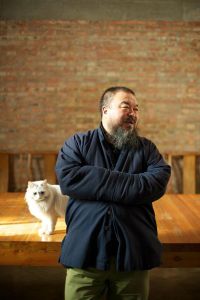
Prominent Chinese contemporary artist and activist Ai Weiwei
The aftermath of Trump’s lackluster China trip is still a top story today. The consensus of the pundits is that the trip was a failure. Trump looked tired, weak, and indecisive. Today, the main concern is that he is ready to sell out Taiwan in his efforts to suck up to Xi Jinping.
Analysis by New York Times China Correspondent Chris Buckley: Trump Makes a High Risk Move to Win Over Xi.
President Trump has described a potential multibillion-dollar weapons sale to Taiwan as a “negotiating chip” with China, raising new doubts about the pace and scale of American military support for the island democracy.
Taiwan’s government has been waiting for months for Mr. Trump to sign off on a $14 billion package of missiles, anti-drone equipment and air-defense systems intended to fortify the island against Beijing’s military threats.
Mr. Trump himself had pressured Taiwan to spend more on its own defense. Now he is using the very arms his administration had pushed the island to buy as leverage with China, the United States’ main adversary.
Mr. Trump told reporters on Air Force One after leaving China on Friday that he had discussed the weapons package with China’s president, Xi Jinping, during their summit this past week in Beijing. He was asked in an interview with Fox News whether he would approve the Taiwan deal.
“No, I’m holding that in abeyance and it depends on China,” he said in the interview, which was recorded in Beijing but aired after he left. “It depends.”
“It’s a very good negotiating chip for us, frankly,” he said. “It’s a lot of weapons.”
He did not go into details about what he wanted in return, but Mr. Trump has pushed China to make major purchases of American airplanes, ethanol, soybeans, beef and sorghum.
His comments appear to undermine the assurances to Taiwan from some in his own administration that U.S. support for the island is steadfast and nonnegotiable. Before the summit, a bipartisan group of senators had urged against letting support for Taiwan become a bargaining chip with China.
“It looks increasingly likely that Trump will indefinitely withhold the $14 billion arms package to Taiwan, in the hopes that Beijing will give him what he wants on the economic front,” said Amanda Hsiao, a China director at Eurasia Group, a consulting firm….
If Mr. Xi wants to punish the Trump administration over Taiwan, analysts have said, China could hold back on orders of farm goods, or ramp up restrictions on exports of rare earths that are essential to many technology components. But Mr. Xi also agreed to make a state visit to the United States this year, and could use the prospect of more talks — and more deals — to influence Mr. Trump.
Trump will sell out every one of our allies before he’s done.
Ian Aikman at BBC News: Trump warns Taiwan against declaring independence, hours after summit with China’s Xi.
US President Donald Trump has cautioned Taiwan against formally declaring independence from China.
“I’m not looking to have somebody go independent,” the US president told Fox News on Friday, at the end of his two-day summit with his Chinese counterpart Xi Jinping in Beijing.
This photograph features the American author Ursula K. Le Guin holding her cat
Taiwanese President Lai Ching-te has previously stated that Taiwan does not need to declare formal independence because it already sees itself as a sovereign nation.
The US has long supported Taiwan, including being bound by law to provide it with a means of self-defence, but has frequently had to square this alliance with maintaining a diplomatic relationship with China.
Trump earlier said he had “made no commitment either way” about the self-governing island – which China claims as part of its territory and has not ruled out taking by force.
Washington’s established position is that it does not support Taiwanese independence, with continued ties with Beijing being contingent on its acceptance that there is only one Chinese government.
Beijing has been vocal in its dislike of Taiwan’s president, who it has previously described as a “troublemaker” and a “destroyer of cross-strait peace”.
Many Taiwanese consider themselves to be part of a separate nation – though most are in favour of maintaining the status quo in which Taiwan neither declares independence from China nor unites with it.

A bit more:
In his interview with Fox News, Trump reiterated that US policy on the matter had not changed.
“You know, we’re supposed to travel 9,500 miles (15,289km) to fight a war. I’m not looking for that. I want them to cool down. I want China to cool down.”
On the flight back to Washington, the US president had told reporters that he and Xi had spoken “a lot” about the island, but said he had declined to discuss whether the US would defend it.
Xi “feels very strongly” about the island and “doesn’t want to see a movement for independence”, Trump said.
Taiwan is actually about the same distance from the US as Iran.
During one of their public meetings, Xi warned Trump to beware of the Thucydides’ Trap. Xi was suggesting that the US is an empire in decline as China rises. Of course Trump had no clue what Xi was talking about until someone filled him in later. then he responded with an idiotic Truth Social post claiming that Xi was referring only to American under Biden.
Chad de Guzman at Time: Xi Warns Trump of ‘Thucydides’ Trap.’ What to Know About China’s Favorite Greek Reference for U.S. Relations.
The world has come to another crossroads,” Chinese President Xi Jinping told U.S. President Donald Trump on Thursday, as the two leaders began their summit in Beijing. Then Xi asked: “Can China and the U.S. overcome the so-called ‘Thucydides Trap’ and create a new paradigm of major-country relations?”
Xi was referring to the ancient Athenian historian and military commander Thucydides, who wrote The History of the Peloponnesian War, recounting the nearly three-decade conflict between the former Greek poleis (city-states) of Athens and Sparta. In his account, he wrote: “The growth of the power of Athens, and the alarm which this inspired in Lacedaemon [Sparta], made war inevitable.”
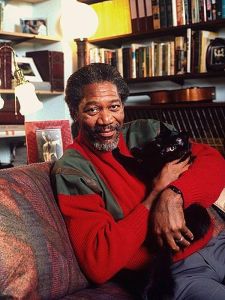
Actor Morgan Freeman posing with a black cat.
While debate on the accuracy of translations continues, the core message stuck: this “inevitability” of conflict when a rising power threatens an existing one was later popularized by American political scientist Graham Allison in the early 2010s as “Thucydides Trap.” But in the modern context, China is Athens, challenging the U.S. as today’s Sparta.
Writing for the Financial Times in 2012, Allison said that “the defining question about global order in the decades ahead will be: can China and the U.S. escape Thucydides’s trap?”
Allison expanded on the “trap” idea further in his 2017 bookDestined for War: Can America and China Escape Thucydides’s Trap?, which argued that the two countries were “on a collision course for war—unless both parties take difficult and painful actions to avert it.” Allison enumerated 16 historical cases of rising and established geopolitical powers facing the “trap,” 12 of which ended in war.
Xi’s invocation of Thucydides’ Trap comes at a time when tensions between the rival superpowers could boil over on any of a number of issues, from trade to AI to Taiwan.
It’s an interesting article. I admit I had never heard about this before, but apparently this idea has been a favorite of Xi’s for many years. De Guzman notes several times that Xi has brought it up with U.S. leaders. A bit more:
It’s not just China referencing the Athenian historian and maxim. During Trump’s first presidential term, national security adviser H.R. McMaster was a known Thucydides buff. He wrote for the New York Times in 2013: “War is human. People fight today for the same fundamental reasons the Greek historian Thucydides identified nearly 2,500 years ago: fear, honor and interest.”
Politico also reported that in 2017 Allison briefed Trump’s National Security Council on Greek history and that then-Defense Secretary James Mattis was “fluent” in Thucydides’ work.
In a February 2018 interview with GQ, Steve Bannon, Trump’s former campaign and White House strategist who is also a reported Thucydides aficionado, was asked if he was worried about starting a conflict with China “that the U.S. would lose.” In response, Bannon told the magazine, “I don’t think it has to happen. First off, the whole concept of the rising power and the declining power presupposes that the larger power that’s declining continues to decline.” He argued that Trump’s “America First” paradigm actually “revitalizes the United States of America and puts China on notice.”
Except Trump isn’t putting American first.
Franklin Foer at The Atlantic on the China trip (gift article): Xi Jinping Was Only Humoring Trump.
Spare a moment, please, for the lame-duck superpower. It calls itself the leader of the free world, but the free world no longer believes it. When it extends its hand, nobody rushes to accept. When it threatens, nobody trembles.
After President Trump arrived in Beijing this week, Xi Jinping showered him with pomp befitting a summit of great powers. Yet the Chinese leader permitted potshots at his guest to go viral on his country’s internet rather than suppressing them, as some observers expected he would during a state visit. Xi answered Trump’s lavish praise by sternly lecturing him about meddling with Taiwan. In the end, Xi offered nothing of great substance—no solutions to the war in Iran, no sweeping trade deals, no promises of access to rare earth minerals. Xi used the visit to humor the lame-duck president, waiting for his time to pass.
Argentine author Jorge Luis Borges with a cat, a frequent subject in his life and work.
During the first Trump administration, foreign leaders flattered and accommodated the president out of deference to American power. They feared it; they relied on it. During the second administration, and especially since the beginning of the Iran war, their calculus has quietly shifted—not because the strategy of obsequiousness has failed, but because it’s no longer worth the trouble. Like many of his counterparts around the world, Xi has begun to assume that it’s not just Trump who is term-limited; it’s also his nation.
Trump’s war in Iran was meant to showcase American power. It did the opposite. In the course of failing to remove a much weaker regime or eliminate its nuclear threat, the United States blew through its arsenal—so much so that allies in the Pacific reasonably wonder whether enough munitions remain to protect them. According to The Wall Street Journal, the Pentagon is now worried that it lacks the firepower to execute contingency plans for defending Taiwan.
Supporters of the war argued that it would deal China a severe blow by eliminating one of its most potent allies. But the Gulf nations most threatened by Iran have actually turned to China. As first reported by The Washington Post, an intelligence assessment prepared for the chair of the Joint Chiefs of Staff warned that those countries have begun acquiring from Beijing the systems needed to protect their oil infrastructure and bases. Trump didn’t just fail to weaken China’s position in the Middle East. He strengthened it.
Without exerting itself much, Beijing has profited from America’s self-immolation. China’s petroleum reserves and its investments in renewable energy have allowed it to offer Thailand, the Philippines, and Australia relief from the energy crisis that the United States instigated. Instead of applying diplomatic pressure on Iran to cut a deal, China has let the conflict linger, so that the United States continues to bear the blame for the disruptions to shipping. Meanwhile, China poses as the faithful steward of the rules-based order—the cooler head, the power on which even the U.S. must now rely.

Foer argues that Iran is using the same strategy, letting American weaken itself.
Use the gift link to read the rest.
One more on this subject from Timothy Snyder at Project Syndicate: America’s Superpower Suicide.
The United States is spending billions of dollars to lose a war in Iran that is enriching its oligarchs, impoverishing its citizens, sabotaging its alliances, and strengthening its enemies. The war is exposing a guiding principle of US President Donald Trump’s foreign policy: superpower suicide. Empires rise and fall, but to my knowledge no state has ever deliberately, and systematically, killed its own power—much less with such speed.
This strategic suicide can be difficult to admit: one still hopes that Trump’s misadventures are based on some understanding of the American national interest. They are not.
Alejandro Jodorowsky, a Chilean-French filmmaker, playwright, author, and spiritual guru.
At a minimum, a superpower must be a modern state that includes, through the rule of law and other institutions, a substantial body of citizens committed to a common endeavor. But the Trump administration treats the US not as a modern state but as a commercial opportunity for a select few.
A superpower must also have a sense of the national interest. While international relations experts disagree about how leaders define this concept, we are unprepared for a situation in which the president is indifferent to the good of the people or the state.
To remain a superpower, a state must also maintain itself over time. Continuity depends on a principle for transferring political authority. By aspiring to remain in power indefinitely and undermining faith in elections, Trump is calling into question the principle that enables political succession in the US. There are of course other ways of going about it, like dynastic rule or a politburo’s decision. Moving to one of these arrangements—one could image the coven of tech oligarchs responsible for the rise of Vice President JD Vance as a capitalist politburo—would end the American republic.
Ensuring that the right people are in charge is crucial for a state to gain and maintain power. Historically, powerful states sought ways to identify and elevate qualified people to serve in positions of authority, regardless of birth. Ancient China had an examination system. Napoleon established the principle of merit in both civilian and military life.
The US, for its part, once had a civil service that was the envy of the world, as well as a highly meritocratic military. But the Trump administration has gutted the civil service and purged the military’s senior ranks—a process carried out by people who are themselves unqualified for the positions they occupy. The fact that Tulsi Gabbard, Kash Patel, and Pete Hegseth are now, respectively, Director of National Intelligence, FBI director, and defense secretary is a clear indicator of a superpower committing suicide.

Read the rest a the link above.
Trump stabbed another ally in the back yesterday, reducing the number of troops in Poland not long after he did the same thing in Germany.
Military Times: Army leaders in hot seat over Poland deployment cancellation.
Army leaders struggled Friday to respond to congressional furor over the Pentagon’s decision to abruptly cancel a deployment of more than 4,000 soldiers to Poland this month.
Portrait of author Doris Lessing taken in 1984 by photographer Marianne Majerus.
Acting Army Chief of Staff Gen. Christopher LaNeve said in an Army budget hearing that the order to halt a planned 9-month rotation to Europe by 2nd Armored Brigade Combat Team, 1st Cavalry Division to Eastern Europe came from Defense Secretary Pete Hegseth.
LaNeve and Army Secretary Dan Driscoll said they were informed of the order and had been consulted, but they wouldn’t provide the exact timing of the decision. On May 1, the unit had cased its colors in preparation for deployment, dispatched its advanced team and launched its equipment overseas.
Soldiers began discussing the decision to scrap the deployment publicly early Tuesday morning; the order was confirmed Wednesday by Army Times and other news media.
LaNeve said the decision was made “in the last two weeks” by the Defense Department and Gen. Alexus Grynkewich, commander of U.S. European Command and the NATO Supreme Allied Commander Europe.
LaNeve and Driscoll downplayed the move as part of routine manning reviews conducted throughout the year.

Politico: ‘Slap in the face’: Republicans skewer Pentagon over Poland move.
Top Republicans on Friday condemned the Pentagon for canceling a U.S. troop deployment to Poland, an abrupt move that also appeared to catch Army leaders by surprise.
The decision, House Armed Service Committee members said, amounted to a gut punch to the NATO ally and to a Congress that has sought to beef up the U.S. presence in Europe. They made those frustrations clear at a hearing with Army officials, where the service’s top civilian and uniform leaders had few answers about the rationale for the move and confirmed its last-minute timing.
“I just want to say this is a slap in the face to Poland; it’s a slap in the face to our Baltic friends,” Rep. Don Bacon (R-Neb.) said. “It’s a slap to the face of this committee.”
The move is the latest in a rift between the Trump administration and Republicans on Capitol Hill who have been at odds over U.S. security interests in Europe. Lawmakers enacted limits on troop withdrawals from Europe last year amid concerns the administration would unilaterally scale back troops on the continent.
“We don’t know what’s going on here, but I can just tell you we’re not happy with what’s being talked about, particularly since there’s been no statutory consultation with us,” Armed Services Chair Mike Rogers (R-Ala.) said.
Another sickening move by Hegseth:
The Guardian: Pentagon quietly shut legally required program to prevent civilian deaths by military, watchdog finds.
The Pentagon hasquietly dismantled a program it is legally required to operate to prevent and respond to civilian deaths in US military operations, according to its internal watchdog.
Japanese manga artist Fujio Akatsuka working at his desk alongside his pet cat, Kikuchiyo
A report released by the department’s inspector general concluded the US military no longer has the people, tools or infrastructure needed to comply with two federal statutes requiring it to maintain a functioning civilian casualty policy, and operate a Civilian Protection Center of Excellence (CP CoE).
Donald Trump’s administration has been accused of making deep cuts to the Pentagon’s civilian harm mitigation and response (CHMR) program, designed to handle training and procedures critical in limiting civilian harm in theaters of war.
While the program has not been officially canceled, the inspector general’s report said that funding had ended for a data management platform; committee meetings had halted; and many dedicated personnel had been lost or reassigned.
“As a result, the DoW [BB comment: actually Department of Defense] may not comply with its civilian casualties and harm policy,” the report read. “A policy required by federal law.”

One more article, not on the Iran war or China, but symptomatic of the decline of the U.S.
Elizabeth Williamson and Adam Goldman at The New York Times (gift article): Snorkeling at Pearl Harbor: Kash Patel’s Travels Add to Focus on Ethical Issues.
Last summer, the F.B.I. director, Kash Patel, capped a whirlwind South Pacific trip with a snorkel trip in Hawaii.
There, Navy SEALs used two boats to transport and escort Mr. Patel and nine other people on what a Defense Department email called a “V.I.P. Snorkel” next to one of the military’s most sacred sites, the underwater tomb of the U.S.S. Arizona that holds the remains of more than 900 Navy sailors and Marines who died at Pearl Harbor.
Mr. Patel swam in the vicinity of the tomb for 30 minutes, according to the Navy.
shows the famous Austrian Symbolist painter Gustav Klimt (1862–1918) holding his pet cat.
Out of respect for the dead entombed in the wreck of the Arizona, rules bar visitors even from wearing swimwear at the memorial. With some exceptions over the years for dignitaries, the only people allowed in the water around the tomb are military and National Park Service divers interring the remains of the last Arizona survivors in the wreck, or conducting annual maintenance surveys, according to a former Navy officer and a former National Park Service official familiar with restrictions at the site.
Officials from the Navy and the Defense Department said V.I.P. “tours” near the Arizona were common, but they declined to say how often they take people snorkeling. A Navy spokeswoman declined to identify the nine people who joined Mr. Patel on the trip. The F.B.I. said that Adm. Samuel J. Paparo Jr., the head of the United States Indo-Pacific Command, invited Mr. Patel to Pearl Harbor….
The idea of a high-ranking government official receiving an escort from the SEALs for a recreational swim near the tomb is “horrifying,” said William M. McBride, a Navy veteran and professor emeritus of history at the U.S. Naval Academy in Annapolis.
“This is a war grave with the same legal status as Arlington National Cemetery,” Mr. McBride said in an interview. “Snorkeling around Arizona is as disrespectful as playing kickball on top of the graves at Arlington.”
The Pearl Harbor trip was at the end of an itinerary in which Mr. Patel visited F.B.I. facilities in Hawaii, Australia and New Zealand. Disclosure of the snorkeling tour, and new details about other trips he has taken, comes as Mr. Patel is already under scrutiny for blending leisure travel with official business or instructing F.B.I. employees to make accommodations for him and his girlfriend, Alexis Wilkins….
Mr. Patel’s use of government jets and F.B.I. agents for himself and Ms. Wilkins has drawn bipartisan criticism and led to growing questions even inside the Trump administration about whether it exceeds the bounds of standard practice.
“The badge is a responsibility, not a V.I.P. pass,” said Rob D’Amico, a former F.B.I. special agent and hostage rescue team operator. With Mr. Patel, he said, “the pattern is clear — exotic locations, exclusive access that no member of the public could ever get, and a support staff working overtime to make it happen.”
F.B.I. policy requires its directors to use government planes for all air travel, personal as well as professional. The director is required to reimburse the government for private trips at the cost of coach travel, and the F.B.I. said Mr. Patel has done so.
But in his travels on F.B.I. aircraft, Mr. Patel has made time for side trips, including to V.I.P. suites for events, leisure activities or nights out with his girlfriend. The F.B.I. declined to say who paid for one of those evenings out, a previously unreported trip with Ms. Wilkins to a country music concert in Philadelphia, where they arrived on a Gulfstream V government jet and were spotted in a private suite that rents for upward of $35,000.

Having Patel as FBI director is a joke. But most of Trump’s other appointees are just as ridiculous. As Timothy Snyder wrote (see above article) “Ensuring that the right people are in charge is crucial for a state to gain and maintain power.”
That’s all I have for you today. What’s on your mind?

 peej
peej Carissa
 bostonboomer
 dakinikat
 ecocatwoman
 jjlo
jjlo mablue2
 Mama Lopez
 peggysue22
 quixote
 skydancingguestblogger
 Mona (aka Wonk the Vote)



 Sky Dancing
Recent Comments