I admit I thought once Trump was out of the White House, we’d be able to move on from our 4-year long nightmare. But it appears that elected Republicans are not going to let that happen. They are doing everything they can to prevent people from voting and they are supporting Trump’s lies about the 2020 election. It’s still not clear that the U.S. can remain a democratic country. Here’s the latest commentary on our current situation.
If Donald Trump’s inaugural address can be summed up in two words – “American carnage” – Joe Biden’s might be remembered for three: “Democracy has prevailed.”
The new president, speaking from the spot where just two weeks earlier a pro-Trump mob had stormed the US Capitol, promised that the worst was over in a battered, bruised yet resilient Washington.
But now, four and a half months later the alarm bells are sounding on American democracy again. Even as the coronavirus retreats, the pandemic of Trump’s “big lie” about a stolen election spreads, manifest in Republicans’ blocking of a commission to investigate the insurrection. And state after state is imposing new voting restrictions and Trump allies are now vying to run future election themselves.
With Republicans still in thrall to Trump and odds-on to win control of the House of Representatives next year, there are growing fears that his presidency was less a historical blip than a harbinger of systemic decline.
“There was a momentary sigh of relief but the level of anxiety is actually strangely higher now than in 2016 in the sense that it’s not just about one person but there are broader structural issues,” said Daniel Ziblatt, co-author of How Democracies Die. “The weird emails that I get are more ominous now than they were in 2016: there seems to be a much deeper level of misinformation and conspiracy theories.”
Photo by Patricia Floriano
A timeline of the GOP rejection of democracy:
Just hours after the terror of 6 January, 147 Republicans in Congress voted to overturn the results of the 2020 presidential election despite no evidence of irregularities. Trump was impeached for inciting the violence but Senate Republicans ensured his acquittal – a fork in the road where the party could have chosen another destiny.
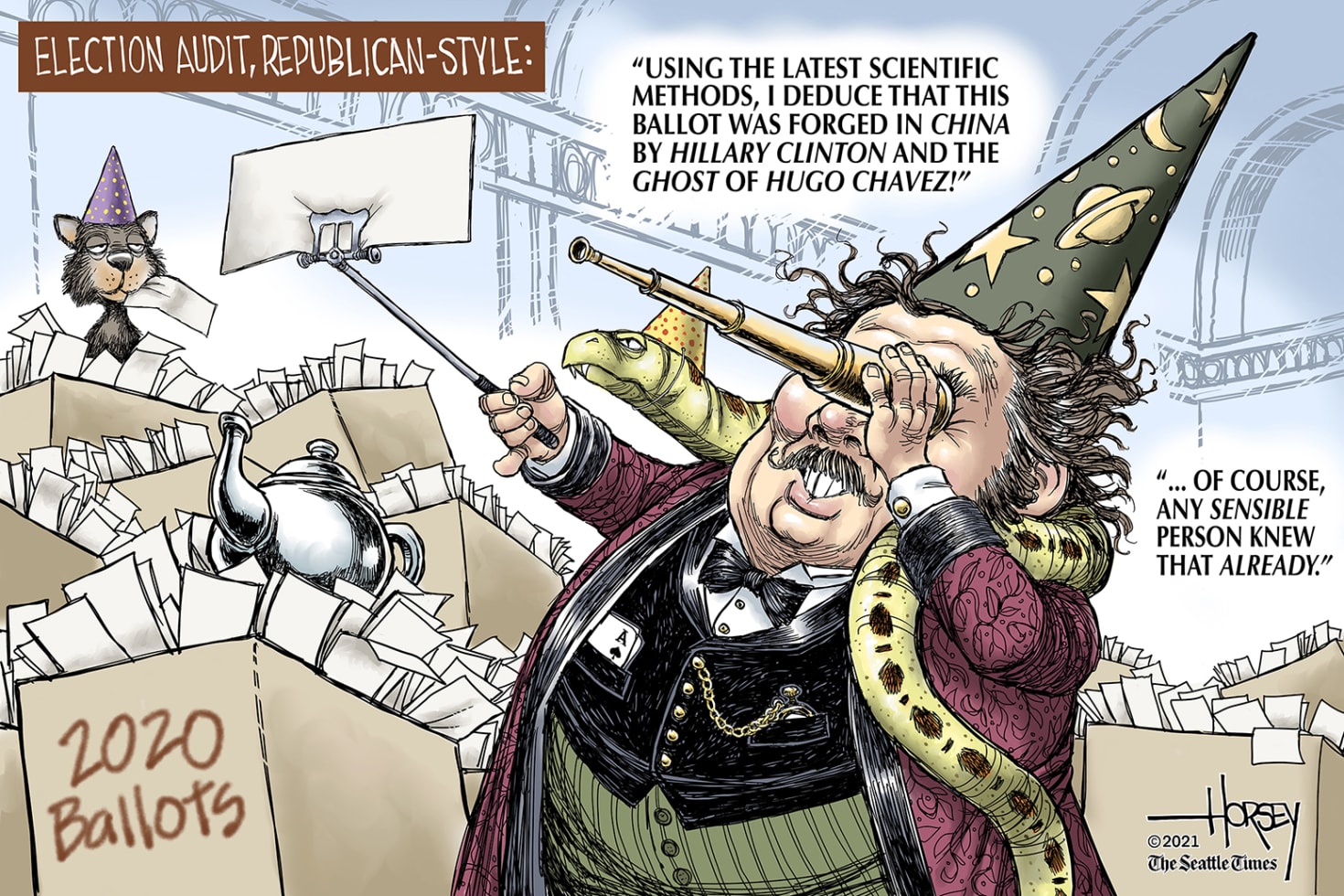
As Trump continued to push his false claims of election fraud, rightwing media and Republican state parties fell into line. A farcical “audit” of votes is under way in Arizona with more states threatening to follow suit. Trump is reportedly so fixated on the audits that he has even suggested – wrongly – he could be reinstated as president later this year.
Perhaps more insidiously, Trump supporters who tried to overturn the 2020 election are maneuvering to serve as election officials in swing states such as Arizona, Georgia, Michigan and Nevada. If they succeed in becoming secretaries of state, they would exercise huge influence over the conduct of future elections and certifying their results. Some moderate Republican secretaries of state were crucial bulwarks against Trump’s toxic conspiracy theories last year.
The offensive is coupled with a dramatic and sweeping assault on voting rights. Republican-controlled state legislatures have rammed through bills that make it harder to vote in states such as Arizona, Florida, Georgia, Iowa and Montana. Their all-out effort in Texas was temporarily derailed when Democrats walked out of the chamber, denying them a quorum.
President Joe Biden’s inaugural address last January, set against the backdrop of a pandemic-gripped capital wrapped in barricades and barbed wire after an attempted insurrection, stood out for more than just its unusual setting. In the speech, he invoked the word “democracy” more than any other president in US history — at 11 times, twice more than either the runners-up Harry Truman or Franklin Delano Roosevelt did in the 1940s.
That has set the tone for his presidency, an administration that has determined to be about first-order things, shoring up the foundation of the nation’s principles and ideals.
Painting by Tatyana Girshunica
Biden’s Memorial Day address on Monday returned to those themes. In a day set aside to remember those who have served and died in the nation’s wars, Biden pivoted to what he saw as their fight: safeguarding democracy. Again and again in the speech, he invoked democracy as “the soul of America.” And while he got a lot right about US democracy in his speech — most importantly, that it is imperfectly practiced and imminently imperiled — he got one essential thing wrong….Democracy has been overthrown in America before. That’s our best evidence and soberest warning that it can happen again.
It’s critical that Biden and others in government understand this point and get it right, because that history — the sometimes-successful fight for democracy and the sometimes-successful fight to thwart it — is exactly the battle that the US is facing today, and there is nothing inevitable about democracy’s success.
The day after his speech, 100 scholars of democracy underscored his point. They warned that Republicans’ efforts to radically reorganize elections at the state level “call into question whether the United States will remain a democracy.” They urged Congress to pass new voting rights legislation but emphasized that would not be enough — minoritarian obstacles from gerrymandering to the filibuster would have to go as well.
Which is why Biden’s speech was so important. With his words, Biden did more than defend democracy — he defined it. That matters, because for much of the past century, presidential invocations of democracy have often amounted to little more than sloganeering (especially when attempting to exportdemocracy abroad). But Biden laid out a theory of democracy, calling it “more than a form of government” but “a way of seeing the world.”
Please read the rest at CNN.
David A. Graham at The Atlantic: This Isn’t Normal, Either. Just beneath a thin veneer of orderliness, the United States faces a set of perilous, unresolved threats.
Squint the right way and things look almost normal. The barriers around the Capitol are gone. People are taking off their masks and going out. The Nats and Orioles are in the basement. Most of all, politics is boring again….
A series of reports has shed light on the bizarre situation of the Old Pretender as he continues to stew over the election. The journalists Maggie Haberman and Charles C. W. Cooke report that Donald Trump is saying, and perhaps truly believes, that he will be “reinstated” as president this summer, after it becomes clear that he rightfully won the election; perhaps some Republican senators defeated in November will come back with him. The Postadds that Trump has become convinced that “audits” in Arizona and elsewhere will prove that he actually won.
Several barriers will prevent this: Trump didn’t win, no evidence can prove otherwise, and there’s no constitutional mechanism for such a reinstatement. Many losing candidates have griped about election results, and insisted that they were cheated. Stacey Abrams never conceded the 2018 Georgia gubernatorial race. John Kerry reportedly remains skeptical of the 2004 presidential-election results in Ohio. But the current situation is unprecedented: No former presidential candidate, much less president, has ever so flatly refused to accept the results or expected to be reinstalled. Samuel Tilden, after being shut out of the White House in 1876, told his supporters, “Be of good cheer. The Republic will live.” Trump, by contrast, exhorted his backers on January 6, “If you don’t fight like hell, you’re not going to have a country anymore.”
Reality has never constrained Trump’s statements. The problem is how far this thinking has spread beyond him. Large portions of the Republican electorate purport to agree in opinion polls that Trump rightfully won the election, and the on-again, off-again Svengali Steve Bannon claims that staying in lockstep with Trump will be a “litmus test” for future GOP candidates. “There will not be a Republican that wins a primary for 2022—not one—that doesn’t take the pledge to get to the bottom of November 3,” he recently told NBC News.
Meanwhile, exercises like the count in Arizona, which purport to rebuild confidence in elections, are actually likely to only further undermine Trump partisans’ trust. As I wrote this week, opposition both to majority rule and to the notion that Democrats can win elections fairly is on the rise in the Republican Party. These rejections of the system’s basic tenets have consequences. In March, FBI Director Christopher Wray (a Trump appointee) warned, “January 6 was not an isolated event. The problem of domestic terrorism has been metastasizing across the country for a long time now and it’s not going away anytime soon.”
By the time Donald Trump left the White House, it was widely agreed upon that he was the most anti-democratic president in modern US history. He exhibited an unparalleled disdain for democratic institutions during his four years in power, and topped it all off by refusing to accept the legitimate results of the 2020 election and provoking a deadly insurrection at the US Capitol. It was unprecedented and the US is still dealing with the consequences.
On his way out the door, Trump was impeached for a second time for inciting the riot. A week later, President Joe Biden was inaugurated, and some scholars of democracy were hopeful that Trump’s departure would open the door for the GOP to hit the reset button. But those feelings of optimism didn’t last long as Republicans continued to show unwavering loyalty to Trump and his “big lie,” and as GOP-led legislatures nationwide pushed for laws to restrict voting in extraordinary ways.
“With Trump gone, I hoped the Republican party might recalibrate, moving away from his illiberal, anti-democratic and irrational behavior and embracing a conservative, but firmly reality-based and small ‘d’ democratic politics,” Berman said. “That the Republican party has proven to be a greater threat than Trump — a single individual — bodes poorly for the health of American democracy.” [….]
Only 16% of Americans say democracy is working well or extremely well, according to a February poll from The Associated Press-NORC Center for Public Affairs Research. The poll found that nearly half of Americans — 45% — think democracy isn’t functioning properly. But it’s less clear if Americans are cognizant of the escalating threat posed to the democratic process in the US by GOP efforts to make it harder to vote.
“I don’t think the average citizen understands the threat because the average citizen doesn’t have the time or the incentive to analyze what is going on politically at the national, state and local level on a daily basis,” Berman said.
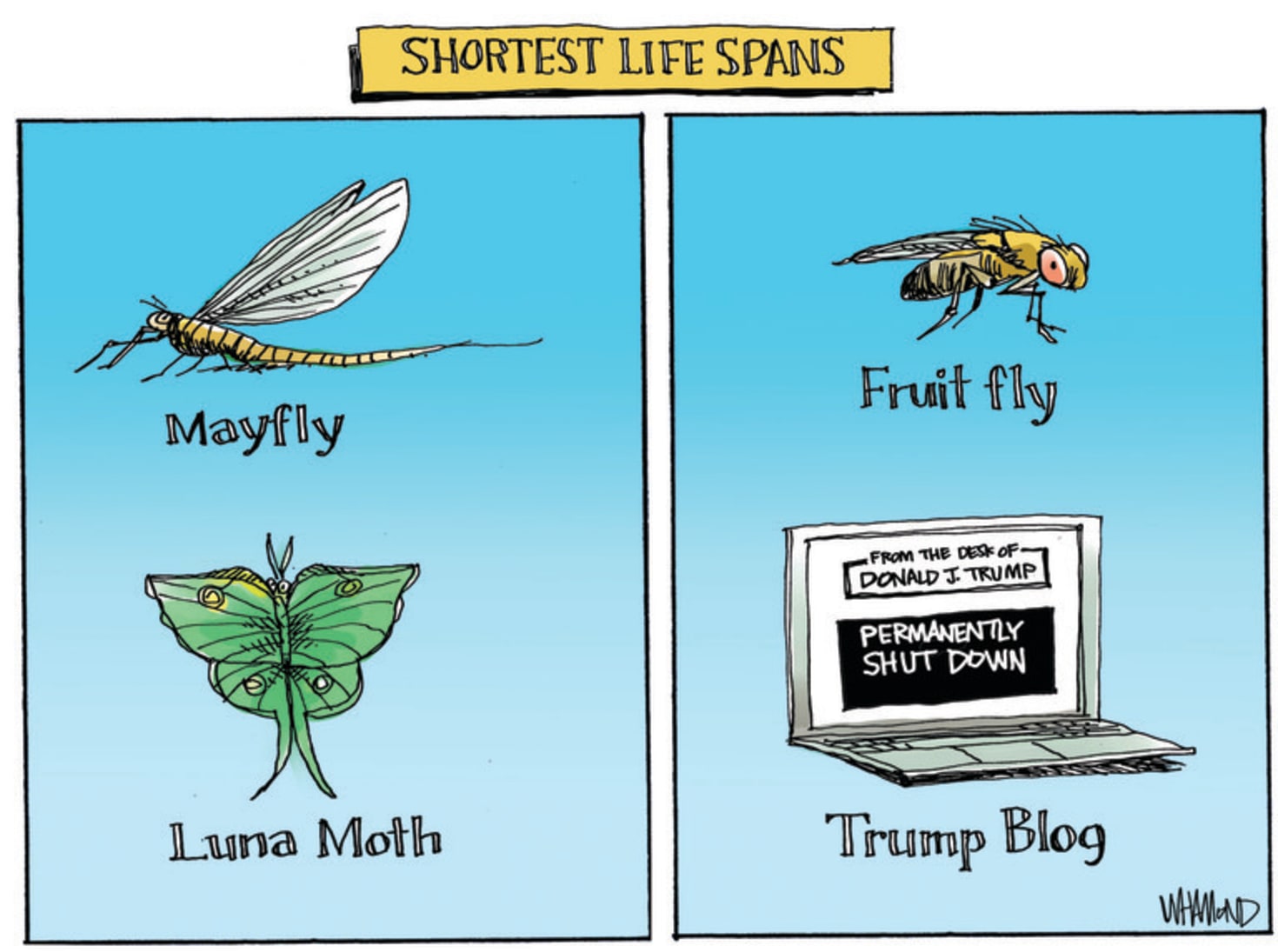
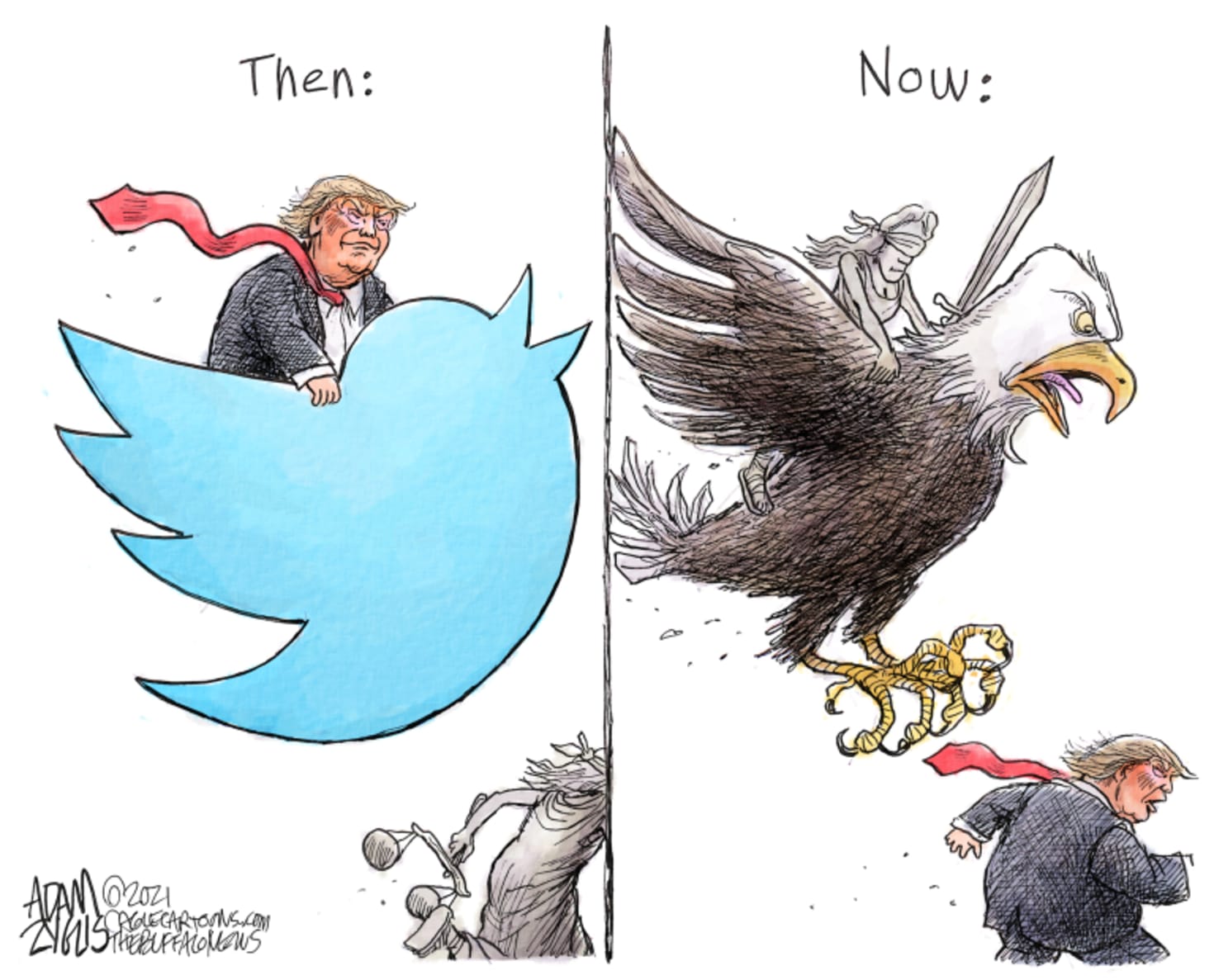
The demented, delusional former guy just won’t go away. After being banned by Twitter and Facebook, he decided to start a blog. Sadly, very few people read it, so he shut it down yesterday after less than a month. Next he plans to return to his Hitler-style rallies. Will anyone show up to listen to his paranoid rants?
Twenty-nine days after it was launched, Donald Trump’s blog, once hailed by fans as his triumphant return to the internet, was taken down on Wednesday.
It was just less than three Scaramuccis old. Noah’s Ark had a longer run.
Publicly, Trump’s team described the decision to remove the “From the Desk of Donald J. Trump” site as part of the process towards building a larger online footprint. But privately, aides conceded that the site was proving to be more of a nuisance than a bullhorn.
“It was more of a hassle than anything else and it wasn’t getting as many views as the team would have liked,” conceded a person familiar with the decision to take down the blog. “It was drawing more negative press than positive press.” [….]
As Trump’s team took down the blog, it promised that something better was in the offing — a Trump-focused, Trump-branded, Trump-world social network, free of the constraints imposed by Big Tech….
So far, no new platform has been revealed. Anddespite reports leaked out of Mar-a-Lago about a string of meetings with MAGA-friendly developers and apps, the reality is that creating a stand-alone Trump platform — even with an eager, preexisting user base — is, experts say, a daunting, almost-impossible task, complicated by cash, technology, time and talent….
Creating and maintaining a social media site untainted by the influence of Big Tech could run into the tens — if not hundreds — of millions of dollars, tech experts say. Computer servers that could process his fans’ activity — every like, comment, share and video play — would have to be purchased. Expensive engineers would also have to be hired to maintain those servers. And as several tech experts told POLITICO, skimping on these investments could mean a site that crashes every hour.
“This isn’t going out and buying a PC from Walmart, and connecting to the internet and hosting a website,” said Keith Townsend, a technology consultant who specializes in cloud computing. “This is very complicated stuff that is extremely costly, and who’s going to fund it when it’s not making money?”
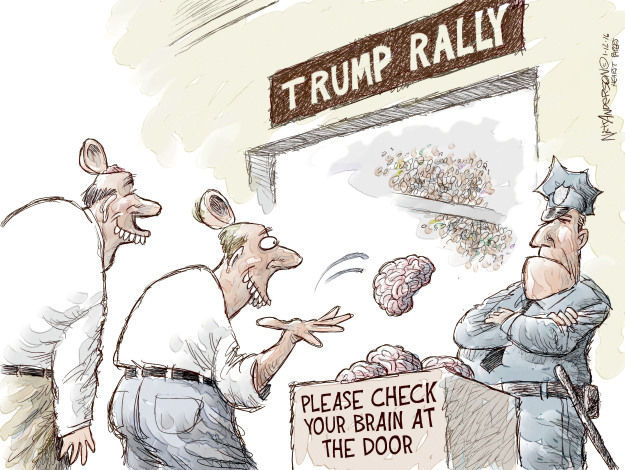
This summer doesn’t mark only the return of family get-togethers and concerts. Starting this month, Donald Trump will also be back in public circulation, headlining a series of grievance-filled summer MAGA rallies. That’s fantastic news for anxious Democrats.
The return of Trump’s hourslong, rambling rallies is an opportunity to remind the American people that Republican craziness hasn’t dialed down a notch since his defeat last year and to remind Democrats that they have reason to focus on their shared values rather than their increasingly bitter Senate fights.
By now, most Americans know to expect plenty of disinformation and far-right red meat from Trump rallies. But they have yet to see how a humiliating electoral loss and Trump’s delusional claim that he’s about to be reinstated as president any day now mix with tried-and-true Trump classics like spreading election disinformation and whining about “cancel culture.”
After just one Trump rally, Democrats will have plenty of sound bites and offensive content to make the case that Trump has learned nothing during his time out of office surrounded by yes men at Mar-a-Lago. And while Trump’s unhinged claims to be the president of the United States in exile may energize MAGA fundamentalists, they reaffirm to independents and moderates who rejected Trump that he has, if anything, grown more detached from reality in defeat.
NBC News’ Jonathan Allen reported Tuesday: “Trump returns to the electoral battlefield Saturday as the marquee speaker at the North Carolina Republican Party’s state convention. He plans to follow up with several more rallies in June and July to keep his unique political base engaged in the 2022 midterms and give him the option of seeking the presidency again in 2024.”
Trump’s return to the rally circuit is a major shift in what has so far been a period of stasis and self-imposed exile at Mar-a-Lago, where he accepts supplicants seeking his blessing and sends out press releases on a blog nobody reads. By holding rallies again, even if theoretically for the benefit of other candidates, Trump will potentially regain a major platform. Let’s hope the news media has learned its lesson from six years ago.
I think that how these first post-presidential rallies are covered will reveal a lot about lessons learned — or not learned. Saturday’s rally simply does not need to be covered live.
For one thing, we can assume that Trump will not hold back. I argued last month that Trump’s social media silence was giving Republicans the space to work on their long-term projects, including re-engineering state election laws. But Trump’s return is likely to push the party line even further — whether GOP leaders want him to or not.
The New York Times’ Maggie Haberman reported Tuesday that Trump has been telling people “he expects he will get reinstated by August.” That’s delusional. But it’s something that famed loon, er, lawyer Sidney Powell has been telling other far-right luminaries for months.
And it’s exactly what Trump’s base wants to hear — directly from the man himself.
Donald Trump now has the notion in his head that he could return to the White House in August. But the twice-impeached former president isn’t getting that idea from constitutional scholars or his attorneys. Instead, MyPillow CEO Mike Lindell apparently inspired him.
“If Trump is saying August, that is probably because he heard me say it publicly,” Lindell told The Daily Beast on Wednesday.
On Monday, New York Times reporter Maggie Haberman tweeted that former President Trump has been telling associates that he expects to be restored to the presidency by August, after Joe Biden’s election is overturned. President Biden, of course, legitimately won the 2020 U.S. presidential election, and decisively beat Trump in the Electoral College and popular vote. There is zero evidence to support that Trump will be back in office this summer, or at any time during the rest of Biden’s term.
Trump has been telling a number of people he’s in contact with that he expects he will get reinstated by August (no that isn’t how it works but simply sharing the information). https://t.co/kaXSXKnpF0
In the past few weeks, two people close to Trump told The Daily Beast, the ex-president had begun increasingly quizzing confidants about a potential August return to power. What’s more, he claimed that a lot of “highly respected” people—who Trump did not name—have been saying it’s possible. Both of these sources said they decided not to tell the former president what they were thinking, which was that it’s not going to happen.
It’s unclear, exactly, who these “highly respected” individuals are, and who first got the August chatter in Trump’s ear. But the August deadline tracks with comments made by Lindell, one of the ex-president’s most ardent supporters and personal friends.
Online conversation among Trump supporters and QAnon followers on new and emerging social media platforms is creating concern on Capitol Hill that President Donald Trump’s continued perpetuation of the falsehood that the 2020 election was stolen could soon incite further violence, three congressional sources tell CNN.
The social messaging platform Telegram has emerged as a particular source of concern among law enforcement officials, the congressional sources say. Groups on the platform dedicated to QAnon and pro-Trump conspiracy theories have tens of thousands of members — many of whom hang on every word the former President says.
Trump’s comments to right-wing media outlets in recent weeks have played directly into the false belief among some of his supporters that he will be reinstated as president in the coming months.
Federal law enforcement officials say there is an overall concern about rhetoric on the election in general, both online, on Telegram and other sites, and offline.
Officials are careful to stress that much of it falls under First Amendment free speech protections. But officials are worried about how the talk can encourage and inspire people to act. They are continuing to monitor extremists and others who at times have shown intentions of violence.
Hundreds of people gathered in Texas for a QAnon-sponsored conference over Memorial Day weekend to hear the biggest boosters of Donald Trump’s Big Lie downplay the Capitol riot and bandy about new threats of a coming coup.
Key Trump allies, including Michael Flynn, Trump’s former national security adviser, former Trump lawyer Sidney Powell, Allen West; and perhaps most notably Rep. Louie Gohmert, R-Tex., attended the three-day event, dubbed “For God & Country Patriot Roundup,” at the Omni Hotel in Dallas.
The QAnon conference came amid reports that Trump is attempting to orchestrate another election coup from his far-off kingdom at Mar-a-Lago. According to a Tuesday tweet from the New York Times’ Maggie Haberman, the former President has been telling a number of people he’s in contact with that he expects he will get reinstated by August.” Trump’s reported thinking echoes that of his former lawyer’s, Sidney Powell. On Saturday, Powell told attendees to the QAnon conference that Trump “can simply be reinstated.”
“A new inauguration date is set, and Biden is told to move out of the White House, and President Trump should be moved back in,” she explained. “I’m sure there’s not going to be credit for time lost, unfortunately, because the Constitution itself sets the date for inauguration, but he should definitely get the remainder of his term and make the best of it.”
Powell was not the only speaker at this past weekend’s event who spoke directly about the possibility Trump could reclaim his throne soon.
David A. Graham at The Atlantic: The Frightening New Republican Consensus. Conservatives may disagree with one another about what happened in 2020, but they’re converging on a belief that Democrats win close elections only through fraud.
Adam Serwer at The Atlantic: The Capitol Rioters Won. Although some Republican leaders deplored their violence, most have come to support the rioters’ claim that Trump’s defeat meant the election was inherently illegitimate.
Wuhan Institute of Virology, where workers fell ill with a Covid-19-like virus in Nov. 2019.
Good Morning!!
We appear to be approaching the end of the pandemic, at least in the US. Now suddenly scientists and journalists are looking more closely at the origins of Covid-19 and seriously considering the theory that the virus escaped from a lab in China.
On May 14, Science Magazine published this letter from 18 scientists: Investigate the origins of COVID-19. The gist is that investigators have not given sufficient attention to the possibility that the virus could have escaped from a lab.
In May 2020, the World Health Assembly requested that the World Health Organization (WHO) director-general work closely with partners to determine the origins of SARS-CoV-2 (2). In November, the Terms of Reference for a China–WHO joint study were released (3). The information, data, and samples for the study’s first phase were collected and summarized by the Chinese half of the team; the rest of the team built on this analysis. Although there were no findings in clear support of either a natural spillover or a lab accident, the team assessed a zoonotic spillover from an intermediate host as “likely to very likely,” and a laboratory incident as “extremely unlikely” [(4), p. 9]. Furthermore, the two theories were not given balanced consideration. Only 4 of the 313 pages of the report and its annexes addressed the possibility of a laboratory accident (4). Notably, WHO Director-General Tedros Ghebreyesus commented that the report’s consideration of evidence supporting a laboratory accident was insufficient and offered to provide additional resources to fully evaluate the possibility (5).
As scientists with relevant expertise, we agree with the WHO director-general (5), the United States and 13 other countries (6), and the European Union (7) that greater clarity about the origins of this pandemic is necessary and feasible to achieve. We must take hypotheses about both natural and laboratory spillovers seriously until we have sufficient data.
This week, the questions about Covid-19’s origins are all over the news. Here’s a sampling:
A US intelligence report found that several researchers at China’s Wuhan Institute of Virology fell ill in November 2019 and had to be hospitalized, a new detail about the severity of their symptoms that could fuel further debate about the origins of the coronavirus pandemic, according to two people briefed on the intelligence.
A State Department fact sheet released by the Trump administration in January said that the researchers had gotten sick in autumn 2019 but did not go as far as to say they had been hospitalized. China reported to the World Health Organization that the first patient with Covid-like symptoms was recorded in Wuhan on December 8, 2019.
Importantly, the intelligence community still does not know what the researchers were actually sick with, said the people briefed, and continues to have low confidence in its assessments of the virus’ precise origins beyond the fact that it came from China. “At the end of the day, there is still nothing definitive,” said one of the people who has seen the intelligence.
The director of the Wuhan National Biosafety Lab, which is part of the Wuhan Institute of Virology, issued a strong denial of the report on Monday.
“I’ve read it, it’s a complete lie,” director Yuan Zhiming told state-run tabloid Global Times. “Those claims are groundless. The lab has not been aware of this situation, and I don’t even know where such information came from.”
For those wondering why news isn’t free:
A @WSJ reporter in China mountain-biked to an old copper mine that’s home to the closest known virus to the one that causes Covid-19, and was detained + questioned for five hours by police.https://t.co/JhEoyNxSFw
This is the subterranean home of the closest known virus on Earth to the one that causes Covid-19. It is also now a touchpoint for escalating calls for a more thorough probe into whether the pandemic could have stemmed from a Chinese laboratory.
In April 2012, six miners here fell sick with a mysterious illness after entering the mine to clear bat guano. Three of them died.
Chinese scientists from the Wuhan Institute of Virology were called in to investigate and, after taking samples from bats in the mine, identified several new coronaviruses.
Now, unanswered questions about the miners’ illness, the viruses found at the site and the research done with them have elevated into the mainstream an idea once dismissed as a conspiracy theory: that SARS-CoV-2, the virus that causes Covid-19, might have leaked from a lab in Wuhan, the city where the first cases were found in December 2019.
The lab researchers thus far haven’t provided full and prompt answers, and there have been discrepancies in some information they have released. That has led to demands by leading scientists for a deeper investigation into the Wuhan institute and whether the pandemic virus could have been in its labs and escaped.
Even some senior public-health officials who consider that possibility improbable now back the idea of a fuller probe. They say a World Health Organization-led team had insufficient access in Wuhan earlier this year to reach its conclusion that a lab leak was “extremely unlikely.”
A growing number, however, including the director-general of the WHO and a prominent U.S. researcher who has worked with the Wuhan Institute of Virology, agree that the WIV needs to provide more information about its work to categorically rule out a lab spill.
There’s more at the link. I got through the paywall–hope it keeps working.
The source of the coronavirus that has left more than 3 million people dead around the world remains a mystery. But in recent months the idea that it emerged from the Wuhan Institute of Virology (WIV) — once dismissed as a ridiculous conspiracy theory — has gained new credence.
How and why did this happen? For one, efforts to discover a natural source of the virus have failed. Second, early efforts to spotlight a lab leak often got mixed up with speculation that the virus was deliberately created as a bioweapon. That made it easier for many scientists to dismiss the lab scenario as tin-hat nonsense. But a lack of transparency by China and renewed attention to the activities of the Wuhan lab have led some scientists to say they were too quick to discount a possible link at first.
Sen. Tom Cotton (R-Ark.) from the start pointed to the lab’s location in Wuhan, pressing China for answers, so the history books will reward him if he turns out to be right. The Trump administration also sought to highlight the lab scenario but generally could only point to vague intelligence. The Trump administration’s messaging was often accompanied by anti-Chinese rhetoric that made it easier for skeptics to ignore its claims.
Head over to the WaPo to read the “timeline of key events, including important articles, that have led to this reassessment.”
When Nicholson Baker wrote a cover story for New York laying out the evidence that COVID-19 may have originated in a lab in Wuhan, China, the hypothesis was still highly controversial. In the months that have followed, and especially over the last week, it’s gained more and more credibility. A week ago, 18 prominent scientists signed a letter published in Science calling for an open investigation into the virus’s origins. This weekend, the Wall Street Journalreported that U.S. intelligence believes three researchers at the Wuhan Institute of Virology became sick enough in November 2019 to require hospitalization, lending even more credence to the possibility of a lab leak.
The hypothesis is far from proven. But this account of the virus’s origins is highly plausible, and at least as well-grounded as the original story of an infection that naturally leapt from a bat to a person.
This development would come as a shock to anybody who had been following this question in the news, especially its more left-leaning precincts. Many mainstream journalists, though not all, dismissed the lab-leak hypothesis out of hand as a conspiracy theory. In part, they were deceived by some especially voluble public-health experts. In part, they simply took Donald Trump’s bait, answering the former president’s dissembling with false certainty of their own.
It is not too early to grapple with the failures of the media, which reflect the wider struggles of trying to fairly convey the truth in an atmosphere deformed by misinformation. Rather than meet lies with truth, the media often met it with other lies.
The confusion surrounding this issue was sown in no small measure by Trump, who used China as a transparent gambit to distract from his failure to respond to the pandemic.
Read the rest at New York Magazine.
What to make of the COVID-19 lab leak theory.
While the lab leak theory is definitely an important topic, it’s still secondary to the real smoking gun in this story – how China weaponized the narrative to sow worldwide terror.
Why did it take so long for the lab leak discussion to formally surface? Politics, mostly.
The “origin story” of COVID-19 remained a forbidden topic in the corporate press for the past 16 months, and people who brought it up on social media were often subject to permanent banishment. There were plenty of incentives *not* to bring it up. Twitter was known to ban people who pushed too hard on the lab leak theory. YouTube has an official policy banishing anyone who defies the “science” coming from the China-influenced World Health Organization. Facebook “fact checkers” dismissed the lab leak theory as false….
Discussing the idea became a major faux pas in elite circles, largely due to the political nature of its conclusions. The lab leak theory has been associated with China hawks, and most prominently, President Donald Trump, who stood by the idea over a year ago. Moreover, U.S. Government Health bureaucrats routinely dismissed the idea of a lab leak, while simultaneously brushing away allegations that they cooperated with the lab in question on high-risk research with few safeguards in place.
But the bigger issue, for Schachtel is China’s behavior.
If the lab leak thesis is true, this implicates the Chinese government in a tremendous scandal of global proportions. It also necessitates a discussion over what China could have done to curtail the spread of the virus before it touched every corner of the globe. If U.S. intelligence reports are correct, China did not sound the alarm about the virus and inform the world about it until well over a month after “patient zero” got sick….
China has been on offense regarding the lab leak theory since the very beginning. Beijing has used its political weapons, such as the World Health Organization, in addition to its economic and trade pressure, to viciously attack any individual or entity that dares to bring up the lab leak theory in a formal setting. Beijing has used tremendous political capital to delegitimize the lab leak theory. While this does not mean China is guilty, it does make for ultra suspicious behavior.
What do you think? I’ll be interested to know what our and biology and medicine experts Quixote and Luna have to say about this issue. Of course, this is still an open thread.
Did you like this post? Please share it with your friends:
There’s a gossipy new book out by a reporter I don’t like very much–Edward Isaac-Dovere. He used to write for Politico and he’s now at The Atlantic. You’ve probably heard about what he wrote about Obama’s opinions of Trump. This is from an interview at The Atlantic by Caroline Nimbs Nyce.
I caught up with Isaac, an Atlantic staff writer who covers elections and the author of the upcoming book Battle for the Soul: Inside the Democrats’ Campaigns to Defeat Trump, to discuss how Biden’s and Obama’s respective approaches to the 45th president have changed over time….
Initially, President Obama seemed pretty restrained when commenting on the 45th president. What was going on behind the scenes?
Obama definitely did not think Donald Trump was qualified to be president. He had a very cautious approach in public to what he said about Trump. But people would push him. Staff members and donors were trying to get him to talk about what he thought about Trump.
And occasionally, he would let something slip and he would say things like, Trump’s a “fucking lunatic.” Or “I didn’t think it would be this bad.” Or even “I didn’t think we’d have a racist, sexist pig.”
At one point, he’s seeing the news reports about when Trump had the Russian ambassador into the Oval Office, and he says, “corrupt motherfucker.”
I don’t think anybody ever imagined that Barack Obama was a Trump voter. But the clarity and the harshness of his view was surprising to many people.
For much of Donald Trump’s presidency, Barack Obama largely abided by the convention that former presidents do not publicly criticize or attack their successors.
Obama jettisoned any such caution during the 2020 election that put his own vice-president, Joe Biden, in the White House. But behind the scenes, with donors and advisers, Obama was reportedly much more candid.
According to a new book, Obama called Trump a “madman”, a “racist, sexist pig”, “that fucking lunatic” and a “corrupt motherfucker”.
Trump’s loathing for Obama is well-known and oft-expressed, beginning with his championing of the racist birther conspiracy which said Obama was not qualified to be president.
Painting by Deborah DeWit-Marchant
Obama’s feelings are well-known, but have rarely been reported in such blunt detail.
Dovere reports that Obama first preferred the prospect of Trump as president to Ted Cruz, because Trump was nowhere near as clever as the hard-right Texas senator, the runner-up in the Republican primary in 2016.
But from 2017, as reality swiftly set in, Obama reacted like many in the US and around the world.
“He’s a madman,” Dovere reports Obama telling “big donors looking to squeeze a reaction out of him in exchange for the big checks they were writing to his foundation”.
“More often: ‘I didn’t think it would be this bad.’ Sometimes: ‘I didn’t think we’d have a racist, sexist pig.’ Depending on the outrage of the day … a passing ‘that fucking lunatic’ with a shake of his head.”
Obama’s strongest remark, Dovere reports, was prompted by reports that Trump was speaking to foreign leaders – including Vladimir Putin, amid the investigation of Russian election interference and links between Trump and Moscow – without any aides on the call.
“‘That corrupt motherfucker,’ he remarked.”
I’m not sure why anyone would find Obama’s opinions on Trump surprising. I’m glad it’s out there publicly now, but I suppose it will provide fodder for the Trumpist maniacs.
While we’re looking back at the 2016 election, there’s an interesting piece at Just Security by former CIA intel officer John Sipher: Same Data, Same Strategy: A New Look at How the Trump Campaign and Russian Intelligence Operated in 2016. Sipher takes a new look at Paul Manafort’s relationship with Konstantin Kilimnik–how he passed Trump campaign polling data to the Russian Spy. We now know that Kilimnik turned the data over to the Russian government.
The recent Biden administration sanctions on the Russian government are part of an ongoing effort to push back against the Kremlin’s malign influence campaign against the West. Although the White House actions are related to Russian attempts to interfere with the 2020 election, included in the announcement is a detail that has reinvigorated interest in the 2016 election and the Trump campaign’s potential connivance with Russian President Vladimir Putin’s intelligence services.
In the announcement, the Treasury Department disclosed that in 2016, Russian intelligence officer Konstantin Kilimnik “provided the Russian Intelligence Services with sensitive information on polling and campaign strategy” that he received directly from Trump campaign Chairman Paul Manafort in the summer of 2016.
It was already known that Manafort had passed confidential internal polling data to Kiliminik, who was described by the 2020 Senate Select Intelligence Committee report as a “Russian intelligence officer.” While it is not a great leap to assume a Russian intelligence officer would pass material to his bosses, the recent announcement was the first time the U.S. government acknowledged Putin’s intelligence services were the recipient of the campaign data.
Those who were already troubled by the Trump campaign’s apparent collusion with the Kremlin, like myself, will see this as yet further proof of Trump’s intent to use illicit means to sway the 2016 election. Those who have long shouted “no proof of collusion” will likely scoff at the detail, labeling it as just another piece of information from the U.S. government with little public evidence to back it up.
Cat philosopher, by Olena Kamenetska-Ostapchuk
Read the whole thing if you’re interested. Sipher’s argument is that the Russians weren’t trying to change voters’ minds with their fake news propaganda and other active measures. What they hoped was that they could appeal to new voters who might support Trump and suppress those inclined to vote for Clinton. A bit more:
As aggressive as the covert Russian influence campaign was, it is hard to imagine that fake Russian articles, tweets, and advertisements could persuade a Democrat to vote for Trump. Some researchers have echoed this assumption. Looking at the 2016 election, political scientist and Dartmouth professor Brendan Nyhan concluded that it is extremely difficult to change the minds of committed Democrats and Republicans. His research on the 2016 election suggests that fake news on social media was more likely to reinforce existing biases rather than change any minds.
While this theory makes sense as far as it goes, this is not what the Russian government – or the Trump campaign – were doing. They were doing exactly the opposite. They wanted to reinforce existing biases, not change minds. They were not interested in appealing to voters to consider alternatives. As information warfare expert Molly McKew explained in a February, 2018 article in “Wired,” following the Mueller indictment of the Internet Research Agency (often called the “troll factory”).
Unfortunately, Trump is still trying to create chaos in U.S. politics. At the Atlantic, Peter Wehner, who apparently still things there could be hope for the GOP, warns: Trump Is Marching Down the Road to Political Violence. The Republican Party must counteract lies rather than indulge them.
At the beginning of last week, former President Donald Trump referred to the 2020 election as the “greatest Election Fraud in the history of our Country.” By the end of the week, he had issued a statement saying, “As our Country is being destroyed, both inside and out, the Presidential Election of 2020 will go down as THE CRIME OF THE CENTURY!”
What else is new? These are the ravings of a 74-year-old sociopath, isolated and banned from social media, living in Mar-a-Lago, where he is crashing wedding parties and delivering rambling monologues.
Karen Hollingsworth, Connected, 2010
Or at least, that would be the right way to look at things, if not for the fact that the GOP remains fully in Trump’s thrall, with its leadership more committed than ever to spreading his foundational lies and conspiracy theories. Under Trump’s sway, the Republican Party is becoming more fanatical, venturing even further into a world of illusion….
No former president, and certainly no president defeated after only one term, has so dominated his party after he left office. So Trump’s words matter. They mattered in the lead-up to, and on the day of, the deadly attack on the Capitol on January 6. They still matter. And if the Republican Party doesn’t counteract these lies rather than indulge them, political violence will become more acceptable and more prevalent on the American right.
This assessment isn’t based on mere speculation; we know that many of the people who participated in the violent assault on the Capitol believed that they were acting patriotically, foot soldiers in the 21-century version of the American Revolution, doing what they understood their leader was asking of them. As aWashington Post story put it, “The accounts of people who said they were inspired by the president to take part in the melee inside the Capitol vividly show the impact of Trump’s months-long attack on the integrity of the 2020 election and his exhortations to supporters to ‘fight’ the results.” The Post story points out that a video clip of rioters mobbing the Capitol steps caught one man screaming at a police officer: “We were invited here! We were invited by the president of the United States!”
A top aide to Republican Rep. Carlos Gimenez of Florida says he spoke with both the Capitol Police and the FBI on the morning of January 6 after overhearing a man in tactical gear talk about storming the FBI building just hours before the deadly insurrection.
Alex Ferro, chief of staff to the Florida GOP congressman, says he heard the comments as he and Gimenez were standing inside the lobby of the Hyatt Regency near Capitol Hill.
Tuxedo Cat Sleeping on Books, by Dawn Barnes
Gimenez, who was staying at the hotel as an incoming freshman lawmaker, alluded to the moment during an interview with CNN’s Erin Burnett Wednesday evening.
“I know for a fact that I saw people in my hotel room that were saying they were going to do something at 2 o’clock. And that happened at 9 o’clock in the morning,” Gimenez told CNN.
Ferro said Gimenez meant to say that the activity in question occurred in the lobby of the hotel, not his room. It was Ferro who initially picked up on the disturbing comments.
According to Ferro, the man who made the remark about storming the FBI did so “with passion in his voice.”
“It didn’t sit well with me,” Ferro added.
“I could have sworn I heard ‘we’re gonna storm the FBI building,'” Ferro continued.
Gimenez voted with Democrats in a support of a January 6 Commission.
The company that is conducting a hand recount of nearly 2.1 million Maricopa County ballots conducted an election audit in rural Pennsylvania county at the request of a state senator who has been a prominent advocate of the “Stop the Steal” movement that has spread baseless conspiracy theories that the 2020 presidential election was rigged against Donald Trump.
According to records and news coverage from Fulton County, Penn., state senators Doug Mastriano and Judy Ward asked county officials to allow Wake Technology Services Inc. to conduct an audit of the election. Ward, who represents the rural county in southern central Pennsylvania, told the Arizona Mirror that she passed the request on to county officials at Mastriano’s behalf.
Mastriano has been a prominent supporter of the “Stop the Steal” movement and Trump ally. He helped organize a Nov. 25 hearing in Gettysburg where Trump campaign lawyer Rudy Giuiani and others aired baseless conspiracy theories that Trump lost Pennsylvania through “irregularities and fraud.” He said on Wednesday Trump recently urged him to run for governor.
Wake TSI, an information technology company that has predominantly worked with clients in the health care sector, is now conducting a hand recount of all ballots cast in Maricopa County during the 2020 presidential election as part of an audit ordered by Arizona Senate President Karen Fann, R-Prescott. The company is part of an audit team led by Cyber Ninjas, a cybersecurity company located in Florida. Fann and Cyber Ninjas cited Wake TSI’s experience in Fulton County as a qualification to participate in the Maricopa County audit.
A Georgia state judge on Friday ordered Fulton County to allow a group of local voters to inspect all 147,000 mail-in ballots cast in the 2020 election in response to a lawsuit alleging that officials accepted thousands of counterfeit ballots.
The decision marks the latest instance of a local government being forced to undergo a third-party inspection of its election practices amid baseless accusations promoted by President Donald Trump that fraud flipped the 2020 contest for President Biden.
The inspection in Fulton County, home to Atlanta, is likely to proceed differently than an audit underway in Maricopa County, Ariz., where Republican state senators ordered county election officials to hand over equipment and ballots to a private company called Cyber Ninjas for examination. That process has come under widespread criticism for lacking security measures and failing to follow the rigorous practices of government recounts. On Thursday, Arizona Secretary of State Katie Hobbs (D) urged local officials to toss their machines after the audit is complete because their security is now in doubt.
In Georgia, Superior Court Judge Brian Amero ruled on Friday that the nine plaintiffs and their experts could examine copies of the ballots but never touch the originals, which will remain in the possession of Fulton election officials. Further details of how the inspection will proceed are expected next week, said one of the plaintiffs, Garland Favorito.
The order for the new ballot inspection comes after Georgia officials did three separate audits of the vote last year, including a hand recount, which produced no evidence of widespread fraud.
None of this is good.
That’s it for me today. I hope you all have a terrific weekend!
Did you like this post? Please share it with your friends:
I’m off to the hospital this afternoon for a series of those “baseline” tests which basically signal that I can look forward to going downhill from whatever peak they establish. I will be wearing a mask there and on the way there and back home in my Lyft ride. It’s a different reality this month. I’m drinking my coffee reading about Louisiana teens getting their vaccinations today. The media is showing yesterday’s presser picture of the day which is basically a shot of President Biden and Vice President Harris mask-free.
Last year, masks were everywhere. This includes the Fitzwilliam Museum in Cambridge, eastern England that closed during the peak of the pandemic and masked some of its collection for view on its website. Today’s art comes from the coverage given the show by CNN in June of 2020..
I’m not sure I’m completely ready to give up my mask yet. I listened to the same conversation between Rachel Maddow and Lawrence O’Donnell. I’m pretty sure I will still wear it for my trips to the corner stores. My other outings were solo dog walks so they were always maskless but with a mask in the pocket. Yesterday, Temple and I celebrated our 7th Templeversary. That’s the day I called up the Bunkie pound and said I want to adopt that dog! Today, we look forward to walks without worrying about outfits with pockets!
John Everett Millais’ “The Bridesmaid” (1851) with a decorated facemask to match her decorative dress. Credit: The Fitzwilliam Museum/FME, Cambridge
The C.D.C.’s intricate list of recommended Covid behavior has baffled many Americans and frightened others, making the guidance less helpful than it might have been.
Yesterday, the agency effectively acknowledged it had fallen behind the scientific evidence: Even though that evidence has not changed in months, the C.D.C. overhauled its guidelines. It said fully vaccinated people could stop wearing masks in most settings, including crowded indoor gatherings.
The change sends a message: Vaccination means the end of the Covid crisis, for individuals and ultimately for society.
If you’re vaccinated, you can safely get together with family and friends, mask-free. You can nuzzle your grandparents or your grandchildren. You can eat in restaurants, go to the movies and attend religious services. You can travel. If you’re vaccinated, Covid joins a long list of small risks that we have long accepted without upending our lives, like riding in a car, taking a swim or exposing ourselves to the common cold.
I’m still having a bit of reaction when even a friend I know is well vaccinated crossed the street with his dog to greet Temple and me. I knew full well he got it back a few months ago and likely before me. It was the same reaction my neighbor had to me last month when we both got fully vaccinated and met up for a neutral ground chat. She reached for her mask and said we’re okay. We’d spent most of the year having small dinners on her porch or dining room properly socially distanced with hand sanitizer and the entire routine. It’s easy to move forward along these lines.
I’m thrilled my youngest is going to see her very pregnant sister over Memorial Day. The thought of getting on planes with strangers from the feral Trumpist outback still frightens me. I had a year of knowing who was crazy and who was prudent with that mask and I’m not sure I’m ready to give that up.
“La Liseuse” (The Reader) by Belgian painter Alfred Émile Léopold Stevens in 1860, as imagined in the pandemic. Credit: The Fitzwilliam Museum/FME, Cambridge
It had not, of course. There were, as always, plenty of caveats to the CDC’s guidance. Masks should still be worn on public transportation and in high-risk settings such as doctor’s offices, hospitals, and nursing homes. The majority of Americans remain unvaccinated and should continue to mask up. Tens of thousands are testing positive for the coronavirus every day, and hundreds are still dying from it. Cases are surging in India and other parts of the world.
So, no, the pandemic isn’t over, but the significance of the CDC’s shift was unmistakable, and the nation’s senior political leaders made sure the public didn’t miss it. Inside the Oval Office, President Joe Biden and the Republican lawmakers with whom he was meeting took off their masks, Senator Shelley Moore Capito of West Virginia told reporters outside the White House. On the Senate floor, Senator Susan Collins of Maine—who earlier this week chastised Walensky over the CDC’s “conflicting” mask guidance—triumphantly waved hers in the air. “Free at last,” Senate Minority Leader Mitch McConnell, previously a fastidious mask-wearer, declared at the Capitol. Conservatives have mocked Biden, who has been fully vaccinated for months, for wearing a mask even when it clearly offered no discernible health benefit, including while walking alone to and from his helicopter. So when Biden spoke later in the afternoon in the White House Rose Garden, it was notable that he wasn’t wearing one. His remarks carried an air of celebration, if not quite finality. “Today,” he said, “is a great day for America in our long battle with the coronavirus.”
“The daughters of Sir Matthew Decker,” painted by Dutch artist Jan van Meyer in 1718. Credit: The Fitzwilliam Museum/FME, Cambridge
So, I do want to make this post mostly about what seems to be a turning-the-corner moment in our history of Covid-19. I even have a friend taking his usual group of college students to Seville Spain this summer to take in the music and the opera. He’s at the Student Health Center getting his vaccine passport because that’s what the Spanish Government requires for visitors. The private universities here are requiring their students to show up on campus in the fall with proof of vaccine this fall. They intend to be open. The Louisiana University and Lousiana State University are still pandering to the backwoods goons in the Lousyana outback. So, it’s still political just as Berman states.
“No,” House Speaker Nancy Pelosi said when asked if the rule mandating masks unless a member is speaking on the House floor would be modified. She then asked, “Are they all vaccinated?”
The answer, among Democrats across both chambers, is a 100% vaccination rate. For Republicans, it’s a different story — with at least 44.8% of House members vaccinated and at least 92% of senators.
In a follow-up to a March House-wide survey and interviews with members, CNN has confirmed that 312 of the 431 members of the House — just over 72% of the 431-member body — have now received a Covid-19 vaccination. Of that, all 219 House Democrats have reported being vaccinated. Among the Republican conference, 95 of the 212 members — 44.8% — have said they are vaccinated.
One hundred and twelve Republican offices did not respond to multiple CNN inquires.
One House Republican, Rep. Tom Massie of Kentucky, said he is not vaccinated.
There’s one other thing that popped up on my radar yesterday. Trump may be prepared to order Florida Governor Ron DeSantis to protect his ass from extradition to New York for prosecution. It appears that may be evident. So, the speculation is wtf is going on here, and can Florida actually do that? From the South Florida Sun-Sentinel: “If New York indicts Florida resident Donald Trump, could DeSantis save him from extradition?”
Trump bought and renovated Mar-a-Lago, in Palm Beach, long before he became president, and in 2019 he declared it was officially his residence after he decided he no longer wanted to call his native New York home. Born in Queens, Trump built an image of himself as a savvy Manhattan real estate mogul.
Since Jan. 20, he’s run his post-presidency from there, issuing statements and delivering occasional speeches to groups of guests in which he rails about the 2020 election. Trump continues to falsely claim the only reason President Joe Biden won is because of widespread voter fraud.
If Vance’s office secures an indictment of Trump while he’s at Mar-a-Lago, the question could land in DeSantis’ lap.
Florida statutes state that “When a demand shall be made upon the Governor of this state by the executive authority of another state for the surrender of a person so charged with crime, the Governor may call upon the Department of Legal Affairs or any prosecuting officer in this state to investigate or assist in investigating the demand, and to report to him or her the situation and circumstances of the person so demanded, and whether the person ought to be surrendered.”
To the extent DeSantis can do anything to help Trump — or appear to help Trump — it’s hard to envision DeSantis easily going along with New York and allowing extradition of the former president. Going along with extradition would infuriate Trump’s MAGA supporters — the very people DeSantis needs for his own re-election next year and any future presidential candidacy. Helping to fight it would undoubtedly earn praise from those same people.
As the Manhattan district attorney’s criminal investigation into former President Donald Trump enters its final stages, officials in Florida are preparing for “thorny extradition issues that could arise” from a statute in the Sunshine State, Politico Playbook first reported on Thursday.
Two officials involved in the “contingency plans” told Politico that law-enforcement personnel in Palm Beach County were looking at what to do if Manhattan District Attorney Cyrus Vance Jr.’s investigation results in an indictment while Trump is at his Mar-a-Lago resort in Florida.
State law allows Republican Gov. Ron DeSantis — a staunch Trump ally — to step in and investigate whether a “person ought to be surrendered” if they’re indicted, Politico said.
Trump is residing at his golf club in Bedminster, New Jersey, for the next few months.
I wonder if they’re fortifying his Florida palace like a drug cartel lord. Maybe he can get some hints from El Chapo.
If he stays there long enough, food poisoning will get him.
— Charles P. Pierce (@CharlesPPierce) May 14, 2021
Okay, that’s enough for me. I need to shower and shower, dress, and mentally prepare myself for post-pandemic wandering. Let us know how your doing with the new reality. Anyone else feeling hesitant like me?
What’s on your reading and blogging list today?
Did you like this post? Please share it with your friends:
The Sky Dancing banner headline uses a snippet from a work by artist Tashi Mannox called 'Rainbow Study'. The work is described as a" study of typical Tibetan rainbow clouds, that feature in Thanka painting, temple decoration and silk brocades". dakinikat was immediately drawn to the image when trying to find stylized Tibetan Clouds to represent Sky Dancing. It is probably because Tashi's practice is similar to her own. His updated take on the clouds that fill the collection of traditional thankas is quite special.
You can find his work at his website by clicking on his logo below. He is also a calligraphy artist that uses important vajrayana syllables. We encourage you to visit his on line studio.




 A series of reports has shed light on the
 The demented, delusional former guy just won’t go away. After being banned by Twitter and Facebook, he decided to start a blog. Sadly, very few people read it, so he
  Creating and maintaining a social media site untainted by the influence of Big Tech could run into the tens — if not hundreds — of millions of dollars, tech experts say. Computer servers that could process his fans’ activity — every like, comment, share and video play — would have to be purchased. Expensive engineers would also have to be hired to maintain those servers. And as several tech experts told POLITICO, skimping on these investments could mean a site that crashes every hour.
 Trump’s return to the rally circuit is a major shift in what has so far been a period of stasis and self-imposed exile at Mar-a-Lago, where he accepts supplicants seeking his blessing and sends out
  Trump’s comments to right-wing media outlets in recent weeks have played directly into the false belief among some of his supporters that he will be reinstated as president in the coming months.
 Miles Parks at NPR:




![Tuxedo Cat Sleepin]g on Books, by Dawn Barnes](https://skydancingblog.com/wp-content/uploads/2021/05/tuxedo-cat-sleeping-on-books-by-dawn-barnes.jpg)





 You can read more on this from The Insider. I am beginning to think Florida is a third rate banana republic right now. It’s embarassing.
 peej
peej Carissa
 bostonboomer
 dakinikat
 ecocatwoman
 mablue2
 Mama Lopez
 peggysue22
 quixote
 skydancingguestblogger
 Mona (aka Wonk the Vote)



 Sky Dancing
Recent Comments