
Presidents’ Day Reads
Posted: February 21, 2011 Filed under: Bahrain, Diplomacy Nightmares, Drone Warfare, Egypt, Foreign Affairs, income inequality, Libya, morning reads, Psychopaths in charge, U.S. Economy, U.S. Politics, Voter Ignorance, worker rights, Yemen | Tags: CIA, Ed Schultz, Egypt, foreign policy, Libya, Pakistan, Raymond Davis, Rush Limbaugh, Wisconsin protests, Yusuf al-Qaradawi 51 Comments
Good Morning! It’s “Presidents’ Day.” Talk about a generic holiday. We used to mark two presidents’ birthdays in February–Washington’s birthday on the 22nd and Lincoln’s birthday on the 12th–but now we just have a Monday in February when everything goes on sale, and pictures of Washington and Lincoln are used to sell cars and mattresses. At least some of us get the day off work.
There’s an awful lot of news happening, and I’m guessing there could be a even more happening Libya by the time you start reading this. The latest is that protesters are in Tripoli, and the family of Libyan dictator Muammar Gaddafi is vowing to fight the protesters “to the last man standing,” according to Gaddafi’s son Saif al-Islam in a really monotonous, rambling speech yesterday.
Anti-government protesters rallied in Tripoli’s streets, tribal leaders spoke out against Gaddafi, and army units defected to the opposition as oil exporter Libya endured one of the bloodiest revolts to convulse the Arab world.
Gaddafi’s son Saif al-Islam Gaddafi appeared on national television in an attempt to both threaten and calm people, saying the army would enforce security at any price.
“Our spirits are high and the leader Muammar Gaddafi is leading the battle in Tripoli, and we are behind him as is the Libyan army,” he said.
“We will keep fighting until the last man standing, even to the last woman standing…We will not leave Libya to the Italians or the Turks.”
He also warned of “rivers of blood.” But those may be famous last words. From the Guardian UK:
In fast-moving developments after midnight, demonstrators were reported to be in Tripoli’s Green Square and preparing to march on Gaddafi’s compound as rumours spread that the leader had fled to Venezuela. Other reports described protesters in the streets of Tripoli throwing stones at billboards of Muammar Gaddafi while police used teargas to try to disperse them.
“People are in the street chanting ‘Allahu Akbar’ (God is great) and throwing stones at photos of Gaddafi,”an expatriate worker told Reuters by telephone from Tripoli. “The police are firing teargas everywhere, it’s even getting into the houses.”
There was also plenty of protesting going on in other Middle Eastern countries:
Libya’s extraordinary day overshadowed drama elsewhere in the region. Tensions eased in Bahrain after troops withdrew from a square in Manama occupied by Shia protesters. Thousands of security personnel were also deployed in the Iranian capital, Tehran, to forestall an opposition rally. Elsewhere in the region unrest hit Yemen, Morocco, Oman, Kuwait and Algeria.
At Asia Times Online, Pepe Escobar wrote a couple of days ago that the protests in Bahrain could soon spread to Saudi Arabia. That is one fascinating article.
In Wisconsin, protesters say they aren’t going anywhere.
“We’ll be here Monday, Tuesday, Wednesday, Thursday — as long as it takes,” Gary Lonzo, a union organizer and former Wisconsin corrections officer, said Sunday as he watched protesters banging drums and waving signs here for a sixth day in a row. “We’re not going anywhere.”
As the protests went on through falling sleet and snow, some lawmakers suggested that a compromise might yet be possible over the cuts that Gov. Scott Walker, a Republican, has proposed. A spokesman for Dale Schultz, a moderate Republican senator, said that Mr. Schultz supported Mr. Walker, particularly in his assessment that the state budget situation was dire, but that Mr. Schultz also hoped to work to preserve collective bargaining rights.
Meanwhile, Wisconsin’s Democratic State Senators are staying in Illinois until further notice.
“This is not a stunt, it’s not a prank,” said Senator Jon Erpenbach, one of the Democrats who drove away from Madison early Thursday, hours before a planned vote, and would say only that he was in Chicago. “This is not an option I can ever see us doing again, but in this case, it’s absolutely the right thing to do. What they want to do is not the will of the people.”
Either I missed this story completely, or the US corporate media ignored it. An exiled religious leader, Muslim cleric Yusuf al-Qaradawi, has returned to Egypt after 50 years and may be trying to “stealing the revolution,” according to a retweet from Mona Eltahawy (h/t, Wonk the Vote). Quaradawi made a speech to more than a million people in Cairo’s Tahrir Square on Friday. During the rally,
Google executive Wael Ghonim, who emerged as a leading voice in Egypt’s uprising, was barred from the stage in Tahrir Square on Friday by security guards, an AFP photographer said. Ghonim tried to take the stage in Tahrir, the epicentre of anti-regime protests that toppled President Hosni Mubarak, but men who appeared to be guarding influential Muslim cleric Yusuf al-Qaradawi barred him from doing so.
Ghonim, who was angered by the episode, then left the square with his face hidden by an Egyptian flag.
Uh oh….
Remember Raymond Davis, who was arrested in Pakistan for shooting two Pakistani men on the street? He was more or less outed as a CIA agent during his trial. The U.S. has been trying to save him from murder charges by claiming he had diplomatic immunity. But the trial has gone on anyway, and now it’s definite that he’s CIA.
Raymond Davis has been the subject of widespread speculation since he opened fire with a semi-automatic Glock pistol on the two men who had pulled up in front of his car at a red light on 25 January.
Pakistani authorities charged him with murder, but the Obama administration has insisted he is an “administrative and technical official” attached to its Lahore consulate and has diplomatic immunity.
Based on interviews in the US and Pakistan, the Guardian can confirm that the 36-year-old former special forces soldier is employed by the CIA. “It’s beyond a shadow of a doubt,” said a senior Pakistani intelligence official. The revelation may complicate American efforts to free Davis, who insists he was acting in self-defence against a pair of suspected robbers, who were both carrying guns.
[….]
The Pakistani government is aware of Davis’s CIA status yet has kept quiet in the face of immense American pressure to free him under the Vienna convention. Last week President Barack Obama described Davis as “our diplomat” and dispatched his chief diplomatic troubleshooter, Senator John Kerry, to Islamabad. Kerry returned home empty-handed.
Many Pakistanis are outraged at the idea of an armed American rampaging through their second-largest city. Analysts have warned of Egyptian-style protests if Davis is released.
Oh dear, another diplomatic nightmare for our indecisive President to deal with. BTW, has he said anything about the bloody massacres in Libya yet?
The New York Post has a nasty takedown of Mitt Romney by Josh Kosman, author of a book on how private equity firms could cause the next economic crisis.
…the former private equity firm chief’s fortune — which has funded his political ambitions from the Massachusetts statehouse to his unsuccessful run for the White House in 2008 — was made on the backs of companies that ultimately collapsed, putting thousands of ordinary Americans out on the street. That truth if it becomes widely known could become costly to Romney, who, while making the media rounds recently, told CNN’s Piers Morgan that “People in America want to know who can get 15 million people back to work,” implying he was that person.
Romney’s private equity firm, Bain Capital, bought companies and often increased short-term earnings so those businesses could then borrow enormous amounts of money. That borrowed money was used to pay Bain dividends. Then those businesses needed to maintain that high level of earnings to pay their debts.
Romney in 2007 told the New York Times he had nothing to do with taking dividends from two companies that later went bankrupt, and that one should not take a distribution from a business that put the company at risk.
Yet Geoffrey Rehnert, who helped start Bain Capital and is now co-CEO of the private equity firm The Audax Group, told me for my Penguin book, “The Buyout of America: How Private Equity Is Destroying Jobs and Killing the American Economy,” that Romney owned a controlling stake in Bain Capital between approximately 1992 and 2001. The firm under his watch took such risks, time and time again.
I’m going to leave you with this video from The Ed Show live in Madison, Wisconsin.
What are you reading and blogging about today?
US Claims “National Security” to Cover Up Embarrassing Deal with Con Man
Posted: February 20, 2011 Filed under: income inequality, Psychopaths in charge, Social Security, The Bonus Class, U.S. Economy, U.S. Military, U.S. Politics, We are so F'd | Tags: Angelo Mozilo, Banksters, con man, Countrywide, Dennis Montgomery, Fraud, Justice Department, national security, software 10 CommentsAccording to the politicians running things in our country these days, paying fair salaries to teachers, social workers, and firefighters is irresponsible because it runs up the deficit. Paying Social Security to old folks is driving the country into bankruptcy. But when the feds pour millions of dollars down the drain because they get duped by a con man, that’s a national security secret.

Dennis Montgomery, Con Man
From The New York Times:
For eight years, government officials turned to Dennis Montgomery, a California computer programmer, for eye-popping technology that he said could catch terrorists. Now, federal officials want nothing to do with him and are going to extraordinary lengths to ensure that his dealings with Washington stay secret.
In fact, the Justice Department has argued in court that if they had to reveal the embarrassing details of what happened, it would damage national security. That could be true if revealing how dumb our public officials and “intelligence” experts are puts our country in danger….
Mr. Montgomery and his associates received more than $20 million in government contracts by claiming that software he had developed could help stop Al Qaeda’s next attack on the United States. But the technology appears to have been a hoax, and a series of government agencies, including the Central Intelligence Agency and the Air Force, repeatedly missed the warning signs, the records and interviews show.
Get this, Montgomery convinced U.S. intelligence wizards that he had designed some software that could detect secret Al Qaeda messages concealed in Al Jazeera broadcasts! ROFLOL! That’s reminds me of the days when religious nuts used to claim they could detect Satanic messages in rock ‘n’ roll music by playing it backwards.
Montgomery also told the CIA that his magic software could “identify terrorists from Predator drone videos” and pick up sounds from submarines. And the CIA geniuses bought Montgomery’s tale hook, line, and sinker. As a result of the government’s involvement with this grifter, there was
…an international false alarm that led President George W. Bush to order airliners to turn around over the Atlantic Ocean in 2003.
The software led to dead ends in connection with a 2006 terrorism plot in Britain. And they were used by counterterrorism officials to respond to a bogus Somali terrorism plot on the day of President Obama’s inauguration, according to previously undisclosed documents.
OMG, my sides are splitting from laughter! And on top of all that,
C.I.A. officials…came to believe that Mr. Montgomery’s technology was fake in 2003, but their conclusions apparently were not relayed to the military’s Special Operations Command, which had contracted with his firm. In 2006, F.B.I. investigators were told by co-workers of Mr. Montgomery that he had repeatedly doctored test results at presentations for government officials. But Mr. Montgomery still landed more business.
In 2009, the Air Force approved a $3 million deal for his technology, even though a contracting officer acknowledged that other agencies were skeptical about the software, according to e-mails obtained by The New York Times.
Angelo Mozilo, Fraudster
Hold onto your wallets, I think President Obama is going to have to ask us “small people” to “sacrifice” some more to make up the difference. Meanwhile, Mr. Montgomery will very likely get away with his fraud, just like Countrywide’s Angelo Mozilo, formerly of Countrywide, and every other fraudster and bankster who comes down the pike. Don’t worry, though, “sacrifice” is good for you, your parents, and your children and grandchildren.
The Selective Mutism of the Progressive Village
Posted: February 7, 2011 Filed under: Egypt, income inequality, POTUS | Tags: 2011: days of revolt, Obama Hearts Reagan, Polling, progressive punditry class, Working and Middle Class Unite 32 CommentsThis is going to be long, but it won’t work well to separate it into two posts. So I’ve divided it up into sections that you can read if it’s too much to digest in one sitting.
Part I: Obama’s Truly-Significant-Best-Month-Ever is O-V-E-R
Exhibit A
Huffington Post/Chris Weignant, February 2nd:
In January, President Obama’s approval rating went significantly higher, while his disapproval rating continued a trend of dropping with a big spike downward. What both of these meant, taken together, is that Obama is once again “above water” in the polls, with his approval rating beating his disapproval rating. This hasn’t happened since last June. But, in reality, Obama has pretty much erased his past entire year’s slow slide in poll numbers — in a single month. Obviously, he didn’t hit an all-time high in absolute numbers, but still, when taken month-to-month, January, 2011, was Obama’s best month of his entire presidency. Not only did he finally get his bump — but it was a truly significant bump.
Exhibit B
Gallup Daily, February 2nd-4th:

Gallup Daily, February 3rd-5th:

I’m not going to waste time putting the Rasmussen tracking chart up, but it shows the same drop. Steve M. over at No More Mister Nice Blog has this to say about it:
This Rasmussen poll has gotten a bit of attention, and not exclusively from the right
Okay, let me interject there for a moment, because I think Obama’s poll numbers dropping off has gotten attention “exclusively from the right”–or at least in terms of what people will cop to paying attention to openly. Since I haven’t seen much discussion in the progressive Village making itself readily available, I’ve been combing through blogs and news outlets trying to find any commentary on the complete reversal of the hyperbolic narrative that was floating just a few days ago–that Obama was King of the Polls again–but almost all of the discussion I’m seeing of Obama’s approvals tanking is coming from the usual wingnut suspects. If you click on Steve M’s “a bit of attention” link, you’ll see an archive of the memeorandum listings under the item on the Rasmussen polling numbers: James Joyner, Gateway Pundit, Hot Air, Scared Monkeys… (the Jennifer Rubin link there doesn’t even discuss the Rasmussen poll.) I don’t see any lefty or even moderate names there, do you?
Anyhow, Steve M continues:
Yeah, yeah, it’s Rasmussen — though, as James Joyner notes, the numbers have worsed in the new Rasmussen poll compared to old Rasmussen polls. Presumably the right-wing bias hasn’t worsened, right? (Call me naive, but I don’t think Rasmussen just makes these numbers up — I think the polls have a right-wing sample bias, and the bias is baked into the data, but that there’s real polling going on nonetheless.)
The reason I take this somewhat seriously is that similar things seem to be happening in Gallup’s daily Obama approval tracking poll — run your cursor over the graph and you see that the president’s approval number was solidly ahead of his disapproval number for much of late January, peaking at 50%-41% in the January 27-29 period. Now it’s down to 45%-47%.
Or, rather, it’s back down to 45%-47%. That’s roughly where Obama was in the Gallup poll pretty consistently from June through early January.
His rationale is that “Obama approval has just returned to baseline”:
So I don’t think Obama’s being hurt by his response to the situation in Egypt (a meme the right would desperately like to spread) so much as he’s not being helped anymore by the three things that met with public favor in the past month and a half or so — the productive lame duck session, the State of the Union address, and (especially) the very well-received Tucson speech.
Wait just a frick-on-a-stickin’ minute there…
Did Steve M just include the president’s SOTU address as one of the three things that met with public favor and had helped his ratings? I’m not so sure about that. In fact, I think it was such a lackluster and forgettable speech that the after-effects of what was left out of the speech damaged his credibility. As Charles Blow noted in response to Obama’s annual address:
President Obama made history on Tuesday.
It was only the second time since Harry S. Truman’s State of the Union address in 1948 that such a speech by a Democratic president did not include a single mention of poverty or the plight of the poor.
And, that’s not all Obama left out. While revolution was erupting in Egypt, with its middle and working class citizens joining together and rising up to demand their human rights and–among other things–an end to persistent unemployment, the president of the United States uttered the words “Egypt” and “Egyptians” not once.
I don’t think in light of what has happened over the last week that Obama’s speech served him well at all. Sure, various instant analysis polls afterward were inflated with happy campers, but that’s out of the people who thought it was important enough to watch the speech in the first place. If you go by the Nielsen numbers, there’s a drop off there too… for goodness sake, even Perez Hilton kept track:
Less people were interested in what President Obama had to say this year.
About 43 million people watched his State of the Union address Tuesday night, which was down in viewership from the previous year. In fact, about 11% less people watched the speech.
There was also No SOTU Bump for Obama this year.
I think once Americans had a chance to sit back, forget the words that were in the speech, and observe the events that transpired in their wake, the words that were missing from the president’s address (poor, poverty, Egypt, Egyptians…) have come into stark and stunning relief. Obama is not a “different” kind of politician or president–he is an indifferent one.
If you’re reading this on the frontpage and are interested, there’s a Part II, III, and IV after the fold.
Monday Reads
Posted: January 31, 2011 Filed under: Corporate Crime, Egypt, Foreign Affairs, Global Financial Crisis, income inequality, John Birch Society in Charge, morning reads, SOTU, The Bonus Class, The Great Recession, U.S. Economy, U.S. Politics | Tags: Bennett, Corporate Welfare Recipients Koch brothers, GDP growth, Hatch, Innovation, median incomes flat, Public cost cutting leads to death, Snowe, Tea party targets Lugar, The Great Stagnation, Uncloak the Koch brothers 75 Comments Good Morning!
I thought I’d start the day off with some new topics given we’ve spent the weekend following world events unfold. One of the major complaints of the Egyptian people is their high unemployment rate. It’s basically the same as ours. They also have seen rising food and energy prices. Our overall price inflation is well under control at the moment, but there are world events that have made food and energy prices more volatile than usual. The Egyptians have experienced GDP growth rates that are twice ours, but like our country, the income improvements have advantaged the very few instead of the many for many of the same reasons. One of the guys that skedaddled on that airplane was the big telecom industry captain. We have many huge corporations–like GE–that exist on no bid government contracts that they never lose, even when they’ve been found endlessly maleficent.
I thought I’d start with Tyler Cohen who has been riffing on themes relevant to his for sell on line pamphlet The Great Stagnation. His NYT article this weekend buried one of the themes of the SOTU. It’s called ‘Innovation Is Doing Little for Incomes’.
The income numbers for Americans reflect this slowdown in growth. From 1947 to 1973 — a period of just 26 years — inflation-adjusted median income in the United States more than doubled. But in the 31 years from 1973 to 2004, it rose only 22 percent. And, over the last decade, it actually declined.
Most well-off countries have experienced income growth slowdowns since the early 1970s, so it would seem that a single cause is transcending national borders: the reaching of a technological plateau. The numbers suggest that for almost 40 years, we’ve had near-universal dissemination of the major innovations stemming from the Industrial Revolution, many of which combined efficient machines with potent fossil fuels. Today, no huge improvement for the automobile or airplane is in sight, and the major struggle is to limit their pollution, not to vastly improve their capabilities.
Although America produces plenty of innovations, most are not geared toward significantly raising the average standard of living. It seems that we are coming up with ideas that benefit relatively small numbers of people, compared with the broad-based advances of earlier decades, when the modern world was put into place. If pre-1973 growth rates had continued, for example, median family income in the United States would now be more than $90,000, as opposed to its current range of around $50,000.
You can find more discussion at Marginal Revolution. The Economist weighed in on the booklet tonight.
improvements in rich world living standards may, for the moment at least, come from the capture of policy low-hanging fruit. In other words, the rich world should focus on getting rid of blatantly foolish and costly policies. Moving from taxes on goods, like income, to bads, like traffic congestion, would be a good start. Not spending so much on medical treatments with dubious benefits would be another possibility. Cutting out policy foolishness like agriculture subsidies and the mortgage-interest deduction would be another positive step. Amid rapid growth, really silly policy choices could be tolerated, since surpluses continued to rise. As growth rates slow, the failure to cut out bad policies will mean continued stagnation or declines in living standards for some.And it’s a little amusing to focus on the implications of the spread of cheap-to-free internet amusement. As Mr Cowen notes, the availability of good, free internet entertainment has allowed a lot of people hit hard by falling incomes or recession-induced joblessness to maintain relatively high levels of utility (though this available substitute has also made it easier to cut down on physical consumption, with nasty effects on GDP).
Paul Krugman agrees here. Robert Reich struck a similar chord on stalled incomes in his response to the SOTU. Reich focuses on one of our topics. That would be the important list of what the president didn’t say.
What the President should have done is talk frankly about the central structural flaw in the U.S. economy – the dwindling share of its gains going to the vast middle class, and the almost unprecedented concentration of income and wealth at top – in sharp contrast to the Eisenhower and Kennedy years.
Although the economy is more than twice as large as it was thirty years ago, the median wage has barely budged. Most of the gains from growth have gone to the richest Americans, whose portion of total income soared from around 9 percent in the late 1970s to 23.5 percent in 2007. Americans kept spending anyway by using their homes as ATMs but the bursting of the housing bubble put an end to that – leaving them without enough purchasing power to reboot the economy. So the central challenge is put more money into the pockets of average Americans.
This narrative would be politically risky (opening Mr. Obama to the charge of being a “class warrior”) but at least honest. And it would allow him to connect the dots – explaining why his new health-care law is critical to reducing medical costs for most working families, why tax reform requires cutting taxes on the middle class while raising them on the rich, why the Bush tax cuts shouldn’t be extended for the wealthy, why deficit reduction must not sacrifice education and infrastructure (both important to rebuilding middle-class prosperity) and why any cuts in Social Security or Medicare must be on the backs of the wealthy rather than average working families.
I still can’t believe we have a President that doesn’t run a counter narrative to the Republican Voodoo economic fantasy. I guess it’s left to those of us in the blogosphere to hammer home traditional democratic values. So, speaking of some of the worst of the worst, there’s a movement afoot to UnCloak the Kochs. Those John Birch Society Billionaires that want to bring down social security have been taking up some virtual ink in left blogistan. Here’s something from the New York Observer: ‘7 Ways the Koch Bros. benefit from Corporate Welfare’.
Now that we’ve heard about their charitable giving, David’s 240-foot mega-yacht and role as patrons of the Tea Party movement, it’s time to ask a more serious question: How libertarian are they?
The short answer…not very.
Charles and David Koch, the secretive billionaire brothers who own Koch Industries, the largest private oil company in America, have spent millions bankrolling free-market think tanks and pro-business politicians in order, as David Koch has put it, “to minimize the role of government, to maximize the role of private economy and to maximize personal freedoms.” But a closer look at their dealings reveals that for the past 35 years the brothers have never shied away from using government subsidies to maximize their own profits, even while endeavoring to limit government spending on anything else.
These guys are a veritable bankroll for so-called think tanks that spout more tank than think. Some one should let them know that their businesses are hardly shining examples of a free market. These guys are card carrying members of the crony capitalist set.
In 1977, Charles Koch founded the Cato Institute, an influential libertarian think tank, with the aim of injecting free-market ideas into the mainstream. The Kochs would go on to establish and fund a vast network of overlapping think tanks, institutes, foundations, media outlets, and lobby groups that would vilify centralized government and promote laissez-faire capitalism as the only route to economic prosperity. The Mercatus Center, Americans for Prosperity, Reason Magazine, the Federalist Society and the Heritage Foundation are just a few of the right-wing organizations that run on Koch cash today.
David Dayen has a post up at FDL about protests organized to protest these bloated trust fund babies and their plutocratic friends. These guys are manufacturers of stupidity like climate change denial. Common Cause organized the protest.
After a litany of speakers – including Jim Hightower, Rick Jacobs of the Courage Campaign, and Common Cause President and former Illinois Congressman Bob Edgar, the entire group of protesters moved to the setup across the street from the resort. Police helicopters buzzed overhead. After a while, the police agreed to shut down Bob Hope Drive, and the protesters streamed across the street and directly in front of the resort, just a few inches away from the phalanx of riot cops. The usual protest chanting and raising of banners ensued. More cops were brought in, traipsing over the flower beds. And 25 protesters were taken away in a paddy wagon. The protests were generally peaceful, and the police professional.
The protesters generally decried the Koch Brothers’ influence over American democracy, in particular their use of the Citizens United ruling to spend corporate money in elections. Koch Industries’ funding of climate denialism and other conservative causes was on the minds of the protesters as well.
You can read some of the dirty deeds that pay others to do dirt cheap in the NYT article on the Tea Party targets. Here’s the list of who is in their ‘surveyor’ marks for the 2012 Senate elections. Evidently, Indiana Senator Richard Lugar is one of the guys they’re after. Here’s some more making their unclean, impure list.
In Maine, there is already one candidate running on a Tea Party platform against Senator Olympia J. Snowe. Supporters there are seeking others to run, declaring that they, too, will back the person they view as the strongest candidate to avoid splitting their vote. In Utah, the same people who ousted Senator Robert F. Bennett at the state’s Republican convention last spring are now looking at a challenge to Senator Orrin G. Hatch.
The early moves suggest that the pattern of the last elections, in which primaries were more fiercely contested than the general election in several states, may be repeated.
They also show how much the Tea Party has changed the definition of who qualifies as a conservative. While Ms. Snowe is widely considered a moderate Republican, Mr. Hatch is not. Mr. Lugar, similarly, defines himself as a conservative. He argues that he has consistently won praise from small-business groups, supported a balanced budget amendment and pushed for a reduction in farm subsidies and the closing of agricultural extension offices as part of an effort to reduce unnecessary spending — all initiatives that fall under the smaller government rubric of the Tea Party.
Guess that means there’s more bat shit crazy folks waiting in the wing to mangle and destroy American history and the constitution. Do you suppose we’ll see any more “I am not a witch” ads?
So, last week I posted something sent to me from BostonBoomer about the rise in violent attacks in prisons due to cost cutting measures and outsourcing to private firms. BB’s found another more horrible link. CNN reports the death of a correctional officer in Washington who had made a complaint to her union steward that she feared for her safety.
Jayme Biendl, 34, was discovered late Saturday night after workers at the Monroe Correctional Complex noticed her keys and radio were missing, according to a statement from the Washington State Department of Corrections. Staff at the prison immediately went to where she worked and found her unresponsive, it said.
Emergency responders declared Biendl dead at the scene shortly before 11 p.m. PT, the department said.
She had been strangled, according to Chad Lewis, a department spokesman.
So, it’s monday morning, I spent all weekend rewriting an article on Venture Capital. As long as you don’t have anything to say about that, because I’ve frankly reached my fill on the subject , I’d like to know …
What’s on you reading and blogging list today?
The Parable of the poor little rich people
Posted: January 13, 2011 Filed under: income inequality | Tags: bonus class, Brad Delong, Catherin Rampell, Emmanuel Saez, fractured parables, Income Inequality, Mega rich, Paul Krugman, Robert Reich 16 Comments Last September, Chicago Law Professor and neighbor of the Obama family Todd Henderson complained that he just couldn’t make ends meet on a combined family income estimated to be about $400,000 a year. In February, CNN Morning News Anchor Kiran Chetry interviewed then-White House budget director Peter Orszag. She seemed flummoxed that 1/4 of a million dollars wasn’t a modest family income for civilized parts of the country.
“You also talk about letting taxes expire for families that make over $250,000. Some would argue that in some parts of the country that is middle class.” Back in reality, more than 98 percent of U.S. households make less than $250,000.
What is it with all these rich people who continue to whine about not having enough money to exist when they clearly are very wealthy when compared to the vast majority (98%) of Americans? What kind of warped perspective on life leads them to shed incessant tears during this kind of economy? Why-oh-why do we have such a candy ass batch of plutocrats? Don’t we at least deserve a few that are sincerely rugged?
This is wonky, but there’s a very simple narrative underlying the numbers and analysis.
Catherine Rampell–writing for Economix–offered up an answer in an article called ‘Why So Many Rich People Don’t Feel Very Rich’. It involves a nifty graph. (You know me and nifty graphs.) I actually got a better nifty graph from Brad Delong’s page in a thread called On the Richness of the Rich Once Again. But, I would have never found either nifty graph without the help of ‘Why Does Inequality Make the Rich Feel Poorer?‘ over at Paul Krugman’s blog. I’m going to discuss all of that and harken back to Robert Reich’s thing at Alternet called The Problem Is That America’s Richest 1% Are Raking It in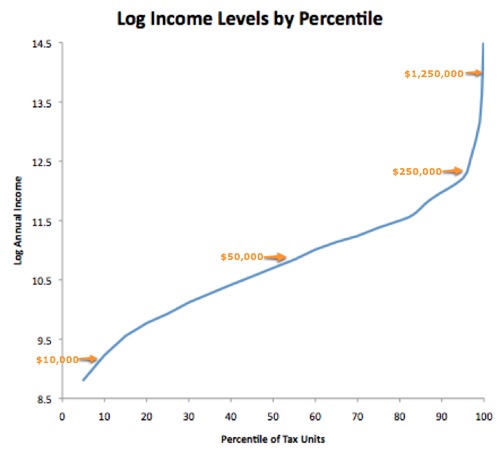 . You should be able to grok the theme of the parable of the poor little rich people by now.
Now what I have to do is explain why the rate of change along the slope of a curve using log income levels by percentile translates into pearl clutching in mamby pamby plutocracts. I know you hate math and it makes your stomach turn. I promise not to use the numbers. We’re going to just talk about the picture and the lines. Over on your right is Brad’s nifty graph. You can see that the curve is upward sloping but the slope varies depending on where you are on the curve.
You can see, however, it is positive at all points. This indicates a direct or positive relationship between two things. If one goes up, the other does too. Because the curve isn’t a straight line, the rate at which the curve goes up is different depending on where you are. This is reflected by the steepness or the flatness of the curve. Think of it as a hill. You have to slog up a steep hill, but a flat hill makes it easier to go forward.
One of the things of interests shown by this graph is the Log of Annual Income and the other is the percentile of tax units. The difference between Rampell’s graph and Delong’s graph is the log calculation. Brad explains why she needs to use the log of annual income compared to the level. Basically, the log turns the comparison in to a growth rate of annual income. A level is simply a level. The log means that we’re using the rate of change happening in incomes as we go up and down the curve. That rate of change is radically different at the richest levels. You can see that the slope almost goes vertical there compared to the middle levels where the curve is less steep and somewhat more horizontal. There’s a story that explains that. Krugman explains it well so I’m going to start with his explanation.

 peej
peej Carissa
 bostonboomer
 dakinikat
 ecocatwoman
 mablue2
 Mama Lopez
 peggysue22
 quixote
 skydancingguestblogger
 Mona (aka Wonk the Vote)



 Sky Dancing
Recent Comments