
“It’s the first time that our court has said that a closely held corporation has the rights of a person when it comes to religious freedom,” she said during a Q&A at the Aspen Ideas Festival. “I find it deeply disturbing that we are going in that direction.”
“It’s very troubling that a sales clerk at Hobby Lobby who needs contraception, which is pretty expensive, is not going to get that service through her employer’s health care plan because her employer doesn’t believe she should use birth control,” she continued.
Tuesday Reads: Live and Let Live Edition
Posted: July 1, 2014 Filed under: Affordable Care Act (ACA), birth control, Discrimination against women, Feminists, fetus fetishists, fundamentalist Christians, GLBT Rights, Hillary Clinton, Marriage Equality, morning reads, religious extremists, Reproductive Health, Reproductive Rights 28 CommentsGood Morning!
 Why is it that many religious people just cannot live without imposing their views on others? That’s one of the things I’ve been thinking about since the reliably patriarchal side of SCOTUS took one more step to force their favorite flavor of religion on the rest of us. Today’s photo montage is via “The Invisibles”. It is a montage of gay couples during the times when theirs was a “love that dare not speak its name”. There are so many folks that choose to live outside of the conventions of the society into which they were born. I was raised to think that this country was born of the dreams of folks wanting to establish a place where they could not be persecuted for not following the majority’s norms. Our country has not had perfect beginnings. But up until recently, I always felt that we were at least creeping towards a “more perfect union”.
While the plight of the GLBT community is improving and appears to have some forward momentum, there are others that are being shoved back into conformity with lives and values not of their choosing. This includes women, immigrants and many minorities. Why do others feel they have to justify their own lives by persecuting others? We’re headed towards our nation’s birthday. What has happened to the idea of creating our “more perfect union” with “liberty and justice for all”?
So, first I feel like I have to add more to the discussion on the SCOTUS decision that allows privately and tightly held corporations that are not engaged  in the business of religion to hold religious beliefs identical to the owners that are supposedly separate from the corporation enough to be indemnified by any illegal activities it undertakes. Hillary Clinton made her views clear on the subject as did Justice Ginsberg writing for the dissent. I will rely on their words here. Hillary Clinton calls the decision “deeply disturbing”.
Justice Ginsberg wrote a masterful dissent.
On Monday, the Supreme Court sided with Hobby Lobby on the company’s challenge to the Affordable Care Act’s contraceptive mandate, ruling that the mandate, as applied to “closely held” businesses, violates the 1993 Religious Freedom Restoration Act. But the divided court’s 5-4 decision included a dramatic dissent from Justice Ruth Bader Ginsburg, who called the majority opinion “a decision of startling breadth.” Ginsburg read a portion of her decision from the bench on Monday.
Addressing the majority of her colleagues — including all but one of the six men sitting on the Supreme Court — Ginsburg wrote:
In the Court’s view, RFRA demands accommodation of a for-profit corporation’s religious beliefs no matter the impact that accommodation may have on third parties who do not share the corporation owners’ religious faith—in these cases, thousands of women employed by Hobby Lobby and Conestoga or dependents of persons those corporations employ. Persuaded that Congress enacted RFRA to serve a far less radical purpose, and mindful of the havoc the Court’s judgment can introduce, I dissent.
The justice goes on to criticize the opinion’s interpretation of the religious freedom law, writing that “until today, religious exemptions had never been extended to any entity operating in ‘the commercial, profit-making world.'”
The reason why is hardly obscure. Religious organizations exist to foster the interests of persons subscribing to the same religious faith. Not so of for-profit corporations. Workers who sustain the operations of those corporations commonly are not drawn from one religious community. Indeed, by law, no religion-based criterion can restrict the work force of for-profit corporations…The distinction between a community made up of believers in the same religion and one embracing persons of diverse beliefs, clear as it is, constantly escapes the Court’s attention. One can only wonder why the Court shuts this key difference from sight.
“In sum,” Ginsburg adds about the free exercise claims at the heart of this case,“‘[y]our right to swing your arms ends just where the other man’s nose begins.’”
Justice Alito got a little prickly in his majority opinion about Ginsburg’s strong criticism of their take on the case:
As this description of our reasoning shows, our holding is very specific. We do not hold, as the principal dissent alleges, that for-profit corporations and other commercial enterprises can “opt out of any law (saving only tax laws) they judge incompatible with their sincerely held religious beliefs.” Post, at 1 (opinion of GINSBURG, J.). Nor do we hold, as the dissent implies, that such corporations have free rein to take steps that impose “disadvantages . . . on others” or that require “the general public [to] pick up the tab.” Post, at 1–2. And we certainly do not hold or suggest that “RFRA demands accommodation of a for-profit corporation’s religious beliefs no matter the impact that accommodation may have on . . . thousands of women employed by Hobby Lobby.” Post, at 2.1 The effect of the HHS-created accommodation on the women employed by Hobby Lobby and the other companies involved in these cases would be precisely zero. Under that accommodation, these women would still be entitled to all FDA-approved contraceptives without cost sharing.
Ginsburg seems to reply to Alito by suggesting that what Alito sees as a narrow, limited decision is essentially an invitation for lots of future challenges on religious grounds: “Although the Court attempts to cabin its language to closely held corporations,” she writes, “its logic extends to corporations of any size, public or private. Little doubt that RFRA claims will proliferate.”
Further quotes from Ginsburg’s dissent can be read at MOJO.
Here are seven more key quotes from Ginsburg’s dissent in Burwell v. Hobby Lobby:
- “The exemption sought by Hobby Lobby and Conestoga would…deny legions of women who do not hold their employers’ beliefs access to contraceptive coverage”
- “Religious organizations exist to foster the interests of persons subscribing to the same religious faith. Not so of for-profit corporations. Workers who sustain the operations of those corporations commonly are not drawn from one religious community.”
- “Any decision to use contraceptives made by a woman covered under Hobby Lobby’s or Conestoga’s plan will not be propelled by the Government, it will be the woman’s autonomous choice, informed by the physician she consults.”
- “It bears note in this regard that the cost of an IUD is nearly equivalent to a month’s full-time pay for workers earning the minimum wage.”
- “Would the exemption…extend to employers with religiously grounded objections to blood transfusions (Jehovah’s Witnesses); antidepressants (Scientologists); medications derived from pigs, including anesthesia, intravenous fluids, and pills coated with gelatin (certain Muslims, Jews, and Hindus); and vaccinations[?]…Not much help there for the lower courts bound by today’s decision.”
- “Approving some religious claims while deeming others unworthy of accommodation could be ‘perceived as favoring one religion over another,’ the very ‘risk the [Constitution’s] Establishment Clause was designed to preclude.”
- “The court, I fear, has ventured into a minefield.”
You can read the full dissent here. (It starts on page 60.)
 The court attempted a narrow decision but crept into an area of corporate law that could create an interesting situation. Usually, corporations are considered distinct from their owners. Hobby Lobby is a corporation tightly held by a family so the majority view basically carved out this type of corporation and said “it’s different”. However, how can you indemnify owners from corporate malfeasance AND say that this specific corporation that doesn’t have a religious mission reflects this set of owner’s pet superstitions? Could the justices have unintentionally left a back door open to challenge the very basis of incorporation which is to make any corporation its own entity?
The decision’s acknowledgment of corporations’ religious liberty rights was reminiscent of Citizens United v. Federal Election Commission, a 2010 ruling that affirmed the free speech rights of corporations. Justice Alito explained why corporations should sometimes be regarded as persons. “A corporation is simply a form of organization used by human beings to achieve desired ends,” he wrote. “When rights, whether constitutional or statutory, are extended to corporations, the purpose is to protect the rights of these people.”
Justice Ginsburg said the commercial nature of for-profit corporations made a difference.
“The court forgets that religious organizations exist to serve a community of believers,” she wrote. “For-profit corporations do not fit that bill.”
I wanted to point out the anniversary of a sad day in New Orleans history. I’m not sure how many of you know about the UpStairs Lounge fire of 1973. The arson mass murder of GLBT stands as the largest of its kind in modern history.
On June 24, 1973, an arsonist set fire to a gay bar in New Orleans called the Upstairs Lounge, killing 32 gay men and women in what has gone down in history as thelargest gay mass murder in U.S. history.
Today is the 41st anniversary of that tragedy, which has been documented by Robert L. Camina in the new film “Upstairs Inferno”. According to the first official teaser trailer below, the horrific event led to even more reprehensible acts in its wake – several bodies from within the club were never claimed by family members, those survivors featured in the news went on to lose their jobs and livelihoods, and the New Orleans police department lagged its feet and attempted to cover up the deadly crime.
To this day, no one has ever been charged with setting fire to the UpStairs Lounge.
Many folks believe this is an event that should not be forgotten.
For a complex array of reasons, including homophobia, shame, and despair, the fire and its victims languished in obscurity for years, not taking its proper place in the broader sweep of LGBT history, but this is quickly changing.
“Upstairs”, my musical tragedy commemorating the fire and honoring its victims premiered last year in New Orleans to sold-out audiences, as part of the 40th anniversary memorials and Pride events. A portion of the musical is now playing at the West Village Musical Theatre Festival in New York.
A new book, “The UpStairs Lounge Arson: Thirty-Two Deaths in a Louisiana Gay Bar”, released just last month, is the most extensively-researched and carefully-told history of the subject.
And “Upstairs Inferno”, a documentary by acclaimed filmmaker Robert Camina is currently in post-production.
In addition, Delery, Camino, and I are advocating the inclusion of the UpStairs Lounge site on the National Register of Historic Places.
To commemorate the anniversary of the fire, I spoke with Camina about his documentary.
The lion’s share of published research about the fire comes from Johnny Townsend, author of “Let the Faggots Burn”, and Clay Delery. Did you interview them for the piece and what did you learn?
Well of course Townsend had a lot to contribute, because without his efforts many years ago to interview people, many of the stories would have been lost. So I think he brought a lot of insight to the tragedy that, since so many have passed on, we are not able to access.
Did you get to talk to anyone that Delery and Townsend did not get to talk to?
I don’t think they interviewed Francis Dufrene. We were able to interview him. He was a survivor of the fire. He slipped through the bars and jumped and landed on the pavement. He suffered third-degree burns. He gave us a distinctive perspective of what it was like in the middle of it when the fire started, so we definitely learned a little bit of what it was like the emotions just the mood and a frame of mind of what people going through in there.
As far as you can tell, what was the UpStairs lounge like as a bar?
It was a very comfortable place. Everyone we talked to said that the patrons were like a family. And the word that has come up that you’re very familiar with is “Sanctuary”.Yes, that’s why I opened my musical with a song of that title. And of course, when a place that is considered a sanctuary is invaded and ruined, it has a profound impact on a community. And I’m not sure I had a whole sense of the impact that it had until I was there last year for the 40th Anniversary to see how the community responded to the memorial events and the play.
Supreme Court Justice Antonin Scalia made an appearance at the Lanier Theological Library in Houston, Texas on Friday, where he claimed that the success of capitalism was deeply tied to the nation’s religious values.
“While I would not argue that capitalism as an economic system is inherently more Christian than socialism … it does seem to me that capitalism is more dependent on Christianity than socialism is,” Scalia, a devout Catholic, said during his speech,according to the Houston Chronicle. “For in order for capitalism to work — in order for it to produce a good and a stable society — the traditional Christian virtues are essential.”
Unfortunately, I can’t seem to read the part in the new testament where the jesus dude said ANY of that. Evidently, we’re supposed to all follow his brand of religion even if we find it to be complete bunk.
Why can’t we just live and let live?
What’s on your reading and blogging list today?
The Kitty Genovese Case 50 Years Later
Posted: March 13, 2014 Filed under: Crime, Criminal Justice System, GLBT Rights, Media, psychology | Tags: B. Latane, bystander effect, J.M. Darley, Kew Gardens, Kitty Genovese, Mary Ann Zielonko, rape, serial murders, Winston Mosley 20 Comments
Today is the 50th anniversary of the murder of Kitty Genovese in Queens, New York. This was a crime that shocked and outraged America and the world, and still horrifies and fascinates people to this day. At The New Yorker, Nicholas Lehmann describes some of the reasons this news story has become so iconic and reviews two new books on the case. Lehmann argues that New York Times editor Abe Rosenthal created a news environment in which this particular murder became the focus of so much attention. Lehmann deliberately shaped the coverage of the murder in a sensational and misleading manner. The story ended up as the focus of a classic psychological study.
a post about this in August 2009, and I thought I’d put that post up again today.
I wrote a piece about this in August 2009. I thought I’d repost it today. I’ve made a few minor edits to the original. At the end, I list some recent books and articles for further reading.
The Kitty Genovese Case: A Fascinating Intersection of True Crime, Psychology, and Media Misinformation
A Murder in Kew Gardens
On March 13, 1964, at around 3:30AM, there was a murder in the Kew Gardens section of Queens, New York. The murder probably wouldn’t have gotten much publicity at all if it hadn’t been for a sensational article that appeared on the front page of The New York Times, a couple of weeks later. The Times story led to groundbreaking research in social psychology and the discovery of new and counter-intuitive information about human behavior.
It was very late, very cold, and very dark when 28-year-old Catherine “Kitty” Genovese parked her car at the Kew Gardens train station after driving from Ev’s Eleventh Hour Bar in Hollis, where she worked nights as manager. When she got out of her car, she saw a stranger walking toward her. The man, Winston Mosley, 29, stabbed Genovese two times as she hurried past a bookstore on Austin Street, pehaps headed a local bar named Bailey’s to seek assistance. She called out, “Oh my God. He stabbed me. Please help me,” and fell to the ground. Winston was leaning over her to stab her again, when he heard a man’s voice calling from a window in an apartment building across the street, “Leave that girl alone!”
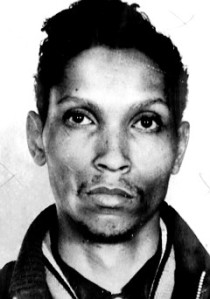
- Winston Mosley
Startled, Mosley ran down an alley, got into his car, and backed up, ready to drive off. Lights had gone on in the nearby apartment building, but they went off again. Mosley got out of the car and again followed Genovese, who had reached the doorway of her apartment building, which was in the back of the building at 82-62 Austin Street. As she fell forward through the doorway, crying out, “I’m dying, I’m dying,” Winston caught up with her, stabbed her again, and then raped her. A short time later, a neighbor, Greta Schwartz, who had called the police after receiving a phone call from another neighbor, ran down to the lobby and cradled Kitty in her lap until the paramedics arrived.
From interviews in the neighborhoods of the two stabbing incidents, police learned that as many as 37 people had seen or heard part of the stalking and murder of Kitty Genovese by Winston Mosley, but supposedly none of them had called the police except Greta Schwartz.
The New York Times Breaks the Story
On March 27, 1964, The New York Times published a front page story by Martin Gansberg (Warning, PDF) headlined “37 Who Saw Murder Didn’t Call Police.”
Apathy at Stabbing of Queens Woman Shocks Inspector
For more than half an hour 38 respectable, law-abiding citizens in Queens watched a killer stalk and stab a woman in three separate attacks in Kew Gardens.
Twice the sound of their voices and the sudden glow of their bedroom lights interrupted him and frightened him off. Each time he returned, sought her out and stabbed her again. Not one person telephoned the police during the assault; one witness called after the woman was dead.
That was two weeks ago today. But Assistant Chief Inspector Frederick M. Lussen, in charge of the borough’s detectives and a veteran of 25 years of homicide investigations, is still shocked.
He can give a matter-of-fact recitation of many murders. But the Kew Gardens slaying baffles him–not because it is a murder, but because the “good people” failed to call the police.
Just that brief excerpt contains a number of inaccuracies, which I’ll get to a little later. Nevertheless, it was from this newspaper article that Americans–and people around the world–formed their lasting impressions of the tragic death of Kitty Genovese. The story shocked the nation; everyone was talking about how terrible it was that in big cities like New York, people just didn’t seem to get to know their neighbors or care about them. Those of us who lived in small cities and towns were sure things would be different in our neighborhoods.
Psychological Study of the Bystander Effect
In 1968, J.M. Darley and B. Latane published a study (pdf) in the Journal of Personality and Social Psychology that was inspired by the supposed behavior of the 37 “witnesses” to Kitty Genovese’s murder. They hypothesized that the reason bystanders did not take action was “diffusion of responsibility,” and that the more bystanders in an emergency situation, the more these bystanders believe that “someone else will help, so I don’t need to.”
Participants in the study were college students in an introductory psychology class at New York University.
Darley and Latane told participants that they wanted to study how students adjust to university life in a highly competitive, urban environment. They said they wanted participants to discuss their problems honestly with other students; and in order to avoid personal discomfort, participants would sit in separate rooms equipped with an intercom system.
There were three different groups. Students in group one were told they would be talking with one other person. In group two, students were told there would be two other people on the intercome with them. Group five was told there would be five other people listening in to the conversation. In reality, all of the students were alone and they the other voices they heard were on tape. The emergency was that one of the participants in the discussion has epileptic seizure (the sounds of the seizure were actually played on tape).
As the intercom discussions began, students heard the first student, a male, tell about his difficulties concentrating on his studies and problems adjusting to life in New York City. He then added, with some embarrassment, that he sometimes had severe seizures, especially when under a lot of stress. Then the conversation switched to the next student. In group 1, the actual student’s turn came next. In the other two groups, the real student heard one or more other students speak first. After the real student took a turn speaking, the first “student” again started to speak normally, then began having a seizure, and asked for help. Darley and Latane measured how long it took subjects to help the student in trouble (helping was defined as leaving the cubicle and notifying an experimenter of the problem).
Why? Not because they were apathetic. All subjects were anxious and showed physical signs of nervousness. Darley and Latane conclued that as the number of people involved in an emergency situation increase, it’s easier for bystanders to assume that someone else will handle it; and the potential guilt for not helping is divided up. Other possible reasons for failure to act are fear of embarrassment or ridicule, fear that they are misinterpreting the situation. The authors also pointed out that most people don’t have much experience with emergency situations and are likely to become confused or overwhelmed when they encounter one.
Joseph De May, Jr., and the Kew Gardens History Page
In 2000, Joseph De May, who had lived in Kew Gardens since 1974, decided to build a website that would contain a comprehensive pictorial history of the neighborhood. As part of his project, De May dug up as much information as he could about the Kitty Genovese murder and then critiqued the original New York Times article and debunked some myths that had grown up around the case. Here is the “short version” of his critique:
# There were only 2 attacks, not 3.
# The attacks were not continuous. There was about a 10 min. interval between them when the killer moved his car to a parking place farther away.
# There were not 38 eye witnesses to either of the attacks. Only 3 people are known to have seen one or the other of the stabbings.
# The first attack on Austin Street – the one that awakened the witnesses – was likely over before all but a few of the witnesses got to their windows.
# Probably many more than 38 were ear witnesses to Kitty’s screams. However, that first attack occurred a few yards away from a bar known for its late night rowdiness.
# After the first attack, Kitty left the scene under her own power without making any outcries for help.
# The second attack took place in a small vestibule in the rear of a building where only one witness was in a position to see it.
# Given the layout of the crime scene, it would have been impossible for anyone to have seen or heard everything.
# Assuming the police were not timely called – a big assumption in my opinion – there were reasons apart from apathy why they were not.

- Crime scene photo: back of apartment building where Kitty died
Furthermore, a 15-year-old boy named Michael Hoffman saw Winston Mosley run away after the first attack in front of the bookstore and saw Kitty Genovese get up and stagger in the other direction. He didn’t know there had been a stabbing, but he told his father what he had seen and the father called the police. The police later admitted they had received several other calls. One man did see the knife and understood that a woman was being stabbed. This man never called the police and couldn’t explain his inaction. At least five other people saw Mosley return to the original scene, but by that time Kitty Genovese was gone.
There were two attacks, not three as the New York Times reported. A man on the first floor of Kitty’s building open his door and saw the final attack. He wanted to call police, but said his wife didn’t want him to get involved. He went to Greta Schwartz’s apartment and asked her to call police, which she did. She then ran downstairs with a friend, found Kitty still alive and cradled her until an ambulance arrived. Also contrary to The New York Times story, the occupants of Kitty Genovese’s apartments building knew and were friendly with each other. Many knew and liked Kitty and her roomate Mary Ann Zielonko.
The Real Kitty Genovese
In 2004, on the fortieth anniversary of Kitty Genovese’s death, Mary Ann Zielonko came forward and talked about Kitty publicly for the first time. She was interviewed on NPR’s Weekend Edition Saturday. In the interview, Zielonko, who now lives in Vermont, revealed that she and Kitty Genovese were lovers. A lesbian blogger in Vermont wrote a piece about her own feelings after she learned about Kitty’s sexual orientation.
Hearing that Genovese was a lesbian has shaken up my psyche. Genovese’s name was always a cautionary tale – about being a woman alone in the city at night, about the need to care and take action in the face of assault. But now it’s also somehow more about me as a lesbian, about our denied and undiscovered herstory, about the dangers we faced then – and now.
In 1964, it was not okay to be queer. The only place to go to hold your lover’s hand in semi-public was a bar. Mary Ann remembers the Swing Rendezvous on MacDougal St. and the Seven Steps on Houston. Police raids and being beaten up for wearing butch or femme drag were common events.
Until now we’ve never had the opportunity to ask whether the neighbors’ indifference might have had an element of homophobia (not that the word existed then). Kitty and Mary Ann lived together in the apartment Kitty was so desperately trying to reach that March night. Mary Ann says some of the neighbors suspected they were lesbians, because they were always together. “But we didn’t look ‘gay,’ whatever that means.” Mary Ann got home from her own shift tending bar and went to sleep – until the police knocked at her door at 4 a.m. and drove her from the tree-lined streets of their Kew Gardens, Queens, neighborhood where Kitty died, to the hospital morgue to identify Kitty’s body.
Some of the neighbors may have suspected that Kitty and Mary Ann were gay, but several reported in interviews that she was a friendly, smiling young woman whom they liked. A few told police and reporters that they “didn’t want to get involved,” but most weren’t sure what they had seen or heard and couldn’t say why they didn’t call for help. It was after 3AM on a winter night, in a neighborhood where there were often loud voices and even fighting among people leaving local bars. As with the participants in Darley and Latane’s study, some of the witnesses may have feared giving a false report to police and looking foolish.
In addition, Joseph De May reports that in those days, NYC police demanded that callers identify themselves rather than just accepting reports of emergencies. That may have deterred some from calling police or holding on long enough to get someone to listen. Even if witnesses had called police to report screaming or fighting, they would likely have taken a long time to respond, because of the bars in the area.
In 2004, The New York Times interviewed De May about his research.
In the end, Mr. De May’s conclusion about the murder is that, while the behavior of the witnesses was hardly beyond reproach, the common conception of exactly what occurred that night is not in fact what occurred. What did occur, he argues, is far more complex and far less damning to the residents of Kew Gardens.
”Yeah, there was a murder,” Mr. De May said. ”Yeah, people heard something. You can question how a few people behaved. But this wasn’t 38 people watching a woman be slaughtered for 35 minutes and saying, ‘Oh, I don’t want to be involved.”’
Mr. De May began his research with the seminal Times article of March 27, 1964. ”I remember reading through it, then putting it down and thinking, ‘Well, this doesn’t hang together at all,”’ he said. ”And then I read it again carefully. I knew the area. I knew the crime scene because I go by there every day.”
Mr. De May soon found himself poring through legal documents related to the case, scouring books and articles, and interviewing neighbors. At one point, he even ran the route of Ms. Genovese’s flight up Austin Street, timing it with a watch. He became convinced that his first impression was correct. ”Here’s something that everyone thinks happened,” he said, ”that isn’t so.”
Winston Mosley
Kitty’s murderer had no idea that she was a lesbian. He had set out that night to kill a woman. He was certainly a sociopath and may have been a serial killer. He confessed to having killed at least one other woman after he was arrested for the Genovese murder. In 1968, Mosley managed to escape from police custody and raped a pregnant woman in her home. In April, 2008, the New York Daily News reported on Mosley’s latest parole hearing.
Forty-four years after stalking and stabbing Kitty Genovese, her killer still blames his wife-beating father for the vicious murder.
“My father was at the time stalking my mother and thinking about killing her,” Winston Moseley told the parole board last month when asked about the infamous 1964 slaying.
“But the problem was not just at that moment in time,” he said. “It existed for many years of sort of the emotional trauma that I was going through.”
Moseley, whose parole bid was rejected for a 13th time, has long displayed little remorse for the March 13, 1964, slaying – although he did offer an apology this time, a transcript of the hearing shows.
Further Reading:
Books
In 2008, Charles E. Stoller, the man who prosecuted Winston Mosley for the murder of Kitty Genovese and two other murders, published a book about the cases, Twisted Confessions: The True Story Behind the Kitty Genovese and Barbara Kralik Murder Trials.
Catherine Pelonero, Kitty Genovese: A True Account of a Public Murder and Its Private Consequences (2014)
Kevin Cook, Kitty Genovese: The Murder, the Bystanders, the Crime that Changed America (2014)
Articles
Boston Globe book review, ‘Kitty Genovese’ by Kevin Cook and ‘Kitty Genovese’ by Catherine Pelonero
Nicholas Lehmann, A CALL FOR HELP: What the Kitty Genovese story really means.
AP (via CBS Local NY), 50 Years Later, Kitty Genovese Murder Case Still Grips NYC, Nation.
Fabian Tepper (Christian Science Monitor), Kitty Genovese murder: would you have helped?
Nancy Dillon (NY Daily News), Brother of Kitty Genovese to release documentary about sister’s 1964 murder, which prompted ‘Genovese Syndrome’ research
International Community Must Confront Putin and Russia on Anti-Gay Legislation
Posted: August 21, 2013 Filed under: Foreign Affairs, GLBT Rights, homophobia, open thread, Russia | Tags: 2013 Winter Olympics, adoption, Bradley Manning, Edward Snowden, Harvey Fierstein, James Kirchick, Russian anti-gay legislation, same-sex marriage, Vladimir Putin 19 Comments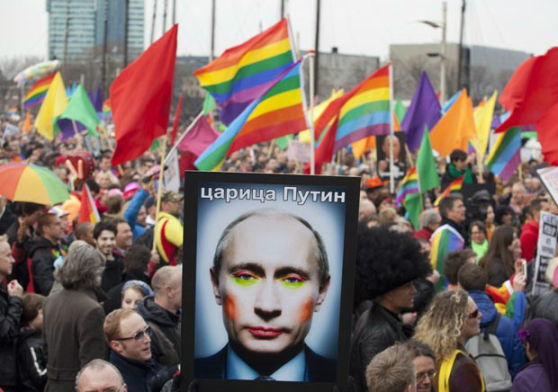
There’s been quite a bit of talk recently about Russia’s anti-gay “propaganda” legislation–signed into law on June 30 by President Vladimir Putin–because of this month’s World Athletics Championships in Moscow and the upcoming Winter Olympics in Sochi as well as Edward Snowden’s decision to defect to Russia. Naturally there is concern about discrimination against gay athletes and coaches at international sporting events; and Snowden has been criticized because his supposed passion for human rights is belied by his embrace of Putin and his disastrous human rights record.
Here’s an explanation of the new law at PolicyMic: Russia’s Anti-Gay Law, Spelled Out in Plain English.
On June 30 this year, Russian President Vladimir Putin signed into law a bill banning the “propaganda of nontraditional sexual relations to minors,” thus opening a new, dark chapter in the history of gay rights in Russia. The law caps a period of ferocious activities by the Russian government aimed at limiting the rights of the country’s lesbian, gay, bisexual, transgender, and intersex people.
The violations of fundamental, constitutionally protected rights of Russia’s gay citizens have included multiple bans on gay pride parades in Moscow and other cities, hefty fines to gay rights groups accused of acting as a “foreign agent,” denial of registration to nongovernmental organizations, and regional laws banning the propaganda of homosexuality to minors, which served as a basis for the federal law enacted by Mr. Putin and unanimously passed by the State Duma. Against this backdrop, violent attacks on gays or “suspect gays” are becoming commonplace.
The federal law is spelled out in Article 6.21 of the Code of the Russian Federation on Administrative Offenses.
Here is what Article 6.21 actually says:
Propaganda is the act of distributing information among minors that 1) is aimed at the creating nontraditional sexual attitudes, 2) makes nontraditional sexual relations attractive, 3) equates the social value of traditional and nontraditional sexual relations, or 4) creates an interest in nontraditional sexual relations.
If you’re Russian. Individuals engaging in such propaganda can be fined 4,000 to 5,000 rubles (120-150 USD), public officials are subject to fines of 40,000 to 50,000 rubles (1,200-1,500 USD), and registered organizations can be either fined (800,000-1,000,000 rubles or 24,000-30,000 USD) or sanctioned to stop operations for 90 days. If you engage in the said propaganda in the media or on the internet, the sliding scale of fines shifts: for individuals, 50,000 to 100,000 rubles; for public officials, 100,000 to 200,000 rubles, and for organizations, from one million rubles or a 90-day suspension.
If you’re an alien. Foreign citizens or stateless persons engaging in propaganda are subject to a fine of 4,000 to 5,000 rubles, or they can be deported from the Russian Federation and/or serve 15 days in jail. If a foreigner uses the media or the internet to engage in propaganda, the fines increase to 50,000-100,000 rubles or a 15-day detention with subsequent deportation from Russia.
As PolicyMic points out, the language of the law is so ambiguous that it is difficult to predict how it will be enforced or how it will be applied to foreigners. According to HuffPo, visitors to Russia should be concerned.
Bad news for lesbian, gay, bisexual and transgender (LGBT) travelers hoping to visit Russia, as foreign tourists will now be subjected to the same “gay propaganda” fines and sentences as residents.
Travel site Skift reports that the new law, signed into law by Russian President Vladimir Putin on June 30, contains a provision that allows the government to arrest and detain gay (or “pro-gay”) foreigners for up to 14 days before they would then be expelled from Russia.
As far as what is considered “pro-gay,” the laws specifics are somewhat vague, butCanadian site Travel and Escape suggests “gay-affirmative” speech, displaying a rainbow flag and same-sex partners holding hands are among the prohibited actions.
A few days later, on July 3, Putin signed another law that bans adoption of Russian children by foreign same-sex couples or by any unmarried couple or single parent in a country that recognizes gay marriage.
Today Harvey Fierstein published an op-ed in The New York Times on Russia’s Anti-Gay Crackdown, in which he reports there are rumors that Putin will soon
sign an edict that would remove children from their own families if the parents are either gay or lesbian or suspected of being gay or lesbian. The police would have the authority to remove children from adoptive homes as well as from their own biological parents.
Fierstein dismisses claims that these recently passed laws are designed to protect children from pedophiles. There is no scientific evidence to show that pedophiles are homosexuals; in fact research shows that the overwhelming majority of pedophiles are heterosexual males. So what is the explanation for the Putin’s war against gays?
Mr. Putin’s true motives lie elsewhere. Historically this kind of scapegoating is used by politicians to solidify their bases and draw attention away from their failing policies, and no doubt this is what’s happening in Russia. Counting on the natural backlash against the success of marriage equality around the world and recruiting support from conservative religious organizations, Mr. Putin has sallied forth into this battle, figuring that the only opposition he will face will come from the left, his favorite boogeyman.
Mr. Putin’s campaign against lesbian, gay and bisexual people is one of distraction, a strategy of demonizing a minority for political gain taken straight from the Nazi playbook. Can we allow this war against human rights to go unanswered? Although Mr. Putin may think he can control his creation, history proves he cannot: his condemnations are permission to commit violence against gays and lesbians. In May a young gay man was murdered in the city of Volgograd. He was beaten, his body violated with beer bottles, his clothing set on fire, his head crushed with a rock. This is most likely just the beginning.
Yet, so far the international community hasn’t done much to push back against Putin’s anti-gay campaign. As Fierstein writes, “this must change,” and the upcoming Winter Olympics provides the perfect opportunity for enlightened government to put pressure on Putin and his regime.
Today, one gay reporter, James Kirchick, did his part to call attention to Russia’s repressive new anti-gay laws when he appeared on Russia Today, the state-owned TV station, ostensibly to discuss the Bradley Manning sentence. It turned into quite a scene.
According to The Washington Free Beacon, Kirchick was taken off the air when he refused to stop talking about Russia’s anti-gay laws and focus on Bradley Manning.
“A quick explanation now for the beginning of our coverage of the Bradley Manning sentences,” one host said later in the program. “We invited a guest on to discuss the fate of the whistleblower, but he used the chance to discuss his views on other unrelated issues and that’s why we had to take him off air. We would like to say sorry for any confusion caused.”
RT also refused to continue Kirchick’s car service, according to the reporter.
“True fact: (RT) just called taxi company that took me to studio to drop me off on the side of the highway on way to Stockholm airport,” Kirchick wrote on Twitter Wednesday morning following his appearance on the network.
This is an open thread, but any comments on the content of this post will be much appreciated.
Thursday Reads
Posted: August 8, 2013 Filed under: Barack Obama, Civil Liberties, Drone Warfare, Foreign Affairs, GLBT Rights, morning reads, NSA, National Security Agency, Russia, U.S. Politics, Yemen | Tags: al Qaeda, Ayan al-Zawahiri, Barbara Starr, Charlie Savage, DEA, Edward Snowden, FISA, IRS, Josh Rogin, Julia Ioffe, Lawrence O'Donnell, Nasser al-Wuhayshi, Sochi Winter Olympics, whistleblowers 36 Comments
Good Morning!!
Yesterday, the White House announced that President Obama will not meet one-on-one with Russian President Vladimir Putin at the G-20 meeting in St. Petersburg as previously planned. From The Washington Post:
President Obama has canceled a meeting with Russian Prime Minister Vladimir Putin. Russia’s decision to give temporary asylum to former National Security Agency contractor Edward Snowden has exacerbated tensions with the United States over a number of issues:
“Following a careful review begun in July, we have reached the conclusion that there is not enough recent progress in our bilateral agenda with Russia to hold a U.S.-Russia Summit in early September,” White House press secretary Jay Carney said in a statement.
Carney cited a “lack of progress” with Russia over the past 12 months on a broad range of issues including missile defense and arms control, trade and commercial relations, global security and human rights and civil society issues. Carney added that Russia’s “disappointing decision” last week to grant Snowden temporary asylum, allowing him to live and work in Russia for up to a year, was also a factor.
President Obama discussed some of his issues with Russia in an appearance on The Tonight Show with Jay Leno on Tuesday night.
Saying that he had “no patience for countries that try to treat gays or lesbians or transgender persons in ways that intimidate them or are harmful to them,” Obama criticized a law, enacted in June, that prohibits public events promoting gay rights and public displays of affection by same-sex couples. A Russian official has promised that the law will be enforced during next February’s Sochi Games despite the International Olympic Committee’s contrary stance.
After the announcement, Russian-American journalist Julia Iofee wrote at The New Republic: Obama Bails on His Inevitably Awkward Date With Putin.
A week after Edward Snowden was granted temporary asylum in Russia, President Obama canceled his bi-lateral September summit in Moscow with Vladimir Putin, though administration officials are at pains to portray this as something greater than pure tit-for-tattery. Rather, they say, it was an excuse to avoid what, even without Snowden, would have been “a pretty dreary affair.”
A few days before Snowden turned up in Moscow, Obama and Putin met on the sidelines of the G8 conference in Northern Ireland. The resulting photo-op—Obama looking forlornly into the distance, Putin slouched and sullen—said it all: they looked like the aging couple at the neighboring table, intently working on their food and eavesdropping on your conversation because they had nothing to support one of their own. Moscow and Washington had talked and talked, they’d gotten START and the transport route to Afghanistan and the sanctions on Iran, but now, the kids are out of the house and they were talking past each other on Syria, on Iran, on pretty much everything.
Lawrence O’Donnell asked Ioffe to appear on his MSNBC show last night to discuss the issues surrounding the decision; but instead of allowing her to express her opinions, O’Donnell interrupted Ioffe, lectured her about Russia and Putin, basically implying she is a liar. Ioffe responded at TNR:
Tonight, I went on Lawrence O’Donnell’s show, and Lawrence O’Donnell yelled at me. Or, rather, he O’Reilly’d at me. That O’Donnell interrupted and harangued and mansplained and was generally an angry grandpa at me is not what I take issue with, however. What bothers me is that, look: your producers take the time to find experts to come on the show, answer your questions, and, hopefully, clarify the issue at hand.
I was invited on the show to talk about Obama’s (very wise) decision to cancel his Moscow summit with Putin, about which I wrote here. I am an expert on Russia. In fact, it is how you introduced me: “Previously, she was a Moscow-based correspondent for Foreign Policy and The New Yorker.” I’m not going to toot my own horn here, but I was there for three years, I’m a fluent, native speaker of Russian, and, god damn it, I know my shit.
Which is why I wish you’d let me finish answering your bullshit question…
You can watch the interaction at MSNBC and read the things she would have liked to say about Putin at TNR. Basically Ioffe tried to explain the Putin doesn’t control everything that happens in Russia anymore than Obama controls everything that happens in the US. She believes that once the Bolivian plane was forced to land because the US suspected Snowden might be on board, Putin really had no choice but to allow Snowden to stay in Russia, because public opinion there strongly supported him.
I have quoted Ioffe in previous posts, and she certainly is no Putin apologist–as she asserts in her piece. I think O’Donnell treated her shamefully.
In other NSA news, mainstream reporters continue to published far more stunning revelations than anything that has come from Snowden and Greenwald. This morning at The New York Times, Charlie Savage writes about surveillance of e-mails between people in the US and foreign countries without warrants, which is being justified by an interpretation of the 2008 FISA Amendments Act.
The National Security Agency is searching the contents of vast amounts of Americans’ e-mail and text communications into and out of the country, hunting for people who mention information about foreigners under surveillance, according to intelligence officials.
The N.S.A. is not just intercepting the communications of Americans who are in direct contact with foreigners targeted overseas, a practice that government officials have openly acknowledged. It is also casting a far wider net for people who cite information linked to those foreigners, like a little used e-mail address, according to a senior intelligence official.
While it has long been known that the agency conducts extensive computer searches of data it vacuums up overseas, that it is systematically searching — without warrants — through the contents of Americans’ communications that cross the border reveals more about the scale of its secret operations….
Government officials say the cross-border surveillance was authorized by a 2008 law, the FISA Amendments Act, in which Congress approved eavesdropping on domestic soil without warrants as long as the “target” was a noncitizen abroad. Voice communications are not included in that surveillance, the senior official said.
Read more at the NYT link.
And at Reuters, John Shiffman and David Ingram report that a DEA program that appears to use NSA data to target ordinary criminals in the and then require DEA officers to conceal the source of the information was also used by the IRS.
Details of a U.S. Drug Enforcement Administration program that feeds tips to federal agents and then instructs them to alter the investigative trail were published in a manual used by agents of the Internal Revenue Service for two years.
The practice of recreating the investigative trail, highly criticized by former prosecutors and defense lawyers after Reuters reported it this week, is now under review by the Justice Department. Two high-profile Republicans have also raised questions about the procedure.
A 350-word entry in the Internal Revenue Manual instructed agents of the U.S. tax agency to omit any reference to tips supplied by the DEA’s Special Operations Division, especially from affidavits, court proceedings or investigative files. The entry was published and posted online in 2005 and 2006, and was removed in early 2007. The IRS is among two dozen arms of the government working with the Special Operations Division, including the Federal Bureau of Investigation, the National Security Agency and the Central Intelligence Agency.
An IRS spokesman had no comment on the entry or on why it was removed from the manual. Reuters recovered the previous editions from the archives of the Westlaw legal database, which is owned by Thomson Reuters Corp, the parent of this news agency.
Just as a reminder that Russia’s treatment of journalists and whistleblowers is actually a hell of a lot worse than anything that happens in the US, Human Rights Watch reports on Russia’s Silencing Activists, Journalists ahead of Sochi Games.
(Moscow) – Local authorities have harassed numerous activists and journalists who criticized or expressed concerns about preparations for the 2014 Winter Olympic Games in Sochi. The six-month countdown to the Sochi Games opening ceremony is this week.
Human Rights Watch has documented government efforts to intimidate several organizations and individuals who have investigated or spoken out againstabuse of migrant workers, the impact of theconstruction of Olympics venues and infrastructure on the environment and health of residents, and unfair compensation for people forcibly evicted from their homes. Human Rights Watch also documented how authorities harassed and pursued criminal charges against journalists, apparently in retaliation for their legitimate reporting.
“Trying to bully activists and journalists into silence is wrong and only further tarnishes the image of the Olympics,” said Jane Buchanan, associate Europe and Central Asia director at Human Rights Watch. “One of the non-negotiable requirements of hosting the Olympics is to allow press freedom, and the authorities’ attempts to silence critics are in clear violation of that principle.”
Obviously that doesn’t justify the Obama administration trying to influence media coverage of the NSA story, but we do need to keep things in perspective. In that vein, Bob Cesca had a good post yesterday: The Real-Life Stories of Legitimate NSA Whistleblowers (Snowden Isn’t One of Them). I hope you’ll give it a read.
In other news, Yemen has been hit by 6 suspected US drone strikes in the past 2 weeks–probably linked to the recently reported threat of an imminent terror strike that led the US to close a number of embassies last weekend.
An official in Yemen said Thursday that the sixth suspected U.S. drone strike in just two weeks had left six suspected al Qaeda militants dead in the group’s former stronghold in the center of the country. The official told The Associated Press that a missile hit a car traveling in the central Marib province, causing the fatalities.
CBS News correspondent Charlie D’Agata reports that Yemen has long been a haven for al Qaeda leadership, and the country claimed Wednesday to have disrupted a major plot, which may have exposed potential targets.
Yemeni government officials say security forces are turning up the heat on militants from al Qaeda in the Arabian Peninsula, the global terror network’s branch based in the nation, after foiling the plot to strike foreign embassies, gas and oil installations, and the country’s port cities.
The government has even given a shoot-to-kill order on anybody who looks suspicious and refuses to identify themselves.
The alleged plot appears to have been similar to the January attack in Algeria which saw gunmen storm the Amenas gas plant, killing more than three dozen foreign workers.
Yesterday in The Daily Beast, Eli Lake and Josh Rogin reported that information about the terror threats came from an al Qaeda “conference call,” involving top al Qaeda leaders and around 20 other people–a report that aroused quite a bit of skepticism on Twitter. Why would these guys risk talking on a conference call? Here’s an excerpt from the Daily Beast article:
The intercept provided the U.S. intelligence community with a rare glimpse into how al Qaeda’s leader, Ayman al-Zawahiri, manages a global organization that includes affiliates in Africa, the Middle East, and southwest and southeast Asia.
Several news outlets reported Monday on an intercepted communication last week between Zawahiri and Nasser al-Wuhayshi, the leader of al Qaeda’s affiliate based in Yemen. But The Daily Beast has learned that the discussion between the two al Qaeda leaders happened in a conference call that included the leaders or representatives of the top leadership of al Qaeda and its affiliates calling in from different locations, according to three U.S. officials familiar with the intelligence. All told, said one U.S. intelligence official, more than 20 al Qaeda operatives were on the call.
To be sure, the CIA had been tracking the threat posed by Wuhayshi for months. An earlier communication between Zawahiri and Wuhayshi delivered through a courier was picked up last month, according to three U.S. intelligence officials. But the conference call provided a new sense of urgency for the U.S. government, the sources said.
Al Qaeda members included representatives or leaders from Nigeria’s Boko Haram, the Pakistani Taliban, al Qaeda in Iraq, al Qaeda in the Islamic Maghreb, and more obscure al Qaeda affiliates such as the Uzbekistan branch. Also on the call were representatives of aspiring al Qaeda affiliates such as al Qaeda in the Sinai Peninsula, according to a U.S. intelligence official. The presence of aspiring al Qaeda affiliates operating in the Sinai was one reason the State Department closed the U.S. Embassy in Tel Aviv, according to one U.S. intelligence official. “These guys already proved they could hit Eilat. It’s not out of the range of possibilities that they could hit us in Tel Aviv,” the official said.
Perhaps the call was encrypted in some way and the US had found a way to listen anyway? But then why would they blow future such operations by leaking the fact that they had listened to the call? This morning CNN’s Barbara Starr tweeted to Josh Rogin:
@joshrogin IT WAS NOT A PHONE CALL. IN FACT, AL QAEDA WENT TO EXTENSIVE MEANS TO SET UP WHAT YOU MIGHT SAY A VIRTUAL MEETING SPACE.”
I’m not sue how to interpret that either. I’ll update if I get anything more on this.
Once again, my morning post has gotten way too long. I have other news links, but I’ll put them in the comments. I hope you’ll do the same with whatever stories you’re following today, and have a tremendous Thursday!!
Wednesday AM: Justice for Marco McMillian
Posted: May 15, 2013 Filed under: GLBT Rights, homophobia, Human Rights | Tags: justice, LGBT, Marco McMillian, Mississippi 31 Comments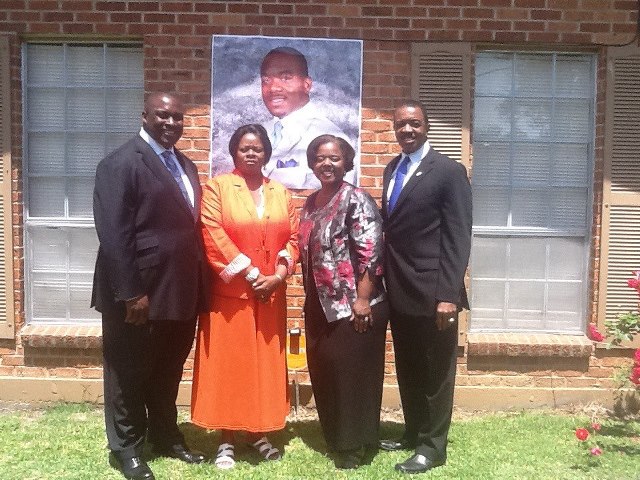
Posted to Marco McMillian’s facebook page: “As we work for justice in the murder of Marco W McMillian we held a press conference in Clarksdale, MS on Thursday May 9, 2013. Please goggle Marco McMillian to get full details. Pictured from (L to R) Atty. Daryl Parks of Parks and Crump law firm, Marco’s mother, Patricia Unger and Sharon Hicks of the National Justice Collation”
Hey all, Mona here…I have missed you all dearly, my Sky Dancing newsjunkies! Had some life-things keeping me out of the regular loop. Funerals and graduations…endings and new beginnings. That kind of thing. And, lots and lots of soul-searching. But, I guess you could say I’m “back” now. For better or worse 😉 I’m going to just dive right in and get my feet wet in the blogging pond…I’ll be using the frontpage this morning to spotlight a topic I wish was getting more attention from the national media. Not to worry, though–JJ will have your Wednesday news round-up fix later in the day! So be sure to check back in for that.
So, how many of you have been following the Marco McMillian story? I know Bostonboomer had mentioned it before back when McMillian was discovered dead in February. Well, the family is now demanding answers. Via the NYT:
Mother’s Letter to Sheriff
Frustrated by the pace of the investigation into the death, Marco McMillian’s mother, Patricia Unger, wrote to investigators regarding unanswered questions in her son’s case.
Click over to see the PDF for yourself. Key excerpt:
It has been over two months since my son, Marco Watson McMillian, was found murdered on February 26, 2013. Within this time frame, my husband and I have only received two visits/correspondences from you. The visit took place on February 26, 2013. During this visit, you informed us that Marco’s SUV had been involved in an accident and that someone else was driving the SUV. You also stated that Marco was not in the vehicle and that you were trying to locate him. The second visit took place on February 27, 2013, during this visit you informed us that his body had been found.
Last month, my husband, Amos Unger, contacted you via phone inquiring about the investigation. You informed him that the investigation was still ongoing and that you could not release any information about the investigation because you were trying to conduct it in a professional manner. You stated that you did not want any leaks to take place due to the family making statements to the press/media. However, I do not feel like the investigation has been done with professionalism. Listed below are unanswered questions/reasons why I feel like this investigation has not been conducted in an ethical manner:
Patricia Unger goes on to list some pretty appalling ethical and professional breaches, such as:
- The only identification of the body sought by the police from the family was through a cell phone picture.
- The family has yet to be introduced to any actual FBI agents investigating the case.
The final point of concern she raises, in her own words:
It has been reported in the press/’ media that you have a suspect in custody, Lawrence Reed. It has also been reported that family members and/or friends have stated that Mr. Reed informed them that he killed Marco in a “gay rape panic”. in this case, suspect and motive have been determined, so why is there still an ongoing investigation? Have other facts/factors been discovered that warrant further investigation? Also, it has been reported that Mr. Reed confessed to killing Marco by strangling him with his wallet chain. in that case, strangulation was the cause of death, so why is it taking so long for me to receive the death certificate? 1 know that this is a matter for the State Medical Examiner, but i would like to know if another cause of death has been or is being taken into consideration.
Pardon my Fraaaaanch, but what the fraggle rock kind of investigation is this? If Patricia Unger’s charges are true , the investigation into her son’s murder makes Mark Fuhrman’s antics in the OJ case look like a paragon of ethics. (Ok, so I’m hyperbolizing, but you get the point.)
The family held a press conference last Thursday. The family’s lawyer, Attorney Daryl Parks, is from the firm that represented Trayvon Martin’s family.
The virtual silence in the national mediaseems deafening to me. Other than local news coverage, the link above from LGBTQNation website (of the standard press release type reporting from the AP), and the NYT link above to the actual letter by McMillian’s mother, I have seen scarce coverage of this story. I don’t have any cable or digital converter, thus I don’t have a constant 24/7 IV-drip of cable news…so maybe I’ve missed whatever blip about the family’s questions and press conference may have been buried on the network formerly known as CNN’s Headline News. Anecdotally, I asked my daily newspaper reading/cable newsjunkie mother if she had heard anything about it, and shockingly…though unsurprisingly…my bringing it up was the first she had heard of it.

I’ve had to go on McMillian’s FB pages (both as mayoral candidate and himself personally) looking for answers. As a case in point, I found the NYT link to his mother’s letter through his personal page.
Marco’s future in politics was bright. To the right you can see him with President Obama and Representative John Lewis, as well as with President Bill Clinton. That he was the first “viable” openly gay black candidate for political office in Mississippi is both incidental and monumental at the same time.
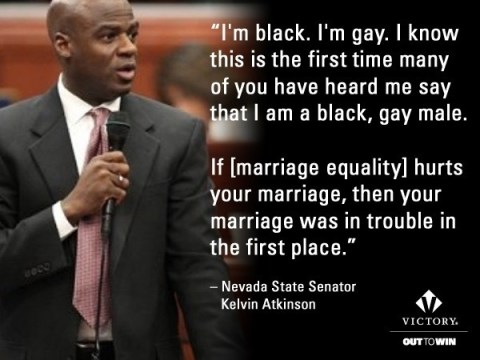
It makes me worry–however fear-driven that may be–for this guy I posted about ever so briefly on my baby blog, LetThemListen, last month:
Precisely, senator.
Alright, well I’ve said my piece. I’d love to hear your thoughts or anything else on your mind/reading list this morning. Take care and remember to stay tuned for JJ’s Wednesday Roundup later today.

 peej
peej Carissa
 bostonboomer
 dakinikat
 ecocatwoman
 mablue2
 Mama Lopez
 peggysue22
 quixote
 skydancingguestblogger
 Mona (aka Wonk the Vote)



 Sky Dancing
Recent Comments