
Friday Reads
Posted: February 24, 2012 Filed under: Egypt, GLBT Rights, Marriage Equality, morning reads, Tunisia, Women's Rights 32 Comments Good Morning!
It’s hard not to think we’re on the verge of civil war after watching the level of political nastiness around us these days. The level of incivility and meanness just has me at a complete loss for words at times. I am really glad there are no Republican primary debates scheduled for awhile. I really can’t take the language of religious jihad any more. I’m going to start out with some sane people for a change. I’ve been dealing with religious nuts since the 1980s and it’s making me depressed frankly. At least every one else knows about them now.
Maryland is going to be the next state to recognize gay marriages. A bill was approved by the Senate and goes to the Governor for signature.
The final vote by the state Senate ended a yearlong drama in Annapolis over the legislation, and marked the first time an East Coast state south of the Mason-Dixon line has supported gay nuptials.
With the vote, the measure moves to Gov. Martin O’Malley (D), who has said he will sign it.
Maryland would join the District and seven states in allowing same-sex marriages. Supporters have cast the bill as a major advance in equal rights. Opponents have called it a misguided attempt to redefine the institution of marriage.
Despite one of the largest Democratic majorities in any state legislature, backers of gay marriage in Maryland had to overcome fierce opposition from blocks of African American lawmakers and those with strong Catholic and evangelical views to cobble together coalitions big enough to pass both chambers.
Here’s some really interesting academic research from folks at UMass-Boston that shows that the increase in household debt isn’t because of undisciplined spending. This comes from a guest post by JW Mason at Rortybomb and it’s very interesting. Nice to see some one did the math and didn’t rely on tired Puritan stereotypes. The reason is that key interest rates have been high, stayed high, gone higher. Also, flow of funds to households via savings and income increases have decreased while prices have not decreased. Some prices on key household expenditures have increased. So, the leverage increase has come more from the nature of already present debt.
First, as a historical matter, you cannot understand the changes in private sector leverage over the 20th century without explicitly accounting for debt dynamics. The tendency to treat changes in debt ratios as necessarily the result in changes in borrowing behavior obscures the most important factors in the evolution of leverage. Second, going forward, it seems unlikely that households can sustain large enough primary deficits to reduce or even stabilize leverage. Even the very large surpluses of 2006-2011 would not have brought down leverage at all in the absence of the upsurge in defaults; and in the absence of large federal deficits and an improving trade balance the outcome would have been even worse since reductions in household expenditure would have reduced aggregate income. As a practical matter, it seems clear that, just as the rise in leverage was not the result of more borrowing, any reduction in leverage will not come about through less borrowing. To substantially reduce household debt will require some combination of financial repression to hold interest rates below growth rates for an extended period, and larger-scale and more systematic debt write-downs.
Farakh Shahzad has written a compelling article in Pakistan Today explaining why Gender Equality is an economic necessity.
Keeping in view the 51 per cent of the total population, it is a smart economics to ensure gender equality as a guarantee towards economic self reliance. By neglecting majority of the segment from the economic mainstream cannot produce better economic outcomes in this generation and the future. Social scientists are unanimous that implementation of gender equality has the potential and dynamics to double the GDP from four to eight per cent that is no less achievement in the current global scenario. For that matter, all you have to do is change the centuries old social misperceptions ingrained in the society. It is an undeniable fact that women in Pakistan remain at the bottom of the socio-economic ladder.
Femininity is measured to be the essential concern in the process of socio-economic infrastructure development. Therefore, investment in women’s empowerment in Pakistan is the key factor in improving the economic, political and social conditions in Pakistan. Hence, decision making processes for women empowerment; valuation planning and policy formulation should emphasis on main streaming gender equality around Pakistan.
Women empowerment is not limited to control over imitation or financial freedom only, rather it is a grouping of literacy, employment and health. Women empowerment is an important and functional concept in the development of a community as it represents women as active agents rather than inactive recipients of development policies …
Yup. It’s something they’ve noticed in all microfinance development strategies. Giving women ways to earn a decent living for their families and all kinds of things improve. But, it seems everywhere, there’s a back lash from hyperpatriarchal men. Women across the MENA regions–including Tunisia and Egypt–are taking stock of their rights. A series of protests and conferences are being held to ensure that the Arab Spring does not result in losses in human rights or women’s rights.
Perhaps one of the most important questions for women in the Arab Spring region is: Has women’s involvement in bringing change to Tunisia and Egypt been undervalued?
“The March 8th call brought a few hundred women to the streets, [which is] nowhere near a million. This was not unexpected…,” revealed Egyptian author and Cairo University professor Dr. Hoda Elsadda in her latest book published by The Global Fund, “Telling Our Stories: Women’s Voices from the Middle East and North Africa,” a collection of articles that have gone deep to describe conditions for women on-the-ground in the region.
“… it was extremely unrealistic to imagine that the first sparks of a popular revolution would bring about overnight a radical transfor- mation in cultural attitudes towards women’s rights,” Elsadda continued. In January 2012 Elsadda was recently placed on the shortlist for her outstanding depth of writing by the Arabic Booker Prize. Her efforts to portray the real life and tone of Egypt have been outstanding.
“…What came as a surprise and a real shock, however, was the marked hostility and violence unleashed against women protesters who were harassed and shouted at by groups of men who encircled them,” Elsadda outlined in her book. “Egyptian women took to the streets to celebrate International Women’s Day [last year], in response to a call that was sent out on Facebook for a million women’s march.”.
Conditions for women in Tunisia have shown promise. “After 1956, we were given almost all the rights French women had,” said Staieb-Koepp during the Global Fund for Women event. “You can have an abortion, you can divorce… [even though] there has never been a very strong movement to get these rights,” she continued.
But Sraieb-Koepp also went on to convey that she worries that if Tunisian women are not especially aware, their rights could be taken away. According to Sraieb-Koepp Islamic fundamentalists in Tunisia are now arguing one of the best ways to cope with unemployment is to “keep women at home.”
While Tunisia and Egypt have different histories, Sraieb-Koepp sees the fate of women in both countries to be very similar, “…it is basically the same experience as [in] Egypt. Women took over the civil society activism and men were drawn to politics,” she added.
Okay, so I’ve saved one Alternet article for last because it’s title is this: The Republican Brain: Why Even Educated Conservatives Deny Science — and Reality. The subheading reads: “New research shows that conservatives who consider themselves well-informed and educated are also deeper in denial about issues like global warming”. I’ve often wondered how so many folks seem to completely ignore all kinds of things to hold some stupid ideas. This comes from an excerpt of an upcoming Chris Mooney book. This section was inspired by a Pew Poll on global warming and the impact scientific data has on various people.
Buried in the Pew report was a little chart showing the relationship between one’s political party affiliation, one’s acceptance that humans are causing global warming, and one’s level of education. And here’s the mind-blowing surprise: For Republicans, having a college degree didn’t appear to make one any more open to what scientists have to say. On the contrary, better-educated Republicans were more skepticalof modern climate science than their less educated brethren. Only 19 percent of college-educated Republicans agreed that the planet is warming due to human actions, versus 31 percent of non-college-educated Republicans.
For Democrats and Independents, the opposite was the case. More education correlated with being more accepting of climate science—among Democrats, dramatically so. The difference in acceptance between more and less educated Democrats was 23 percentage points.
This was my first encounter with what I now like to call the “smart idiots” effect: The fact that politically sophisticated or knowledgeable people are often more biased, and less persuadable, than the ignorant. It’s a reality that generates endless frustration for many scientists—and indeed, for many well-educated, reasonable people.
And, of course, The Lorax is just one step in the indoctrination process to convince children that “industrialization is bad”. I guess teh evil is no long Winky Tink or the Muppets. It’s Doctor Seuss. Yes, Lou Dobbs at Fox has declared a war on Dr. Seuss.
On his Tuesday night show, Dobbs trashed the upcoming kids movies The Lorax and The Secret World Of Arrietty, accusing them of being liberal indoctrination that echoes the messages of Occupy Wall Street and President Obama. Dobbs didn’t appear to care that The Lorax is based on a book from 1971 and Arrietty is based on one from 1952 (and also, y’know, a Japanese film). Either that or the Occupy movement is much older than I thought.
Dobbs played clips from the movies and then drew the parallels.“So, where have we all heard this before? Occupy Wall Street forever trying to pit the makers against the takers and President Obama repeating that everyone
should pay their fair share in dozens of speeches since his State of the Union address last month.”
Guess there’s an occupy your local nursery and I missed the invite. Yes, the Loras is yet another Kenyan born Muslim that wants to inflict Socialism on your children.
So, how do these people manage to drive and walk in a world with so many imaginary friends and enemies wandering around? Is it something you have to have a special talent for like seeing dead people?
Anyway, that’s it for me on this Friday morning. Let’s hear what’s on your reading and blogging list today!
Women Front and Center in MENA Protests
Posted: December 22, 2011 Filed under: Bahrain, Egypt, Foreign Affairs, Tunisia, Violence against women, Women's Rights | Tags: women fighting fundamentalist religions, women in democracy protests, Women's Rights 4 Comments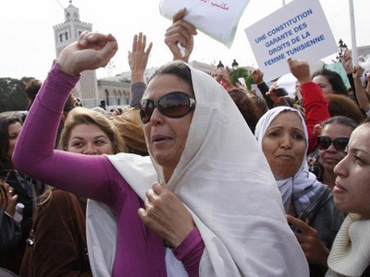 Many cultures in the MENA region are well-known for their horrible treatment of women. We see practices like honor killings, genital mutilation, and taking child brides. One of the offshoots of the Arab Spring has been the central role of women looking for broader participation in their countries.
Just as we in the United States are experiencing a political/fundamentalist Christian backlash that has turned into a war on the rights of women, the protests movements associated with the Jasmine Revolutions and their related political change have brought out a wave of political/fundamentalist Muslim backlash. There are several signs of hope in a region experiencing lots of social unrest. First, we’ve become aware of a large number of feminist leaders. Second, we’ve seen that many women are putting their lives on the line to ensure that the social change includes improving the lives and status of women. While oppression of women is frequently attached to fundamentalist religious followers, the roles of traditional tribal cultures and their dominance in places that are underdeveloped and rural–like Alabama or Uganda–cannot be underestimated. Here’s some stories that have made headlines recently that show the global struggle for women’s rights–like the US struggle for women’s rights–is still an uphill battle.
In response, thousands of women — and men — marched Tuesday in Cairo’s Tahrir Square. Observers say it was the largest demonstration of women in Egypt in decades. Not since 1919, when women mobilized under the leadership of feminist Hoda Sha’rawi in anti-colonial demonstrations against the British have so many Egyptian women taken to the streets. (After representing Egyptian women at the International Women Suffrage Alliance in Rome in 1923, Sha’rawi returned to Cairo and very publicly removed her veil.)
Women have played an important role in Egypt’s modern revolution but have struggled to translate their activism into a political role in the new, emerging system. They have been excluded from important decision-making bodies, and the military leadership declined to continue a Mubarak-era quota for women that ensured them at least 64 seats in parliament. Based on early election results, it appears that few women will win a place in the new government.
Nevertheless, one intrepid woman, Bothaina Kamel, is breaking ground with her candidacy for president. The campaign of Kamel, a well-known television presenter, at first was shocking, and certainly quixotic, with polls indicating her support is less than 1%. But her persistence has gained her credibility. While she has little chance of winning, she is helping to normalize the idea of women in politics — an idea that is deeply contested in Egyptian society. Leaders of Salafi parties, which gained a surprising 20% of the vote in the first rounds of elections, have spoken out against women running for office.
The recent women’s protest may breathe life into a movement that desperately needs new energy. In the early weeks of the revolution, women activists tried to bring attention to women’s issues but never succeeded in getting the masses behind them.
Tunisian women are also concerned about women’s rights since the country’s recent elections. The picture up top is from that country. Newly elected leaders have had to promise to recommit their country to modernization and democratic principals that include increased roles of women.
“We are all the women of Tunisia,” stated Professor Khalid Kshir of Tunis University in conversation with the author of this article. Professor Kshir is a member of the Democratic Modernist Pole, a coalition of leftist parties. He fears that the Ennahda party will push the country back instead of moving it forward.
Just a year ago, literally weeks before the start of the uprising in the country, Tunisians had joked that theirs was a country of free women and happy men. No other Arab nation had ever granted so many rights to women, fixed de jure and de facto, than Tunisia. That was something of which Tunisians were proud, and even boasted about. Today, many people in Tunisia fear that the country’s achievements on the road to becoming a modern society will be brought to nought.
”We need to focus all our efforts in the sphere of politics and culture on women’s rights, because women form half of our society and any infringement on their rights will be harmful to all of us,” Professor Kshir went on to say.
Strange as it may seem, the issue of women’s rights was also on the agenda of a conference on promoting tourism which took place in Tunisia early in November, shortly before the final election results were announced. The conference was organized by the Ennahda party, which decided not to wait for the National Constituent Assembly to convene and the government to be formed before holding a series of meetings with representatives of Tunisia’s major industries in order to lay out the priorities for getting the national economy out of its post-revolution stupor. The discussion on the prospects for yourism was among the first meetings to be held, along with a conference on the financial market, co-sponsored by Tunisia’s Brokers’ Association.
…
The party leader’s comforting assurance came in response to concerns expressed by travel agencies, tour operators, hoteliers and bankers at the meeting, who voiced questions such as, “What will be Tunisia’s international image following your electoral victory? What will happen to women’s rights? How will European tourists feel in Tunisia, and do they have a reason to fear Islamists?”
What started as a discussion on the prospects of tourism eventually escalated into a broader deliberation on Tunisia’s prospective path of development. There are strong reasons for such an interconnection: tourism accounts for six per cent of Tunisia’s GDP and makes up 60 per cent of the national trade deficit. The industry employs 12 per cent of the country’s working population, while one in eight Tunisian families live off tourism, one way or another. During the revolutionary turmoil which rocked the country between January and September 2011, tourism revenues in Tunisia plunged by 38.5 per cent compared to a similar period in 2010, while the overall number of tourists coming to Tunisia sank by 34.4 per cent.
That is why at present Ennahda is ready for dialogue and compromise. “We guarantee freedom in food, drink and clothes,” Hamadi Jebali said.
He emphasized that his party would respect democratic principles and that Tunisian society would retain its progressive nature. According to Jebali, the revolution took place in the name of improving the lives of Tunisian citizens and moving the country forward rather than hindering its development.
Many of those present at the conference believed the words of the Ennahda leader – or said that they did. “I believe Jebali. I am an optimist but only on condition that the rights of women won’t be violated and if we don’t follow the path of Saudi Arabia where a woman can do business but is forbidden to drive a car,” Sihem Zaiem, a member of the Federation of Tourist Agencies, said after the conference.
Delegates applauded her when she demanded that the Ennahda secretary-general explain Tunisia’s true face to the world as soon as possible, and demonstrate Islamists’ attitude to women’s rights. Jebali promised that nothing would change in the arena of women’s rights. His speech was very convincing.
A mother in Bahrain has gone to jail for playing revolutionary music and participating in protests.
Fadhila Al Mubarak, a 38-year-old mother of a 9-year-old boy, is still in jail after she was sentenced in an unfair military trial for charges related directly to exercising her right to freedom of expression and peaceful assembly. She was detained and prosecuted in a military court for playing revolutionary music in her car, trying to save her son and nieces, participating in peaceful protests in Pearl Roundabout and writing a poem to her son about the revolution, freedom and fighting for his future. The information available on the conditions of her detention is very worrying and her family has raised concerns over her health.
Fadhila, who was living with her husband and her son in the area of Aali, was arrested on 27 March 2011, just a few days after the National Safety Law was imposed on 15 March 2011. She was arrested at a checkpoint because there was an audio recording of revolutionary songs playing in her car. She was asked to pull over her car and step out. They insulted her, called her names and cursed her. While security officers at the checkpoint were talking to her, a man in civilian clothing tried to get into her car. In fear over the safety of the children, her son (9), nieces (14 – 15), she pulled him away thinking he was a thug who would kidnap or hurt them. Later, she found out he was a police officer.
Her family asked about her at police stations close to the checkpoint where she was arrested only to find out after four days that she was held in Riffa police station. She was later transferred to Isa Town women’s prison. During the period of her detention, her family had no contact with her and was not allowed to visit or talk to her over phone. Family members tried to appoint her a lawyer, a request that was rejected by the military court.
Women in the region can take heart from the post revolutionary experience of Indonesia’s women who have managed to get many advances since their repression by former president Soeharto following a 1965 tragedy. Indonesia is the world’s largest Muslim majority democracy. As with all countries, religious fundamentalists obsessed with old testament prohibitions continue to seek repression of women. However, Indonesian laws continue to reflect the country’s will to improve conditions for women. The current president seems to be backsliding on reforms gained during the tenure of Indonesia’s previous PM.
Of course, like the feminists have suggested, the Reform Era in 1998 has given women opportunities to revive the real spirit of Kartini. However, as Mariana suggested, the Reform Era was nothing but “a short-term honeymoon” moment for women’s movement.
When the late former president Abdurrahman Wahid changed the name of the ministry of women affairs into the ministry of women’s empowerment, for example, feminists felt very confident about their cause. In addition to that, the National Commission on Violence Against Women (Komnas Perempuan) was given full support to continue its investigation into the May 1998 tragedy, where many Chinese women were sexually abused.
“During Megawati’s era, we were more enthusiastic because the first woman was finally installed as a president amid opposition from some religious leaders,” Mariana said. “Megawati then also succeeded in passing the law on domestic violence.”
Celebrating women’s achievement even more, she added, was the policy of granting women a 30 percent quota of seats in the Parliament.
However, this celebration of women’s movement had to end in 2005, when Susilo Bambang Yu-dhoyono won his first presidential term.
“The year marked the introduction of the pornography bill, which was mentioned by President SBY during his first [presidential] speech,” said Mariana. “He even took the opportunity to comment about women’s belly buttons!”
And from that moment on, she went on, the women’s movement in Indonesia started to lose its ground. While battling against the criminalization of women, feminists have been labeled as “Western devilish agents”, gaining a bad reputation in society.
It seems that vigilance of women over their rights in all democracies is important. That is why it is important that women officials with high public profiles–like US SOS Hillary Clinton–continue to keep their focus on the rights of women and also GLBT rights aound the world. The world’s religious fundamentalists continue to press for backsliding. Religious fanatics push for edicts that can run the gambit from defining an egg as a person to hold women’s bodies hostage to narrow religious views of ‘life’ as in seen in Arkansas recently. There are also the many Sub-Saharan African nations–like Nigeria and Uganda–where laws ignore or encourage violence against GLBT because of both Muslim and Christian extremists in the regions. The latter example has been funded for and encouraged by US fundamentalist Christians which is even a more outrageous intervention than just resurrecting or perpetuating native tribal traditions like the child bride tradition which is also a problem in places like highly Christian Guatemala as well as Western African countries.
SOS Clinton strongly condemned the treatment of women protestors by Egyptian security forces this week. It is heartening to see her speak out for women’s full participation in democratic movements and governance.
In unusually strong language, the US secretary of state accused Egypt’s new leaders of mistreatment of women both on the street and in politics since the street revolt nearly a year ago that overthrew leader Hosni Mubarak.
“This systematic degradation of Egyptian women dishonours the revolution, disgraces the state and its uniform and is not worthy of a great people,” Mrs Clinton said in a speech at Georgetown University.
In images widely seen over YouTube, helmeted troops were shown beating a veiled woman after having ripped her clothes off to reveal her bra and stomach.
Other pictures circulating on social media networks that have enraged protesters include one of a military policeman looming over a sobbing elderly woman with his truncheon.
“Recent events in Egypt have been particularly shocking. Women are being beaten and humiliated in the same streets where they risked their lives for the revolution only a few short months ago,” Mrs Clinton said.
Here is the PBS NEWSHOUR coverage of the Egyptian Women’s protests and an interview with participant May Nabil. It has some interesting narrative of the march in that many woman spontaneously joined the march and weren’t just drawn to it via internet. Additionally, there were many supportive Egyptian men in attendance.
Thursday Reads
Posted: May 19, 2011 Filed under: Bahrain, Egypt, Environment, Farming, Foreign Affairs, Gaza, Iran, Israel, Libya, MENA, Pakistan, Psychopaths in charge, religion, Syria, Team Obama, Tunisia, U.S. Politics, We are so F'd | Tags: "historic" speeches, Barack Obama, birthers, Catholic Bishops, China, Dominique Strauss-Kahn, Espionage Act, Jane Mayer, Joseph Cannon, NSA spying, pedophile priests, rape, Thomas Drake, violence against women, whistle blowers 41 Comments
Good Morning!! Does anyone have a remedy for the sleepies? I recently finished a semester of teaching, and the last couple of days I’ve been extremely groggy. Yesterday I even slept until 10:30AM! It doesn’t help that we haven’t seen the sun in the Boston area for at least a week–it’s dark, dank, and raw out there. It seems a lot more like November than late May. On top of all that my Spring allergies are the worst I’ve ever experienced. So please forgive me if this post makes no sense. On to the news of the day.
Disgraced IMF honcho Dominque Strauss-Kahn’s accuser testified before a New York grand jury today. Immediately following her testimony, Strauss-Kahn’s attorneys announced their determination to spring their client from his cell at Rikers Island Jail.
His lawyers initially proposed a $1 million bail package that was rejected by the court.
Today a new offer that was said to add a private monitoring firm, an electronic bracelet and a guard to the package was put together. The cash component of the bail package remained at $1 million dollars, but the deal now included a guarantee that Strauss-Kahn would remain confined in New York City and not leave his residence except for visits to his doctor or lawyers. His passports and travel documents have already been taken from him.
According to ABC News, police are testing body fluids found in Strauss-Kahn’s hotel room for DNA.
ABC News has confirmed that police cut a swath of carpet to test for DNA and swabbed one of the suite’s sinks under a black light that indicated there was potential DNA evidence there.
Apparently Strauss-Kahn’s attorneys plan to claim that their client’s sexual encounter with a hotel maid was “consensual,” but there is a serious problem with that theory in addition to the maid’s testimony.
Investigators also say information downloaded from the suite door’s electronic card reader indicates the maid entered the room and never closed the door. The hotel policy requires maids to leave the door open when cleaning. The open door, they say, is proof that the women entered the room to work, not to engage in consensual sex.
I won’t dwell on this sordid story much longer, but I did want to call your attention to this piece in Time Magazine, which details a number of previous accusations against Strauss-Kahn–along with rumors –gossip about his abusive behavior toward women–that were hushed up until now. How predictable these guys are!
Joseph Cannon’s latest post is a must-read, along with the New Yorker article by Jane Mayer on which the Cannon comments. It’s about the domestic spying by the NSA that went on under Bush and the Obama administration’s heavy handed prosecution of whistleblowers while at the same time protecting the Bush administration criminals. (Minkoff Minx also mentioned Mayer’s article in her morning post yesterday.) Here’s an introduction to the piece by Cannon:
This humble blog spent a lot of time talking about NSA overreach during the controversies over Russell Tice and FISA. Meyer’s piece confirms a long-held suspicion that the real problem wasn’t eavesdropping on telephone calls but automated data-mining of all forms of electronic communication.
Two competing computer systems were designed to take us into this brave new world: ThinThread and Trailblazer. (The system in place now is called Turbulence. Someone at NSA has a strange affection for the letter T — which is also the first letter in totalitarian.) Trailblazer turned out to be a costly boondoggle. ThinThread worked. Originally, it had provisions built in to protect the privacy of American citizens; NSA Director Haybed tossed out those barriers.
Meyer focuses on an NSA whistleblower named Thomas Drake, who tried to blow the whistle on the Trailblazer fiasco — and on the abuses of privacy — to a staffer on the House Intelligence Committee. Unfortunately, the Committee was headed, at the time, by Porter Goss — and by Nancy Pelosi. They both seemed deaf to what Drake had to say.
Why is Obama so obsessed with prosecuting whistleblowers–even to the point of dusting off the Espionage Act? Jane Mayer writes:
When President Barack Obama took office, in 2009, he championed the cause of government transparency, and spoke admiringly of whistle-blowers, whom he described as “often the best source of information about waste, fraud, and abuse in government.” But the Obama Administration has pursued leak prosecutions with a surprising relentlessness. Including the Drake case, it has been using the Espionage Act to press criminal charges in five alleged instances of national-security leaks—more such prosecutions than have occurred in all previous Administrations combined. The Drake case is one of two that Obama’s Justice Department has carried over from the Bush years.
Gabriel Schoenfeld, a conservative political scientist at the Hudson Institute, who, in his book “Necessary Secrets” (2010), argues for more stringent protection of classified information, says, “Ironically, Obama has presided over the most draconian crackdown on leaks in our history—even more so than Nixon.”
Mayer asked Drake about it:
Sitting at a Formica table at the Tastee Diner, in Bethesda, Drake—who is a registered Republican—groaned and thrust his head into his hands. “I actually had hopes for Obama,” he said. He had not only expected the President to roll back the prosecutions launched by the Bush Administration; he had thought that Bush Administration officials would be investigated for overstepping the law in the “war on terror.”
“But power is incredibly destructive,” Drake said. “It’s a weird, pathological thing. I also think the intelligence community coöpted Obama, because he’s rather naïve about national security. He’s accepted the fear and secrecy. We’re in a scary space in this country.”
Check out her article if you can. She’s one of the best investigative reporters we have.
You may have missed Dakinikat’s late night post on Tuesday–the one about exploding watermelons. I thought this story deserved a little more emphasis, because it shows what can happen when there are no government regulations on agriculture–and industry in general (and that is what the Republicans would love to make happen). From Raw Story:
A bizarre wave of exploding watermelons — possibly due to farmers’ abuse of a growth-boosting chemical — has once again spotlighted safety fears plaguing China’s poorly regulated food sector.
State media has said nearly 50 hectares (120 acres) of watermelon crops in the eastern city of Danyang have been ruined by the phenomenon this month after some growers doused them with the growth accelerator forchlorfenuron.
“On May 7, I came out and counted 80 (exploded watermelons), but by the afternoon it was 100,” farmer Liu Mingsuo told state broadcaster China Central Television (CCTV) in a report that aired Tuesday. He said he had sprayed them with the chemical just a day before.
Remind me to never buy any food produce in China!!
Have you heard that the Obama campaign is selling T-shirts and coffee cups that mock the “birthers?”
President Obama’s 2012 presidential campaign today started selling “Made in the USA” t-shirts featuring images of both President Obama and the long-form birth certificate he released copies of last month.
Wear your support for this campaign with an official Made in the USA T-shirt,” his website advertises. Donate $25 or more today and we’ll send you your limited-edition shirt.
Coffee-mugs are also available.
“Remember ‘fight the smears’ from the 2008 campaign?” asked campaign spokesman Ben LaBolt. “This is the mobile version of it.”
Quite frankly, I think this is a little bit tacky….but that’s just me. And speaking of tasteless behavior, the Catholic Church is attempting to blame the ’60s counterculture for the behavior pedophile priests. From the Guardian UK:
The investigation commissioned by Catholic bishops said that the peak incidence of sexual abuse by priests in the 1960s and 70s reflected the increased level of other deviant behaviours in American society in the period, including “drug use and crime, as well as social changes, such as an increase in premarital sex and divorce.”
Researchers at John Jay College of Criminal Justice said most of the abusive priests were ordained in the 1940s and 50s and were not properly trained to confront the social upheavals of the 1960s.
David O’Brien, a historian of American Catholicism at the University of Dayton, said the report, Causes and Context of Sexual Abuse of Minors by Catholic Priests in the United States, 1950-2010, was dangerous because it seemed to exonerate bishops.
The study also ignores the long history of sexual abuse of children by the Catholic clergy. Methinks these “researchers” told the Catholic Bishops what they wanted to hear rather than do any serious research.
Finally, President Obama plans to give another “most amazing speech evah” tomorrow. This one is on the Middle East and North Africa. According to Voice of America:
The speech will be broad in scope, as Mr. Obama focuses on the peaceful democratic movements for change that have swept the region, discusses implications for U.S. policy, and offers what administration officials call some concrete policy proposals.
He will give his assessment of the impact of popular uprisings that have led to political changes in Egypt and Tunisia, and which continue in places like Syria, Libya and Yemen.
Senior administration officials say Mr. Obama will speak of a moment of opportunity, after a decade of great tensions and divisions, in which people of the region and U.S. policy can begin to turn the page toward a more positive and hopeful future.
The stalemated Israel-Palestinian peace process will be an important element. However, Mr. Obama is expected to frame it as part of a wider picture and say that leaders on both sides of that conflict should seize an opportunity for peace.
Whatever….I think I’ll arrange to be busy while he’s speechifying. Anyway, what are you reading and blogging about today?
The Changing Face of the MENA Region (Breaking News)
Posted: March 24, 2011 Filed under: Algeria, Bahrain, Egypt, Foreign Affairs, Iran, Iraq, Israel, Jordan, Lebanon, Libya, Syria, Tunisia, Yemen | Tags: arab awakening, MENA 8 Comments The WSJ reports that Yemeni President Saleh is working out a deal that will let him resign. The country’s leading general will also resign. The details will be released on Saturday.
“Both sides have agreed on the main points of departure, and Saturday is expected to be the day that Saleh and General Ahmar both step down,” according to a senior official familiar with the negotiations.
It couldn’t be determined which individuals were being considered as candidates for any transitional authority as talks continued late Thursday between the two leaders.
The support for mainstream opposition party leaders is unclear across the rugged and largely conservative country. Meanwhile, traditional tribal leaders who have great social standing would face problems exerting authority over rival tribes.
The Pentagon is currently holding a presser and has announced that they’re no longer ‘detecting’ Libyan planes in the air. NATO and the UN are expected to make an announcement shortly that NATO will be taking over the No-fly efforts. I just read some interesting analysis at Juan Cole’s Informed Consent on the Top Ten Accomplishments of the UN’s no-fly zone efforts. Cole says the French have also verified that Gadhafi’s air attacks have stopped and that his planes are grounded. There is also this tidbit.
The participation of the Muslim world in the United Nations no-fly zone over Libya has been underlined. The measure was called for by the Arab League, which has not in fact changed its mind about its desirability. Qatar is expected to be flying missions over Libya by this weekend. Other Arab League countries will give logistical support.
It is significant that the Arab League is supporting this action. The GCC (Gulf Cooperation Council)–an organization that is an essential part of my research on trade–is also trying to curb problems in Bahrain. This is significant because it shows that region is actively trying to create situations to jointly improve the conditions in the region.
Meanwhile, the people of Syria may be closer to the goals of their mostly peaceful protests. Syria is one of the most repressed countries in the region and has been under martial law for 50 years. Clashes between protesters and the government have increased recently.
President Bashar al-Assad made a rare public pledge to look into granting Syrians greater freedom on Thursday as anger mounted following attacks by security forces on protesters that left at least 37 dead.
Syrian opposition figures said the promises did not meet the aspirations of the people and were similar to those repeated at regular Baath Party conferences, where committees would be formed to study reforms that do not see the light of day.
“The leadership is trying to absorb the rage of the streets. We want to see reform on the ground,” said a protester in the southern city of Deraa.
A hospital official said at least 37 people had been killed in the southern city of Deraa on Wednesday when security forces opened fire on demonstrators inspired by uprisings across the Arab world that have shaken authoritarian leaders.
While an aide said Assad would study a possible end to 48 years of emergency rule, a human rights group said a leading pro-democracy activist, Mazen Darwish, had been arrested.
It’s exciting to watch the move to democracy and modernity in a region known for strongmen dictators, kings, and harsh political oppression. This will be an interesting situation to watch. I only hope that the people get what they are hoping for and that modernity and better treatment of women are part of the equation. Some of the states–like Qatar and the UAE–are further along in this pursuit than others. Yemen and Syria are perhaps the most dangerous parts of the equation. The Shia-Sunni dynamic is present and that always makes for a delicate situation.
Also, SOS Hillary Clinton will be making a statement shortly. We will try to keep you updated and give you interesting links as these new developments unfold.
Hillary says No
Posted: March 16, 2011 Filed under: Democratic Politics, Diplomacy Nightmares, Domestic Policy, Egypt, Foreign Affairs, Hillary Clinton, Tunisia | Tags: CNN, interview with Hillary Clinton, politics, Wolf Blitzer 25 CommentsCNN’s Wolf Blitzer has released an interview with SOS Hillary Clinton. Blitzer asked if she was going to either serve a second term or run for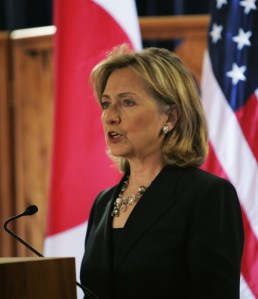 President in 2012. This is pretty clear evidence the Clinton is planning on returning to private life shortly. Blitzer interviewed Clinton during her visit to the U.S. Embassy in Cairo on March 16, 2011.
Q- If the president is reelected, do you want to serve a second term as secretary of state?
No
Q- Would you like to serve as secretary of defense?
No
Q- Would you like to be vice president of the United States?
No
Q- Would you like to be president of the United States?
No
Q- Why not?
Because I have the best job I could ever have. This is a moment in history where it is almost hard to catch your breath. There are both the tragedies and disasters that we have seen from Haiti to Japan and there are the extraordinary opportunities and challenges that we see right here in Egypt and in the rest of the region. So I want to be part of helping to represent the United States at this critical moment in time, to do everything I can in support of the president and our government and the people of our country to stand for our values and our ideals, to stand up for our security, which has to remain first and foremost in my mind and to advance America’s interests. And there isn’t anything that I can imagine doing after this that would be as demanding, as challenging or rewarding.
Q- President of the United States?
You know, I had a wonderful experience running and I am very proud of the support I had and very grateful for the opportunity, but I’m going to be, you know, moving on.
Q- I asked my viewers and followers on Twitter to send questions and a lot of them said, “Ask her if she’ll run in 2016 for the presidency.” A lot of folks would like to you to do that.
Well that’s very kind, but I am doing what I want to do right now and I have no intention or any idea even of running again. I’m going to do the best I can at this job for the next two years.
Clinton also spoke of democratic reforms in Egypt while visiting that nation and Tunisia. She was greeted with protests in Tunisia.
Clinton toured Cairo’s Tahrir Square, the epicenter of the pro-democracy uprising that led to last month’s resignation of Egyptian President Hosni Mubarak.
Clinton said visiting the square was a “great reminder of the power of the human spirit and desire for freedom and human rights and democracy.”
She was welcomed by Egyptian citizens and shook hands with passersby in the square before meeting with Egyptian Prime Minister Essam Sharaf.
Before leaving for Tunisia on Wednesday, Clinton was set to meet with Arab League Secretary General Amr Moussa. Moussa, 74, is a veteran Egyptian diplomat and has announced his candidacy for the country’s presidency.
Clinton also met with pro-democracy activists and members of Egypt’s civil society. She is the highest-ranking U.S. official to visit Egypt since the anti-government protests.
Clinton arrived in Cairo Tuesday after attending a Group of Eight foreign ministers’ meeting in Paris.
After wrapping up talks in Egypt, she travels to Tunisia – the starting point of the pro-democracy movement that has swept through much of the Middle East and North Africa this year.
Dozens of Tunisians took to the streets in Tunis on Wednesday to protest against Clinton’s visit. The demonstrators said they oppose foreign intervention in their country.
There appears to be no break through in her meetings with the G8 in terms of backing a no-fly zone for Libya. While she met with Egypt’s Prime Minister, some details of their meeting have not been released.
On Tuesday, Clinton issued a strong statement of praise for Egypt’s political revolution, declaring she was “deeply inspired” by the dramatic change and promising new assistance for America’s longtime Middle East ally.
Clinton pledged $90 million in emergency economic assistance during a meeting in Cairo with Foreign Minister Nabil Al-Araby. She is the highest ranking U.S. official to visit Egypt since the overthrow of Mubarak.
“The United States will work to ensure that the economic gains Egypt has forged in recent years continue, and that all parts of Egyptian society benefit from these gains,” a State Department statement noted.
She’s not yet discussed her plans after she retires from the position of US Secretary of State.

 peej
peej Carissa
 bostonboomer
 dakinikat
 ecocatwoman
 mablue2
 Mama Lopez
 peggysue22
 quixote
 skydancingguestblogger
 Mona (aka Wonk the Vote)



 Sky Dancing
Recent Comments