
Tuesday Reads
Posted: August 27, 2013 Filed under: Barack Obama, China, Foreign Affairs, Iran, Iraq, morning reads, NSA, National Security Agency, Regulation, Russia, Syria, U.S. Politics | Tags: California wildfire, chemical weapons, cuba, David Miranda, Edward Snowden, GCHQ, Glenn Greenwald, John Kerry, Saddam Hussein, San Francisco water and power, Texas legislature, West Fertilizer Co., Yosemite National Park 30 Comments
Good Morning!!
The big news today is that President Obama appears likely to order “limited” strikes on Syria in the next few days in response to Syria’s use of chemical weapons against opposition fighters. From the WaPo: After Syria chemical allegations, Obama considering limited military strike.
President Obama is weighing a military strike against Syria that would be of limited scope and duration, designed to serve as punishment for Syria’s use of chemical weapons and as a deterrent, while keeping the United States out of deeper involvement in that country’s civil war, according to senior administration officials.
The timing of such an attack, which would probably last no more than two days and involve sea-launched cruise missiles — or, possibly, long-range bombers — striking military targets not directly related to Syria’s chemical weapons arsenal, would be dependent on three factors: completion of an intelligence report assessing Syrian government culpability in last week’s alleged chemical attack; ongoing consultation with allies and Congress; and determination of a justification under international law.
“We’re actively looking at the various legal angles that would inform a decision,” said an official who spoke about the presidential deliberations on the condition of anonymity. Missile-armed U.S. warships are already positioned in the Mediterranean.
I guess “looking at…legal angles” is code for that pesky rule in the Constitution where Congress has to declare wars. When’s the last time that happened–WWII?
Meanwhile, BBC News reports: Russia and China step up warning over strike.
Russian foreign ministry spokesman Alexander Lukashevich has called on the international community to show “prudence” over the crisis and observe international law.
“Attempts to bypass the Security Council, once again to create artificial groundless excuses for a military intervention in the region are fraught with new suffering in Syria and catastrophic consequences for other countries of the Middle East and North Africa,” he said in a statement.
Late on Monday, the US said it was postponing a meeting on Syria with Russian diplomats, citing “ongoing consultations” about alleged use of chemical weapons in Syria.
Hours later, Russia expressed regret about the decision. The two sides had been due to meet in The Hague on Wednesday to discuss setting up an international conference on finding a political solution to the crisis.
The Russian deputy defence minister, Gennady Gatilov said working out the political parameters for a resolution on Syria would be especially useful, with the threat of force hanging over the country.
Read more at the link.
Just as SOS Kerry was giving a speech to justify the upcoming military strikes, providing “Clear Evidence of Chemical Weapon Use in Syria” (NYT), a little birdie told Shane Harris and Matthew Aid of Foreign Policy magazine that the U.S. facilitated Saddam Hussein’s use of chemical weapons against Iran back in 1988.
The U.S. government may be considering military action in response to chemical strikes near Damascus. But a generation ago, America’s military and intelligence communities knew about and did nothing to stop a series of nerve gas attacks far more devastating than anything Syria has seen, Foreign Policy has learned.
In 1988, during the waning days of Iraq’s war with Iran, the United States learned through satellite imagery that Iran was about to gain a major strategic advantage by exploiting a hole in Iraqi defenses. U.S. intelligence officials conveyed the location of the Iranian troops to Iraq, fully aware that Hussein’s military would attack with chemical weapons, including sarin, a lethal nerve agent.
The intelligence included imagery and maps about Iranian troop movements, as well as the locations of Iranian logistics facilities and details about Iranian air defenses. The Iraqis used mustard gas and sarin prior to four major offensives in early 1988 that relied on U.S. satellite imagery, maps, and other intelligence. These attacks helped to tilt the war in Iraq’s favor and bring Iran to the negotiating table, and they ensured that the Reagan administration’s long-standing policy of securing an Iraqi victory would succeed. But they were also the last in a series of chemical strikes stretching back several years that the Reagan administration knew about and didn’t disclose.
U.S. officials have long denied acquiescing to Iraqi chemical attacks, insisting that Hussein’s government never announced he was going to use the weapons. But retired Air Force Col. Rick Francona, who was a military attaché in Baghdad during the 1988 strikes, paints a different picture.
“The Iraqis never told us that they intended to use nerve gas. They didn’t have to. We already knew,” he told Foreign Policy.
Read the rest of this long article at Foreign Policy.
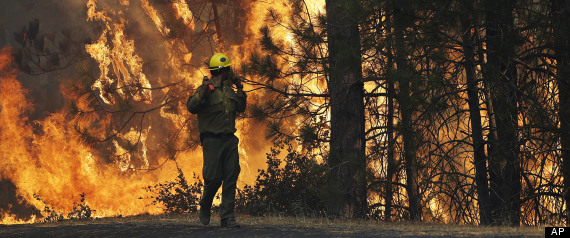
Firefighter A.J. Tevis watches the flames of the Rim Fire near Yosemite National Park, Calif., on Sunday, Aug. 25, 2013. With winds gusting to 50 mph on Sierra mountain ridges and flames jumping from treetop to treetop, hundreds of firefighters have been deployed to protect this and other communities in the path of the Rim Fire raging north of Yosemite National Park. (AP Photo/Jae C. Hong)
The wildfire in Northern California continues to spread into Yosemite National Park and has begun to threaten towns in the area. From the LA Times: Massive Rim fire continues to reshape lives and topography.
…even as firefighters worked furiously to hold a line outside of town, officials warned that this blaze was so hot it could send sparks more than a mile and a half out that could jump lines and start new hot spots. Evacuation advisories remain in effect for Tuolumne City and nearby areas.
On the north edge, the fire — now 134,000 acres — pushed into the Emigrant Wilderness Area and Yosemite National Park. It’s the one side of the fire with a natural last stand: Eventually it will run into granite walls that have snuffed out fires in this region for centuries.
Each day, what the massive blaze does depends on the wind. But officials were particularly attuned to each shift of breeze Sunday because of the weather’s eerie similarities to the day when the fire first exploded out of control.
So far the unpredictable blaze is only about 20% controlled, and it still threatens water and power sources for San Francisco.
The massive fire presents every challenge: steep slopes, dry fuel, rugged terrain and entire communities possibly in harm’s way.
The base camp and incident post, usually a haven outside fire lines, was a prominent example of the fire’s unpredictability: It’s in the middle of the burn zone, charred land with still-smoldering stumps on both sides.
Firefighters call such complete devastation “the black.” Entire ravines and ridges were a dusty gray moonscape. But some of the land was a “dirty burn” — meaning there were small circles of pine and aspen and even grass and wildflowers in the middle of charcoal-black areas where smoke still curled and embers glowed. The specks of beauty made firefighters nervous: To a fire, they are fuel.
My sister and her husband own a house north of San Francisco. It’s probably not in danger, but it still brings the scope of this disaster home to me. I sure hope Firefighers will begin to make progress soon. The burning area is now the size of the city of Chicago, according to CNN.
Yosemite National Park, California (CNN) — A massive northern California wildfire that’s threatening Yosemite National Park and San Francisco’s key water and power sources grew Monday, becoming the 13th largest in state history, state fire authorities said.
The Rim Fire, which has devoured 160,980 acres, has scorched an area about the size of the city of Chicago while more than 3,600 firefighters try to rein it in….
The wildfire, which was 20% contained Monday night, was spreading primarily to the east and threatened to grow amid extremely dry conditions and hot weather.
Part of the fire continued to spread Monday toward a key part of San Francisco’s water supply: the Hetch Hetchy Reservoir, which lies within Yosemite and is just east of the flames.
The fire also could threaten the area’s hydroelectric generators, which provide much of San Francisco’s electricity. Because of the approaching flames, officials shut down the generators, and the city — more than 120 miles to the west — temporarily is getting power from elsewhere.
Speaking of disasters, Charles Pierce reminds us that West, Texas is still recovering from the horrible explosion at the fertilizer plant there and that Texas still isn’t doing that much to prevent similar events in the future.
Read the rest of this entry »
Tuesday Reads: Dreaming a Life; Obama and Putin; NSA and Snowden
Posted: June 18, 2013 Filed under: Barack Obama, Foreign Affairs, Great Britain, morning reads, NSA, National Security Agency, Real Life Horror, Russia, Syria, U.S. Politics | Tags: Carol Morley, Charles Pierce, checks and balances, Dick Cheney, Dreams of a Life, Edward Snowden, FISA court, G-8 summit, Glenn Greenwald, John Aravosis, Joyce Carol Vincent, leakers, mysterious deaths, Richard Nixon, Vladimir Putin, whistleblowers 29 Comments
Good Morning!!
I’m going to begin with an article I came across yesterday while reading the Guardian. It’s about a story from 2006 that I remembered and sometimes think about–a woman whose skeletonized body was found in her apartment three years after she died.
On 25 January 2006, officials from a north London housing association repossessing a bedsit in Wood Green owing to rent arrears made a grim discovery. Lying on the sofa was the skeleton of a 38-year-old woman who had been dead for almost three years. In a corner of the room the television set was still on, tuned to BBC1, and a small pile of unopened Christmas presents lay on the floor. Washing up was heaped in the kitchen sink and a mountain of post lay behind the front door. Food in the refrigerator was marked with 2003 expiry dates. The dead woman’s body was so badly decomposed it could only be identified by comparing dental records with an old holiday photograph of her smiling. Her name was revealed to be Joyce Carol Vincent.

Joyce Carol Vincent
How could such a thing happen? So often we hear sad stories like this and never get any answers to our questions. In this case, filmmaker Carol Morley decided to find out who Joyce Carol Vincent was, and she has made a documentary about her quest called Dreams of a Life. She writes:
In a city such as London, home to 8 million people, how could someone’s absence go unnoticed for so long? Who was Joyce Vincent? What was she like? How could she have been forgotten?
News of Joyce’s death quickly made it into the global media, which registered shock at the lack of community spirit in the UK. The story ran on in the British press, but still no photograph of Joyce appeared and little personal information.
Soon Joyce dropped out of the news. I watched as people discussed her in internet chatrooms, wondering if she was an urban myth, or talking about her as though she never mattered, calling her a couch potato, and posting comments such as: “What’s really sad is no one noticed she was missing – must have been one miserable bitch.” And then even that kind of commentary vanished.
But I couldn’t let go. I didn’t want her to be forgotten. I decided I must make a film about her.
She began by placing advertisements in newspapers asking anyone who knew Joyce to come forward. It turned out that Joyce had lots of friends over the years. She had been engaged to be married before she died, and she had also spent some time in a battered women’s shelter. Eventually, Morley was able to talk to many people who had known Joyce. She describes her journey in the Guardian article. It’s an amazing story, and I hope you’ll go read the whole thing.
Follow me below the fold for some news and opinion…
Tuesday Reads: McCain Plays “Pretend President,” Pressure Cookers, Upcoming Zimmerman Trial, and Other News
Posted: May 28, 2013 Filed under: Barack Obama, Crime, Criminal Justice System, Foreign Affairs, John McCain, morning reads, Republican politics, Syria, U.S. Politics | Tags: Barbara Boxer, EU, Free Syrian Army, Fukushima, Gen. Salem Idris, George Zimmerman, Hussain Al Khawahir, John Kerry, pressure cookers, Pretend President McNasty, Racism, right to vote, San Onofre nuclear plant, Syrian Emergency Task Force, Trayvon Martin, Turkey, US Supreme Court 76 Comments
Good Morning!!
Last night Josh Rogin reported that warmongering Senator John McCain had sneaked across the Syrian border from Turkey and talked to Gen. Idris Salem, head of the “Free Syrian Army.”
McCain, one of the fiercest critics of the Obama administration’s Syria policy, made the unannounced visit across the Turkey-Syria border with Gen. Salem Idris, the leader of the Supreme Military Council of the Free Syrian Army. He stayed in the country for several hours before returning to Turkey. Both in Syria and Turkey, McCain and Idris met with assembled leaders of Free Syrian Army units that traveled from around the country to see the U.S. senator. Inside those meetings, rebel leaders called on the United States to step up its support to the Syrian armed opposition and provide them with heavy weapons, a no-fly zone, and airstrikes on the Syrian regime and the forces of Hezbollah, which is increasingly active in Syria.
Idris praised the McCain visit and criticized the Obama administration’s Syria policy in an exclusive interview Monday with The Daily Beast.
“The visit of Senator McCain to Syria is very important and very useful especially at this time,” he said. “We need American help to have change on the ground; we are now in a very critical situation.”
Apparently McCain decided to play Pretend President to celebrate Memorial Day. I haven’t been paying close attention to the news for the past few days, but I think I would have seen any reports that the White House or the State Department had requested Senator McNasty’s help in reaching out to opposition forces in Syria.
Prior to his visit inside Syria, McCain and Idris had separate meetings with two groups of FSA commanders and their Civil Revolutionary Council counterparts in the Turkish city of Gaziantep. Rebel military and civilian leaders from all over Syria came to see McCain, including from Homs, Qusayr, Idlib, Damascus, and Aleppo. Idris led all the meetings.
The entire trip was coordinated with the help of the Syrian Emergency Task Force, an American nonprofit organization that works in support of the Syrian opposition.

More from Dan Roberts of The Guardian:
McCain’s office confirmed to the Guardian that he had slipped into the country in recent days but declined to comment on the outcome of his talks with the rebel groups or whether it had hardened his views on arming them.
The Arizona senator has been leading efforts in Congress in recent weeks to force Barack Obama to intervene in Syria following reports of alleged chemical weapons use by forces loyal to Assad.
As the most senior US politician to have visited Syria, his intervention is likely to strengthen the hand of hawks in Washington at a time when parallel efforts are being made by the French and British governments to persuade the European Union to lift the arms embargo.
At the same time, actual US Secretary of State John Kerry was working toward a different goal than loud-mouthed Obama critic McCain.
Meanwhile the US State Department continues to pursue diplomatic efforts to bring the civil war to an end, successfully encouraging the Russians to persuade Assad to take part in peace talks in Geneva next month.
Capping off an eight-day trip to the Middle East and Africa, secretary of state John Kerry flew into Paris on Monday to see Russian foreign minister Sergey Lavrov and exchange updates on their respective diplomatic efforts.
No word yet on any reactions from the Obama administration to McCain’s attempt to influence its foreign policy decisions.
The EU is also pushing for intervention in Syria. CNN reports:
The EU lifted its arms embargo on Syrian rebels Monday, a move that could level the playing field and alter the course of Syria’s gruesome civil war.
While there are no immediate plans to ship weapons to rebels, the move sends a strong message to Syria’s defiant president: Negotiate or face consequences.
“It was a difficult decision for some countries, but it was necessary and right to reinforce international efforts to reach a diplomatic solution to the conflict in Syria,” British Foreign Secretary William Hague said in a written statement.
“It was important for Europe to send a clear signal to the Assad regime that it has to negotiate seriously, and that all options remain on the table if it refuses to do so.”
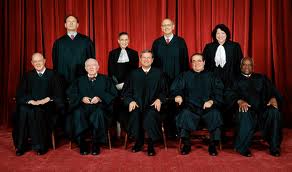
In domestic news, CNN calls attention to the important rulings that could come from the Supreme Court in June.
Four weeks. Four major legal rulings. What the Supreme Court decides by the end of June could fundamentally change lives and legacies on a range of politically explosive issues.
The justices will meet in at least five public sessions to release opinions in its remaining 30 cases, among them some the most strongly-contested legal and social issues they have confronted in decades:— Same-sex marriage: A pair of appeals testing whether gays and lesbian couples have a fundamental constitutional right to wed.
— Affirmative action: May race continue to be used as a factor in college admissions, to achieve classroom diversity?
— Voting rights: The future of the Voting Rights Act, and continued federal oversight of elections in states with a past history of discrimination.
— Gene patents: Can “products of nature” like isolated parts of the human genome be held as the exclusive intellectual property of individuals and companies, through government-issued patents?
For more detailed summaries of these cases from CNN, click here.
“It’s almost unimaginable the number of things that the Supreme Court is going to decide that will affect all Americans in the next month,” said Thomas Goldstein, a top Washington attorney and publisher of SCOTUSblog.com.
“What would surprise me this term is if the court upheld use of affirmative action or the (enforcement tool behind the) Voting Rights Act. And I think it would be a big surprise if the court did anything radical when it came to same-sex marriage — either saying there was a constitutional right to it, or rejecting that claim outright and forever. I think that’s something they’re going to try and tread that middle ground path.”
Meanwhile, two Democratic Congressmen, Rep. Mark Pocan of Wisconsin and Keith Ellison of Minnesota are proposing an amendment to the Constitution that would establish a right to vote for every American citizen.
“Most people believe that there already is something in the Constitution that gives people the right to vote, but unfortunately … there is no affirmative right to vote in the Constitution. We have a number of amendments that protect against discrimination in voting, but we don’t have an affirmative right,” Pocan told TPM last week. “Especially in an era … you know, in the last decade especially we’ve just seen a number of these measures to restrict access to voting rights in so many states. … There’s just so many of these that are out there, that it shows the real need that we have.”
The brief amendment would stipulate that “every citizen of the United States, who is of legal voting age, shall have the fundamental right to vote in any public election held in the jurisdiction in which the citizen resides.” It would also give Congress “the power to enforce and implement this article by appropriate legislation.”
After investigating the issue, Pocan said he and Ellison decided this type of amendment was the best way to combat measures to restrict voting access.
“Essentially, what it would do is it would put the burden on any of these states that try to make laws that are more restrictive that they would have to prove that they’re not disenfranchising a voter. Rather than, currently, where a voter has to prove they’ve somehow been wronged by a state measure,” said Pocan.
Of course that’s pretty much pie in the sky considering how difficult it is to pass a Constitutional amendment and get it approved by three-quarters of state legislatures.
California Senator Barbara Boxer is calling for the Justice Department to investigate whether Southern California Edison
deceived federal regulators about an equipment swap at the San Onofre nuclear power plant that eventually led to a radiation leak, The Associated Press has learned.
The California Democrat obtained a 2004 internal letter written by a senior Southern California Edison executive that she said “leads me to believe that Edison intentionally misled the public and regulators” to avoid a potentially long and costly review of four replacement steam generators before they went into service.
The twin-domed plant between Los Angeles and San Diego hasn’t produced electricity since January 2012, after a small radiation leak led to the discovery of unusually rapid wear inside hundreds of tubes that carry radioactive water in the nearly new generators….
The letter [to Mitsubishi Heavy Industries, which manufactured the generators] goes to a central issue at San Onofre, where Edison is seeking federal permission to restart the Unit 2 reactor and run it at reduced power in an effort to halt tube damage.
The replacement generators were different than the originals — they were far heavier and hundreds of additional tubes were added as part of design changes, for example. Edison installed the equipment in a $670 million overhaul in 2009 and 2010 without an extended NRC review after concluding the new machines met a federal test to qualify as largely the same as the ones they replaced, requiring little or no changes to safety systems or components in the plant.
Just one more reminder that we have potential Fukushima disasters right here in the USA.

Police in Michigan are still freaking out over random pressure cookers after the common cooking utensils were used to make two bombs that exploded at the Boston Marathon in April.
Police in Dearborn are trying to understand why a pressure cooker was left in the restroom of the Adoba Hotel, forcing the evacuation of guests until the early morning hours.
The evacuation also canceled Sunday night’s banquet of the University of Muslim Association of America….
The pressure cooker discovered at the hotel was detonated by police as a precaution, but contained no explosives.
Dearborn officers have determined that the pressure cooker had not been converted into any type of explosive device.
Meanwhile a Saudi man, Hussain Al Khawahir, is still in jail after being arrested at the Detroit airport for having a pressure cooker in his luggage–reportedly a gift for his nephew whom he planned to visit in the US. Al Khwahir is scheduled to be in court today.
A lawyer for Hussain Al Khawahir, arrested at Detroit Metro Airport on May 11 after a pressure cooker was found in his baggage, filed a request for release on bond Monday.
Al Khawahir was arrested by federal agents on suspicion of carrying an altered passport and making conflicting statements to Customs and Border Patrol agents about the pressure cooker….Defense attorney James Howarth in the request for bond claimed Al Khawahir, a 33-year-old citizen of Saudi Arabia, was carrying one valid passport and one expired passport that contained a visa stamp for his entry to the U.S.
He also argued that the two statements Al Khawahir made about the pressure cooker were not much different.
(Read the motion here .)
“The passport that was purportedly ‘altered’ was the expired document,” Howarth wrote.

We’re getting closer to the trial of George Zimmerman for the killing of teenager Trayvon Martin. From The Orlando Sentinel:
SANFORD – With just two weeks remaining before his trial, George Zimmerman’s attorneys returned to court this morning for what may be his last pre-trial hearing, a session that could turn into a marathon with his attorneys asking for a trial delay and that an especially-damaging state audio expert be banned from testifying.
Circuit Judge Debra S. Nelson will be asked to decide a long list of other issues, things that will determine how the trial plays out and what jurors will see and hear.
For example, defense attorney Mark O’Mara has asked that she take jurors to the scene of the shooting, a middle- to working-class gated townhouse community on Sanford’s west side where Zimmerman killed Trayvon Martin, an unarmed black 17-year-old, Feb. 26, 2012.
Zimmerman says he acted in self-defense. His second-degree murder trial is to begin June 10.
Defense attorneys on Tuesday also will ask the judge to keep jurors’ names a secret, something prosecutors are not expected to oppose.
Read more at the link. I guess we’ll be hearing a lot more about this in the coming weeks. I can’t say I’m really looking forward to the publicly expressed racism that is likely to be unleashed during the trial.
That’s all I’ve got for you today. Please post your recommended reads in the comment thread, and have a terrific Tuesday!
Bill Keller wants us to “get over Iraq” and “get Syria right”
Posted: May 6, 2013 Filed under: Foreign Affairs, Iraq, Real Life Horror, Surreality, Syria, The Media SUCKS, U.S. Economy, U.S. Military, U.S. Politics | Tags: Bill Keller, Bush administration, chemical weapons, Judith Miller, leadup to Iraq War, Michael Gordon, mushroom cloud, neo-cons, Sarin Gas, the NEW York Times, Thomas Friedman 20 Comments
Could there be a less appropriate advocate for U.S. intervention in Syria than Bill Keller, Judith Miller’s editor at The New York Times during the runup to the disastrous war in Iraq?
Has this man ever been right about anything? Remember when he told us the baby boomers were responsible for the fiscal crisis and we should give up our hopes of a dignified old age because our selfishness has caused the U.S. to have “a less-skilled work force, lower rates of job creation, and an infrastructure unfit for a 21st-century economy”? Because obviously the costs of the Iraq war had nothing to do with the country’s current economic troubles.
Today Keller had the unmitigated gall to lecture us about the need to get involved in Syria. He isn’t really sure what we should do, but he’s positive we need to do it and he has a list of reasons why getting into another war in the Middle East is the right thing to do.
Of course even the monumentally “entitled” Bill Keller understands that lots of people are going to read his op-ed and respond by either screaming bloody murder or laughing hysterically at the spectacle of one of the architects of the Iraq War having the nerve to pontificate about another obviously insane foreign adventure.
So he tries to convince us that this time it’s different: “Syria is not Iraq,” he says.
Of course, there are important lessons to be drawn from our sad experience in Iraq: Be clear about America’s national interest. Be skeptical of the intelligence. Be careful whom you trust. Consider the limits of military power. Never go into a crisis, especially one in the Middle East, expecting a cakewalk.
But in Syria, I fear prudence has become fatalism, and our caution has been the father of missed opportunities, diminished credibility and enlarged tragedy.
“Be careful whom you trust,” he warns. Then why would we trust the man who allowed a once-great newspaper to be given over to neo-conservative enablers like Judith Miller and Michael Gordon who lapped up and printed every lie the Bush White House fed them?
But Keller brushes our doubts aside and offers four reasons why Syria is different from Iraq. But some of his arguments sound awfully familiar to me.
First, we have a genuine, imperiled national interest, not just a fabricated one. A failed Syria creates another haven for terrorists, a danger to neighbors who are all American allies, and the threat of metastasizing Sunni-Shiite sectarian war across a volatile and vital region. “We cannot tolerate a Somalia next door to Israel, Lebanon, Jordan, Iraq and Turkey,” said Vali Nasr, who since leaving the Obama foreign-policy team in 2011 has become one of its most incisive critics. Nor, he adds, can we afford to let the Iranians, the North Koreans and the Chinese conclude from our attitude that we are turning inward, becoming, as the title of Nasr’s new book puts it, “The Dispensable Nation.”
Weren’t we trying to keep Iraq from being a “haven for terrorists” too? And weren’t the neo-cons afraid of having the U.S. be perceived as weak?
Second, in Iraq our invasion unleashed a sectarian war. In Syria, it is already well under way.
This one is just ridiculous. We should invade because things are already worse than when we invaded Iraq?
Third, we have options that do not include putting American troops on the ground, a step nobody favors. None of the options are risk-free. Arming some subset of the rebels does not necessarily buy us influence. The much-touted no-fly zone would put American pilots in range of Syrian air defenses. Sending missiles to destroy Assad’s air force and Scud emplacements, which would provide some protection for civilians and operating room for the rebels, carries a danger of mission creep. But, as Joseph Holliday, a Syria analyst at the Institute for the Study of War, points out, what gets lost in these calculations is the potentially dire cost of doing nothing. That includes the danger that if we stay away now, we will get drawn in later (and bigger), when, for example, a desperate Assad drops Sarin on a Damascus suburb, or when Jordan collapses under the weight of Syrian refugees.
Huh? This one starts out sounding like an argument for staying out of Syria, so Keller throws in one of the neo-con arguments for invading Iraq–things could get worse if we don’t go in. Remember the warnings about “smoking guns” becoming “mushroom clouds?”
Fourth, in Iraq we had to cajole and bamboozle the world into joining our cause. This time we have allies waiting for us to step up and lead. Israel, out of its own interest, seems to have given up waiting.
What kind of argument is that? We should get into a war just because our “allies” want us to “lead?” Meaning they want us to provide the money and manpower.
Sorry, I’m just not convinced. Let the other guys do it for a change. If Israel wants to go to war in Syria, let them. In fact, let Bill Keller go if he’s so gung ho. Maybe he can convince some of his superrich pals to go along with him.
And what do you know? Along with Keller, Judy Miller’s old partner Michael Gordon, who still has his job at the Times, and has been writing story after story pushing U.S. involvement in Syria–as has op-ed columnist Thomas Friedman (I can’t provide links right now because I don’t seem to be able to circumvent the paywall). But here’s Greg Mitchell at The Nation:
Hail, hail, the gang’s nearly all here. Michael Gordon, Thomas Friedman, now Bill Keller. Paging Judy Miller! The New York Times in recent days on its front page and at top of its site has been promoting the meme of Syria regime as chemical weapons abuser, thereby pushing Obama to jump over his “red line” and bomb or otherwise attack there. Tom Friedman weighed in Sunday by calling for an international force to occupy the entire country (surely they would only need to stay one Friedman Unit, or six months).
Now, after this weekend’s Israeli warplane assaults, the threat grows even more dire.
And Bill Keller, the self-derided “reluctant hawk” on invading Iraq in 2003, returns with a column today stating right in its headline, “Syria Is Not Iraq,” and urging Obama and all of us to finally “get over Iraq.” He boasts that he has.
The Times in its news pages, via Sanger, Gordon and Jodi Rudoren, has been highlighting claims of Syria’s use of chem agents for quite some time, highlighted by last week’s top story swallowing nearly whole the latest Israeli claims.
Please go read the rest. Michell makes much more coherent arguments than I can. I’m still just sputtering from rage and trying to keep from banging my head on my keyboard.
Monday Reads
Posted: May 6, 2013 Filed under: American Gun Fetish, Austerity, children, Economy, Foreign Affairs, Homeless, Israel, Mental Health, morning reads, Syria | Tags: Gabby Giffords, gun, israel, safety, Syria, toxic products for children, wealth inequality 34 Comments Good Morning!
There’s a lot going on in the middle east as tensions mount between Syria and Israel. The situation continues to unravel.
Israeli jets devastated Syrian targets near Damascus on Sunday in a heavy overnight air raid that Western and Israeli officials called a new strike on Iranian missiles bound for Lebanon’s Hezbollah.
As Syria’s two-year-old civil war veered into the potentially atomic arena of Iran’s confrontation with Israel and the West over its nuclear program, people were woken in the Syrian capital by explosions that shook the ground like an earthquake and sent pillars of flame high into the night sky.
“Night turned into day,” one man told Reuters from his home at Hameh, near one of the targets, the Jamraya military base.
Former Arizona Congress Woman Gabby Giffords won a profile in courage award in Boston. Her new role is an outspoken and effective symbol for more gun safety laws.
“It takes real courage to overcome a disability that is so personal,” says Guy McKhann, a leading neurologist at Johns Hopkins University.
Although he hasn’t treated her, he says it was clear that, distinct from cognitive abilities, retrieving the right words is difficult for Giffords. “What she wants to say sometimes doesn’t come out,” McKhann says. (A personal disclaimer: I am chairman of the Profile in Courage Committee that honored her Sunday and have a son with a brain injury.)
On Jan. 8, the two-year anniversary of the shooting, Giffords and Kelly started Americans for Responsible Solutions. They’ve already raised more than $10 million, enlisted more than 300,000 supporters, aired national television ads advocating expanded background checks for gun purchases and campaigned for the measure in a dozen states.
They are perfect for this role. She is a courageous survivor of a gun attack, a former Western member of Congress, a longtime hunter and supporter of gun rights. He is a combat veteran, Navy pilot and space shuttle commander. The National Rifle Association can’t paint them as effete foes of the Second Amendment.
In January, Giffords delivered emotional testimony on the measure to the Senate Judiciary Committee. She and Kelly personally lobbied members. Before last month’s Senate vote on the proposal, she sought out Arizona Republican Jeff Flake, a friend from her House days, and blurted out, “Need,” as in we need you. Unlike his Arizona colleague John McCain, who backed the background checks compromise, Flake voted no. The measure failed; since then, polls show a drop in Flake’s home-state popularity.

If you have young children around, this should scare you. You should also check the list at the link in the article to see if any of this crap is in your home.
Over 5000 children’s products contain toxic chemicals linked to cancer, hormone disruption and reproductive problems, including the toxic metals, cadmium, mercury and antimony, as well as phthalates and solvents. A new report by the Washington Toxics Coalition and Safer States reveals the results of manufacturer reporting to the Washington State Department of Ecology.
Makers of kids’ products reported using 41 of the 66 chemicals identified by WA Ecology as a concern for children’s health. Major manufacturers who reported using the chemicals in their products include Walmart, Gap, Gymboree, Hallmark, H & M and others. They use these chemicals in an array of kids’ products, including clothing, footwear, toys, games, jewelry, accessories, baby products, furniture, bedding, arts and crafts supplies and personal care products. Besides exposing kids in the products themselves, some of these chemicals, for example toxic flame retardants, build up in the environment and in the food we eat.
Examples of product categories reported to contain toxic chemicals include:
- Hallmark party hats containing cancer-causing arsenic
- Graco car seats containing the toxic flame retardant TBBPA (tetrabromobisphenol A)
- Claire’s cosmetics containing cancer-causing formaldehyde
- Walmart dolls containing hormone-disrupting bisphenol A
Kinda terrible isn’t it?
The basic idea behind Keynesian support for stimulus/opposition to austerity under current conditions is that when private demand is weak and monetary policy is up against the zero lower bound, there is no offset to changes in government spending. This shouldn’t be a hard concept to grasp — in particular, you would think that anyone posing as an economist could grasp the conditional nature of the statement.
Meanwhile, the proof is in the results. Look at the record highs in the Eurozone unemployment numbers.
European unemployment has hit a new record and Moody’s cut Slovenia’s debt rating to junk status as German Chancellor Angela Merkel defended her crisis strategy, pushing for twin goals of fiscal rigour and growth.
Grim new data showed on Tuesday that European unemployment set a fresh record in March with more than 19 million jobless people — including one out of four under-25-year-olds.
The Eurostat data agency reported an extra 62,000 people joining unemployment queues in just four weeks in the eurozone as the jobless rate climbed for the 23rd consecutive month — hitting 12.1 percent in March.
The frightening new figures — which showed almost two in three under-25s in Greece and Spain unemployed — come amid vocal criticism over the effects on jobs of the cost-cutting measures pushed by austerity advocates.
Anger against austerity is rising across Europe as hard economic data fails to show a turn-around.
Greece saw joblessness climb relentlessly to 27.2 percent in January, the latest available figures, from 26.3 percent in December.
Meanwhile Portugal, with unemployment at 17.5 percent in March, was seeking to agree new austerity measures after its Constitutional Court rejected as discriminatory cuts to civil servant salaries and pensions decided in response to demands by EU-IMF lenders.
In Cyprus, which saw a huge month-to-month rise in unemployment to 14.2 percent against 10.7 percent the previous month, the parliament was to debate the terms of a tough 10-billion-euro EU-IMF bailout.
The EU’s employment and social affairs commissioner Laszlo Andor warned that “EU institutions and governments, business and social partners at all levels need to do all they can to avoid a ‘lost generation'”
There is absolutely no reason for us to relive the Great Depression years and the complete political upheaval that resulted. I just do not get the obsession with debt. This is especially true because there is so little evidence for it and what evidence was provided was shown to be falsified, error-riddled, and just plain wrong by these kinds of numbers.

I wanted to end with a story that should be on every one’s radar but probably isn’t. Homelessness has been an increasing problem in this country for some time. So has the lack of treatment for the mentally ill. It’s been a Reagan pogrome that we can’t seem to rid ourselves of. Here’s the connection between the two.
Most homeless shelters in the US only take in people who are deemed mentally stable. Most don’t offer anything beyond basic shelter.
Housing programs that also provide psychological services are in the minority, homeless advocates told me. The harsh reality is that most homeless people living in the US who also suffer from serious illnesses like bi-polar disorder, schizophrenia and a host of other mental health disorders, are typically turned away from shelters on a nightly basis.
It’s a disturbing statistic when you discover, as I did, that more than 50 percent of the people living on the streets in the US are mentally ill. Of that number, I was told, less than half are receiving any mental health treatment.
For years, Candace Wood was one of them. I met with Wood in the dining room of Knoxville’s Volunteer Ministry Center (VMC).
For years the mission has dedicated itself to ending homelessness by providing not just housing, but the mental health services that ensures its residents don’t just get off the street, but also have the ability to stay off the street.
Wood told me that before she was connected with the VMC, she was, “wandering around aimlessly.”
“But, I was sick. I was sick because I didn’t take the medicine,” she said.
Wood said she is bi-polar. Since she was previously not on medication and was unable to manage her symptoms. She used to break into buildings to stay warm, hoping it would also get her arrested. Wood said that in jail she knew she’d get the meals and medication she needed.
Ginny Weatherstone is a passionate advocate for Knoxville’s homeless, she’s also the CEO of Volunteer Ministry Center. She says Wood’s story is a common one among the homeless who are also mentally ill.
“Three ‘hots’ and a cot. You get that in jail. For them, jail is their mental health hospital. Jail is their housing,” Weatherstone told me.
I’ve always felt that the Reagan and Bush years were all about punishing the poor, the ill, the elderly, the weak, the young, and the feeble. Statistics show that the wealthy have been doing fabulously since these three presidents reigned. It really is such a horrible statement on our countries’ priorities. How can so many folks be so rich and not give a damn about any one else.
The Rich Have Gained $5.6 Trillion in the ‘Recovery,’ While the Rest of Us Have Lost $669 Billion
It’s no accident.Oh, are we getting ripped off. And now we’ve got the data to prove it. From 2009 to 2011, the richest 8 million families (the top 7%) on average saw their wealth rise from $1.7 million to $2.5 million each. Meanwhile the rest of us — the bottom 93% (that’s 111 million families) — suffered on average a decline of $6,000 each.Do the math and you’ll discover that the top 7% gained a whopping $5.6 trillion in net worth (assets minus liabilities) while the rest of lost $669 billion. Their wealth went up by 28% while ours went down by 4 percent.
It’s as if the entire economic recovery is going into the pockets of the rich. And that’s no accident.

 peej
peej Carissa
 bostonboomer
 dakinikat
 ecocatwoman
 mablue2
 Mama Lopez
 peggysue22
 quixote
 skydancingguestblogger
 Mona (aka Wonk the Vote)



 Sky Dancing
Recent Comments